



Abstract
We argue that the literature on critical thinking in sociology has conflated two different skill sets: critical sociological thinking and higher-level thinking. To begin to examine how sociologists weigh and cultivate these skill sets, we interviewed 20 sociology instructors and conducted a content analysis of 26 assignments. We found that while multiple interviewees considered critical thinking to be too obvious a goal to warrant discussion, it did emerge as a criterion for evaluating assignments. In addition, we created a spectrum of writing tasks and found that only a minority of assignments (5 of 26) could be classified as eliciting higher-level thinking. These were found exclusively in advanced courses, where they were still outnumbered by assignments eliciting lower-level thinking by nearly 2 to 1.
Early in their important paper on critical thinking in sociology, Rickles et al. (2013) note that (1) most people agree that critical thinking is crucial for a college education and (2) almost half of all students did not improve their critical thinking during the first two years of college, as measured in Arum and Roksa’s (2011) study, Academically Adrift. If instructors agree with its importance and students believe they are learning critical thinking (Howard and Zoeller 2007), why did Arum and Roksa (2011) find so little improvement?
We think that part of the answer comes from the fact that critical thinking is a slippery concept. Rickles et al. (2013:271) also observe that “most teachers seem to know what critical thinking is until asked to define it, and not surprisingly, there is no conclusive set of strategies for teaching critical thinking in the college classroom.” We argue in this conversation that the sociological literature refers to two different things when they write about “critical thinking”: critical sociological thinking (Grauerholz and Bouma-Holtrop 2003) and higher-level thinking. Understanding these two different conceptions of critical thinking is significant because underlying them may be two different visions of what higher education should accomplish. On one hand, studies like Arum and Roksa’s (2011) assume that students’ improvement in cognitive skills (what we call higher-level thinking) should be a major aim of higher education. On the other, some sociologists (e.g., Buechler 2008) have argued that critical sociological thinking is more important for sociologists to emphasize because of its relevance for social justice. And of course, other sociologists might embrace both kinds of thinking as goals for their courses.
Do sociologists emphasize one interpretation of critical thinking over another, and if so, how do their priorities translate into pedagogical strategies and the work that students are asked to do? To answer these questions, we focus on writing assignments because practice is essential for improving any skill (Ericsson, Krampe, and Tesch-Romer 1993), and assignments represent a main form of academic practice. To explore how two understandings of critical thinking in sociology take shape in classrooms, we interviewed 20 sociology instructors about how they think about, design, and assess writing assignments. We also conducted a content analysis of 26 assignments provided by interviewees. (Details about our interviews and content analysis of assignments can be found in Appendix A.)
We first discuss how these two understandings are sometimes conflated in the sociological literature and advocate for disentangling these strands. We then turn to look empirically at how instructors think about these different forms of critical thinking as goals for their courses and assignments and whether they emphasize one rather than the other in assignment design, preparation, and evaluation. We conclude that a better understanding of the two sides of the critical thinking coin will help instructors be purposeful in designing and evaluating assignments that accomplish all of their goals.
Critical Thinking, Critical Sociological Thinking, and Higher-Level Thinking
Multiple writers have noted the difficulty in defining critical thinking (e.g., Grauerholz and Bouma-Holtrop 2003; Rickles et al. 2013). We find two strands of thought in the sociology literature on critical thinking, which we call critical sociological thinking and higher-level thinking. The first, critical sociological thinking, was identified by Grauerholz and Bouma-Holtrop (2003) in their influential article on the topic. The authors (Grauerholz and Bouma-Holtrop 2003:491–93) define critical sociological thinking as “the ability to evaluate, reason, and question ideas and information while demonstrating awareness of broader social and cultural contexts.” They acknowledge that “there may be some basic critical thinking skills and abilities that are applicable to any subject matter or problem” but that critical thinking within sociology requires sociological thinking and awareness (Grauerholz and Bouma-Holtrop 2003:491–93). They explain: This knowledge consists not only of concepts but, more importantly, employs the sociological imagination. In this type of thinking, students perceive and understand that their individual life choices, circumstances, and troubles are shaped by larger social forces such as race, gender, social class, and social institutions. (Grauerholz and Bouma-Holtrop 2003:493)
The key elements of critical sociological thinking are therefore sociological concepts together with the intellectual move of situating an individual’s experience in a larger social context.
When sociologists refer to critical thinking, they often mean this disciplinary-grounded version, critical sociological thinking. For instance, a Teaching Sociology article (Mollborn and Hoekstra 2010:23) on the use of clickers to facilitate critical thinking clearly draws on Grauerholz and Bouma-Holtrop’s (2003) conception when the authors write that the data generated by clickers prompted students “to think critically about the extent to which sociological theories and concepts fit the experiences of ‘people like me.’” This example clearly connects critical thinking with situating one’s personal experience, a hallmark of the sociological imagination—but is not necessarily related to other skills conventionally associated with critical thinking, such as creating an original, logically consistent argument.
Higher-level Thinking
Another strand of writing on sociology pedagogy conceives of critical thinking as cognitive work that emphasizes logic, argumentation, and abstract thinking and is not discipline specific. For instance, Baker (1981) argued that the best researchers and educators teach students to develop their logical capacity. Browne and Litwin (1987) define critical thinking in terms of eight cognitive components, including assessment of logic, examination of metaphorical allusions, and generation of alternative inferences.
More recently, Rebekah Massengill (2011) advocated for making higher-level thinking an explicit goal of writing assignments. In particular, she is critical of assignments that ask students to “discuss” how course readings “relate” to new data as this may not necessarily lead students to construct their own arguments. Such an assignment may prompt students to do little more than summarize the arguments of a scholar (in other words, the lower-order thinking skill of recall) or merely consider whether the class materials are applicable or not to a new domain—an intellectual project that can reinforce yes-or-no dualistic thinking. (Massengill 2011:372)
For Massengill, the hallmark of critical thinking is an original, theoretically informed argument.
Massengill (2011) draws on Roberts’s (2008) work as well as that of Geertsen (2003), who adapts Bloom, Krathwohl, and Masia’s (1956) taxonomy by developing a hierarchy of cognitive tasks based on the level of abstraction required. The highest level for Bloom et al. was evaluation, which entailed making judgments about the value of ideas or materials. Since then, others have posited categories of an even higher order. For instance, a student of Bloom, Lorin Anderson, working with David Krathwohl, added a category of “creating” at the top of the pyramid (Anderson and Krathwohl 2000). This entails creating a new meaning or structure and sounds very much like Massengill’s (2011) standards for critical thinking, which emphasize crafting original, theoretically informed arguments. We borrow Massengill’s (2011) and Geertsen’s (2003) term higher-level thinking to refer to critical thinking that focuses on the cognitive tasks related to abstraction that lead to original, theoretically informed arguments.
Thus far, sociologists’ writings on critical thinking tended to conflate the concepts of critical sociological thinking and higher-order thinking. For instance, after noting that “a central purpose of sociology is to think more critically about social phenomena,” Rickles et al. (2013:272) go on to discuss the sociological imagination, quoting Malcom, that thinking critically requires that students “recognize that the concepts discussed in class can be applied to real life events happening outside.” This sounds very much like critical sociological thinking, steeped in sociological content and making linkages between sociological concepts and one’s own life (Grauerholz and Bouma-Holtrop 2003). Yet they measure the success of their intervention in increasing critical thinking by a taxonomy that identifies learning outcomes in terms of levels of abstraction and that emerged from an interdisciplinary consortium aimed at students in the sciences (Gerwing et al. 2007; Rickles et al. 2013). Moreover, they frame their work in terms of Arum and Roksa’s (2011) Academically Adrift, in which findings on critical thinking are measured in terms of argumentation and the capacity for abstraction.
Content and Cognition: Intertwining and Disentangling Critical Sociological Thinking and Higher-level Thinking
In practice, sociology instructors may want to cultivate both sets of skills, and we argue that both critical sociological thinking and higher-level thinking have value. Indeed, some psychologists argue that critical thinking is inherently intertwined with content; critical thinking is always thinking about something, and mastery of this content is essential for the common advice to “consider both sides of an issue” (Willingham 2008). It is nevertheless important to attend to the distinction between the two as they have somewhat different goals. Grounded in the concept of the sociological imagination (Mills 1959), critical sociological thinking emphasizes situating individual experience, choices, and constraints in the broader stratification system (Grauerholz and Bouma-Holtrop 2003). The skill involved in making these connections is content-laden. By contrast, higher-level thinking focuses on skills that involve complex intellectual tasks, often at high degrees of abstraction, in which the writer creates his or her own argument (Massengill 2011). These complex mental tasks involve logic, evidence, synthesis, and evaluation (which are in turn predicated on knowledge and comprehension; Bloom et al. 1956); these are intellectual moves that happen in a variety of disciplines.
The fact that each set of skills has slightly different goals means that we need to be explicit about both. Otherwise, we risk overlooking the need for giving specific guidance to students for both sets of skills. For instance, while the sociological imagination’s emphasis on contextualizing personal experience in broader social forces may have an elective affinity with making good use of evidence or creating a logically coherent argument, it is also possible to think in a sociologically informed way without making such intellectual, writerly moves.
Instructors’ Goals for Courses and Assignments
Interviewees were more likely to refer to critical sociological thinking (Grauerholz and Bouma-Holtrop 2003) than to higher-level thinking when discussing their goals for the course and assignments. Seven instructors made critical sociological thinking a main goal for the course. As an example, the instructor of an introductory class said that her goal was to get students to apply sociological concepts to their lives “because America would be a better place if people learn what’s actually happening in terms of race, class, and gender.” Another instructor, when asked what he hoped students would get from his introductory sociology course, responded that he had two goals: “One is to help them become able to look at society, their lives, where they are in society, in a critical fashion. . . . And the other thing is to get them to better understand where they are in the world . . . society and culture and such.”
In a similar vein, several other interviewees also gave as their primary goal for the course encouraging students to think critically about the specific topic of the course. For instance, a medical sociologist said that the goal of her course was “always to have students think critically about issues, and so specifically about health and healthcare. To develop or exercise the sociological imagination.” Consistent with the pedagogical literature, critical sociological thinking (Grauerholz and Bouma-Holtrop 2003) was a main course goal for these interviewees.
By contrast, no interviewee articulated goals related to higher-level thinking as vividly as they discussed critical sociological thinking. 1 Three sociologists teaching theory courses did, however, discuss assignment goals related to logic and systematic thinking. For instance, two sociologists teaching courses on theories in criminology both wanted to emphasize to their students that the theory used as a departure point will lead to certain questions, which in turn will point toward certain policy interventions over others.
An equal number of interviewees actively avoided using the term critical thinking, implying that the topic was stale or too obvious. Because in other parts of the interview they spoke warmly about the sociological imagination, we understood their use of critical thinking to indicate what we have been referring to as higher-level thinking. For instance, for a class on theory, one interviewee sought to move beyond what she considered to be the hackneyed idea of critical thinking to emphasize content. In this case, the interviewee was speaking about what she thinks students should get from a sociology major. She replied, Obviously the over-played critical thinking skills, but everyone says that, right? Everyone says in their teaching statements I want to teach critical thinking skills. . . . I guess if I had to put a really basic assessment to it, appreciation of inequality, stratification along a plethora of different realms.
A medical sociologist said that the learning goals for her course were for them to sort of understand the basic sociological theories that underlie the field of medical sociology. And then I also want them to think . . . I’m trying not to use the term think critically . . . I want them to have a critical eye towards issues that they maybe take for granted . . . I want them to understand things like patterns of inequality in health and illness.
In both examples, the interviewees explicitly sought to avoid the language of critical thinking and ultimately emphasized topics rather than cognitive skills.
Another interviewee explained that he divided course objectives into a three-part framework: (1) content, (2) general education objectives, and (3) the uniqueness of sociology. In his discussion of general education objectives, he makes reference to critical thinking. After listing “general education objectives, or liberal arts kinds of objectives,” he adds, “I mean, everybody says their course is about critical thinking, and certainly a sociology course ought to be about critical thinking. Um, I think sociology courses also should help students develop some quantitative literacy, so certainly at least being able to read a table.” Interestingly in this quote, the interviewee raises the issue of critical thinking as an objective, but again, in a somewhat dismissive way (“everybody says their course is about critical thinking”), and then immediately shifts to another topic.
Preparation for Assignments
The vast majority of interviewees (17 of 19) gave some form of guidance to students about how to complete the assignment, but this rarely took the form of explicit practice developing higher-level skills. (One interviewee was not asked this question.) About one-third of the interviewees who discussed the assignment in advance (6 of 17) gave fairly minimal preparation by describing the assignment when it was distributed, sometimes with a “reminder” a week or two later, and offering to answer questions. An additional 3 interviewees also provided models for students to emulate, either of their own work or past successful papers from the class.
Another five interviewees gave additional in-class support for the paper, but this support was more often geared toward critical sociological thinking. For instance, one instructor, for an assignment that entailed having students identify course concepts in a film, led a class discussion in which students talked about the connections they were making. A last category of preparation was peer review, which four interviewees use. Peer review has the potential to provide students with feedback on, for instance, their use of evidence or the logic of their arguments, depending on the instructions they receive and the skill of their reader. Finally one instructor created an in-class “lab” that gave students practice with comparing and contrasting—one intellectual move useful in higher-level thinking.
Overall, consistent with instructors’ downplaying of critical thinking skills as a goal of courses and assignments, most did not prepare their students to do this kind of work. Of the 19 interviewees asked to describe how they prepared students for their assignments, only 1 provided an explicit workshop aimed at developing a higher-level thinking skill. A minority of interviewees did include peer review activities, in which students might receive feedback from a peer about, for instance, the need for additional evidence or whether a conclusion logically followed from the evidence presented. We speculate, however, that whether this happens will vary depending on the specific instructions provided for peer review and how much practice students receive in writing peer reviews.
Evaluation Criteria
Although higher-level thinking was usually not a goal of courses or assignments or the target of explicit preparation, it did in fact inform instructors’ evaluation criteria. When discussing how they would characterize a successful versus an unsuccessful paper, 14 of 20 interviewees made some reference to higher-level thinking skills. For instance, when asked what she looked for in a successful response to a paper prompt, one medical sociologist explained, The criteria . . . essentially they need to . . . have an argument; they need to support that argument going from the books that they’ve read. They can’t just burble on making claims; they have to back up their claims with examples from what they’ve read and from both books, and/or quotes, and/or examples and quotes that substantiate the argument that they make.
Similarly, another interviewee responded, I’d say most of it was sort of presentation of evidence, the quality of how they presented it, the sort of depth and breadth, and then also were they able to draw the correct conclusions from the data that they collected. And also how sort of critical or comprehensive were they in describing the conclusions and why they came to those.
A theory instructor also focused on critique: “The papers that are not done so well basically summarize what the article says. They don’t give me a critique; they tell me what it says.”
Higher-level thinking also emerged in discussions of the difficulty of trying to get students to perform these tasks. One instructor commented that “by the 400-level you should be able to recount what the book is about, and maybe talk about some themes that emerge and things like that. But not that many people can step back and have their own analysis.” Another interviewee explained, “the more critical the thinking there has to be, the harder it is, right? Students can usually summarize . . . they do have difficulty putting it in their own words. They tend to just copy.” She estimated that 50 percent of her students had difficulty going beyond summary. As Browne and Litwin observed in 1987, “students are not straining at the leash to think more critically” (p. 385). Teaching these skills is so challenging that in some cases, interviewees explicitly avoided taking on this task. One instructor noted about his class that “it’s not a super hard critical thinking course” because he felt that students would not be able to do the work. He explained, you could take this to a liberal arts college and make it kind of a hardcore developing theories on [the topic], and it would probably go well, but here that would really just be really hard on students here. I don’t think it would necessarily be an appropriate approach with a lot of the kids I have in class. They really just need some basic writing skills.
In discussions of course and assignment goals, higher-level thinking is striking mainly in its absence. Perhaps because multiple interviewees believed that these skills were too obvious to require discussion, fostering these skills was rarely made an explicit goal of assignments or the course itself. It emerges later, however, in conversations about evaluation criteria and in the disappointment that multiple interviewees experienced when reading papers devoid of effective argumentation and other markers of higher-level thinking. Consistent with the presence of two sets of goals that emerge in the sociological literature, interviewees seem to hold two different sets of expectations for students’ work. Perhaps because they do not disentangle the two, however, they may not give the guidance necessary for students to realize instructors’ expectations around higher-level thinking.
Assignments
Given that cultivating higher-level thinking emerges as an implicit goal for interviewees, to what extent do their writing assignments develop these skills? In other words, what kind of intellectual work do these assignments ask students to do? Because we know of no study that examined this, we draw on standards from work on this topic in Teaching Sociology as well as Bean’s (2011) Engaging Ideas—perhaps the bible of creating assignments designed to foster higher-level thinking. Based on these sources, we create a spectrum of intellectual tasks and classified the assignments provided by interviewees (Figure 1). (For more detail on how we created this spectrum, see Appendix B.) The sample of assignments includes prompts from doctoral-level universities, master’s-level universities, and liberal arts colleges and from across levels of courses (100- through 400-level).
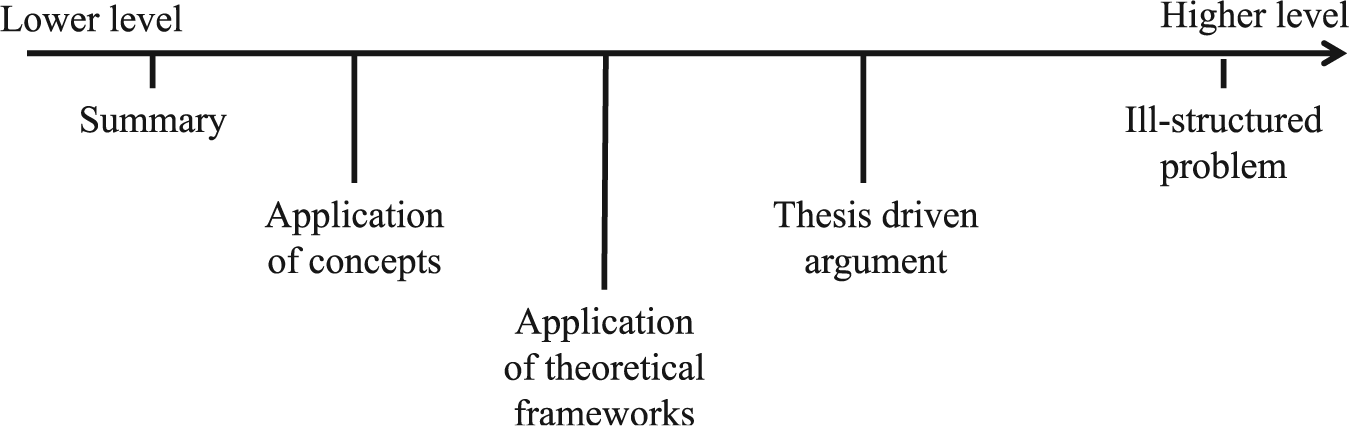
Spectrum of intellectual tasks.
After classifying assignments along this spectrum, we cross-tabulated the assignment score with course level.
Table 1 reveals that the most common form of assignment was one that asked students to do some kind of application of course concepts; there were 10 of these, or about 38 percent of the sample. This assignment took various forms, mainly in terms of what concepts were related to. For instance, a course reflection letter for a 200-level class asked students to “select three sociological concepts, ideas, or insights . . . write a letter . . . explaining the concept; provide an example; explain why it is important/relevant to everyday life, and how it has effected [sic] the way you see society.” An upper-level criminology course assigned a journal article critique. The first five components related essentially to summarizing the sections of a journal article; the last bullet stated in bold: “ a discussion of how this article relates to, fits into, or expands the material covered in this course (definition and application of key concepts, for example).”
Intellectual Task by Course Level.

Note: Twenty-six assignments obtained from 13 different instructors.
The next most common form of assignment (six cases) was one that asked students to apply a theoretical framework. Unsurprisingly, this kind of assignment appeared in theory classes; in one, the instructor asked students in seven to nine pages to apply a theory used in class to offer a sociological explanation of an empirical phenomenon. In a course on inequality, the instructor asked students in a six- to eight-page paper to choose two ethical frameworks that had been discussed in class and argue which framework is better for applying to the empirical situation of their choosing.
Five assignments were summaries. For instance, a linked essay and poster presentation asked students to “write a one-page essay that describes the key economic, social, political, and environmental forces” related to the issue they chose. In a criminology-related course, the instructor asked students to write an essay about a celebrity who died from alcohol abuse.
Only 1 of the 26 assignments could be classified in terms of Kurfiss’s (1988) discussion of an “ill-structured” problem. This was an in-class exercise for an upper-level medical ethics class in which students were asked to imagine that they were the doctor treating a teenager suffering from a chronic tumor whose parents would not consent to any procedure involving the donation of blood products; when alone, however, the daughter indicated that she was afraid of dying and wanted the doctor to do whatever would be most effective. Students were asked several questions, beginning with the Level 3 question of “What ethical principles are relevant to this case and why?” and culminating in Kurfiss’s (1988) ill-structured problem: “What should you do, and what ethical considerations should inform your decision?” The instructor then changed the scenario to one in which it was the daughter who objected to the use of blood products. Students were then asked whose consent was more important and why—and again, “What should you do?”
That the most common category involved relating sociological concepts to new material demonstrates how deeply critical sociological thinking shapes assignment design. By contrast, these assignments generally did not give instructions that would cue higher-level thinking. In fact, 15 of the 26 assignments (58 percent) were at the lower-order end of the spectrum. This is consistent with the fact that most interviewees did not list this as an assignment goal. Writing nearly 30 years ago, Joanne Kurfiss (1988:4) pointed out that “students are often assigned tasks that require [critical thinking] skills, but the problem of acquiring the requisite skills is left to the ingenuity, good fortune, and native ability of the student.” We would add that our findings suggest that instructors expect students to demonstrate these skills even when the intellectual task assigned may not be conducive to higher-level thinking. For instance, we should not expect an independent, thesis-driven argument from an assignment that asks students to summarize.
Finally, it is worth considering at what point in the sociology curriculum students encounter assignments that tend toward the higher end of the spectrum. As we might expect, the cross-tab reveals that the five assignments requiring higher-level thinking are all found in upper-level (300- and 400-level) courses. Interestingly, however, there are still more lower-level than higher-order assignments appearing in these more advanced courses (eight lower-order as compared to five upper-level). This is particularly true for 300-level courses, in which only two of the higher-level assignments are found (as compared to the eight lower-level prompts).
Conclusion
We argued that when sociologists write about critical thinking, they actually conflate two distinct skill sets: critical sociological thinking and higher-level thinking. Our research revealed that this conflating seem to have practical consequences: Interviewees espoused critical sociological thinking as the goal of their courses and assignments but often relied on evaluation criteria based in higher-level thinking skills. The assignments themselves also tended not to elicit higher-level thinking.
For some, this is perhaps as it should be. An exception to those who meld these two types of skills, Buechler (2008:329) advocated in this journal for “less emphasis on critical thinking as a generic technique and more attention to the critical potential that has been embedded in our discipline since its origins.” For him, the decontextualized nature of critical thinking as a generic skill—what we refer to here as higher-level thinking—“reduces critique to a disembodied technique that may serve diverse interests in a decidedly uncritical fashion” (Buechler 2008:318). In other words, while higher-level thinking makes no commitment to any particular outcome, critical sociological thinking should serve the ends of social justice, and it is therefore the latter skill that sociologists should teach.
As we have pointed out in this conversation, however, we believe that both kinds of critical thinking have their place in sociology instruction. Fostering higher-level thinking promotes an informed citizenry and can help prepare a generation that faces a wide array of problems that will require thinking creatively. That most students will not become professional sociologists and that higher-level thinking skills are valued by employers mean that there are added incentives to using our material as a springboard for helping students develop these skills (Davidson 2016). Assigning work that elicits exclusively lower-level skills like summary or relating concepts is a missed opportunity: The social sciences, by their nature controversial and timely, are rich in their potential to use material students find interesting to help them learn to make less familiar and perhaps somewhat intimidating intellectual moves (Kurfiss 1988).
Moreover, not actively helping students to develop the skills of higher-level thinking while evaluating papers in terms of these skills means that students need to pick them up on their own or to have come to our classes already equipped with them. We would argue that this expectation may serve to reproduce disadvantage given the strong association between social class and race with college preparedness (e.g., Lareau 1998; Roderick, Nagaoka, and Coca 2009). In short, actively cultivating higher-level thinking skills among our students can also serve the ends of social justice.
Footnotes
Appendix A
Appendix B
Acknowledgements
We thank Shawn Bauldry, Rebecca Bordt, Annalysse Mason, David Newman, and the four anonymous Teaching Sociology reviewers.
Funding
The author(s) disclosed receipt of the following financial support for the research, authorship, and/or publication of this article: This work was funded by The American Sociological Association’s Carla B. Howery Teaching Enhancement Fund and a faculty development grant from DePauw University.
Editor’s Note
Reviewers for this manuscript were, in alphabetical order, Jeffrey Chin, Teresa Ciabattari, Suzanne Hudd, and Javier Trevino.