




Abstract
The role of extra credit in the college classroom has been examined as a philosophical and pedagogical issue, but in this project, we argue that the matter of extra credit is also a sociological one. Using survey data, we examine how college instructors’ status and individual demographic characteristics are related to the use of extra credit. We found that women and instructors with less teaching experience are more likely to offer extra credit. Furthermore, we also found that instructors who perceived extra credit as a means to engage students with the world beyond the classroom were more likely to offer it. We situate our findings within a broader discussion of the pedagogical merits of extra credit for creating just learning environments within sociology.
The role of extra credit within the college classroom has been mostly examined as a philosophical (Pynes 2014) and pedagogical issue (Hassel and Lourey 2005; Slay 2005). In this project, we argue that the matter of extra credit is also a sociological one. While teaching can be rewarding to all instructors, these rewards are not distributed evenly among those who teach. Instructors’ gender, race, and academic rank all have an impact on how they are perceived (Hendrix 1998; Kardia and Wright 2004; Miller and Chamberlin 2000; Pittman 2010) and evaluated in the classroom (Laube et al. 2007; MacNell, Driscoll, and Hunt 2014; Mitchell and Martin 2018), their personal well-being (Grady et al. 2014; Meanwell and Kleiner 2014), and how they grade students’ work (Filetti, Wright, and King 2010; Moore and Trahan 1998). Similarly, the use of and attitudes toward extra credit should depend on and vary by instructors’ status and individual characteristics, but researchers have not explored this issue.
Three goals guide our research. First, using a national online survey, we examine the prevalence of extra credit assignments and the types of extra credit sociology instructors offer. Second, we examine how instructors’ gender, race, academic rank, years of teaching experience, and the type of institution in which they teach impact the likelihood of offering extra credit. Third, we extend our analysis to examine the relationship between instructors’ attitudes toward extra credit and the likelihood of offering (or not offering) extra credit.
Previous Research on Extra Credit
Faculty members tend to have varying opinions about offering extra credit opportunities (Norcross, Dooley, and Stevenson 1993; Norcross, Horrocks, and Stevenson 1989; Pynes 2014; Slay 2005). Surveying full-time faculty at two universities, Norcross and colleagues (1993:242) found that “approximately 60 [percent] to 70 [percent] of [respondents] were adamant about refusing to offer extra credit, and about 10 [percent] always provided extra credit opportunities.” They also found that these attitudes were related to behavior in that instructors’ attitudes toward extra credit “largely determined whether or not it was offered.” Similarly, instructors are divided on the pedagogical merits of extra credit. Some perceive it as a positive tool in helping students do better on exams (Padilla-Walker 2006), prepare more for class, and encourage attendance (Thorne 2000), while others see it as fundamentally inequitable and favoring already high-achieving students (Hardy 2002; Moore 2007; Pynes 2014). While research has documented a wide variation in instructor attitudes toward extra credit, the existing literature has not explored how instructors’ opinions and use of extra credit in the classroom may be related to their individual and demographic characteristics.
Previous scholarship extensively documents the influence of gender on classroom instruction (Laird, Garver, and Niskodé-Dossett 2011; MacNell et al. 2014; Miller and Chamberlin 2000; Pittman 2010). Drawing on a variety of strategies (e.g., using dress and demeanor strategically, enforcing a preferred form of address, or being selective about making personal disclosures about one’s life in the classroom), women often have to work harder than men to establish authority within the classroom (Kardia and Wright 2004). Furthermore, the academy generally tends to be less favorable toward women who, as a group, are afforded less time for research (O’Meara et al. 2017) and are less likely to be promoted to tenure (Weisshaar 2017), especially if they have children and are married (Mason, Wolfinger, and Goulden 2013; Perna 2005). As positive student evaluations are increasingly tied to promotion (Laube et al. 2007; Moore and Trahan 1998), pay increases, and tenure, women may use extra credit to mitigate some of the challenges they encounter in the academic workplace.
In addition to gender, instructors’ race also has an impact on their performance in and outside of the classroom (Kardia and Wright 2004; Martinez, Chang, and Welton 2017; Pittman 2010). Compared to white instructors, faculty of color often have to fend off challenges from (white male) students to their authority and competence (Hendrix 1998; Pittman 2010). This issue becomes more pronounced when intersected with gender and age, where women and younger looking instructors are more likely to be discredited as faculty (Kardia and Wright 2004). To minimize such conflict, nonwhite instructors utilize a number of strategies, including setting clear behavioral expectations, providing detailed assignment guidelines, and establishing high achievement standards from the beginning of the course (Kardia and Wright 2004). Based on these strategies, we suspect that faculty of color might be more likely to offer extra credit opportunities to students to buttress their standing within the classroom.
Academic rank may also be important to consider when examining instructors’ use of extra credit. Moore and Trahan (1998) found that tenure-track faculty tend to grade more leniently than tenured colleagues, which has implications both for tenure and grade inflation. Similarly, graduate students who are just learning the craft of teaching often feel anxious about managing the classroom for the first time (Grady et al. 2014; Meanwell and Kleiner 2014). With limited institutional support, they often have to become savvy, adjust their expectations, and form their own support networks to successfully navigate the instructional terrain (Smollin and Arluke 2014). Thus, offering extra credit is a teaching strategy that graduate students and tenure-track instructors may be more likely to use because they may face different challenges in the classroom compared to their tenured colleagues.
Finally, faculty’s use of extra credit can vary across institutions and disciplines. Sampling instructors at two universities—one a medium-size private liberal arts institution and the other a large public institution—Norcross and colleagues (1989) found that the faculty at the smaller private university were less likely to offer extra credit than their counterparts at the larger public institution (20 percent vs. 30 percent, respectively). Similarly, they also found that instructors from social-behavioral departments offered extra credit more frequently than their colleagues in the natural sciences, quantitative sciences, and humanities (27 percent vs. 1 percent, 7 percent, and 6 percent, respectively). However, the comparative analysis of extra credit use is quite limited and plagued by small samples. We anticipate that the instructors in large institutions are more likely to offer extra credit because they typically teach larger size classes and can use extra credit to manage students’ perceptions of both the course and the instructor.
Previous research has almost exclusively focused on the attitudes toward and frequency of extra credit use among college instructors or the type of student who most benefits from extra credit. We add to this scholarship by examining how instructor’s gender, race, academic rank, years of teaching experience, and other status characteristics can explain the use of extra credit in the classroom.
Methods
The data for this project come from the National Online Extra Credit Survey of college-level sociology instructors, a survey we designed and administered. Using a list of all US colleges as compiled by the University of Texas-Austin, we drew a stratified random sample of 100 four-year universities and 50 two-year colleges. Searching institutions’ websites, we created a list of sociology instructors, including tenured, tenure-track, and nontenured faculty and graduate student instructors. Whenever an institution did not have a sociology department, we searched for sociology instructors within related departments. In total, our sample included 978 faculty members and 247 graduate students. In the rest of the paper, we use the term instructors to refer to those who teach, regardless of professional title.
With Institutional Review Board approval, we administered the survey using Qualtrics between October 2015 and February 2016. We sent an initial invitation email containing information about the study and a personalized link to the survey, and we sent several follow-up reminders as needed. The survey consisted of three parts and used a combination of open- and closed-ended questions. The first section contained questions about sociology instructors’ attitudes toward extra credit. Drawing on Pynes’s (2014) work, respondents were presented with 11 questions regarding the value and use of extra credit. The second section asked respondents about the types of extra credit they offered and how frequently they did so. From a provided list, the respondents marked off all types of extra credit opportunities they presented to students the last time they offered extra credit in their course (Hill, Palladino, and Eison 1993). Additionally, instructors had an opportunity to write in any other extra credit activities that were not already listed. At the end of this section, we asked respondents to explain in their own words what motivated them to offer or not offer extra credit opportunities to students. The third section collected respondents’ demographic information and a history of teaching experience.
In total, 306 sociology instructors responded to our survey from 60 institutions in 32 states, resulting in a 25 percent response rate. The majority of our respondents came from four-year universities offering degrees through doctorates. The two-year institutions were omitted from our analysis because only one person replied to our survey. All four types of instructors—graduate students (33 percent) and nontenured (14 percent), tenure-track (16 percent), and tenured faculty (37 percent)—were well represented in our sample. Just over half of our sample were women, and most of the instructors completing the survey identified as white (86 percent). On average, instructors had 12 years of teaching experience; however, this average varied considerably between different types of instructors.
Findings
Frequency and Type of Extra Credit Use
Use of extra credit was quite common among college-level sociology instructors. Two-thirds (67 percent) of them reported offering extra credit at least once within the past two years, which stands in sharp contrast with previous findings (Norcross et al. 1989, 1993). Women were more likely to offer extra credit compared to men (see Table 1). One plausible explanation for this gender difference might be the pressure for positive student evaluations. Students often rate women lower than their male counterparts (Laube et al. 2007; Mitchell and Martin 2018) even when they teach the same course (MacNell et al. 2014). Women also face issues of credibility and status in the classroom as students often view women as teachers and men as professors (Miller and Chamberlin 2000). Since positive student course evaluations are increasingly tied to promotion, pay increases, and tenure, some female instructors may use extra credit to boost student performance in the course in an effort to ensure more favorable evaluations of their work. Thus, extra credit may serve as a strategy to mitigate gender-biased perceptions.
Respondents Offering Extra Credit (n = 272).
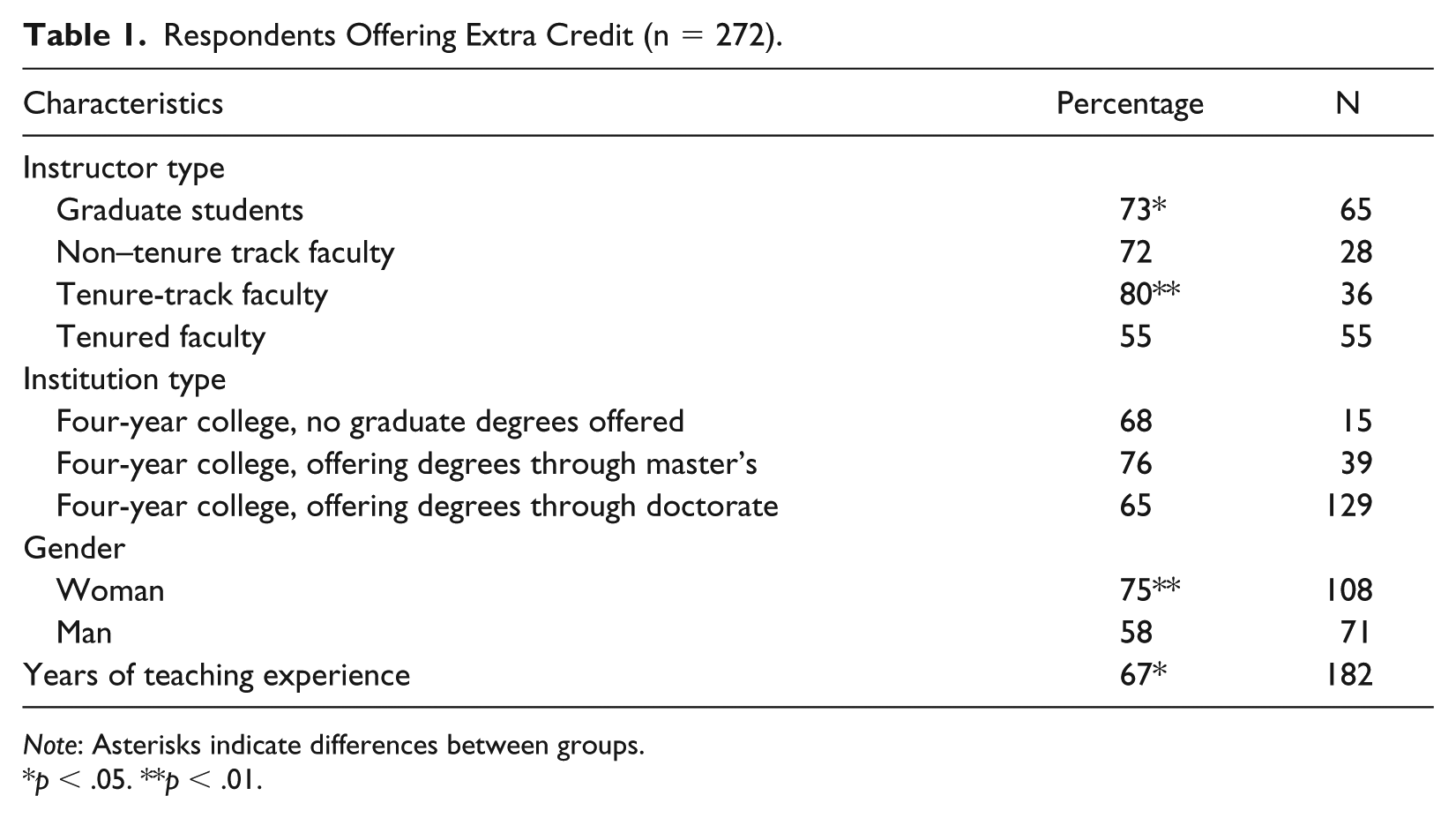
Note: Asterisks indicate differences between groups.
p < .05. **p < .01.
Years of teaching experience also had a significant negative impact on the likelihood of offering extra credit. Instructors with more years of teaching experience were less likely to offer extra credit opportunities to their students. Two possible explanations may account for this finding. First, as instructors teach more courses over the years, they have an opportunity to test new assignments and activities via extra credit. As they learn what works in their classroom, they can incorporate it directly into the course design. For example, if they want students to engage with the social world outside of the classroom, they may require attendance at various campus events as part of the course rather than on an optional basis. Furthermore, instructors with less teaching experience, such as graduate students, might use extra credit as a strategy to deal with the challenges of first-time teaching (Smollin and Arluke 2014). Second, as instructors become more established in their careers and institutions, they may feel less pressure to offer extra credit or grade more leniently (Moore and Trahan 1998). To the extent that offering extra credit may serve as a strategy to receive more positive course evaluations, this may be a strategy that is less common among those in more secure positions.
Among the four types of instructors, graduate students and tenure-track faculty were more likely to offer extra credit than tenured faculty (see Table 1). Also, the type of institution where the instructor worked and instructors’ race and ethnicity had no bearing on the likelihood of offering extra credit; although, these finding should be interpreted cautiously since two-year colleges were excluded from the analysis due to a low response rate and nonwhite respondents comprised only 14 percent of our sample.
To assess different types of extra credit use, we asked each respondent to mark off any extra credit opportunities they offered to students from the provided list. Table 2 summarizes the most commonly used activities. Having students attend an outside class event, such as a lecture, and prepare a written summary was the most common extra credit opportunity offered. This finding suggests that some instructors tended to favor extra credit when its use aligned with larger sociological goals of directly engaging with and critically examining the social world.
Types and Frequencies of Extra Credit Use (n = 284).
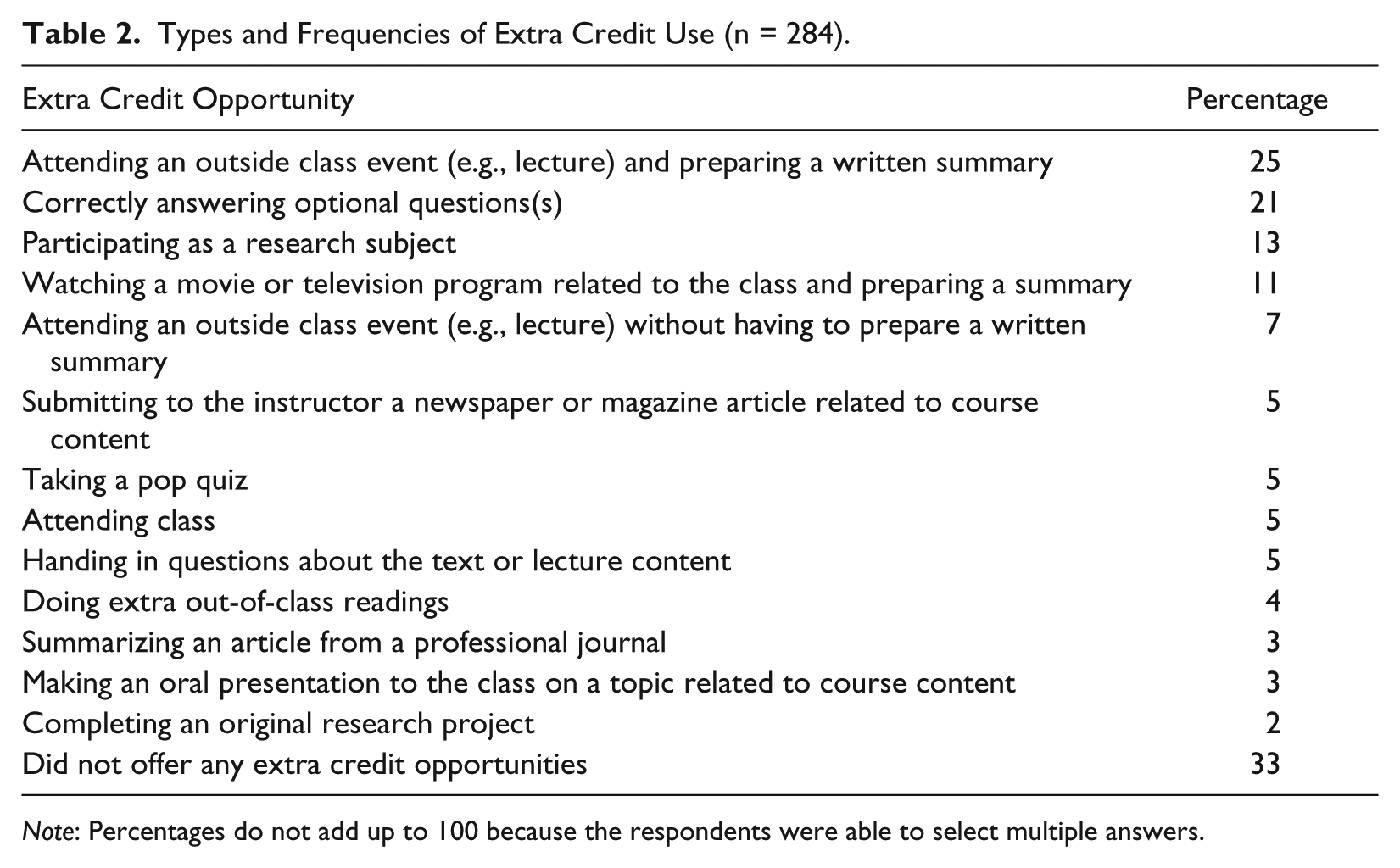
Note: Percentages do not add up to 100 because the respondents were able to select multiple answers.
The second most commonly used type of extra credit was answering optional questions on the exam, followed by participating as a research subject. However, having students participate as research subjects was more common within four-year institutions with doctoral programs since these larger schools typically have the resources to offer research opportunities. Many instructors marked off more than one activity; however, since instructors often concurrently teach multiple classes, it is not clear if they offer different types of extra credit opportunities within a single course or across different courses.
In addition to making selections from a list, we asked respondents to write in any other types of extra credit opportunities they offered. Offering bonus points for completing course evaluations was the most commonly reported one among them. Eight sociology instructors reported using extra credit to incentivize participation in and thus increase the response rate on course evaluations. However, instead of giving students points outright for completing evaluations, some instructors used a threshold approach. As one of them explained, “I have also offered the entire class extra credit if over 75 percent of the class completes the online course evaluation survey. I use this to teach about response rates and collective action.”
In our sample, only eight respondents indicated using extra credit as an incentive for completing course evaluations. Strikingly, among these instructors, six were graduate students, one was tenure-track faculty, and one was non–tenure track faculty. This finding suggests that academic rank might help to explain the extra credit use within the context of teaching evaluations. As tenure and promotion are increasingly tied to positive student course evaluations, more instructors might be tempted to offer incentives to students for completing course evaluations in the future. Furthermore, as more institutions switch to paperless evaluations and the financial pressures put on universities and departments grow, this number might increase.
Other types of extra credit opportunities reported in the qualitative responses included revising and resubmitting previously completed work, completing a writing assignment beyond the required minimum (i.e., if the students were required to complete three out of four assigned essays, then they could complete the fourth essay for extra credit points), going on field trips to places relevant to the course, tweeting about course-related content using a designated hashtag, submitting a proposal for a symposium, researching unanswered questions that came up during the class lecture or discussion, engaging in a creative activity (e.g., writing a song, short story, or a poem), and offering extra credit opportunities only to students who were performing below the passing threshold, such as students who were receiving a letter grade lower than a C.
Attitudes toward Extra Credit
While our primary goal was to investigate how instructors’ status and individual demographic characteristics affected the likelihood of offering extra credit, we now extend our analysis to examine how different attitudes toward extra credit can further explain its use within the college classroom. Drawing on Pynes’s (2014) arguments against extra credit, we found that instructors who offered extra credit opportunities had more positive attitudes about extra credit than instructors who did not offer extra credit (see Table 3). On all but three attitude measures, the two instructor groups differed significantly.
Attitudes toward Extra Credit by the Use of Extra Credit (N = 279).

p < .05. **p < .01.
The belief that extra credit is a good incentive to engage students with real-world events outside of the classroom was the most commonly espoused attitude among instructors who offered extra credit. Among the instructors who did not offer extra credit, the belief that extra credit opportunities contribute to the overall grade inflation in the classroom was most common; however, this group difference was not statistically significant. Interestingly, we found that a considerable portion of instructors who did not offer extra credit opportunities in their courses still maintained favorable attitudes toward extra credit.
Based on our analysis, we noticed that some of the 11 attitude measures tend to cluster together. To test our suspicions and enhance our interpretation of the data, we conducted a factor analysis, which revealed three clusters of attitudes toward extra credit (see Table 4). The first cluster, which we call points over content, includes the attitudes that extra credit is merely an opportunity to give out additional points to students and contribute to grade inflation. The second cluster, learning enhancement, consists of more positive attitudes toward extra credit as an opportunity to expand students’ learning beyond the classroom. The third cluster, only A-students benefit, contained just one attitude measure: only top students benefit from the bonus questions on the exams. We created each cluster by combining appropriate attitude measures into a new variable, which resulted in each participant having a unique score.
Factor Analysis of Attitudes toward Extra Credit.

After constructing the three clusters of attitudes toward extra credit, we examined how well each of these clusters predicted the odds of offering extra credit opportunities. In analysis not shown here, we found that the points over content and learning enhancement clusters were significant predictors of sociology instructors’ extra credit use. Instructors who perceived extra credit as a means to generate additional points for students and inflate course grades were less likely to offer extra credit. In contrast, instructors who saw extra credit as an opportunity to enhance students’ learning were more likely to offer extra credit.
Instructors’ Explanations for Offering Extra Credit
To provide context for our quantitative findings, we asked respondents to explain in their own words their motivations for either offering or not offering extra credit opportunities to students in their courses. Many instructors used extra credit as an incentive for students to attend on-campus guest lectures and activities: “We have so many excellent speakers on campus whose topics are relevant to our coursework. I believe the added incentive of extra credit helps students prioritize attendance at these presentations and provides clear examples to support concepts and theories covered in class.” While this respondent and many others saw extra credit as an opportunity for students to connect class material to the outside world, some instructors remained ambivalent about extra credit: This was actually the first time I ever offered extra credit for anything in any course. I thought I would just try it, and although a couple of students took the opportunity to attend an event outside of the class related to the course, very few students did. . . . One of my colleagues in sociology always offers extra credit for attending an event and writing a short page about the event for extra credit. That inspired me to try it, but I probably will not continue to do it.
Some instructors were reluctant to offer extra credit because of low student participation, while others perceived it as detracting from the actual coursework: “[I] encourage students to attend outside lectures and events. I generally do not like to offer extra credit because I prefer students to concentrate on the actual assignments for the course, and [I] have noticed that it leads to overly inflated grades.” In many cases, instructors used extra credit but with reservations.
Many instructors also cited students’ complex life circumstances as a reason to offer extra credit. Sometimes students fall behind in coursework due to health issues (both their own and others’), pregnancies, vehicle accidents, and other unforeseen events. In those circumstances, extra credit served as an opportunity to make up missed work: Some students experience real and unforeseen life events. It is difficult to make up classes when we have moved on, especially with group work, so for those students who come to me, I offer a list of extra credit options that provide additional work. They don’t know ahead of time that I have such a list of options and I sometimes choose not to offer it if I think the student is not ready to complete the work or if they are taking advantage.
This instructor’s comments reveal a certain reversal in Pynes’s (2014) logic. Pynes (2014) has argued against offering extra credit when it is not available to all students. In this case, extra credit is used precisely because it can serve a selected few. As the aforementioned instructor noted, some coursework cannot be made up once missed, but an extra assignment can allow the student to catch up. At the same time, for this type of extra credit application to be fully equitable, the way in which the extra credit opportunity is presented to students should be more transparent and systematic rather than just dependent on instructor’s discretion.
Another common reason for providing extra credit, which was not captured within the attitude measures, was creating good will and lowering anxiety among students. As one instructor explained, “My sense is that extra credit provides students with a sense of reassurance. It allows them to feel that they have more control over their grades. Particularly with lower-level students, that reassurance allows me to stand firmer with grades on formal assignments and avoid lots of grade complaints.” Another instructor voiced a similar sentiment, “The students feel comfort from [extra credit], even if the amount of points is negligible.” This approach was especially popular in research methods and statistics courses, which tend to produce a great deal of anxiety among students (Markle 2017). The instructors who taught these classes often reported that offering extra credit seemed to have positive effects on students’ stress levels: “Students have high anxiety in statistics course. Even two points on the exam helps calm them down.” Thus, in addition to being a tool for improving students’ graded performance or their learning experience, extra credit also was used to manage students’ emotions.
Instructors’ Explanations for Not Offering Extra Credit
The majority of instructors who did not offer extra credit believed that any activities deemed important for student learning should be part of the course’s formal design as opposed to extra credit. Reflecting the points over content attitude cluster, these instructors were reluctant to offer extra credit because it detracted students from completing originally assigned work. If the instructor, for example, wanted students to participate in a campus event, then participation at this event should be a part of the course’s structure. As one of the respondents bluntly put it, “If such opportunities are valuable, they are required. Extra credit is fluff. Either the assignment should be required or not required.” Instead of extra credit use, these instructors often emphasized a clear course design. “I believe that clearly stated expectations, grading rubrics, and assignments that are driven by the learning goals of the course are the best overall method for student success,” observed one instructor. “I use many graded assignments/exams so there are plenty of opportunities to make up for poor performance without offering extra credit,” another one added.
These respondents, and others like them, espoused an attitude that extra credit became superfluous when the course itself was clearly laid out and its objectives, materials, and assignments aligned with each other. Consequently, these instructors stressed the importance of students doing well on already assigned work instead of offering extra credit opportunities. If a student were to do any additional work, then instructors preferred that it be revising already completed class assignments.
Some instructors also believed that extra credit was biased toward students who have free time to do additional work, thus disadvantaging students who held full- or part-time jobs or had other noncollegial obligations. As one instructor noted, “I have seen extra credit favor students who are already privileged by their class, race, and gender.” From a more practical approach, some instructors considered extra credit as additional work for themselves. These instructors already spent a great deal of time preparing and running the course and felt it unnecessary to design and grade additional assignments.
Discussion and Conclusion
Our primary goal in this work was to empirically assess if instructors’ status and individual demographic characteristics are related to the use of extra credit within the sociological classroom. We found that women, tenure-track faculty, graduate students, and instructors with less teaching experience were more likely to offer extra credit opportunities than men, tenured faculty, and instructors with more years of teaching experience. Furthermore, instructors who espoused a set of attitudes that extra credit can enhance students’ learning by engaging them with real-world events outside of the classroom and instilling in them ideals that go beyond the graded material—what we called the learning enhancement cluster—were more likely to offer extra credit. In contrast, instructors who perceived extra credit primarily as a means of offering students extra points and inflating grades—those who agree with the points over content set of attitudes—were less likely to provide extra credit opportunities in their courses.
As women are more likely to offer extra credit opportunities than their male counterparts, our findings speak to larger gender disparities within academia. Women are less likely to be promoted to tenure, and when they are promoted, it is in lower-prestige departments (Weisshaar 2017). As such, they may use a number of strategies, such as offering extra credit, to mitigate some of these gender biases to help them advance their careers. In other words, actions that women take in the classroom might reflect larger structural gender inequalities embedded in academic work.
Our qualitative findings revealed additional motivations for offering extra credit that were not captured in our quantitative measures. For example, eight respondents indicated that they used extra credit as a way to incentivize completing course evaluations. This finding raises important ethical questions about using incentives to gather feedback from students as well as concerns about the reliability and validity of such data. While adequately addressing these concerns is beyond the scope of this project, we suspect that the number of instructors who use incentives when administering student course evaluations will only increase as more institutions transition from pen-and-paper to electronic evaluation systems. Furthermore, offering extra credit to increase the completion rate of course evaluations speaks to the institutional obstacles that college instructors face. As positive student course evaluations are tied to promotion, pay increases, and tenure, instructors may feel a need to provide students with extra credit in return for more favorable evaluation of their work.
Our findings also suggest that some types of extra credit opportunities are more suitable for sociological instruction than others. Drawing from the sociological tradition, college sociology instructors can extend learning beyond the classroom and directly engage students with both local and global communities by selecting extra credit opportunities that meet these goals. We saw evidence of this behavior with the instructors who had students attend an outside event and prepare a written summary—the most commonly offered type of extra credit among our respondents. When used in this manner, extra credit can be a vehicle for connecting students with the outside world and instilling in them values that go beyond the graded material.
Our study has a number of limitations. While we drew a randomly stratified sample, we are cautious to treat it as nationally representative because of the relatively low response rate. Similarly, while our sample is diverse along many demographic measures, it is majority white and not representative of two-year colleges. Nevertheless, we believe that our study offers an important empirical insight into the topic of extra credit because existing literature on the topic tends to be largely theoretical and draws from small convenience samples.
In addition to examining the status and demographic factors for offering (or not offering) extra credit among sociology instructors, our project also speaks to broader concerns of fostering equity in the classroom. It is important that sociologists systematically examine extra credit because it can disadvantage some students and benefit others. Course design tends to cater to the traditional college student—right out of high school, residential, full-time, and unencumbered by family and dependents—even as the national college population has become more socioeconomically diverse. For students who do not match up with this definition across all dimensions, extra credit work may often be unattainable. When a person has to work a full-time job or take care of children in addition to being a student, attending a non-classroom event—a type of extra credit most favored by our respondents—may seem more like an unachievable obligation rather than a learning opportunity. Thus, sociology instructors should align their course design with their particular population of students.
With a large portion of sociology instructors offering extra credit, our findings have pedagogical and course design implications. Doing a perfunctory survey of instructional books and teaching manuals for sociologists and social scientists, we found that these resources remain silent on the subject of extra credit use within the course design. As such, most instructors must figure out informally if, when, and what type of extra credit to offer. Our qualitative responses showed that some instructors do discuss these issues with their colleagues, but it is beyond the scope of our study to determine how widespread these conversations are. Thus, a better understanding of what sociology instructors believe about extra credit and how they use it may be useful for instructors who must decide whether to offer extra credit in response to student requests.
Footnotes
Acknowledgements
We thank John Martinez for his assistance in putting together and managing the list of institutions in our sample. We also extend our gratitude to Brian Powell and three anonymous reviewers for their feedback and support. An earlier version of this work was presented at the Midwest Sociological Society’s annual meeting in Minneapolis, Minnesota.
Editor’s Note
Reviewers for this manuscript were, in alphabetical order, Katrina Hoop, Peter Kaufman, and Carol Wickersham.