




Abstract
The American Sociological Association has produced a wide range of reports and materials addressing curricular best practices. Collectively, those materials are an invaluable resource for guiding revisions of the sociology major, but they do not address processes for implementing such revisions. In this conversation piece, we describe the steps by which our department implemented a thorough curricular redesign—a process nearing completion after five years of formal discussions, and with roots reaching back even farther. We organize our discussion around three areas of effort that comprised our process: charting a course, bringing colleagues along, and institutionalizing outcomes. We highlight important milestones, challenges, and successes that we encountered along the way and provide recommendations based on our experiences for colleagues in other departments interested in undertaking their own redesign.
Keywords
In recent decades, successive groups of sociologists have worked under the auspices of the American Sociological Association (ASA) to develop guidelines and best practices for sociology curriculum design and development. Most recently, in 2017, the ASA’s Task Force on Liberal Learning and the Sociology Major (hereafter, Liberal Learning) released The Sociology Major in the Changing Landscape of Higher Education: Curriculum, Careers, and Online Learning, which provides “recommended practices for sustaining high quality and comprehensive sociology programs for undergraduates” (Pike et al. 2017:v). That was the third such periodic report produced to guide sociology curriculum, following the original 1990 Liberal Learning report (Eberts et al. 1990) and the second, produced in 2004 (McKinney et al. 2004). Collectively, these—and other ASA reports related directly or indirectly to the sociology curriculum (discussed below)—offer an invaluable set of recommendations and resources for departments seeking to update or improve their curriculum.
While ASA materials identify a range of best practices to guide curriculum redesign, many decisions remain about how to structure and implement changes. As a consequence, the process of redesign can present multiple challenges, as colleagues with different priorities and visions work together to reach collective decisions. In this conversation piece, we describe the process by which our program debated and decided how best to adopt and adapt the ASA’s curriculum recommendations. We will describe and summarize many of the outcomes of our curriculum redesign (that is, how we translated the ASA’s general recommendations into specific curricular components); however, our primary emphasis here is on the way we navigated the process of redesign. (The authors are happy to share additional details of the curricular framework that we created with any interested readers.)
Ideal curricula—and the processes to achieve them—vary by institution and department, so it is important to begin with a brief description of our own institutional and departmental context. Ours is a young program in a new university within a large system. California State University Channel Islands (CSUCI) is a public regional university established in 2002 as the newest campus in the largest system of four-year institutions of higher education in the United States, the California State University (CSU). Ours is a midsized department with approximately 440 majors. 1 We currently have seven tenure line faculty, one tenure line faculty on joint appointment with another program, and three full-time lecturers and about a half dozen part-time lecturers. The first tenure-line faculty member was hired in 2006, at which time the foundation of our curriculum had already been created by faculty outside of sociology. While we had a solid curriculum, there was ample room to integrate new and best curricular practices. The seeds of redesign were planted in the fall of 2013, when our department added three new tenure-track colleagues, which offered a great opportunity to think collectively about our curriculum and to immediately engage new faculty in conversations about curricular priorities.
We did not initially approach curriculum redesign as a comprehensive process. Rather, it emerged organically from recurring conversations about gaps in student foundations and efforts to address them at the level of individual courses. To the extent that there was a recognizable “starting point,” it was marked by an initiative to redesign our introductory course. That was strategic because it required identifying what we are preparing students for and what is of most value in our discipline (both for majors and for nonmajors). Our goal was most often conceptualized in terms of preparing our students for the capstone course, which was an ongoing point of frustration for all who taught the course. 2 The nature of those discussions gradually and inevitably shifted from piecemeal issues to a comprehensive curriculum redesign revolving around course sequencing and pedagogical scaffolding across the curriculum. As we moved forward, we balanced developing long-term comprehensive plans and implementing immediate course and curricular reforms to address students’ needs.
Here, we share the challenges we confronted and the lessons we learned in the process of our own curriculum redesign in the hope that they might prove useful and encouraging to programs in navigating the redesign of their own curriculum. Our collective experiences in curriculum redesign represent a case study. The purpose of this conversation piece is not to lay out a “one-size-fits-all,” step-by-step instruction guide for implementing the ASA’s curricular recommendations. In fact, we would be hard-pressed to provide a step-by-step timeline of steps we took in the exact order we took them; we often tackled steps contemporaneously or set out to address one component of our curriculum only to discover we needed to address others first. We also recognize that the opportunities and challenges associated with other programs will vary, as they have different types of students, faculty compositions, relationships with administration, and budgetary considerations than we do. We encourage readers to think creatively about how they may redesign their curriculum given the unique opportunities and constraints they face.
We organize our conversation around three broad steps to redesign (see Figure 1).
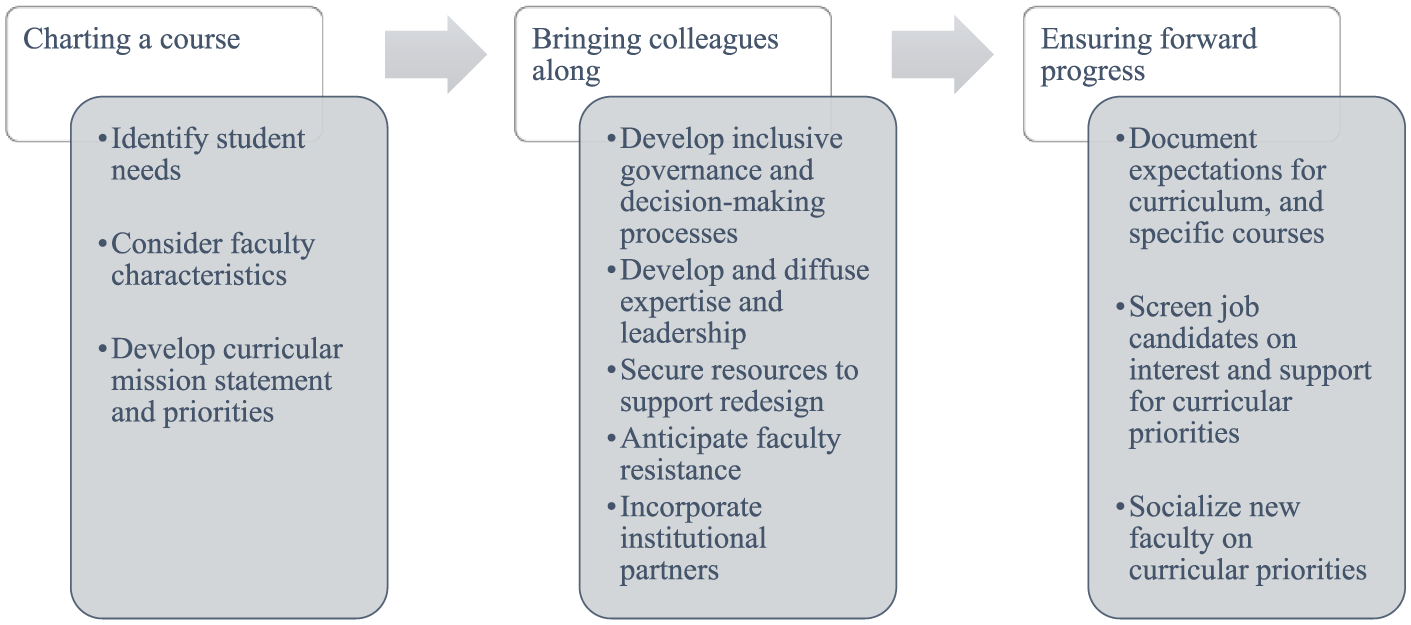
Overview of California State University Channel Islands’ Curriculum Redesign Process.
The first step is identifying what needs to be done, that is, charting the course. The second step involves cultivating consensus and commitment across the faculty, that is, bringing colleagues along. The third and final step is ensuring forward progress, that is, institutionalizing the changes. Those steps are not strictly discrete and linear; in many instances, they overlap or are concurrent. Before we describe our own process in greater detail, we provide a brief discussion of the curricula-related reports produced by the ASA that guided our efforts and a summary of the Liberal Learning guidelines we integrated into our curriculum and the ways we did so.
ASA Materials on Curricular Best Practices and Overview of Redesign Plan
The three ASA reports on the structure of the sociology major offer an invaluable collection of curricular best practices in our discipline. Collectively, those reports ask what is of most value in the sociology curriculum and how it can be systematically cultivated. Each report builds on the previous, indicating both consistency and evolution. The first report (Eberts et al. 1990) presented 13 recommendations. At the core was an emphasis on “in-depth study” of the discipline, drawing on recommendations from a report produced by the American Association of Colleges (1985). The push for depth of study encouraged the creation of a sequenced curriculum characterized by the development of skills over time and across distinct course levels. This sequenced (or scaffolded) curriculum was an effort to move beyond what the ASA report called the “Ferris wheel” model of curriculum, defined in the following manner: Anyone, from freshman to senior, who has the “ticket” (the introductory course prerequisite) can hop on at any point. The few courses required for the major (usually methods, statistics, and theory) require this single prerequisite, and rarely are students expected to take them in any order. (Eberts et al. 1990:15)
The second Liberal Learning document (McKinney et al. 2004:ii) reiterated the emphasis on in-depth study and away from the Ferris wheel curriculum. It refined many of the earlier recommendations and added several more, including a greater tailoring of curriculum around one’s own students’ needs and interests, the development of a mission statement for one’s curriculum, the promotion of capstone courses, and an infusion of empiricism throughout the curriculum. The third report (Pike et al. 2017) integrated additional strategic recommendations, such as the introduction of the sociological literacy framework and an increased emphasis on career readiness.
In addition to these reports, the ASA published other resources that can be useful for curriculum design, even if they are not directly related to it. For example, Keith et al. (2007) discuss the way the sociology major might best articulate with general education, and Senter, Spalter-Roth, and Van Vooren (2015) address career and employment market issues from the Bachelors and Beyond Study, which has implications for career preparation across the curriculum. Reports on assessment focus on how to identify curricular strengths and weaknesses (e.g., ASA Task Force on Assessing the Undergraduate Sociology Major 2005).
All of those reports judiciously vetted and summarized the best practices on curriculum. When we began our curriculum redesign discussions in 2013, the third report had yet to be published, and so we started our redesign with an integration of recommendations from the second report. When the third report was published, we integrated new recommendations from it and benefited from the updating and further elaboration of previous themes and recommendations. Table 1 provides an overview of the specific changes we made and the recommendations from the second and third reports that these changes addressed. (Some of the changes listed are still in progress due to university-level curriculum schedules; we will submit final materials associated with the changes in the fall of 2019.)
Summary of Curriculum Changes and Liberal Learning Recommendations That Changes Support.

Note: LL2 = Liberal Learning and the Sociology Major Updated: Meeting the Challenge of Teaching Sociology in the Twenty-first Century (McKinney et al. 2004); LL3 = The Sociology Major in the Changing Landscape of Higher Education: Curriculum, Careers, and Online Learning (Pike et al. 2017).
Making changes to support some of the recommendations took priority over others. For example, recommendation 9 from the third Liberal Learning report suggests incorporating multiple pedagogies in course work, particularly those that encourage active learning (Pike et al. 2017:4). While we could no doubt provide our students more opportunities for active learning, we felt that recommendation would be best realized by building on existing practices and increasing awareness, rather than addressing it at the level of formal curricular structure.
Identifying the best practices we wanted to incorporate into our curriculum was only the starting point; we still had to find ways to implement them in a logical and coherent curriculum. In the following sections, we discuss the process by which we arrived at our new curriculum. Before embarking on any formal redesign, we began with an honest look at our own students and the institutional context in which we operate (as recommended by Pike et al. 2017:12–19).
Charting the Course: Considering Students, Faculty, and Mission
Student Needs
As with most programs, many of our students come to us underprepared for college-level work. Recent campus data indicated that incoming first-year sociology students were more likely than any other first-year majors to require remediation in both math and English (which is the primary measure of college readiness in our system). Many of our students come from groups traditionally underrepresented in higher education—for example, they are the first in their family to attend college or are Pell eligible. CSUCI is a Hispanic-Serving Institution (HSI), and approximately three quarters of our students in sociology are Latinx. Also, approximately 80 percent of students in our major are transfers, meaning that the vast majority of them are with us only for their upper-division course work. Another important consideration is what our students do after graduation—that is, what are we training them for? Few of our graduates pursue a graduate degree in sociology, but many of them (either immediately postgraduation or after a break of one or several years) pursue other degrees (such as an MSW, a master’s in counseling, etc.). And the majority of our students move directly into the workforce. All of that had to be taken into consideration in designing and implementing the curriculum that would best serve our students.
With that understanding of our students, we focused on how we might tailor the ASA’s curricular recommendations to best serve their needs. To do so, we had to ask a series of questions: How are our students doing in our program? What courses are particularly challenging for them (e.g., statistics, theory)? What skills are they having trouble with (e.g., writing, reading comprehension, note taking)? What is the process or order in which students are taking classes? When are students taking required classes versus electives? Are they graduating in a timely way? If not, is it due to curriculum issues (hidden prerequisites, sequenced classes that students are not starting on time), or too few offerings of required classes? And, most fundamentally, are we happy with the skills with which they are graduating (and, as noted previously, with which they were entering the capstone course)?
Most of our formal assessment efforts to date have focused on either capstone or general education courses, or on alumni experiences and outcomes. In the absence of formal, systematic assessment data, we sought to answer the above questions using more informal pieces of evidence. First, we collectively accumulated a wealth of experiential and anecdotal impressions about our students’ strengths and weaknesses. In recent years, we rotated all tenure-line and full-time faculty teaching assignments so that all have had firsthand experience teaching upper-division core courses (e.g., statistics, methods, theory, and our capstone course). Those experiences gave all core faculty a solid collective understanding of the issues and challenges that curriculum redesign must address. In addition to experiential observations, we sought out aggregate data (formal reports or informal communications) from partners on campus, such as advisors, administrators, records and registration, and our institutional research office.
Faculty Characteristics
A subtle aspect of our self-assessment focused on faculty composition, which is an important but often overlooked collective characteristic of any department (Downey 2018). Over the course of the redesign, we had a minimum of four tenure-track faculty, with just one of them tenured. Our redesign process was facilitated by the influx of multiple new tenure-track faculty at one time, which allowed us to get new faculty involved in thinking about the curriculum at the start of their career and before any changes would require extensive course retrofitting. Our junior-heavy faculty also required more support to facilitate their engagement so that it did not take time and focus away from the central tasks associated with achieving tenure, which include developing a record of strong teaching in the context of a 4/4 teaching load and the publication of a minimum of three peer-reviewed journal articles or one monograph as well as significant service to the program and university. Finding resources to support their efforts (discussed below) became paramount. We also developed a culture of service in the department and made sure that engagement in the redesign was visible in their service portfolios. Ultimately, we worked to make sure curriculum redesign efforts were “counted” toward service expectations. As many academics would suggest, the more intractable obstacles to institutional change are likely to come from senior faculty. While that was not central to our experience, we discuss some of the relevant issues below in our discussion of anticipating and managing resistance to change.
Tenure density is equally crucial for curriculum redesign. Our collective capacity to undertake and implement an intensive redesign was restricted by the extent to which teaching is done by non-tenure-track faculty, who generally have higher teaching loads and no compensation for service activities. Non-tenure-line faculty enjoy some basic protections in our system (extended contracts, employment entitlements, etc.), but those protections do not make up for the overall inequities that they face. Moreover, tenure density on our campus is particularly low (well under 40 percent by student courses). The lower level of commitment and investment on the part of the university to those faculty might naturally translate into a lower level of commitment and investment in our curriculum redesign efforts. All aspects of our process described below were shaped by the challenges confronting non-tenure-track faculty.
A third faculty characteristic concerns the interinstitutional nature of transfer-heavy programs, wherein much of the lower-division teaching in the major is done by colleagues at other institutions—most often, community colleges. Those community college faculty members are de facto colleagues, and we suggest they should be embraced as such in a real way. They need a solid understanding of the priorities and emphases in the curricula of their four-year partners in order to effectively prepare their students for transfer (just as we need an understanding of their priorities and emphases). And if they are being asked to teach to those emphases, it is important to engage those colleagues in their development. All of that requires close communication. In our case, as a regional university, two community colleges account for the majority of our transfers, so partnering with them on curricular issues has been relatively easy and productive.
Curricular Mission Statement
Once we better understood our students’ needs and faculty characteristics, we asked difficult questions about how we were serving our students. What is the current structure and rationale behind our major? What are we already doing well with our curriculum, and where can we improve? What are the particular strengths of our faculty, and where are the gaps? Who are we now and what kind of program do we want to be? Above all, what are our curricular priorities?
It was out of our self-assessment, and following the directive of the Liberal Learning documents (recommendation 1 in both 2004 and 2017 documents), that we developed a tailored curricular mission statement rooted in our collective understanding of how we can best serve our students. We landed on two main mission statement foci: (1) a rigorous and developmental curriculum and (2) a curriculum focused on systematic empirical inquiry. We identified these emphases relatively early on in our redesign process but worked out what each emphasis meant in practice alongside ongoing discussions about specific curricular components.
First, our efforts to provide underrepresented and often underprepared students with an education that will serve them well beyond the university convinced us that we should provide a curriculum that is both rigorous and developmental. We collectively agreed that we need to challenge our students to ensure that what they earn goes beyond the “limited learning” that too often characterizes contemporary higher education (Arum and Roksa 2011). Given our students’ backgrounds, most have little in the way of a safety net to fall back on if we fail to deliver the skills necessary to succeed in a career after graduation or to pursue an advanced degree. But we also want to ensure that all of our students have the chance to succeed, which means that we must carefully scaffold their learning and provide all necessary developmental opportunities and assistance to meet our expectations. We must pay careful attention to identify when and where to deliver incremental skills—specific to sociology but also to being a successful college student (i.e., reading, writing, study skills, etc.). Being both rigorous and developmental requires that we pay particular attention to the way that fundamental skills and content are cultivated across a sequence of course levels in an incremental and progressive manner, as recommended by the ASA. In other words, it requires that we focus on pedagogical scaffolding (Hogan & Pressley 1997) and on curricular sequencing.
We also developed consensus around a curricular emphasis on systematic empirical inquiry, inspired by the ASA’s recommendations to integrate an empirical focus throughout the curriculum (recommendation 4 in McKinney et al. 2004 and recommendation 5 in Pike et al. 2017). Systematic empirical inquiry places a priority on the practice of sociology (that is, how we come to learn about the social world) in addition to the products of sociology (that is, what the discipline has contributed to our understanding of the social world). A curriculum rooted in systematic empirical inquiry will take a piece of evidence or explanation presented in any class as a starting point for understanding rather than a conclusion. Evidence and evaluation, research and explanation, methods and theories, and critical thinking and analysis are not relegated to particular classes (like methods and theory) but integrated throughout the curriculum in both core and elective classes. Our hope was that a focus on systematic empirical inquiry—on applied skills over disciplinary content—would provide students the most useful skill sets whether or not they continue on to graduate programs, as well as a critical lens that is crucial for both career opportunities and for contemporary democratic engagement in an era of “alternative facts.” This emphasis also drew from ASA research regarding career development among sociology graduates (Senter et al. 2015; Spalter-Roth et al. 2010)—specifically the finding that students with more developed skills were more likely to be in career positions (and generally more satisfied with those positions) than students with less developed skills.
Bringing Colleagues Along: Cultivating Consensus and Commitment
Scaffolding at the curricular level creates a web of interdependence across colleagues, as it requires that each member of a department rely on her or his colleagues to deliver the necessary skills in the proper place in the curriculum. That interdependence means that it is essential for us to have widespread buy-in among faculty regarding curricular goals and frameworks, so that instructors of more-advanced courses can safely assume that enrolled students will be exposed to specific skills in introductory courses. Consequently, the foundation of our redesign was the effort to cultivate consensus and commitment regarding its means and ends. In the following sections, we highlight our efforts to do so through a range of measures.
Inclusive Governance and Decision Making
One of the most critical factors in cultivating buy-in is to ensure that decision-making processes are inclusive and equitable, with maximum participation and contributions from all colleagues. That is so regardless of rank or status and perhaps particularly so for non-tenure-line faculty. Generally, that is an issue of departmental culture, and research consistently finds that departmental culture has an important influence on the success of educational innovation (Corbo et al. 2016; Knight and Trowler 2000; Schendel 2016). Our curriculum meetings—often a mix of brainstorming and specific problem solving—were open to all and sought to give voice and vote to all interested faculty. Along the way, we revised our program bylaws to facilitate more inclusive dialogue and democratic decision-making processes in all matters.
Efforts to institute decision-making processes based on consensus had its drawbacks. As political and social movement scholars can verify, realizing “participatory democracy” can present substantial challenges to decision-making processes even as they convey important benefits (Polletta 2002). We certainly felt those tensions. In our regular curriculum meetings, we hashed out plans and took proposals to faculty meetings for formal votes. Because some colleagues attended curriculum meetings sporadically, and new colleagues joined us mid-process, a substantial part of many meetings was informing people about debates and decisions from previous meetings. It would certainly have been more efficient to identify a smaller committee to work through the changes and then move it forward, but that would have risked losing the buy-in that will be essential for maintaining the integrity of our curriculum in the future.
Expertise and Leadership
Curriculum redesign is similar to any efforts to initiate change in academic institutions in that it demands strategic action on the part of departmental leaders (Lucas and Associates 2000). However, it cannot be accomplished without the active participation of faculty throughout a department, which requires that a critical mass of colleagues have sufficient expertise regarding best practices within the discipline. In recent decades, teacher training within graduate programs in our discipline has become more common and more extensive (Blouin and Moss 2015; Pescosolido and Milkie 1995). However, it is generally at the level of course design and classroom practices rather than broader curricular design. Consequently, much of the expertise necessary for considering curricular changes has to be consciously and collectively cultivated within a department. We sought to accomplish that through a variety of efforts. One ongoing effort was the identification, dissemination, and discussion of essential curricular materials (most notably the ASA materials discussed above). In addition, we encouraged all faculty to take advantage of intra- and extramural opportunities for professional development focused on pedagogy and curriculum. We also invited external expertise into our department. For example, we asked English colleagues to help us develop the required writing course when it became clear that was an essential skill that needed significant development. And in order to deepen our discussion of the capstone, we invited Robert Hauhart, coauthor of a research-based monograph on the capstone (Hauhart and Grahe 2015), to visit our campus for a presentation.
We also sought to spread the workload associated with redesign. Our most important step in that direction was to create a curriculum coordinator position to take leadership of the effort. 3 The tasks associated with that position were to research curriculum-related matters, coordinate and lead curriculum meetings, and complete the appropriate paperwork for university committees’ approval. As it became clear that we would be spending significant time on the curriculum over several years, the chair dedicated one course release per year to that position (of the three annually that are funded by the school) for the duration of the redesign (three years from that point). That also generated capacity to meet and consult with a variety of curriculum-relevant staff and administrators on campus (such as articulation officers, advisors, and members of our university curriculum and general education committees), which was essential to identifying obstacles and opportunities in our redesign. Beyond that central leadership role, we also identified different core faculty members to take the lead in applying the general curricular priorities to specific courses. This division of labor helped to diffuse both expertise and leadership.
Resources
Curricular revisions require time and effort—not only in the redesign itself but in the new course development (or revisions) that are introduced through the redesign. Finding resources to support the work that redesign requires (such as course releases or stipends) was a critical way that we facilitated the actual work of redesigning the curriculum and cultivated buy-in among faculty. Again, that was particularly important for junior colleagues on the tenure track and for non-tenure-line faculty who have no provisions for service in their contracts. The most direct form of support for the work of curriculum redesign was the annual course releases dedicated to the curriculum coordinator. But we actively sought out other ways to provide resources for faculty who wanted to be involved in the redesign, and we had substantial success in finding such resources.
For example, we secured funding from the CSU Chancellor’s Office to redesign our introductory course with the intent of decreasing repeatable grades (Ds, Fs, and Ws). The grant provided four course releases for instructors to redesign curriculum to increase student success. (Two of those course releases were awarded to two new faculty colleagues, one was for a full-time lecturer, and the final one was for a tenured colleague.) Several years later, we secured funding for another course redesign—this time, faculty received stipends to move away from text-based courses (a broader initiative to save students money). Based on our efforts up to this point to integrate systematic empirical inquiry into our courses, we found nontextbook materials to be superior to textbooks, so it presented a mutual opportunity for us and the initiative. We used the resources to redesign our social stratification course into an “advanced introductory” course. Such courses are a best-practices recommendation designed to “serve as a bridge to other core required courses” (McKinney et al. 2004:10), offering particular assistance to transfer students. Four faculty (one tenure line and three lecturers) collected non-textbook-based materials that could be shared with other instructors while working to identify and integrate introductory-level skills into the class (in particular, skills related to systematic empirical inquiry).
We secured a range of other resources for projects tangential to curriculum design but that served to move the process forward in one way or another. For example, we were granted one course release for our program advisor to create mandatory “student success” workshops for students receiving a D or F in our major, which we used to emphasize our curricular mission related to rigor. We received another course release to deepen assessment practices, which we used to think about curricular strengths and weaknesses. As already mentioned, we received funding to support a visit by a national expert on the capstone course, enhancing conversations about an essential component of our curriculum. Our most recent strategic success was receiving resources to work with our community college colleagues as part of an HSI grant to support transfer success. Specifically, we received one course release as well as stipends not only for a colleague in our program but for three community college colleagues, as well. The central initiative was a regional faculty summit that allowed us to meet with colleagues across our county to initiate conversations about our curriculum and find ways to better partner together.
This list of resources might make it appear that our university is exceptionally flush with opportunities that simply do not exist in other departments, therefore limiting the applicability of our experiences to other departments. In fact, our university suffers from the general funding challenges that are characteristic of other regional public universities, which most directly manifests in heavy teaching loads, relatively low tenure density, and relatively high service expectations. By some administrative accounting, course releases on our campus are slightly more common than at other campuses in our system, but they are all the more essential in our general context to carve out time and energy to address curriculum issues.
Our success in securing resources for curriculum redesign relied on several factors. First, the most focused resource comprises the three course releases that have supported the work of the curriculum coordinator. Those releases were redirected from those assigned to the chair (which is three course releases per year, from a 4/4 load). While that required no external support, it did require that we make it a departmental priority that warranted use of our own limited resources. The other and more crucial factor in our success is our creativity and flexibility in identifying and securing support for our redesign initiatives from sources that were not earmarked for that purpose—that is, finding resources to support initiatives oblique to our redesign efforts but that could help us to move the redesign forward (while serving the intent of the resource grantor). We received resources dedicated to decreasing rates of nonpassing grades and increasing the use of online readings, resources from an HSI grant for promoting transfer student success, resources for capacity building in the area of assessment, and small grants from the Dean’s Office for program initiatives and from the Provost’s Office for graduation success initiatives. None of those resources were designed specifically for curriculum redesign, but each productively supported our efforts. Finally, we were diligent in promoting departmental initiatives and successes in ways that put us on campus administrators’ radar screens. In several instances, this led administrators to approach our program and encourage us to seek out resources that were to be made available.
Anticipating and Managing Resistance
A central aspect of any initiative for institutional change is addressing resistance to change. As Cheldelin (2000:65) explains, “It is predictable that resistance is likely to occur when faculty with autonomous/independence anchors [to career satisfaction] are asked to be part of department or college-based initiatives.” The most immediate threat to that autonomy as it pertains to curriculum redesign is likely the concept of curriculum standardization. However, as noted previously, curricular sequencing cannot work without specific, agreed-upon expectations across courses (i.e., standardization)—expectations that some faculty may feel to be an encroachment upon their academic freedom. We addressed this issue by focusing on skills that students should be exposed to at each level of the curriculum while being careful to provide no restrictions on content or subject matter that is presented alongside those skills. For example, we require that some lower-division courses assign a project that involves searching for and identifying the main components of a peer-reviewed article (e.g., abstract, intro, methods section, etc.). That is a foundational skill necessary to develop before searching for peer-reviewed articles and using them to write literature reviews. But we leave it up to instructors to determine the focus of that research or what sociological concepts he or she teaches related to that focus.
Through regular discussions, we also developed a collective understanding of what academic freedom entails—and what it does not. We worked from the premise that departments can (and should) collectively identify and require essential skills or content in specific classes. 4 Arriving at a consensus around the meaning of academic freedom helped us to avoid specious arguments that could have jeopardized our curriculum redesign before it started to move forward.
As our redesign discussions moved forward, a consensus also emerged that the redesign should not have disparate effects on different categories of faculty (i.e., non-tenure-line compared with tenure-line) or faculty teaching courses at different levels (e.g., 100 vs. 400). Scaffolding skills and content across the curriculum means cultivating skills more broadly and deeply in some courses than in others. That generally translates to more time-intensive pedagogical practices for instructors (think a 15-page paper rather than a multiple-choice test). In order to address that issue fairly, we developed a general principle of “workload neutrality”—that is, that courses should require comparable preparation, teaching, and grading time (in the aggregate) on the part of the instructor.
To realize workload neutrality, we lowered enrollments in courses that required more intensive work with students. For example, we reduced caps for our courses with intensive writing demands, like our capstone, theory courses, and our newly created writing course (to 15, 25, and 20 students, respectively). As our funding model is based on student-to-faculty ratios across the major as a whole, we had to balance that reduction with increased enrollment in other courses. We accomplished that primarily through more efficient scheduling to make sure that no courses were underenrolled, but we also marginally raised some course capacities by 5 or 10 students, primarily in our electives, which we collectively decided could use less-time-intensive pedagogical practices than the core courses (e.g., exams and short papers rather than long term papers).
Finally, it is important to return to the issue of faculty composition as it concerns resistance to change. Specifically, while it was not a central part of our collective experience, senior faculty can play an oversized role in resistance given their influence on departmental politics and processes. It is important to underscore that senior faculty have much to contribute on account of their wealth of experience and institutional understanding, and can remain vital and productive members of their departments (Bland and Bergquist 1997; Huston, Norman, and Ambrose 2007). However, the balance of costs and benefits associated with curriculum redesign may be less compelling to senior faculty to the extent that it entails new course preparations or significant course revisions (and, potentially, pedagogical or technical retraining)—all at a time in their career when they may prefer to build on established foundations. Moreover, all things being equal, they will have less time to enjoy the fruits of the revised curriculum. Ultimately, building support for redesign among senior faculty is one part of the broader challenge of leading academic change (Lucas and Associates 2000). Realistically, a department with a core of senior faculty members fundamentally opposed to curriculum redesign will make it effectively impossible, but it would be incorrect to assume that senior faculty will be more resistant than junior faculty. Efforts to build consensus and commitment need to focus on the specific needs and motivations of faculty, whether junior or senior. One review of faculty development programs concluded that “senior faculty members are motivated and satisfied through opportunities for intellectual inquiry, membership in a meaningful academic community, opportunities to have institutional impact, and recognition for their work” (Bland and Risbey 2006:12). None of those are unique to senior faculty, but each represents a foundation upon which support for curricular redesign can be developed. We would add that consensus on the need for curricular redesign was particularly strong among faculty teaching the capstone course. We suspect that senior faculty are equally as likely as junior faculty to be motivated by efforts to address the barriers to effective teaching associated with the lack of student preparation for their courses. That is, frustration with existing curriculum can be a particularly effective motivating factor for change.
Institutional Partners
We also sought to generate buy-in for our curriculum redesign from strategic institutional partners outside of our program. We agree with Ferguson (2016) that sociology curricula should be designed and implemented by sociologists (rather than, say, administrators or government officials). However, we recognize that we are bound by multiple curriculum-related directives (from campus, system, and state and federal policies) that we have no control over and little understanding of (initially, at least). Some of the external colleagues that we worked with, and areas of expertise that they lent us, were university advisors who had firsthand experience and aggregate data on where our students encounter obstacles in our major, articulation officers in charge of agreements with community colleges and other four-year institutions (which affect the number of upper-division units we could require for our major), members of the university General Education and Curriculum Committees who understand the specifics of graduation writing requirements and general education requirements as well as campus rules around course sequencing and numbering, and administrators who can explain broader university- or systemwide initiatives (often before they are even in place).
Meeting regularly with those colleagues resulted in a range of benefits. It helped us to move our curriculum redesign forward and allowed us to course correct if we had an idea that might cause unforeseen problems for students. It also gave us a good reputation for collegiality and thoughtful curricular planning and helped keep administrative colleagues informed and excited about the work we were doing (which was also useful in our efforts to secure resources for our efforts). During our conversations with these colleagues, we underscored how our curriculum changes would improve student success (an important source of institutional validation, addressing a central strategic priority) and how they were based on ASA recommendations (a crucial source of external validation).
Ensuring Forward Progress: Institutionalizing Curriculum Changes
The final series of steps we are taking in our redesign involves institutionalizing our new curriculum—that is, embedding the new curriculum into our program beyond the commitments and presence of key supporters so that the goals of the redesign will be met even with the addition of new colleagues and when personnel turn over. We are working toward that goal in several ways.
The most important steps involve documenting specific expectations for each course (primarily required courses) to ensure that they are implemented in a way that supports our curricular mission and curricular scaffolding. Above all, instructors must understand the part each course plays in the overall framework of our curriculum. To ensure that, we have begun to write the specific skills we expect instructors to cultivate into course descriptions and learning outcomes, which are published in our university catalog and required on course syllabi. We are also developing one-page course descriptions for each class highlighting those expected skills, to be made available to instructors and students. As part of a broader effort to guide and assist faculty, we are currently identifying exemplary course materials and assignments that reinforce the skills we want to cultivate in each class and plan on making them available to all instructors to digitally consult and adopt, if they choose. These materials will collectively convey our curricular mission and priorities and provide ideas for how to achieve them, which will allow us to more effectively communicate that to all new colleagues. Once these skills and expectations—and the materials and assignments that support them—have been put into place, we will begin to develop formal tools and processes to assess them.
Hiring faculty is another crucial consideration in ensuring curricular stability. We now screen potential candidates for interests and skills in developing and implementing our curriculum (e.g., asking interview questions about it, asking how candidates might integrate systematic empirical inquiry into their courses, etc.). We have also made sure that those priorities are clear in our job advertisements. Once hired, it is also important to provide feedback about how faculty are integrating curricular foci into their courses. Lecturers and junior faculty at our university are required to have a peer observation of their teaching annually. In many departments, those are largely perfunctory exercises. In our department, we are committed to making them valuable conversations about teaching generally—and, specifically, to make sure to include a focus on the ways instructors are supporting the kind of skills-based emphases that are at the core of our curriculum.
Tenure Density as an Obstacle to Institutionalization
One of the most vexing obstacles to institutionalization (and one that shaped all of our redesign efforts) is the issue of tenure density. While we briefly discussed that issue earlier, it is a threat that merits additional discussion as it concerns the long-term viability of curriculum redesign. The issue of declining tenure density is a fact of contemporary higher education that has a range of costs for students, faculty, and higher education as a whole (American Association of University Professors 2016). Low tenure density complicates all of the challenges associated with undertaking and institutionalizing a curriculum redesign. It makes coordination across faculty much more difficult to accomplish and buy-in more difficult to achieve for contingent faculty. To the extent that the service obligations associated with curriculum are not shared by contingent faculty, it concentrates the service workload on tenure-line faculty (who may themselves be overextended). Ultimately, even though there is very little that can be done at the departmental level about the decline of tenured positions, there are ways to try to minimize the deleterious effects of low tenure density, such as inclusive governance, community building, and professional development opportunities (Fuller, Brown, and Smith 2017). Our program has done what it can in each of those areas, but we still find that our best efforts to serve our students are made precarious because our colleagues doing much of the work in our program have to do so with less pay, without security of employment, and with fewer of the developmental opportunities that come from the university as a whole.
Concluding Recommendations
This conversation piece was written to share insights about processes of curricular redesign in order to assist and inspire colleagues in other departments who are interested in engaging in their own redesign. Each department has its own dynamics, challenges, and curricular goals, but we believe that our experiences might assist others in navigating the curriculum redesign process. Our most basic recommendations include the following:
Start thinking collectively about curriculum before formally embarking on a curriculum redesign; promote a culture of intentional pedagogy and develop shared goals and expectations in the form of a curriculum mission statement to guide discussions. In general, work toward some small wins before engaging broader issues.
Cultivate and diffuse expertise about curricular best practices as widely as possible among colleagues. In short, nourish a culture of curricular expertise, taking full advantage of ASA materials and other relevant sources (such as Teaching Sociology and venues for pedagogy in higher education) as well as extramural opportunities for professional development.
Engage as many colleagues as possible in curriculum discussions, and make sure that governance processes are in place to facilitate productive conversations and inclusive decision-making.
Be opportunistic in the search for resources to support the redesign effort; identifying potential sources of support and seeking ways that they may meet needs are generally more productive than waiting for specific targeted funding sources to appear.
As the process moves forward, think ahead about how outcomes can be institutionalized to ensure that collective goals will be realized well into the future, rather than developing an inspirational concept that is never fully and truly implemented.
We would like to conclude by noting that while the process has been intensive, the collective work has created a curriculum that we are all excited about and that we believe—based on anecdotal evidence—is already starting to serve our students well. For example, faculty are reporting differences in the research and writing skills of students who have taken the required writing course compared with those who have not. Beyond the realized and anticipated benefits to student success, this collective effort has also been central in building what we consider to be an extremely well-functioning department, even beyond curricular issues.
Footnotes
Editor’s Note
Reviewers for this manuscript were, in alphabetical order, Melinda Messineo, Diane Pike, and Mary Senter.
Authors’ Note
This article, and the curriculum redesign processes it describes, is the result of a collective effort on the part of all authors. The writing of the manuscript was led by the first two authors (listed alphabetically) in their roles as program chair and curriculum coordinator, respectively. All other authors made crucial contributions and are also listed alphabetically.