




Abstract
The classroom climate shapes students’ learning and instructors’ teaching experience in profound ways. This study analyzes classroom climate statements in syllabi from various sociology courses to understand the extent that sociology instructors highlight climate issues and how climate is conceptualized in their syllabi. Drawing from data from two different times periods (pre-2005 and post-2010), the current study examines the frequency of classroom climate statements, the factors that may contribute to the presence of a statement, and themes within these statements. Results show a significant increase in climate statements between the two time periods (17 percent vs. 58 percent) and that statements appear more often in courses that focus on race, class, gender, and sexualities and those taught by women. Classroom climate is typically framed as a matter of respect, creating a safe space, scholarly engagement with the materials and ideas, and responsibility.
Most instructors recognize that the classroom climate profoundly shapes the experiences of both instructor and student. This socio-emotional aspect of the classroom is part of what Atkinson, Buck, and Hunt (2009) refer to in their call for sociologists to examine the “sociology of the classroom.” Atkinson et al (2009:234) recognize that the classroom is a social site and encourage sociologists to explore “social phenomena that take place at the level of the classroom and other sites of faculty-student interactions.” In reviewing the research on the “chilly climate” for women (Hall and Sandler 1996), for example, Atkinson, et al. (2009) note that the classroom climate is critical to understanding the classroom and students’ (and instructors’) experiences. In fact, they conclude “professors’ interpersonal styles may not be as central [to student learning] as class traits (e.g., emotional climate and interaction norms)” (Atkinson et al. 2009:240).
There are challenges to studying classroom dynamics, in part because teaching is so localized and individualized. Yet one way we can glimpse the classroom culture across a wide range of courses is through course syllabi, which shed light on instructors’ concerns and standards for classroom encounters. For instance, a syllabus that contains a classroom climate statement directly communicates its importance to students. Syllabi can also reveal how sociologists view and frame classroom climate.
This study analyzes classroom climate statements in syllabi from various sociology courses. Drawing from data from syllabi published prior to 2005 (Grauerholz and Gibson 2006) and more recent syllabi (published after 2010) from the Teaching Resources and Innovations Library for Sociology (TRAILS), the current study compares college classroom syllabi from two different time periods to analyze the frequency of classroom climate statements across time periods, the factors that may contribute to the presence of a statement, and common language/themes within these statements.
Background
Shaping the Classroom through Syllabi
The syllabus is an essential component of a college course, providing students with an introduction to the course, subject, and instructor; outline of assignments, readings, the activities; and a sense of the course (Atkinson and Lowney 2016; Nilson 2010). Through the syllabus, many instructors seek to shape not just the concrete pedagogical goals and means of instruction but also the classroom’s interactional and socio-emotional landscape, what we refer to in this study as classroom climate. In Sulik and Keys’s (2014:154) analysis of introductory sociology syllabi, they found that syllabi “help instructors to cultivate a class climate that facilitates critical thinking, active learning, and self awareness,” suggesting that syllabi serve as a socializing mechanism and help shape class climate. In their study, they found that 66 percent of introductory sociology syllabi included language about respect “as foundational for learning, personal growth, and the making of a good society” (Sulik and Keys 2014:157).
Syllabi have been found to shape students’ perceptions of the course. For example, Slattery and Carlson (2005:160) state that a less friendly syllabus that is detailed and unimaginative may lead students to believe that their professor will expect them to not succeed, leading “to a self-fulfilling prophecy,” whereas a syllabus that is friendly and warm will be associated with more positive results. Harnish and Bridges (2011) similarly found that students who received a “friendly” syllabus were more likely to perceive the instructor to be more approachable, warm, and motivated to teach compared to perceptions of instructors by students who received an “unfriendly” syllabus. Perrine, Lisle, and Tucker (1995) found that students were more willing to seek help from instructors with supportive statements in their syllabus than those with neutral statements. Syllabi with punitive statements made students more hesitant to ask for help from instructors (Ishiyama and Hartlaub 2002).
The Changing College Classroom
Syllabi are material artifacts that reflect changes occurring within the classroom and higher education more generally. Syllabi have become increasingly mandatory, contractual, and elaborate and as such can provide insight into the growing challenges faced by college instructors. These challenges, which stem from structural and institutional level shifts, include: growth in classroom size; reduction in full-time and tenured/tenure-earning faculty and increase in contingent faculty who lack the prestige and protections that their tenured faculty enjoy; increase in first-generation students who may be less familiar with college culture; increased pressures on students who work, parent, and go to school; a growing sense of entitlement and consumerist attitudes among students; the politicization, divisiveness, and ideologies that characterize our culture more generally seeping into the college classroom; neo-liberal principles that put pressure on institutions to be more efficient; and so on (Brunsma, Brown, and Placier 2012; Chen and Carroll 2005; Delucchi and Korgen 2002; Laverghetta 2018; Lippmann, Bulanda, and Wagenaar 2009; Lucal 2015; Martinez-Cola 2018; National Center for Education Statistics 2017; Royce 2000; Sohr-Preston et al. 2016). In particular, there has been concern about growing classroom incivility in colleges and universities (Feldmann 2001; Laverghetta 2018; Royce 2000; Weger 2018).
While these shifts are widespread, sociology instructors may be particularly vulnerable to meeting student resistance and hostility. As Bach and Lucal (2002:1) note, It should come as no surprise that the sociology classroom elicits hostility from some students. We encourage our students to “think outside the box,” to direct a critical eye toward social organizations and institutions in their own social milieu. In essence, we ask them to question what they have been taught to accept as normal and right.
Sociology challenges students’ ways of knowing and commonsense understanding (Lichtenstein and DeCoster 2014), and this may be especially true for courses that deal with issues that are particularly divisive in today’s society, what Roberts and Smith (2002:291) refer to as “button-pushing topics,” such as race, class, gender, or sexualities (Jakubowski 2001). Much has been published in this journal about the challenges of teaching about these topics (see e.g., Davis 2005; Grauerholz and Settembrino 2016; Khanna and Harris 2015; Mueller 2012; Roberts and Smith 2002; Weinzimmer and Bergdahl 2018; Wentling et al. 2008) and the challenges faced by instructors of color or women (Friedman and Rosenberg 2007; Moore 1997; Pittman 2010). Pittman (2010), for instance, found that women instructors of color experienced challenges from white male students, who challenged authority, questioned teaching competency, disrespected scholarly expertise, and engaged in threatening and intimidating behavior. To circumvent such challenges, one popular guide for teachers stresses the importance of having clear policies and ground rules in one’s syllabus to prevent “class disruptions, name calling, personal attacks, and other demonstrations of disrespect. State any consequences for disruptive behavior specifically and clearly, and explain the nature of, value of, and rules for civil discussions” (Nilson 2010:35).
Another important change in higher education in general and sociology in particular is the shift toward decentering the instructor’s power and creating a space within which students’ voices can be heard, spurred in part by insights gleaned from student-centered learning, feminist teaching, critical/radical pedagogy, and most recently, flipped classroom approaches (see e.g., Braa and Callero 2006; Chow et al. 2003; Fobes and Kaufman 2008; Jafar 2016; Pereira 2012; Reidsema et al. 2017; Roberts and Smith 2002; Sweet 1998; Tsui 2010). Arguably, classroom climate is not only about managing conflict but also creating an environment in which students feel comfortable exploring and voicing difficult and emotional reactions. Given the nature of sociological instruction, sociology courses may evoke strong emotional responses from students (see e.g., Bach and Lucal 2002; Davis 2005; Murphy-Geiss 2008; Roberts and Smith 2002). For example, Murphy-Geiss (2008) discusses her experience teaching a domestic violence course in which there is always a subgroup of her students who have had direct experiences with domestic violence and the course can evoke strong emotional responses from these students. Classroom climate statements are recognized as a way not only to mitigate some of the problems facing instructors but also help build a positive classroom environment. For example, Davis (2005:23) suggests that to create a safe classroom environment, it is important to include a statement on classroom etiquette in the syllabus to “recognize and legitimize the strong feelings the course generates” without limiting the other students’ divergent views.
Syllabi are not static. As changes and challenges at the institutional and classroom levels arise and intensify, we are likely to see course syllabi shift to address such challenges. In this study, we seek to gain insight into how these shifts are reflected in course syllabi by examining the existence of and changes in classroom climate statements. We explore whether classroom climate statements have become more common in recent years, factors that may contribute to the presence of a statement, and common language/themes within these statements. The current study compares college-level sociology syllabi from two different time periods (pre-2005 and post-2010) to analyze the frequency of classroom climate statements and how the language of these statements differs. We also explore whether sex of instructor and type of course impact whether a statement is included in the syllabus. Although we acknowledge that a host of behaviors—intentionally and unintentionally disruptive—are important in creating the classroom climate, here we focus on statements that target more blatant forms of incivility rather than behaviors that simply may be perceived as annoying (Weger 2018). These findings can help us better understand the changing nature of the classroom and issues facing sociology instructors in today’s classrooms.
Methods
Data and Samples
The data for this study were taken from published undergraduate syllabi used in face-to-face sociology courses published in the American Sociological Association (ASA) Teaching Resource Center’s (TRC) so-called Syllabi Sets and on the TRAILS website (http://www.asanet.org/teaching-learning/trails). The ASA TRC collections were hard-copy manuals containing a combination of syllabi, pedagogical exercises, essays, and so on specific to teaching a particular course (e.g., social psychology). In 2010, TRAILS was established, and the hard-copy collections were phased out, replaced by a digitized collection from which users can search by subject matter, type of resource (e.g., syllabi or video), or other features (e.g., class size) (trails.asanet.org). The syllabi in the TRC collections were vetted by editors, and TRAILS submissions are subject to a two-stage review process.
We used both collections to compare syllabi from two different time periods, pre-2005 (obtained from TRC) and after 2010 (obtained from TRAILS). The data from the pre-2005 sample were collected in 2004 by Grauerholz and Gibson (2006); those for the post-2010 sample were collected in 2017 for this study by the authors. Because we wanted to compare two time periods, we choose only those syllabi published after 2010 by TRAILS.
In the original data set of syllabi published by the TRC, there were 434 syllabi coded from 44 manuals (Grauerholz and Gibson 2006). The manuals selected corresponded to an ASA Section or were for introductory or social problems courses. Ten syllabi from each manual were sampled, or if fewer than 10 syllabi were included in the manual, all were coded. For the current analyses, 21 cases (5 percent) were missing and not obtainable. Hence, the final sample for the early period is 412. Syllabi for the post-2010 sample were selected from similarly commonly taught courses as those sampled in the 2004 sample. Of the 82 subject areas listed on the TRAILS, 19 subject areas closely matched the TRC collections used in the pre-2005 sample, and from these 19 areas, 50 syllabi were sampled from the post-2010 syllabi using the same technique as for the earlier sample (10 syllabi randomly chosen or if fewer, all were included). For the post-2010 sample, only syllabi published in 2011 or later were coded (many of the syllabi collected for the early sample are published on the TRAILS website; these were not recoded). In total, there were 462 syllabi analyzed in the current study. Although the syllabi in our sample are not representative of all sociology courses, there is a variety of courses included. 1
Beyond subject areas, we did compare the two samples to determine how similar they were on measures for which information was available such as level of course or sex of instructor. In both samples, the vast majority were substantive courses rather than introductory, theory, or methods courses (87 percent in earlier period and 84 percent in the latter). Of the pre-2005 sample, 13 percent coded were for syllabi published in TRC guides focused on race, class, gender, and/or sexuality compared to 18 percent in the post-2010 sample. However, there was a notable difference between the earlier sample of syllabi and the latter in terms of sex of instructor. For example, 48 percent of instructors were men in the earlier sample compared to 32 percent in the latter sample. Thus, while the two samples were not matched in terms of instructor sex, they appear to be fairly similar in terms of basic features.
It is possible that editors of the syllabi or instructors themselves may have removed “extraneous” information, such as classroom climate statements, before publishing. However, the absence of classroom climate statements was not specific to any particular volume or search term. That is, while there were some areas that tended to not contain classroom climate statements (e.g., sociology of work and occupations), there were syllabi within these volumes that did contain statements, suggesting that they were not omitted by editors. In other cases (e.g., courses on demography, international), no statements appeared, but other extraneous information was included, which might suggest that they did not originally contain classroom climate statements.
Coding and Variables
All syllabi were coded quantitatively for whether they contained a classroom climate statement or not. Sex of instructor was determined by name, or if the name was ambiguous, information was obtained through the instructor’s college or university website. If no information was available or the course was team-taught by a man and woman, the value was coded as missing. Unfortunately, we are not able to determine gender identity from these data.
We hypothesized that courses that focus specifically on race, class, gender, and/or sexualities might be more contentious and therefore more likely to contain classroom climate statements. Hence, syllabi published in volumes or subject areas dealing with Latina/o studies, gender, race and ethnic relations, race/class/gender, stratification, and sexualities were coded as inequalities courses and compared to those syllabi published in other areas such as theory, social problems, aging, or deviance. Time of publication compares syllabi if published prior to 2005 and if published after 2010.
If a syllabus was coded as having a classroom climate statement, further qualitative analysis of its content was conducted. Here we looked for the types of words and themes included. For this analysis, we eliminated all text that was not directly related to interpersonal dynamics. For example, texts concerning classroom rules or etiquette (e.g., reading or eating in class, leaving class early, or coming in late) were omitted unless they specifically referenced the effect these behaviors would have on others or the classroom. For example, one syllabus states, “Reading newspapers, talking with friends, arriving late, and leaving class early are disruptive, distracting, and unacceptable”; this statement was included because it noted the effects (distraction, disruption) on other students or the classroom. By contrast, the statement included in one syllabus that read “Although attendance and participation in lecture is not recorded, I expect you to attend lecture and participate” was not included because it did not speak directly to interpersonal classroom dynamics.
Analysis
We use descriptive statistics (frequencies and t tests) to analyze differences in presence of classroom climate statements in these syllabi and whether sex of instructor, time of publication, or type of course is associated with the presence of classroom climate statements. We then qualitatively analyzed the statements (N = 100), paying close attention to the wording and tone of statements. We began with initial coding in which each word in the statement is scrutinized for meaning, followed by focused coding in which broader themes within the data could emerge (Charmaz 2014). For example, in the initial coding stage, words or phrases such as interaction, discourse, cooperation, or supportive environment emerged. Focused coding raised these initial codes to a higher order and more analytic level while staying close to the data and included labels such as respect and student responsibility. From there, four major themes emerged that captured the essence of these statements. Once themes were identified, we conducted independent sample t tests to determine whether significant differences across themes occurred by year and type of course (i.e., whether the course was inequalities-related). Levene’s test for equality of variances was used to determine whether group variances were unequal; when it was determined that they were unequal, we used the Welch-Satterthwaite method to adjust to the degrees of freedom to avoid violating the assumption of homogeneity of variance.
Findings
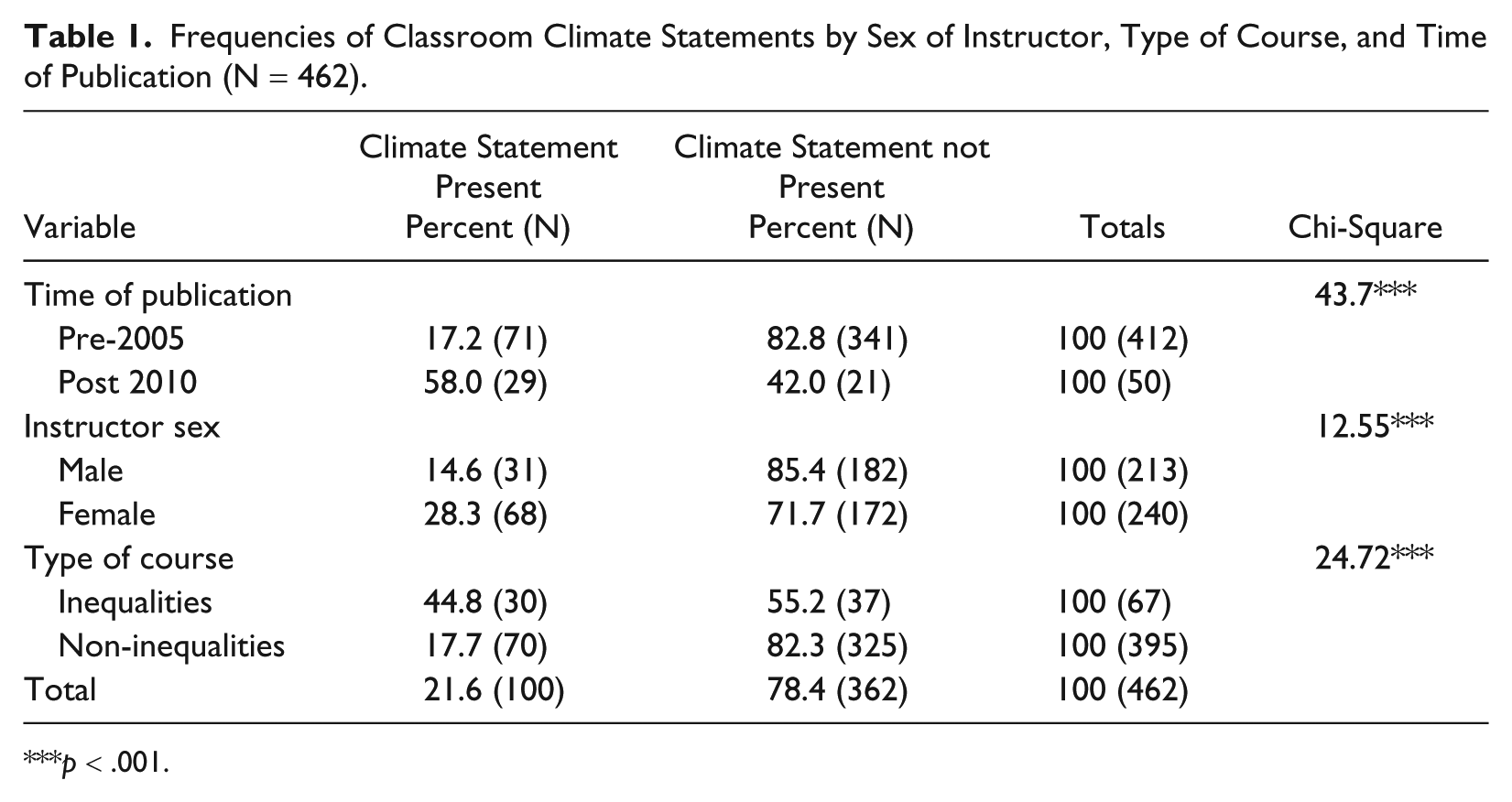
Overall, 22 percent (100/462) of all syllabi in our sample contained some type of classroom climate statement (see Table 1). Comparing syllabi from the pre-2005 period to more recent syllabi, it is clear that recent syllabi are much more likely than earlier ones to contain classroom climate statements. In the pre-2005 sample, 17 percent of the syllabi contained statements compared to 58 percent for those published in the latter period (χ2 = 43.7; p = .000).
Frequencies of Classroom Climate Statements by Sex of Instructor, Type of Course, and Time of Publication (N = 462).
p < .001.
Factors such as sex of instructors or inequalities courses are associated with syllabus having a classroom climate statement. Women are more likely than men to include climate statement in their syllabi (28 percent vs. 15 percent, respectively), and this difference is significant (χ2 = 12.6; p = .000). Courses that focused on race, class/stratification, gender, and/or sexualities are also more likely to use classroom climate statements in their syllabi compared to syllabi for other courses (45 percent vs. 18 percent, respectively), and this difference is significant (χ2 = 24.7; p = .000).
There were 71 classroom climate statements published during the early period and 29 during the latter period. We further analyzed these 100 statements for complexity, tone, and content. In terms of complexity, statements ranged from 6 words to 537, with an average of 136 words per statement. Statements from the earlier period were slightly longer than those from the latter (140 and 126 words, respectively). Some statements were simple and to the point, for example, “Classroom behavior: Be respectful and considerate” (6 words; pre-2005, Culture), while others were more complex and described what was expected from students and at times, why. For example, It is my goal that you should
The qualitative analysis also explored the language or tone of the statements. Statements varied widely in terms of tone. Some were supportive, collaborative, personal; others were more impersonal and punitive, as seen in the following two examples: Build on each other’s strengths. Encourage, support, and honor the unique talents of each member. Become better communicators, teachers, and thinkers together. Use this opportunity to learn new public speaking and team building skills the EASY WAY. (pre-2005, Organizations) Due to the nature of some of the topics in this course I must insist on a policy of respect, understanding, compassion and empathy. Anyone displaying attitudes and behavior that can be construed as disrespectful, rude, vulgar or offensive will be dismissed from class and receive a zero for class attendance and participation for that day. Academic interactions between and amongst students and with the instructor will be respectful, cordial and civil. (post-2010; Race, Class, Gender)
We found that statements from the earlier sample compared to the latter tended to be more positive, open, encouraging, and collaborative. In the pre-2005 sample, instructors were more likely to emphasize openness, respect, and sharing between peers and between instructor and student. Several of the statements contained a sentence or two encouraging students to discuss any concerns with their professors. In the latter sample, many statements included open and encouraging language but also contained more restrictive and punitive language, such as: “Discriminatory and inflammatory remarks will not be tolerated and will result in students being asked to leave the class for the evening” (post-2010, Introduction/Social Problems).
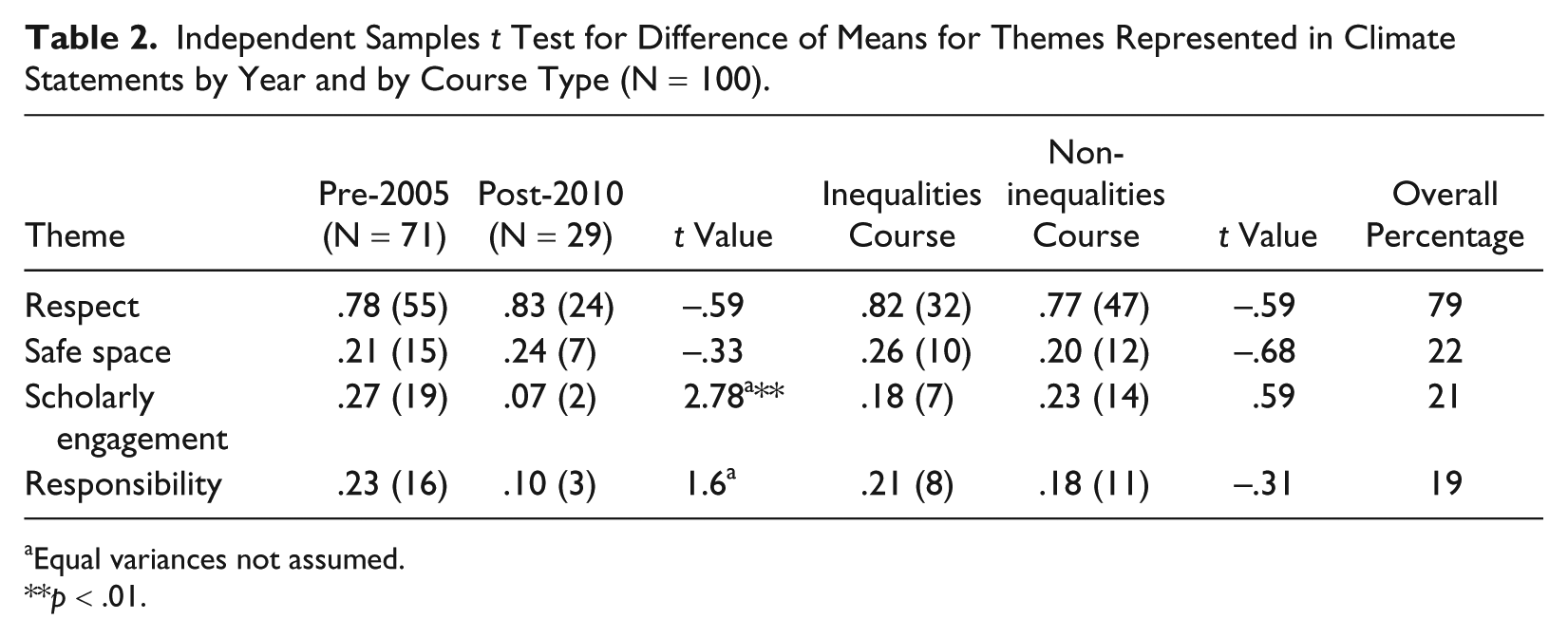
We analyzed these 100 statements for themes. Recall that we did not include classroom rules (e.g., use of cell phones or leaving class early) unless these were framed as being disruptive to the instructor and/or other students. When we focus on remaining text, we found classroom climate is framed almost exclusively around classroom discussion (74 percent of the statements included language directed at class discussion and participation). There was one instance in which a climate statement was incorporated into expectations surrounding a group project and several cases in which expectations are noted without reference to discussion or participation (e.g., “I will not be lenient about . . . disrespect of any kind”; post-2010, Social Psychology), but overwhelmingly, instructors are focused on classroom discussion and participation. Within this framework, there were four main themes that emerged in terms of how climate is conceptualized: (1) as a matter of respect, (2) the creation of safe space, (3) the importance of engaging on a scholarly rather than personal level, and (4) as a responsibility. Table 2 presents the frequencies for each of these themes by sample and type of course for these 100 statements.
Independent Samples t Test for Difference of Means for Themes Represented in Climate Statements by Year and by Course Type (N = 100).
Equal variances not assumed.
p < .01.
Respect
In the vast majority of statements, classroom climate is framed as a matter of respect for other students. Overall, 79 percent of the 100 classroom climate statements contained mentions of “respect” or “being respectful.” Occasionally, instructors make reference to additional qualities such as maturity or professionalism (e.g., “a climate of tolerance, respect and maturity is essential”; post-2010, Environment), but respect is emphasized. These types of comments were somewhat more common in the latter period than earlier (83 percent vs. 78 percent, respectively) and in courses focused on inequalities compared to others (82 percent vs. 77 percent, respectively), but these differences are not significant.
In theory, respect can be extended to any number of groups or objects, but in these syllabi, it is framed almost entirely around respect for classmates’ views or opinions. A typical statement is: “Please listen carefully to your classmates and respect other viewpoints. Every student will have a chance to express her/his opinion as long as it is voiced in a respectful manner” (pre-2005, Introduction). In a few cases, instructors frame respect in broader terms, such as emphasizing respect for the instructor (and what she/he/they are saying), such as: “You are expected to be respectful of each other and the instructor” (post-2010, Theory). In a few cases, respect for individuals or groups about whom the students are learning was mentioned. For example, “it is important that we respect the victims and their decisions even if we disagree with those decisions” (pre-2005, Family Violence) and “Unless there is an emergent situation that requires your immediate attention, please show respect for your classmates, your professor, and the people about whose cultures and lives we are learning by observing cell phone abstinence” (post-2010, Race and Ethnic Relations).
We found that few statements actually explained what respect means or the behavioral expectations. There were some exceptions, however. For example: Please . . . a) be good listeners to your fellow students (a democratic and open classroom necessitates a respectful environment); b) try to focus your discussion on broader society, social theory and course concepts; c) discussion is usually more stimulating when many people are involved, thus I ask for your help in trying to get everyone to contribute; d) respect and welcome all political and ideological perspectives and give them fair and critical consideration. (pre-2005, Organizations)
Creating a Safe Space
Another way classroom climate is conceptualized in syllabi is by emphasizing the importance of creating a safe space. Approximately one-quarter of the statements made reference to creating a safe space in which students could feel free to participate and express opinions. Statements from the latter sample and those for inequalities-related courses were somewhat more likely to include references to safety or safe environments (24 percent vs. 21 percent and 26 percent vs. 20 percent, respectively), but these differences are not significant.
While few instructors use the term safe space, emotional and psychological safety are stressed. For example, “This course is meant to provide a safe, fun, and engaging atmosphere in which everyone is invited to participate regardless of their opinions, backgrounds, or how well they know the material” (post-2010, Political) and “To facilitate class discussion, everyone must feel safe expressing their assessment of the readings” (post-2010, Sexualities). Similar to respect, most instructors do not elaborate on what safe space means. One exception was: “In a safe learning environment, folks feel respected, they show interest in others’ thoughts by actively listening and offering constructive feedback, and strive to debate, not dominate, during class discussions” (post-2010, Medical). In these statements, instructors emphasize creating a safe space so that all class members can feel emotionally and psychologically comfortable to express diverse views and opinions.
Scholarly Engagement
The next most common theme to emerge through the qualitative analysis concerned the importance of scholarly engagement with the material when participating in class discussion. Overall, 21 percent of the statements contained language stressing, for example, that students “should be prepared for class by having completed readings and homework assignments,” to use “logic and evidence” to support their views, to be mindful of the “sociological framework that is guiding our discussion and express . . . comments within the context of this framework,” to “maintain an analytical objectivity to the material under study,” to engage in “critical thinking,” and so on. One statement from a course on Family Violence reminded students that they were in an “academic class” and that no one was “qualified as a therapist.” Such language was more common in the earlier period compared to the latter (27 percent vs. 7 percent, respectively), and this difference is significant (t = 2.78; p = .007). In addition, courses that were not focused on (race, class, gender, sexualities) inequalities were also more likely to include language encouraging such scholarly engagement (23 percent vs. 18 percent for inequalities-related courses), but this difference was not significant.
Responsibility
About 20 percent of classroom climate statements contain language regarding responsibility. Generally, these are framed primarily as an individual responsibility rather than community or class responsibility. Students are asked to check their own attitudes and behaviors. For instance, statements encourage students to “Listen carefully to your classmates and respect other viewpoints” (pre-2005, Introduction) or “Establish and protect your own boundaries and needs” (pre-2005, Organizations). Yet, there are some important exceptions. Several instructors frame their statements as a reciprocal exchange in which both students and instructors share responsibility for creating a positive classroom climate, for example, “we have a responsibility to one another to create an open, non-threatening classroom environment where everyone’s contributions are valued” (pre-2005; Race, Class, Gender). Others stress the shared responsibility students have to one another. For example: “Encourage all of your classmates to participate. Avoid keeping ideas between just you and your ‘neighbor’ Don’t miss any chances to help others expand their perspectives” (pre-2005; Race and Ethnic Relations). Other instructors acknowledge personal responsibility but more in terms of management of the classroom rather than building a collaborative classroom environment; for example: Instructors have the right and obligation to confront disruptive behavior thereby promoting and enforcing standards of behavior necessary for maintaining an atmosphere conducive to teaching and learning. Instructors are responsible for establishing, communicating, and enforcing reasonable expectations and rules of classroom behavior. (post-2010, Criminology)
Language about responsibility was more likely to appear in syllabi from the earlier period (23 percent vs. 10 percent), but this difference was not significant (possibly due to small sample sizes). Courses that focused on inequalities were about as likely to include language about responsibility as those that did not (21 percent vs. 18 percent, respectively).
Discussion
The current study uses syllabi from face-to-face courses to examine whether sociology instructors incorporate classroom climate statements within their syllabi. We used syllabi from two time periods (those from late 1990s–early 2000s and those from the past decade). We were interested in the extent to which instructors make formal statements about the classroom climate in their syllabi and the nature of these statements and whether there has been any change in the nature or frequency of such statements over time. We found that about one in five published syllabi contained climate statements and that these statements were much more common in the latter period compared to the earlier one. In addition, courses taught by women and courses that focus on race, class, gender, and/or sexualities were also more likely to contain classroom climate statements.
The nature, importance, and functions of syllabi have changed over the decades, driven in part by increased enrollments, concerns about student incivility, and the broader socio-political climate that has brought contentious issues to the fore of public discourse, to name a few. Although we cannot presume to know instructors’ motives from the data analyzed here, it is possible that the changing college classroom has spurred some instructors to create more explicit messages in their syllabus about classroom behavior and climate. Indeed, compared to syllabi published prior to 2005, more recently published syllabi are more likely to contain some type of statement, perhaps in an effort to preemptively shape the socio-emotional and interactional classroom space in the face of growing challenges. There has been, of course, a growing body of literature designed to guide instructors in syllabus construction, and these typically include suggestions for spelling out guidelines for how students are expected to act within the classroom. 2
Instructors teaching inequalities-related courses (those dealing with race, class, gender, sexualities) and women instructors are especially likely to include such statements. While issues of race, class, gender, and sexualities are contentious issues in contemporary society, most sociologists would likely agree that any sociology course could be politically and culturally charged and evoke strong emotions (Roberts and Smith 2002). Yet, there does appear to be a “collective wisdom” that inequalities-focused courses are particularly vulnerable to student resistance and challenges, although this may be a more anecdotally than empirically based assumption. Nonetheless, this assumption may be the impetus for including classroom climate statements in these courses.
Studies have shown that women instructors are more likely than men to be challenged in the classroom, have their authority or competence questioned, and be marginalized (Alberts, Hazen, and Theobald 2010; Miller and Chamberlin 2000), which may help explain why syllabi written by women are more likely than those by men to contain classroom climate statements. Scholars have written about the emotion work (Hochschild 1983) required of women professors (see e.g., Kadowski and Subramanian 2014). This study suggests a kind of anticipatory emotional labor that may begin before the course is taught, as syllabi are being constructed, as women anticipate and utilize strategies for managing the socio-emotional landscape of the classroom.
The vast majority of classroom climate statements included language directed at class discussion and participation, suggesting that this is the area where instructors believe classroom management is most needed. To be sure, many instructors include statements about such things as use of cell phones, class attendance, eating and drinking in class, plagiarism, and so on, but apart from these classroom rules, the common pattern that emerged in our study was management of class discussion. Within this framework, respect (mostly for other students) was central. Other themes included creating a safe space (so that others feel comfortable sharing), the importance of engaging with materials and ideas on a scholarly level, and accepting responsibility for creating and maintaining a positive learning environment. When we compared these themes over time and by type of course (inequalities-focused or not), the only significant difference was that syllabi published in the later years were significantly less likely to highlight the importance of scholarly engagement with the topic. It is unclear why more recent syllabi do not explicitly address the importance of examining topics critically, objectively, and analytically; it is possible that this shift represents an openness to an “emotional curriculum” in which students are encouraged to “acknowledge, reflect upon, and address the emotions that underlie and intersect with teaching in an effort to extend students’ learning” (Storrs 2012:1). It is also important to note that the quantitative analysis of themes was based on a small sample size; a larger sample would be needed to draw conclusions about changes in themes across time or type of course.
Limited information is available from syllabi, and this study leaves several questions unanswered. From our data, we cannot determine why instructors of inequalities courses are more likely to include classroom climate statements, only that they do. We cannot know instructors’ intent or how they handle issues in class with students. Future research might explore why instructors of inequalities courses and women are more likely to include climate statements. Are inequalities-focused courses, in fact, more controversial, or is this part of our discipline’s unexamined assumptions? We were not able to code for race or ethnicity of instructor or other factors that may shape instructors’ experiences in the classroom, such as nationality. Are instructors of color more likely to include statements, and does intersectionality play a role (e.g., do instructors who are women of color include classroom climate statements in their syllabi more often than white women or men of color)? Such a study may provide insights into the challenges faced by these instructors. Most importantly, do classroom climate statements make a difference in students’ and instructors’ experiences? Do students actually read the syllabus and attend to climate statements? Do instructors emphasize these parts of the syllabus, and how important do they consider them to be in creating the classroom climate? To answer these questions and more fully understand how classroom climate emerges and is managed, we must move beyond the syllabus.
The syllabus is often seen as a contract, constructed and delivered by instructors to guide and shape student behavior and learning (Parkes and Harris 2002), but the syllabus might be better viewed as a conversation starter. It is often the first voice heard, and it can set the tone of the conversation. We hope this study stimulates further discussion and study among instructors about classroom climate.
Footnotes
Acknowledgements
The authors wish to thank the editors of the syllabi guides for the pre-2005 sample for providing copies of the guides for analysis. We also thank Greg Gibson for his assistance in collecting pre-2005 data used in this study. An earlier version of this paper was presented at the 2018 American Sociological Association annual meetings.
Editor’s Note
Reviewers for this manuscript were, in alphabetical order, Jennifer Keys, Betsy Lucal, and Gail Murphey-Geiss.