



Abstract
Sociology has been slow in responding to the challenge of climate change. In this conversation, we advocate adding more climate change content to Introduction to Sociology courses. To support our arguments, we present data from a content analysis of the top 11 best-selling introductory textbooks in the United States, demonstrating that environmental concerns are usually relegated to the end of books, which provide little (and sometime errant) content. Climate change gets even less attention, and there has been little change to textbook content over time. To correct such deficiencies, we suggest instructors free climate change from its current position as “a subfield of a subfield” and interweave the issue with all content areas in the curriculum. Our conversation concludes by considering how climate change can be featured in the curriculum of introductory courses as well as in the pedagogies presented at the introductory level.
Inspired by the Swedish teen climate activist Greta Thunberg, the “school strike for climate” movement started to gain traction toward the end of 2018. On March 15, 2019, over 1 million students in more than 100 countries skipped school on Friday to protest government inaction on climate change (The Guardian 2019). This movement, led by teenagers, has spurred the largest demonstrations on climate change to date. Ironically, when these students enter colleges, enthusiastically searching for answers to climate change in sociology classes, they would find little to relate. In this article, we initiate a conversation about mainstreaming climate change in sociology teaching. We argue that on the one hand, sociology teaching offers important insights to help students deepen their understanding of the climate crisis; on the other hand, teaching climate change can effectively demonstrate the relevance and power of sociological thinking.
Ongoing discussions of what constitutes “the core” of sociology programs suggest that some colleagues might not find the absence of climate change in intro courses particularly problematic. Teaching Sociology has extensively discussed the teaching goals (Ferguson 2016; Ferguson and Carbonaro 2016; Persell 2010; Persell, Pfeiffer, and Syed 2007; Wagenaar 2004). For example, in their sociological literacy framework, Ferguson and Carbonaro (2016) proposed to organize the courses around sociological perspectives, namely, the sociological eye, social structure, socialization, stratification, and social change and reproduction, as well as the sociological toolbox, inducing scientific principles and research method. Notably absent is specific reference to the human-environmental interface.
To stimulate this conversation, we hope to achieve two goals in this article. The first goal is diagnostic. We want to survey what is being taught about climate change in introductory courses and demonstrate that the current teaching indeed ignores the topic. To make our case, we follow up Lewis and Humphrey’s (2005) textbook content analysis on environmental sociology, adding a specific focus on climate change. We will show that there has been a serious absence of climate change content in all most popular intro textbooks. Second, instead of completely overhauling the curriculum, we will offer a few suggestions that could interweave climate change with other substantive areas in introductory courses as well as a team research teaching module as a pedagogy.
Before we proceed, we want to especially recognize that climate change and environmental issues in general are not the only issues missing or given scant attention in introductory courses. However, we argue that no other single issue has the greatest likelihood of reshaping lives, life chances, and social relations. For that reason, it is critical that climate change be a central, not marginal or tangential, focus in introductory sociology courses.
In the following sections, we start with observations about how textbooks discuss what sociology has to say about societies’ relationship with the environment as a whole. We then home in on what these books have to say specifically about “climate change” or “global warming.” We also briefly discuss the potential explanations of the absence of climate change in these texts. We then offer some concrete steps to bring climate change to the fore of introductory courses.
Notes on Data and Analyisis
We consulted with academic publishers in private communication and identified the 11 bestselling Introduction to Sociology textbooks (private communication, March 13, 2017; see Table 1). The sales ranking can be messy due to various data gaps, but it serves the purpose to give us a general picture of the representative popular texts in our field. While we initially planned to include only the top 10, we decided to include the 11th best seller because it is a textbook authored by some of the biggest names in sociology, authors widely recognized as leaders in our field, and because its first—and most famous—coauthor, Anthony Giddens, has written a whole book about climate change (Giddens 2009). We did not include the “essential” versions or the “readers” of introductory textbooks. All 11 selected books are comparable with each other and serve similar purposes.
Most Popular Introduction to Sociology Textbooks Under Review.
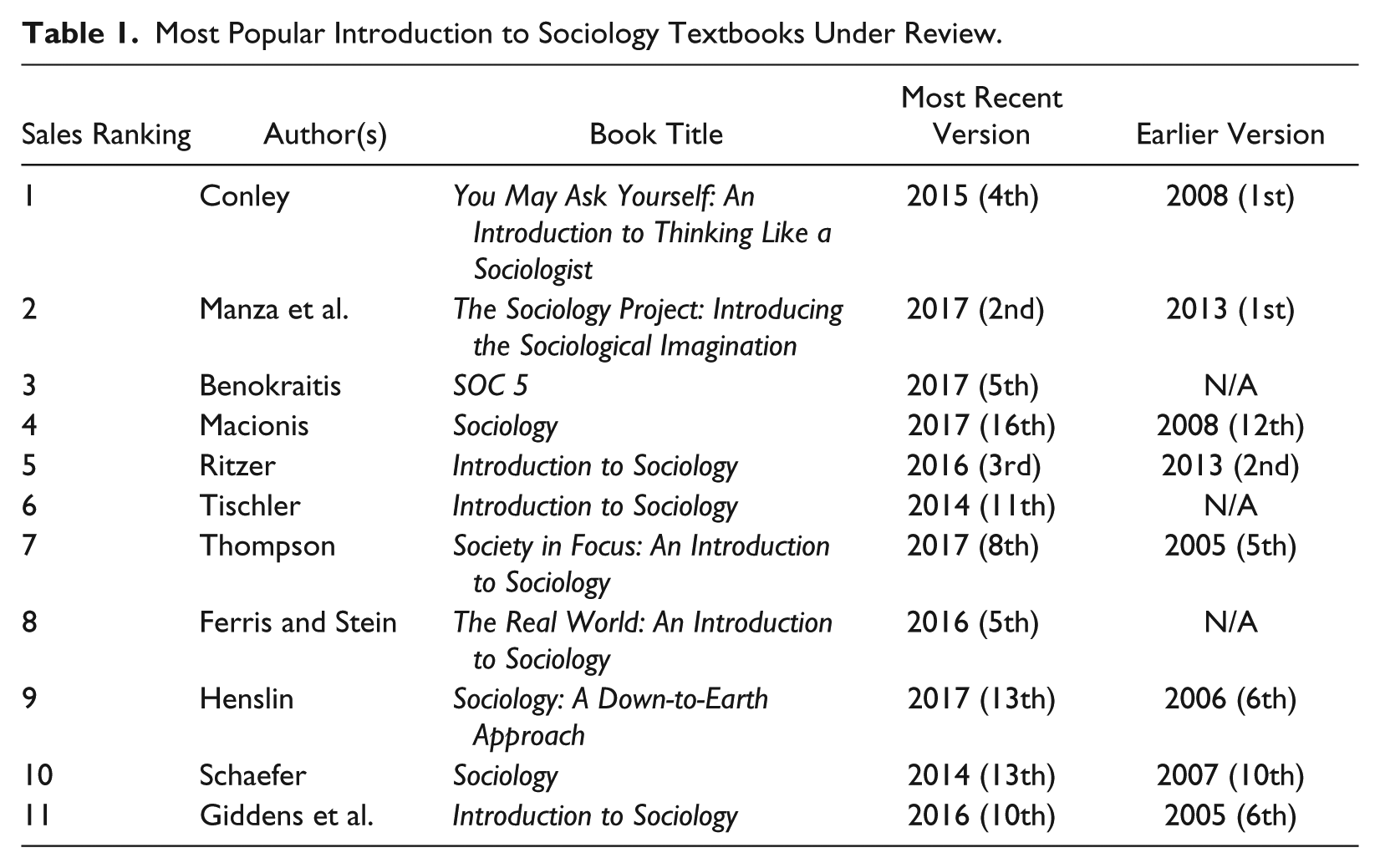
To construct our sample, we gathered the most recent edition of the textbook, ones mostly published in 2016 or 2017. For 8 of our 11, we also located earlier editions of the same textbooks, editions that were published as much as 9 or 10 years earlier, so that we could ask and answer the question: Has the discussion of climate change improved, deepened, or changed in any significant way in the intervening years, given that the science of climate change and our understanding of its potential impacts continued to improve over the past decade. For each text, we collect either digital or paper copy for analysis. We especially examine the contents in the environmental sociology chapters and use the index and the full-text search function to locate any content related to “climate change” or “global warming.”
Our approach follows a myriad research that analyzed the most widely adopted Introduction to Sociology textbooks, both their overall structure (Babchuk and Keith 1995; Keith and Ender 2004) and how these textbooks discuss specific topics such as symbolic interactionism (Carrothers and Benson 2003); race, gender, and class (Ferree and Hall 1996; Puentes and Gougherty 2013); sexuality (Suarez and Balaji 2007); religion (Carroll 2017); work (Dixon and Quirke 2014); and classical sociological theory (Manza, Sauder, and Wright 2010). Particularly relevant for this article, Lewis and Humphery (2005) found that only a small percentage of key concepts in environmental sociology is covered in introductory textbooks, and the total number of pages devoted to the sociology of the environment is typically less than 3 percent of the text.
Environment: At the End, Shared Chapters, and No More than Few Pages
All our textbooks follow essentially the same basic format; the sequence of subjects covered is pretty much the same from book to book. Early chapters are devoted to the sociological imagination and a discussion of various methods/ways of knowing. Then come chapters on specific topics, crime and deviance, race and ethnicity, gender and sexuality, family, and so on. The general trend is to go from early chapters devoted primarily to the “micro” facets of sociological inquiry to later chapters on more “macro” facets, social-structural subjects such as the economy, politics and power, globalization, social movements, and social change.
While it is beyond our point to replicate Lewis and Humphrey’s coding, our findings suggest that not much has changed since their study in 2005. We want to highlight and elaborate four key observations on the coverage of the environment in these texts. (1) Discussion of the environment is always relegated to or near the end of the textbook; (2) with one exception, environment does not get its own chapter but is relegated to sharing a chapter with other topics; (3) in that late, shared chapter, environment always comes last; and (4) it does not get more than a few pages.
No textbook has its discussion of the environment anywhere close to its early or even its middle chapters. Four books have it two positions from the final chapter (e.g., chapter 18 when there are 20 in the book). Five others put it in the next to last chapter. One has it last. The number six bestseller, Tischler, has no discussion of the environment at all. This pattern means that environment comes after many other subjects, such as deviance, aging, sexuality, and so on. Those subjects are all important, and they are certainly traditionally understood to be at the core of sociological inquiry. We interpret the sequence as a rough signal of importance: Important topics come early and less important topics at the end of the book. This point is supported by Lowney, Price, and Guittar’s (2017) syllabi study, which showed that the content actually being taught skews heavily to the earlier chapters.
The implicit message that the environment is not that important is further reinforced by the fact that it almost never gets its own chapter. Most frequently, by far, one sees some permutation of the triad “population, urbanization, environment.” There are single instances of some other combinations, “science, environment, and society” and “technology, social movements, and environment.” In our sample, there was only the number two best seller, Manza et al., that gave the environment its own chapter.
In the books in which environment shares a chapter with other subjects, it comes last. Always. First population, then urbanization, then environment. When the textbook finally gets to discussing the environment, it does not get much space. The environment chapter in Manza et al. gets a respectable 30 pages. That’s an outlier. A couple of books give it about 10 pages. Half the books less than 8 pages; some a page or less.
To be clear, it is not the case that the environment does not exist in sociological research. We want to highlight to our readers that ASA has a very active Environmental Sociology Section. The Section was established in 1977 and has grown significantly over the years, reaching almost 500 members in 2018, on par with sections such as development, population, and sexualities. Scholars have also noted that environmental sociology has gradually moved from the fringe to the core of sociology (Scott and Johnson 2017). Yet, the pattern we described here—a modest amount of space, at the back of the book, without its own chapter—implicitly yet very clearly suggests that the environment remains at the fringe of sociologists’ teaching practices. The textbooks still maintain the human exemptionalist paradigm that environmental sociologists have been critiquing since the 1980s.
Climate change: if it is a catastrophe, why is it so invisible?
We now turn to our primary concern—how bestselling Introduction to Sociology textbooks discuss climate change. First, it is important to examine how Introduction to Sociology textbooks treat very basic questions about climate change—is it real, and is it serious? As we write, in 2019, the United States seems to be the sole important exception to the worldwide consensus, articulated by governments, national and international scientific bodies, and public opinion, that climate change is real and is serious, possibly an existential threat to the future of human societies. In the United States, in contrast, climate change denial is organized, well funded, highly vocal, and embraced by some important segments of the American public (Dunlap and McCright 2011). Against this background, sociology has the responsibility to present the correct information to students.
Besides the basic physics, a comprehensive sociological analysis of climate change would also need to address three facets of the issue. First, it would need to offer a sociological—not just physical—explanation of the cause(s) of climate change. Second, it would need to describe in detail all the impacts of climate change, both impacts already observed and the predicted future impacts assuming “business as usual” scenarios. Third, such an analysis would need to describe how the world’s peoples, institutions, and governments have responded so far to scientists’ and activists’ warnings about the threat. That would constitute a far more comprehensive sociological analysis. With that in mind, we now consider what these bestselling textbooks actually say about the causes, impacts, and societal responses to climate change.
Is Climate Change Real?
Almost unanimously, the answer is “yes.” Almost all the books briefly describe how the buildup of greenhouse gases, mostly CO2, keeps solar energy from being radiated back into space, thereby throwing the planet’s energy balance out of whack. Some of the books mention that there are skeptics, but they make sure to emphasize that the science is unequivocal. Eight of the 10 textbooks that address environment/climate change (again, Tischler does not) do not express any real doubt about the reality of climate change.
There are two exceptions to this overall pattern. Thompson (No. 7) does not deny the existence of climate change but conflates it with depletion of atmospheric ozone, an entirely different issue. Henslin (No. 9) does worse. Back in 2006, he wrote that “the consequences [of climate change] are likely to be catastrophic” (p. 424). In 2017, that phrase was gone. Instead, we read that “climate change is producing many problems” (p. 499), but given “the limited space we have,” Henslin chooses to focus on the “controversy” that CO2 emissions have recently risen fast while the “rate of warming slowed” (pp. 500–501). The existence of this purported slowing has been refuted, but it is—still—a popular denialist talking point, supported by widely disseminated graphs that, by strategically choosing the starting and ending dates, create a false impression of temperature trends. Henslin treats this denialist trope as if it were a real problem for belief in the reality of climate change and then urges students to debate the “controversy.”
Is Climate Change Serious?
Most say “yes, serious” and worse. Here is a selection of quotes:
“drastic consequences” (Conley 2015:672)
“the single greatest hazard to both our ecosystem and humanity” (Manza 2017:465)
“ . . . our planet is ailing. Can people slow some of earth’s devastation?” (Benokraitis 2017:310)
“a serious problem that threatens the future of all of us” (Macionis 2017:584)
“a climate change of a few degrees can cause catastrophic consequences for the world and its inhabitants” (Ferris and Stein 2016:454)
“devastating consequences” (Giddens et al. 2016:529).
At the same time, though, those dire assessments are undercut in a number of ways: Climate change or global warming is discussed in the chapter on environment, a topic that, as we have already pointed out, is tacitly treated as relatively unimportant. Within those chapters and then within the short, final sections of those chapters, climate change finds itself as just one among a list of several other environmental issues such as species extinction, resource depletion, and various forms of waste and pollution, all treated as if they are of equal concern, no issue more pressing than any other. And finally, climate change typically gets only a bit of space. Five of the books give less than one page to the subject, some of these only a single paragraph or even less. Only one gives it more than two pages.
Causes, Impacts, Societies’ Responses to Climate Change
Causes
For the most part, the textbooks get the physical causes of climate change right (though there are glaring exceptions): huge increase in the burning of fossil fuels; buildup of greenhouse gases, especially CO2; keeping incoming solar energy from being radiated back out into space; and so on. Much less is said about the sociological causes. Some books say nothing. Some begin to identify societal actors that are responsible for increased CO2 emissions, but the treatment is quite terse: “corporations and consumers” (No. 2), “factories and automobiles” (No. 4). Others are a bit better, naming drivers that begin to sound more clearly sociological, “consumption in wealthy countries” (No.10), “capitalist economic development” (No. 9). Such explanations are more promising, but they are still quite terse, and the causal chain that connects, say, “capitalism” to the burning of fossil fuels is not spelled out. There is much room for improvement as meant to teach students the sociological perspectives to look at the world.
The space devoted to climate change makes up only a fraction of the space allotted to the environment as a whole, however. We thus examine the sociological analyses of the causes of general environmental degradation. We found no trend between the quality of the discussion and page length. Some attributed environmental problems to one or two primary causes, population, consumption, a capitalist economy’s imperative for growth. Some give the reader a choice of sociological explanations, harkening back to introductory textbooks’ canonical division of social theory into the triad of functionalism, conflict theory, and symbolic interactionism (Manza et al. 2010). Some settle for listing some of the more familiar ideas in Environmental Sociology, Garrett Hardin’s “tragedy of the commons,” Allan Schnaiberg’s “treadmill of production,” or the IPAT (Impact = Population × Affluence × Technology) formula first proposed by Paul Ehrlich and John Holdren. And some offer no overarching social theory of environmental crisis at all, just lists of serious environmental problems.
Consequences
As compared to the analysis of causes of climate change, textbook writers do a better job discussing the social consequences. Taken as a whole, these 11 textbooks, together, identify many of the most distressing potential impacts. Taking the bestselling You May Ask Yourself as an example, Conley mentions impacts such as more damaging hurricanes, melting glaciers and rising sea levels, heat waves, tropical diseases, impacts on agriculture, and migration away from coastal regions in two paragraphs; he uses a lot of space reviewing Eric Klinenberg’s study on heat wave fatalities in Chicago. Conley, as many others too, also emphasizes the inequality/social justice dimension—that these impacts are going to disproportionately affect the poorer peoples and poor nations. While many texts document climate change’s impacts similarly to the previous example, we, however, feel they generally fall short of grappling with the scale of the threat. Conley ends the discussion by saying, “you can begin to understand some of the social challenges human societies will face.” Some authors say or imply that although one cannot underestimate the challenges, we human beings are smart, inventive, and can, with difficulty, adapt. Overall, students are gently led to a way too benign conclusion about whether they should be concerned.
Responses
No textbook offers anything close to a comprehensive review of the rich variety of individuals’, organized interests’, media’s, and many governments’ responses to the climate threat. A couple of books mention troubles coming and agree on implementing the Kyoto Protocols—now an outdated discussion. Others talk about the role of activism and the environmental movement. Still others focus on impediments, that the public finds other concerns more important, or why the world’s nations have had such difficulties forging a treaty that every nation can agree to. Several books describe how carbon markets could be a solution, and they cite some corporations’ efforts to go green. Others speak hopefully about the idea of sustainability or sustainable development. The content in this area is shallow and fragmented.
Are Recent Editions Better than Earlier Ones?
Much has happened in the past decade. Climate science has steadily improved. Predictions of future impacts have grown ever grimmer. Al Gore’s Oscar-winning documentary in 2007 and the accompanying jump in media coverage raised public awareness and concern. Then that concern was overshadowed by the Great Recession of 2008 (Brulle, Carmichael, and Jenkins 2012). The environmental movement made climate change a top priority. Climate denial continued to be well funded by fossil fuel interests and continued to be championed by conservative think tanks and conservative politicians (Brulle 2014; Dunlap and Jacques 2013). Climate change was caught up in and became one more front in America’s “culture wars” (Dunlap, McCright, and Yarosh 2016). Climate policy at the national level stalled. Attempts to forge an international agreement also floundered but eventually made real progress in the Paris Agreement in 2016. Meanwhile, the technologies that could deliver reliable, cost-effective, renewable energy improved.
Was any of this reflected in the textbooks’ discussions of climate change? For 8 of 10 textbooks, we compared the most recent editions with earlier ones. In 4 of the 8, there was no change, or only a very minor change, such as the substitution of one photo or one graph for another. Two show improvement from earlier to later editions. Giddens et al. added a sturdy summary of the 2014 report of the Intergovernmental Panel on Climate Change (IPCC), the world’s leading body tasked with periodic updates of the scientific consensus. Schaefer’s 2014 edition has a section on climate that was not there in 2006. Two went the other direction. Manza et al. moved the environment chapter one position closer to the end of the book. Henslin regressed from affirming the reality of climate change in 2006 to uncritically featuring a key denialist talking point in 2017. In sum, we do not see the textbooks reflect the progress in climate science over time.
The Good, the Bad, and the Average
Before we move on to explain the lack of climate change content, let’s make a quick rating of these books. If we limit the discussion to a “within” comparison, just considering each against the other 10, some are clearly far better than others. In our opinion, Jerolmack’s chapter in Manza et al. (No. 2) and Giddens et al. (No. 11) are the best; Conley (No. 1) and Ritzer (No. 5) are a cut above the average. At the other extreme, we find Tischler (No. 6), who leaves environment completely out of the sociological project; Thompson (No. 7), who gets the science wrong, conflating climate change with ozone depletion; and Henslin (No. 9), whose most recent edition takes a big step back from his much better discussion in 2006. But even the best have real issues: They share basic structural features that do not do justice to climate change either as an issue that looms large in the future lives of all undergraduates or as a subject that can demonstrate the power of sociological ideas.
Explaining Sociology Textbooks’ Silence on Climate Change
To end this section, we draw from literature to surmise two processes that could explain of the current inadequate state of climate teaching in Introduction to Sociology textbooks.
The first process is sociology’s lagging engagement with climate change. About a decade ago, a few journal articles began to highlight that sociology had been slow to respond to the climate issue and argued that sociology ought to begin to engage with this increasingly important phenomenon (Lever-Tracy 2008; Urry 2009; Yearley 2009). In 2010, the American Sociological Association established a Task Force on Sociology and Global Climate Change, asking that it produce a sociological analysis of climate change and to make policy recommendations. This effort culminated in the Climate Change and Society: Sociological Perspectives (Dunlap and Brulle 2015), which covers a wide range of sociological research on climate change. We are also seeing more individual pieces of research into various facets of the sociology of climate change (Bohr and Dunlap 2018; Scott and Johnson 2017). Even though these are clear signs of progress, sociological research on climate change remains small and marginalized. As of 2019, the term climate change or global warming has not yet appeared on one single article title in our discipline’s flagship journal of American Sociological Review and American Journal of Sociology. The then ASA Environmental Sociology Section Chair Kari Norgaard (2018) still calls sociologists to join the crucial conversation.
The second process is the persistent gap between the “textbook” sociology and the sociology as actually practiced by today’s sociology professoriate (Hamilton and Form 2003; Manza et al. 2010). This gap is shaped by both supply-side factors—publishers tend to conform to a market-tested model—and demand-side factors that encourage routinization with textbooks; sociology of climate change, being a new topic, finds limited space to slip into the conservative textbook template. Overall, teaching climate change lags further behind the progress we have witnessed in research.
Pedagogical Interventions To Fix The Situation
Ideally, we would like to see these introductory textbooks evolve to better reflect actual sociological research and relate to contemporary social problems, but given the realities of the textbook publishing business, we understand that such change is likely to take some time. In the meantime, we cannot depend on the textbooks to adapt fast enough, so in the short to medium run, it will be up to the individual instructors to find ways to inject climate change into their courses.
The first step is to make a conceptual adjustment. Climate change should no longer be seen as no more than “a subfield of a subfield.” Climate change should be freed from its current position as a small fragment of an already short environmental chapter. Climate change can be and arguably should be treated throughout the course, instead, as one of the most important challenges to contemporary global human existence.
How, then, to do that? We don’t think there is just one obviously most appropriate way. Here we will offer a couple of preliminary ideas for instructors to bring climate change content into their curricula.
Bringing Climate Change in, Again and Again, as the Class Learns about Various Sociological Topics
Over a semester, the typical introductory course surveys a large number of sociological topics and ideas, inequality, race and ethnicity, gender, power and domination, aging, crime, deviance, the rules of face-to-face interaction, and more. Climate change may not be relevant to all these topics, but it is certainly relevant to at least a handful. We suggest that the instructor can select several topics for which climate change is especially relevant and bring climate change into his or her discussion of those topics. This practice is similar to how gender, race, class, and international concerns are commonly interwoven throughout the course.
Climate change can enter the course as soon as the semester starts. For example, when discussing sociological imagination, we could follow Norgaard’s (2018) suggestion to develop two specific kinds of imagination: (1) to see the relationships between human actions and their impacts on earth’s biophysical system and (2) to see the relationships within society that make up this environmentally damaging social structure. This brings home the point that the well-being of a society is dependent on the healthy functioning of the environment. Such imagination can help students overcome the all too often individualistic thinking on the environment (e.g., Do you recycle?) to invite them to use sociological imagination to envision societal transformation (Shove 2010).
When discussing the scientific approach and research method, we can bring in, for example, the social construction of reality. The instructor can encourage students to think about how they (and others) come to see—to construct—climate change as a problem (Marisa Dispensa and Brulle 2003). Instructors can also discuss the value of the scientific method by talking about the climate denial movement and its manipulation of scientific data (Dunlap 2013). Instructors could describe how the “echo chambers” of new social media shape citizens’ beliefs about climate change (Williams et al. 2015)—a topic that threads together social network, culture, and science.
Besides the sociology core, climate change can also find ways into other chapters as the typical “one-page box” feature in textbooks. We now consider how climate-relevant discussion can enrich or deepen four substantive areas that are found in most textbooks and are, presumably, taught in most intro courses: (1) the economy, (2) globalization, (3) science and technology, and (4) social movement.
In the economy chapter, climate change can be discussed as a signal that our current economic system is not sustainable. Most current textbooks feature critiques of the current capitalist system on the point of social inequality; very few texts touch on the environmental problems and climate change as another consequence of the capitalist system. On this point, instructors can benefit from the political economy approaches in environmental sociology, such as the metabolic rift (Foster 1999), the treadmill of production (Gould, Pellow, and Schnaiberg 2008), and ecological modernization (Mol 2003), which all trace the origins of environmental problems in our capitalist production systems. We also suggest to include some contents on the potentials and limits of green consumptions (Szasz 2011) as they tend to be relatable to students.
When covering globalization, many texts bring up the vast inequality between the global North and South through topics such as sweatshops, colonialism, and so on. This is a perfect entry point to consider climate change sociologically through the lens of global inequality. Roberts and Parks (2006) demonstrate that most of the carbon pollutions are caused by the developed countries, and yet the impacts are felt mostly by the vulnerable developing countries, which have only little say in the global climate governance processes. Similar points can also be brought up when discussing the concept of environmental justice in general.
In terms of science and technology, climate science serves as an interesting case on the social dimensions of science. The sociological perspective sees that scientific knowledge is something produced and consumed by societies, not something just “out there” to be discovered. For example, Gauchat (2012) offers a longitudinal view of the ebbs and flows of trust in science in American society. For sociologists, such trust always relates to one’s social positions such as race, gender, class, religiosity, and political views (Liu 2015; McCright and Dunlap 2011; Norgaard 2011). In this regard, instructors can also tap into the vast literature on climate change denialism to illustrate the politicization and polarization that characterized our current time (Dunlap et al. 2016; Jasny, Waggle, and Fisher 2015).
Finally, with its low-level grassroots mobilization compared to other social issues, climate change can also be an interesting topic when teaching social movements. It can be a worthwhile exercise, following McAdam’s (2017) analysis, to ask students to think about why we fail to witness a stronger social movement regarding climate change. Students can examine the issue from multiple perspectives—resource mobilization, political opportunity, framing, and so on—and brainstorm various strategies to organize.
Let’s, again, take our Conley example to illustrate this approach. Conley uses three pages to describe sociology of climate change in chapter 17, and besides that, there are many other content areas relevant to the issues. For example, chapter 14 on capitalism can help students understand the drivers of climate change; chapters 7, 9, and 10 can be helpful to introduce climate change impacts; chapter 11, on health, can be brought up in this regard; several other chapters on media (3), government (15), science (17), and social movements (18) can be used to cover societal responses. We suggest these topics not because we believe they are the only, or even the best, ways to show students the relevance of sociological thought for better understanding the threat of climate change but merely as examples of what is possible with current textbooks.
Beyond the Textbook: Pedagogical Innovation to Foster Understandings of Climate Change
Besides increasing the climate-relevant content in the course, we also need pedagogies to effectively cultivate the sociological imagination on climate change. We provide one illustration of how to develop and apply pedagogy on this topic. One of us (Szasz) is currently developing a separate module specifically devoted to sociological analyses of climate change (the URL is szasz.sites.ucsc.edu). The module offers three lesson plans—full, middle, and minimalist, which would take three, two, or one class session, respectively. In all versions, students would be assigned, as homework before the first class, to watch two videos that cover the basics of climate science. These videos should significantly mitigate the concerns that some instructors might not be confident to lecture on the sciences. In all versions, instructors show the video A Sociology of Climate Change.
In the minimalist version, students discuss the connections between the video and the rest of their course. In the middle and full versions, students are assigned to study, either individually or in small teams, one of the facets of climate change (the list of topics can be viewed at: https://szasz.sites.ucsc.edu/for-students/). In the middle option, students submit their findings, either as a traditional research paper or as a YouTube-style short video, and a second session offers an opportunity for discussion. Finally, in the full version, one more session provides time for students to either orally present their findings to the class or show their video to the class.
Such an approach would have several benefits. The obvious one is that students would be helped to systematically educate themselves about one of the most serious social conditions they will have to cope with for the rest of their lives. But more, coming toward the end of the semester, such a module would demonstrate to students the power and relevance of sociological thought—which is, after all, the fundamental purpose of any Introduction to Sociology course!
Conclusion
In this article, we call to “mainstream” climate change in teaching Introduction to Sociology courses. Our analysis first examined the coverage of environment and climate change in the top 11 best-selling textbooks in the United States. We found that the environment usually is relegated to the end of the book with little content. As for climate change, we found that on the one hand, it is described as potentially a civilization-ending event; on the other hand, climate change gets only a bit of attention, always near the end of the book. As the world gets hotter, it will become increasingly untenable to ignore climate change in our curriculum. While revolutionizing the textbooks seems unlikely in the short term, instructors can adopt various strategies to better engage climate change in introductory courses. This change requires sociologists to highlight climate change in all the relevant chapters instead of leaving it as a subfield of a subfield.
We recognize that most instructors would not have specific training in environmental sociology, as only few PhD-granting sociology programs have such specialty. Consequently, many would not feel confident lecturing on climate change. We also recognize that our proposal may seem to require a significant undertaking from sociology instructors. We do, however, think such changes are not only desirable but also feasible. As for the physical dimensions of climate change, the Guided Team Research teaching module contains videos that help instructor quickly summarize the key points, and there are ample other resources (e.g., IPCC reports, The Climate Reality Project, and many online videos from scientific bodies). In fact, we expect many students to have some prior knowledge about these physical facts. In our opinion, sociology is mainly to bring to the fore the social dimension of climate change—which instructors should be able to learn just like any other important social issues such as mass incarceration or fake news. ASA Task Force Report’s Climate Change and Society should provide sufficient resources for anyone who wants to quickly learn about the current sociological research. We also believe further curricular development will ease the burden in the coming years if our proposal gains traction.
While some sociologists may not be persuaded by our call to foreground climate change in the Intro to Sociology courses, a less controversial proposal will be to increase the content on climate change in Social Problems courses. In Lowney and colleagues’ (2017) analysis, environment does not even account for 1 percent of the content in the Social Problem syllabi they collected. Our diagnosis and suggestion could almost entirely be applied to typical Social Problem courses.
Before we end, we also want to make a quick digression to contrast sociology’s situation with economics. Economics 101 courses often tout themselves to teach students “how to think like an economist,” a point that likens our focus to develop students’ sociological imagination. One of us (Liu) has conducted a similar content analysis of 27 economics textbooks. The result shows that economics offers a consistent theoretical framework—externality—to explain climate change and other environmental problems, and prominent policy tools such as emission trading and pollution tax are taught universally across all texts. Some textbooks even connect climate change with specific topics such as cost-benefit analysis or international negotiation with in-depth discussions (Liu, Bauman, and Chuang 2019). Overall, an average introductory economics course covers much more about climate change than sociology. Sociologists would agree that addressing climate change is much more than an economic issue of “putting a price on carbon” but a social issue of how we organize livelihoods with sustainability and justice. Yet, sociology’s current teaching does not offer that competing perspective.
Sociology, with its diverse theoretical frameworks and research methodologies, is uniquely suited in the crucial interdisciplinary endeavor envisioned by scholars (Hackmann, Moser, and St. Clair 2015; Norgaard 2018; Sovacool 2014; Weaver et al. 2014). Sociology needs to take action. Besides engaging in more research, we could start by cultivating a sense of sociological imagination on climate change in our introductory courses.
Footnotes
Editor’s Note
Reviewers for this manuscript were, in alphabetical order, Michael Carroll, Jessica Crowe, and Erica Morrell.