




Abstract
Teaching race and ethnicity in various sociology courses, we found students in our classes can be very reluctant to approach the subject of race, discrimination, and racism. Moreover, during class discussion, they often have a hard time defining and analyzing these concepts. In this study, we examine how popular culture can be a useful tool to teach difficult subjects, such as race and ethnicity. Instead of a traditional lecture, we had students watch the popular Cartoon Network series Teen Titans. Using the characters’ interactions from this series as examples, students constructed definitions of racism and discrimination. The result of this study demonstrates that students may be more comfortable recognizing and discussing fictional characters’ racist or discriminatory behavior as a way of entering the conversation. After discussing fictional examples, students effectively link events from the cartoon to the subsequent lecture about race and racism.
In 2016, a survey conducted by the Huffington Post/YouGov showed that 45 percent of Trump supporters believed that whites faced more discrimination in America than any other group (Mosbergen 2017). 1 Moreover, events such as the 2017 “Unite the Right” rally in Charlottesville, Virginia; the effort to ban individuals from Muslim-majority countries in the same year; ongoing police shootings of unarmed people of color; and recent acts of white supremacist domestic terrorism targeting black and Latino families have all received a large amount of media attention and renewed conversations about race in America. In higher education, institutions struggle with diversity in staff, student population, and curriculum. For instance, the Los Angeles Times reported on a study that revealed the lack of diversity in faculty and senior leadership in the main public college systems in California, one of the most diverse states in the country. The minority student population from the public colleges, including University of California, California State, and California’s community college system, average around 69 percent. However, 60 percent of college faculty and 74 percent of senior leadership on California’s campuses were white (Watanabe 2018). Furthermore, ethnic studies programs continue to either be underfunded or face the threat of being defunded or removed from public colleges (Delgado 2012).
Teaching race in the age of Obama or the “postracial” era focused on addressing color-blind ideology. Teaching pedagogy stressed the importance of race and racism in American society, even as millennials grew up with the mixed messages that race and racism were left in their parents’ generation. Instructors found that white students in their classrooms had difficulties discussing race and white privilege, while students of color also minimized their experience with race (Khanna and Harris 2015). Still, groups like Black Lives Matter, formed in 2013, and internet movements, such as #Oscarssowhite in 2015, kept the conversation about race in the media and in the larger cultural context. Furthermore, Donald Trump winning the presidential election in 2016 altered the national discourse on race, especially the public comments Donald Trump made about Latinx populations and blacks in the United States (C. Stout 2020). Yet, students are still hesitant to discuss race and racism in the classroom. They have difficulty defining what race and racism are. Moreover, many students argue that concepts of race and racism have returned to the United States with Black Lives Matter and the election of Donald Trump rather than understanding that both systematic and everyday racism persisted in American society during Obama’s presidency. Some students see only contemporary disagreements about affirmative action, Black Lives Matter, or jobs in minority communities, as they are all discussed in political discourse, but do not see a larger reckoning with a white supremacist culture.
To help students understand and discuss difficult topics, such as race, discrimination, and racism, this article will suggest using an active learning exercise that uses methods of literary analysis and content from comic books and popular animated media. We propose that using an alternative fictional universe can ease students’ discomfort when discussing race and racism. Furthermore, this exercise provides instructors a contemporary reference point from the students’ media environment that can help shape their approach to a challenging subject. We suggest that critical thinking about race, while taught in various sociology classes, can and should be applied to the virtual and actual environments students inhabit. The comparison of racist and discriminatory behaviors, dynamics, and events in virtual and actual environments fosters creative and critical thinking about how race functions as both a sociological fact and a social construction.
In the following sections, we will review the benefits of using the DC Universe comic franchise for teaching sociology. We will also discuss the reluctance students express while approaching subjects such as race and show how active learning exercises can be beneficial for students in college courses. Briefly, we explain the episode “Troq” from the DC comic book television series Teen Titans and why this episode was used to teach race and racism. Finally, using a qualitative approach taken from the students’ worksheets, we reveal the effectiveness of this exercise in teaching race and racism to students. This exercise was conducted in three phases: a pilot phase conducted in spring 2017 over four Social Problems (SP) classes at a two-year college in rural Virginia, a second phase conducted in fall 2018 at the same college with four SP classes, and a final stage in spring 2019 that included a student population diverse in gender and race in both phases. They were all 75-minute classes. The results of these findings show an alternative way to engage students in freely and openly discussing race and racism.
Active Learning, Comic Books, and Media
Active learning activities are growing in different fields to try to engage students (Prince 2004). Wankat’s (2002) research shows students’ attention spans start to waver after the first 15 minutes of class. Moreover, Benjamin (2002) stated that students remembered only about 20 percent from the last 10 minutes of class compared to 70 percent from the first 10. Therefore, scholars (Prince 2004; V. Stout, Kretschmer, and Stout 2016) are suggesting that breaking up lecture with an active learning activity might be useful for students.
Because of the nature of their discipline, sociologists do not have to necessarily follow traditional teaching methods and can explore a wide range of examples from any society, even fictional ones (Laz 1996; Loewen 1991). Indeed, a primary goal of sociology instructors is to show students how applicable sociology is to everyday life, “even in places where they may least expect it to be relevant” (Hall and Lucal 1999:60). Art, including popular culture, offers a world that both mirrors and estranges life; for example, in the case of much popular culture, the mirror distorts through exaggeration or fantasy while nevertheless providing opportunities for reflecting and comparing perspectives on gender, race, social class, and more (Hall and Lucal 1999). Additionally, active learning exercises to teach race that use media and pop culture have grown in popularity because they allow students to become active seekers in a medium with which they are already familiar while demonstrating how versatile sociological theory can be outside of regular textual materials (Collet, Kelly, and Sobolewski 2010). Many scholars use media studies to teach race; for example, Khanna and Harris (2015) use prime-time television programs to help guide students in discussing the lack of minority representation, racial inequality, and white privilege. Comic book media series, however, are used very little in sociology even though they have growing international success in pop culture. There has been some interdisciplinary academic interest in analyzing comic book characters both in books and on the screen. Characters such as Iron Man—from a popular Marvel comic book and television show and a featured character in the blockbuster Avengers movie franchise—has been used to explore and explain anxieties in the United States surrounding nationalism, technology, race, and masculinity (Chambliss 2015). While there has been a rise in the production of comic book movies and television shows and a growth in comic book sales, comic book characters are critically examined less often in the academy than more traditional and literary genres and media.
The value of illustrating the dynamics of racial injustice and other social issues through a fictional world that is recognizably not one’s own can be explained via several well-known processes described by literary critics. As Rita Felski (2008) explains, processes of identification, recognition, enchantment, shock, and knowledge formation all inform a reader’s interpretation and experience of a fictional work. This interpretation and experience of a virtual world is preconditioned by experiences, practices, and ideas from a reader’s emotional and intellectual life. Because characters from comic books inhabit a world containing other-worldly marvels, such fiction is likely to be compared to the reader’s actual perceived world in a manner that elicits strange correspondences. For the pedagogical purposes of this exercise, we are concerned with the ways in which the virtual, magnificent world of the comic book character enables students to approach controversial issues with honesty and confidence. Because students are not passing judgment on an actual person or an actual controversy, the threat of overpoliticization of the topic is diminished, while the dynamics at play in the actual world are disclosed more vividly by observing their operation in a strange and fictional one.
This defamiliarizing effect of art, including the science fiction and fantasy of simple comic book narratives, is an underdeveloped pedagogical resource in sociology classrooms (Hall and Lucal 1999). Lopes (2006) suggests why when arguing that comic books have been stigmatized or considered a lower form of popular culture and explaining how their readers have been similarly stigmatized. However, using this genre is beneficial not only because most of the students would have had some introduction to comic book characters but also because the genre can refresh staid thinking about social dynamics and controversial events in the real world. For this active learning exercise, we decided to use the popular Teen Titans series from Cartoon Network created by Glen Murakami and based on the comic books by Bob Haney and Bruno Premiani.
Teen Titans Series and “Troq”
For those who are not familiar with the Teen Titans (2003–2006) series, it is a superhero series about five young superheroes, Robin from Batman (the most recognizable), Starfire (from the alien planet Tamaran), Cyborg (a half man, half robot from Earth), Beast Boy (a half man, half beast from Earth), and Raven (a witch-like character from the dimension of Azarath), saving the world one episode at the time. Although many current students would have been between the ages of three and six when the series started, the success of the series has created a spinoff, movies, and syndications. For example, the series Teen Titans GO! began in 2013 on Cartoon Network, and many of the students in this study watched this show when they were teenagers as well as the reruns of the original series. Many of these students also watched the recent feature film Teen Titans GO! To the Movies, released in July 2018. This movie made $52 million and has a viewer’s rating of 91 percent on Rotten Tomatoes (2018). Moreover, because superhero narratives share some consistent themes and plots, like saving the world each episode, even students who had not seen or heard of the show, including older or nontraditional students, stated it was not difficult for them to understand the superhero world created in the cartoon. Also, unlike other comic book characters, who are primarily white, Teen Titans features Cyborg, who is a black superhero, one of the few black superheroes represented in children’s cartoons in the early 2000s.
“Troq,” an episode directed by Michael Chang and written by Amy Wolfram, is about an alien superhero know as Val Yor who lands on Earth to fight evil machines threatening to destroy the galaxy. The Titans instantly establish a deep admiration for him and decide to join his quest to defeat the mechanical menace to the human world. Throughout the first half of the episode, the Titans are consistently impressed by Val Yor and hang on his every word. However, as the episode progresses, Val Yor treats Starfire from Tamaran very differently. He covertly and later overtly excludes Starfire from the mission, yells at her, and calls her “Troq,” a term viewers later learn means “nothing,” indicating that Starfire is a nothing or worthless in Val Yor’s eyes. We learn that other aliens like Val Yor do not like Tamaraneans and think that they are inferior to other species.
Starfire reacts to this treatment by withdrawing from her friends, who are still enjoying Val Yor’s company and are clueless as to what is happening. Finally, the Titans discover Val Yor’s isolation of and discrimination against Starfire, but they continue the mission with Val Yor anyway. Starfire, instead of withdrawing like earlier in the episode, becomes the hero who goes on the main mission with Val Yor and even saves his life. At the end of the episode, the Titans demand Val Yor apologize to Starfire, which he does halfheartedly. The Titans are dissatisfied with his apology and make it clear he is not welcome with the Titans anymore. Val Yor leaves them disgruntled, claiming that Earthlings are just as bad as the Tamaraneans. The episode ends with Robin apologizing to Starfire for the treatment she endured, but she assures him that people like Val Yor do not matter because she is with her friends.
This episode is particularly useful in teaching race for several reasons. First, the character Val Yor is not a traditional villain. When we first meet Val Yor in the episode, he is portrayed as a superhero. He arrives to Earth as he is destroying with his bare hands an evil machine that is threatening mankind. The Titans, including Starfire, are instantly impressed and in awe of this character’s strength and heroic bravery, and they are eager to help him in the mission. This portrayal subverts tropes of racism and discrimination, which depict such behaviors as the domain of outright bigots of low moral character, social status, and intelligence.
Second, this episode is interesting because Val Yor’s discriminatory treatment of Starfire starts covertly and is disclosed only gradually so that the bigotry is overt only at the end of the episode. When discussing racism with students prior to viewing the episode or in previous classes, students provided examples of racism and discrimination at their most extreme as the definitional representations of racism, like active segregation in the 1960s, the Holocaust, or (more controversially in class) active shootings and their protest movements, such as the Black Lives Matter movement. Very few students mention contemporary institutional racism, such as segregation, racial problems in education (Leonardo and Grubb 2018), or job segregation and discriminatory hiring (Lowe and Wallace 2017). In the cartoon episode, however, students unguardedly observe Val Yor’s behavior, and since he is not overtly treating Starfire differently in the beginning of the episode and did not have a “No Tamaraneans” sign on his ship, students have to decide and discern whether his behavior is just a “bad attitude,” if there is a reasonable explanation for his suspicion and dislike of Tamaraneans, or if it is, indeed, a form of racial discrimination and evidence of institutional job discrimination.
Finally, Starfire’s behavior during the episode is very relatable. In the episode, she withdraws from her friends as she is being discriminated against. At first, Starfire is confused about why she is being treated differently by Val Yor and does not understand until he calls her Troq. Instead of telling her friends right away, she slowly withdraws from the rest of the mission as her friends continue to admire Val Yor and participate in the mission without noticing her isolation. Her friends find out only because Cyborg unknowingly calls her Troq and she becomes angry with him and has to admit that Val Yor has been calling her a bad name. Starfire’s behavior in the episode helps instructors explain why everyone is not always forthright when they experience racism or other forms of discrimination in the United States, because social pressures and a fear of further isolation or victimization, being accused of playing the “race card,” or drawing attention to felt personal inferiorities that others might attribute to race makes speaking out a daunting task.
Research Methods: Guide to Exercise
The assignment was broken up into three sections. The first part consisted of watching the Teen Titans videos, and students were asked to fill out the first section of their worksheet (see the appendix). The second step was for students to get into groups of two or three to reflect and discuss section 2 of the worksheet. Finally, the instructor reviewed all worksheets and adjusted the next course about race to include the students’ comments and ideas, particularly about racism and discrimination.
Participants
The students in this study were freshmen and sophomores taking an SP course at a small, two-year, rural college. There were six classes and 149 student participants in this study as well as one SP class that did not watch the video at all. 2 SP classes 1, 2, and 3 were from fall 2018, and SP 4, 5, and 6 were from spring 2019. Students in these courses were between the ages of 18 and 24, with four exceptions who considered themselves mature students. The students also identified in five different racial groups: 63 identified as black, 58 identified as white, 15 identified as Latino, 16 identified as Asian, and 7 identified as biracial. This shows that our classes are diverse, however the majority of students are black and white students.
Worksheet
The worksheet had 11 open-ended questions. The first portion consisted of six questions and was completed while the students watch the episode. It focused on the Titans’ behavior toward Val Yor and then specifically asked about the relationship between Starfire and Val Yor as the episode progresses. The second portion of the worksheet asked students to reflect upon and analyze what they had just seen, particularly their views on discrimination, negative attitudes, and racism. Students completed this portion in groups of three (for small classes, groups of two) and were asked to reflect upon and discuss together the relationship between Val Yor and Starfire and then the other Titans. They were required to explain whether they felt Val Yor redeemed himself at the end of the episode. They were also asked to analyze and evaluate Starfire’s behavior, to critique her actions, and to decide if they would have done something differently. Students were asked to analyze and justify why they believe Val Yor’s behavior was or was not discriminatory. Finally, they were asked to show how Val Yor’s behavior represents what is happening in the United States at present and use an outside example of their choice. This activity gave students a chance to not only reflect but also to discuss their differences of opinion about what they see in the film. While they were in a class discussion, students were told to answer the second part of their worksheet. They were welcome to write down answers similar to their partner(s) in the group activity or to write down individual answers if they do not agree.
Slides and Lecture
The third portion of this study was led by the instructor. First, after students completed this worksheet, the instructor led a discussion using the worksheet as a guide to discuss what the students had seen and to gain knowledge about their concepts of race and racism. After the lecture, the instructor took field notes of the in-class conversations and observed whether students felt they could freely discuss the topic. For the following race-and-ethnicity lecture, the instructor gathered quotes from the students’ worksheets and paired them with the lecture on racism. For all the classes, we used Todorov’s (2000) suggested components of racism: a belief in the existence of several races rather than the human race, a belief in a connection between physical type and character, and a belief that the actions of the individual are determined by the groups to which someone belongs. The instructor referred to Macpherson (1999), who stated that institutional racism is a pattern of subordination of one group by another at the societal level in social institutions, such as education, policing, and the labor market. For everyday racism, the instructor cited Essed (2002), who argued that socialized racist notions are integrated, become familiar and repetitive, and are reinforced in society. However, the instructor used their notes differently between fall 2018 and spring 2019. For SP 1 and 2, the instructor took quotes from the student worksheets but only read them aloud as examples. For SP 3, the instructor did not use any notes at all. For SP 4, 5, and 6, the instructor included their quotes on the slides alongside the definitions. Nevertheless, students referred to the video. During all class periods, the instructor took observational notes to examine class participation and focused on how many students contributed to the classroom discussion as the instructor taught the traditional lecture about race using the students’ comments.
Assessment
There were two main overall goals of this exercise. The first was to get more students involved with discussing race in the classroom by using the alternative universe provided by this comic book series. The second was to see if students could use this fictional world to convey their understanding of both institutional and everyday racism. To assess their learning, we focused on three aspects: student discussions in class, student worksheets, and student test scores. 3 Overall, we found students’ response to the episode “Troq” was useful for instructors because it provided insight into how many students process what racism and discrimination are without making them feel uncomfortable discussing these topics.
Larger class discussions were longer and more fruitful than other classes involving traditional lecture. Students also noted how much they enjoyed using sociological theory to explain a favorite childhood comic cartoon. Class discussions were similarly vibrant to a pilot study a semester earlier in all classes that watched the video. The word/concept troq is a euphemism for any number of other racial slurs that would be uncomfortable to mention in class. In comparison, students in the SP class that did not watch this video and had traditional lecture were quieter and more reluctant. To assess this, the instructor had taken field notes of how many students contributed to the larger class discussion between the three semesters. Students from both semesters in which this exercise was conducted were more likely to contribute to class discussion than those who did not watch the video. In all but one class, the instructor had to stop the conversation because the class time was over; in the traditional lecture, students left immediately when the time was up.
For the lecture following the video, the instructor included the students’ words in two different ways. To elaborate, for the first manner of inclusion, for classes SP 1 and SP 2, the instructor reviewed the worksheets, took out a couple of quotes, and added them to the lecture. When the instructor discussed institutional racism using the students’ notes, students were excited to hear their quote being read out loud. In both these classes, the instructor referred back to the Teen Titans episode and continued to speak about race and racism. For SP 3, the instructor did not mention the students’ notes at all. These students were less enthusiastic, the lecture proceeded, and there were fewer comments compared to other classes. In spring 2019, for all three classes (SP 4, 5, and 6), the instructor incorporated the students’ notes in the actual slides. After showing Todorov’s (2000) definition of racism, the next slides had appropriate student comments from the worksheet under each of the corresponding definitions. Students during the time were very engaged, and the instructor observed students turn to their classmates and point to their comment enthusiastically. For all three classes, the instructor once again spoke about how the Teen Titans episode was a useful example for them to explain racism in the United States. To compare, students who saw their work on the lecture slides contributed more to the discussion than the students who heard their comments read or did not see them at all. Students who saw their comments on the lecture slide were more likely to engage and explain the reasoning behind their work.
When using their own words, students were more perceptive with regard to information and were more active during the instructor’s lectures. For example, using students’ comments on Val Yor’s character, the instructor was able to highlight his superhero status and relate this to other institutional problems, such as policing in the United States. Val Yor’s status and power privileged him with an ability to exhibit various forms of racial discrimination similar to what racial and other minorities face, particularly exclusion, and to do so without consequence. 4
Institutional Racism
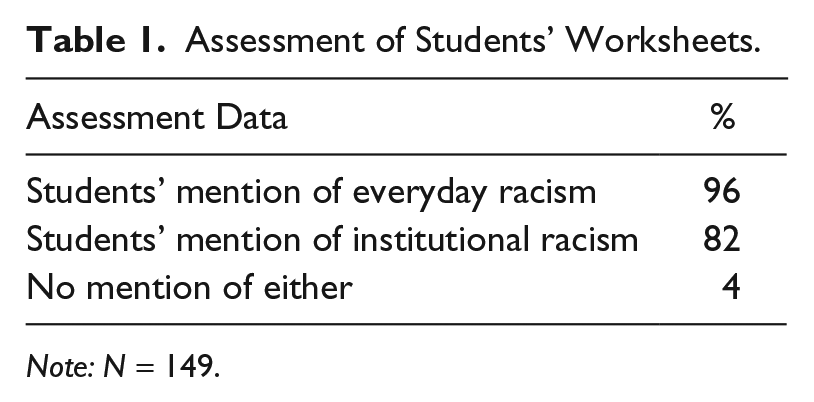
Alongside class discussion, the instructor was able to review all the students’ worksheets to see how they viewed and processed the episode. As previously mentioned, students were able to view the behavior between the characters, argued why they considered this behavior discrimination, and applied this to the real world. Students could analyze behaviors they examined on the show to explain both everyday and institutional racism in the real world. More students were able to analyze everyday racism; however, still over 80 percent of students were able to identify types of institutional racism (see Table 1). During this time in the semester, the instructor would not have been exposed to any lectures on racial discrimination or any racial theory, so students had to interpret the behavior based on their own background and what they considered to be racial discrimination. They were asked whether what they witnessed between Val Yor and Starfire was a bad attitude or discrimination. The students were not given a particular direction but were asked to explain what they understood discrimination was and to link it to examples in the United States. Most of the students stated that Val Yor’s behavior was clear discrimination, even if it was not always so obviously portrayed in the episode.
Assessment of Students’ Worksheets.
Note: N = 149.
As to whether Val Yor displayed institutional racism, students argued for two distinct ways the episode “Troq” mirrored the real world. First, many of the students’ responses remarked upon how institutional racism affected economic opportunities. They argued that because Starfire was Tamaranean, she was excluded from working on the ship even though she was invited to go on the mission. Val Yor does not give her a job on the ship, and when he finally gives her a job, it is a dangerous one and he comments that “her people” can handle such dangerous jobs. Students were able to connect this to situations in the United States. One student, a white female, responded, “This showed discrimination. He discriminated [against] Starfire by not giving her a job at first, calling her names, giving her the dangerous job, being hostile with her, and thinking she is worthless.” A black male student said, “I believe he was discriminating against her, because he didn’t want her to do anything [on the ship]. He thought since she was Tamaranean, she couldn’t do anything or she would mess it up if she did.”
Students stated that they notice that people in higher positions in the United States were usually white and people of color were at the bottom. They were able to correlate Starfire’s experience with how people of color are ignored regardless of their skills because of their race and are not given opportunities. In the United States, black unemployment rates exceed white unemployment rates, and black college graduates share the same unemployment rate as an adult white high school graduate (Wilson 2019).
Although the most obvious revelation of racial prejudice in the episode is when Val Yor calls Starfire the name Troq, many students also commented on behavior they noticed toward the rest of the Teen Titans. They stated that while other Titans were given jobs, she was excluded based on her “species” and that this action was discriminatory. Students stated that he tried to belittle her in ways that went beyond calling her Troq and that these were also forms of discrimination, such as making rude comments about her species or expressing doubt about whether she was strong enough to help with the mission. Finally, the majority of the comments from students stated that Val Yor discriminated against Starfire because he already had predetermined ideas about Starfire based on her being a Tamaranean.
During the class discussion, students commented on how they still see job segregation in the United States. They state that the majority of top-paying jobs, like CEOs, and political offices are still occupied by whites, compared to lower-paying jobs, which are more likely to be occupied by people of color. Since Val Yor served as an instructor and mentor figure, students were able to correlate the importance of connections and opportunities being denied to minority students with Val Yor intentionally ignoring Starfire and refusing to give her opportunities or attention compared to her other teammates. For instance, a black female student commented, “Val Yor think of Starfire as in the way and worthless to the mission. He was okay putting her in risk way. He is always second guessing her. He was almost ok if she gets hurt.”
Second, students were able to conceive of Val Yor as analogous to the police and the institutional policing of monitories in the United States. There is a plethora of research that reviews the treatment people of color receive from the police in the United States (Bass 2001; Brunson and Miller 2006; Macpherson 1999). This research demonstrates how law enforcement officers are likely to target a male person of color much more than someone who is white. However, students did not relate this to the way Val Yor treated Starfire but suggested instead that Val Yor, as a superhero, was supposed to protect “everyone” but that he did not offer this service to Starfire because of who she was. One student, a black male, said, “It was very representational of discrimination in the United States in the sense that Val Yor plays the role of this superior powerful figure that can do wrong and shun people as he pleases and still be capable of having a following.” Another student (a white female) stated, “This relates to my perception of discrimination in the United States pretty well, almost perfectly, the only thing missing is the police violence that runs alongside discrimination, Val Yor never attacked Starfire, just with verbal actions.”
Students then discussed the complexity of Val Yor’s character. He is a superhero who had initially saved the world in the episode. In the beginning of the episode, he was also considered a teammate to the Titans. However, in the lecture following the video, students argued that this was a representation of how racism in American society functions, since people of color are too often disproportionately hurt by the police force, an agency created to protect residents. They argued that the police have the same reputations as heroes but were not heroes to them, just like Val Yor might act like a hero but was not a “real hero.” Moreover, like the police, students argued that there is no “real punishment” for Val Yor. Students commented on how he was not going to face any consequences for his actions with Starfire. Many mentioned that some people will think he is a “good person” because he is super strong and portrays himself as a hero even though he is “racist.” They related that this is common in the United States, that even when police hurt someone, they argue that there are not real consequences for this action. The Henry A. Wallace Police Crime Database, created to track consequences for police killing civilians since 2005, shows that there are very few convictions for police officers who kill a civilian. Students nevertheless understand that the criminal justice system in this country is complex and that there is a blurry line between heroes and villains, since even those who act in ways that are intentionally or unconsciously racist may also be responsible for other acts that are valorous, like Val Yor.
Everyday Racism
More students from all classes were able to highlight everyday racism in this video because of the conversation around its mention of the epithet Troq. Still, the majority of students noticed these specific themes of exclusion, hostile or rude behavior, disrespect, or inferior treatment. One student, an Asian male, responded, Though he is not actively hostile towards Starfire, there are subtle hints of discrimination. He constantly insinuates that she is beneath him by berating her for her mistakes and ignoring her when she spoke.
Likewise, a black female student commented on the relevance of the themes presented in the program: This episode is a very good example of the world we live in today. Minorities get called all these different kinds of things each and every day. Even if whites have never seen or talked to that said person before.
Most of the students reflected on the behavior they saw in the episode and wrote more on overt forms of exclusion Val Yor exhibited within the episode. They discussed Val Yor’s rude or hostile microaggressions toward Starfire and how he disrespected her as a member of a group, calling her a racial epithet but also making comments like “your people.” They noticed that after she saved his life, he could not give her a decent apology. Students argued that the reason Val Yor treated Starfire this way was because he thought that she was inferior. They observed that, in battle together, Val Yor criticized Starfire even if she was stronger than the enemy. Students connected the word Troq to the racial slurs used in the United States. Moreover, one student of color shared their experiences and how they related to Starfire with daily microaggressions they had faced: “He was actively discriminating against her due to racial stereotypes. This can be seen when he makes direct racist comments about her solely because she’s Tamaranean.” Another student remarked on the use of derogatory language by the villain: “He was discriminating, the slur he used targeted her entire race, not just her.”
As a result of the exercises established around the video, students’ developed their ability to define and recognize racism and discrimination and grew more enthusiastic about understanding the topic and deepening their comprehension. This portion of the worksheet showed that students were successful in applying examples they saw during the show to both institutional and everyday racism in the real world. First, in small groups, we observed students were speaking with each other. Many times minority students were using Starfire’s experience to discuss their own experiences, a common practice: using fictional characters to express complex emotions (Dixon and Frasier 1986). Likewise, many students related the name Troq to the derogatory names used for blacks and Latinos in the United States. Val Yor’s character was heavily commented upon by students; they stated that although he was not a good person, and disrespectful to Starfire, he would continue to be a superhero. Moreover, they felt that even though Starfire had saved his life, he did not learn any lessons and would continue to “hate” Tamaraneans. Indeed, students stated that in real life, people will not always change their mind about a group even after they meet members of the group who do not conform to their stereotypes. When we combined this work with the subsequent lecture on critical race theory, we were able to set up the conditions for a more sophisticated and deepened understanding. Students were able to connect their thoughts with the larger theories.
The larger classroom discussions in all classes were vibrant, and students were able to speak freely, at length, and with detail and sophistication about what they saw from the episode. While this exercise was useful in starting discussion about race and racism in the classroom, it did not improve test scores. The exercise is held in the fourth week of the semester after the first exam and two weeks before the second exam. Student exams consist of five key terms and two short-answer questions on topics other than race alone. Furthermore, all students were given a study guide before their exam; therefore, so long as students used the study guide, regardless of whether they did the exercise or not, they could have attained a good grade. For this assignment, one of the essay questions asked students to give Todorov’s (2000) definition of racism and to give an example. There were no statistical differences in the successful answering of this question between students who watched the video and those who did not, and notes were given to students in different courses differently. Groups from SP 1 and 2, SP 3, and SP 4 and 5 all have similar scores, revealing that how the worksheets were later used in classes did not influence testing grades. Those students in SP 7, who did not watch the video, showed slightly lower scores, but there were no significant statistical differences. See Table 2.
Average Test Scores (in percentages).
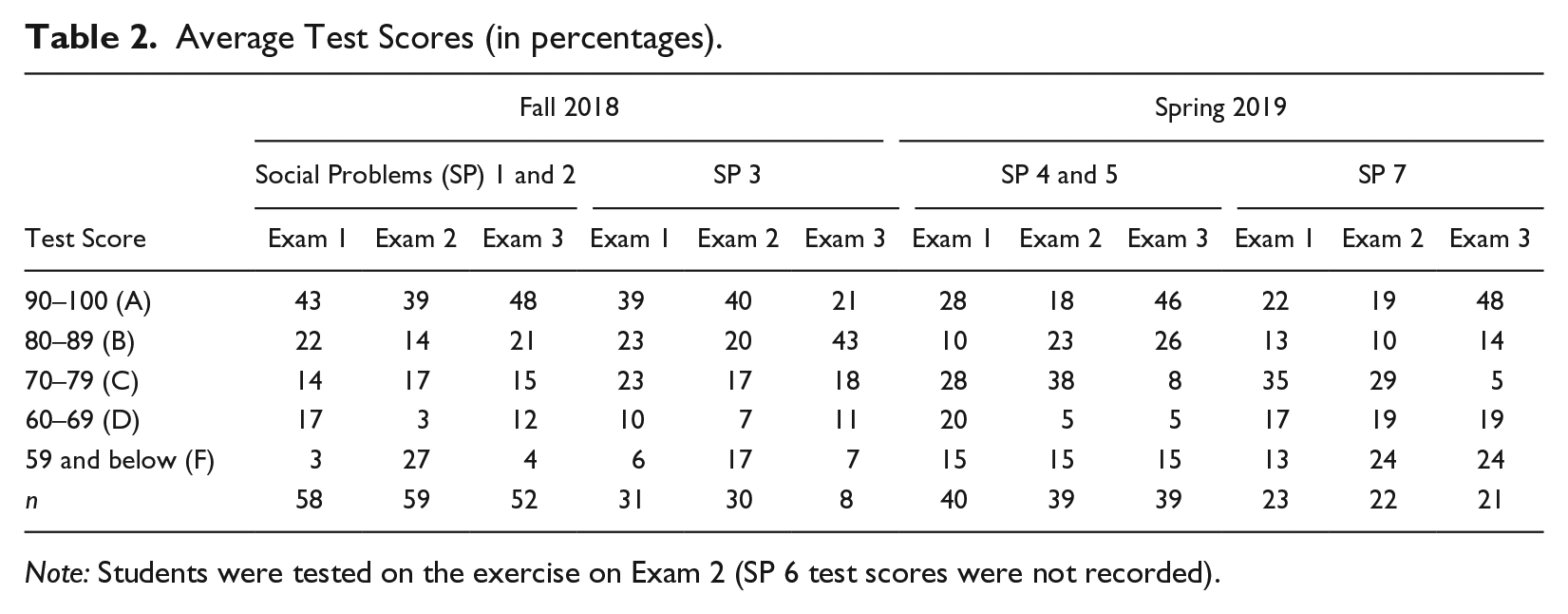
Note: Students were tested on the exercise on Exam 2 (SP 6 test scores were not recorded).
A few students from courses SP 3, 4, and 5 did use the Teen Titans episode in their answers when their comments were put on the slide.
Conclusion and Further Research
Teaching complex topics, such as race and ethnicity, in sociology courses can be challenging. Showing the Teen Titans episode “Troq” gave students who may not have had any experiences with racism a glimpse of this experience, and it gave students who have experienced racism a vivid, virtual comparison that could help them deconstruct their experiences. As an instructor, it was a useful tool to build class participation. At the end of the discussion, the instructor was able to shape race lectures based on student answers on the worksheets. While the instructor did not change the traditional slides, theory, or pace of the lecture, they were able to use students’ responses in the worksheets to show examples when discussing everyday racism and institutional racism rather than using instructor-chosen examples. Additionally, students were enthusiastic about being able to watch a popular television show in class and use it to discuss critical race theory.
However, like all class exercises, this video has some potential shortcomings. This exercise does take a whole class period, making the activity very time-consuming, and it may be more of a time commitment than other classroom activities (Coghlan and Huggins 2004). While most classrooms are now equipped with audiovisual capabilities, this exercise cannot be mobile and needs a screen, computer, and internet. This video is not on YouTube and must be purchased through a streaming service or on DVD. Moreover, we have conducted this exercise only in small classroom settings, so it might not work in larger lecture classes, where classroom participation may be restricted by time and size.
In addition to these practical concerns, the video itself has its shortcomings if one values the episode primarily for its analogy with the historical and personal complexities of racism and its pernicious persistence in human culture. Particularly because Teen Titans is a show aimed at children, it has a happy ending with the moral lesson neatly wrapping up the episode. Val Yor’s character completely disappears from the Titans’ universe, leaving Starfire free from discrimination, whereas the bleak reality of institutional and everyday racism in the real-world continues, ever renewing and deepening the suffering of those targeted by discrimination. As a result of Val Yor’s removal from the show, Starfire does not have to continue to deal with issues like institutional racism over the long term. Moreover, she states that Val Yor does not matter because she has friends to help her get through these situations, implying that there are no long-term consequences for her as a result of Val Yor’s discriminatory behavior. However, students argued that they felt that it is really those who perform racist acts who face few real-life, long-term consequences, and students of color noted that, for them, unlike Starfire in the episode, being a target of discriminatory and racist behavior will not change in their lifetime.
Footnotes
Appendix
Acknowledgements
We would like to thank Tiffany Birdsong, Eric Miller, Barbara Mogan and Kim Dupree. They gave us the opportunity to find a new way of learning, and it inspired this project.
Editor’s Note
Reviewers for this manuscript were, in alphabetical order, Rebecca Bach, David Brunsma, and Jeffery Dennis.
