



Abstract
The boundary between organizational insiders (e.g., employees) and outsiders (e.g., customers) has become increasingly permeable due to Internet discussion boards that enable members of both groups to share experiences of organizational fairness and unfairness. We studied discussion board threads on Vault.com, focusing on threads initiated by postings containing organizational justice content and authored by an organizational insider or outsider. Consistent with predictions of the social identity model of deindividuation effects, organizational insiders capitalized on anonymity to post messages that were significantly more negative in both cognitive content (describing organizations as less fair) and emotional tone (using more negative emotional language) than messages posted by organizational outsiders. As predicted by contagion theory, cognitive content influenced the emotional tone of reply messages, especially when initial postings were from organizational outsiders.
It is increasingly difficult to keep secrets on either side of the organizational fence. Organizational insiders lampoon employers on YouTube (Clifford, 2009) and compare benefit packages on blogs (Baker & Green, 2008). Information that organizational outsiders intended for friends and family reaches a wider audience as companies use social networking sites in background checks (Schawbel, 2010). Members of organizational identity groups (e.g., employees, former employees, job applicants, clients, and employees of competitors) regularly share information on sites designed to encourage discussions of customer gripes (Fost, 2008), company ethics (Lynn, 2009), and the quality of work life (Lewis, 2000). The websites operate as electronic discussion boards where individuals post information, raise questions, and share experiences (Lewis, 2000; Trigaux, 1999). Using these Internet resources, individuals with varying degrees of organizational affiliation are brought together in a passionate debate on the effective and ineffective ways organizations operate.
One of the most dramatic examples of the way Internet sites can bring diverse people together is the proliferation of discussion boards. We focus on Vault.com, an Internet website providing career advice. In March 1999, Vault opened hundreds of electronic bulletin boards, each one associated with a specific company, and invited employees, job applicants, and other interested parties to share information, career advice, and gossip. Within a few years, Vault had nearly one million messages posted on its boards (“Job Talk Popular,” 2003) and was attracting between 5000 and 7000 visitors every week (Lewis, 2000). Topics discussed on the Vault boards cover the gamut of organizational life, including organizational policies, pay worries, internal morale, and hiring practices.
Vault describes itself as the electronic version of the company water cooler—the place where people gather to discuss issues (Trigaux, 1999). But, while the traditional water cooler only attracted actual employees (organizational insiders), the electronic water cooler is visited by organizational outsiders—prospective employees, customers, journalists, and other organizational stakeholders (Jones, 2001). Vault offered the first company-focused discussion boards on the Internet and it has been described as “the bible” (Rose, 2010) and “the best” (Shellenbarger, 1999) among its competitors. Some discussion sites focus on employees in specific companies or industries (e.g., greedyassociates.com, focusing on newly minted attorneys) or deliberately solicit negative content (e.g., untied.com, a site attracting disgruntled employees and customers of United Airlines). In contrast, Vault’s discussion boards are open to organizational stakeholders of all kinds. Further, Vault does not explicitly encourage the posting of negative content about organizations. Therefore, its discussion boards reflect the spontaneous ways that organizational insiders and outsiders use an open forum to express their views.
Internet discussion boards create an opportunity for organizational insiders and outsiders to tell their organizational stories to a broad, even a worldwide, audience (Degoey, 2000; Martin, 1982; Skarlicki & Kulik, 2005). By providing an interpretive account of an organizational event, stories convey complex information in a highly concentrated manner. The stories told on these discussion boards might convey cognitive or descriptive information suggesting that the organization is fair or unfair. This descriptive information constitutes the posting’s cognitive content (Degoey, 2000). A poster might, for example, report the level of outcomes received from the organization (e.g., the extent to which an organization pays employees fairly or offers fair prices to customers), identify the opportunities for voice that the organization provides (e.g., the extent to which an organization’s management asks employees for input into decision making or asks the public for feedback), or describe the interpersonal treatment of organizational agents (e.g., the extent to which employees or job applicants feel respected by management).
However, the identical cognitive content can be expressed with different degrees of emotional tone (Degoey, 2000). The descriptive information communicated in a discussion board posting may be accompanied by emotionally charged language that conveys the poster’s emotional reaction to the organization and its outcomes or procedures. When people describe a justice-related organizational event, their narratives frequently contain references to the emotions they experienced in response to the incident (Bies & Moag, 1986; Bies & Tripp, 2002; Mikula, 1986). Posters can use the Internet discussion board as a forum in which to express the uncertainty, joy, anger, enthusiasm, disappointment, and other emotions they experience during their encounters with organizations and their agents. The emotions may be conveyed directly (e.g., “I love my job!” or “I was outraged!”) or indirectly through word choice (e.g., “I have the best job in the world” conveys a stronger positive emotional response than “I like the work I do here,” and “Service was abysmal” conveys a stronger negative emotional response than “Service was bad”).
The interactive nature of Internet discussion boards like Vault makes them an ideal place to observe candid conversations—including the cognitive content and emotional tone of those conversations—among organizational insiders and outsiders as they talk about their organizational justice experiences. Discussion boards blur the boundaries between organizational insiders and outsiders (Gossett & Kilker, 2006) and enable members of both groups to share their organizational experiences with an unusually broad audience (Degoey, 2000; Martin, 1982; Skarlicki & Kulik, 2005). The size and scope of the audience of Internet discussion boards are important because organizational justice experiences affect not only the people involved in an experience, but also the people who learn about the experience secondhand (De Cremer & Van Hiel, 2006; Skarlicki & Kulik, 2005; Spencer & Rupp, 2009).
We know little about how insiders and outsiders use discussion boards to communicate about organizational justice—or how these justice-related postings affect readers’ impressions of organizations. In particular, we know little about the characteristics of either postings or posters that have the most potent impact on readers (Boush & Kahle, 2005). To fill this gap, our research examines the cognitive content and emotional tone (Boush & Kahle, 2005; Degoey, 2000) of discussion board postings at Vault. We chose Vault over alternative discussion sites because of the breadth of Vault’s discussion topics and the variety of its posters. We use the Vault postings to examine two questions about organizational justice as it is discussed on the Internet: (a) How do organizational insiders and outsiders talk about organizational justice—do their postings differ in cognitive content and/or emotional tone? (b) How does insider/outsider status change the impact of a posting’s cognitive content and emotional tone on readers?
How Insiders and Outsiders Talk about Organizational Justice
An individual’s self-concept encompasses both a unique personal identity and various social identities. Social identities derive from connections with social groups, including employment relationships (Abrams & Hogg, 1990; Tajfel, 1982; Turner, 1987). The social identity model of deindividuation effects (SIDE; Lea & Spears, 1991; Reicher, Spears, & Postmes, 1995; Spears & Lea, 1992, 1994) describes the dual cognitive and strategic processes that are evoked when relevant social identities become more salient than an individual’s personal identity (i.e., deindividuation).
On the cognitive dimension, SIDE suggests that the anonymity afforded by computer-mediated communication reduces the salience of personal identity. In general, anonymity reduces people’s awareness of their personal identity so they feel less inhibited by social conventions and norms (Diener, 1980; Zimbardo, 1969). As a result, people engage in greater self-disclosure on the Internet than in face-to-face interactions (Tanis, 2008), express stronger emotions and feelings (Douglas, 2008), and are more willing to express opinions on controversial issues (Ho & McLeod, 2008). The anonymity experienced during computer-mediated communication is particularly effective in reducing one’s sense of personal identity because computer-mediated communication provides so few cues about a communicator’s idiosyncratic style, charisma, or appearance (Spears, Postmes, Lea, & Wolbert, 2002).
Anonymity’s disinhibiting effects are likely to motivate both organizational insiders and outsiders to describe unfair organizational experiences and to use stronger emotional language in those descriptions than they might in a face-to-face encounter. However, for organizational insiders, the reduction in salience of their personal identity is likely to be accompanied by an increase in the salience of a relevant social identity—their organizational membership. Social identity information is readily communicated on the Internet through message headers (Spears, Lea, Corneliussen, Postmes, & Ter Haar, 2002) and discussion topics (Lea, Spears, & Watt, 2007). For example, organizational insiders frequently adopt aliases for Vault that convey their insider status (“IBM Lifer”) and provide information in the subject header that links their posting to the relevant organization either directly (“McDonald’s pay practices”) or indirectly (“I bleed brown”—a reference to UPS’s brown vans and uniforms). On Internet discussion boards, these identity cues are likely to heighten a participating insider’s awareness of his or her social identity as an organizational member. Organizational membership is a very accessible social identity: “Indeed, for many people their professional and/or organizational identity may be more pervasive and important than ascribed identities based on gender, age, ethnicity, race, or nationality” (Abrams & Hogg, 1990, p.121). Even former organization members continue to identify with employers and derive intrinsic value from their prior affiliation (Ashforth, 2001).
In addition to the cognitive component, SIDE highlights a strategic component of deindividuation for organizational insiders (Klein, Spears, & Reicher, 2007; Spears et al., 2002). Once a social identity is made salient, computer-mediated communication offers strategic opportunities for organizational insiders to engage in identity performance, the “purposeful expression (or suppression) of behaviors relevant to those norms conventionally associated with a salient social identity” (Klein et al., 2007, p. 30). An insider can capitalize on the anonymity of the computer medium to express views that would otherwise be sanctioned or punished by organizational authorities (Gossett & Kilker, 2006; Spears & Lea, 1994; Spears, Lea, & Postmes, 2000). The identity performance of organizational insiders may include criticism of the organization, behavior that would antagonize authorities (Reicher & Levine, 1994). These critical views are designed to generate social resistance or change (Spears et al., 2002). The knowledge that an audience is present on the boards, and that the audience includes other organizational insiders, increases an insider’s sense of solidarity and support, giving the insider the courage to defy organizational disapproval and “badmouth” decisions or procedures (Spears & Lea, 1994). This form of dissent is particularly attractive to weaker organizational members who might otherwise fear being labeled a trouble maker or being retaliated against (Gossett & Kilker, 2006).
Research supports SIDE’s predictions that organizational members are more willing to express negative viewpoints when they are anonymous to institutional authorities but have access to other organizational members who might provide support (Lea, Spears, & Rogers, 2003). For example, students are more likely to describe non-normative behavior (e.g., “borrowing” from fellow students’ essays to save work; Reicher & Levine, 1994) and attitudes (e.g., disliking a course requirement to participate in research; Spears et al., 2002) when they are anonymous, and this engagement in “inappropriate” expression is heightened in the virtual presence of other students (Reicher, Levine, & Gordijn, 1998) or the electronic communication of social support (Spears et al., 2002). Further, employees are particularly likely to dissent to external audiences (family and nonwork friends outside of the formal organization) when they have exhausted internal organizational channels for change (Gossett & Kilker, 2006; Kassing & Dicioccio, 2004). In these circumstances, communication content may become increasingly strident and desperate because it is the only proactive option available (Gossett & Kilker, 2006). Internet discussion boards enable organizational insiders to engage outsiders and other insiders in dissent that would otherwise be discouraged by organizational management.
Organizational outsiders, in contrast, are unlikely to experience the strategic effects predicted by SIDE. Organizational outsiders do not experience a heightening of social identity on Internet discussion boards, because they are only peripherally associated with the organization—there is no ongoing well-defined social identity that a discussion of an employer is likely to activate.
Therefore, organizational outsiders are likely to maintain a salient personal identity even when posting anonymously. Further, the anonymous forum provides few strategic advantages for organizational outsiders. As outsiders, they have no reason to fear sanctions if they speak negatively about the organization so they do not need to capitalize on anonymity or leverage support from other readers.
Thus, we predict that,
Hypothesis 1: Relative to the postings of organizational outsiders, the postings by organizational insiders will convey less positive cognitive content (describe the organization as less fair).
Hypothesis 2: Relative to the postings of organizational outsiders, the postings by organizational insiders will express less positive emotional tone.
The Impact of Insider/Outsider Status on Reader Reactions
Much of the information any individual person has about an organization comes not from personal experiences but instead from the broader collective experience of other people (Jones & Skarlicki, 2005; Lind, Kray, & Thompson, 1998). Individuals actively incorporate the experiences of others into their own perceptions of organizations (Skarlicki & Kulik, 2005). Prospective job applicants, for example, actively seek input from organizational insiders (Ashford & Black, 1996; Cable & Judge, 1996) and participate in an anticipatory socialization process in which they develop associations with organizational ideologies and value systems even before beginning employment (Brief, Aldag, Van Sell, & Melone, 1979; Gibson & Papa, 2000). In addition, former employees continue to be perceived by others as organizational “insiders” and can influence outsider opinions (Sertoglu & Berkowitch, 2002).
These collective impressions play a key role in establishing and maintaining an organization’s fairness reputation. Public perceptions of an organization are highly vulnerable to social influence, social comparison, and interpersonal validation of reality (Greenberg, 1990, Lamertz, 2001; Salancik & Pfeffer, 1978). Over the long run, an organization’s fairness reputation contributes to its ability to attract, develop, and keep key employees (Koys, 1995; Turban & Cable, 2003), since potential employees would be unlikely to join an organization that has a reputation for unfair practices (Beugre & Baron, 2001).
Word of mouth or “word on line” (Granitz & Ward, 1996) is a particularly powerful channel for conveying information about organizations to a wide audience (Godes & Mayzlin, 2004). A story about a first-hand organizational experience can ignite social contagion—a process by which individuals imitate and exaggerate the thoughts and emotions of the storyteller (Barsade & Gibson, 1998). Thoughts and feelings about the organization can pass from one person to another and ultimately spread through an entire network. Degoey’s (2000) model of contagious justice identifies two distinct types of contagion. In cognitive contagion, it is the descriptive knowledge about the event that impacts the network. In emotional contagion, it is people’s emotional reactions that impact the network.
We have suggested that Vault postings will convey both cognitive content and emotional tone. Participants on the discussion boards can use the cognitive content and emotional tone of posters’ messages to socially construct an impression of the organization. As participants read and respond to initial postings, information about the organization can be communicated quickly. We expect that both the cognitive content and the emotional tone of initial postings will have a downstream effect on the discussion thread, influencing the emotional tone of replies to the initial posting.
However, we also expect that the social identity of the initial poster will be important in determining the impact of these message characteristics on the thread. The anonymous, deindividuated context of computer-mediated communication removes individuating cues about a poster’s personal identity but simultaneously provides cues about their social identity (i.e., evidence about whether they are an organizational insider or outsider). The lack of individuating cues about a poster’s personal status or credibility is likely to lower readers’ motivation to scrutinize and evaluate the poster’s message (Lee, 2008), and readers’ motivation is likely to be particularly low when the poster can be categorized as an organizational insider. Categorization can “impugn” the perceived independence and credibility of individual category members because perceivers assume that their opinions do not reflect solely their personal experience (Wilder, 1990, p. 1203). For example, Harkins and Petty (1987) found that the effectiveness of arguments presented by multiple sources was diluted when the sources were described as members of a common committee.
In contrast, a source that is perceived as offering independent information will trigger more motivated processing (Lee, 2008). In a discussion board devoted to a particular organization, postings by organizational outsiders are likely to stand out and command more attention—and be more persuasive. People are generally more persuaded by communicators who have nothing to gain if the communication recipient adopts their view, particularly when the communication content is of high concern to the recipient (Petty & Cacioppo, 1981). Menon and Pfeffer (2003) demonstrated that people place a particularly high value on outsider information, perceiving knowledge originating outside the organization to be less biased and more special and unique than knowledge originating from the inside.
Therefore, we predict that,
Hypothesis 3: The downstream emotional tone of a discussion thread (i.e., the replies to an initial posting) will be more strongly influenced by the cognitive content of initial postings that are authored by organizational outsiders rather than insiders.
Hypothesis 4: The downstream emotional tone of a discussion thread (i.e., the replies to an initial posting) will be more strongly influenced by the emotional tone of initial postings that are authored by organizational outsiders rather than insiders.
Method
Sample
The sample for this study consisted of messages posted to discussion boards on Vault, a site established to facilitate interaction between employees of hundreds of companies and these companies’ customers, job applicants, and other interested outsiders. Each discussion board is associated with an organization (e.g., IBM, Allstate Insurance), and anyone can go to an organization’s board and initiate a discussion thread. Participation is free of charge.
We harvested all the messages contained in 1,089 threads on the boards associated with Fortune 500 companies posted during the first 6 months of the site’s operation (launch date March 23, 1999). We collected data during the first 6 months of the discussion boards, because, at this point, the communication gates were fully open. Vault did not require any formal registration to post on its boards until June 2001 (Glater, 2001), and the companies who were the targets of discussion were slow to learn about the site, generate policies about postings, or block the site on company-owned computers (Abelson, 2001; Work Week, 2000). As a result our analysis of Vault’s first 6 months of operation represents a maximally open flow of information between and across organizational insiders and outsiders. We focused on Fortune 500 companies, because these discussion boards were among Vault’s most popular, generating the largest amount of traffic and producing the largest amount of content for analysis.
Content Analysis and Data Integration Procedure
Initial postings (the first message in each discussion thread) were read by two coders, an undergraduate student who was unfamiliar with this study’s hypotheses and the first author. The coders first conducted a screen to see if the initial posting in a thread conveyed any information about outcomes received from the organization or its agents (discounts, pay, bonuses, promotions, travel opportunities, training, layoffs, budget cuts, fringe benefits, etc.), procedures used by the organization or its agents to determine the allocation of outcomes (criteria used to determine who gets laid off, who gets promoted, etc.), or the quality of interpersonal treatment received from the organization or its agents (being treated equally/unequally, respectfully/disrespectfully, politely/impolitely, etc.). These three content areas reflect, respectively, the distributive, procedural, and interpersonal treatment dimensions of organizational justice (Cropanzano & Greenberg, 1997). If the initial posting did not contain any information about outcomes, procedures, or treatment, then all coding and analysis ceased at this point. This screen enabled us to filter out threads in which the initial posting contained gibberish (e.g., “xxyyyzzz”), content that was irrelevant to the organization (e.g., “My girlfriend is hot!”) or content unrelated to organizational storytelling (e.g., “Does Joe Smith still work in the marketing department?”). A sample of initial postings that passed this screen is presented in Table 1. Coders were encouraged to think about the outcome, procedure, and interpersonal treatment content areas very broadly, and to code the thread as 1 = yes if the initial posting contained any information about organization-related outcomes, procedures, or treatment; 0 = no if the initial posting contained no information about outcomes, procedures, or treatment. Cohen’s kappa is a measure of intercoder reliability used when coding tasks are based on mutually exclusive categories. It is a conservative measure that corrects for chance agreement, and a kappa of .70 or greater suggests acceptable reliability (Cohen, 1960, 1968). For this initial screen, Cohen’s kappa = .75.
Sample Initial Postings

For threads in which the initial posting did convey information about the organization’s outcomes, procedures, or treatment, coders provided additional information about the initial posting’s content (details are described below). The coders independently coded each initial posting and met regularly to compare codes and resolve coding discrepancies.
Then every posting in every thread (the initial posting and each reply) was assessed using the Dictionary of Affect in Language (DAL) computer program (Sweeney & Whissell, 1984; Whissell, 1998). The DAL contains more than 8,000 words that have been rated by an average of eight different judges and has been used to provide objective ratings of emotional tone in text samples in several organizational contexts, including customer conversations with service representatives (Verhoef, Antonides, & de Hoog, 2004), employee reactions to organizational change efforts (Mossholder, Settoon, Harris, & Armenakis, 1995), and managerial descriptions of within- and between-culture conflicts (Doucet & Jehn, 1997).
Finally, we matched the organization discussed in each thread to the 1999 Fortune Corporate Reputation Database. We used the 1999 database, because it described the organizations’ reputation at the time the discussion threads in our sample were being initiated. Companies in the Corporate Reputation Database are the 10 largest companies in 58 industries. Within each industry, executives, directors, and securities rate the companies quality of management, quality of products/services, innovativeness, long-term investment value, financial soundness, employee talent, social responsibility, and use of corporate assets. Fortune uses these ratings to rank order the corporations’ reputations (where 1 = most admired).
At the end of this procedure, we had integrated into one database the following information: (a) coder ratings of the content conveyed in the thread’s initial posting, (b) DAL data on the postings in the thread, and (c) Fortune Corporate Reputation data on the organization discussed in the thread. In our database, and in the subsequent analysis, the unit of analysis is the thread. By focusing on the threads in which the initial poster conveyed information about the organization’s outcomes, procedures, or treatment (described above) and in which the initial poster’s insider/outsider status could be identified (details below), the database was constrained to 678 threads associated with 184 organizations for analysis.
Predictor and Outcome Variables
Initial poster identity group
The two coders assessed whether an initial posting was authored by an organizational insider or an outsider. Identity group was coded as 1 if the initial posting appeared to be authored by a current employee, a former employee, or a family member or friend of a current or former employee (see the top half of Table 1 for examples). Identity group was coded as 0 if the initial posting appeared to be authored by a job applicant, someone seeking career advice about the organization, a customer, or an employee of a rival organization (see the bottom half of Table 1 for examples). In other words, organizational insiders were indicated by “1”; outsiders were indicated by “0.” Identity codes were based on the poster’s alias (e.g., “IBM employee” or “UPSer”) and on message content (e.g., a poster would often describe his or her affiliation with the organization in the body of the message; Cohen’s kappa = .75).
Cognitive content (fairness)
The two coders assessed the initial message’s cognitive content by answering the following question: Overall, is the initial posting describing the organization or its agents as fair or unfair (1 = unfair; 5 = fair)? Coders’ fairness ratings were averaged to form a Cognitive Content score (rwg = .71). We used rwg as a measure of intercoder reliability because the fairness rating categories are ordered (James, Demaree, & Wolf, 1993).
Emotional tone (positiveness)
We used the DAL to calculate the percentage of unusually positive and unusually negative words in each posting (i.e., the percentage of words with scale scores ranking them in the top or bottom quartiles of all the words in the DAL; Whissell, 1989; Whissell, Fournier, Pelland, Weir, & Makarec, 1986). Our Emotional Tone measure is the arithmetic difference between the percentage of unusually positive words and the percentage of unusually negative words in the thread’s initial posting (see Sigelman & Whissell, 2002).
Downstream emotional tone (thread positiveness)
For analyses assessing a downstream effect in the thread, we needed an overall measure of the emotional tone associated with replies. When a thread included replies to an initial posting, we calculated the arithmetic difference between the percentage of unusually positive words and the percentage of unusually negative words in each reply and averaged these difference scores to create a Downstream Emotional Tone measure.
Control Variables
Organizational characteristics (e.g., a firm’s public image) may influence discussions about the organization’s behavior in specific incidents (Degoey, 2000) and therefore we included the organization’s most admired rank (from the Fortune Corporate Reputation Database) in each analysis. As the reputational variable is a rank, larger numbers reflect less positive reputations.
Incident characteristics (e.g., the content of the initial poster’s message) may influence both the initial poster’s emotional tone and the tone of replies. First, messages focusing directly on an individual-level experience are likely to convey more vivid and specific content. Specific content makes it easier for the reader to imagine himself or herself in similar circumstances, making an emotional response more likely (Batson, Early, & Salvarani, 1997; Skarlicki & Kulik, 2005). The two coders assessed whether the initial posting’s message content had a “micro focus” (1 = discussing individual jobs or careers within the organization) or a “macro focus” (0 = discussing the organization more broadly; Cohen’s kappa = .74). Second, diversity incidents are often “hot button” emotional issues and people have distinct emotional responses to demographic groups (Cottrell & Neuberg, 2005; Roberson & Stevens, 2006). Further, justice issues are particularly likely to emerge in posters’ recollections of diversity incidents (Roberson & Stevens, 2006). We wanted to ensure that our analyses assessed the impact of a message’s justice content and emotional tone independent of its diversity content. Consistent with Roberson and Stevens’ (2006) qualitative analysis of diversity narratives, we asked coders to watch for content describing discrimination based on demographics (e.g., race or sex) or commenting on an organization’s diversity climate (e.g., the organization’s policies or practices about diversity inclusion). The two coders assessed whether the initial posting contained any diversity content (1 = diversity content; 0 = no diversity content; Cohen’s kappa = .80).
Finally, the punctuation used in an initial posting may influence the likelihood of replies. Specifically, question marks signal a poster’s interest in dialogue and may influence both the likelihood of a response and the emotional tone of responses (Thomsen, 1996). The DAL counted the Number of Question Marks, and this was used as a control variable in the downstream analyses.
Results
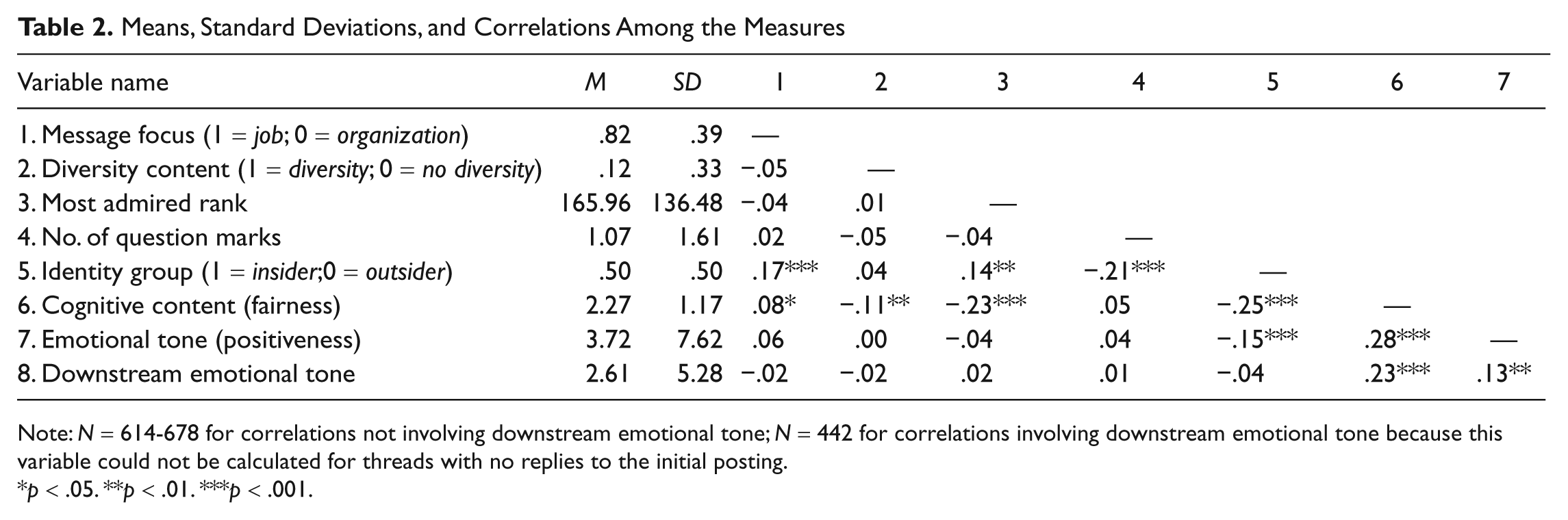
Table 2 reports the mean, standard deviations, and correlations among all the variables. Hypotheses 1 and 2 predicted that initial postings would describe an organization as less fair and use a less positive emotional tone when they were authored by organizational insiders (coded as “1”) rather than outsiders (coded as “0”). Consistent with predictions, the correlations indicate that insiders described their organizations as less fair (r = –.25, p < .001) and with more negative emotional tone (r = –.15, p < .001) than outsiders did. These hypotheses were tested more rigorously using multiple regression and the results are presented in Table 3.
Means, Standard Deviations, and Correlations Among the Measures
Note: N = 614-678 for correlations not involving downstream emotional tone; N = 442 for correlations involving downstream emotional tone because this variable could not be calculated for threads with no replies to the initial posting.
p < .05. **p < .01. ***p < .001.
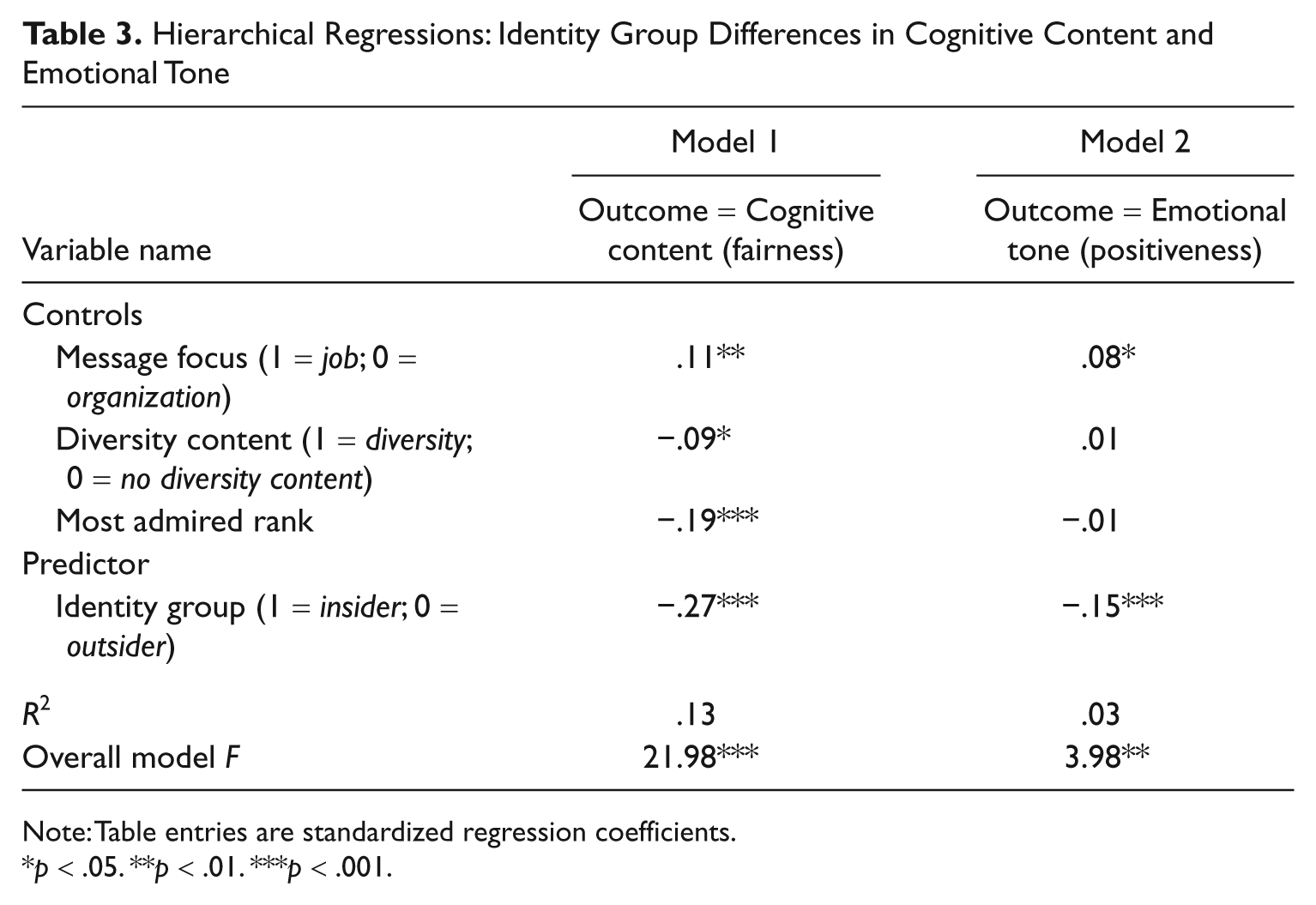
Hierarchical Regressions: Identity Group Differences in Cognitive Content and Emotional Tone
Note: Table entries are standardized regression coefficients.
p < .05. **p < .01. ***p < .001.
The initial poster’s identity group was the primary predictor variable in equations predicting the initial postings’ cognitive content (fairness) and emotional tone (positiveness). Both equations also included several control variables that previous research suggested might influence the results. As shown in the Model 1 column of Table 3, several of the control variables significantly predicted the cognitive content (fairness) of the initial posting: Messages focusing on individual jobs or careers (β = .11, p < .01), containing no diversity content (β = −.09, p < .05), and posted on the discussion boards of more admired organizations (β = −.19, p < .001) described the organization as more fair. As shown in the Model 2 column of Table 3, messages focusing on individual jobs or careers (β = .08, p < .05) also had a more positive emotional tone.
Table 3 shows, after controlling for the control variables, the sign on identity group (1 = insider; 0 = outsider) remains negative in both Model 1 and Model 2. Thus, consistent with Hypotheses 1 and 2, initial postings authored by organizational insiders described the organization as significantly less fair (β = −.27, p < .001) and used a significantly less positive emotional tone (β = −.15, p < .001) than those authored by outsiders.
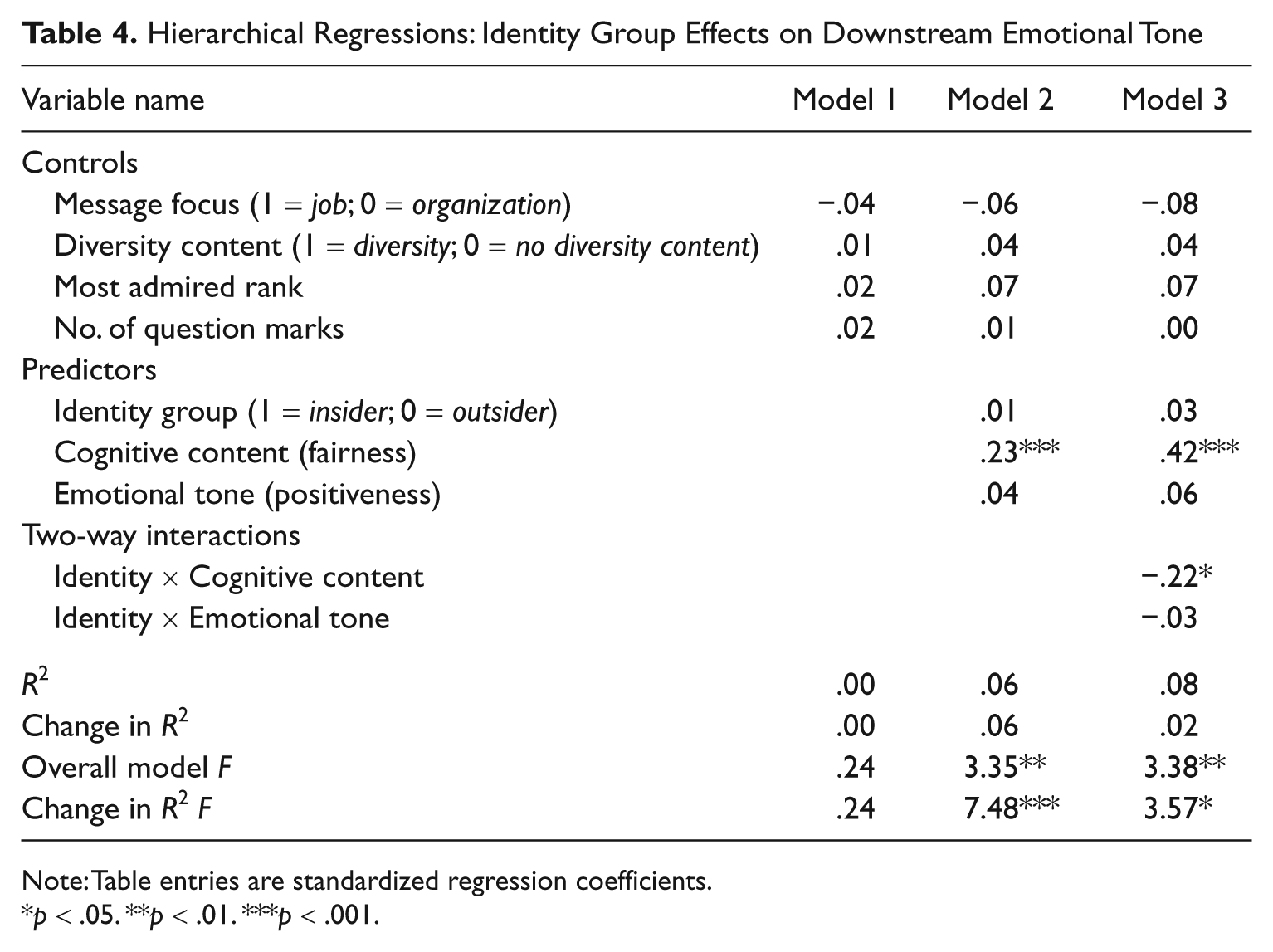
Hypotheses 3 and 4 predicted that the cognitive content (fairness) and emotional tone (positiveness) of initial messages would have a greater downstream effect when the initial message was authored by an organizational outsider. These hypotheses were tested using hierarchical multiple regression and the results are presented in Table 4. Prior to the regression analysis, we centered the values for cognitive content (fairness) and emotional tone (positiveness) and created interaction terms by multiplying these centered variables by identity group (Aiken & West, 1991). The inclusion of multiplicative terms in regression analyses can raise concerns about multicollinearity, but the variance inflation factors associated with our predictor variables were all close to 1.0, indicating very low levels of multicollinearity (Hair, Anderson, Tatham, & Black, 1998).
Hierarchical Regressions: Identity Group Effects on Downstream Emotional Tone
Note: Table entries are standardized regression coefficients.
p < .05. **p < .01. ***p < .001.
Control variables were entered in the first step of the regression (Model 1 in Table 4). None of the control variables had a significant effect on the evaluative tone of downstream messages. Predictor variables were entered in the second step. Identity group and emotional tone were both positively signed but not significant (identity group β = .01, p = ns; emotional tone β = .04, p = ns). However, cognitive content (fairness) had a significant positive effect (β = .23, p < .001); the more the initial poster provided cognitive content indicating the organization was fair, the more positively toned the replies.
Two two-way interactions (Identity group × Cognitive content and Identity group × Emotional tone) were entered in the third step. Only the interaction involving identity group and cognitive content (fairness) was significant, suggesting that the effect of an initial message’s cognitive content (fairness) on downstream positiveness was moderated by the poster’s identity group (β = –.22, p < .05). We estimated the effect size, which describes the proportion of total variability attributable to the interaction term, to be f2 = .032. Although this increment is small in an absolute sense, the size of the effect compares favorably with the observed size of other moderator effects in the management literature. In a 30-year review of articles published in the Journal of Applied Psychology, Personnel Psychology and the Academy of Management Journal, Aguinis, Beaty, Boik, and Pierce (2005) found that the overall mean observed size of moderating effects of categorical variables was .009, with a 95% confidence interval ranging from .006 to .012. However, the skewed nature of the effect size distribution may make the median effect size of .002 a more appropriate point of comparison. The observed power for the calculation of effect size in our analysis was .92. This result also compares well with Aguinis et al. (2005) where the mean statistical power to detect a targeted effect size of .010 was .62 (Mdn = .61).
To better understand the significant interaction, we plotted the overall regression equation using procedures recommended by Aiken and West (1991). The plot is shown in Figure 1. We plotted separate regression lines for organizational insiders and outsiders. These regression lines plot the effect of different levels of cognitive content (fairness) in the initial posting on the emotional tone (positiveness) of downstream messages. An inspection of the simple slope coefficients demonstrate that the cognitive content (fairness) of an initial message posted by an organizational insider has a nonsignificant impact on downstream emotional tone (b = .29, p = ns). However, the cognitive content (fairness) of an initial message posted by an outsider does have a significant impact (b = 1.65, p < .01).
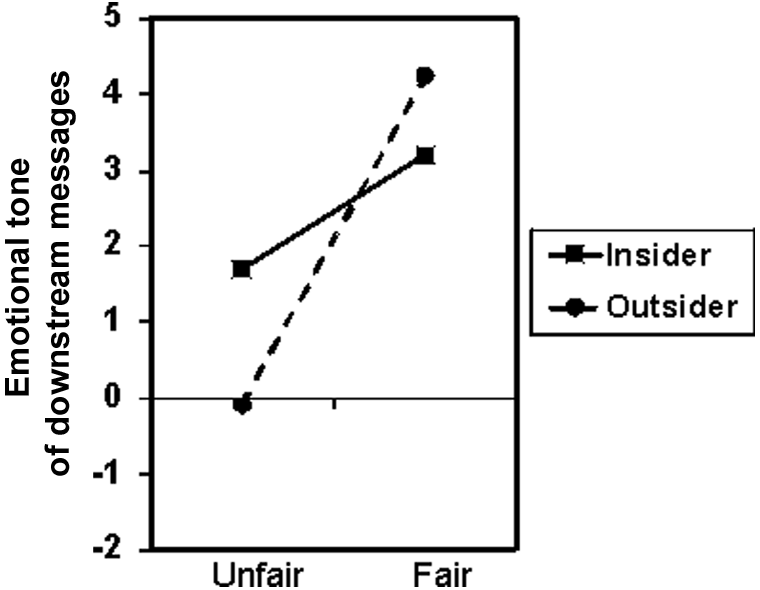
Moderating effect of identity group
Discussion
In this research, we examined how insiders and outsiders discuss organizations on a website that encourages interaction across the organizational boundary. We focused specifically on discussion threads in which the initial poster conveyed information about the outcomes, procedures, or interpersonal treatment associated with an organization. As Degoey (2000) explains, people are motivated to talk about these dimensions because of their association with organizational justice. With little opportunity to directly influence the quality of outcomes or interactions experienced during organizational encounters, talking about these issues with other people facilitates sense making and provides social support.
The website enabled us to observe how organizational insiders and outsiders describe their organizational experiences to others. We found postings authored by organizational insiders contained cognitive content that described the organization as less fair, and used a more negative emotional tone, than postings authored by outsiders. The site also provided us the opportunity to see how other people react to those descriptions. We found the cognitive content (the extent to which the initial poster described the organization as fair or unfair) had a significant downstream effect on the emotional tone of replies—but only when the initial posting had been authored by an organizational outsider.
Our findings lead us to two conclusions. First, the motivation for posting organizational experiences on an Internet discussion board differs for organizational insiders and outsiders. Organizational insiders use discussion boards as a place to “vent” about the organization; outsiders use them to share “good news” about organizational encounters. Second, outsiders have a greater effect on how discussion board participants feel about organizations than insiders do. The power of the outsider lies in his or her description of the organization as fair or unfair. Discussion board participants responded to the cognitive content of the outsider’s message, not the outsider’s emotional tone.
Theoretical and Practical Implications
Insider motivations for discussion board activity
Based on social identity theory, organizational insiders are usually expected to protect their organization’s reputation, and thus indirectly to protect their own self-esteem (Abrams & Hogg, 1990; Haslam, Oakes, Turner, & McGarty, 1996). In face-to-face circumstances, the desire to maintain a positive self-concept usually makes an insider more reticent about criticizing an organization than an outsider would be. Organizational insiders “accentuate the positive” aspects of their organizations (Ashforth, 2001). They “bask in reflected glory” and brag about organizational successes, but downplay organizational failures (Cialdini et al., 1976).
However, the SIDE model suggests that social identity has different effects in anonymous contexts. Specifically, the anonymity provided by Internet discussion boards highlights insiders’ social identity while protecting them from organizational reprisals (Gossett & Kilker, 2006). In these situations, the strategic component of deindividuation is activated and insiders engage in identity performance—intentional behavior designed to affect audience members (Klein et al., 2007). Protected by anonymity, low status employees have nothing to lose by challenging authority openly and aggressively (Scheepers, Scheepers, & Ngwenyama, 2006). Identity performance in anonymous contexts can include passionate descriptions of organizational injustice and active antagonism of organizational authorities in the hope of gaining social support from audience members (Reicher & Levine, 1994; Spears et al., 2002).
Audience effects are rarely examined within real-world communication contexts (Smith, Terry, & Hogg, 2006), and one of the most important contributions of our research is our demonstration of how organizational insiders engage in identity performance for a diverse virtual audience. On some Internet sites, particularly sites that were deliberately established to provide a forum for disgruntled employees and customers (e.g., RadioShackSucks.biz), posters are aware that managers are monitoring the discussions (Gossett & Kilker, 2006). But in Vault’s early days (we studied postings from the first 6 months of operation), managers were largely ignoring the boards (Work Week, 2000) or only occasionally lurking (Furchgott, 1997). Only later did managers begin to actively participate in the boards (Simons, 2001) or develop policies about employee involvement with the boards (Berenson, 2002). This suggests that, consistent with SIDE’s predictions, that the primary targets of insider postings on Vault were non-management insiders and organizational outsiders. If the message reaches the right ears, it might stimulate collective action to correct the unfairness (Postmes & Brunsting, 2002).
The power of outsider fairness descriptions
Our findings also demonstrate that discussion board participants are affected by the descriptive content about organizational fairness presented by outsiders. This has implications for our understanding of contagion effects. While Degoey (2000) suggested that communication recipients respond to both the cognitive content of a justice message and its emotional tone, our findings suggest that cognitive content (the fairness implications of the message’s content) may be the primary driver. The effect of outsiders’ cognitive content was strong even though outsiders frequently asked questions that acknowledged their information was limited (“Anybody got anything bad to say?”) or secondhand (e.g., based on a television interview with the CEO). Further, our findings demonstrate that contagion effects operate through processes other than direct imitation or exaggeration (Barsade & Gibson, 1998). In the discussion threads, respondents did not mimic the initial poster’s emotional tone (positiveness)—they reacted to the cognitive content (the description of the organization as fair or unfair) and generated an emotional response to it.
We based our social influence predictions on evidence that sources perceived as providing independent information generate more effortful processing (Lee, 2008), are expected to be less biased (Menon & Pfeffer, 2003), and therefore are more persuasive (Petty & Cacioppo, 1981). However, theoretical perspectives drawing on social identity theory (e.g., referent informational influence theory; Abrams, Wetherell, Cochrane, Hogg, & Turner, 1990; Turner, Wetherell, & Hogg, 1989) suggest that the reader’s own social identity group is likely to make a difference. In particular, people who share the initial poster’s social identity are more likely to view the poster’s arguments as valid—and to incorporate the poster’s viewpoint into their own opinion (Lee, 2007). In the context of social identity theory predictions, our findings are surprising, because organizational outsiders are not associated with any particular social identity group and therefore might be expected to generate little or no attitude change in discussion board readers (Cialdini & Goldstein, 2004). One possibility is that outsiders expressing negative views about an organization were particularly effective in engaging disaffected insiders who saw the outsider as a “kindred spirit” even if he or she was not an official card-carrying organizational member.
As access to Internet-based media continues to expand, organizations are increasingly challenged about how to manage the flow of information across their boundaries. Some organizational attempts to “manage” the interpretive process occurring on Internet discussion boards have been heavy handed, with several organizations firing employees for posting negative opinions on message boards (Berenson, 2002). But recent cases (Greenhouse, 2010) have confirmed that talking about working conditions is a protected right, whether it takes place at the physical water cooler or the virtual one. Further, our results suggest that management interventions designed to suppress Internet discussions about working conditions may be misdirected. First, the interventions exclusively target insiders, while our study’s results suggest that organizational outsiders have greater influence than insiders in shaping public opinion. Second, the interventions fail to consider the possible negative effects of constraining insider access to Internet forums. Research has found that suppressing unpleasant emotions in the work context decreases employee job satisfaction and increases intentions to quit (Cote & Morgan, 2002). Writing about an experienced organizational injustice boosts employees’ well-being and reduces employees’ anger and intention to retaliate (Barclay & Skarlicki, 2009). Just like the physical water cooler, the electronic water cooler may be a place where insiders can “take off their masks” and temporarily drop the emotional faces they usually are expected to wear at work (Kelly & Barsade, 2001)—benefiting the employee, and indirectly benefiting the organization.
Organizational scholars have suggested that rumors’ substance have strategic value to organizations (see Conlon & Shapiro, 2002), and therefore, managers might want to consider a broader range of responses to managing Internet discussions. Some organizations accept employees’ Internet activity, asking them only to protect company secrets (Wong, 2009). Some try to have the best of both worlds by encouraging employees to adopt anonymous aliases and be “as savage as they like” but to keep the exchange on the company’s internal electronic soapbox (Ewing, 2009). And still others try to actively shape their reputations by developing sites like “Kmart Forever,” an organization-developed site that “shamelessly begs its employees and customers to give it compliments” (Hwang, 2002). Future research is needed to determine what it means to “manage well” the Internet-based forms of organizational insiders’ and outsiders’ communications, including making an informed choice between passive and active interventions. Because outsiders exert a greater influence than insiders (see Menon & Pfeffer, 2003), organizational interventions may need to differ depending on the informational source (internal or external).
Research Strengths and Limitations
By coding the Vault message material and integrating these data with other objective sources (DAL text analysis and Fortune reputational data), we avoided the common method concerns associated with the survey methodology that dominates the organizational literature (Podsakoff & Organ, 1986). However, archival research of this kind has its own limitations. Most importantly, we relied on poster-conveyed signals (their name or alias and the posting content) to categorize posters as organizational insiders and outsiders, and these signals may not have been accurate. Posters may have intentionally misrepresented their organizational identity. Vault founders have argued that their discussion boards “self-regulate” these misrepresentations (Schrage, 1999) and in our own Vault lurking, we regularly observed posters who would demand details that would confirm another poster’s claim to have first-hand information or to work in a particular department. Our hypotheses about the downstream effects of the initial poster’s identity group (Hypotheses 3 and 4) do not depend on the accuracy of those insider/outsider categorizations, because Internet readers use and respond to the same poster-conveyed signals we used to make inferences about the poster’s identity group. However, identity group accuracy may have implications for hypotheses about how members of these two groups behave (e.g., our Hypotheses 1 and 2). The opportunity to temporarily “adopt” an outsider identity may eliminate the threats to self-esteem that social identity theory suggest will inhibit a person from disclosing negative information about a group to which they belong (Cialdini et al., 1976; Haslam et al., 1996). This suggests that future research should examine insider and outsider presentational differences under conditions that constrain the opportunity for posters to misrepresent their identity on the Internet.
By using the Vault discussion boards as a data source, we were able to access spontaneous communications by organizational insiders and outsiders. Previous research has demonstrated contagion effects in controlled settings (e.g., Brockner et al., 1997; Folger, Rosenfield, Grove, & Corkran, 1979), but the Vault discussion boards provide the opportunity to observe contagion in a natural setting. The discussion threads preserve the cause-and-effect chain of one person’s description of organizational fairness and other people’s reactions to that description. Therefore, we were able to examine perceptions of organizational fairness that were spontaneously communicated (unprompted by a researcher’s survey questions) by both organizational outsiders and insiders in an interactive forum (as opposed to self-report). However, the SIDE-based interpretations of our findings suggest that organizational insiders are strategically motivated to post and influence particular audiences, and we were not able to assess these motivations directly. Researchers are beginning to develop typologies of the diverse motivations of online participants (e.g., Brüggen, Wetzels, de Ruyter, & Schillewart, 2011; Foster, Francescucci, & West, 2010; Hau & Kim, 2011). Integrating survey-based assessments of posters’ motivations with their actual online activity would enable us to make stronger casual statements about why insiders and outsiders post different kinds of information. Alternatively, some research on SIDE makes use of laboratory methodologies to assess persuasive communication in deindividuated contexts (e.g., Lee, 2007, 2008). These experimental contexts can be used to simulate the downstream effects we witnessed on Vault, by demonstrating how members of different social identity groups respond to persuasive communication delivered by organizational insiders and outsiders. Most importantly, however, we encourage any research on justice discussions to explicitly consider the simultaneous engagement of organizational insiders and outsiders. Our findings suggest that organizational outsiders and insiders talk to each other and use the Internet to facilitate that talk—most likely, this talk leads to behavior (some desired and some not desired by organizations) as insiders and outsiders act on what they learn from one another.
Footnotes
Acknowledgements
The authors thank Michelle McQueen for her help with the content coding and Sarbari Bordia and Prashant Bordia for their useful advice on earlier versions of the manuscript.
Declaration of Conflicting Interests
The authors declared no potential conflicts of interest with respect to the research, authorship, and/or publication of this article.
Funding
The authors disclosed receipt of financial support for the research, authorship, and/or publication of this article from the grants-in-aid program sponsored by the Society for the Psychological Study of Social Issues.