




Abstract
Many consider same-sex marriage the civil rights issue of our time. Although support is on the rise, there are some Americans who oppose same-sex marriage. Heterosexual males are a demographic group particularly likely to oppose same-sex marriage. Mass media and education are often thought of as important agents of socialization in American culture. Pornography in particular is a platform often discussed in terms of its impact on males’ sexual attitudes. This study used nationally representative three-wave longitudinal data gathered from adult U.S. males to examine the over-time interplay between pornography consumption, education, and support for same-sex marriage. Support for same-sex marriage did not prospectively predict pornography consumption, but pornography consumption did prospectively predict support for same-sex marriage. Education was also positively associated with support for same-sex marriage. Scientific and social implications of these findings are discussed.
Introduction and Background
A variety of U.S. commentators have identified same-sex marriage as “the civil rights issue of our time” (Dowd, 2011, para. 16; “Legislature Should Vote for Same-Sex Marriage,” 2012, para. 3; Ruffin, 2011, para. 1). Social scientific data suggest that same-sex couples and their children suffer a variety of negative consequences due to same-sex couples’ inability to marry. Herek (2006) reviewed the literature on marriage and well-being and concluded the following:
Marriage bestows substantial psychological, social, and health benefits . . . Same-sex couples and their children are likely to benefit in numerous ways from legal recognition of their families, and providing such recognition through marriage will bestow greater benefit than civil unions or domestic partnerships. (p. 607)
Public support for same-sex marriage is on the rise in the United States. Gallup Poll data (May 20, 2011) showed, for the first time, that a majority of adult Americans (53%) agreed that “marriages between same-sex couples should be recognized by the law as valid, with the same rights as traditional marriage” (Newport, 2011). There are many Americans, however, who still oppose same-sex marriage. At present just six states (Connecticut, Iowa, Massachusetts, New Hampshire, New York, Vermont) and Washington, D.C., allow same-sex marriage (Maloney, 2012).
Given the documented benefits of marriage and the variability in support for same-sex marriage among individuals of voting age in the United States, research is needed that identifies predictors of support for same-sex marriage. Research to date has primarily explored demographic predictors, such as age, gender (Newport, 2011), ethnicity (Lewis & Gossett, 2008), and political orientation (Persily, Egan, & Wallsten, 2006). Identifying demographic predictors is important. But it is perhaps more important to identify socializing forces that predict change in support for same-sex marriage over time.
Mass media and education are often thought of as important agents of socialization in American culture (Potter, 2005). Little research exists on either social influence and on support for same-sex marriage in the United States, however. Research that has been conducted on education (Lewis, 2005) and media consumption in the form of news media (Becker & Scheufele, 2011) found little evidence that either factor significantly contributed to views on same-sex marriage. But the news media’s capacity to change attitudes has long been questioned (Cohen, 1963; McCombs & Shaw, 1972). And studies correlating education with acceptance of homosexuality more generally (Herek, 1984, 1991; Loftus, 2001) cast doubt on the dependability of research suggesting that attitudes toward same-sex marriage are independent of education.
Attitudes toward same-sex marriage are, in essence, sexual attitudes. According to both liberal (Luciano, 2012) and conservative (Hawkins, 2012) commentators, the number one factor that determines attitudes toward same-sex marriage is attitudes toward same-sex sex. Indeed, Americans’ attitudes toward same-sex sex are strongly correlated with their attitudes toward same-sex marriage (Davis & Smith, 2010).
Pornography consumption may be a more reliable predictor of sexual attitudes than consumption of news or other nonsexual media. Pornography may be defined, broadly, as mediated content depicting nudity and explicit sexual acts (Wright, Malamuth, & Donnerstein, 2012). Recent cross-sectional survey research has correlated pornography consumption with more acceptance of a wide variety of nontraditional sexual behaviors (Braun-Courville & Rojas, 2009; Carroll et al., 2008; Weinberg, Williams, Kleiner, & Irizarry, 2010; Wright, 2011b). Longitudinal and experimental studies have found that earlier pornography exposure predicts subsequent changes in nontraditional sexual attitudes and behaviors (Brown & L’Engle, 2009; Peter & Valkenburg, 2010; Wright, 2012, 2013; Zillmann & Bryant, 1988). Media sexual socialization theory (Wright, 2011a; Wright, Malamuth, et al., 2012) suggests that the effect of sexual media on social attitudes may depend on consumers’ level of education. As indicated previously, level of education may be particularly germane to research on attitudes toward homosexuality. Accordingly, this study employs nationally representative, three-wave longitudinal data provided by the General Social Survey (GSS) to explore the over-time interplay between pornography consumption, education, and support for same-sex marriage among heterosexual male adults in the United States. Heterosexual males were selected for analysis because they are the primary target of and consumers of pornography (Cooper, Morahan-Martin, Mathy, & Maheu, 2002; Malamuth, 1996; Sabina, Wolak, & Finkelhor, 2008) and have more negative attitudes toward homosexuality generally and toward same-sex marriage specifically than females (Kite & Whitley, 1996; Lewis & Gossett, 2008; Newport, 2011).
This study makes several additional contributions to the literature besides being the first to examine change in support for same-sex marriage over time as a function of pornography consumption. First, numerous experimental studies have demonstrated pornography’s socializing impact (Mundorf, Allen, D’Alessio, & Emmers-Sommer, 2007; Oddone-Paolucci, Genuis, & Violato, 2000), but some critics dismiss experimental pornography research out of hand for imposing pornography consumption on participants (Berkowitz & Donnerstein, 1982; Gunter, 2002; Pappas, 2012). This study measures self-reported pornography consumption, avoiding this critique. Second, this study employs a cross-lagged longitudinal panel design, the best method for assessing causality after the experimental design (Little, Card, Preacher, & McConnell, 2009). While many cross-sectional survey studies have correlated pornography consumption with sexual attitudes and behaviors, only a few longitudinal studies exist assessing the temporal sequencing of these associations (e.g., Peter & Valkenburg, 2010, 2011a; Wright, 2012). Third, pornography studies typically use convenience samples of college students. Dependence on convenience sampling of college students for data generation allows critics of pornography research to reject results as ungeneralizable and uninformative. For instance, in a recent evaluation of the literature on the effects of pornography on aggression, Ferguson and Hartley (2009) concede that survey studies have found positive associations between pornography consumption and aggressive behavior: “Results of these studies, however, must be taken with a grain of salt as they used college students only” (p. 326). This study addresses this critique by utilizing a randomly selected, nationally representative sample of U.S. adults. Finally, many pornography studies assess straightforward pornography consumption–sexuality associations (Morgan, 2011; Wingood et al., 2001; Wright & Randall, 2012). Demonstrating overall associations is important, but the assessment of moderating factors is necessary for theory-building (Kingston, Malamuth, Fedoroff, & Marshall, 2009; Wright, 2011a). This study addresses this need by assessing whether the over-time association between pornography consumption and change in support for same-sex marriage depends on level of education.
Literature Review
Pornography and Sexual Socialization
Wright has developed a sexual script acquisition, activation, and application model (3AM) of sexual socialization that explains how consumption of sexual media can affect human sexuality (Wright, 2011a, 2011b, 2012, 2013; Wright & Arroyo, in press; Wright, Malamuth et al., 2012; Wright & Randall, 2012; Wright, Randall, & Arroyo, 2012). The 3AM draws on numerous media, information-processing, and behavioral theories, including social cognitive theory (Bandura, 2001), cultivation (Gerbner, Gross, Morgan, & Signorielli, 1994), uses and gratifications (Rubin, 2002), media dependency (Rubin & Windahl, 1986), and priming (Berkowitz & Rogers, 1986). The 3AM draws most heavily, however, on the information-processing model of media effects developed by Huesmann (1986; see also Huesmann, 1988, 1998).
Huesmann (1986, 1988, 1998) theorizes that mediated influence occurs through the provision of scripts. Scripts are socially constructed expectations for human behavior. Scripts indicate what is appropriate and inappropriate. Scripts also portend the outcomes of various behaviors. Sexual scripts can reference very specific behaviors (e.g., the appropriateness and consequences of unprotected male-to-male anal sex) or more abstract perspectives on sexual behavior (e.g., the appropriateness and consequences of consensual sex of whatever variety between same-sex couples who are either male or female). A scripts explanation for human sexuality has been advocated by several sex researchers (Gagnon & Simon, 1973; Laws & Schwartz, 1977).
According to the 3AM, sexual media can provide viewers with sexual scripts they were unaware of (acquisition), prime sexual scripts they were already aware of (activation), and encourage the utilization of sexual scripts by portraying particular sexual behaviors or general patterns of sexual behavior as normative, acceptable, and beneficial (application). Script application can occur at the level of personal behavior (e.g., deciding to personally engage in a particular behavior or pattern of behavior) or judgment (e.g., deciding that people in general should be able to engage in a particular behavior or pattern of behavior). In the context of the present study, script application would occur at the level of judgment (i.e., deciding that same-sex couples should be able to marry). The 3AM was developed to explain the effects of mainstream media sex (Wright, 2011a) but has since been applied to pornography both in conceptual discussion (Wright, Malamuth, et al., 2012; see also Malamuth, Hald, & Koss, 2012) and empirical investigation (Wright, 2011b, 2012, 2013; Wright & Arroyo, in press; Wright & Randall, 2012). Figure 1 presents a diagrammatic summary of the 3AM model.

Diagrammatic summary of the 3AM.
What types of scripts might pornography activate that would affect heterosexual males’ attitudes toward same-sex marriage? Prior research suggests two possibilities. 1
First, there is evidence that pornography activates a sexually “liberal” mind-set (Linz & Malamuth, 1993) that embraces nonjudgment toward and even approval of nontraditional sexual behavior. For instance, studies have found that pornography consumption correlates positively with approval of and/or engagement in nontraditional sexual behaviors such as having multiple sexual partners, having ongoing relationships with multiple sexual partners, one-night stands, premarital sex, extramarital sex, extrarelational sex, group sex, sex for pay, and casual sex (Braun-Courville & Rojas, 2009; Brown & L’Engle, 2009; Carroll et al., 2008; Lo & Wei, 2005; Maddox, Rhoades, & Markman, 2011; Morgan, 2011; Omori, Zhang, Allen, Ota, & Imamura, 2011; Peter & Valkenburg, 2006; Weinberg et al., 2010; Wingood et al., 2001; Wright, 2011b; Wright & Randall, 2012; Zillmann & Bryant, 1988).
Especially relevant are two recent national longitudinal studies of adults aged 45 years on average that found that present pornography consumption predicted subsequent permissive sexual attitudes (Wright, 2013) and casual sex behavior (Wright, 2012). Even more relevant is an experimental study that found that showing males pornography led to more support for “the view that parties should be free to form and discontinue intimate relationships without regulations by any government” (Zillmann & Bryant, 1988, p. 529).
Second, there is evidence that pornography activates sexual scripts supportive of traditional masculinity. Interrogations of pornography carried out by humanistic scholars find that pornography portrays men as sexually powerful, controlling, aggressive, and dominant (Jensen, 2007). Social scientific researchers concur. Frable, Johnson, and Kellman (1997) summarize content analyses of pornography as follows:
“Pornographic films, books, and magazines magnify the “‘male means masculine’” stereotype. Sex episodes are acts of virile, redblooded men (Smith, 1976); they are always in charge (Cowan et al., 1988; Dietz & Evans, 1982), and deviations from this pattern are treated derisively (Palys, 1986; Smith, 1976). (p. 314)”
Recent quantitative content analyses support Frable et al.’s (1997) and others (Bridges et al., 2010; Sun, Bridges, Wosnitzer, Scharrer, & Liberman, 2008) summaries. For instance, Sun et al. analyzed 61 scenes randomly selected from 33 of the most-rented male-directed pornographic films of 2004-2005. Males engaged in physically dominant acts in 83.6% of scenes and verbally dominant acts in 49.2% of scenes.
Accordingly, several studies have found that pornography exposure correlates positively with support for traditional sex roles among males (Brown & L’Engle, 2009; Garcia, 1986). Support for traditional sex roles has been and continues to be a reliable predictor of antihomosexual sentiment (Keiller, 2010; Kite & Whitley, 1996).
In sum, pornography appears to activate liberal, nonjudgmental sexual scripts (which should support homosexuality) and scripts supportive of traditional masculinity (which opposes homosexuality). The tension between these scripts coupled with the lack of prior research on pornography consumption and attitudes toward homosexuality make a specific prediction about the association between pornography consumption and attitudes toward same-sex marriage difficult. Consequently, the following research question is proposed:
Research Question 1 (RQ1): What is the nature of the prospective association between pornography consumption and attitudes toward same-sex marriage?
Education as a potential moderator
Media portrayals of sex are often unrealistic (Allen, D’Alessio, Emmers, & Gebhardt, 1996; Kunkel, Eyal, Finnerty, Biely, & Donnerstein, 2005). Correspondingly, the 3AM predicts that viewers are less likely to be affected when they are able and apt to engage in critical thinking. The premise underlying this assertion is simple: Critical thinkers should be critical viewers, and critical viewers’ skepticism of sexual media’s authenticity and real-world applicability should reduce the probability of sexual socialization. From the perspective of the 3AM, critical viewing should reduce the likelihood that mediated sexual scripts will be both acquired and activated, and scripts that are not acquired or activated cannot be applied. To put it another way, critical viewers’ dismissal of fantastic media portrayals of sex prevents the levels of both message reception and message yielding required for the influence process to culminate (McGuire, 1985).
The premise that critical viewing inhibits pornographic socialization undergirds a body of experimental studies attempting to show that educational briefings prevent effects from exposure to violent pornography (Allen et al., 1996). In such studies, “educational briefings consisted of a short audiotape or written handout pointing out that the material consumed is fictional and fantasy” (p. 136). A meta-analysis suggests that such briefings appear to be successful in preventing social learning from pornography (Allen et al., 1996).
In sum, there is evidence from several pornography studies that media literacy interventions can increase the criticality of viewers and reduce the likelihood of effects. It seems likely, however, that viewers differ in critical thinking aptitude and ability irrespective of interventions. These preexisting differences should also moderate effects. Two experimental studies—one in the realm of mainstream media sex (Bryant & Rockwell, 1994), one in the realm of pornography (Bogaert, Woodard, & Hafer, 1999)—suggest the importance of preexisting differences in critical thinking.
Bryant and Rockwell’s (1994) study involved 13- and 14-year-old adolescents. Some participants viewed multiple hours of television programming featuring pre and extramarital sex; the remaining participants did not view any sexual programming. All participants then watched several vignettes featuring sexual “improprieties” (p. 187), such as a married individual having an affair, and were asked to render judgments about how “bad” the behavior was and how “wronged” the victim was (p. 188). Viewing sexual television led to reduced perceptions of the immorality of the sexual improprieties and the harm they caused but only among youth who were not critical viewers. These results were interpreted as supporting the contention that “critical media consumption” facilitates “resistance to attitude change” (p. 189).
Bogaert et al.’s (1999) research involved undergraduate males who were exposed to various types of pornography and then allowed to interact with a female confederate. Like Bryant and Rockwell (1994), Bogaert et al. (1999) hypothesized that critical viewing would inhibit effects. Specifically, they reasoned that high IQ males would be critical viewers resistant to pornographic influence: “A likely candidate for a moderator is intelligence, because of its relation to critical and analytical thinking which, in turn, affects resistance to persuasion (Rhodes & Wood, 1992)” (p. 283). In alignment with this supposition, low-IQ men’s—but not high-IQ men’s—sexually suggestive behavior toward a female confederate increased after exposure to more unrealistic pornography.
The GSS does not assess critical thinking. However, like Bogaert et al. (1999), the present study reasons that critical thinking may be tapped indirectly. An indicator suggested by prior pornography research on educational debriefings and research on critical thinking is level of education. Debriefing research suggests that educational efforts directed specifically at pornography literacy reduce social learning from pornography, but it might also be the case that education in general results in critical thinking skills that reduce the suasory impact of pornography’s “unreal” presentation of sex (Allen et al., 1996, p. 136). Formal education has long been considered a central pathway to critical thinking (Pithers & Soden, 2000), and the two are correlated (Denney, 1995).
In total, theory and prior media sex research suggest that attitude change from exposure to pornography is more likely for less educated individuals. More educated individuals’ should have a higher degree of criticality and skepticism toward pornography than less educated individuals. This criticality should prevent the acquisition and activation of pornographic scripts, and unacquired or inactive scripts cannot influence the formation of social judgments (Wright, 2011a). For these reasons, it is predicted that the over-time association between change in attitudes toward same-sex marriage from pornography exposure will be stronger for less educated males.
However, it is expected that education will be positively correlated with support for same-sex marriage. According to Lewis and Gossett (2008), acceptance of homosexuality “tends to rise with education, which exposes one to more diverse perspectives [and] teaches social and political tolerance” (p. 9). Research by Denny (2011) generated the same conclusion: “Increases in education causes individuals to be significantly more tolerant of homosexuals” (p. 2). The following hypothesis is thus proposed:
Hypothesis 1 (H1): The prospective association between pornography consumption and attitudes toward same-sex marriage is stronger for less educated individuals, but educated individuals are more supportive of same-sex marriage.
Pornography and Selective Exposure
Hypothesis 1 adopts a sexual socialization account for why males who consume pornography are more likely to possess attitudes congruent with pornography’s perspective on sex. To put it another way, H1 reflects a social learning stance on pornography consumption: Consumption of pornography leads to more agreement with the sexual philosophy of pornography. But a “selective exposure” explanation is also possible (Cotton, 1985). From this perspective, correlations between pornography exposure and content-congruent sexual attitudes arise because people who already possess those sexual attitudes selectively expose themselves to pornography. As such, the selective exposure perspective would predict that earlier attitudes toward same-sex marriage predict subsequent pornography consumption.
Cognitive dissonance theory (Festinger, 1957) provides a theoretical explanation for selective exposure (Cotton, 1985). Dissonance is psychological turbulence or discomfort. Dissonance is enhanced when individuals encounter information that contradicts their attitudes and is reduced when individuals encounter information that supports their attitudes. From this perspective, media consumers should “avoid information that they expect will be discrepant or disagreeable and seek out information that is expected to be congruent with their preexisting attitudes” (Bennett & Iyengar, 2008, p. 719). The possibility of selective exposure to media has intrigued and continues to intrigue communication researchers (D’Alessio & Allen, 2007; Klapper, 1960).
While intuitive, the selective exposure perspective has not received much support in longitudinal pornography research (Peter & Valkenburg, 2010, 2011a; Wright, 2012). These studies find that pornography exposure reliably predicts over-time change in sexual attitudes and behavior, but sexual attitudes and behavior do not reliably predict over-time change in pornography consumption. After reviewing the pornography use research, Wright (2012) surmised that the lack of a selective exposure finding may be because motives such as stress reduction, boredom relief, loneliness alleviation, and masturbatory stimulation are more important predictors of pornography consumption than attitudinal or behavioral corroboration. Consequently, the present study asks the following question:
Research Question 2 (RQ2): Do attitudes toward same-sex marriage prospectively predict pornography consumption?
Method
Data Source
Data were provided by the GSS (Davis & Smith, 2010). Funded by the National Science Foundation, the GSS is the only ongoing, national, full-probability survey examining social beliefs and behaviors currently carried out in the United States (The National Data Program, 2011). The GSS surveys residence-inhabiting adults age 18 years or older. Comparisons of the makeup of GSS participants with census data indicate that the GSS has high external validity (National Opinion Research Center, 2011a). The GSS has traditionally sampled from a novel group of respondents at each data collection. In 2006, the GSS introduced a panel component. Participants in the present study were 530 males who participated in GSSs 2006 (T1), 2008 (T2), and 2010 (T3). Weight variable “wtpannr123” was applied in accordance with GSS Panel Data Release Notes (National Opinion Research Center, 2011b).
The primary purpose of this inquiry was to assess whether consuming pornography correlates with change in heterosexual males’ attitude toward same-sex marriage. Participants in panels GSS 2006, 2008, and 2010 were not asked directly about their sexual orientation. They were asked, however, about the sex of their sexual partners in the past 5 years. Participants who had a male sexual partner in the past 5 years (n = 19) were deleted from the sample (530 participants who did not have sex with a male in the past 5 years/549 total participants = 97% of participants whose sexual behavior suggests a heterosexual orientation). Data gathered from different respondents for cross-sectional GSS 2008 and different respondents for cross-sectional GSS 2010 suggest the accuracy of this assessment of males’ sexual orientation. Participants in cross-sectional GSS 2008 and 2010 were asked directly about their sexual orientation. Specifically, participants in cross-sectional GSS 2008 and 2010 were asked whether they were “gay, lesbian, or homosexual” or “bisexual” or “heterosexual or straight.” In alignment with the present study’s tactic for identifying sexual orientation, 97% of male respondents in cross-sectional GSS 2008 and 97% of male respondents in cross-sectional GSS 2010 identified themselves as heterosexual or straight. 2
Measures
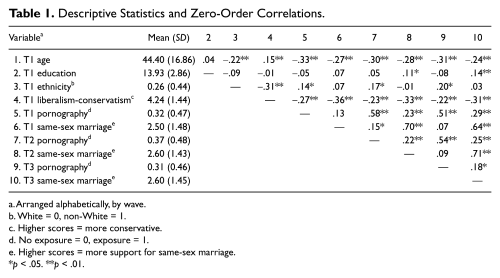
The study’s measures are described below. The GSS began using computer-assisted personal interviewing procedures in 2002. To maximize measurement validity, sex-related data are reported confidentially by participants using computer-assisted self-interviewing procedures (J. Kim, personal communication, January 9, 2012). Measurement consistency was established via test-retest reliability. Expectations for the size of test-retest correlations depend on the variables under examination (DeVellis, 1991). For example, demographic measures should have high test-retest correlations. Opinion measures should have lower test-retest correlations, as opinions may fluctuate over time. Descriptive statistics and zero-order correlations are presented in Table 1.
Descriptive Statistics and Zero-Order Correlations.
Arranged alphabetically, by wave.
White = 0, non-White = 1.
Higher scores = more conservative.
No exposure = 0, exposure = 1.
Higher scores = more support for same-sex marriage.
p < .05. **p < .01.
Demographics
Demographics at baseline (T1) were as follows. Participants were 44.40 years old on average (SD = 16.86). Age at T1 was strongly correlated with age at T2 (r = .99, p < .01) and T3 (r = .99, p < .01). Following Wright (2011b) and Wright and Randall (2012), ethnicity was operationalized as White (coded 0) or Nonwhite (coded 1). Whites comprised 73.8% of participants. Ethnicity at T1 was strongly correlated with ethnicity at T2 (r = .86, p < .01) and T3 (r = .79, p < .01). Following Wright (2011b, 2012), education was operationalized in terms of the number of years of school participants had completed (M = 13.93, SD = 2.86). Education at T1 was strongly correlated with education at T2 (r = .77, p < .01) and T3 (r = .85, p < .01). Following Vaisey (2006), political orientation was operationalized in terms of whether participants considered themselves liberal or conservative (1 = extremely liberal, 7 = extremely conservative; M = 4.24, SD = 1.44). Political orientation at T1 was strongly correlated with political orientation at T2 (r = .60, p < .01) and T3 (r = .61, p < .01).
Pornography consumption
Pornography consumption was assessed at T1, T2, and T3 by asking participants whether or not they had viewed a pornographic film in the prior year (0 = no, 1 = yes). 32.2% said they had viewed a pornographic film in the prior year at T1, 36.4% at T2, 30.6% at T3. Pornography consumption at T1 was strongly correlated with pornography consumption at T2 (r = .58, p < .01) and T3 (r = .51, p < .01). Prior research suggests that conservatives should be less likely to consume pornography than liberals (Linz & Malamuth, 1993) and that non-Whites should be more likely to consume pornography than Whites (Brown & L’Engle, 2009; Wright, 2011b). Accordingly, the criterion validity of this measure is suggested by conservatives being less likely to consume pornography than liberals at T1 (r = −.27, p < .01), T2 (r = −.28, p < .01), and T3 (r = −.16, p < .01), and by non-Whites being more likely to consume pornography than Whites at T1 (r = .14, p < .05), T2 (r = .16, p < .01), and T3 (r = .29, p < .01).
Dichotomous classification of participants into “‘did not consume pornography/did consume pornography’” categories has yielded theoretically predictable results in a number of studies. Kjellgren, Priebe, Svedin, and Langstrom (2010) found that Swedish adolescents who consumed violent pornography were more likely to be sexually coercive than Swedish adolescents who did not consume violent pornography. Ybarra, Mitchell, Hamburger, Diener-West, and Leaf (2011) found that the same dichotomous classification (i.e., never consumed violent pornography/had consumed violent pornography) predicted the sexually aggressive behavior of American adolescents. Wingood et al. (2001) found that female adolescents who consumed pornographic films were more likely to have multiple sexual partners than female adolescents who did not consume pornographic films. Most relevant to the present study, Wright (2011b) found that adult males who consumed pornographic films were more likely to hold permissive sexual attitudes (e.g., more positive attitudes toward extramarital sex) and engage in permissive sexual behaviors (e.g., sex with multiple partners) than adult males who did not consume pornographic films.
Support for same-sex marriage
Support for same-sex marriage was assessed at T1, T2, and T3 by asking participants whether they agreed or disagreed that homosexual couples should have the right to marry one another (1 = strongly disagree, 2 = disagree, 3 = neither agree nor disagree, 4 = agree, 5 = strongly agree; T1: M = 2.50, SD = 1.48; T2: M = 2.60, SD = 1.43; T3: M = 2.60, SD = 1.45). Support for same-sex marriage at T1 was strongly correlated with support for same-sex marriage at T2 (r = .70, p < .01) and T3 (r = .64, p < .01). Prior research suggests that conservatives should be less likely to support same-sex marriage than liberals (Lewis & Gossett, 2008; Newport, 2011). Accordingly, the criterion validity of this measure is suggested by conservatives being less likely than liberals to support same-sex marriage at T1 (r = −.36, p < .01), T2 (r = −.41, p < .01), and T3 (r = −.30, p < .01).
Analytic Approach
Hierarchical multiple regression analyses were employed to test H1 and H2. Change in R2 was used to assess the significance of the association between pornography consumption and subsequent attitudes toward same-sex marriage (H1) and the interaction of pornography consumption and education to subsequent attitudes toward same-sex marriage (H2; Aiken & West, 1991). As the 3AM predicts that audience characteristics that exist prior to sexual media exposure are responsible for differing socialization effects, T1 education was multiplied by T2 pornography consumption to create the interaction term. To interpret the interaction, simple-slope tests were carried out at one standard deviation above and below the mean of education (Aiken & West, 1991). A hierarchical logistic regression analysis was carried out to test RQ1. Change in χ2 was used to assess the significance of the association between attitudes toward same-sex marriage and subsequent pornography consumption (Rose, Chassin, Presson, & Sherman, 2000). Interval variables were mean centered in all analyses (Howell, 2002).
As outlined in the literature review, significant correlations between pornography consumption and sexual attitudes are usually attributed to sexual socialization (pornography changes attitudes) or selective exposure (people with particular attitudes gravitate to pornography). An alternative possibility, however, is that some prior factor (also known as a “third variable” confound; Little et al., 2009) causes both subsequent pornography consumption and/or subsequent sexual attitudes. In the case of pornography consumption predicting subsequent attitudes toward same-sex marriage, it may be the case that earlier attitudes toward same-sex marriage cause both subsequent pornography consumption and subsequent attitudes toward same-sex marriage. Consequently, T1 attitudes toward same-sex marriage was entered in the initial multiple regression step and T2 pornography consumption in the second step when testing H1 and H2, which predicted associations between pornography consumption and subsequent attitudes toward same-sex marriage (assessed at T3). In the case of attitudes toward same-sex marriage predicting subsequent pornography consumption, it may be the case that earlier pornography consumption causes both subsequent attitudes toward same-sex marriage and subsequent pornography consumption. Consequently, T1 pornography consumption was entered in the initial logistic regression step and T2 attitudes toward same-sex marriage in the second step when testing RQ1, which asked whether attitudes toward same-sex marriage predict subsequent pornography consumption (assessed at T3).
Other potential confounds suggested by prior research include political orientation (Lewis & Gossett, 2008; Linz & Malamuth, 1993; Newport, 2011), age (Braun-Courville & Rojas, 2009; Wright, 2011b), ethnicity (Brown et al., 2006; Hennessy, Bleakley, Fishbein, & Jordan, 2009), and education (Wright, 2011b). These variables were assessed at T1 and were also entered in the initial step of all analyses.
Results
RQ1: Sexual Socialization
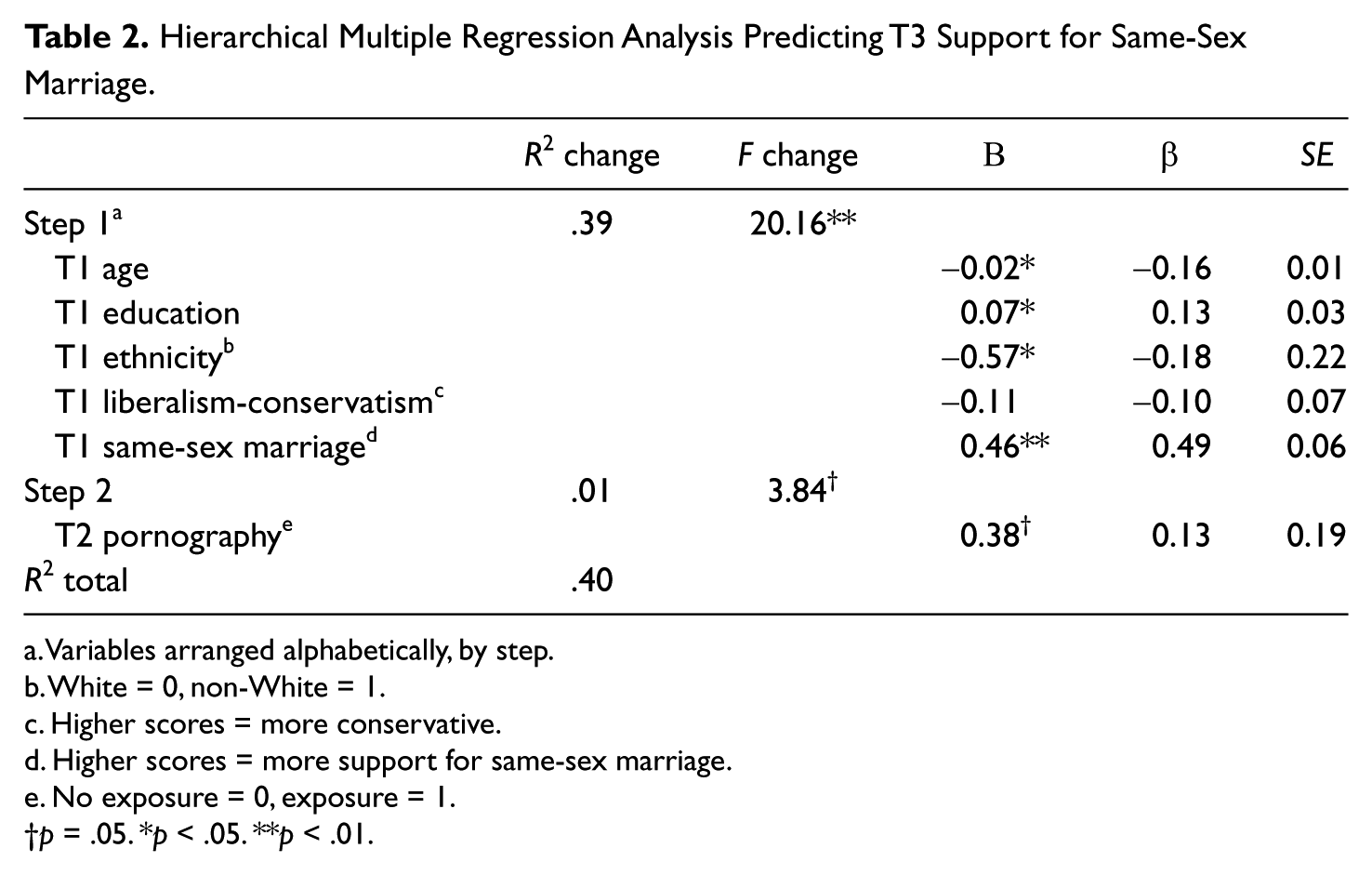
Prior pornography consumption was associated with more subsequent support for same-sex marriage (see Table 2). Specifically, after controlling for T1 attitudes toward same-sex marriage, age, education, ethnicity, and political affiliation (Step 1), T2 pornography consumption (Step 2) contributed to the prediction of T3 attitudes toward same-sex marriage at the significance threshold (R2 change = .01, F change = 3.84, p = .05). Consuming pornography at T2 was associated with an increase in support for same-sex marriage at T3 (β = 0.13).
Hierarchical Multiple Regression Analysis Predicting T3 Support for Same-Sex Marriage.
Variables arranged alphabetically, by step.
White = 0, non-White = 1.
Higher scores = more conservative.
Higher scores = more support for same-sex marriage.
No exposure = 0, exposure = 1.
p = .05. *p < .05. **p < .01.
H1: Moderating Role of Education
Hypothesis 1 was supported. After controlling for T1 attitudes toward same-sex marriage, age, education, ethnicity, and political affiliation (Step 1) and adding T2 pornography consumption to the model (Step 2), the interaction of T1 education and T2 pornography consumption (Step 3) contributed to the prediction of T3 attitudes toward same-sex marriage (R2 change = .02, F change = 6.42, p < .05). 3 As predicted, education was associated with more support for same-sex marriage (β = 0.13, p < .05), but present support for same-sex marriage did not covary with past pornography consumption for the more educated (β = −0.06, p = .57). Conversely, as predicted, past pornography consumption was associated with more support for same-sex marriage for the less educated (β = 0.30, p < .01). Figure 2 displays this interaction.
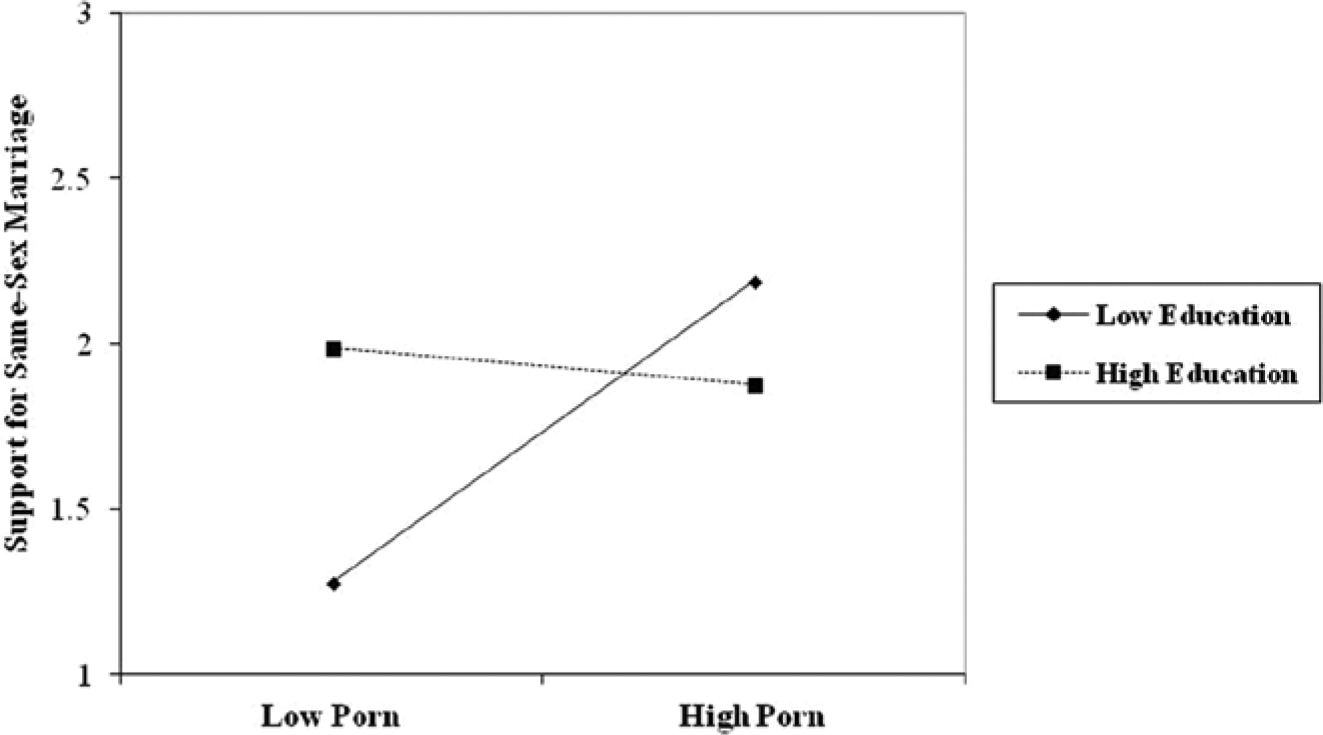
Interaction of T1 education and T2 pornography consumption on T3 support for same-sex marriage.
RQ2: Selective Exposure
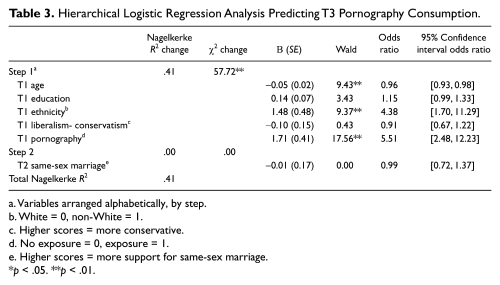
The selective exposure premise was not supported (see Table 3). After controlling for T1 pornography consumption, age, education, ethnicity, and political affiliation (Step 1), T2 attitudes toward same-sex marriage (Step 2) did not contribute to the prediction of T3 pornography consumption (χ2 change = 00, p = .95).
Hierarchical Logistic Regression Analysis Predicting T3 Pornography Consumption.
Variables arranged alphabetically, by step.
White = 0, non-White = 1.
Higher scores = more conservative.
No exposure = 0, exposure = 1.
Higher scores = more support for same-sex marriage.
p < .05. **p < .01.
Discussion
This study employed nationally representative three-wave panel data gathered in 2006, 2008, and 2010 to assess associations between heterosexual adult U.S. males’ consumption of pornography and attitudes toward same-sex marriage. This study appears to be the first quantitative analysis of these variables. Males were studied because they hold more negative attitudes toward same-sex marriage than females (Newport, 2011) and are more likely to consume pornography than females (Sabina et al., 2008). The following sections review the study’s findings, consider the scientific and social implications of the findings, and discuss directions for future research.
Review of Findings
That people who consume pornography are more likely to possess sexual attitudes and engage in sexual behaviors consistent with pornography’s perspective on sex has been demonstrated by numerous cross-sectional surveys (Braun-Courville & Rojas, 2009; Carroll et al., 2008; Lo & Wei, 2005; Maddox et al., 2011; Morgan, 2011; Omori et al., 2011; Peter & Valkenburg, 2006; Weinberg et al., 2010; Wingood et al., 2001; Wright, 2011b; Wright & Randall, 2012). Recent longitudinal studies have begun to tease out the directionality of these associations (Peter & Valkenburg, 2010, 2011a; Wright, 2012). In these studies, pornography consumption reliably predicted over-time change in sexual attitudes and behavior, but sexual attitudes and behavior did not reliably predict over-time change in pornography consumption. Similar results were found in this study. Specifically, support for same-sex marriage did not predict over-time increases in pornography consumption, but pornography consumption did predict over-time increases in support for same-sex marriage. However, the association between prior pornography consumption and subsequent support for same-sex marriage was moderated by education. While educated males were more supportive of same-sex marriage, this support was independent of their pornography consumption. Conversely, pornography consumption predicted changes toward more support for same-sex marriage for less educated males.
Scientific Implications
The scientific implications of the results of this study are as follows: First, they suggest the external validity of prior experimental research. Zillmann and Bryant (1988) found that male college students who had been shown video pornography were more likely than males who had not been shown video pornography to agree that the government should not prevent couples from entering into intimate relationships. This is important, as the external validity of experimental pornography research has been and continues to be questioned (Berkowitz & Donnerstein, 1982; Gunter, 2002; Pappas, 2012). Similarly, the generalizability of pornography studies using convenience samples of college students has been questioned. Along with other recent pornography research utilizing nationally representative samples (Peter & Valkenburg, 2011a; Wright, 2011b), this study suggests that studies of college students that find, for example, associations between consumption of pornography and attitudes toward women (Hald, Malamuth, & Yuen, 2010) or recreational sex (Weinberg et al., 2010) should perhaps be taken with more than “a grain of salt” (Ferguson & Hartley, 2009, p. 326).
Second, the next best method for assessing causation after the laboratory experiment is the longitudinal panel survey (Little et al., 2009). Two important criteria for establishing causality are covariation (phenomena fluctuate together in a quantifiable manner) and temporal sequencing (a cause should be observed before its effect is observed; Wright, 2011a). The present study met both these criteria regarding the hypothesis that pornography is a causal contributor to change in sexual attitudes: Pornography consumption was associated with over-time change in support for same-sex marriage; support for same-sex marriage was not associated with over-time change in pornography consumption.
Third, they support the 3AM premise that consumers of sexual media, in addition to learning about specific sexual behaviors, may glean “the general rule or philosophy guiding media models’ behavior” (Wright, 2011a, p. 349). Huesmann (1986) calls this “higher order” scripting (p. 131). One would be hard-pressed to find a content analysis indicating that heterosexual pornography depicts or discusses same-sex marriage. Yet this study found that self-reported consumption of pornography prospectively predicts support for same-sex marriage, even after accounting for prior attitudes toward same-sex marriage and a number of confounds that prior research suggest are directly relevant to an analysis of pornography consumption and attitudes toward same-sex marriage. Likewise, experimental exposure to “standard fare” heterosexual pornography (i.e., nonviolent, consensual depictions of heterosexuals engaging in petting, oral sex, and intercourse) changes beliefs regarding behaviors that are not depicted (e.g., estimates of the percentage of people who engage in sadomasochism and bestiality; Zillmann & Bryant, 1982). Findings such as these suggest that pornography activates “abstract” perspectives on sexual behavior that may be used to render judgments across a variety of sexual contexts (Bandura, 2001, p. 275). For instance, the results of this and prior studies (e.g., Lo & Wei, 2005; Wright, 2011b) suggest that pornography activates a liberal sexual script that encourages nonjudgment toward and even approval of nontraditional sexual behavior.
Fourth, pornography exposure is associated with support for traditional sex roles (Brown & L’Engle, 2009; Zillmann & Bryant, 1988), and support for traditional sex roles has been and continues to be associated with antihomosexual sentiment (Keiller, 2010; Kite & Whitley, 1996). However, pornography exposure is also associated with a liberal, nonjudgmental perspective on sexuality and participation in nontraditional sexual behaviors (Braun-Courville & Rojas, 2009; Brown & L’Engle, 2009; Carroll et al., 2008; Lo & Wei, 2005; Maddox et al., 2011; Morgan, 2011; Omori et al., 2011; Peter & Valkenburg, 2006; Weinberg et al., 2010; Wingood et al., 2001; Wright, 2011b, 2012; Wright & Randall, 2012; Zillmann & Bryant, 1988).
Gallop poll data indicate that the cultural tide is turning in favor of support for same-sex marriage in the United States (Newport, 2011). In the words of Forbes editorialist Erik Kain (2011, para. 2), there appears to be “a cultural sea change in attitudes toward marriage equality in America.” Evidence indicating a similar upturn in support for traditional sex roles is difficult to locate. Consequently, the results of this study suggest that when sexual media activate competing sexual scripts, the script selected for application may depend on current social mores.
Finally, they support the theoretical position that attitudinal shifts from exposure to pornography will be more likely for some individuals than others (Kingston et al., 2009). Specifically, they suggest that attitudinal shifts from exposure to pornography may be less likely for more educated individuals. This finding is consistent with the 3AM’s (Wright, 2011a) premise that sexual media effects are less likely when audiences are critical thinkers, as education is positively associated with critical thinking (Denney, 1995). 4
Social Implications
Same-sex marriage continues to be a debated topic among social conservatives and liberals (“Conservative vs. Liberal: Gay Marriage,” 2012). If this study is considered in a political and social scientific vacuum, its implications for conservatives and liberals are straightforward. Liberals consider restrictions on same-sex marriage a violation of homosexuals’ civil and moral rights (Lewis & Gossett, 2008; Ruffin, 2011). Consequently, if pornography consumption and education generate support for same sex-marriage, both are to be encouraged. Social conservatives, conversely, consider same-sex marriage a threat to opposite-sex marriage and the traditional family (“Conservative vs. Liberal: Gay Marriage,” 2012). If pornography consumption and education generate support for same-sex marriage, pornography consumption should be discouraged and efforts should be made to “de-liberalize education” (Curtis, 2012, para. 6).
If a broader political and social scientific perspective is adopted, however, the social implications of this study are quite complicated, especially concerning pornography. If the only effect of pornography consumption was increased support for same-sex marriage, conservatives could discourage pornography consumption without conflict. But studies suggest that pornography consumption changes attitudes and increases the probability of behaviors supported by conservatives. As reviewed previously, pornography exposure correlates positively with support for traditional sex roles (Brown & L’Engle, 2009; Garcia, 1986). For instance, an experimental study found that showing participants video pornography led to more agreement with the sentiment that “a stable marriage is best achieved by the wife yielding in most conflict situations” (Zillmann & Bryant, 1988, p. 530). As an additional illustration, content analytic research indicates that condoms are rarely used in pornography (Grudzen et al., 2009). Correspondingly, some research finds that pornography users are less likely to use condoms (Peter & Valkenburg, 2011b; Wingood et al., 2001). As condoms prevent procreation, the lack of condom use in pornography is in alignment with conservatives’ procreational values (“Conservative vs. Liberal: Gay Marriage,” 2012; Linz & Malamuth, 1993).
If the only effect of pornography consumption was increased support for same-sex marriage, then liberals could encourage pornography consumption without conflict. But studies suggest that pornography consumption changes attitudes and increases the probability of behaviors opposed by liberals. The prime example of this conflict has to do with attitudes supportive of violence against women. The present study explored males’ consumption of pornographic films in the mid-2000s. Bridges et al. (2010) content analyzed 304 scenes from 50 of the best-selling and most-rented pornographic films of 2004 and 2005. It was seen that 88.2% of scenes contained physical aggression such as spanking, gagging, slapping, hair pulling, and choking, and 48.7% of scenes contained verbal aggression, such as females being called “bitch” or “slut.” Across all aggressive acts (i.e., both physical and verbal), women were the targets 94.4% of the time. Correspondingly, meta-analyses indicate that pornography consumption correlates positively with attitudes supporting of violence against females (Allen, Emmers, Gebhardt, & Giery, 1995; Hald et al., 2010) and laboratory aggression committed by males against females (Allen, D’Alessio, & Brezgel, 1995). Recent survey research indicates that male pornography consumers express a higher likelihood of committing rape (Foubert, Brosi, & Bannon, 2011).
Results such as these led Saar (2012), a liberal activist, to make the following statement in a recent Huffington Post editorial:
I am deeply disappointed that the left continues to exalt porn as some manifestation of sexual liberation, free speech, or women’s empowerment - without any thoughtful discussion of how so much of present day porn legitimizes violent treatment of women and girls. (para. 6)
In sum, social scientific research suggests that pornography’s effects are diverse and not unilaterally supportive of or a challenge to a particular political philosophy. Blanket statements about pornography’s social benefits and costs reveal an unfamiliarity with social scientific pornography research. Ultimately, conclusions about whether pornography does more social harm than good or more social good than harm depend on the weight each individual attaches to particular sexual lessons potentially imparted by pornography.
Future Directions
Several future research directions are warranted. First, rather than asking about support for same-sex marriage in general, future studies should ask males about their support for male-male marriage and female-female marriage specifically. Males “have significantly stronger antipathy toward gay men than toward lesbian women” (Keiller, 2010, p. 38). Consequently, males’ attitudes toward female-female marriage may be more amenable to change. It is important to note, however, that prior research indicates that when respondents see the word “homosexual” (the term used in the GSS’s question about same-sex marriage), they overwhelming assume the question is asking about gay men (Haddock & Zanna, 1998). The results of this study, therefore, suggest a change in males’ attitude regarding male-male marriage.
Second, rather than asking about pornography consumption in general, future studies should ask about specific categories of pornography consumption. As reviewed previously, the pornography most popular with males features hypermasculine performers who conform rigidly to traditional masculine roles, and belief in traditional masculinity decreases the probability of support for homosexuals. But other genres of pornography exist. For instance, “idealized” pornography (aka “erotica”) depicts “graphic displays of physical sex” but stresses “compassionate portrayals of sexuality with emphasis on emotional aspects of heterosexual sex” (Gunter, 2002). Current examples of idealized pornography targeting heterosexuals can be found at http://www.erosexotica.com. Such pornography may activate liberal, nonjudgmental sexual scripts without activating traditional sex role scripts. Another pornography category worthy of exploration is female-female pornography. Female-female pornography is quite popular among males (Paul, 2009) and has obvious relevance to perceptions about homosexual sex.
Third, rather than classifying males into simple no exposure/exposure categories, future studies should assess varying degrees of pornography exposure. The 3AM predicts that more frequent exposure to sexual media results in stronger socialization effects. Experimental research conducted by Zillmann and Bryant (1982) supports this premise.
Fourth, future studies should employ experimental designs using various categories of pornography. As discussed earlier, there are some scholars who dismiss experimental pornography research for lacking external validity. It is the contention of this article, however, that a combination of survey and experimental research provides the most conclusive evidence of the effects of pornography (see also Hald et al., 2010).
Fifth, future studies should continue to explore differences in Whites and non-Whites’ consumption of pornography and support for same-sex marriage. Pornography consumption predicted more support for same-sex marriage in this study, even after ethnicity was controlled. Still, it is interesting to observe that non-Whites were more likely to consume pornography than Whites but were less likely to support same-sex marriage than Whites. These findings are consistent with prior pornography research (Brown & L’Engle, 2009; Wright, 2011b) and prior research on support for same-sex marriage (Bruni, 2011). One possible explanation is that non-Whites in general (Sutton, Brown, Wilson, & Klein, 2002) and Blacks in particular (Brown et al., 2006) may rely more on interpersonal sources than mediated sources to inform their sexual opinions.
Finally, it is likely that education is not the only individual difference that moderates the association between pornography consumption and support for same-sex marriage. Other moderators suggested by the 3AM and other media effects theories are viewers’ motivations for viewing pornography (e.g., for entertainment versus information), level of psychological involvement with the content, degree of identification with pornography actors and actresses, and level of dependency on pornography for sexual learning.
Footnotes
Declaration of Conflicting Interests
The authors declared no potential conflicts of interest with respect to the research, authorship, and/or publication of this article.
Funding
The authors received no financial support for the research, authorship, and/or publication of this article.