




Abstract
The issue of same-sex marriage continues to be a focal point in U.S. media. The topic garnered a substantial amount of attention in 2013, with the repeal of Defense of Marriage Act, the legalization of same-sex marriage in eight U.S states and five foreign countries, and the passage of the Russian Anti-Gay Law. The question at hand is how U.S. newspapers framed these stories throughout the year. The authors utilized a qualitative content analysis of source quotes included in articles about same-sex marriage in The New York Times. The findings from this analysis reveal the use of not only the traditional equality master frame but also uncovered themes of children, inevitability, political evolution, and fear. The results also unearthed a lack of human interest perspective. This study adds insight into how citizens of the United States are exposed to (and may ultimately define) the issue of same-sex marriage.
Introduction
The public’s perception of marriage equality is constantly evolving, and the number of governing entities that recognize same-sex marriage is continuously changing. As of August of 2014, 17 countries in the world and 19 U.S. states legally recognize the marriage of same-sex couples (Pew, 2014). The year 2013 was a year of significant marriage equality momentum. On June 27, 2013, Defense of Marriage Act (DOMA) was overturned by the U.S. Supreme Court. Also in 2013, eight more states (California, New Mexico, Rhode Island, Maryland, Hawaii, New Jersey, Delaware, and Minnesota) and five countries (England, Brazil, New Zealand, Uruguay, and France) passed laws allowing the marriage of same-sex couples (Human Rights Campaign, 2014).
Despite the many strides in greater acceptability of marriage equality in 2013, one international event reminded us that there is still a clear-cut resistance to the movement. On June 30, Russian President Vladimir Putin signed into law a bill banning the “propaganda of nontraditional sexual relations to minors” (McCabe, 2013, para. 1), which includes any reference or display of homosexuality, and the law inflicts harsh sanctions, jail time, and even deportation upon anyone who is gay or assumed to be gay.
The events in 2013 highlight the historical and binary representation of marriage equality in journalism: equality versus morality. Traditionally, the journalists have centered almost entirely on two extreme positions on the issue, one side being religious conservatives and the other being gay rights activists (Moscowitz, 2013). This research employs a qualitative framing analysis of source quotes in The New York Times (NYT) to investigate if same-sex marriage is still framed within those two, dominant, conflicting frames. Specifically, this article will employ an inductive approach to investigate how the morality and equality master frames have evolved into new subframes. While the master frames of equality and morality may still exist, are there overarching subframes that draw both ends together? The major goal of this study is to move the research on marriage equality forward to a more intermediate space.
Literature Review
Conceptual Framework
Goffman (1974) proposed framing as an interpersonal theory of how individuals make sense of their everyday lives. Frames introduce or elevate the salience or perceived importance of specific ideas or objects, “activating schemas that encourage target audiences to think, feel and decide in a particular way” (Entman, 2007, p. 164; Iyengar & Simon, 1993; Kim, Scheufele, & Shanahan, 2002; Price, Tewksbury, & Powers, 1997). According to Entman (1993), a fully developed frame usually performs the functions of problem definition, causal analysis, moral judgment, and remedy promotion. In mass communication literature, scholars have applied framing theory to the way the media make sense out of news events (Liebler, Shwartz, & Harper, 2009) and organize stories into themes, frames, or conflict in order to define a social reality (Goffman, 1974; Tuchman, 1970; Weaver, 2007).
The media select and emphasize specific components of an issue or event and stress them while ignoring or giving a lower profile to other components of the issue or event (Entman, 1993), ultimately shaping how the public receives and accepts information on the issues, such as same-sex marriage. The news media have traditionally played a role of creating and regulating the boundaries of gender and sexual identities, often giving privilege to heterosexuality (Rubin, 1989). Because the media represent a “larger hegemonic power structure,” marginal groups such as lesbian, gay, bisexual, transgender, and queer (LGBTQ) members must often adapt to the guidelines of those that are in power in order to gain some sort of visibility (Moscowitz, 2010, p. 26).
Framing theory has not been without its criticism. Some scholars argue that framing is hegemonic in nature, and the prevailing ideologies of society are masked in media coverage by frames that perpetuate their consensus (Liebler et al., 2009). Carragee and Roefs (2004) argued that framing research “neglected the relationship between media frames and broader issues of political and social power” (p. 214). They suggest that news stories should be viewed as a forum for an exchange of competing definitions of specific frames and that future research should target the way frames are constructed by the media, how those in power manipulate the capacity of social groups and affect the news, and also question what this means for framing contests and the advancement of the theory.
Media Coverage of Same-Sex Marriage in the United States
At the onset of the 21st century, marriage had been overwhelmingly expressed in U.S. media in heterosexual terms: as the union of a woman and a man and as a site for reproduction (Halle, 2001). This has long been the dominant definition of marriage in society until the 2000s when the issue of same-sex marriage (also referred to as gay marriage) emerged in the wake of the gay rights movement. Any change in the way society’s attitude is directed toward the institution of marriage is dependent upon the way the media frame the issue of traditional and same-sex marriage (Liebler et al., 2009).
The mainstream coverage of gays and lesbians entering into marriage did not happen for the most part until the early 1990s. Before that, homosexuals were more commonly depicted as a social problem, deviants, or even threats to national security (Alwood, 1996, Pearce, 1981). The Stonewall rebellion of 1969 increased visibility gay rights issues in mainstream media coverage throughout the 1970s (Barnhurst, 2003; Pan, Meng, & Zhou, 2010). However, some researchers argue that any advances made in the 1970s were lost in the 1980s, with the moral panic generated as a consequence of the AIDS epidemic (Moscowitz, 2010; Nardi, 1997). By the late 1980s, news coverage started to include more stories about gay rights, gay art, and the LGBTQ lifestyle (Chomsky & Barclay, 2010). This was followed by the appearance of gay-themed television shows, film, and advertising in the late 1990s (Becker, 2006; Gross, 2001). From the early 2000s until 2013, the media were more inclined to report the issue of LGBTQ rights and same-sex marriage in ways that did not challenge hegemonic notions of gender and sexuality and were framed in ways that favored heterosexuality (Battles & Hilton-Murrow, 2002; Dow, 2001; Liebler, et al., 2009). In other words, homosexuality was portrayed as abnormal or as a threat to heterosexuality.
In addition to the types of coverage described already, news media had the task of covering legal and political developments regarding the same-sex marriage. The 1996 DOMA signed into law by President Clinton is one such landmark. The bill denied federal recognition to same-sex marriages and sanctioned state governments to discount marriages performed in other states (Barnhurst, 2003; Kenix, 2008). Before this act, only a few states had laws prohibiting the marriage of same-sex couples. The act held that marriage could be only between a man and a woman, but that was not the final word on the subject. This propelled the issue of same-sex marriage to nation-wide media coverage, as well as often making it a topic in individual states as they considered codifying one man-one woman definitions of marriage. From 1992 to 2000, the amount of news coverage of this topic increased; however, the stories became shorter over time (Barnhurst, 2003).
In 1999, the Vermont Supreme Court passed legislature legalizing civil unions for same-sex marriage. The media not only covered the issue at a state level but also nationally (Hester & Gibson, 2007). In August of 2002, NYT began to publish same-sex commitment ceremonies alongside traditional wedding announcements of heterosexual couples in its Sunday Styles section (Pan et al., 2010).
On November 19, 2003, the Massachusetts Supreme Court passed a law recognizing same-sex marriage as constitutional and saw no rational basis for distinguishing even the name between unions and marriages among gays and lesbians. This event happened just 1 year before the 2004 presidential election and caused the media to focus on the difference of positions held by both presidential candidates (Becker & Scheufele, 2009). In 2004, 11 states voted on and passed constitutional amendments banning same-sex marriage. The issue of same-sex marriage continued to receive media coverage from 2004 to 2013 as more U.S. states began to recognize same-sex marriage (Jurkowtiz, 2004) or alternatively take up bills to ban same-sex marriage.
Same-Sex Marriage Frames
A frame, in this study, is defined as the primary logic used to justify an argument (Chong & Druckman, 2007; McFarland, 2011). Frames are important because they can influence perceptions and audience understandings (Adams, 2013). Frames are introduced by elites, including politicians and other authorities, and by the media (Chomsky & Barclay, 2010). Framing involves decisions on the media’s part about which side of a debate or issue to cover, putting more emphasis on one side, putting forth one’s own interpretation, or choosing which sources to highlight (Schnell & Callaghan, 2001). As groups in power and those attempting to merely have a voice vie to have their perspectives reign in a debate, the news media accounts then for many become the platform in which the struggle is framed (Moscowitz, 2010). In the past, scholars have recognized a historical bias toward straight news and antigay tone (Alwood, 1996; Bennett, 2000, Moscowitz, 2010).
Same-sex marriage has been framed traditionally in morality and equality frames. Those who favor same-sex marriage have often framed the issue in terms of equality and granting equal rights, specifically the right to marry. Those who oppose same-sex marriage frame the issue in terms of traditional morality and want to deny the right for same-sex couples to marry (Brewer, 2001; McFarland, 2011; Price, Nir, & Cappella, 2005). The frames of morality and equality can be viewed as master frames, frames into which other specific frames might be inserted and understood as contributing to the master frame. Master frames supply terminology and context that can be applied across a breadth of specific social movements, or issues, to assign blame for given social circumstances and even propose possible remedies (Hull, 2001). One of the primary ways frames enter news coverage is through the people used as sources by journalists (the choice of whom represents another way in which journalists might frame a topic). These frames might come through, for example, in the quotes given in a news story, or the sources might put forward a frame adopted subtly (or not) by the journalist. Thus, our first two research questions are:
RQ1: What sources were utilized in
The New York Times' 2013
coverage of marriage equality?
RQ2: Based against the existing scholarship of coverage of LGBTQ issues prior to 2013, how does the 2013 use of sources in The New York Times compare?
The morality frame is traditionally used by conservatives, religious activists, and traditionalists (Mucciaroni, 2011). Opponents of same-sex marriage use the morality frame to highlight the negative consequences for society if gays and lesbians were allowed to marry, call attention to government behavior, the immorality of same-sex marriage, and the influence same-sex marriage would have on family and children (Adams, 2013; Baunach, 2011). Other frames that fall under the morality category are sexual preference, homosexuals prey on children, homosexuality is teachable/contagious, it goes against the Bible and God, judicial activism, not needed/special rights, and children need mom and dad (Adams, 2013; McFarland, 2011). A majority of morality-framed news articles cite sources such as the American Family Association, which is against same-sex marriage.
In terms of equality, Baunach (2011) states that the equality or tolerance frame, used by same-sex marriage supporters, equates same-sex marriage and same-sex unions to heterosexual marriage and paints a portrait of equal rights. The equal rights frame emphasizes the lack of access to fundamental rights and legal securities accompanying marriage to same-sex couples (DeLaet & Caufield, 2008). Other equality frames that can be found in the literature include frames that equate how the loss of minority rights will lead to the loss of everyone’s rights, frames that involve the separation of church and state, egalitarianism, civil rights, acceptance, responsibility, queer culture, equating gay rights to racism, tolerance, and personal privacy (Brewer, 2003; Hull, 2001; Jowett & Peel, 2010; Kenix, 2008; McFarland, 2011; Smith, 2007). The majority of equality-framed news articles tends to cite sources such as the Human Rights Campaign and the American Civil Liberties Union, who have lobbied and pushed for equal rights of the LGBTQ community (Kenix, 2008; Liebler et al., 2009).
RQ3: What frames can be identified in the NYT 2013 coverage of marriage equality?
RQ4: What do the answers to RQs 1, 2, and 3 suggest about the privileging of frames of some groups as compared to others?
Method
The purpose of this study is to employ in-depth observation and analysis in order to identify the frames of marriage equality in the United States during 2013. Qualitative content analysis was thus utilized to uncover both overt and subtle themes of this coverage. Due to the exploratory nature of this study, NYT was chosen exclusively to analyze to ensure consistency and potential coverage of marriage equality. In addition to having one of the highest newspaper circulation rates (Beaujon, 2013) for several decades, the NYT has established itself as a preeminent and influential newspaper in the United States and is prominently used in mass communication research (McCombs, 2004).
To gather newspaper articles, three distinct searches were conducted in LexisNexis from January 2013 to December 2013. A general search of the terms same-sex marriage, gay marriage, and civil union yielded 528 articles in the NYT. However, upon further inspection, several of these articles did not deal with marriage equality directly, so then the process was repeated using a headline search with the same terms, yielding 100 relevant articles.
Qualitative research explores the nuances of societies (Denzin & Lincoln, 2000), allowing researchers to examine text with the intention of letting the content speak for itself and determining the frames through an inductive process. This involves the researchers making multiple passes though the material, coming up with tentative identification of frames, and then going back through the material in a long soak to see if the categories of frames still work upon greater reflection and additional analysis (Flick, von Kardorff, & Steinke, 2004). This approach also allows the researchers greater latitude to consider contextual and cultural cues within the quotes when interpreting the frames that are present (Denzin & Lincoln, 2000). This research argues this is especially well suited for any pilot study looking at news frames in general (Attride-Stirling, 2001) and of media treatment of LGBTQ groups in particular. This broader contextual viewpoint available to the qualitative researcher helps address problems that can arise from the use of coded language (similar to the concept of dog whistles) that might escape notice in a less nuanced approach to examining texts (Riffe, Lacy, & Fico, 2005).
To conduct this analysis then, the researchers keyed in on source quotes found within the articles. Themes were identified during a first pass through the material, and then the sources and frames were more firmly identified and classified through subsequent readings.
Findings
Once source quotes were extracted from each article within the sample frame, the researchers began to broadly group together sources. Pertaining to RQ1, the sources were identified as governmental (politicians, judges, and heads of state), parts of civil society (religious leaders, advocates, and activists), experts (professors and medical professionals), and members of the general public. Within the specific source groups, the identified quotes were then clustered inductively into the most repeated categories that were used to both justify marriage equality and deny it: politics, religion, child rearing, and inevitability of the issue. Finally, within these categories, the researchers identified the specific themes that emerged as a part of the master equality and morality frames.
Main Frames Identified Through Source Quotes in New York Times Articles in 2013.
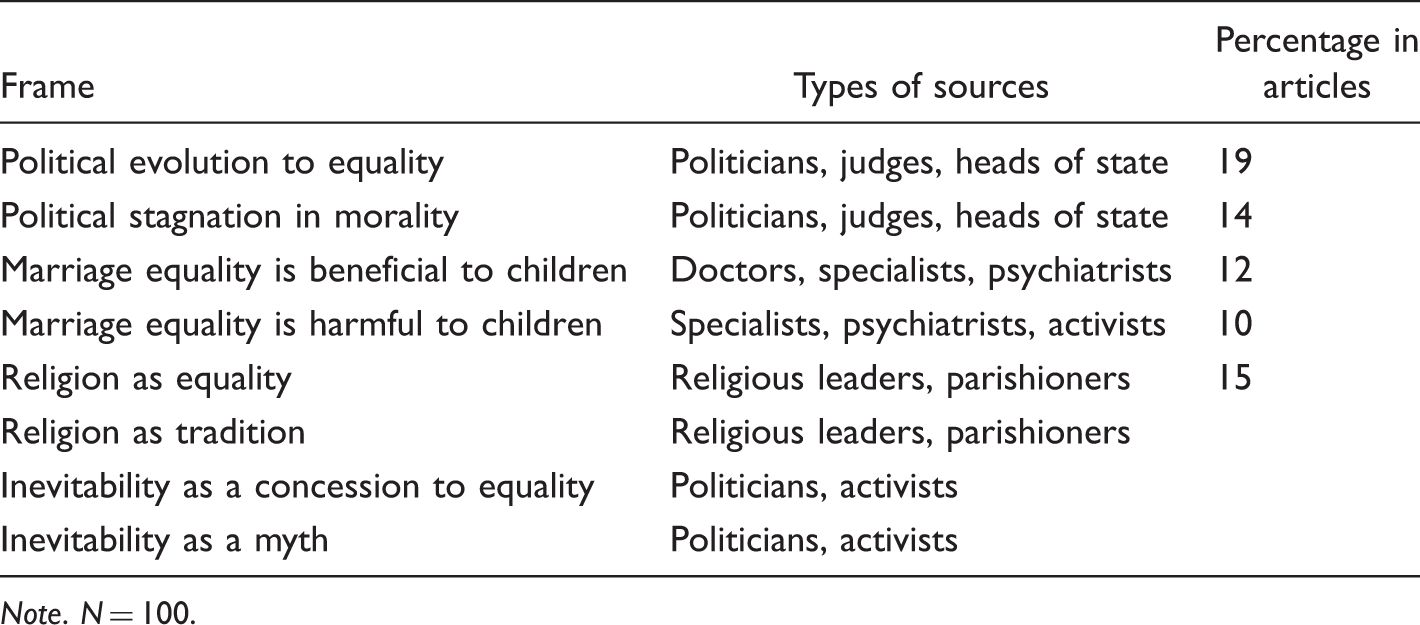
Note. N = 100.
Political Evolution to Equality
Due to the legal and governmental ramifications of either legalizing same-sex marriage or continuing to ban it, it is not surprising that a majority of NYT articles in 2013 focused on source quotes from politicians. As Moscowitz (2013) illustrates, marriage equality is full of legal and political contradictions. For the past two decades, a “moral panic” (Adam, 2003, p. 259) has propelled or overturned legislation quickly that prohibit marriage equality in the United States, most notably the DOMA signed into law by a Democratic president. Media coverage around these pivotal decisions is presented as a clash of two sides that create a great division both politically and in the general public (Moscowitz, 2010).
Interestingly, an undercurrent of greater acceptance emerged among politicians both within the United States and abroad in the 2013 coverage. This was expressed at times as desiring to be a part of a greater movement instead of following party platforms. As one former Republican Congresswoman expressed, “Like a lot of the country, my view has evolved from the first day I set foot in Congress” (quoted in Stolberg, 2013a, p. A1). In these instances, there was not a specific catalyst that spurred a change to an equality frame, only that it felt wrong not to do so. This occurred for Republicans and Democrats, even former President Bill Clinton who signed DOMA into law two decades ago, I grew up in a different time. And I was hung up about the word. I had all these gay friends. I had all these gay couple friends. I was hung up about it. And I decided I was wrong. (quoted in Baker, 2013, p. A1)
For other politicians, supporting marriage equality was triggered by a family member being gay, most prominently Dick Cheney’s daughter. Once personal, it is difficult to then ignore the rights of that child, with or without party support. As Ohio Senator Portman emerged from a morality stance to one of equality after he learned his child was gay. At the time, my position on marriage for same-sex couples was rooted in my faith tradition that marriage is a sacred bond between a man and a woman … Knowing that my son is gay prompted me to consider the issue from another perspective. (quoted in Peters, 2013, p. A11)
Political Stagnation in Morality
Whilst there were ideological changes for both Democratic and Republican politicians, these developments were not universal. Indeed, 14% of Americans have changed to favor same-sex marriage, but there is still 44% of the public in opposition of it (Pew, 2013). This was particularly evident in Republican Party members who did not support their leaders’ acceptance of marriage equality, “If you’re a Christian and you believe in those principles, whether or son or daughter is homosexual, you can’t change your principles” (quoted in Gabriel, 2013, p. A11). Most of the morality frame in relation to politics/politicians was expressed by a third party and not by the politician themselves. This was at times to criticize a politician for being stagnant in her or his attitude toward marriage equality, “This is embarrassing that people that love each other have to beg us and our colleagues on the Republican side of the aisle to do the right thing” (quoted in Zernike, 2013, p. A21). At other times, it was to express a kind of betrayal for not vehemently defending the traditional marriage stance.
Marriage Equality Is Beneficial to Children
According to those supporting a traditional view of marriage, an integral function of marriage in the United States is procreation, and thus LGBTQ couples have in many cases been excluded from marriage equality on those grounds, despite the fact that as far back as 1988 some 10 million children were being raised by LGBTQ couples (Mohr, 1995). Indeed, having children and creating a family unit, and the opinion that same-sex couples are incapable of doing either, are prominent arguments for many zealous resistors, particularly in places like France and in the United States (Biskupic, 2014). Nevertheless, elites are now humanizing families that currently consist of LGBTQ parents, evidenced by the writing of Justice Kennedy, “There are some 40,000 children in California who live with same-sex parents, and they want their parents to have full recognition and full status. The voice of those children is important in this case” (quoted in Liptak, 2013, p. A1).
Besides an empathetic approach to child rearing, journalists also used quotes from medical professionals to validate the potential benefits of marriage equality on children, like one doctor who argued same-sex couples posed more value than destruction to children: “There is an emerging consensus, based on extensive review of the scientific literature, that children growing up in households headed by gay men or lesbians are not disadvantaged in any significant respect relative to children of heterosexual parents” (quoted in Saint Louis, 2013, p. A18).
Quotes like these were used in the majority of instances to balance the views expressed by other sources who found same-sex parenting damaging to children.
Marriage Equality Is Harmful to Children
Some of the articles focused on the issue of marriage equality as one of procreation and not so much the union of two same-sex partners. “To make a child, you need a man and a woman” (quoted in Erlanger, 2013, p. A5) said one political analyst. A practicing attorney stated marriage equality would “refocus the purpose of marriage and the definition of marriage away from the raising of children and to the emotional needs and desires of adults … The key to marriage is procreation” (quoted in Liptak, 2013, p. A1). Here, one can see the master frame of morality manifested through traditional viewpoints of proliferation.
Some journalists included source quotes from those who oppose same-sex marriage that highlighted the danger of allowing same-sex couples to raise children. One extreme example was from the National Organization for Marriage, “Will one of the consequences be a serious push to normalize pedophilia” (quoted in Stolberg, 2013b, p. A1).
Religion as Equality
Religion is not always equated with the morality frame. There was also a theme of religion as a means to justify equality. DeLaet and Caufield (2008) argue that religion can be used as a basis to support gay marriage. Furthermore, religious beliefs of tolerance and acceptance may be used as a consideration to trump notions of antigay principles found in the Bible (Van Geest, 2007). One Jewish rabbi’s sentiment reflects that: Our clergy … views the Torah as a living document that allows room for new understandings and approaches. As we have modernized the role of women and many other practices, the demand on the part of our brothers and sisters who are gay to be able to live in a sanctified relationship is a call to our conscience and our responsibility as Jews. (quoted in Nagourney, 2013, p. A1)
Some religions recognize same-sex marriage and debate that not allowing LGBTQ members to marry is an infringement on their freedom of religion. A Persian member of the Sinai congregation stated: There are some people who are not yet ready to accept nontraditional views, but we cannot look the other way knowing that within our community we do have gays and lesbians. We have to embrace them not only in the families but in our congregations. (quoted in Santos, 2013, p. A17)
Religion as Tradition
Religion, as a deep-rooted and committed tradition, was manifested through the inclusion of source quotes such as one Catholic Bishop, “Catholics should examine their consciences very carefully before deciding whether or not to endorse same-sex relationships or attend same-sex ceremonies, realizing that to do so might harm their relationship with God and cause significant scandal to others” (quoted in Seelye, 2013, p. A15). By including such a quote from a religious leader, the newspaper conveys a message of spiritual separation from God and the church. The theme was not just limited to a Christian religious view but also demonstrated with source quotes from other religions as demonstrated by this Iranian member of a Jewish congregation: “Homosexuality is explicitly condemned in Scripture and has been categorically and passionately rejected by all classical Jewish legal and ethical thinkers as a cardinal vice in the same category as incest, murder and idolatry” (quoted in Nagourney, 2013, p. A1).
People with strong religious convictions are less likely to read news articles concerned with same-sex marriage, even if the article advocates against gays being able to marry (Liebler et al., 2009; Sherkat, Powell-Williams, Maddox, & De Vries, 2011). Conversely, those individuals with strong religion convictions who do read such framed articles are less likely to be swayed by pro-same-sex marriage frames (Chong & Druckman, 2007), and their attitudes are reinforced by morality frames.
Inevitability as a Concession to Equality
Events in 2013 reflect a path of lesser resistance to legalizing same-sex marriage both within the United States and abroad and was manifested through quotes such as that from House Minority Leader Representative Scott Pelath (D-Indiana) who stated, “The tables have turned on this issue, and the Republican members are at a loss about what to do about it” (quoted in Davey, 2013, p. A1). A Midwest music teacher added, “The time will come soon enough when enough of these states will have legalized it, for the federal government to make it law” (quoted in Santos, 2013, p. A17). The view that marriage equality is inevitable may be the reason why the framing of the issue has evolved from previous studies. “In two years … it’s going to seem surreal that we had this whole debate” (quoted in Erlanger, 2013, p. A5).
This finding coincides to the findings of the 2013 Pew Research Survey, which found the share of Republicans who see same-sex marriage as inevitable soared from 47% to 73% over the past 9 years. The study also found the same pattern was similar in religion where the share of White evangelical Protestants who see same-sex marriage as inevitable also escalated from 49% to 70% (Pew, 2013).
Inevitability as a Myth
Notwithstanding, poll results that show a major acceptance of marriage equality, die hard resisters insist that momentum to this issue is nonexistent. Journalists included quotes from sources claiming that the inevitability of marriage was only a myth, and the fight against marriage equality was not over and victory was ahead for those who oppose it. As National Organization for Marriage expressed, “I don’t see momentum for redefining marriage” (quoted in Seelye, 2013, p. A15) and a government lobbyist, “The notion that somehow we are on a one-way elevator to gay marriage, and that no matter what anyone does that it’s going to happen, is false. That is the myth of inevitability” (quoted in Stolberg, 2013a, p. A1). By including source quotes of inevitability as a myth, the journalist implies that marriage equality needs to be, and still can be, stopped.
Discussion
The valence of media frames not only influences people’s attitude toward the LGBTQ community but also helps sculpt the public’s perspectives on the acknowledgment of same-sex marriage by the media (Pan et al., 2010). Due to the inductive nature the qualitative content analysis employed, four themes emerged that better express the latent nuances of the news coverage in the NYT. This contributes to the overall scholarship of framing marriage equality that has denoted two polarized viewpoints that create a friction between “religious conservatives” and “gay activists” (Moscowitz, 2013, p. 79). This study adds to the literature on the gray area that augments current research on the emergence of overarching subframes that draw these extreme polarized ends together and repositions the framing of marriage equality toward to a more intermediate space.
Framing research concludes that journalists (often following journalistic convention by presenting more than one viewpoint but still maintaining easy-to-understand information) use dualism in their coverage of most topics (Lee, McLeod, & Shah, 2008). The findings of this specific research underscore the use of dualism to narrow the gap between the extremes of equality and morality, which has influenced NYT coverage and the source quotes used therein. In order to address RQ4 (What do the answers to RQs 1, 2, and 3 suggest about the privileging of frames of some groups as compared with other?), the researchers offer the following discussion on the four subframes that inductively materialized through the qualitative content analysis.
The first exposed subframe is the evolution of many prominent politicians, which no longer limits marriage equality to party lines. The group in power has historically been the religious conservative who reinforces heterosexual privilege instead of challenging homophobia (Becker, 2006; Gross, 2001). We found a shifting from this perception in the quotes from politicians to a more equality voice. Although, for some it took a relative coming out as gay to accept marriage equality, many politicians admitted to wrongfully being against same-sex marriage either out of ignorance or fear. At any rate, not only do the source quotes often express a desire for marriage equality, the actions of legalizing same-sex marriage in eight states in 2013 denote action behind the words.
The second subframe is recent scientific support for the capabilities of gay couples to parent. As echoed in recent history through the voice of the elite, the notion of disrupting the long-established family nucleus of a father, a mother, and children bonded in marriage (Fitzgerald, 1999), coupled with the argument of marriage entails procreation, has distressed the American public on their views on same-sex marriage as expressed through the source quotes. In 2013, medical elites disseminated the message that children raised in gay or straight families matched equally to levels of well-being and self-esteem citing the largest gay parenting study conducted to date (McDonough, 2013). The once dominant voice of fear from religious conservatives is being replaced by scientific elites, ultimately educating the public on gay parenting.
A third subframe identifies that not all religious groups are homogenous. Historically, religion has been viewed as a hegemonic power structure, yet this analysis finds an increasing number of religious voices quoted in the NYT as giving support to the marginalized LGBTQ community. Religious sources reflected a spectrum of being traditional, moderate, or liberal in both their full acceptance and advocacy of marriage equality or the rejection of it on moral grounds.
A fourth subframe understands that while one may oppose or favor marriage equality, it is inevitable, and therefore resistance may be futile. This perception has modified the once dominant tendency to stand firmly at extreme ends of the spectrum to ultimately conceding to acceptance. From a journalistic point of view, understanding that LGBTQ-related topics are no longer taboo or controversial as they once were, more nuanced and in-depth coverage of same-sex marriage and gendered minorities.
Percentages of Sources Associated with Human Interest Versus Legislative/Government in New York Times Articles in 2013.

This suggests to the researchers that there is a need for more humanizing news coverage of ordinary LGBTQ voices; the sentiment of those directly affected by marriage equality. Drawing upon Carragee and Roefs’ (2004) concept of persons in power influencing the public’s perception of a topic, news coverage lacking the voices of the LGBTQ community limits the ability of audiences to form a more complete understanding of same-sex marriage. While several articles in the NYT include source quotations from special interest groups or nongovernmental organization (NGOs) on both sides of the marriage equality debate, the overall thematic scheme is dominated by the voices of the elite. On one hand, this pilot study finds evidence to support the notion that even with what might be an overreliance on these usual suspects for source quotes, a wider diversity of frames are making their way into news coverage as compared with just a few years ago. This would seem to add nuance to the journalistic coverage that, earlier research argues, has been a discussion dominated by the equality versus equality frames. On the other hand, this study finds that by using a high proportion of elite sources coverage seems to privilege these perspectives over the perspectives of average members of the LGBTQ community. It is worth noting this seeming power imbalance might be exacerbated if the elite sources are themselves not members of the LGBTQ community. To put it simply, if the perspectives of a subordinate group are legitimized only in the news, when coming from a member of a dominant group, it can reinforce, rather than challenge, a heteronormative way of viewing the world.
Footnotes
Declaration of Conflicting Interests
The authors declared no potential conflicts of interest with respect to the research, authorship, and/or publication of this article.
Funding
The authors received no financial support for the research, authorship, and/or publication of this article.