



Abstract
Sports often go beyond simple games to something that individuals identify and relate to throughout their lives. Furthermore, passive and active sports consumption (i.e., video games) allows individuals to further create a sense of fanship and identification with their favorite teams. The following study manipulates player saliency to team, saliency to opponent, and competitive outcome to examine those impacts on enjoyment and hostility. A 3 (opponent saliency) × 2 (team identification) × 2 (competitive outcome; win vs. loss) experimental design was invoked to study these effects. Results indicate that competitiveness was significantly related to both enjoyment and hostility. Furthermore, data suggest a significant interaction between identification and competitive outcomes on hostility.
Keywords
Sports games are noted as one of the most popular genres of video games (Stein, Mitgutsch, & Consalvo, 2012); yet, research looking into the effects of play are limited. According to the Entertainment Software Association (ESA; 2011), the sports video game genre represents one of the highest selling categories at 16%, second only to the action genre. Despite this genre’s popularity, there is a dearth of research looking into how sports video games can be used as a vehicle to address affective and learning outcomes from socially constructed identifiers, such as sports teams—and how varying the gaming situation is impacted by the identification with competitors and competition outcomes.
Recently, researchers have come to understand that competition is a core component to gaming (Song, Kim, Tenzek, & Lee, 2013). Here, researchers have made strong arguments to support contentions that the competitive aspect of video games leads to aggression, not the violent content (Adachi & Willoughy, 2011, 2013). On the other hand, research has also demonstrated that competitive video gaming can lead to enjoyment and positive affect (Vorderer, Hartmann, & Klimmt, 2006). That is, there may be differences beyond violent or non-violent content that predicts aggressive cognitions and behaviors as well as more positive outcomes related to enjoyment. In regard to sports competition, identification with character or team may likely exacerbate post–game play outcomes related to enjoyment and state hostility.
To this end, this research explores (a) the role of identification, (b) the role of competitive outcomes, and (c) the effect of sports gaming on affective outcomes such as enjoyment and state hostility—thereby extending the media effects literature by exposing the intricacy of gaming where gamer, opposition, and gaming outcome interact to create unique outcomes beyond what research has investigated in the past.
Identification With Game Content
Cohen (2001) defined identification as a “mechanism through which audience members experience reception and interpretation of the text from the inside, as if the events were happening to them” (p. 245). That is, identification is a motivation for, and an outcome from, media exposure (Cohen, 2001)—thus helping shape a person’s attitudes. As a general concept, identification explains how individuals become cognitively involved with a media representation. This experience involves individuals adopting the goals of their character and connecting with their emotions and motivations (Cohen, 2001). Thus, identification strengthens primarily when information is processed from the media content perspective and is then transformed into empathetic emotions (Cohen, 2001; Howells, 2002; Jansz & Martis, 2007; Zillmann, 1994). Identification, within this context, has been shown to positively impact affinity, attachment, affect orientation, emotional reactions, similarity, and imitation of content (Chory-Assad & Cicchirillo, 2005; Cohen, 2001; Eyal & Rubin, 2003; Jansz & Martis, 2007; Konijn & Hoorn, 2005; Zillmann, 1994).
While Cohen (2001) interpreted identification through the television medium, recent game-based research (Van Looy, Courtois, De Vocht, & De Marez, 2012) supports a three-dimensional operational definition of identification consisting of avatar identification, group identification, and game identification. Here, avatar identification is defined as a “temporary alteration in self-perception of the player induced by the mental association with their game character” (p. 206). Group identification is defined through perceived self-attributes based on in-group game membership, and finally, game identification is defined through perceived membership to the community surrounding the game (p. 206). In defining identification within these dimensions, Van Looy et al. allow researchers to expand identification beyond Cohen (2001) and others research investigating how players interact with avatars and agents to a more group-based definition within game play (i.e., group and game identification). That is, the extension to a more social definition extends to how players interact with players and play within a group.
Furthermore, video games allow the player to be involved in the creation of the narrative of that game rather than a passive consumer of that content (Malliet, 2006).Thus, interactive technologies, in particular video games, allow the player to be a collaborator and co-creator of the game content. In regard to sports-themed video games, Crawford and Gosling (2009) have noted that “sports-themed games facilitate the development of gamer narratives, and also often act as a resource in social narratives constructed around both video games and wider sports-related themes” (p. 63). As sports fans, individuals strongly identify with certain teams that impact their interpretation of that narrative (i.e., the game). Investigations in the sports domain have found team identification is the “strongest explanatory factor in predicting repatronage” (Wakefield, 1995, p. 349; Wakefield & Wann, 2006) and has additional positive correlations with a sense of belonging (Gibson, Willming, & Holdnak, 2002), a general positive outlook on life (Branscombe & Wann, 1991), and a better quality of life (Smith, 1988), as well as purchasing associative products (End, 2001; Wakefield & Wann, 2006).
Research indicates that “one’s school identification is an important part of self-definition” (Reeves & Tesser, 1985, p. 329) of which a school’s sport team is an extension (Dietz-Uhler & Murrell, 1999). Further evidence is seen in a study where students wore more school-related clothing following a home team victory than following a defeat (Cialdini et al., 1976). For the purposes of this study, identification refers to the degree of psychological and emotional connection to a team (Wakefield, 1995; Wakefield & Wann, 2006; Wann, Melnick, Russell, & Pease, 2001). This identification is then constructed in the real-world through group and extended into play. In a sense, like Van Looy et al. (2012), this construct is derived through group membership and game play.
In the current situation, defining groups as fans of a college sports team promotes group membership by an already-established and salient college affiliation (Cialdini et al., 1976; Hirt, Zillmann, Erickson, & Kennedy, 1992)—and the competition between teams increases distinction and solidarity. Here, due to saliency differences associated with identification, it is thought that stronger identification increases enjoyment. Because identification has shown to increase enjoyment levels (Klimmt & Vorderer, 2003), the following was hypothesized:
It is also expected that opponent-identification will likely impact levels of enjoyment. Identification in a sports context also relates to the opponent—referred to as a comparison group or out-group. Compared to the player’s home team, opponent would receive a low degree of psychological connection. According to prior research, accessibility and salience of out-group identification varies (Bruner, 1957; Taylor & Moriarty, 1987; Voci, 2006), often depending upon the social meaning of similarities and differences. Socially, certain groupings and distinctions should come to a person’s mind more readily than others, perhaps from historical intergroup contexts such as competition (Worchel, Axsom, Ferris, Samaha, & Schweizer, 1978). When this occurs, the identification effects are enhanced.
Opponents or competitors faced yearly and who readily conjure memories of great victories and defeats for a conference championship should be most salient—hence competing against this opponent should produce greater effects. An opponent played regularly as part of a conference should follow second. Finally, an opponent rarely played with little context (i.e., out of conference schedule opponent) should be least salient and produce the smallest effects. To this end, given the saliency differences based on the opponent, outcomes such as affect should differ based on opponent; therefore, enjoyment levels are hypothesized to be greatest against a main rival, followed by a conference opponent, and finally an “other” opponent.
Identification and Competition
A majority of American citizens believe in competition and believe it to be a basic component of society—a necessary factor for achievement in economics, arts, science, and sports (Bonta, 1997). A basic element to competition is the inverse relationship of goal attainment between two entities—as one advances toward achieving a given goal, the other moves further away from it. All sporting events consist of competition, either being interactive (e.g., football) or non-interactive (e.g., figure skating; Deci & Olson, 1989). Interestingly, “competition is said to promote comradery and friendship, and the mastery of general and unique motor skills, attained through disciplined training” and is essential for character formation (Zillmann, Bryant, & Sapolsky, 1989, p. 244).
Spectatorship in relation to sports helps integrate and cement social circles, be it a community, town, state, region, or country by bolstering self-worth and societal belongingness (Branscombe & Wann, 1991; Smith, 1988). Gaming represents active involvement on the part of the player rather than more passive consumption related to television. Moreover, regarding sports, it allows the player to extend from a spectator (e.g., in television) to an active participant. Players become engaged in the content of the game and help to shape the outcome of the event. Although it is a simulation (Malliet, 2006), players may cognitively and emotionally engage in the result of that game. Thus, in competitive gaming contexts, there are winners and losers, and a gamer must take credit for defeat as much as victory—thus a person cannot engage in mental maneuvering to distance the self from a losing team (Cialdini et al., 1976). In this way, a football video game encompasses interactivity, involvement, and identification processes.
Important to note in competition is team relevancy (Vorderer et al., 2006). In football, two teams compete during a contest; however, accessibility and salience of the player and opponent vary (Bruner, 1957; Taylor & Moriarty, 1987; Voci, 2006). Here, certain groupings come to a person’s mind more readily than others, enhancing categorization and identification effects. For instance, prior research regarding competition indicates, “Seeing a liked player struggle with a tough rival not only should be more suspenseful, but should also liberate more enjoyment than the safe play against a weak opponent” (Zillmann et al., 1989, p. 266), meaning enjoyment increases in intensity as saliency of player and opponent increase (Vorderer et al., 2006).
Finally, due to saliency differences with the team played as (Branscombe & Wann, 1991; Wann & Branscombe, 1993), and against (Bruner, 1957; Taylor & Moriarty, 1987; Voci, 2006), it is predicted state hostility levels will increase as saliency of identification increases. That is, because state hostility levels have shown to increase in competitive situations (Berkowitz, 1989, 1990; Bonta, 1997; Wann et al., 2001), particularly through frustrating situations (i.e., a loss), the following are hypothesized:
Competitive Outcomes in Gaming Contexts
Studies have evidenced that competitive video games can increase enjoyment (Vorderer et al., 2006). Peng and Crouse (2013) found playing competitively against another person (even if separated physically) resulted in higher levels of enjoyment compared to playing alone. Research has further shown that player performance (in a competitive gaming situation) is positively associated with enjoyment (Trepte & Reinecke, 2009). Thus, research supports contentions that competition and competitive outcomes can result in a positive outcome such as enjoyment.
However, research has shown that excessively violent content in sports video games has also been linked to aggressive affect, attitudes, behaviors, and cognition (Anderson & Carnagey, 2009). Competition is inherently frustrating because of continual resistance toward obtaining a desired goal. Berkowitz (1989, 1990) has shown aggression develops as a response to frustration. Examining competition effects within violent play, Adachi and Willoughby (2011) examined video games that differed on violence but were similar on level of competitiveness (Experiment 1). Results support contentions that competitiveness increases aggressive effects in the short term, not violence (Adachi & Willoughby, 2011). Supporting Berkowitz, this may occur because competition increases levels of frustration, in that someone else is intentionally blocking the player’s chances of winning (Adachi & Willoughby, 2013). Thus, there is evidence to support both contentions that competition can lead to enjoyment and hostility.
To better understand competition and potential positive and negative affective responses, the current research will look at competitive outcomes (i.e., winning or losing). Simply put, it could be suggested that winning results in positive affect, while losing results in negative affect. Nummenmaa and Niemi (2004) conducted a meta-analysis on studies that manipulated success or failure either through intelligence tests, exam feedback, cognitive tasks, or miscellaneous manipulations that included sports competition results. The results demonstrated that success and failure impact positive affect and negative affect, respectively (Nummenmaa & Niemi, 2004). Specifically related to video game playing, Katsyri, Hari, Ravaja, and Nummenmaa (2013) examined functional magnetic resonance imaging (fMRI) responses to success and failures within a competitive video game. Results showed that winning and losing in a competitive video game activated cognitions associated with reward and motivational pathways (i.e., striatum; Katsyri et al., 2013), thus supporting the notion that winning and losing within a competitive video game can predict both enjoyment- and hostility-based outcomes. Therefore, two different affective states can be expected based on the outcome of the gaming situation (winning vs. losing).
Research supports the notion that opponent type does impact aggression (Eastin, 2006, Eastin & Griffiths, 2006, Eastin & Griffiths, 2009). Furthermore, looking at identification and competitive outcomes, research (Branscombe & Wann,1991) suggests that identification can interact with competition to influence the expression of negative affect or cognitions. Furthermore, research shows that opponent type impacts levels of aggression generated in a competitive gaming situation. For instance, Williams and Clippinger (2002) found evidence that individuals experienced more aggressive affect after playing a computer opponent than after playing unknown individual face-to-face. Williams and Clippinger (2002) noted that “the playing situation and the identity, and perhaps the proximity, of the opponent has an impact on the feelings of aggression and hostility associated with playing the game” (p. 504). Thus, predictions can be made that identification with a salient opponent may interact with the competitive situation to create hostility. However, not enough video gaming research exists on this topic to develop a directional prediction. Therefore, two research questions were posed:
Method
Participants
Two hundred and ninety-four participants successfully completed the pre-test and post-test (88% response rate). Approximately 43% of the participants were male and the average age was 20.50 years (SD = 3.27). Seventy-nine percent were Caucasian, 12% were African American, 3% were of Asian descent, and 2% were Latino/Hispanic. The remaining participants comprised Native Americans, Pacific Islanders, and other ethnicities. A vast majority (91%) earned below US$20,000 annually, while 23% were in their first year of college, 29% were sophomores, and 29% were juniors. Turning to prior gaming experience, a small percentage of the sample had never played a video game, but the vast majority had (97%). Furthermore, 85% of the sample has been playing for more than 5 years. For those who played regularly, 33% played mostly sports-themed games, 33% played action-oriented games, and only 7% played violent games. 1
Pilot Study
To ensure the manipulations met with their respective intent, a brief pilot study was conducted prior to the main experiment. As mentioned, opponent membership consisted of three factors: main rival, conference opponent, and other opponent. For operationalization purposes, main rival is considered the opponent for which participants have high emotional regard, and against which the participants believe winning is imperative. For this, we assessed player involvement with each team. This factor is based on previous literature which indicates that involvement impacts motivation, arousal, and interest in a sports team (see Funk, Ridinger, & Moorman, 2004, p. 40). Thus, opponent involvement was measured to ensure the appropriate levels existed between main rival, conference opponent, and other opponent. It should be such that the main rival creates higher levels of involvement than other opponents. Pairwise comparisons indicate the main rival was significantly greater from conference opponent, t(99) = 4.68, p < .05, main rival was significantly greater from other opponent, t(99) = 4.96, p < .05, and conference opponent was significantly greater from other opponent, t(99) = 3.54, p < .05.
Player membership situation included two factors: identifier and non-identifier. Identifier represented playing as the team most readily identified. Based upon pilot study information of the general demographic, Ohio State was the overwhelming response (M = 5.86, SD = 1.83). Non-identifier represented playing as a lowly identified team (San Diego State) (M = 1.06, SD = 0.21) and thus was the team utilized for the non-identifier group. Identification distinctions allowed for strength of identification (e.g., high and low) to be manipulated. The difference between identifier and non-identifier was significant, t(99) = 26.39, p < .05.
Procedure
Participants were recruited from communication classes at the main campus of a large Midwestern university. Anyone could participate in the study and those who did received extra credit for their participation. Participants completed the trait measures (trait hostility, trait competitiveness) 2 weeks prior to participating in the experiment. All other variables state hostility, enjoyment, perceived arousal, and attention were measured following game play. Upon arrival, participants were directed toward the gaming environment, given verbal instructions in how to use the controls for approximately 5 minutes, and allowed to practice alone for approximately 10 minutes. Participants played a third-person football game, EASports NCAA Football, on the XBOX 360 connected to a Panasonic 42-inch high definition plasma television. During this training time, participants practiced offense (e.g., play calling, running, and passing), defense (e.g., play calling and tackling), and kicking (e.g., field goals). After the practice session, they were given final instructions and then left “alone” to play.
Participants were randomly placed into 1 of the 12 experimental conditions. The conditions differed on opponent type main rival (Michigan), conference rival (Indiana), or other opponent (Northern Illinois), teams identification (identifier vs. non-identifier), and competitive outcome (winning vs. losing). The manipulation of the competitive outcome was invoked via the confederate. In the competitor wins condition, the participant is the ultimate winner of the game whereas in the competitor loses condition, the participant’s opponent is the ultimate winner of the game. Winning or losing was based on the total number of points scored during the game’s time frame (roughly 20 minutes generated from the natural game play of four, 2-minute quarters). The confederate received numerous hours of training on the gaming situation, so that winning or losing was done at will. In no assigned condition was the outcome (winning or losing) different from what was expected.
Participants played the game for approximately 20 minutes (a complete game with four, 2-minute quarters) against an unknown human opponent (i.e., confederate) and perceived console opponent. The confederate was placed in a separate room with the gaming consoles linked via XBOX Live to provide private viewing of content action and maintain the illusion the participant was competing against the console opponent, not a human.
Independent Variables
Identification measures
To glean a general understanding of the participants and study, several other measures were included, such as identification with the teams and general demographics.
Identification was measured through the 7-item Team Identification Scale developed by Wann and Branscombe (1993). The measure includes questions such as “How important to YOU is it that the Ohio State football team wins?” “How strongly do your FRIENDS see YOU as a fan of the Ohio State football team?” and “How often do YOU display the Ohio State football team’s name or insignia at your place of work, where you live, or on your clothing?” Respondents then respond on an 8-point Likert-type scale whether each item is not important (1) to very important (8). Identification for the teams played as and teams played against were assessed (α = .91; Wann & Branscombe, 1993). In this study, identifier (M = 6.25, SD = 1.61) was significantly greater than non-identifier (M = 1.07, SD = 0.22) in terms of identification, t(293) = 54.93, p < .05. Moreover, main rival (M = 1.47, SD = 0.59) was significantly greater than conference opponent (M = 1.21, SD = 0.50), t(293) = 6.28, p < .05; main rival was significantly greater than other opponent, t(293) = 10.09, p < .05; and conference opponent was significantly greater than other opponent (M = 1.12, SD = 0.26), t(293) = 3.33, p < .05.
Dependent Variables
The dependent variables assessed related to enjoyment and state hostility. All summed scales have been converted to their respective average sum.
Enjoyment was assessed using an Enjoyment Scale used in sports research (Su-lin, Tuggle, Mitrook, Coussement, & Zillmann, 1997). The seven-item questionnaire used an 11-point Likert-type scale (1 = not at all, 11 = extremely) and included items such as “I enjoyed it,” “It excited me,” and “It bored me” (reverse coded). Prior research has demonstrated the scale to have a high alpha level (M = 7.82, SD = 2.03, α = .95; Su-lin et al., 1997).
State hostility was measured using the Anderson, Deuser, and DeNeve (1995) State Hostility Scale (M = 2.03, SD = 0.52, α = .96). Participants were asked to indicate the extent to which they agreed with each mood statement through 35 Likert-type items. The items ranged from a score of 5 (strongly agree) to 1 (strongly disagree). Example items include “I feel furious” and “I feel angry.” Of the 35-items, 11 needed to be reversed scored (e.g., “I feel friendly”). The State Hostility Scale is composed of feeling unsociable, feeling mean, lack of positive feelings, and aggravation. However, in order to protect degrees of freedom, we are treating this variable as one overall scale.
Control Variables
Competitiveness, trait aggression, perceived arousal, attention allocation, and gender were controlled, when appropriate, as alternative explanations for the dependent variables.
Regarding enjoyment, gender, attention allocation, and perceived arousal were controlled. Prior research has shown that aspects of attention allocation positively associate with enjoyment (Shafer, 2013; Shafer, Carbonara, & Popova, 2011). Furthermore, research has found that perceived arousal positively impacts the gaming experience (Anderson & Dill, 2000), which could lead to greater enjoyment.
Regarding state hostility, gender, attention allocation, perceived arousal, trait hostility, and trait competitiveness were controlled. Perceived arousal, trait hostility (Anderson & Bushman, 2001), and trait competitiveness (Berkowitz, 1989; Bonta, 1997) have shown to positively impact state hostility.
Trait competitiveness was measured from the 25-item Sports Orientation Questionnaire (Gill & Deeter, 1988; Giuliano, Popp, & Knight, 2000; Houston, McIntire, Kinnie, & Terry, 2002). Items ranged from strongly disagree (1) to strongly agree (5) (M = 3.83, SD = 0.72, α = .94; Houston et al., 2002).
Trait aggression was measured utilizing the 29-item Buss–Perry Aggression Questionnaire (Buss & Perry, 1992). Trait aggression was assessed via the questionnaire’s four scales: Anger, Hostility, Physical Aggression, and Verbal Aggression. The 29 items were measured on a 7-point Likert-type scale where 1 indicates extremely uncharacteristic of me and 7 indicates extremely characteristic of me (M = 3.10, SD = 0.96, α = .91; Buss & Perry, 1992).
Attention allocation was assessed using the Attention Allocation sub-scale of spatial presence (see Vorderer, Klimmt, & Ritterfield, 2004). The eight items of the Attention Allocation scale were assessed on a 5-point Likert-type scale ranging from 1 (I do not agree at all) to 5 (I fully agree) (M = 4.39, SD = 0.72, α = .93). Example items include “I devoted my whole attention to the video game,” “I dedicated myself completely to the video game,” and “My attention was caught by the video game.”
Perceived arousal was garnered from the Perceived Arousal Scale (Anderson et al., 1995). The scale consists of 24 items of self-report arousal (e.g., “active,” “excited”) measured on a 5-point Likert-type scale (1 = very slightly or not at all, 5 = extremely). Fourteen items were reverse coded (e.g., “exhausted”; M = 3.62, SD = 0.67, α. = 94).
Results
The results demonstrated that H1 nor H2 were not supported by the data—meaning, neither player membership, F(1, 278) = 0.06, p > .05,
However, the competition outcome did significantly predict enjoyment, F(1, 278) = 69.79, p < .05,
Finally, RQ1 and RQ2 examined interaction effects between player membership and competition outcome. Here, the interaction between player membership and competition outcome was significant, F(1, 276) = 5.27, p < .05,
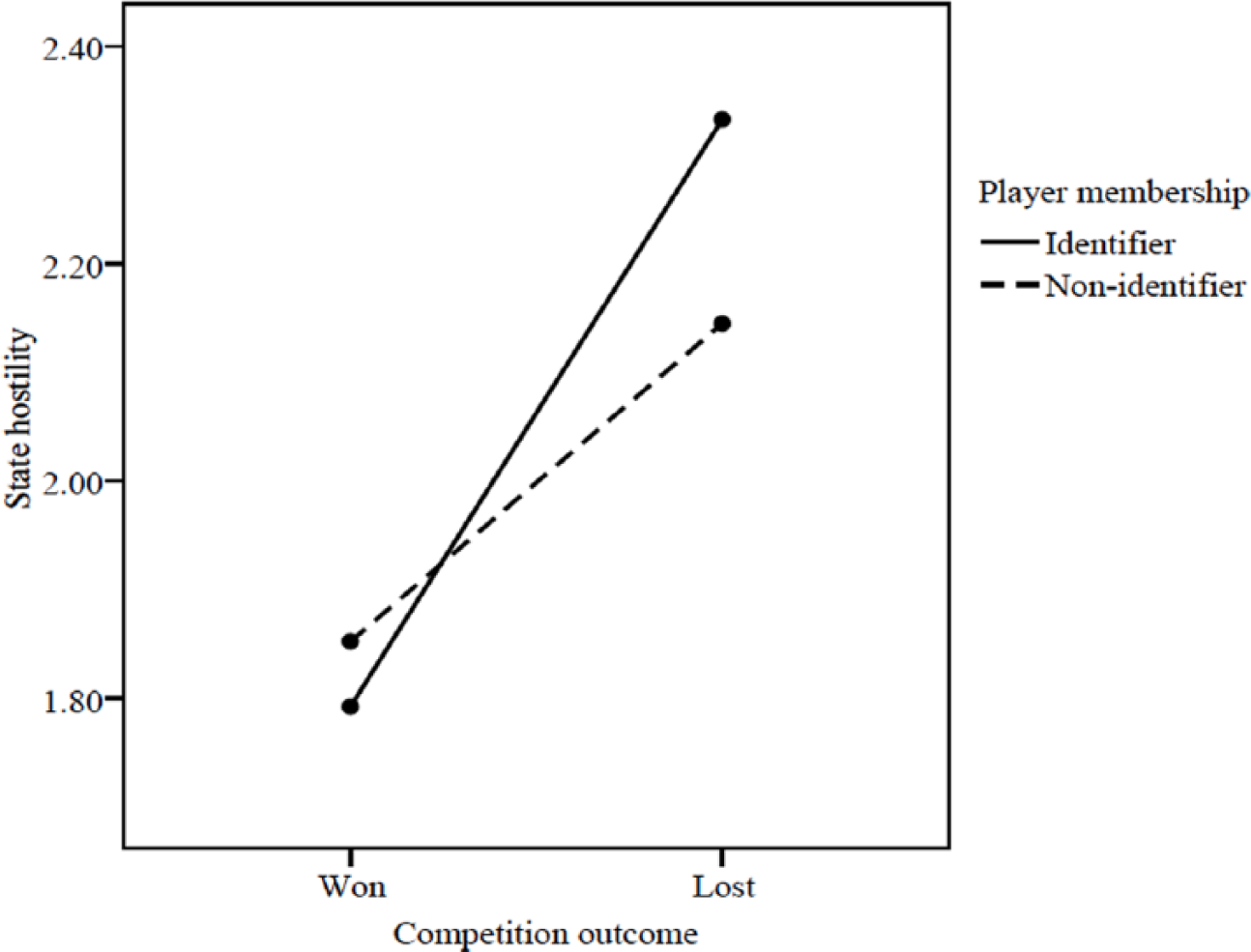
Interaction—Player membership × Competition outcome on state hostility.
The interaction between opponent membership and competition outcome was also significant, F(2, 276) = 3.00, p = .05,
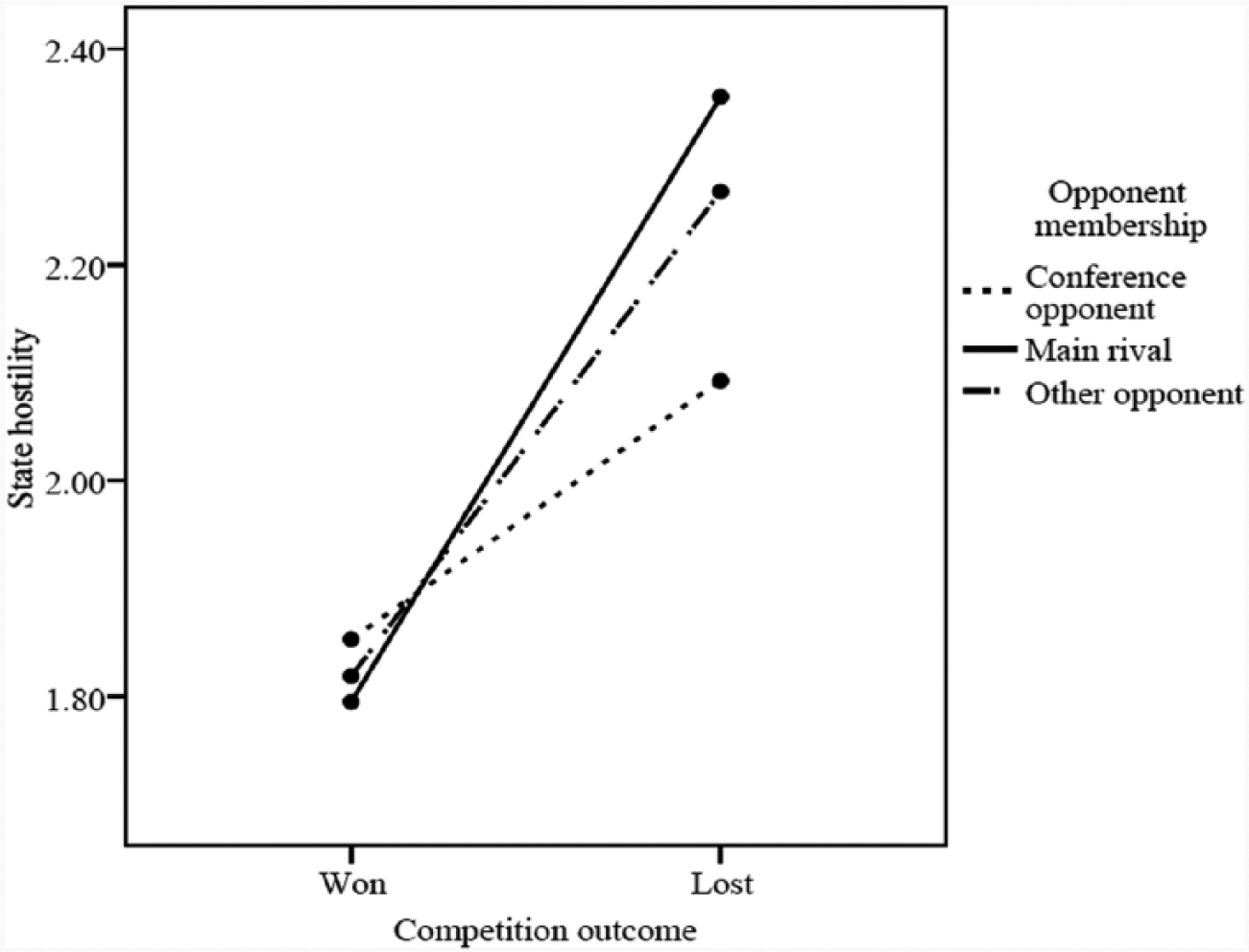
Interaction—Opponent membership × Competition outcome on state hostility.
In addition to the main effect of competition outcome and the interaction effects just described, the controlled variable of trait aggression significantly predicted state hostility, F(1, 276) = 14.12, p < .05,
Discussion
This study examined the role of identification, opponent saliency, and competitive outcome on hostility and enjoyment as outcomes of playing a sports video game. Research suggests that competition can lead to frustration, which in turn results in aggression and hostility (Adachi & Willoughby, 2011, 2013). However, research suggests competition within a video game context results in positive affect and enjoyment (Vorderer et al., 2006). To that end, this research attempted to understand under what conditions hostility or enjoyment might be elicited in competitive video gaming situations (i.e., sports video games). Identification was examined as a potential mechanism to understanding how individuals process outcomes in the context of competitive sports video games. Speaking to the main effects, data did not support the effect for identification on enjoyment or hostility. This is counter to research suggesting identification is positively associated with enjoyment (Klimmt & Vorderer, 2003). It could be that identification in this type of context does not impact enjoyment or hostility by itself without considering other factors.
As expected, competitiveness was significantly related to both enjoyment and hostility. Here, results showed that losing the game produced greater hostility compared to winning. This result further supports prior research addressing frustration, competition, and hostility (Berkowitz, 1989, 1990). As mentioned, while frustration may be a key component to eliciting hostility among video game players (see Adachi & Willoughby, 2013), player performance (i.e., playing at a high level) can result in positive experiences in gaming situations (Trepte & Reinecke, 2009).
The overall results suggest the competition outcome is a significant component to post–game play responses. This research is consistent with broader psychological effects research on the role of success or failure on the impact of positive and negative affect (Nummenmaa & Niemi, 2004). This has important implications for video game research that proposes violence in the gaming situation causes aggressive responses. These data suggest the outcome of the gaming situation also influences aggression-related outcomes. Thus, game researchers need to consider more than content when estimating effects.
Another significant finding of this research relates to the interaction between identification and competitive outcome on hostility. There was no main effect for identification on either state hostility or enjoyment; however, this null effect may be explained through the interaction between identification and competition. Data demonstrated that losing when playing as an emotionally relevant gaming avatar increases state hostility more than playing as an irrelevant gaming avatar. This finding is consistent with past research indicating increases in identification with aggressive character impacts aggressive-related outcomes (Konijn, Bijvank, & Bushman, 2007).
The interaction of opponent membership and competition outcome was also significant—demonstrating the potential importance of opponent with regard to state hostility. This finding supports similar research that opponent type can greatly impact aggressive outcomes (see Williams & Clippinger, 2002). Moreover, the identification and competitive outcome interaction indicates that losing, especially to a more salient opponent, draws stronger reactions than winning against a salient opponent. Researchers have noted that losing elicits stronger narrative reactions (Baker-Ward, Eaton, & Banks, 2005). Here, individuals may have more interpretations for the way in which they played a game that resulted in a loss. Thus, narrative aspects (i.e., competitors) and ludic aspects such as how the game is played and circumstances of the game (bowl game, national championship, etc.) can have a greater impact than either one alone. Furthermore, it is possible that losing to a more salient opponent draws stronger reactions because of the shared narrative history (i.e., rivalry) between the competitors.
The interaction effect can be explained by looking at research related to social identity theory (Tajfel, 1981, 1982; Tajfel & Turner, 1986). “Social identity is defined as that part of the individuals’ self-concept which derives from their knowledge of their membership of a social group (or groups) together with the value and emotional significance of that membership” (Tajfel, 1982, p. 24). Because humans belong to numerous potential identities, self-concept may be heightened or accentuated under certain conditions (Hogg, 2003; Mastro, 2003; Roccas & Brewer, 2002). It has been shown that intergroup behavior, such as competition, enhances in-group solidarity, as well as hostility toward the out-group (Worchel & Austin, 1986). The greatest state hostility was found when losing to the main rival, the most salient out-group. Furthermore, social identity has shown to influence uses and gratifications of media (Harwood, 1999). Being able to play as a favored identity (or team) or having the chance to beat a hated rival could help explain the immense popularity of games, particularly sports video games.
In conclusion, this study provides a glimpse into the affective reactions to competitive situations that are continually built upon, stored, and strengthened over time—and because games afford general learning behavior, reactions experienced during gaming transcend into fan behavior, and general personality traits triggered by competitive events.
This inherent function of competition is a necessary component to gaming effects research due to its influence. In this regard, competition outcomes may be best posited as a situational input within the general aggression model (Anderson et al., 1995; Bushman & Anderson, 2002), or more universally, the general learning model (Buckley & Anderson, 2006). Regarding identification, understanding who the gamer is playing as or against influences affective outcomes. Although initially this was not taken into consideration in gaming research (Anderson, 2004), recent research has started to manipulate the player’s avatar (Eastin, 2006, Eastin, Appiah & Cicchirillo, 2009). Based on the identification literature, greater effects were expected to occur when manipulating a relevant team (as with the case of this study).
Limitations and Future Research
This research might benefit from examining in-game behaviors and emotions during actual game play. For instance, research has shown that affect and uncertainty during a sporting event (as spectatorship) fluctuate during a sporting event (see Knobloch-Westerwick, David, Eastin, Tamborini, & Greenwood, 2009). However, in-game affect was not continuously assessed in this study so that the overall gaming experience was not interrupted.
The current research could be enhanced by understanding how identification and, more specifically, competition outcomes impact violent gaming situations. For instance, NCAA Football is generally not rated as a violent game by the gaming industry (NCAA 07 is rated “E” for Everyone by the Entertainment Software Rating Board (ESRB; 2007). However, some individuals may argue that inherently football is an aggressive sport. Understanding whether violent gaming effects are simply a result from competition outcome could substantially progress the gaming field. At the very least, future gaming effects research should control for competition outcome.
Furthermore, by investigating how children identify with gaming characters within competitive environments, it is possible to obtain a better understanding of how gaming impacts children and developmental learning. Just because the game is not labeled as aggressive or violent, the inherent competitiveness, as well as identification with media characters, shows state hostility can arise from seemingly non-violent situations—for example, simply competing against a salient other (e.g., a sibling or best friend) could induce greater hostility than against anyone else. On the other hand, such frustrating experiences through losses in competitive video gaming may foster an opportunity for developmental learning of coping responses to frustration, which could result in better sportsmanship attitudes and greater resilience to real-life frustrations. Another fruitful research direction would be to incorporate many newer games’ capability of creating the players’ own team. Perhaps there is a more pronounced impact when competing with the gamers’ own name, favorite colors, and logos. More generally, with the increased focus on personalization, games including digitized images of the game player could show dramatic increases in gaming effects in the coming years.
Footnotes
Declaration of Conflicting Interests
The authors declared no potential conflicts of interest with respect to the research, authorship, and/or publication of this article.
Funding
The authors received no financial support for the research, authorship, and/or publication of this article.