




Abstract
Numerous empirical investigations demonstrate that exposure to the stereotypic and oftentimes threatening portrayals of race/ethnicity in the media predict a wide range of unfavorable intergroup outcomes. The current study extends this work by experimentally examining the role of emotions in this process. Specifically, a 2 (Immigration Threat: Present/Absent) × 2 (Ingroup Emotion Endorsement: Present/Absent) + 1 (Control Group) experimental design tests the influence of exposure to immigration news stories on group-level emotions and intergroup behaviors. Findings indicate that exposure to threatening immigration news coverage indirectly influences intergroup outcomes through group-level emotions. Exposure to immigration news indirectly produces active and passive harming behaviors through feelings of contempt. These results provide an important first step in understanding a broader array of media-related intergroup processes and effects.
Keywords
Immigration is among the most controversial topics on the U.S. policy agenda. Despite holding strong opinions on the subject, most Americans’ views are in conflict—they support both tougher border patrol policies and are in favor of developing routes for undocumented immigrants to receive U.S. citizenship (Pew Research Center, 2011; Segovia & DeFever, 2010). At the center of this contentious issue are perceptions (often held by those opposed to immigration) that these ethnic groups present an economic threat to the United States by straining limited government resources and taking jobs away from U.S. citizens (Pew Research Center, 2011). One of the factors (among others) that likely contributes to these threat perceptions is media exposure (see Mastro & Atwell Seate, 2012).
Research in mass communication has long demonstrated that group memberships, particularly those tied to race and ethnicity, are relentlessly linked in the media with social issues ranging from cultural tensions to matters pertaining to crime, terrorism, and the like (Dixon & Linz, 2000a, 2000b; Hoffner & Cohen, 2013; Mastro, 2009; Mastro & Behm-Morawitz, 2005). The subject of immigration is no exception (cf., Fujioka, 2011). All of these issues are highly charged and emotional, primarily owing to the intergroup dynamics at play. Only recently, however, has mass communication scholarship turned its attention to the role that such emotions play in media-related intergroup processes (e.g., Fujioka, 2011; Ramasubramanian, 2010, 2011). Consequently, little is known about the influence of media exposure on group-level emotions or the extent to which such media-driven emotions (if present) impact social identities and intergroup behaviors. Given that media use is known to contribute to both the activation of group memberships and the definitions of those groups (Mastro, 2003; Mastro, Behm-Morawitz, & Ortiz, 2007), the lack of scholarship in this area is a notable shortcoming. As such, the current study applies insights from intergroup emotions theory (IET) and BIAS map research (i.e., behaviors from intergroup affect and stereotypes) to assess the influence of exposure to immigration news on viewers’ emotions and intergroup behaviors/intentions.
The Role of Social Identity in Producing Group-Level Emotions
Hogg (2004, p. 741) defines intergroup processes as “what happens between groups of people or between people who are in different groups—how they behave and relate toward one another” and underscores the considerable role that intergroup relations play in “prejudice, discrimination, social disadvantage, stereotyping . . . and even . . . the way we define ourselves and form a concept of who we are, an identity.” Although intergroup scholars have long articulated the importance of affect in such intergroup processes (e.g., Allport, 1954), empirical tests of this relationship did not emerge until much more recently. This work has explored how enduring affective states (mood) and interaction-specific affect (emotion) influence intergroup processes (see Forgas, 2008; see Smith & Mackie, 2010). Specifically, several major lines of theory and research have arisen which examine the role of emotion in predicting intergroup dynamics (see Smith & Mackie, 2010). This study integrates insights from two of these perspectives: IET (see Smith & Mackie, 2010) and BIAS map (Cuddy, Fiske, & Glick, 2007), to understand the role of media in intergroup emotion and behaviors.
Rooted in the social identity and self-categorization framework(s), IET and BIAS map research investigates the relationship between group-level emotions (vs. individual) and a range of intergroup processes, from ingroup identification to group-related cognitions to intergroup behaviors. In particular, both of these frameworks focus on the distinct nature of emotions when experienced at the group level (i.e., based on social identity), as opposed to the individual level (i.e., based on personal identity). The distinction between group-level emotions and individual-level emotions is meaningful (see Caprariello, Cuddy, & Fiske, 2009; Cuddy et al., 2007; Davis & Stephan, 2011) given that group-based evaluations (depending on the group and the context) have been found to elicit specific interpretations and evaluations, which then evoke particular emotions (e.g., pity, envy, etc.). These emotions, in turn, can trigger certain behavioral responses (e.g., helping, harming).
Central to this logic is the well-documented understanding that identity is comprised both of features unique to the individual (personal identity) as well as those shared by members of the various social groups to which one belongs (social identity), including those based on race, ethnicity, nationality, gender, and the like (Tajfel & Turner, 1986; Turner, 1985). Identification with a group motivates members to maintain a sense of positive ingroup distinctiveness (i.e., favorable comparisons with relevant outgroup(s)) as these group comparisons can support and enhance self-worth. Indeed, the influence of social identity can be so powerful that simply shifting identity salience from the individual to the group can profoundly alter perceptions of the social world and the people in it—motivating intergroup bias. This tendency has been demonstrated in innumerable real-world (and even artificial) settings and has been well-documented in a variety of settings, including mediated contexts (see Mastro & Atwell Seate, 2012).
Given that social identities shape the way we view our social world, it is reasonable to conclude that they would also influence the emotions we experience. From this social identity/self-categorization perspective, IET (see Smith & Mackie, 2010) argues that when individuals are categorized as members of a social group they experience emotions on behalf of the group, and these emotions, in turn, predict intergroup behavior (e.g., Leonard, Moons, Mackie, & Smith, 2011).
IET conceptualizes emotions as “a shared product of group life . . . that . . . creates shared tendencies to act in common ways toward collective others” (Mackie, Maitner, & Smith, 2009, p. 285). From this perspective, emotions are linked with psychological identities (e.g., group memberships) rather than merely with physical (i.e., biological) identities. That is to say, IET argues that emotions can be experienced at the group level, not just at the individual level. Recent empirical evidence provides strong support for this claim. For example, Moons, Leonard, Mackie, and Smith (2009) found that exposure to information about group-level emotional norms impacted participants’ group-level, but not individual-level, emotions. In particular, informing U.S. college students about the emotional norms of shared: (a) national groups, (b) gender groups, and even (c) artificial groups, prompted convergence with the specific, group-based emotion (including fear [Experiment 1], anger [Experiments 1, 2, 3, & 4], and happiness [Experiment 3]); with no effect on individual-level emotions. Altogether, the implication is that group memberships are associated with emotional profiles (that are distinct from individual-level emotions), that are (in part) determined by the communication of group-level emotional norms. In other words, when categorized as members as a social groups, people’s emotions are not “idiosyncratic, but are shared by group members” through communication (Mackie et al., 2009, p. 1869).
The degree to which a person experiences group-level emotions is not exclusively dictated by exposure to communication (or information) about group-based emotional norms. Consistent with social identity theory and self-categorization theory, IET also predicts that experiencing group-level emotions depends on the level of identification with the group. To illustrate, research by Rydell et al. (2008; Experiment 2) found that group identification impacted the degree of intergroup anger experienced by participants. In particular, this study demonstrated that group threat (i.e., cultural insults) predicted anger, and increasingly so, as group identification rose. Notably, not only are highly identified group members more likely to experience group-level emotions but they also feel these emotions more acutely.
Additionally, group-based emotions are determined by intergroup evaluations within the social context. When a person’s social identity trumps their personal identity, the individual appraises their environment at the group level, asking questions like “Will this hurt/help my group?” The response to this type of question dictates the emotions experienced on behalf of the group. These intergroup judgments are governed, partly, by stereotypes about the outgroup (Cuddy et al., 2007). Research in the BIAS map domain aids in clarifying how outgroup stereotypes influence the experience of group-level emotions, which in turn predict specific intergroup behavior.
The Role of Stereotypes in Intergroup Emotions
Evidence from BIAS map research (e.g., Cuddy et al., 2007) indicates that the stereotypes people hold regarding outgroup members govern the intergroup emotions people experience. However, from this perspective, stereotypes are understood in terms of the shared trait dimensions underlying stereotypic perceptions (as opposed to the particular features of specific social stereotypes). BIAS map draws on the stereotype content model’s (Fiske, Cuddy, Glick, & Xu, 2002), theorizing which suggests that “stereotypes are captured by two dimensions (warmth and competence) and that . . . status and competition predict [these] dimensions of stereotypes” (Fiske et al., 2002, p. 878). Specifically, competitive outgroups (e.g., groups that pose a threat) are deemed to lack warmth (e.g., they lack sincerity and kindness), whereas cooperative groups (e.g., groups that do not pose a threat) are stereotyped as warm (Cuddy et al., 2007; Fiske et al., 2002). Additionally, groups deemed high in status (e.g., having high worth in the social structure) are rated competent while low status groups are stereotyped not to be competent. In other words, theory and empirical evidence (see Caprariello et al., 2009; Fiske et al., 2002) indicate that evaluations of competence are based on judgments regarding status (not on competition-based judgments) whereas views regarding warmth stem from perceptions of competition (not status). As such,
Out-groups are perceived as competent to the extent that they are perceived as powerful and high status or as incompetent to the extent that they are perceived as powerless and low status; out-groups are perceived as relatively warm and nice to the extent that they are perceived as not competing with the mainstream in-group. (Fiske et al., 2002, p. 888)
Importantly, the degree to which groups are defined along these two dimensions is guided, at least in part, by traditional “social stereotypes” as we typically define them (e.g., cognitive representations of groups including beliefs about the features, attributes, behaviors, and so on, associated with different groups).
BIAS map research (Cuddy et al., 2007) argues that these two trait dimensions of stereotyping, competence and warmth, predict intergroup behaviors; with this relationship mediated by intergroup emotions (i.e., an indirect effect). In particular, Cuddy, Fiske, and Glick (2008, p. 111) posit that “warmth stereotypes will elicit active facilitation (i.e., helping) and prevent active harm (e.g., attacking), while competence stereotypes will elicit passive facilitation (e.g., associating with) and prevent passive harm (e.g., excluding).” Accordingly, warmth determines the nature of active behaviors (i.e., facilitative or harmful) and competence governs the nature of passive behaviors. Specifically (see Cuddy et al., 2007), groups that are categorized as highly warm but low in competence (e.g., older adults) should illicit feelings such as pity, which in turn produce active facilitative behaviors (e.g., helping behaviors) and passive harming behaviors (e.g., neglect). Groups seen as high in competence but low in warmth (e.g., Asian Americans, per Cuddy et al., 2008) should cue envy which prompts both passive facilitation and active harm. Those groups perceived to be high in both competence and warmth (e.g., allies, ingroups) evoke feeling of admiration which promote active and passive facilitation. Finally, those seen as low in both competence and warmth (e.g., poor people, per Cuddy et al., 2008) prompt contempt which elicits active harm as well as passive harm. Cuddy and associates’ (2007, Studies 3 and 4) work provides empirical evidence that emotions mediate the relationship between outgroup stereotypes and intergroup behavior. Specifically, their findings demonstrate that competence and warmth stereotypes influence both active and passive harming behaviors through group-level emotions.
Most important in the context of the current study is the fact that groups that are seen as low in competence and warmth (as undocumented immigrants are described) should engender feelings of contempt. Contempt is a complex social emotion that is theorized to be comprised of disgust and some form of anger, such as irritation or resentment. Groups associated with contempt are often viewed as exploiting or draining limited/valuable resources (Cuddy et al., 2008). Given research (e.g., Pew Research Center, 2011) indicating that U.S. citizens perceive undocumented immigrants as a strain to government resources, it should come as no surprise that research finds that undocumented immigrants are perceived as low on both competence and warmth (e.g., Lee & Fiske, 2006). Hence, for majority group members, seeing undocumented immigrants should illicit feelings of group-level contempt.
What is particularly notable about contempt (Cuddy et al., 2007) is its association with both active and passive harming behaviors. In the BIAS map literature, the differentiation between active and passive harm is based on intensity, such that active harm takes more effort on behalf of the perceiver (Cuddy et al., 2007). Thus, active harming behaviors are “those that are conducted with directed effort to overtly affect the target group; they [the perceiver] act . . . against the group” (p. 633). Alternatively, passive harming behaviors are “conducted or experienced with less directed effort, but still have repercussions for the outgroup” (p. 633). According to Cuddy et al. (2007), active harm can take place institutionally or interpersonally; whereas, passive harm takes place by enacting behaviors that diminish the outgroup’s social capital. On the one hand, contempt can be associated with avoidance and/or dismissive and neglectful behavior, indicative of passive harm, because the individual perceives the outgroup (and/or its members) as having lower status. On the other hand, the disgust component of contempt motivates active harming behaviors, compelling the individual to “remove a noxious stimulus from one’s perceptual field, eliciting the desire to forcefully expel or obliterate the stimulus,” as seen in behaviors ranging from support for discriminatory policies (i.e., an institutional-level active harming behavior) to enacting hate crimes (i.e., an individual-level harming behavior) (Cuddy et al., 2007, p. 634). Indeed, research provides some evidence for these claims.
Theoretical Implications for Mediated Contact
Given the importance of group identity in media processes and effects (see Harwood & Roy, 2005; Mastro & Atwell Seate, 2012), the implications of IET and the BIAS map would be expected to be particularly consequential in this domain. Mass communication research provides strong evidence that media exposure meaningfully contributes to social identity creation, maintenance, application, and activation, as well as to broader intergroup dynamics in society (see Harwood & Roy, 2005; Mastro & Atwell Seate, 2012). Accordingly, it would be expected that the group-level emotional norms articulated by IET and BIAS map research also would be implicated in these relationships. In the context of the current study, then, the manner in which immigration issues are characterized in the media would be meaningful as these messages help to determine the trait dimensions along which the target group is defined, leading to distinct intergroup emotions (see Mastro & Atwell Seate, 2012).
Although there are variations in representations, generally speaking, racial/ethnic minority groups are commonly presented unfavorably in the media; including in ways that are likely to exacerbate intergroup bias (see Mastro, 2009). In fact, intergroup biases have been empirically linked to exposure to media portrayals that persistently characterize non-dominant groups (and by extension of their members) as threats to dominant group members in society (see Mastro & Atwell Seate, 2012). Arguably, few subjects in media content offer more contentious and threatening intergroup themes and dynamics than immigration (cf. Kim, Carvalho, Davis, & Mullins, 2011; see Hoffner & Cohen, 2013).
News coverage of race/ethnicity in the context of immigration (undocumented or otherwise) has not been extensively examined via quantitative content analysis; however, ample evidence exists which suggests that racial/ethnic minority groups are commonly and persistently associated with threats to dominant culture in the news (e.g., Arendt, 2010; Conway, Grabe, & Grieves, 2007; Rodgers & Thorson, 2000). Much the same appears to be true when it comes to immigration portrayals. Not only are immigrants (undocumented and in some cases documented) and foreigners depicted as threats to the dominant groups’ physical well-being (Arendt, 2010; Conway et al., 2007), but they also are characterized as a threat to the morals and values of the country (Conway et al., 2007) as well as a threat to the livelihood and economic stability of its citizens (Rodgers & Thorson, 2000). To illustrate, research suggests that when addressing “foreigners” and “illegal aliens,” Fox News host Bill O’Reilly regularly characterizes these groups as physically dangerous to the American people (Conway et al., 2007). Undocumented immigrants on network television news are portrayed as “invaders threatening our nation’s well-being” (Subervi, Torres, & Montalvo, 2005, p. 12). Although immigration also is addressed in the context of political policies and legislative initiatives, the overarching images are those of mass arrests of the “flood” of undocumented immigrants illegally penetrating the U.S. border with Mexico. Perhaps predictably then, research indicates that the topic of undocumented immigration is nearly exclusively defined in terms of Latinos; encouraging the inaccurate conflation of Latinos with undocumented immigrants in the United States (Barreto, Manzano, & Segura, 2012; Subervi et al., 2005). Given this, it should come as no surprise that the more individuals perceive immigration news as negative, the more threatening they perceived undocumented immigrants to be (Fujioka, 2011). Certainly, group identity factors and associated group-level emotions are likely to be of critical importance to this process.
Media Characteristics That Activate Identity-Related Processes
Additional factors commonly associated with news media coverage also are likely to play a role in this process. Recall, IET predicts that the explicit communication of ingroup emotional norms influences individuals’ group-level emotional experiences, but does not influence individual-level emotions (see Moons et al., 2009). Accordingly, the specific manner in which immigration is reported in the media is important to consider. Given that many issues in the news are framed through the use of exemplars (e.g., expert source, spokesperson, community member, etc.) espousing the group’s perspective on any given issue (which likely includes information on how group members feel about the issue at hand), the provocation of group-level emotions is quite plausible (see Zillmann & Brosius, 2000 for exemplification theory review). Indeed, Entman (1990) suggests that media play a prominent role in communicating emotional norms (although not explicitly addressed in this manner). He argues that pairing racial and ethnic minorities with intergroup threats and highlighting majority groups (e.g., Whites) fears likely influences the extent to which individuals experience negative, group-level emotions. That is to say, news content that features ingroup members endorsing emotional norms for the group (e.g., advocating a particular emotional response, promoting or normalizing a certain affective reaction) should strengthen the group-level emotion experienced. Indeed, abundant empirical evidence indicates that the appropriate media exemplar (e.g., ingroup member, salient, vivid, etc.) can wholly define issues, categories, and events, whether or not these exemplars are actually accurate representations (Harris, Cady, & Barlett, 2007). Taken together, IET and media research suggest that the use of exemplars in the news should moderate the direct effect of mediated intergroup contact and group-level emotions.
The Moderating Role of Identity Importance
As addressed previously, IET predicts that individuals higher in group identification tend to experience and exhibit more pronounced consequences of group categorization. This is true of both real-world (Rydell et al., 2008) and mediated environments (Mastro, 2003; Mastro, Behm-Morawitz, & Kopacz, 2008). For example, research indicates that the more White viewers identify with their racial ingroup, the more they offer sympathetic evaluations of ingroup characters (Mastro, 2003, Study 1) and unfavorable evaluations of outgroup characters (Mastro et al., 2008). Thus, if a particular group membership is a trivial component of one’s self-definition, intergroup outcomes (emotional or otherwise) are less likely to be pronounced.
Group-Level Emotions’ Impact on Active and Passive Harming Behavior
Because undocumented immigrants would be considered low in both competence and in warmth on the BIAS map, contempt would be activated when contextually relevant. As noted previously, these emotions should, in turn, predict both active and passive harming behaviors. In the context of exposure to news coverage of immigration, one relevant active harming behavior would be supporting legislation that is disadvantageous to the outgroup, such as English-only laws in the United States. Support for institutional discriminatory policies is a quintessential active harming behavior (Cuddy et al., 2007). Alternatively, passive harm might be reflected in social aggression (a classic passive harming behavior) and may take a variety of communicative forms; including sharing information with one’s interpersonal network about the subject of the threat to diminish the outgroup’s social capital (e.g., Brader, Valentino, & Suhay, 2008). Although in a different context, this idea is echoed by Rojas, Shah, and Friedland (2011, p. 692) who assert, “[a] communicative perspective of social capital, on the other hand, shifts the focus from such social attitudes to the exchange of information and shared meaning that flows through social ties,” particularly those ties in one’s interpersonal network. Thus, contempt emotions are likely to be associated with a wide range of behaviors that overtly and/or indirectly damage or devalue the outgroup (Cuddy et al., 2007).
Hypotheses
Taken together, existing theory and empirical evidence suggest that mediated contexts embody the appropriate conditions to influence intergroup behavior through group-level emotions. Less clear, however, is the particular trajectory of this relationship. On the one hand, IET and BIAS map indicate that intergroup threat should both directly and indirectly (i.e., via group-level emotions) influence intergroup behaviors. On the other hand, empirical results from mediated-intergroup research suggest that effects are more likely to be indirect (e.g., Ramasubramanian, 2010). To give primacy to the theory, we predict that exposure to a threatening immigration news story (vs. non-threatening or control condition) will have a direct effect on behavioral tendencies that protect the self and the ingroup (Hypothesis 1 [H1]). Specifically, it is hypothesized that media exposure will directly influence sharing information about the threatening outgroup (passive harm; Hypothesis 1a [H1a]) and support for discriminatory policies that favors U.S. citizens (active harm; Hypothesis 1b [H1b]).
Consistent with IET, BIAS map research, and media research (e.g., Ramasubramanian, 2010), we also predict that group-level emotions will mediate the relationship between mediated intergroup threat and active and passive harming behavior. Stated formally, we predict an indirect effect of exposure to threatening immigration news through feelings of contempt on both sharing information (passive harm; Hypothesis 2a [H2a]) and support for discriminatory policies that favor U.S. citizens (active harm; Hypothesis 2b [H2b]).
As discussed previously, IET indicates that both individual differences and message factors influence the extent to which group-level emotions are experienced (see Mackie, Smith, & Ray, 2008). Put another way, IET predicts that individual differences (e.g., identity importance) and the message environment (e.g., ingroup member/exemplar endorsing the emotional norm) will moderate the relationship between mediated intergroup threat and group-level emotions. More specifically, both identity importance (i.e., ingroup identification) and ingroup endorsement of the emotional norms presented in the news (i.e., validation offered by ingroup media exemplar) should exacerbate the level of contempt experienced. Accordingly, we postulate that immigration threat and identity importance will interact in predicting contempt such that as group identification increases, those exposed to the immigration threat will report more contempt
Because group identification and ingroup norm endorsement are predicted to impact feelings of contempt (H3 and H4), it stands to reason that these factors would moderate the indirect effects predicted in H2. Hence, we expect that the indirect effect proposed in H2 will be moderated by group identification and ingroup norm endorsement (i.e., ingroup media exemplar espousing the group’s view), such that there will be a conditional indirect effect of immigration threat on both active and passive harm for those with high levels of group identification and exposed to the ingroup member endorsing the emotional norms (Hypothesis 5 [H5]). Please see Figure 1 for an illustration of the hypothesized model.
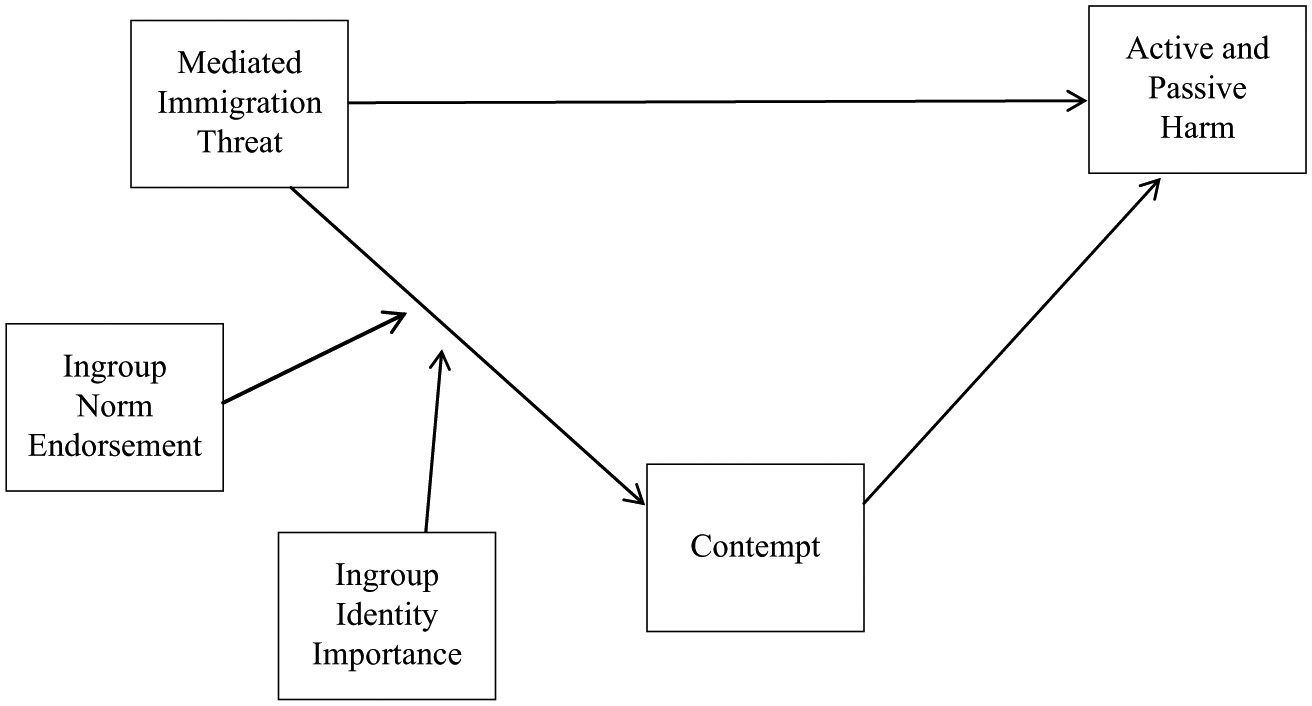
Proposed model.
Method
Participants
Four-hundred and forty-four participants were recruited from communication courses at a large southwestern university. Because this study examined intergroup perceptions regarding immigration at the U.S.-Mexican border in the United States all non-U.S. citizens and Hispanic/Latinos were excluded from the analyses (n = 70). Participants were compensated with extra course credit. Participants mostly self-identified as White (88%); however, 4.8% identified as Asian/Pacific Islander, 4.8% identified as African American/Black, and 2.4% identified as other. The average age of the participants was 20.14 (SD = 1.24) and the majority were female (71.1%). Other data from this project are reported elsewhere (Atwell Seate & Mastro, 2013, 2015).
Procedure
Participants came to a research lab in groups of up to 10 to complete the experiment and were randomly assigned to experimental conditions at individual computer stations (see below). First, participants watched a news segment that contained a distracter segment (about the weather) and then the experimental manipulation. After watching the news segment, participants completed the study’s questionnaire. Once finished, participants were fully debriefed.
Experimental Manipulation
Participants were randomly assigned to a 2 (Immigration: Threat, No-threat) × 2 (Ingroup Emotional Norm Endorsement: Present, Absent) + 1 (Control Group) experimental design. Because we did not want the control condition to be exposed to any intergroup information, we included a condition that was not in the factorial design. The news segment was adapted from actual immigration news reports (i.e., Lamm & Harrison, 2010; Solís, 2010) and produced by the local public media affiliate news studio. The actor who played the news anchor was the same in all conditions. In the threat condition, the story covered the negative implications of illegal immigration including increases in crime, threats to U.S. culture, and threats to the economy—which research suggests are common in this type of news (Kim et al., 2011). The no-threat condition discussed immigration in a non-challenging way. Specifically, this story highlighted the possibly favorable cultural and economic consequences of immigration in the local community. The second factor, ingroup endorsement of emotional norms, was manipulated by either featuring or not featuring ingroup members (White, U.S. citizens; one male and one female) endorsing the emotional norm of the story. The ingroup members either endorsed the emotions elicited by the threat (e.g., “I don’t think people really understand how angry we all are about seeing the number of immigrants coming into [our community].”) or the absence of threat (e.g., “I think that people assume we are all angry about immigrants coming into [our community], but we aren’t.” In other words, participants were either exposed or not exposed to the ingroup members endorsing the emotional norm of the story. The control condition watched a second, non-intergroup news story (see Appendix).
Pilot testing of experimental conditions
To ensure that the news segments created for use in the current study represented the desired frames regarding immigration, three undergraduate coders (blind to the goals of the study), coded news segments for perceptions of threat and presence of the exemplar, among other distractor variables. To assess threat, the coders responded to a semantic differential item, with “1” representing a threatening frame, “7” representing a non-threatening frame, and “4” representing neither threatening nor non-threatening. A threatening frame was defined as a frame that emphasized the negative, harmful, and undesirable consequences of immigration to U.S. citizens, whereas, a non-threatening frame was defined as a frame that emphasized the positive and beneficial consequences of immigration to U.S. citizens. The coders were highly reliable (Krippendorff’s α = .98).
Next, the threatening and non-threatening frames were separately averaged across exemplar presentations. In other words, the threatening/exemplar-present condition was averaged with the threatening/exemplar-absent condition, so that a single threatening frame score was created for each coder. The same was done for the non-threatening news stories. The resulting mean for each frame was threatening (M = 1.35), non-threatening (M = 6.84), and control (M = 4.00), indicating the desired manipulation of threat for the news segments used in the current study. To further test the appropriateness of the news conditions, the ideal/desired scoring of each frame (threatening = 1, control = 4, non-threatening = 7) was used to predict the coder’s actual ratings. The regression results indicated that the coders perceived the frames as intended in the manipulation, β = 1.00, t = 30.25, p < .001. Finally, all coders correctly identified the presence (or absence) of the ingroup member/exemplar endorsing the emotional norms in each of the news segments.
Moderator
Ingroup identification
The ingroup identification measure was adapted from four items used by Mastro et al. (2008). For example, “Compared to other characteristics that define you, how much do you value being an American?” and “[h]ow strong a sense of belonging do you have with being an American?” Responses ranged from not at all (1) to very (5) on a 5-point scale (M = 3.79, SD = 0.91, α = .88).
Mediator
Contempt
Contempt was measured by adapting items from Ramasubramanian (2010). Specifically, participants were asked to: “Please look at each of the following adjectives and indicate how well they describe your feelings toward undocumented immigrants in general. Please be frank in your opinions.” Participants reported their feelings of irritation and disgust toward undocumented immigrants. Responses ranged from strongly disagree to strongly agree on a 7-point scale. The two items were averaged (M = 2.98, SD = 1.58, r = .65, p < .001).
Dependent Variables
Active harm
Based on previous research by Brader and associates (2008), active harm was measured by asking participants whether they wanted to sign a petition to support an English-only law, specifically: “There is a movement trying to get an amendment added to the Constitution making English the official language of the United States, meaning government business would be conducted in English only, would you like to sign that petition?” Response options were “Yes” and “No.” If participants chose “Yes,” they were taken to an online petition where they had the opportunity to enter their name. Only participants that entered their name were coded as signing the petition.
Passive harm
To measure passive harm, participants rated how likely they would be to share the news story: interpersonally with friends, through email, and through social networking sites. Responses ranged from very unlikely through very likely on a 7-point scale. These items were averaged (M = 1.99, SD = 1.06, α = .71). Information sharing was positively skewed and a square root transformation was performed to reduce the absolute value of the skew (Fink, 2009).
Results
To assess whether news exposure influenced intergroup behaviors both directly and indirectly through contempt, a two-step regression approach was taken. Because the control condition does not fit into the factorial design, the two-step approach is most appropriate. First, the direct, indirect, and conditional indirect analyses were computed using the PROCESS macro (Hayes, 2013) with only the fully factored experimental conditions. The use of this macro is advantageous as it provides both the direct and conditional indirect effects of the independent, mediator, and moderator variables in one model. Moreover, it uses bootstrapping techniques for the standard errors, which is the most appropriate way to compute these estimates. For the current analyses, the 95% confidence intervals for all effects used 5,000 bootstrapped samples. The PROCESS macro provides the user with a variety of mathematical computations to model direct, indirect, and conditional indirect effects (see Hayes, 2013). Specifically, Model 4 was used to test both the direct and indirect effects (H1 and H2) and Model 9 was used to ascertain the conditional indirect effects (H3-H5; see Hayes, 2013). Second, ordinary least squares regression analyses compared the mean differences between the fully factored experimental conditions and the control condition for H1. For these regression analyses, four dummy-coded variables (coded such that the control condition is the reference category) were entered together as a block, comparing each experimental condition with the control condition.
Hypothesis Testing
Direct effect of experimental condition
To test H1 and H2, we used PROCESS, Model 4 (Hayes, 2013). H1 predicted that exposure to a threatening immigration news story would lead to sharing information about the outgroup (passive harm) and support for discriminatory policies that favors U.S. citizens (active harm), more so than exposure to a story featuring immigration without mention of intergroup threats or the control condition. Results revealed that the direct effect of the immigration threat on information sharing was not significant, b = .06, t = 1.47, p > .05. Moreover, the immigration threat did not have a direct effect on English-only law support, b = −.38, Z = −1.61, p > .05. The experimental conditions were not significantly different from the control in directly predicting information sharing, F (4, 369) = 1.12, p > .05, or English-only law support, χ2(4) = 1.60, p >.05. H1 was not supported.
Indirect effect of experimental condition
H2 predicted that there would be an indirect effect of exposure to a threatening immigration news story through contempt, on sharing information about the threatening outgroup (passive harm) and support for discriminatory policies that favor U.S. citizens (active harm). PROCESS (Hayes, 2013; Model 4) revealed a modest indirect effect of immigration threat on information sharing, b = .02, 95% CI [.003, .04], model R2 = .03. Contempt also directly predicted information sharing, b = .03, t = 2.50, p < .05. The second mediation model similarly revealed that exposure to the immigration threat indirectly impacted support for English-only legislation via contempt, b = .12, 95% CI [.03, .27], Nagelkerke R2 = .05. Contempt also directly predicted support for English-only legislation, b = .24, Z = 3.13, p < .01. In sum, these results indicate that exposure to immigration threat increased contempt-related emotions; with increases in contempt associated with more information sharing and a greater likelihood of supporting the English-only law. Taken together, these results support H2.
Moderator effects in predicting contempt
To test H3 to H6, we used PROCESS, Model 9 (Hayes, 2013). H3 predicted an interaction between immigration threat and ingroup identification, such that there would be a positive association between ingroup identification and contempt for those exposed to the immigration threat. Indeed, there was a significant interaction between the immigration threat factor and ingroup identity, b = .39, t = 2.01, p < .05. We used PROCESS to interpret this interaction (Model 1, model R2 = .06). Results indicated that for those exposed to the immigration threat, there was a positive association between ingroup identity importance and contempt among individuals with high levels of ingroup identification (i.e., one SD above the mean), b = .85, p < .01 and average levels of ingroup identification (i.e., at the mean), b = .48, p < .01. However, there was no relationship between ingroup identity importance and contempt for those exposed to the immigration threat and low on ingroup identity importance (i.e., one SD below the mean), b = .10, p > .05. Please see Figure 2. These results support H3.
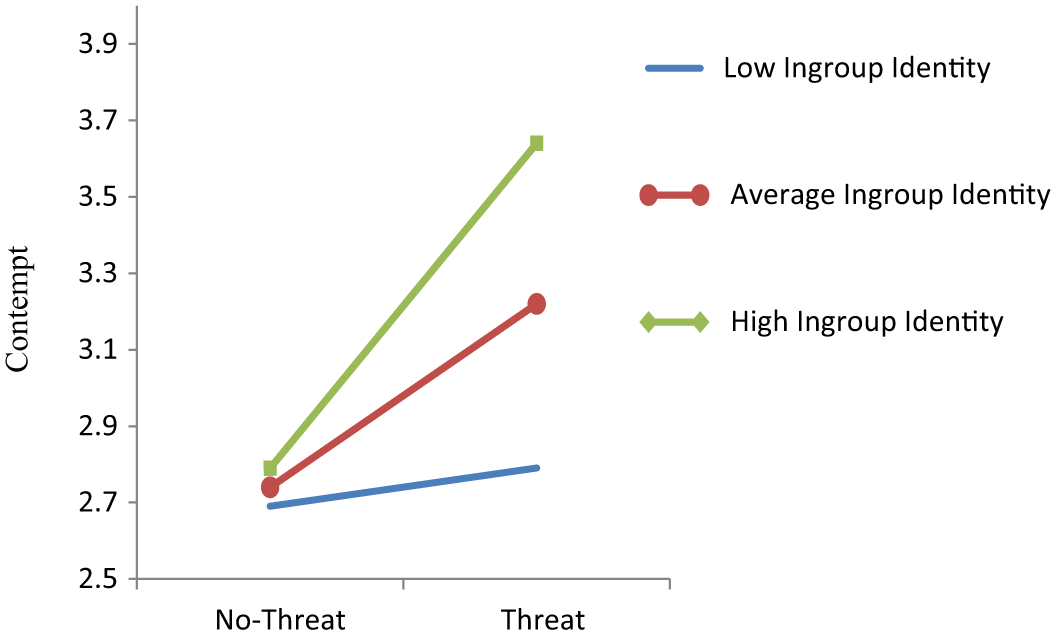
Interaction between threat condition and group identity importance in predicting contempt.
H4 predicted that contempt would be the highest for those exposed to the immigration threat and the ingroup endorsement of the emotional norm. The interaction between immigration threat and ingroup emotional norm endorsement was not significant, b = .55, t = 1.56, p> .05. H4 was not supported.
Conditional indirect effects
H5 predicted that the indirect effect proposed in H2 would be moderated by ingroup identification and ingroup norm endorsement, such that there would be a conditional indirect effect of the immigration threat on the outcomes for those with high levels of ingroup identification and exposed to the ingroup member endorsing the emotional norm. With regard to information sharing, results revealed a modest conditional indirect of experimental condition. Specifically, there was an indirect effect of exposure to the immigration threat on information sharing via contempt for those with high levels of ingroup identification. This conditional indirect effect occurred for individuals that had high levels of ingroup identification (i.e., one SD above the mean) and were not exposed to the ingroup member endorsing the emotional norm, b = .02, 95% CI [.001, .05]. This effect also occurred for those who were exposed to the ingroup member endorsing the emotional norm and had average levels of ingroup identification (i.e., at the mean), b = .02, 95% CI [.004, .06] or high levels of ingroup identification, b = .04, 95% CI [.01, .08], model R2 = .04 (see Table 1).
Conditional Indirect Effect of Exposure to Immigration Threat as a Function of Ingroup Emotional Norm Endorsement and Identity Importance on Information Sharing.

Note. Identity importance was a quantitative moderator. The above values are at 1 SD below the mean, at the mean, and 1 SD above the mean.The information sharing measure was transformed; see text.
A similar pattern emerged for English-only law support. Contempt mediated the relationship between immigration threat and English-only law support for those with high levels of ingroup identification. This conditional indirect effect occurred for individuals that had high levels of ingroup identification (i.e., one SD above the mean) and were not exposed to the ingroup member endorsing the emotional norm, b = .14, 95% CI [.005, .36]. This effect also occurred for those who were exposed to the ingroup member endorsing the emotional norm and had average levels of ingroup identification (i.e., at the mean), b = .18, 95% CI [.05, .42] or high levels of ingroup identification, b = .27, 95% CI [09, .58], model Nagelkerke R2 = .05 (see Table 2).
Conditional Indirect Effect of Exposure to Immigration Threat as a Function of Ingroup Emotional Norm Endorsement and Identity Importance on English-Only Law Support.
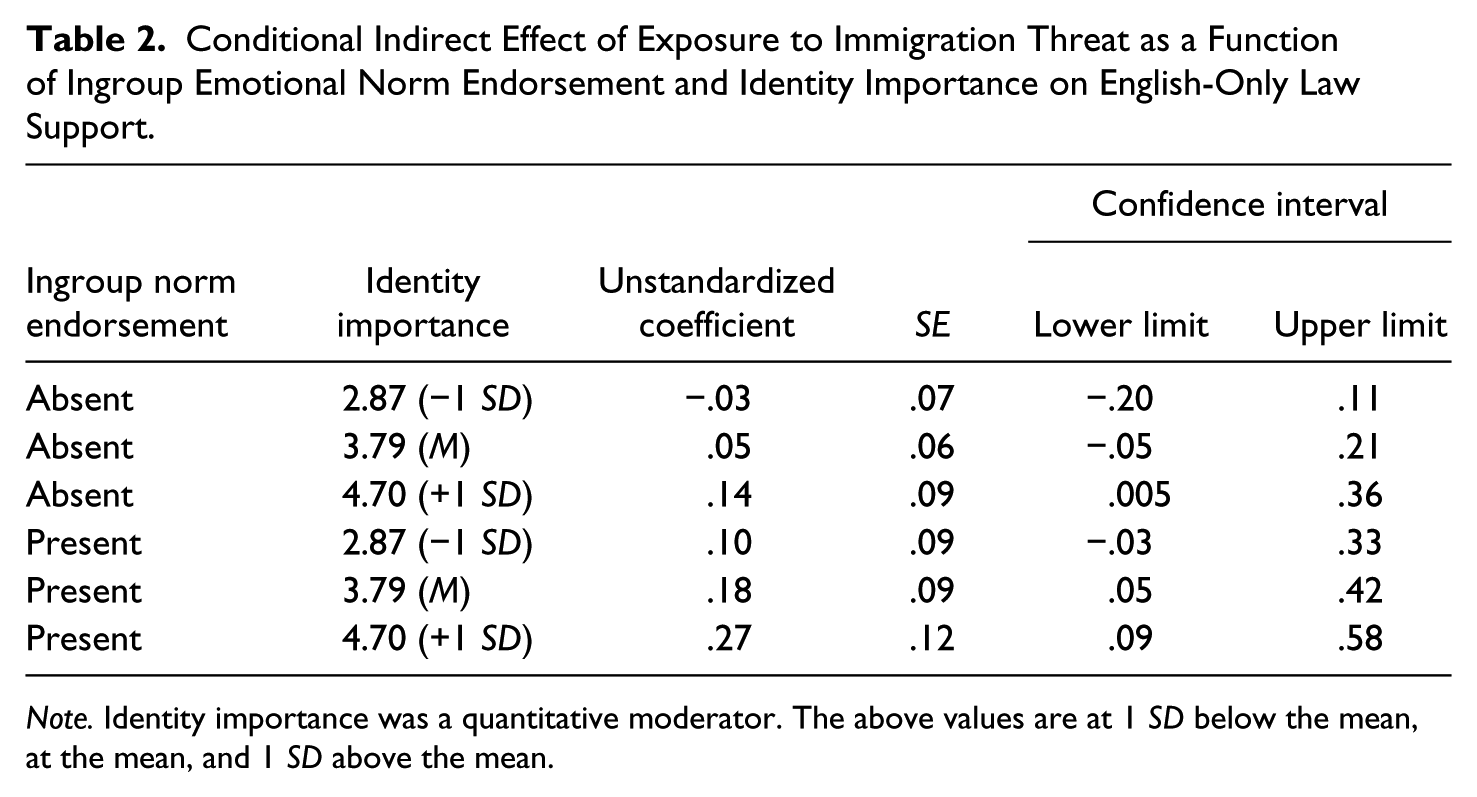
Note. Identity importance was a quantitative moderator. The above values are at 1 SD below the mean, at the mean, and 1 SD above the mean.
In sum, these moderated mediation analyses reveal that exposure to immigration threat indirectly impacts both active and passive harming behaviors for individuals who have high levels of identity importance, regardless of the presence or absence of an ingroup member endorsing the emotional norm presented in the news story. However, for those with moderate levels of identity importance, the presence of an ingroup member was needed to trigger the contempt. Taken together, these results provide support for H5.
Discussion
The current investigation examined the mechanisms through which mediated intergroup threats influence both active and passive harming behaviors. Integrating insights from social identity, appraisal-based theories of intergroup emotion this study provides evidence that mediated intergroup threats impact support for English-only laws and information sharing indirectly through group-level emotions. These indirect effects were moderated by ingroup identification and the presence of an ingroup member endorsing the emotional norms in the news segment. Taken together, the current work suggests that the causal impact of media exposure on intergroup outcomes is complex, with features of media content and individual differences working together to influence intergroup emotions, which in turn predict intergroup behavior.
We found that exposure to mediated intergroup threat did not, in and of itself, directly influence intergroup behavior. The failure to detect a direct effect for media exposure on active and passive harming behaviors is not entirely surprising for several reasons. First, scholars investigating emotion argue that emotions can mediate the influence of cognitions on behaviors (e.g., Mackie, Devos, & Smith, 2000). This line of reasoning is consistent with media research by Ramasubramanian (2010), which demonstrates that television consumption indirectly impacts affirmative action attitudes through feelings of outgroup prejudice. Second, intergroup communication scholars consistently find that the media works in tandem with individual-level factors in producing intergroup outcomes (e.g., Dixon, 2006). For example, Mastro (2003) found that Whites did not uniformly justify an ingroup member’s criminality more so than an outgroup member’s criminality. Instead, ingroup identification moderated the relationship between media exposure and criminality justification. Because IET underscores the importance of group identity in producing group-level emotions, our findings are consistent with both theory and extant literature.
Although exposure to news depictions of immigration threat did not directly influence either active harm (i.e., English-only law support) or passive harm (i.e., information sharing), it did affect behaviors indirectly through contempt, increasingly so as ingroup identification rose. This supports IET which predicts that highly identified group members experience group-level emotions more strongly. Specifically, those who were exposed to the immigration threat reported stronger contempt as their identification with their ingroup increased. Contempt, in turn, predicted both active and passive harming behaviors. Because undocumented immigrants would be expected to be perceived as a competitive outgroup (e.g., jobs, resources) with a low status, they would be stereotyped as low on both warmth and competence on the BIAS map (among majority group members) and, consequently, evoke contempt. Accordingly, predictable (and harmful) behavioral tendencies should emerge when media exposure cues this structural relationship. Indeed, these data suggest that not only is this the case, but that news media use can trigger this process. Altogether, these findings extend predictions rooted in IET and the BIAS map by demonstrating the relevance of media in activating emotional intergroup prejudice. In light of increasing levels of news coverage on the topic of immigration (Kim et al., 2011), these results are particularly disconcerting. Although the effect sizes reported here are small, Abelson (1985) notes, “Small variance contributions of independent variables in single-shot studies grossly understate the variance contribution in the long run” (p. 133). Hence, when the results here are considered alongside rates of media use in the population, these results are even more alarming, given that the media landscape is replete with competitive/threatening depictions of race/ethnicity.
Quite possibly, the most interesting finding of the current study is the nature of the relationship between ingroup identity and ingroup norm endorsement in influencing the indirect effect of intergroup threat on passive and active harming behaviors. For both information sharing (i.e., passive harm) and English-only law support (i.e., active harm), contempt mediated the relationship between news exposure and subsequent behaviors when individuals either: (a) did not see the ingroup member endorsing the emotional norm and had high levels of ingroup identification or (b) had average or high levels of ingroup identification and were exposed to the ingroup member endorsing the emotional norm. It seems that for those who had the highest levels of group identification, fewer communication cues were needed to underscore the normative group-level emotional profile (i.e., these individuals experienced higher levels of contempt regardless of the presence of an ingroup member in the news story). However, those with average levels of ingroup identification needed to be exposed to an ingroup member endorsing the emotional tone of the story for the indirect relationship between media exposure and harming behaviors via contempt to hold. This is consistent with self-categorization theory which articulates that people use their social identities to judge the appropriateness of their behavior (Turner, 1985). In other words, people look to ingroup members to “validate their responses as correct, appropriate, and desirable” (Turner, 1985, p. 113). Moreover, these results are in line with the tenets of IET, as they underscore the dominant role that group membership can play in guiding feelings (and related judgments and actions), when the group is highly important to the individual.
Theoretical and Practical Implications
Taken together, this work provides novel insights into how media messages and group membership influence intergroup relations. Although the indirect and conditional indirect effects were modest, they cautiously extend previous intergroup research, offering evidence that group-level emotions prompted by media exposure can predict both active and passive harming behaviors. In so doing, the results demonstrate the important role of media exposure in a wider array of intergroup processes and outcomes than previously appreciated.
Equally importantly, the finding that media exposure has the potential to encourage sharing news stories with other ingroup members implies that these messages may have even more pronounced effects than those detected here. Scholars argue that when information is shared online there is “an implicit level of credibility” when the message comes from a friend (e.g., Chui, Hsieh, Kao, & Lee, 2007, p. 525). Moreover, people are more likely to share online information when it comes from a friend (Chui et al., 2007). In other words, watching a news story that was shared by another individual may elevate perceptions regarding the believability and truthfulness of the message, which in turn increases the likelihood of continued information sharing. It stands to reason, then, that a message that is shared by an ingroup member may have a stronger impact on intergroup outcomes, through increased credibility perceptions. Given the ease with which one can email a news article or send a link to a news broadcast, the significance of information sharing in this context cannot be overstated.
An implication that has both practical and theoretical importance is the influence of emotion on policy decision-making. Although exposure to immigration threat coverage did not directly impact attitudes toward immigration policy or policy support behaviors, exposure did indirectly impact policy support through feelings of contempt. This result suggests that individuals may be just as likely to support legislation based on the emotions they experience in association with the issue, as they are based on the facts related to the issue. In other words, it appears that as long as individuals experience strong (and negative, in the current media environment) emotions in association with group-related policy issues (such as immigration), individuals may engage in unsympathetic behaviors to protect what they see as their group’s best interest.
Finally, although the current study focused on the potential for media exposure to cue harmful intergroup outcomes, it is important to note that these same mechanisms also should promote more auspicious intergroup emotions and behaviors, under the right circumstances (see Cuddy et al., 2007; Cuddy et al., 2008). For example, if well-known and respectable features of an outgroup are emphasized in the media (e.g., strong family values) viewers could, indeed, feel admiration for the group (e.g., Mastro & Tukachinsky, 2011); provided the dimension does not represent a zero-sum scenario or a situation wherein limited resources are at stake. This could stem from taking pride in and/or admiring the accomplishment due to the relevance of the concept to the self or from assimilating the success to one’s own group. In either case, these group-level emotions would then, conceivably, promote both active (e.g., assisting, defending) and passive (e.g., cooperating) helping behaviors.
Limitations and Concluding Comments
Like all research, this study has several limitations that should be noted. First, a primary limitation of the current study was the inability to recruit more racial/ethnic minorities. Although a fair number of Latinos (n = 50) participated in the study, the quantity was insufficient to treat ethnicity as a between-subjects factor in statistical analyses (as preliminary analyses indicated that they were systematically different from non-Latinos, including other racial/ethnic minorities). Future research would be greatly benefitted by examining how Latinos perceive and respond to immigration news coverage. Second, although other racial/ethnic groups were retained in the current study, the majority of the sample was White and the overall proportion of racial/ethnic groups was not reflective of real-world demographics. This ultimately limits the generalizability of the current study’s findings. Finally, this study was conducted in the southwest United States, where immigration is a prominent regional issue, covered frequently in the news. Hence, threats regarding immigration may be more salient to our participants.
Despite the limitations, the results from the present study allude to a number of important consequences of group-level emotions in the context of media that warrant further consideration. First, it is reasonable to suggest that consistently pairing certain groups with themes characterized by threat (as is the case for undocumented immigrants as well as a range of ethnic groups) will lead to the persistent association of specific emotional norms (in this case, unfavorable) with these groups. Second, appreciating the media’s ability to evoke these emotions is critical as they would be expected to define how media messages are processed. Finally, this group-emotion-based interpretation should point to a predictable set of intergroup actions that might otherwise be ignored in the context of individual-based media effects frameworks (see Mastro & Atwell Seate, 2012). Thus, albeit preliminary, the insights found here help to lay the foundation for future research into the role of media and group-level emotion in intergroup processes.
Footnotes
Appendix
Acknowledgements
The authors would like to thank Dr. Jake Harwood and Dr. Chris Segrin for their helpful suggestions on an earlier version of this manuscript.
Declaration of Conflicting Interests
The authors declared no potential conflicts of interest with respect to the research, authorship, and/or publication of this article.
Funding
The authors received no financial support for the research, authorship, and/or publication of this article.