



Abstract
This study reports a quasi-experiment (N= 374) that examined an underlying mechanism through which narratives can facilitate personalization of risk. The participants were exposed to one of four entertainment clips depicting an at-risk character who either tested positive or negative for sexually transmitted diseases (STDs). As predicted, reduction of perceived social distance to an at-risk character resulted in a convergence of perceived self- and character-risk. More importantly, the convergence of risk was driven by an increased perception of self-risk, as opposed to a reduction of character-risk. The observed pattern of risk convergence was much more pronounced in the negative rather than the positive STD test narratives. Furthermore, narrative engagement through identification, parasocial interaction, and perceived realism led to a greater degree of risk convergence, which was mediated by reduction in perceived social distance. The order in which the subjects estimated self- and character-risk did not influence the perceptual gap.
Keywords
One of the major obstacles to risk communication is individuals’ tendency to underestimate their own likelihood of being affected by risk events while overestimating the likelihood of others (Weinstein, 1989). Recognizing the unrealistic optimism (Weinstein, 1980) or illusions of invulnerability (Perloff, 1983) as a form of resistance to risk communication efforts, various types of health communication interventions have been designed to help individuals overcome this perceptual fallacy and perceive more realistic levels of risk conducive to protective action against danger. Of these efforts, entertainment education (E-E), or narrative-based persuasion more broadly, has received much scholarly attention due to its relative advantage in facilitating the personalization of risk (Kreuter et al., 2007; Moyer-Gusé, 2008). Accordingly, a growing body of research in E-E and narrative persuasion has identified various narrative engagement processes that promote the personalization effect including identification with a character (Basil & Brown, 1997; Moyer-Gusé & Nabi, 2010), parasocial interaction (Brown & Basil, 1995), transportation (Dunlop, Wakefield, & Kashima, 2010), and perceived realism (Cho, Shen, & Wilson, 2013).
The accumulation of knowledge regarding the various conditions conducive to risk personalization has begun to motivate scholars to push their research agenda toward what Reis and Stiller (1992) referred to as second-generation research, which aims at explaining why the observed effects may have occurred. Notably, arguing for a common mechanism that can explain the effects of various narrative engagement processes on personalization of risk, So and Nabi (2013) proposed the risk convergence model (RCM) by integrating the disjointed literature on narrative persuasion and media effects. In essence, RCM posits that reduction of perceived social distance to an at-risk character is a fundamental mechanism that can explain the effects of various narrative engagement variables on audiences’ personal risk perceptions. Although RCM received empirical support for the theoretical arguments put forward, some of the underlying core assumptions were left unexamined, leaving us uninformed of the exact psychological mechanism that takes place when one personalizes a risk event experienced by a narrative character. For instance, the model is grounded on an assumption that reduction of perceived social distance to an at-risk character would increase personal risk perception by allowing it to converge with that of the at-risk character, which the model assumes to be reasonably high and stable. As So and Nabi’s study focused on audience’s personal risk perceptions as the only outcome variable of interest, the idea of risk convergence was not explicitly tested, leaving the psychological mechanism of risk personalization unexplored.
This study joins the growing body of research that seeks to move beyond the identification of a phenomenon—that is, narrative influences on risk personalization—and toward a “fuller, more detailed investigation of the nature” of the phenomenon (Reis & Stiller, 1992, p. 465). Specifically, this research investigated the underlying psychological mechanism involved in risk personalization in a narrative context and examined if and how perceived social distance contributes to increased personal risk perception through convergence or divergence between self- and character-risk perceptions. On a methodological front, we also explored the possible influence of the order in which risk judgments regarding self and character were made. Lastly, informed by So and Nabi’s (2013) study, the influence of the nature of the narrative depiction (i.e., whether a character actually experiences the risk event or not) and the facilitative roles of various narrative engagement variables in the converging process were examined in this context.
We first turn to the construal-level theory (CLT; Trope & Liberman, 2010), which offers insights into the relationship between perceived social distance to an at-risk character and the perceptual gap between self- and character-risk. The postulated role of perceived social distance is further corroborated with empirical research examining self-other perceptual bias in broader contexts, namely, the optimistic bias (Weinstein, 1980, 1989) and the third person effect (Davison, 1983). Finally, we present a brief description of RCM (So & Nabi, 2013), which served as an impetus for the current study, along with a discussion of how this study further extended and elaborated on the theoretical mechanism involved in the model.
Social Distance and Convergence of Self-Other Risk
CLT
CLT (Trope & Liberman, 2010) is a theory of psychological distance and its influences on our perceptions. According to CLT, social distance is one of the four dimensions of psychological distance, along with temporal distance, spatial distance, and hypotheticality. Given the four dimensions, Liberman, Trope, and Stephan (2007) posited that one’s direct experience of the here and now is the zero-anchoring point of psychological distance and anything else—“other times, other places, experiences of other people, and hypothetical alternatives to reality”—is psychologically distant (p. 353). In essence, CLT postulates that psychologically distal entities, be it socially distant others or a future event, are mental constructs that are construed on a higher level (i.e., more abstractly) than psychologically proximal ones.
The postulated relationship between social distance and construal level is grounded on an assumption that we usually lack specific, concrete knowledge about distant others relative to information about ourselves or people who are socially close (Liberman et al., 2007). Such information differentials can be in amount, type, depth, and accessibility of information (McGuire & McGuire, 1986; Prentice, 1990; Rogers, 1981). For example, whereas people have a wider range of information on their own orientations toward risk, such information about distant others may be limited, vague, and diffused. Based on this assumption, CLT posits that the lack of information about more distant others causes us to construe them on a higher level (i.e., more abstractly), thus effectively departing from the perceptions and judgments about self and others who are closer. Liberman and colleagues (2007) reasoned that this is because, in the absence of relevant information to make judgments about others, individuals try to extrapolate from judgments about more proximal ones, such as judgments about oneself. However, as similarity ordinarily decreases with distance, the ability to project one’s own judgment about self onto others decreases as well. Thus, individuals resort to general schemas to make judgments or form perceptions about distal others, which likely diverge from our own experiences and accompanying judgments and perceptions about ourselves.
The converging effects of reduced social distance on judgments about the self and others have also been well-documented in other areas of health communication and media effects research, thus providing further support for the predicted effect. Specifically, the concept of social distance has been incorporated in research concerning discrepancies in different types of self-other perceptions, namely, the optimistic bias (Weinstein, 1980, 1989) and the third person effect (Davison, 1983).
Optimistic Bias
The optimistic bias refers to a robust phenomenon in which individuals generally underestimate their own likelihood of being affected by adverse life events while overestimating the likelihood of others (Weinstein, 1980, 1989). Simply put, the optimistic bias implies that individuals generally perceive greater social risk than personal risk.
Consistent with the prediction offered by CLT (Trope & Liberman, 2010), the research on the optimistic bias has shown that reduced social distance between self and others causes risk judgments about the self and others to converge (i.e., become similar). In fact, perceived social distance has been identified as one of the most significant moderators of this phenomenon (Klein & Weinstein, 1997). Empirical research on the optimistic bias has demonstrated that individuals tend to judge more distant others as more susceptible to negative influences in the future than those who are perceived to be socially closer to them. For example, Perloff and Fetzer (1986) found that participants estimated greater risks of experiencing a variety of negative consequences (e.g., divorce, cancer) for “the average college student” or “one of their friends” than for “their closest friend.” In fact, there was no significant difference between perceived risk for themselves and their closest friend on most of the negative topics. Similarly, Harris and Middleton (1994) found that participants showed reduced optimistic bias when comparing their own risks of contracting a range of illnesses with an acquaintance than with a friend’s friend whom they have never met. In addition to these correlational studies, Harris, Middleton, and Joiner (2000) manipulated perceived social distance between the self and the typical university student in an experimental study. As predicted, optimistic bias for negative events was not observed when social distance between self and the (in-group) others was reduced experimentally.
Third Person Effect
The influence of perceived social distance on perceptions about self and others is also evident in the third person effect research (Davison, 1983). Whereas the optimistic bias concerns the likelihood judgment about negative future life events, the third person effect concerns the perceived vulnerability to negative influence of the media. Specifically, the third person effect refers to the tendency of people to perceive others as more susceptible to negative media influence than themselves. Similar to research on the optimistic bias, scholars have observed that the size of the third person effect increases as the self-other social distance increases (e.g., Cohen, Mutz, Price, & Gunther, 1988). This phenomenon is referred to as the social distance corollary.
Empirical research on the third person effect generally supports this thesis. For example, Gunther (1991) found that University of Minnesota students perceived greater influence of media on “other Minnesota residents” (i.e., more distant others) than on “other University of Minnesota students” and themselves. The strongest evidence came from a meta-analysis on third person perception (Sun, Pan, & Shen, 2008), which showed that social distance, operationalized as sociodemographic similarity, was a significant moderator of the third person perception such that the perceptual gap decreased with greater sociodemographic similarity to the target other.
RCM
In sum, the aforementioned lines of research concern discrepancy in various types of self-other perceptions in different contexts. Despite the apparent differences in the types of judgment (e.g., risk judgment or vulnerability to negative media effects) or the target of perceptual comparison (e.g., a character in a narrative or a distant other in the reality), they all speak to the role of perceived social distance to the target other in moderating the size of the perceptual gap.
RCM (So & Nabi, 2013) integrated these theoretical frameworks in the context of narrative persuasion to explain the effects of narratives on audiences’ personal risk perception with reduction of perceived social distance to an at-risk character. Specifically, So and Nabi (2013) argued that, if the degree of discrepancy between perceptions and beliefs about self and other increases as social distance to the target other increases, the opposite should hold for socially close others: Judgments regarding the self and the close entity are likely to be similar. Thus, they proposed that reduction of perceived social distance experienced during exposure to a narrative would lead perceptions of audiences’ and at-risk character’s risk to become similar or to converge, which received indirect support in their study. Therefore, based on both theory and empirical evidence, we first tested the fundamental premise of RCM, which serves as a prerequisite for subsequent tests performed to extend and elaborate on the theoretical process involved.
Form of Risk Convergence
RCM goes beyond predicting the converging effects of reduced social distance and proposes that the convergence of risk would result in an increase in audiences’ perceptions of personal risk, thus explaining the effects of narratives on personal risk perceptions. In other words, implicit in RCM is that the convergence of risk levels between self and an at-risk character is a function of an increase in audiences’ perceptions of self-risk, but not due to fluctuations in perceptions of the character-risk, which is assumed to remain stable and high regardless of perceived social distance. So and Nabi (2013) indeed found that reduced social distance to an at-risk character led to an increase in audiences’ personal risk perceptions. However, the specific forms of convergence through which reduction of social distance led to increased personal risk perception remained untested.
Given the robust findings of research on the optimistic bias, which show that one’s own risk is estimated to be consistently lower than that of others (Weinstein, 1989), there are three different ways in which convergence may occur: (1) The perception of self-risk may increase while that of the character-risk remains high, (2) both the perceptions of self- and character-risk may move toward each other, and (3) the perception of character-risk may decrease while that of self-risk remains low.
The first scenario is the one underlying the predictions of RCM. Arguably, as perceived social distance is reduced, one may increase his or her own risk perception as a way of closing the gap between self- and character-risk. This is the premise implied in RCM: Reduction of perceived social distance facilitated by various narrative engagement variables during media exposure leads audiences to feel more vulnerable to the risk event depicted and experienced by the character to whom they feel socially close. From the risk communication perspective, this would be the most functional form of risk convergence that can help audiences overcome unrealistic optimism. The second scenario is not ideal, but would still serve the purpose of risk communication.
The third possible form for risk convergence involves adjustment of the perceptions of the character’s risk as a defensive mechanism. This would defeat the purpose of risk communication despite risk convergence. Such a form of risk convergence is similar to the defensive attribution bias (Greenberg, 2007). The fundamental attribution error serves the purpose of self-enhancement in such a way that we make internal attributions to our own success and external attributions to our own failure. Similar defensive attributions are made for other people who are similar to us or perceived to be socially close. Along the same logic, when individuals perceive characters in the narrative to be close to themselves, convergence of perceived risk between oneself and the at-risk character may not result in oneself feeling vulnerable to the risk event depicted in the narrative; instead, the characters are no longer perceived to be at risk because “they are just like me.” This is also a plausible scenario from the social comparison point of view: As information about oneself tends to be more specific, concrete, and thus, likely valid, perception of self may be more rigid, while other-related information tends to be more abstract and vague, thus allowing perceptions about others to have greater room to be adjusted (Shen, Palmer, Kollar, & Comer, 2012). In the context of the third person effect, Shen and his colleagues (2012) indeed found that assimilation priming reduced the self-other perceptual gap in a way that perceived media effects on others shifted toward perceived effects on self.
However, it is important to note that this prediction may fare particularly well in the third person effect research when the target others are usually described as an abstract other, such as “an average person in your own age group” (Shen et al., 2012, p. 6), whose information is, by definition, abstract, vague, and diffused. On the other hand, in the context of narrative persuasion where the target other is the main character whose personal situation, private thoughts, and emotions are depicted rather concretely and vividly, the self-other information differential may be reduced substantially. At-risk characters in narratives are portrayed to engage in risky lifestyle behaviors, voice their concerns about their risk statuses, or actually experience risk events (e.g., being diagnosed with HIV/AIDS). That is, they serve as elemental and concrete exemplars who are at high risk. In comparison, audiences may not have extended much cognitive effort to evaluate their own risk status prior to exposure to a risk narrative despite the fact they have access to an abundant amount of relevant information to make such risk judgment (see Costanzo, 1991). Thus, in line with the premise of RCM, we examined the functional form of risk convergence by testing an interaction between perceived social distance and self- and character-risk perception as follows:
Anchoring Effects
On a related note, research on the anchoring effects on the size of perceptual gaps suggests that convergence in self-other perceptions might be more likely when self-related estimates were generated first and other-related ones second given the information differential (e.g., Shen et al., 2012). For example, given that a judgment made first serves as an anchor or reference point for a subsequent judgment (Festinger, 1954; Sherif, Taub, & Hovland, 1958), Shen and colleagues (2012) predicted that when individuals make a self-judgment first (i.e., when self-perception is an anchor), perception about others that is made subsequently will be influenced by experimentally induced priming manipulations (e.g., assimilation or contrast) as there is greater room for other-related perceptions to be adjusted due to the relative paucity of other-related information. On the other hand, when other-related judgment is made first, and thus serves as an anchor, they predicted that the effects of the priming manipulations on the subsequent self-related judgment would be minimal because self-perception is expected to be more rigid and less vulnerable to change due to the relative abundance of self-related information. They experimentally tested the presumed order effects of self- and other-perception and found support for their predictions in the context of third person perception.
It might be possible that such effects occur in the current context as well, such that the order in which the participants are asked to estimate self- and character-risk would influence the magnitude of the perceptual gap between the two risk judgments. If this were the case, then risk convergence to be observed may be a methodological artifact. On the other hand, because the current context is different from Shen and colleagues’ in that it involves an exposure to an engaging narrative about the target other (i.e., at-risk character) that can provide concrete examples and relevant information, the self-other information differential may be minimized, which, in turn, should reduce the differences in social comparison across different orders. Thus, we asked,
Facilitative Role of Narrative Engagement Variables in Risk Convergence
In addition to demonstrating the significant negative relationship between perceived social distance to an at-risk character and audiences’ own risk perceptions, So and Nabi’s (2013) study also provided evidence for the mediational role of reduced social distance in the relationship between narrative engagement variables and audiences’ personal risk perceptions.
RCM predicted the latter finding by highlighting distance-reducing qualities of the various narrative engagement variables including identification, parasocial interaction, transportation, and perceived realism. For instance, as identification implies the merging of the self with the character (Cohen, 2001), RCM predicted that strong identification with a character would lead to reduced, if not zero, social distance. Indeed, So and Nabi’s (2013) findings showed that identification was the strongest form of distance-reducer of all engagement variables in the model. Especially germane to the concept of social distance, RCM also proposed that parasocial interaction, an imaginary friendship between an audience and a character (Horton & Wohl, 1956), would reduce social distance felt to the character through the feelings of intimacy and closeness one feels toward a close (albeit pseudo) friend.
RCM made theoretical linkages from transportation and perceived realism to perceived social distance by focusing on their capacity to reduce other dimensions of psychological distance, which are highly correlated with the perception of social distance (Trope & Liberman, 2010). Specifically, transportation, the process of being fully immersed in the narrative, thereby, feeling as if one is in the scene (Green & Brock, 2000), was expected to influence social distance via enhanced sense of presence, which has direct implications on perceptions of temporal and spatial distance. RCM also predicted that perceived realism would reduce social distance by minimizing hypotheticality, which is another dimension of psychological distance and a direct opposite of perceptions of realism. As transportation and perceived realism do not focus on “a person as the target of involvement” (p. 330), while identification and parasocial interaction do, So and Nabi (2013) found that the former two forms of narrative engagement were less efficient in reducing perception of social distance than identification and parasocial interaction.
The findings on the mediational role of social distance can be interpreted in two ways: (1) Reduction of perceived social distance can serve as an explanation for why these narrative engagement variables have been shown to influence personal risk perceptions, or (2) various narrative engagement variables may facilitate reduction of social distance felt to the at-risk character, thus affecting one’s own risk perceptions. The latter interpretation may be particularly useful from a risk message design standpoint. Thus, the final hypothesis extends So and Nabi’s (2013) findings by reexamining the mediational model with the perceptual gap between self and character as the outcome variable of interest. It was predicted that:
Method
Stimuli Messages
The stimuli media messages were adopted from So and Nabi’s (2013) study, which were entertainment clips from Entourage, Sex and the City, and Grey’s Anatomy. These clips had been edited from the original aired version to specifically focus on the periods when characters were discussing sexual health. Each edited video was around 9 minutes in length. These four narratives varied in two dimensions: (1) gender of the main character (Male: Eric in Entourage and George in Grey’s Anatomy vs. female: Miranda and Samantha in Sex and the City) and (2) sexually transmitted disease (STD) test results (positive: Miranda in Sex and the City and George in Grey’s Anatomy vs. negative: Eric in Entourage and Samantha in Sex and the City; see the appendix for each synopsis).
Participants and Design
Participants were 374 undergraduate students enrolled in introductory communication classes at the University of Georgia. Participation in the study either fulfilled students’ course requirement or earned them a small portion of extra credit. The participants ranged in age from 18 to 27 years (M = 19.64, SD = 1.34), with 76.9% describing themselves as White/Caucasian, 9.4% as of Asian descent, 3.0% as of Hispanic descent, 8.9% as of African descent, and 1.6% as Other. Two participants failed to disclose their race. Fifty-four percent reported their sex as female and 46% as male. The majority reported as being currently sexually active (66.58%). 1 As the data were collected as a part of a larger project, which included constructs irrelevant to this study, only a part of the data that is relevant to this study is reported here. There were slight variations in the actual sample size in data analyses due to missing values.
Participants signed and dated consent forms before they were randomly assigned to watch one of the four entertainment clips. The participants were also randomly assigned to complete one of the two versions of the questionnaire that varied in the order in which the risk perception questions were asked. In one version, the participants were asked to assess the degree to which the characters in the message were at risk of an STD before they reported their own risk level. In the other version, the participants were asked to estimate their own risk of an STD before judging the characters’ risk level. Therefore, the study was a 4 (narrative) × 2 (question order) factorial design. The data collection sessions lasted no more than 30 minutes.
Measures
Social distance
In line with research on CLT, social distance was operationalized as perceived dissimilarity measured by four 5-point Likert-type scale items (1 = very similar to 5 = very dissimilar). 2 Participants were asked to judge the similarity between themselves and the characters regarding lifestyle, daily experience, ways of interacting with other people, and sexual behavior. Responses to these items were reverse coded and averaged to form an overall measure of perceived social distance such that higher scores reflected greater levels of dissimilarity and perceived social distance (M = 3.85, SD = 0.94, α = .84).
Perceived realism
Perceived realism of narrative messages was measured by five 5-point Likert-type scale items (1 = strongly disagree to 5 = strongly agree). Sample items included “The events presented in the video can actually happen in the real world” and “The situation described in the video is realistic.” Responses to these items were averaged into a composite score (M = 3.89, SD = 0.77, α = .79).
Transportation
Transportation was assessed by Green and Brock’s (2000) scale. Participants responded to nine items using a 5-point Likert-type scale (1 = strongly disagree to 5 = strongly agree). Sample items included “While I was watching the clip, I could picture myself in the scene of the clip” and “Activity around me was on my mind” (reverse coded). Responses to these items were averaged into a composite score (M = 3.29, SD = 0.59, α = .69).
Identification
Identification was assessed with Cohen’s (2001) scale. Ten items were used to measure the construct using a 5-point Likert-type scale (1 = strongly disagree to 5 = strongly agree). Example items included “I tend to understand the reasons why the characters felt the way they did” and “When the characters succeeded I felt joy; when they failed I felt sad.” Responses to these items were averaged into a composite score (M = 3.15, SD = 0.72, α = .83).
Parasocial interaction
Parasocial interaction was assessed using 13 items on a 5-point Likert-type scale developed by Schramm and Hartmann (2008; 1 = strongly disagree to 5 = strongly agree). The perceptual-cognitive response exemplar questions included “I became aware of aspects of the character that I really liked or disliked” and “I kept wondering if I know persons that are similar to the characters.” The affective response sample questions included “Sometimes I really loved the character for what she/he did” and “If the character felt bad, I felt bad as well.” The behavioral response questions included “Sometimes I felt like speaking out” and “Occasionally, I said something on impulse.” Confirmatory factor analyses yielded a unidimensional structure after 4 items were dropped, resulting in a 9-item scale (M = 3.15, SD = 0.68, α = .77).
Risk perception
Participants were asked to make probability judgments estimating a likelihood of contracting an STD using a percentage scale ranging from 0% (not at risk at all) to 100% (extremely high risk), with 10% increments: for themselves (M = 19.21%, SD = 22.00%) as well as for the characters (M = 77.57%, SD = 18.77%). Recall that these two questions were asked in alternate sequences.
Controlled covariates
Several variables were also measured as controlled variables in addition to the demographic variables. The participants were asked to report in the past year (1) if they have been sexually active; if yes (2) how many sex partners they had; (3) if they practiced safe sex; and (4) if they got tested for STDs.
Results
H1 predicted that reduction in social distance would lead to convergence of risk perception (i.e., the gap between character- and self-risk perceptions should shrink). A hierarchical linear regression model was estimated to predict the perception gap between self- and character-risk. Age, gender, sexual activity status, and number of sex partners were entered in the first block. Safe sex practice and STD testing were excluded because of the large number of missing values (i.e., no response from those who were not sexually active). Question order was entered in the second block. The three dummy variables for narrative type were entered in the third block. Perceived social distance was entered in the last block. With these parameters, assuming α = .05, two-tailed, and N= 374, the statistical power to detect an effect size equivalent to r = .20 exceeded .97. Results from the regression analysis showed that question order was not a significant predictor: β = −.01, ΔR2 = .00, p = .88 (RQ1). The gap in risk perception was M = 58.96% (SD = 27.77%) when the participants were asked to estimate the characters’ risk before their own. The gap was M = 57.79% (SD = 28.82%) when they were asked to estimate their own risk before judging the characters’.
As predicted, perceived social distance was a positive and significant predictor of the gap in self- and character-risk perceptions, β = .23, ΔR2 = .036, p < .001. In other words, smaller social distance reduced the perceptual gap and resulted in convergence of risk perception. Thus, H1 received support. In addition, the impact from the block of three dummy variables for narrative type was significant as well: ΔR2 = .037, p = .001. To explore the possible moderating effect of narrative type on the relationship between social distance and the gap in risk perception (i.e., risk convergence), the regression analyses were rerun within each narrative type (without the block of the three dummy variables). Results showed that the parameter estimate for the impact of social distance on risk perception gap was β = .46, p < .001 for Eric in Entourage; β = .29, p = .003 for Samantha in Sex and the City; β = .07, p = .55 for Miranda in Sex and the City; and β = .12, p = .30 for George in Grey’s Anatomy. In sum, smaller social distance led to risk convergence when the characters’ STD test results were negative (Eric and Samantha’s narrative), but this relationship diminished when the characters’ STD test results were positive (Miranda’s and George’s narrative).
H2 predicted that risk perceptions would converge due to increases in the estimate of self-risk, rather than reduction in the judgment of character-risk. A multivariate general linear model (GLM) was estimated, using perceived social distance and narrative type to predict risk perception for self and the characters, with age, gender, question order, sexual activity status, and number of sex partners as controlled covariates. Results showed significant main effects of narrative type: F(6, 353) = 3.74, p = .001, η2 = .010. Univariate analyses showed that narrative type had a nonsignificant effect on perception of one’s own risk: F(3, 354) =0.36, p = .79, but a significant effect on perceptions of characters’ risk: F(3, 354) = 7.41, p < .001, η2 = .057. Pairwise comparisons showed that George in Grey’s Anatomy (83.30%) and Samantha in Sex and the City (80.59%) were perceived to have significantly higher risk than the other two characters but not significantly different from each other. Eric in Entourage (71.31%) and Miranda in Sex and City (73.03%) were estimated to have significantly lower risk than the other two characters but not significantly different from each other. More importantly, social distance also emerged as a significant predictor: F(2, 353) = 14.15, p < .001, η2 = .072. Univariate analyses showed that social distance had a significant effect on one’s own risk assessment: F(1, 354) = 27.81, p < . 001, η2 = .072, but a nonsignificant effect on perceived character’s risk: F(1, 354) = 0.15, p = .70. Therefore, both H2a and H2b received support. The marginal means (Figure 1) showed that risk estimates for characters remained relatively stable regardless of perceived social distance across the four narratives, while perceptions of one’s own risk were elevated as social distance to the at-risk character decreased. These results showed that H2 received support.
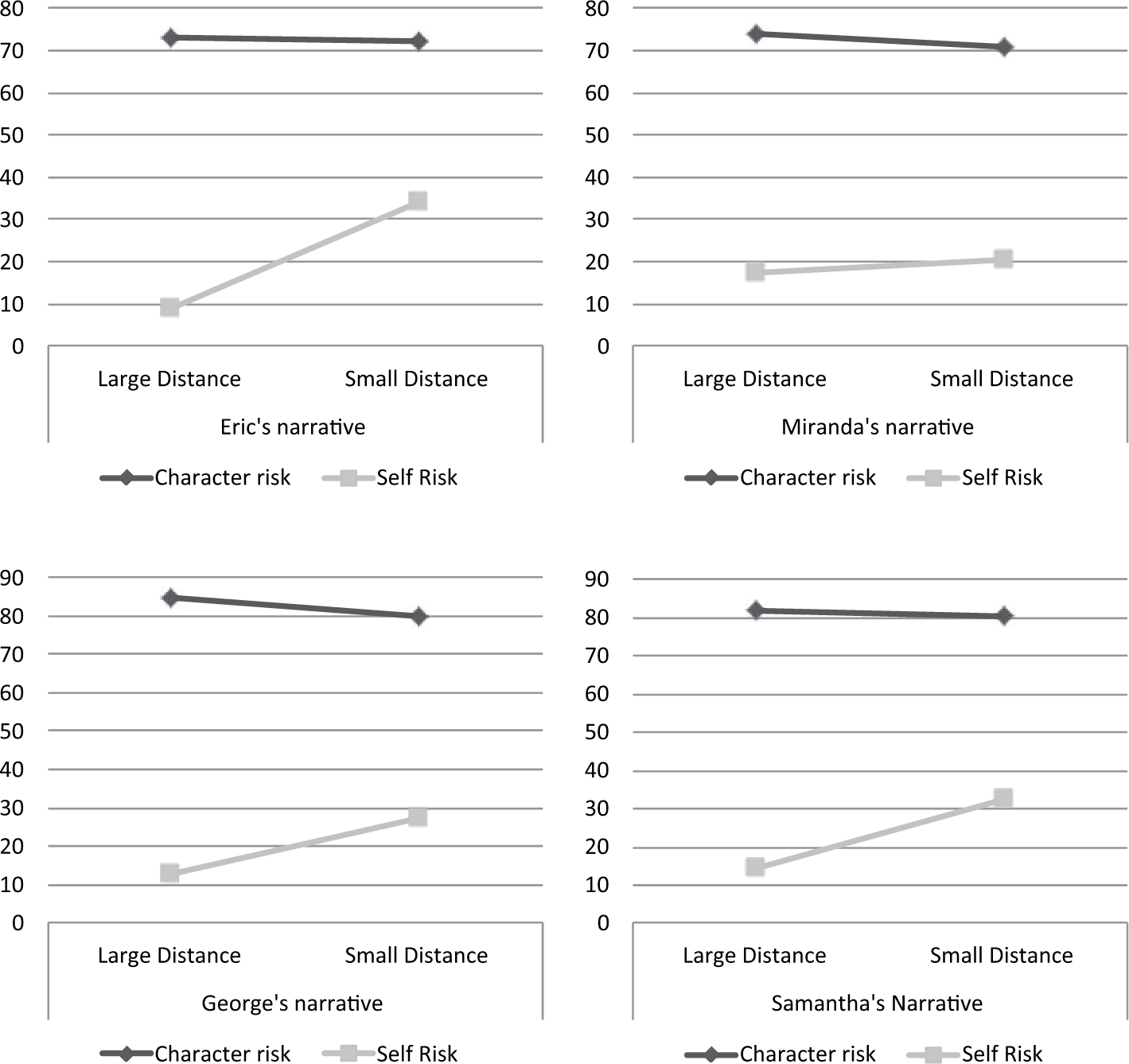
Risk convergence as a function of social distance across four narratives.
Additional hierarchical regression analyses using the same covariates showed that smaller perceived social distance predicted greater self-risk in the negative-test narrative conditions, β = −.40, p < .001, while the relationship was significant only at the level of α = .10, albeit in the anticipated direction, in the positive-test narrative conditions, β = −.14, p = .053. The magnitude of association observed in the negative-test narrative conditions was significantly larger than that in the positive-test conditions, p = .007.
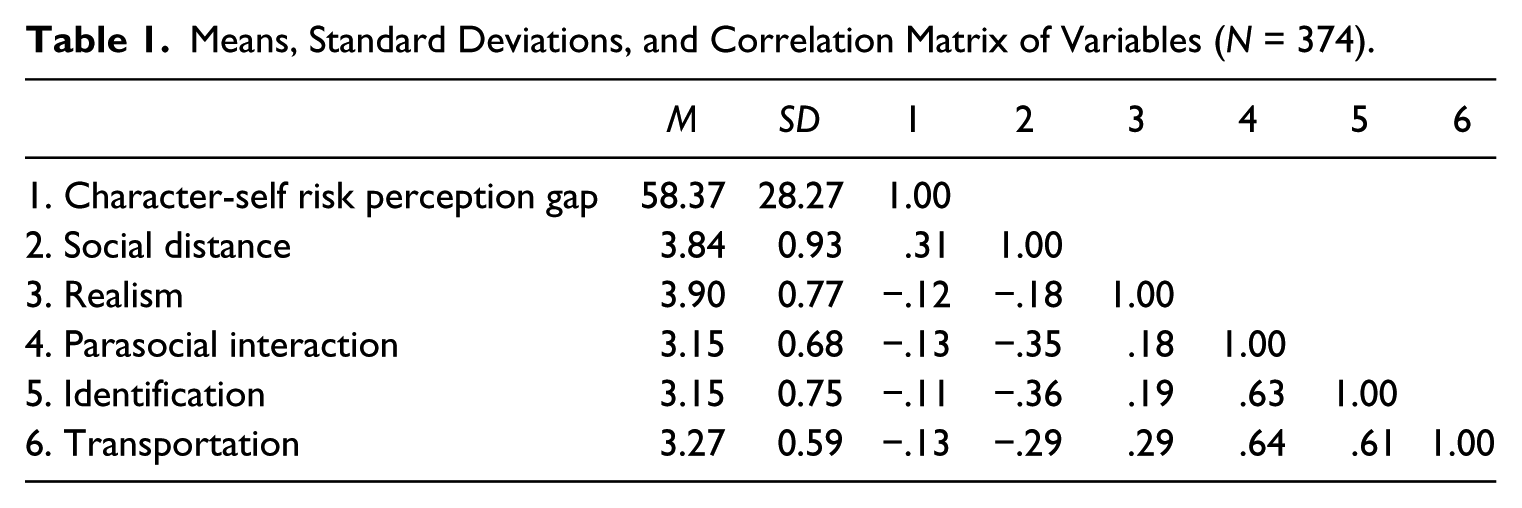
H3 predicted that various forms of narrative engagement and verisimilitude of the entertainment clips would facilitate risk convergence through reduction of social distance. Structural equation modeling (SEM) analyses were performed to test this hypothesis. Table 1 presents the means and standard deviations and the correlation matrix among the variables involved, with gender, age, sexual activity status, and number of sex partners partialled out. These data were entered into LISREL 8.80 for SEM analyses with the maximum likelihood procedure. Perceived realism, parasocial interaction, identification, and transportation were specified to cause perceived social distance, which was specified to cause character-self gap in risk perceptions. The four exogenous variables were allowed to correlate with each other. No other paths were allowed.
Means, Standard Deviations, and Correlation Matrix of Variables (N = 374).
To evaluate the overall model fit, four indices were considered: the goodness of fit index (GFI), the comparative fit index (CFI), the root mean square error of approximation (RMSEA), and the Bayesian information criterion (BIC). BIC is constructed such that negative values provide evidence of model fit, while positive BIC values suggest problematic model fit. Differences in BIC of 2 or more provide evidence favoring one model (with the smaller BIC value) over another; 6 or more provide strong evidence; and 10 is taken to be very strong evidence for model improvement (Raftery, 1995). The original model was a good fit to the data: df = 4, χ2 = 2.47, p = .65, GFI = .99, CFI = 1.00, RMSEA = .00, BIC = −21.23. We also tested an alternative model where perceived realism and social distance were specified as exogenous variables and narrative engagement variables were specified as mediators between exogenous variables and risk convergence. The alternative model did not fit the data: df = 5, χ2 = 403.44, p < .001, GFI = .74, CFI =0.41, RMSEA = .46, BIC = 373.82. Figure 2 presents the standardized path coefficients in the obtained model. As predicted, perceived realism (β = −.10), parasocial interaction (β = −.19), and identification (β = −.22) had negative and significant paths to social distance, which, in turn, had a positive and significant path to gap in character-self risk perception (β = .31). Thus, H3a, H3b, and H3c were supported. Transportation, on the other hand, did not have a significant path to social distance. Thus, H3d was not supported. In sum, reduction of perceived social distance completely mediated the effects of perceived realism, identification, and parasocial interaction on convergence of perceived risk between self and character. These results showed general support for H3.
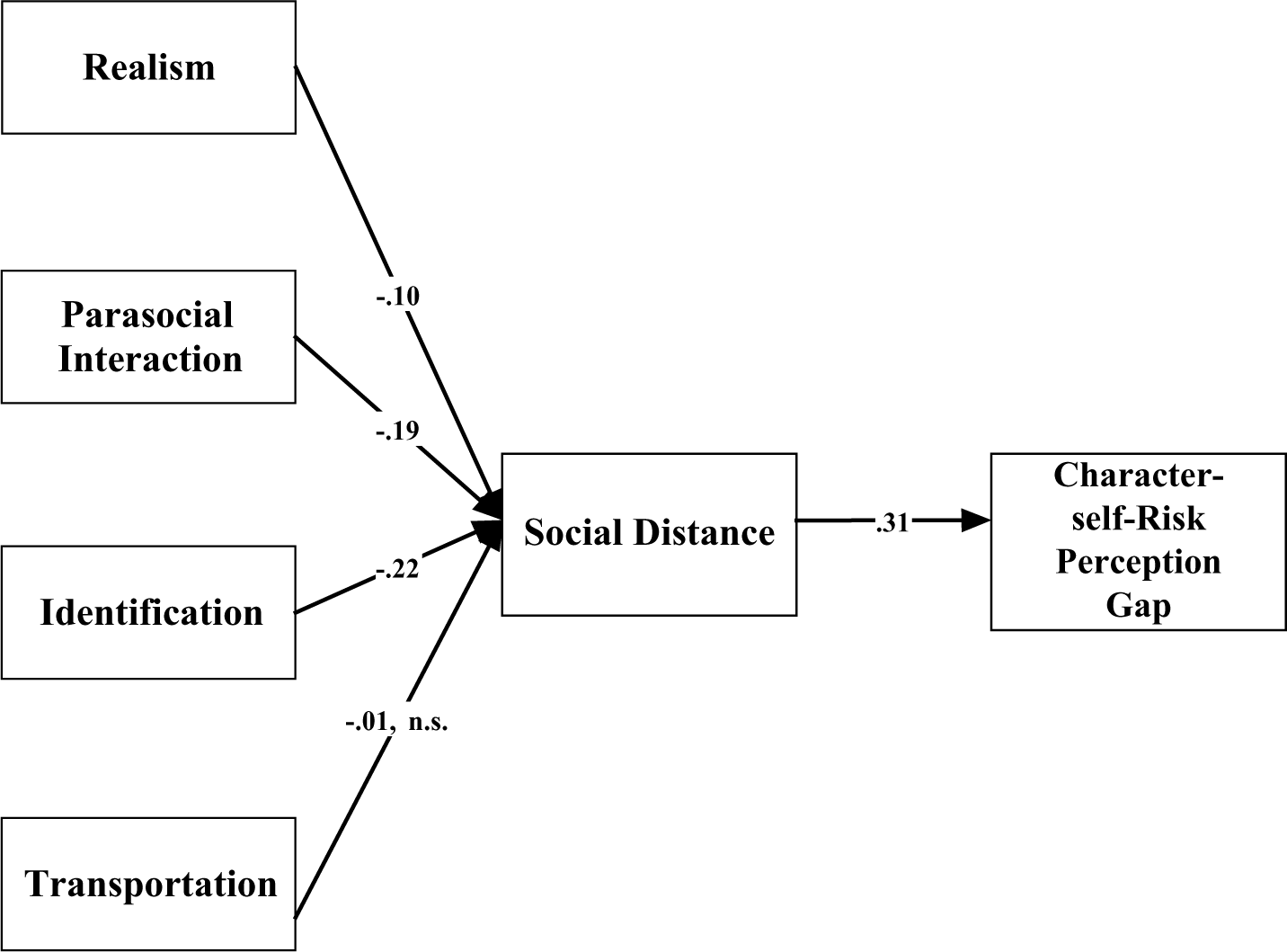
Social distance as mediator of character-self risk perception gap.
Discussion
This study sought to further explicate the underlying mechanism of narrative effects on audience’s personal risk perceptions through the theoretical lens offered by RCM (So & Nabi, 2013). Specifically, by examining the moderating role of perceived social distance on self- and character-risk perception gap and elaborating on the specific conditions under which the presumed effects amplify or attenuate, this study explored a series of more finely tuned questions regarding the specific mechanism involved in personalization of risk.
The empirical findings from this study lend credence to the argument that convergence of risk is driven by an increase in audiences’ perceptions of self-risk, as opposed to a decrease in the character-risk (see Figure 1). From a risk communication standpoint, this is the most desirable form of convergence: It allows the audiences to possibly overcome the illusion of invulnerability and adjust their levels of personal risk to a more realistic level.
Although the overall data showed good support for the arguments made regarding convergence of risk, more specific analyses that took the narrative types into account showed that the narrative types, or risk portrayal types, moderated the relationship between perceived social distance and perceptual gap. More specifically, while the predicted effects of social distance on convergence of risk were clearly observed in narrative conditions where the at-risk character tested negative for STDs, the predicted effect was nonsignificant, albeit in the predicted direction, in narrative conditions where the character tested positive. Additional analyses revealed the underlying reason for this finding: In general, while perceptions of character-risk remained constant regardless of perceived social distance, perception of self-risk increased as social distance decreased. However, although there was a general tendency for the latter effect in all narrative conditions, it was particularly pronounced and statistically significant in the “negative-test” narrative conditions. Thus, it can be inferred that when the narrative portrayed an at-risk character who was concerned about their health status but later found out that they were free from the disease (i.e., “negative-test” narratives), the reduced social distance to the character led to audiences’ heightened sense of personal risk. However, when the character was described to actually have an STD (i.e., “positive-test” narratives), the perception of smaller social distance did not fully translate into an increase in the audiences’ own personal risk perceptions.
This finding presents a slight departure from So and Nabi’s (2013) findings as they found the relationship between social distance and personal risk perceptions to statistically hold across both positive- and negative-test narrative conditions. However, it is similar in that the magnitude of association, albeit not significantly different, was slightly smaller in the “positive-test” narrative condition.
To offer an explanation for this finding, it may be more profitable to focus on the similarity than the difference across the two findings. Taken together, social distance led to convergence of self- and character-risk, which was driven by an increase in audience’s perceptions of personal risk. However, the latter mechanism was not as pronounced in the “positive-test” conditions, as compared with “negative-test” conditions across the two studies. One explanation we can offer concerns a possible defense mechanism that may have been triggered by watching a character being diagnosed with an STD, which is socially undesirable. Defense mechanisms are activated when an individual perceives a potential threat to positive perceptions about oneself such as physical (e.g., health risks; Gerrard, Gibbons, & Reis-Bergan, 1999) and psychological well-being (e.g., self-esteem; Cramer, 2000). Through this motivated, unconscious mental process, we deceive ourselves and deny implications of adversity in an effort to foster “unrealistic self-illusions” (Cramer, 2000, p. 639). For example, we can maintain or enhance self-esteem despite potential forces that can damage our self-esteem by adopting a defense mechanism that allows us to reframe and reinterpret available information.
It is speculated that a defensive mechanism may be at work when audiences are exposed to a narrative with a character who represents a social entity with undesirable characteristics. One may think if a defensive mechanism is in operation then individuals may attempt to distance themselves from the diseased character. However, this was not the case: Narrative types did not influence their perceptions of social distance. Rather, in positive-test narratives, even when the character is perceived to be close, social distance did not have much influence on one’s own perceived personal risk. This is particularly notable because such different patterns in risk convergence were not a function of perceptions of character-risk either: Samantha’s risk (M = 80.59%) was perceived to be significantly higher than Eric’s (M = 71.31%), but risk convergence occurred in both conditions presumably because their tests were negative; Miranda’s risk (M = 73.03%) was perceived to be significantly lower than George’s (M = 83.30%), but risk convergence was absent in both conditions, presumably because their tests were positive.
In a narrative in which undesirability of STDs are highlighted by observing a diseased character go through social and physical challenges, a defense mechanism may be activated and consequently override the effects of reduced social distance, which would have otherwise increased personal risk perceptions. This point has an important implication for designing narrative messages to help individuals overcome unrealistic optimism. When an at-risk character is portrayed as having and experiencing health issues with highly undesirable and certain consequences, a defensive mechanism may be activated and render the risk communication efforts obsolete.
The present study also tested the possible anchoring effects that would, if found, undermine the effects of perceived social distance on the perceptual gap. If that were the case, it would mean that risk convergence might have been, at least partially, a methodological artifact. This study did not find any evidence for anchoring effects, which strengthened the evidence for RCM. As was anticipated, anchoring effects on perceptual gap may be a more relevant phenomenon in research concerning a distant target who is described to be abstract and vague. This is a typical situation in the optimistic bias and third person effect research. However, in the narrative persuasion context, as narratives employ vivid depictions of character’s risk and their deep-down private emotions and thoughts, risk judgments about characters in narratives may not be as fluid or flexible as other types of “others,” that are usually employed as the target of comparison of likelihood judgment in studies that found evidence for the anchoring effects.
This study found support for the mediational model that predicted the concerted effects of various narrative engagement variables in reducing the perceptions of social distance, which, in turn, would lead to reduced perceptual gap. The only narrative engagement variable that did not show a significant path to social distance was transportation. Transportation was expected to indirectly associate with social distance via reduction of spatial and temporal distance, which CLT posits to interactively influence other forms of psychological distance including social distance. Thus, transportation, along with perceived realism, was anticipated to show a relatively weaker association with social distance than other engagement variables. This prediction should be particularly relevant as the model included other forms of narrative engagement that may overlap with transportation to some degree (Cohen, 2001; Moyer-Gusé, 2008; So & Nabi, 2013). Thus, when the effects of other engagement variables are partialled out by testing them simultaneously, the unique contribution of transportation likely has been minimized. This finding is, in fact, consistent with So and Nabi’s (2013) finding as transportation and perceived realism (nonsignificant path) were found to have weaker associations with perceptions of social distance than other narrative engagement variables. On the other hand, identification and parasocial interaction, which both focus on a person as a target of involvement, were significant contributors to perceptions of small social distance. We should also note that an alternative model specifying perception of social distance as a predictor of narrative engagement variables did not show acceptable fit to the data. However, as the SEM analyses were based on correlational data, more definite causal inference awaits future research employing experimental manipulations of these variables.
This study has several limitations. First, while quasi-experiments utilizing actual, existing entertainment clips as stimuli may be particularly suitable and informative for research on E-E and narrative persuasion from an ecological validity standpoint, they can also limit our ability to cleanly manipulate variables and interpret the findings. For example, although we were informed by So and Nabi’s (2013) study that STD test result types could serve as a potential factor to consider in the analyses and thus conceptualized it as a factor that may have driven the difference in the observed effect, it is possible that other factors that were shared within the negative- and positive-test result narratives could have contributed to the difference in the findings. Notably, the timing of revealing the test results coincided with the test result types and thus could potentially explain the difference in the findings across the two narrative conditions. Specifically, the characters learned about their test results toward the end in the negative-test narratives, while the characters learned about their results at the beginning of the narratives in the positive-test narratives. Plausibly, the timing of revealing the test results could have potentially affected the audiences’ engagement with the narrative in two ways: First, narratives revealing the test results in the end might have provided greater opportunity for transportation, which is affected by suspensefulness of narratives (Tal-Or & Cohen, 2010; Zillmann, 1991, 1996). Second, narratives revealing that the characters for sure have STDs at the beginning of the narrative could have activated the participants’ defense mechanisms early on and short-circuited their identification (see Tal-Or & Cohen, 2010, for the effects of positive portrayals of characters on identification) and/or transportation. However, it should be noted that the two types of narratives did not differ significantly in the levels of identification, transportation, and parasocial interaction (PSI) (all p > .20). Therefore, the alternative explanation involving timing of revealing as a factor does not seem to have a firm empirical ground to stand in this study.
Another limitation of this study concerns the use of same entertainment clips employed by So and Nabi (2013). By doing so, the extension of their study made in this research can be readily integrated to offer a more explicit account of the converging process involved in narrative effects of these stimuli. However, because we used the same narratives as experimental stimuli, we were not able to enhance the external validity of the findings beyond the four narratives So and Nabi (2013) used. In addition, though the study used a different sample from So and Nabi’s study, they were also college students. The use of college students as subjects in a study about risk perception should be acknowledged as youth tend to show a greater sense of invulnerability than the general population (Kreuter & Strecher, 1995). Therefore, the findings from this study may not be generalized to the general populations that risk communication should reach ideally. However, despite their tendency to engage in greater unrealistic optimism than the general population, it should be noted that this study still found support for the argument that audiences may accept personal vulnerability when engaging in the narratives and perceiving an at-risk character to be socially close to them as a result.
In conclusion, this study examined the underlying psychological mechanism involved in narrative’s influence on risk personalization and found that reduced social distance led to convergence of risk driven by increased perceptions of audiences’ self-risk, but not character’s risk, as RCM had assumed. This effect was particularly pronounced in certain types of narrative conditions: Significant effects were found when the at-risk character was described to have tested negative for STDs. Future research should further investigate different narrative types and features that can facilitate the convergent effects of reduced social distance to enhance the effectiveness of risk communication interventions utilizing narratives. As we speculate that a psychological defense mechanism may have been activated by the (social) undesirability and certainty of STDs, it would be fruitful to test this speculation and examine if the relationships observed in this study would hold when a different health topic with less negative connotation attached (e.g., heart disease for overweight adults) is portrayed in the narrative.
Footnotes
Appendix
Acknowledgements
The authors would like to thank Robin Nabi and the two anonymous reviewers for their invaluable comments on earlier versions of this work.
Authors’ Note
A previous version of this article received a Top Paper Award from the Health Communication Division at the National Communication Association’s 100th annual convention.
Declaration of Conflicting Interests
The authors declared no potential conflicts of interest with respect to the research, authorship, and/or publication of this article.
Funding
The authors received no financial support for the research, authorship, and/or publication of this article.