



Abstract
The bulk of current literature on partisan media explores its various detrimental influences on the democratic sphere. This study highlights a possible positive outcome of partisan media consumption: enhanced political participation. It is hypothesized that consumption of congruent partisan media will tilt perceptions of opinion climate so that it is viewed as more supportive of one’s views, while consumption of incongruent partisan media is viewed as less supportive. Consequently, consumers of congruent partisan media will participate more, and vice versa. The hypotheses are tested using two panel studies: the first conducted during the 2012 U.S. presidential elections (N = 377) whereas the second, during the 2013 Israeli election (N = 340). In the Israeli case, survey data are supplemented with behavioral measures. All hypotheses are supported except the one regarding the effects of incongruent partisan media exposure. The results are discussed in light of the spiral of silence theory and the selective exposure hypothesis.
Keywords
The editors wish to note that this article relies on part of a dataset that has been previously published in Human Communication Research, New Media & Society, and Media Psychology. It was accepted by the prior editors in June 2015. The citations of the related articles are as follows:
Garrett, R. K., Gvirsman, S. D., Johnson, B. K., Tsfati, Y., Neo, R., & Dal, A. (2014). Implications of pro- and counterattitudinal information exposure for affective polarization. Human Communication Research, 40, 309-332. doi: 10.1111/hcre.12028
Dvir-Gvirsman, S., Tsfati, Y., & Menchen-Trevino, E. (2016). The extent and nature of ideological selective exposure online: Combining survey responses with actual web log data from the 2013 Israeli elections. New Media & Society, 18, 857-877. doi: 10.1177/1461444814549041
Dvir-Gvirsman, S. (2015). One-track minds? Cognitive needs, media diet, and overestimation of public support for one’s views. Media Psychology, 18, 475-498. doi: 10.1080/15213269.2014.929526
Over the past decade and a half, media markets have undergone rapid change, including the meteoric rise of partisan news media (Stroud, 2011). This surge in opinionated journalism poses a threat to democracy because it has the potential to promote polarization and fragmentation of the electorate (Levendusky, 2013b; Mutz, 2006; Stroud, 2011). Mutz (2006) and other scholars have, however, also suggested that consuming these media can yield an important benefit, namely, the promotion of public political activity (Dilliplane, 2011; Knobloch-Westerwick & Johnson, 2014; Stroud, 2011). The aim of this study is, first, to confirm that consumption of partisan media drives individuals to take part in the political process and second, but more important, to reveal the mechanism governing this effect.
Our inquiry is anchored in the selective exposure hypothesis, which posits that when given the opportunity to choose among a wide selection of political information, individuals tend to seek out content that is consonant with their own opinions (e.g., Garrett, Carnahan, & Lynch, 2013). By offering audiences more diverse content and more choices, the new media landscape has raised the potential for exposure to congruent news to unprecedented heights (Stroud, 2008; Webster, 2011).
We argue here that exposure to congruent partisan media will contribute to political participation by influencing perceptions of public opinion. Indeed, individuals have been shown to perceive media coverage as an indicator of the opinion climate (Noelle-Neumann, 1974). In a niche media that gives voice to congruent opinions, one’s perception of the opinion climate may become biased (Wang, Guo, & Shen, 2011; Webster, 2011; Wojcieszak, 2008). In a logical inversion of the spiral of silence (Noelle-Neumann, 1974), we argue that the perception that public opinion is on one’s side may foster political participation.
The model proposed here is tested using two case studies, both based on a panel design and conducted during elections in two different countries: the first, during the 2012 U.S. national election, and the second, during the 2013 Israeli election. Using a panel design allows us to demonstrate that exposure to partisan media precedes any change in actual participation (Hayes & Matthes, 2014). In other words, we can establish temporal order, which is impossible using cross-sectional survey data. In the Israeli case, these data are supplemented with behavioral measures that provide a uniquely powerful confirmation that the effects observed are not an artifact of survey self-reports (Prior, 2013). Finally, using two case studies, from different electoral systems and two different media markets, validates the robust global significance of these effects.
Partisan Media and Political Participation
The recent proliferation of politicized media outlets has triggered a wave of interest among communication scholars (Holbert, Garrett, & Gleason, 2010). Considerably less attention, however, has been devoted to possible influences of exposure to such outlets on political participation: only a handful of studies appear to have dealt with this question directly. Using panel data, Dilliplane (2011) demonstrated that during the 2008 U.S. election campaign, exposure to congruent news increased participation whereas exposure to incongruent news decreased it. A similar pattern was observed in an analysis of two other survey data sets independently collected during the 2008 election, though in this study, the negative effect of crosscutting media exposure was contingent on participation in online political discussion (Brundidge, Garrett, Rojas, & Gil de Zúñiga, 2014). Congruent exposure to partisan news media was also associated with political participation in Stroud’s (2011) data with some indication from panel studies that exposure is linked to participation. In an experimental setting, Knobloch-Westerwick and Johnson (2014) demonstrated that participants who had been exposed to congruent content online assessed the likelihood of participating in politics at a future time more positively. Finally, in a field experiment manipulating the ideological content to which Ghanan public-transportation passengers were exposed, Conroy-Krutz and Moehler (2015) showed that incongruent exposure decreased participation whereas exposure to congruent content had no influence on it. Similar patterns can be found in work focusing on the influence of discussion network heterogeneity on participation. Crosscutting political discussion have been shown to depress various forms of political engagement and there is some evidence that likeminded discussion increases participation (Eveland & Hively, 2009; Mutz & Silver, 2014; however, see Huckfeldt, Mendez, & Osborn, 2004; McLeod et al., 1999; Scheufele, Nisbet, Brossard, & Nisbet, 2004). 1
But why and how does congruent ideological exposure increase political participation? The current investigation explores the possibility that perceptions of opinion climate—what audiences think the public believes—mediate that process.
Partisan Media and Perception of Opinion Climate
Members of the public infer majority opinion from media coverage (Hoffman, 2013; Hoffman, Glynn, Huge, Sietman, & Thomson, 2007; Mutz & Soss, 1997). When gauging public opinion, individuals tend to rely on exemplars, such as people in their immediate surroundings, rather than on opinion distribution data (Zillmann, 1999; Zillmann, Gibson, Sundar, & Perkins, 1996), and the media supply catchy examples of what “the man on the street” thinks, coloring individuals’ perceptions of public opinion.
How can this principle be applied to those who rely on partisan media? We argue that if individuals consume one-sided partisan media, which are rife with homogeneous examples, their perception of the majority opinion may be tilted (Baum & Groeling, 2008). There is considerable evidence that the partisan news media tend to display greater support for their political camp. In the context of the Israeli pullout from the Gaza Strip (“the disengagement”), for example, content analysis demonstrated that Israeli right-wing newspapers’ coverage of this debate included relatively more opponents of the disengagement than mainstream newspapers, while also featuring fewer supporters. That is, the coverage included more exemplars that were consistent with the newspapers’ ideological stand (Dvir-Gvirsman, Tzfati, Menchen-Trevino, 2014, see in particular Endnote 2). In the United States, Baum and Groeling (2008) have shown that partisan outlets tend to highlight news favorable to the associated party. Similarly, analysis of partisan television news transcripts over a 12-month period shows that these outlets tend to use more positive language when referring to the favored party (Holtzman, Schott, Jones, Balota, & Yarkoni, 2011).
When exposed to congruent media outlets, a person is bombarded with anecdotal evidence that people share his or her views and will probably form an impression of false public consensus (Dvir-Gvirsman, 2014b; Wang et al., 2011; Wojcieszak, 2008). More specifically, the exposure to a biased sample of exemplars renders similar opinions cognitively more accessible and highly salient (Wojcieszak, 2011; Wojcieszak & Rojas, 2011), and as a result, facilitates the formation of public consensus consistent with the ideological media’s perspective (Wojcieszak, 2011; Wojcieszak & Rojas, 2011). Cognitive availability of an opinion is mistakenly interpreted as an indicator of its frequency among the public (Tversky & Kahneman, 1974). The opposite effect occurs on exposure to incongruent media outlets (Mutz & Martin, 2002; Wojcieszak & Rojas, 2011), which supply examples contravening one’s own views. As a result, one draws out exemplars from a more diverse “sampling frame.”
This is consistent with Wojcieszak’s (2011) finding that exposure to diverse news sources attenuates over-estimation of support for one’s personal opinion. A reverse process is outlined by Tsfati, Stroud, and Chotiner (2013), who demonstrated the bias-inducing influence of exposure to congruent media outlets. So far, however, only one study has tested concomitantly the effect of incongruent exposure and the complementary effect of congruent exposure on the accuracy of public opinion perceptions (Dvir-Gvirsman, 2014b). That study demonstrates that although incongruent exposure prevents over-estimation of support for one’s personal opinion, exposure to congruent content promotes it.
A person who is exposed to partisan media from one side of the political map does not, however, necessarily avoid the other side (Garrett, 2009). There is even some evidence that crosscutting and congruent exposure are positively correlated (Garrett et al., 2013; Holbert, Hmielowski, & Weeks, 2012). Given that congruent exposure and incongruent exposure are distinct yet sometimes linked behaviors and that the two types of exposure may propel individuals’ perception of public opinion in opposite directions, a comprehensive analysis is important. Moreover, testing both types of exposure helps to capture the range of exemplars provided by partisan media.
Perception of Opinion Climate and Political Participation
One of the most tested theories of public opinion, the spiral of silence, posits that when we feel that majority opinion is against us, we refrain from expressing our opinions out of a fear of social isolation (Noelle-Neumann, 1974; Scheufele & Moy, 2000). Extending this logic to an environment in which people believe they are in the majority, it follows that these individuals should feel safe to express their opinions (Mutz & Silver, 2014). Indeed, a case has been made regarding the effect of people’s perceptions of opinion climate on their willingness to express their opinions in public (Glynn, Hayes, & Shanahan, 1997). Only a handful of studies have tested whether people actually express their political opinions under the influence of such perceptions (Hayes, Uldall, & Glynn, 2010; Matthes, 2011) and even fewer have investigated a broader range of public participatory acts (Scheufele & Eveland, 2001).
One should recall that Noelle-Neumann’s original model focused specifically on an individual’s willingness to speak up in a hypothetical situation such as a future political discussion, interview, and so on. Yet, a number of researchers (e.g., Hayes, 2007)—including the authors of this article—assert that this theory should hold for a more diverse range of public expression, including political participation. Can we not view signing petitions, participating in protests, and posting and sharing political materials on Facebook as forms of political expression that should all be affected by fear of isolation? 2
It also has been argued that we should shift scholarly focus from individuals’ opinions regarding what they might do to what they have actually done (Hayes & Matthes, 2014; Scheufele, Shanahan, & Lee, 2001). Numerous findings show that the link between individuals’ expected behavior and their actual behavior is tenuous at best (Bohner & Dickel, 2011). People are poor judges of the social forces that might be at play in any given situation, influencing their actual behavior. Moreover, in many studies testing the spiral of silence, participants were asked about their willingness to express their opinions to unsympathetic listeners (Glynn et al., 1997). Such questions highlights one element of social context (namely, conflict) at the expense of other comparably relevant elements (e.g., the importance of the issue), potentially exaggerating the silencing effect. This methodological artifact can be reduced by asking people whether they, in actuality, tend to abstain from expressing their opinion. Among the very few studies that explored that avenue are Scheufele et al. (2001). The study compared replies to questions about a hypothetical scenario with replies to questions about behavioral intentions after participants had been told that they would be contacted in the future with the purpose of soliciting their political participation. The findings indicate substantially higher rates of abstinence when participants thought that they would be contacted in the future (see also Hayes, Shanahan, & Glynn, 2001). Going one step further, Hayes, Uldall, and Glynn (2001) conducted an experiment in which they asked participants to attend a discussion group. Two other notable studies, which targeted different issues, measured real-world political participation as part of their procedure. For instance, Scheufele and Eveland (2001) studied participation during the 1996 U.S. national election campaign, showing it to be related to participants’ perception of the chances for their preferred candidate to win the election. 3
Combining H1 and H2, we assert that when individuals are situated in congruent media enclaves, they tend to form the impression of false consensus and to feel socially safe, which leads them to take political action.
The Current Study
Our study focuses on election campaigns—a period when political participation is normally on the rise—using two cases, one from the United States and the other from Israel, and employing a similar panel design in both. The approach adopted here is innovative, as only a few studies have tested partisan media effects outside the boundaries of the United States, and fewer still have used data from more than one country (Goldman & Mutz, 2011).
Israel and the United States differ in their parliamentary system. The Israeli political system is in many ways an antithesis of its American counterpart, in that it is parliamentary, multi-party to an extreme, and is based on a coalition power structure. We harness this difference to our advantage, by studying complementary aspects of public opinion perception. Following Scheufele and Eveland (2001), we asked American participants to assess each candidate’s chances to win—a conventional approach to gauging perceptions of opinion climate during U.S. elections, where horserace-style news coverage is commonplace (Ladd, 2010). In Israel, with its coalition power structure, such a measure would require numerous items. Even asking about the three or four main parties and likely winners would be complex and would not capture the societal distribution of opinion, given that forming a coalition involves political skills and willingness for compromises and the coalitions sometimes do not properly reflect the societal distribution of opinion. Instead, we asked Israeli participants to assess public opinion regarding four key issues that stood at the center of the elections. Taken together, the two cases afford the opportunity to explore two dimensions prominent in the political arena—issues and candidates. Additionally, in contrast to the work reviewed above, the focus here will be on perception of public opinion and not on their accuracy (i.e., level of over-estimation of support for one’s personal opinion). This is due to the fact that in the individual-level analysis of spiral of silence theory, it is less important whether or not our perceptions are anchored in social reality; it only matters whether these perceptions position us in the minority or in the majority.
Study 1: Israeli 2013 Election
Method
To test the hypotheses and the research question, we use data from a two-wave panel survey conducted during the 2013 Israel national election among a sample of Israeli Jewish voters. 4 Data were gathered by Panels, a survey company specializing in Internet-based research. The company recruits panelists via the Internet, sponsoring ads on Google, Facebook, and other popular sites; thus, the panel was limited to Internet users. 5 The panel includes 400,000 participants, who are asked to take part in periodic surveys, in exchange for incentives (gift certificates).
Baseline data were collected from December 23 to 25, 2012. The survey company sent e-mail invitations to a sample of 900 panelists, stratified by age, gender, and geography. Of those, 453 respondents completed the first survey. Respondents’ demographics roughly matched Israeli census figures for age (M = 44.4 years, SD = 16.9 years), income (on a 5-point scale, M = 2.6, SD = 1.3), and education (on a 6-point scale, 46% held academic degree, the same rate as found in Organisation for Economic Co-operation and Development (OECD) data regarding Israel), but women were overrepresented (56% in the sample, as compared with 52% in the general population) and ultra-Orthodox were underrepresented (5.5% ultra-Orthodox, compared with 8.2% in the general population and 7% in random digital dialing (RDD) samples). The second wave of data collection began 1 day after the election (between January 27 and 31, 2013) and yielded 397 respondents (a 12% attrition rate). Attrition was associated with right-wing attitudes, t(450) = −2.9, p < .01, but no other differences were detected between the two waves.
The analysis is based on data collected in the first wave, except when the public political participation is concerned, regarding which we relied on data collected in both the first and the last wave.
Measures
Party leaning
Respondents were asked to place themselves on a scale ranging from 1 = extreme right to 7 = extreme left, M = 3.5, SD = 1.3 (49% of respondents—right and 22%—left). The political orientation of 125 participants placing themselves at the middle of the scale was further investigated using other attitudinal indices measured in the survey. 6 It was thus determined that 37% of these participants were left-wing, 57% right-wing, and 6% centrists. The latter 6% (8 participants) were not included in the analysis.
Congruent and incongruent exposure
Respondents were asked to what extent they were exposed to a list of ideological outlets, including websites, newspapers, and radio stations (the ideological tendency of the outlets was independently established by the researchers). 7 Response categories varied between 1 = not exposed at all and 5 = exposed regularly. In the next phase, we created two separate measures of partisan exposure to right-wing and left-wing outlets by averaging the 15 items measuring right-wing exposure (α = .79, M = 2.05, SD = 0.65) and the 13 items measuring left-wing exposure (α = .85, M = 2.01, SD = 0.71). Exposure to left-wing media outlets reported by respondents leaning to the left and exposure to right-wing media outlets reported by respondents leaning to the right were computed as congruent exposure (M = 1.50, SD = 0.60). Similarly, exposure to right-wing media outlets by respondents leaning to the left and exposure to left-wing media outlets by respondents leaning to the right were computed as incongruent exposure (M = 1.30, SD = 0.50).
Mainstream and neutral media use
In reply to the question presented in the previous section and based on the same response categories, participants indicated to what extent they had been exposed to a list of nine news outlets considered mainstream, including radio stations, newspapers, Internet news sites, and television news shows (α = .75, M = 2.70, SD = 0.71).
Behavioral data
In addition, we had a rare set of data at our disposal—a behavioral measurement of online exposure. This allowed us to develop a behavioral indicator of congruent and incongruent online exposure. The main advantage of such a behavioral indicator is its high reliability in comparison with self-report data (Prior, 2013). During the 7 weeks between the first and the second wave of data collection, we gathered the records of the web-browsing behavior for all participants with their informed consent. We relied on a computer program that the participants installed on their own volition on their computers. The program recorded complete URLs and the exact time at which the URL was opened. The program did not record traffic from secure sites (all websites using HTTPS).
We coded these records in two stages, and the coding scheme was used at the website level (with the exception of YouTube videos, which were individually coded).
Given the large number of websites that received very little attention, we included only those websites that were visited by at least 2 participants one time or those that were visited by one participant at least 2 times. Thus, we coded 3,359 websites (out of 15,975 websites) that accounted for 83% of the URLs documented. Coding procedures are described in detail in the online appendix. 8 In the first stage of coding, we separated the websites that featured political issues from the other websites. Two coders coded all 3,360 websites, and 5% of the sites were determined to be political. A reliability check of 300 websites yielded a Krippendorff’s alpha of .74 (see the online appendix). Although only 5% of the websites were political, these websites accounted for 15% of all the traffic documented. In the second stage of the coding process, we coded for the ideological orientation of the political websites. The websites were coded as leaning to the left, leaning to the right, or as having no clear ideological leaning. A reliability check of 80 websites yielded a Krippendorff’s alpha of .81.
Based on these data, we calculated scores for each participant with regard to the following: total volume of web browsing (total number of URLs each participant visited, M = 1645, SD = 2045) and total number partisan URLs visited by the participant, divided into congruent and incongruent exposure (based on political orientation of participants as specified above, congruent: M = 34.5, SD = 186.5; incongruent: M = 14.2, SD = 7.8).
Perception of opinion climate
We used four questions to gauge perception of public opinion regarding four different issues that stood at the center of the election campaign: social welfare, Israeli-Palestinian negotiations, a possible attack on Iran’s nuclear installations, and relations between secular and ultra-Orthodox sectors. 9 Each respondent was asked to give an assessment of the percentage of the Israeli public that supports the attitude presented by one of the sides (i.e., two-state solution for the Palestinian-Israeli conflict, attack Iran). For three of the issues, the participants were required to assess the public support of left-wing parties, and for one issue—of the right-wing.
Next, based on the replies, we calculated the dependent variable in two steps as elaborated in what follows. First, we averaged the four variables to create a single measurement that assessed the degree to which participants estimated public support for the attitudes promoted by left-wing parties. At the next step, we recoded this averaged variable according to each participant’s political view, so that those from the left received a higher score if they overestimated support for the left, and those from the right received a higher score if they overestimated support for the right. This variable ranged from 15% to 93% (M = 54.9%, SD = 13.5%).
Public political participation
Public display of political participation was measured using 13 questions adapted from Hayes, Scheufele, and Huge (2006), as well as several additional questions targeting the participants’ Internet-related habits. In particular, the participants were asked to report their rate of participation on a scale from 0 = not once in the past year to 2 = more than once in the past year (first wave Cronbach’s α = .85, factor analysis yielded a one-factor solution, with 55% explained variance). Items included questions regarding volunteering for a political campaign, signing a political petition, taking part in political discussions, stating opinion in the media, blogging, tweeting, joining Facebook groups, and so on. The items were dichotomized and a count was computed. We used data from both waves (first wave: M = 3.2, SD = 3.1; second wave: M = 3.6, SD = 3.2).
Covariates
Ideological extremity was computed by folding the measure of political leaning. Scores range from 1 to 4, with higher scores reflecting more extreme ideologies (M = 2.10, SD = 0.91). We also controlled for the initial level of public political participation, to account for any differences in participants’ original propensity in this regard. Thus, the change in political participation was modeled. Additionally, to ensure that polarization is ruled out as an alternative explanation, we controlled for ideological extremity in the later wave of data collection (i.e., second wave in the Israeli case). 10 Finally, controls for political knowledge were tested but the effect of these variables proved non-significant, and they were not included in the models.
Statistical Analysis and Model Specifications
The model proposed here involves a mediated relationship. To test this pattern, a formal assessment of mediation was conducted using Hayes’s (2013) bootstrapping technique (10,000 iterations). The latter produces confidence intervals (CI) for the indirect effect based on the distributions obtained from a given data set. This technique is more powerful than the traditional Sobel Test and is rapidly becoming the preferred test for mediation (Hayes, 2013). As already stated, it is a change in the dependent variable that was modeled, and so any effect obtained is after controlling for initial levels of public participation. We reported two sets of regression models: One is based on the self-report data, and the second is based on behavioral data.
Results
Before turning to formal tests of our hypothesis, we note the level of political participation observed by those who consume partisan media and those who do not. Figure 1 presents the level of participation by those who reported never being exposed to partisan media and those who reported being exposed at least once (using a cut point of 1.3, on a scale ranging from 1 = never to 5 = regularly), before and after the elections. At a first glance, it is evident that participation is significantly higher among those exposed to congruent media, and although change is evident over time, the increase is rather small. Still, it should be noted that the observation period, though politically intense, is brief. As for consumers of incongruent media, here too, as suggested, we see a demobilizing effect over time. 11
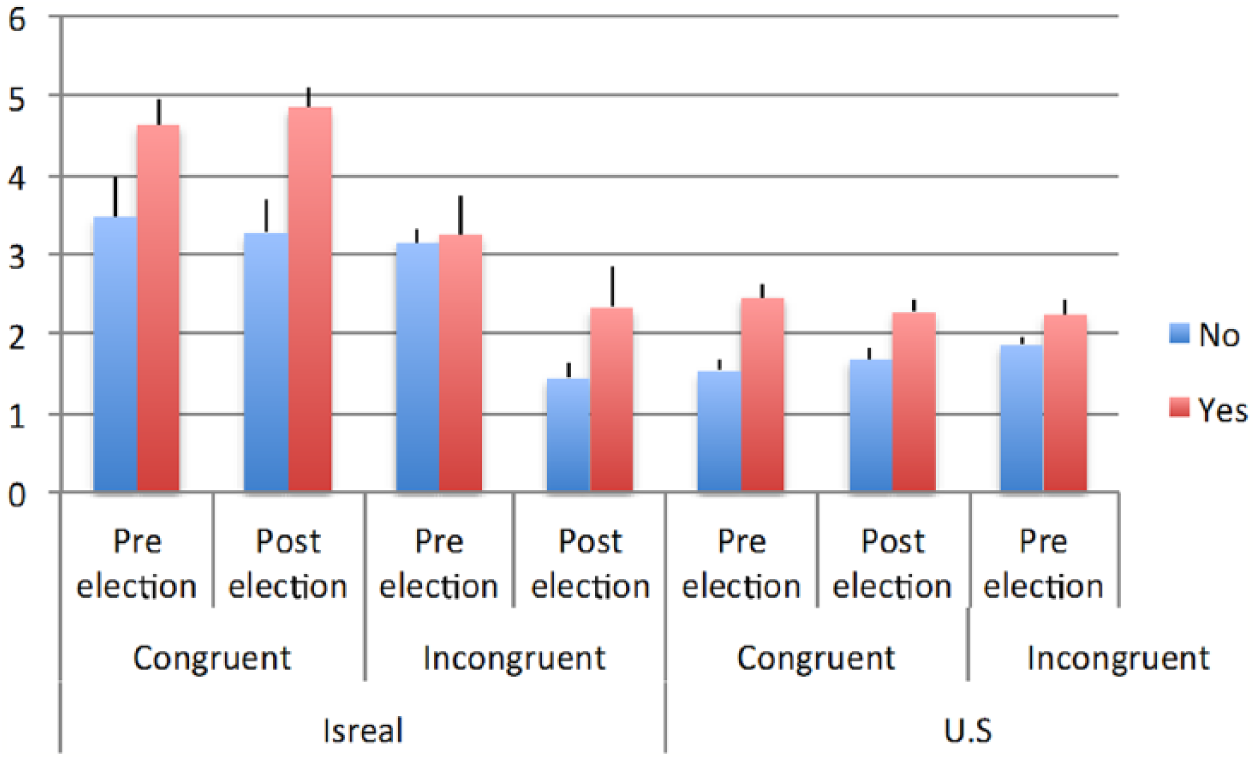
Descriptive statistics of political participation according to exposure patterns.
We begin by examining the influence of congruent exposure (H1a) and incongruent exposure (H1b) on perception of public opinion. As reported in Table 1, and presented visually in Figure 2, congruent exposure has a consistently positive significant effect on perception of public opinion. More frequent use of congruent outlets is associated with perceived public support for one’s view, in both self-report and behavioral data. In contrast, the hypothesized effect of incongruent exposure was not supported by the data (H1b). 12 Importantly, political participation at Wave 1 was not significantly associated with perception of public opinion—a finding that helps in establishing causal direction in the model.
Effects of Congruent and Incongruent Exposure on Perception of Public Opinion and on Change in Net Favorability Toward Parties (Israeli Case): Mediated Model.
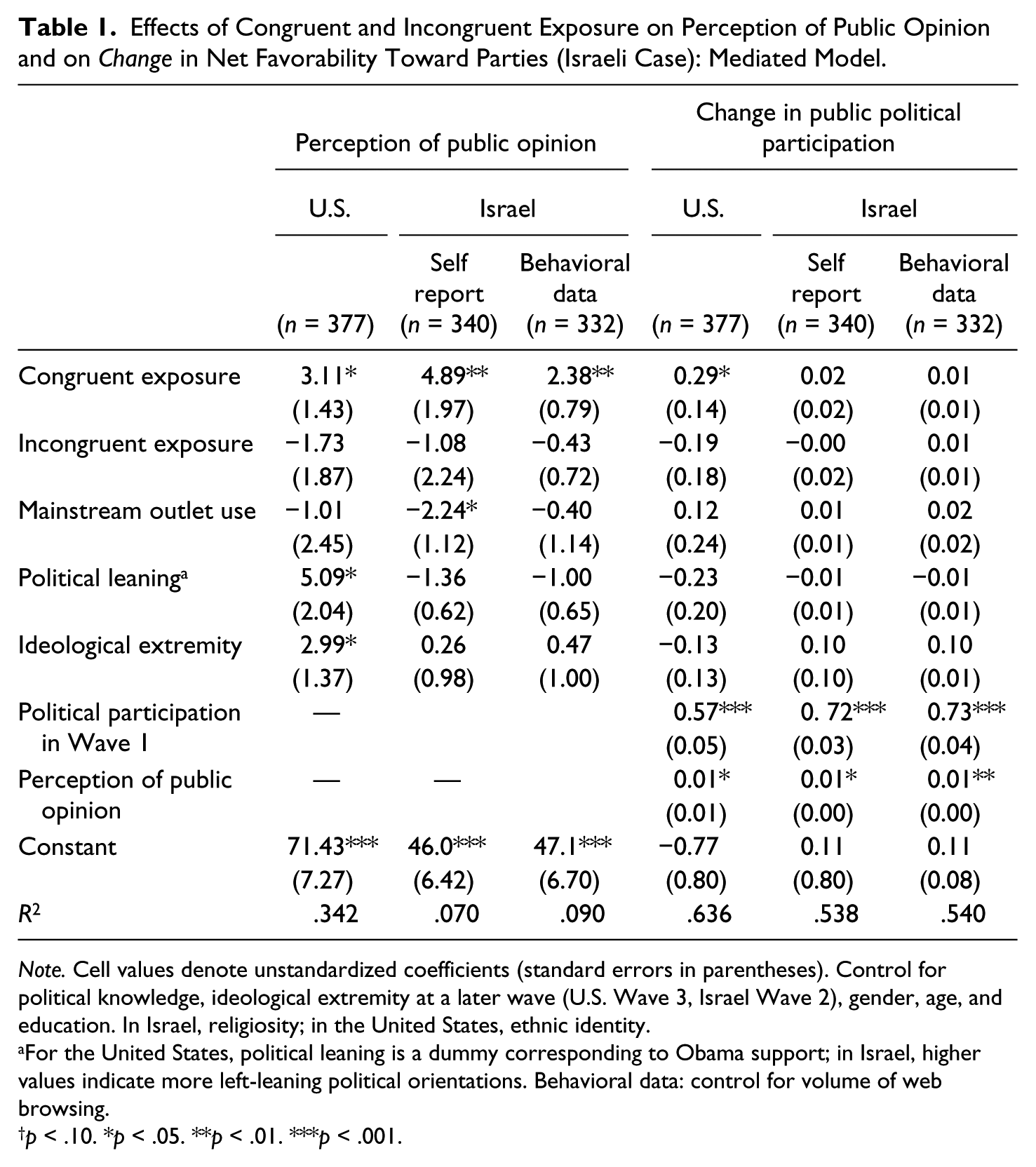
Note. Cell values denote unstandardized coefficients (standard errors in parentheses). Control for political knowledge, ideological extremity at a later wave (U.S. Wave 3, Israel Wave 2), gender, age, and education. In Israel, religiosity; in the United States, ethnic identity.
For the United States, political leaning is a dummy corresponding to Obama support; in Israel, higher values indicate more left-leaning political orientations. Behavioral data: control for volume of web browsing.
p < .10. *p < .05. **p < .01. ***p < .001.

Results of mediated model—Israeli case.
Our hypothesis regarding the association between perception of opinion climate and political participation (H2) was confirmed as well: Those who believed public opinion to be on their side reported stepping up their public political participation during the campaign (see Table 1). Recall that this effect was obtained after controlling for initial levels of participation at Wave 1.
Next, we tested the mediated association between congruent exposure and political participation (H3). As hypothesized, in both cases, the association between exposure to congruent outlets and political participation was mediated by perception of public opinion. Indeed, significant indirect effects were observed (effect size self-report = .0063, SE = .004, 95% CI = [.005, .019]; effect size behavioral data = .0043, SE = .002, 95% CI = [.001, .011]. The association between exposure and participation was fully mediated.
Study 2: The 2012 U.S. Presidential Elections
Method
For the U.S. case, GfK Knowledge Networks ran an online three-wave panel survey during the 2012 U.S. presidential election. The sample was selected from a panel constructed using probability-based sampling via random-digital dialing and address-based sample techniques. The baseline survey involved 1,004 respondents and was conducted from July 14 to August 7, 2012. Wave 3 took place between November 2 and 19, with a final count of 652 (83.4% retention from Wave 2; 64.9% from baseline). The analyses are based on data collected in the first and the third waves.
The sample is demographically diverse and representative with regard to age (M = 50.9, SD = 16.1), gender (50.3% male), education (92.0% high school graduate or higher and 35.9% bachelor’s degree or higher), race (77.0% White, 7.7% Black, 8.7% Hispanic, 6.6% Other), political party affiliation (45.2% Democrat or Democrat-leaning, 13.3% pure Independent, 35.7% Republican or Republic-leaning), and ideology (30.8% liberal, 32.5% moderate, 36.7% conservative). 13
Measures
Party leaning
In the baseline survey, respondents were asked to select the option that best described their party affiliation, on a 7-point scale from 1 = strong Democrat to 7 = strong Republican. On the basis of these categorizations, true Independents, 4 = Independent (close to neither party), were excluded and the remaining partisans were coded as either Democrat/leaning-Democrat (60.7%; dummy = 0) or Republican/leaning-Republican (39.3%; dummy = 1). 14
Congruent and incongruent exposure
Respondents were asked about their online use of liberal and conservative news sites and blogs. 15 A 5-point scale (1 = every day or almost every day, 5 = never) was used to indicate frequency of exposure, with the values reverse-coded so that a higher number reflected more frequent exposure. Exposure to liberal media by Democratic or Democratic-leaning respondents and exposure to conservative media by Republican or Republican-leaning respondents were computed as pro-party exposure (M = 1.64, SD = 0.95). Similarly, conservative media exposure by Democratic or Democratic-leaning and liberal media exposure by Republican or Republican-leaning respondents were computed as counter-party exposure (M = 1.30, SD = 0.61).
Mainstream and neutral media use
The frequency of exposure to mainstream, relatively neutral, and online news was measured by asking how often in the previous month (1 = every day or almost every day; 5 = never, reverse-coded) they had received information about candidates or the campaign from the “website of a major national news organization that is not frequently characterized as favoring a particular party or ideology, including USA Today, CBS News, and Yahoo! News” (M = 1.62, SD = 0.86).
Perception of opinion climate
We asked respondents to estimate their preferred candidate’s chances of winning the election in the pre-election panel waves using a slider with values ranging from 0% to 100% (first wave: M = 67.7, SD = 16.8).
Public political participation
Respondents indicated the frequency with which they participated in a series of nine political activities in the three months preceding the survey on a 3-point scale: 1 = never, 2 = once, and 3 = more than once (first wave Cronbach’s α = .81, factor analysis yielded a one-factor solution, with 45% explained variance). The activities assessed were as follows: signing a petition, donating money, volunteering with a community or religious organization, contacting a political figure, taking part in a protest, wearing a campaign button, trying to convince someone how to vote, going to a political event in support of a candidate, and volunteering for a candidate. The items were dichotomized, and a count was computed (first wave: M = 1.78, SD = 2.17; third wave: M = 1.97, SD = 2.25).
Covariates
Covariates are identical to the Israeli cases and included initial level of public political participation, ideological extremity (as measured in the third wave), and political knowledge. Lastly, a dummy variable was computed from the party affiliation item described above to single out strong partisans. Those who identified as strong Democrats or strong Republicans (27.8%) were assigned a value of 1, whereas the rest were assigned a value of 0.
The statistical analysis and model specification were identical to those employed in the first study.
Results
Here, too, we began with a simple exploration of differences in participation according to exposure patterns (see Figure 1). 16 As in the Israeli case, those using partisan media (both congruent and incongruent) are more politically active with a rather small increase in participation over time.
Before turning to details of these results, we note the striking comparability of results across analyses. The magnitude and direction of coefficients are very similar across models for all three data sets, suggesting both that the self-reported data are reliable and that the theoretical mechanisms apply to a variety of circumstances.
All the significant paths emerged in the first study were significant in the second study as well. As reported in Table 1, and presented visually in Figure 3, more frequent use of congruent outlets is associated with stronger beliefs that one’s candidate would win the elections (H1a). This belief, in turn, was positively associated with participation, after controlling for initial level of participation (H2). As in the first study, here too, the effect of incongruent exposure was not significant (H1b), and political participation did not have a significant effect on perception of public opinion. Lastly, as per H3, the association between exposure to congruent outlets and political participation was mediated by perception of public opinion (indirect effect size = .033, SE = .025, 90% CI = [.003; .090]). Figure 3 illustrates the mediated effect of exposure on participation. As can be seen, the change is rather small; still, it is significant and occurred over a short but important period of time—namely, an election campaign. Lastly, it should be noted that, although the association between exposure and participation was fully mediated in the Israeli case, congruent exposure in the United States still had a significant direct effect on participation. This may indicate that the U.S. case is subject to other mechanisms and processes.

The mediated effect of congruent exposure on increase political participation.
Discussion
We derived two hypotheses based on spiral of silence theory: First, media exposure influences the perception of the opinion climate; second, opinion-climate perceptions have an impact on political expression. Our data support both of these individual-level predictions. The first hypothesis is validated by the finding that exposure to congruent media was associated with biased perceptions of public opinion. The second hypothesis is confirmed by the finding that perceived public support for one’s opinions was associated with political outspokenness and politically meaningful acts. The pattern was the same in both behavioral and self-report data and in the United States and Israel.
The finding that incongruent exposure had little effect on political participation—in contrast to congruent content, which did—may suggest that audience members react to these two types of messages quite differently. It seems that when a media message aligns with our preconceptions, we tend to be receptive to and influenced by it. In contrast, the results of this and other studies (Taber, Cann, & Kucsova, 2009; Taber & Lodge, 2006) suggest that people are far less open to incongruent messages and may even actively resist them; consequently, the effects of such exposure on political perceptions and political participation might be quite minimal. This stands in contrast to the negative effect of crosscutting exposure found in the context of interpersonal discussions (Mutz, 2006; Mutz & Martin, 2002). This result merits further elaboration, to the extent that together with our other findings it contributes to research on partisan media and the spiral of silence theory.
Partisan media exposure is relatively rare: Most people prefer entertainment over political information most of the time. Although partisan content may not suit everyone’s taste, it does appeal to certain segments of the public, especially politically engaged audiences with strong political views (Jamieson & Cappella, 2008; Knobloch-Westerwick & Meng, 2011; Levendusky, 2013a; Stroud, 2008; Taber & Lodge, 2006). Despite partisan news media’s rather modest reach, their audience may be uniquely influential, taking a more active part in the political process and exerting greater influence on politics than those who are not exposed to such media. Furthermore, our behavioral data affirm that even modest real-world exposure matters, significantly shaping individuals’ perceptions of political reality.
At the other extreme, scholars claim that the recent increase in politically motivated selective exposure marks a “new era of minimal effects.” This argument suggests that the media are losing their ability to influence attitudes because individuals are increasingly isolated from viewpoints that differ from their own (Bennett & Iyengar, 2008). The present study, however, is more consistent with Holbert et al. (2010), who assert that the media have not lost their ability to influence audiences for at least two reasons. First, as shown by a growing body of work, exposure to congruent content (selective approach) does not necessarily entail selective avoidance (Garrett, 2009; Holbert et al., 2012). Our data demonstrate further that congruent and incongruent exposure yielded different results, possibly due to different processing of media messages. Consequently, had these two indicators been merged into one, the depiction of partisan media effects would have been attenuated.
The second argument against the idea of “minimal effects” is that congruent exposure contributes to the creation of reinforcing spirals (Slater, 2007, 2014). In other words, exposure to congruent voices appears to reinforce one’s attitudes, perception of opinion climate, and the tendency to express one’s opinions publically. Moreover, a growing body of evidence suggests that this type of reinforcing influence is far more frequent than the impact of incongruent media messages (Slater, 2014).
Scholars have offered a number of theoretical accounts regarding the influence of partisan media on audiences, but relatively little empirical work has been carried out to examine these explanations. By testing whether the association between media exposure and participation is mediated by perception of public opinion, this study contributes to the development of a theoretical framework for partisan media effects. Of course, our data do not demonstrate that perceived opinion climate is the only mediator between congruent exposure and participation. On the contrary, the fact that in the U.S. data a direct effect was still found after controlling for perceived opinion climate suggests that other mediating mechanisms may underlie the association between partisan exposure and participation. 17
In light of accumulated evidence (Dvir-Gvirsman, 2014a; Kim, 2013; Tsfati et al., 2013), it seems that normative, cognitive, and emotional mechanisms are particularly promising when modeling the influence of partisan media. In the current work, the focus was on perception of public opinion that is one normative belief shaped by partisan media. By influencing perceptions about the acceptance of a political idea, partisan media may shape audience beliefs about which behaviors and attitudes are “right,” potentially motivating people to adopt more extreme opinions. For example, if an individual perceives racism to be widely accepted, he or she may be more likely to express racist views. However, other works allude to cognitive mechanisms such as argument repertoire (Garrett, 2009), knowledge (Jamieson & Cappella, 2008), attitude accessibility (Knobloch-Westerwick & Meng, 2011), and more recently, to the emotional mechanisms behind partisan media such as negative feelings toward those holding differing political views (Garrett et al., 2014; Lelkes, Iyengar, & Sood, 2013). 18
In addition to advancing research on the influence of partisan media, this study also contributes to the long tradition of work on the spiral of silence theory. Relying on data collected in two different countries and using complementary operationalizations of key concepts, we are able to explore important dimensions of opinion climate. We have shown that during elections, media shape perceptions of public opinion regarding both the issues and the candidates. It is also important to note that according to the original spiral of silence model, the relationship between public opinion perceptions and public expression is focused on harm: hostile opinions silence public expression. As previously noted (Mutz & Silver, 2014), the original hypothesis does not concern the beneficial relationship demonstrated here, namely, that supportive opinions may increase participation. Although our insight may be no more than the flipside of the coin, it highlights some of the normative assumptions underlying the spiral of silence model.
In focusing exclusively on the silencing effect, the spiral of silence theory implies that the “natural” state of an individual is to be politically active. Put differently, a tacit assumption of this theory is that people have a built-in propensity to speak up, but under some circumstances, this tendency is attenuated. Interestingly, this premise contravenes dominant approaches to participation such as mobilization, as well as rational choice theories (Finkel & Muller, 1998; Klandermans, 1984; Leighley, 1995; Olson, 1965). The latter approaches are premised on the assumption that individuals naturally tend to be passive and that action requires strong incentives. Furthermore, according to the rational choice theory, being in the majority reduces the incentive to take political action as individuals will be tempted to free ride. When a person belongs to the majority, she is less likely to act because she knows that others will uphold her cause. These expectations are a striking contrast to the patterns observed here.
The media landscape has dramatically changed since Noelle-Neumann proposed her theory of the spiral of silence. The variety and diversity of partisan voices offered by cable television and online channels in the contemporary media landscape were not present in the late 1960s, when the spiral of silence was first envisioned—although, to be sure, some sort of partisan media had always existed. Thus, as Katz (1984) put it, Noelle-Neumann assumed that “the media tend to speak in one voice . . . [a]lmost monopolistically” (p. 89). In other words, Noelle-Neumann assumed that even if there are several television stations operating in a given society, the climate of opinion projected by all these stations will be rather uniform (Noelle-Neumann, 1984).
In light of the above, although our data support the two most important individual-level predictions of the spiral of silence model, the consequences of our findings at the macro-level yield a dramatically different social dynamic than the one arising from the spiral of silence rationale. Under Noelle-Neumann’s assumption of consonance, people watching or listening to mainstream media see themselves as being either in the majority or in the minority, and as a result, they either feel confident to voice their opinions or are silenced by their fear of social isolation in the face of a hostile-opinion climate. The findings obtained in this study demonstrate that in the current media landscape, it is possible that two supporters of different political camps may selectively expose themselves to different ideological media—and as a result, form different perceptions of the public opinion climate, ultimately shaping their political participation level.
This research contributes to the understanding of motives underlying political participation, but it is not free of limitations. First, the Israeli survey uses an opt-in online panel for recruitment, which is based on self-selection. As such, the sample likely exhibits bias, especially in terms of participants’ heightened interest in politics. As this factor is a key variable in the present analysis, such a bias would be influential. There was, however, some variation in the sample: Of all, 10% of the sample reported no interest in politics and an additional 20% reported little interest. Thus, individuals with little interest in politics are represented in the sample, albeit not at levels found in the general population. Second, and more importantly, results based on the Israeli data are entirely consistent with those based on the U.S. data, which were collected from a nationally representative probability sample.
Other biases inherent in Internet-based sampling could also be influential. Participants in such panels are known to give more reliable answers (Chang & Krosnick, 2009). On the face of it, this constitutes a clear advantage, but the high reliability of responses may be due to participants’ frequent experience with surveys. In other words, participants’ familiarity with the format of the questions, including the Likert-type scale, may be greater than that of the general public—a discrepancy that would detract from the external validity of the study.
Finally, some indicators known to influence perception of public opinion were not included in the current analysis. Among these is the influence of social networks, particularly their level of homogeneity, on participation and perception of social reality—an issue addressed in many studies to-date (Eveland & Hutchens, 2013; Mutz & Soss, 1997). Our analysis of the U.S. case does not control for the possibility of such influence. Additionally, this analysis also misses another key factor: exposure to offline media. Given that different demographics rely on offline outlets, this lacuna might have biased the results presented. We also do not control for additional mediators between congruent exposure and participation: two possible examples are stereotypic perceptions of the candidates (Kim, 2013), which were shown in recent research to play a part in the process, as well as the emotional reaction that might be triggered by the passionate and uncivil nature of partisan content.
These limitations notwithstanding, our findings have important implications for democratic life. Noting that any discussion of the macro-level consequences is potentially plagued by the ecological fallacy, it could be argued that the process described in this article carries advantages for the public sphere by producing a “spiral of participation”: exposure to congruent political media leads to more participation, and the outcome may be higher levels of political participation in the political arena as a whole. For this deduction to hold true, though, a sizable number of citizens should consume partisan media. That is, for us to assume that level of participation increases over time among the public as a whole due to the penetration of partisan media, partisan media must reach a critical mass of the public. However, this question is highly debated (Dvir-Gvirsman, 2014a; Prior, 2013; Stroud, 2011). Our findings, together with the body of work that links partisan media to disrespect and intolerance toward the other side (e.g., Levendusky, 2013a; Mutz, 2006), suggest that more research should be conducted in order to examine the effects of the heightened activity on the political discourse more generally.
Footnotes
Appendix
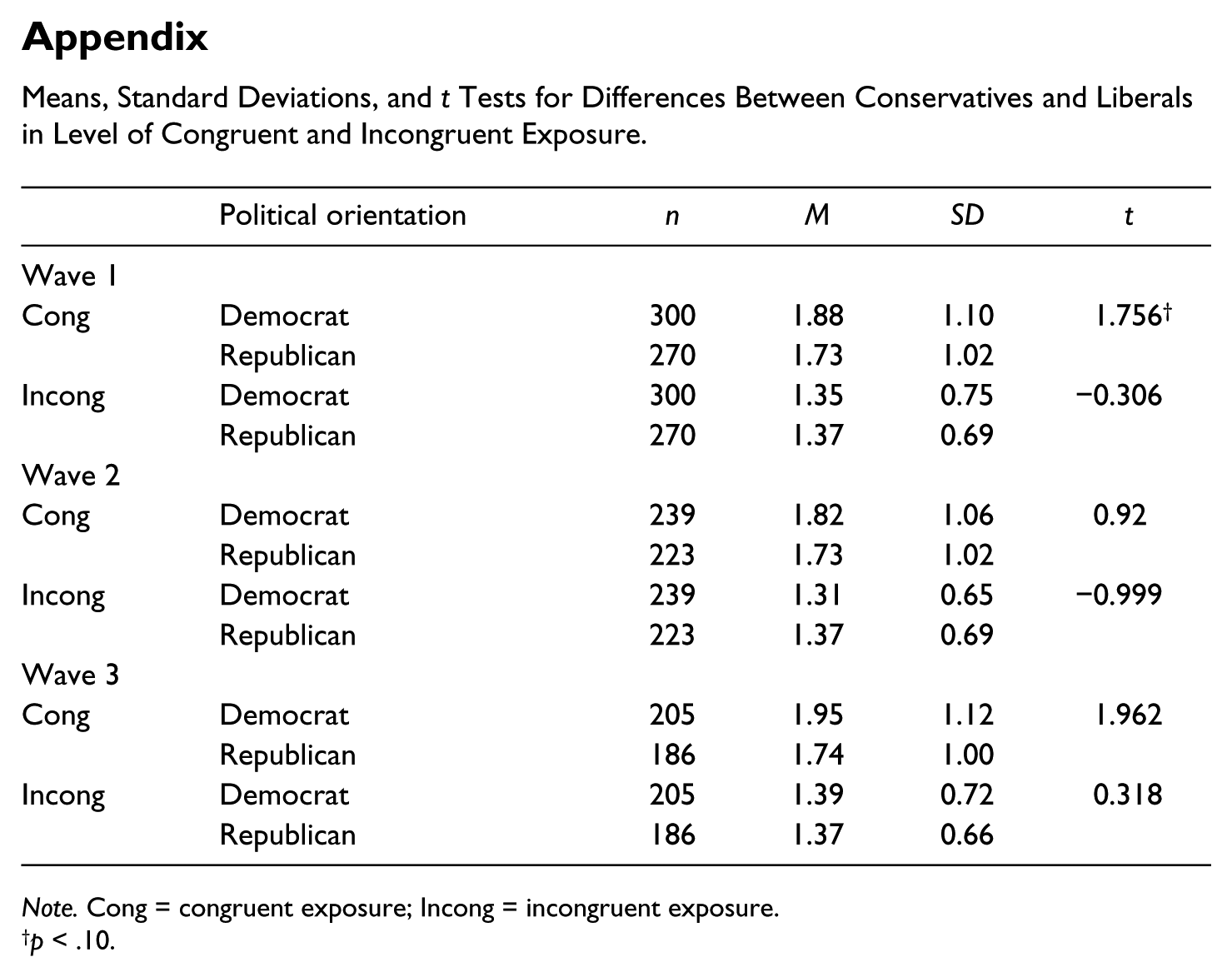
Means, Standard Deviations, and t Tests for Differences Between Conservatives and Liberals in Level of Congruent and Incongruent Exposure.
| Political orientation | n | M | SD | t | |
|---|---|---|---|---|---|
| Wave 1 | |||||
| Cong | Democrat | 300 | 1.88 | 1.10 | 1.756 † |
| Republican | 270 | 1.73 | 1.02 | ||
| Incong | Democrat | 300 | 1.35 | 0.75 | −0.306 |
| Republican | 270 | 1.37 | 0.69 | ||
| Wave 2 | |||||
| Cong | Democrat | 239 | 1.82 | 1.06 | 0.92 |
| Republican | 223 | 1.73 | 1.02 | ||
| Incong | Democrat | 239 | 1.31 | 0.65 | −0.999 |
| Republican | 223 | 1.37 | 0.69 | ||
| Wave 3 | |||||
| Cong | Democrat | 205 | 1.95 | 1.12 | 1.962 |
| Republican | 186 | 1.74 | 1.00 | ||
| Incong | Democrat | 205 | 1.39 | 0.72 | 0.318 |
| Republican | 186 | 1.37 | 0.66 | ||
Note. Cong = congruent exposure; Incong = incongruent exposure.
p < .10.
Declaration of Conflicting Interests
The authors declared no potential conflicts of interest with respect to the research, authorship, and/or publication of this article.
Funding
The authors received no financial support for the research, authorship, and/or publication of this article.