




Abstract
Bias in political news coverage may have a profound influence on voter opinions and preferences. However, the concept of media bias actually encompasses different sub-types: Visibility bias is the salience of political actors, tonality bias the evaluation of these actors, and agenda bias the extent to which parties address preferred issues in media coverage. The present study is the first to explore how each type of bias influences party preferences. Using data from the Austrian parliamentary election campaign of 2013, we combine an online panel survey (n = 1,285) with measures of media bias from content analyses of party press releases (n = 1,922) and media coverage in eight newspapers (n = 6,970). We find substantial effects on party preferences for tonality bias and agenda bias, while visibility bias has no clear impact. Voters who are less politically sophisticated and lack a party identification are more susceptible to bias, and media bias can also reinforce existing partisan identities.
In Western democracies, the mass media can have a crucial influence on how citizens relate to and engage with politics (Altheide & Snow, 1979). Normatively speaking, citizens need to know at least a little about politics, parties, and candidates in order to be able to make effective and informed electoral decisions (Delli Carpini & Keeter, 1996). Importantly, they gain this knowledge above all from the mass media: For better or for worse, the media are the core arena for public political debates (Ferree, Gamson, Gerhards, & Rucht, 2002) and citizens’ main source of political information (Norris, 2000). Therefore, one central responsibility of the media arguably is to supply voters with balanced and objective information on relevant political issues and actors (Strömbäck, 2008).
The media often fall short of this ideal, and indeed they are regularly accused of partisanship and biased reporting, especially during election campaigns. Media reporting that lacks balance because it favors some political positions and political actors over others has been described using a large number of terms and concepts, including ideological bias (Hackett, 1984), media bias (Reeves, 1997), news bias (Boomgaarden & Semetko, 2012), partisan bias (D’Alessio & Allen, 2000), and political bias (Hopmann, van Aelst, & Legnante, 2011b). In such politically biased reporting, issues and actors are presented and discussed in an unbalanced and slanted way. Most studies that consider media bias focus merely on what it reveals about media content (Berkel, 2006; Brandenburg, 2005; Hofstetter & Buss, 1978; Takens, Ruigrok, & van Hoof, 2010). However, media bias is also important because it can have substantial effects on recipients’ political interest, knowledge, attitudes, and even vote choice (McCombs, 2005). Accordingly, several recent studies investigate the effects of media bias on evaluations of party leaders (e.g., Lenz & Lawson, 2011; Prior, 2006), on vote intention (e.g., Boomgaarden & Semetko, 2012), or on both (Druckman & Parkin, 2005).
In studying the effects of media bias, it is important to disaggregate this broader concept into different sub-types, which refer to different aspects of the journalistic product such as actor salience, actor valence, or issue content. In the literature, three sub-types of biases are commonly identified: visibility bias (also referred to as coverage bias), tonality bias (also referred to as statement bias), and agenda bias (also referred to as gatekeeping bias or selectivity; D’Alessio & Allen, 2000). While visibility bias deals with the salience of political parties or candidates in the news, tonality bias measures how these actors are evaluated, and agenda bias investigates which issues parties are able to address in media coverage. Most of the literature on influences of media bias focuses on one type of bias only (Beck, Dalton, Geene, & Huckfeldt, 2002; Fournier, Nadeau, Blais, Gidengil, & Nevitte, 2004; Oegema & Kleinnijenhuis, 2000; Takens, Kleinnijenhuis, van Hoof, & van Atteveldt, 2015). However, some recent studies have included two types of biases in their analysis in order to measure media bias effects more accurately (Boomgaarden & Semetko, 2012; Lengauer & Johann, 2013). Overall, most research tends to disregard agenda bias, even though it is potentially important in increasing uncertainty and even misperceptions about party positions, which in turn may result in a decline in voter support (Brandenburg, 2005).
Building on the insight that media bias can have three different forms, this study makes three key contributions. First, this article is the first to examine the distinct effects of each type of media bias on party preferences. Our emphasis on agenda bias is particularly novel. Second, our model of media bias effects is rigorous as it leverages a multi-wave panel survey with detailed exposure measures to study changes in party preferences over an election campaign. The model also tightly controls for potential confounders of media influence. Our measures of media bias are based on extensive content analyses of newspaper coverage and party press releases. Third, we explicitly consider the possibility that media effects are not universal and examine two key moderating factors so far understudied in bias effects studies: political sophistication and partisan identification (Fournier et al., 2004). Overall, this study sketches a comprehensive picture of media effects during election campaigns in a European multi-party system and substantially adds to the literature on bias effects of political news coverage on voting, thereby addressing one of the core questions in political communication research.
In order to address these gaps, this study presents evidence from an integrated research design that combines data from an extensive media content analysis of eight national newspapers with data about party press releases of six parties and a panel survey carried out during the Austrian national election campaign of 2013. We will investigate how the three types of media bias influence voters’ party preferences, while examining how voter characteristics such as political sophistication and partisanship moderate their effects.
Bias and Balance
Bias is best understood through its opposite, commonly referred to as objectivity, a rather broad quality criterion of news reporting that consists of many different aspects such as accuracy and realism, separation of fact and opinion, as well as avoidance of slant (McQuail, 1992). Bias can be investigated on the basis of both issues (e.g., Takens et al., 2010) and actors (e.g., Boomgaarden & Semetko, 2012). In this article, we focus on actor-based bias as our aim is to explain voters’ support for political parties. Nevertheless, issue-based bias is reflected in our concept of agenda bias, which is related to issue-based conceptualizations of bias.
In order to arrive at a better operational definition, some scholars argue that the opposite of bias is not necessarily objectivity but neutrality or balance (Hopmann et al., 2011b). An unbiased news report is a neutral or balanced report, thus one that is not strongly slanted in favor of or against any political side. All sides should be equally represented according to some kind of benchmark for balance or neutrality. Conversely, in this view, bias is the extent to which media reporting deviates from this benchmark. The literature describes three types of actor-based biases that may affect voters’ party preferences: visibility bias, tonality bias, and agenda bias. In the next section, we describe each type of bias in turn and explain why each type is important for understanding voter attitudes or behavior.
Three Types of Media Biases: Visibility, Tonality, Agenda
Actors can be more or less visible in the media as they compete for media attention (Hopmann, Elmelund-Præstekær, Albæk, Vliegenthart, & De Vreese, 2012; Hopmann, Vliegenthart, De Vreese, & Albæk, 2010; Weaver & Wilhoit, 1996). There is visibility bias in a medium when a political actor is the subject of an undue amount of coverage compared to other actors and other outlets. This type of bias is therefore defined by the relative amount of coverage devoted to each political actor in each medium. Of course, we should not expect all political actors to receive equal amounts of coverage: Some actors will be covered more because of their media viability (King, 2002) or because of journalistic news values such as relevance (e.g., incumbency bonus) and novelty (Galtung & Ruge, 1965; Harcup & O’Neill, 2001; Semetko & Boomgaarden, 2007). However, these factors should influence all media outlets equally (van Dalen, 2012), and in this study we focus on relative levels of media bias within one political and media system. Hence, our interest lies in the extent to which some media outlets devote disproportionally more coverage to some actors than other outlets do.
Such party and candidate visibility is important and influential because it is a necessary condition for voters to even learn about candidate characteristics and party policy positions. Furthermore, the visibility of political actors in media coverage will increase their accessibility to audiences, influencing subsequent political judgments (Kiousis & McCombs, 2004), especially because voters tend to infer a party’s political importance from its media salience (Miller & Krosnick, 2000). Studies combining media content data with voter surveys have indeed found that the mere visibility of parties and candidates is an important factor influencing vote choice (Oegema & Kleinnijenhuis, 2000; Semetko & Schönbach, 1994). We thus expect that the more visible a party is in voters’ media repertoire, the higher their preference for that party (Hypothesis 1a [H1a]).
Tonality bias measures whether evaluations present in media coverage are systematically more favorable to one political party compared to other parties. The media can frame actors as being either good or bad politicians (or parties), and thereby provide evaluations of them and their performance. Whereas visibility is a purely quantitative measure, tonality therefore adds a qualitative aspect by considering how political actors are covered. The tonality of coverage is important because it can provide the media audience with templates for understanding politics. For instance, valence framing suggests that positive or negative aspects of an object are highlighted in the media, consequentially affecting the salience of these aspects in the public’s mind (de Vreese & Boomgaarden, 2003). Similarly, Druckman and Parkin (2005) argue that audiences’ inferences about candidate traits are rather automatically made from positive or negative descriptions in texts. Studies investigating both visibility and tonality bias conclude that these biases are not necessarily consistent in their effects, with tonality bias identified as having a greater impact (Boomgaarden & Semetko, 2012; Norris, Curtice, Sanders, Scammell, & Semetko, 1999). We thus expect that the more favorable the tonality toward a party is in voters’ media repertoire, the higher their preference for that party (Hypothesis 1b [H1b]).
Agenda bias refers to the extent to which political actors appear in the public domain in conjunction with the topics they wish to emphasize. Agenda bias therefore stems from a journalist’s or editor’s decision to select or ignore specific news stories, as a result only giving a voice to some actors and their policy positions (Covert & Wasburn, 2007; White, 1950). Hence, it is not just important how often political actors appear in the media (visibility bias), or how they are evaluated (tonality bias). It is also crucial for understanding voter preferences whether political actors are allowed to present their own policy positions and talk about their issues in the media (Brandenburg, 2005). Although agenda bias is still actor-driven, it also reflects issue-based bias, in that it captures the extent to which politicians and parties are connected to the specific issues they favor. Parties choose their issue agenda carefully, highlighting issues that they are perceived to be competent on, that they “own,” and that are important to their voters (Ansolabehere & Iyengar, 1994; Petrocik, 1996). Parties and candidates thus not only want to be present in the media, but they also want the media agenda to be congruent with their own agenda, and therefore define the issue-based criteria on which they will be evaluated by voters (Brandenburg, 2005; Hopmann et al., 2011b). For example, a government party will want to talk about the economy in the media when it is doing well in order to prime that issue among voters (Druckman, 2004). In sum, news content producers can suggest to news audiences the specific issues on which they should assess parties (Iyengar & Kinder, 1987). The effect of the media agenda will depend on whether these issues favor or hurt parties. Because our assumption is that parties emphasize issues that they think will advantage them at the polls, parties will benefit if the mediated party agenda is close to the party agenda (Brandenburg, 2005). Hence, our third hypothesis is that the more congruent a party’s agenda is with its mediated issue agenda in voters’ media repertoire, the higher their preference for that party (Hypothesis 1c [H1c]).
Moderators of Media Bias Effects
Media effects do not to occur across the board but are different for different types of recipients (McLeod, Kosicki, & McLeod, 2009; Valkenburg & Peter, 2013; Zaller, 1992). In this study, we focus on two key moderators of the effects of media bias on party preferences: political sophistication and partisanship.
First, political sophistication is defined as a voter’s capacity to understand and utilize political information (Zaller, 1992) and can be seen as a combination of its three key drivers: media attention, political interest, and education (Smith, 1989). Following the literature, the moderating effect of political sophistication may not always be straightforward. Some level of political attention is needed to even be aware of media coverage about politics and thus to be affected by media at all. Hence, some studies find that paying close attention to election coverage may increase the effects of its content (Delli Carpini, 2004), although existing evidence in this direction is mixed (Boomgaarden & Semetko, 2012). Furthermore, the media context has to be factored in: Outside of intense election periods and when there is little access to countervailing information, even highly sophisticated voters may be open to media influence (Zaller, 1992).
Concerning media effects during election campaigns, the majority of studies agree that political sophistication is important because it makes voters less susceptible to media effects (Ansolabehere & Iyengar, 1995; Fridkin, Kenney, Gershin, Shafer, & Woodall, 2007; Hillygus & Jackman, 2003). Arguably, such sophistication increases an individual’s ability to make an informed decision when evaluating whom to vote for (Gomez & Wilson, 2007). A greater interest in politics helps voters to better organize and filter whatever information or coverage they are confronted with in order to assess its validity and finally accept or reject the message (Luskin, 1990; Zaller, 1992). Similarly, more educated voters tend to be less easily influenced by media coverage as they have the communication skills and background knowledge to process and interpret new information while taking into account prior evidence and the information source itself (Johansen & Joslyn, 2008). Conversely, less sophisticated voters are said to be less alert to their political environment, more easily persuaded by mere symbolic display, and less resistant to manipulation from political elites such as parties and media. Especially during periods of intense information flows, such as parliamentary election campaigns, less sophisticated voters are thus most susceptible to media messages (Zaller, 1992). Hence, we expect media bias effects on voters to decrease as their level of political sophistication increases (Hypothesis 2a [H2a]).
A second key moderating factor is partisanship. 1 Most citizens have little knowledge of political parties, policies, or events and come into contact with politics only through media coverage (Fridkin et al., 2007). This is arguably less strongly the case with partisans, voters that strongly identify with specific parties and their candidates, societal values and ideology. Studies find that partisans generally tend to be less affected by campaigns as their voting behavior is determined by long-term factors such as their partisan identification (Fournier et al., 2004). Moreover, partisans’ desire to maintain prior beliefs leads them to process counter-attitudinal information selectively by paying less attention to it or trying harder to find reasons to dismiss it (Taber & Lodge, 2006). So, partisans tend to ignore or reject information dissonant with their own political views, especially if it comes from media they perceive to be biased in favor of the opposing parties (Beck et al., 2002; Boomgaarden & Semetko, 2012; Fournier et al., 2004). In addition, partisan behavior such as selective media exposure makes it even more unlikely that media coverage will change a partisan’s overall preference (Bennett & Iyengar, 2008). Yet, there may still be room for media effects among partisans: By activating and reinforcing partisan identities, media coverage may renew and strengthen partisans’ initial vote intentions (e.g., Ansolabehere & Iyengar, 1995; Dilliplane, 2014). This leads us to the following two hypotheses: Non-partisans are more likely to be affected by media bias than partisans (Hypothesis 2b [H2b]), but partisanship may also be reinforced by media bias toward the favored party (Hypothesis 2c [H2c]).
The Case: Austria
Most studies on media bias focus on the United States, a two-party system (i.e., Covert & Wasburn, 2007; Doll & Bradley, 1974; Hofstetter & Zukin, 1979). Determining the effects of bias toward one or the other party or candidate is “fairly easy” in such a system compared to systems with many competitors (Hopmann et al., 2011b, p. 241). However, the findings from these studies are not necessarily applicable to most European media and political systems, where media outlets are—at least historically—more strongly tied to political parties and where media bias is more common albeit dispersed over different parties (Brüggemann, Engesser, Büchel, Humprecht, & Castro, 2014; Hallin & Mancini, 2004). Nevertheless, only a few studies systematically analyze media bias in multi-party systems (e.g., Boomgaarden & Semetko, 2012; Hopmann et al., 2010; Takens et al., 2010). Our study of Austria is an important contribution in this regard. Here, newspapers generally refrain from taking clear partisan stances and communicating them publicly such as in endorsements. Most newspapers explicitly state in their editorial policy that they adhere to the standards of impartiality and diversity of opinions.
According to Hallin and Mancini (2004), Austria has a democratic-corporatist media system (comparable to Germany), with a high level of readiness for political intervention and an overall closeness between political actors and journalists (Plasser & Lengauer, 2012). From a more technical perspective, the Austrian media landscape can be qualified as analytically manageable and diverse at the same time. It has several newspapers (quality, tabloid, regional, and free), all with relatively high circulation figures, as well as a growing television sector (Aichholzer, Kritzinger, Jenny, Müller, & Vonbun, 2014).
Politically, Austria has a long tradition of grand coalition governments between Social Democrats (SPÖ) and the People’s Party (ÖVP). However, the results of the 2013 Austrian national election were far from certain beforehand, and the results meant that the two traditional major parties shrunk to a record low, while a right-wing populist party (FPÖ) gained increasing voter support. Its offspring party, the BZÖ, lost parliamentary representation, while the NEOS (a liberal party) and the Team Stronach (led by a business tycoon) entered parliament for the first time (Dolezal & Zeglovits, 2014). In sum, the Austrian election of 2013 can be characterized as a volatile election. Overall, examining a country with a democratic-corporatist media system and a partisan history provides a reference point for many European countries and breaks with mostly binary analysis of media bias in two-party systems.
Data and Method
Data collection for this research took place within the interdisciplinary framework of the Austrian National Election Study (AUTNES). Its integrated design combines media content, party communication, and survey data. The media analysis consists of all media coverage on political actors in eight newspapers (Eberl et al., 2015). 2 The data on party communication comprise all party press releases sent out by the six parties that were in office during the last legislative period (Müller et al., 2014). Both types of content data were linked to the general population using an online access panel survey (Kritzinger et al., 2014). All data focus on the period between August 19 and September 29, 2013, that is, the 6 weeks prior to Election Day.
The media sample contains a wide variety of different types of outlets selected on the basis of circulation figures, genre as well as national and regional distribution. 3 All media outlets are under private ownership and have no explicit partisan ties. 4 Media content was analyzed using manual content analysis of political claims on a sentence level (Koopmans & Statham, 1999). A claim is a statement made by an actor about a political issue and/or actor, including the expression of criticism, responsibility, or support. 5 The recording unit is small and has clear relational properties, that is, claims distinguish between speakers, issues, addressees as well as evaluations (Helbling & Tresch, 2011). These properties are important for measuring different types of media biases. For the following analysis, only claims by or addressed toward a political party or candidate were of relevance, generating a subsample of about 7,000 articles and 42,000 claims.
Our analysis of party communication is based on party press releases, in particular on the policy issues addressed in these press releases. 6 This information is used to compare the party with the media data and measure agenda bias (see below). Overall, approximately 1,900 party press releases from six parties were coded (SPÖ, ÖVP, FPÖ, Greens, BZÖ, and Team Stronach).
Third, these data were linked to the first wave (45 to 32 days before election day) and third wave (last 4 days before the election) of a four-wave online-panel survey of the Austrian population eligible to vote. Respondents were drawn randomly from an already existing opt-in online access panel based on key demographics in terms of representing the target population. The profile of the panel was largely in line with the overall population with minor discrepancies concerning age and region that reflect the usual patterns of such online surveys (Kritzinger et al., 2014). After dropping cases with missing values for the relevant variables, the remaining subsample contained 1,285 respondents.
Visibility Bias
To determine visibility bias, we first need to measure visibility per se. We treat a party as visible in an article if the party itself or candidates from the party are a speaker or addressee in at least one of the claims included. The overall visibility for each party is then defined by the relative amount of articles in which the party is present.
The next step is to define when and to what extent there is a bias in terms of the visibility of parties. Operationalizing media bias remains a challenge (D’Alessio & Allen, 2000), mainly because it is difficult to determine the most appropriate reference point to distinguish between balanced/neutral and biased reporting. Hopmann et al. (2011b) argue that coverage should be compared to benchmarks of parties at a given point in time, for example, the amount of their campaign communication or their standing in polls, because what balanced reporting is might vary from one election to next. Although this logic considers the relative nature of balance, it does not yet allow for comparison across diverse media outlets. Some media outlets might generally leave less space to parties or their issues, or be overall more skeptical of them, not due to partisan but rather due to genre or format influences. To consider differences between parties as well as media outlets, the average visibility of all parties in each media outlet during the period of analysis is a key benchmark (Druckman & Parkin, 2005). Our bias measure therefore captures whether party visibility is biased in comparison to what is typical for that outlet.
Visibility bias is then computed as the deviation of each party’s specific visibility from the average visibility of all other parties in that outlet. An example can illustrate this approach. If Party A has a visibility of 50% in the outlet under study, and the mean visibility of all other parties in that outlet is 35% (i.e., each of the other parties is visible in just over a third of articles), then the visibility bias of Party A in that outlet is +15%. Our measurements of bias in election coverage therefore take into account differences between parties as well as between media outlets. We thus construct a benchmark for balance for each party-medium combination. 7
Tonality Bias
Most studies count positive and negative statements about political actors and then aggregate these to create a measure of tonality (D’Alessio & Allen, 2000). 8 Similarly, we follow Berkel (2006) and Lengauer and Johann (2013) and measure tonality toward a party based on the claims coded within articles, specifically their evaluation (positive +1, negative −1) and addressee (i.e., party; D’Alessio & Allen, 2000). As with visibility bias, we then take the average party tonality in that outlet, with tonality bias computed as the deviation of each party’s specific tonality from the average tonality of all parties in that outlet. To ensure comparability between visibility and tonality bias, both have been standardized to range from −1 to 1, where a party would have a bias of 0 (balanced/neutral), when its visibility or tonality is equal to the mean visibility or tonality across all parties in that media outlet. 9
Agenda Bias
The operationalization of agenda bias is somewhat more challenging. In order to know which news stories have been selected as well as deselected by journalists, one would have to know the universe of news stories at a given point in time (D’Alessio & Allen, 2000). To allow for an operationalization of agenda bias, this study uses parties’ campaign communication as an approximation of the potential universe of news stories (Brandenburg, 2005; Hopmann et al., 2011b; Hopmann et al., 2012). We compare the policy issues addressed in campaign communication (i.e., the party agenda) with the policy issues the parties address in media coverage (i.e., the mediated party agenda).
For each press release and for each party claim, we coded the main issue at a low level of aggregation (750 issues). We then collapsed these issues into 15 broader issue categories based on issue ownership categorizations by Hayes (2008) as well as Meyer and Müller (2013). 10 Statements on issues that did not fit into one of these policy fields as well as statements concerning campaigning or coalition formation were not considered. This leaves us with a subsample of 12,857 party-issue-units in media reporting and 1,523 party-issue-units in party communication. Agendas were measured in terms of percentage distributions of these party-issue units across the 15 policy fields.
Then, we estimated bivariate correlations between party agendas and the mediated party agendas. These correlations represent the agenda selectivity each party experiences in each media outlet. The higher the correlation, the more congruent both agendas are (Brandenburg, 2005; Harris, Fury, & Lock, 2006; Kim, Xiang, & Kiousis, 2011). Again, to measure the bias and not just outlet specificities, for each outlet the mean agenda selectivity of all other parties was subtracted from each party’s specific agenda selectivity value and then standardized to range from −1 to 1, where −1 stands for both agendas being not congruent at all and +1 stands for both agendas being identical. 11
Analyses and Model Specifications
The literature on media effects has long struggled with the challenge that these effects might be minimal (Bennett & Iyengar, 2008; Holbert, Garrett, & Gleason, 2010). However, this may have something to do with the commonly used dependent variable such as vote choice, which does not allow for much variation in a country with rather stable voting behavior (Hopmann et al., 2010; van der Eijk, van der Brug, Kroh, & Franklin, 2006). In this study, we therefore use a more detailed dependent variable, namely, the propensity to vote (ptv) for each party on a scale from 0 (very unlikely) to 10 (very likely), a non-ipsative measure of party preferences. This measure allows for more variation across voters and across time, even more so when considering smaller and newer parties. In addition, working with ptv scores as our dependent variable allows us to analyze a voter’s score for all parties, and thus consider the possibility that media bias affects evaluations of all existing alternatives and not just the one party (Pardos-Prado & Dinas, 2010; van der Eijk et al., 2006).
Our stacked data analyses include a large amount of individual-level control variables such as age (in years), gender (0/1, 1 = male), late deciding (0/1), party identification (0/1), left-right self-placement (0-10), 12 and media use (additive index of days per week spent reading each news outlet, theoretical range of 0-49). Following the works of Smith (1989), Zaller (1992), and Highton (2009), we measure the theoretical concept of political sophistication (0-9) in approximation only by using an additive index of political interest (0-3), attentiveness to the election campaign (0-3), and level of formal education (0-3). Both party identification and political sophistication are first used as control variables but later as subgroup determinants. These non-party-specific variables are transformed to the centered predicted values associated with each party in the stacked data, a procedure outlined in van der Eijk et al. (2006). Including all these variables in one model guarantees a conservative measurement of media bias effects, eliminating potential confounding factors.
It is important to capture the effects of political media bias and not just of structural biases. Political media bias exists when any one specific party has a disproportionally higher or lower value in one outlet compared to all other outlets (not compared to other parties). Structural bias exists when a party receives more or less—and more or less favorable—coverage solely due to institutional or contextual factors such as incumbency or historical legacies. This is potentially problematic in an analysis if, say, a party has a positive visibility bias across all outlets and higher levels of party preferences that are both caused by the party’s historical strength. To capture the effects of political media bias rather than that of such structural bias, we include fixed effects for each party. Once fixed effects are included, the remaining effect of our bias measures on party preferences reflects politically biased media coverage rather than structural differences between party coverage in the media.
For each individual, we measure exposure to media bias by using their reported media consumption for each of the eight media outlets on a scale from 0 to 7, where 0 stands for never reading a specific outlet and 7 stands for reading this outlet every day of the week (see Table 1).
Respondents’ Self-Reported Media Consumption (in %).

Note. Data from [Kritzinger et al., 2014].
Respondents reported that media consumption in our study largely reflects circulation figures, with “Salzburger Nachrichten” being the least and “Kronen Zeitung” being the most read newspaper (Aichholzer et al., 2014). Furthermore, 21% of our respondents stated that they never read any newspapers, while on average respondents read at least two newspapers at least once per week. Using these data, we computed voter i’s bias exposure toward party j based on their use of different media outlets k:
Importantly, our analyses also include a pre-election measurement of the ptv score (0-10), turning it into a very conservative model of party preferences. We therefore assess the changes in ptv scores in the last 6 weeks of the election and are thus able to disentangle media bias effects from effects due to selective media exposure (e.g., Gentzkow & Shapiro, 2010) as the lagged dependent variable controls for the extent to which people who support/oppose parties choose media that reflect their views (self-selection). In combination with the suite of control variables, this two-pronged strategy is very conservative, going beyond many media effects studies. 14
To test the general effects of the different types of media biases (H1a-H1c), we conducted a linear regression model with standard errors clustered by respondents. As some of our independent variables of interest have been subjected to a linear transformation and can therefore not be interpreted meaningfully beyond their statistical significance (see van der Eijk et al., 2006), we repeated these analyses separately for the subgroups of lower, moderately and highly politically sophisticated voters (H2a), as well as for partisans, non-partisans, and partisan subgroups (H2b and H2c) to test the second set of hypotheses. 15
Results
Our evidence shows that media outlets differed in their coverage of political parties and their issues in the 2013 Austrian election campaign in important ways (see Online Appendix Table 1). First, visibility bias follows a similar pattern in most media outlets, with larger and government parties more visible than smaller opposition parties. In our sample, the strongest positive deviation from the balanced benchmark was in favour of the government party SPÖ, while the strongest negative deviation from the balanced benchmark is against the BZÖ, which was also the party that lost parliamentary representation during this election. This phenomenon can be seen as reflecting the status quo division of power as well as an incumbency bonus (e.g., Hopmann, de Vreese, & Albæk, 2011a; Semetko & Boomgaarden, 2007). Second, there is a stronger variation between outlets in terms of tonality bias. For example, in the tabloid newspaper “Österreich”, the Social Democrats have the highest positive score, whereas in the liberal quality newspaper “Der Standard” this place goes to a much smaller party, the Greens. These results are in line with past studies on bias in Austria (Lengauer & Johann, 2013). Third, some parties (e.g., the Greens) are more successful in mediating their policy agendas than others (e.g., the FPÖ), a finding consistent with that of Hopmann et al. (2012). Nevertheless, the variation between media still suggests that agenda bias is considerable. Finally, when there is a positive visibility bias, it does not automatically follow that there is also a positive tonality bias and positive agenda bias—and vice versa. Only in very few party-medium units do all three types of biases point in the same direction. This underlines the importance of studying all three types of media biases simultaneously, as examining just one aspect provides a misleading picture of the extent and nature of bias. The existence of various and diverse forms of media bias also means that it is worth considering their distinct effects on party preferences.
A second requirement for media bias effects is that these preferences did indeed shift over the course of the campaign. More than half of all ptv scores changed during the last 6 weeks under study: 26% sank, while 29% increased. In our sample, only 4% of all respondents did not change any of their ptv scores. Hence, change in ptv scores was frequent and widespread.
Our main concern now is to what extent these changes were caused by the media bias voters were exposed to. To answer this question, we turn to a multivariate analysis of the ptv scores. We first test the effects of each bias type separately, and then include all three types in one model (Table 2).
Linear Regression for Media Bias Effects on ptv for a Party.

Note. Standard errors in parentheses; centered predicted values associated with each party for each of the voter-specific control variables; control variables are age, gender, late deciding, political sophistication, left-right self-placement, partisanship, media use; model includes non-nested dummy variables for parties. Standard errors clustered by respondents. ptv = propensity to vote.
p < .10. *p < .05. ***p < .001.
If H1a were correct, there would be a positive effect of visibility bias on party preferences. However, this effect cannot be confirmed, as the effect of visibility bias is positive but not statistically significant. We have seen that visibility is strongly related to the size and relevance of parties, and we control for these effects in all these models with party dummies. Holding these factors constant, visibility bias does not seem to be an important factor in determining party preferences.
However, there is strong evidence for a positive effect of tonality bias on ptv scores (H1b). As can be seen from Models 2 and 4, the effects of tonality bias are stable. Considering only the most complete model, we can say that for a standard deviation (= 0.06) increase in tonality bias, we expect the ptv score to increase by 0.06 points. In other words, there is a statistically significant effect, even if, as previously theorized (Klapper, 1960), this effect is comparatively small. Nonetheless, being exposed to media coverage that portrays a specific party positively indeed increases a voter’s ptv for this particular party.
Finally, agenda bias has a positive and significant effect on ptv scores (H1c). For a standard deviation (= 0.21) increase in the agenda bias, we expect the ptv score to increase by 0.10 points. H1c can thus be confirmed. When a party’s agenda is congruent with its mediated party agenda, this positively influences the voters’ willingness to vote for that party.
Summing up, during the 2013 Austrian national election campaign, two of three types of biases actually had an overall effect on voters. Note that these models are very conservative by controlling for the ptv scores before the campaign and a range of possibly confounding factors such as party-specific factors or overall media use. These tight controls explain why the effects that we show are relatively small in magnitude, as large media bias effects should not be expected in the short time frame studied here. In addition, testing the effects of visibility bias, tonality bias, and agenda bias in one model indeed disentangles the effects of each. These results underline the importance of considering all types of media biases when considering media effects during election campaigns.
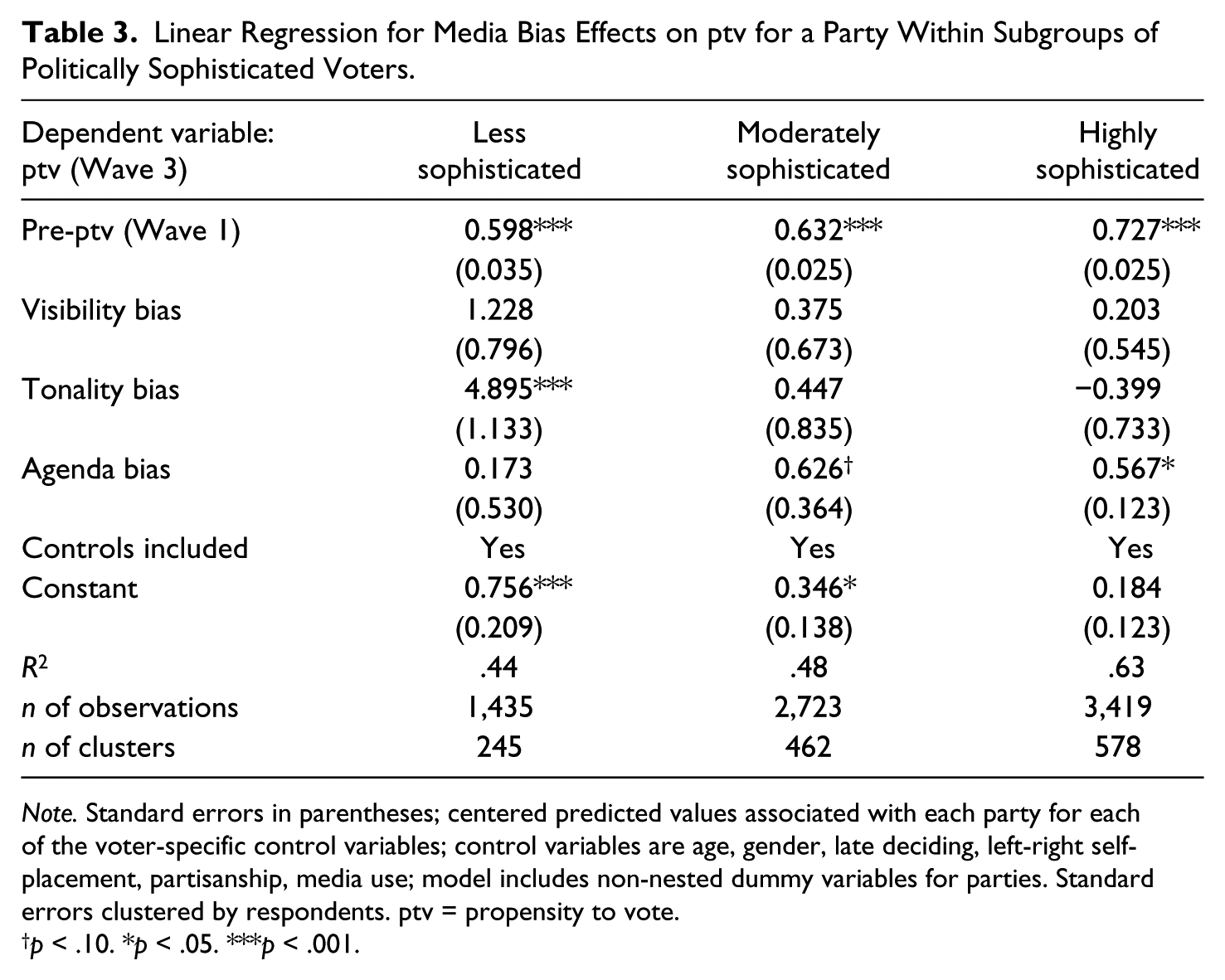
As media bias effects may be heterogeneous, we also test for differences in media effect strength between the following groups: voters with little, moderate, and high political sophistication; and partisans and non-partisans. Voters with high political sophistication are expected to be more resistant to media effects (H2a). To test this hypothesis, we divided voters into three political sophistication groups approximately equal in size; voters with a score between 0 and 3 were defined as less sophisticated, voters with scores of 4 and 5 defined as moderately sophisticated, and those with scores of 6 to 9 defined as highly sophisticated. Table 3 suggests that less politically sophisticated voters are indeed much more susceptible to tonality bias. In this subgroup, a standard deviation (= 0.06) increase of tonality bias may increase the ptv scores by about 0.29 points. These effects are in fact strikingly different from those for moderately or highly sophisticated voters.
Linear Regression for Media Bias Effects on ptv for a Party Within Subgroups of Politically Sophisticated Voters.
Note. Standard errors in parentheses; centered predicted values associated with each party for each of the voter-specific control variables; control variables are age, gender, late deciding, left-right self-placement, partisanship, media use; model includes non-nested dummy variables for parties. Standard errors clustered by respondents. ptv = propensity to vote.
p < .10. *p < .05. ***p < .001.
However, there are no clear differences in the effects of other types of biases. While the effects of visibility bias tend to be larger for less sophisticated voters and the effects of agenda bias tend to increase with political sophistication, these tendencies are not large enough to be statistically distinguishable (Figure 1). Political sophistication thus moderates the effects of media bias when it comes to evaluations in media coverage but not when considering the visibility of parties or their mediated policy agenda.
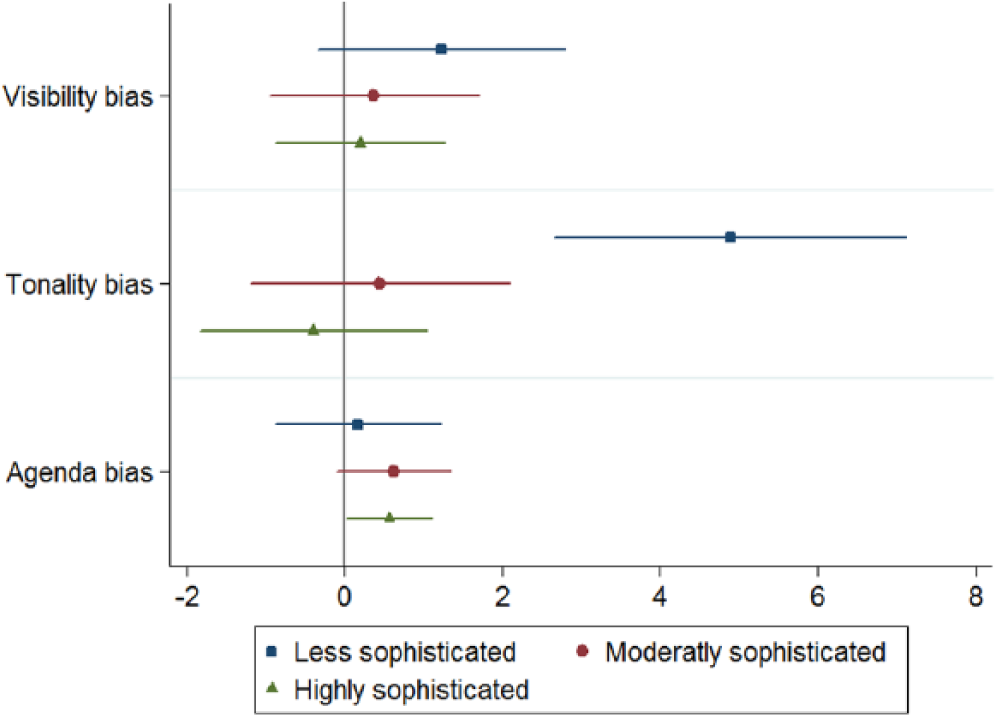
Effects of media bias for each subgroup of politically sophisticated voters.
Our last set of models (Table 4) first test H2b by considering whether non-partisans (Model 1) are more susceptible to media bias than partisans (Model 2). The effects of tonality bias are clearly stronger for non-partisans than for partisans. Among non-partisans, we expect the ptv score to increase by 0.11 points for a standard deviation (= 0.06) increase in tonality bias. Again, visibility bias and agenda bias do not seem to differ strongly between both groups (see also Figure 2). Focusing on the effects of tonality bias, we can confirm that non-partisans tend to be more affected by media bias than partisans (H2b).
Linear Regression for Media Bias Effects on ptv for a Party Within Subgroups of Partisan and Non-Partisan Voters.

Note. Standard errors in parentheses; centered predicted values associated with each party for each of the voter-specific control variables; control variables are age, gender, late deciding, political sophistication, left-right self-placement, media use; model includes non-nested dummy variables for parties. Standard errors clustered by respondents. ptv = propensity to vote.
p < .10. *p < .05. **p < .01. ***p < .001.
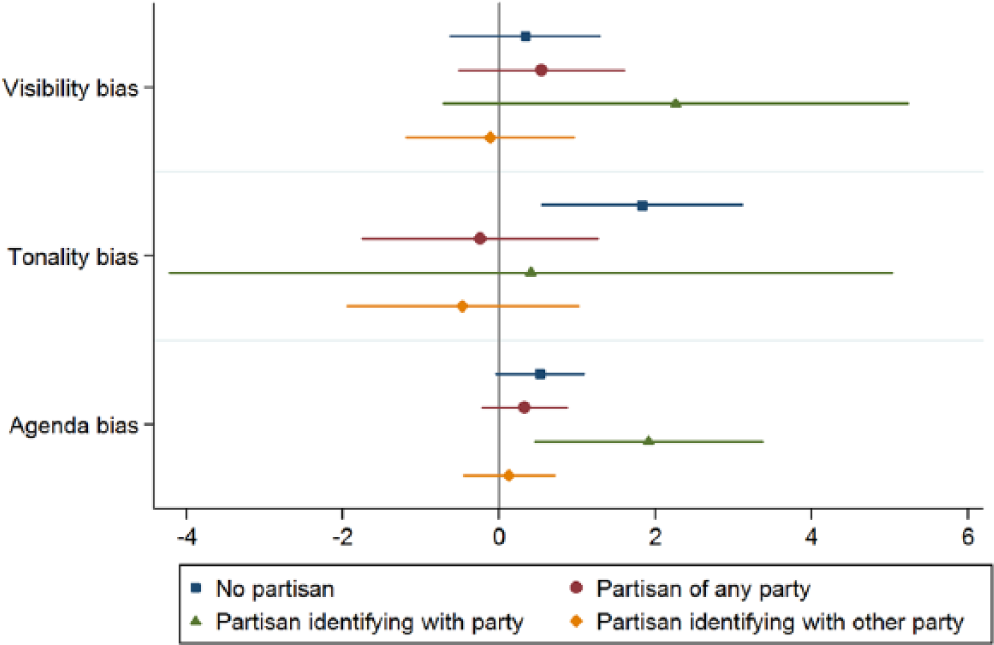
Effects of media bias for each subgroup of partisan voters.
Finally, we disaggregate the subgroup of partisans (n = 539) for a more detailed analysis. The first group (Model 3) only contains observations where partisans are asked about the party preferences toward their favored party. We expect a positive effect of media bias here, since partisans are said to react to bias when it is directed toward their preferred party. The second group (Model 4) contains observations of the same respondents but in relation to their preferences toward all other parties. As they are expected to already have made up their minds about the opposing parties, no systematic effects are expected here (H2c).
Figure 2 confirms this hypothesis. The results suggest that the effects of agenda bias in particular are larger when media bias is addressed toward partisans’ own party. For a standard deviation increase (= 0.20) in agenda bias toward a partisan’s preferred party, we expect the ptv score to increase by 0.38 points. In this case, we can detect no differences considering tonality bias. Standard errors for visibility bias are also too high to allow us to make substantive claims. However, there is evidence that partisans are activated by media effects concerning their party’s agenda. It is possible that partisans respond to the fact that their party is addressing policy issues that are important to them, thus reminding them what policy they stand for and why they felt close to this party in the first place (H2c).
Conclusion
Our study has found strong evidence of media bias effects on voters. Specifically, voters update their party preferences in response to the tonality of the media coverage they are exposed to. They also evaluate parties more favorably if those parties addressed their own favored topics more prominently in media coverage. The effects of tonality and agenda bias are stable across models, so they hold even if other types of media biases are controlled for. Moreover, we found that agenda bias might be even more relevant than tonality bias. This provides further support for the argument that we need to include agenda bias as a key form of media bias in future studies, even if this bias is often difficult to operationalize (Brandenburg, 2005; Hopmann et al., 2011b).
In contrast, the visibility of parties seems to be of little relevance. Our examination of bias present in coverage indicated that visibility patterns largely follow patterns of party size and relevance, so there is little outlet-specific variation. When analyzing the effects of media bias in a multi-party system, the usefulness of visibility bias therefore has to be questioned. This accords with the findings of previous studies, where the effect of visibility bias was weak compared to that of tonality bias or agenda bias (Boomgaarden & Semetko, 2012; Norris et al., 1999). However, while the visibility of parties may not be that relevant in the short period of the election campaign itself, its potential long-term effects in terms of the production and reproduction of political legitimacy should not be underestimated (Gamson & Wolfsfeld, 1993).
Considering the moderating factors of media bias, respondents who were less politically sophisticated as well as non-partisans exhibited larger effects of tonality bias, therefore confirming earlier theories and findings (Fournier et al., 2004; Hillygus & Jackman, 2003; Luskin, 1990). Moreover, partisans seem to be particularly susceptible to positive media bias toward their preferred party that reaffirms their partisan identity (Ansolabehere & Iyengar, 1995).
The overall effects of media bias are unsurprisingly relatively small, reflecting several key aspects of our empirical approach. Most importantly, our models capture a short time frame and include strong controls for prior influences on party preferences as well as for party-specific changes. Hence, finding any effect on preferences at all is important, given the design of the study. The potential long-term effects of media bias may be larger than the short-term effects we focused on Moreover, there may also be additional indirect media effects captured by the two-step flow of communication (e.g., Katz, 1957) as each individual’s social environment is also affected by media bias (Hopmann et al., 2010). The direct effects we study are a necessary condition of such broader media bias effects, and our narrower approach of course potentially underestimates overall bias effects. We also did not have sufficient data points from television or online media coverage to include them meaningfully in the analysis. The potential for media effects online and on television is at least as great as in the print media, and biases may work in different ways. Future research should therefore examine bias effects in other types of media. Finally, remember that we focus on media bias effects rather than overall media effects. While broader intermedia campaigns may influence voters in important ways, these effects were not considered, as they do not fall under the definition of media bias. Studying indirect and long-term effects and comparing media bias to overall media effects are, however, important tasks for future research.
Overall, the prevalence of tonality bias and agenda bias effects during the last 6 weeks of this election campaign has strong implications for the role of media in democracy. Normative democratic theory demands that citizens be minimally informed (Delli Carpini & Keeter, 1996). However, political information is not necessarily unbiased and neutral. As a result, the increase in media choice and fragmentation (Prior, 2007) may lead not just to a less equal distribution of political knowledge (e.g., Prior, 2005) but also to a polarization of the electorate. Yet, it is important to note that Austrian newspapers tend to incorporate relatively high standards of journalistic objectivity concerning the visibility of political actors, comparable to normative benchmarks such as reflexive diversity (van der Wurff & van Cuilenburg, 2001). Hence, future research should aim to establish the relationship between media fragmentation, media bias, and media effects. This research should make sure to consider all types of media biases—visibility bias, tonality bias, and agenda bias—since one bias certainly does not fit all.
Footnotes
Acknowledgements
We particularly would like to thank Martin Haselmayer as well as our anonymous reviewers for their helpful comments and insights. Also, we want to thank Sebastian Mackowitz and Paul Majdzadeh Ameli for their help in collecting and cleaning the media data.
Declaration of Conflicting Interests
The authors declared no potential conflicts of interest with respect to the research, authorship, and/or publication of this article.
Funding
The authors disclosed receipt of the following financial support for the research, authorship, and/or publication of this article: This research is conducted under the auspices of the Austrian National Election Study (AUTNES), a National Research Network (NFN) sponsored by the Austrian Science Fund (FWF) (S10908-G11).