




Abstract
This study provides an overview of the media’s role in shaping public discourse and belief through framing news stories in a biased perspective and setting an agenda that is in keeping with the interests of the corporate and institutional funders of the media apparatus. Support for such an analysis is provided by a literature review that covers many critical aspects of news framing, agenda setting and cultivation theory, especially with respect to the emergence of a new ‘network society’. The ‘content analysis’ approach is utilised to search for biased content via the use of coders and decoders in some 140 randomly selected sampled links of the ‘Glenn Beck’ show during the two periods of time from 1 January 2010 to 30 June 2010, and from 1 January 2011 to 30 June 2011, each of these periods consisting of 70 samples. The results ultimately show that the programme almost unilaterally provides supportive views of moral conservative values, and slight negative portrayals of Muslims. The programme presents critical views of President Obama and his policies, although the finding in opposing Obama’s policies is not statistically significant. The significance of these findings is discussed within the larger context of media bias and its influence on political reality, as well as public discourse and belief; although the study and hence, the findings suggesting ‘bias’ do not represent the entire media industry representing conservative values.
Introduction
Graham and Hajru (2011, p. 20) arguably point out about the ‘public-spirited way of talking whereby citizens make connections from their individual and personal experiences, issue and so forth to society’. The Glenn Beck shows may be classified under this category. Glenn Beck has always been linked with pursuing Republican’s conservative agenda. But in the first quarter of 2011, Glenn Beck shows received severe criticisms due to his ‘rhetoric’ and ‘ranting’ style and especially about his comment regarding Obama being ‘racist’, which made the advertisers wary and the ratings of the show fell drastically. The show was taken off the Fox News Network on 30 June 2011 and Glenn Beck joined his own streaming network ‘GBTV’ to continue to produce his shows.
Glenn Beck programme was chosen because it represented the political talk of right-wing conservative partisan audience and was characterised by public perception of antagonism drawn by the frontier of American conservatism in ‘below-the-line’ news media (Graham & Wright, 2015), where conservatism in modern American focused on capturing the movement of republican party and by reshaping the democratic party throughout the 1980s and 1990s in which contemporary ‘conservative media’ played an influential role in the form of ‘media effects’, ‘propaganda’ or ‘deep Stories’ (Bauer, 2020). The scholars from rhetoric and political communication, media sociology and journalism studies have constantly attempted to investigate the consistent patterns of such ‘meaning making’ that arise as a result of producing, circulating and consuming such ‘conservative news culture’ (Bauer, 2020). Furthermore, Turner-Zwinkels et al. (2021, p. 1) argue that conservatives’ moral foundations (care, fairness, loyalty, respect, sanctity) are more densely connected than liberals’ moral foundations. For example, Swain (2011) vehemently criticises cultural elites of America and expresses her strong support for ‘conservative values’, such as American nationalism, by quoting biblical scripture. Similarly, Hemmer (2016) argues that ‘conservative media movement’ originated around the 1940s and gained ground shortly because of it being ideology based that borrowed values from Christianity. The book further talks about Glenn Beck as 2nd-generation conservative and how he has come to be associated with contemporary conservative news media.
Hence, the popularity of Glenn Beck programming and its position within the network’s broadcast schedule helped escalate it to a position of controversy centring on Beck’s decidedly conservative take on contemporary news issues until the show was taken off the Fox News Network. In order to determine the precise extent to which the programming had an impact upon shaping public discourse and could be rightly accused of engaging in agenda setting, one must engage in the process of mixed-method approach. Hence, the study will perform a generic form of content analysis of the ‘Glenn Beck’ show, to be corroborated by discourse analysis, in an effort to address pressing questions relating to the inculcating effect of contemporary news media in the content of the ‘network society’ as the collective network technologies, in the sense of television and radio networks, smart phones, computer networks, information networks and social networks, result in society being dramatically shaped by the interactivity of these networks; a ‘network society’ (McQuail, 2010, p. 136). Furthermore, any part of Beck’s programming or the findings of the study do not represent or support, in any form, the concept of hegemony in US news media.
Literature Review
This section presents the necessary background and framework for their research project by appealing to the large body of existing research on the topic of ‘media bias’.
Network Society
One of the most important concepts to emerge in mass communication in recent years is the ‘network society defined as the social structure of the information age’ (Arensault & Castells, 2008, p. 488). Significantly, one of the most important studies in this category was carried out on the figure of Rupert Murdoch, the head of News Corp, that owns Fox News Channel and is responsible for the ‘Glenn Beck’ programme (Arensault & Castells, 2008, p. 488). The study revealed how figures such as Murdoch ‘negotiated the power dynamics of the network society to serve their overarching business goals’ (Arensault & Castells, 2008, p. 488). This explains how media corporations develop a motive for the active manipulation of media content to shape public discourse.
One of the most potent working definitions of the ‘network society’ inextricably equates the term with the rise of digital networks, stating that the ‘formation and exercise of power relationships is decisively transformed by the … rise of global digital networks of communication as the fundamental symbol processing system of our time’ (Castells, 2009, p. 1). The result is that the capacity for media bias to affect discourse is stronger than ever.
Agenda Setting and Framing
One of the mechanisms through which the media impacts public belief and discourse in a network society is through ‘agenda setting’. In short, the topics that the media chooses to cover, as well as the frequency and tone of coverage they afford to those topics, determines what issues become a topic of national debate and which fade into obscurity. By ‘choosing and displaying news, editors, newsroom, staff and broadcasters play an important part in shaping political reality’ in the twenty-first century (McCombs & Shaw, 1972, p. 176; Turner & Kinnally, 2010).
Furthermore, communication scientists have expanded their investigations beyond the agenda of news stories and moved towards the agenda of attributes (Lopez-Escobar et al., 1998) that may be linked to the news stories (McCombs et al., 2000). The fundamental concept of agenda setting is to transfer the salience from one agenda attribute to the next, known as second-level agenda setting (Kiousis & McCombs, 2004; Singhal et al., 2006). Moreover, Ghanem (1997) argues that second level of agenda setting comprises of four components: subtopics, framing elements as well as emotional and cognitive element. Golan and Wanta (2001) examined the process of second-level agenda setting (Nyarko & Teer-Tomaselli, 2018) during the primaries of presidential election in New Hampshire, and found a strong correlation between the media agenda of candidate attributes and voters’ evaluation (Ghanem, 1997) of the two candidates. Similarly, Wanta et al. (2004) further investigated the agenda setting effect of broadcast news on people’s awareness of foreign nations and found support for both the first-level and second-level agenda setting. Finally, the core concept of agenda setting is the importance of specific aspects of messages known as ‘salience’. Roessler and Eichhorn (as cited in Takeshita, 2006) propose that ‘salience’ comprises of two elements: awareness and importance. Awareness implies people’s prompt reactions based on the availability of information accessible by them. Importance is reflected by steady judgement that may be connected with individual’s belief systems displayed by individual’s emotions and sentiments. This shows that awareness and importance cannot be assessed directly but can be measured through proxies in the form of the total number of news stories about political or social issues and political parties.
Besides agenda setting, the media also impacts public discourse through the practice of ‘framing’. Framing, in fact, can be viewed as the basis for agenda setting, as the development of ‘frames’ can impact how a particular news topic is viewed, leading to a sense of cognitive dissonance that is conducive to agenda setting (Kalvas et al., 2011, p. 2). Furthermore, framing can be defined as ‘selecting or highlighting some facets of events or issues, and making connections among them so as to promote a particular interpretation, evaluation and/or solution’ (Entman, 2003, p. 5). Framing is of critical importance to the study of media’s effect upon public opinion. A 2007 study showed that people are generally quite susceptible to the ‘framing effect’, such that even small changes in how a story is covered can produce ‘large … changes of opinion’ (Chong & Druckman, 2007, p. 103). The framing effect underlies further the news media’s role not just in forming public opinion but also in evolving political processes which are assumed to have formally represent ‘Republican’ or ‘Conservative’ views as one of the studies suggests that the relationship between political cynicism and news media is conditional (Entman, 2003, p. 16). Furthermore, framing plays a very important role in political communication research in order to understand how media contents can influence attitude, cognition and perhaps even conduct (Entman, 1993, p. 54).
Cultivation Hypothesis
Gerbner and Gross (1976, p. 175) argue that mass communication with television, as its main component, is the ‘central cultural arm of American society. It is an agency of the established order and as such serves primarily to extend and maintain rather than to alter, threaten, or weaken conventional conceptions, beliefs, and behaviors’. However, ‘Cultivation research approaches television as a system of messages – a system whose elements are not invariant or uniform – but compliment, organic and coherent – and enquires into the functions and consequences of those messages as a system, overall, in toto for its audiences’ (Shanahan & Morgan, 1999, p. 5). The consequences of such ‘cultivation’ due to the television exposure occur over a long period of time (Shanahan & Morgan, 1999, p. 5).
Cultivation hypothesis can further be elaborated by discussing narrative paradigm as proposed by Walter R Fisher. Fisher (1985) argues that narrative paradigm is way of story-telling through non-verbal and verbal analysis of human communication that are organised logically to construct a meaning. This process of story-telling depends upon people’s past experiences and their personal behaviour and includes the incidents that the story-teller or narrator communicates with the listener. Further, Fisher argues that narrative paradigm operates on two principles: (a) coherence that is defined by the extent of sense making of narrative and is shaped by construction of narrative, reliability of characters and semblance of stories; and (b) fidelity that is defined by credibility of the story narrated and depends upon whether and, to what extent, a narrator can persuade the listener. Hence, narrative paradigm is a very important tool to analyse the nature and efficacy of human communication.
One of the most well-regarded methods for measuring the framing and shaping capacity of media is the ‘content analysis’ or ‘the systematic analysis of communications content’ for bias and a correlated impact upon ‘social and cultural issues, values and phenomena’ (Hansen, 1998, p. 91). Ultimately, as these methods of analysis develop and media continues to coalesce with both sociological and political concerns, one will see the field of mass communications evolve from an ‘interdisciplinary’ theory to a ‘post-disciplinary’ one; it is this assumption and methodology upon which the following research project will be constructed (Herbst, 2008, p. 603).
Research Questions
Based on the above research and literature in order to carry out a fruitful content analysis of the ‘Glenn Beck’ shows, one must formulate a number of research questions, to guide the formal aspects of the content analysis. Such questions are hereby delineated:
Do Glenn Beck shows reinforce or represent conservative values? Is there any significant difference with regard to representing or reinforcing conservative values (moral and right conservative values, occurrences to terrorism/jihad and occurrences to Obama policies/Democrats) in the Glenn Beck shows between the time periods from 1 January 2010 to 30 June 2010 and from 1 January 2011 to 30 June 2011? Do Glenn Beck shows overall represent or reinforce moral and right-wing conservative values? Do Glenn Beck shows support or oppose Obama and/or his administration on policy matters? Is there any significant difference with regard to supporting or opposing Obama, his administration or/and his policies in the Glenn Beck shows between the time periods from 1 January 2010 to 30 June 2010 and from 1 January 2011 to 30 June 2011? Do Glenn Beck shows present anti-Muslim rhetoric or reference? Is there any significant difference with regard to referring to terrorism/Jihad in the Glenn Beck shows between the time periods from 1 January 2010 to 30 June 2010 and from 1 January 2011 to 30 June 2011? To what extent, do Glenn Beck shows overall have negative (disparaging, criticising, ridiculing, etc.) and emotional/concerned tone? Is there any significant difference in Glenn Beck’s ‘negative’ and ‘alarmed/emotional/ concerned’ tones between the time periods from 1 January 2010 to 30 June 2010 and from 1 January 2011 to 30 June 2011?
Methodology
Research Design
The research methodology was designed keeping in mind the coding and decoding of the television text. As such, the research design for the project was shaped using content analysis in mind, which became the focal point for analysing and interpreting the Glenn Beck shows. Content analysis is defined as a research method for ‘objective, systematic and quantitative description of the manifest content of communication’ (Berelson, 1952, p. 147). Weber (1990, p. 9) further elaborates content analysis as designing a ‘set of procedures’ to interpret the texts from which ‘valid inferences’ are obtained using certain distinct and meaningful categories and hence can be explained further as a systematic, replicable technique for compressing many words of text into fewer content categories based on explicit rules of coding in Stemler (2001). Both quantitative and qualitative content analyses were used to carefully interpret and quantify the meaning embedded in words, images, etc. Additionally, discourse analysis was also used to get deeper insights into the text or images in relation to meaning hidden between words or among words, and to ensure the validity of the results obtained by content analysis (van Dijk, 1983).
It is critical that a sufficient span of the programme’s broadcast be examined in the course of the study, so as to account for typical representations of issues in the course of any one-day’s programming. With this in mind, the research project was shaped by analysing the content of 140 YouTube links of ‘Glenn Beck’ programming content, each of the links averaging approximately 10–11 minutes long. These 140 links represented 70 programmes from the time period of 1 January 2010 to 30 June 2010 (Appendix E), and an additional 70 programmes from the time period of 1 January 2011 to 30 June 2011 (Appendix F). The above specific periods were chosen because, as per the media reports, Glenn Beck shows’ ratings fell drastically below from 2.9 million on 1 January 2010 to 1.8 million on 1 January 2011. Additionally, the advertisers shied away from sponsoring his shows towards the end of 2010 and early 2011, that cost Fox News US$600,000 a week. Moreover, The Blaze website was launched on August 2010 as an alternative to mainstream media outlets. Such an approach allowed the researcher to compare the evolution of the show directly, over the span of a politically eventful year, and made them compare the two periods in relation to the programming content in terms of ‘agenda setting’ and ‘framing’. Since the Glenn Beck show was taken off the Fox News Network on 30 June 2011, 70 samples were taken during each of the periods between 1 January 2010 to 30 June 2010 (Appendix E) and 1 January 2011 to 30 June 2011(Appendix F) respectively using simple random sampling method. The time period between 1 January 2010 and 30 June 2010 was compared against the time period between 1 January 2011 and 30 June 2011 for the number of occurrences of moral conservative values (supporting marriage, education, family, environmental issues and philanthropy and opposition to divorce, abortion and homosexuality), right conservative values (nationalism, superiority or inferiority of any race or/and religion or/and culture), and Obama administration/democrat policies along with the number of reference to terrorism/jihad, style of reference to Muslims/Islam and overall tones of the words used in each of the samples to see if there is any significant difference between the time periods from 1 January 2010 to 30 June 2010 and from 1 January 2011 to 30 June 2011. The analysis of 2010/2011 data from Glenn Back TV shows is still valid in 2021 because the show is still continuing on Blaze TV, and Glenn Beck has been regarded as one of the major contemporary conservative media activists along with Rush Limbaugh and Sean Hannity, and hence represents the same views and opinions about various national, social and cultural issues in 2021 what he represented a decade ago (Hemmer, 2016). During each of the time frames, 232 samples were randomly picked up and numbered from 1 to 232 for a total of 464 samples from both the time frames considered, the length of each of the samples being approximately 10–11 minutes on an average. Then, using Random Sequence Generators, 1 random numbers were generated starting from 1 to 232 and, based on the generated numbers, the samples were matched and labelled again starting from 1 to 232(Appendix C and Appendix D) in order for it to be used for simple random sampling method. Finally, using SPSS statistical software, a simple random sampling method was used to ensure that 70 samples (Appendix E and Appendix F) out of 232 shows were chosen during each of the periods as mentioned above for a total of 140 samples during both the periods. The samples selected were of high representative value (a common approach in statistics).
Rationale Behind the Method Used
Content analysis was considered to be an appropriate methodology for a study of this sort, as the purpose of the research is to determine whether the ‘Glenn Beck’ programme assists in the manipulation of public discourse and opinion through a biased selection and coverage of issues. However, content analysis does have some limitations, such as it is ‘time consuming’ and is subject to ‘increased human error’, is ‘inherently reductive’, ‘tends too often to consist of word counts and is often devoid of theoretical base’ or/and ‘attempts too liberally to draw meaningful inferences about the relationships and impacts implied in the study’ (Writing@CSU, n.d.,). Further, Hansen (1998, p. 95) enumerates ‘quantification’ as well as one of the limitations of quantitative content analysis. As a result of these limitations, qualitative content analysis was also used which is defined as an approach to an ‘empirical, methodological controlled analysis of texts within their context of communication, following content analytical rules and step by step models, without rash quantification’ (Mayring, 2000, p. 2). Becker and Lissmann (1973) have distinguished two stages of content: (a) themes and central core of the text as fundamental content; (b) context information as dormant content. Hence, qualitative content analysis was used to conserve the gains of quantitative content analysis and to relocate and further cultivate them to qualitative–interpretative stages of analysis. Therefore, 'discourse analysis' was also used to analyse the 140 samples of the shows. Discourse analysis is defined as giving more import to semantic configuration of the discourse and ‘to make explicit implications, presuppositions, connections, strategies, etc., which usually remain implicit in the discourse’ (van Dijk, 1983, p. 27). Discourse analysis was considered as a supplemental method for content analysis as ‘the analysis of the discourse and rhetoric analysis requires the careful reading and interpretation of texts and rigorous scholarships’ (Gill, 1996, p. 144), and hence was used to corroborate the results obtained by content analysis. However, as part of the content analysis, Glenn Beck show was also analysed using thematic, syntactical—arrangement of words, sentences and pauses between words or sentences—and rhetorical structures and tone of the discourse used in the show which are a part of discourse analysis as well.
Design of the Coding Frame (Coding Sheet) and Code Book
The coding sheet (Appendix A) was designed very carefully around the platforms ‘simplicity’ and ‘coherence’ with all the appropriate categories included in it for ‘reliable’ and ‘valid’ coding (Bauer, 2000, p. 141). ‘Once the categories are chosen and defined, they need to be set out in a codable form’ on a coding sheet, what Hansen called a ‘coding schedule’, containing a listing of variables to be coded for each of the samples chosen (Hansen, 1998, p. 116).
Hence, the design of the coding sheet included all the well-defined categories based on the research questions to be explored as ‘Content analysis stands or falls by its categories. Particular studies have been productive to the extent that the categories were clearly formulated and well adapted to the problem and the content’ (Berelson, 1952, p. 147). Thereafter, a code book (Appendix B) was designed giving detailed instructions to coders about how to reliably code each of the samples for a ‘reliable’ and ‘valid’ analysis. Code book is defined as the
summary list of all codes and the frequency distribution for each code and each with a total number of codes. Finally, each code will be reported with an intentional definition, its code name, code label and an illustrative text unit that applies to each code. (Bauer, 2000, p. 116)
Unit and Level of Analysis
The unit of analysis can be defined as ‘the specific segment of content that is characterised by placing it in a given category’ (Holsti, 1969, p. 11). Hence, there were two levels of analysis in each of the samples—the first level of analysis was the entire ‘scene’ in each of the samples. A scene is composed of different ‘shots’, ‘but there are no established limits to the length or complexity of a single shot’ (Gruba, 1999, p. 73). In each of the scenes, specific terms/words or groups of terms/words became the unit of analysis that referred to the number of occurrences of moral and right conservative values (Appendix B, pp. 21–23), Occurrences to terrorism/jihad and occurrences to Obama, democrats and his administration policies as defined in the code book. These were called ‘syntactical units’ since ‘these were delimited by syntactical criterion’ (Rourke et al., 2001, p. 9). The second level of analysis was the entire episode in which the coder looked for specific attitude of the specific word/terminology or attitude of the group of the specific words/terminologies which became the unit of analysis that specified the topic(s), support/oppose/neither support nor oppose Obama, style of the reference to Muslims/Islam 2 and the attitude or the tone of the word(s) 3 used in the entire show. Such units were called ‘Message’ and ‘Thematic’ units (Rourke et al., 2001, p. 10). Thematic unit is defined as ‘… a single thought unit or idea unit that conveys a single item of information extracted from a segment of content’ (Budd et al., 1967, p. 34).
Reliability and Validity
‘To make valid inferences from the text, it is important that the classification procedure be reliable in the sense of being consistent: different people should code the same text in the same way’ (Weber, 1990, p. 12). Keeping that in mind, all the categories and variables were defined and included in the coding sheet very carefully so as not to have any multiple level of classification or differentiation, and special care was taken to adhere to a single level of classification. There were two coders: ‘me’ and ‘Elizabeth’, where I was a graduate student of ‘media studies and global communication’ in London and Los Angeles, and Elizabeth was in the junior year pursuing her undergraduate degree in ‘social sciences’ in Los Angeles. Both of us had enough expertise and training in coding/decoding TV programmes.
After the pilot viewing, the actual coding was done. During the actual coding, 21 samples (30.00% of the 70 samples; Lombard et al., 2010) from each of the two periods, that is, from 1 January 2010 to 30 June 2010 and from 1 January 2011 to 30 June 2011, for a total of 42 samples during both the periods were selected to be coded by each of the coders in order to determine the ‘inter-coder reliability’ (ICR). Both the coders coded the samples independently of each other. ICR is defined as ‘the extent to which the different judges tend to assign exactly the same rating to each object’ (Tinsley & Weis, 2000, p. 98). In this study, ICR was calculated as follows:

ICR of 0.80 or greater was considered to be acceptable (Lombard et al., 2010) for this study. ICR was calculated for each of the categories in the coding sheet. While calculating the ICR, the ICR for ‘Occurrences to Religion (2011)’ was found to be 70.42%. Since its ICR was below the minimum acceptable level of 80.00%, so it was withdrawn from the analysis. Finally, overall average ICR, excluding the category ‘Religion’, for the entire show was calculated and was found to be 87.83%.
The validity of the samples is related to ‘its grounding the materials and its congruence with the theory of the researcher and in the light of his or her research purpose’ (Bauer, 2000, p. 133). Hence, to maintain the validity, the coding categories were carefully designed with ‘predefined themes and valuations’ (Bauer, 2000, p. 134) in order to assess the samples ‘objectively’ and ‘systematically’.
Data Analysis and Results
All the data collected were fed into the computer (SPSS and Excel). SPSS and Excel were used because these were easily available to us. First percentages were calculated for each of the categories/sub-categories in each of the periods separately (1 January 2010 to 30 June 2010 and 1 January 2011 to 30 June 2011) and then, in each of the cases, coding related to the specific phenomenon was independently measured and compared to the number of samples in total, so that the existence of biased content can be simplistically represented as a percentage of the whole by combining both periods of 2010 and 2011 samples. SPSS was used only if the difference between the two periods in any of the sub-categories was approximately equal to 10.00% or more, based on the charts. This difference of approximately 10.00% or more, based on analysing the charts, was assumed to be significant enough for the SPSS to be used. Using SPSS, one period against the other was compared to see if there is any statistically significant difference, which exists between the periods. ‘Independent samples t-test’ was used to see the statistically significant difference between the years. The level of significance, α, was set to be at 0.05 for all the testing purposes. While using SPSS, the year 2010 was designated as ‘0’ and the year 2011 was designated as ‘1’.
Do Glenn Beck shows reinforce or represent conservative values? Is there any significant difference with regard to representing or reinforcing conservative values in the Glenn Beck shows, both moral and right conservative values, occurrences to terrorism/jihad and occurrences to Obama policies/democrats between the time periods from 1 January 2010 to 30 June 2010 and from 1 January 2011 to 30 June 2011? Do Glenn Beck shows overall represent or reinforce moral and right wing conservative values?
The chart in Figure 1 represents changing patterns from one block of programming (2010 samples) to another (2011 samples).

Based on the Figure 1, in all the three sub- categories, we will use SPSS to see if the difference is statistically significant.
T-Test (Moral Conservative Occurrences Values)
For variances, ‘significance’ or p = .231 > .05. Hence, there is no statistically significant difference between the years 2010 and 2011. Now based on the equal variances, no statistically significant difference exists in their respective means for the year 2010 and 2011 since ‘significance’ or p = .913 > .05.
T-Test (Right Conservative Occurrences Values)
For variances, ‘significance’ or p = .008 < .05. Hence there is a statistically significant difference that exists in the variances between the years 2010 and 2011. Now based on not the equal variances, statistically significant difference exists in their respective means for the years 2010 and 2011 since ‘significance’ or p = .045 < .05.
T-Test (Terrorism/Jihad Occurrences Values)
For variances, ‘significance’ or p = .000 < .05. Hence there is a statistically significant difference that exists in the variances between the years 2010 and 2011. Now based on unequal variances, statistically significant difference exists in their respective means for the years 2010 and 2011 since ‘significance’ or p = .003 < .05.
Now, we combine each of occurrences together from both 2010 and 2011 samples and calculate percentages of each to the total occurrences of both the periods and draw the chart (Figure 2).
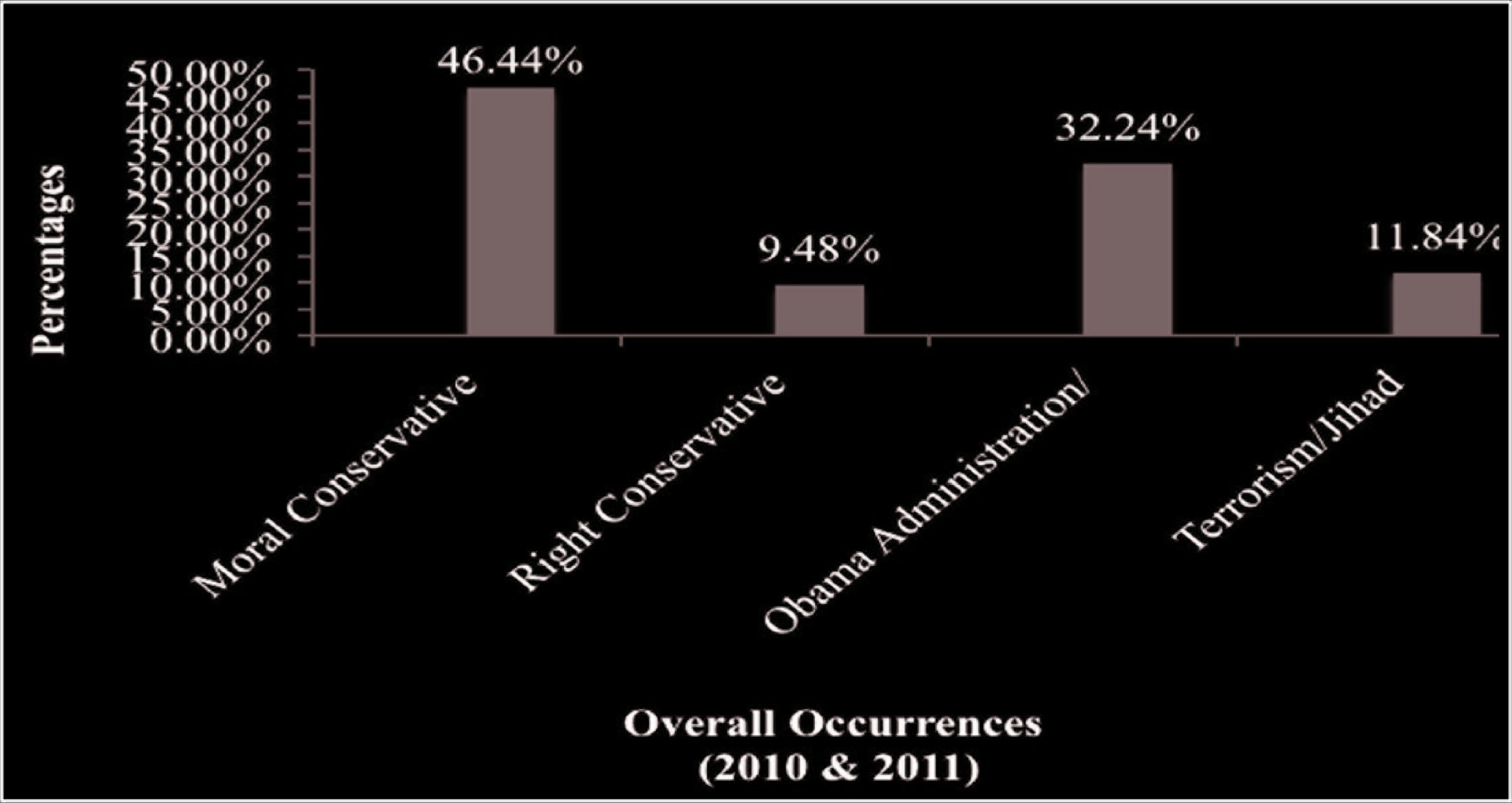
We see that there is a significant ‘bias’ towards the occurrences of moral conservative values and Obama administration/democrats as opposed to right conservative values and terrorism/jihad.
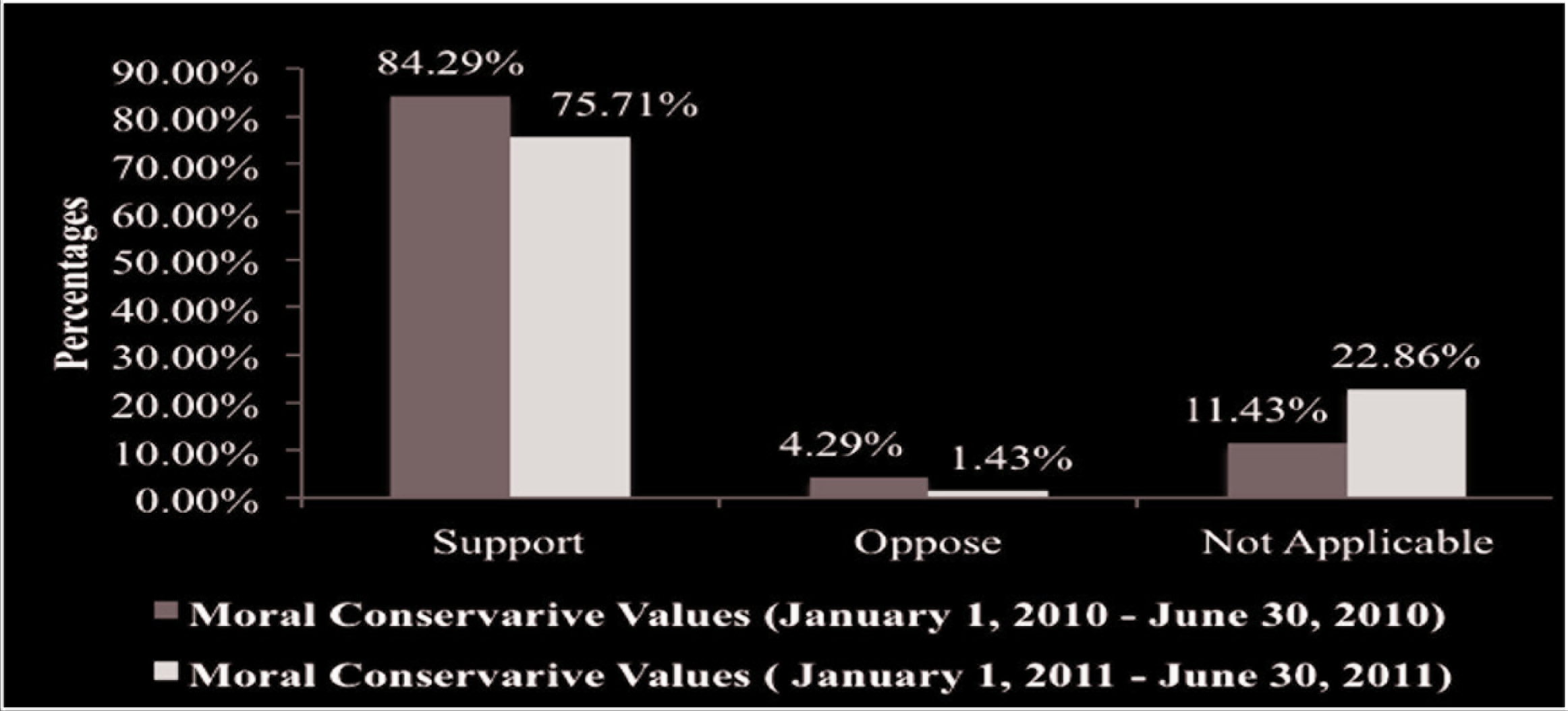
Next, we compare one sample against another for moral conservative values from both the periods (1 January 2010 to 30 June 2010 and 1 January 2011 to 30 June 2011) as shown in the chart (Figure 3).
Based on the Figure 3, we use SPSS to see if the difference is statistically significant in this sub-category. The same way, the difference in the sub-category ‘opposition of moral conservative values’ between 2010 samples and 2011 samples does not seem to be significant.
T-Test (Moral Conservative Values: Not Applicable)
For variances, ‘significance’ or p = .000 < .05. Hence, there is a statistically significant difference that exists in the variances between the years 2010 and 2011. Now based on unequal variances, no statistically significant difference exists in their respective means for the years 2010 and 2011 since ‘significance’ or p = .074 > .05. Although the difference in their variances is statistically significant between the years 2010 and 2011, the difference in not covering that the moral conservative values between the years 2010 and 2011 is not statistically significant.
Now, we combine the samples together from both the periods (2010 and 2011) to see if there is any significant ‘bias’ as shown in the chart (Figure 4).
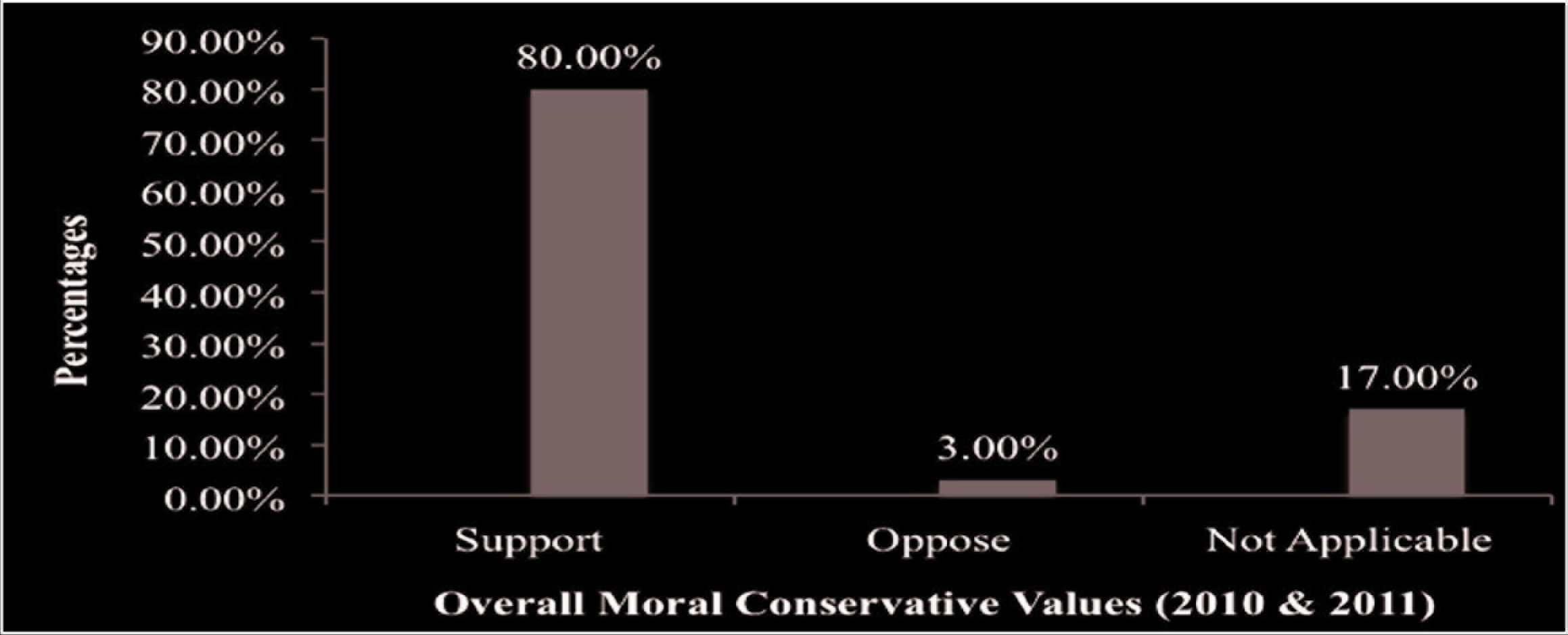
We see from Figure 4 that there is a significant ‘bias’ in supporting moral conservative values suggesting that the programme is indeed biased in that direction, and hence can be said to shape discourse around the agenda of moral conservative issues. The part of Glen Beck’s programme in not covering ‘moral conservative valuers’ (not applicable) individually in both the years and in overall combined samples is very little.
Next, we compare right conservative values from both the periods (2010 and 2011 samples) against one another as shown in the chart (Figure 5).
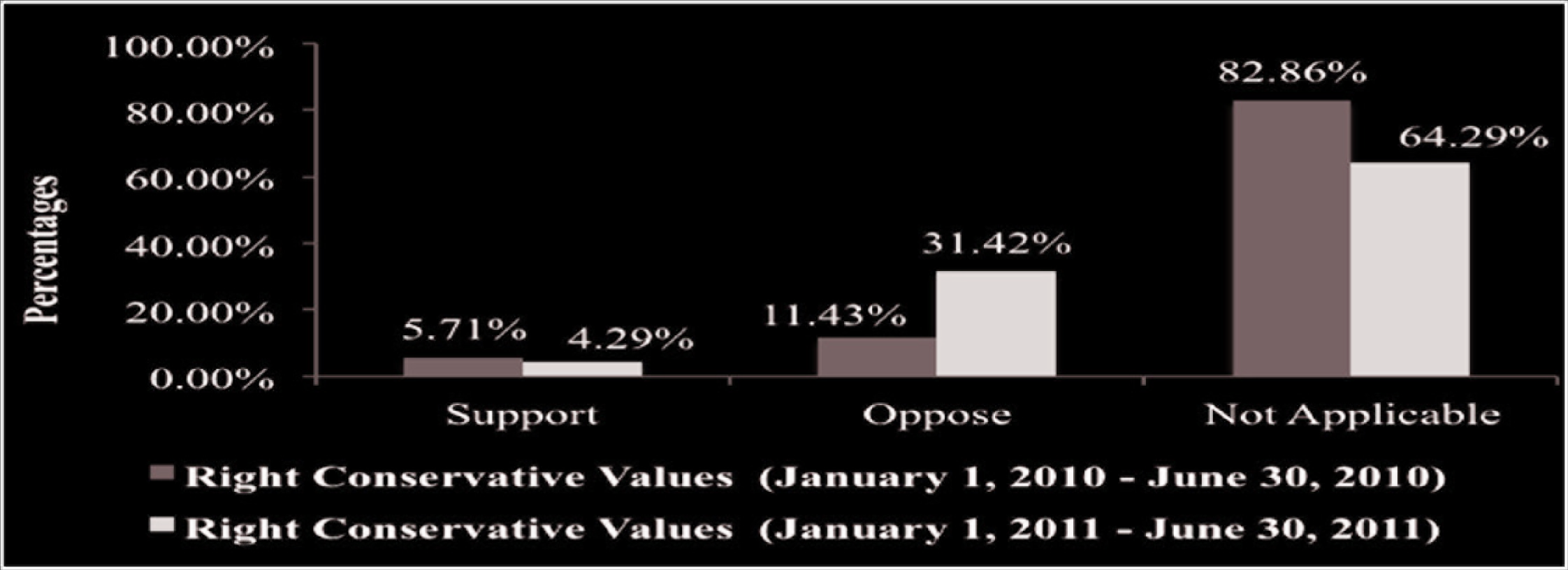
Based on the Figure 5, the category ‘Not Applicable’ (not covering the right conservative values) has a much higher percentage as opposed to the categories ‘Support’ or ‘Oppose’ for both the years. Further, in both the sub-categories, ‘Oppose’ and ‘Not Applicable’, we use SPSS to see if the difference is statistically significant.
T-Test (Right Conservative Values: Oppose)
For variances, ‘significance’ or p = .000 < .05. Hence, there is a statistically significant difference that exists in the variances between the years 2010 and 2011. Now based on unequal variances, a statistically significant difference exists in their respective means for the years 2010 and 2011 since ‘significance’ or p = .004 < .05.
T-Test (Right Conservative Values: Not Applicable)
For variances, ‘significance’ or p = .000 < .05. Hence, there is a statistically significant difference that exists in the variances between the years 2010 and 2011. Now based on unequal variances, a statistically significant difference exists in their respective means for the years 2010 and 2011 since ‘significance’ or p = .007 < .05. Hence, the difference in not covering the right conservative values between the years 2010 and 2011 is statistically significant.
Now, we combine all the 140 samples from both the periods to check if there exists any significant ‘bias’, as shown in the chart (Figure 6).
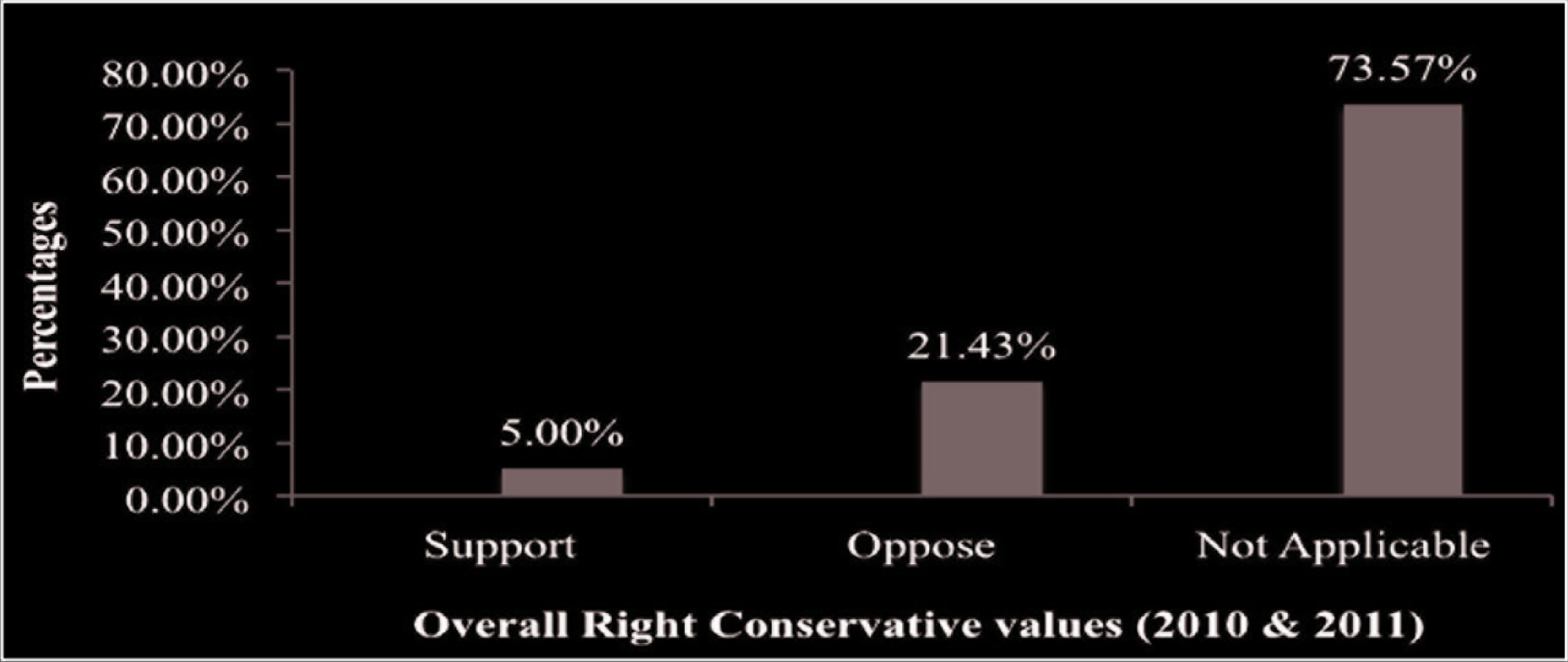
We see that right conservative values do not figure high in the Glenn Beck’s shows as shown by ‘Not Applicable’ sub-category. Hence, there exists a clear ‘bias’ against right conservative values.
2. Do Glenn Beck shows support or oppose Obama and/or his administration on policy matters? Is there any significant difference with regard to supporting or opposing Obama, his administration or/and his policies in the Glenn Beck shows between the time periods from 1 January 2010 to 30 June 2010 and from 1 January 2011 to 30 June 2011?
The chart drawn in Figure 7 shows if there is any significant difference between 2010 samples and 2011 samples with regard to Obama administration/democrats.
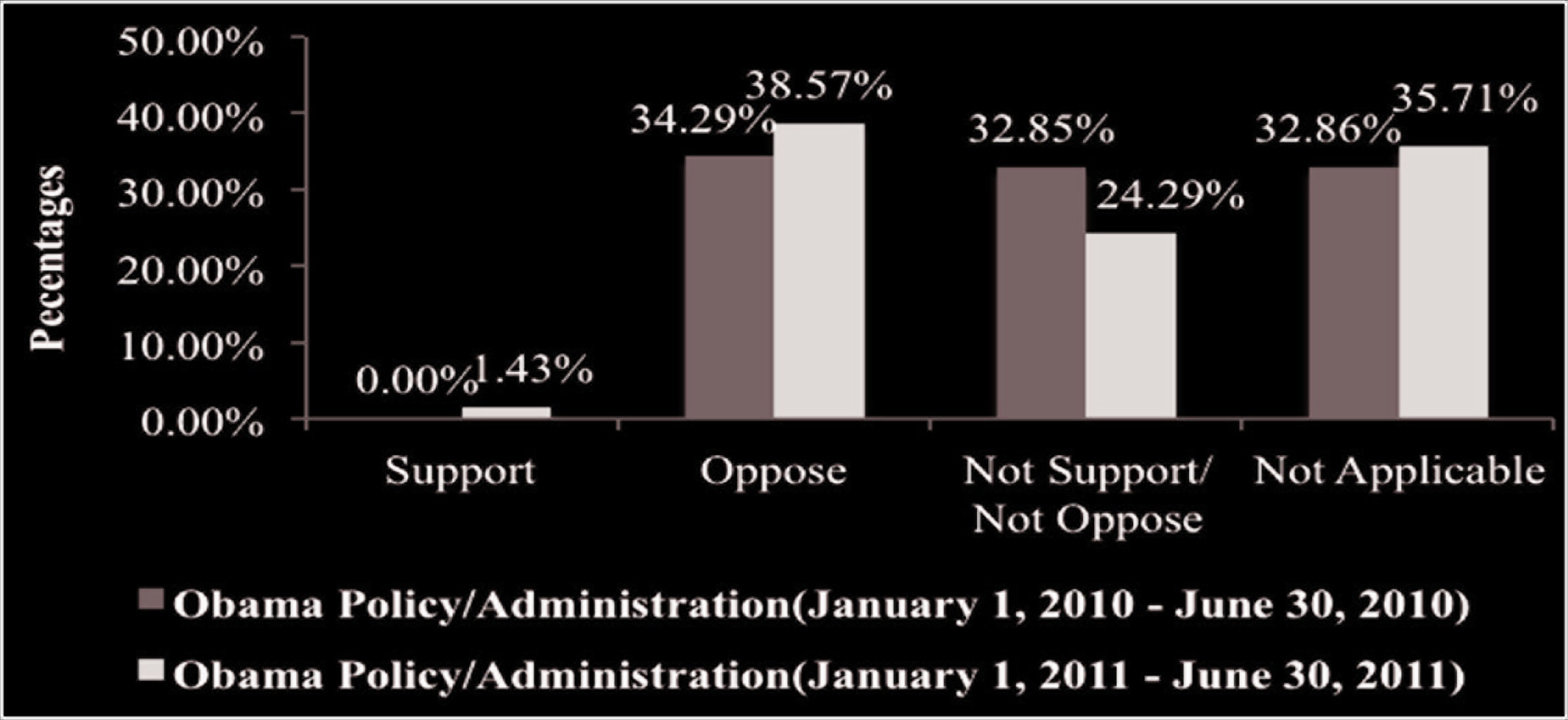
Figure 7 shows that ‘Oppose’, ‘Not Support/Not Oppose’ and ‘Not Applicable’ with respect to Obama administration are equally spread and there is no significant difference that exists to see if the difference is statistically significant, we do not use SPSS in this category or in any of the above sub-categories to see if the difference is statistically significant.
When we combine both the periods, 2010 and 2011 samples, to see if there is any ‘bias’ in the overall samples, the chart (Figure 8) shows that there seem to be a significant ‘bias’ in opposing Obama, his administration and his policies as opposed to the percentage of all the samples that has supported Obama or/and his policies.

Thus, we can argue that the ‘Glenn Beck’ programme promotes an agenda that is opposed to the Obama presidency. However, there is no statistically significant difference between the categories ‘Oppose’, ‘Not Support/Not Oppose’ and ‘Not Applicable’ in reference to Obama administration.
3. Do Glenn Beck shows have anti-Muslim rhetoric or reference? Is there any significant difference with regard to referring to terrorism/jihad in the Glenn Beck shows between the time periods from 1 January 2010 to 30 June 2010 and from 1 January 2011 to 30 June 2011?
Based on Figure 9, we use SPSS to see if the difference is statistically significant.

T-Test (Reference to Muslims Values: Negative)
For variances, ‘significance’ or p = .000 < .05. Hence, there is a statistically significant difference that exists in the variances between the years 2010 and 2011. Now based on unequal variances, a statistically significant difference exists in their respective means for the years 2010 and 2011 since ‘significance’ or p = .001 < .05.
T-Test (Reference to Muslims Values: Not Applicable)
For variances, ‘significance’ or p = .000 < .05. Hence, there is a statistically significant difference that exists in the variances between the years 2010 and 2011. Now based on unequal variances, a statistically significant difference exists in their respective means for the years 2010 and 2011 since ‘significance’ or p = .002 < .05.
Hence, most of the Glenn Beck’s programme does not have any reference to Muslims, when it does exist it is very little individually in both the years as compared to ‘Not Applicable’ (no mention/reference of Muslims). When we combine both the years as shown in the chart (Figure 10), we observe that there seems to be clear ‘bias’ against ‘Not’ referring to Muslims/Islam (Not Applicable sub-category). However, only 16.43% of the samples have negative reference to Muslims/Islam.

Thus, there is a slight bias towards presenting a negative view of Muslims/Islam on the programme. However, most of the Glenn Beck’s programme (72.86%) does not have any reference to Muslims.
4. To what extent, do Glenn Beck shows overall have negative (disparaging, criticising, ridiculing, etc.) and emotional/concerned tone? Is there any significant difference in Glenn Beck’s ‘negative’ and ‘alarmed/emotional/ concerned’ between the time periods from 1 January 2010 to 30 June 2010 and from 1 January 2011 to 30 June 2011?
The chart in Figure 11 shows that there is no significant difference between the two periods, 2010 and 2011 samples.

Looking at Figure 11, we observe that the difference between the two sample periods in any of the sub-categories is not significant enough to use SPSS to see if the difference is statistically significant.
Finally, we observe overall tone of the words, as shown in the chart (Figure 12), by combining the two samples to see the extent of ‘bias’ in the tone for both 2010 and 2011 samples.
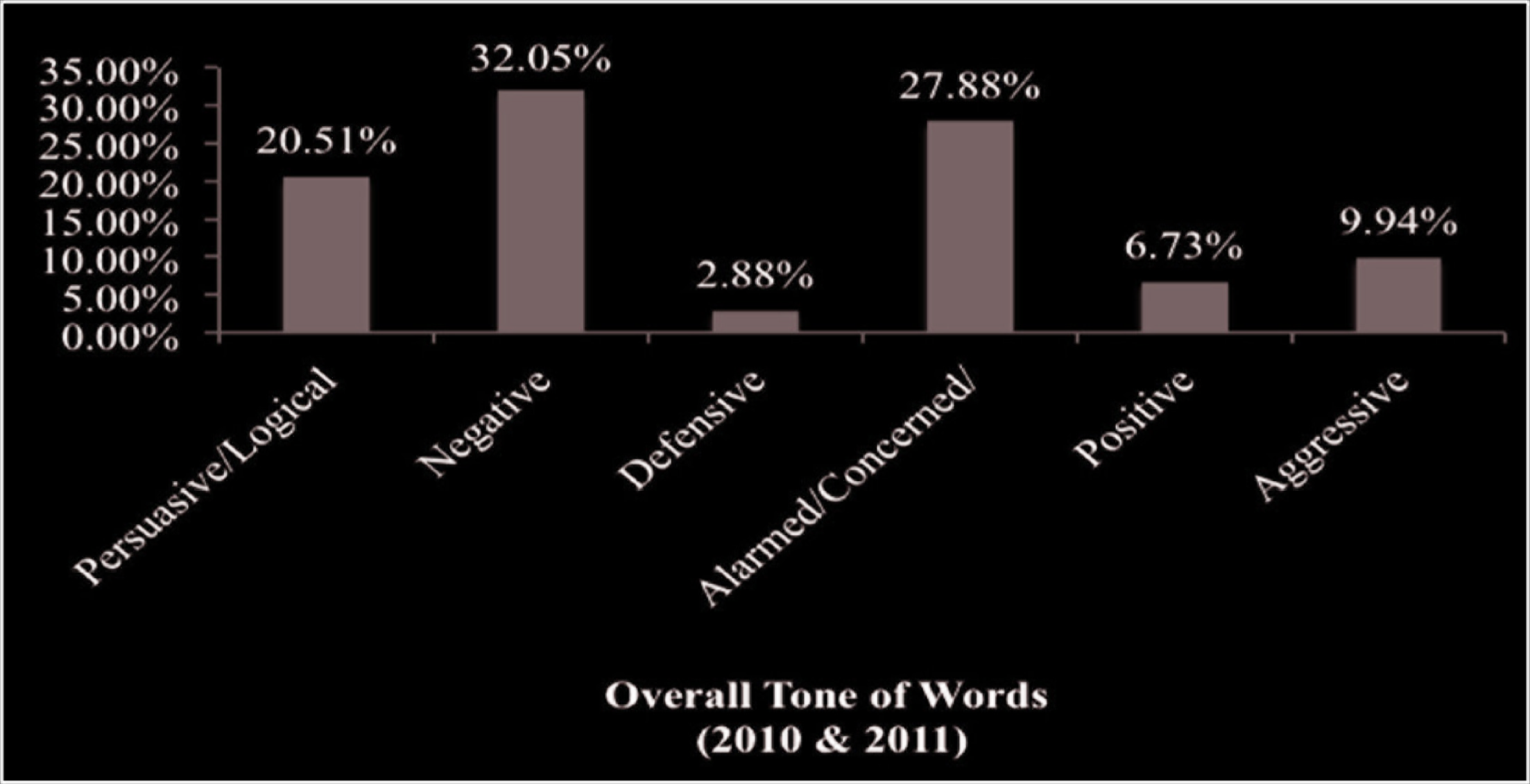
The Figure 12 indicates that Beck’s programme works to shape public discourse towards a viewpoint that is focused on negativity and emotional concerns, reinforcing ideology through promoting a culture of fear.
Discussion
The content analysis of the ‘Glenn Beck’ show reveals at least some degree of significant bias in the programming. Such ‘biases’ can easily be explained on the basis of ‘agenda-setting’, ‘framing’ and ‘political communication’. As Kaid (2009) rightly states that the media chooses the ‘method’ and the ‘contents’ that determines how the message is received, perceived and understood by the audience what he calls the ‘framing’. Further Kaid (2009, p. 458) argues how political communication works and how it is based on ‘source and content of the message’ that shapes and ‘cultivates’ an agenda propagated by media corporations based on their respective social and political beliefs.
The graphs, as a result of the content analysis, clearly indicate a preference for episode content trending towards supportive views of moral conservative values and critical views of the Obama administration. The biased nature of programming as well as its position within the Fox News Channel resounds with many theoretical viewpoints discussed above, most significantly, the idea that corporate US media inherently promotes an agenda, which resonates with the entities that fund the media outlet. As a subsidiary of Rupert Murdoch’s massive News Corp, Fox News Channel has an obvious interest in promoting a conservative agenda on both emotional and political levels, as conservative values tend to be the most supportive of the rights and privileges of corporations, often in the interest of the ‘free market’, which can be explained on the basis of the literature discussed above about how a ‘network society’ or ‘the emergence of global digital network’ can transform power relationships to serve their business goals (Arensault & Castells, 2008; Castells, 2009). Additionally, these biases can also be explained on the basis of the other literature about how media organisations give particular attention to specific issues related to their conservative agenda indicating overall biases of the organisation. This can be further interpreted by ‘coherence’ aspect of Fisher’s narrative paradigm representing the extent of narrative’s sense making (Fisher, 1985), which in turn may produce social-level processes such as ‘political socialisation, decision-making, and collective actions’ (de Vreese, 2005) and how the coverage of a particular story can produce a ‘large change of opinion’ among the audience (Chong & Druckman, 2007) that can further be explained by ‘credibility’ aspect of Fisher’s narrative paradigm representing the extent the listeners can be convinced (Fisher, 1985). Finally, the findings also give credence that such media biases may be the result of the notion that the continuous exposure of particular stories can ‘cultivate’ effects (Gerbner & Gross, 1976; Shanahan & Morgan, 1999).
The content analysis of the ‘Glenn Beck’ show is entirely in keeping with such a viewpoint, and matches up neatly with expectations that one might have of the network and its inherent biases, just from possessing a cursory knowledge of the theoretical underpinnings of contemporary mass communications theory. None of the prominent theories, as covered in the above literature review, is contradicted by the findings, and indeed, most of the findings tend to offer further support to these theoretical viewpoints.
It is helpful to look at how the findings match up with the specific research questions. The first research question was ‘Do Glenn Beck shows reinforce or represent conservative values?’ The answer to this question, in the general sense, was ‘yes’, with the overwhelming majority of examined programmes containing content that coded for a bias towards moral conservative values. Interestingly, the focus is much more on moral conservative values than right-wing conservative values, when taken in conjunction with the programme’s emphasis on emotional and persuasive rather than objective tonality, suggests an agenda that extends well beyond the scope of traditional ‘news’ programmes in simply providing an objective presentation of current events. The first part of the research question involved the examination of whether there was any significant difference in the representation of conservative values over time on the ‘Glenn Beck’ show. As the findings above indicate, the support for moral conservative values did seem to have decreased over time from 2010 to 2011; however, the decrease did not seem to be significant, with a greater percentage of episodes providing content that coded for a moral conservative bias. Although the right conservative values were not covered enthusiastically in the Glenn Beck shows, but has increased considerably over the period from 2010 to 2011. When the trend of terrorism/jihad is seen between the two periods, there is a significant increase in such occurrences over the period from 2010 to 2011, which can be explained on the basis of the killing of Osama Bin Laden invoking the painful memory of 9/11 by opening up the debate once again on the line of Republican’s agenda about how secured Americans are after the death of Osama Bin Laden and how significant this achievement is for Obama and his administration and for future political processes. With regard to the second part of the research question, Glenn Beck shows do heavily support moral conservative values but oppose considerably right conservative values keeping in tandem with American values of freedom, liberty and justice. With regard to the occurrences of Obama and his policies over the period from 2010 to 2011, although such occurrences increased slightly over the period, the change does not seem to be significant.
The second research question was ‘Do Glenn Beck shows support or oppose Obama and/or his administration on policy matters?’ Based on the above findings, there was little doubt that the ‘Glenn Beck’ programme promotes an agenda that is at odds with the Obama administration. The numbers suggested that the programme was more than 45 times as likely to be critical of Obama as it was to express support for his policies, a disparity out of keeping with the general popular conception of Obama’s policies on the national level. Clearly, this too is in keeping with Fox News Channel’s ultimate agenda, as determined by the corporate backing of the media empire. As for the second half of this research question, there was a somewhat surprising trend: the coverage of Obama, on the whole, tended to decrease from 2010 to 2011, whereas most other biased content seemed to increase such as opposition to Obama increased slightly from 2010 to 2011 and ‘Neither Supporting/Nor Opposing’ sub-category did increase considerably from 2010 to 2011 showing Glenn Beck pursuing political agenda favouring republicans and their conservative values. However, the difference was not statistically significant. This may reflect a shift of focus of the programme from a negative representation of Obama and his policies towards a positive focus on the emerging candidates for the Republican Party’s presidential nominee for the 2012 election that may be explained by second-level agenda setting and salience. This would also explain the relative increase in supportive ‘bias’ for moral conservative values.
The third research question was about the ‘Glenn Beck’ show’s incidence of anti-Muslim rhetoric or references. The findings showed that out of 140 samples of the programme, there was hardly any positive reference to Muslims, in comparison to negative references to Muslims. However, overwhelming majority of the Glenn Beck’s programme does not have any reference to Muslims. But, still, there is a little but clear ‘bias’ on the part of Beck’s programming. This is in keeping with the overall conservative agenda that Fox News Channel has an interest in purveying, as the conservative political administration of George W. Bush was the original architect of anti-Muslim rhetoric in the form of jihad, Islamic terrorism, anti-Christ, etc., during the days following the 11 September 2001 attacks. This can be explained by ‘coherence’ aspect of Fishers’ narrative paradigm denoting the extent of sense making created by composition of narrative, consistency of characters and resemblance of the story (Fisher, 1985). Furthermore, such framing can also be perceived as a type of communication among victims, government and the larger audience that instilled fear among them (Tuman, 2010), and thereby, had the potential for a political decision-making (Saleem et al., 2017). Hence, this can be explained by ‘credibility’ aspect of Fisher’s narrative paradigm representing the extent to which narrators can persuade the listeners (Fisher, 1985). Finally, such framing in Glenn Beck shows can also be explained by rhetorical framing as argued by Debatin (2014) in the literature reviewed above. With regard to the second part of the research question, over time, these anti-Muslim sentiments have only increased considerably on Beck’s shows. However, at the same time, the covering of reference to Muslims/Islam has decreased significantly over the period from 2010 to 2011.
The final research question was ‘to what extent do Glenn Beck shows overall have negative and emotional/concerned tone?’ The findings above indicated that the programme far and away focused on an emotional and negative tone in presenting the issues. Beck himself is well known for bursting into tears on air, so this finding comes as a little surprise. It is in keeping with many of the views documented in the above literature review that a high emotional content in media is associated with greater incidences of framing and agenda setting. The negative tone of Beck’s shows is also in keeping with the general ‘culture of fear’ (Tuman, 2010), which has recently become a critical part of the conservative agenda.
On the whole, the findings that resulted from the content analysis were in keeping with the expectations that might have been derived from the existing research on the nature and character of media ‘bias’ and its role in shaping political discourse. The research method, on the whole, proved to be quite effective as a measurement of bias through the examination of coders and decoders in content. Future research projects might well be established on a similar basis, to equally useful results with regard to what extent, the media ‘bias’ can shape and reshape public opinion discourse and create awareness (McNair, 2000, p. 1) and ‘visibility’ (Thompson, 2000, p. 1) in the eyes of the audience. Thus, future research can also focus on the ‘mediated public life’ (Craig, 2004, p. 4) and to what extent it can encapsulate Thompson’s idea of ‘visibility’ and that, how media bestows upon an environment to the public to create a platform for ‘debates’ and even the structure of ‘debates’.
Conclusion
As the world moves further into the framework of a ‘network society’ wherein traditional mass media increasingly intersects with horizontally managed forms of media and network, the role that media plays in shaping public discourse will become increasingly important. Also affecting the importance of this role is the ubiquity that media now has, thanks to online channels and 24-hour cable news channels. Programmes such as the ‘Glenn Beck’ shows have been engaged in news framing and agenda setting, using the authority of the media to promote specific ideologies and to control what issues enter into public debate in the first place through their selection of stories and relative frequency of coverage. Only through becoming conscious of the role of media in promoting a biased viewpoint can individuals begin to ascertain an objective view of global facts through a conscious synthesis of disparate sources and begin to wrest control of the media apparatus from the corporate backers and interest groups who now dominate public discourse.
A significant topic of research that must eventually be carried out concerns not just the fact that the media does promote a biased agenda (a fact that is almost indisputable at this point), but rather, what can be done about it to preserve the information integrity of the future ‘network society’.
Supplementary Material
Supplementary material for the article is available online.
Footnotes
Acknowledgements
I would first like to thank Professor Art Langer of the School of Professional Studies at Columbia University in the City of New York. The door to Professor Langer’s office was always open whenever I ran into trouble or had a question about my research and writing. He consistently allowed this study to be my own work but steered me in the right direction whenever he thought I needed it.
I would also like to thank Professor Terhi Rantanen of the Department of Media and Communication at London School of Economics and Political Science. Without her passionate participation and input, the content analysis of Glenn Beck shows, analysing the media bias, would not have been successfully performed.
Finally, I must express my very profound gratitude to my parents and to my siblings for providing me with unfailing support and continuous encouragement through the process of researching and writing this article. This accomplishment would not have been possible without them.
Declaration of Conflicting Interests
The author declared no potential conflicts of interest with respect to the research, authorship and/or publication of this article.
Funding
The author received no financial support for the research, authorship and/or publication of this article.
Notes
References
Supplementary Material
Please find the following supplemental material available below.
For Open Access articles published under a Creative Commons License, all supplemental material carries the same license as the article it is associated with.
For non-Open Access articles published, all supplemental material carries a non-exclusive license, and permission requests for re-use of supplemental material or any part of supplemental material shall be sent directly to the copyright owner as specified in the copyright notice associated with the article.
