



Abstract
Given children’s difficulty comprehending prosocial narratives, we examined strategies to bypass comprehension (affiliative priming) and reduce cognitive burden (simplified lessons, adult scaffolding). In Study 1, one hundred seven 3- to 5-year-olds watched a prosocial narrative (helping vs. waiting) with affective primes (loving vs. funny) or a control narrative. Comprehension was low and behavioral outcomes were unaffected by lesson or prime. In Study 2, sixty-four 3- to 5-year-olds watched shorter stimuli (1-minute song videos) about loving or helping others. Those in the helping condition helped more, but the loving condition did not differ from a no-exposure control. In Study 3, 636 parents of 2- to 10-year-olds were surveyed about a time their child showed prosocial responses to media. Over 70% recalled an instance, a third of which involved songs. Reported response duration was positively predicted by family discussions after exposure (rather than at the time), including explicating the lessons and giving timely reminders/praise.
What does it take for educational media content to elicit prosocial behavior from young viewers? Decades of developmental research indicate that prosocial behavior and self-regulation in childhood predict prosocial behavior in adolescence and adulthood (Eisenberg et al., 1999; McClelland et al., 2007). Conversely, childhood deficits in socioemotional competence predict subsequent increases in antisocial behavior (Tremblay, Boulerice, Arseneault, & Niscale, 1995). A key question is whether and how educational media might foster early socioemotional skills.
Various meta-analyses have reported small but positive effects of children’s exposure to media depictions of prosocial behavior (Coyne et al., 2018; Hearold, 1986; Mares & Woodard, 2005). However, there are also instances where exposure to TV programs with prosocial lessons has yielded null, indirect-only, or highly contingent associations with outcomes (Cingel & Krcmar, 2017; Cingel, Sumter, & van de Leur, 2017; Persson & Musher-Eizenman, 2003) or has predicted longitudinal increases in relational aggression (Ostrov, Gentile, & Mullins, 2013). Even repeated exposure to TV programs considered exemplary for their depictions of kind, inclusive interactions and minimal hostility (Mister Rogers’ Neighborhood, Daniel Tiger’s Neighborhood [DTN]) showed negligible associations with prosocial outcomes when the prosocial themes were not explicated by adults (Friedrich-Cofer, Huston-Stein, McBride Kipnis, Susman, & Clewett, 1979; Rasmussen et al., 2016).
The central argument of the current project is that young viewers find it difficult to understand socioemotional TV content. The main goal of the three studies described here is to examine a series of strategies for helping young children respond in positive, prosocial ways.
Children’s Learning From Educational TV
Educational television content for preschool-aged viewers almost always takes the form of stories. Characters interact, the plot unfolds, and along the way, various lessons are taught. Such lessons often focus on socioemotional themes such as altruism, turn-taking, emotion recognition, and inclusiveness (Jordan, Schmitt, & Woodard, 2001; Mares & Acosta, 2008).
According to Fisch’s Capacity Model (Fisch, 2000; Fisch, Kirkorian, & Anderson, 2005), learning from TV narratives requires that viewers split their cognitive resources between understanding the plot and understanding the embedded lessons. Furthermore, viewers must form a flexible mental representation of the lesson in order to transfer it to new situations (not just the exact scenario depicted). Increasing the complexity of either the narrative or the lesson increases burden on children’s limited working memory, reducing their ability to attend to, comprehend, and recall the educational content.
Consistent with these propositions, research indicates that 3- to 5-year-olds’ learning increases when characteristics of the child or of the content make more working memory capacity available. Such characteristics include the child’s age (e.g., Schroeder & Kirkorian, 2016), prior exposure to the content (e.g., Crawley et al., 1999), and the visual concreteness of the lesson (e.g., Fisch, Brown, & Cohen, 2001). However, research suggests that moral narratives in particular (i.e., stories with lessons about social relationships) are misinterpreted well into the early elementary school years (Mares & Acosta, 2008; Narvaez, Gleason, Mitchell, & Bentley, 1999), even with repeated exposure (Mares, 2006). This may be because empathy and perspective-taking are still developing (Hoffman, 2001) and because such narratives do not fit young audiences’ moral schemas (Narvaez, 1998).
Although the Capacity Model implies that comprehension of the moral lesson is central to prosocial effects (e.g., attitudes, reasoning, behaviors), evidence thus far is mixed.
With regard to prosocial judgments, Mares and Acosta (2010) added short previews to two TV narratives about social inclusion and found that the previews improved interpretations of the content, which in turn predicted moral reasoning and interest in interacting with outgroup members. However, Persson and Musher-Eizenman (2003) found that repeated exposure improved 5- and 6-year-olds’ comprehension of prodiversity TV content, but it did not affect attitudes. Relatedly, Cingel and Krcmar (2017) found that effects of a prosocial TV narrative on 4- to 6-year-olds’ moral reasoning about violence were not mediated by comprehension of events, motives, and emotions. Rather, exposure to the episode increased perspective-taking which predicted moral reasoning.
Only two studies (both of Mister Rogers’ Neighborhood) speak to the impact of comprehension on prosocial behavior. Friedrich and Stein (1973) found positive effects of 4 weeks of in-class exposure to the show on preschoolers’ prosocial behavior, but these behaviors were not predicted by content comprehension (i.e., knowledge of characters’ names and typical behavior). Friedrich-Cofer et al. (1979) found null or mixed behavioral effects of extensive in-class exposure unless viewing was followed by activities that elaborated on the prosocial themes.
If comprehension is indeed the problematic element that explains limited prosocial effects (as suggested by the Capacity Model), then we might see benefits of an alternative approach that does not require comprehension for prosocial responses. Alternately, positive outcomes might occur if cognitive burden were reduced by using simpler stimuli or if adults facilitated comprehension, memory, and use of prosocial lessons by scaffolding the content. Below, we consider prior research on these strategies.
Bypassing the Lesson: Affiliative Priming
If explicit educational lessons prove too difficult for young viewers to understand, one attractive possibility for children’s media would be to engage unconscious, automatic processes involved in priming affiliative responses. Research on affiliative priming is grounded in attachment theory (Bowlby, 1982), which proposes that infants and caregivers form close emotional bonds in part because of the evolutionary advantage of doing so. Extending this reasoning, scholars have argued that humans have innate tendencies toward affiliation (love) and cooperation because these characteristics increase the odds of group survival and reproduction (Gintis, Bowles, Boyd, & Fehr, 2003).
Based on this set of arguments, Over and Carpenter (2009) proposed that affiliation and prosocial orientation are intertwined, and that priming affiliative networks in memory prompts prosocial tendencies. Relatedly, Mikulincer, Shaver, Gillath, and Nitzberg (2005) argued that priming thoughts of secure, loving relationships reduces focus on the self so that individuals can respond with empathy and care to the needs of others. Indeed, research found that adults showed more positive attitudes toward social outgroups (e.g., Arabs, gay men) and more altruism (e.g., volunteering) when they were exposed to words like “love” or “hug” or the names of loved ones, even when the primes were subliminal (Mikulincer & Shaver, 2001; Mikulincer et al., 2005; Pavey, Greitemeyer, & Sparks, 2011). Greitemeyer (2009) found that undergraduates who heard songs with lyrics about caring and helping (vs. neutral lyrics) had more accessible prosocial thoughts, felt more compassion toward sad strangers, and donated more to charity. Priming affiliation/security also facilitates self-regulation. For example, Blackhart, Nelson, Winter, and Rockney (2011) found that undergraduates primed with affiliative thoughts (i.e., their closest friends) ate fewer cookies and were more likely to favor long-term goals over short-term gratifications compared with those primed with thoughts of social rejection.
Such effects have also been observed in young children. Over and Carpenter (2009) found that 18-month-olds were quicker to help an adult after viewing photos that suggested affiliation (two dolls close together, facing each other) compared with nonaffiliative photos (i.e., two dolls facing away from each other, or a single doll, or two columns of blocks). Relatedly, Kesek, Cunningham, Packer, and Zelazo (2011) found that 4-year-olds’ ability to delay gratification improved more when they heard a story with verbal primes about maximizing rewards (e.g., “most,” “many) compared with a story with primes about immediate rewards (e.g., “soon,” “right away”) or stories with explicit instructions (“get the most rewards you can” vs. “get rewards as soon as you can”).
No research has yet tested the effectiveness of love-related priming in children’s TV content. Study 1 of the current project examined whether loving images and words (added as song video interstitials) improved the behavioral effects of a prosocial narrative. Study 2 examined the effects of the loving song video minus the narrative.
Simplifying the Lesson: Educational Songs
A second approach to positive behavioral responses is to reduce the cognitive burden involved in understanding the prosocial message by using short song videos that would summarize and repeat the lesson in a catchy jingle. Harwood (2017) noted that music can attract audiences to lyrics and video and can intensify the emotional force of both, and that audiences can tolerate far more repetition of songs than of lyrics or video content alone.
Although songs are often used to convey lessons in shows such as Sesame Street and Barney & Friends (McGuire, 2001; Wolfe & Stambaugh, 1993), prior findings about children’s learning are not encouraging. In reviewing the research, Calvert (2004) argued that young children tend to learn lyrics and tunes but tend not to process the meaning, perhaps because their cognitive capacity is taxed by the sound of the words and melody. For example, Calvert and Billingsley (1998) found that 4-year-olds remembered their phone number best when they heard it as prose rather than as a song, but still failed to understand the lesson that they should use the phone number to call home if they were lost. In another study in the same paper, preschoolers assigned to learn either the English or French version of Frere Jacques remembered the incomprehensible French version better. Repetition did not improve comprehension of the English lyrics, suggesting that children were just singing the words without thinking about the meaning. Relatedly, Wolfe and Jellison (1995) reported that 3- to 5-year-olds who heard Sesame Street songs about inclusiveness (It’s not easy being green, It’s hip to be square) could answer simple questions about the lyrics (e.g., what color is Kermit?) but showed no change in their judgments about social exclusion.
Despite these discouraging findings, it seems possible that songs might be effective in certain circumstances. As described earlier, songs that contain love-related words might prime attachment security and thereby foster altruism and self-regulation (Blackhart et al., 2011; Greitemeyer, 2009). Alternately, songs could make the lesson so simple that the meaning is apparent even with limited cognitive resources. Consider, for example, a song in which the message is conveyed in two words, with two varied repetitions (“Clean up! Pick up! Put away!”). Such songs might be comprehensible even for audiences who struggle to interpret songs about French monks being woken by church bells or social exclusion of frogs and squares. Study 2 of the current article examines the effects of simple song videos about love or helping on children’s helping behavior.
Scaffolding the Lesson: Adult Discussion
If weak behavioral effects of prosocial content reflect children’s limited comprehension, then adult scaffolding (explanations, reminders) of the content might increase positive responses. Research on parental socialization of prosocial behavior (e.g., Pettygrove, Hammond, Karahuta, Waugh, & Brownell, 2013) indicates that young children often need adult scaffolding, such as in-the-moment reminders of rules and expectations when a relevant situation arises. Research on active mediation indicates that adult explanations, questions, or evaluative statements while co-viewing sometimes reduce negative responses to media content (Chakroff & Nathanson, 2008). However, research on scaffolding of prosocial media is limited and findings are mixed.
As noted earlier, Friedrich-Cofer et al. (1979) found positive behavioral responses to Mister Rogers’ Neighborhood when viewing was followed by related teacher-led activities. Without such activities, there were no effects or simultaneous increases in both prosocial and aggressive behaviors. In contrast, Cingel and Krcmar (2017) found that parent-child discussions during experimental exposure to a prosocial TV narrative did not alter the impact of the episode on children’s moral reasoning, regardless of whether parents were told to interact as they would at home or were asked to point out the important concepts and lessons. Rasmussen et al. (2016) found no association between preschoolers’ habitual viewing of Daniel Tigers’ Neighborhood and their levels of empathy and emotion recognition. Experimental exposure at home (10 episodes over 2 weeks) also mostly had no effects even if parents were told to watch and discuss the content with their child. The exception was that younger (rather than older) children whose parents habitually discussed educational TV content with them (not those assigned to discussion) showed significant effects of experimental exposure (but not habitual exposure) on empathy and emotion recognition.
One possibility is that discussions at the time of exposure are less effective in stimulating prosocial responses than subsequent in-the-moment reminders. Indeed, it remains unclear how parents use and scaffold media for prosocial outcomes in children’s everyday lives. Study 3 took a qualitative, open-ended approach to examine these issues.
Study 1
Based on this body of theorizing and research, Study 1 explored two paths to prosocial behavior—one via comprehension of the intended lesson, and the other via affiliative priming of attachment security. Two prosocial TV narratives were used, one teaching altruism (helping) and one teaching self-regulation (waiting). These were shown with and without affiliative primes.
We examined altruism and self-regulation because they are intertwined developmentally and conceptually (Blake, Piovesan, Montinari, Warneken, & Gino, 2015) and because they provided two tests of comprehension and priming effects. We assessed children’s helping and waiting (i.e., behavior depicted in helping and waiting conditions, thus near transfer). We also assessed sharing, as a distal outcome associated with both altruism and self-regulation (i.e., less similar task, requiring more generalization or far transfer in both conditions). Although each condition acted as a control group for the other, we also added a control episode (story and song) with the goal of comparing the effects of funny and loving primes to relatively neutral content.
Based on the Capacity Model (Fisch, 2000) and work on moral narratives (Narvaez et al., 1999), we expected that age, empathic development, and prior exposure to the program would positively predict comprehension of the lessons (H1). In turn, H2 predicted that, within prosocial condition, comprehension would predict near transfer (waiting in waiting condition; helping in helping condition) and far transfer (sharing). H3 predicted moderated effects of experimental exposure to the prosocial lessons on near and far transfer, such that positive behavioral effects would increase with age (H3a), empathy (3b), and prior exposure (H3c).
We also examined the effects of affiliative primes. The narratives were presented with either loving or funny songs (to assess whether prosocial effects were specific to primes of love rather than any positive affect; Mikulincer & Shaver, 2001; Mikulincer et al., 2005). The control condition had the original songs about crayons. Based on theorizing about attachment security (Mikulincer et al., 2005) and findings of effects on altruism (e.g., Mikulincer & Shaver, 2001) and self-regulation (e.g., Blackhart et al., 2011), we predicted that children who saw the affiliative primes (vs. funny primes or control condition) would be more likely to help, wait, and share (H4).
Study 1 Methods
Participants
Participants were 107 3- to 5-year-olds (age in months M = 47.56, SD = 7.35; 51.4% girls). Data from parents indicated 70.1% of children were White, 2.8% were African American, 6.5% were Asian, 1.9% were Hispanic, and 15.9% were multiracial or multiethnic (2.8% did not answer). Written parental consent was obtained for all participants.
Design
Participants were randomly assigned to see one of four clips that varied in lesson (helping vs. waiting) and affective prime (loving vs. funny songs) or to see a control clip. Thus, there were five conditions: helping/love (n = 20), waiting/love (n = 20), helping/funny (n = 21), waiting/funny (n = 22), and control (n = 24).
Procedure
Two researchers greeted the child and explained that the child would watch TV and then play games to get ready for a tea party. Researcher B left. Researcher A showed the episode, then left, and Researcher B (blind to condition) re-entered the room and assessed (in random order) the child’s helping, waiting, and sharing. Researcher A rejoined them and assessed recognition of the show’s lesson and emotion. Researcher A was instructed to note whether the child seemed not to be paying attention to the episode (e.g., turned away, talked, fidgeted). There were no such incidents, perhaps because there were no distractions and children were instructed to watch.
Materials
Each clip lasted roughly 7:30 minutes, including 90 seconds of songs. All were from DTN, an animated show rated as Educational/Informative. Details of the lesson and affective prime manipulations are given in Online Appendix A.
Narrative lesson
In the helping episode (Friends Help Each Other), Daniel accidentally knocked over a toy tea set, and then he and his friend Katerina picked it up together. In the waiting episode (A Night Out at a Restaurant), Daniel and Katerina learned to be patient while waiting for food at a restaurant. In the control episode (Trip to the Crayon Factory), Daniel and friends went to a crayon factory and learned about the value of close observation and curiosity.
Affective primes
All DTN episodes have songs that either summarize the lesson or depict Daniel using his imagination. Love prime songs (originally from Something Special for Dad and I Love You, Mom) had lyrics about love and images of hugging, kissing, and holding hands. Fun prime songs (from Daniel Tries New Food) had lyrics about laughing and giggling and images of a toy tiger dancing. The control clip had the original songs about crayons.
Pretest
To verify that themes were evident at least to adult viewers, 168 undergraduates (86.9% female; age M = 20.09, SD = 2.24) rated how much the clips emphasized each lesson and emotion (1 = not at all, 7 = very much). One-way ANOVAs were followed by Sidak comparisons. Results indicated that the helping episode emphasized themes of helping (M = 6.30, SD = 1.03) more than the waiting episode (M = 4.29, SD = 1.80) or control episode (M = 4.14, SD = 1.67), F(2, 127) = 29.830, p < .001, η2 = .32. The waiting episode emphasized themes of patience/self-control (M = 6.07, SD = 1.02) more than the helping episode (M = 3.92, SD = 1.27) or control episode (M = 4.21, SD = 1.56), F(2, 127) = 41.564, p < .001, η2 = .40. Episodes with loving primes were rated as more loving (M = 6.15, SD = 1.02) than those with funny primes (M = 5.22, SD = 1.27) or the control episode (M = 4.18, SD = 1.61), F(2, 127) = 22.953 p < .001, η2 = .27. The episodes were rated equivalently on positivity (happy, cheerful, upbeat). In sum, we manipulated the prosocial themes and focal emotion of love; however, the control episode was seen as positive rather than truly neutral.
Measures
Helping
In preparing for the tea party, Researcher B “accidentally” knocked over a cup with 10 spoons. Following Over and Carpenter (2009), there were up to three 10-second phases. First, the interviewer was silent and gazed at the spoons and the child. If the child did not help, the interviewer said, “My spoons fell on the floor, we need those!” and waited for 10 more seconds. If the child had still not helped, the interviewer asked, “Please, could you pick them up?” and waited 10 more seconds. If the child never helped, the interviewer picked them up and the child received the maximum possible score (30 seconds). Sessions were videotaped for coding of response time (seconds till the child touched the first spoon), prompts needed (till the child touched the first spoon), and number of spoons picked up. In fact, if children helped at all, they picked up all spoons, so this measure was dropped.
Coding of the videos indicated unintended variation between experimental sessions in the exact timing of prompts for the helping task. Given this, we coded prompt delay for the final prompt given (e.g., –1 = one second early, 2 = 2 seconds late) to be used as a covariate.
Sharing
Researcher B put out three plates and placed seven small cookies (Teddy Grahams) on one. Researcher B then said, “Can you put out the cookies? You can keep them or share them.” She filled the teacups with water while the child distributed the cookies and then recorded how many cookies the child kept versus gave to others.
Waiting
We used a modified version of the “Less Is More” task developed by Carlson, Davis, and Leach (2005) to assess children’s ability to wait patiently (delay gratification).
Practice rounds
Children were shown a pile of stickers and given a small paper cup. They were told that the cup “holds all the good things you can wait for.” Researcher B put a sticker in front of the child and said the game would be over if the child took the sticker, but they would get two stickers in the cup if they waited to hear a buzzer. If the child waited 10 seconds, the interviewer said, “You waited! Now you get two stickers in your special waiting cup to take home! Let’s play again.” The process was repeated until children could answer two questions correctly: (a) “What happens when you wait?” and (b) “Where do the stickers go?”
Waiting game
Children were then told they would play the waiting game with small chocolates (Hershey’s Kisses), though they would have to wait longer than for the stickers. There were five possible rounds, starting at 30 seconds, with successive increases of 1 minute (maximum length = 5:30; 12.5 minutes total). Time in seconds until children ate a chocolate was the outcome. All children ate one chocolate to finish the game; additional chocolates were saved for home so that the amount consumed would not confound the cookie-sharing task.
Lesson comprehension
Based on measures of Mares and Acosta (2008), children were asked two questions (both coded as 1 = correct, 0 = incorrect) that were summed. First, the researcher showed three screenshots from the clip, read out a brief description, and asked the child to point to the one that best showed what Daniel learned. Options included (a) the intended lesson (it’s good to wait, shown with a shot of Daniel and Katerina at the restaurant; it’s good to help your friends, shown with Daniel and Katerina picking up the tea set; it’s good to look closely, shown with them looking closely at crayons), (b) a tangentially related option (restaurants are fun, with a shot of them eating; tea parties are fun, shot of them playing with the tea set; drawing is fun, shot of Daniel drawing), and (c) an irrelevant option (“Trolleys take you places”; image of the trolley).
Next, (to assess application to humans), children saw three photos without any verbal description and pointed to the one that best showed what Daniel Tiger learned. Photos depicted (a) the correct lesson (family waiting at a restaurant, children picking up puzzle pieces, children looking through magnifying glass), (b) a tangentially related event (children eating, playing with a tea set, drawing with crayons), and (c) a trolley like the one shown in each episode.
Affective manipulation check
The researcher read three affect-related words and showed three images, “loving” (photo of a boy and girl hugging), “laughing” (photo of a girl grinning with hands over mouth), or “just okay” (photo of a boy with a neutral expression). Children were asked to point to the photo that showed how the clip made them feel.
Prior exposure to DTN and prosocial TV
Parents indicated how often the child watched 15 TV shows (including DTN) whose websites indicated that the curriculum included socioemotional goals (1 = never, 5 = very often).
Empathy
Parents completed the Dadds et al. (2008) 23-item Griffith Empathy Measure (e.g., “my child gets upset when they see others get hurt”; Cronbach’s α= .88).
Overall TV viewing
Parents reported how much time their child spent watching TV on an average weekday and weekend day. A score of average daily TV viewing was calculated.
Age and ethnicity
Parents gave the child’s birth month and year and their race/ethnicity.
Results
Analytic strategy
Checking randomization
Chi-square analysis revealed equal distribution of gender. One-way analyses of variance (ANOVAs) revealed no differences among conditions in child’s age, empathy, overall TV viewing, or prior exposure to DTN or other prosocial TV programs.
Checking normality
Three of the four behavioral outcomes were not normally distributed (all Kolmogorov-Smirnov statistics >1.0, all ps < .001). For time to help, a square root transformation resulted in an adequate distribution (Kolmogorov-Smirnov = .080, p = .134). For sharing and waiting, neither square root nor logarithmic transformations achieved normality, so they were recoded. Children were coded as “sharers” (1) if they kept two or fewer cookies and “not sharers” (0) if they kept three or more cookies (i.e., favored themselves). Waiting times were bimodal: Roughly a third dropped out in Round 1 and another third waited the entire time. They were coded as (1) if they waited all five rounds and (0) if they dropped out earlier.
Descriptive statistics
Online Appendix B shows descriptive statistics for all variables by condition.
Behavioral responses
On average, children first helped after the 10-second prompt but before the 20-second prompt (M = 16.804, SD = 9.767). Roughly half (53.3%) were “non-sharers” of cookies and half (46.7%) were sharers. Roughly a third (39%) waited the full five rounds for a treat, and two thirds (61%) did not.
Comprehension
Overall, 44.8% chose the correct picture of Daniel (of the three options), and 20.8% chose the correct photo of humans (of the three options). Scores did not significantly exceed chance (33%) for either task in any condition, all ps > .5. Overall, the score for comprehension (summed across both tasks) was low (M = 0.66, SD = 0.65).
Affective responses
Research on affiliative priming indicates that even subliminal primes can affect attitudes and behaviors (Mikulincer et al. 2001; Mikulincer et al., 2005); thus, viewers need not consciously experience feelings of love for behavioral effects. Nonetheless, it is noteworthy that there was no relationship between affective prime conditions (control episode vs. funny prime episodes vs. loving prime episodes) and children’s responses when asked how they felt while watching, χ2(4) = 2.123, p = .713. Within each condition, children responded at chance. Given the gendered photo response options, we examined whether children’s answers varied by gender, but there were no significant differences either overall or within each condition.
Testing hypotheses
Analytic strategy
For hypotheses involving predictors of comprehension and helping (the latter operationalized as prompts needed and time to help), we used linear regressions. Prompt delay was included as a covariate in all analyses predicting helping. For hypotheses involving predictors of waiting and sharing (both dichotomous), we used logistic regression. In all instances, variables were entered in a single step, with the exception of interaction terms which were entered in a second step. There were 11 cases of missing data for prior exposure to DTN, reducing the sample size for analyses including this variable.
H1: Predicting comprehension of the prosocial lesson
H1 predicted that age, empathy, and prior exposure to DTN would predict comprehension of the prosocial lesson (i.e., either helping or waiting, depending on condition). We ran a linear regression excluding the control condition (n = 73), entering all seven predictors simultaneously: age in months, empathy, prior DTN exposure, and (to assess unanticipated effects) lesson condition (waiting = 0, helping = 1) and prime condition (funny = 0, loving = 1), and (as covariates) gender and prosocial TV viewing. The model was significant, F(7, 65) = 2.674, p < .05, adjusted R2 = .140. Of the hypothesized predictors, only empathy was significant, β = .304, p < .01. H1 received only partial support. Of the other variables, there was only an unanticipated effect of prime, β = .234, p < .05: Comprehension was higher for those who saw stories with loving rather than funny interstitials.
H2: Comprehension predicting behavior
H2 predicted that within each prosocial lesson condition, comprehension would predict near transfer (waiting in waiting condition, helping in helping condition) and far transfer (sharing in either). To assess near transfer in the helping condition (n = 41), we ran two linear regressions predicting time till helped and number of prompts needed, entering prompt delay, comprehension, and prime. To assess near transfer in the waiting condition (n = 42), we ran a logistic regression predicting whether the child waited or not, entering comprehension and prime. To assess far transfer (sharer vs. not), we ran two logistic regressions (within waiting condition or helping condition), entering comprehension and prime. Comprehension was consistently nonsignificant and H2 was not supported.
H3a-c: Moderated effects of prosocial lessons on behavior
H3 predicted moderated effects of experimental exposure to the prosocial lessons on near and far transfer, such that positive effects would increase with age (H3a), empathy (H3b), and prior exposure to DTN (H3c). To maximize power for these analyses, we compared children who saw the relevant prosocial lesson with those who did not (i.e., those who saw the other prosocial lesson, combined with those who saw the control episode). Thus, N = 107, except for analyses involving prior exposure to DTN where N = 96, given missing data. In each instance, we entered lesson condition and the moderator together, and then the interaction term.
To test H3a-c for helping, we ran six linear regressions (two helping outcomes × three moderators), entering prompt delay, lesson condition (helping vs. waiting/control), and the moderator, and then the interaction term in Step 2. For time to help, there were significant effects of prompt delay and age, but no main effect of exposure to the helping narrative and no age by exposure interaction. For prompts needed, there were no significant effects. Over and Carpenter (2009) dichotomized helping as unprompted (first 10 seconds) or prompted, and we tried the same approach, but there were no significant effects. For analyses testing empathy and prior exposure as moderators, there were no main effects or interactions.
To test H3a-c for waiting, we ran three logistic regressions (waiting vs. helping/control × three moderators). There was a main effect of age on waiting, B = 0.0797, SE = .040, p < .05, but no main effect of exposure to the waiting narrative and no age by exposure interaction. In analyses with empathy and prior exposure, there were no significant main effects or interactions.
Sharing was a far transfer task in both the helping and waiting conditions. Accordingly, we ran six logistic regressions (helping vs. waiting/control or waiting vs. helping/control × three moderators). There were no significant effects of either lesson or the moderators or interactions.
In sum, there were no moderated (or main) effects of exposure to prosocial lessons on prosocial behavior. H3a-c were not supported.
H4: Effects of affective prime on behavior
H4 predicted that children exposed to the love primes (vs. control condition or vs. fun primes) would be more likely to help, wait, and share. We ran eight regressions (four outcomes × two comparisons), entering age in months (as a covariate) and the dummy code for the comparison. For the love prime (1) versus control condition (0) comparisons (n = 64), there were no significant effects of prime on any outcome. For love prime (1) versus fun prime (0) comparisons (n = 83), there were no effects on helping or sharing, but those who saw the love primes were 3.498 times more likely to wait all rounds than those who saw the fun primes, B = 1.252, SE = .507, p < .05.
Post hoc, we ran four regressions comparing the funny prime versus control condition (n = 67) and found no significant effects either on helping outcome or on waiting or sharing.
In sum, love primes outperformed funny primes for waiting but no other outcomes. Neither differed relative to the control episode for any outcomes. H4 received minimal support.
Post hoc exploration: lesson × prime interactions predicting behavior?
Post hoc, we ran four regressions (one for each behavioral outcome), excluding the control group (so n = 83), entering dummy codes for lesson condition (help vs. wait) and prime condition (love vs. fun), and then the interaction term in Step 2. There were no significant lesson by prime interactions (or main effects) predicting prosocial behavior.
Study 1: Discussion
Comprehension of the narrative lessons was low and did not predict behavior. There were no effects of exposure to either prosocial narrative on behavior, either with or without love song videos. Children were more likely to wait the full five rounds if they saw the love prime rather than the fun primes, but neither prime differed significantly from the control condition. A key limitation worth acknowledging was the relatively small sample size, particularly for analyses with multiple predictors or interactions or for subgroup analyses.
Study 2
Although comprehension did not predict behavior in Study 1, this may have reflected floor effects for comprehension. Therefore, rather than relying on children to focus on the key actions during the 7-minute narrative, perhaps a brief song video with an explicit message about helping would be more effective because it would be less cognitively burdensome. Similarly, it was possible that the narratives overwhelmed the prime in Study 1 and that behavioral effects would occur if children were exposed to the love prime without the story.
To test these possibilities, Study 2 examined the effects of exposure to 1-minute song videos (interstitials taken from DTN), relative to a no-exposure control group. The song videos focused on either love or helping. We used the same helping task as in Study 1. We predicted more and quicker helping among children exposed to the love song video (H1) or help song video (H2) relative to those in the no-exposure group.
Study 2 Method
Participants
Participants were sixty-four 3- to 5-year-olds (months M = 59.25, SD = 7.20; 57.81% male). Parent survey and consent forms indicated 65.6% were White, 1.6% were African American, 10.9% were Asian, 6.3% were Hispanic, and 15.6%. were multiracial or multiethnic.
Design
Children were randomly assigned to a 1-minute love song video (n = 16), helping song video (n = 26), or no-exposure control (n = 22).
Procedure
Data were gathered at the end of a separate experiment about science TV. Children had been answering questions by pointing to images on a computer, and they were still seated in front of it. In the two song video conditions, the researcher started gathering up materials and clicked the computer to start the assigned song video. Afterward, the researcher moved a cup of 10 pencils and “accidently” knocked them off the table. For children in the no-exposure group, there was no song video, and the researcher simply knocked the pencils off while gathering up materials. The same sequence of 10-second pauses and prompts was followed as in Study 1.
Materials
The love song video was the love prime used in Study 1. The help song video came from the Friends Help Each Other episode used in Study 1 (though it was edited out in Study 1).
Measures
Researchers recorded the number of pencils picked up (out of 10), the child’s response time (measured in seconds), and the number of verbal prompts before the child first touched a pencil (none, one, two, or nonresponse coded as “3”). Unlike in Study 1, variables were normally distributed and did not require transformation.
Study 2: Results
Gender was not a significant covariate, nor did it interact with condition, so it was dropped. Age did not interact with condition, so it was treated as a covariate in a multivariate analysis of covariance (MANCOVA) testing the effect of condition on the behavioral measures. Online Appendix C reports the descriptive statistics for all variables.
The results of the MANCOVA indicated a significant multivariate effect of condition: Wilks’s λ = .752, F(6, 118) = 3.017, p < .01,
Response time
The univariate effect of condition on time till the child helped was not significant. There was a significant effect of the covariate, age in months, F(1, 1836.83) = 5.52, p < .05. As in Study 1, older children took less time to help.
Number of prompts till helped
Roughly a third of children (37.5%) did not help even after two prompts. There was a significant univariate effect of condition on number of prompts before the child helped, F(2, 60) = 4.779, p < . 05,
Pencils retrieved
There was a significant univariate effect of condition on number of pencils picked up, F(2, 60) = 7.47, p < . 01,
Summary
H1 (positive effect of help video) was partially supported. H2 (positive effect of love song video) was not.
Study 2: Discussion
As in Study 1, exposure to the love song did not increase the speed or amount of helping relative to a control group. Unlike Study 1, there was a significant effect of a prosocial message when that message was stripped down to its essence in song form, and the need for helping arose within seconds of exposure to the message. While this indicates that young viewers can be prompted to help by very simple content, it tells us little about the circumstances under which there might be prosocial outcomes of media use in everyday life.
Study 3
The goal of Study 3 was to explore parents’ accounts of instances when their child showed positive socioemotional responses to media content and whether/how they scaffolded such responses. We conducted an online survey of parents of 2- to 10-year-olds, asking whether they could recall an instance where media use helped make their child “nicer in some way.” We left the prompt open-ended in order to see the types of positive outcomes reported. We asked parents how much they had talked about the content with their child and what they discussed.
The Capacity Model (Fisch et al., 2005) and work on moral narratives (e.g., Narvaez et al., 1999) suggest that children struggle to extract prosocial lessons from media content and to connect such lessons to their own lives. Accordingly, we anticipated that parents would report prosocial responses under circumstances that would involve less burden or more scaffolding. Overall, we predicted that parents of older (rather than younger) children would be more likely to report a prosocial media response (H1). Among those reporting a prosocial response, we predicted that parents of younger children would be more likely (than parents of older children) to mention a song as the source of the positive response (H2), and they would report more extensive discussions of the content with their child (H3).
When considering what should contribute to longevity of positive responses, we noted prior findings of minimal effects of parental discussions while co-viewing prosocial narratives (Cingel & Krcmar, 2017; Rasmussen et al., 2016), but positive effects of post-viewing activities that elaborated on prosocial themes (Friedrich-Cofer et al., 1979). Accordingly, we predicted that reported length of positive response would be positively predicted by the extent of later discussions (H4a). In addition, given arguments that children need help extracting and transferring lessons, we predicted that parents would report long-lasting responses if they mentioned that discussions included explicating the lesson (H4b), connecting it to the child’s life (H4c), or timely reminders/praise about using the depicted lesson (H4d).
Study 3: Methods
Participants
U.S. parents (N = 636, 57% mothers) of 2- to 10-year-olds were recruited from Mechanical Turk and paid 50 cents for completing an online survey. Parents ranged in age from 18 to 70 (M = 32.84, SD = 7.45). Quotas for racial/ethnic self-identification achieved proportions comparable to 2010 census data: 68.2% White non-Hispanic (vs. 69% nationally), 12.9% African American (vs. 12.6% nationally), 8.4% White Hispanic, 4.6% Asian or Pacific Islander (vs. 4.8% nationally), 1.3% American Indian or Alaskan Native, 2.6% multiracial/multiethnic, and 2.4% other. Overall, 9.3% identified as Hispanic (of any race; vs. 16% nationally). The education distribution was similar to Child Trends (2015) national data for parents of 6- to 18-year-olds: 29.7% high school or less (vs. 37.2% nationally), 37.4% some college/2-year degree (vs. 29.5% nationally), and 35.7% completed college (vs. 33.4% nationally). With regard to the focal child, 53.3% wrote about a 2- to 5-year-old and 46.7% about a 6- to 10-year-old; 44% wrote about a daughter. Parents with multiple children were asked to focus on the one with the most recent birthday.
Measures
Participants answered screening questions (whether they had a child aged 2-10, plus two irrelevant questions to make eligibility criteria less evident) and then demographic questions (parent education, age, gender, race/ethnicity, and then age and gender of child, number of siblings).
Initial prompt
Parents were asked, “Thinking about the last 6 months, can you remember any TV program, film, or song that helped your child be nicer in some way?” Those who chose “no” were asked whether they could remember one “at any point in your child’s life.” Parents who could recall any positive effect were asked the name of the content, which aspects of the content had effects (e.g., “specific scenes or lyrics”), and “Can you describe the effect(s) this had on your child? Please give us a fair amount of detail if you can.” Those who could not recall any positive effect completed a final set of questions about their child’s media use.
Nature of positive responses
Parents’ open-ended descriptions were coded into a set of nine socioemotional categories with dichotomous scoring (no, yes) and a 10th category of “other.” Children could receive scores in multiple categories. The first author coded all cases; the third author coded 100 cases (20% of the 500 who responded about an effect). Krippendorff’s alpha ranged from .90 to 1 (see Table 1).
Study 3: Parents’ Reports of Their Child’s Prosocial Media Responses.
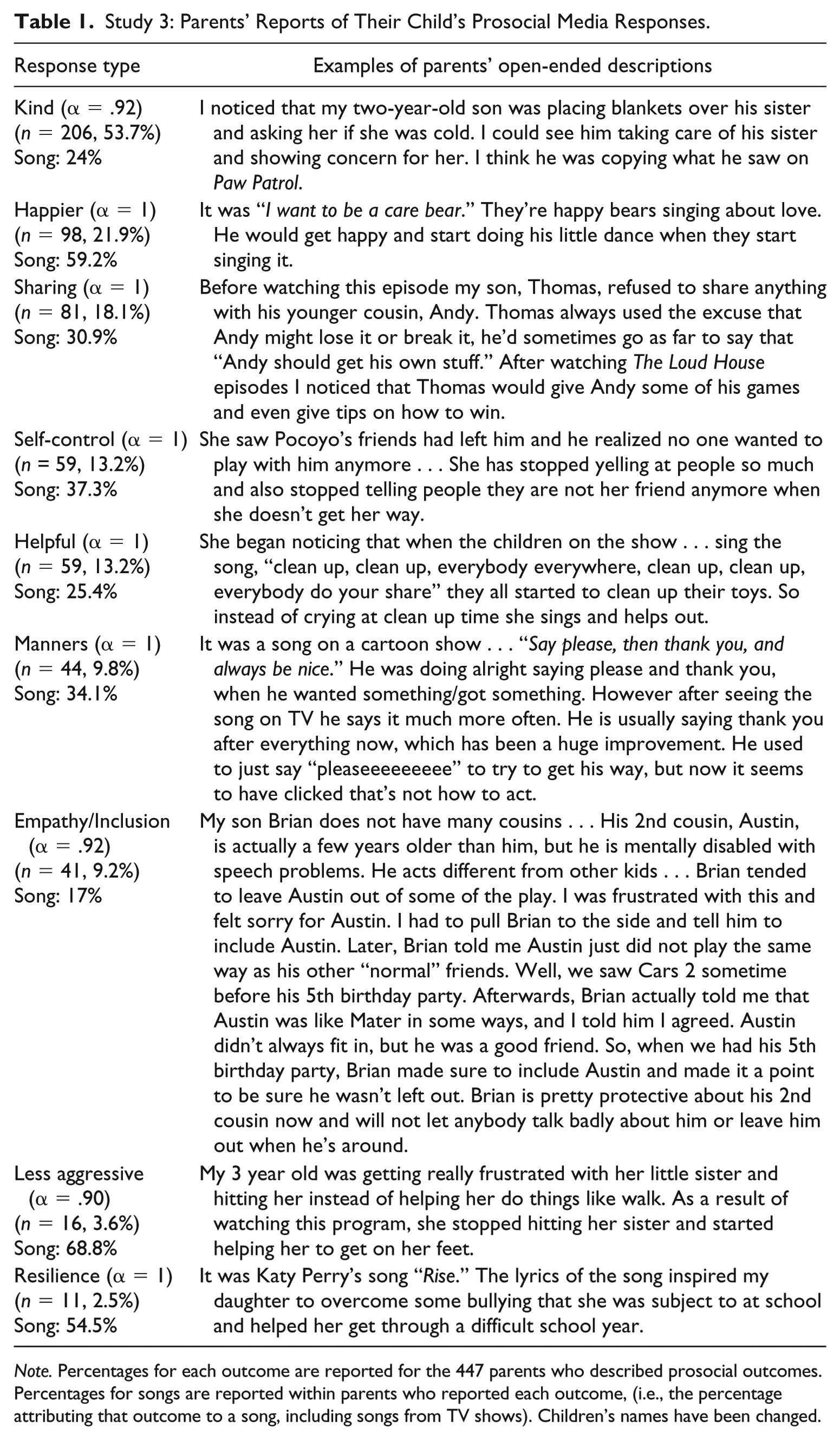
Note. Percentages for each outcome are reported for the 447 parents who described prosocial outcomes. Percentages for songs are reported within parents who reported each outcome, (i.e., the percentage attributing that outcome to a song, including songs from TV shows). Children’s names have been changed.
Media source
Parents were asked whether the content was a TV program, film, song (even if part of a TV show or film), or other. They could select more than one option.
Length of response
Parents indicated length of response: minutes, less than a day, 1 day to 1 week, >1 week to 1 month, >1 month to 6 months, >6 months to 1 year, and >1 year.
Child’s age at time of exposure
Parents indicated the child’s age at the time.
Extensiveness of discussion
Parents rated the extent to which they had discussed the content with the child (a) at the time of exposure and (b) later (1 = not at all, 7 = a lot).
Discussion content
Parents were asked, “What kinds of things did you talk about?” (with no time frame specified). Their open-ended responses were coded (no, yes) for mentions of them or the child (a) explicating the lesson, that is, stating the lesson, elaborating on it; (b) connecting the lesson to child’s life, that is, noting similarities with the child’s own experiences; and (c) timely reminders/praise, that is, reminding the child of the lesson at relevant moments, helping child practice the behavior, or referring back to the content when praising positive behavior. The first author coded all responses, and the second author coded 25% independently. Disagreements were resolved together. Krippendorff’s alpha ranged from .82 to .85 (see Table 2).
Study 3: Examples of Parents’ Scaffolding of Prosocial Media.

Note. Percentages for each type of scaffolding are reported for the 447 parents who described a positive socioemotional outcome.
Child’s habitual media use
Parents indicated how much time their child spent (a) watching TV, DVDs, and streaming video and (b) listening to music on a typical school day and a typical weekend day (wake-up till noon, noon till dinner, dinner till sleep). Scores were computed for average daily TV/video and daily music.
Study 3 Results
Online Appendix C reports the descriptive statistics for variables.
Remembering a positive response
Of the 636 participants, 136 (21.4%) did not report any positive response. Despite the instructions to focus on content that “made your child nicer in some way,” an additional 53 parents (8.3%) only described an educational or health outcome such as learning about numbers or tooth-brushing. A total of 447 parents (70.3%) described a positive socioemotional response.
H1: Predictors of recalling a prosocial response
As shown in Table 2, a logistic regression predicting participants’ likelihood of recalling a prosocial, socioemotional response (no, yes) indicated no significant differences by child age (contrary to H1) or parental education, child gender, child’s TV/video viewing, or music listening. Mothers were more than twice as likely to recall a positive response than fathers.
All subsequent analyses focus on the 447 reports of positive socioemotional outcomes.
Descriptive statistics and H2: Media source of prosocial response
Among parents who recalled a positive response, the majority (334, 74.7%) referenced a TV program. DTN (n = 50) and Sesame Street (n = 41) were mentioned most often, with no other program listed by more than 15 parents. The average age at the time of exposure for these two programs was 3.43 years. Among parents listing TV programs, 114 (34.1%) specifically mentioned songs from the program (34 from DTN). Sixty-eight parents mentioned a film, with seven of those naming a song from the film (e.g., from Frozen). In addition, 42 (9.3%) parents referenced a song that was not in a film or TV program (e.g., Pharrell Williams’s Happy). Overall, 163 parents (36.5%) mentioned songs as the source of the positive response. H2 predicted that parents of younger (rather than older) children would list a song as the source. Results of a logistic regression (Table 2, column 2) indicated that this hypothesis was supported. One book and one website were also listed as sources.
Exploring types of responses recalled
As summarized in Table 1, open-ended answers indicated nine types of positive responses. The most common response was of “kindness” after exposure, described with words like “kind,” “nice,” “caring,” “friendly,” “hugging,” “gentle,” and “nurturing.” Examples included children hugging strangers who looked sad and being gentle and caring with a younger sibling.
The second most common response was that the child became happier and less grumpy after media exposure. Third, parents reported improved sharing (typically of toys). Fourth was self-control, which included improved control over negative emotions (mainly anger, frustration) and improved ability to make transitions (e.g., from play to bed). Fifth was helping with chores, which included cleaning up, laying the table, and putting away groceries. Sixth, parents reported that their child became more polite, said “please” and “thank you,” or learned to apologize. Seventh, 41 parents reported on moments of inclusiveness (e.g., inviting an excluded child to play) or emotional insight into the feelings of others (“sympathetic,” “empathy,” “aware of others’ feelings,” and “considers others’ points of view”). Eighth, some parents reported that their child became less aggressive. And, finally, a few parents reported that media exposure helped their child be more resilient, whether dealing with bullying in school or coping with competition.
Descriptive statistics and H3: Extent of discussion
Almost all parents who reported a prosocial response said they had discussed the content with their child (97.7%), whether at the time of exposure (93.5%, M = 4.58, SD = 1.76) and/or later (95.2%, M = 4.55, SD = 1.67).
H3 predicted that parents of younger (rather than older) children would report more extensive discussions. To test this, and to explore other demographic and media-related predictors of discussion, we ran linear regressions (see Table 3). Given that songs and DTN were the most commonly mentioned sources of positive responses, we explored whether parents who referenced DTN or songs reported more extensive discussions than those who referenced other content (tested in separate regressions because songs often came from DTN). As shown in Table 3, age of child was unrelated to extent of discussion at time of exposure but (as predicted) was negatively associated with extent of later discussion. Thus, H3 was partially supported. With regard to media content, extent of discussion at time of exposure was positively predicted by referencing DTN (but not songs) as the source of the positive response and (unexpectedly) by daily music listening. Extent of later discussion was positively predicted by referencing either DTN or songs as the source of the response and (again unexpectedly) by daily music listening.
Study 3: Regression Analyses Predicting Parents’ Reports of Positive Responses and Scaffolding.

Note. Child’s age was age at time of survey for recall of media response; it was age at time of response for other analyses. Coefficients are reported for the step on which variables were entered. Step 3 (predicting length of effect) is reported with songs as source entered on Step 2. DTN = Daniel Tiger’s Neighborhood.
p < .05. **p < .01. ***p < .001.
Examining the content of discussions
We coded parents’ open-ended descriptions of what they talked about (at unspecified times). As shown in Table 2, explicating the lesson was the most common of the three topics coded, followed by connecting the lesson to the child’s life and offering timely reminders or praise related to the depicted lesson.
H4 and exploration: Predicting length of positive response
Reported length of response varied considerably: 4% of the 447 parents reported a response lasting minutes, 7.2% less than a day, 13% 1 day to 1 week, 20.6% >1 week to 1 month, 23.3% >1 month to 6 months, 19.1% >6 months to 1 year, and 12.8% >1 year.
We predicted that length of response would be positively predicted by rated extensiveness of later discussion (H4a) and by mentions of explicating the lesson (H4b), connecting the lesson to child’s life (H4c) and timely reminders/praise (H4d). Given that songs and DTN predicted extent of discussion, we controlled for these (also allowing us to explore whether these commonly referenced sources were associated with more enduring responses than other sources). As shown in Table 2, we ran two linear regression analyses, entering demographic characteristics of the child and parent and overall media use and years since exposure in Step 1, dummy codes for DTN or songs as the source of the response in alternate Step 2, and then extensiveness of discussion at the time of exposure and later, and dummy codes for mentions of each of the three discussion topics in Step 3.
The results indicated extent of discussion at the time of exposure did not predict length of response, but extent of later discussion was a significant positive predictor—H4a was supported. In addition, reported length of response was positively predicted by mentions of explicating the lesson (H4b) and timely reminders/praise (H4d), but not by connecting the lesson to child’s life (contrary to H4c). Parents who mentioned DTN (but not songs) as the source of the prosocial effect reported longer-lasting responses than those who mentioned other sources.
Post hoc exploration: Indirect paths via extent of subsequent discussion
Both DTN and songs predicted the extent of later discussions, and such discussions predicted length of prosocial response. Thus, it seemed possible that there would be positive indirect effects of these two media sources via discussions. To test these possibilities, we ran two multiple mediation analyses (Hayes, 2013, PROCESS Model 4), controlling for length of time since exposure and the child’s music listening (see Figure 1). The results of the first analysis indicated a significant positive indirect effect of DTN → rated extensiveness of later discussion → length of response; indirect effect = .168, SE = .070, 95% confidence interval = [.059, .339]. The results of the second analysis indicated a significant positive indirect effect of songs → rated extensiveness of later discussion → length of response; indirect effect = .073, SE = .035, 95% confidence interval = [.014, .156]. Examination of the total and direct effect of songs indicated that discussion helped suppress a negative effect of songs on length of response. Follow-up analyses indicated that age at time of exposure did not moderate either indirect effect.
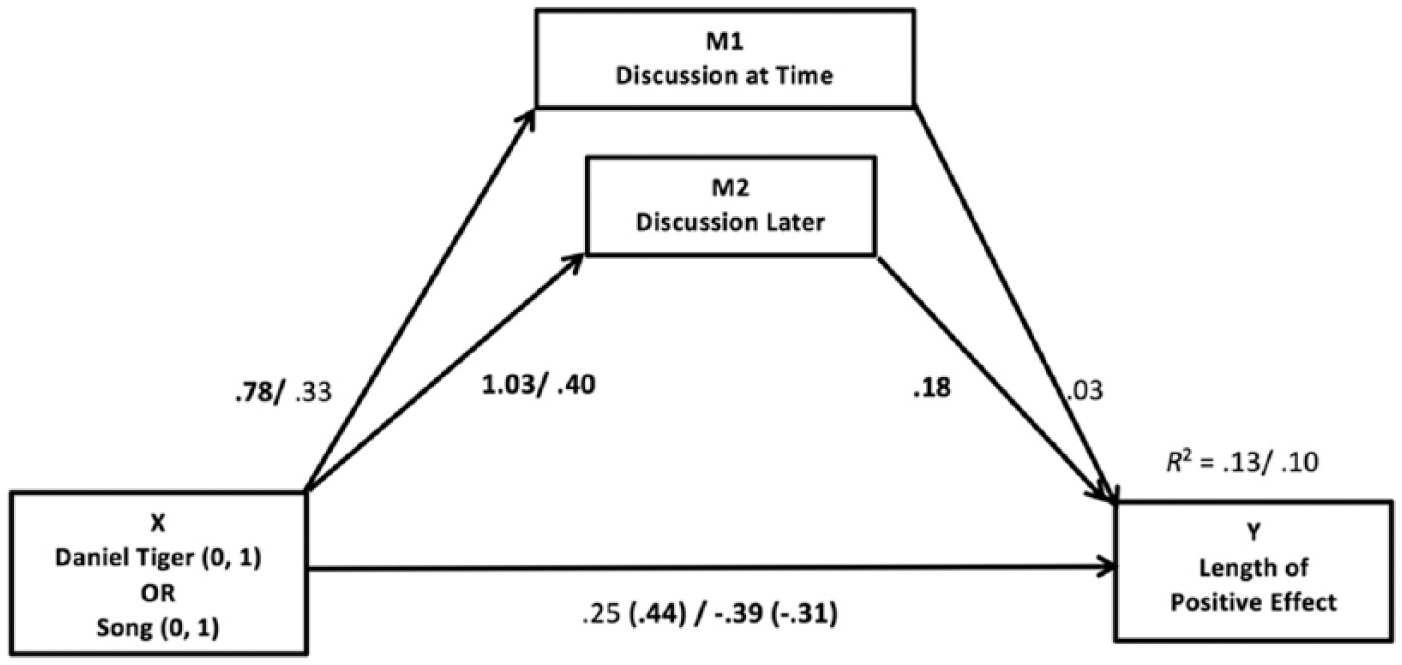
Study 3; Multiple mediation model predicting length of reported positive socioemotional effect.
Study 3: Discussion
The majority of parents surveyed (70.3%) recalled an instance in which they felt media use had made their child “nicer in some way.” Roughly a third mentioned songs as the source of the positive effect. There were significant positive indirect effects of both DTN and songs on length of response, via extent of later discussions of the content. Mentions of explaining the lesson and timely reminders/praise also predicted reported length of response.
General Discussion
The central argument of this article was that young children struggle to understand TV moral narratives and that prosocial outcomes could be enhanced if comprehension could be improved (by simplified lessons in the form of short song videos, by scaffolding) or if the need for comprehension could be bypassed (by incorporating loving primes).
We were right that young children struggle to understand prosocial TV narratives. As in prior studies (e.g., Mares & Acosta, 2008), children in Study 1 did not perform above chance in identifying the intended lesson. However, we found no association between comprehension and prosocial behavior. This may reflect the floor effects for comprehension, or it may mean that comprehension is insufficient for behavioral responses. Based on the Capacity Model (Fisch, 2000), we expected that age, empathic development, and prior exposure would predict lesson comprehension and would enhance the effects of exposure to the prosocial narratives on behavior. Only empathy predicted lesson comprehension, and none of the three moderated the effects of exposure. In fact, there were no effects of exposure to these prosocial narratives. Children who saw the story about helping were as slow to help as those who saw stories about waiting or a visit to a crayon factory. Those who saw the story about waiting were no more likely to complete the waiting game than those who saw the crayon or helping stories.
In Study 2, we reduced the lesson to a 1-minute song video (featuring the same characters as in Study 1) in which characters sang about helping. Those who saw the song video needed fewer prompts before starting to help and picked up more pencils than those who did not see it. The short song, devoid of any plot, seemed to succeed where the narrative had not, consistent with arguments about young viewers’ cognitive constraints and the need for simple messages.
In Study 3, the majority of parents surveyed described an instance in which they felt media had helped make their child “nicer in some way.” Consistent with our argument that children often need help interpreting and responding to prosocial media content, these reports of positive responses almost always involved some scaffolding, with more extensive conversations reported for younger children. Consistent with prior experimental findings (Cingel & Krcmar, 2017; Rasmussen et al., 2016), parents’ ratings of how extensively they discussed the content at the time of exposure did not predict the length of positive response. In contrast, length of reported response was positively predicted by the extent of subsequent discussion and by parents’ open-ended descriptions of explicating the prosocial lesson (at unspecified times) and providing reminders/praise related to the lesson at key moments. Of course, because these were simply cross-sectional survey data, it is possible that salient content generates both discussion and lasting effects and that scaffolding is not crucial to comprehension and comprehension is not crucial to effects. Experimental work that tests the effects of specific forms and timing of scaffolding on prosocial comprehension and behavior is needed to clarify these issues.
Further work is also needed to probe the current findings about songs. The findings of positive behavioral effects of experimental exposure to a short 1-minute song video in Study 2 and the relatively frequent reports of positive responses to songs in Study 3 seem somewhat inconsistent with prior findings (e.g., Calvert & Billingsley, 1998; Wolfe & Jellison, 1995) that songs produced minimal or superficial learning. On the other hand, post hoc exploration in Study 3 also indicated a negative direct association between reported response length and references to songs (vs. other types of content) as the source of the response. This negative direct association was offset by a positive indirect path via extent of subsequent discussions. One interpretation is that songs either need to be extremely simple and supported by visual demonstrations of the desired action (as in Study 2) or need to be supported by extensive parental prompts. It is possible that songs may foster prosocial outcomes by providing catchy, memorable scripts for parents to use to help their children respond to challenges. With regard to more direct effects, it remains unclear what are the key elements of songs for teaching lessons in different domains (e.g., socioemotional vs. numeracy), the mechanisms for effects (comprehension, emotion, arousal), and the boundary conditions (ages).
What about affiliative priming as an alternative route to prosocial effects? In Over and Carpenter’s (2009) study, 18-month-olds were quicker to help after seeing “the merest hint of affiliation”—eight photos with “two small dolls standing next to each other in the background of photographs of other objects” (p. 1189). In our Study 1, children in the loving conditions saw over a minute of loving images (e.g., hugging, rubbing noses) and heard 15 to 16 repetitions of the words “love” and “caring.” Nonetheless, they were no more likely to help, wait, or share than children who saw an interstitial about dancing crayons. In Study 2, we replicated these null results when we removed the surrounding narrative. Those who saw the love song video required as many prompts and picked up as few pencils as the no-exposure control group. It is unclear why there were effects for Over and Carpenter’s toddlers and no effects in our studies.
Finally, it is worth acknowledging that when we presented Study 1 at a conference, we were asked why we had altered DTN by adding the loving or funny interstitials and by showing only one story. As aired, each episode consists of two related stories (to foster generalization of the overarching theme), and each story contains songs that summarize the theme. Our goal in Study 1 was not to evaluate DTN, but to test narrative comprehension and priming as two theory-driven approaches to prosocial effects. Moreover, Rasmussen et al. (2016) had reported that neither habitual nor experimental exposure to the program had significant effects on children’s behavior, unless parents habitually discussed educational TV with their child (much like in our Study 3). Nonetheless, the point was well taken. Study 3 somewhat ameliorates this issue by examining real-world exposure, but it suffers from potential issues of social desirability and imprecise or faulty memory.
Moving forward, quasi-experimental, repeated-exposure research could test the empirical claims suggested by parents’ self-reports in Study 3. Such work could examine the effects of repeated exposure to unedited programs (as in Rasmussen et al.’s, 2016 study), but could build on that work by encouraging adults to use media content in the manner described by parents in Study 3. Rather than “mediating” programs at exposure, caregivers could clarify the lesson and then refer back to it at specific moments when the child needs help. Assessment of comprehension of both the program and the scaffolding prompts, as well as assessment of children’s motivation to engage in the target behavior, would clarify what facilitates prosocial behavioral responses to prosocial narratives.
In Study 3, we cast the net wide, unsure whether parents would be able to recall any instances of prosocial media effects and whether their examples would seem either so trivial and fleeting or so vague and general, as to cast doubt on their meaning. Roughly a third did not, in fact, report any positive outcomes. The examples reported by the remaining 70% were often specific and moving, offering renewed hope for positive media effects and initial insight into the conditions in which they can occur.
Supplemental Material
Online_Appendices_rev – Supplemental material for Love or Comprehension? Exploring Strategies for Children’s Prosocial Media Effects
Supplemental material, Online_Appendices_rev for Love or Comprehension? Exploring Strategies for Children’s Prosocial Media Effects by Marie-Louise Mares, James Alex Bonus and Alanna Peebles in Communication Research
Footnotes
Declaration of Conflicting Interests
The authors declared no potential conflicts of interest with respect to the research, authorship, and/or publication of this article.
Funding
The authors disclosed receipt of the following financial support for the research, authorship, and/or publication of this article: The studies reported here were supported in part by grants to the first author from the Hamel Family Research Fund, administered by the Department of Communication Arts at the University of Wisconsin–Madison.

Author Biographies
References
Supplementary Material
Please find the following supplemental material available below.
For Open Access articles published under a Creative Commons License, all supplemental material carries the same license as the article it is associated with.
For non-Open Access articles published, all supplemental material carries a non-exclusive license, and permission requests for re-use of supplemental material or any part of supplemental material shall be sent directly to the copyright owner as specified in the copyright notice associated with the article.
