




Abstract
The impacts of help-seeking (HS) on purchase decisions associated with social media websites (SMWs) are deemed powerful given the enormous popularity of social media and growth of social commerce. This research explores HS on SMWs and empirically investigates how it influences users’ decision performance. Utilizing the heuristic-systematic model (HSM), media system dependency (MSD) theory, and tangibility theory, in addition to HS logics, the research proposes a theoretical model incorporating both a MSD path and tangibility path for gauging purchase decision on SMWs. Two HS logics—dependent and autonomous—moderate the relationships between gratification, perceived diagnosticity, and decision performance. Data collected from 629 users of SMWs supported all of our hypotheses. Practitioners can benefit from the findings by more fully understanding the prospective value of diverse supports afforded by SMWs and constructing new guidelines to design more effective mechanisms that help consumers.
Keywords
The emergence of social media has revolutionized how people communicate and where people acquire information. Social media websites (SMWs), such as social networking sites, social shopping communities, and consumer review sites, provide public forums that allow people to connect with peers, express opinions, and access user-generated online product reviews that facilitate their purchase decisions (Wang, Yu, & Wei, 2012). People seek help and advice on SMWs when they desire to purchase a new product, choose a place to vacation, and verify whether specific information is reliable or not (Cheon, Choi, Kim, & Kwak, 2015; hereafter namely “help-seeking” or “HS”). This change in the kind of information sources consulted applies to people’s purchase decision-making process and marketing communications (Wang et al., 2012), namely, social commerce. Indeed, the impacts of HS on purchase decisions associated with online social platforms are deemed powerful given the enormous popularity of social media and growth of social commerce (Hajli & Sims, 2015). Hence, the present research is an attempt to obtain more insights into HS on SMWs and explore how they influence people’s decision-making process.
Central to this study is the notion of HS, which is an informal, interpersonal activity wherein one deliberately approaches others whom one considers to be better endowed with the resources, capabilities, and/or information needed to deal with some problem (Geller & Bamberger, 2012). Help-seeking also occurs on SMWs. For example, consumers increasingly use online social platforms to find opinions about products and compare purchase experiences. Collectively, these opinions make up a huge amount of user-generated information on SMWs and have inspired a number of research streams generating valuable insights into the effectiveness of peer communication, its effects (e.g., on consumer purchase decisions and information-sharing), and its antecedents (e.g., action-based social information, opinion-based social information, individual-level tie strength, group-level identification, and relational inertia) (Cheon et al., 2015; Cheung, Xiao, & Liu, 2014; Wang et al., 2012). Previous studies have examined peer communication on SMWs using network theory (Cheon et al., 2015), consumer socialization theory (Wang et al., 2012), information signaling theory (Cheung et al., 2014), and social exchange theory (Zhang, Lu, Gupta, & Zhao, 2014). However, few studies to date have empirically investigated the fundamental questions: What can people obtain from SMWs while HS? What are their evaluation processes on SMWs? And does this process change people’s decision performance? Because social media and social commerce have expanded rapidly in a short period of time, research on HS substantially lags behind. This lack of research represents one observable gap in the literature and thus deserves our explicit attention.
Indeed, as Cheon et al. (2015) contend, SMWs have recently received attention as a new channel for requesting, receiving, and distributing product information. People HS on SMWs can be analyzed from two perspectives: the media perspective and the information perspective. With respect to the media perspective, it is unclear whether the abovementioned theories and factors lacking media consideration would have a sufficient explanation for purchase decision performance in the context of social media. Given that media system dependency (MSD) theory is the theoretical foundation for explaining people’s dependency on the medium to find diverse resources that meet their goals (Ball-Rokeach & DeFleur, 1976), MSD (with its three dimensions of understanding, orientation and play) is useful in clarifying their motivations for HS on SMWs in this regard. Concerning the information perspective, research has conceptually looked at information factors on SMWs (e.g., product information, informational support; Hajli & Sims, 2015). However, previous research has hitherto not empirically verified the impacts of information factors on purchase decision performance in the environment of SMWs. In a sense, people use social media to seek more tangible information (e.g., product information and peers’ usage experience) to gain diagnosticity to simplify or initiate a purchase decision (Cheung et al., 2014). The notion of tangibility and its impacts on perceived diagnosticity may govern decision performance on SMWs. It is illuminating to apply the theory of tangibility and its three dimensions (physical tangibility, specificity, and mental tangibility; Laroche, Bergeron, & Goutaland, 2001), along with perceived diagnosticity, to determine the impacts of information factors on decision performance in the context of SMWs. Moreover, the heuristic-systematic model (HSM) is a widely recognized dual process theory that elucidates human decision-making in a wide range of validity-seeking contexts (Chaiken & Eagly, 1989). Altogether, by employing HSM as an overarching theory, we integrate the theories of MSD and tangibility with heuristic and systematic processing (hereafter referred to as the MSD path and tangibility path, respectively) to achieve a better understanding of HS and its influence on decision performance in the context of SMWs.
In addition, as Geller and Bamberger (2012) suggest, people maintain an implicit and relatively stable set of assumptions regarding how and for what purposes assistance should be solicited, and these assumptions vary depending on the degree to which two alternative logics are endorsed. Two HS logics—dependent HS logic and autonomous HS logic—may turn simple, key effects into more insightful conditional relationships. However, investigation of HS logic on the decision-making process in the SMW environment has been sparse. To fill the gap, this study considers both dependent and autonomous HS logic as moderators of the MSD path and tangibility path to evaluate decision performance.
This study makes four key contributions to extant literature. First, drawing upon theories of HSM, MSD, and tangibility, in addition to HS tenets, the body of social media literature is enriched by this investigation providing a deeper understanding of HS and the decision-making process on SMWs. Second, it is always enlightening to expand existing work by applying multiple theoretical perspectives, thereby illuminating, in our case, this new social phenomenon. MSD theory helps us understand what factors guide HS and shape people’s decisions from the perspective of dependency relationships between people and the medium, whereas tangibility theory provides a guideline to effectively approaching decision-making from an information perspective. Integration of the two streams enables us to better understand why people seek help and how this guides their decision performance on SMWs. Hence, this study takes an exploratory step in this direction and is one of the first that examines both paths to decision performance in the context of SMWs. Third, we note that research has hitherto not confirmed how the reinforcing or attenuating effects of HS logics on the MSD path and tangibility path are distinguished conceptually or empirically. Hence, the two HS logics, as moderators, pave the way toward systematically understanding linkages between both paths and decision performance on SMWs. Fourth, we further contribute to HS literature by strengthening the applicability of HS logics in the context of SMWs.
Literature Review
Help-Seeking and Decision Performance on SMWs
Help-seeking (HS) has been recognized as an interpersonal activity in which one deliberately approaches others whom he/she believes to possess the skills, capabilities, and/or resources needed to manage or solve a problem (Bamberger, 2009). Since people behave on SMWs in the same way they would face-to-face (Fang, 2014), HS can happen in the context of social media. This becomes more evident when people confront complex and uncertain decisions, when they have no experience with a product or service, and when they do not know how to judge what attributes are available or unreachable (Sanchez, Costa, & Goes, 2015). According to a recent social media marketing report (Stelzener, 2018), 94% of marketers used Facebook as their social platform, 87% claimed their social media efforts benefited their business with increased exposure, and 78% confirmed the positive results of increased customer traffic. Therefore, scholars endeavor to construct a more thorough knowledge base of effective marketing and interpersonal communication in a changing media landscape (e.g., Liu, Fraustino, & Jin, 2016), otherwise practitioners are adjusting how they approach social commerce without sufficient empirical evidence to direct their strategies. Accordingly, further research is needed to explore the impacts of HS via social media in closer detail.
According to marketing news and an “Omni-channel retail” report released in 2017, 77% of consumers search for online product reviews before buying (Rodela, 2017), 42% look for a friend’s review, and 23% of buyers are inspired by social media recommendations. The existing literature also suggests that soliciting help from others (e.g., customer reviews, experts’ evaluation, friends’ opinions, and support on SMWs) can enhance confidence in the decision made, minimize the cognitive effort necessary to conclude a decision (Sanchez et al., 2015), as well as promote decision effectiveness and efficiency (Mudambi & Schuff, 2010) by reducing uncertainty about critical knowledge and information (Fang, 2012). Briefly, HS assists consumers in making better and quicker decisions. Therefore, HS appears to be positively associated with various decision performances, directly and indirectly. In an organization, decision performance has traditionally been measured by “the extent to which a decision achieves the objectives established by management at the time it is made” (Dean & Sharfman, 1996, p. 372), in addition to the time and cost it takes to reach a decision (Song, Jones, & Gudigantala, 2007). Yet, when applied to the context of social media, some components of decision performance cannot be precisely measured due to their inaccessibility and inappropriateness (e.g., profit growth and turnover growth). As Fang (2012) suggests, consumers’ subjective perceptions govern their subsequent behaviors and decisions in online environments. Accordingly, decision performance in this study is primarily measured from people’s subjective perceptions and manifested by decision confidence, decision satisfaction, decision effectiveness, and effort conservation.
Previous studies have confirmed the essential roles of these four constructs of decision performance in diverse online settings (Kamis & Stohr, 2006). In line with the most common view, they are included in this study as second-order constructs of decision performance. Decision confidence reflects a self-reported level of confidence in one’s decision (Kamis & Stohr, 2006), such as consumers’ beliefs about their favored outcome and their perception of the probability that their decisions are correct (F. D. Davis & Kottemann, 1994). As Grefen, Ludwig, and Angelov (2003) suggest, online consumers have declared the need for confidence in their decision before committing to it. Decision confidence is thus crucial to a decision-maker in cyberspace (Kamis & Stohr, 2006). Decision satisfaction refers to consumers’ satisfaction with their experiences in arriving at decisions (Fitzsimons, 2000). Consumers’ satisfaction with the decision process significantly contributes to their overall decision judgments (Fitzsimons, 2000). Paralleling decision quality, decision effectiveness reflects an individual’s belief about how worthwhile and productive it is to use an SMW to arrive at a decision (Song et al., 2007). Effort conservation focuses on consumption and investment of the least amount of energy and time to reach a decision (Song et al., 2007). As noted earlier, it is unclear how HS enhances consumer decision performance on SMWs. In the next section, we put forward dual processes to approach determining consumer decision performance on SMWs, predominantly applying the HSM, along with the theories of MSD and tangibility.
The HSM
The HSM asserts that people often engage in validity-seeking by consulting various resources to better understand a situation (Davis & Tuttle, 2013). HSM advocates that judgment formation incorporates two distinct processing modes in terms of different degrees of cognitive effort: systematic processing and heuristic processing. Systematic processing is information-intensive and analytically oriented, whereas heuristic processing relies on the ready availability of heuristics and simple decision rules to form quick judgments (J. M. Davis & Tuttle, 2013). Systematic processing requires much more cognitive effort than heuristic processing. The rationale for considering HSM as an overarching theory in this study is threefold. First, HSM has been applied to understanding a wide range of judgment domains (Chaiken & Eagly, 1989), such as adoption of information in online communities (Zhang & Watts, 2008), impacts of online reviews on consumer decisions (Zhang et al., 2014), and end-user information processing when information system (IS) exceptions are encountered (J. M. Davis & Tuttle, 2013). Second, HSM has undergone various theoretical extensions that enhance its ability to support interesting explorations within the dual process framework (Zhang & Watts, 2008). Third, such theoretical extensions of HSM (e.g., additivity, attenuation, and bias effects; Chen & Chaiken, 1999) and its two underlying principles (sufficiency and least effort) provide useful building blocks for clarifying how systematic and heuristic processing functions on SMWs. Hence, HSM is applicable to HS in the context of SMW applications, where media, users, information, and social factors dominate the decision-making process.
According to HSM, systematic processing occurs when people operate under the sufficiency principle, which stipulates that people will actively engage in information processing until they reach their sufficiency threshold—that point when the depth and/or breadth of understanding they believe to be necessary to make a confident and satisfying decision is reached (Chen & Chaiken, 1999). That is, in system processing, information reliability and accuracy outweigh time and cognitive energy constraints. Here, people concentrate on message content (Chaiken & Ledgerwood, 2012). HSM, however, does not offer specific factors for HS on SMWs. Tangibility theory and its three components complement HSM in this respect. Alternatively, heuristic processing arises when the least effort principle is dominant in a decision-maker’s mind. This principle specifies that in the interest of economy, people often expend the least amount of effort and rely on the availability, accessibility, and applicability of heuristics (e.g., simple decision rules or rules of thumb) to reach conclusions (Chaiken & Ledgerwood, 2012). Indeed, SMWs represent a less-effortful means and easily accessible channel for people to seek help and information. MSD is capable of explaining why people depend on social media to obtain resources that help them achieve their goals. Altogether, MSD contributes to heuristic processing in this regard.
MSD Theory
MSD refers to “a relationship in which the capacity of individuals to attain their goals is contingent upon the information resources of the media system” (Ball-Rokeach, 1985, p. 487). MSD can encompass micro-level (i.e., individual) and macro-level (i.e., system) effects, which can be determined by analyzing macro-level influences on micro-level media consumption. The macro-level of MSD relations is dominated more by changes in media and social systems, while the micro-level of MSD relations is derived from a desire to achieve personal goals (Ball-Rokeach, 1985). The present study predominantly emphasizes the micro-level of MSD relations (i.e., individual MSD) because it serves as a solid basis for measuring individual dependency relations concerning a specific medium or genre (Grant, Guthrie, & Ball-Rokeach, 1991).
MSD theory conceptualizes goals as broadly capturing the motivations behind all potential media-related activities and decisions. Ball-Rokeach (1985) used the term “goals” because it implies a problem-solving behavior and is contingent upon media system resources. She identified three goals for individual MSD: understanding, orientation, and play. Understanding deals with an individual’s goal to understand the social environment and themselves within it. Orientation relates to the goal to behave effectively in interactions with others and in personal behavior decisions. Play centers on the goal for escapism and enjoyment. Generally, these three goals are not mutually exclusive (DeFleur & Ball-Rokeach, 1989). Instead, more than one kind of goal can be satisfied via the same medium. Sequentially, each of the goals can be divided into individual (self) and social dimensions to ultimately yield six kinds of individual MSD relations: social/self understanding, interaction/action orientation, and social/solitary play. 1 Individual dimensions focus on personal goal fulfillment pertaining to the individual, while social dimensions emphasize personal goal fulfillment in relation to dealing with society. Both individual and social dimensions can enter into a person’s judgment spontaneously in the context of social media where social interaction is a crucial feature of its unique architecture (Papacharissi, 2009).
Theory of (In)tangibility
Intangibility has been conceptualized as the lack of physical evidence and that which cannot be touched or seen, precisely clarified, or grasped mentally (Laroche et al., 2001). According to Laroche et al. (2001), intangibility encompasses three dimensions: physical intangibility (inaccessibility to the senses), mental intangibility (difficulty in visualizing a particular product), and generality (difficulty in precisely defining or describing a particular product). It has been acknowledged that intangibility can significantly change the way consumers make decisions (Laroche et al., 2001; Mazaheri, Richard, Laroche, & Ueltschy, 2014). For example, lack of physical contact with a product before purchasing it represents a higher level of risk for certain consumers because physical tangibility is determined by accessibility to the senses (Nepomuceno, Laroche, Richard, & Eggert, 2012). Indeed, previous studies have observed that many consumers are resistant to e-commerce due to its inability to present physical cues (Featherman & Pavlou, 2003). The online setting increases the intangibility of physically tangible products and is thus viewed more in terms of intangibility than experiences through traditional offline channels (Nepomuceno, Laroche, & Richard, 2014). However, in a sense, the Internet enables consumers to “tangibilize” the intangible (Berthon, Pitt, Katsikeas, & Berthon, 1999) by allowing them, via online searches, to access more information and experiences of other consumers before purchasing (Hajli & Sims, 2015). By such means, consumers can gauge the functionality and design of products and make assumptions about the product’s quality. The Internet thus serves as a crucial medium for information services and electronic commerce. Recently, among diverse Internet platforms, SMWs with a large and growing user base and two-way communication capabilities can be prominent venues for consumers to engage in information-seeking/exchange (Liu et al., 2016). To date, extant studies have not examined the influence of tangibility on consumer decisions via SMWs in depth. By integrating tangibility theory and HSM, this study proposes a systematic processing path (hereafter referred to as the tangibility path) to clarify HS and individuals’ decision-making on SMWs. 2
Research Model and Hypotheses
According to the additivity effect of HSM, both heuristic processing and systematic processing can independently impact a judgment decision in various ways and function concurrently (Chen & Chaiken, 1999; Eagly & Chaiken, 1993). We propose that, to arrive at informed judgments and satisfying decisions, people activate both the MSD path and tangibility path to achieve their HS goals on SMWs. Hence, this study links the heuristic and systematic processing of HSM with theories of MSD and tangibility to build a research model for understanding a consumer’s decision-making process on SMWs (see Figure 1).
3
The upper part of the model depicts the MSD path (with its three components: media dependency
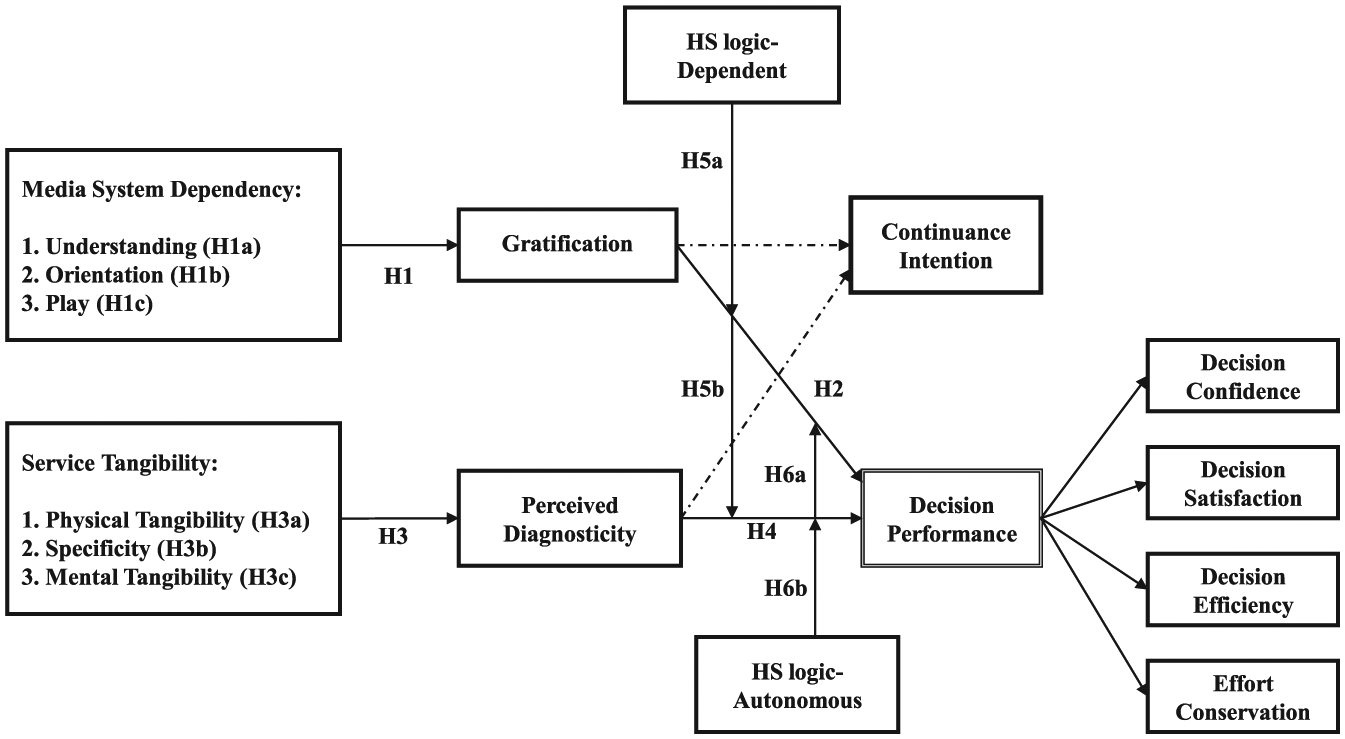
Research model.
The MSD Path
Individual MSD explains why individuals habitually use particular media and how strong their relationship is with it (Schrock, 2006). MSD theory can identify gratifications derived from using social media as well as relationships between goals pursued and available resources (Ruiz-Mafe, Martí-Parreño, & Sanz-Blas, 2014). When applied to HS on SMWs, individual MSD theory can provide new insights and contribute to heuristic processing under HSM (hereafter referred to as the MSD path) so as to explain HS and an individual’s decision-making process on SMWs.
Three MSD goals and gratification
According to the logic of heuristic processing, the MSD path occurs when the least effort principle dominates a person’s mind. In humans, this principle states that heuristic processing is the default strategy employed when a decision must be made, as people are economy-minded processors who prefer to expend the least amount of cognitive effort, and will only intensify that effort when they have to (Zhang et al., 2014). Given that individual MSD relations and the three goals of understanding, orientation, and play are available, accessible, and applicable in the context of SMWs, they represent less-effort heuristics along the MSD path than in systematic processing to arrive at decisions in this context. As such, people tend to automatically apply MSD heuristics, which can include simple decision rules or rules of thumb to make a quick judgment (Chaiken & Ledgerwood, 2012). More specifically, people undertaking HS on SMWs are simply dependent on social media for achieving nonmutually exclusive goals. Put differently, people have certain goals that they are motivated to realize and social media provides the needed information and resources to help fulfill those goals (Ball-Rokeach, 1985). Such fulfillment of people’s self and social goals through media communication has been referred to as gratification (Chiu & Huang, 2014). As abovementioned, the MSD path incorporates straightforward decisions in which attitudes can be altered on account of simple associations and goals from MSD relations. We thus theorize a positive relationship between the three MSD goals and gratification on SMWs and propose the following hypotheses:
Gratification and decision-making performance
Heuristic processing utilizes learned knowledge structures in the form of simple decision rules to achieve goals and judgments (Chaiken & Ledgerwood, 2012). As such, people are inclined to adopt the MSD path as their first, or default, strategy. The proposed impact of gratification on decision performance is thus based on the logic of heuristic processing and MSD theory, which postulate heuristics (the three MSD goals in our case) as shortcuts to drawing quick conclusions. Viewing decision performance as the focus of our conclusions, gratification of MSD goals can then be seen as prerequisite to decision performance. More specifically, social media provide a diversity of gratifications. In turn, this enables people to achieve their diverse objectives (Patwardhan & Yang, 2003). Taking into account evidence found in the literature that focuses on social media (Ruiz-Mafe et al., 2014) for gratification effects afforded by Web 2.0 applications on future behaviors, this study surmises that greater gratification regarding people’s MSD goals can lead to better decision performance.
The Tangibility Path
According to HSM, once people encounter ambiguous or inconsistent information, they may recognize that heuristic processing (the MSD path in our case) alone is insufficient for achieving their desired level of confidence (J. M. Davis & Tuttle, 2013). Hence, systematic processing (i.e., the tangibility path) arises and the sufficiency principle guides people’s decision-making process. The sufficiency principle asserts that people expend significant cognitive effort collecting enough information to reach a sufficient degree of confidence that they have attained their processing goals (Eagly & Chaiken, 1993). Physical tangibility, mental tangibility, and specificity can correspond to processing goals because these three dimensions of tangibility can facilitate more information-seeking to generate diagnosticity and diminish risk. For instance, asking friends and relatives for advice and information about a product or service (i.e., tangibilizing the intangible) aids decision assessment and avoiding unfavorable consequences (Nepomuceno et al., 2012). Existing tangibility research has predominantly considered the link between intangibility and perceived risk (Nepomuceno et al., 2014), but scarce studies have explored diagnosticity and its association with intangibility or tangibility. Considering the salient influence of diagnosticity on the process of decision-making (Fang, 2012) and consistency associated with a positive view of system processing, this study focuses on the tangibility-diagnosticity-decision link to manifest the tangibility path. Altogether, these three dimensions of tangibility may help explain some of the reasons why people seek help and how tangibility changes decision-making in the context of SMWs.
Tangibility and perceived diagnosticity
Perceived diagnosticity refers to the sufficiency of received information to resolve a judgment task (Kempf & Smith, 1998; Qiu, Pang, & Lim, 2012). Diagnosticity is settled by the perceived correlation between information and the evaluation task, which is often conceptualized as helpfulness of the information toward making a satisfying judgment (Qiu et al., 2012). According to tangibility theory, the three dimensions of intangibility represent impediments to picturing service or product attributes and related benefits, thus increasing evaluation difficulties for consumers (Nepomuceno et al., 2014). Physical tangibility related to products or services can be applied to assist people in overcoming perceptions of intangibility (Featherman & Wells, 2010). Mental tangibility reflects the extent to which a consumer can interpret evaluation cues to obtain a clear mental representation of an object (Laroche et al., 2001). Specificity reflects how well consumers can precisely define or describe a particular product or service (Laroche et al., 2001). For instance, a product is viewed as specific if it can be depicted and differentiated by clear-cut definitions, features, and/or outcomes in people’s minds. Hence, the three-faceted construct of tangibility can represent the desired goal of information received from others on SMWs, which enables consumers to understand the quality and performance of a product or service being evaluated.
In a sense, SMWs allow people to interact with others with ease and speed, thus facilitating multidirectional communications between people (Fang, 2014). Obtaining such helpful evaluation cues on SMWs assists people in overcoming the barrier posed by inability to physically inspect products in online contexts (Filieri, 2015), thus paving a way toward better diagnosticity, which in turn connotes positive implications for decision performance. As in any other type of online setting, an opportunity exists on SMWs to understand how consumers’ mental conceptualizations (i.e., tangibility) affect their decision-making process. Altogether, it is hypothesized that the more physical tangibility, mental tangibility, and specificity received information has, the more consumers find such information to be diagnostic in judging the quality and performance of a product/service they are considering buying.
Perceived diagnosticity and consumer decision performance
Given the inability of consumers to physically investigate products and services in the online context, diagnosticity thus mediates the space-time barrier by discouraging completion of transactions involving misrepresented or low-quality products (Pavlou, Liang, & Xue, 2006). The decision-making literature has consistently acknowledged the important role of diagnosticity on decision outcomes (e.g., decision confidence, satisfaction, transaction intention; Fang, 2012; Kempf & Smith, 1998). Perceived diagnosticity has been found to ease information asymmetry through the logic of incentives and signals (Pavlou et al., 2006) and reinforce consumers’ confidence in their purchase decisions (Kempf & Smith, 1998). In essence, a higher perception of diagnosticity is believed to buttress one’s belief in one’s decision (Jiang & Benbasat, 2004). Along the same logic, in the case of SMWs, rich information obtained from others allows consumers to thoroughly judge the functionality and design of products, thus generating higher diagnosticity. By such means, consumers become less concerned about the lack of physical examination (Dimoka & Pavlou, 2008), and feel more certain in their estimation of product quality (Kempf & Smith, 1998) and their ultimate purchase decision.
Help-Seeking Logics as Moderators on SMWs
HS logics of action have been conceptualized as the assumed means-ends relations underlying people’s displayed or self-perceived behavioral tendencies (Bacharach, Bamberger, & Sonnenstuhl, 1996). Such logics of action are schema-like knowledge structures that permit a priori prediction, enabling people to process available cues as well as select succeeding behaviors and decisions with relatively little effort (Geller & Bamberger, 2012). Nadler (1998) classified two types of HS logics: dependent and autonomous. People who solicit assistance strictly for finding an immediate solution can be regarded as performing dependent HS, while people who undertake HS to be more independent in determining their own solutions can be seen as engaging in autonomous HS (Bamberger, 2009). On the whole, HS has been regarded as a beneficial and productive organizational behavior. Yet some studies in social psychology and management indicate that these effects may not necessarily have universally positive effects on individual and group performance (Bamberger, 2009; Geller & Bamberger, 2012). HS logics and their impacts have been investigated in diverse contexts, such as employees’ performance and well-being in the workplace (Bamberger, 2009), customer support service performance (Bone, Fombelle, Ray, & Lemon, 2015), and learning performance in education (Nadler, 1998). As Nadler (1998) concluded, it is crucial to clarify the two types of HS logics and consequences of undertaking them. To date, only Geller and Bamberger’s (2012) study has focused on the moderating role of HS logics and found that the HS-performance link was contingent upon the dependent and autonomous alternatives considered in our study. Aside from these research contexts and findings, HS logics can be applicable elsewhere HS frequently occurs, such as on SMWs. SMWs have become popular places for people to undertake HS behavior by posting questions about specific problems regarding a product or service. Altogether, we believe HS logics represent a promising way to explore HS on SMWs and systematically shed light on both the MSD path and tangibility path to measure decision performance. The rationale and related hypotheses are discussed below.
Dependent HS logic as a moderator between decision performance and its antecedents
Dependent HS logic (HSD) is characterized by a focus on immediate problem resolution, which distinguishes it from autonomous logic (Nadler, 1998). When applied to HS on SMWs, HSD may act as a moderator that initiates the attenuation effect. According to Chaiken and Eagly (1989), the attenuation effect under HSM suggests that an elevated level of systematic processing can attenuate the influence of heuristic processing on people’s judgment decisions. The attenuation effect occurs “when the implication of the heuristic is incongruent with the judgment implied from systematic processing” (Zuckerman & Chaiken, 1998, p. 31). This effect becomes stronger when people are highly motivated to process information. That is, when people are more likely to tackle higher levels of systematic processing (the link between perceived diagnosticity and decision performance in our case). This attenuation effect can thus lessen the influence of gratification on decision performance along the MSD path. Correspondingly, HSD serves as a moderator, not just to attenuate the relationship between gratification and decision performance along the MSD path, but strengthen that between perceived diagnosticity and decision performance along the tangibility path.
In a sense, the dependent help-seeker is performance-goal oriented and tends to undertake more expedient HS aimed at asking other persons to offer their resources to disentangle his/her immediate problem (Geller & Bamberger, 2012). Providing that a highly dependent help-seeker is used to relying on others for resources and takes it for granted, he/she may pay less attention to the assessment of gratification than one with low HSD when considering decision performance. Indeed, his/her gratification of MSD goals represents a relatively broader and more implicit judgment, when compared with perceived diagnosticity, and thus denotes a less observable signal for reaching a quick decision. Hence, the attenuation effect occurs since the judgment implied by perceived diagnosticity is likely to be viewed as more reliable than that implied by gratification under heuristic processing (Zuckerman & Chaiken, 1998). Ultimately, the influence of gratification is reduced. This suggests, altogether, that for a highly dependent help-seeker, decision performance is more likely to be increased by the explicitness of perceived diagnosticity and less by gratification. Correspondingly, the preceding arguments suggest:
Autonomous HS logic as a moderator between decision performance and its antecedents
According to Geller and Bamberger (2012), autonomous HS logic is characterized by a tendency to concentrate on realizing independent mastery, with the aim of maximizing longer term benefits of HS while minimizing instrumental and psychological costs. When applied to HS on SMWs, autonomous HS logic may serve as a moderator that initiates a bias effect, an essential theoretical extension for HSM (Chaiken & Eagly, 1989). The bias effect suggests that heuristic processing (the gratification-decision link along the MSD path) may change a person’s judgment indirectly by way of biasing systematic processing (the diagnosticity-decision link along the tangibility path) (Eagly & Chaiken, 1993). The justification behind this effect is that relatively broad heuristic clues may allow people to draw wider inferences so as to achieve a better decision. Generally, a help-seeker who endorses such a mastery-goal orientation will more strongly regard HS situations as opportunities to enhance his/her competence and solicit help that facilitates learning, thereby enabling independent action in the future. For example, a highly autonomous help-seeker, aiming for independent mastery, who possesses inadequate knowledge of a product/service being evaluated (i.e., limited cognitive capability) thus becomes more motivated to engage in heuristic evaluation. Limited knowledge in a given area may be considered another aspect of cognitive capacity that can reduce system processing (Zuckerman & Chaiken, 1998). Hence, the bias effect arises. In such a case, gratification of diverse MSD goals and resources denotes a relatively broad assessment and thus complements a product-oriented evaluation (perceived diagnosticity). Furthermore, in the context of SMWs, for a highly autonomous help-seeker, gratification with diverse help and support derived from media dependencies may be elaborated on more positively and viewed as more valid than merely a focus on the accuracy of received information (perceived diagnosticity) while considering decision performance. Briefly, we expect that when their decision performance is measured, people who possess high autonomous HS logic will place more value on gratification and less value on perceived diagnosticity than those who possess low autonomous HS logic. On the basis of this reasoning, two hypotheses are provided:
Research Methodology
Measure Development
It is crucial to decide whether constructs should be specified as formative or reflective when developing measures. According to Hardin, Chang, and Fuller (2008), psychological constructs are best measured using reflective indicators. Decision performance, understanding, orientation, and play were operationalized as reflective second-order constructs. Take decision performance, for example. The rationale for such operationalization is fivefold. First, the four indicators (decision confidence, decision satisfaction, decision efficiency, and effort conservation) share a common theme (i.e., decision performance). Second, because they have the same determinant (i.e., perceived diagnosticity), they meet the reflective model prerequisite that nomological nets of construct indicators are expected not to differ (Patterson & Spreng, 1997). Third, the reflective indicators can be added or dropped without changing the meaning of the construct (decision performance). Fourth, the direction of causality is from the construct to its indicators. Fifth, the treatment of decision performance as a reflective second-order construct is warranted because it is consistent with the logic of the existing operationalization of performance construct (e.g., Hansen, 2004). Given this, decision performance should be regarded as a reflective latent construct wherein each indicator is an imperfect reflection of the underlying construct. The same logic can apply to understanding, orientation, and play constructs.
All measurement items were adapted from existing measures wherever possible (Supplemental Appendix A). In addition, every item was responded to on 7-point Likert-type scales with the anchors strongly disagree (1) and strongly agree (7). The initial questionnaire was translated from English into Chinese by one bilingual researcher and then back-translated into English by another bilingual researcher. The second bilingual researcher verified the conceptual, rather than literal, equivalence between the two versions. Then, the survey questionnaire was processed in Chinese to ensure understanding among all participants. A small-scale pretest of the questionnaire was performed using 20 graduate students with HS experience on SMWs to evaluate its sequence of items, logical consistencies, ease of understanding, and contextual relevance. Based on the feedback of pretest study participants, adjustments were made to certain wording of existing items to better reflect HS associated with product evaluation on SMWs. For example, drawing on an existing survey question from the work of Loges (1994) and Chiu and Huang (2014), the second item in the assessment of social understanding was revised to evaluate the extent to which the information obtained from an SMW helped with learning the purchase experience of other consumers, rather than the original context of evaluating the extent to which information on an SMW helped with learning about one’s country. Following this, three dimensions of tangibility were refined to fit the usefulness of information obtained from Facebook. Likewise, the first item for evaluating self-understanding was modified to assess the extent to which an SMW helped with both observing how others cope with similar situations and gaining further understanding of self-problems, instead of merely appraising self-personality (Chiu & Huang, 2014; Loges, 1994). In addition, explanations were added to certain items to better serve the study’s purpose. For the four dimensions of decision performance, examples of purchase decision-making and HS on Facebook were provided to clarify which tasks and background had to be evaluated, so as to properly reflect decision performance. Then, a pilot study with 289 users of the target SMW was performed to verify measurement properties of the final items. Providing that factor loadings ranged from 0.70 to 0.96, the average variance extracted (AVE) values ranged from 0.60 to 0.91, and the composite reliabilities ranged from 0.89 to 0.97, the results implied the appropriateness of the questionnaire for formal testing.
Survey Administration
The research hypotheses were examined with data collected from users of Facebook, which is the most popular SMW today. As of September 2018, this SMW had 2.27 billion active users monthly (Facebook newsroom, 2018). As such, Facebook offers better opportunities for HS between users than other SMWs. To target such users, a web-based survey was used. We advertised the survey on fan pages, with user groups and in chat rooms related to specific products and services in Taiwan, such as apparel (clothing and accessories), health and beauty products, restaurants, foods, and travel services. Those Facebook users who had HS experience pertaining to experience-goods and services on these fan pages, and in these groups and chat rooms, were invited to support this study by participating in our survey. Notably, we exclusively focus on experience-goods and services because obtaining information about product and service quality before experiencing them is relatively difficult and more costly than obtaining that of search-goods due to the subjective and equivocal nature of experience attributes (Fang, 2012). As such, consumers must integrate information from diverse sources to evaluate the global value of a product alternative or restructure information to make it tangible and comparable (Johnson, 1988). A screen question based on Nelson’s (1974) criteria (i.e., comprehensive information on dominant attributes cannot be identified without direct experience; and an information look for major attributes is more difficult or costly than direct product experience) was applied to exclude those respondents who did not have such evaluation of experience-goods and services.
The cover page of the questionnaire illuminated the study goal, the length of the questionnaire, compensation for finishing the survey, and ensured confidentiality. Then, two screen questions were used to ensure specific criteria were met. The first question asked respondents to indicate if they sought any help regarding experience-goods or services from Facebook in the past month, and the second question asked them to identify what products and/or services were evaluated, thus helping us to align our criteria with that propounded by Nelson (1974). Next, eligible respondents were required to recall their most impressive HS experience over the last month while answering the survey. Data were collected between March and April of 2016. To enhance the probability that respondents would more fully complete the questionnaire with fewer errors (Godwin, 1979), thus ensuring quality survey responses, the promise of an incentive was offered. Twenty-five U.S. dollars ($25) in cash would be given to 40 randomly selected respondents with valid responses. During the data collection period, our posts made 3,796 impressions (the total number of times our posts are presented to those Facebook users on target fan pages, groups, and chat rooms), resulting in 2,261 people reached (the total number of people who read our posts; Gu, Skierkowski, Florin, Friend, & Ye, 2016). After initially screening for usability and reliability, this study obtained 629 complete and valid questionnaires for data analysis. Our estimation of the response rate by reach was 27.81%, while the total response rate by Facebook impressions was 16.57%, which was inside the predicted range for web survey response rates, between 15% and 25% (Crawford, Couper, & Lamias, 2001). Providing that this survey adopted a convenience sample, nonresponse bias was tested by comparing the responses of early respondents with those of late respondents. The t test results indicated no significant differences in terms of demographics and the means of all constructs. Table 1 presents the demographic information of survey respondents.
Demographic Information of Respondents (N = 629).
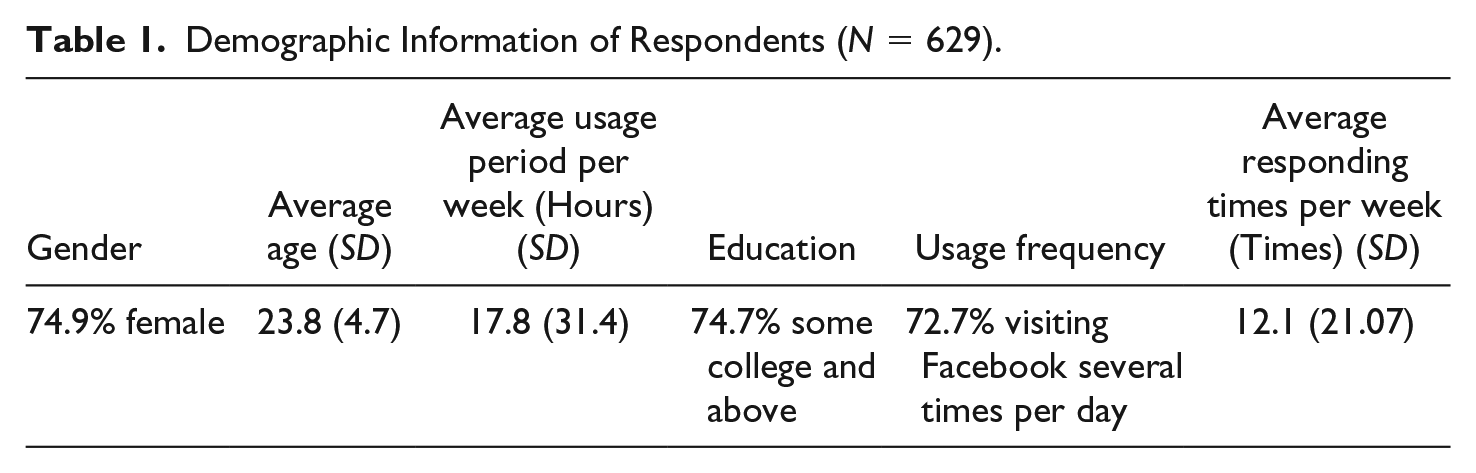
Further analysis indicates that the majority of our responses were provided by college students (63.9%). However, our sampling remains in line with the profile of Facebook users of recent reports in that the majority of active users (associated with the evaluation of products, brands, and services) were female (Vermeren, 2015), between 18 and 29 years of age (87%; Duggan, Ellison, Lampe, Lenhart, & Madden, 2015), and had college and above degrees (91.2%; Fang, Tang, Li, & Wu, 2018). This observation suggests that the sample in this study was indeed representative of the population of interest (i.e., active Facebook users interested in seeking information regarding experience-goods and services in Taiwan). Note that justification for our sample characteristics (female, around the age of 24, and highly educated) is threefold. First, we posted survey advertisements and invitations on fan pages, and in groups and chat rooms related to apparel, health and beauty products, restaurants, and travel services, which attract more females, college students, and younger users. Second, women, in general, are more enthusiastic about answering a questionnaire regarding shopping issues than men (Farag et al., 2007). And third, according to a 2017 survey reported by the Market Intelligence & Consulting Institute, mainstream Facebook users who more frequently look for product information are between 20 and 24 years of age and female. Therefore, there is sound reasoning for including their responses as valid data.
Data Analysis
We apply a two-step approach to analyze data: the first step includes analysis of the measurement model, while the second investigates structural relationships among the latent constructs. The two-step approach is to establish the reliability and validity of the measures before evaluating the structural model. SmartPLS (Ringle, Wende, & Becker, 2015) was applied to evaluate both the measurement model and the structural model because it permitted the latent constructs to be treated as reflective or formative indicators.
Measurement Model
We assessed the reliability, convergent validity, and discriminant validity of the measurement model. Findings suggest adequate reliability and convergent validity because all constructs fulfilled the recommended threshold of 0.7 for composite reliability (CR) and 0.5 for AVE (AVE ranging from 0.63 to 0.94), whereas all indicator loadings exceeded 0.7 (Supplemental Appendix A, Fornell & Larcker, 1981). Discriminant validity is sufficient because the square root of any construct’s AVE exceeded its correlations with other constructs (Table 2, Fornell & Larcker, 1981).
Correlations Among Constructs and the Square Root of the AVE.

Note. The diagonal elements (in bold) represent the square root of the AVE. Please refer to Supplemental Appendix A for the abbreviation of each construct. AVE = average variance extracted.
To test the threat of common method bias, first, Harman’s one-factor test was conducted. The first factor derived from principal components factor analysis did not explain a majority of the covariance among all the constructs (14%; Podsakoff & Organ, 1986). Second, the correlation matrix (Table 2) did not reveal any highly correlated constructs (e.g., r > .90), indicating a lack of common method bias (Bagozzi, Yi, & Phillips, 1991). Hence, all of these results suggest that common method bias is not a serious threat to the validity of the study. Furthermore, multicollinearity is not a serious issue in this study because tests of variance inflation factors (ranging from 1.46 to 3.07) and condition numbers (5.56) lay below danger levels (3.3 and 10, respectively).
Structural Model
In PLS analysis, investigating the structural paths (using the standardized path coefficients) and R2 values of endogenous variables evaluates the explanatory power of a structural model (Figure 2). All paths were significant, with a p value below .05, indicating support for all hypotheses. Our model accounted for a considerable proportion of the variance of decision performance (R2 = .66) and continuance intention (R2 = .42), empirically supporting the validity and explanatory ability of the model. A goodness-of-fit (GoF = 0.64), calculated from the geometric mean of the average communality and average R2 (for endogenous constructs), is above the cutoff value for a large effect size (0.36; Wetzels, Odekerken-Schröder, & Van Oppen, 2009), supporting the fit of the structural model.
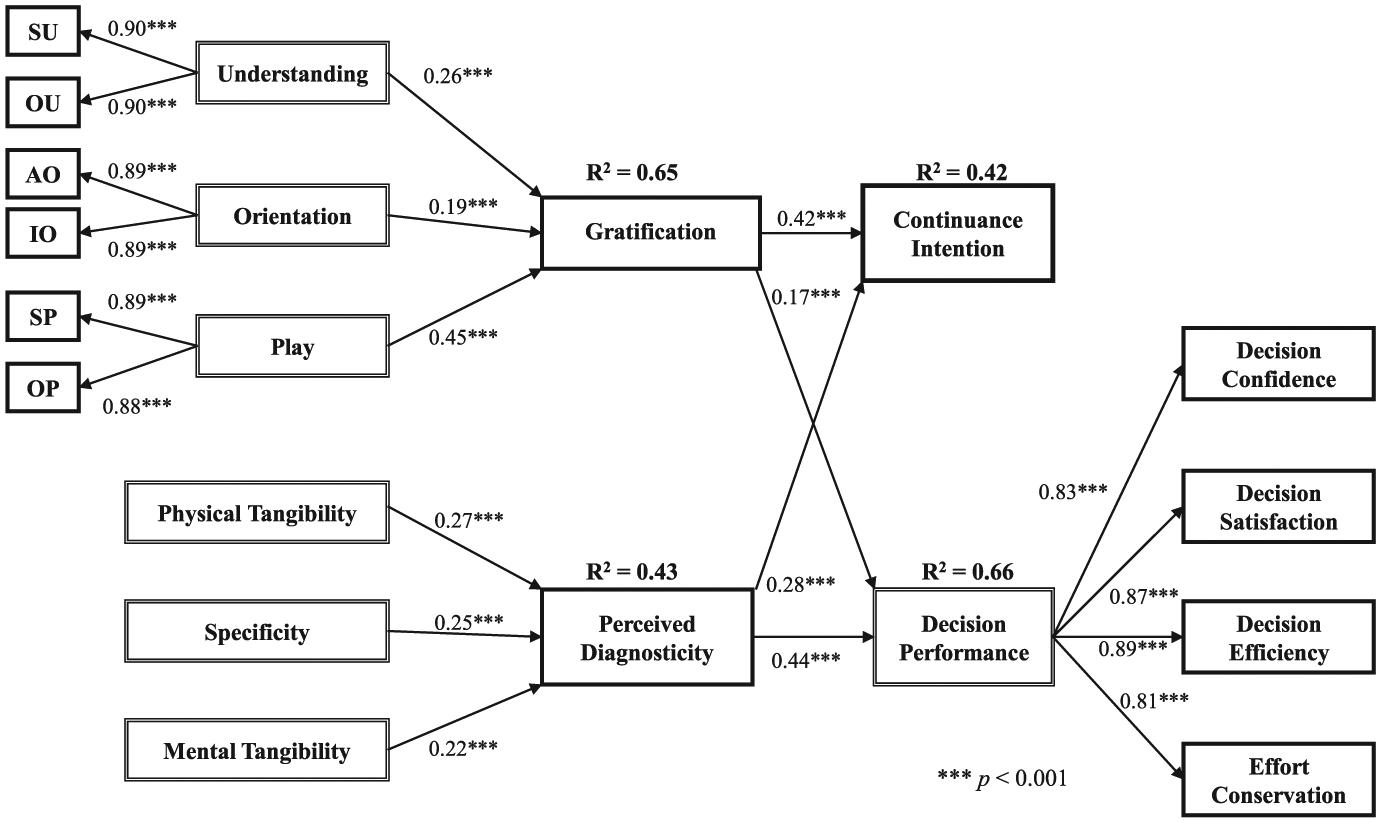
SmartPLS analysis of the research model.
Model comparisons were conducted by comparing the full model (containing the MSD path and the tangibility path) with each of the single model paths (Homburg, Wieseke, & Hoyer, 2009). Results show that the full model proposed (Gof = 0.64; R2 = .66) provides a significantly better model fit than either the MSD path (Gof = 0.62; R2 = .58) or tangibility path (Gof = 0.61; R2 = .65). This indicates that the full model is superior to both single models. Specifically, a significance test for the differences between R2 values was performed by commutating F values and their effect size (Cohen, 1988). The R2 differences are statistically significant with effect size f2 (0.24 and 0.03), falling between the medium and large effect sizes, and between the small and medium effect sizes, respectively. 4 We find that both the tangibility path and MSD path significantly increase R2 relating to decision performance. Hence, the full model has substantially higher explanatory power than the model with either path.
Further analyses were performed to investigate the moderating hypotheses (H5 to H6). H5a and H5b were analyzed by comparing the path coefficients from gratification to decision performance and from perceived diagnosticity to decision performance in the low-HSD model, with corresponding path coefficients in the high-HSD model (Chin, Marcolin, & Newsted, 2003). A similar process was applied to HSA for examining H6c and H6d. Table 3 summarizes the testing. Concerning the moderating effects of HSD, Table 3 reveals that for high-HSD users, gratification has a smaller influence on decision performance than for those with low HSD, whereas diagnosticity has a greater influence on decision performance than for those with low HSD, which support H5a and H5b (t = 21.87 and 14.03, respectively, p < .001). As predicted, for the high-HSA users, gratification has a greater impact on decision performance (t = 44.48, p < .001) than for those with low HSA, whereas a reverse result was found between diagnosticity and decision performance. That is, diagnosticity has a smaller effect on decision performance (t = 20.26, p < .001) than for low-HSA users. Accordingly, results support H6a and H6b.
Path Coefficients and the Results of Moderating Effect Testing for help-seeking logic-Dependent (HSD) and help-seeking logic-Autonomous (HAD).

Note. n.s. denotes insignificant impact.
p < .001.
Discussion and Implications
The purpose of this study is to gain more insights into HS on SMWs and how HS influences people’s decision-making process. Against this backdrop, we applied the HSM, MSD theory, tangibility theory, and HS logic to study the matter to develop a theoretical framework with potential academic and practical implications. Empirical results support our expectations that both the MSD path and tangibility path can significantly influence decision performance. Concisely, the MSD path employs three MSD factors (understanding, orientation, and play) so as to achieve the gratification of realizing MSD goals, which in turn contributes to help-seekers’ decision performance. Alternatively, the tangibility path employs three tangibility factors (specificity, physical tangibility, and mental tangibility) to realize the diagnosticity of tangible goals, which ultimately leads to a better judgment and decision. In addition, for HSD, the attenuation effect on those links between gratification, diagnosticity, and decision performance is verified in this investigation. Explicitly, HSD attenuates the link between gratification and decision performance, but reinforces the link between diagnosticity and decision performance. For HSA, the bias effect on links between gratification, diagnosticity, and decision performance are ultimately confirmed. That is, HSA can bias the impact of diagnosticity on decision performance, but strengthen the influence of gratification on decision performance. In the sections that follow, each of these results is discussed with its research implications and guidance for practice.
Theoretical Implications
With regard to the applicability of MSD theory to SMWs, the results are of great importance because the majority of research in MSD has drawn attention to single MSD links to approach either intention to continue using an SMW (Chiu & Huang, 2014) or loyalty toward a Facebook fan page (Ruiz-Mafe et al., 2014). What distinguishes this study from previous ones is that this study explores a tangibility path alongside the MSD path to approach decision performance in the case of HS on SMWs. According to the sufficiency principle under HSM (Eagly & Chaiken, 1993), people activate systematic processing (the tangibility path in this study) and carefully scrutinize all relevant information regarding a product or service to reach a sufficient degree of confidence that they have achieved their processing goals. Since the concept of tangibility can supplement the absence of physical accessibility to a product or service before purchasing and alter people’s decision-making outcomes (Laroche et al., 2001; Mazaheri et al., 2014), overlooking the tangibility path and related factors seems to be negligible when studying HS on SMWs. The tangibility path provides a promising direction for gaining a comprehensive understanding of the decision-making process. Study results reveal that the tangibility path is more salient than the MSD path in increasing decision performance (β = .44 and .17, respectively). These results imply that, in the case of HS on SMWs, although the media dependency consideration can contribute to help-seekers’ decision performance to a certain degree, the tangibility consideration adds more value to superior decision performance because it can tangibilize the functionality, design, and use experience of the target product or service. This study provides a significant step in this direction and is one of the first that empirically investigates both paths to decision performance on SMWs.
This research explicitly differentiates the MSD path and tangibility path, thereby expanding our understanding of the determinants of help-seekers’ decision performance on SMWs. Specifically, study findings indicate that gratification and perceived diagnosticity are significant determinants of decision performance, and they can account for a very substantial amount of the variance in decision performance (R2 = 66%). Results imply that gratification and perceived diagnosticity are possibly among the most salient antecedents of decision performance, and it is fruitful to take both notions into account when explaining decision performance in the context of SMWs.
From a descriptive standpoint, decision performance represents a key outcome in HS on SMWs that has been ignored in the literature. Specifically, decision confidence, decision satisfaction, decision effectiveness, and effort conservation serve as manifest indicators of decision performance. This study enhances previous findings on performance wherein measures of the dimensions of performance are best seen as reflective indicators of a general performance factor. In addition, mean values of the four dimensions of decision performance range from 5.10 to 5.67, indicating that help-seekers indeed highly confirm the help they gain from SMWs in determining their decision. Ultimately, decision effectiveness has the highest mean value (5.67), suggesting that generating productive outcomes is the key concern when people use an SMW to arrive at purchase decisions.
Furthermore, although not hypothesized, the links between gratification, diagnosticity, and continuance intention were examined. Results show that gratification has a strong effect on continuance intention (β = .42) and the effect was stronger than its effect on decision performance (β = .17). These findings not only agree with prior literature pertaining to the significant link between gratification and continuance intention (Chiu & Huang, 2014) but also show empirical support for an extended linkage between gratification and decision performance. A possible explanation is that the relative importance of gratification is context-specific in terms of its affected outcome variables. That is, gratification plays a crucial role in affecting continuance intention, but is not of the same importance in the case of decision performance. Future research is needed to examine other possible outcome variables as well as their associations with gratification in diverse contexts. Alternatively, results reveal that perceived diagnosticity has a stronger influence on decision performance (β = .44) than on continuance intention (β = .28). These findings imply that diagnosticity derived from helpful and tangible information on an SMW can not only enhance help-seekers’ decision performance but also promote their willingness to continue using the SMW. Altogether, results show the added value of investigating the influence of perceived diagnosticity on HS in the context of SMWs because it predicts decision performance more strongly than does gratification.
As predicted, all three tangibility constructs positively affect perceived diagnosticity. Comparing the importance of the three tangibility constructs, physical tangibility plays the dominant role, followed by specificity and mental tangibility. These results are compatible with the desired goals pursued in systematic processing: information reliability and accuracy (Chaiken & Ledgerwood, 2012). Since lack of physical contact with a product or service before buying has frequently been a barrier to shopping, online or offline, physical tangibility, in the form of helping an SMW user grasp, see, and touch a product or service (i.e., accessibility through the senses; Nepomuceno et al., 2012), is therefore deemed to be more significant than other factors in forming diagnosticity. On the other hand, results show that three second-order constructs—understanding, orientation, and play—as expected, are all significantly related to gratification in relying on SMWs for HS. These three factors explain 65% of the variances in gratification, with play taking the lead (β = .45) in shaping gratification. These findings are consistent with R. Chen’s (2013) assertion that entertainment value is at the heart of activities on SMWs.
Study results provide empirical evidence that confirms the proposed moderating effects of HS logic on linkages between gratification, diagnosticity, and decision performance. As expected, HSD can intensify the impact of diagnosticity on decision performance (H5b) but can attenuate the affect of gratification on decision performance (H5a; see Table 3). These findings support our conjecture that, for a high-HSD group, MSD consideration (i.e., gratification of MSD goals in this case) may correspond to a relatively wider and implicit judgment than diagnosticity (tangibility consideration), thus providing less help in arriving at a simple and quick decision when HS in the context of SMWs. As such, the high-HSD group pays more attention to diagnosticity than gratification when evaluating decision performance, compared with the low-HSD group. Indeed, these findings also confirm our conjecture that HSD activates the attenuation effect to transform key effects into more systematic relationships.
The results further confirm our expectation that HSA positively moderates the impact of gratification on decision performance (H6a) but negatively moderates the impact of diagnosticity on decision performance (H6b; Table 3). Although perceived diagnosticity remains the major driver of decision performance, regardless of the level of HSA held by help-seekers, its association with decision performance becomes weaker for high HSA individuals than those with low HSA. It appears that the bias effect occurs and influences strengths between gratification, diagnosticity, and decision performance. Taken together, first, although HS occurs every day in cyberspace, there is a void in our knowledge regarding the role of HS logic in the context of SMWs. The extension of HS logic to the SMW environment underlying this study thus contributes to the literature in this domain. Second, it is always interesting to look for moderating variables that turn simple effects into more thoughtful relationships (Fang, 2014). Recognition of HS logic represents an incremental contribution that offers a richer understanding of how gratification, diagnosticity, and each of their associations with decision performance can be intensified or attenuated through diverse mechanisms (the attenuation effect or bias effect) for different users, and therefore, SMW research and practice in the communication discipline.
Practical Implications
The key practical implication from this study is that a clear understanding of the dual mechanisms through what HS achieves is vital to the judgment of decision performance on SMWs. Practitioners can benefit from study findings by learning about the prospective value of diverse supports afforded by SMWs and acquiring new guidelines to design more effective mechanisms that help consumers. In general, when launching campaigns designed to promote their product or service, companies and marketers should not depend exclusively on one medium (e.g., brand websites). Creating social marketing campaigns is a brilliant means to reach potential consumers and influence their purchase selection because SMWs can increase the visibility of products and services. Indeed, the findings of this study show that consumers incorporate both MSD and tangibility considerations, simultaneously, to arrive at their purchase decisions on SMWs. Incorporating tangibility considerations is beneficial to facilitating consumer purchase decision-making. For marketers and designers of SMWs, more advanced tools like virtual reality (VR) are needed to develop and enhance a variety of ways that tangibility can be presented on SMWs so as to assist a consumer’s product evaluation process. For example, VR can replicate a real or imagined environment that enables user interaction with a targeted product by generating a sensory experience that includes sight, touch, hearing, and smell. By such means, accessibility through the senses (physical tangibility), visualization of a targeted product/service (mental tangibility), and accurate description of an evaluated product/service (specificity) (Laroche et al., 2001) can be substantially reinforced and lead to explicit diagnosticity. This boosts consumers’ confidence, satisfaction, and efficiency in making their final decision, thus saving effort and time spent in the judgment process. That is, marketers and SMW designers can help consumers work smartly via tools and technologies such as this.
Regarding MSD considerations, study findings further reveal that play is a stronger predictor in shaping gratification than understanding and orientation. However, from the perspective of a manager or designer of SMWs, it would be particularly unfortunate to explain our results as implying that understanding and orientation may be paid less attention or neglected. The proper explanation is that given the situational context of this study’s sample, further increases in understanding and orientation may be less potent than similar increases in play. These findings open up a new avenue for SMW designers and managers to create a more friendly and interactive environment using various advanced mechanisms. For example, they can incorporate multimedia tools to allow multiuser synchronous communication and the concurrent exchange of multiple opinions to help people answer a help-seeker’s queries and resolve her/his problems simultaneously, thereby enhancing interpersonal interaction. Or they can invent ingenious techniques to analyze users’ interests and automatically display information to fit those interests, thus assisting users with their shopping plan and/or service needs.
Concerning the moderating effects of HS logic constructs, this study should be of special interest to SMW designers because its results affirm that HS tendencies can regulate consumers’ decision process in the context of SMWs. This observation poses a challenge for SMWs designers and marketers because information that is helpful and relevant is conditionally decided by HS tendencies of consumers. It is advisable to design innovative mechanisms (i.e., games or tests) embedded in new technologies (e.g., an artificial intelligence [AI] system) to collect and discover consumers’ tendency types to present them with appropriate information. For example, the presentation of more tangible information about a product or service facilitates clarity of judgment, something important to consumers who tend to look for a quick answer. Therefore, a wide breadth of information can be exceedingly helpful for consumers making wider-scoped evaluations. In this case, the display or presentation of such information can implicitly aid superior decision-making, so it is more useful to consumers who tend to automatically make broader inferences to arrive at a comprehensive judgment. As such, SMWs designers and marketers can more effectively target suitable information and even advertisements to their users, creating win-win situations by helping more people, and earning more money by selling advertisements (Loiacono, 2015).
Limitations and Future Research Directions
Several limitations require acknowledgment. First, the findings may have been influenced by selection bias because our sample merely involves current users of Facebook. Users who ceased utilizing Facebook might think differently about the influence of the two paths put forth in making a decision. Therefore, the findings should be explained as only enlightening the continuance intention and decision performance of current Facebook users. Future research can seek influential determinants of Facebook usage and decision performance from the position of noncurrent users. Second, the data were collected from users of a single SMW, Facebook. Although Facebook is the most popular SMW in the world, whether the key findings of this study can be generalized to other SMWs needs further study. Third, this study integrates theories of MSD, tangibility, and HS as building blocks to formulate two paths for exploring decision performance. An interesting direction for future research is to investigate the determinants of purchase decisions by incorporating cross-discipline perspectives. Fourth, although our samples—characterized as female, young, and highly educated—are in line with the target population of interest, our samples may be unbalanced in terms of gender, age, and education. This must be kept in mind when interpreting the empirical findings of our research. Therefore, future research can strengthen the generalizability of our model by clustering groups consisting of different genders, ages, and education-levels to obtain a more diverse sample to investigate.
Supplemental Material
Appendix_A-12-05-2018 – Supplemental material for A Dual Process Model of Help-Seeking on Social Media Websites
Supplemental material, Appendix_A-12-05-2018 for A Dual Process Model of Help-Seeking on Social Media Websites by Yu-Hui Fang in Communication Research
Footnotes
Declaration of Conflicting Interests
The author declared no potential conflicts of interest with respect to the research, authorship, and/or publication of this article.
Funding
The author disclosed receipt of the following financial support for the research, authorship, and/or publication of this article: This research is supported by the National Science Council under Research Grant NSC105-2410-H-032-054-MY2.
Supplemental material
Supplemental material for this article is available online.
Notes
Author Biography
References
Supplementary Material
Please find the following supplemental material available below.
For Open Access articles published under a Creative Commons License, all supplemental material carries the same license as the article it is associated with.
For non-Open Access articles published, all supplemental material carries a non-exclusive license, and permission requests for re-use of supplemental material or any part of supplemental material shall be sent directly to the copyright owner as specified in the copyright notice associated with the article.
