



Abstract
Research has revealed that crime tends to concentrate in families and that it also tends to be transmitted across generational lines. The current study expanded on this line of research by examining the familial concentration and transmission of crime in a sample of sibling pairs. Analysis of data drawn from the National Longitudinal Study of Adolescent Health (Add Health) revealed that 5% of all families accounted for more than 50% of all criminal arrests. Additional analyses revealed between-sibling similarity and intergenerational transmission in being arrested, being sentenced to probation, being incarcerated, and being arrested multiple times. Structural equation models (SEMs) were also estimated to examine the mechanisms that might account for the familial concentration and transmission of crime. These SEMs provided evidence indicating that the concentration and transmission of crime was due, in part, to genetic factors as well as mating patterns.
The finding that crime is concentrated in families and that it is transmitted across generational lines has been detected in a considerable amount of research (Farrington, 2010). Some of the earliest evidence uncovering the concentration and transmission of crime was reported by Dugdale (1887) in a study that purportedly showed that criminal behavior was highly embedded within a singular family, whom he called the Jukes. Although early research on this topic was somewhat crude, contemporary research has employed more sophisticated methodologies and more rigorous statistical procedures. Even with these methodological improvements, the results continue to show that crime and other antisocial behaviors are highly familial in that a small proportion of families account for a majority of all crimes (Farrington, Jolliffe, Loeber, Stouthamer-Loeber, & Kalb, 2001). In a similar vein, studies have revealed that there is a relatively strong degree of intergenerational transmission in crime and other types of misbehavior, wherein the offspring of criminal parents are significantly more likely to be arrested than the offspring of noncriminal parents (Farrington et al., 2001; Frisell, Lichtenstein, & Långström, 2011; Rowe & Farrington, 1997). These patterns of results have been reported across a wide range of heterogeneous studies, suggesting that the concentration and transmission of crime is a relatively indelible feature of certain families.
The current study seeks to build on the extant literature in three important ways. First, the statistical models estimated are designed to examine both the concentration and intergenerational transmission of arrests, being sentenced to probation, incarceration, and chronic offending. Second, unlike most of the existing research, which employs samples from non-U.S. countries or uses samples that are nonrepresentative or outdated, the current study analyzes a sample of sibling pairs drawn from a large, nationally representative, and contemporary sample of Americans. Third, in addition to providing descriptive information about the concentration and transmission of crime, some of the potential underlying explanatory mechanisms that might be able to account for the concentration and transmission of crime are also examined.
The Familial Concentration and Transmission of Crime
Just as a long line of research has revealed that a small proportion of all individuals commit the majority of all crimes (DeLisi, 2005; DeLisi & Piquero, 2011; Moffitt, 1993; Wolfgang, Figlio, & Sellin, 1972), research has also revealed that a small proportion of all families account for the majority of all arrests (Farrington et al. (2001); Farrington (2010). One of the main contributing reasons crime concentrates in families is because of sibling resemblance. What this means is that families that have one child who is antisocial or criminal are statistically more likely to have another child who is also criminal or antisocial. And the more chronic and severe the antisocial behavior, the more likely it is that the siblings will also engage in crime. The opposite, however, also appears to be true in that families where one child is not a criminal translates into a lower probability that his or her siblings will become a criminal. The end result is that criminal siblings tend to “pile up” in certain families, thereby disproportionately increasing the number of crimes committed by those families.
There is a great deal of research that has revealed that there is sibling similarity in antisocial behaviors. For example, in some early work on this topic, Rowe and his colleagues found that there was a significant association in self-reported delinquency between siblings (Rowe, Linver, & Rodgers, 1996). Other studies have also reported between-sibling correlations on delinquency (Lauritsen, 1993; Rowe & Gulley, 1992) as well as on other measures of antisocial behavior, such as aggression (Garcia, Shaw, Winslow, & Yaggi, 2000), drug use (Rowe & Gulley, 1992), alcohol consumption (Conger & Rueter, 1996), and other forms of externalizing behaviors (Kim, Hetherington, & Reiss, 1999).
The major drawback to these studies is that although the behaviors of focus are known correlates to crime, they are not necessarily measures of criminal involvement or of contact with the criminal justice system. There are studies that have examined more direct measures of crime, such as arrests and convictions (van de Rakt, Nieuwbeerta, & Apel, 2009). The results of these studies have provided estimates that parallel those reported using criminogenic risk factors. In an early study of Glasgow boys, for instance, T. Ferguson (1952) reported strikingly high and significant between-sibling concordance rates for criminal convictions. More recent research conducted by Farrington and colleagues has also revealed similar findings in their analyses of data from the Cambridge Study in Delinquent Development (CSDD; Farrington et al., 2006). In one study, for example, Farrington et al. (1996) reported that having a convicted brother or sister predicted the respondent’s own probability of being convicted (see also Rowe & Farrington, 1997). Overall, the findings from Farrington et al.’s studies have revealed that approximately 50% of all criminal convictions were attributable to approximately 6% of all families. Or, using a slightly different cut point, approximately 10% of all families accounted for more than 60% of all criminal convictions (Farrington et al., 2001).
Not only does crime tend to concentrate among siblings from the same household, but there is also strong evidence indicating that crime is transmitted across generational lines (Moffitt & Caspi, 2003; Walters, 1992). Similar to the studies examining the concentration of crime, much of the intergenerational transmissions research has focused on antisocial behaviors that are not direct measures of crime. For example, research has revealed statistically significant associations between parents and their children on measures of aggression (Huesmann, Eron, Lefkowitz, & Walder, 1984; Zoccolillo et al., 2005), levels of self-control (Boutwell & Beaver, 2010), externalizing behaviors (Bornovalova, Hicks, Iacono, & McGue, 2010; Hicks, Krueger, Iacono, McGue, & Patrick, 2004; Thornberry, Freeman-Gallant, Lizotte, Krohn, & Smith, 2003), and other types of psychopathologies (Loeber, Hipwell, Battista, Sembower, & Stouthamer-Loeber, 2009).
Importantly, studies that have employed direct measures of criminal behavior have consistently produced evidence indicating that crime is transmitted from parent to offspring. Some of the most compelling evidence underscoring the intergenerational transmission of crime once again comes from Farrington and colleagues’ analyses of the CSDD (Farrington et al., 2006; Farrington, Gundry, & West, 1975; West & Farrington, 1977). Farrington et al.’s studies have revealed, for instance, that boys who had a criminal mother or father were significantly more likely to be arrested than boys who did not have a criminal parent. In addition, analyses of the CSDD also revealed significant intergenerational transmission from grandparent to parent and from parent to child (Farrington, Coid, & Murray, 2009). Studies analyzing samples other than the CSDD have also detected intergenerational transmission in violent offending (Putkonen, Ryynänen, Eronen, & Tiihonen, 2007), chronic offending (van de Rakt, Nieuwbeerta, & de Graaf, 2008), and even domestic violence (Ehrensaft et al., 2003). Similar results have been detected in a population-based study of 12.5 million people from Sweden, wherein statistically significant associations were reported between violent crime in parents and violent crime in their children (Frisell et al., 2011) as well as in a sample drawn from the Netherlands (Bijleveld & Wijkman, 2009). Taken together, virtually all of the available evidence indicates that crime is highly concentrated in a small proportion of families and that crime is transmitted intergenerationally from parent to offspring. The looming question, then, is what factor or factors explain this familial concentration and transmission of crime?
Explanations for the Concentration and Transmission of Crime
Explanations for the concentration of crime within families and the intergenerational transmission of crime tend to go hand in hand with each other, wherein an explanation for the concentration of crime is also typically applied to the transmission of crime. Although there has been a wide range of explanations advanced to account for the concentration and transmission of crime, Farrington et al. (2001) identified six categories of explanations. These explanations can be further grouped into three overarching perspectives: (a) those that emphasize environmental factors to explain the concentration and transmission of crime, (b) those that emphasize genetic factors to explain the concentration and transmission of crime, and (c) those that combine genetic and environmental explanations (e.g., assortative mating).
Environmental explanations
Farrington et al. (2001) discussed four explanations for the concentration and transmission of crime that largely focus on environmental factors. First, they noted that the familial concentration of crime could be the result of a criminal justice system bias against certain (criminal) families. According to this perspective, the police may be more apt to arrest children from families with parents who are known to law enforcement agencies. After these children are arrested, they may be subjected to harsher prosecutorial decisions and even harsher sentences. In this case, it is the bias of the criminal justice system that is largely driving the concentration of crime within families.
The second environmental explanation advanced by Farrington et al. (2001) is that criminogenic risk factors are passed along generational lines, and these risk factors are thus likely to be concentrated in certain families. When multiple criminogenic factors are nested in the same family, the likelihood of crime, delinquency, and serious violence increases precipitously. For example, Hawkins and his colleagues (1998) conducted a thorough review of the predictors of youth violence. Their review revealed that as the number of risk factors increased, so too did the odds of being convicted for violence. Specifically, they reported that only 3% of youths with zero risk factors were convicted for violence, compared against 31% of youths who had four or five risk factors. Keep in mind that multiple risk factors include all types of risk factors, but much research has focused on environmental factors, such as poverty, family size, neighborhood conditions, and parenting practices (see Huizinga & Jakob-Chien, 1998).
Third, Farrington et al. (2001) pointed out that family members, including parents and siblings, may have a direct socializing effect on offspring in the family. This socialization effect is likely to be in the form of mimicry and learning where offspring imitate the antisocial behaviors of their parents and/or their siblings (Akers, 1998; Rowe & Farrington, 1997). There is some evidence in favor of this perspective in that studies have revealed that between-sibling similarity in delinquency is most pronounced among siblings who are close in age (West & Farrington, 1977), presumably the ones whom they value the most and with whom they have the most contact.
The last environmental explanation for the concentration and transmission of crime underscores the very real possibility that the effect of parental criminality and crime on offspring crime is mediated by environmental factors, especially parenting techniques. This explanation highlights the literature revealing that parental socialization is one of the main contributors to adolescent delinquency and lifelong involvement in crime (Gottfredson & Hirschi, 1990; Sampson & Laub, 1993). Moreover, this perspective also draws from research revealing that antisocial and criminal people typically do not engage in the types of parenting practices that promote prosocial behavior (Boutwell & Beaver, 2010; Nofziger, 2008). As a result, the link between criminal parents and criminal offspring is explained in terms of the way in which criminal parents socialize their children, which also explains why delinquency and crime tend to be concentrated among siblings—because they are all socialized by the same parents in approximately the same way.
All of these explanations emphasize different environmental factors to explain the concentration and transmission of crime, and obviously a single study is unable to test all of these different mechanisms. However, it is possible to identify salient risk factors that cut across most of these explanations and then to use those factors as the focal point of analysis. One group of risk factors that seems to have application to at least the last three explanations (excluding the criminal justice bias explanation) is the family environment. A disadvantaged family environment, for instance, is a known risk factor for antisocial behaviors (Moffitt, 1993), it is transmitted across generational lines (Huesmann et al., 1984; Belsky, Conger, & Capaldi, 2009), it is known to covary with other criminogenic risk factors (Boutwell & Beaver, 2010), and it has been shown to be a source of social mimicry (Akers, 1998). Against this backdrop, the family environment (with a focus on parenting) will be singled out as the environmental risk factor of interest in the current study.
Genetic explanations
In contrast to environmental explanations for the transmission and concentration of crime, Farrington et al. (2001) also argued that genetic factors could explain the concentration and transmission of crime. According to this explanation, the intergenerational transmission and familial concentration of crime is the result of genetic risk factors that are concentrated in certain families. These genetic risk factors are then passed along to offspring, which accounts for the significant associations between parents and their children on measures of crime. This argument, however, hinges on whether criminal behavior is influenced by genetic factors; if it is not, then the parent-offspring similarity in crime would have to be attributable to environmental factors. A large body of research exists that has tested genetic influences on crime, and the results of these studies have revealed that crime and other antisocial behaviors are heritable, with approximately 50% of the variance being explained by genetic factors (Moffitt, 2005). Seen in this way, the concentration of crime among biological relatives (including the transmission across generational lines) is the result of the genetic material that is shared among biological relatives (and that is transmitted from parent to offspring). Having a criminal biological parent or sibling, then, is simply a proxy indicator for the latent genetic risk that is evident within the family.
An integrated explanation
Although it may seem as though the environmental and genetic explanations are mutually exclusive and incompatible with each other, this is not the case. A large body of research has revealed, for example, that although genetic factors account for approximately half of the variance in antisocial behaviors, environmental factors also explain half of the variance (C. Ferguson, 2010; Mason & Frick, 1994; Miles & Carey, 1997; Rhee & Waldman, 2002). These findings thus are in direct opposition to nature-versus-nurture explanations to crime. Plus, what is even more revealing is that there has been a wave of research indicating that environmental factors and genetic factors work interactively and that it is the combination of both sets of factors that ultimately produces antisocial behaviors, such as crime and delinquency (Guo, Roettger, & Cai, 2008; Moffitt, 2005; Simons et al., 2011).
One interesting finding that has emerged out of the literature and that is compatible with an integrated explanation is that mates tend to be very similar to each other on a wide range of traits, behaviors, values, and other characteristics. This phenomenon is known as assortative mating, and there is evidence that mates tend to be similar on antisocial behaviors and traits. For instance, Krueger, Moffitt, Caspi, Bleske, and Silva (1998) analyzed data from the Dunedin Multidisciplinary Health Study and reported mate correlations of greater than r = .50 for antisocial behaviors. Similarly, Boutwell and Beaver’s (2010) analysis of the Fragile Families and Child Wellbeing Study revealed statistically significant associations between mates on their levels of self-control. Assortative mating has important consequences for the concentration and transmission of crime because children born to criminal parents are likely to be saturated with genetic risk factors (from both parents) as well as environmental risk factors (e.g., poverty, living in a disadvantaged neighborhood, etc.) that are known to covary with having criminal parents. As a result, assortative mating is a salient process to study when attempting to uncover the mechanisms that ultimately are responsible for the concentration and transmission of crime.
The Current Study
There are five goals of the current study. First, the concentration of criminal arrests across families is examined by analyzing a sample of sibling pairs drawn from a nationally representative sample of American youths. Second, sibling similarity is estimated on four criminal justice outcome measures: arrests, probation, incarceration, and being arrested multiple times. Third, the intergenerational transmission of crime from parents (both mother and father) to their offspring is examined. Fourth, the potential factors that could explain the transmission and concentration of crime are explored by evaluating the effects of family risk and genetic risk on the four criminal justice outcome measures. Last, assortative mating patterns for criminal involvement between mates are estimated.
Method
Data
Data for this study came from the National Longitudinal Study of Adolescent Health (Add Health). The Add Health is a four-wave study of a nationally representative sample of American youths who were enrolled in middle and high schools during the 1994-1995 academic school year (Udry, 2003). The first round of surveys, known as the Wave 1 in-school surveys, was administered to youths at school. Youths were asked a range of questions pertaining to their social relationships, family life, and demographics. Approximately 90,000 adolescents participated in the Wave 1 in-school component to the study. To gain more detailed information from the adolescents, the researchers selected a subsample of youths and their primary caregivers (usually their mother) to be reinterviewed at their homes. The Wave 1 in-home surveys included questions asking about delinquency, risky sexual behaviors, and relationships, among other topics germane to adolescents. Overall, 20,745 youths and more than 17,000 primary caregivers were included in the Wave 1 in-home component to the study (K. Harris et al., 2003).
The second wave of data was collected approximately 1 to 2 years after the first wave of data was collected. Because most of the respondents were still adolescents at Wave 2, most of the same questions that were included in the Wave 1 surveys were retained at Wave 2. For example, youths were asked about their delinquent involvement, their family life, and their social relationships. Overall, 14,197 youths were successfully interviewed at Wave 2. The third wave of data was collected in 2001-2002, approximately 7 years after the commencement of the study. Given that the respondents were now young adults, the questions asked at the two previous waves were no longer age appropriate. As a result, the questionnaires were redesigned at Wave 3 to include items that were more germane to young adults. For example, participants were asked about their employment and educational histories, their marital status, and their child-rearing experiences. A total of 15,197 respondents participated in the Wave 3 component of the study (K. Harris et al., 2003). The fourth and final wave of data was collected in 2007-2008, when most of the respondents were between the ages of 24 and 32 years old. Participants were asked an array of questions pertaining to their lifetime contact with the criminal justice system, their childbearing and child-rearing histories, and their romantic relationships. Altogether, 15,701 respondents were successfully interviewed at Wave 4.
One of the distinguishing features of the Add Health study is that embedded within the nationally representative sample is a subsample of kinship pairs. During Wave 1 interviews, respondents were asked whether they had a twin. If they responded in the affirmative, then their twin was added to the sample. Additionally, respondents were asked whether they lived with a half sibling, an unrelated sibling, or a cousin. If their sibling or cousin was between the ages of 11 and 20 years of age, then their sibling or cousin was also included in the study. Finally, a probability sample of full siblings was also included in the sample (Jacobson & Rowe, 1999). In total, more than 3,000 kinship pairs are nested within the data (K. Harris, Halpern, Smolen, & Haberstick, 2006).
Measures
Child criminality
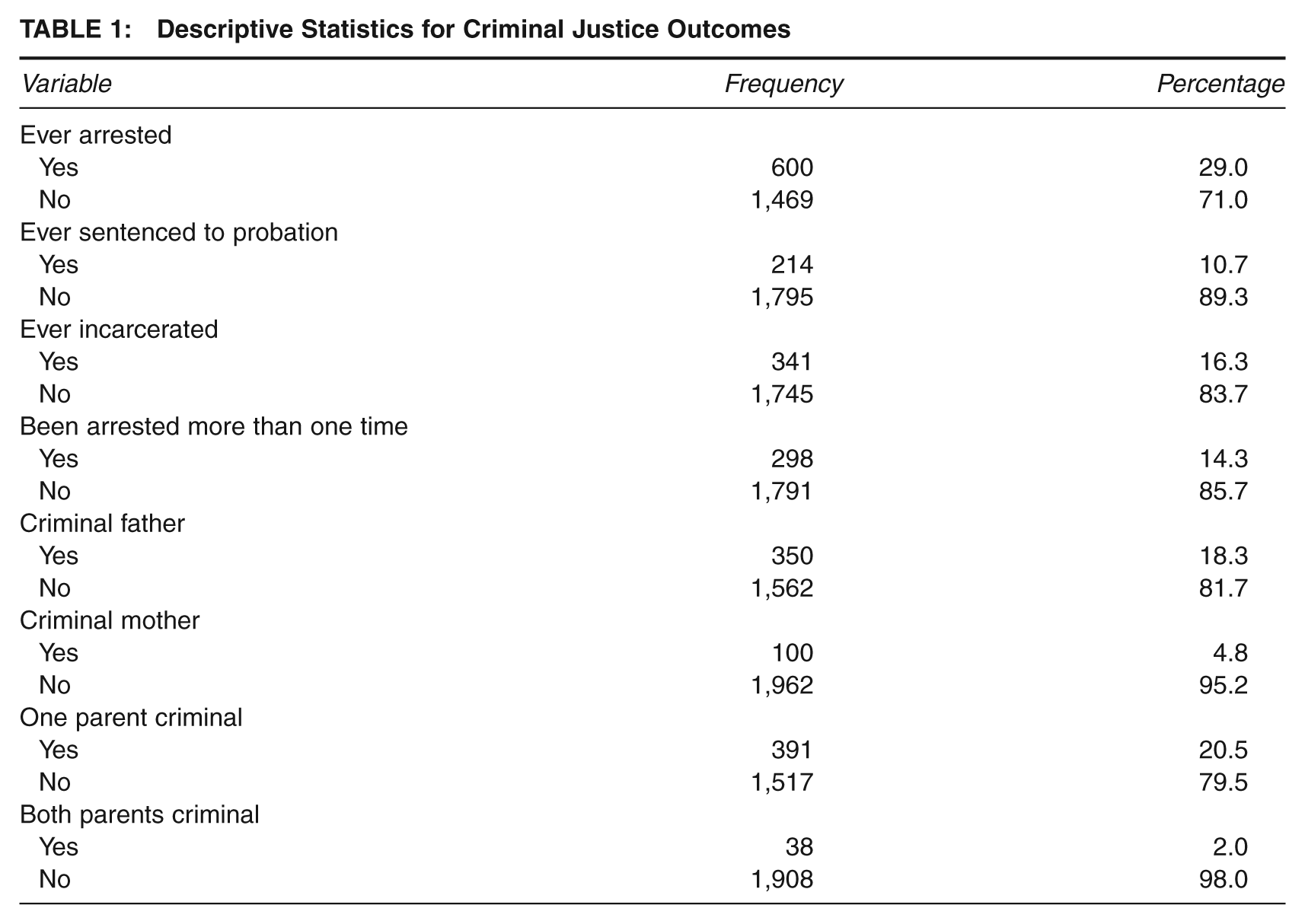
During Wave 4 interviews, respondents were asked a series of questions that were designed to measure their lifetime contact with the criminal justice system. Four of these measures were used in the current study. Specifically, participants were asked whether they had ever been arrested (ever arrested), whether they had ever been sentenced to probation (ever sentenced to probation), whether they had ever been incarcerated (ever incarcerated), and whether they had been arrested more than one time (arrested more than one time). All of these items were coded dichotomously, where 0 = no and 1 = yes. Additionally, respondents were asked how many times they had been arrested before their 18th birthday and how many times they had been arrested since their 18th birthday. Responses to these two questions were summed together to index the total number of arrests that each respondent accrued in their lifetime. Table 1 provides descriptive statistics for all of the criminal justice outcome measures that are used in the analyses.
Descriptive Statistics for Criminal Justice Outcomes
Parental criminality
Parental criminality was measured in four different ways. During Wave 4 interviews, respondents were asked to indicate whether their biological father had ever spent time in jail or prison (0 = no, 1 = yes). Similarly, during Wave 4 interviews, respondents were also asked to indicate whether their biological mother had ever spent time in jail or prison (0 = no, 1 = yes). Both of these dichotomously coded variables were then used to create two additional parental criminality variables. First, a binary measure was created to indicate whether at least one parent (i.e., either their father or their mother) had been arrested (0 = no, 1 = yes). Second, a binary measure was created to indicate whether both parents had been arrested (0 = no, 1 = yes).
Family environment
Two scales were employed to measure the family environment: a Lack of Maternal Attachment scale and a Maternal Disengagement scale. During Wave 1 interviews, respondents were asked two items that tapped maternal attachment: how close they feel to their mother and how much they think their mother cares about them. Responses to these items were reverse-coded and then summed together to create the Lack of Maternal Attachment scale, where higher values represent less maternal attachment (α = .64). Also at Wave 1, respondents were asked five items pertaining to maternal disengagement. For example, they were asked how warm and loving their mother was, how much they talk with their mother, and the overall quality of their relationship with their mother. Responses to the five items were summed to create the Maternal Disengagement scale, where higher values represent more maternal disengagement (α = .84). Both of these scales have been used previously by researchers analyzing the Add Health data (Beaver, 2008; Haynie, 2001; Schreck, Fisher, & Miller, 2004).
Plan of Analysis
The analysis for this study proceeded in five steps. Before outlining the steps of the analysis, however, it is important to note that all of the analyses are based on only two siblings per household. Although the Add Health data collected information about more than two siblings for some of the households, the current study randomly selected two siblings per household. So, if a household included three siblings, only two siblings were selected from that household for inclusion in the final analytic sample. That way, comparisons in criminal arrests across families would be based on the same number of siblings.
The first step in the analysis was to examine the concentration of criminal arrests across families. To do so, the variable total number of arrests was aggregated for both siblings in the same household. Then, the distribution of arrests was examined across the families to estimate the degree to which criminal arrests concentrates in families. Second, sibling similarity in the four dichotomous criminal justice outcome measures (i.e., ever arrested, ever sentenced to probation, ever incarcerated, and been arrested more than one time) was examined. In these analyses, scores on the criminal justice outcome measure for one sibling were used to predict the probability that his or her sibling would have experienced that particular criminal justice sanction or outcome. Effects were presented as odds ratios (with 95% confidence intervals) to facilitate interpretation of the results. The third step was to examine parent-child similarity in criminal justice outcomes. These analyses were conducted by using the four dichotomous parental criminality measures (i.e., criminal father, criminal mother, at least one criminal parent, and two criminal parents) to predict the probability that a child experienced the four different criminal justice outcome measures. For these analyses, one sibling was randomly selected to be included in the analysis and the other sibling was deleted. In line with the previous statistical models, the effect sizes were presented as odds ratios.
The last two steps in the analyses estimated structural equation models (SEMs) using the statistical software program AMOS 18.0. The fourth step in the analysis estimated SEMs to explore the interrelationships among parental criminality, family environment, and child criminality. Figure 1 portrays the SEMs that were estimated. Two points are worth noting. First, both parents and both siblings were employed in these SEMs, with the unit of analysis as the family. Second, for each of the latent constructs, there are two duplicate observable indicators: one reported on by Child A and one reported on by Child B. The parameter estimates in Figure 1 will be discussed in the Results section.
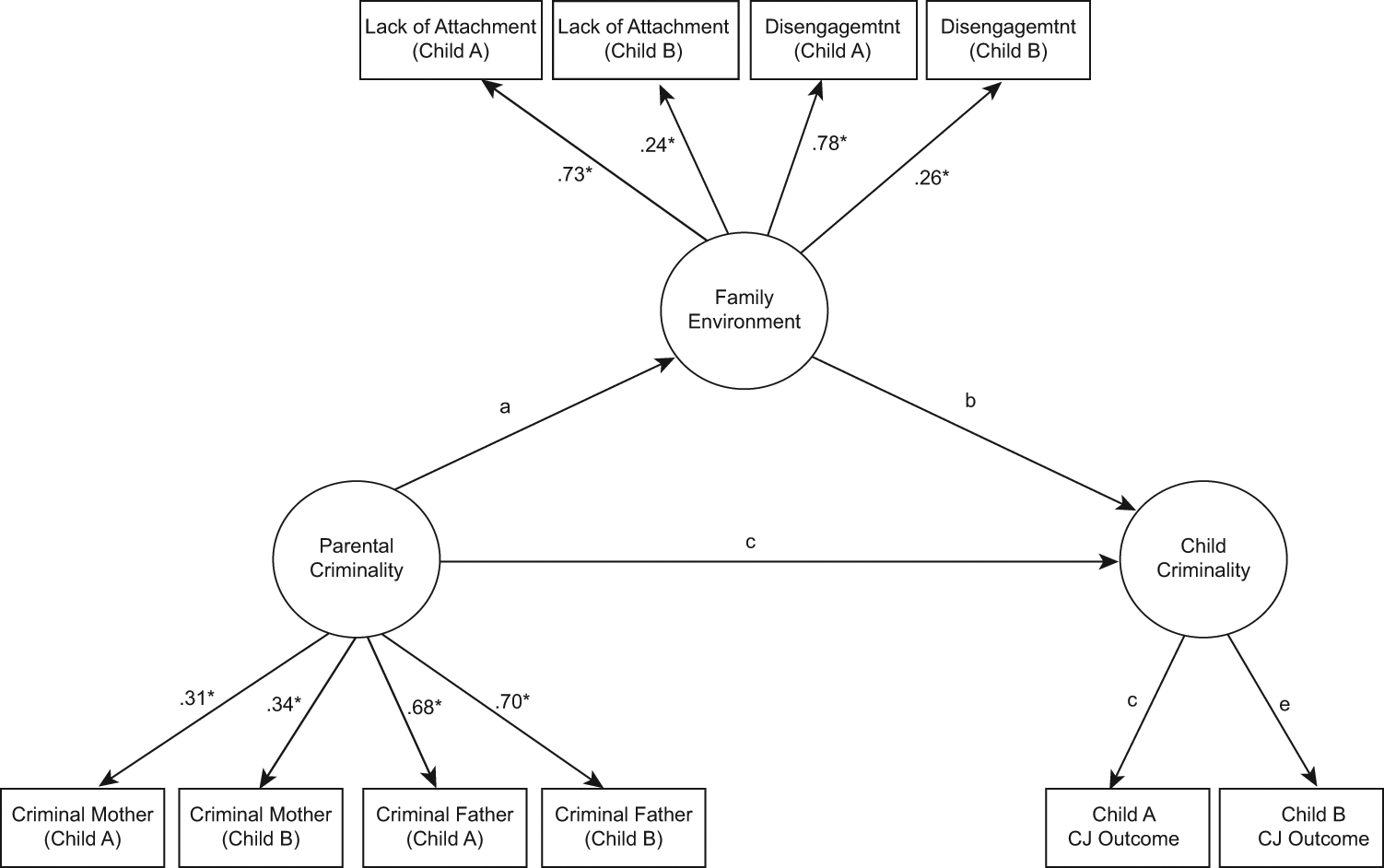
Empirical Assessment of the Interrelationships Among Parental Criminality, Family Environment, and Child Criminality
The last step of the analysis estimated an SEM to examine assortative mating in criminal arrests between the respondent’s father and the respondent’s mother. To do so, two latent factors were created: one for the father and one for the mother. The observable indicators for these latent constructs were the criminal father variable (reported on by Child A and by Child B) and the criminal mother variable (reported on by Child A and by Child B). In short, sibling reports of their parents’ criminal history were used to create the latent constructs of criminal father and criminal mother.
Results
The analysis for this article began by examining the concentration of criminal arrests across the families. The concentration of criminal arrests across families was estimated by identifying the families who scored in the top 5% in terms of criminal arrests, those who scored in the top 10% of all criminal arrests, and those who scored in the top 25% of all criminal arrests. The results of these analyses are presented in Table 2. As can be seen, the top 5% of criminal families accounted for 53% of all criminal arrests in the sample, tabulating almost 1,300 arrests, with an average of 13.96 arrests per family. The top 10% of criminal families accounted for 79% of all arrests, with an average of 8.89 arrests per family. All of the criminal arrests were accounted for by the top 25% of criminal families, with an average of 5.51 arrests per family. Taken together, these results indicate that criminal arrests tend to be confined to a relatively small percentage of all families.
The Concentration of Criminal Arrests in Families

The next set of analyses examined sibling similarity in criminal justice outcomes by estimating odds ratios for all siblings (Child A’s score predicting Child’s B score), for same-gender siblings (only brothers or only sisters), for brothers only, and for sisters only. The results of these models are presented in Table 3. As can be seen, across 16 equations, sibling similarity was statistically significant at the .05 level in 15 of them, with the one null effect marginally significant (p = .06). The effect sizes ranged in magnitude from 2.16 to 7.80. In short, the analyses presented in Table 3 provide evidence that siblings are similar in criminal justice outcomes.
Odds Ratios (ORs) for Sibling Similarity in Criminal Justice Outcomes
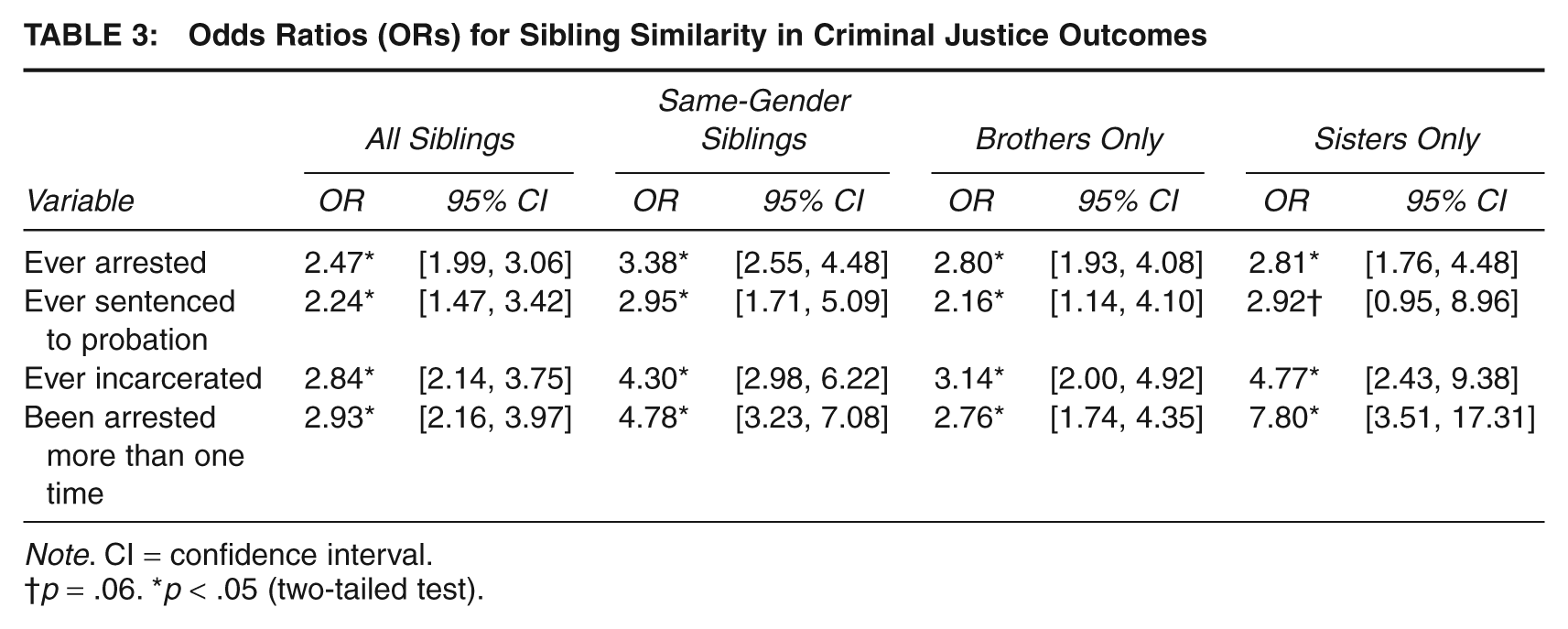
Note. CI = confidence interval.
p = .06. *p < .05 (two-tailed test).
The analysis now turns to the models estimating parent-child similarity in criminal justice outcomes. Recall that for these models, only one child was included in the analyses. Table 4 shows that the criminal parent variable is included in the column headings, and criminal justice outcome of the child is included in the rows. The effects, once again, are presented as odds ratios. Similar to the results garnered for the sibling similarity models (Table 3), the parent-child models reveal a high degree of similarity, where the criminal status of the parents significantly predicted the probability that the child would experience criminal justice sanctions or outcomes. Of the 16 models estimated, the odds ratio was statistically significant in 15 of them. These results suggest that criminal behavior is transmitted from parent to child and that this transmission is relatively strong regardless of whether the father is a criminal, the mother is a criminal, or both parents are criminals.
Odds Ratios (ORs) for Parent-Child Similarity in Criminal Justice Outcomes
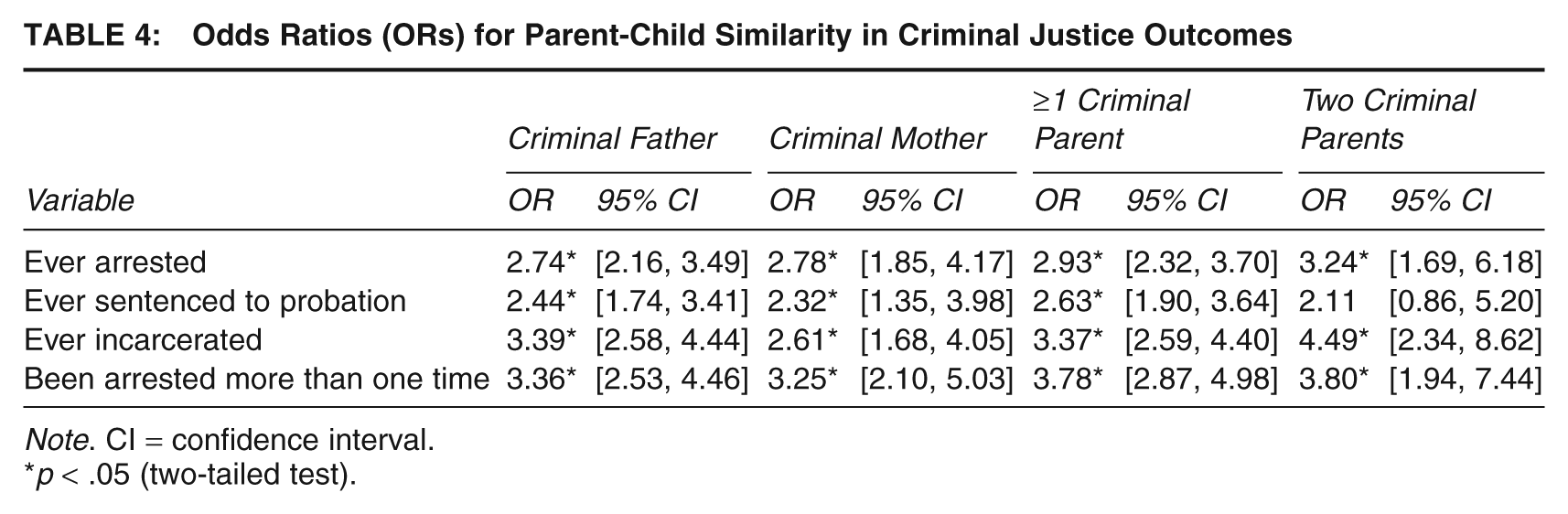
Note. CI = confidence interval.
p < .05 (two-tailed test).
Thus far, the analyses have revealed that criminal arrests concentrate in families, that there is a high degree of similarity in criminal justice outcomes between siblings, and that there is significant intergenerational transmission of criminal behavior. Next, a series of SEMs was estimated to examine the interrelationships among parental criminality, family environment, and child criminality. Referring back to Figure 1, it is easy to see that the three main constructs are all modeled as latent factors. Parental criminality is, for example, a function of criminal mother (reported on by both siblings) and criminal father (also reported on by both siblings). As can be seen, the factor loadings for these four observable indicators are statistically significant. The family environment latent construct is defined by the Lack of Maternal Attachment scale (reported on by both siblings) and by the Maternal Disengagement scale (reported on by both siblings). Once again, the factor loadings for these four constructs were all statistically significant. Finally, the child criminality latent factor is defined by two observable indicators: one for Child A and one for Child B. Note, however, that since child criminality is operationalized in four different ways (ever arrested, ever sentenced to probation, ever incarcerated, and been arrested more than one time), the factor loadings are not presented in Figure 1 but, rather, will be presented in later analyses.
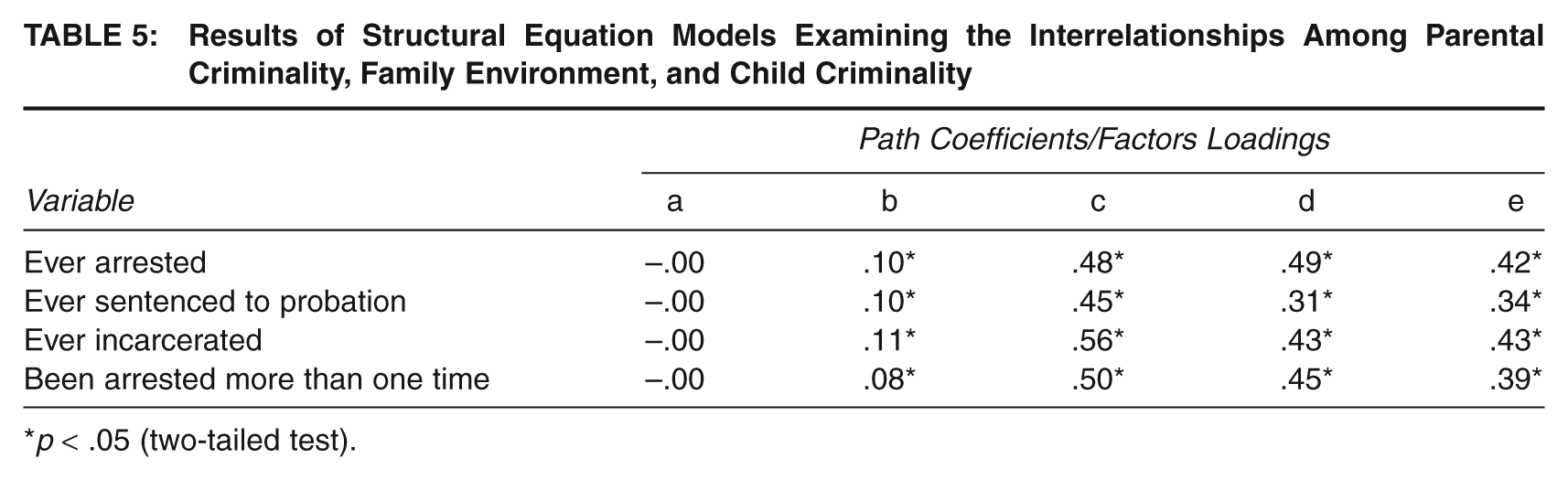
One additional comment about Figure 1 is important to make at this point—namely, that there are three path coefficients labeled as a, b, and c that need to be estimated. Path a provides information as to whether parental criminality is associated with the family environment. Path b provides information as to whether the family environment is associated with child criminality. Path c provides information as to whether the parental criminality is associated with child criminality after removing some of the effects that are tied to family socialization processes.
Table 5 presents the results of the SEMs estimated in Figure 1. The rows correspond to the various criminal justice outcome measures that were used to define child criminality. As can be seen (Path a), there is no association between parental criminality and the family environment. There is, however, a relatively small, but statistically significant, effect of family environment on child criminality across all four models (Path b). Of particular interest were the path coefficients estimating the direct effect of parental criminality on child criminality (Path c). Across all four of the models, this association was relatively large and statistically significant, with betas ranging between .45 and .56. The factor loadings (Paths d and e) were statistically significant for all four of the latent constructs that were used.
Results of Structural Equation Models Examining the Interrelationships Among Parental Criminality, Family Environment, and Child Criminality
p < .05 (two-tailed test).
Last, the analyses explored whether parents tend to be similar in their criminal behaviors. This possibility was examined by calculating an SEM, the results of which are presented in Figure 2. Importantly, the observable indicators for each of the latent constructs are the same items, but one is reported on by Child A, and the other is reported on by Child B. Of particular interest is the correlation between the two constructs, as it estimates the degree of similarity between parents in criminal behavior. As can be seen, this coefficient (r = .31) is statistically significant, meaning that parents tend to resemble each other in terms of their criminal histories.
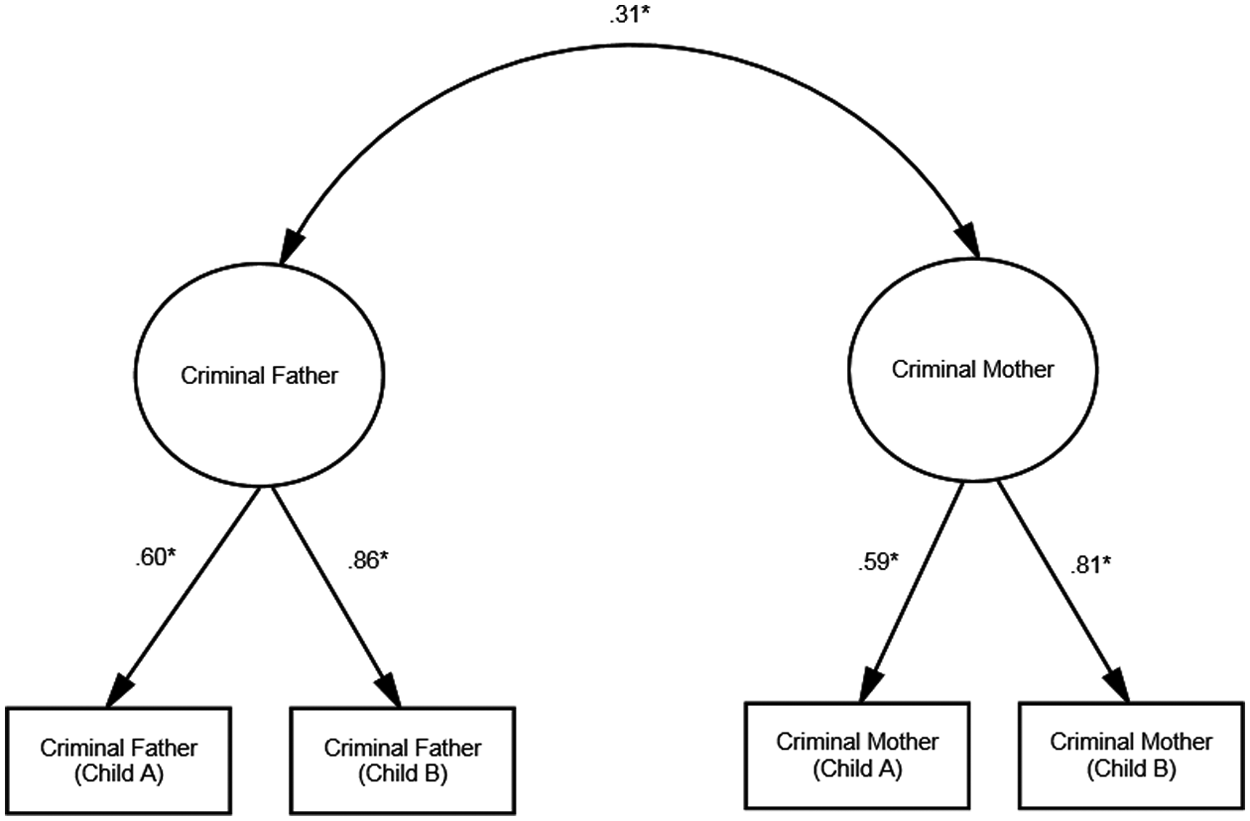
Structural Equation Models Examining Assortative Mating in Criminal Arrests
Discussion
There has been a great deal of interest in examining the familial concentration and transmission of crime (Farrington, 2010). The findings culled from these studies have indicated that the majority of all criminal arrests are accounted for by a small faction of all families and that there is a high degree of intergenerational transmission of crime (Moffitt & Caspi, 2003; Rowe & Farrington, 1997; Walters, 1992). Much of the research examining these issues has used samples drawn from outside of the United States or from samples that are not nationally representative. As a result, the extent to which these findings are applicable to the larger population remains unknown. The current study was designed to address these gaps in the literature by analyzing a sample of sibling pairs drawn from a nationally representative sample of American youths. Moreover, in addition to simply estimating the concentration and transmission of crime, this study also sought to shed light on some of the potential underlying mechanisms that give rise to the familial concentration and transmission of crime. Analysis of sibling pairs from Add Health revealed four key findings.
First, and consistent with prior research (Farrington et al., 2001), the data revealed a very high concentration of criminal arrests within families. Specifically, 5% of all families accounted for 53% of all criminal arrests, with these families wracking up a total of 1,298 arrests. Using a more liberal cutoff point, 10% of all families accounted for 79% of all criminal arrests, and 100% of all arrests were accounted for by 25% of all families. These findings underscore the fact that the vast majority of all crimes are committed by a small pool of all families. Moreover, what is particularly intriguing is that these findings also parallel the results of studies that are conducted on career criminals, wherein approximately 5% of all offenders are classified as severely disordered or a career criminal and account for the vast majority of all serious violent offenses (DeLisi & Piquero, 2011; Vaughn et al., 2011).
Additional analyses revealed that there was a high degree of sibling similarity across four different criminal justice outcome measures. For example, if one sibling was arrested, sentenced to probation, incarcerated, or arrested more than once, then the likelihood that his or her sibling would also receive that same criminal justice sanction increased by a factor ranging between 2.16 and 7.80. Having one criminal child more than doubles the odds that the child’s sibling will also be criminal. These findings were observed when all siblings, same-gender siblings only, brothers only, and sisters only were examined.
The second key finding to emerge from the analyses was that crime is transmitted intergenerationally both from father to child and from mother to child. Having a criminal father, for example, increased the odds that the child would be arrested by a factor of 2.74, that he or she would be sentenced to probation by a factor of 2.44, that he or she would ever be incarcerated by a factor of 3.39, and that he or she would be arrested more than one time by a factor of 3.36. Similar results were garnered in respect to having a criminal mother, having at least one criminal parent, and having two criminal parents. Taken together, these findings dovetail with those of previous studies revealing that crime is transmitted across generational lines (Farrington, 2010; Farrington et al., 2001; Moffitt & Caspi, 2003).
Third, a number of different mechanisms that might be able to account for the concentration and transmission of crime were examined by calculating SEMs. The results of these models indicated that parental criminality had a statistically significant direct effect on child criminality that was not mediated by the family environment. The family environment also had a statistically significant and direct effect on child criminality, but this effect was much weaker than the effect of parental criminality. These findings provide some evidence indicating that the transmission of crime across generations is partially the result of genetic architecture as opposed to being attributable solely to environmental factors. This interpretation hinges, in large part, on the assumption that the most salient environmental factors that might mediate the parent-child link in criminality were included in the models. Opponents to genetic explanations will be quick to point out that there are myriad criminogenic environmental factors that were not included in the statistical models, and if they had been, the parental criminality effect may have been mediated completely. Of course, opponents can always lean on this criticism because it is never possible to include all potential mediators. Nonetheless, it is possible to draw from the behavioral genetic research to help address this issue more fully.
Behavioral genetic research frequently decomposes variance in behavioral measures into three different components: a heritability component, a shared environmental component, and a nonshared environmental component (Plomin, DeFries, McClearn, & McGuffin, 2008). The heritability component captures the proportion of variance accounted for by genetic factors. The shared environmental component accounts for the proportion of variance that is the result of environmental factors that are the same between siblings. Shared environments work to make siblings more similar to each other on behavioral measures. The nonshared environment, in contrast, captures environments that are unique to each sibling and that make them different from each other. One of the most consistent findings to emerge from behavioral genetic research is that the shared environment accounts for very little, if any, of the variance in antisocial behaviors (J. Harris, 1998; Rowe, 1994). What this necessarily means is that the reason siblings are similar to each other on measures of crime is likely not because of shared environmental factors but, rather, is the result of shared genetic factors. Applying these findings to the current study, one can conclude that it is likely that the parent-child similarity and the sibling-sibling similarity in arrests, probation, and incarceration are attributable to genetic factors, not to unmeasured environmental factors.
The fourth finding of this study concerns the similarity in criminality between mates. The results of the SEM testing revealed a statistically significant association in criminal arrests between mates, wherein mates were significantly similar to each other in terms of their own criminality. The end result of this process is that the child is likely to be exposed to a double dose of risk factors, wherein he or she receives genetic risk factors from his or her parents as well as disadvantaged-environment factors. These analyses, however, were not able to explore why mates are similar to each other. It could be the case, for instance, that criminals seek out other criminals to date, marry, and procreate with, or it could be the case that criminals have a socializing effect on their mate such that the mates become more similar to each other the longer the relationship persists (Boutwell & Beaver, 2010; Rowe & Farrington, 1997; Zoccolillo et al., 2005). Future research would benefit by examining the reasons mates tend to be similar to each other in terms of criminality.
Although the findings of the current study contribute to the literature on the familial concentration and transmission of crime, there are a number of limitations that need to be addressed in follow-up studies. First, the measures of parental criminality were reported on by the respondent (i.e., the parents’ children). This measurement strategy likely resulted in an underreporting of parental criminality, because the children may have been unaware of their parents’ criminality. Importantly, this error would deflate the effects of the parental criminality measures, meaning that the effects reported in the current study are likely underestimates of the true effect size of the parental criminality measures. Second, all of the sibling crime measures were based on self-reports, not official crime data. Because some differences have been reported between self-report and official crime data (Kirk, 2006; Piquero, Farrington, & Blumstein, 2003; Thornberry & Krohn, 2000), it would be interesting to determine how the findings reported here would change (if at all) had official crime data been available in the Add Health. Third, the family environment measures that were employed in the current study were not exhaustive and did not represent the full spectrum of all environmental factors that could contribute to offspring criminality. Replication studies would benefit greatly by exploring the role that other environmental factors play in the familial concentration and transmission of crime. Fourth, it was not possible to directly estimate the extent to which genetic factors accounted for the intergenerational transmission of crime. To do so, the data would need to include information about the siblings’ children. Given that this information is not available in the Add Health, genetic influences on the intergenerational transmission of antisocial behaviors could be only inferred indirectly.
The social and financial costs produced by criminals are staggering, and given the familial concentration of crime, it takes no stretch of the imagination to consider how much of these costs are the result of a small proportion of all families. From a purely economic perspective, being able to identify the small number of criminal families who produce the vast majority of criminals should provide a finely demarcated roadmap into where resources need to be devoted—that is, to families where at least one parent is a criminal and/or where at least one sibling is a criminal. Appropriating a disproportionate concentration of resources to these families in the form of prevention and intervention services could go a long way toward reducing crime, protecting society, and saving taxpayer dollars.
Footnotes
Author’s Note:
The author wishes to thank the anonymous reviewers and the editor for their insightful comments and suggestions. This research uses data from Add Health, a program project designed by J. Richard Udry, Peter S. Bearman, and Kathleen Mullan Harris and funded by Grant P01-HD31921 from the Eunice Kennedy Shriver National Institute of Child Health and Human Development, with cooperative funding from 17 other agencies. Special acknowledgment is due to Ronald R. Rindfuss and Barbara Entwisle for assistance in the original design. Persons interested in obtaining data files from Add Health should contact Add Health, Carolina Population Center, 123 W. Franklin St., Chapel Hill, NC 27516-2524 (