



Abstract
Keppel and Walter’s (1999) classification system for serial sexual murder/murderers is sometimes used as the basis for generating offender profiles despite the fact that it has yet to be empirically validated. This model assumes that serial sexual murder/murderers can be classified into four categories—power-assertive, power-reassurance, anger-retaliation, and anger-excitation—according to the degree of anger and power exhibited by the offender in their criminal and noncriminal lives. Within the current study, assessing the validity of this model involved examining the crimes and backgrounds of 53 serial sexual murderers to determine if the categories proposed by Keppel and Walter could be identified. Proximity Scaling was used to examine the degree of co-occurrence between each and every behavior/characteristic. No evidence of highly co-occurring behaviors/characteristics from Keppel and Walter’s proposed categories was found, indicating that the classification system is potentially invalid. Results are discussed in terms of their theoretical and practical implications.
Over the past two decades, classification systems have been developed for various crime types in an attempt to make the process of generating offender profiles more systematic (e.g., Canter & Fritzon, 1998; Häkkänen, Lindlof, & Santtila, 2004; Salfati & Canter, 1999). Generally speaking, these classification systems are used in an attempt to categorize the crimes and backgrounds of serial offenders and to show how these two domains relate to one another. One type of crime that has received attention in this regard is serial sexual murder (e.g., Godwin, 2000; Hazelwood & Douglas, 1980; Hodge, in press; Holmes & Holmes, 2002). The primary reason for this is that serial sexual murder represents a crime where investigative techniques such as offender profiling are commonly used (Trager & Brewster, 2001). While classification systems for use in serial sexual murder investigations have been around for some time (Prentky & Burgess, 2000), it is only recently that they have been subjected to detailed empirical scrutiny.
Perhaps the most commonly cited classification system for serial sexual murder/murderers is the organized/disorganized model proposed by Hazelwood and Douglas (1980). According to the original dichotomy, all serial sexual murders/murderers could be classified as either organized or disorganized on the basis of their crime scene behaviors and their background characteristics. 1 In simplistic terms, organized offenses are characterized as well planned and controlled, and they are committed by relatively high-functioning, organized offenders (e.g., characterized as having average to above average intelligence, being socially competent, having skilled employment). Disorganized offenses, on the other hand, are opportunistic and sloppy, having been committed by disorganized, relatively low-functioning serial offenders (Ressler, Burgess, Douglas, Hartman, & D’Agostino, 1986).
While intuitively appealing and simple to apply for the purposes of profiling offenders, the organized/disorganized model has only recently been empirically tested. Specifically, the validity of the organized/disorganized dichotomy for classifying crime scene behaviors was assessed by Canter, Alison, Alison, and Wentink (2004) using a sample of 100 crimes committed by 100 serial killers from the United States. The authors examined the “organized” and “disorganized” crime scene behaviors exhibited by these offenders using multidimensional scaling (MDS). If serial homicides can in fact be characterized as either organized or disorganized, as Ressler et al. (1986) contend, then organized behaviors should co-occur frequently with each other, as should disorganized behaviors, but organized behaviors should rarely co-occur with disorganized behaviors and vice versa. Thus, in an MDS plot, these patterns of co-occurrences should form a clear division between organized and disorganized variables, but no such divisions were evident in the plot created by Canter et al., leading the authors to question the validity of the model as it was originally proposed.
Another classification system of serial sexual murder/murderers that has received attention is Holmes and Holmes’s (2002) motivation-based typology. They proposed that there are four different kinds of serial murderers, each characterized by a set of crime scene behaviors: (1) the visionary killer who kills in response to voices or visions, (2) the mission killer who is driven by a need to rid the world of a specific group or category of people, (3) the hedonistic killer who derives pleasure and satisfaction from the act of murder itself, 2 and (4) the power-control killer who thrives on holding the power of life and death over his victims.
Canter and Wentink (2004) were the first to systematically test the validity of the Holmes and Holmes (2002) model. Using a similar procedure to the one described above, they sought to determine whether the behaviors within each category of murder proposed by Holmes and Holmes co-occurred with one another with a higher frequency than the behaviors from different categories. Based on an analysis of 100 homicides committed by 100 U.S. serial sexual killers, their results did not support the proposed model. While some themes did appear to form more distinct regions in the MDS plot than others—the visionary theme in particular—the behaviors that were supposed to represent the categories of crimes were generally spread out around the plot. Thus, there currently is a lack of empirical evidence supporting the existence of the categories of crimes put forward by Holmes and Holmes.
Unlike these two classification systems, Keppel and Walters’ (1999) classification system has yet to be empirically tested. As discussed in more detail below, Keppel and Walter propose that serial sexual murderers are primarily motivated by either anger or power and that from these two sources of motivation four different themes emerge in the crime scene behaviors and background characteristics of offenders: power-assertive (PA) power-reassurance (PR), anger-retaliation (AR), and anger-excitation (AE). In proposing this model, Keppel and Walter’s contention is that these four themes reveal the different ways in which serial sexual murderers commit their crimes and, further, that these differences reflect overtly available distinguishing features of the offender’s noncriminal life. However, despite the popularity of this model in law enforcement circles (Hazelwood & Burgess, 2001), it is still uncertain whether the four themes that Keppel and Walter proposed actually exist, and it is unclear whether this model forms a suitable basis for examining the patterns exhibited by serial sexual murderers across their crimes and between their criminal and noncriminal lives. This study represents the first attempt to validate the Keppel and Walter model of serial sexual murder.
Keppel and Walter’s (1999) Classification System of Serial Sexual Murder/Murderers
Keppel and Walter’s (1999) classification system of serial sexual murder/murderers is a refinement and extension of a classification system for rape that was originally proposed by Groth, Burgess, and Holmstrom (1977). The system proposed by Groth et al. focuses on what the offense means to the offender, as opposed to the behaviors that constitute the offender’s actions (Canter & Heritage, 1990). After interviewing over 500 rapists, Groth et al. proposed that what motivated a rapist was not sex but rather anger or power. Their classification system includes four categories of rape, two of which directly express themes of power (the PA rapist and the PR rapist) and two that directly express themes of anger (the AR rapist and the AE rapist).
Using a combination of interviews with offenders, past investigative experience, 3 and the descriptions provided by Groth et al. (1977), Keppel and Walter (1999) proposed that, as with rape, sexual murderers are motivated by either anger or power. As is the case with the Groth et al. classification system, Keppel and Walter argued that these two sources of motivation combine to form four different themes: PA, PR, AR, and AE. However, unlike Groth et al., Keppel and Walter attempted to objectify the classification system by indicating what specific crime scene behaviors and background characteristics would be present in each theme (see Tables 1 and 2 for crime scene variables and background characteristics representative of each theme).
Crime Scene Behaviors Representative of Keppel and Walter’s (1999) Themes

Background Characteristics Representative of Keppel and Walter’s (1999) Themes

PA
According to Keppel and Walter (1999), the PA rape-murderer believes in his superiority over others and wants to demonstrate this to his victims. He will commit a series of rapes in which the intent is not to kill but where the increasing aggression needed to control the victim results in her eventual death. The offender will leave an organized crime scene in an attempt to conceal his identity. However, his desire for recognition may be too strong, and he may ultimately share his secret with someone.
Keppel and Walter (1999) suggest that the background for the PA killer reflects an emotionally primitive individual who is concerned with projecting a macho self-image. For example, they argue that the offender will usually be in his early 20s, often a body builder, and may display tattoos. In addition, the offender may have a history of multiple marriages or relationships that he does not view as being unsuccessful, has likely dropped out of school, and may have a history of burglary, theft, or robbery.
PR
Keppel and Walter (1999) argue that the PR rape-murderer wants to assure himself that he is powerful and in control of the victim and the situation. The PR offender only plans to rape the victim; the murder occurs only once the offender realizes that reality cannot live up to his fantasy. The rape often “fails” due to the offender’s impotence. At this point, he may need to reassure himself of his power and control and may kill the victim, typically through manual strangulation or pummeling. The crime scene is most likely to be disorganized, the period between his killings may vary, and his offenses are likely to occur in clusters.
It is thought that the PR offender will usually be in his mid-20s, unless he was incarcerated for other crimes during his mid-20s. Due to his obsessive daydreaming and fantasizing, he is generally isolated with no friends and may come across as dull and emotionally scattered. Due to his fear of rejection, he is plagued by an inadequate sex life, is unmarried, and uses sexual fantasies to overcome the dysfunction of his reality. He most likely has a long history of behaviors such as window peeping and various fetishistic practices (e.g., clothes fondling) and may have an offense record as a result of these activities. Educationally, he is an underachiever and may be thought to have a learning disability, but he does tend to complete his schooling. He is usually immature, lacks the confidence to participate, feels inferior, and cannot tolerate criticism.
AR
In the case of the AR rape-murderer, Keppel and Walter (1999) suggest that the offense is reflective of the offender’s anger and hatred of women. Here, both the rape and the murder are planned. The sexual assault is very violent and the murder is characterized by overkill. The rape may be incomplete due to an inability to get an erection, and so the offender will often vent his anger with his fists, a blunt object, or a knife. The assault continues until the offender is emotionally satisfied regardless of whether the victim is still alive. Upon completion, he places the body into a submissive position and leaves a disorganized crime scene.
The AR offender is usually in his mid- to late 20s and is seen as explosive, quick-tempered, and self-centered. His social relations are superficial and often limited to a few drinking buddies. If he has been married, there was most likely a history of spousal abuse and extramarital relations. Sexually, he may be impotent and does not tend to use any pornographic materials. He is usually a school dropout and typically has problems with authority figures regardless of the specific context.
AE
Finally, for the AE rape-murderer, Keppel and Walter (1999) emphasize that the offender’s focus is on the pain and suffering of the victim, from which the offender derives sexual pleasure and satisfaction. This offender also intends to commit both the sexual assault and the murder prior to committing the offense. This offender leaves an organized crime scene and frequently moves the body to a second location in order to conceal it. He also tends to commit crimes in areas distant from his usual activities, though he may try to interject himself into the criminal investigation.
The AE offender is usually slightly older than the other three types of offenders, but the age range is variable. He is often socially capable and is able to appear law-abiding and conventional. As such, he may have a happy marriage and appear to be a good husband. Financially, he is an adequate provider. He may enjoy working with his hands, is compulsive in his daily habits, and may also have attended or graduated university.
While Keppel and Walter (1999) did provide case examples for each type of serial sexual murderer, they never tested this classification system empirically. As a result, there is currently no information available as to how reliable or valid the system is.
The Current Study
The intention of the current study is to empirically examine the classification system proposed by Keppel and Walter (1999) using an approach that is similar to the approach previously adopted by Canter et al. (2004) and Canter and Wentink (2004). If the system can be validated, the profiling community would have an empirically defensible, predictive classification system that relates directly to the underlying motivations of the offender and, more importantly, to their observable behaviors and background characteristics. To accomplish this task, the crime scene behaviors and background characteristics of a sample of U.S. serial sexual murderers will be examined for evidence of the four themes proposed by Keppel and Walter. Two specific questions will be addressed:
(1) Do the offenders’ crime scene behaviors cluster into the four themes proposed by Keppel and Walter (1999)?
(2) Do the offenders’ background characteristics cluster into the four themes proposed by Keppel and Walter (1999)?
Method
Data
The data used for this study are a subset of data that were originally collected by Godwin (1998). The original sample contained information on the crime scene behaviors and background characteristics of 96 serial sexual murderers. The majority of the sample was obtained from the Homicide Investigation and Tracking System (HITS) database of the Attorney General’s Office in Seattle, Washington, while the remaining 25% of the sample was obtained from other various homicide databases, such as the Violent Criminal Apprehension Program (VICAP), as well as from court transcripts (Godwin, 1998).
A sample of 53 serial murderers (out of the original 96) was retained for analysis in the current study. Several exclusion criteria were employed to ensure that the sample fit the specific needs of this investigation. First, all female offenders were removed from the sample, as Keppel and Walter’s (1999) classification system is intended only for the classification of male serial murderers. Second, all co-offending teams were excluded, as it is currently unknown whether operating in a team will affect the thematic classification of an offender. Third, all offenders who had less than three victims were eliminated from the sample, as the definition of serial sexual murder adopted in the current study requires that the offender kills at least three victims (Holmes & DeBurger, 1988). Finally, after irrelevant variables were excluded from the data set, any offender with missing data was removed from the sample.
A cap of three murders per offender (159 offences in total) was established in order to ensure that all offenders were equally represented in the analyses (this is common practice in research of this type; see Salfati & Bateman, 2005). If a higher number of crimes were chosen as a cutoff, this would have excluded a large number of offenders from the final sample since many of the 53 offenders were only known to be responsible for three crimes. Rather than choosing the first three crimes in each offender’s series, the first, middle, and last crimes were used in case more behavioral variability occurs across an entire crime series (e.g., there is more opportunity for learning to occur as one examines crimes from over longer time intervals). That being said, the results reported by Godwin (2000) suggest that serial murderers are reasonably consistent across their crimes when examining the sorts of behaviors included in the current study.
Variables
Godwin’s (1998) original sample included 251 crime scene variables and 47 background variables. These variables were all dichotomously coded, with 1 indicating the presence of a variable and 0 indicating its absence (with the exception of variables related to the age and race of the offenders and victims, which were coded continuously and nominally, respectively). As the data were collected directly by investigators, there is no way to verify the interrater reliability of the data. While recent studies have raised concerns about the potential reliability of data included in databases such as HITS and VICAP (e.g., Martineau & Corey, 2008; Snook, Luther, House, Bennell, & Taylor, 2012), there is also some indication from past studies that inter-rater reliability for this type of data is not necessarily problematic. For example, Kirby (1993) found inter-rater agreement levels to be approximately 98% in his study of child sexual abuse. In addition, the dichotomous coding of variables (as is the case in the present study) is known to substantially increase the degree to which high levels of inter-rater reliability can be achieved (Holsti, 1969; Krippendorff, 1980).
As some of the variables in Godwin’s (1998) data file were highly specific (i.e., more specific than the general behaviors discussed by Keppel and Walter, 1999), some variables were aggregated to form a single variable. For example, the original data file included specific materials that were used to bind the victim (e.g., bound with rope, bound with tape). Keppel and Walter simply refer to a victim being bound so these types of variables were collapsed to form single variables (e.g., body bound).
Two variable samples were constructed based on different inclusion criteria. The first sample consisted of only those variables that were directly related to the themes described by Keppel and Walter (1999). This inclusion method resulted in a sample of 55 crime scene variables and 17 background characteristics (see variables marked with a 1 in Appendices A and B). A second sample was included in this study because there is a high degree of overlap in the themes proposed by Keppel and Walter; that is, many of the variables they discuss are expected to be present in more than one theme. It is questionable whether such variables will be useful in differentiating offenses/offenders. Therefore, the second sample consisted of all those variables that were directly related to the themes described by Keppel and Walter, but representative of only one particular theme (see variables marked with a 2 in Appendices A and B). This more stringent inclusion criterion resulted in only 39 crime scene variables and 12 background variables.
Analyses
This study used a nonmetric MDS procedure known as Proximity Scaling (PROXSCAL; Commandeur & Heiser, 1993) to study the relationships between the crime scene and background variables. Association matrices could have been used for this purpose and will be in the current study to examine the relationships between small subsets of variables. However, interpreting such matrices in an attempt to develop an overall understanding of how multiple variables relate to one another can prove difficult, especially if the number of variables in the matrix is relatively large (as is the case here). What is needed is a procedure that allows the researcher to easily visualize the relationships between many variables, all of which may potentially co-occur with one another to varying degrees, and to find patterns in these co-occurrences. PROXSCAL is such an analysis.
PROXSCAL is a module included in SPSS that produces a spatial representation of the association between variables. The basic premise of PROXSCAL analysis is that the more associated two variables are (i.e., the more they co-occur in crimes), the closer they will be in the geometric plot (Shye, Elizur, & Hoffman, 1994). The program basically calculates a measure of association between each and every variable, and then rank orders these associations before plotting the variables into a geometric space. An attempt is made by PROXSCAL to organize the variables in a geometric configuration that fits the data well, where the rank orderings of associations are preserved in the distances between variables on the plot.
One of the advantages of using PROXSCAL to examine the crime scene and background variables discussed by Keppel and Walter (1999) is that it provides metrics that indicate the degree of fit between the plot and the original association matrix. For example, degree of fit can be estimated by the normalized raw stress score, which ranges from 0 (indicating a perfect fit) to 1 (indicating a complete lack of fit) (Kruskal & Wish, 1978). Generally, a normalized raw stress score of .10 or less indicates a good degree of fit with the data. However, it is important to highlight the fact that many factors influence this stress measure, such as the number of variables included in the analysis and the amount of error associated with the data (Canter & Heritage, 1990; Shye et al., 1994).
Due to the dichotomous nature of the data used in the analyses, the measure of association used in the current study was the Lance and Williams measure, sometimes referred to as the Bray-Curtis coefficient (Santtila, Korpela, & Häkkänen, 2004). This measure reflects the degree of association between variable pairs, while omitting any joint nonoccurrences. In other words, the joint absence of variables in a particular case will not increase the degree of association between those variables. This is thought to be important in studies using data recorded by police because the absence of a variable does not necessarily mean it did not occur (e.g., the variable may not have been accurately recorded by the police) (Canter, Hughes, & Kirby, 1998; Fritzon & Brun, 2005; Häkkänen et al., 2004).
The geometric plots produced by PROXSCAL (i.e., for the crime scene and background variables) will be examined for evidence of the four themes of PA, PR, AR, and AE. Identifying these themes within the geometric space relies on the principle of contiguity, which states that variables related to a common theme or construct will be more highly associated than those variables that are related to differing constructs and, thus, will be plotted closer together in the geometric space (Shye, 1978).
Procedure
Before entering the variables into PROXSCAL, a simple association matrix will be examined to see if there is evidence of the four themes in the crime scenes and backgrounds of the offenders. Should Keppel and Walter (1999) be correct, it is expected that variables predicted to be in the same theme will have higher co-occurrence rates than those predicted to be in different themes. Next, PROXSCAL plots will be examined for both samples of variables. If the classification system is supported, the PROXSCAL plots should reveal four regions of variables reflecting the four themes of PA, PR, AR, and AE, with a central cluster being formed by those behaviors common to all four types of serial murders/murderers.
Results
Association Matrix
Before analyzing all of the variables using PROXSCAL, certain variables were selected from the sample and the degree to which they co-occur with each other was examined (see Tables 3 and 4). Note that the variables included in Tables 3 and 4 were specifically selected because they were not expected to overlap at all (i.e., represent more than one theme) and because they have high face validity. If Keppel and Walter’s (1999) model accurately describes serial sexual murderers and their crimes, variables within each of the proposed themes should co-occur with one another to a greater extent than they do with variables from other themes. As can be seen from the tables, there are very few occasions where this actually happens. Indeed, variables from one predicted theme often co-occur more frequently with variables from completely different themes than they do with variables from their own theme.
Associations Between Selected Crime Scene Behaviors From Each of the Four Themes Proposed by Keppel and Walter (1999)
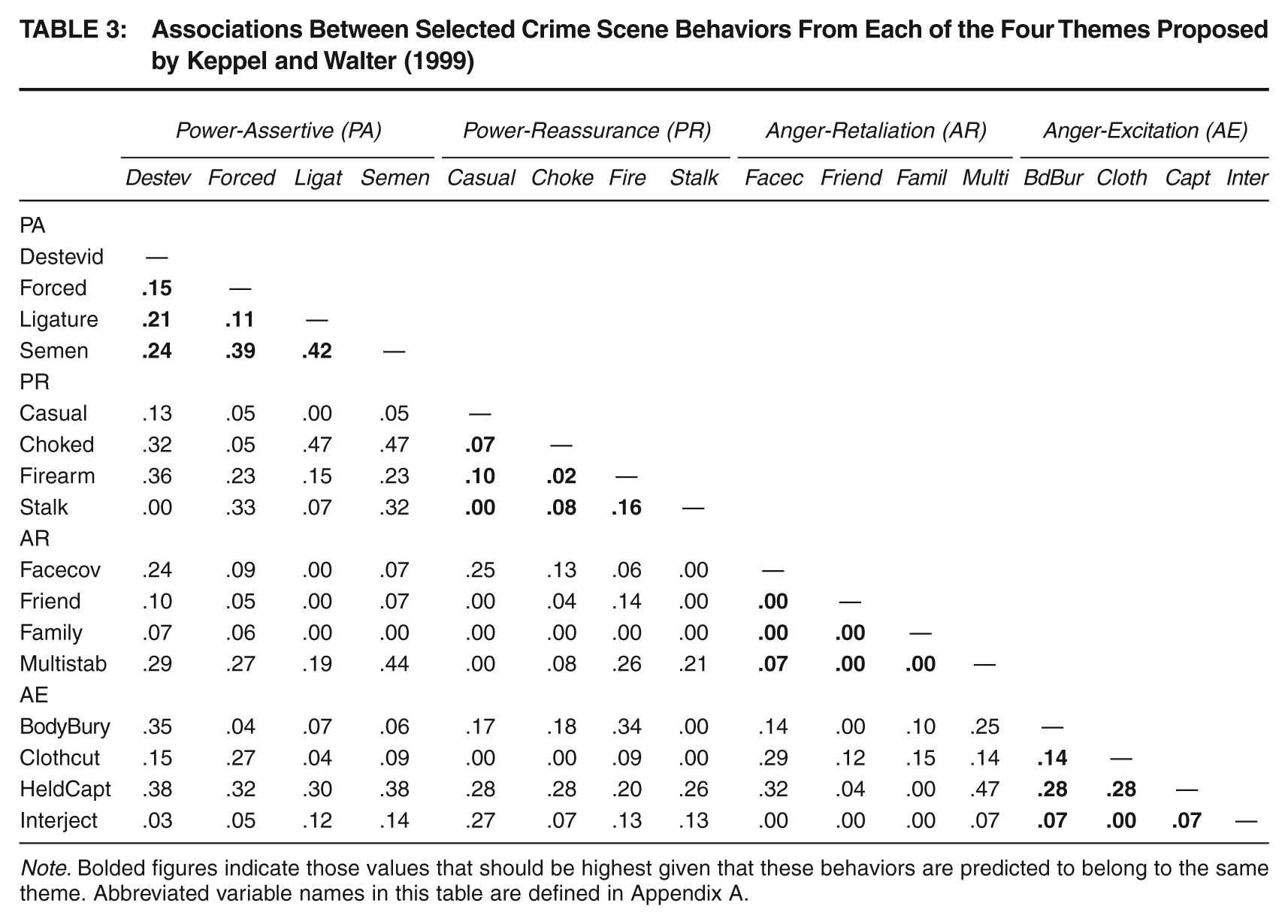
Note. Bolded figures indicate those values that should be highest given that these behaviors are predicted to belong to the same theme. Abbreviated variable names in this table are defined in Appendix A.
Associations Between Selected Background Characteristics From Each of the Four Themes Proposed by Keppel and Walter (1999)
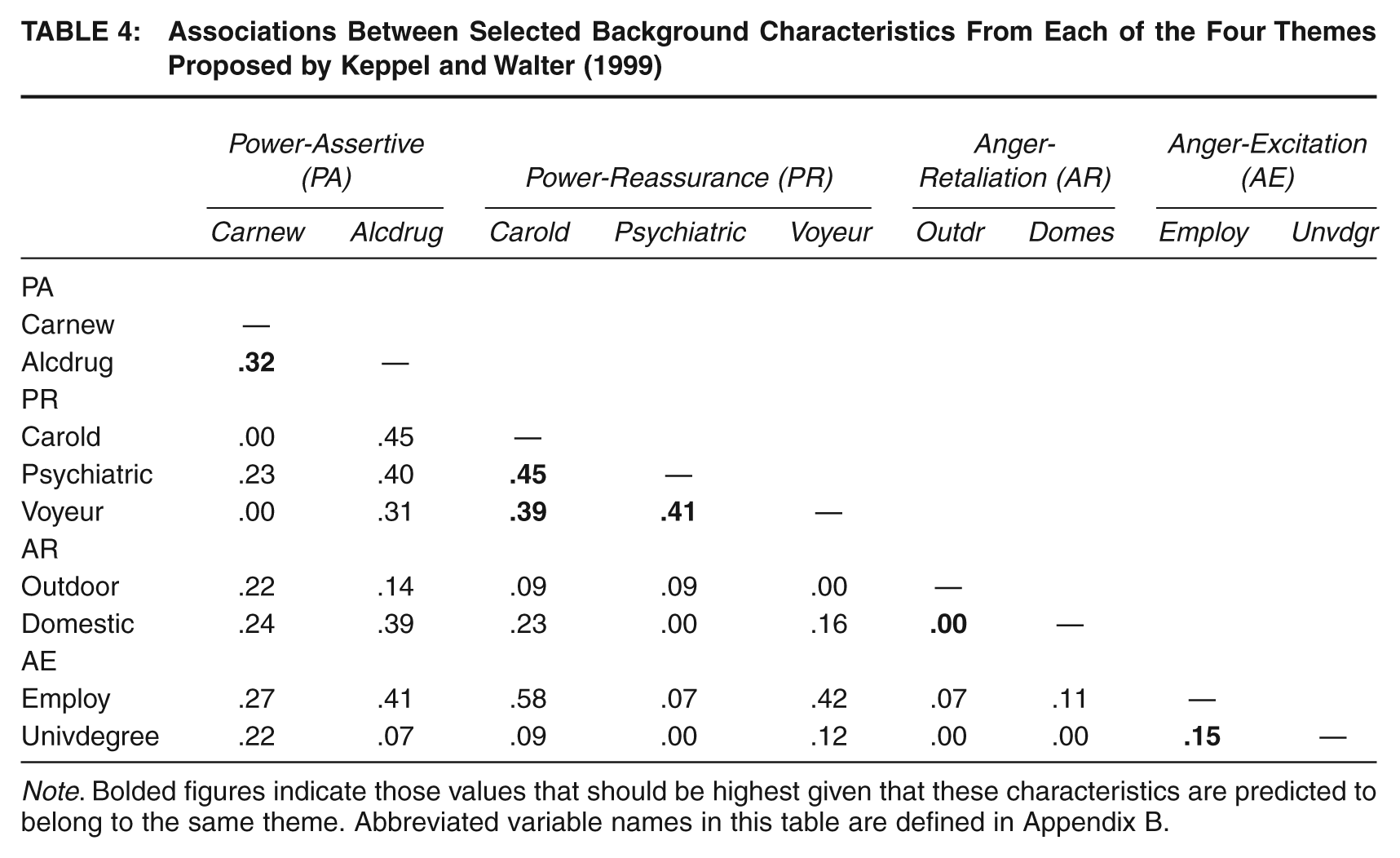
Note. Bolded figures indicate those values that should be highest given that these characteristics are predicted to belong to the same theme. Abbreviated variable names in this table are defined in Appendix B.
Proxscal Analyses
Despite the results obtained from Tables 3 and 4, all of the crime scene and background variables from both samples were subjected to PROXSCAL analyses. Recall that Sample 1 includes crime scene variables and background characteristics that relate directly to any of the themes described by Keppel and Walter (1999), whereas Sample 2 includes variables that are representative of only one particular theme. As indicated above, variables within each theme (indicated by different symbols in Figures 1-4) are expected to co-occur with one another to a greater extent than they are with variables from the other three themes. Thus, the plots should consist of regions of similarly shaped symbols.

PROXSCAL of Crime Scene Behaviors Included in Sample 1

PROXSCAL of Background Characteristics Included in Sample 1

PROXSCAL of Crime Scene Behaviors Included in Sample 2

PROXSCAL of Background Characteristics Included in Sample 2
Despite the respectable normalized raw stress score of .09 for crime scene behaviors and .08 for background characteristics included in Sample 1, it is clear from the plots that the predicted regions could not be identified (see Figures 1 and 2). Despite some general clustering of certain behaviors/characteristics that were expected to cluster (e.g., some of the AE behaviors in Figure 1), the behaviors/characteristics from each of the hypothesized themes are relatively spread out around the plot. With that being said, the position of certain variables in the plot made sense. For example, variables such as “sex” and “stranger victim” are found near the centre of the plot, indicating a high frequency of occurrence at the crime scenes of serial sexual murderers. Given the nature of the sample we are examining, the location of these variables is unsurprising. Although the crime scene behaviors and background characteristics included in Sample 2 were also found to have respectable normalized raw stress scores (.10 and .06, respectively), the plots indicate that the predicted regions could not be identified again (see Figures 3 and 4). 4 These plots, therefore, do not provide empirical support for the categories proposed by Keppel and Walter (1999).
As a last step in our analysis, we also examined each of the plots to determine whether any evidence could be found for an alternative model of serial murder/murderers. We considered the organized/disorganized model proposed by Hazelwood and Douglas (1980) as well as the motivation-based model proposed by Holmes and Holmes (2002). We also considered lesser-known models of serial homicide, including Godwin’s (2000) model, which was derived from the larger data set we drew on to conduct the current study and Hodge’s (in press) role-based model.
In brief, Godwin’s (2000) model proposes that serial murders can be categorized into one of four themes based on a combination of behavioral organization (cognitive or affective), which in some ways relates to the concepts of organization and disorganization, and attachment components (object or vehicle), which relates to the way the offender perceives their victim (either as an object to be exploited or as a vehicle with which to express their rage). Hodge’s (in press) model describes three themes, all of which relate to the role assigned to a victim by an offender. According to this model, a serial murderer can treat a victim as an inanimate object to fulfill the offender’s objectives (victim as object), as a vehicle to express the offender’s own emotional state (victim as vehicle), or as a person who can be used to develop a sort of pseudo-intimate relationship with (victim as person).
Based on our examination, no evidence could be found in the PROXSCAL plots for any of the above models, including Godwin’s (2000) classification system (note that a substantially different set of variables was used in the current study compared to his original study). As we discuss below, it appears that if a viable model of serial sexual murder/murderers does exist, it will be found using behaviors and characteristics that were not included in the current PROXSCAL plots.
Discussion
Having never been empirically tested, the present study set out to examine the system proposed by Keppel and Walter (1999) for classifying serial sexual murder/murderers. Using MDS analysis, an attempt was made to examine the hypothesis that the crime scene behaviors and background characteristics of a sample of U.S. serial sexual murderers could be classified into the themes of PA, PR, AR, and AE. The analyses do not appear to support this system of classification. In the remainder of the article, we discuss a variety of issues related to this failed attempt to validate Keppel and Walter’s model.
Crime Scene Behaviors in Keppel and Walter’s (1999) Model
To date, the only published evidence that we are aware of that supports Keppel and Walter’s (1999) classification system is the four case studies the authors provided in their original article as prototypical examples for each of the thematic categories (i.e., PA, PR, AR, and AE). However, the existence of these cases do not, in and of themselves, provide substantial support for the validity of this system since it is typically not difficult to identify at least one case to represent categories in any classification system. When the proposed system is examined more systematically, as it was in the present investigation, virtually no support can be found for the model.
While this finding might represent a blow to the proposed classification system, it is important to stress that the conceptual basis of Keppel and Walter’s (1999) system may still have some merit. In other words, despite the results presented here, it may still be the case that serial sexual murder can best be conceptualized as the product of anger or power, and it may even be the case that PA, PR, AR, and AE are valid themes within this context. What the present results may reflect is simply the fact that Keppel and Walter got it wrong when they translated Groth et al.’s (1977) motivation-based system into a behavior-based model.
For example, Keppel and Walter (1999) may have selected the wrong behaviors to represent each of the four themes. Given that motives for crime are often unknown, even to the offenders themselves (Canter, 2000), it may be a formidable task to assign behaviors to underlying motivations. In addition, it is likely the case that a single crime scene behavior reflects different motivations for different offenders (Winter et al., in press), which would also make it very difficult to select specific behaviors to represent particular themes. If the original set of behaviors focused on by Keppel and Walter failed to capture the essence of the themes proposed by Groth et al. (1977), assuming that they are valid, the results reported here should come as no surprise. Thus, future research should attempt to reconceptualize Keppel and Walter’s classification system using alternative behaviors to determine if a greater degree of supporting evidence could be found for the model.
Some might also argue that our failure to find evidence in support of Keppel and Walter’s (1999) model is due to the fact that variables were included in our PROXSCAL analyses that should not have been. Keppel and Walter might contend that some of the variables we analyzed do not perfectly represent the variables contained in their model or that we examined variables that were never intended to be included in their model. For example, the variable “hand/club” was included in our analysis. This variable was included to reflect the fact that Keppel and Walter indicate that serial murder victims will sometimes display bruises from “beating and pummeling.” However, at no point do Keppel and Walter explicitly describe the variable “hand/club” as being part of their model.
Although we believe that the variables included in Samples 1 and 2 are all directly related to the themes described by Keppel and Walter (1999) and reflect fairly the variables they highlighted, there is always a degree of subjectivity involved in these sorts of exercises. With that being said, even if these potential concerns are valid, the variables included in the current analyses that do accurately reflect the themes proposed by Keppel and Walter should co-occur with one another more than they do with behaviors/characteristics from other themes. In other words, some evidence for their proposed themes should still be revealed in the PROXSCAL analyses even if irrelevant behaviors were included. This was not found to be the case.
Background Characteristics in Keppel and Walter’s (1999) Model
As was the case with crime scene behaviors, the results from this study do not support the hypothesis that the background characteristics of serial sexual murderers cluster into themes of PA, PR, AR, and AE. However, the points that have just been raised apply equally well to the analysis of background characteristics. In addition to these general issues, there is one other important point that is specific to the analysis of the background characteristics that should be highlighted.
Although Keppel co-developed the classification system tested in this study and was also the creator of the HITS database from which the majority of the present data were obtained, a considerable number of variables presented in the original 1999 article do not appear to be included in the HITS database (or at least they did not appear to be included in HITS when the data used in this article were originally collected). This created a situation in the current study where variables that might be necessary to meaningfully assess Keppel and Walter’s model were not available in the data set. This problem was far more pronounced in relation to the background characteristics (compared to crime scene behaviors), with many of the characteristics discussed by Keppel and Walter (1999) not existing in Godwin’s (1998) data set. For example, Keppel and Walter suggest that the AR offender is quick-tempered in his noncriminal life; however, to our knowledge, the HITS database contains no variables that reflect this predisposition.
Our proposed solution to this problem was to select background characteristics from the existing database that matched the target variables as closely as possible, but of course the inability to find support for the four themes proposed by Keppel and Walter (1999) could be a reflection of this selection process. Clearly, further research is needed to address this specific problem. Ideally, this research should draw on a set of variables that allows one to directly examine the behaviors and characteristics discussed by Keppel and Walter.
An Alternative Model of Serial Sexual Murder/Murderers?
Given the lack of empirical support for Hazelwood and Douglas’s (1980) organized/disorganized model, Holmes and Holmes’s (2002) motivation-based model, and now Keppel and Walter’s (1999) rape-inspired model, an obvious question to ask is whether any model is likely to be found that can accurately capture the distinguishing features of serial sexual murder/murderers. Canter et al. (2004) review the evidence, which suggests that it is unlikely that support will ever be found for the sort of two-fold typological model proposed by Hazelwood and Douglas; human behavior is simply too complex and ambiguous to fit neatly into two distinct types. Similarly, finding support for motivation-based models of serial sexual murder/murderers, like the sort proposed by Holmes and Holmes, will be problematic given the very difficult task of relating motivations to observable crime scene behaviors (Canter & Wentink, 2004).
An alternative approach for developing classification systems is proving to be more productive, however—an approach that focuses on themes rather than types and behaviors rather than motivations. For example, in Canter et al.’s (2004) critique of the organized-disorganized model, they were able to reinterpret their MDS plot to find four themes that accurately described the behaviors present in the crimes of serial killers (mutilation, sexual control, plunder, and execution). As already described, Godwin (2000) and Hodge (in press) were also able to identify models of serial homicide that have received some empirical support. In addition, Jones, Bennell, and Emeno (2012) were recently able to identify a model of serial sexual murder/murderers using a different subset of Godwin’s (1998) data.
The model proposed by Jones et al. (2012) is particularly exciting because they found consistent themes across the criminal and noncriminal domain. Specifically, they report strong evidence for the themes of hostility, control, and involvement where offenders’ interactions with people (either victims or others) are characterized by extreme aggressive tendencies (hostility), the desire for predictability and structure (control), or a need for affiliation and intimacy (involvement). 5 This classification system is interesting, not only because common themes were found both in the crimes of offenders and in their everyday lives, but also because similar sorts of themes have been reported in other forms of interpersonal violence, such as rape (e.g., Canter, Bennell, Alison, & Reddy, 2003) and child sex abuse (Bennell, Alison, Stein, Alison, & Canter, 2002). This opens up the possibility that the same types of themes characterize interpersonal interactions across a range of situations, which vary in their level of brutality. Given the robustness of these themes across different data sets, this classification system may also turn out to be productive in the profiling domain.
Conclusion
No evidence could be found in this study to support the existence of the four themes of serial sexual murders/murderers proposed by Keppel and Walter (1999). Although it is clear from their study that offenders do exist that fit nicely into each of the proposed themes, the results of the present study suggest that these offenders are the exception rather than the rule. Given these results, it would be wise for investigators to use extreme caution when applying this classification system in serial sexual murder investigations. Indeed, it would be sensible for practitioners and researchers alike to be skeptical of Keppel and Walter’s system until future research provides stronger support for the model. It will also be important to examine other possible classification systems to determine if they could provide empirically defensible approaches for profiling serial sexual murderers.