



Abstract
The Level of Service Inventory–Revised (LSI-R) is an assessment instrument designed to evaluate the risks and needs of offenders. The current study examines the predictive validity of the LSI-R with a sample of 2,849 probationers and parolees at two points in time. This design allows for the analysis of the instrument’s predictive validity at Time 1 and Time 2, and the correlation between changes in LSI-R scores and recidivism. The results suggest that the LSI-R is a valid assessment instrument for predicting recidivism and that change in LSI-R score is associated with change in risk of recidivism. The implications of these findings for effective correctional intervention are discussed.
Despite the get tough movement, today’s corrections is increasingly marked by two interrelated developments: first, the recognition that interventions need to be evidence-based (Cullen, Myer, & Latessa, 2009; Latessa, Cullen, & Gendreau, 2002; MacKenzie, 2000); and second, given the failure of punitive oriented interventions, the recognition that the “best practice” for changing offenders is to reaffirm rehabilitation (Cullen & Gendreau, 2000; Cullen & Gilbert, 1982).
Part of the movement toward evidence-based corrections is thus to focus on what interventions are effective. Information about individual offenders must be obtained so as to direct those who pose the greatest risk to public safety to the interventions that will best address their individual risk and responsivity factors. Assessment instruments are increasingly important in this effort to deliver effective treatments. Amid this context, the Level of Service Inventory–Revised (LSI-R) has emerged as an important assessment instrument for two reasons.
First, it is linked to a prominent paradigm for treatment, which was developed mainly by Canadian correctional psychologists; most prominent in this group are Don Andrews, James Bonta, and Paul Gendreau. The principles of risk, need, and responsivity comprise the Canadians’ principles of effective correctional intervention (see Andrews & Bonta, 1998; Andrews et al., 1990; Cullen & Gendreau, 2000; Gendreau, Smith, & French, 2006; Smith, Gendreau, & Goggin, 2004). The risk principle directs that the most intensive correctional services be provided to offenders who are most at risk for recidivating. To that end, treatment must also address an offender’s criminogenic needs (e.g., antisocial attitudes, peers, criminal history, and antisocial personality) because these risk factors have been shown empirically to predict future criminal behavior (Andrews & Bonta, 1998). The responsivity principle attempts to identify unique characteristics (e.g., intelligence, gender, anxiety, sexual abuse) that may inhibit an individual’s likelihood for success in a particular treatment setting and then place the offender in a treatment program that will best match the offender’s responsivity factors (Andrews & Bonta, 1998; Andrews, Bonta, & Wormith, 2006; Hubbard, 2007).
Second, the LSI is a valuable and empirically supported assessment instrument that is appropriate for use in a variety of correctional settings (Andrews & Bonta, 1995). The versatility of this assessment tool may help to explain why more than 900 correctional agencies across North America currently rely on the LSI-R for purposes of offender classification and case management (Lowenkamp, Lovins, & Latessa, 2009). To date, more than 40 studies of the LSI and its subsequent iterations (e.g., LSI-R, LSI: SV, LS/CMI, YLS/CMI) have been conducted. The majority of individual studies (Hsu, Caputi, & Byrne, 2009; Lowenkamp et al., 2009; Manchak, Skeem, & Douglas, 2008; Olver, Stockdale, & Wormith, 2009; Vose, Cullen, & Smith, 2008) and meta-analytic studies (Gendreau, Goggin, & Smith, 2002; Smith, Cullen, & Latessa, 2009) find the instrument to be a valid predictor of recidivism. Even so, the instrument has not received unanimous empirical support (Dowdy, Lacy, & Unnithan, 2002; Hendricks, Werner, & Shipway, 2006; Holtfreter, Reisig, & Morash, 2004; Marczyk, Heilbrum, Lander, & DeMatteo, 2003; O’Keefe, Klebe, & Hromas, 1998; Reisig, Holtfreter, & Morash, 2006; Schlager & Simourd, 2007; Schmidt, Hoge, & Gomes, 2005). The absence of unanimous empirical support, the extent to which correctional agencies have come to depend on the LSI-R to guide decision making, and the limitations of previous research suggest additional research is needed.
With respect to the limitations of previous research, nearly all studies have tested the LSI-R at one point in time. Very few studies on the LSI have administered the assessment multiple times to consider how change in an offender’s total LSI score may impact the instrument’s ability to predict recidivism (Hollin, Palmer, & Clark, 2003; Miles & Raynor, 2004; O’Keefe et al., 1998; Raynor, 2007; Schlager & Pacheco, 2011). These studies have indicated that an offender’s LSI total scores have the potential to change over time—that is, an offender’s total LSI scores at the time of reassessment may be higher, lower, or the same as the offender’s total LSI from the initial assessment (Hollin et al., 2003).
O’Keefe et al. (1998) assessed a sample of parolees and a separate sample of offenders under community supervision at two distinct points in time. The initial assessment and reassessment took place roughly 6 months apart. The predictive validity of the LSI for parolees was statistically significant and Time 1 and Time 2 but was not statistically significant at Time 1 or Time 2 for the sample of offenders under community supervision. Furthermore, the predictive validity for the sample of parolees was stronger at Time 1 (r = .31) than it was at Time 2 (r = .22). The opposite was true with the sample of offenders under community supervision. Although neither Time 1 nor Time 2 was statistically significant, Time 2 (r = .11) was a slightly better predictor than Time 1 (r = .08) for offenders under community supervision.
Miles and Raynor (2004) and Raynor (2007) compared how an increase or decrease in total LSI from Time 1 to Time 2 affects likelihood of recidivism. Miles and Raynor assessed offenders who were beginning select treatment programs and then reassessed these offenders upon program completion. The mean total LSI-R score was lower for all treatment groups upon reassessment. Furthermore, the authors found that individuals whose LSI-R score was higher upon reassessment were more likely to recidivate than offenders whose total LSI-R score was lower at reassessment than it was at the time of their initial assessment (Miles & Raynor, 2004).
Using a sample of New Jersey parolees (n = 179), Schlager and Pacheco (2011) studied changes in LSI-R scores and found a significant decrease in total LSI-R score from initial assessment to reassessment. Furthermore, they found significant changes from Time 1 to Time 2 in 8 of the 10 domains of the LSI-R. Although a relatively small sample, the findings from Schlager and Pacheco underscore the importance of examining change in LSI-R scores and how this may impact the management of the offender population.
The current study builds on the foundation of aforementioned studies by examining the predictive validity of the LSI-R with a sample of 2,849 offenders on probation and parole in the state of Iowa at two points in time (Time 1 and Time 2). The fact that these offenders were administered the LSI-R on two occasions allows for an assessment of change in scores over time. As such, we hope to advance the existing literature by testing how change in total LSI-R score from initial assessment to reassessment impacts the predictive validity of the instrument.
In sum, this study explores the predictive validity of the LSI-R in three ways: at Time 1, at Time 2, and changes between Time 1 and Time 2. If the LSI-R has predictive validity, changes in LSI-R scores should be associated with changes in the risk of recidivism. A reduction in an offender’s risk level may warrant a change in supervisory placement or release from supervision. An increase in an offender’s risk level or no change in risk level may indicate a need to reevaluate the offender’s case management plan. In sum, the information obtained from multiple LSI-R assessments has the potential to improve offender classification practices, increase proper program placement, and reduce the likelihood of recidivism.
Method
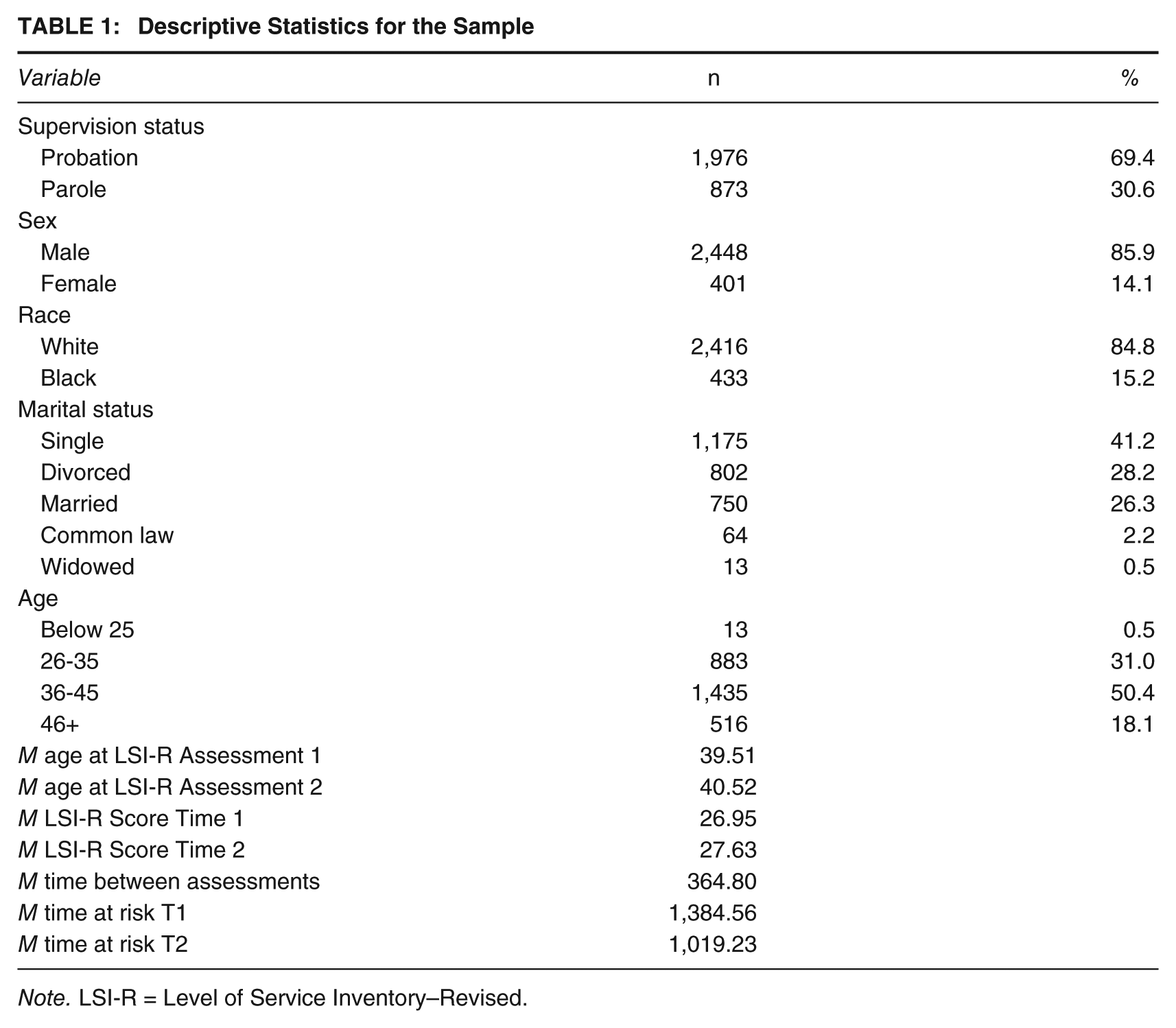
The Iowa Department of Corrections provided data for the current study from the Iowa Correctional Offender Network (ICON). All probationers and parolees who were under state supervision between August of 2000 and September of 2005 and who were administered the LSI-R on at least two occasions were included in the sample. A total of 2,849 adult probationers and parolees are represented in the sample. The descriptive statistics for the sample are presented in Table 1.
Descriptive Statistics for the Sample
Note. LSI-R = Level of Service Inventory–Revised.
Sample
The sample of 2,849 adult probationers and parolees was selected because all of these offenders were administered the LSI-R at least twice during the 5-year study period beginning August of 2000 and ending September of 2005. Although the data do not include reason for reassessment, on average, 1 year had elapsed (364.8 days) between an offender’s initial assessment and reassessment. This is important because assessment instruments comprising dynamic factors (e.g., attitudes, employment status, current substance use) have the potential for change. Therefore, dynamic risk assessment instruments are said to have a “shelf life” and must be readministered roughly once a year to maintain an accurate record of an offender’s risk/needs.
The initial assessment helps to identify criminogenic needs so that a treatment plan may be implemented to address an offender’s needs (e.g., attitudes, employment/education, peers, substance abuse). If an offender’s needs are correctly identified and the offender is placed in a program that will address those needs and take into account responsivity factors, a reduction in risk would be expected. A reassessment will determine whether there has been a change in risk since the initial assessment and if appropriate, the offender’s treatment and supervision services may be amended to match their current risk level.
Measures
Total LSI-R scores at Time 1 and Time 2 are the independent variables of interest used in the analysis. 1 The total LSI-R score can range from 0 to 54 with higher scores indicating an elevated risk for recidivism. There was an increase in the mean total LSI-R score at Time 1 (26.95) to (27.63) at Time 2. The following control variables: gender, race, age, supervision status, risk category, and time at risk were included in the multivariate analysis.
The dependent variable for the study is recidivism (0 = “no” and 1 = “yes”). Recidivism is defined as any new misdemeanor or felony conviction. The mean number of days in the follow-up period, referred to as time at risk, varied based on when the initial assessment was administered. The mean time at risk for the initial assessment was 1,385 with the number of days ranging from 558 to 2,258. The mean time at risk for the reassessment was 1,019, with the number of days ranging from 400 to 2,214.
Results
The study results are presented in three steps. First, the bivariate correlations between total LSI-R score and recidivism at Time 1 and Time 2 are provided. Second, we examine the degree to which changes in risk category have occurred from initial to follow-up assessment and how those changes are associated to changes in rates of recidivism. 2 In addition, we report rates of recidivism by risk category at Time 1 and Time 2. Third, we include multivariate models at Time 1 and Time 2 and multivariate models for percent change and raw change.
Total LSI-R Score and Recidivism
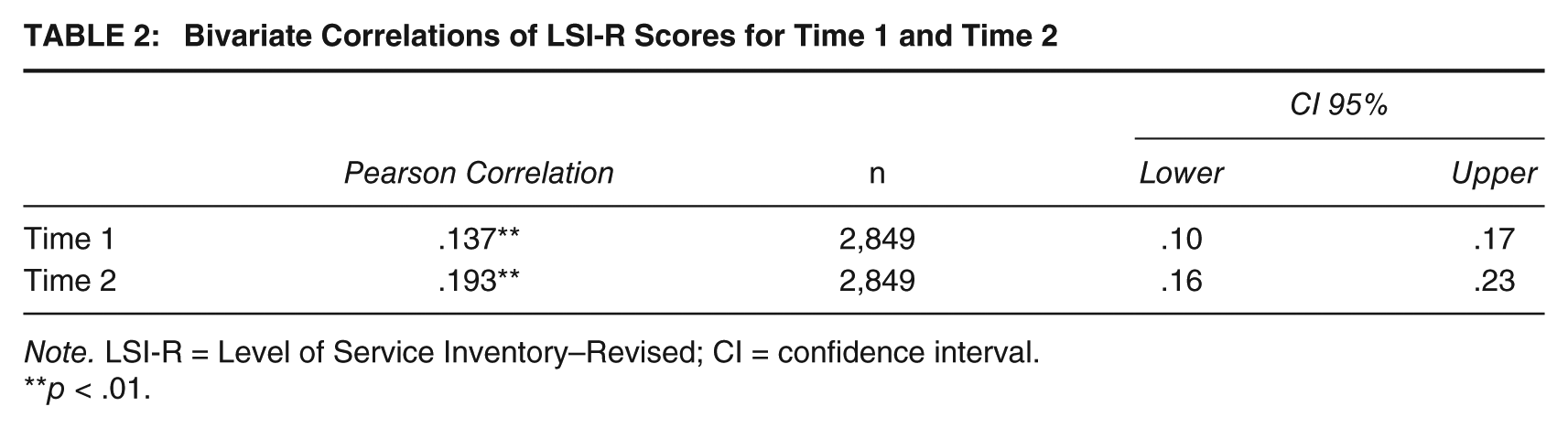
Table 2 reports the bivariate correlations between total LSI-R score and recidivism at Time 1 and Time 2. The Time 1 (r = .137) and Time 2 (r = .193) correlations are statistically significant at the .01 level. These findings suggest that the higher the total LSI-R score, the more likely the offender is to recidivate.
Bivariate Correlations of LSI-R Scores for Time 1 and Time 2
Note. LSI-R = Level of Service Inventory–Revised; CI = confidence interval.
p < .01.
Table 2 also includes the confidence intervals (CIs) associated with the Pearson correlation values to assess the magnitude and precision of the point estimates (see Cummings & Finch, 2005, for a more complete discussion on how to interpret CIs). Cummings and Finch (2005) assert that a significant difference exists between values when there is little or no overlap between the point estimates. Our findings suggested there was no significant difference between the Time 1 and Time 2 correlations for the sample despite the minimal overlap in the 95% CI ranges (CI = [.10, .17] at Time 1 vs. CI = [.16, .23] at Time 2).
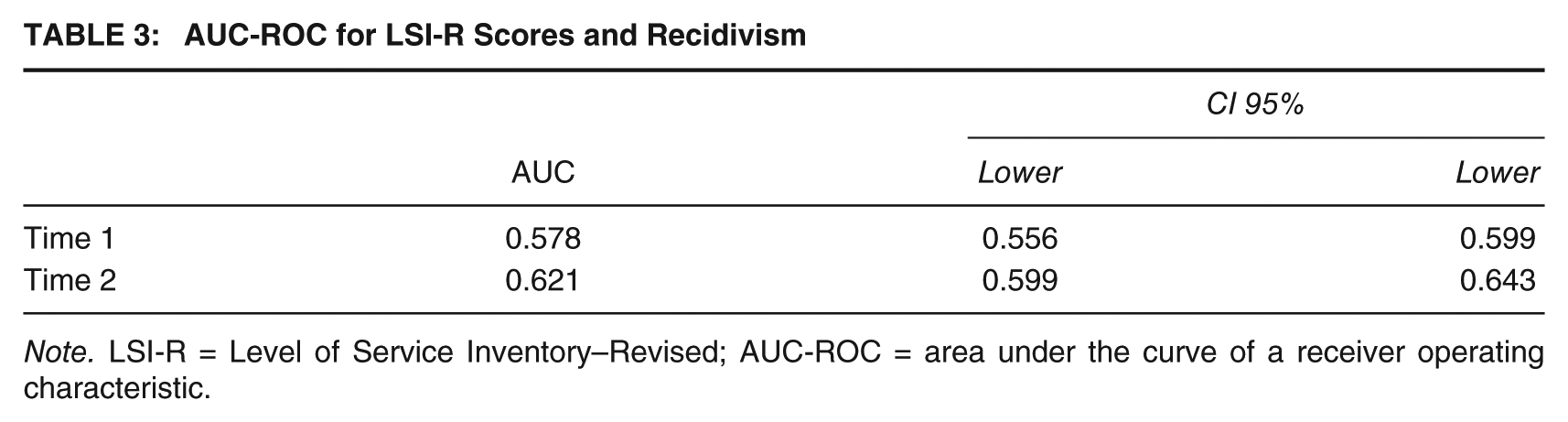
Table 3 includes the area under the curve of a receiver operating characteristic (AUC-ROC) values between the LSI-R total score and conviction for a felony or misdemeanor at Time 1 and Time 2. The AUC-ROC values are somewhat lower than is typically seen in LSI-R research. However, of interest, the two statistics differ from one another significantly. That is, the AUC-ROC produced from the Time 2 data is significantly higher than the AUC-ROC produced from the Time 1 data. These findings are consistent with the conclusions based on correlations reported in Table 2.
AUC-ROC for LSI-R Scores and Recidivism
Note. LSI-R = Level of Service Inventory–Revised; AUC-ROC = area under the curve of a receiver operating characteristic.
Change in Total LSI-R Score and Recidivism
This section discusses the results from the change analysis for the entire sample. Table 4 outlines the raw number as well as the percentage of offenders by risk category who recidivated after their Time 2 LSI-R assessment. The risk categories of the LSI-R at initial assessment are represented by rows, whereas the risk categories at Time 2 assessment are represented by columns. Simply put, the findings in the table indicate that high-risk offenders were indeed more likely to recidivate than low-risk offenders. Moreover, a change in risk level from Time 1 assessment to Time 2 assessment (defined as a reclassification from one category to another) was correlated with recidivism. For example, offenders who were assessed as moderate risk at Time 1 and as moderate/high risk at Time 2 have a 34.1% chance of failure. Similarly, offenders who are moderate risk at Time 1 and then low/moderate at Time 2 have a 21.20% likelihood of recidivism. These findings suggest that change in risk level was related to the rate of recidivism for the sample. Specifically, an increase in risk level results in higher failure rates and a decrease in risk level results in lower failure rates.
Risk Classification and Recidivism Time 2
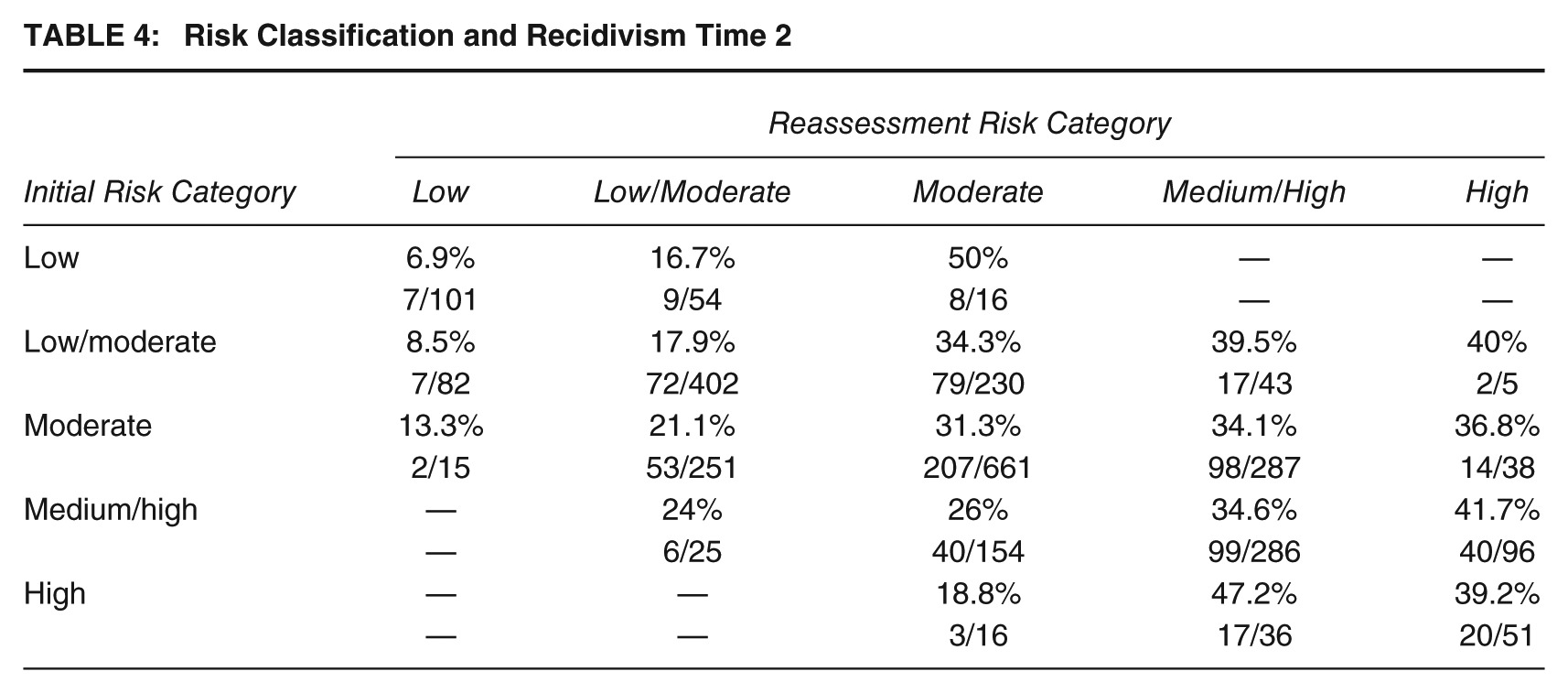
Figure 1 illustrates the rate of recidivism by risk category at Time 1 and Time 2. The rate of recidivism at Time 1 is higher than Time 2 for each risk category. Moreover, increases in risk category correspond with an increased risk of recidivism at Time 1 and Time 2. The most dramatic decrease in recidivism from Time 1 to Time 2 is found in the high- and low/moderate-risk categories (16%).
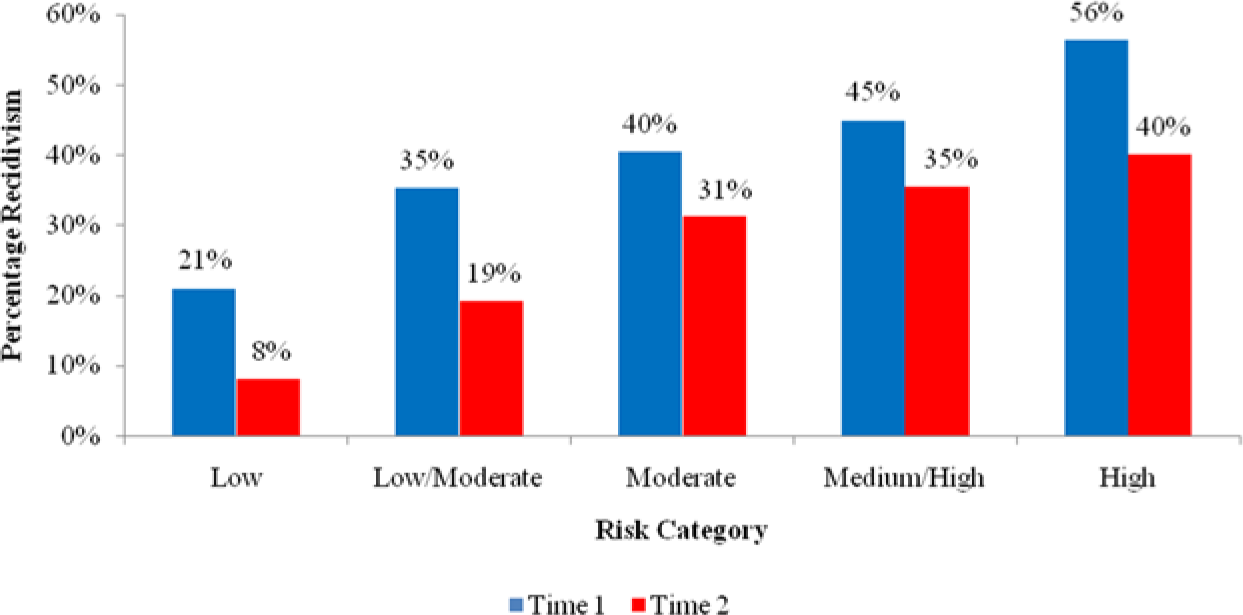
Percentage Recidivism for Time 1 and Time 2, by Risk Category
Multivariate Analysis
Beyond examining the bivariate correlations between total LSI-R score and recidivism at Time 1 and Time 2, it is important to include multivariate analysis in order to control for variables such as race, age, gender, and supervisory status (Cohen, 1995; Gendreau, Little, & Goggin, 1996; Hirschi & Gottfredson, 1983; Lowenkamp & Bechtel, 2007; Minor, Wells, & Sims, 2003; Whitehead, 1991). Logistic regression models are estimated at Time 1 and Time 2 where race, age, gender, and supervisory status, and a measure of change on the LSI-R are included as control variables.
The multivariate models from Time 1 and Time 2 are presented in Table 5. Time at risk (i.e., the number of days between LSI-R assessment and record check) and total LSI-R score are statistically significant predictors at Time 1 and Time 2. Race, age, gender, and supervisory status are not significant predictors of recidivism at Time 1 or Time 2.
Logistic Multivariate Analysis of LSI-R by Time
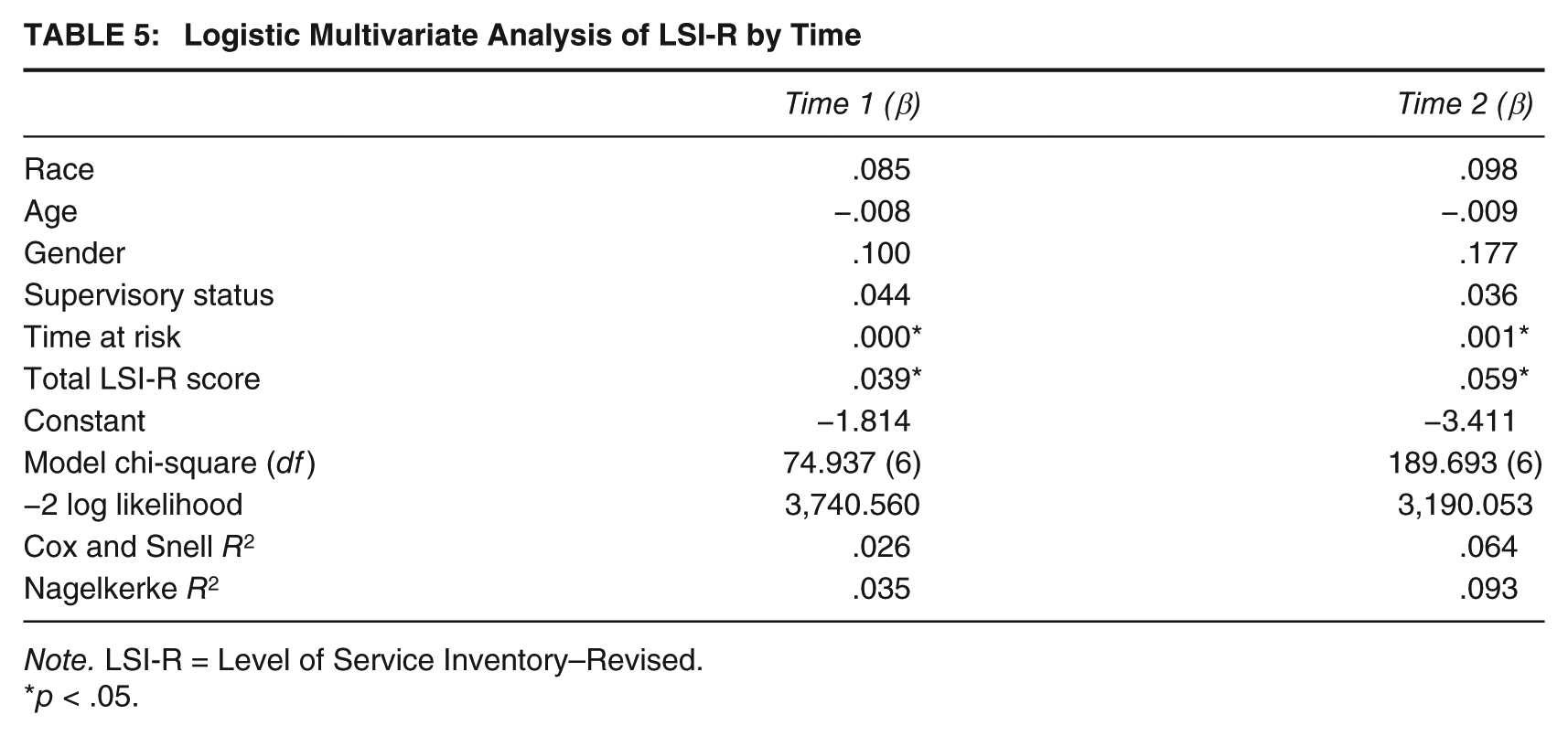
Note. LSI-R = Level of Service Inventory–Revised.
p < .05.
The current project examines both percent change and raw change. Percent change is meaningful when discussing increases and decreases in rates of recidivism and can be interpreted by individuals who are not familiar with the LSI-R instrument. One drawback of using raw change is that it requires the reader to be familiar with the scoring protocol of the LSI-R. However, raw change is more descriptive than percent change because the risk categories of the LSI-R are based on raw scores and change in raw score provides insight on any change in the offender’s risk level. This is important because offender risk level is regarded as an important factor when determining program placement. Specifically, higher risk offenders require more intensive treatment and supervision than lower risk offenders (Andrews & Bonta, 1998; Gendreau, 1996; Marlowe, Festinger, Lee, Dugosh, & Benasutti, 2006).
Table 6 presents the results from the multivariate analysis of percent change and raw change. Time at risk at Time 2 and risk category at Time 1 are statistically significant in both models. Percent change and raw change are also significant in their respective models. Finally, the interaction terms for each model (risk category Time 1 and percent change) and (risk category Time 1 and raw change) are significant predictors. Race, age, gender, and supervisory status fail to be significant predictors in either of the multivariate change models.
Logistic Multivariate Analysis of LSI-R by Percent Change and Raw Change
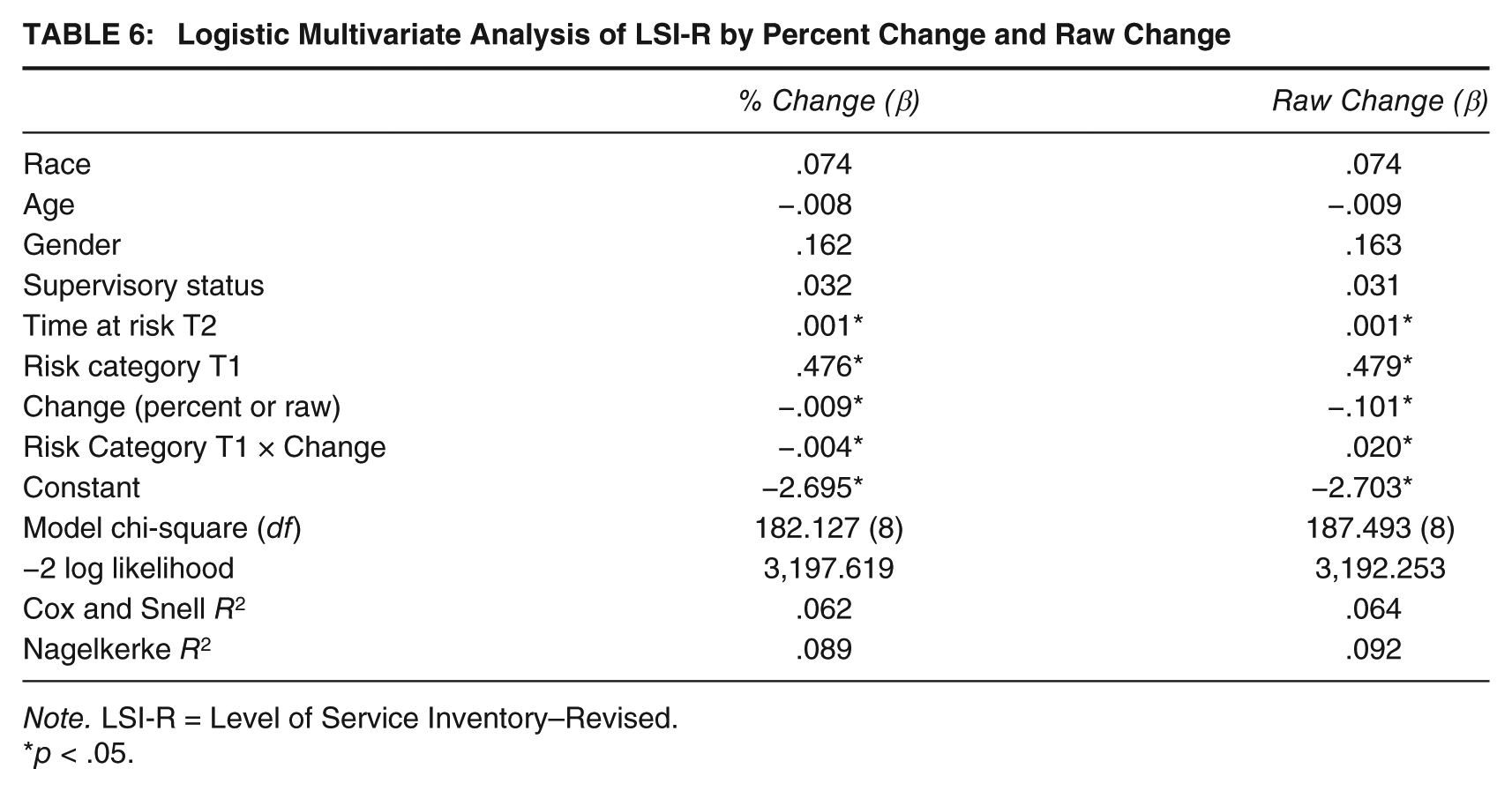
Note. LSI-R = Level of Service Inventory–Revised.
p < .05.
Discussion
Three major findings emerge from the current study. First, the LSI-R is a valid predictor of recidivism. Second, change matters. Reduction in total score results in lower rates of recidivism. Conversely, increases in total score result in higher rates of recidivism. Third, change matters more for some than it does for others. Specifically, reducing the total LSI-R score of high-risk offenders corresponds with more dramatic reductions in recidivism than does reducing the total LSI-R score of low-risk offenders.
Implications for the Theory of Effective Correctional Intervention
The LSI-R is an assessment instrument based on the theory of effective intervention. Although this study is not a direct test of this theory, the findings do have theoretical implications. To reiterate, the three major components outlined in the theory of effective intervention are the principles of risk, need, and responsivity. The risk principle maintains that offenders should receive treatment and supervision commensurate with their level of risk. That is, high-risk offenders should receive more treatment and supervision than low-risk offenders. The needs principle asserts individuals have certain characteristics (e.g., antisocial attitudes, criminal peers, antisocial personality) that may increase their likelihood of recidivism. These factors or “needs” can be targeted for treatment. Finally, the responsivity principle suggests that offenders should be placed in treatment programs based on their risk, need, and learning style. The purpose of matching offender to treatment is to maximize the offender’s potential for positive change and reduce likelihood of recidivism (Andrews & Bonta, 1998; Andrews et al., 1990).
The findings from the current study relate back to the theory of effective intervention in two ways. First, the risk principle dictates that high-risk offenders should be the focus of treatment and supervision efforts. The findings from the change analyses suggest that the impact that change has on rate of recidivism varies across categories of risk. Specifically, change for high-risk offenders has a greater impact on rate of recidivism than change for low-risk offenders. Although any reduction in recidivism is meaningful, the difference in crime savings between high-risk and low-risk offenders suggests that concentrated efforts with high-risk offenders may provide the largest return (reduction in recidivism) on correctional investment (treatment and supervision services).
Second, the theory of effective intervention implies that individual behavior can be changed if appropriate criminogenic needs are targeted for change through correctional treatment. To be clear, this study did not consider or evaluate any type of treatment services that the offenders in the sample may have received prior to or during the study period. As such, it is not appropriate to speculate why an offender’s total LSI-R score at Time 2 is higher, lower, or the same as it was at Time 1. However, the fluctuation in total LSI-R scores leaves open the possibility that offenders may have risks/needs that can be identified through proper assessment and targeted for change through appropriate correctional programming. Again, speculating why change in total LSI-R score occurred is beyond the scope of the current project, but this line of research is recommended for future studies involving change scores and the LSI-R.
Policy Implications
As of 2010, there were nearly 5 million U.S. citizens on probation or parole (Glaze & Bonczar, 2011). The dramatic increase in the offender population over the last 30 years has forced correctional agencies to make difficult decisions about how to balance the need for public safety against the cost of treating and supervising the offender population. To that end, correctional agencies must resort to managing groups of offenders rather than each individual offender (Feeley & Simon, 1992). Offender classification instruments are commonly used by correctional agencies to divide offenders into groups based on offender risk level. Although there are a number of different classification instruments available for use today, the LSI-R has emerged as one of the most popular. It is within this context that the policy implications for use of the LSI-R with the offender population are discussed.
The findings from the majority of studies on the LSI-R conclude that the instrument is a valid predictor of recidivism (Barnoski & Aos, 2003; Gendreau, Goggin, & Law, 1997; Holsinger, Lowenkamp, & Latessa, 2006; Mills, Jones, & Kroner, 2005; Simourd, 2004). The findings from this study are consistent in support of the LSI-R as a valid predictor of recidivism. For that reason, it is appropriate for correctional agencies to adopt this risk/needs assessment for use in offender classification (Andrews & Bonta, 1995).
The statistical analysis conducted for the current work provided information regarding rate of recidivism by risk category on the LSI-R at two distinct points in time. Not surprisingly, the rate of recidivism increased as risk level increased. Alone, this finding supports the need for correctional agencies to utilize the LSI-R to identify high-risk offenders for treatment and supervision because high-risk offenders are most likely to recidivate. However, the previous finding, coupled with the idea that change in total LSI-R score for high-risk offenders results in a greater reduction in recidivism compared with changes in total LSI-R score for low-risk offenders, should further motivate correctional agencies to focus treatment and supervision efforts on high-risk offenders. High-risk offenders pose the greatest likelihood of failure but also have the most potential for positive change.
The finding that change in LSI-R score matters in predicting recidivism and that the degree to which it matters varies across categories begs the question whether or not it is necessary to administer the LSI-R to offenders at multiple points in time. Administering the LSI-R multiple times is recommended for two reasons. First, multiple assessment points provide an opportunity for the correctional agency to monitor an offender’s rehabilitative progress. For example, if an offender is assessed at intake and placed in a treatment program that corresponds with his or her risks, criminogenic needs, and responsivity factors, then a reduction in total LSI-R score should occur between Time 1 and Time 2 assessments. If the offender is reassessed 6 months after his or her initial assessment, having received treatment in the months between initial and follow-up assessments, and no change in total LSI-R score has taken place, then the agency may need to assign the offender to a different treatment program that may better address the offender’s risks and criminogenic needs.
No change in total LSI-R score may indicate a problem with the program to which the offender has been assigned. Research suggests that on average, treatment programs reduce recidivism by 10% (Lipsey, 1992; Losel, 1995). Moreover, some treatment programs work better than others (Cullen & Gendreau, 2000; Gendreau & Ross, 1979). To that end, in addition to helping agencies monitor the rehabilitative progress of offenders, multiple assessments may also help agencies monitor the effectiveness of their treatment programs.
The second reason to administer assessment at multiple points in time involves supervisory placement and release decisions. Given that the probability of recidivating varies across categories of risk and that change in total scores impacts rates of recidivism differently across categories of risk, it is possible that offender risk level could change enough to warrant either a reduction in supervisory level or a complete release from supervision. For example, offenders in the sample initially assessed as moderate risk have a 40% likelihood of failure. Moderate-risk offenders whose risk level decreased to low-risk upon reassessment have a 21.1% failure rate. A dramatic decrease in likelihood of recidivism may inspire an agency with limited financial and human resources either to reduce the treatment and supervision for the now low-risk offender or to release the low-risk offender from supervision so that treatment efforts may be directed toward offenders who have a greater likelihood of failure.
Future Research
Although there have been more than 40 studies on the LSI-R to date, very few of them have considered the impact of change in LSI-R score on likelihood of recidivism (Hollin et al., 2003; Miles & Raynor, 2004; O’Keefe et al., 1998; Raynor, 2007; Schlager & Pacheco, 2011). As such, the findings from the current study bring to light new research questions to consider in studies.
First, there is the need to replicate this study with other samples of offenders. While change matters with this particular sample of probationers and parolees from Iowa, change may or may not matter with samples of offenders from other states or countries. To that end, does change matter with juvenile offenders? Given that this is only one study and that the demographic characteristics of offenders in Iowa do not represent the entire population of offenders, it is recommended that researchers carry out similar studies on a variety of offender populations.
Second, the results from the current project indicate that change in total LSI-R score occurred but cannot offer an explanation as to why the change occurred. Research that considers the type of treatment the offender receives may help to explain why some offenders’ scores increase, some decrease, and some stay the same from one assessment point to the next. As previous research has shown, on average, treatment programs reduce rates of recidivism by 10% (Lipsey, 1992; Losel, 1995) and that some treatment programs work better than others (Cullen & Gendreau, 2000; Gendreau & Ross, 1979). To that end, it is important to examine the type of treatment received and the degree to which type of treatment may or may not impact change in total LSI-R score.
Third, it is important for future research efforts to question when the LSI-R should be administered. If an agency is only able to administer the LSI-R once, should that take place at intake or perhaps 6 months after the offender has received treatment and supervisory services? At what point in time is the instrument most accurate in predicting recidivism? Similarly, if an agency is able to administer the LSI-R at multiple points in time, what is the appropriate number of days between initial and follow-up assessment?
Perhaps the best way to address these questions is through research using an experimental design. This method would allow for the assignment of offenders to an experimental group or control group. Moreover, the researcher can control when offenders are assessed and reassessed. In addition, this method would allow the researcher to dictate the type of treatment the offender receives between initial assessment and follow-up assessment. Ultimately, the experimental design method of research has the potential to overcome many of the limitations of the current study. Accordingly, it is recommended that experimental design research is used in future research that attempts to assess the impact of change in LSI-R score on the prediction of recidivism.
Although a considerable amount of research has been conducted on the LSI-R, there are still many questions to be answered. For that matter, there are still many questions to be asked. The findings from this study help contribute to the existing body of research on the LSI-R and to extend the literature by examining the impact of change on rates of recidivism. Additional research efforts assessing offenders at multiple points in time and the impact of change on rates of recidivism are necessary. The findings from this project and similar projects in the future may provide correctional agencies with valuable information to better treat, supervise, and manage the burgeoning offender population.