



Abstract
The current study examines the impact of perceived risk and fear of sexual assault on male and female offenders’ fear of (a) property crime, (b) violent crime, and (c) gang crime. Results indicate that perceived risk of victimization and fear of sexual assault are significantly associated with fear of property, violent, and gang crime among the full sample and among both men and women. Confirming results of prior research, perceived risk of victimization is a stronger predictor of property, violent, and gang fear among men. Fear of sexual assault emerged as a stronger predictor of fear of property, violent, and gang crime among women, confirming Ferraro’s shadow of sexual assault thesis.
There are many factors that are related to fear of crime. Studies often find that fear is higher among people who live in urban areas, are poor or minority, perceive their neighborhoods to be disordered or in decline, and worry about the behaviors of people who are racially different than they are. These people often feel more at risk and therefore more afraid. Early studies found that the elderly were more afraid even though they were at least risk of victimization, but studies using better measures often find that younger people are more afraid. Prior victimization is sometimes related to higher fear and sometimes not (Merry, 1981; Skogan, 1990; for a review of research, see Lane & Meeker, 2003; Warr, 1994). Yet the most consistent predictor of fear of crime over time is gender. In most studies, across time and context, women are more afraid than men (Lane, in press; for a review, see Warr, 1994).
Scholars have developed at least four theoretical ideas to help account for this gender difference, including physical vulnerability, or the idea that women are generally smaller and weaker than men (Skogan & Maxfield, 1981), differential socialization, or the idea that women are socialized to be fragile and submissive whereas men are socialized to be tough and dominant (Hollander, 2001), and patriarchy, or the idea that men purposely control women through the threat of rape and other violence (Brownmiller, 1975; Stanko, 1985). The fourth theoretical explanation, the shadow of sexual assault thesis, is the focus of this article and was developed primarily by Ferraro (1995, 1996), who argued that women are more afraid of crime generally because they are particularly afraid of sexual assault and the likely physical and emotional consequences that they would face if they were raped. That is, rape serves as a key “perceptually contemporaneous offense,” or one that is associated in people’s minds with other crimes (Warr, 1984, p. 695). Ferraro (1995, p. 87) argued that fear of rape was particularly acute for women because rape victimization overwhelmingly affects women compared to men, and he reasoned that rape may serve as a “master offense” among women. As noted later, his theoretical explanation for greater fear among women—or the “shadow thesis”—has received a lot of attention and support in the literature, but studies to date have focused on the general population.
Another line of fear research has started to focus on fear of crime among offenders because offenders are at greater objective risk of victimization because of their participation in the criminal lifestyle (Chen, 2009; Lauritsen, Sampson, & Laub, 1991; Sampson & Lauritsen, 1990). One might expect offenders to be more afraid of crime than those in the general population who have less firsthand experience and knowledge of the reality of crime (Lane & Fox, 2012). Gang members, in particular, associate with other offenders but also often experience retaliation and victimization because of their involvement in the gang (Taylor, 2008). That is, victimization and offending are often related and involve the same people, rather than random people in the general public (Black, 1983; Fagan, Piper, & Cheng, 1987). It may be that people involved in crime are more afraid because they know and hang out with others who commit crime and therefore know the real risks or because they have committed crimes against people that could result in retaliation. Yet it also may be that their experience with crime and knowledge of those who commit it may allow them to feel less afraid because of personal feelings of strength or protection by friends (e.g., members of their own gang). In spite of an increased objective risk of victimization among offenders, only a few studies have examined fear among people who commit crime, and even fewer have examined gang members (Lane, 2006, 2009; Lane & Fox, 2012 May, 2001a; May, Vartanian, & Virgo, 2002). People in the public and policy makers may not yet be concerned about fear among offenders, but this issue is practically important. It is possible that high fear among offenders may lead them to commit more crime as a way of protecting themselves or saving face (e.g., carrying weapons, reacting to threat with force, joining gangs; see Cobbina, Miller, & Brunson, 2008). If this is true, offender fear may lead to more crime and victimization, affecting both other offenders and the general public, and may point to the importance of trying to protect both groups—not just the public—in crime reduction efforts (see Lane & Fox, 2012).
This study is designed to blend the two areas of research—that on the shadow thesis with that focusing on offenders—by examining the impact of fear of sexual assault on fear of property, violent, and gang crime while on the street among men and women in jail, some of whom are gang members. We believe that the shadow of sexual assault thesis may be especially relevant to offenders, particularly women, many of whom have personally experienced sexual victimization either as children or as adults (Chesney-Lind & Pasko, 2004; Richie, 2000; Widom, 2000). Although rape is underreported, studies indicate that the rate of sexual victimization among female offenders is higher than for women in the general public (Holsinger, 2000; Richie, 2000), which may make them more acutely aware of the context and impacts of this experience. Specifically, their increased likelihood of previous sexual victimization may make worry and fear about rape and other sexual assaults even more salient than they would be for women in the general public, who, some scholars argue, are constantly aware that they are at risk of being assaulted by men (Stanko, 1985). Adding to this is female offenders’ increased personal experience with the criminal lifestyle more generally through participation in crime, which may make them feel even more afraid (because they see consequences first hand) or less afraid (because they feel bolstered by their street experience or personal connections; Cobbina et al., 2008; Lane, 2006; Miller, 2001). Clearly, given these circumstances, women offenders are an important subpopulation to study when trying to understand the impact of the shadow of sexual assault. Yet it is important also to examine the impact of fear of sexual assault among male offenders because sometimes men also are raped, and much fear of crime research shows that objective victimization risk does not neatly coincide with fear of crime (Tjaden & Thoennes, 2000).
Given this context, we ask the following research questions: (a) Are female offenders more afraid of property, violent, and gang crime than are male offenders? (b) Is fear of sexual assault also a strong predictor of fear of other types of crime among offenders, as research shows it is for the general population? (c) And, if so, is fear of sexual assault among offenders a stronger predictor of fear for women compared to men, as prior results show is true in the general population? Much of the research examining fear of crime among offenders to date has focused on juvenile offenders (e.g., Lane, 2006, 2009; May, 2001a; May et al., 2002). This is the first to examine the shadow thesis as it applies to offenders and one of the first to examine fear of crime among adult offenders (see Lane & Fox, 2012). We believe that adult offenders may be different from juvenile offenders in the levels and causes of fear, in part because they have more life and possibly criminal experience.
Prior Research on the Shadow Thesis
Ferraro (1995, 1996) was the first to specifically articulate the shadow thesis as it is currently discussed in the literature. He built his work on the arguments of other scholars that women were terrified of rape and that they were especially afraid of the possible harms, including death, that might result from rape (e.g., Gordon & Riger, 1989; Riger, Gordon, & LeBailly, 1978). In an earlier study, Warr (1985, p. 247) examined fear of rape among women only, finding that they were more afraid of rape than any other crime and that this fear was a key predictor of their fears of other crimes—that they were “perceptually contemporaneous offenses” (also see Warr, 1984, p. 695). Ferraro (1996, p. 669) then argued that rape was a perceptually contemporaneous offense to most other crimes but that it served as a “master offense” among women especially, increasing their fear of nonsexual offenses. It was so important because women realized that any criminal victimization might also result in a sexual assault (also see Ferraro, 1995). In other words, because of heightened risk of and experience with rape, women would be more afraid of rape and rape would affect other types of fear more for them than it would for men. 1
Ferraro (1995) first examined the shadow thesis by examining its impact on one dependent variable representing fear of nonsexual crime. He first estimated a regression model with neighborhood characteristics, personal characteristics (including gender), and perceived risk included as predictors and then estimated a second model where the official rape rate and fear of rape were added. He found that fear of rape was the strongest predictor of fear of nonsexual crime and that gender became nonsignificant when fear of rape was included in the model. Ferraro (1996) then did a similar set of analyses but predicted fear of specific crimes (e.g., murder, robbery, assault, burglary, and car theft). He again found that fear of rape was a strong predictor of fear of violent crimes but that the effect of gender generally reversed (e.g., for murder and assault) or became nonsignificant (e.g., robbery, burglary while at home). Fear of rape was also a significant predictor of fear of nonviolent crimes, but gender was not a significant predictor before or after fear of rape was added to the models for three crimes (car theft, being cheated, or vandalism).
Ferraro’s (1995, 1996) work prompted others to examine his arguments among different samples. Madriz’s (1997) qualitative work supported the shadow thesis argument, when she found that women constantly worried that something small like a “touch in the street may or may not become a sexual assault” (p. 154). May (2001b) also found that fear of rape predicted fear of other offenses for both teenage girls and boys, prompting him to argue that some boys may feel physically weaker and be faced with a “shadow of powerlessness” (p. 167). Lane and Meeker (2003) examined the effect of fear of sexual assault and fear of nonsexual (gang) assault on fears of specific gang crimes among both men and women. They found that once the harm component (nonsexual assault) was controlled, the fear of rape was still important but explained much less variance in fear of other crimes, leading them to argue that the harm component of rape had a stronger impact on fear of other crimes than the sexual component. Of interest, they found that fear of rape was a significant predictor for other fears for men also, but perceived risk was a stronger predictor for men, and the reverse was true for women.
Other studies have focused primarily on fear of crime among college students. Fisher and Sloan (2003) examined the shadow thesis among a national sample of college students, also finding that the signs for gender often reversed once fear of rape was included in the model for both daytime and nighttime fear. That is, after controlling for fear of rape, men were a little more afraid of larceny, robbery, and both types of assault both during the day and at night. Similar to Ferraro, they found that fear of rape was a stronger predictor of fear of violent crime compared to nonviolent crimes (Fisher & Sloan, 2003). Lane, Gover, and Dahod (2009) built on Ferraro (1996) and Fisher and Sloan (2003), examining the impact of perceived risk and fear of rape on fear of robbery and assault at night and during the day among a convenience sample of college students at one university. Lane et al. also reported regression results separately for men and women to see if the impacts of these variables differed by gender. They found that women felt more perceived risk and fear of rape than men did, but that in the multivariate models perceived risk was a stronger predictor for men and fear of rape was a stronger predictor for women (also see Lane & Meeker, 2003). This study was also consistent with prior results in finding that either the influence of gender became nonsignificant or the sign reversed (men became more afraid) once fear of rape was included as a predictor. Like Lane and Meeker (2003), they also found that fear of rape was a predictor, although a weaker one, for men. Cook and Fox (2012) recently examined the effects of fear of assault versus fear of sexual assault on fear of home invasion, robbery, and murder among male and female college students. Findings revealed that fear of assault and fear of sexual assault were both important predictors of other types of fear (home invasion, robbery, and murder) among both men and women, although, contrary to prior findings, fear of assault was more important than fear of sexual assault for both groups.
Wilcox, Jordan, and Pritchard (2006) studied whether or not victim–offender relationship in fear of sexual assault mattered in predicting other types of fear. They found that fear of stranger-perpetrated and acquaintance-perpetrated sexual assault were both positively related to fear of other types of crimes. The strongest relationships were between fear of stranger-perpetrated sexual assault and fear of other stranger-perpetrated crimes. Hilinski (2009) also found the fear of rape predicted fear of theft, robbery, and simple and aggravated assault regardless of whether those crimes were perpetrated by strangers or acquaintances. In addition, once she controlled for fear of rape, she found that men were more afraid of all of these crimes, except theft. In sum, all quantitative studies that have specifically focused on examining the shadow of sexual assault thesis have found support for Ferraro’s (1995, 1996) arguments, often finding that men become more afraid or gender becomes nonsignificant once the analysis controls for fear of rape (the master offense). Hilinski, Pentecost Neeson, and Andrews (2011) recently examined the shadow thesis using qualitative data garnered from a web-based survey of college women, also finding support for this idea. They found that some women indicated that their fears of sexual assault were tied to their fears of other offenses, either because the other offenses might lead to rape or vice versa.
Prior Research on Fear of Crime Among Offenders
The authors are aware of only one study that focused on fear of street crime among adult offenders as this one does and none that examined the shadow of sexual assault thesis among offenders. We recently (Lane & Fox, 2012) compared fear of property, personal (i.e., violent), and gang crime among current and ex-gang members and non-gang members, focusing on the impact of perpetration, victimization, and social disorganization. The results indicated that adult offenders were not very afraid of crime overall, but there were differences in predictors across groups. Although current and ex-gang members felt more at risk of victimization, they were less afraid than were non-gang members. Prior victimization and perceptions of social disorganization better predicted fear of crime among non-gang offenders than gang or ex-gang offenders, whereas amount of perpetration was not significant at all. With regard to gender, non-gang women were more afraid of all three types of crime, whereas female current and ex-gang members were more afraid than men of property crime but not personal or gang crime (Lane & Fox, 2012). We argued that women in gangs may feel more protected from personal and gang crimes because of their participation in the gang—that is, being in the gang brings both risk and protection but generally more protection (Lane & Fox, 2012; also see Cobbina et al., 2008; Miller, 2001).
A few studies have focused on fear of crime among juveniles who were on probation (Lane, 2006) or incarcerated (Lane, 2009; May, 2001a; May et al., 2002). Taken together, these studies suggest that despite their heightened victimization risk, offenders are not very afraid of crime—except for serious crimes such as being shot or murdered (Lane, 2006, 2009). Yet the issue is complex because studies of gangs in particular find that members often say they joined the gang for protection. Research also shows that gangs attack other gangs because they are worried they themselves will be attacked (e.g., Chin, 1996; Decker & Van Winkle, 1996; Jankowski, 1991; Klein, 1995). Melde, Taylor, and Esbensen (2009) examined fear of crime among elementary students who were in gangs and compared them to those who were not in gangs. They found that over time gang members were less afraid than non-gang youths. Yet none of these studies have examined the impact of fear of rape on fear of nonsexual crime among offenders as the current study does. Moreover, with so few studies examining fear of crime among offenders and given the complexity of the issue, we have much to learn about the causes and consequences of their fear.
Current Study
As noted, this study examines the effects of perceived risk (or the expected “likelihood” that victimization will happen) and fear (the “feeling” about the possibility of victimization) of sexual assault on male and female offenders’ fear of (a) property crime, (b) violent crime, and (c) gang crime (see Ferraro, 1995). We first examine these relationships among the full sample of offenders and then disaggregate the sample to compare results for men and women, as some previous studies have done. Based on earlier research, we believe that the impact of fear of sexual assault on other types of fear should vary by gender, that is, it should matter more for women and perceived risk should be more important for men (see Lane et al., 2009; Lane & Meeker, 2003). Looking beyond fear studies specifically, research shows that women generally are more emotionally expressive than men, although differences, of course, exist among individuals in both gender groups (Brody & Hall, 2010). Consequently, it would make sense that fear (an emotion) would matter more for women whereas perceived risk (cognition) might matter more for men.
Based on prior literature, we test a series of hypotheses related to fear of property, violent, and gang crime among offenders: (a) women will be significantly more afraid of crime compared to men (Ferraro, 1995), (b) both men and women who perceive a greater risk of experiencing crime will be significantly more likely to fear crime, (c) perceived risk of victimization will have a greater impact on fear for men than women (Lane & Meeker, 2003), (d) both female and male offenders who are more afraid of sexual assault will be significantly more likely to fear crime more generally, and (e) fear of sexual assault will have a greater impact on fear for women than men (Ferraro, 1995, 1996; Lane & Meeker, 2003). Consistent with the shadow hypothesis, we expect that fear of sexual assault will emerge as the strongest predictor of fear of property, violent, and gang crime.
Method
Data Collection
The data for the current study were the result of a project designed to collect original data from a large sample of jail inmates from 14 of the 20 largest Florida jails in 2008 and 2009 (70% of the target sample). Because crime (Duhart, 2000), gangs, and gang crime are more prevalent in urban areas (Egley & Howell, 2012), we targeted the 20 largest urban jails in Florida (for a detailed description of the data, see Fox, Zambrana, & Lane, 2011; Lane & Fox, 2012). The population of jail inmates incarcerated on the days of data collection ranged from 866 to 3,535 (average of 1,700). The sample of jail inmates was incarcerated for a variety of reasons, including awaiting trial (n = 779, 34%), serving a jail term (n = 442, 19%), and parole or probation violation (n = 577, 25%), among other reasons. 2
Participants
Jail inmates are clearly a subset of offenders, but we chose to sample them because it was a convenient way to access a large number of offenders at once who, although removed from the street, had not been so for long (about 60% had been there for 3 months or less and another 18% had been there for fewer than 6 months). Within each facility, we introduced the study to the offenders and informed them that participation was voluntary, anonymous, and without compensation or penalty if they declined. We surveyed both men and women, and all inmates were eligible to participate with the exception of those incarcerated in disciplinary confinement, psychiatric units, and communicable disease units. 3 Inmates who agreed to participate answered questions regarding a variety of topics, including gang membership, criminal offending, crime victimization, perceived risk while on the street, fear of crime while on the street, and personal characteristics. Jail staff were not present in the rooms during survey administration, and they were unable to view or handle inmate surveys. The research team read the survey questions and response options aloud (in both English and Spanish) as respondents privately indicated their responses on either English or Spanish versions of the survey. Inmates were spaced adequately from each other in an effort to prevent others from viewing their responses.
In total, 2,414 inmates completed the survey, which was administered by the research team inside jail dorms or pods. Although the research team delivered the announcement about the survey while the inmates were quieted, it was impossible to count the number of inmates who actually listened to the invitation to participate. Many inmates were outside the view of researchers, and some inmates appeared to be occupied with other tasks (e.g., reading, listening to music with headphones). In addition, most of the units housed up to 100 inmates, which prevented counts during the announcement. Therefore, the response rate was based on the official number of inmates present within each housing unit as tracked by the correctional officers supervising each unit. The response rate is comparable to those of other research on incarcerated inmates (Struckman-Johnson, Struckman-Johnson, Rucker, Bumby, & Donaldson, 1996) and is a conservative estimate given that not all of the inmates housed in each unit actually heard the study announcement.
The response rate ranged from 13% to 35% among the jails, with an average of 25%. Although we did not detect discernible differences in response rates across the jails, we observed situational factors that appeared to lower the response rate in some instances. For example, fewer inmates participated when the survey was administered in the early mornings, when the survey interfered with other activities (e.g., recreation, meals, visitation), or when officers who exhibited poor rapport with inmates escorted the researchers. Based on our observations, we cannot identify any reasons to suspect that including nonrespondents would have changed the findings. Although we cannot determine whether respondents and nonrespondents are similar or different in terms of our key measures (e.g., fear, gang membership, victimization), we took precautions to avoid biasing the sample toward those who were afraid of crime by initially describing the study as a general survey about crime, beliefs, and personal histories.
Measures
Dependent Variable: Fear of Crime
We asked respondents to rate how “personally afraid” they were of 19 specific crimes occurring while outside of jail (e.g., Ferraro, 1995). Response options included not afraid (coded as 1), somewhat afraid (coded as 2), afraid (coded as 3), and very afraid (coded as 4; see Lane & Meeker, 2003). We combined the 18 nonsexual fear items into three indexes, to measure (a) fear of property crime (theft, vandalism, and burglary), 4 (b) fear of violent crime (robbery, threatened with a weapon, attacked without a weapon, attacked with a weapon, stabbed, witness intimidation, home invasion, shot at, shot, and being killed), and (c) fear of gang crime (carjacking, property damage by gang graffiti, home invasion by a gang member, gang attack, and gang harassment; Lane & Meeker, 2003). We created the indexes by adding the responses from the individual items and dividing by the total number of variables such that the three fear indexes ranged from 1 (indicating less fear) to 4 (indicating more fear). Cronbach’s alpha scores indicate high reliability for the fear of property crime index (α = .832), fear of personal crime index (α = .955), and fear of gang crime index (α = .953).
Independent Variables
Demographic variables
Gender (0 = women, 1 = men) is one of the key independent variables in this analysis, given the historical importance of gender to fear of crime and especially the shadow thesis. We also included race (0 = non-White, 1 = White) and age (continuous variable) in the models because prior research often shows that minorities are more afraid than Whites, and age has been an important but inconsistent predictor in prior research (for a review, see Ferraro, 1995, 1996; Warr, 1994).
Gang status
Given that some research indicates that gang members are significantly less fearful than non-gang members (Lane & Fox, 2012; Melde et al., 2009), we included gang membership as a predictor. Similar to prior research, we asked respondents to indicate their current or former gang membership (Curry, 2000; Decker, Katz, & Webb, 2008; Esbensen, Winfree, He, & Taylor, 2001; Melde et al., 2009; Webb, Katz, & Decker, 2006). We created dummy variables for ex-gang members and gang members (where non-gang members was the reference category), and included both variables in the models to account for the effects of gang membership. 5
Crime perpetration and victimization
We presented respondents with a series of crimes and asked them to report the number of times they had ever been victimized by each crime, including theft, vandalism, threatened with a weapon, assaulted without a weapon, assaulted with a weapon, robbed, carjacked, witness intimidation, home invasion, drive-by shooting, stabbed, shot at, and shot and hit. We also asked respondents to indicate how many times they had committed each of these crimes. We summed the number of times respondents reported being victimized by each crime to create a victimization index (Cronbach’s α = .725), and we added the number of times respondents reported committing each crime to create a perpetration index (Cronbach’s α = .697). We truncated both indexes at the 99th percentile in an effort to avoid model misspecification from extreme outliers (Nagin & Smith, 1990). 6 Respondents were also asked whether they had ever perpetrated or been victimized by rape or sexual assault (0 = no, 1 = yes). These two dichotomous variables were included in the models to control for the possibility that personal experience with sexual assault (perpetration or victimization) may influence perceived risk of victimization or fear of victimization.
Perceived risk of victimization
We presented respondents with the same list of crimes used to measure fear and asked them to rate their likelihood of being victimized by each crime in the future while outside of the jail (also see Melde et al., 2009). Response options included very unlikely (coded as 1), somewhat unlikely (coded as 2), somewhat likely (coded as 3), and very likely (coded as 4). Using the same crimes and procedure as in the fear indexes, we created three indexes to measure (a) perceived risk of property crime (Cronbach’s α = .741), (b) perceived risk of violent crime (Cronbach’s α = .924), and (c) perceived risk of gang crime (Cronbach’s α = .910). The indexes ranged from 1 (less perceived risk) to 4 (more perceived risk). In the multivariate models predicting fear of crime, we entered the specific perceived risk index as an independent variable that corresponded to the specific type of fear. For example, models predicting fear of property crime used the perceived risk of property crime index.
Fear of sexual assault
Given that the current study aimed to examine the shadow of sexual assault thesis (Ferraro, 1995, 1996) with regard to fear of property, violent, and gang crime, we also include fear of rape or sexual assault as a key independent variable (e.g., Ferraro, 1995, 1996; Lane & Meeker, 2003). Using the same four response options (ranging from not afraid, coded 1, to very afraid, coded 4), respondents indicated the degree to which they were personally afraid of “being sexually assaulted or raped” while outside of jail.
Analytic Plan
We first present the descriptive statistics for the variables of interest among the full sample and then separately among men and women. Next, we present multivariate models separately for the full sample, men, and women, first examining fear of property crime, followed by fear of violent crime, and finally fear of gang crime. We estimated theoretically driven nested models to observe the ways in which the effects of certain variables changed as others were introduced. The steps correspond with prior research and are modeled after theoretical expectations within the fear of crime literature (e.g., Ferraro, 1995, 1996; Lane & Meeker, 2003). In the tables, the first model includes demographics, gang membership, and crime perpetration and victimization, the next model includes perceived risk of victimization, and the full model incorporates fear of sexual assault (Step 3). We present estimates for all the nested models to show how estimates change once other variables are added (see Ferraro, 1995, 1996).
Results
Sample
Table 1 presents the descriptive characteristics among the full sample and among men versus women separately. The majority of the full sample was male, non-White, relatively young, and non-gang members. Women were significantly more likely than men to be White, and men were significantly more likely to be involved with gangs, either as ex-gang members or current gang members. Men reported perpetrating and being victimized by crime significantly more often than women. Although there were no significant differences between the groups for committing sexual assault, women were significantly more likely than men to be victims of sexual assault. In fact, about half (51%) of the women reported having been sexually assaulted, whereas only 7% of men did. Men were significantly more likely than women to believe they were at a greater risk for being victimized by violent crime and gang crime, but not property crime. Alternatively, women were significantly more fearful of property crime, violent crime, and sexual assault. No significant differences between the groups were observed for fear of gang crime (although the difference was nearly significant at p = .055). Generally confirming Hypothesis 1, then, the descriptive results indicate that women are significantly more afraid of three types of crime (property, violent, and sexual assault) but not gang crime.
Descriptive Statistics

p < .05. **p < .01. ***p < .001. Asterisks represent significant differences between men and women.
Fear of Property Crime
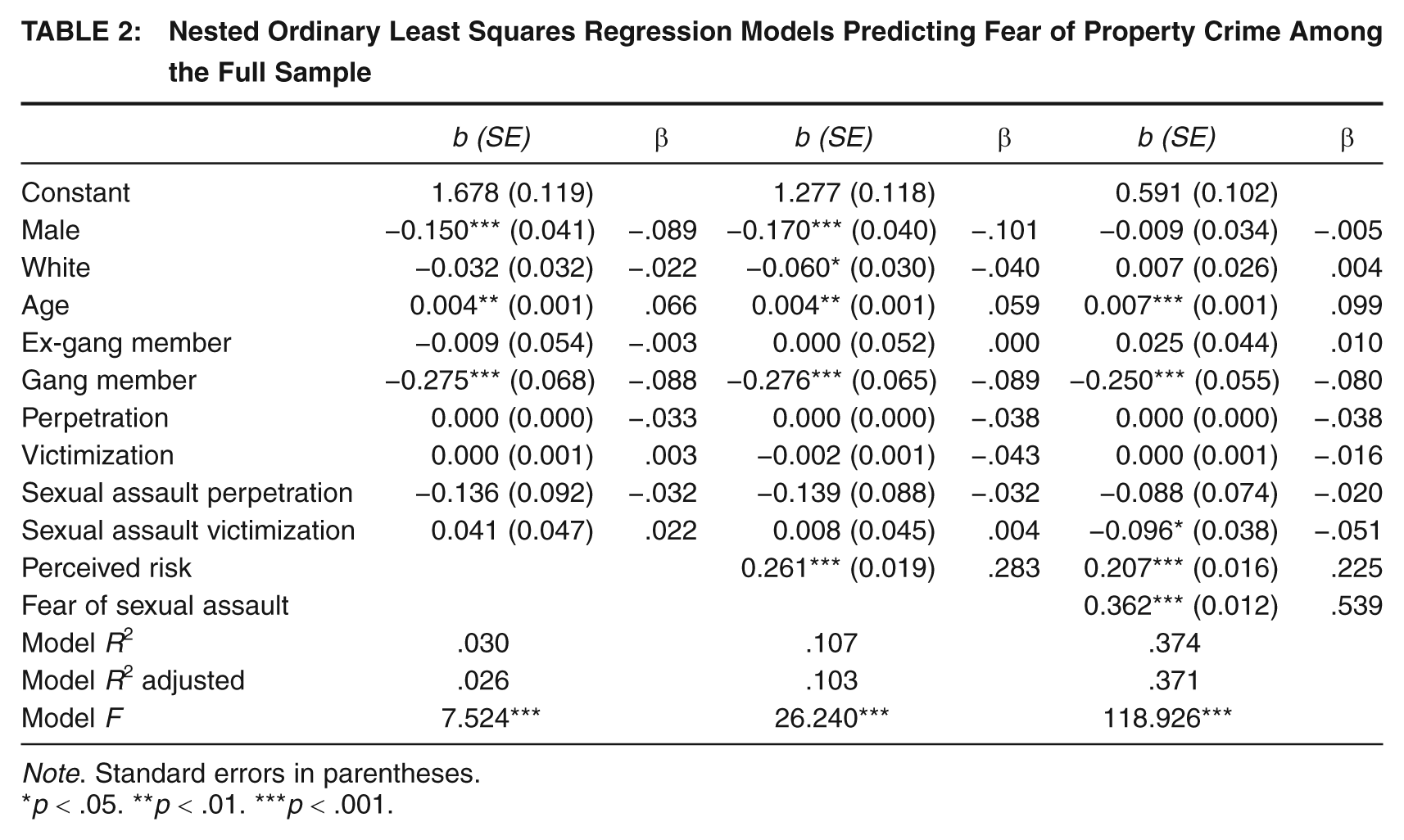
Table 2 presents the set of nested models for the full sample of offenders. Women are significantly more afraid of property crime when only the personal characteristics and then perceived risk are added to the model; yet, as Ferraro (1995) found in his models predicting nonsexual crime, this gender effect is no longer significant in the full model when fear of sexual assault is included. The elimination of the gender effect after including fear of sexual assault in the model, therefore, is consistent with Ferraro’s (1995, 1996) shadow of sexual assault thesis. Across the three models, older offenders are significantly more afraid of property crime compared to younger respondents and gang members are significantly less afraid (also see Melde et al., 2009). In only the second model adding perceived risk, non-Whites emerge as significantly more afraid of property crime; although this is not a consistent finding across all models. Consistent with the hypothesis, perceived risk of property crime victimization is significantly related to offenders’ fear of property crime. In other words, those who believe that they likely will be victims of property crimes are more likely to be afraid of them. When fear of sexual assault is entered into the equation, the model explains approximately 26% more variance in fear of property crime, indicating that fear of sexual assault is the strongest predictor of fear of property crime for the sample as a whole.
Nested Ordinary Least Squares Regression Models Predicting Fear of Property Crime Among the Full Sample
Note. Standard errors in parentheses.
p < .05. **p < .01. ***p < .001.
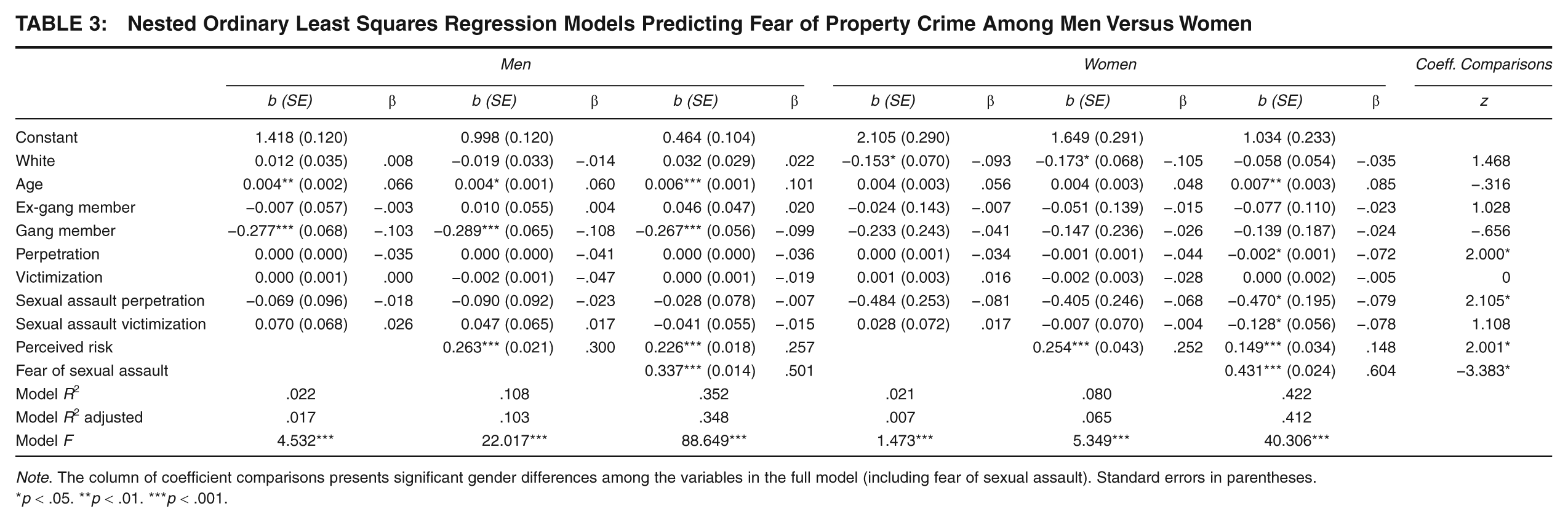
Table 3 compares the effects of personal characteristics, perceived risk of property crime victimization, and fear of sexual assault on fear of property crime separately among men and women. Among women, non-Whites were significantly more fearful in the first two models (but not after fear of sexual assault was entered in the final model), whereas race was not significant among men. Age was a consistent predictor across the models for men, whereas age was significant for women only in the final model, which indicated that older men and women were slightly more afraid of property crime once we controlled for fear of sexual assault. Among men, gang members were significantly less afraid of property crime compared to ex-gang members and non-gang members. Although none of the crime perpetration or victimization variables were significant among men, the final model for women indicates that women who committed less crime (e.g., perpetration index) and who did not report perpetrating or being victimized by sexual assault were significantly more likely to fear property crime, which is consistent with other research indicating that offenders who are less involved in crime are more afraid (Lane, 2006). Stated differently, women who committed or were victims of sexual assault were less afraid of property crime once we controlled for fear of sexual assault.
Nested Ordinary Least Squares Regression Models Predicting Fear of Property Crime Among Men Versus Women
Note. The column of coefficient comparisons presents significant gender differences among the variables in the full model (including fear of sexual assault). Standard errors in parentheses.
p < .05. **p < .01. ***p < .001.
Similar to the results from the full sample model (see Table 2), in Table 3, perceived risk was significantly and positively related to fear of property crime among both men and women. Coefficient comparison tests (z tests) indicated that perceived risk of property crime had a stronger impact on fear of property crime among men compared to women (z = 2.002). The final model indicates that fear of sexual assault is significantly associated with fear of property crime among men and women. Similar to Lane and Meeker’s (2003) findings, our results show that although perceived risk had a stronger impact among men, the impacts of fear of sexual assault on fear of property crime were more robust among women (z = −3.383; also see Lane et al., 2009). In addition, women who perpetrated fewer crimes (z = 2.00) and fewer sexual assaults (z = 2.105) were significantly more afraid than men who perpetrated fewer of these crimes.
Fear of Violent Crime
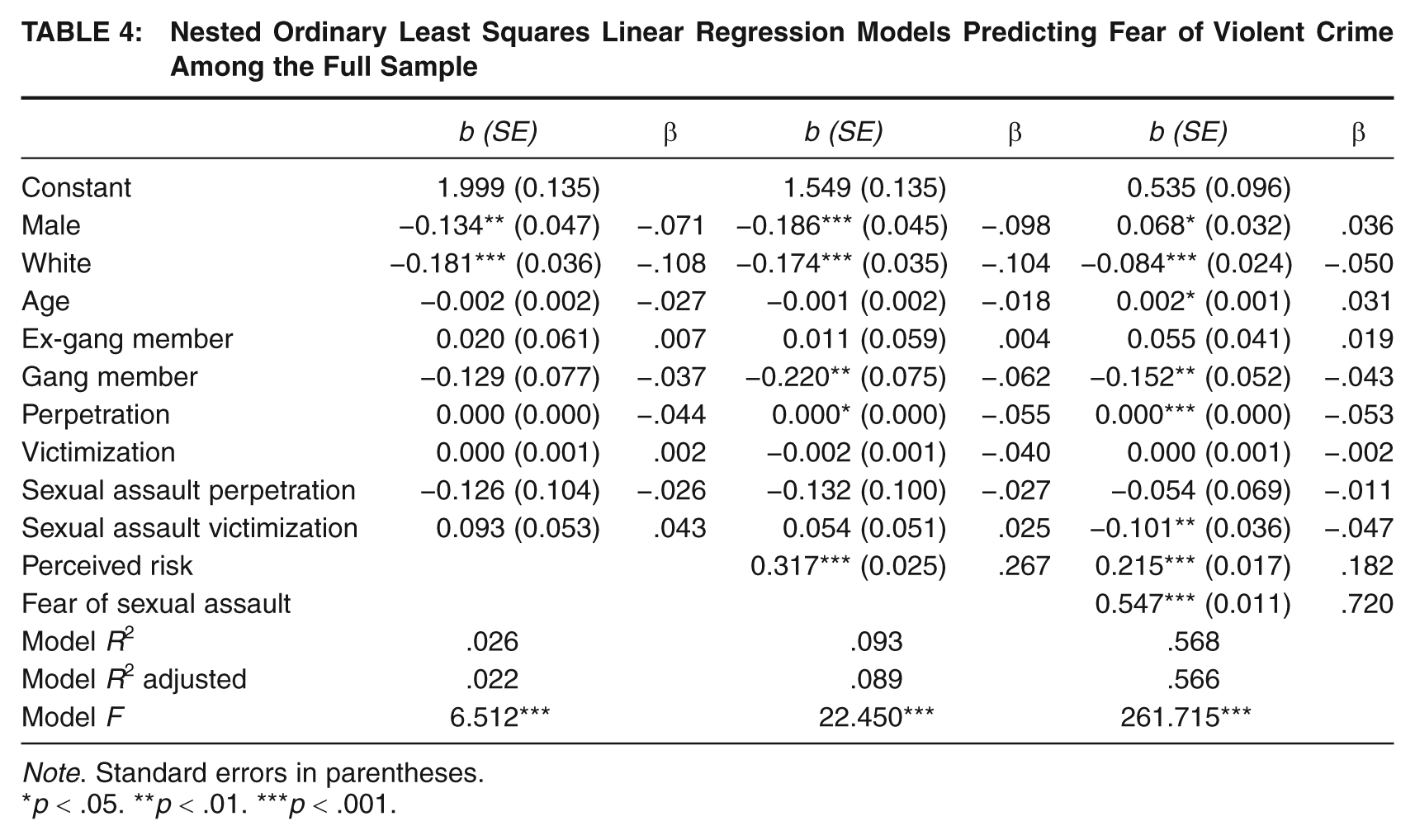
The results of nested models predicting fear of violent crime among the full sample are in Table 4. Consistent with Ferraro’s (1996) work examining the impact of fear of sexual assault on fear of violent crime (i.e., murder and assault) and fear of nonsexual crime generally (Ferraro, 1995), the relationship between gender and fear of violent crime reverses once fear of sexual assault is entered into the model. Before fear of sexual assault was entered into the model, women were significantly more afraid of violent crime than men; however, in Model 3, men become significantly more afraid of violent crime after accounting for the effects of fear of sexual assault. Across all models, non-Whites are significantly more afraid of violent crime compared to Whites. Gang membership emerges in the second and final models (when perceived risk and fear of sexual assault are entered) as an important factor related to fear, indicating that gang members are less afraid of violent crime compared to ex-gang members and non-gang members (also see Lane & Fox, 2012). Offenders who reported committing fewer crimes were significantly more fearful of violent crime (Models 2 and 3; see Lane, 2006). In the third model, offenders who did not report being sexually assaulted were significantly more afraid of violent crime. Consistent with the models predicting fear of property crime, respondents who perceived a greater risk of experiencing violent crime and those who were more afraid of sexual assault were significantly more afraid of violent crime. As in the fear of property crime models, the explained variance among the models predicting fear of violent crime substantially increases in the final model when fear of sexual assault is included (increasing by more than 47%; for similar results see Ferraro, 1996; Lane & Meeker, 2003).
Nested Ordinary Least Squares Linear Regression Models Predicting Fear of Violent Crime Among the Full Sample
Note. Standard errors in parentheses.
p < .05. **p < .01. ***p < .001.
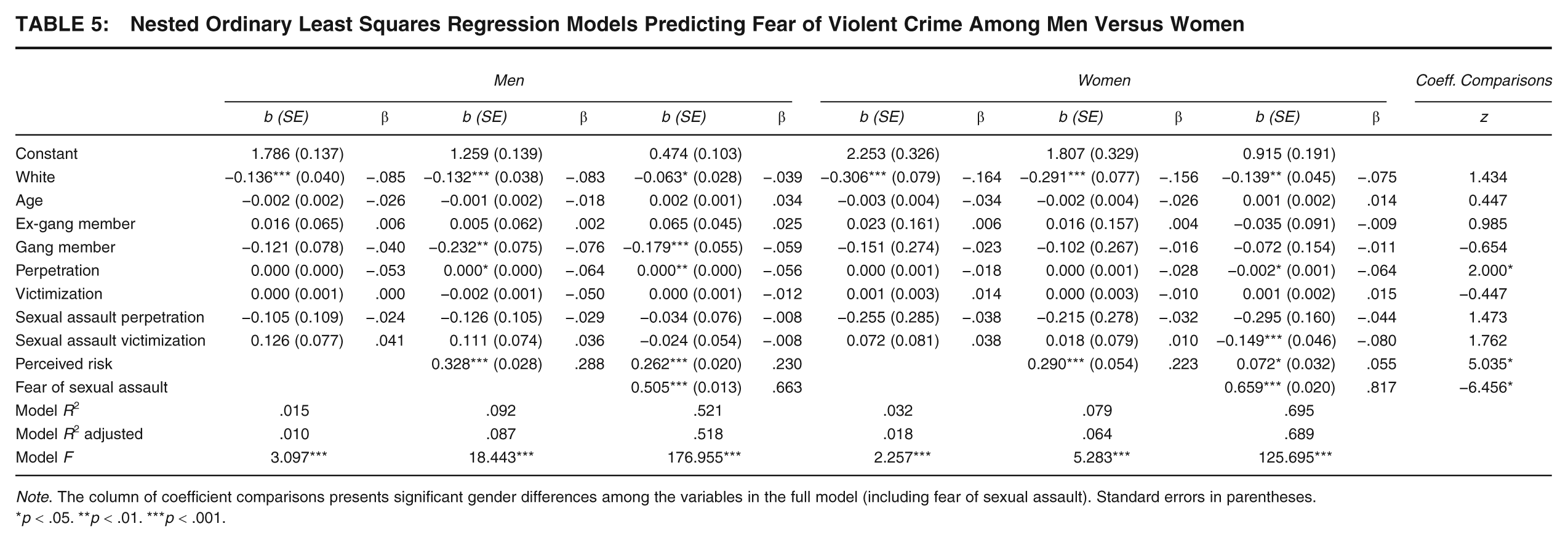
Table 5 compares fear of violent crime between men and women. Across all models for both men and women, non-Whites are significantly more afraid of violent crime compared to Whites. Among men, gang members are significantly less afraid of violent crime (Models 2 and 3) compared to men who were ex-gang members and non-gang members. Similar to the results presented for the full sample, the perpetration index is significant and negative among men (Models 2 and 3) and women (Model 3), indicating that both men and women who reported less involvement with crime were significantly more afraid of violent crime once we controlled for perceived risk and fear of sexual assault (see Lane, 2006). In the final model, once we controlled for fear of sexual assault, women who did not report sexual assault victimization were significantly more afraid of violent crime compared to women who were sexually assaulted. Consistent with the results predicting fear of property crime and our hypotheses, perceived risk and fear of sexual assault were significant for both men and women. Coefficient comparison tests indicate that for fear of violent crime, like for fear of property crime, the effect of perceived risk was stronger among men (z = 5.035), whereas the impact of fear of sexual assault mattered more for women (z = −6.456; for similar results see Lane et al., 2009; Lane & Meeker, 2003). Z tests also indicate that women who reported committing less crime also were significantly more afraid of violent crime than men who perpetrated less (z = 2.00).
Nested Ordinary Least Squares Regression Models Predicting Fear of Violent Crime Among Men Versus Women
Note. The column of coefficient comparisons presents significant gender differences among the variables in the full model (including fear of sexual assault). Standard errors in parentheses.
p < .05. **p < .01. ***p < .001.
Fear of Gang Crime
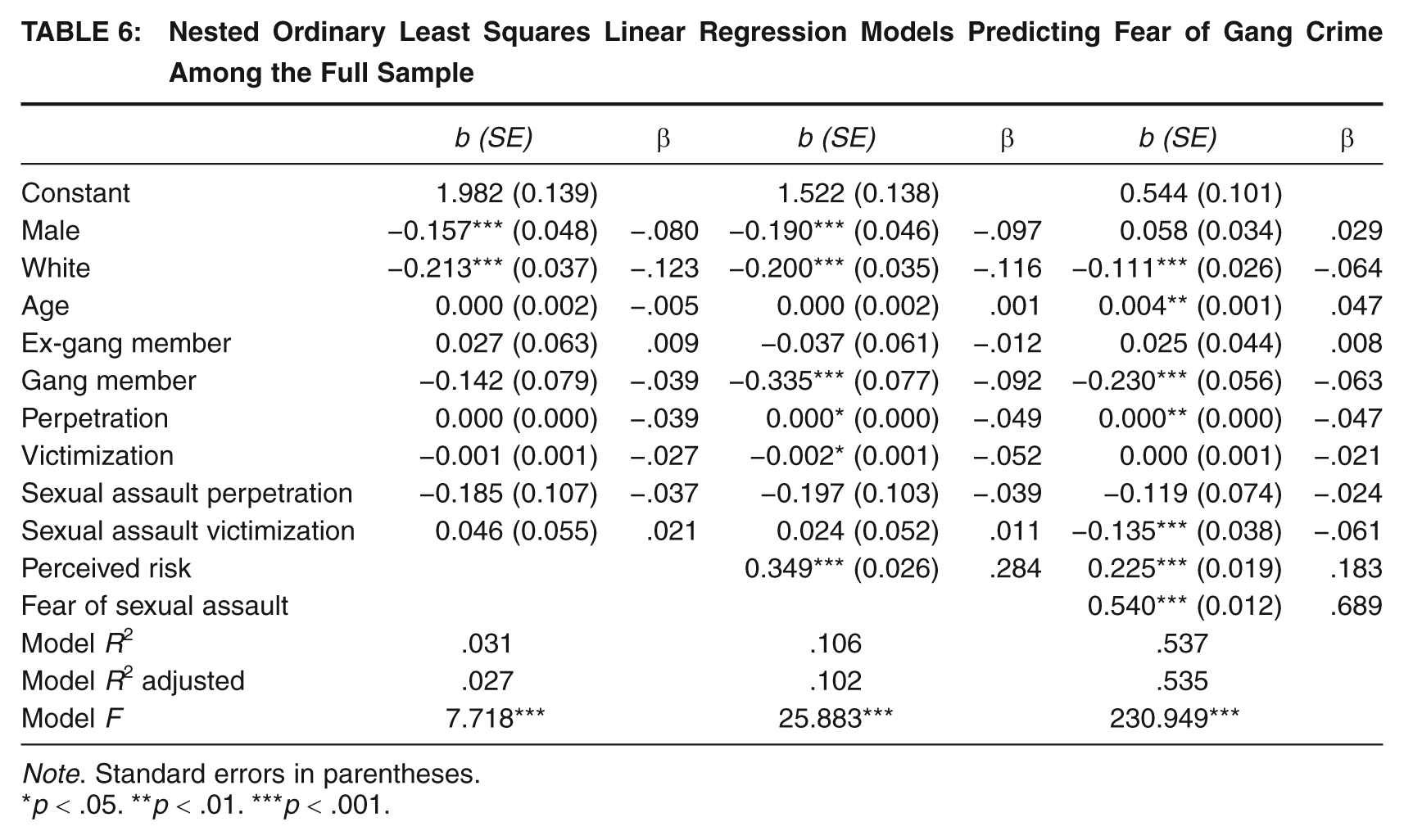
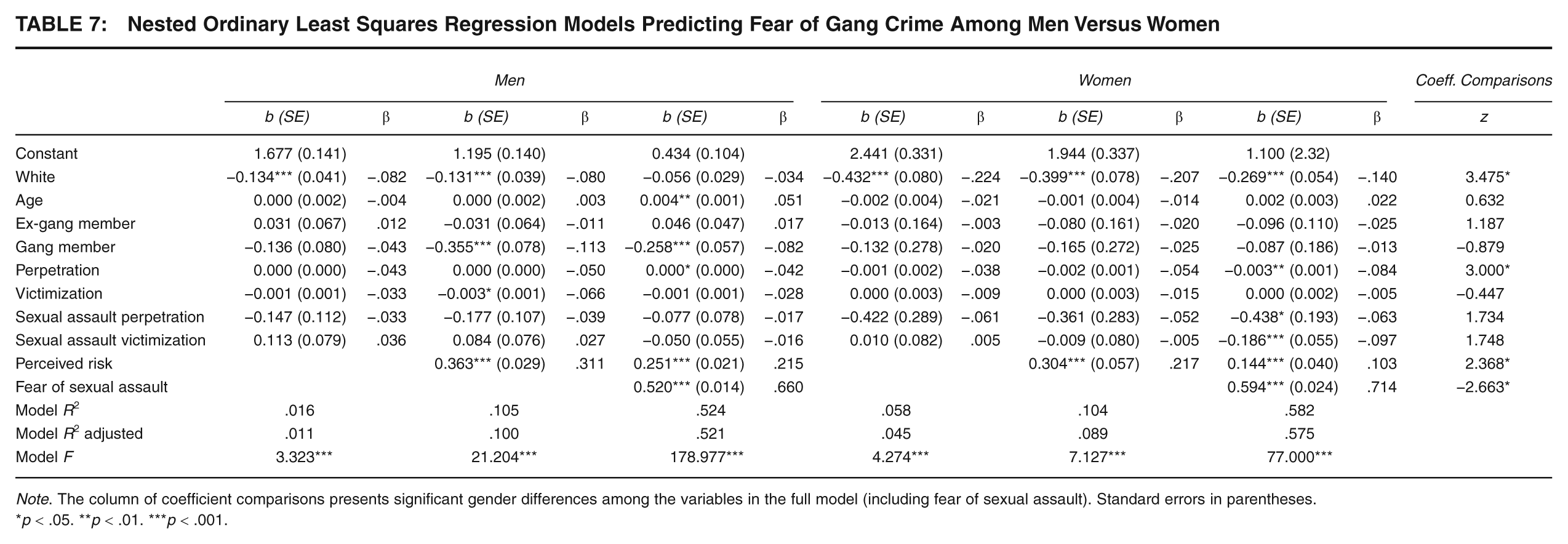
The final two tables present results of the nested models featuring fear of gang crime among the full sample (Table 6) and among men and women separately (Table 7). Among the full sample, gender is significant in the first two models, indicating that women are significantly more afraid of gang crime when personal characteristics are entered alone and once perceived risk is in the model. However, after fear of sexual assault is entered in the final model, the gender effect is reduced to nonsignificance whereas the explained variance in fear substantially increases. This finding is similar to Ferraro’s results when predicting fear of robbery once fear of rape was entered into the model (gender in his model also changed from significant to nonsignificant once he controlled for fear of sexual assault; Ferraro, 1996).
Nested Ordinary Least Squares Linear Regression Models Predicting Fear of Gang Crime Among the Full Sample
Note. Standard errors in parentheses.
p < .05. **p < .01. ***p < .001.
Nested Ordinary Least Squares Regression Models Predicting Fear of Gang Crime Among Men Versus Women
Note. The column of coefficient comparisons presents significant gender differences among the variables in the full model (including fear of sexual assault). Standard errors in parentheses.
p < .05. **p < .01. ***p < .001.
In Table 6, across all three models, non-Whites are significantly more afraid of gang crime compared to Whites. Age becomes significant in the final model, such that older offenders are significantly more afraid of gang crime than younger ones once we control for perceived risk and fear of sexual assault together. Gang members are significantly less afraid of gang crime compared to ex-gang members and non-gang members when perceived risk is in the model and when fear of rape is added (Models 2 and 3). Offenders who reported less involvement with crime (Models 2 and 3) were more afraid when perceived risk and both perceived risk and fear of rape were in the model, and those who were victimized less often were more afraid of gang crime when perceived risk was entered by itself (Model 2). In the final model, once all variables were included, respondents who were not sexually assaulted were more afraid of gang crime. Consistent with the models predicting fear of property crime and fear of violent crime and with our hypotheses, people who perceived a greater risk of gang crime victimization and who were more afraid of sexual assault were significantly more afraid of gang crime.
Table 7 compares men’s and women’s fear of gang crime. With the exception of the final model among men, where fear of sexual assault was included, both non-White men and non-White women were significantly more afraid than Whites across models. Older men were more afraid of gang crime than younger ones when fear of rape was in the model, although age was not significant among women at any point. Gang members were less afraid of gang crime compared to ex-gang members and non-gang members once perceived risk (Model 2) and perceived risk and fear of rape (Model 3) were in the model. In the final model, including fear of sexual assault, both men and women who reported less criminal activity were significantly more afraid of gang crime. Those men who experienced less victimization were significantly more afraid only when perceived risk was entered (Model 2) but not when fear of sexual assault was included (Model 3). Among women, those who reported no perpetration or personal victimization by sexual assault were significantly more afraid of gang crime than those who were perpetrators or victims. In support of the hypotheses and similar to the previous models predicting fear of property and violent crime, perceived risk of victimization and fear of sexual assault were significantly related to fear of gang crime among both men and women. Coefficient comparison tests revealed that perceived risk of gang crime victimization had a stronger impact on gang fear for men (z = 2.368) and fear of sexual assault was stronger among women (z = −2.663; see Lane et al., 2009; Lane & Meeker, 2003). Z-tests indicated that minority women were significantly more afraid than minority men (z = 3.475). In addition, women who reported committing less crime were more afraid of gang crime than were men who reported committing less crime (z = 3.000).
Discussion
Key Findings
Our key research questions focused specifically on examining the foundational work of Ferraro (1995, 1996) on the shadow of sexual assault thesis as it applies to adult offenders. This study examined whether or not the relationships that have been found in the general public would emerge with offenders, and we find that they do. We first examined these relationships in the full sample of offenders and then among men and women separately. We find clear support for Ferraro’s (1995, 1996) arguments that rape may serve as a master offense in predicting women’s fear of nonsexual crimes. For all three nonsexual crimes, fear of rape is a significant predictor for both men and women. Yet the coefficient comparison tests indicated that the effect was stronger for women in every model (property, violent, and gang crime), confirming our hypotheses (also see Lane et al., 2009; Lane & Meeker, 2003). As Ferraro (1995, 1996) found, after considering the impacts of fear of sexual assault on other types of fear, the gender difference is often eliminated or reverses in our analyses of the full sample (also see Fisher & Sloan, 2003; Lane et al., 2009; Lane & Meeker, 2003). Specifically, for fear of property crime and gang crime, gender becomes nonsignificant once fear of rape is in the model but remains significant in the violent crime model.
A striking number of women reported having been sexually assaulted (51%), which confirms prior research indicating that female offenders have a lot of experience with sexual victimization in their lifetimes (Chesney-Lind & Pasko, 2004; Holsinger, 2000; Richie, 2000; Widom, 2000). Yet one interesting and unexpected finding is that for all three types of fear (property, violent, and gang), those women who experienced sexual assault were less likely to express fear of other crimes once fear of rape was in the model. In the prior steps for all three types of crime (personal characteristics only and perceived risk steps), sexual assault victimization was not a significant predictor for women. Bivariate results indicated that women who had been victimized were significantly more likely to be afraid of rape. These results taken together suggest that it is the emotional component of the victimization that is more important than the experience itself. That is, it is how women react to the experience through fear that affects their fear of other crimes, as Ferraro (1995, 1996) has argued, not just the rape itself. And, possibly more important, it provides further evidence that fear of rape is a major factor in fear of other crimes for many women. Of interest, there were no significant differences between women and men in terms of self-reporting that they had committed a sexual assault, but this is likely a result of the small number of people in both groups who reported they had done so (4% of men, 2% of women) rather than some unique finding contrary to statistics indicating that males are much more likely to commit rape or sexual assault (Tjaden & Thoennes, 1998).
Also confirming prior results and our hypotheses, we found that perceived risk increased fear of crime for both men and women, but that it was a stronger predictor for men once we controlled for fear of sexual assault (Lane & Meeker, 2003). This was true for the models predicting fear of property, violent, and gang crime; however, coefficient comparison tests indicated no significant gender differences on perceived risk for fear of property crime (z = 0.188), violent crime (z = 0.625), or gang crime (z = 0.923) before accounting for fear of sexual assault (e.g., Model 2 in the tables).
In terms of demographic variables other than gender, in the full sample we found that minorities were more afraid of violent and gang crime in all models, but only more afraid of property crime in the model including perceived risk (not fear of rape). These findings are consistent with prior work finding that minorities are more afraid of violent crime (for a review, see Warr, 1994). Of interest, older people were slightly more afraid of property crime in all models and of gang crime when fear of sexual assault was included as a predictor, but younger people were more afraid in all three violent crime models. These disparate findings regarding age could be explained by lifestyle differences in age groups. For example, older people may have accumulated more or nicer belongings over time, whereas younger people may choose criminal, recreational, and other activities that put them at even greater risk of personal victimization. In addition, in the full models, non-gang members generally were more afraid of all three types of crime, also consistent with prior findings (see Lane & Fox, 2012).
In the gender-specific models, minority women were more afraid of property crime in the models without fear of sexual assault. Both minority men and women were more afraid in all violent and gang crime models (except the gang crime models for men once we controlled for fear of rape). Older men were more afraid of property crime in all models, but older women were more afraid only once we controlled for fear of rape. Older men were also more afraid of gang crime in the final model. For men only, those who were not gang members were more afraid of property crime in all models and more afraid of both violent and gang crime when we controlled for perceived risk and fear of rape.
In sum, this study finds that women are more afraid of property and violent crime but not (significantly) gang crime, generally confirming the consistent finding over time that women are more afraid of crime, even when they are involved in crime themselves. The results confirm that the sexual assault thesis applies to both men and women who commit crime—or those closest to “front lines”—it is not just an explanation for women (and some men) in the general public who have some social and physical distance from the reality of criminal behavior. That is, it is not just a theoretical way to account for the disconnect between real victimization risk (often lower) and fear of crime (often higher) in the general public that much of the research in the past few decades has tried to disentangle. It matters, too, for those at higher risk of victimization because of their lifestyle choices. As studies find for the general public, though, the impact of sexual assault fear is stronger for offending women than men. Fear of rape is not solely a female issue, but gender does matter.
In terms of other demographic characteristics, our findings are generally consistent with those of other studies in that non-Whites generally are more afraid and the effect of age depends on the type of fear (young people tend to be more afraid of violent crime and older people tend to be more afraid of property crime). For women, gang membership was not important, but for men those who were not gang members were generally more afraid than those who were gang members. The findings for women may be a result of the fact that very few women (n = 13, 2%) indicated they were gang members.
Theoretical Implications
As noted, one important theoretical implication is that the sexual assault thesis applies not only to the general public but also to people who are involved in crime. It is not just a theoretical explanation for the disjunction between objective victimization risk and fear of crime that often appears in the general public. In this sample, too, fear of rape matters more for women than for men, as Ferraro (1995, 1996) has argued it should if rape serves as a master offense for them in terms of fear. It makes sense given their greater risk and experience with rape or sexual assault compared to men generally and given the large number of women in this sample that had already experienced sexual assault (51%). However, given the increased experience of sexual victimization experienced by women offenders compared to the general public, the question remains with regard to whether fear of sexual assault is an even more important predictor of nonsexual fears among women who offend compared to law-abiding women. One limitation of this study is that there were no nonoffending women in the sample, which prevented us from examining this question. Future studies could examine the differential importance of the shadow of sexual assault for these groups by asking the same questions of women who are involved in crime and women who are not.
In addition, as other studies have found (e.g., Lane et al., 2009; Lane & Meeker, 2003), fear of rape or sexual assault is a strong predictor of fear of nonsexual crimes among men too (but still not as important as it was for women). Those who have argued that fear of rape is unique to women seem to miss the larger context of fear of sexual assault. Although it is true that sexual assault is much more likely to happen to women (Bureau of Justice Statistics, 2011), it is not true based on prior research that objective risk and fear neatly coincide (e.g., Melde et al., 2009; Skogan & Maxfield, 1981; Warr, 1984). That is, emotions do not always reflect reality. It seems unfair to assume that because men’s risk of rape and sexual assault is lower than women’s that they are not relevant to the conversation regarding the impacts of fear of rape. Some might wonder if the impact of fear of sexual assault on men’s fear of crime is unique to this jail population (e.g., that they are afraid of rape while incarcerated), but the measures specifically asked respondents to indicate how personally afraid they were “while outside this jail.” In addition, prior research on gender and the shadow thesis has found that fear of rape predicts other types of fear for men in the general population, so it is unlikely to be simply an incarceration effect (e.g., Lane et al., 2009; Lane & Meeker, 2003).
Yet future research might advance our understanding of offenders’ fear by examining and comparing fear of sexual assault both while on the streets and while incarcerated, both in jail and in prison. Inmate-on-inmate sexual assault is an important practical issue in incarceration facilities, and, as Ross and Richards (2002, p. 85) indicated, “The Number One fear of those going to prison: Being raped” (also see Soering, 2006, for a personal account). Consequently, for offenders, the “shadow thesis” may be even more pertinent to the incarceration experience than to regular life on the street. For some, those who spend years incarcerated, fear of sexual assault may be at the forefront of their minds daily. Future research could expand this study to include experiences and fears of sexual assault on the “inside,” especially among people incarcerated for long periods, to better understand these possibilities.
In addition, the empirical literature focused more specifically on the experience of sexual assault and rape, rather than fear of crime, emphasizes the importance of measuring sexual assault using multiple indicators. This may be especially relevant for research on offenders, especially gang members, who may feel they need to maintain a tougher persona to survive on the streets or while incarcerated (see Anderson, 1990). Questions that ask about fear of sexual intrusions (e.g., use of force or having sex against one’s will) but do not specifically use the terms rape or sexual assault may elicit more information given that many offenders and victims do not label their interactions this way (Kolivas & Gross, 2007). Given the personal nature of sexual behavior and assault, both men and women may be more likely to report their experiences and feelings of fear if there are multiple ways to express them.
Some might wonder if the strong relationship between fear of sexual assault and fear of other crimes simply reflects a tendency to answer questions the same way (rather than consider each one) or to be fearful generally rather than something unique about rape. Some research has shown that people tend to be more or less fearful generally in life (e.g., Farrall, Jackson, & Gray, 2009). The fear of crime measures are highly correlated (all above a Pearson correlation of .557), which is what one would expect if someone was generally fearful. But if fear of rape is connected with other crimes in people’s minds, one would also expect these correlations to be high (see Ferraro, 1995, 1996). To further tease out the cognitive and emotional connections that people make in their minds among these offenses and the possible impact of a general tendency to be afraid, future studies might use qualitative research methodologies, such as structured or unstructured interviews, to allow people to speak for themselves.
Our results indicated that sometimes older offenders were slightly more afraid generally and once we controlled for the fear of sexual assault (specifically for property offenses), which was also true in some of Lane and Meeker’s (2003) equations. For violent offenses, we found that younger offenders were more afraid (also see Ferraro, 1995, 1996; Lane & Meeker, 2003). Prior research generally finds that in the general population, once we measure fear of specific offenses, younger people are more afraid (e.g., Ferraro, 1995, 1996). These results raise an important question with regard to when older people are afraid and when younger people are, both generally and when examining the shadow of sexual assault thesis. Ferraro (1995, 1996) examined younger versus older women, but more studies need to be conducted to fully understand the intricacies of age and fear for both men and women among both the general public and offenders. One of the limitations to the current data set is that it is cross-sectional. It would be interesting to see how fear of crime among the same people changes as they age, using a longitudinal study.
In addition, the data are based on self-reports, which relied on inmates to accurately provide information to personal, and potentially sensitive, questions. Although this is a potential limitation, we contend that the likelihood of inaccurate reporting is relatively small given several safeguards in the data collection phase of the project. For example, respondents were spaced adequately from each other while answering the survey questions, which reduced the possibility for others to view their responses, thereby discouraging socially desirable answers provided for peers’ sake. In addition, correctional officers were not permitted to touch or view the surveys, and jail staff remained outside (or far from) the place of survey administration. Therefore, inmates were reassured that the correctional staff would not have access to their responses.
Because the results are based on a lower response rate (average of 25% among facilities), readers should use some caution when generalizing the findings to all offenders. Although we were unable to identify any systematic differences among participants and nonparticipants, our informal observations suggest that nonparticipation may have been influenced by environmental circumstances, rather than personal characteristics. For example, noticeably fewer people agreed to participate in the study in the early mornings, during scheduled recreational activities, and when the survey overlapped with visitations from family or attorneys. To those familiar with correctional settings, it makes sense that inmates might not want to give up the “fun stuff” like sleeping, seeing family, and exercising to participate in research. Although we have no reason to suspect that the results would be significantly different if a higher proportion of the population participated, we encourage future research to replicate the current study to advance our understanding of these complex relationships.
Finally, the surveys were anonymous, and respondents were informed that it would be impossible for the researchers to link their answers to them. Consequently, although men generally may be less likely to report fear as some have argued, we believe this setting did not increase the likelihood that they, or women, would not report it if they felt it (e.g., Goodey, 1997). We look forward to more studies examining the shadow of sexual assault thesis on offenders, especially women, who have more experience with sexual assault victimization.
Policy Implications
Some might wonder what the results mean for policy makers and practitioners. That is, why does it really matter that fear of sexual assault affects offenders’ fears of other crimes? First, if offenders commit more crime because they are afraid (e.g., carry weapons more often or strike first in difficult or uncertain situations), it helps practitioners to know the causes so programs and policies can target them to reduce crime. Given that actual risk does not always match perceived risk and fear, giving offenders details about their actual risk of victimization may (Warr, 2000) or may not (Lane & Meeker, 2003) make offenders feel safer (see Lane, in press). Yet there may be ways to teach both men and women how to make smart lifestyle choices so that they feel they can prevent sexual and other crimes without turning to criminal force (e.g., how to avoid risky situations altogether, to stay with trusted others, to walk away rather than respond with violence, or to use self-defense tactics). Yet some theoreticians argue that teaching women self-defense may backfire (Lane, in press). For example, Stanko (1998) argued that such training puts the responsibility for male crimes (e.g., harassment and rape) on women rather than men and may actually make women more afraid by causing them to be hypervigilant.
More than half of the women in this sample had already experienced sexual assault, meaning their fear was rational on a personal level. Policy makers may not want to do anything to reduce the fear if it leads to self-protective behaviors and therefore less victimization (Warr, 2000). However, this finding implies a need for more efforts to reduce sexual assault and ways to understand and lessen the impact of sexual assault victimization on future decisions to commit crime. Some programs have focused on changing men’s attitudes about women to reduce rape and have noted success (e.g., Foubert & Cowell, 2004; Foubert, Godin, & Tatum, 2010; Foubert & Perry, 2007). Other efforts might focus on intervening in the lives of children and teens who have been sexually assaulted or abused in an effort to reduce the negative impacts (such as strain and fear) that might lead them into criminal behavior (see Garcia & Lane, 2012). One approach might be “trauma-informed” care strategies, which during treatment take into account victimization experiences and their impacts (see Covington, 2008; Harris & Fallot, 2001).
Footnotes
Authors’ Note:
The authors wish to thank the Society for the Psychological Study of Social Issues for funding this research. Views expressed in this article are those of the authors and do not necessarily represent those of the funding agency. The authors wish to thank the jail administrators and inmates who participated in this research and Kathy Zambrana and Jen Klein for their valuable research assistance.