



Abstract
Despite societal perception that sex offenders will repeat their crimes, research indicates these offenders are more likely to be generalists than sex offense–specific offenders. Sex offender–specific legislation has reinforced this erroneous perception while contributing to the excessive labeling of sex offenders as sexual recidivists. Additionally troubling is the lack of research on the efficacy of generalized risk/needs assessments for sex offenders. The present study fills this void by evaluating the adequacy of the Level of Service Inventory–Revised (LSI-R) for use with a sexual offending population. The predictive accuracy of the LSI-R for sexual and nonsexual recidivism outcomes was explored using a sample of 21,298 individuals released from New Jersey correctional facilities from 2004 to 2006. Results indicate that while the LSI-R does not have predictive utility for sexual offenses, it has utility for sex offenders overall. Policy implications of the usefulness of the LSI-R for this offending population are discussed.
The Level of Service Inventory–Revised (LSI-R; Andrews & Bonta, 1995) is a generalized risk/needs actuarial instrument commonly utilized in correctional environments due to the instrument’s demonstrated reliability and predictive validity (e.g., Andrews, 1982; Andrews & Bonta, 1995; Andrews & Robinson, 1984) as well as its promotion of standardized and objective risk decisions (Flores, Lowenkamp, Holsinger, & Latessa, 2006). Like other state parole supervision units, the New Jersey State Parole Board (SPB) employs the LSI-R extensively to assist in parole board decision-making and as a guide for parole supervision requirements. Upon a recent visit to the SPB by a member of our research team, however, it was communicated that the Board largely disregards the results of the LSI-R when making release decisions about sex offenders because it is presumed that the instrument both overclassifies them as low risk and is not adequate at predicting sexual offenses. This revelation was confirmed with several SPB Board Members and largely provides the impetus for the present study. 1
Society as a whole is overwhelmingly occupied with the perception that the vast majority of sex offenders will repeat their crimes (Levenson & Cotter, 2005), however research indicates sex offenders are more likely to be generalists than sexual offense–specific offenders (Hanson & Morton-Bourgon, 2005). Sex offender–specific legislation, passed by states and the federal government with great frequency in the last two decades, has only served to reinforce this erroneous perception while contributing to the excessive labeling of sex offenders as sexual recidivists. Additionally troubling is the lack of existing research on the efficacy of generalized risk/needs assessments, such as the LSI-R, for sex offenders. Given that community reentry is a difficult transition for any type of offender, the criminal justice system can benefit from the utilization of actuarial methods that assess both sexual and nonsexual recidivism, as well as basic risks and needs for sex offenders specifically.
The present study attempts to fill the void in this area by exploring the usefulness of the LSI-R for use with a sexual offending population. In particular, the present study investigates the predictive accuracy of the LSI-R for sexual recidivism outcomes, as well as nonsexual recidivism outcomes, using a sample of individuals released from New Jersey correctional facilities between 2004 and 2006. The LSI-R assessment was specifically chosen over other general risks/needs instruments given its wide utilization in community corrections overall (Jones, Johnson, Latessa, & Travis, 1999) as well as its broad use in determining community supervision provisions for non–sexual offending offender groups in New Jersey. If significant, the findings from the present study will have considerable implications for the implementation of the LSI-R for sex offenders in both New Jersey and at large.
Literature Review
Sex Offender Risk Assessment
Sex offenders have been the focus of much legislation passed by the U.S. federal government and states within the last two decades after a number of widely publicized sexual abuse cases gripped the nation throughout the 1990s. While these policies vary in their design and methods, their primary goal is ultimately the same: sexual offense risk reduction and public protection from such offenders.
The provisions of the state and federal policies are often carried out with the aid of risk assessments. Risk assessments exist on a continuum that includes unstructured professional judgment, structured professional judgment, empirically guided information/pure actuarial risk assessment, clinically adjusted actuarial instruments, and the adjusted actuarial approach (Blasko, Jeglic, & Mercado, 2011; Witt & Barone, 2004). Research has consistently demonstrated the superiority and increased accuracy in decision-making of risk for reoffending of actuarial instruments over unstructured professional judgment (e.g., Ægisdóttir et al., 2006; Bengtson & Långström, 2007; Grove & Meehl, 1996; Grove, Zald, Lebow, Snitz, & Nelson, 2000). Additionally, actuarial instrumentation has been deemed more accurate than clinical judgment when the long-term risk of recidivism is considered (Harris, 2006), thus making it superior to other forms of risk assessment for sex offenders specifically.
The acceptance of actuarial methods of risk assessment over clinical judgment is witnessed in the increasing amount of research dedicated to the development and testing of such instrumentation within the last two decades. For a sex offending population, the most cited and utilized instruments include: the Violence Risk Appraisal Guide (VRAG; Harris, Rice, & Quinsey, 1993), the Sex Offender Risk Appraisal Guide (SORAG; Quinsey, Harris, Rice, & Cormier, 1998), the Rapid Risk Assessment of Sexual Offense Recidivism (RRASOR; Hanson, 1997), the Static-99 (Hanson & Thornton, 1999), the Static 2002 (Hanson & Thornton, 2003), the Minnesota Sex Offender Screening Tool–Revised (MnSOST-R; Epperson, Kaul, & Hesselton, 1998), and the Risk Matrix 2000 (RM 2000; Thornton et al., 2003). However, validation studies of these instruments have largely included the recidivism outcomes of sexual recidivism and violent recidivism (including the sex crime) only (e.g., Hanson & Thornton, 2000; Harris et al., 2003; Looman, 2006; Nunes, Firestone, Bradford, Greenberg, & Broom, 2002; Sjöstedt & Långström, 2001; Sjöstedt & Långström, 2002), with few studies including analyses of nonsexual recidivism overall (e.g., Barbaree, Seto, Langton, & Peacock, 2001; Bartosh, Garby, Lewis, & Gray, 2003; Ducro & Pham, 2006).
The lack of evaluations for actuarial instrumentation that analyze nonsexual recidivism is particularly noteworthy given that the percentage of sex offenders who reoffend with a new sex crime is relatively low; in a meta-analysis consisting of 23,393 sex offenders, only 13.4% of the sample reoffended with a new sex offense within a 4- to 5-year follow up period (Hanson & Bussière, 1998). On the contrary, sex offenders are more likely to be general recidivists, as a more recent meta-analysis found that the general recidivism rate of the 29,450 offenders included within the sampling frame was 36.2% (Hanson & Morton-Bourgon, 2005). Also of note is the emphasis in predicting recidivism (nonsexual or otherwise) using solely sexual or violent actuarial scales. Given that sex offenders are not specialists, these actuarial instruments provide little insight into the general risks and needs of these offenders. Unfortunately, once the “sex offender” label has been applied by society, it is often difficult to cast off, and basic treatment needs go unrecognized.
Sex Offender Labeling
Scholars have discussed the dynamic effects of sex offender labeling through formal and informal means, even going so far as to say that sex offender labels are excessively applied throughout the United States (Robbers, 2009). It has been stated that the “floodgates of sexual offender labeling” (Robbers, 2009, p. 5) were opened at the passage of a critical piece of sex offender legislation, the Jacob Wetterling Crimes Against Children and Sex Offender Registration Act, enacted into federal law as Title XVII of the Violent Crime Control and Law Enforcement Act of 1994. This legislation mandated that states establish a sex offender registry by year-end 1997 or risk losing federal funding for state and local law enforcement. As such, convicted sex offenders, or any offender who committed a crime against a child, were required to register their information with local law enforcement agencies. 2 By 1999, all states were running a state sex offender registry. Additional federal legislation for sex offenders was passed in subsequent years; these policies widened the labeling of sex offenders by extending law enforcement registries to the public (Megan’s Law 1994) and making these registries available via the Internet (Prosecutorial Remedies and Other Tools to End the Exploitation of Children Today [PROTECT] Act, 2003). States have also contributed to the labeling of these offenders by passing legislation to civilly commit sex offenders who are deemed “sexual predators,” restricting the locations where sex offenders may live through residence restrictions, and monitoring the day-to-day activities of these offenders using Global Positioning System (GPS) technology.
Together, the sex offender policies passed within the last 20 years have aided in and sustained the disintegrative shaming (Braithwaite, 1989) of sex offenders. In Robbers’s (2009) qualitative study of 153 registered sex offenders in four Virginia counties, disintegrative shaming was found to be a real consequence of sex offender legislation that produced long-term negative consequences, including the fostering of low self-esteem and a feeling of worthlessness. The sex offenders in the sample reported being prohibited from participation in community activities, including faith-based and volunteer initiatives. Such exclusion prompted many in the sample to live anonymously in an attempt to dissociate from their sex offender label. Repercussions of living anonymously include the loss of healthy social support (Mingus & Burchfield, 2012), familial ties, and civic identity, as well as increased psychological stress (Robbers, 2009).
The reentry success of sex offenders is also compromised by labeling in that sex offenders are perceived to be a homogenous group of individuals; rather, sex offenders are heterogeneous in their risk levels, treatment needs, personalities, and crime typologies (Boer, Wilson, Gauthier, & Hart, 1997), both of a sexual and nonsexual manner. While sex offender risk assessments are designed to distinguish offenders by risk of reoffense for sexual crimes, their predictive ability to distinguish offenders by risk of reoffense for nonsexual offenses, or their risks/needs overall, is largely unknown. The criminal justice system can benefit from the utilization of actuarial methods that assess both sexual and nonsexual recidivism, as well as basic risks and needs for sex offenders specifically. One instrument to consider for such a task is the LSI-R.
The LSI-R
The LSI-R is a 54-item risks/needs assessment that measures both static and dynamic factors associated with risk for future recidivism and offender success. Items on the LSI-R are grouped into 10 subcomponents: Criminal History, Education/Employment, Financial, Family/Marital, Accommodations, Leisure/Recreation, Companions, Alcohol/Drug Problems, Emotional/Personal, and Attitudes/Orientation. An offender’s score on the LSI-R is calculated by summing the individual scores within each subcomponent. Total scores range from 0 to 54, with higher scores indicating a higher risk level.
The validity and reliability of the LSI-R have been demonstrated throughout the literature (e.g., Andrews, 1982; Andrews, Kiessling, Minkus, & Robinson, 1986; Andrews & Robinson, 1984; Bonta & Motiuk, 1987), and the scale has proven valid with a variety of community supervised groups, including probationers (Andrews, 1982; Andrews & Robinson, 1984), halfway house residents (Bonta & Motiuk, 1985), and parolees (O’Keefe, Klebe, & Hromas, 1998; Schlager & Pacheco, 2011). However, research surrounding its utility for sex offenders is scant. To date, there are few peer-reviewed articles that explore the validity and reliability of LSI-R instrumentation for this group (i.e., Rossegger, Laubacher, Moskvitin, Villmar Palermo, & Endgrass, 2011; Simourd & Malcolm, 1998; Wormith, Hogg, & Guzzo, 2012).
Simourd and Malcolm (1998) measured the adequacy of the LSI-R against the Hare Psychopathy Checklist–Revised (PCL-R; Hare, 1991), the General Statistical Information on Recidivism (GSIR; Nuffield, 1982), 3 and the Denial/Minimization Checklist (DMCL; Barbaree, 1991) for a group of federally incarcerated sex offenders (N = 216) in Canada. The overall results of the study conclude that the LSI-R can be extended to a sexual offending population, as the reliability estimates of the LSI-R were found to be acceptable and consistent with the pattern of results found for other, nonsexual offender groups. In Rossegger et al. (2011), the ability of the LSI-R (along with the PCL-R; the Historical, Clinical, Risk-Management-20 [HCR-20; Webster, Douglas, Eaves, & Hart, 1997], VRAG, and the Forensic Operationalized Therapy/Risk Evaluation System [FOTRES; Urbaniok, 2009]) to discriminate against recidivists and nonrecidivists in a sample of violent and sex offenders (N = 109) released from a prison in Switzerland was assessed. It was determined that all instruments, including the LSI-R, were able to discriminate between recidivists and nonrecidivists. Although informative, these studies are difficult to generalize to the current sample of focus as the studies suffer from small sample sizes; additionally, neither study evaluates how the LSI-R can be useful for informing community supervision provisions for sex offenders, specifically.
In a similar vein to the present study, Wormith et al. (2012) examined the predictive validity of the Level of Service/Case Management Inventory (LS/CMI; Andrews, Bonta & Wormith, 2004) on a large sample of sex offenders (N = 1,905) extracted from a cohort of offenders (N = 26,450) in Canada. 4 Participants included offenders released from Ontario provincial correctional facilities, offenders sentenced to a custodial sentence (but allowed supervision in the community), and offenders under probation supervision by the Ministry of Community Safety and Correctional Services (MCSCS). Reoffending outcomes included sexual, violent, and general recidivism for both the sexual and nonsexual offender groups. The authors found that the LS/CMI predicted sex offenders’ general recidivism with the same accuracy as violent and sexual recidivism, and therefore concluded that the LS/CMI could be utilized in sexual offender risk assessment. Although useful for community supervision agencies, this study does not include those sex offenders who were of much higher risk, a limitation stated by Wormith et al. (2012) in their discussion. Thus, there is a pressing need to determine if the LSI-R can be extended to a heterogeneous sex offender population and aid in risk/need evaluation.
The present study contributes to the research on the usefulness of generalized risk assessment actuarial scales for sexual offending populations by examining the predictive utility of the LSI-R among a sample of individuals released from New Jersey correctional facilities. Specifically, we explored two research questions: (1) What is the predictive utility of the LSI-R for sex offenders? And (2) what is the predictive utility of the LSI-R for sexual offenses? The present research advances the field in this area in that parole supervision classifications are applied to distinguish offenders as well as crime typologies (thus testing the instrument’s applicability for community supervision agencies’ use) while also including nonsexual offenders as a comparison group.
Data and Methods
Participants
Data for this study were collected by the SPB. We were provided with a database that highlighted all individuals who were released from New Jersey prisons from 2004 to 2006 with all attendant demographic, instant offense, prerelease risk assessment score, and release type information attached to cases at an individual level. A total of 37,298 offenders were released within this time period. Because the majority of sex offender actuarial risk instruments were developed for use with adult male offenders (e.g., the VRAG, SORAG, Static-99, and RM 2000), and also because the LSI-R was developed and initially validated on a predominately male sample (Andrews, 1982), all females were removed from the sample of study. After deleting these cases, we were left with 34,435 offenders. We further dropped all offenders that did not have a prerelease LSI-R record. The final sample consisted of 21,298 males with viable LSI-R scores to analyze.
Data Collection
Criminal history and recidivism information were attached to each case through the use of a SPB data abstracting system administered and maintained by the state’s Department of Criminal Justice. This system tracks individual-level arrest, conviction, and sentencing data associated with a unique state-level identifying number. For the purposes of this study, we focus upon arrests specifically. Arrests that occurred prior to an offender’s release in 2004, 2005, or 2006 are considered to be criminal history. In keeping with the average time-at-risk period found within meta-analyses on sex offender risk assessment (i.e., Hanson & Bussière, 1998; Hanson & Morton-Bourgon, 2005), arrests that occurred within 5 years of an offender’s release are considered to be recidivism.
The LSI-R’s predictive ability for several other crime types in addition to sexual offenses was explored to provide insight into how the LSI-R fares in predicting sex crimes versus nonsex crimes. Specific crime types that we investigated within our recidivism measures include overall recidivism during the follow-up period, as well as sexual recidivism, violent recidivism, and other recidivism.
Overall recidivism includes any offense type (including sex, violent, and nonsex crimes) and represents the primary arrest event that occurred after the individual’s release from a New Jersey prison. Rearrests are considered sex crimes if charges for sexually related offenses have occurred within the rearrest event. Examples of sex crimes include (but are not limited to) criminal sexual contact, aggravated criminal sexual contact, sexual assault, and aggravated sexual assault. Rearrests are considered violent crimes if there are charges for violent offenses within the rearrest event. Examples of violent crimes include (but are not limited to) assault, robbery, carjacking, arson, manslaughter, and murder. Crimes that are sexual in nature but have violence imbedded within them (e.g., aggravated sexual assault) are considered solely sex crimes within this study. Finally, other recidivism includes any nonsexual, nonviolent offense. Examples of other crimes include (but are not limited to) larceny, theft, disorderly conduct, possession, and/or distribution of drugs and/or drug paraphernalia, and obstructing the administration of the law. Crime types were attached to individual arrest charges contained within arrest events. For example, if an offender was rearrested within 2 years of his release, and that arrest included charges of robbery and criminal sexual contact, the recidivism event would be considered both a violent and a sexual crime.
Several definitions of sex offenders are used to represent the various potential conceptualizations that a community supervision authority may have of what constitutes a “sex offender.” These definitions include (1) general sex offenders (n = 1,602), (2) statutory sex offenders (n = 697), and (3) nonstatutory sex offenders (n = 905). General sex offenders include anyone with a prior arrest that includes crimes of a sexual nature; this category is a combination of our statutory and nonstatutory sex offender groups. Statutory sex offenders are those offenders requiring supervision for life by the SPB under parole supervision for life (PSL) or community supervision for life (CSL) statutes. 5 Nonstatutory sex offenders are offenders who are released from prison who have a prior arrest for a sex crime, but who were not required supervision by the SPB under the PSL/CSL statutes. In addition to our sex offender–specific analyses, we investigate the predictive validity of the LSI-R more broadly for all released offenders (N = 21,298), including the sex offender subpopulation as well as nonsex offenders (n = 19,696). The nonsex offender group serves as a baseline comparison for our sex offender–specific analyses. Such comparisons will allow us to determine how the LSI-R scores of sexual offenders compare to those of nonsexual offenders.
Data Analysis
We use three approaches to analyze the utility of the LSI-R: bivariate correlations, incremental logistic regression models, and receiver operating characteristic (ROC) curves. First, we present Pearson correlation coefficients between the offender’s cumulative prerelease LSI-R score and whether the offender was rearrested (both overall and for the specific offense types) within each year of his release from prison up to 5 years postrelease. Second, we construct two-step logistic regression analyses where the initial block includes age at time of release from prison and number of prior arrests and the second block adds the LSI-R score to the model. Models are constructed for overall recidivism, and sexual, violent, and other types of recidivism specifically, and measure the occurrence of a recidivism event (Y/N) within the 5-year follow up period. 6 Third, we use ROC curves to plot the true positives out of the positives (i.e., sensitivity) versus the fraction of false positives out of the negatives (i.e., 1-specificity) for the LSI-R to predict the different recidivism types for each year of an offender’s release up to 5 years postrelease. In the interest of brevity, we present the area under the curve (AUC) statistic rather than each individual ROC characteristic curve plot. The AUC statistic communicates the likelihood that a randomly selected true positive will have a higher score on the discriminating instrument than a randomly selected true negative. Scores can range from 0 to 1.0, with 0.5 representing a chance prediction (e.g., a coin flip). In general, AUC statistics above 0.7 are considered to be acceptable levels of discrimination between true and false positives, and those above 0.75 are considered to be good (Douglas, 2001; de Vogel, de Ruiter, van Beek, & Mead, 2004). 7
Results
Descriptives
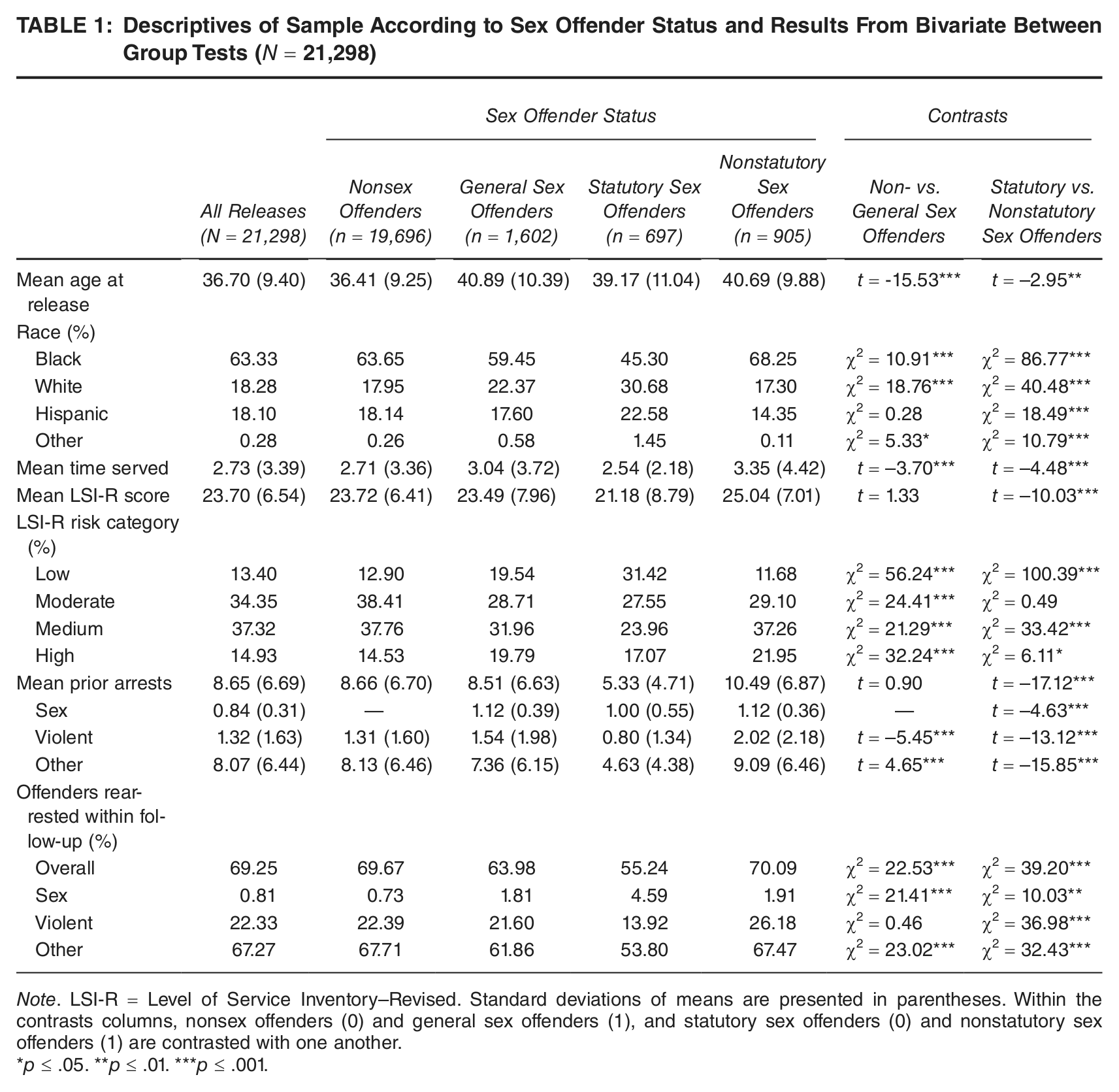
Table 1 presents descriptive information for the entire sampling frame. The average age at release for all offenders was 36.7 years. Approximately 64% of the sample was Black, 18.28% was White, and 18.10% was Hispanic. Less than 1% of the sample identified as “other” race. Offenders were incarcerated for approximately 2.73 years prior to their release and were considered to be of medium risk on their prerelease LSI-R score. 8 Participants had approximately nine prior arrests on their criminal record; on average, one of these priors was for a violent crime. Nearly 70% of all offenders were rearrested for any offense within the 5-year follow-up period; specifically, 0.81% were rearrested for a sex crime, 22.33% for a violent crime, and 67.27% for another offense.
Descriptives of Sample According to Sex Offender Status and Results From Bivariate Between Group Tests (N = 21,298)
Note. LSI-R = Level of Service Inventory–Revised. Standard deviations of means are presented in parentheses. Within the contrasts columns, nonsex offenders (0) and general sex offenders (1), and statutory sex offenders (0) and nonstatutory sex offenders (1) are contrasted with one another.
p ≤ .05. **p ≤ .01. ***p ≤ .001.
The sample of general sex offenders was approximately 41 years of age at release. Nearly 60% of sex offenders were Black, 22.37% were White, and 17.6% were Hispanic. Sex offenders were incarcerated for approximately 3.04 years prior to their release and were considered to be primarily of medium risk on their prerelease LSI-R score. Sex offenders had 8.51 prior arrests on their criminal record, and on average one of these priors was for a sex crime. Nearly 64% of sex offenders were rearrested for any offense within the 5-year follow-up period; specifically, 1.81% was rearrested for a sex crime, 21.6% for a violent crime, and 61.86% for another offense.
Table 1 also presents descriptive information for the nonsex offending and specific sex offending groups, as well as results from bivariate between-group statistical tests. Nonsex offenders shared similar characteristics to the total release population and significantly differed from general sexual offenders on several characteristics. General sex offenders were significantly older than nonsex offenders at the time of release (aged 40.89 vs. aged 36.41; t = −15.53, p < .001), served more time on average (3.04 years vs. 2.71 years; t = −3.70, p < .001), and were more likely to be White (χ2 = 18.76, p < .001). While there were no significant differences between the mean LSI-R scores of nonsex offenders and general sex offenders (t = 1.33, ns), there were differences between these groups for the LSI-R risk categories. Although both groups had the majority of offenders included within the moderate/medium risk categories, the general sex offenders grouping had a higher proportion of offenders located in the low- and high-risk categories (χ2 = 56.24, p < .001, and χ2 = 32.24, p < .001, respectively). The mean number of any prior arrests did not differ significantly between groups, but general sex offenders had more violent arrests on their record on average (t = −5.45, p < .001). Finally, nonsex offenders were more likely to have a postrelease arrest for any type of offense by the end of the 5-year follow-up period (χ2 = 22.53, p < .001), but general sex offenders were more likely to have an arrest for a sexual offense than their counterparts (1.81% vs. 0.73%, respectively; χ2 = 21.41, p < .001).
Bivariate between-group statistical tests for the statutory and nonstatutory offender groups were also completed. Statutory sex offenders were more likely to be White (χ2 = 40.48, p < .001) or Hispanic (χ2 = 18.49, p < .001) when compared to nonstatutory sex offenders, however African Americans were the modal racial category for both statutory and nonstatutory sex offenders. Statutory sex offenders served less time, on average, than nonstatutory sex offenders (2.54 years vs. 3.04 years, respectively; t = −3.70, p < .001), likely because the statutory sex offenders were released on parole supervision. The majority of statutory sex offenders were considered to be of low risk on the LSI-R, whereas the majority of nonstatutory sex offenders were designated as medium risk, indicating significant differences between the distributions of risk groupings on the LSI-R for these offenders. Nonstatutory sex offenders had a markedly higher number of overall prior arrests as compared to statutory sex offenders (10.49 vs. 5.33, respectively; t = −17.12, p < .001), as well as higher numbers of sexual (t = −4.63, p < .001), violent (t = −13.12, p < .001), and other (t = −15.85, p < .001) offenses. Finally, nonstatutory sex offenders were more likely to recidivate with any postrelease arrest by the end of the 5-year follow-up period (χ2 = 39.20, p < .001), though statutory sex offenders were more likely to have an arrest for a sexual offense than their counterparts (4.59% vs. 1.91%, respectively) (χ2 = 10.03, p < .01).
Bivariate Correlations
Results from the correlation analysis are presented in Table 2. The LSI-R exhibited statistically significant yet weak to moderate correlations with rearrests overall, rearrests for violent crimes, and rearrests for other crimes within each year of the follow-up period for all releases. Similar results were found for the nonsex offender and general sex offender groups specifically. In looking at sex crimes exclusively, the LSI-R exhibited statistically significant yet weak correlations with rearrests for a sex crime within each year of the follow-up period for all releases. Similar results were found for the nonsex offender group specifically. However, LSI-R scores did not significantly correlate with the experience of a postrelease arrest for a sex crime throughout the follow-up period for any of the sex offender–specific groups save for statutory sex offenders after 2 years of follow-up time.
Pearson Correlation Coefficients Between Cumulative Prerelease LSI-R Scores and Rearrest Types Across Postrelease Time Periods According to Sex Offender Status

Note. LSI-R = Level of Service Inventory–Revised.
p ≤ .05. **p ≤ .01. ***p ≤ .001.
Logistic Regression Analyses
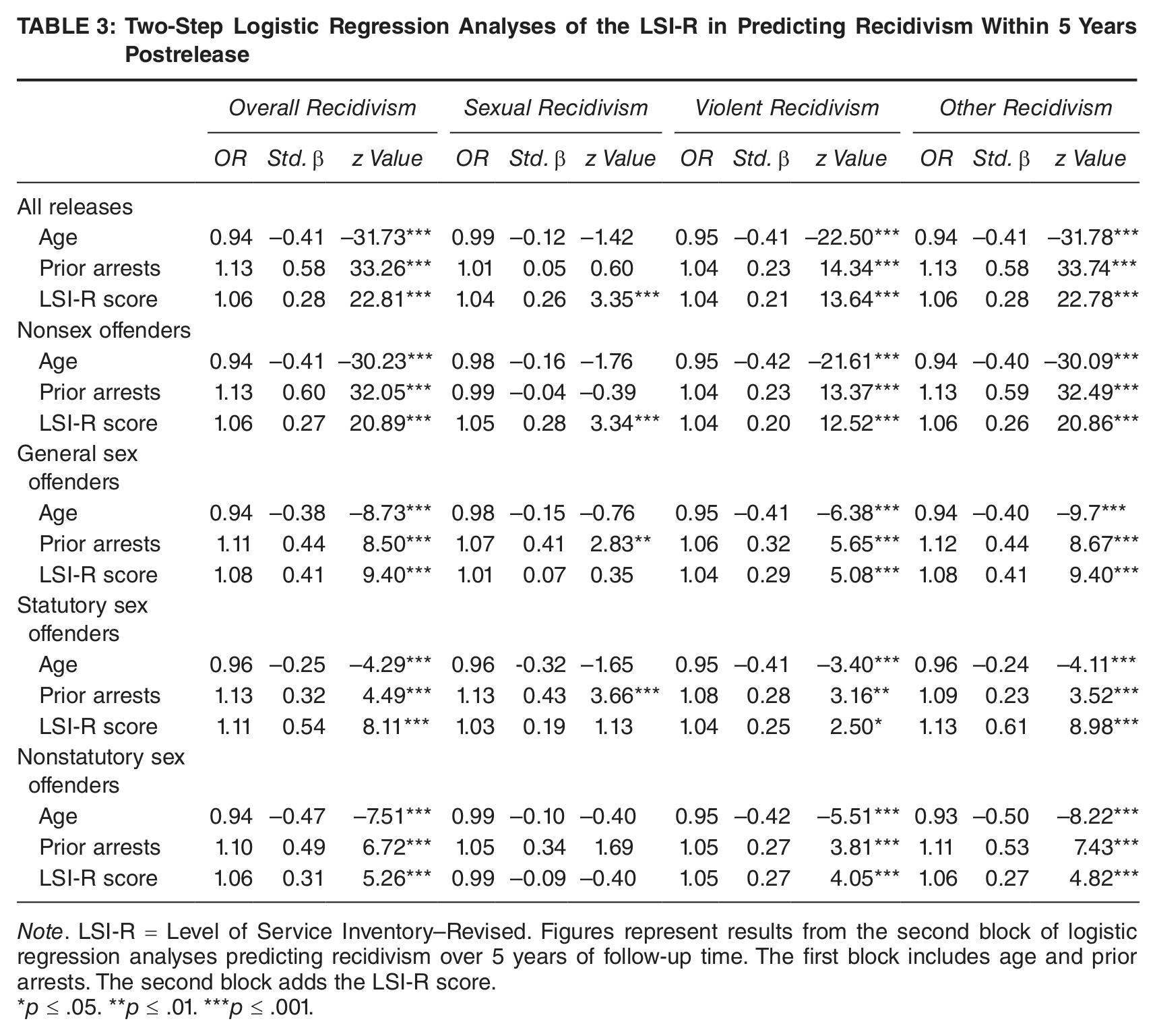
Results from the two-step logistic regression analyses are presented in Table 3. 9 Focusing on models that predict sexual recidivism over the course of 5 years of follow-up time, the addition of the LSI-R significantly increased the ability to predict sexual rearrests for all releases (log-likelihood = −996.67, p < .01) and nonsexual offenders specifically (log-likelihood = −843.21, p < .01). However, final models predicted less than 1% of the variance in sexual reoffending for both all releases (R2 = .0074, p < .001) and nonsexual offenders (R2 = .0091, p < .001). Among the sex offender–specific groups, the addition of the LSI-R did not significantly improve the ability to predict sexual reoffending above that of models that solely included offender age and prior arrests. Within all of these models, the LSI-R was not a statistically significant predictor of sexual rearrests and was consistently the weakest predictor (i.e., had the lowest standardized beta value) within the final models when compared to age and prior arrests.
Two-Step Logistic Regression Analyses of the LSI-R in Predicting Recidivism Within 5 Years Postrelease
Note. LSI-R = Level of Service Inventory–Revised. Figures represent results from the second block of logistic regression analyses predicting recidivism over 5 years of follow-up time. The first block includes age and prior arrests. The second block adds the LSI-R score.
p ≤ .05. **p ≤ .01. ***p ≤ .001.
The addition of the LSI-R did, however, significantly increase the predictive ability of all other regression models that were constructed to predict nonsexual reoffenses (i.e., overall recidivism, violent recidivism, and other recidivism) for sex offenders. For example, for general sex offenders and overall recidivism, the addition of the LSI-R improved the variance explained by approximately 5 percentage points when compared to the first iteration of the model (log-likelihood = −901.32, R2 = .1331, p < .001 vs. log-likelihood = −853.33, R2 = .1793, p < .001, ΔR2 = .0462, p < .001). For statutory sex offenders, the LSI-R score was the strongest predictor of overall reoffending when compared to both age and prior arrests after standardizing the beta coefficients, and the addition of the LSI-R increased the ability of the model to explain the variance in overall reoffending by approximately 8 percentage points (log-likelihood = −396.38, R2 = .1645, p < .001 vs. log-likelihood = −358.40, R2 = .2446, p < .001, ΔR2 = .0801, p < .001). For nonstatutory sex offenders, the addition of the LSI-R improved the variance explained by approximately 2 percentage points (log-likelihood = −545.57, R2 = .0959, p < .001 vs. log-likelihood = −531.12, R2 = .1198, p < .001, ΔR2 = .0239, p < .001).
ROC Curve Analyses
AUC values from the ROC curve analyses are presented in Table 4. Overall, the AUC values were relatively stable within groups and crime types across the entire follow-up time period. The LSI-R was generally a weak predictor of overall and crime-type-specific recidivism within the total release population as well as the nonsex offender subpopulation. Within these groups, AUC values did not exceed the cutoff of 0.7, indicating it as an acceptable tool for discriminating between recidivists and nonrecidivists. This is apparent across the different years of follow-up as well as the different crime types.
Area Under the Curve (AUC) Values for Cumulative Prerelease LSI-R Score to Predict Rearrest Types Across Postrelease Time Periods According to Sex Offender Status

Note. AUC =Area Under the Curve; LSI-R = Level of Service Inventory–Revised.
The predictive ability of the LSI-R was fairly strong for overall offending within the statutory sex offender group across all yearly follow-up periods. The AUC values ranged from 0.7601 for rearrests within 1 year to 0.7899 within 5 years of follow-up time for this group. This finding communicates that when looking at 1 year of follow-up time, a statutory sex offender who was rearrested for a new crime would be approximately 76% more likely to have a higher LSI-R score than a statutory sex offender who was not rearrested. Similarly, when looking at 5 years of postrelease recidivism data, a statutory sex offender who was rearrested for a new crime would be about 79% more likely to have a higher LSI-R score when compared to a statutory sex offender that was not rearrested within 5 years of their release from prison.
In comparison, AUC values were quite low for the prediction of sex-specific crimes regardless of follow-up time or group membership. Interestingly, the LSI-R exhibited lower than chance (i.e., below 0.5) predictive ability for sex crimes committed by nonstatutory sex offenders. These scores ranged from 0.3989 within 1 year of release to 0.4891 within 5 years of release. While the LSI-R improved the predictive ability to identify sexual recidivists within the statutory sex offender group above that of chance alone, this improvement was modest. AUC values ranged from 0.6337 within 1 year of follow-up time to 0.6579 within 5 years of follow-up time. These values communicate an increased predictive ability of about 13% above chance within 1 year of follow-up time and 16% above chance within 5 years of follow-up time.
Discussion
The present study was completed to determine the usefulness of generalized risk assessment actuarial scales for sexual offending populations specifically by examining the predictive utility of the LSI-R among a sample of individuals released from New Jersey correctional facilities between 2004 and 2006. Two research questions were explored: (1) What is the predictive utility of the LSI-R for sex offenders? And (2) what is the predictive utility of the LSI-R for sexual offenses? The genesis of the present study stemmed from a conversation with a SPB Board Member who indicated that it is customary to ignore the results of the LSI-R when determining supervision provisions for sex offenders because the instrument tends to classify these individuals as low risk. Our analyses indicate that the LSI-R does indeed classify many sex offenders as low risk (approximately 20% in our entire sample), but that the conceptualization of who is considered a sex offender can have marked impacts upon the low-risk group makeup. More importantly, our results indicate that while the LSI-R likely does not have predictive utility for sexual offenses, it does have significant utility for sex offenders overall.
We generally found nonsignificant or very weak correlations between sex offense recidivism and cumulative LSI-R scores within our different groups and across follow-up years. Our two-step logistic regression analyses indicated that the addition of the LSI-R did not significantly increase the ability to predict sexual recidivism over the course of 5 years of follow-up time for sex offenders when compared to models that solely included age and prior arrests. However, the addition of the LSI-R did significantly improve the ability to predict nonsexual reoffending for sex offenders. ROC analyses demonstrate that the LSI-R was generally a poor discriminator between true and false positives within the total sample of released offenders, as well as nonsexual offenders specifically, despite the follow-up time or the specific crime type under examination. Additionally, when used to predict sex offenses for sex offenders, the LSI-R did not provide for meaningful increases in sensitivity/specificity above that of chance alone. In fact, the instrument performed worse than chance when used to predict sex offenses for those who had a history of sexual offending but who were not statutorily required to be supervised by SPB for life.
Taken as a whole, our results indicate that it would be foolish to rely upon the LSI-R to increase one’s predictive ability to identify those who are likely to engage in postrelease sex crimes; conversely, it would be equally foolish to ignore available information about the risks and needs of offenders based solely on their label as a sex offender. The results of our descriptive analyses are supportive of previous findings that suggest sex offenses are not the sole province of sex offenders (see Hanson & Bussière, 1998; Hanson & Morton-Bourgon, 2005). Within 5 years of their release, 63.98% of sex offenders within our sample were rearrested for a new offense, yet less than 2% of these offenders were rearrested for a new sex crime specifically. Rather, these offenders were much more likely to commit new offenses of a nonsexual nature, whether it was violent or otherwise.
Additionally, while LSI-R score did not significantly correlate with the experience of a postrelease arrest for a sex crime within the follow-up period for sex offenders overall, the results of our correlation analysis suggest that the LSI-R was correlated, albeit weakly, with recidivism overall and for violent and other forms of recidivism specifically. Similar coefficients for general and violent recidivism have been documented (Wormith et al., 2012), indicating that the utility of the LSI-R extends beyond that of the present sample.
As such, it is our impression that the LSI-R can be used in conjunction with other validated sex offender actuarial instrumentation (e.g., the VRAG, SORAG, RRASOR, Static-99, Static 2002, MnSOST-R, or RM 2000) to better identify the risks and needs of these offenders outside of sex crimes solely. Information related to a sex offender’s general risks and needs (which is currently available to releasing authorities like the SPB through the LSI-R) can be used to proactively transition these offenders into programs that target general criminogenic risks and needs, while sex offender–specific instruments can be utilized to guide sex offender–specific treatment regimens simultaneously. It is our belief that criminal thinking patterns overall could potentially be changed, thus aiding in the prevention of future sexual offending as well as general offending. Although the present paper did not directly study the actual programming that is offered to sex offenders within the state of New Jersey, our results can help communicate the service needs for these offenders to a releasing authority, and therefore create a more complete picture of the overall needs of sex offending populations beyond that of their societal label.
Directions for Future Research
While the results of the present study advance the existing literature base within this area (i.e., Rossegger et al., 2011; Simourd & Malcolm, 1998; Wormith et al., 2012), more research is needed. Specifically, it is our impression that the predictive accuracy of the LSI-R should be tested in comparison with more formal sexual offender risk assessment instrumentation. Additionally, to date, the present research is the only known evaluation of the LSI-R for use with a sexual offending population completed within the United States. While many sex offender traits are not specific to a particular country, there is no denying that sex offenders in the United States suffer under community supervision provisions that are uncommon in other parts of the world. Recent changes in sex offender legislation under the Sexual Offender Registration and Notification Act (SORNA 2006) will standardize the registration and notification requirement of sex offenders within jurisdictions throughout the United States by implementing a tiering system (i.e., Tier I [low], Tier II [medium], and Tier III [high]) based on a sex offender’s risk level, as determined by the offender’s crime of conviction. Although this new legislation renders risk assessments to be of little value in establishing community supervision provisions, the need to better understand the general risks and needs of these offenders remains. 10
Limitations
While the sample size for the present study was quite large (N = 21,298), there were 13,137 additional male offenders originally included within the SPB database who did not have an LSI-R attached to their records. These missing data can likely be attributed to staff oversight during data entry and/or identifier mismatches between the SPB’s subsystems that track risk assessment information and those that track demographic/release information. It is unclear how these extra cases may have impacted the findings of the current study if included within the sampling frame.
Also of consideration is our use of official arrest records as a determinant of sexual recidivism. It has been well established that sexual offenses are underreported and arrest records may therefore underestimate actual behavior (Furby, Weinrott, & Blackshaw, 1989); however, arrest records are said to be less biased than other methods of assessing sexual offending behaviors (Quinsey, Harris, Rice, & Lalumiere, 1993). While the addition of a self-reported measure would certainly supplement our findings, such actions were beyond the scope of the present study. Additional validation research for the LSI-R that specifically utilizes self-report measures among this population should be undertaken in the future.
Finally, we must note the large presence of minorities within our sampling frame: Nearly 64% of the sample was Black and 18% was Hispanic. Because New Jersey tends to be more racially and ethnically diverse than many other jurisdictions of the United States, caution should be exercised in extending our results to other jurisdictions that are less heterogeneous in this respect.
Conclusion
The results of the present study confirm earlier findings of promise in the utility of the LSI-R for determining general risks and needs of sex offenders, outside of sexual recidivism risks and needs (Simourd & Malcolm, 1998). Sex offenders are a heterogeneous group of individuals, and while their crimes may be different than nonsexual offenders, many of their criminogenic and noncriminogenic needs are quite similar. While we do not recommend that the LSI-R be used to predict sexual recidivism solely, we do recommend that the instrument be considered in conjunction with other validated risk assessment measures when making community supervision decisions.
Footnotes
Acknowledgements
The authors would like to express their appreciation to the New Jersey State Parole Board for access to the data used within this study.