



Abstract
Each year many offenders are released homeless putting them at great risk of being returned to prison. To reduce the likelihood of recidivism, Washington State implemented the Reentry Housing Pilot Program (RHPP) to provide housing assistance for high risk/high need offenders leaving prison without a viable place to live. This study provides a longitudinal (2008-2011), multisite outcome evaluation that considers how ex-offenders in the RHPP program (n = 208), who were provided housing and wraparound services, compared with similar offenders released with an elevated risk of homelessness while being traditionally supervised (n = 208). Findings show that the RHPP program was successful in significantly reducing new convictions and readmission to prison for new crimes, but had no significant effect on revocations. In addition, results showed that periods of homelessness significantly elevated the risk of recidivism for new convictions, revocations, and readmission to prison. The authors recommend that subsidized housing for high risk offenders become a central part of coordinated responses to reentry.
Prisoner reentry has become an important policy concern due to the demands many ex-offenders place on criminal justice and social service agencies, their families, and the community. Many of the estimated 700,000 inmates released from prison each year experience a combination of individual, social, and economic challenges that impede their ability to successfully reintegrate into the community. Concerns about community safety combined with the fiscal crisis in corrections and social services has inspired many policy makers to consider moving beyond purely coercive criminal justice responses (supervision, arrest, sanctions, revocation to prison) to coordinated responses inclusive of social services (housing, food, clothing), treatment (substance abuse, mental health), and community support for inmates recently released from prison (Rodriguez & Brown, 2003). Within a coordinated response to reentry, homelessness and residential instability has been identified as one of the greatest challenges confronting ex-offenders and their chance to achieve successful reintegration (Gunnison & Helfgott, 2011; Rodriguez & Brown, 2003; Roman & Travis, 2006).
It is well known that many barriers contribute to ex-offenders’ residential instability. Many ex-offenders return to impoverished communities in high crime, unsafe, urban areas with a shortage of affordable housing (Clear, 2007; Fontaine & Biess, 2012; Kirk, 2009, 2012; Kubrin & Stewart, 2006). Federal and state policies often prohibit felons, especially those convicted of drug or sex offenses, from accessing public housing and most, without adequate income to pay the first and last months’ rent plus the security deposit, are excluded from securing housing in the private sector (Geller & Curtis, 2011; Malone, 2009; Mele & Miller, 2005; Roman & Travis, 2006). Even when rental units are available, many landlords are reluctant to rent to ex-felons because of a lack of trust and community safety concerns (Helfgott, 1997; Roman & Travis, 2006). Living with family members can also be difficult due to poverty or because of strained relationships owing to the offender’s past behavior or family members’ history of criminal conduct (Fontaine & Biess, 2012; Martinez & Christian, 2009). Histories of mental illness and drug abuse also create hardships for ex-offenders and their ability to sustain employment and the financial resources necessary to keep a residence (Dickson-Gomez, Convey, Hilario, Weeks, & Corbett, 2009; Dumont, Brockmann, Dickman, Alexander, & Rich, 2012; Greenberg & Rosenheck, 2008; Kushel, Hahn, Evans, Bangsberg, & Moss, 2005). Thus, many ex-offenders are often confronted with homelessness, living in temporary shelters, living with friends or acquaintances for short periods of time, or living in low-cost hotels located in high risk communities (Dickson-Gomez et al., 2009; Fontaine & Biess, 2012; Geller & Curtis, 2011; Gowan, 2002; Kushel et al., 2005).
In spite of these challenges and the importance of establishing stable housing as a basis for success in other areas of reentry, few programs place housing at the center of the coordinated response supporting the transition from prison to the community (Rodriguez & Brown, 2003; Roman & Travis, 2006). The current study fills this gap and contributes to the literature on coordinated responses to reentry through an outcome evaluation of the Washington State Reentry Housing Pilot Program (RHPP). This program placed housing at the center of reentry and targeted high risk/need prisoners without a suitable place to live on release. The goal of the program was to reduce recidivism by providing access to stable housing for up to 1 year and coordinating resources across agencies including the police, community corrections officers, social service providers, employers, and housing managers.
Reentry and the Importance of Housing Stability
Safe and stable housing is often viewed as the foundation for individuals to prepare and proactively engage the process of reentry. Housing is important because it can provide a sense of security that gives social and psychological refuge from external threats and enhance overall well-being (Lee, Tyler, & Wright, 2010; Shaw, 2004). A home provides a place of consistency and control to engage in the day-to-day routines important to building social networks and establishing an identity of personal worth (Shaw, 2004). Residential stability provides a base from which to seek employment, focus on treatment, establish a social network within the community, and to comply with community supervision. Conversely, homelessness and housing instability increases the likelihood of social stigma, exposure to antisocial peers, victimization by others, and “shadow work” that exists outside of the formal economy such as panhandling, scavenging, and street vending that is criminalized in many jurisdictions. Crimes such as theft, prostitution, and drug sales are also more likely (Lee et al., 2010). Therefore, homelessness and housing instability generally place ex-offenders in social contexts and situations that are highly correlated with treatment failure (especially for substance abuse and mental illness), violation of supervision, and recidivism (see Malone, 2009; Roman & Travis, 2006; Tsai & Rosenheck, 2012).
Housing interventions inclusive of support services may be effective in reducing high risk behaviors related to reentry failure. Research shows that correctional interventions that address offenders’ criminogenic risk and needs (i.e., exposure to antisocial peers, substance abuse and mental health treatment, employment, etc.) significantly reduce recidivism (see Andrews and Bonta, 2010a, 2010b). Cullen and his colleagues argue that providing social and structural support serves as a protective factor that shields individuals from deviant behavior and enhances participation in conventional activities and treatment services (Cullen, 1994; Cullen, Wright, & Chamlin, 1999; also see Hochstetler, DeLisi, & Pratt, 2010). Housing stability therefore serves as a conduit to access and build the social capital necessary to sustain long term reintegration into the community (Cullen et al., 1999; Portes, 1998). Averting homelessness or transience by providing stable housing is likely to reduce exposure to deviant peers, social stigma, and the violation of public order laws related to living and working on the street and increase exposure to pro-social networks, constructive activities, and a sense of safety and well-being conducive to participating in treatment and other services.
In spite of the many positive aspects of having a place to live, a large number of offenders experience homelessness or residential instability on reentry to the community from prison. Approximately 10% of inmates experienced homelessness just before their current prison term and approximately the same number will experience homelessness on their release (Roman &Travis, 2006). Those with prison histories experience homelessness at a rate 4 to 6 times greater than the general population (Greenberg & Rosenheck, 2008). In a large study of all New York State prison releases to New York City, Metraux and Culhane (2004, p. 139) found that “within two years 11.4 percent of the study group entered a New York homeless shelter and 32.8 percent of this group was again imprisoned.” Relatedly, in a study of those living in the single adult shelter system in New York City, Metraux and Culhane (2006) report that 23.1% had a record of incarceration in either a prison (7.7%) or a jail (17%). Similarly, in a longitudinal study of urban families, Geller and Curtis (2011) report that housing insecurity is significantly greater for men with incarceration histories than those without (also see Kushel et al., 2005). More specifically men with incarceration histories were twice as likely to experience housing instability, four times more likely to experience homelessness, and those most recently incarcerated confronted 69% greater odds of housing insecurity than the comparison group (Geller & Curtis, 2011; also see Greenberg & Rosenheck, 2008).
Several studies also suggest that frequent movements within the 1st year of release increase the likelihood of failure while on supervision and readmission to prison. For instance, a study in Georgia found that every time a parolee changed addresses the possibility of arrest increased by 25% (Meredith et al., 2003, as cited by Roman & Travis, 2006; Steiner, Makarios, Travis III, & Meade, 2012). Yet, La Vigne and Parthasarathy (2005) in a longitudinal study based on interviews with released prisoners in Chicago found that “movers” are not necessarily at greater risk of relapse and recidivism than “stayers,” because those who move are often trying to avoid family conflict, to be more independent, or to reside with an intimate partner or friend.
Immediately establishing residential stability may be critical for long term success, given that the majority of those who fail will do so within the first 3 to 6 months of release from prison (Hamilton & Campbell, 2013; Petersilia, 2003). Without a stable place to live, it is difficult to address issues related to the cumulative effect of having a prison record, living in poverty, and managing the deficits caused by a lack of education, unemployment, substance abuse, and/or mental health problems (Government Accounting Office, 2000; Greenberg & Rosenheck, 2008; Hamilton, Kigerl, & Hays, 2013; Kushel et al., 2008; Lutze & Kigerl, 2013; The Pew Center on the States, 2009; Sabol, West, & Cooper, 2009; Tsai & Rosenheck, 2012). Thus, a coordinated response to reentry that includes residential stability is likely to increase successful outcomes for a subset of ex-offenders who otherwise would be without a safe and secure place to live.
Coordinated Responses to Reentry and Housing
The multiple challenges confronting ex-offenders released from prison are generally greater than any one agency to solve and therefore many jurisdictions have moved toward implementing a coordinated response to prisoner reentry that includes considerations for community safety and the individual needs of ex-offenders (Hall, Burt, Roman, & Fontaine, 2009; Rodriguez & Brown, 2003; Winterfield, Lattimore, Seffey, Brumbaugh, & Lindquist, 2006). Interdisciplinary responses to reentry entails cooperation between police, community and institutional corrections, social services, treatment providers, government agencies, community groups, and families (Lattimore, Visher, & Lindquist, 2005). Most coordinated responses to reentry appear to focus on wraparound services in which housing is just one of many services available to ex-offenders. Other programs however, place housing at the center of the coordinated response and use it as a foundation to provide wraparound services.
Coordinated Wraparound Services
A number of reentry initiatives direct participants toward a variety of services related to need and in general appear to be successful in providing increased access to services and improving justice related outcomes. For example, evaluations of the Serious and Violent Offender Reentry Initiative (SVORI), as well as other similarly designed reentry programs, show that they provide significantly more services than traditional supervision (Bouffard & Bergeron, 2006; Lattimore et al., 2005; Winterfield et al., 2006), significantly reduce recidivism (Bouffard & Bergeron, 2006; Braga, Piehl, & Hureau, 2009; Duwe, 2012), and significantly increase the time to failure in the community (Braga et al., 2009), but have no significant effect on technical violations (Bouffard & Bergeron, 2006; Duwe, 2012).
There is also evidence that not all coordinated responses to reentry are successful. For example, New York’s Greenlight Project provided wraparound services related to employment, education, cognitive behavioral treatment, and family counseling, with an emphasis on housing stability to divert offenders from shelter care. Wilson and Davis’s (2006) study revealed that the participants in the program experienced an increased likelihood of rearrest. Based on interviews with parolees and program staff, Wilson and Davis (2006) conclude that there appeared to be few differences between Greenlight and traditional supervision along multiple dimensions including the number of shelter days utilized by both groups. They suggest that budget constraints and staff’s ability or willingness to implement the model as intended may have also contributed to the negative outcomes seen in the study.
Housing Centered Services
Although the broad array of programs and intensive services offered to ex-offenders are important, many argue that safe and secure housing is central to ex-offenders and their participation in other services especially those related to substance abuse, mental health, and employment (Culhane, Metraux, & Hadley, 2002; Dickson-Gomez et al., 2009; Geller & Curtis, 2011; Metraux & Culhane, 2004, 2006; Rodriguez & Brown, 2003; Roman & Travis, 2006; Tsai & Rosenheck, 2012). The few studies specifically evaluating the effectiveness of securing safe and stable housing for offenders related to recidivism and other outcomes, however, show mixed results.
For instance, a meta-analytic review by Miller and Ngugi (2009) found only seven studies evaluating the effect of providing housing to ex-offenders on recidivism. The results of their meta-analyses showed that the provision of housing to the general offender population did not significantly reduce recidivism, but housing combined with other services to high risk offenders significantly reduced recidivism by 12%. Studies of halfway house programs show that they are effective at reducing recidivism if they target and are responsive to the clientele in which they were designed to serve (Hamilton, 2011; Seiter & Kadela, 2003). A study by Worcel, Burrus, Finigan, Sanders, and Allen (2009) found that housing provided to substance abusing ex-offenders compared with nonhousing groups appeared to provide added value to wraparound services by significantly decreasing substance use, stress to participants, and costs to the community, but no differences were found related to recidivism. 1 Research on incarceration among chronically homeless adults, many with serious alcohol and mental health problems, enrolled in supported housing programs has shown that those with incarceration histories benefit from housing support similarly to those who were never incarcerated (Tsai & Rosenheck, 2012), criminal history is not predictive of housing failure (Malone, 2009), and housing reduces the time spent in jail, thus breaking the homeless, to jail, to homeless cycle (Clifasefi, Malone, & Collins, 2013). Finally, Hamilton, Kigerl, and Hays (2013) measured the effects of providing housing vouchers to offenders released early from prison compared with those that remained incarcerated beyond their earned release date and found that the provision of offender housing resulted in a significant reduction in correctional costs with no additional risk to the community.
Overall, prior research shows that housing instability and a history of incarceration are interconnected. Programs that provide coordinated services inclusive of housing to ex-offenders on reentry tend to be effective in reducing recidivism if properly implemented. Research focused on housing-centered strategies with additional services, however, are mixed. Few housing centered interventions appear to target high risk offenders who would otherwise have been released homeless. The current study builds on existing research by evaluating the effectiveness of providing a housing centered intervention with wraparound services to high risk/need offenders who were identified as having no suitable place to live on release from prison. This analysis avoids the study limitations of prior evaluations by (a) utilizing a large sample size (thus, increasing statistical power), (b) extending the follow-up period beyond the length of the program duration to identify the extended program effects up to 3 years post-release, and (c) measuring periods of homelessness over time for the treatment and the comparison groups to establish the effects of residential instability on outcomes.
Method
In an attempt to reduce the high financial and human costs of recidivism, the 2007 Washington State Legislature created the RHPP for high risk, high need inmates being released from prison without a place to live. 2 As part of a larger bill to support evidence-based practices to reduce recidivism, the legislature recognized that, “stable, habitable, and supportive housing is a critical factor that increases a previously incarcerated individual’s access to treatment and services as well as the likelihood of success in the community” (Washington State Bill ESSB 6157, p. 48). The legislation provided up to 12 months of housing support to qualified offenders who were willing to engage in treatment, secure employment, and work toward self-sustainability. At the state level the legislature directed the Washington State Department of Commerce to oversee the distribution of funds and implementation of the project. The Department of Commerce is responsible for economic development, housing, and justice assistance for the entire state. At the local level, RHPP was designed to promote interagency collaboration and information sharing between multiple stakeholders such as the RHPP contractors, Community Justice Centers, the Department of Corrections, and other supporting agencies (i.e., social services, mental health, treatment providers, and police).
The Washington State Legislature required that RHPP be operated in collaboration with the Washington State Department of Correction’s Community Justice Centers (CJC) existing in the counties selected as pilot sites. CJC’s co-locate many reentry services in the same facility as community supervision officers, offering a one-stop-shop for supervision and reentry needs. RHPP pilot sites were implemented in Clark (Vancouver), King (Seattle), and Spokane Counties that represent three of the most populated counties in the state. Each county implemented a similar basic framework, but developed different types of partnerships and housing resources based on their unique jurisdictions and the resources available in each geographic location (see Lutze, Bouffard, & Falconer, 2009). For instance, each county has a case management plan for offenders, targeted treatment services, offender accountability strategies, and established partnerships with corrections, law enforcement, and treatment providers. Each county also included identified housing units, self-sufficiency plans for the participants, renter’s rights courses, and coordinated safety plans to address issues that may arise for landlords, neighbors, or the community related to high risk offender behavior. Also, while each county included in this study differs somewhat in the RHPP team composition that manages participants, the target population, and in criminal justice system partnerships, housing partnerships, and the types of housing available to offenders in their jurisdiction, these differences were negligible in their effects on program delivery and outcomes (see Lutze, Bouffard, & Rosky, 2010).
Each program operated at capacity throughout the project. A number of RHPP participants (41%) were terminated from the program (Lutze et al., 2010). The majority of these terminations were due to supervision violations including noncompliance with rules, drug use, and absconding, while a few (4%) of the terminations were for new crimes (Lutze et al., 2010). These violation and criminal outcomes are accounted for in subsequent analyses and are reflective of the failures for the RHPP treatment group in our outcome measures for this study.
Measures
Data for the analysis were provided by The Washington State Department of Corrections (WADOC; 2008), the Washington State Institute for Public Policy’s (WSIPP) Criminal History Data Base, and the Washington State Administrative Office of the Courts (AOC). The DOC provided subjects’ pre- and postrelease characteristics including address information (see Table 1). As a subject could move more than once within the time frame of the study and also move in and out of periods of homelessness, housing statuses of a subject were identified by start and end dates for a given period of housing along with this period’s address as recorded by the DOC. Addresses for each period of housing were then geocoded to identify if the address was one of Washington State’s many homeless shelters or a permanent residence. In addition, the DOC records typically indicated “homeless” in the address field for those who the DOC determined were without a valid address. Each period of housing that an offender had during the study was then categorized into one of two groups based on the type of address, homeless or stable. 3 Homelessness was defined as a housing period in which the DOC address field indicated homeless or the field indicated a residence at a shelter. Stable housing was defined as a housing period indicated in the address field as a permanent residence. The RHPP Group included subjects admitted to the RHPP housing intervention. Demographic characteristics include age at release, race/ethnicity, sex, and county of release. Criminal history and risk measures were gathered from the Washington State Static Risk Assessment (Barnoski & Drake, 2007). 4 High risk offenders are those assessed as having the greatest likelihood to recidivate by committing a violent, property, or drug related felony on release. Instant offense refers to the offense committed that resulted in the most recent incarceration. Selected measures from the Washington State Offender Needs Assessment (ONA) were used to examine subject’s needs as deemed theoretically and statistically relevant to reentry and case management. 5 The ONA is described in greater detail below.
Propensity Score Matching Descriptives—Selected Item List (N = 1,340)
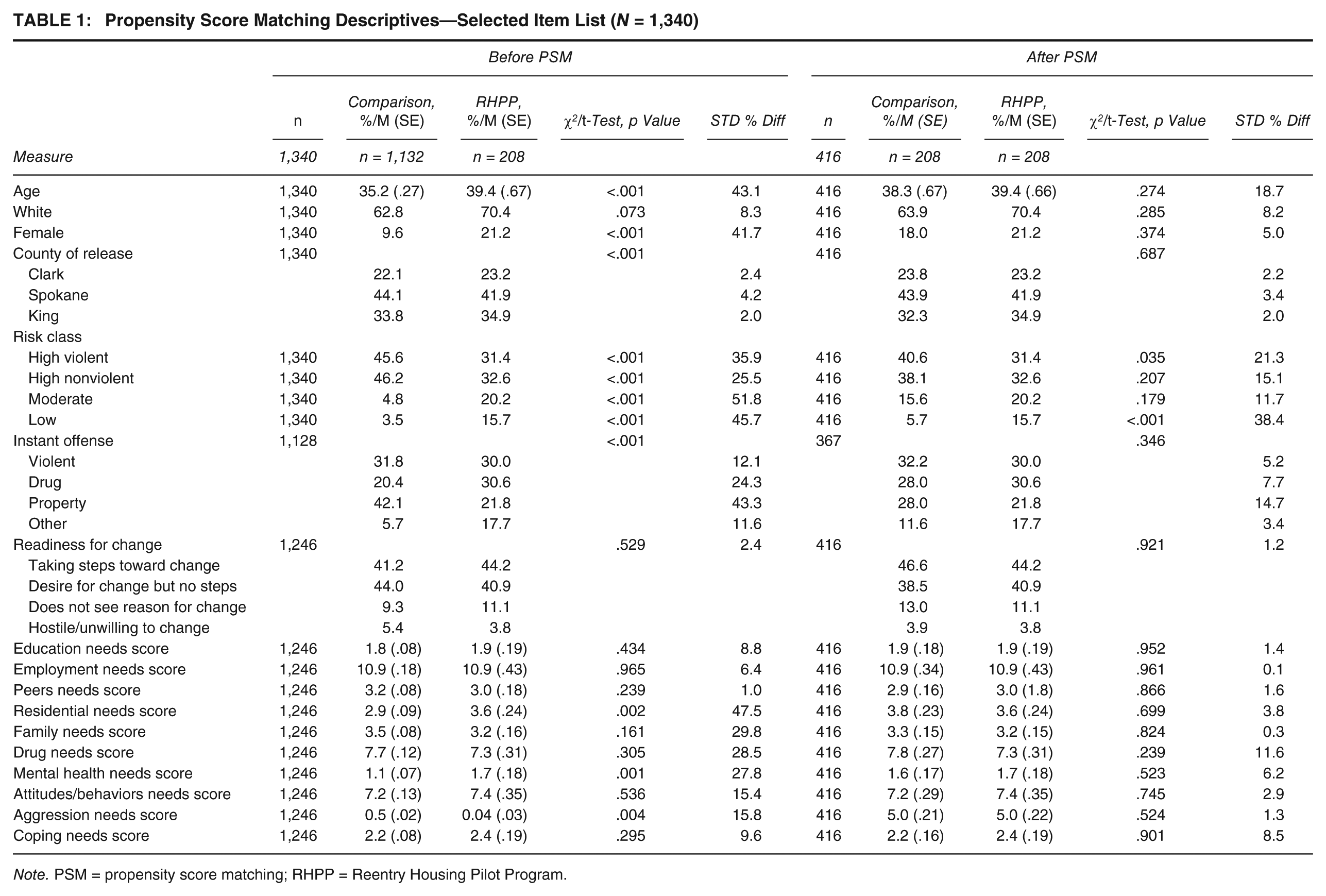
Note. PSM = propensity score matching; RHPP = Reentry Housing Pilot Program.
The WADOC and WSIPP provided outcome data, including new convictions, community supervision revocations, prison readmissions, and time-to-event data. New convictions are charges in which a guilty plea or verdict are entered for the subject following release. Revocations are events in which an offender violates the technical conditions of community supervision and is admitted to a secure facility including prison, jail, or work release. Prison readmission is a return to prison as a result of a revocation from community supervision or a new conviction. Finally, time-to-event data represent the number of days from release to community corrections to each of the three recidivism events. Time-to-event calculations for subjects that do not commit an event are censored at the day in which subjects leave the study for (a) another competing recidivism event or (b) the day in which the study follow-up period was terminated.
Sampling Frame
A quasi-experimental design was implemented comparing RHPP participants with a sample of community corrections participants released during the study period. The WADOC institutional staff determined eligible RHPP participants based on a screening tool in which high risk/need inmates without a viable release plan were selected if they had at least 12 months of community supervision to serve, were currently incarcerated for their initial sentence (not for a revocation), their sentence originated from an RHPP pilot county, they were free of major infractions for 90 days, had no warrants or detainers, were eligible for release between January 2008 and July 2009, and volunteered to participate in the program (WADOC Screening Tool, 2008). Once the WADOC prison staff determined eligibility, the RHPP case management team in each county confirmed the ex-offender’s eligibility and willingness to participate on arrival into the community. 6 The final RHPP sample consisted of 208 participants across the three study counties.
Although ideally a randomized design would be constructed to eliminate biases stemming from group selection, ethical considerations along with feasibility restrictions prevented such a methodology. Therefore the initial pool of potential comparison subjects were selected based on a broad, but mirrored eligibility of RHPP participants, which were (a) high risk offenders, (b) released from incarceration to community supervision during the years of 2008-2009, and (c) who served their community corrections supervision in Clark, King, or Spokane County. These basic criteria netted a total population of 1,132 potential comparison subjects.
To reduce the potential for selection bias in the comparison group, propensity score matching (PSM) was used to statistically balance the differences between study groups on all theoretically relevant preintervention characteristics. Our propensity score matching variables were taken from WADOC Offender Needs Assessment (ONA) instrument that was informed by Andrews and Bonta’s (2010a, 2010b) discussion of the Big Four and Central Eight domains of risk-needs. The ONA includes demographics, prior criminal history, risk levels, education, employment, peers, housing, family, substance abuse/use, mental health, aggression, attitudes/behaviors, and coping skills.
The resulting propensity score provides a single summary item of all included measures, representing the predicted probability of being a RHPP participant (Stuart, 2010). A one-to-one matching strategy was used in which a RHPP subject was matched to a comparison subject with the closest propensity score. Comparison subjects were selected without replacement and the distance of each match was restricted to the commonly utilized caliper of less than 0.2 standard deviation units. Selected comparison subjects (n = 208) were included in the final modeling procedures described (N = 416) and those subjects not selected were removed from the comparison subject pool. Diagnostic tests were performed to examine the accuracy of the propensity score matching. Bivariate tests were used to compare groups prior to and following the match. Following Rubin’s (2006) advice that researchers should take a liberal approach to include as many variables as possible to aid in the assumption that there are no ignorable variables related to treatment assignments, a total of 75 items within 12 domains were utilized in the PSM known to be potentially related to our outcomes. 7
Prior to the match, nearly 35% of the item comparisons differed significantly between the groups. To examine the sensitivity and specificity of the model a Receiver Operating Characteristics (ROC) curve was computed for the multivariate propensity score predicting treatment group assignment. The Area Under the Curve (AUC) estimate was .88, indicating the model and its covariates were collectively strong predictors of group assignment. 8 Following PSM less than 3% of the comparisons were found to be significant (well within the acceptable 5% expected due to chance). AUC estimates of .67 were found for ROC models of the matched sample, indicating a substantial reduction of the covariates’ accuracy in predicting treatment assignment. Table 1 compares the constructed comparison group with the RHPP group on selected preintervention characteristics before and after the propensity score matching process. 9 Only two items remained significant following the match (Risk Classes—High Violent and Low). 10
Although the assumption of the study was that those eligible for RHPP could end up homeless, given that residential stability is a postrelease factor determined through offenders’ procurement of a residence, matching procedures did not account for comparison subjects’ group differences with regard to housing status. That being said, it was anticipated that those individuals living in a stable residence for a given housing period would have a lesser likelihood of committing a recidivistic event. Therefore, for the purposes of hypotheses testing the comparison groups were divided into two types: (a) RHPP versus Comparison Group and (b) homelessness versus stable housing. Based on the primary study objectives two hypotheses were formulated:
Analytic Plan
The study defines program impact as greater days to a recidivism event among RHPP participants compared with a matched sample of comparison subjects. Several analyses were conducted to examine the program’s impact. First, bivariate outcomes demonstrating program impact were computed. Second, Kaplan–Meier analyses were utilized to examine survival trends between RHPP and comparison subjects. Last, Cox regression models were then investigated to examine program impact with the inclusion of key control measures (gender, race, age, and risk level) along with the time-varying variable of housing status on subjects’ risk for failure.
Results
Cross-tabulations and unadjusted survival times of the three recidivism outcomes were compared across the RHPP and comparison groups and results are presented in Table 2. While in each of the three outcomes the RHPP group experienced fewer events and possessed longer survival times, only the outcomes of new convictions (21.6% RHPP vs. 35.6% Comparison, p = .002) and readmissions (37% RHPP 56.3% vs. Comparison, p < .001) were statistically significant; revocation outcomes were not significantly different (39.9% RHPP vs. 47.1% Comparison). However, the log rank statistics were all statistically significant (p < .01) across all three outcomes where RHPP survival times were better than the comparison group survival times, on average, 133 days, 76 days, and 255 days for new convictions, revocations, and readmissions, respectively.
Outcomes by Study Group (N = 416)
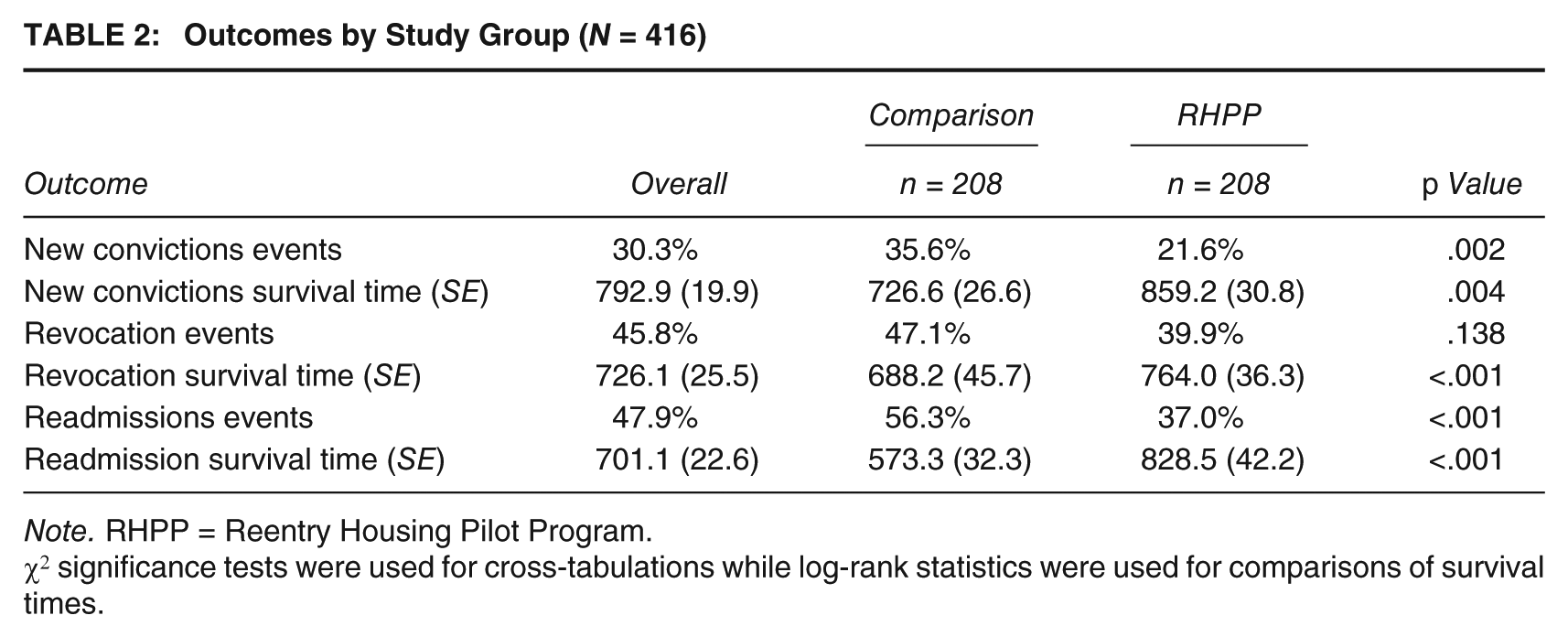
Note. RHPP = Reentry Housing Pilot Program.
χ2 significance tests were used for cross-tabulations while log-rank statistics were used for comparisons of survival times.
Examination of time-varying housing status revealed several interesting findings summarized in Table 3. The results examining address changes indicated that RHPP and the comparison group had a median of two address changes within the study time frame; that both groups had an offender with a minimum of one address change; and RHPP had an offender with a maximum of seven address changes while the comparison group had an offender with eight changes. The results examining homeless periods were comparable with the address changes with both groups having a median of zero periods of homelessness and RHPP having an offender with a maximum of three periods of homelessness, while the comparison group had a maximum of four periods. Proportionately, the RHPP group had significantly less subjects, 18.3%, experience one or more periods of homelessness than the comparison group, 26.3% (p = .045). In addition, the RHPP group had only 8.7% of the subjects who became homeless post-treatment for the study period versus 15.4% of the comparison group who were homeless for the entire period of the study.
Housing Status Descriptives (n = 416)
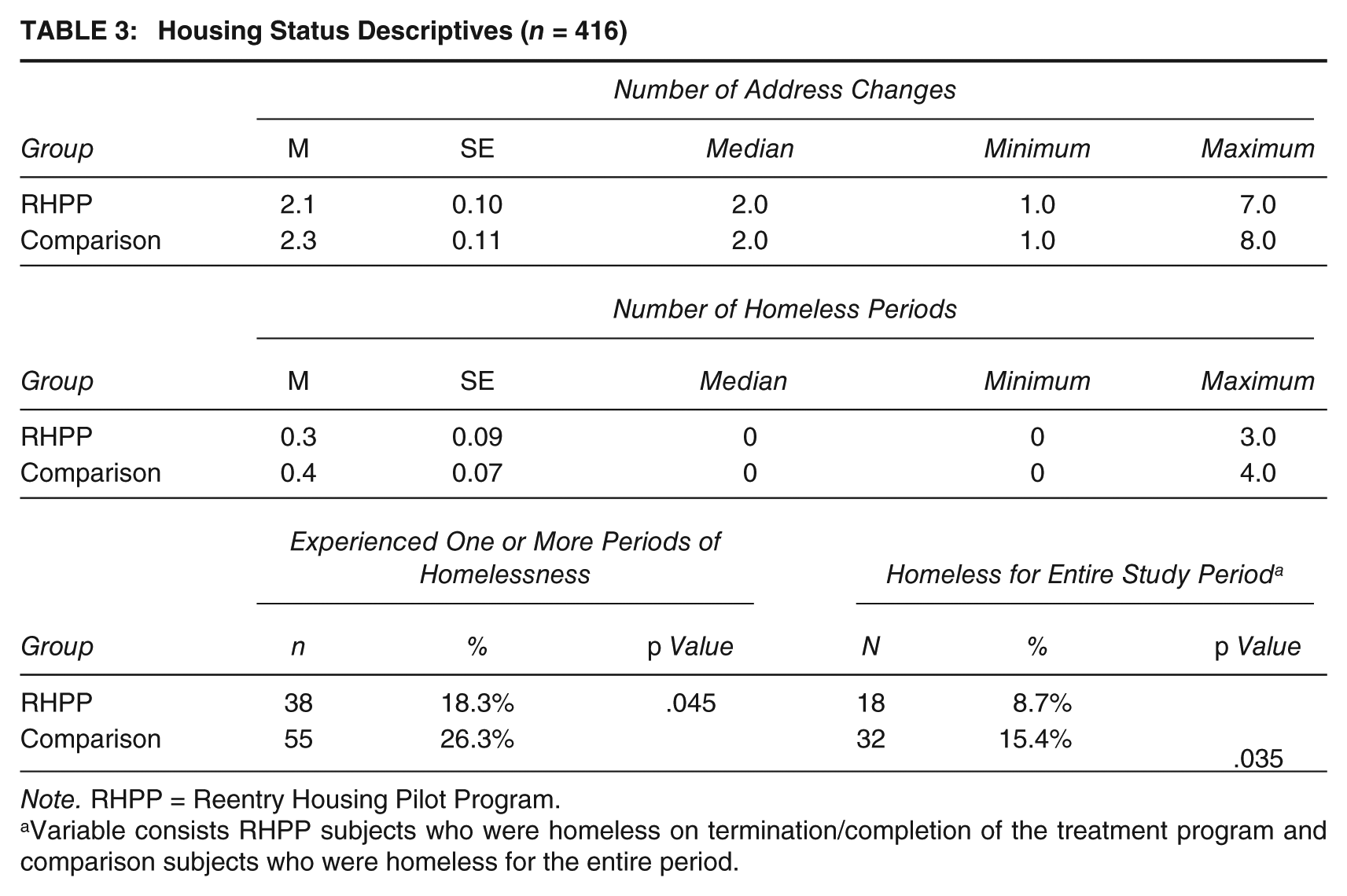
Note. RHPP = Reentry Housing Pilot Program.
Variable consists RHPP subjects who were homeless on termination/completion of the treatment program and comparison subjects who were homeless for the entire period.
Results from the Cox analyses including the time-varying covariate for housing status are presented in Table 4. All three models were found to be statistically significant (p < .001) versus a null model. Findings remained consistent with the Kaplan–Meier results for all three outcomes where the new convictions and prison readmissions models indicated that after controlling for demographic items and time-varying housing status, the RHPP group possessed a lower propensity for new convictions and prison readmissions than the comparison group. As with the Kaplan–Meier results, no significant difference in propensity for revocation was observed between the RHPP and comparison groups after controlling for demographic items and time-varying housing status. However, the time-varying periods of homelessness created greater than two times the risk for new convictions and prison readmissions and three times the risk for revocations, indicating that periods of homelessness significantly elevate the risk for recidivism across all three levels of recidivism irrespective of treatment group. Moreover, these results suggest that RHPP treatment diminishes the impact of homelessness on recidivism for new convictions and readmission, but has no statistically significant effect on revocations.
Cox Regression Models for New Convictions, Revocations, and Readmissions

Note. RHPP = Reentry Housing Pilot Program.
In addition to the study hypotheses, several control measures were also predictive of recidivism (see Table 3). Non-White offenders (p < .05) had a greater propensity for having new convictions and readmissions, while younger offenders (p < .01) have a significantly greater propensity for failure for all three event types. Finally, male offenders (p < .01) were significantly more likely than females to experience a new conviction, be revoked, and be readmitted to prison.
Discussion
The overall results of this study show that the RHPP program, which provides housing and wraparound services to high risk offenders who otherwise risk homelessness post-release, reduces participants’ propensities to commit recidivistic events including new convictions, revocations, and readmission to prison. As hypothesized, the RHPP group had lower rates of recidivism than the comparison group across all three outcome measures: new convictions (22% vs. 36%), revocations (40% vs. 47%), and readmission to prison (37% vs. 56%), although reductions in revocations did not reach statistically significant levels for RHPP program effects. The fact that RHPP significantly reduced risk in two of three recidivism measures offers substantial evidence that providing housing and wrap-around services to those who otherwise risk homelessness reduces recidivism and moves high risk offenders into a more ideal housing context as intended. Therefore, the Washington State Legislature’s goal to reduce recidivism through the provision of housing to high risk offenders who would have been released homeless was achieved.
While the RHPP group performed better than the comparison group and lessened the impact of homelessness for new convictions and readmissions, the results also showed that periods of homelessness, across the RHPP group and the comparison group, are an important risk factor for the three recidivism measures. Periods of homelessness over time significantly elevated recidivism risk to more than two times the rate of those in stable housing for new convictions and readmissions and three times the rate of those in stable housing for revocations. These findings strongly suggest that policymakers need to move beyond conceptualizing residential status as a fixed event, but instead as a fluid and volatile state of being for offenders that is an ongoing threat to successful reentry and long term reintegration.
Similar to other research, these findings indicate that effective programs that reduce recidivism and readmissions to prison are still seriously challenged in their ability to significantly reduce the number of revocations. Although the results of this study show that the time to revocation (number of days) was significantly greater for RHPP participants than the comparison group, the number of offenders revoked did not significantly differ between groups. This can be interpreted as a positive finding given that many forms of supervision that increase surveillance of offenders also tend to significantly increase revocations (see Taxman, 2002). The increased time to revocation for the RHPP group may be an indicator that corrections staff working in interdisciplinary teams in a program focused on providing support may be more likely to wait longer before revoking offenders because other options are immediately available to address inappropriate behavior (see Dowden & Andrews, 2004; Jalbert, Rhodes, Flygare, & Kane, 2010; Paparozzi & Gendreau, 2005; Wodahl, Garland, Culhane, & McCarty, 2011). Yet, revocations remain a serious challenge that need to be addressed, because they serve as a primary source of prison admissions and overcrowding (Burke, Gelb, & Horowitz, 2007). Thus, RHPP shows promise in reducing revocations, but adjustments will need to occur to significantly impact this particular outcome.
Another possible explanation why RHPP participants performed well is that they possessed greater motivation to change. Although subjects had to volunteer for the program before being released from prison, some opted out when meeting with the RHPP case management team because of the rigorous requirements that mandates treatment participation, employment, and abiding by “house” rules (see Lutze et al., 2009). Therefore, RHPP participants may have been more motivated to change than those in the comparison groups. To control for this limitation each subject’s motivation for change as measured by the ONA was utilized as a part of the propensity score matching (see the appendix). Thus, we find it doubtful that observed group variations in motivation are responsible for the significant differences found, because this methodological adjustment limits the potential effects of selection bias, but of course, it does not eliminate the potential for bias entirely. With that in mind we note that to completely eliminate doubt resulting from selection bias, future research should attempt to utilize randomized controlled studies to account for offender motivations to change when ethically possible.
Overall these findings contribute to the existing research on housing instability and incarceration in several important ways. This study provides further evidence that stable housing matters in supporting the long term success of high risk offenders leaving prison. It appears that having a place to live immediately on release may add to the stability necessary to navigate the many challenges encountered on reentry. Although homeless and marginally housed ex-offenders were combined for the purposes of these analyses, it is also important to note that, similar to Roman and Travis (2006), these findings strongly suggest that being released homeless or marginally housed puts ex-offenders in almost immediate risk of failure, especially with regard to revocation for noncompliance and readmission to prison for a new offense (see Kushel et al., 2005; Steiner et al., 2012).
The results of this study also lend some support to the growing body of literature that shows wraparound services and aftercare are important to ex-offenders trying to make it through the difficult period immediately following incarceration (see Bouffard & Bergeron, 2006; Braga et al., 2009; Duwe, 2012; Lattimore & Visher, 2009). Given that the RHPP group outperformed the comparison group suggests that the coordinated team management approach established in the RHPP program is promising and may provide added value beyond housing alone. It appears that utilizing a team to case manage each participant on a regularly scheduled basis and proactively addressing housing, safety, and other programmatic and behavioral concerns as they arise helps to reduce the likelihood of committing a new crime and returning to prison.
Although not the focus of this study, the results also show that across both study groups, men and those who are younger tended to be at a greater risk of failure compared with women and older individuals. These findings are consistent with previous research and suggest that programs need to be developed that address the risks and special needs of these groups across all settings to reduce recidivism and increase successful outcomes (Malone, 2009). Examinations of subpopulations in future research should reveal additional areas of responsivity that may enhance RHPP outcomes.
Finally, as state budgets contract, it is important for housing programs to maintain effective outcomes while also demonstrating to be cost-effective solutions. Funding for RHPP was cut prior to knowing its effectiveness due to the fiscal crisis caused by the recession. Although beyond the scope of the current study, it is important to examine if the benefits of the observed reductions in recidivism outweigh program costs. Such assessments have been conducted previously for reentry housing programs in the State of Washington (see Hamilton, Kigerl, & Hays, 2013), showing significant cost savings, and attempts are currently underway to examine the associated costs of RHPP.
Conclusion
Homelessness and housing instability undermines offenders’ ability to take advantage of opportunities to participate in treatment, access social support services, comply with the conditions of their supervision, and to avoid antisocial peers and environments highly correlated with crime. In short, high risk offenders living in high risk conditions are likely to be a threat to community safety. The results of this study show that providing housing, in conjunction with wraparound services, increases the likelihood of successful reintegration.
It is clear that incarceration and homelessness are interrelated (Greenberg & Rosenheck, 2008; Kushel et al., 2005; Metraux & Culhane, 2004, 2006; Tsai & Rosenheck, 2012). Programs such as RHPP can reduce the cycling of offenders between prison, jail, homeless shelters, and other public services. Given the high rate of failure for those who cycle in and out of homelessness, greater attention must be paid to the homeless as well as those who find temporary shelter among acquaintances, friends, and family, but have no real place of their own to stay. Assisting ex-offenders to sustain safe housing is likely to enhance public safety by reducing recidivism and saving precious resources that could be utilized by others in need. Thus, policymakers and community corrections officers may want to consider providing housing as an interim solution instead of revocation to prison or jail as a response to those who are homeless and noncompliant with supervision. Offering interim housing, such as admittance to a halfway house, may better suit the needs of these subjects, provide greater accountability, be less expensive, and provide greater success in the long term.
In addition, current research on neighborhoods and crime show that a return to the same negative environments increases the risk of recidivism (Kirk, 2009, 2012; Kubrin & Stewart, 2006). Therefore, future research needs to consider the social context in which housing is provided and what types of social support are most likely to improve outcomes. Some examples include group housing versus single occupancy; relationship to one’s roommate; single family residence versus multifamily dwellings versus apartment buildings; the type of neighborhood; or the distance from support services and public transportation.
There is also a growing body of literature indicating the importance of providing coordinated services to ex-offenders in the period immediately following incarceration. Central to coordinated services is the ability to identify and target high risk inmates without a viable housing plan and provide them with stable housing. This approach may assist institutional corrections to free expensive bed space by assisting offenders to meet their earned release date or later by avoiding readmission to prison due to failure (Bouffard & Bergeron, 2006; Hamilton et al., 2013). Community corrections may also benefit by being better able to manage high risk offenders by garnering the support of other agencies as well as knowing where high risk individuals on their caseload are residing (see Lutze, in press). In addition, coordinated support services are more likely to guide ex-offenders toward becoming independent, self-sustaining citizens who are better able to problem solve and manage the process of reentry.
Finally, it is rare that complex problems are easily solved through simple solutions. Reentry poses serious challenges to the agencies that work with offender populations, whether they are social services versus criminal justice, or institutional- versus community-based corrections. Although coordinating and providing housing to high risk offenders is no easy task, it is achievable and likely to result in successful outcomes when implemented within partnerships and managed through teams that are focused on achieving success for their agency as well as the ex-offender. Implementation of successful interventions requires the utilization of state level collaborations that capitalize on existing expertise and the power to maintain quality control throughout the process.
Footnotes
Appendix
Propensity Score Matching Descriptives—Full item list (N = 1,340)
| Domain/Measure | Before PSM | After PSM | ||||||
|---|---|---|---|---|---|---|---|---|
| n | Comparison, %/M (SE) | RHPP, %/M (SE) | χ2/t-Test, p Value | n | Comparison, %/M (SE) | RHPP, %/M (SE) | χ2/t-Test, p Value | |
| Study Group | 1,340 | n = 1,132 | n = 208 | 416 | n = 208 | n = 208 | ||
| Demographics |
||||||||
| Age | 1,340 | 35.2 (.27) | 39.4 (.67) | <.001 | 416 | 38.4 (.66) | 39.4 (.66) | .290 |
| Race | ||||||||
| White | 1,340 | 62.8 | 70.4 | .073 | 416 | 66.5 | 70.2 | .742 |
| Black | 24.4 | 21.4 | 25.7 | 21.6 | ||||
| Hispanic | 8.8 | 6.6 | 6.5 | 6.5 | ||||
| Other | 4.0 | 1.6 | 1.2 | 1.6 | ||||
| Female | 1,340 | 9.6 | 21.2 | <.001 | 416 | 20.8 | 21.2 | .912 |
| County of release | 1,340 | <.001 | 416 | .483 | ||||
| Clark | 22.1 | 23.2 | 23.8 | 23.2 | ||||
| Spokane | 44.1 | 41.9 | 43.9 | 41.9 | ||||
| King | 33.8 | 34.9 | 32.3 | 34.9 | ||||
|
|
||||||||
| Education | ||||||||
|
|
||||||||
| High school diploma or GED | 1,246 | 68.0 | 66.3 | .642 | 416 | 65.4 | 66.3 | .832 |
| History of education problems | 1,246 | 49.8 | 43.8 | .110 | 416 | 45.7 | 43.8 | .677 |
| Education needs score | 1,246 | 1.8 (.08) | 1.9 (.19) | .434 | 416 | 2.0 (.18) | 1.9 (.19) | .980 |
| Education protective score | 1,246 | 4.8 (.05) | 5.0 (.13) | .098 | 416 | 5.0 (.11) | 5.0 (.13) | .915 |
|
|
||||||||
| Criminal history/risk | ||||||||
|
|
||||||||
| Risk class | ||||||||
| High violent | 1,340 | 45.6 | 31.4 | <.001 | 416 | 40.6 | 31.4 | .035 |
| High nonviolent | 1,340 | 46.2 | 32.6 | <.001 | 416 | 38.1 | 32.6 | .207 |
| Moderate | 1,340 | 4.8 | 20.2 | <.001 | 416 | 15.6 | 20.2 | .179 |
| Low | 1,340 | 3.5 | 15.7 | <.001 | 416 | 5.7 | 15.7 | <.001 |
| Instant offense | 1,128 | <.001 | 367 | .176 | ||||
| Violent | 31.8 | 30.0 | 31.3 | 29.7 | ||||
| Drug | 20.4 | 30.6 | 30.8 | 31.4 | ||||
| Property | 42.1 | 21.8 | 28.4 | 21.5 | ||||
| Sex | 3.3 | 15.9 | 8.5 | 15.7 | ||||
| Other | 2.4 | 1.8 | 1.0 | 1.7 | ||||
| Offender registry | 932 | 1.8 | 10.3 | <.001 | 4.5 | 10.3 | .055 | |
|
|
||||||||
| Employment | ||||||||
|
|
||||||||
| Longest employment | .220 | 416 | .938 | |||||
| Never employed | 1,340 | 9.4 | 7.7 | 6.4 | 7.7 | |||
| Less than 6 months | 1,340 | 20.4 | 23.1 | 24.8 | 23.1 | |||
| 6 months to a year | 1,340 | 22.0 | 17.3 | 19.2 | 17.3 | |||
| 1 to 3 years | 1,340 | 24.2 | 22.1 | 22.2 | 22.1 | |||
| More than 3 years | 1,340 | 23.9 | 29.8 | 27.4 | 29.8 | |||
| Not in workforce | 1,340 | 5.3 | 13.5 | <.001 | 416 | 8.5 | 13.5 | .097 |
| Primary income source | 1,340 | <.001 | 416 | 13.2 | 11.1 | |||
| No income | 21.9 | 11.1 | 33.8 | 30.8 | ||||
| Employment | 37.1 | 30.8 | 36.3 | 43.8 | ||||
| Social/gov benefits | 21.0 | 43.8 | 10.7 | 8.7 | ||||
| Criminal behavior | 16.9 | 8.7 | 6.0 | 5.8 | ||||
| Other | 3.1 | 5.8 | ||||||
| Monthly legal income | 1,340 | <.001 | 416 | .212 | ||||
| No legal Income | 42.2 | 26.9 | 34.6 | 26.9 | ||||
| Under $1,000 | 31.1 | 51.4 | 45.3 | 51.4 | ||||
| $1,000 to $1,999 | 17.5 | 16.8 | 17.9 | 16.8 | ||||
| $2,000 to $3,999 | 7.7 | 4.3 | 2.1 | 4.3 | ||||
| $4,000 and over | 1.5 | 0.5 | 0.0 | 0.5 | ||||
| History employment problem | 1,340 | 9.4 | 7.7 | .437 | 416 | 6.4 | 7.7 | .598 |
| Employment needs score | 1,340 | 10.9(.18) | 10.9(.43) | .965 | 416 | 11.0(.36) | 10.9(.42) | .800 |
| Employment protective score | 1,340 | 8.1(.17) | 8.2(.38) | .800 | 416 | 7.9(.34) | 8.2(.38) | .479 |
|
|
||||||||
| Peers | ||||||||
|
|
||||||||
| Supportive peers | 1,340 | 30.0 | 26.9 | .375 | 416 | 27.8 | 26.9 | .841 |
| Antisocial unsupportive peers | 1,340 | 82.3 | 81.7 | .845 | 416 | 81.2 | 81.7 | .885 |
| Peers needs score | 1,340 | 3.2 (.08) | 3.0 (.18) | .239 | 416 | 3.1 (.16) | 3.0 (.18) | .644 |
| Peers protective score | 1,340 | 0.9 (.03) | 0.9 (.07) | .470 | 416 | 0.8 (.06) | 0.9 (.07) | .212 |
|
|
||||||||
| Housing | ||||||||
|
|
||||||||
| Homeless/transient | 1,340 | 20.8 | 18.3 | <.413 | 416 | 34.4 | 18.3 | .120 |
| Residential support | 1,340 | <.001 | 416 | .289 | ||||
| Pro-social environment | 22.1 | 9.1 | 13.2 | 9.1 | ||||
| Some anti-social | 43.9 | 51.4 | 43.2 | 51.4 | ||||
| Significant anti-social | 31.1 | 37.0 | 40.6 | 37.0 | ||||
| Remote/no neighborhood | 2.9 | 2.4 | 3.0 | 2.4 | ||||
| Residential needs Score | 1,340 | 2.9 (.09) | 3.6 (.24) | .002 | 416 | 3.7 (.21) | 3.6 (.24) | .878 |
| Residential protective score | 1,340 | 2.1 (.04) | 1.9 (.08) | .051 | 416 | 1.9 (.10) | 1.9 (.08) | .773 |
|
|
||||||||
| Family | ||||||||
|
|
||||||||
| Ever married | 1,340 | 63.8 | 73.1 | .010 | 416 | 75.6 | 73.1 | .537 |
| Minor children | 1,340 | 43.7 | 39.4 | .254 | 416 | 42.3 | 39.4 | .538 |
| Family influence | ||||||||
| Positive influence | 1,340 | 19.8 | 17.8 | .499 | 416 | 15.4 | 17.8 | .497 |
| Minimal influence | 1,340 | 91.2 | 89.9 | .536 | 416 | 91.5 | 89.9 | .575 |
| Negative influence | 1,340 | 2.6 | 2.4 | .851 | 416 | 3.0 | 2.4 | .704 |
| Anti-Social Influence | 1,340 | 3.9 | 4.8 | .520 | 416 | 6.0 | 4.8 | .586 |
| Family history of drugs/alcohol abuse | 1,340 | 5.2 | 5.3 | .944 | 416 | 4.3 | 5.3 | .617 |
| Family history of crime/anti-social | 1,340 | 4.4 | 8.2 | .021 | 416 | 4.3 | 8.2 | .088 |
| Family conflict | ||||||||
| Minimal/no conflict | 1,340 | 20.6 | 22.6 | .514 | 416 | 20.9 | 22.6 | .673 |
| Some conflict | 1,340 | 11.0 | 7.7 | .157 | 416 | 8.1 | 7.7 | .868 |
| Verbal conflict | 1,340 | 2.1 | 2.9 | .482 | 416 | 3.0 | 2.9 | .947 |
| Threats of violence | 1,340 | 0.6 | 0.5 | .819 | 416 | 0.0 | 0.5 | .288 |
| Domestic violence | 1,340 | 0.1 | 0.5 | .019 | 416 | 0.0 | 0.5 | .288 |
| Perpetrator domestic violence | 1,340 | 0.6 | 0.5 | .819 | 416 | 0.4 | 0.5 | .933 |
| Family support | ||||||||
| Consistent support | 1,340 | 16.7 | 12.5 | .133 | 416 | 12.8 | 12.5 | .919 |
| Some Support | 1,340 | 12.4 | 12.0 | .891 | 416 | 13.2 | 12.0 | .698 |
| Not willing to support | 1,340 | 5.1 | 8.2 | .074 | 416 | 6.4 | 8.2 | .475 |
| Hostile, berating and belittling | 1,340 | 0.4 | 0.0 | .339 | 416 | 0.4 | 0.0 | .345 |
| Family member Involved in Life 6 months | 1,340 | 66.2 | 52.9 | <.001 | 416 | 56.8 | 52.9 | .404 |
| Family needs score | 1,340 | 3.5 (.08) | 3.2 (.16) | .161 | 416 | 3.4 (.16) | 3.2 (.15) | .326 |
| Family protective score | 1,340 | 0.8 (.05) | 1.0 (.15) | .079 | 416 | 1.0 (.15) | 1.0 (.15) | .904 |
|
|
||||||||
| Substance abuse/use | ||||||||
|
|
||||||||
| Alcohol/drug problem ever | 1,340 | 95.4 | 93.8 | .294 | 416 | 95.3 | 93.8 | .473 |
| Alcohol/drug problem 6 months | 1,340 | 40.7 | 36.1 | .212 | 416 | 38.0 | 36.1 | .668 |
| Substance used | ||||||||
| Alcohol | 1,340 | 75.6 | 83.2 | .018 | 416 | 77.4 | 83.2 | .126 |
| Cocaine/crack | 1,340 | 56.3 | 61.5 | .158 | 416 | 65.4 | 61.5 | .402 |
| Meth | 1,340 | 57.7 | 57.2 | .902 | 416 | 60.3 | 57.2 | .516 |
| Heroin | 1,340 | 22.3 | 33.7 | <.001 | 416 | 33.3 | 33.7 | .943 |
| Marijuana | 1,340 | 79.7 | 75.5 | .173 | 416 | 75.6 | 75.5 | .969 |
| Other | 1,340 | 30.2 | 35.1 | .163 | 416 | 33.8 | 35.1 | .768 |
| Crime to support substance use | 1,340 | 54.7 | 46.2 | .023 | 416 | 51.7 | 46.2 | .244 |
| Prior treatment | 1,340 | 73.6 | 77.9 | .196 | 416 | 82.9 | 77.9 | .183 |
| Drug needs score | 1,340 | 7.7 (.12) | 7.3 (.31) | .305 | 416 | 7.8 (.27) | 7.3 (.31) | .266 |
| Drug protective score | 1,340 | 1.4 (.04) | 1.5 (.08) | .287 | 416 | 1.5 (.08) | 1.5 (.08) | .917 |
|
|
||||||||
| Mental health issues | ||||||||
|
|
||||||||
| Mental health problem ever | 1,340 | 63.8 | 49.0 | <.001 | 416 | 55.6 | 49.0 | .171 |
| Mental health diagnosis | 1,340 | <.001 | 416 | .318 | ||||
| None ever | 63.8 | 49.0 | 55.1 | 49.0 | ||||
| Not known | 27.5 | 31.2 | 29.9 | 31.2 | ||||
| Diagnosis | 8.8 | 19.7 | 15.0 | 19.7 | ||||
| Prior mental health treatment | 1,340 | 95.2 | 98.1 | .060 | 416 | 96.2 | 98.1 | .232 |
| Mental health needs score | 1,340 | 2.3 (.03) | 2.2 (.07) | .137 | 416 | 2.2 (.07) | 2.2 (.07) | .891 |
| Mental health protective score | 1,340 | 1.1 (.07) | 1.7 (.18) | .001 | 416 | 1.5 (.17) | 1.7 (.18) | .325 |
|
|
||||||||
| Aggression | ||||||||
|
|
||||||||
| Aggression needs score | 1,340 | 0.5 (.02) | 0.04 (.03) | .004 | 416 | 4.8 (.21) | 5.0 (.22) | .343 |
| Aggression protective score | 1,340 | 4.6 (.10) | 5.0 (.22 | .047 | 416 | 0.4 (.03) | 0.4 (.03) | .732 |
|
|
||||||||
| Attitudes/behaviors | ||||||||
|
|
||||||||
| Readiness for change | 1,340 | .529 | 416 | .875 | ||||
| Taking steps toward change | 41.2 | 44.2 | 46.2 | 44.2 | ||||
| Desire for change but no steps | 44.0 | 40.9 | 37.2 | 40.9 | ||||
| Does not see reason for change | 9.3 | 11.1 | 12.4 | 11.1 | ||||
| Hostile toward/unwilling to change | 5.4 | 3.8 | 4.3 | 3.8 | ||||
| Believes in success | 1,340 | .418 | 416 | .293 | ||||
| Believes has the skills to succeed | 33.3 | 30.3 | 35.5 | 30.3 | ||||
| Believes will succeed but no skills | 44.2 | 50.5 | 40.2 | 50.5 | ||||
| Believes will succeed if external controls | 11.1 | 9.1 | 12.4 | 9.1 | ||||
| Does not believe will succeed | 4.6 | 5.3 | 6.0 | 5.3 | ||||
| Hostile to supervision | 6.8 | 4.8 | 6.0 | 4.8 | ||||
| Attitudes/behaviors needs score | 1,340 | 5.3 (.13) | 5.9 (.33) | .126 | 416 | 5.7 (.30) | 5.9 (.33) | .719 |
| Attitudes/behaviors protective score | 1,340 | 7.2 (.13) | 7.4 (.35) | .536 | 416 | 7.0 (.28) | 7.4 (.35) | .419 |
|
|
||||||||
| Coping | ||||||||
|
|
||||||||
| Coping needs Score | 1,340 | 3.8 (.07) | 3.7 (.16) | .555 | 416 | 3.8 (.15) | 3.7 (.16) | .723 |
| Coping protective score | 1,340 | 2.2 (.08) | 2.4 (.19) | .295 | 416 | 2.2 (.17) | 2.4 (.19) | .579 |
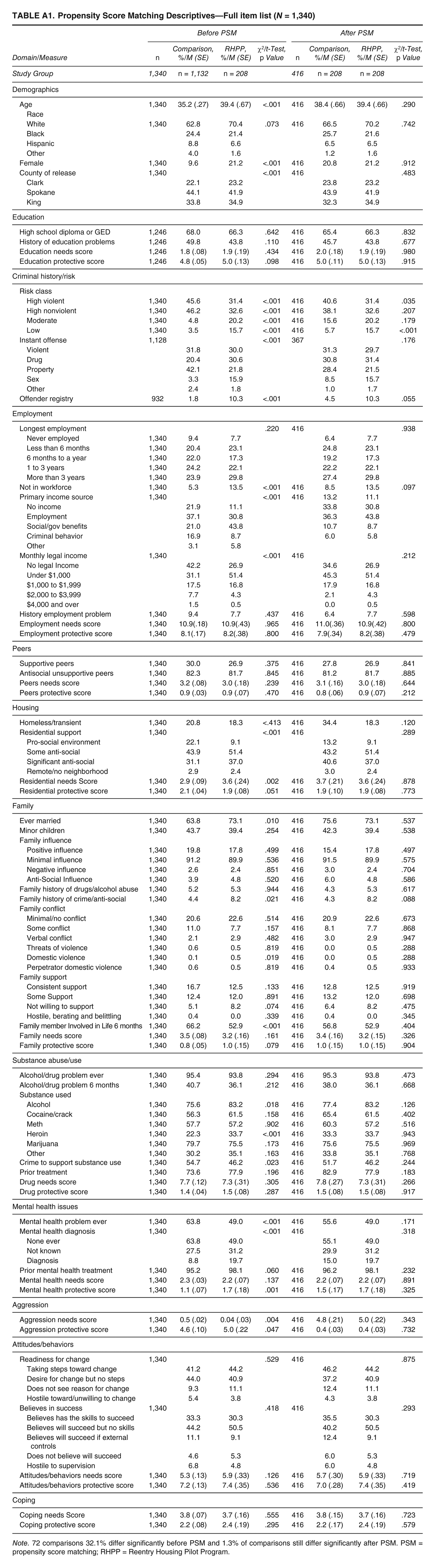
Note. 72 comparisons 32.1% differ significantly before PSM and 1.3% of comparisons still differ significantly after PSM. PSM = propensity score matching; RHPP = Reentry Housing Pilot Program.
Authors’ Note:
A paper presented at the annual meetings of the Academy of Criminal Justice Sciences, New York City, New York, March 14-17, 2012. This study was funded by the Washington State Department of Commerce, Olympia, WA. The findings and discussion are those of the authors and may not represent the position of the Washington State Department of Commerce.