



Abstract
Despite the nationwide use of halfway houses (HWHs), empirical findings documenting their impact have been generally infrequent over the last 30 years. Recent high-profile incidents have increased public attention and raised questions regarding their effectiveness and appropriate use. In response, this study provides information needed to fill the knowledge gap and answer policy questions through an analysis of 6,599 participants across 18 HWH programs in New Jersey. Participants were matched and compared with released inmates who were not provided a HWH placement. Using frailty models, an examination of five correctional outcomes revealed support for the effectiveness and continued use of HWH interventions, with regard to violating conditions of release resulting in revocations. Nonsignificant findings were identified for rearrests and convictions.
In recent years, criminal justice administrators have had to deal with an unprecedented era of accountability. Expectations of evidence-based practices are increasingly becoming the norm (Latessa, 2004; Listwan, Jonson, Cullen, & Latessa, 2008; Petrosino, Boruch, Soydan, Duggan, & Sanchez-Meca, 2001). In no place is this more apparent than in community corrections. Past incarceration trends now fuel a large-scale shift of offenders from state correctional institutions into community supervision (Gartner, Doob, & Zimring, 2011; Greene & Mauer, 2010) characterized best by an increased use of discretionary parole of more than 10% since 2010 (Maruschak & Bonczar, 2013). Within the context of this change, some have noted the potential for greater levels of recidivism (see Gartner et al., 2011; PEW, 2009; Phelps, 2013; Wright & Rosky, 2011). States must subsequently focus their efforts toward assessing and increasing the effectiveness of community corrections in reducing recidivism or be faced with the added problems associated with the increased recidivism potential.
Officials increasingly rely on impact evaluations to determine which programs offer the greatest effect in reducing recidivism. In the case of reentry and community corrections, such determinations are particularly critical as state resources and support to community corrections continue to fade, making up 5% or less of the overall corrections budget in many states (Engel, Larivee, & Luedeman, 2009; Subramanian, 2012). The problem with determining effectiveness in community corrections, however, is that reliable evaluations are quite sparse and narrow in focus of population, which leaves administrators to informally evaluate program utility based on limited information. This is particularly the case for halfway houses (HWHs) or pre–postrelease residential facilities. Considering that some states, such as New Jersey, rely on HWH 1 systems as a key form of reentry, authorizing specific and sound evaluation research to guide decisions of utility is an integral and clear solution to the problem of sparse, hyper-generalized information.
Central to the problem of limited evidence is the fact that HWHs are not a new programming style. Due to their historic uses, HWH systems’ effectiveness is often assumed rather than evaluated, leaving them susceptible to problems both politically and pragmatically. This study supplies new empirical evidence to the needed discussions of HWH research and overarching questions of effectiveness. The question this evaluation aims to answer is “Do New Jersey HWH participants demonstrate a lower proportion of recidivism compared with individuals who do not participate?” We investigate program impact from several angles, utilizing multiple program outcomes. The impact evaluation uses a quasi-experimental comparison of participants with nonparticipants on previously identified recidivism outcomes (Lipsey & Pollard, 1989) and moves beyond prior research in emphasizing the importance of state HWH systems in the larger context of reentry.
Overview of Utilization and Process
Transitional housing, more commonly known after the 1950s as halfway houses, refers to relatively small facilities that are typically residential and located in or near an urban community (Seiter, Carlson, Bowman, Grandfield, & Beran, 1977). The term “halfway house” embodies the two main types of facilities, each tailoring approaches to parolees and probationers—supplying the offender a “more structured environment than probation” (halfway-in) and providing less structure than institutional corrections for parolees (halfway-out; Thalheimer, 1975). No matter the model, each is driven by the premise to keep offenders close to society to reintegrate them successfully (Goetting, 1974). Theoretically, HWHs are used to provide continued change to offending thought processes and patterns by acting as an extension of the state’s control and reform over the individual. Ideally, the offender is given structure and services upon reentry, supplying the individual with resources to succeed and function as a prosocial member of the community.
HWH reintegration for ex-offenders commonly includes services, such as, but not limited to, work release, substance abuse treatment, and psychotherapy. In addition to parolees, HWHs can serve probationers and special offender populations such as substance abusers, the mentally ill, sex offenders, and juveniles. Notwithstanding such diversity, there are three models that are most common for parolees as identified by Allen and Seiter (1981, as cited in Donnelly & Forschner, 1984; Caputo, 2004; Latessa & Allen, 1982): (a) early release, where HWHs supply a venue where the parolee’s initial supervision is spent; (b) prerelease, where HWHs are used as a “readiness-test” by the Department of Corrections—the offender is still technically an inmate, and if he or she completes the HWH program successfully, then admission to traditional parole supervision is permitted; and (c) remand, where HWHs are a type of extra supervision to those parolees who technically violate, rather than sending them back to prison.
Within these separate structural models, Caputo (2004) documented two methods of providing programs to offenders: supporting and intervening. Each method can be understood along a spectrum of how programs are offered, either in the community separate from the HWH or in the facility. Approaches that are supportive offer housing while acting as a program-broker or liaison, in that the HWH would connect the parolee with services that are available in the community. In contrast, intervening approaches provide the parolee with treatment services in-house. The majority of HWHs tend to range between the two, offering few in-house services that usually do not require a specialized staff or environment (e.g., work release) and some substance abuse counseling. The majority also connect parolees to some more intensive treatment in the community (e.g., psychotherapy). These models of both systemic utility and delivery of services are important when discussing the initiative of this study, as New Jersey supplies multiple programs that are similar for parolee reentry. Two particular programs to note, for instance, are Day Reporting Centers and Halfway Back Programs. Day Reporting Centers described and studied by Ostermann (2009) and Boyle, Ragusa-Salerno, Lanterman, and Marcus (2013), among others, are multiservice centers that do not provide housing or security. The Halfway Back Program discussed by Ostermann (2009) and White, Mellow, Englander, and Ruffinengo (2011) is a residential program used in New Jersey specifically for technical violators. Both Day Reporting Centers and Halfway Back are supported by the New Jersey Division of Parole and serve probationers and parolees as an alternative to incarceration or intermediate punishment. Therefore, Day Reporting Centers and Halfway Back represent the remand model identified by Allen and Seiter (1981) and offer intervening approaches to service delivery as noted by Caputo (2004). The current study focuses on Residential Community Release Programs also known in New Jersey as “Halfway Houses”; therefore, the names are used interchangeably (New Jersey Office of Administrative Law, 2008). Residential Community Release Programs are residential facilities under the auspices of the New Jersey Department of Corrections, operating within Allen and Seiter’s prerelease model, and offer specialization of in-house services (e.g., substance abuse treatment or vocational training), whereas medical and other services are provided through referral.
Effectiveness of Being Halfway-Out
For well over 100 years, HWHs were routinely used for a connection from mental health institutions to the community for patients (Keller & Alper, 1970). This use suggested some evidence of effectiveness (Apte, 1968) marked by the beneficial general approach, structure, and philosophy (e.g., social milieu) to ease long-term patients of the asylums into reestablishing social ties and norms of communal functioning. From this application developed the contemporary focus of HWHs today, involving released offenders with similar expectations and gradually aiding the offender back into the community through an established residence. Although many HWH evaluations since 1970 have highlighted the effectiveness of probation (Hartmann, Friday, & Minor, 1994; Latessa & Travis, 1991), in the form of diversion style programs or day reporting centers, far fewer evaluations focus on parole (Hartmann et al., 1994). Furthermore, the majority of postrelease HWH studies were conducted in the late 1960s and 1970s, many of which were in response to Martinson’s (1974) report.
In a meta-analytic review for the Law Enforcement Alliance of America (LEAA), Seiter et al. (1977) compiled parolee HWH evaluations. After examining 35 evaluations, Seiter and colleagues noted that, although 11 quasi-experimental studies indicated a lower recidivism rate for the HWH groups when compared with institutional parolees, 8 studies found either no significant difference or an iatrogenic effect. They stated there was “little evidence available to conclude that halfway houses are assisting in the reintegration of ex-offenders by increasing their ability to function in a socially acceptable manner” (Seiter et al., 1977, p. 26).
This analysis was extended by Latessa and Allen (1982) by including additional studies of each design while focusing on HWH types of several states and their varying operational objectives. Like Seiter et al. (1977), Latessa and Allen investigated the overall effectiveness and cost-efficiency of HWH programs in comparison with traditional parole in a meta-analytic review. They found HWHs to be a cost-efficient form of community corrections but stopped short of concluding that HWHs were more effective than traditional parole in terms of recidivism (Latessa & Allen, 1982). Latessa and Allen conclude their piece by not only highlighting the fact that the majority of the studies used were very weak methodologically but also suggesting that more studies need to focus specifically on HWH effectiveness that involve far more methodological rigor and stronger comparison groups.
Research surrounding parolee HWH evaluation remained dormant in research until the turn of the century when Lowenkamp and Latessa (2002) conducted a multisite evaluation of Ohio HWHs. They investigated the effectiveness of 24 HWHs using a quasi-experimental design. With a sample of 3,737 HWH participants and 3,058 comparison group offenders, their study proved to be the most robust to date. A particularly unique aspect of this study is that the design accounted for Ohio’s use of each of Seiter’s three structural models for HWHs (Allen & Seiter, 1981). Regarding the programming approach, virtually all of the HWHs offered a form of substance abuse and employment programming, whereas others additionally offered educational and financial management courses, cognitive-based groups, anger management, mental health services, and sex offender treatment (Lowenkamp & Latessa, 2002). Using a logistic regression and an interaction term of risk level by group membership (treatment or comparison), the researchers found strong evidence in support of HWH use for high-risk parolees. A similar interaction term of risk-by-group membership was found to be significant in a later piece by the authors (Lowenkamp & Latessa, 2005) that investigated the importance of using the risk principle when assigning community correctional program participation. Ultimately, the authors concluded both studies in favor of targeted residential treatment, including parolee HWHs.
Gaps of Literature, Research, and Policy
In our discussion to this point, we express the relevant literature on the utilization and effectiveness of parolee HWHs. However, through our understanding of the existing research there are a number of problematic gaps that should be addressed. These literary gaps characterize (a) the importance of distinction and precision in research attention, (b) the general lack of empirical tests of halfway-out programs, (c) the necessity to answer the pragmatic and overarching question of effectiveness, and (d) the difficulty in attaining adequate data to answer such questions.
First and foremost is the problem of precision in the focus of the research. When considering the different uses of HWHs, probationer and parolee HWHs serve two distinctly different populations; therefore, evaluations of one should not necessarily be indicative of the other’s performance. As mentioned previously, a majority of the HWH evaluation studies conducted since 1970 are focused on the effectiveness of HWHs for probationers. Moving forward, it is important to identify the differences between halfway-in (probationer) and halfway-out (parolee) program effectiveness in addressing the different needs and risks of their respective populations. As such, we offer an investigation into the impact of a system of halfway-out programs with suggested future examination of similar programs such as those conducted on parolee Halfway Back Programs (White et al., 2011), Day Reporting Centers (Boyle et al., 2013), and their comparison (Ostermann, 2009).
Since 1975, there have been less than 10 evaluations of halfway-out programs, and none explicitly examine the impact of HWHs on recidivism (Seiter & Kadela, 2003). The few studies that have, focused on characteristics in client attrition (Donnelly & Forschner, 1984; Wojtowicz & Tongyin, 2006), treatment and program integrity (Lowenkamp, Latessa, & Smith, 2006), ecological context (Wright, Pratt, Lowenkamp, & Latessa, 2011), technical violations and return types (Hamilton & Campbell, 2013), federal HWHs (Taxman, Rexroat, Shilton, Mericle, & Lerch, 2010), or economic costs (Zhang, Roberts, & Callanan, 2006). The current study adds to this literature and moves beyond by focusing the discussion to the intrinsic interest and question held by practitioners and policymakers regarding HWH utilization—Does it work?
As suggested by Latessa and Allen (1982), to properly evaluate a program’s effectiveness and utility, there must be a rigorous study design, ample sample size, and an appropriate comparison group. Current gaps in the HWH literature involve the omission of at least one of these important parts (e.g., Hetz-Burrell & English, 2006; Taxman et al., 2010). Specifically regarding study design, previous studies (e.g., Lowenkamp & Latessa, 2002) relied on between-group matches that were constructed on a direct (or exact) match of only a few measures: demographics, arrests, incarcerations, offense severity, and risk level. Although a direct match is preferred over modern propensity score modeling techniques, when a greater number of selection bias predictors can be utilized, exact matching is typically not possible. In these situations, propensity score modeling techniques are preferred and typically return a comparison group that possesses greater balance with the intervention group.
The current study addresses these points through a quasi-experimental design and a sizable comparison group, and matches to comparison subjects using propensity score modeling based on a number of key variables all in the effort to improve the ability to clearly identify HWH impact. Specifically, this study provides the first rigorous impact evaluation of a statewide HWH system utilizing a large sample of prison inmates (N = 13,198). Furthermore, unlike prior multisite HWH evaluations, we account for between-facility variations through the use of random-effects modeling in shared frailty survival models.
Method
Objectives and Hypotheses
The primary research objective identified by the New Jersey Department of Corrections (NJDOC) was to describe the generalized impact of HWH program participation on postrelease recidivism. This study consists of a single research question explored and tested using a series of hypotheses. Our research question is “Do New Jersey HWH participants demonstrate a lower proportion of recidivism by comparison with individuals who do not participate?” To best answer this question, two study hypotheses were constructed.
New Jersey Residential Community Release Program
Since June 2012, several media reviews of the New Jersey system detailed some key issues affecting a few HWH facilities (Dolnick, 2012a, 2012b, 2012c). Among these issues, the primary concern was the prevalence of escapes, termed “walkaways,” from HWH facilities and damaging crimes committed by a select few walkaway cases. The report sparked controversy between the public and corrections officials, and specifically raised the question “Just how effective are New Jersey HWHs at reducing recidivism and other negative offender behaviors?” This evaluation began as a result.
An often-overlooked aspect of previous multisite evaluations is the variation between facilities. The State of New Jersey utilizes 18 privately owned and operated HWH facilities, generally termed Residential Community Release Programs. 2 In the context of the models and approaches presented above, Residential Community Release Programs operate under the prerelease model and are separate programs with different staff and contractual agreements. Accordingly, all participants of a program still bear the status of “inmate” while being offered available services that are mainly in-house. Ergo, the purpose and specialization of each privately owned facility, falls in an intervening approach to providing a continuum of care tailored to participants’ needs. Moreover, the programs emphasize far more structure than the common HWH model, abiding by a process through which each participant (a) is assessed for treatment and intervention needs; (a) is provided with individualized treatment plans; (c) enters employment, education, and/or vocational training; (d) is subject to greater accountability and supervision than traditional parole; (e) is subject to random drug screening; (f) is stipulated counseling within the program; (g) participates in an appropriate 12-step program (e.g., Alcoholics Anonymous) as required; (h) enters life skills development; (i) enters a structured phase/level system where incremental privileges are earned as residents progress through the various phases; (j) is stipulated financial responsibility toward payment of maintenance fees, Victim Crimes Compensation Board, Drug Enforcement Demand Reduction Fee, child support, and restitution; (k) enters substance use disorder treatment, as required; and (l) engages in Domestic Violence programming, as appropriate. A caveat, however, to the notion of “in-house care” exists in the separation of the facility types. The four general facility types available to respond to offender needs consist of assessment, treatment, work release, and special needs.
Assessment
Participant inmates typically transition from prison to one of the two assessment centers utilized within the State. Inmates who are within 24 months of parole eligibility and/or completion of sentence and who have been approved by the Institutional Classification Committee for community release programs, are assigned to an assessment center for up to 90 days prior to placement in a community program.
At this point, the Institutional Classification Committee assesses inmates for their risk to recidivate and their treatment needs by way of the Level of Service Inventory–Revised (LSI-R) to identify and quantify characteristics and behaviors that promote criminal lifestyles. Through this process, “targeted need areas” are identified, for which individual treatment interventions are designed. The assessments are then used to inform decisions regarding optimal placement and are periodically readministered to determine the inmate’s response to treatment and reduction in risk indicators. Work readiness classes are also provided to appropriate inmates.
When assigned to an assessment facility, inmates undergo intensive treatments for 8 hours per day, including individual and group counseling. Most often these services and treatments are viewed as transitional for further placement in a more specialized facility. However, it is not uncommon for an individual to be released to the community without additional (or specialized) HWH participation, either to parole supervision or through termination of their sentence (i.e., max-out). As the participants are still inmates, they are not eligible to participate in work release or furloughs, and access to the community is restricted. This is key; as opposed to receiving residential services while on parole, revocations do not occur as a result of these NJDOC policy/process restrictions. If a participant walks away or violates facility rules, their security level is raised and, with few exceptions, they are returned to prison.
Treatment
Inmates who are identified as possessing a substance abuse issue commonly transition from the assessment center to a “treatment” HWH. These facilities provide substance abuse treatment to participants who have been assessed to be in need. Facilities that specialize in the provision of substance abuse treatment often incorporate a work release component, but greater restrictions are placed on community movements compared with traditional work release facilities. All facilities are privately owned and operated, where each is permitted to provide its own style and intensity of treatment.
Work Release
Work release facilities provide vocational training and employment services. Typically, these programs help subjects to graduate from temporary employment to job placements within the community and allow them to leave the facility during the day to obtain and attend a job. Participants may also attend educational programs if they are unable to find viable employment or even attend part-time education in conjunction with employment. Again, these facilities are thought to vary in the services they provide. It should also be noted that subjects may participate in more than one facility, some attending treatment and transitioning to a work release HWH. In addition, although treatment programs restrict eligibility requirements to those considered high-moderate risk, the NJDOC provides work release HWHs to low-risk individuals who can benefit from obtaining a job prior to discharge, reconnecting with family members and early initiation of the reintegration process.
Special Needs
Finally, special needs HWHs are provided for participants who are not currently appropriate for the treatment or work release programs. These individuals are provided with similar treatments and services while competently responding to their medical and/or mental health needs; however, the focus of the special needs programs is on treatment to meet the inmate’s specific needs. It should be noted that mental health and medical services are provided on an “as-needed” basis in the other house types through outpatient services, where special needs houses are reserved for offenders with issues that are serious enough to require specialized attention that cannot be adequately provided elsewhere.
Inmate Eligibility and Placement
Applicants must meet the NJDOC eligibility criteria for participation in Residential Community Release Programs and be approved by both the Institutional Classification Committee and the Institutional Administrator prior to placement in a residential facility. Consideration for inmate placement is based on each inmate’s risk and treatment needs coupled with the availability of bed space. To be eligible, inmates must meet the following requirements: (a) have “full minimum security status,” 3 (b) be within 24 months of a parole eligibility or completion of sentence, (c) have a positive psychological evaluation (i.e., no acute clinical symptoms) within the past year, (d) be medically cleared within the past year, and (e) have a good institutional record (i.e., a lack of major disciplinary infractions). All participants are first screened and approved by the Institutional Classification Committee, the Office of Community Programs (screens for eligibility criteria and program appropriateness), and the Assessment and Treatment Center Classification Committee.
Sampling
To test the study hypotheses, a quasi-experimental design was constructed to compare HWH participants with a matched group of comparison subjects. A purposive sample was gathered with two primary eligibility criteria used for study inclusion. First, all subjects were incarcerated in prison prior to their release from NJDOC custody. Second, all subjects were released from custody during 2008 or 2009. This criterion allowed all subjects to have a minimum of 3 years to be tracked on key study outcomes. Subjects were then divided into two study groups: HWH participants and nonparticipants. All HWH subjects participated in at least one of the four facility types. The pool of potential comparison subjects consisted of individuals released from NJDOC custody during the sample time frame but did not participate in an HWH following incarceration. All study subjects either were released to parole supervision or terminated their sentence (i.e., maxed out) while on NJDOC supervision. Participants identified as “max-outs” terminated their DOC supervision in a HWH facility, whereas potential comparison subjects terminated their supervision in prison.
Data Sources
Two data sources were used, each drawn from the archival collection routinely collected by the NJDOC. The New Jersey DOC data management system was the primary source and was used to assemble demographics (i.e., race/ethnicity, age, and gender), subject movement, and recidivism data. Subject movement data identified the dates and location of each facility transfer. For comparison subjects, transfer dates were utilized to identify the day of release from prison to parole and, if a recidivistic event had occurred, revocation 4 or new commitment was identified. Days from release to recidivistic event were utilized to examine the mean survival times of subjects. Additional transfer data were required for HWH study subjects, including the date of HWH admission and the date of release from the facility to parole supervision. Subjects’ arrest and court processing records were also collected from the Department of Law & Public Safety’s Research and Evaluation Unit statistical repository. This data provided for subjects’ prerelease arrest and conviction history as well as recidivism outcome measures of reconvictions, rearrests, and offense types.
Measures
Three categories of study measures were used: prerelease characteristics, HWH indicators, and study outcomes.
Prerelease Characteristics
Prerelease characteristics are those measures that were gathered prior to the subjects’ release from prison. The characteristics were used to select the comparison group and to provide sample descriptives. A total of 14 prerelease characteristics were gathered for the study subjects. Age was indicated in years at the day of prison release. Subject Race was collapsed into four categories: White, Black, Hispanic, and Other. The measure Male was a dichotomous item indicating subjects’ gender. “Release Cohort” indicated the year of subjects’ release. Year of Education Attainment was collected as a continuous measure. Educational attainment was also dichotomized to identify if subjects possessed a high school diploma or possessed or attained a GED during their incarceration. 5 Offenders’ level of chemical dependency was measured using the contiuous Addiction Severity Index (ASI) scale. Subjects’ Number of Prior Arrests was a continuous measure gathered from Department of Law & Public Safety’s Research and Evaluation Unit, indicating all arrests recorded for each subject, prior to the study incarceration and occurring in New Jersey. Number of Failed Parole Attempts and Number of Prior Incarcerations were continuous measures gathered from NJDOC movement data and represent counts of each event’s occurrence prior to the study incarceration. Instant Offenses represent the most serious of all offenses in which a subject was sentenced for and were then categorized into three types: Violent, Drug, and Property/Other. DOC Term Instant Offense is an aggregate count of months served on all sentencing terms (in months) as of original admission for the study incarceration. Scores on the subjects’ LSI-R (administered prior to release) were used to identify risk of recidivism following release and were then categorized into three levels or “bands”: Low (scores ranging from 0 to 20), Low-Moderate (scores ranging from 21 to 30), Moderate (scores ranging from 31 to 39), and High (40 and above). 6 The measure Paroled was constructed from NJDOC discharge reasons and collapsed into two categories: paroled and max-out.
HWH Indicators
HWH indicators were utilized as the independent variable to test the study hypotheses. A dichotomous measure was created indicating if a subject had, or had not, participated in a facility immediately following their release from prison. Subjects that were not offered a HWH placement were released directly to the community and made up the pool of potential control subjects. 7 In addition, to adjust for between-facility variations, a nominal measure was used to examine the facility in which a participant primarily attended. 8
Study Outcomes
Several outcome measures were constructed to serve as dependent variables for study hypotheses. Five dichotomous event measures were utilized to examine HWH impact, measuring if a subject was rearrested, reconvicted, reincarcerated for a new offense (new commitment), returned to prison as a result of a parole technical violation (revocation), 9 and a general measure of any return (including new commitments, revocations, and returns to prison from court-supervised Intensive Supervision Parole) 10 following their release from NJDOC custody. Time-to-event measures were also computed for each outcome, identifying the number of days from NJDOC custody release to a given event. If an outcome event does not occur during the subject’s follow-up period, the individual was right-censored and the days of their follow-up period was entered as the censored time interval. Time at risk for all outcomes began for comparisons at the time of release from prison, whereas exposure for the intervention group began the day following release from the HWH.
Analytic Strategy
To create a suitable comparison group, propensity score modeling was used to match each HWH participant with an individual from the pool of potential study subjects. Although ideally a randomized design would be constructed to eliminate biases stemming from group selection, ethical considerations along with feasibility restrictions prevented the utilization of the said methodology. Instead, a quasi-experimental design was created and is viewed as the next best alternative to the randomization gold standard. To reduce issues of selection bias, two safeguards were implemented. First, as described, all subjects are matched on stated eligibility requirements. To further reduce selection bias in the comparison group, propensity score modeling was implemented. This procedure allowed for the reduction of differences between the HWH and the comparison subjects on key demographic and criminal history measures. The intended result was to create a comparison sample that is statistically identical to the HWH study group on all key prerelease characteristics for which data are available. The propensity score modeling procedure uses the included predictor characteristics to create a single summary measure (e.g., the propensity score). This summary measure represents the predicted probability of being a HWH participant. Propensity score models take advantage of the pool of potential comparison group subjects. When this pool is large (as is the case here), each intervention subject is matched to the comparison subject that possesses the same or similar propensity score, whereas all remaining comparison pool subjects are eliminated from the study impact analyses. The resulting model produces two groups that are equally balanced on all prerelease measures. A more detailed description of the propensity score modeling is discussed in the next section. A primary advantage of propensity score modeling is that it removes the need for complex modeling of outcomes where testing of hypotheses can be completed with a comparison of study group means and proportions (Guo & Fraser, 2010).
To test Hypothesis 1, bivariate cross-tabulations were used to test each study outcome at 1-, 2-, and 3-year fixed time intervals. Survival models were used to examine days-to-outcome. Because clustering of inmates participating in the same HWH exists, it is likely that offenders’ propensity to commit each outcome is correlated within facility. We argue that clustering is caused by similar environments and similarity of services and programming. Shared frailty models were computed to model survival times of each outcome. Frailty models allow one to model random effects, which control for the unobserved heterogeneity within each HWH facility. Specifically, we used mixed-effects Cox proportional hazard, which is estimated with a penalized partial likelihood estimation algorithm. The random effect, primary HWH facility, is nested, as inmates are identified to have only one primary facility. Both traditional Cox regression (not presented) and frailty models were computed to compare model log-likelihood estimates. For all five outcomes, the frailty model was found to produce significantly improved model fit, and thus, we only present estimates for frailty models.
Propensity Score Matching
A propensity score modeling routine was completed for the HWH evaluation dataset provided. A total of 25,495 cases were eligible for study inclusion, of which 6,599 were HWH participants. A one-to-one greedy matching procedure was utilized with a selection caliper, where a matching subject is selected for each HWH participant based on the closest propensity score identified among the pool of potential comparison participants. 11 A total of 14 prerelease measures (see Table 1) were utilized to create the propensity score models. The selected cases from each model were then combined for the diagnostic examination described below.
Propensity Score Matching Descriptive Statistics

Note. HWH = halfway house; LSI-R = Level of Service Inventory–Revised.
Asterisks such as these convey that the overall measure is significantly different between the two groups. For some, there are no measures of central tendency or SE to present as a whole so the asterisks appear in the otherwise empty cell (e.g., “race” row).
All cases not paroled were identified as “max-outs” either at the conclusion of their incarceration term or their HWH placement.
p < .05. **p < .01. ***p < .001.
Diagnostic tests were performed to examine the group balance achieved by the propensity score match. Bivariate tests were used to compare groups prior to and following the match. Prior to the matching procedure, HWH participants were compared with the entire pool of potential comparison subjects on each prerelease measure. Findings revealed that 10 of the 14 measures (71%) differed significantly between the two prematched study groups, confirming potential confounding effects of selection bias and the need for propensity score modeling. Following the modeling and subsequent matching procedure, the groups were compared again on each of the 14 measures. Findings presented in Table 1 revealed that 1 of the 14 measures remained significant after the match (Instant Offense) representing 7% of the total postmatch tests.
These findings indicate a substantial reduction in selection bias; however, the proportion of items retaining significant group differences was slightly beyond the 5% threshold anticipated by chance alone. It was suspected that this remaining significant difference was not indicative of an inadequate match but merely a reflection of the large sample size (N = 13,198) and a relatively modest number of matching covariates (k = 14). Although a common diagnostic metric of sample balance, some have argued that significance tests alone can be misleading, particularly when sample sizes are either large or small (Austin, 2008; Loughran et al., 2010). We further examined the covariate balance using the average distance in means, computed as a percentage of the average standard deviation. The following formula, created by Rosenbaum and Rubin (1985), was used to calculate the standardized (STD) absolute differences in percentages,
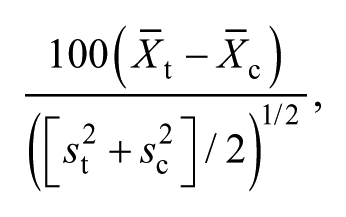
where
Sample Descriptives
The postmatch characteristics presented in Table 1 also provide the univariate sample descriptives. A common profile of HWH participants is displayed indicating that the study subjects are, on average, 35 years old, two thirds are Black, and 88% are male. The average age of the first arrest was slightly greater than 23, while the average number of arrests exceeded 10. Most subjects were incarcerated for a drug offense and the average LSI-R score indicated the typical subject was of moderate risk.
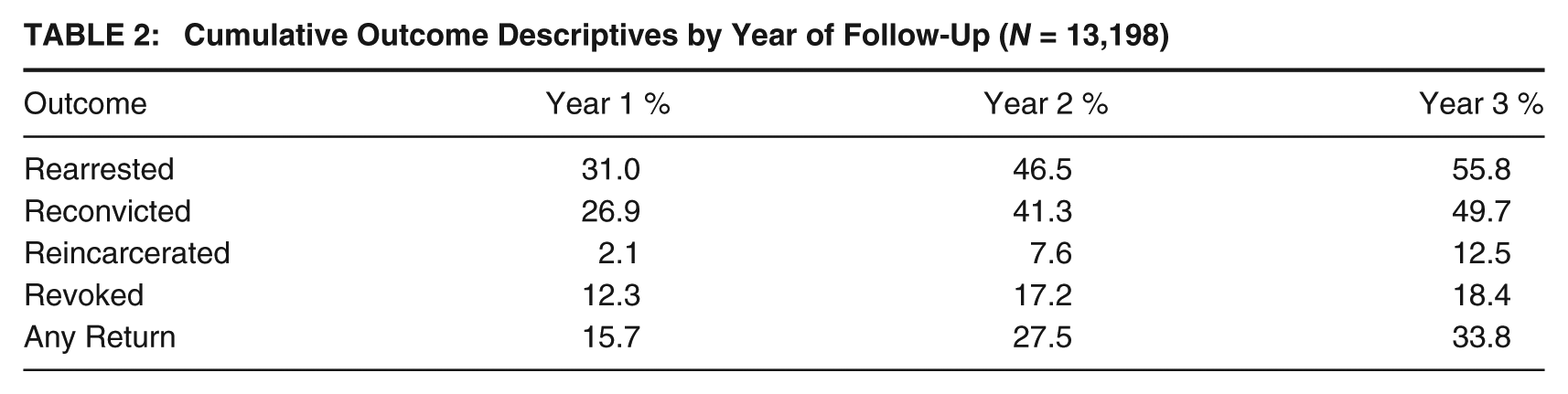
Three measures for each dichotomous outcome were computed and truncated by year of exposure. Year 1 measures include outcomes incurred within the first year following NJDOC release. Year 2 outcome measures represent the cumulative observations in the first 2 years of the follow-up period. Year 3 measures represent the cumulative observations for all three follow-up years. The descriptives for cumulative yearly breakdowns of outcomes are provided in Table 2. As demonstrated in previous findings, the highest risk period for releasees occurs within 6 to 18 months following release (Petersilia & Turner, 1993). Specifically, the vast majority of arrests, reconvictions, revocations, and “any prison return” occur in the first year of follow-up. Given the duration of time needed for criminal justice processing, reincarcerations lag behind slightly, with the largest proportional increase occurring in Years 2 and 3 of the follow-up period.
Cumulative Outcome Descriptives by Year of Follow-Up (N = 13,198)
Results
To test Hypothesis 1, study-eligible HWH participants were compared with matched subjects on all five dichotomous outcomes in conjunction with chi-square tests of significance. 12 These examinations were performed 2 times, once for each follow-up year for which the findings are displayed in Table 3. The HWH group was found to have fewer recidivistic events overall; however, significant and stable effects were only identified for revocations and the collapsed outcome of “Any Return.” Specifically, HWH subjects were also found to have fewer reincarcerations in Year 1 (p < .001) and possessed nearly 33% lesser odds of committing this event; however, this effect did not hold for Years 2 and 3. Participants were also significantly less likely to have their parole revoked; this effect held for all 3 follow-up years (p < .001) and possessed more than 40% lesser odds of committing said events. Finally, HWH subjects were less likely to be returned for any reason in all 3 follow-up years (p < .001) and again possessed substantially lesser odds than comparison subjects of committing the said event (odds ratio [OR] = .570, .614, and .689, respectively). These findings indicate strong support for Hypotheses 1d and 1e, as HWH participants possess lower proportions of revocations events and returns to incarceration for any reason when compared with nonparticipants. 13
Cumulative Yearly Outcome Event Comparisons by Study Group (N = 13,198)
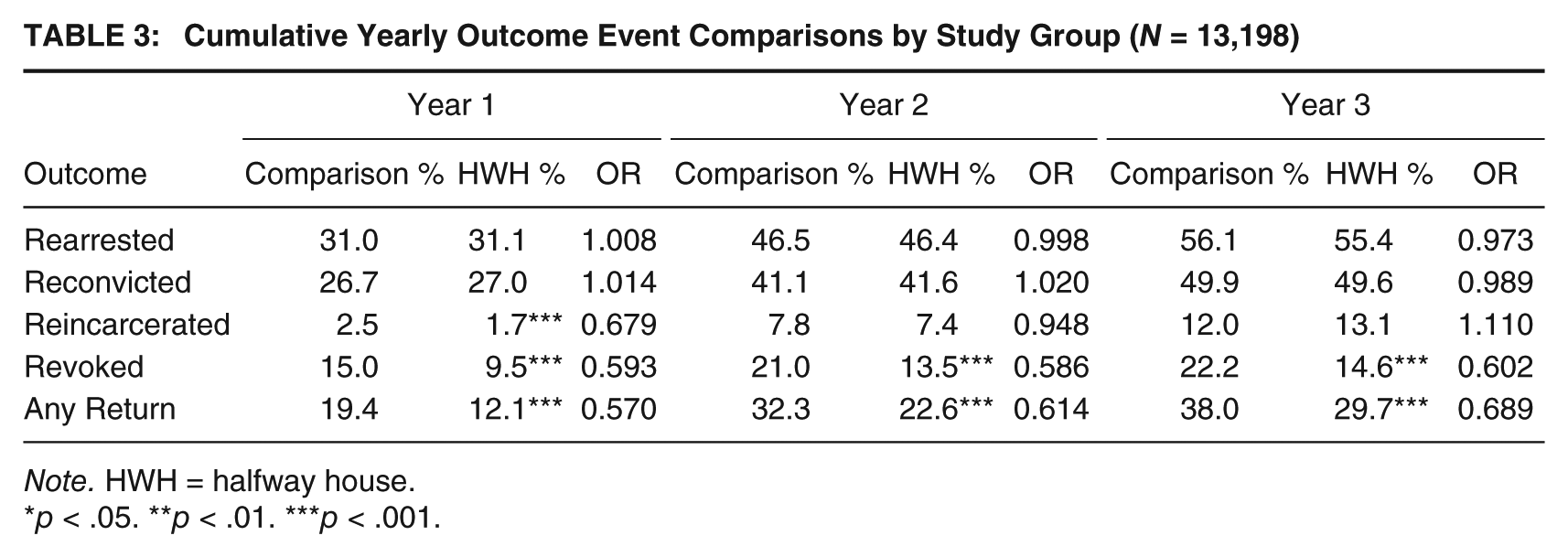
Note. HWH = halfway house.
p < .05. **p < .01. ***p < .001.
To test Hypothesis 2, shared frailty models were used to examine each of the five time-to-event outcomes between study groups. Significance tests of the model coefficient, HWH participation, were also computed to determine significant group differences, and hazard ratios (HRs) were used as effect size estimates. As described earlier, all subjects not committing a given event are right-censored on the final day of the follow-up for their cohort. These findings are presented in Table 4. Similar to the findings presented in Table 3, significant differences were identified among revocations and “any return” models (p < .01 and p < .05, respectively). Nonsignificant differences were found for rearrests, reconvictions, and reincarcerations. Participants were found to have a 41% reduction in the hazard for revocations and a 29% reduction for “any prison return.” Findings provide partial support for the second set of hypotheses, namely, Hypothesis 2d and 2e; the number of days from release to recidivism event is greater for HWH participants than nonparticipants.
Frailty Models Examining Study Group Impact on Five Outcomes (N = 13,198)
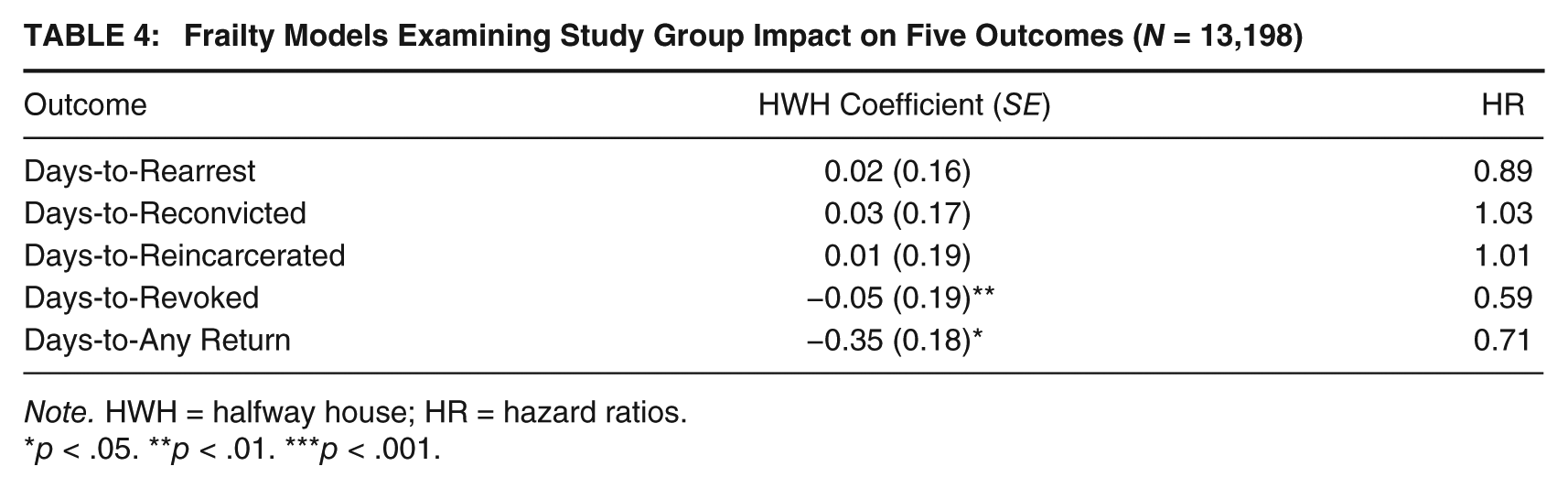
Note. HWH = halfway house; HR = hazard ratios.
p < .05. **p < .01. ***p < .001.
One additional point regarding facility differences had been made in the aforementioned research emphasizing targeting offender risk level and its potential importance in HWH effectiveness. Although it should be stressed that the primary importance of the current study is to generalize the effectiveness of the New Jersey HWH system, we are aware of the theoretical principles stated by Andrews, Bonta, and Hoge (1990) and the unique findings of Lowenkamp and Latessa (2002; 2005) where high-risk participants are thought to perform better than low-risk subjects in HWH interventions. With this in mind, we tested interaction terms of HWH participation and risk level across the five outcomes and failed to identify a significant interaction effect. Due to the nonsignificant findings and the specified scope of this study, we do not present the detailed results of these additional analyses. 14
Discussion
The NJDOC provides treatment and work release services to thousands of inmates returning to the community via HWH placements in an effort to ameliorate the potential negative effects known to occur upon reentry. Each program is privately owned, operated, and contracted to provide services to NJDOC participants. This study sought to measure the effectiveness of the New Jersey HWH system in reducing later recidivism among HWH participants. In accordance with the findings, one can say confidently that by criminal justice standards generally and by the standards observed by the NJDOC, HWH participants are returning to incarceration less, and when returns occur, it takes longer for HWH participants to return. Among the test results, significant differences indicated that HWH participants possess lower propensities for returns to incarceration. Particularly with regard to parole revocations and other returns to prison, HWH participants outperformed their matched counterparts by wide margins. Unfortunately, nonsignificant findings were found when examining differences between participants and comparison subjects on more traditional measures of recidivism—rearrest, reconviction, and reincarceration. Despite these nonsignificant findings, we do not assess New Jersey’s HWH system to be ineffective.
Considering that the primary goal of all states’ Departments of Corrections Programs and specifically that of NJDOC is to prevent returns to prison, our findings favoring HWH participants have great importance. Although HWHs are not provided with the primary goal of reducing correctional costs, those unintended consequences are likely a result of the reduction of institutional populations and the fact that employed participants pay federal and state taxes, maintenance fees, medical co-pays, fines, penalties, restitution, and child support payments. Given the cost of incarceration via revocation noted in earlier studies (Hamilton, Kigerl, & Hays, 2013; Kyckelhahn, 2012; Zhang et al., 2006) and that the use of HWHs did not reduce public safety in terms of new crimes committed, there is cost savings to New Jersey that, although was not directly captured in the current findings, is likely substantial. Future studies should attempt to assess the cost savings associated with HWH provision.
A noteworthy component to the New Jersey system is the use of the Department of Corrections, rather than Parole, as the authority for the provision of HWHs. This variation in process and policy is a likely contributor to the successful reduction in revocation. Many alternatives to incarceration struggle with revocations, often identifying higher rates of return than “treatment as usual” (Hamilton, 2011a; Petersilia & Turner, 1993). Programs incurring higher rates of revocations are often provided by parole, where interventions often raise the requirements and observations of participants resulting in “supervision effects” (Hamilton, 2011a). Because participants of HWHs in New Jersey are still considered “inmates” during their participation, the frequency of violations are reduced and often handled cooperatively between the NJDOC and each facility. As a result, many of the technical violations that can be incurred on parole are not as relevant while residing in the HWH (i.e., remaining in the county, not associating with known offenders, regular contact with parole officers). Above all, the objective of each HWH facility is focused on preparation for life in the community, assisting individuals with obtaining employment, treatment, and housing for their transition. Thus, by the time an individual is released to parole, the likelihood of technical violation is substantially reduced. This method of program delivery decreases the likelihood of “supervision effects” that often accompany community-based alternatives to incarceration and thus better prepare releasees to meet the often lofty goals of parole requirements.
Although the average impact is shown to be substantially beneficial for HWH participants, there are many critiques of the system that still retain merit for future issues of community corrections. Discussed in detail by previous contributors (Wright & Rosky, 2011), the thermodynamics of the criminal justice system suggests that systematic pressures from other systems (e.g., increased arrests, prosecutions) will create consequences that are often unforeseen by policymakers. As states continue to draw back incarceration-focused policies (e.g., Rockefeller Drug Laws) and bolster alternatives (i.e., HWHs) aimed at reducing current levels of incarceration, community supervision populations will continue to grow. Along with this adaptation to population changes, state-established programs with facilities currently in operation will likely be seen as an easy solution. This means that burdens of overcrowding may switch from prisons to state HWH systems and other methods of community corrections as shown by other recent research (PEW, 2009). Especially true during tough economic times, “doing more with less” is a standard of the treatment field. Providing interventions in bulk (i.e., increasing population sizes) is often considered a cost-saving measure that will strain current supervision practices and affect the fidelity of treatment. When these forces interact, the likelihood of violence, escapes, and other violations will also increase. Ensuring the sustainability, setting treatment standards, and equipping facilities with adequate resources to meet new demands for internal safety and public security will be a top concern going forward.
The processes and details of New Jersey’s successful HWH system were decades in the making. This system provides a continuum of care structure whose detailed description is beyond the scope of this study (see Hamilton, 2011b). Policymakers should be aware of the complexity of providing systemwide HWH interventions before attempting increases in program scope. That being said, the findings here demonstrate the clear benefits of providing HWH release as an efficient alternative to incarceration to improve correctional system efficiency, thus likely to result in a reduction of costs related to reincarceration and revocation.
Limitations
Several limitations of our evaluation need further discussion. First, although propensity score matching is a sophisticated method used to simulate randomization, there were restrictions to the matching procedure. First, a modest number of prerelease items (k = 14) were gathered to be utilized for the match, with the majority consisting of static criminal history measures. Diagnostics indicated adequacy of the match and that any remaining imbalances did not affect the study groups negatively. However, without a randomized design, it is difficult to rule out hidden bias resulting from measures that were not feasibly attainable. A key element to be considered is motivation. The comparison group pool is comprised of both eligible participants who remained waitlisted as well as those who did not apply for HWH placement. With regard to the latter type, these individuals either maxed out in a prison facility or made the decision to return to parole directly. Although propensity score modeling balances study groups on known characteristics, motivation for participation is a commonly unmeasured factor of criminal research and, unfortunately, was not able to be considered here. As with nearly all post hoc design of existing programs, it is difficult to isolate and rule out the various types and effects of motivation for participation. However, given that positive program impacts were isolated to reductions in revocations and returns to prison, it is not anticipated that a systematic influence of participant motivation was the root cause of the observed effects. Future evaluations of HWH systems should make efforts to randomly assign participants (when ethically viable) or collect a greater amount of prerelease characteristics to create a more perfect match.
As mentioned, each facility is privately owned and operated, and though contractually restricted to provide a certain minimum of services and treatments, each facility is free to adhere to those standards in their own way, thereby allowing them to tailor their intervention to offender needs as they see fit. However, as a result of this autonomy among facilities, programming fidelity and the overall quality of treatment may vary widely between facilities, and thus has the potential to diminish responsivity among HWH participants. We control for variations between facilities through the inclusion of a random effect utilized in shared frailty models. However, responsivity elements and effective program components may be further parsed out through the use of a multilevel model making used of key Level 2 predictors. An examination of the facility-level effects, including the effects fostered by ecological contexts, was not within the scope of this evaluation, although is a focus of research currently underway. Subsequently, upcoming studies will examine both general and specific differences that demonstrate improved responsivity for participants. Furthermore, separately matched samples will be used as part of two subpopulation assessments of program effects for HWHs that specialize in substance abuse treatment and work release. Feasibility limitations, along with current study objectives, restricted our ability to present these findings.
Last, given the previously discussed differences in HWH models, the external validity of these findings are limited to similar prerelease HWHs. This is not only an important distinction for interpreting the results presented here but also one that should be applied to future HWH evaluations. Similarly, the implementation of Allen and Seiter’s (1981) HWH model may differ by state and population served. All HWH evaluation results should be interpreted accordingly.
Conclusion
Although not finding universally positive outcomes, the findings we present here favor HWH use. We impart recommendations for the future of HWH intervention to policymakers and future research. First, on the whole, statewide HWH interventions should be continued, though with one major caveat: There must be sound, objective, and reoccurring evaluations. Correctional history in the United States is indeed a tale of caution when it comes to reactionary policy. Political reactions to news of tragic, but rare, instances of an offender’s early release leading to a heinous crime carries lasting implications. Given the reality of reaction-based policy coupled with decades of correctional research, two replicable findings can be seen as truth to any Department of Corrections: (a) appropriately implemented interventions are consistently found to be more effective at reducing recidivism and other negative offender behaviors than incarceration alone and (b) a single offender committing a heinous act has the power to sabotage a system and reverse progress gained through progressive rehabilitation practices. Lessons learned from these truths suggest that evidence should guide policy and prevent overreactions to speculations or negative news events.
With regard to questions surrounding New Jersey’s use of HWH programs, appropriate actions were taken. An independent study was provided to identify the validity of recent assertions, and subsequent findings clearly demonstrated that HWHs have a positive impact, decreasing the likelihood of returns to prison, as per the explicit goal of the New Jersey HWH program. Elimination, or reductions, of HWH use will likely result in increased returns to incarceration and subsequent costs incurred by a State’s DOC. In general, statewide HWH systems have the potential to provide a conciliating aid to prison crowding and their subsequent costs, mainly by offering a well-versed transitional structure from total institutions of correction to the community in the absence of state control. However, without proper and mindful evaluation of such initiatives, whether they be birthed of political reaction or not, HWHs are just as susceptible to fail as any other state intervention.
Second, future research should focus on understanding how improving proficiency among HWHs can help states to mediate offender populations. State systems are under constant pressure to keep up production. Although correctional systems are not often thought of in business terms, there is a flow of inmate output that will need to be maintained to sustain, and hopefully reduce, the current rate of incarceration. However, the main hindrance of any correctional progress is the recycling of offenders back into the system. One of the primary strengths and limitations of New Jersey’s HWH system is its size. In spite of New Jersey’s many resources for returning offenders, the supervision and effective use of programs can prove to be a daunting task. With so many moving parts and the restricted ability to structure treatments and services provided by privately operated organizations, improving efficiency while maintaining quality is a complicated endeavor for the NJDOC.
Although the Department of Corrections cannot specifically dictate the timing and provision of treatments and services each facility provides, it does retain the power and authority of participant placement. The facilities themselves would likely be the first to note that, even among the four main types of placements (assessment, substance abuse treatment, special needs, and work release), all programs are not alike. Treatments, services, staff, and resources will inevitably differ. Increased efforts to improve HWH system proficiency should focus on the placement of participants in such a way that it will increase responsivity. Andrews and colleagues (1990) indicated that, like all interventions, correctional programs are ineffective if they are serving the incorrect population. Their Principle of Responsivity is contained within the efforts of intervention matching. This entails tailoring interventions to meet the specified risks and needs of a given participant. Intervention matching is a difficult endeavor because it requires a large system of resources that can be “plugged in” to address an individual’s unique set of characteristics. Additional research is needed to provide feedback to identify which interventions are found to be effective for a given individual. It is recommended that states perform and commission research to explore the creation of a tool or instrument that will guide placement decisions to specific programs within a state’s rehabilitative system.
Third, HWH placement processes should be thoroughly evaluated. With current nationwide efforts to exercise more fiscal restraint, correctional budgets are tightening. Inexpensive system responses are being reconsidered in an effort to more frugally provide correctional services. Various methods have been used to reduce correctional costs, including eliminating or reducing rehabilitation services offered, releasing nonviolent offenders early form incarceration, and removing low-risk releasees from community corrections supervision caseloads. Moreover, the importance of removing low-risk offenders from postrelease supervision has been emphasized. Petersilia and Turner (1993), for example, identified that the extended use of community corrections can create what was later termed supervision effects, where increased observations of the offender resulted in unintended, greater rates of revocations. Similarly, Lowenkamp and Latessa (2005) recognized the potential for iatrogenic effects of correctional interventions. They specifically found that residential placements (i.e., HWHs) of low-risk offenders increased the likelihood of recidivism.
Although the vast majority of HWH participants are moderate-high risk, the NJDOC allows some low- and low-moderate risk offenders to participate in work release HWHs to increase their opportunities to obtain a job, reconnect with family, and initiate the reintegration process. Given the empirical support for the removal of low-risk offenders and the nonsignificant findings regarding criminal recidivism reported here, we recommend that New Jersey and other states providing HWH services consider restrictions to program eligibility criteria. That is to say, findings in support of HWH use do not necessarily mean these programs should be broadly applied to releases at all risk levels, as systemic overreactions to positive findings can be just as harmful as those to negative findings. Often motivated by positive study findings, policymakers have been known to overuse interventions beyond their intent. The current study’s findings have the potential to be misinterpreted as support for expanding the scope of HWH programming beyond their intended population. Some might argue low-risk participants found in the current findings are evidence of such an occurrence. Additional research should be conducted to identify predictors and/or inmate types that do not benefit from HWH interventions in an effort to eliminate the potential provision of harm and further reductions of correctional costs.
Footnotes
Authors’ note:
Both Zachary Hamilton and Christopher Campbell are affiliates of the Department of Criminal Justice and Criminology at Washington State University. In addition, the authors acknowledge the willingness and assistance of the New Jersey Department of Corrections in securing the data and permission for this project, specifically Dr. Kristen Zgoba.