



Abstract
A growing body of evidence has highlighted the relationship between narcissism and violence. Importantly, however, the predominance of this evidence comes from experimental tests or small-scale samples that most often overlook the contribution of low self-control to explicating the relationship. The present study refers to the National Epidemiological Study of Alcohol and Related Conditions (NESARC) to assess narcissism, low self-control, and violence among a nationally representative sample. Using Latent Class Analyses (LCA), four classes of individuals are identified, and multinomial regression models indicate that narcissism and low self-control are associated with a range of violent acts among these groups. Most importantly, results show that the class of individuals that is high in narcissism and deficient in self-control is far and away the most prone to violence. Together, these findings lend important nationally representative support to recent experimental and meta-analytical conclusions suggesting that the co-occurrence of narcissism and low self-control has significant implications for our understanding of violence. Limitations of this study and avenues for future research are discussed.
The etiology of violence has received a wealth of theoretical and empirical attention from a range of disciplines that have offered a diversity of explanations (e.g., Anderson, 1999; Caspi et al., 2002; Golden, Jackson, Peterson-Rohne, & Gontkovsky, 1996; Loeber & Hay, 1997; Moffitt, 1993; Raine, 2013; Raine, Brennan, & Mednick, 1994; Sampson, Raudenbush, & Earls, 1997; Widom, 1989, 2014). Within psychology specifically, one of the more intriguing debates surrounding violence pertains to the implications of narcissism (see Baumeister, Bushman, & Campbell, 2000; Baumeister, Smart, & Boden, 1996; Bushman & Baumeister, 1998). This body of literature was motivated by the seminal work of Baumeister et al. (1996) who suggested that it is not low self-esteem but rather an overinflated self-esteem, or narcissism, that is associated with a propensity toward violent behavior (but see Anderson, 1999; Donnellan, Trzesniewski, Robins, Moffitt, & Caspi, 2005).
In line with the propositions of Baumeister et al. (1996), the literature on violence and narcissism has focused significant attention to whether threatened egotism, or challenges to an individual’s favorable self-view, is the lifeblood of the relationship (e.g., Barry et al., 2007; Baumeister et al., 2000; Baumeister et al., 1996; Bettencourt, Talley, Benjamin, & Valentine, 2006; Bushman & Baumeister, 1998). Attention to the implications of emotional provocation is meaningful line of inquiry, to be sure, but such theoretical fixation has moved the literature away from a general understanding of the extent of the narcissism–violence nexus. Furthermore, because so much of what is known about the relationship has come from experimental designs, the extant literature is hampered by little evidence from large nationally representative samples. As argued by Donnellan et al. (2005), “aggressive behaviors occurring in the lab are not antisocial to the same extent as real-world aggression” (p. 334). Finally, and perhaps most importantly, only a paucity of research on narcissism and violence has assessed the contribution of self-control (LSC; e.g., Centifanti et al., 2013; Miller et al., 2009; Vaughn, DeLisi, Beaver, Wright, & Howard, 2007; Vazire & Funder, 2006), which has a strong independent relationship with antisocial behavior (DeWall, Baumeister, Stillman, & Gailliot, 2007; Gottfredson & Hirschi, 1990; Pratt & Cullen, 2000).
Given these shortcomings, the present study refers to the National Epidemiological Study of Alcohol and Related Conditions (NESARC) in an effort to better understand the interplay of narcissism, low SC, and violence. In doing so, we answer two specific questions. First, irrespective of provocation, is narcissism generally associated with violent behavior? And second, in what way does low SC add to our understanding of narcissism and violence? In the end, the findings of this study will elucidate the proclivity to an array of violent behavior for individuals who have a surplus of narcissism and are deficit in LSC.
Narcissism
Narcissism is generally defined as a pervasive sense of grandiosity, self-absorption, and entitlement that is accompanied by a strong desire to be validated and admired by others (American Psychiatric Association [APA], 1994). 1 Importantly, narcissism is specified in different ways across clinical and social psychology (see Fossati et al., 2005; Haslam, 2003; Livesley, Schroeder, Jackson, & Jang, 1994; Markon, Krueger, & Watson, 2005). Among clinical psychologists, the structure of narcissism is taxonic. That is, individuals are either classified as having narcissistic personality disorder (NPD; Fossati et al., 2005), which only applies to less than 1% of the general population (APA, 1994), or not. Alternatively, social psychologists understand narcissism as a dimension that places individuals somewhere along a continuum (Livesley et al., 1994; Raskin & Terry, 1988; Thomaes et al., 2008). A recent study by Foster and Campbell (2007) assessed this dichotomy and found that “narcissism—as it occurs in the general population and assessed by the NPI—is continuously rather than categorically distributed” (p. 1330). In other words, narcissism is measurable at the “subclinical” level among the general population, and so most individuals can be understood as expressing some degree of narcissism (e.g., minimal, moderate, extreme).
Despite the conceptual overlap that characterizes narcissism and high self-esteem, there are meaningful differences between the two (Campbell, Rudich, & Sedikides, 2002). For instance, negative interpersonal relationships are common among narcissists, who are likely to have a low desire of intimacy (Carroll, 1987) and social bonds that lack in investment and quality (e.g., Campbell & Foster, 2002; Foster, Shrira, & Campbell, 2006). Relative to individuals with high self-esteem, evidence also points to narcissists being “relatively unconcerned with being nice or moral” (Campbell, Rudich, & Sedikides 2002, p. 365; see also Bushman, Bonacci, Van Dijk, & Baumeister, 2003). Furthermore, unlike individuals with high self-esteem, narcissists are especially vulnerable to negative feedback that may challenge their inflated self-view, regardless of whether those challenges come via personal insults or challenges (Baumeister et al., 1996) or task failure (Rhodewalt & Morf, 1998). Importantly, it is this sensitivity that much of the research on narcissism and violence has found brings the relationship to life (Baumeister et al., 1996; Bushman & Baumeister, 1998; Centifanti et al., 2013).
Narcissism and Violence
In their seminal article on narcissism and violence, Baumeister et al. (1996) challenged the accuracy of prior theoretical suggestions that low self-esteem was strongly related to such behavior (e.g., Anderson, 1999; Oates & Forrest, 1985; Toch, 1992). Offering exhaustive empirical support, they proposed that the relationship between self-esteem and violence most likely fell on the opposite of the continuum. That is, it is not low self-esteem, but rather an overinflated self-esteem that can lead to violence. Specifically, they posited that narcissists are prone to react to challenges to their self-view with violence due to the instability of their self-esteem and the overall sensitivity that follows such uncertainty of self-worth. According to Baumeister et al., We propose that the major cause of violence is high self-esteem combined with an ego threat. When favorable views about oneself are questioned, contradicted, impugned, mocked, challenged, or otherwise put in jeopardy, people may aggress. In particular, they will aggress against the source of the threat. (p. 8)
What followed this proposition was a line of research focused on “threatened egotism” and whether it is a required element of the narcissism–violence link (Barry et al., 2007; Baumeister et al., 2000; Bushman & Baumeister, 1998; Centifanti et al., 2013; Stucke & Sporer, 2002; Thomaes et al., 2008; Twenge & Campbell, 2003; Washburn, McMahon, King, Reinecke, & Silver, 2004).
Not long after their reconceptualization, Bushman and Baumeister (1998) found evidence for their threatened egotism hypothesis. Through two experimental studies, they determined that “people who are emotionally invested in grandiose self-views are the most aggressive, particularly in response to an esteem threat” (p. 227), yet absent provocation, these people are no more likely to behave aggressively. In addition, Baumeister et al. (2000) submitted that “threatened egotism, rather than low self-esteem, is the most explosive recipe for violence” (p. 29). Further evidence pointing to the importance of provocation to the narcissism–violence link has come from a variety of recent studies (Bushman et al., 2003; Stucke & Sporer, 2002; Thomaes et al., 2008; Twenge & Campbell, 2003; Vaillancourt, 2013).
Importantly, however, not all research supports the proposition that narcissism is only associated with violence when a narcissistic individual is provoked (Barry et al., 2007; Centifanti et al., 2013; Reidy, Foster, & Zeichner, 2010; Washburn et al., 2004). For example, Washburn et al. (2004) determined that narcissism is associated with proactive (i.e., unprovoked) displays of aggression among young adolescents. Barry et al. (2007) found that narcissism was associated with both reactive and proactive forms of aggression, highlighting that threatened egotism is not a necessary prerequisite for narcissistic individuals to behave violently. Furthermore, Martinez et al. (2008) identified a relationship between narcissism and displaced aggression toward an innocent victim not responsible for provocation. Twenge and Campbell (2003) highlighted a similar outcome: “Narcissism was positively associated with a willingness to use . . . displaced aggression after a rejection” (p. 269). Considered together, these studies show that narcissism can be associated with both proactive and reactive violence, and importantly, that violence can be directed toward an uninvolved third party. The inconclusiveness of the literature on the threatened egotism hypotheses suggests that a more general understanding of the relationship between narcissism and violence is a warranted and potentially fruitful line of inquiry. Perhaps more importantly, this mixture of findings points to the need for a more nuanced understanding of the link.
Narcissism, LSC, and Violence
Why is it that narcissistic individuals are prone to violent behavior? An array of recent findings in the literature on narcissism and violence points to the relevance of LSC (Centifanti et al., 2013; Vazire & Funder, 2006). Some research shows that sensation-seeking behavior is common among narcissists (Emmons, 1981), suggesting that LSC and narcissism share common ground (see Vazire & Funder, 2006). In fact, research has established that “self-control is closely connected with psychopathology, specifically narcissism, and is a much broader construct than has been reported in the criminological literature” (Vaughn et al., 2007, p. 816). Thus, a complete understanding of LSC and its behavioral manifestations necessarily requires attention to psychopathological traits such as narcissism, and vice versa (Miller et al., 2009).
Given that narcissism and LSC share common ground, it should come as no surprise that narcissism and LSC are independently associated with a range of antisocial and self-defeating behaviors (Casillas & Clark, 2002; Moffitt, 1993; Pratt & Cullen, 2000; Vazire & Funder, 2006). Importantly, however, despite the known correlation of narcissism and LSC, LSC has been largely ignored as a predictor of narcissists’ behavior (Vazire & Funder, 2006; but see Centifanti et al., 2013). According to Vazire and Funder (2006), “the paradoxical behavior of narcissists, such as their limitless self-enhancement, counterproductive aggression, and preference for short-term immediate gratification over long-term benefits may be driven in part by their dispositional impulsivity” (pp. 161-162). Therefore, studies that examine the relationship between narcissism and violence but fail to consider the unique contribution of LSC are bound to produce misspecified and consequently misleading conclusions, which may be contributing to the mixed findings in the narcissism and violence literature just reviewed. The present study aims to move past this limitation by focusing attention to the association between narcissism and LSC.
Theoretical Framework
A recent study by Centifanti et al. (2013) provides further evidence of the importance of considering LSC in understanding the narcissism–violence link. In a laboratory setting, they determined that the relationship between narcissism and aggression took two forms. Specifically, they arrived at the following conclusion: “Our findings suggest that there are two kinds of narcissistic people: those that are emotionally stable and aggress proactively and those that are emotionally labile and aggress reactively” (p. 480). More broadly, they discovered that narcissistic youth who struggled to regulate their emotions under stress were the most likely to engage in proactive aggression. This experimental finding confirms the connection between narcissism and LSC, and points to the need for a theoretical model that considers the dynamic influence of the temperament that these factors create. The recent temperament-based theory by DeLisi and Vaughn (2014) offers one such conceptual model that has the potential to capture the additive influence of narcissism and LSC on violence. Their theory suggests that effortful control (i.e., impulsivity, low conscientiousness, and boldness) and negative emotionality (i.e., anger, thin-skinnedness, and hostility) interact with one another to increase the likelihood of antisocial behavior directly and indirectly through their impact on various contextual factors (i.e., family, peers, schools, and neighborhoods). Given the established relationships of narcissism with low SC (e.g., Vaughn et al., 2007; Vazire & Funder, 2006), low conscientiousness (e.g., Thomaes, Bushman, Orobio de Castro, & Stegge, 2009), anger (e.g., Bushman & Baumeister, 1998), sensitivity (e.g., Baumeister et al., 1996; Kernberg, 1975), hostility (e.g., Morf & Rhodewalt, 2001), and weak interpersonal relationships (e.g., Campbell & Foster, 2002; Foster et al., 2006), there is little question that individuals with such deficits are likely to respond to their environments problematically (see Thomaes et al., 2009). Although the link between LSC and negative emotionality is well-established, no studies to our knowledge have called on their interactive and dynamic nature to predict violence among a nationally representative sample. The present study serves as the first attempt to do so.
Method
Sample and Procedures
Study findings are based on data from Wave 1 (2001-2002) and Wave 2 (2004-2005) of the NESARC. The NESARC is a nationally representative sample of non-institutionalized U.S. residents aged 18 years and older. The survey gathered background data and extensive information about substance use and mental disorders from individuals living in households and group settings (e.g., shelters, college dormitories, and group homes) in all 50 states and the District of Columbia. The NESARC utilized a multistage cluster sampling design, oversampling young adults, and racial/ethnic minorities in the interest of obtaining reliable statistical estimation in these subpopulations, and to ensure appropriate representation of racial and ethnic subgroups. The cumulative response rate was 70% for both waves with a response rate of 81% for Wave 1 (N = 43,093) and of 87% for Wave 2 (N = 34,653).
Data were collected through face-to-face structured psychiatric interviews conducted by U.S. Census workers trained by the National Institute on Alcohol Abuse and Alcoholism and U.S. Census Bureau. Interviewers administered the Alcohol Use Disorder and Associated Disabilities Interview Schedule, Diagnostic and Statistical Manual of Mental Disorders (4th ed.; DSM-IV; APA, 1994) version (AUDADIS-IV), which provides diagnoses for clinical, personality, and substance use disorders. The AUDADIS-IV has shown to have good-to-excellent reliability in assessing psychological morbidity in the general population (Grant, Hartford, Dawson, Chou, & Pickering, 1995; Hasin, Carpenter, McCloud, & Grant, 1997). The study design and procedures are presented here in a summarized form; however, a more detailed description of the NESARC procedures is available elsewhere (Grant et al., 2003).
Measures
Indicator Variables
This study utilized latent class analysis (LCA) to identify latent subgroups on the basis of 21 dichotomous indicator variables related to the constructs of narcissism and LSC. See the appendix for a comprehensive list of the 21 indicator variables used to measure narcissism and LSC in this study.
Narcissism
Seventeen dichotomous (0 = no, 1 = yes) indicator variables related to narcissism were drawn from the items measuring narcissistic personality disorder in the AUDADIS-IV. All items were examined in reference to how individuals felt or acted the majority of the time over their life regardless of the contextual factors. Sample items include the following: “Have people told you that you have too high an opinion of yourself?” and “Have you felt that you were the kind of person who deserves special treatment?”
LSC
Four dichotomous (0 = no, 1 = yes) indicator variables related to long-term patterns of LSC were also utilized. Sample items include the following: “Have you often done things impulsively?” and “Have you often had temper outbursts or gotten so angry that you lose control?”
Outcome Variables
This study utilized multinomial regression analysis to examine the association between membership in the latent subgroups and various outcomes related to violent behavior and intimate partner violence (IPV).
Violent behavior
Eight dichotomous (0 = no, 1 = yes) variables from the antisocial personality disorder module of the AUDADIS-IV were used to examine violent behavior. Data from Waves 1 and 2 were combined to measure respondent self-report of having exhibited any of the behaviors in their lifetime. Example items include the following: “In your entire life, did you ever get into a lot of fights that you started?” and “In your entire life, did you ever use a weapon like a stick, knife, or gun in a fight?”
Intimate partner violence
The enactment of IPV was measured on the basis of four items from the Conflict Tactics Scale, Form R (Straus, Hamby, Boney-McCoy, & Sugarman, 1996). Respondents who reported having been married or in a relationship over the previous 12 months were queried about the frequency of having carried out various acts of IPV during that time. Items measuring forced sex and injury of a partner/spouse were excluded due to very low base rates (<0.50%) for these items. For each item, respondents who reported having carried out one or more acts of IPV were coded 1 and all other respondents coded 0.
Control Variables
The following sociodemographic variables were included as indicator covariates (in the latent class analysis) and control variables (in multinomial regression analyses): age, gender, race/ethnicity, household income, education level, marital status, region of the United States, and urbanicity. Furthermore, we refer to measures of clinical and substance use disorders, including the following: lifetime DSM-IV mood (major depression, dysthymia, and bipolar disorder) and anxiety disorders (generalized anxiety disorder, panic disorder, social phobia, specific phobia, and posttraumatic stress disorder), and lifetime alcohol or any illicit drug use disorder (abuse/dependence). Consistent with the original NESARC coding, each item was dichotomously scored (0 = no, 1 = yes).
Statistical Analyses
LCA and multinomial regression analyses were executed in successive steps to identify and subsequently validate latent subgroups. LCA is a statistical procedure designed to assign individual cases to their most likely latent subgroups on the basis of observed data (McLachlan & Peel, 2000). Multinomial regression is a statistical procedure designed for nominal outcomes that contain categories that can be assumed to be unordered (Long & Freese, 2006).
Beginning with the LCA, a sequence of latent class models were identified between one and five classes using Latent GOLD® 4.5 (Vermunt & Magidson, 2008) software. Four statistical criteria were used to identify the best fitting model: the Bayesian Information Criterion (BIC), Akaike’s Information Criterion (AIC), Consistent Akaike’s Information Criterion (CAIC), and Log Likelihood. In interpreting these criteria, lower BIC, AIC, and CAIC values and higher log likelihood values reflect better model fit. In addition to these quantitative criteria, the parsimony and substantive interpretability of the latent class solutions also function as key criteria for the selection of the final model.
After identifying latent subgroups and assigning subjects to classes on the basis of the probability of membership, multinomial regression was used to predict class membership. The class containing the greatest number of respondents was identified as the reference category. Using multinomial regression, relative risk ratios (RRs) and confidence intervals (CIs) were estimated. RRs refer to the likelihood of membership in one particular class versus a specified reference class and are interpretably akin to odds ratios (Zhang & Yu, 1998). Statistical procedures involving multinomial regression models were conducted using Stata 13.1SE survey data functions (StataCorp, 2013).
Results
Latent Class Analysis
Identification of Latent Subgroups
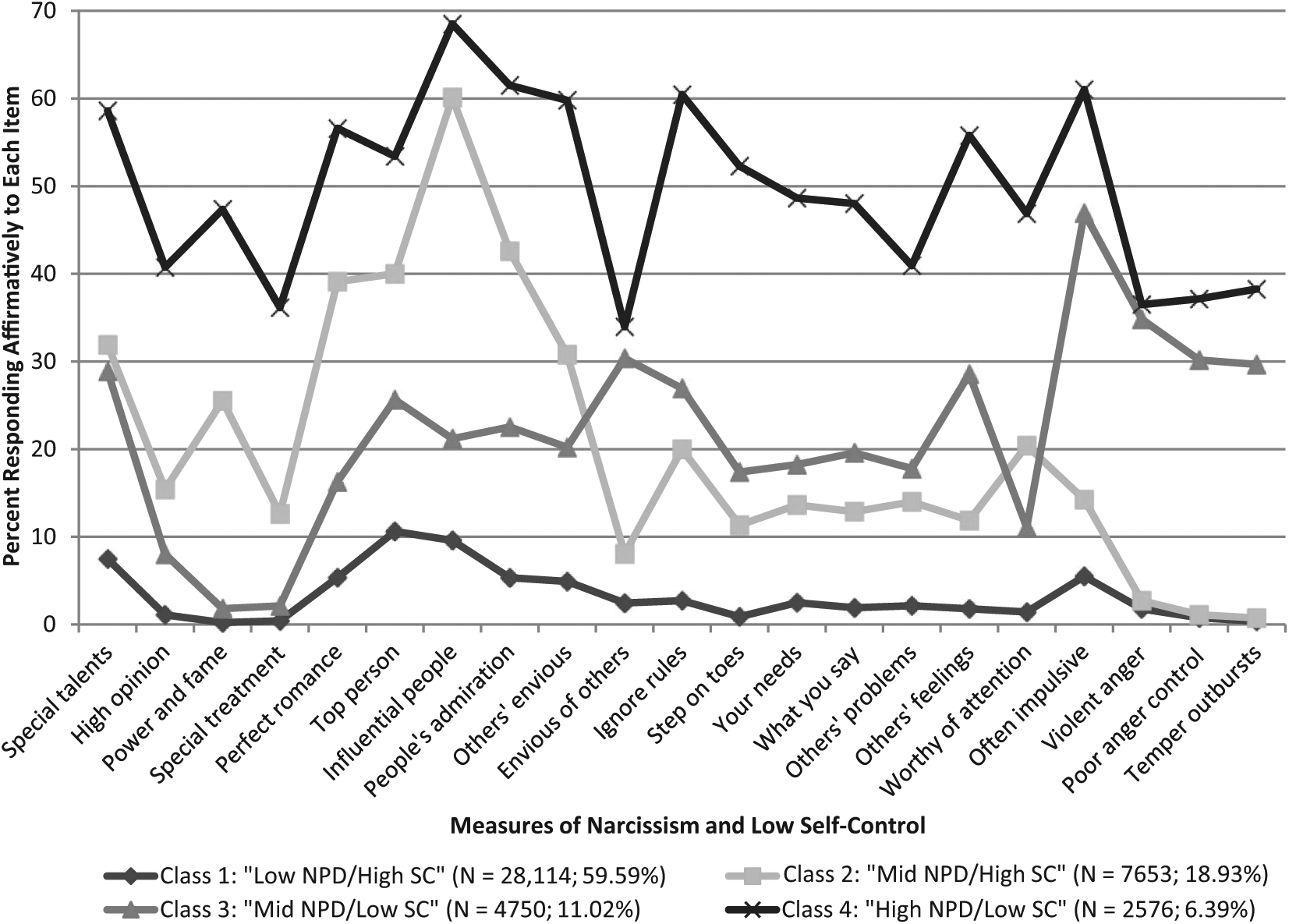
As seen in Table 1, the statistical criteria suggest that a five-class solution was the optimal modeling of the data. Whereas the fit indices (i.e., Log Likelihood, BIC, AIC, and CAIC) suggest that the inclusion of a fifth class would slightly improve model fit, the relatively minor differences between the four- and five-class models suggest that the five-class solution would not be parsimonious. Moreover, the conceptual fit of the latent class models was examined by means of plotting the mean values of the 21 indicator variables across each of the latent classes. As illustrated in Figure 1, the four-class solution provides a clearly distinguishable and conceptually coherent modeling of the heterogeneity of the data, providing further support to the four-class model.
Fit Indices for Latent Classes
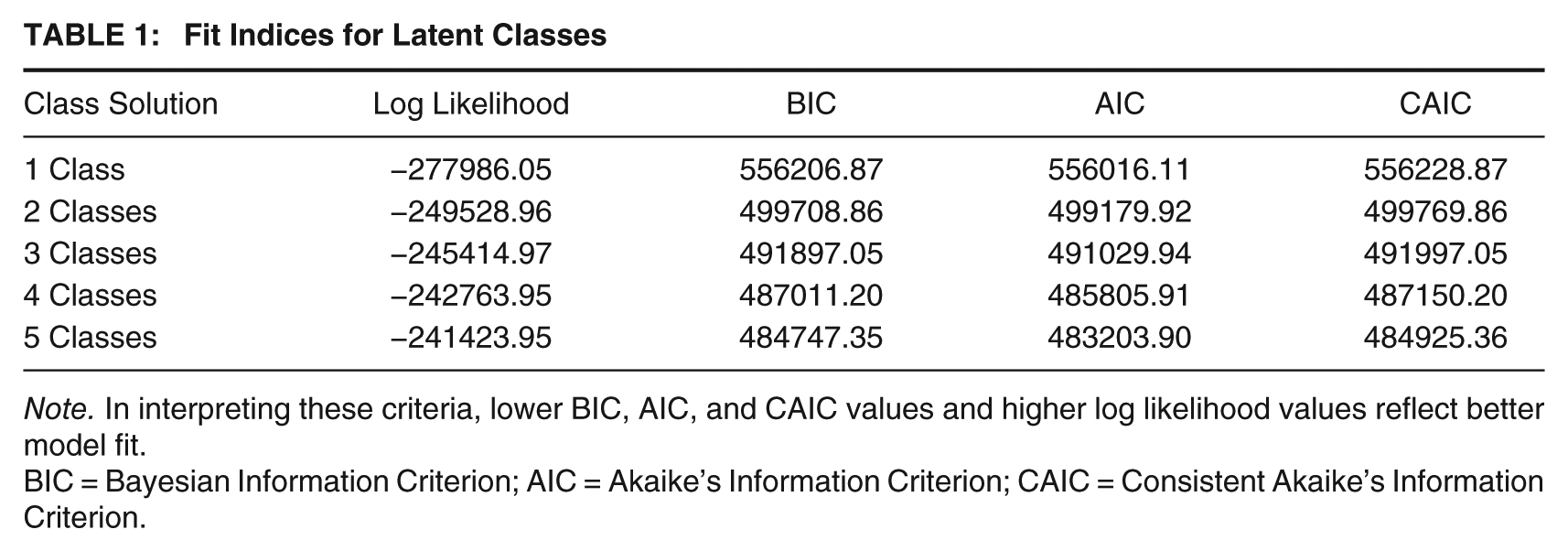
Note. In interpreting these criteria, lower BIC, AIC, and CAIC values and higher log likelihood values reflect better model fit.
BIC = Bayesian Information Criterion; AIC = Akaike’s Information Criterion; CAIC = Consistent Akaike’s Information Criterion.
Characteristics of Latent Classes
The four-class solution is composed of the following: Class 1: Low NPD/High SC (n = 28,114, 59.59%), Class 2: Mid NPD/High SC (n = 7,653, 18.93%), Class 3: Mid NPD/Low SC (n = 4,750, 11.02%), and Class 4: High NPD/Low SC (n = 2,576, 6.39%). Low NPD/High SC, which is by far the largest class identified, is characterized by universally low levels of narcissism in combination with a high degree of SC. The characterization of Mid NPD/High SC is slightly more nuanced as it is characterized by generally moderate levels of most narcissism items—with the notable exception of very high levels for several items related to self-importance (i.e., almost always insist on seeing the top person, important to spend time with influential people, high importance of others’ admiration)—in combination with a high degree of SC. Mid NPD/Low SC is characterized by relatively moderate levels of narcissism in combination with poor SC. Finally, High NPD/Low SC is characterized by universally high levels of narcissism and poor SC.
Proportion of Respondents in the Latent Classes Across Sociodemographic Differences
Table 2 displays the bivariate associations between membership in the four latent classes and sociodemographic factors. Particularly noteworthy differences were observed in terms of the distribution of respondents along the lines of age, gender, and race/ethnicity. With respect to age, large differences in proportion were observed between Low NPD/High SC and High NPD/Low SC. More precisely, whereas nearly three quarters of the respondents in High NPD/Low SC were under the age of 50 (73.79%), more than half of the respondents in Low NPD/High SC were aged 50 or older (50.03%). In terms of gender, although Mid NPD/High SC and Mid NPD/Low SC were very similar in terms of the proportion of male respondents (Mid NPD/High SC Male = 54.32%; Mid NPD/Low SC Male = 53.45%), a noteworthy difference was observed between Low NPD/High SC (Male = 42.64%) and High NPD/Low SC (Male = 65.10%). As for race/ethnicity, the highest proportion of non-Hispanic White respondents was found in Mid NPD/Low SC (87.56%), the highest proportion of African American respondents was identified in High NPD/Low SC (28.03%), and the highest proportion of Hispanic respondents was identified in Mid NPD/High SC (21.01%). Significant differences were also observed in terms of household income, education level, marital status, region of the United States, and urbanicity.
Sociodemographic Characteristics of Latent Classes

Note. NPD = narcissistic personality disorder; RR = risk ratios; SC = self-control.
Sociodemographic and Behavioral Health Characteristics of Latent Classes
Table 3 displays the associations between sociodemographic and behavioral health characteristics and membership in the four latent classes. A variety of significant differences were observed in terms of sociodemographic factors. For instance, in terms of age, gender, and household income, members of the Mid NPD/High SC, Mid NPD/Low SC, and High NPD/Low SC classes were significantly younger, more likely to be male, more likely to reside in households earning less than US$20,000 per year, and more likely to have been divorced as compared with the reference class (i.e., Low NPD/High SC). Members of Mid NPD/High SC, RR = 2.13, 95% CI = [2.03, 2.23], and High NPD/Low SC, RR = 1.93, 95% CI = [1.82, 2.06], were also more likely to never have been married. With respect to race/ethnicity, whereas members of Mid NPD/High SC and High NPD/Low SC were significantly more likely to be a racial/ethnic minority, members of Mid NPD/Low SC were significantly less likely to be a minority as compared with the reference class. As for education, members of Mid NPD/High SC were significantly less likely to have graduated high school, RR = 0.84, 95% CI = [0.79, 0.90], or to have completed some college, RR = 0.92, 95% CI = [0.86, 0.99]; members of Mid NPD/Low SC were significantly less likely to have graduated college, RR = 0.81, 95% CI = [0.74, 0.89]; and members of High NPD/Low SC were significantly less likely to have graduated from high school, RR = 0.83, 95% CI = [0.76, 0.92], or to have completed college, RR = 0.80, 95% CI = [0.73, 0.88]. Finally, with respect to urbanicity, members of Mid NPD/High SC were significantly less likely to reside in urban areas, RR = 0.91, 95% CI = [0.88, 0.95], and members of High NPD/Low SC were significantly more likely to reside in urban areas, RR = 1.08, 95% CI = [1.02, 1.13].
Sociodemographic and Behavioral Health Characteristics of the Four Latent Classes
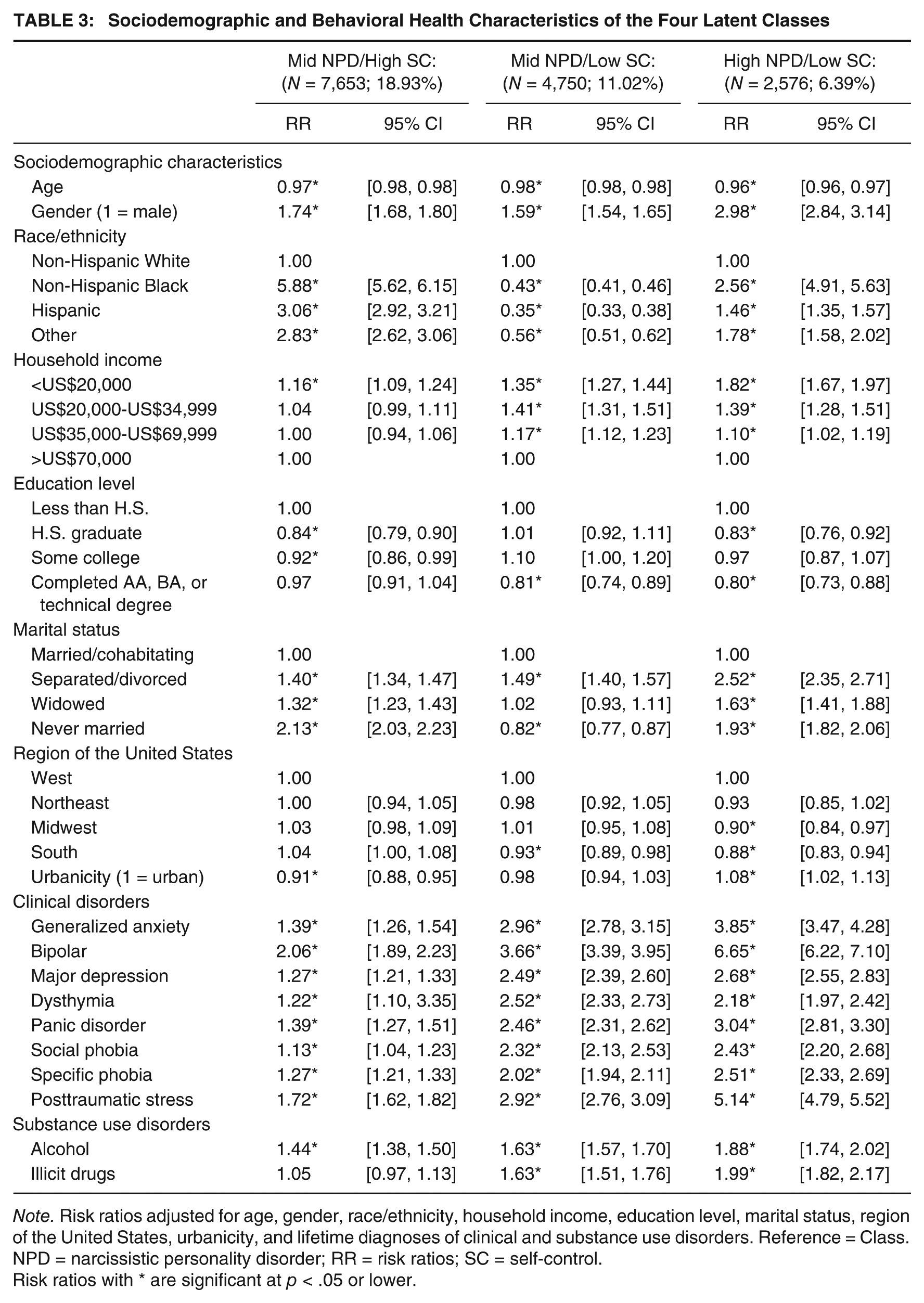
Note. Risk ratios adjusted for age, gender, race/ethnicity, household income, education level, marital status, region of the United States, urbanicity, and lifetime diagnoses of clinical and substance use disorders. Reference = Class. NPD = narcissistic personality disorder; RR = risk ratios; SC = self-control.
Risk ratios with * are significant at p < .05 or lower.
With respect to clinical and substance use disorders, a consistent pattern of associations was identified. Compared with the reference class, the three other classes were significantly more likely to meet criteria for all mood and anxiety disorders examined in this study. Moreover, with the exception of dysthymia, the effect sizes for this relationship were smallest for Mid NPD/High SC, incrementally larger for Mid NPD/Low SC, and the largest for High NPD/Low SC. For example, compared with the reference class, members of Mid NPD/High SC were roughly 2 times more likely to meet criteria for bipolar disorder, RR = 2.06, 95% CI = [1.89, 2.23]; these effects gradually increased for members of Mid NPD/Low SC, RR = 3.66, 95% CI = [3.39, 3.95], and High NPD/Low SC, RR = 6.65, 95% CI = [6.22, 7.10], who were roughly 3.5 and 6.5 times more likely to meet criteria for bipolar disorder, respectively. Notably, a highly similar pattern was observed for alcohol use and, with the exception of Mid NPD/High SC, illicit drug use disorders.
Violent Behavior and IPV Across the Latent Classes
Table 4 displays the associations between violent behavior, IPV, and membership in four latent classes. For all violent behaviors examined in this study, members of Mid NPD/Low SC and High NPD/Low SC were significantly more likely to report involvement in behaviors ranging from frequent fight starting to cruelty to animals. Notably, with the exception of having physically hurt another person on purpose or using a weapon in a fight, the observed effects were slightly smaller among members of Mid NPD/Low SC than among members of High NPD/Low SC. Significant associations among members of Mid NPD/High SC were also observed for four of the eight behaviors examined, including bullying, RR = 1.22, 95% CI = [1.14, 1.32]; cruelty to animals, RR = 1.48, 95% CI = [1.25, 1.75]; forced sexual intercourse, RR = 3.90, 95% CI = [2.61, 5.81]; and injuring another person, RR = 1.40, 95% CI = [1.30, 1.52]. In terms of IPV, a similar pattern was observed with effect sizes smallest among members of Mid NPD/High SC, slightly larger among members of Mid NPD/Low SC, and largest for members of High NPD/Low SC. More specifically, members of Mid NPD/High SC were significantly more likely to report having pushed, grabbed, or shoved, RR = 1.47, 95% CI = [1.30, 1.65], and slapped, kicked, bit, or hit, RR = 1.18, 95% CI = [1.01, 3.39], a spouse or partner. Members of Mid NPD/Low SC were also significantly more likely to have pushed, grabbed, or shoved, RR = 3.22, 95% CI = [2.97, 3.50]; slapped, kicked, bit, or hit, RR = 4.09, 95% CI = [3.63, 4.72]; and cut or bruised, RR = 2.34, 95% CI = [1.77, 3.11], a spouse or partner. Membership in High NPD/Low SC was significantly associated with the increased likelihood of involvement in all IPV behaviors examined in this study.
Violent Behavior Across the Four Latent Classes
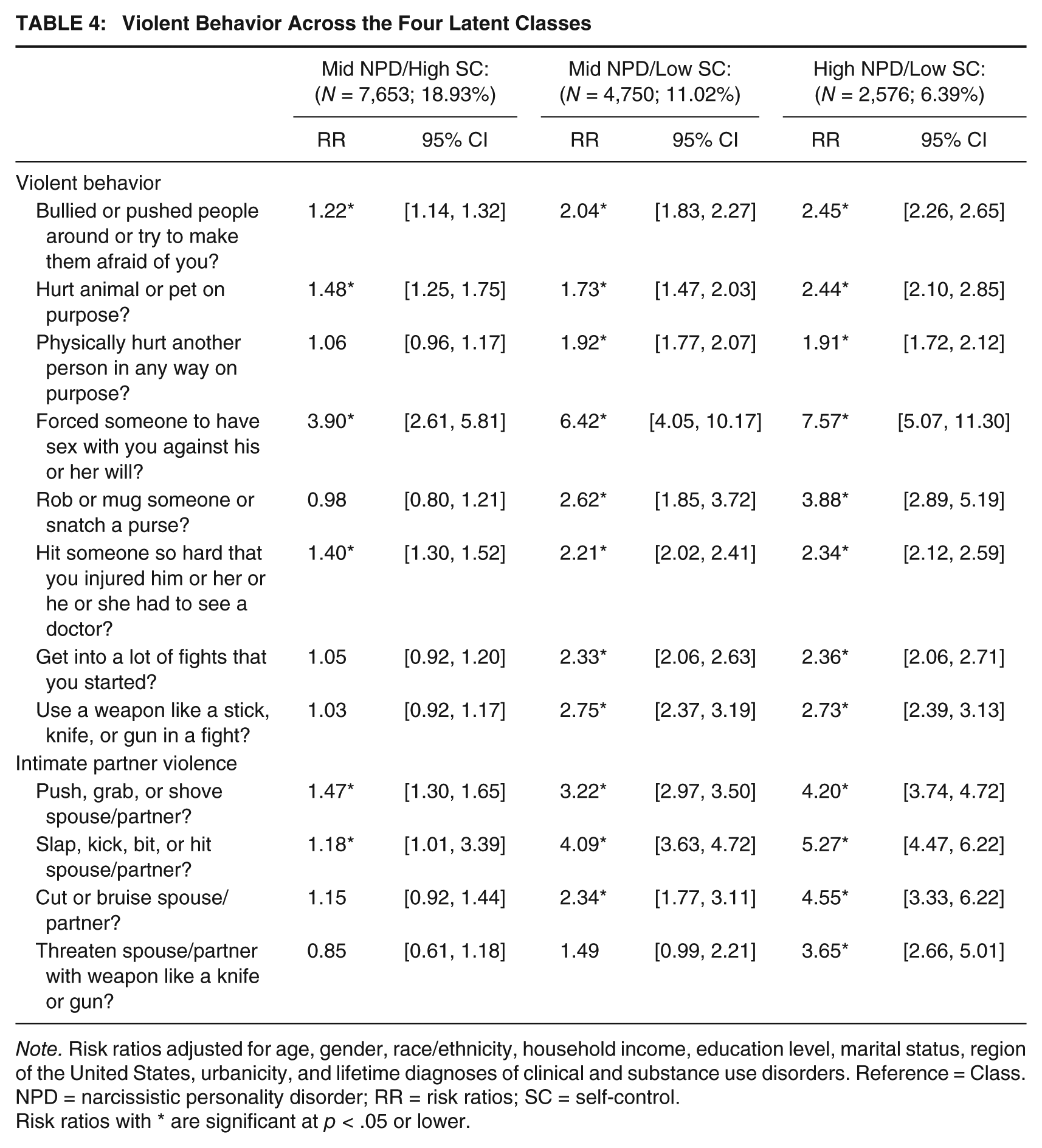
Note. Risk ratios adjusted for age, gender, race/ethnicity, household income, education level, marital status, region of the United States, urbanicity, and lifetime diagnoses of clinical and substance use disorders. Reference = Class. NPD = narcissistic personality disorder; RR = risk ratios; SC = self-control.
Risk ratios with * are significant at p < .05 or lower.
Discussion
Lingering questions about the role of low and high self-esteem in violence perpetration have been replaced in recent years by increasing attention to the role of narcissism (e.g., Bushman & Baumeister, 1998; Fossati, Borroni, Eisenberg, & Maffei, 2010; Miller et al., 2009; Twenge & Campbell, 2003). Importantly, however, almost all of what we know about this relationship has been derived by experimental designs (e.g., Bushman & Baumeister, 1998; Centifanti et al., 2013; Miller et al., 2009) and often neglects the importance of LSC to understanding the association (see, however, Centifanti et al., 2013; Miller et al., 2009; Vaughn et al., 2007; Vazire & Funder, 2006). The present investigation addresses these shortcomings and serves as the first study to use latent class analysis to examine the interplay of narcissism, LSC, and violence among a nationally representative sample.
We arrived at three primary findings in the present study. First, with only one exception, the class of individuals classified as high in narcissism and low in SC was far and away the most likely of the four classes to have engaged in an array of violent acts, a pattern that persisted even in light of an impressive array of covariates. Specifically, these individuals were at least twice as likely as their low narcissism, high SC counterparts to engage in every one of the violence items, and, most remarkably, were more than 7 times as likely to have forced someone to have sex against their will. Considered together, this finding suggests that the intersection of narcissism and low SC has dire behavioral implications, which is in line with the conclusions of Vazire and Funder’s (2006) recent meta-analysis. Second, the consequences of narcissism were observable even among the class of individuals who possessed (a) moderate levels of narcissism and high SC and (b) moderate levels of narcissism and poor SC. Thus, narcissism was associated with violence irrespective of LSC for a class of individuals, but its consequences were significantly more pronounced among the class who also suffered from low SC. In the end, this finding adds to the divergent conclusions offered by Vazire and Funder (2006) and Miller et al. (2009), and highlights the importance of future research in this domain.
The interplay of narcissism, low SC, and violence among the latent classes that were captured in this investigation are particularly meaningful because they are the first to offer such evidence from a nationally representative sample. That said, however, our findings should not come as much of a surprise. On their own, the independent effects of narcissism (e.g., Baumeister et al., 1996; Bushman et al., 2009) and low SC (e.g., Piquero, MacDonald, Dobrin, Daigle, & Cullen, 2005) on violence are well-established. Indeed, research has determined that narcissism, by itself, is strongly associated with information processing deficits, heightened attention and sensitivity to negative stimuli, and emotional dysregulation, which together increase the likelihood of violence (see Centifanti et al., 2013). With few exceptions, similar patterns emerge from research on LSC (Pratt & Cullen, 2000; Sellers, 1999). Yet, few studies have endeavored to assess the additive nature of narcissism and low SC and what they mean for the perpetration of violence. The blend of these specific risk factors is certain to be located within a unique temperamental disposition that is prone to violence (see DeLisi & Vaughn, 2014). Heightened attention to the biological and contextual influences that may help explicate the relationships established in this article offer a particularly fruitful avenue of inquiry for both developmental psychologists and criminologists interested in the perpetration of violence.
Despite the strengths of the nationally representative portrait offered by this article, there are a few limitations that deserve mention. First, we do not give any attention to differences between the established dimensions of narcissism (e.g., grandiose vs. vulnerable; see for example, Miller et al., 2011), which are bound to have an important bearing on conclusions centered on narcissism and violence perpetration. Despite the strength of our narcissism measure, it is not perfect and we caution the reader and future researchers to keep this in mind. Second, the lack of temporal ordering of the study’s variables hinders causal inferences about the relationship between violence and narcissism. Although our analyses control for a number of confounds, results should be considered associational rather than causal. Finally, important situational (e.g., precipitating events) and contextual (e.g., neighborhood) study variables that would have added greater depth to the analysis were not available in the NESARC.
In the end, these nationally representative findings highlight the range of violent behaviors that are found among individuals with different profiles of narcissism and low SC. In general, our results demonstrate that for one class of individuals, narcissism has a substantively meaningful relationship with violence among the general population, but that its behavioral consequences are greatest among the class of individuals who are also deficient in LSC. Future research in this area should aim to more fully explicate the associations identified here to more comprehensively understand the mechanisms that are most likely to bring the relationship to life. Moreover, now that this article has presented evidence indicating a particularly robust relationship between narcissism, low SC, and violence among a nationally representative, non-institutionalized sample, it is pertinent that future studies focus specifically on the role of threatened egotism to determine what role it plays on the nature of violence among individuals with varying degrees of narcissism and LSC (see Baumeister et al., 1996; Bushman & Baumeister, 1998).
Footnotes
Appendix
Indicator Variables Used in Latent Class Analysis
| Item | Survey Question |
|---|---|
| Narcissism | |
| Special talents | Have people often failed to appreciate your very special talents or accomplishments? |
| High opinion | Have people told you that you have too high an opinion of yourself? |
| Power and fame | Have you thought a lot about the power, fame, or recognition that will be yours someday? |
| Special treatment | Have you felt that you were the kind of person who deserves special treatment? |
| Perfect romance | Have you thought a lot about the perfect romance that will be yours someday? |
| Top person | When you have a problem, have you almost always insisted on seeing the top person? |
| Influential people | Have you felt it was important to spend time with people who are important or influential? |
| People’s admiration | Has it been very important to you that people pay attention to you or admire you in some way? |
| Others envious | Have you felt that others are often envious of you? |
| Envious of others | Have you often been envious of others? |
| Ignore rules | Have you thought that you could ignore certain rules or social conventions when they get in your way? |
| Step on toes | Have you often found it necessary to step on a few toes to get what you want? |
| Your needs | Have you often put your needs above other people’s? |
| What you say | Have you often expected other people to do what you ask without question because of who you are? |
| Others’ problems | Have other people’s problems or feelings failed to interest you? |
| Others’ feelings | Have people complained to you that you don’t listen to them or care about their feelings? |
| Worthy of attention | Have you found that there are very few people who are worth your time and attention? |
| Self-Control | |
| Often impulsive | Have you often done things impulsively? |
| Violent anger | Have you hit people or thrown things when you got angry? |
| Poor anger control | Have even little things made you angry or have you had difficulty controlling your anger? |
| Temper outbursts | Have you often had temper outbursts or gotten so angry that you lose control? |

Acknowledgements
The authors would like to thank the three anonymous reviewers for their helpful suggestions on the previous version of this article.