



Abstract
Risk and protective factors for antisocial behavior may operate differently for youth with versus without psychopathic traits. No prior studies address positive parenting in youth with a clinical measure of psychopathic traits. This study tested whether psychopathic traits reduce responsiveness to parental warmth in terms of conduct problems, substance use, and risky sexual behavior and the alternative perspective that psychopathic traits reduce responsiveness to harsh parenting, but not responsiveness to nurturance among 214 ethnically diverse male and female adolescent detainees. Multiple regression indicated that, for adolescents with low and medium levels of affective traits—but not adolescents with high levels of these traits—higher levels of warmth were associated with marginally fewer conduct disorder symptoms and with lower levels of substance use. Similarly, the association between warmth and substance use was stronger in youth with lower levels than for youth with high levels of overall psychopathy.
Antisocial and high-risk behaviors in adolescents can be conceptualized as actions that negatively affect the individual and others, and that have an adverse impact on society as a whole. Psychopathy refers to a syndrome of personality pathology defined by a pattern of interpersonal, affective, and behavioral characteristics that include interpersonal manipulation, callous disregard for the rights of others, stimulation seeking, poor anger control, and impulsive and antisocial behaviors (Campbell, Porter, & Santor, 2004; Neumann & Hare, 2008; Vitacco, 2007). Substantial research suggests that youth with callous-unemotional (CU; i.e., lack of guilt, absence of empathy, constricted emotional range) and other psychopathic traits constitute a distinct group of youth who exhibit severe and stable patterns of conduct problems as well as a variety of other high-risk behaviors, including risky sexual behavior, substance misuse, and other forms of stimulation seeking (for example, see Frick, Ray, Thornton, & Kahn, 2014).
Research on child development highlights the importance of understanding relationships between parenting practices and personality traits relevant to the development of antisocial and other high-risk behaviors in adolescents (Kochanska, Barry, Aksan, & Boldt, 2008; Kotchick, Dorsey, Miller, & Forehand, 1999; Luyckx et al., 2011). Factors such as parental permissiveness, harsh and inconsistent discipline, and low levels of parental supervision have all been associated with high levels of conduct problems, high-risk sexual behavior, and illicit substance use (Donenberg, Wilson, Emerson, & Bryant, 2002; Luyckx et al., 2011; Patterson, DeBaryshe, & Ramsey, 1989). However, some research suggests that relationships between parenting practices and conduct problems depend on the extent to which children exhibit CU traits. For example, Wootton, Frick, Shelton, and Silverthorn (1997) reported poor parenting was a risk factor for conduct problems in children without CU traits, but quality of parenting was less important for adolescents with high levels of CU traits—these adolescents showed a significant number of conduct problems regardless of the quality of parenting. Several other studies have also shown that harsh and inconsistent parenting was predictive of children’s behavioral problems, but only for adolescents with low levels of CU traits (Edens, Skopp, & Cahill, 2008; Oxford, Cavell, & Hughes, 2003; Pasalich, Dadds, Hawes, & Brennan, 2011). This study was designed to address several gaps in the literature examining the impact of parental warmth on the behaviors associated with psychopathic traits in youth.
Although it is frequently suggested that psychopathic traits, like many other forms of psychopathology, reflect interactions between genetic diatheses and environmental factors (e.g., Viding & McCrory, 2012), findings that point to reduced impact of parental behaviors may be interpreted as suggesting that parental factors may not contribute substantially to the initial development of psychopathic traits (e.g., Blair, Peschardt, Budhani, Mitchell, & Pine, 2006). One explanation for the reduced impact of parental factors is that youth who are born with a relative fearless temperament or an unemotional temperament are less responsive to parental punishment than other children, less likely to bond or attach with parental figures, less likely to internalize parental behavior standards, and less likely to feel empathy for other children (Blair et al., 2006; Frick & White, 2008).
In contrast, several researchers have argued that youth with CU traits are responsive to a mutually responsive mother–child relationship (also referred to as reward-based parenting) and may also benefit from parental nurturance (e.g., Kochanska, 1997). Parental warmth has been defined as parental expressions of love and acceptance. Positive parenting components, such as high levels of warmth in the parent–child dyad, maternal responsiveness, and open communication reportedly protect against the development of antisocial and high-risk behaviors in adolescents (Kochanska et al., 2008; Kotchick et al., 1999). Moreover, Kochanska and Aksan (2006) reviewed longitudinal evidence that maternal responsiveness and attachment security were associated with stronger conscience development in children rated relatively fearless. This research suggests that youth with CU traits might be normally or even abnormally responsive to parental warmth even if they are relatively unresponsive to parental harshness or discipline. Pasalich et al. (2011) reported that youth with high levels of CU traits were less responsive than youth with low levels of CU traits to the harmful effects of parental harshness. However, youth with high levels of CU traits were more responsive than youth with low levels of CU traits to parental warmth. Parental warmth was associated with lower levels of conduct problems in boys with high and medium levels of CU traits, but not in boys with low levels of these affective traits of psychopathy. Similarly, Hampton, Hynes, Yeh, and Kosson (2015) reported that higher levels of subjective attachment to parents were associated with lower numbers of official charges for criminal conduct among youth with higher levels of psychopathic traits. Studies such as these suggest that higher levels of parental warmth may be more strongly associated with lower levels of antisocial behavior in children high in the core affective features of psychopathy. However, very few studies have examined the impact of positive parenting, such as warmth, on youth with different levels of psychopathic traits and no prior studies have examined this issue using a clinical measure of psychopathic traits. Therefore, the current study was designed to address this issue.
Other research has suggested the possibility that the impact of parental behavior may depend on the component of psychopathic traits that is being investigated. In particular, whereas the affective component of psychopathy has often been linked to reduced responsiveness to parental behavior (with the exception of Pasalich et al., as noted above), other components of psychopathy may be responsive to parental behavior. In particular, Edens et al. (2008) reported that higher levels of harsh and inconsistent discipline predicted increased antisocial conduct for adolescents high in the interpersonal facet of psychopathy when compared with adolescents who scored low in the interpersonal domain. Similarly, Vitacco, Neumann, Ramos, and Roberts (2003) reported that, among a sample of Hispanic youth, parental behaviors were unrelated to scores on the affective features of psychopathy, but were related to ratings on the interpersonal/narcissism and impulsive lifestyle components of psychopathy. Although both the interpersonal and affective components are often considered core personality components that are more specific to psychopathy than the lifestyle and antisocial components of the syndrome, these studies raise the possibility that the interpersonal features of psychopathy may be more responsive to environmental influences than the affective features. When viewed holistically, these findings highlight the importance of not only considering psychopathic traits as a whole but also examining the separate dimensions of psychopathy when looking at the moderating role of psychopathic traits in the development of antisocial and high-risk behaviors. A second aim of the current study was to examine whether the impact of parental warmth differed for youth at different levels of the interpersonal or the affective component. In addition, because no prior studies of parenting and psychopathy have examined whether overall levels of psychopathic traits moderate the impact of parenting factors, another purpose of the present study was to examine the potential moderating effects of overall levels of psychopathic traits on the relationship between parental warmth and antisocial behavior.
A third major aim of the current study was to examine whether the commonly reported findings for reduced responsiveness to parenting behaviors of youth with psychopathic traits and the increased responsiveness to parenting behaviors (sometimes reported) generalize to other kinds of risky and potentially harmful behaviors associated with psychopathy. Prior studies of this topic have focused exclusively on the criterion of conduct problems. To demonstrate that these other kinds of risky behaviors are also associated with psychopathic traits, we briefly review relationships between psychopathic traits and substance use and risky sexual behavior.
Psychopathy and Other High-Risk Behaviors
Both high-risk sexual behavior and substance use are maladaptive behaviors associated with psychopathic traits among adolescents. In fact, the psychopathy construct, as measured in the Psychopathy Checklist: Youth Version (PCL:YV), includes impersonal sexual behavior as a characteristic of the construct in adolescents (Forth, Kosson, & Hare, 2003). Although few studies have addressed sexual behavior in youth samples, studies among adults have indicated moderate relationships between psychopathic traits and behaviors ranging from promiscuity to behaviors that increase risk of spreading HIV (e.g., Benotsch et al., 2012; Fulton, Marcus, & Payne, 2010; Kastner & Sellbom, 2012). Similarly, the two studies we found addressing this issue in a youth sample reported that adolescents high in psychopathic traits were more likely to have unprotected sex and showed little change or intention to change unsafe sexual behaviors (Malow et al., 2007; Ručević, 2010).
Although several studies have found moderate to high correlations between alcohol and other drug use and psychopathic traits, as measured using the PCL:YV, in adolescent offenders (Bauer, Whitman, & Kosson, 2011; Epstein, Douglas, Polythress, Spain, & Falkenbach, 2002; Hemphala & Tengstrom, 2010; Mailloux, Forth, & Kroner, 1997; Toupin, Mercier, Déry, Côté, & Hodgins, 1996), not all studies are consistent. The two studies that did not find significant correlations between psychopathic traits and substance use in adolescents (Campbell et al., 2004; O’Neill, Lidz, & Heilbrun, 2003) were characterized by methodological features likely to reduce their power for observing such relationships. 1
At the time of writing, we know of no study that focuses on the interaction of parental factors and psychopathic traits to predict high-risk sexual behavior and substance use. Nevertheless, the evidence of significant relationships between warmth and both high-risk sexual behavior and substance use (e.g., Shelton et al., 2007) and between psychopathic traits and these high-risk behaviors suggests the utility of examining whether warmth interacts with psychopathic traits to predict substance use and high-risk sexual behavior. The current study aimed to address several additional important public health behaviors associated with the psychopathy construct. First, because some studies have suggested that youth with psychopathic traits are more responsive than youth without such traits to parental warmth, we examined whether levels of psychopathic traits were associated with increased impact of parental warmth on involvement in antisocial behavior. Although one prior study suggests that levels of parental warmth are protective only for girls with low levels of CU traits, but not girls with high levels of CU traits (Hipwell et al., 2007), this is also the only prior study of the topic with female adolescents, and it does not directly contradict the findings of responsiveness to warmth for male youth with psychopathic traits. However, Hipwell et al. raise the possibility that CU traits may be associated with a reduced association between parental warmth and conduct problems.
In addition, previous research addressing Psychopathy × Parenting interactions have focused exclusively on adolescent conduct problems (Edens et al., 2008; Oxford et al., 2003) or externalizing symptoms (Pasalich et al., 2011; Wootton et al., 1997). However, psychopathic traits are not only predictive of such externalizing behavior but are also predictive of a variety of risky and damaging behaviors that create difficulties for the individuals with those traits and for others, including high-risk sexual behavior (Malow et al., 2007; Malow, Dévieux, Rosenberg, Samuels, & Jean-Gilles, 2006) and substance use (Hemphala & Tengstrom, 2010; Mailloux et al., 1997). Therefore, in addition to assessing conduct disorder symptoms, the present study included measures of high-risk sexual behavior and substance use.
Third, some studies suggest differential effects for the affective features versus the interpersonal features of psychopathy. However, most studies have only examined individual differences in affective features of psychopathy. Therefore, we conducted separate analyses for the affective and the interpersonal features of psychopathy as well as analyses for overall levels of psychopathic traits.
Finally, at the suggestion of an anonymous reviewer, we also report analyses addressing whether any significant differences in the impact of parental warmth that are identified in this study are dependent on the age of the adolescents in our sample.
The Current Study
The chief aim of this study was to examine the impact of warmth on youth with different levels of psychopathic traits using a clinical measure of psychopathy. A second aim of the current study was to examine whether the impact of parental warmth differed for youth at different levels of the interpersonal or the affective components of psychopathy. A third major aim of the current study was to examine whether the commonly reported findings for reduced responsiveness to parenting behaviors of youth with psychopathic traits and the increased responsiveness to parenting behaviors (sometimes reported) generalize to other kinds of risky and potentially harmful behaviors associated with psychopathy such as high-risk sexual behavior and substance use. 2
Method
Participants
In accordance with procedures approved by the Rosalind Franklin University of Medicine and Science Institutional Review Board, potential participants and a parent or guardian were approached during visitation hours at a suburban juvenile detention center near Chicago, Illinois, informed about research procedures, and invited to participate in the study. To be eligible for participation, adolescents were required to understand English. Both parent/guardian informed consent and participant assent were required for adolescents to participate in the study. Participants were compensated $39 USD for their participation in the study.
Participants were 183 male and 31 female (N = 214) adolescents ranging from 11 to 17 years of age (M = 15.37, SD = 1.11). The sample was ethnically diverse and consisted predominantly of participants of European American (30.4%), African American (27.6%), and Latin American (33.6%) descent. A small number of participants (8.4%) identified themselves as biracial or multiracial, or declined to report their ethnicity.
Assessments and Measures
Psychopathic Traits and Conduct Disorder (CD) Symptoms
The PCL:YV is an expert-rater measure, and PCL:YV scores provide reliable and valid indices of psychopathic traits in adolescents (Forth et al., 2003; Hare & Neumann, 2009). It is based on the Psychopathy Checklist Revised (PCL-R), but with modifications to item descriptions and scoring procedures to reflect adolescent norms and the different contexts in which adolescents function. To assess for the presence of psychopathic traits, an expert-trained interviewer utilizes information gathered during an extensive clinical interview, behavioral observations, and a review of collateral (institutional file) information. The 20 items of the PCL:YV are rated 0 (consistently absent), 1 (sometimes present), or 2 (consistently present). The item scores are then summed and pro-rated if any items are omitted, to obtain a total score. Full scale PCL:YV scores range from 0 to 40, with higher PCL:YV scores indicative of higher levels of psychopathic traits (Forth et al., 2003). Overall PCL:YV ratings and ratings on the four facets (Kosson et al., 2013; Neumann, Kosson, Forth, & Hare, 2006) exhibited acceptable internal consistencies (α = .83 for total scores, αs = .60 to .73 for facet scores) as well as good inter-rater agreement (intraclass correlation coefficient [ICC] = .94 for total scores, ICC = .70 to .85 for facet scores) in this sample.
The same interview used to assess psychopathic traits included questions assessing CD symptoms as listed in the Diagnostic and Statistical Manual of Mental Disorders (4th ed., text rev.; DSM-IV-TR; American Psychiatric Association [APA], 2000). The total number of CD symptoms met ranged from 0 to 15. Symptom criterion scales have been used in previous studies (Frick et al., 1994; Kosson, Cyterski, Steuerwald, Neumann, & Walker-Matthews, 2002) and characterized by high positive predictive power in the Diagnostic and Statistical Manual of Mental Disorders (4th ed.; DSM-IV; APA, 1994) field trials for the disruptive behavior disorders (Frick et al., 1994).
Parental Warmth
Adolescent-reported parental warmth was assessed by interview questions adapted from the Multidimensional Inventory of Development, Sex, and Aggression (MIDSA) Caregiver Relationship Scales (Augur Enterprises, 2011). Participants were informed that the researchers wanted to know about different types of events that may have happened during childhood with respect to their parent or caregiver. The warmth scale consists of eight items addressing the frequency with which a parent expressed love, affection, and support. Answers are coded on a 5-point Likert-type scale ranging from “never” to “very often” with scores ranging from 0 to 32 where higher scores indicate higher levels of parental warmth (M = 24.47, SD = 6.46). In the MIDSA standardization sample, Caregiver Relationship Scale scores had good internal consistencies for juveniles (αs = .90 to .94; Augur Enterprises, 2011). Participants responded with regard to the behavior of at least one of their parents or caregivers. In the current sample, parental warmth scores had acceptable internal consistency (α = .87). In a separate study, the internal consistency of scores on the parental warmth scale was acceptable (α = .85, M inter-item r = .44) with corrected item-to-total correlations ranging from .34 to .70 (Schraft et al., 2015).
High-Risk Sexual Behavior
High-risk sexual behavior was assessed using the AIDS Risk Behavior Assessment (ARBA), a questionnaire assessing self-reported sexual behavior and drug/alcohol use (Donenberg, Emerson, Bryant, Wilson, & Weber-Shifrin, 2001; Teplin et al., 2005). Responses to items on the ARBA addressing the number of vaginal, anal, and oral sex partners and frequency of condom use during vaginal intercourse were used to score the Unsafe Sex Scale (USS), a scale developed by Centers for Disease Control researchers (Kotchick et al., 1999), as follows: no sexual activity (0), one sexual partner and consistent condom use (1), sex with multiple partners and consistent condom use (2), one sexual partner with inconsistent condom use (3), and sex with multiple partners with inconsistent condom use (4). Adolescents were asked about the number of sexual partners and the frequency of condom use, but were not asked whether they engaged in heterosexual or homosexual activity.
Substance Use
Based on Donenberg et al. (2001), a drug/alcohol use composite score was used to evaluate substance use. The composite score was created by summing the number of different types of substances (including alcohol) utilized in the past 6 months and assigning an additional point for injecting or booting a drug (i.e., injecting a drug partially into a vein, then withdrawing blood into a syringe before reinjection). Higher drug/alcohol use composite scores indicate use of a greater number of different substances (M = 1.71, SD = 1.82). Similar measures include the number of drugs reportedly used by adolescents and are considered to have good validity (Forth et al., 2003). To examine whether any observed relationships were evident with simpler measures of drug use, analyses were repeated with lifetime measures of alcohol and marijuana, the two substances for which participants reported the highest rates of use. 3
Results
Descriptive Statistics and Bivariate Relationships
Descriptive statistics for predictor and criterion variables are presented in Table 1. Significant skewness in substance abuse scores was corrected via square root transformation. Bivariate relationships between demographic variables and predictor and criterion variables are presented in Table 2.
Descriptive Statistics for Variables used in Primary Analyses

Note. INT = Psychopathy Checklist: Youth Version (PCL:YV) interpersonal facet score; AFF = PCL:YV affective facet score; PCL:YV Total = PCL:YV total score; CD symptoms = total number of conduct disorder symptoms; Unsafe sex = a measure of high-risk sexual behavior.
Correlations Between Study Variables and Demographic Variables
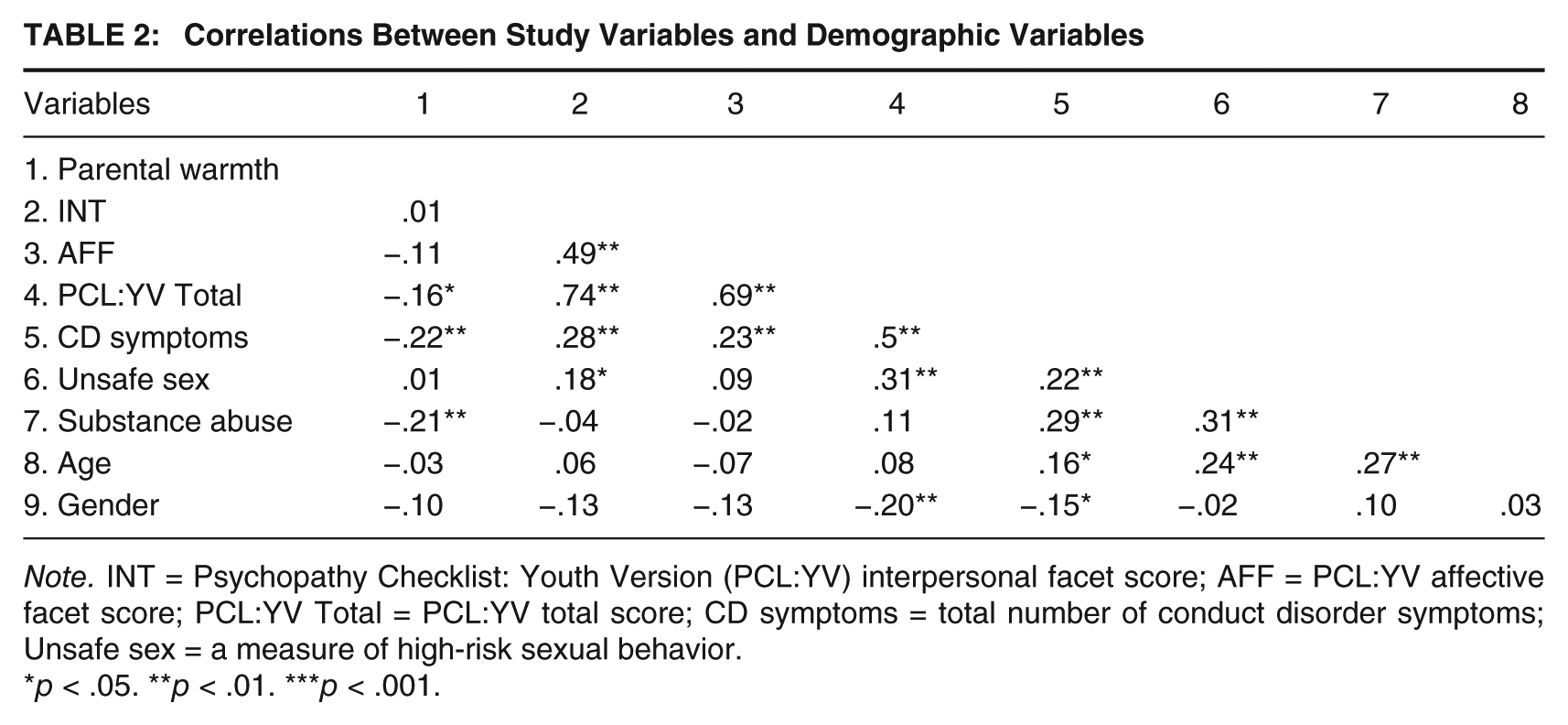
Note. INT = Psychopathy Checklist: Youth Version (PCL:YV) interpersonal facet score; AFF = PCL:YV affective facet score; PCL:YV Total = PCL:YV total score; CD symptoms = total number of conduct disorder symptoms; Unsafe sex = a measure of high-risk sexual behavior.
p < .05. **p < .01. ***p < .001.
Primary Analyses
Overview of Analytic Approach
To assess the effects of each potential moderator on associations between warmth and indices of maladaptive behavior (Baron & Kenny, 1986), we conducted separate hierarchical multiple regressions involving the predictor variable, warmth, for each criterion variable (i.e., conduct disorder symptoms, high-risk sexual behavior, and substance use), and for each potential moderator (interpersonal, affective, and overall traits of psychopathy). All predictor and moderator variables were centered to increase interpretability and reduce likelihood of multicollinearity (Aiken & West, 1991; Jaccard & Turrisi, 2003).
Simple slopes analyses examined significant interactions (Aiken & West, 1991) based on moderator terms one standard deviation above, below, and at the mean for each predictor variable. Regression coefficients were examined to determine levels of the moderator at which the slope of the regression line was significantly different from zero (Cohen, Cohen, West, & Aiken, 2003).
Warmth and conduct disorder symptoms
As presented in Table 3, regression analyses indicated that warmth (β = −.23, p = .002) and interpersonal traits of psychopathy (β = .30, p < .001) explained 13.8% of the variance in CD symptoms, F(2, 171) = 13.65, p < .001. However, interpersonal traits of psychopathy did not moderate the relationship between warmth and CD symptoms, ΔF(1, 170) = 1.38, p = .24, ΔR2 = .007.
Regression Analyses Testing for Moderation of Associations Between Warmth and Indices of Maladaptive Behavior
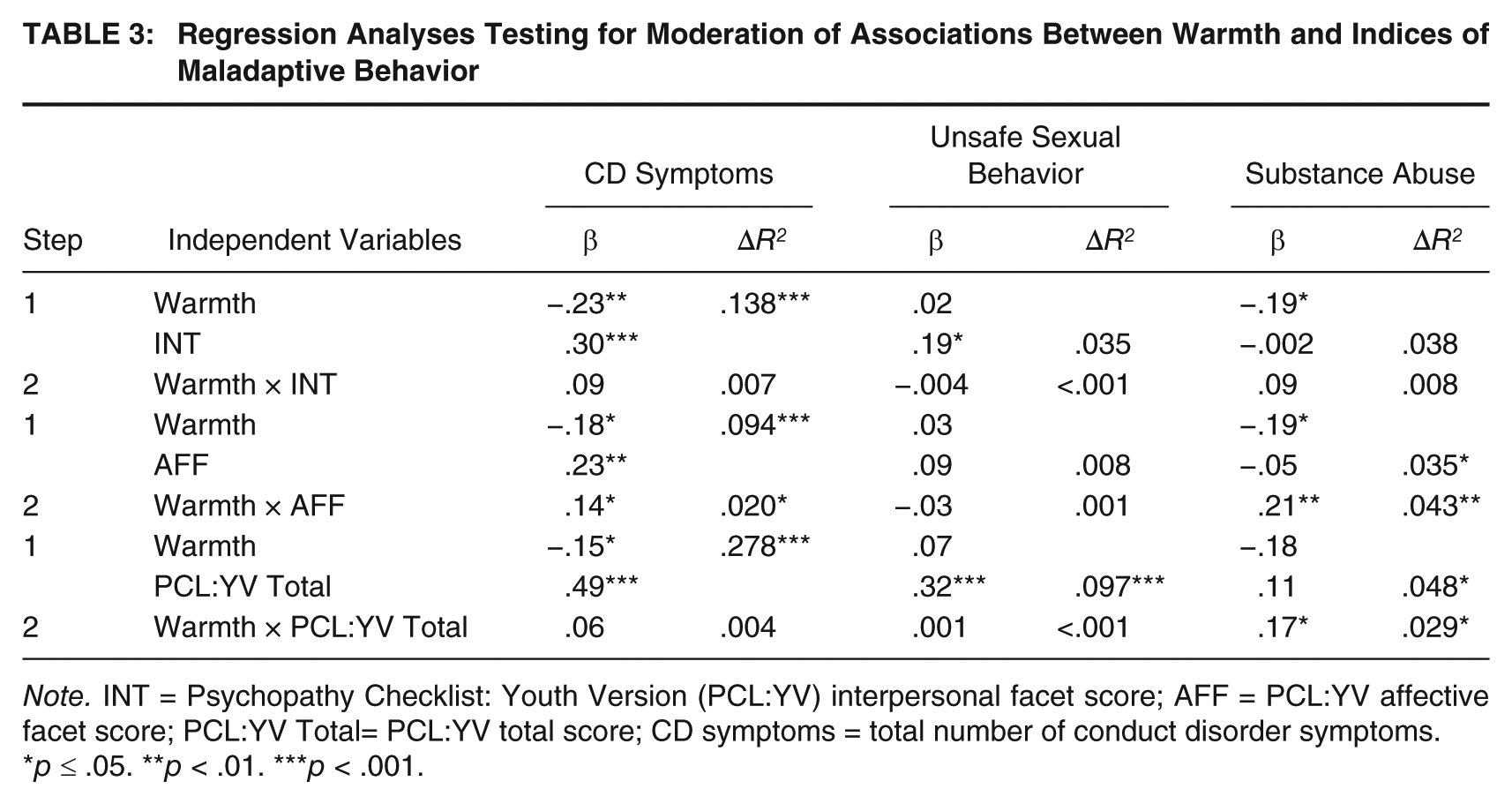
Note. INT = Psychopathy Checklist: Youth Version (PCL:YV) interpersonal facet score; AFF = PCL:YV affective facet score; PCL:YV Total= PCL:YV total score; CD symptoms = total number of conduct disorder symptoms.
p ≤ .05. **p < .01. ***p < .001.
In contrast, affective traits of psychopathy moderated the relationship between warmth and CD symptoms. Together, warmth (β = −.18, p = .02) and the affective traits of psychopathy (β = .23, p = .002) explained 9.4% of the variance in the criterion variable, F(2, 168) = 8.68, p < .001. The interaction of warmth and affective traits was marginally significant (β = .14, p = .05), explaining an additional 2% of the variance, ΔF(1, 167) = 3.86, ΔR2 = .020 (see Table 3). Simple slope analyses showed that negative relationships between warmth and CD symptoms were significant at low and medium levels (β = −.35, p = .002; β = −.19, p = .009; respectively), but not at high levels of affective traits (β = −.04, p = .73; see Figure 1).
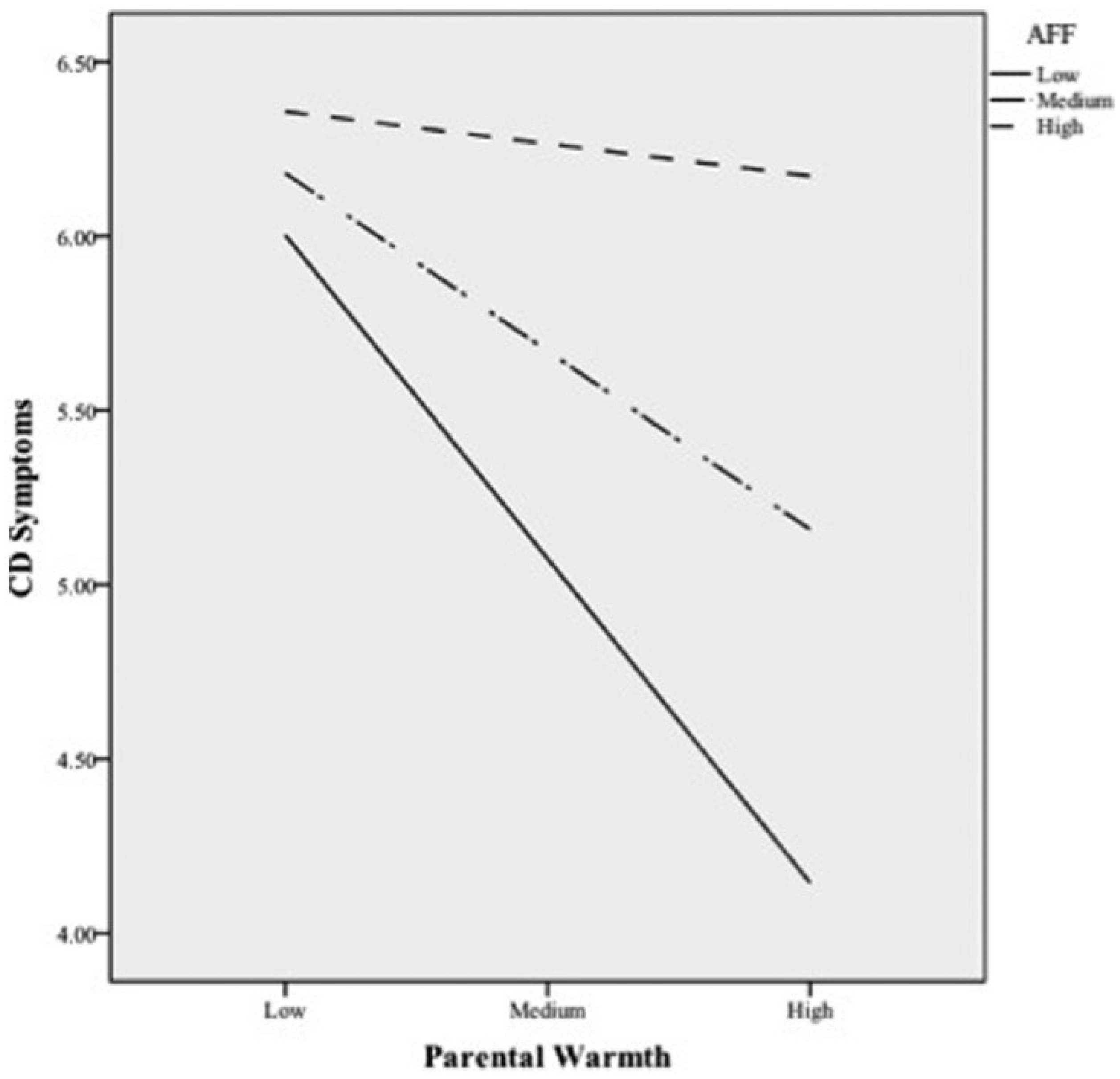
Simple Slopes of the Associations Between Parental Warmth and Conduct Disorder Symptoms Low, Medium, and High Levels of Affective Traits
Overall levels of psychopathic traits did not moderate the association between warmth and CD symptoms. Although both warmth (β = .15, p = .02) and PCL:YV total scores (β = .49, p < .001) predicted CD symptoms and explained 27.8% of the variance observed, the Warmth × PCL:YV interaction did not improve the model, ΔF(1, 170) = .84, p = .36, ΔR2 = .004, β = .06.
Warmth and unsafe sexual behavior
Results of regression analyses demonstrated that neither levels of interpersonal or affective components of psychopathy nor overall levels of psychopathic traits moderated the relationship between warmth and unsafe sexual behavior. Although interpersonal traits of psychopathy explained 3.5% of the variance in unsafe sexual behavior (β = .19, p = .02), neither warmth (β = .02, p = .80) nor the interaction of this component of psychopathy with warmth improved the model, ΔF(1, 151) = 0.003, p = .96, ΔR2 < .001, β = −.004. There were no significant main effects for affective features of psychopathy (β = .09, p = .29) or warmth (β = .03, p = .76), and their interaction was likewise not significant, ΔF(1, 148) = 0.17, p = .68, ΔR2 = .001, β = −.03 (see Table 3 for statistics). Although PCL:YV total scores (β = .32, p < .001) explained 9.7% of the variance in unsafe sexual behavior, F(2, 152) = 8.13, p < .001, the product of Warmth × PCL:YV scores did not explain additional variance in unsafe sex, ΔF(1, 151) ≤ .001, p = .99, ΔR < .001, β = .001.
Warmth and illicit substance use
Both affective and overall traits of psychopathy moderated relationships between warmth and substance abuse. In all three models, only the main effects for warmth were significant (β = −.19, p = .01; β = −.19, p = .02; β = −.18, p = .02; respectively; see Table 3) with Step 1 predictors explaining 3.8% to 4.8% of the variance (Fs = 3.04 to 4.42, all ps < .05) in scores on the composite substance/alcohol use index. Although the Warmth × Interpersonal facet interaction was not significant, the Warmth × Affective facet interaction (β = .21, p = .005) and the Warmth × PCL:YV total score interaction (β = .17, p = .02) explained an additional 4.3% and 2.9% of the variance, ΔF(1, 170) = 8, p = .005; ΔF(1, 173) = 5.49, p = .02, respectively.
Simple slopes analyses showed that there was a significant relationship between greater warmth and lower levels of substance abuse at low (β = −0.44, p < .001) and at medium levels of the affective traits of psychopathy (β = −.21, p = .006), but not at high levels of the affective traits (β = .02, p = .87; see Figure 2). Similarly, there was a significant relationship between higher levels of warmth and lower levels of substance abuse at low (β = −.38, p = .001) and medium levels of overall psychopathic traits (β = −.20, p = .008), but not at high levels (β = −.02, p = .85; see Figure 3).
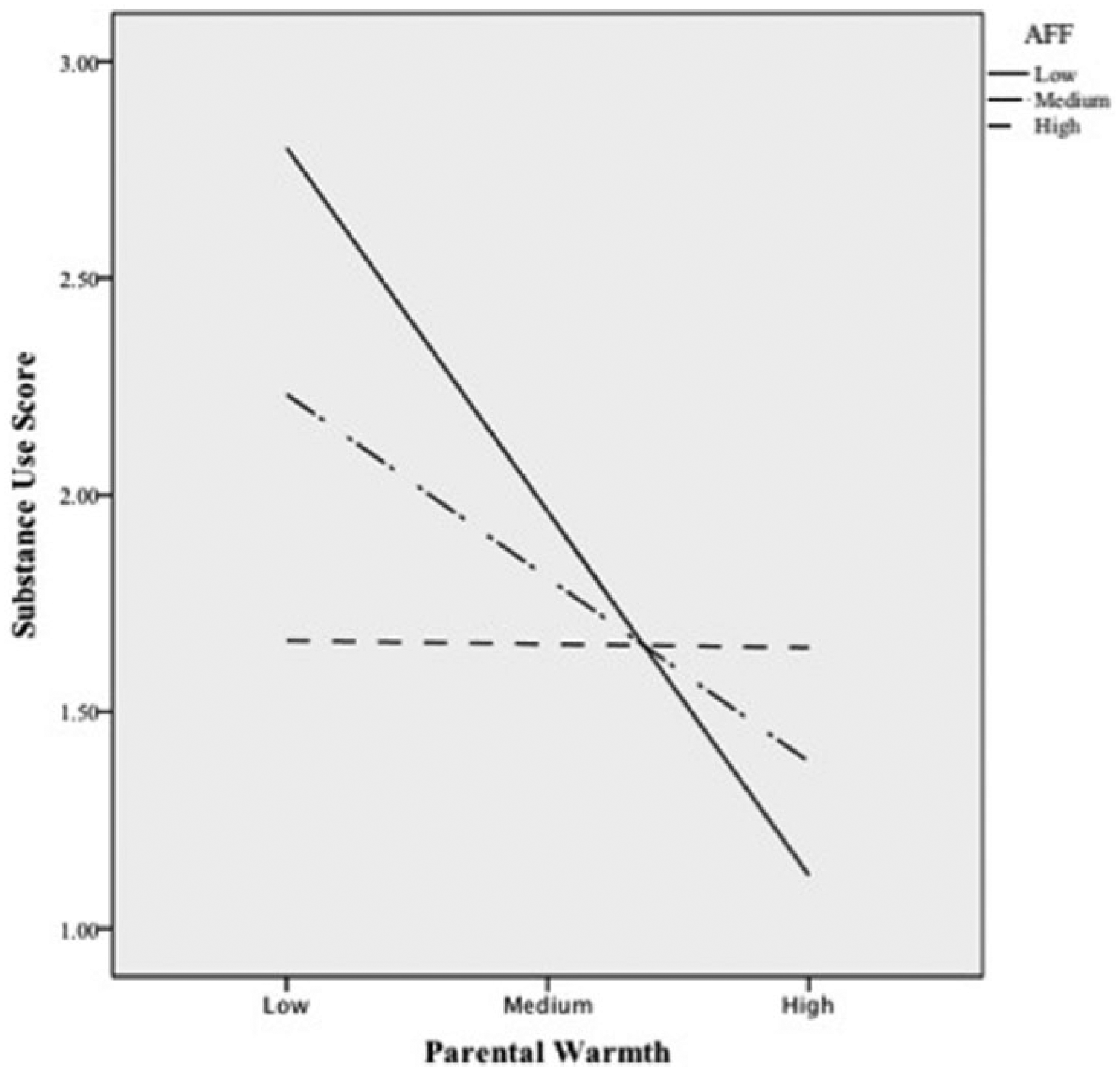
Simple Slopes of the Associations Between Parental Warmth and Substance Use at Low, Medium, and High Levels of Affective Traits
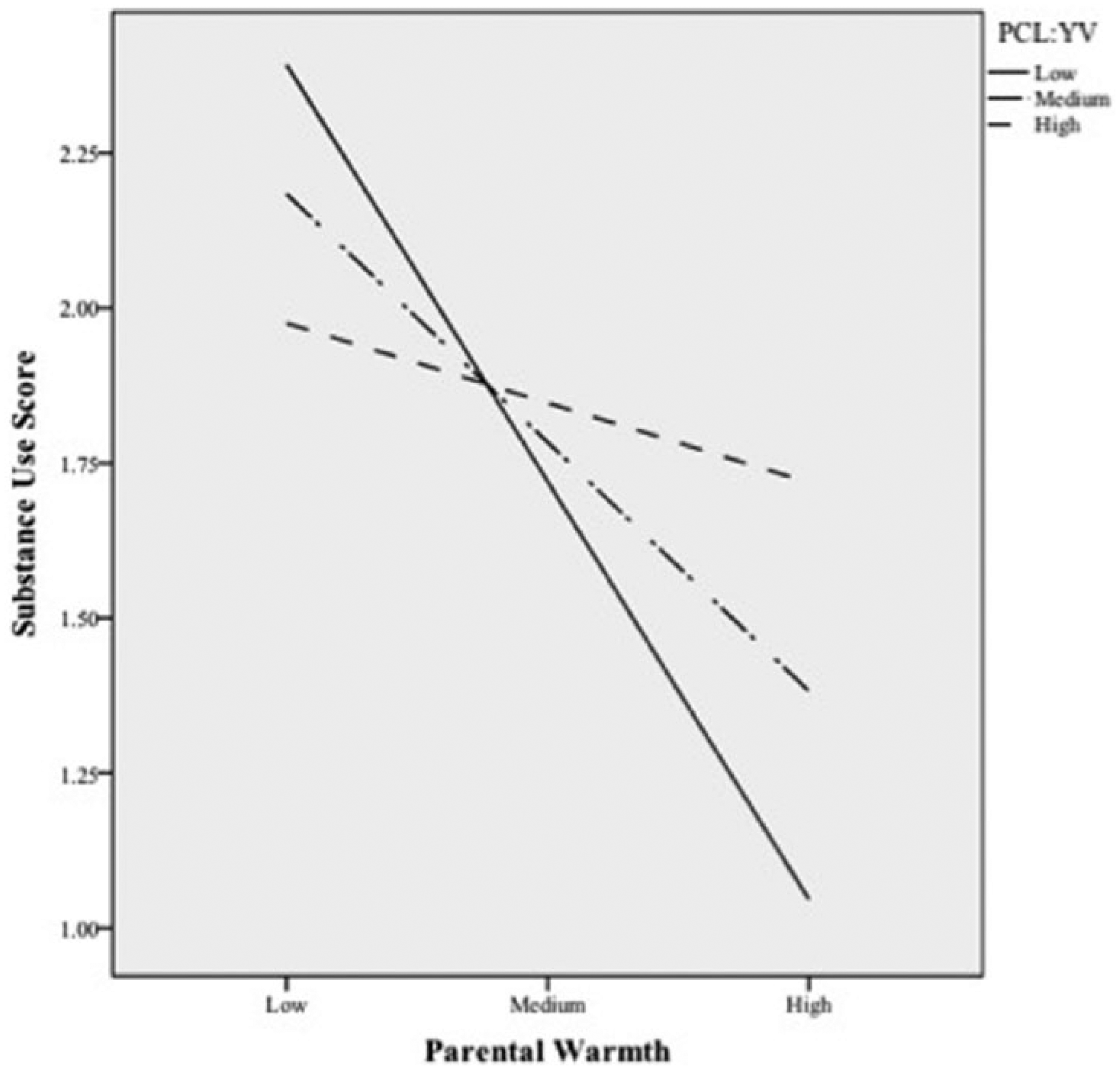
Simple Slopes of the Associations Between Parental Warmth and Substance Use at Low, Medium, and High Levels of PCL:YV Total Scores
When analyses were repeated with lifetime measures of alcohol and marijuana, results were similar, indicating significant Warmth × Affective facet interactions for lifetime alcohol and marijuana use. The Warmth × Interpersonal facet interaction and the Warmth × PCL:YV total score interactions were not significant (see Note 3 for details).
Supplementary Analyses
At the suggestion of an anonymous reviewer, we conducted supplementary analyses to examine whether the Psychopathic Traits × Warmth interactions reported above were specific to younger versus older youth by using the median age, 15.7 years, for this sample to identify younger and older subsamples.
Analyses with the younger sample, participants 15.7 years of age or lower, revealed that the Warmth × Affective traits interaction was still marginally significant (β = .22, p = .05), explaining an additional 4.2% of the variance in conduct disorder symptoms, ΔF(1, 85) = 3.94. For the older subsample, the interaction was not significant (β = .04, p = .68) and explained only an additional .02% of the variance, ΔF(1, 77) = .17, in the conduct disorder symptoms.
However, with respect to substance abuse criteria, both affective and overall traits of psychopathy moderated relationships between warmth and substance abuse only in the regression analyses involving the older part of the sample. For the younger half of the sample, neither the Warmth × Affective traits interaction (β = .08, p = .46) nor the Warmth × PCL:YV total score interaction (β = .13, p = .21) explained significant variance in substance use scores, ΔR2 = .006, ΔF(1, 87) = .54, p = .46; ΔR2 = .017, ΔF(1, 88) = 1.61, p = .21, respectively. In contrast, for the older subsample, both affective and overall traits of psychopathy moderated relationships between warmth and substance use. The Warmth × Affective traits interaction (β = .28, p = .01) explained an additional 7.5% of the variance, ΔF(1, 78) = 6.95, p = .01. The Warmth × PCL:YV total score interaction explained 4.2% of the variance and was marginally significant, β = .21; ΔF(1, 80) = 3.91, p = .05.
Discussion
Consistent with prior studies (e.g., Malow et al., 2007; O’Neill et al., 2003), psychopathic traits were associated with a variety of negative behaviors that are recognized as public health problems: risky sexual behavior, substance use, and conduct problems. Although parental warmth was associated with fewer conduct disorder symptoms and lower levels of substance use, these associations with warmth were largely not significant for adolescents with high levels of psychopathic traits.
In addition, the impact of psychopathic traits varied by psychopathy component and by index of maladaptive behavior. The Warmth × Psychopathic traits interactions indicated that, for adolescents with low and moderate levels of psychopathic traits, higher levels of warmth were associated with lower levels of conduct disorder symptoms and substance use; for adolescents with higher levels of psychopathic traits, warmth was not associated with lower levels of conduct disorder symptoms or substance use. These findings provide evidence consistent with the majority of prior studies in this area (Frick & Marsee, 2006; Oxford et al., 2003; Wootton et al., 1997). They add to our knowledge in showing that not only negative aspects of parenting (e.g., harshness and inconsistency, physical abuse), but also positive aspects of parenting may be less influential in accounting for some of the maladaptive behaviors associated with psychopathic traits.
Conversely, psychopathic traits did not moderate relationships between warmth and scores on the measure of high-risk sexual behavior. The small effect sizes for interactions show that the lack of moderation is not a function of low statistical power. At the time of writing, no prior studies have examined the impact of psychopathic traits on the relationship between parental warmth and high-risk sexual behavior. Nevertheless, this study provides additional evidence of links between overall levels of psychopathic traits and risky sexual behavior and a specific relationship between the interpersonal component of psychopathy and risky sexual behavior. To our knowledge, this is the first report of a specific link between core components of psychopathy and risky sexual behavior among adolescents using a clinical measure of psychopathic traits. Although it is important to evaluate the robustness of these findings, current findings suggest that interactions between psychopathic traits and parenting factors may be specific to some domains of maladaptive behavior.
The findings of the present study are distinct from the findings of one prior study that suggested that parental warmth was associated with lower levels of conduct problems in children with high or medium levels of CU traits, but not in children with low levels of these affective traits of psychopathy. Differences in findings may be partly attributable to methodological and sample differences. Pasalich et al. (2011) used a sample composed of 95 boys aged 4 to 12 years (M = 7.24, SD = 2.28). In addition, Pasalich et al. utilized multiple informants to assess child conduct problems and affective traits of psychopathy and assessed for coercion and warmth within the parent–child dyad via direct observation. Kroneman, Hipwell, Loeber, Koot, and Pardini (2011) assessed CU features using four items from both the parent and teacher report on the Antisocial Processes Screening Device. Although they also focused on low parental warmth and harsh punishment, they examined these relationships in a longitudinal study of girls. Cross-sectional findings, including the present study, indicate that conduct problems are not as strongly related to poor parenting practices for children with high CU traits in combined male and female samples (Oxford et al., 2003; Wootton et al., 1997) or all female (Hipwell et al., 2007) samples.
As noted above, supplementary analyses addressing younger versus older subsets of our sample revealed that the Warmth × Affective traits interaction was marginally significant for conduct disorder symptoms, whereas, for the older subsample, the interaction did not approach significance. With respect to substance use criteria, both affective and overall traits of psychopathy moderated relationships between warmth and substance use only in the regression analyses involving the older subset of the sample. For the younger half of the sample, neither the Warmth × Affective traits interaction nor the Warmth × PCL:YV total score interaction explained significant variance in substance use scores. These findings raise the possibility that the relative unresponsiveness to parenting of youth with psychopathic traits may vary over time and with age of the adolescent and the domain examined.
Adolescents who are high in psychopathic traits constitute a unique subset of youth who have historically shown fewer gains and appear less amenable to traditional treatment approaches aimed at decreasing such maladaptive and high-risk behaviors (Frick & White, 2008). Although some may suggest that adolescents with psychopathic traits are incorrigible, there is evidence that some positive aspects of the parent–child relationship protect against maladaptive behavior in youth with some psychopathic traits (Hampton et al., 2015; Pasalich et al., 2011), and that interventions that emphasize consistent reward contingencies have efficacy among youth with psychopathic traits (Caldwell, McCormick, Umstead, & Van Rybroek, 2007). Consequently, although current findings suggest that youth with psychopathic traits are less responsive to nurturance by others than youth without psychopathic traits, these findings from other studies raise the possibility that interventions that aim to improve parenting skills, promote warm parent–child relationships, and teach reward-based parenting practices may ultimately prove helpful for youth with psychopathic traits. In this context, it is quite interesting that a cross-sectional study of girls suggested that youth with CU traits were less responsive to variation in warmth than were youth without CU traits; however, a longitudinal study by the same investigators showed that, over time, youth with CU traits were quite responsive to variation in caregiver warmth. 4
The present study has some notable limitations. The generalizability of current findings may be limited by the use of incarcerated adolescents within the Midwestern United States. The sample was primarily composed of detained adolescent males, which prevented analyses of sex differences. Furthermore, the ages of participants ranged from 11 to 17 years. This age range spans late childhood and adolescence. It would also be interesting to examine group differences between children and adolescents, as parental warmth may differently affect children and adolescents. Studies outside forensic settings with both male and female samples and outside the United States are warranted. In addition, although findings on conduct problems replicated prior findings, findings on substance misuse were novel. The robustness of these findings cannot be judged until their replicability is examined.
All indices have limitations. It is possible that response styles or impression management may have influenced responses on self-report measures (e.g., indices of risky sexual behavior and substance misuse). The USS does not specifically ask whether the types of sex and condom use were used during heterosexual or homosexual sexual activity. This could bias results as this measure may not accurately capture the full scope of unsafe or risky homosexual sexual activity in which participants may have engaged.
Adolescent reports of parental behavior may have been influenced by perceptions of warmth within the parent–child relationship. In completing the measure to assess perceptions of parental warmth, participants were asked to respond with regard to at least one of their parents or caregivers. In addition, the present study did not capture information with respect to who participants were living with prior to their incarceration. Whether participants lived with their parent or primary caregiver or in other settings (e.g., other caregivers such as foster parents or in a group home) may have affected their perceptions of parental warmth. Direct observations of a parent–child interaction rated on a standardized scale may provide the most useful and objective measure of parental warmth. Alternatively, obtaining both adolescent and parent ratings of parenting practices for both parents may provide a more accurate picture of parental warmth than can be obtained from a single source. Prior research has found inconsistencies between self-report ratings of warmth and observer ratings. Pasalich et al. (2011) conducted a prior study using multiple informants; they did not obtain a consistent pattern of results across self-report and observer measures of warmth. Future studies that utilize a multi-measure multi-method approach may be particularly persuasive.
Despite limitations, the present study demonstrates the value of examining multiple criteria. Notably, moderation was present for two of the three classes of maladaptive behavior examined. Warmth predicted lower levels of both CD and substance use, but only for adolescents with low and moderate levels of psychopathic traits. Further analyses demonstrated that relationships between warmth and criterion variables differ for subsamples based on age. Future studies of different kinds of maladaptive behavior may help researchers to better understand how psychopathic traits affect the landscape of maladaptive behavior for youth within different developmental time frames.
The current study, like all prior studies addressing how psychopathic traits moderate relationships between parent–child relationship factors and maladaptive behavior, was cross-sectional. Additional longitudinal research is needed to examine the impact of psychopathic traits on relationships between various parenting styles and maladaptive behavior over time. Such research is needed to elucidate the risk and protective mechanisms that lead to or inhibit the development of psychopathic traits.
Footnotes
Acknowledgements
We wish to thank Susan G. Korpai, Rosemarie Gray, Louise Loud, Leonard Young, Michael Fletcher, Robert Cesar, the correctional officers, and the adolescents at the Depke Juvenile Justice Complex in Illinois for their consistent support and cooperation of the research reported here. We thank Rachel Tercek, Lindsay Allen Whitman, Josh Greco, Cody Schraft, Sarah Hampton, and Kristin Ridder for interviewing the participants. We also wish to thank two anonymous reviewers for suggesting the possibility that Psychopathy × Warmth interactions might depend on participant age.