



Abstract
The experiences of juveniles in adult prisons have gained increased attention over the last several decades. This article adds to understandings of these experiences by examining the relationship between age and prison behavior among transferred juveniles (N = 763). Results reveal that juveniles committed to prisons at younger ages accumulate more misconducts than those committed at older ages. Results also indicate that African American youth, youth with mental health issues, youth with more extensive prior histories in the juvenile system, and youth committed for property and weapons offenses accumulated more prison misconducts. Policy and practice implications are discussed.
The legislative changes of the 1970s to 1990s that eased the process of treating juveniles as adults have drawn substantial interest among scholars and advocates. Although the specific number of juveniles transferred to the criminal court is not known, there is evidence that more juveniles are being transferred to the adult criminal justice system and committed to adult prisons as a result of these legislative changes (Bishop, 2000; Campaign for Youth Justice, 2007; Fagan, 2008; Griffin, Addie, Adams, & Firestine, 2011; Shook & Sarri, 2008; Strom, 2000). This has raised a number of questions about the experiences of young people in prison (Bishop, 2000; Fagan, 2008). These questions are particularly important in light of research that shows that transferred juveniles are more likely to recidivate, recidivate faster, and commit more serious offenses when they do recidivate (Fagan, 2008; Redding, 2010; Task Force on Community Preventive Services, 2007). In general, research on the prison experiences of juveniles has found that they are subject to higher rates of victimization, experience different types of programs and services than those offered in juvenile facilities, are less likely to form positive relationships with staff in adult facilities, suffer from higher levels of depression, and are more likely to attempt suicide in adult prisons (Beyer, 1997; Bishop, 2000; Bishop & Frazier, 2000; Fagan, 2008; Forst, Fagan, & Vivona, 1989; Ng, Sarri, Shook, & Stoffregen, 2012; Ng et al., 2011; Schiraldi & Ziedenberg, 1997). Furthermore, a number of studies have shown that age is significantly associated with a higher rate of prison misconducts (Gendreau, Goggin, & Law, 1997) and that younger inmates are more likely to commit violent misconducts (Cunningham & Sorensen, 2007).
Despite this growing body of research, much remains unknown about the experiences of juveniles in adult prisons. In particular, more research is needed on variations in prison behavior among transferred juveniles. This latter point is important because several studies have found that institutional misconducts are associated with more time served in prison (Flanagan, 1980) and a decreased probability of being paroled (Huebner & Bynum, 2006; see also Caplan, 2007, for a review). Most research on institutional behavior, however, focuses on either the adult population in the criminal justice system (Steiner & Wooldredge, 2013) or juveniles in juvenile facilities (DeLisi et al., 2009; MacDonald, 1999; Trulson, DeLisi, & Marquart, 2011). Only a few studies have examined the behavior of juveniles in adult prisons, and these studies focused on comparing samples of juveniles with adults, thus limiting understanding of the variation among juveniles (Kuanliang, Sorensen, & Cunningham, 2008; Leigey & Hodge, 2013; McShane & Williams, 1989; Tasca, Griffin, & Rodriguez, 2010). Understanding variation in prison behavior within a sample of juveniles in adult prisons can both add to the development of theoretical frameworks and to debates over policies and practices that place juveniles in adult prisons, especially younger juveniles.
The goal of this article is to build on existing research by examining the relationship between age and institutional misconducts in a sample of transferred juveniles. We examine whether younger juveniles are more likely to accrue a higher number of institutional misconducts while accounting for factors such as the presence of a mental health or drug/alcohol problem, offense characteristics, prior history in the juvenile system, race, and time served in prison.
Legislative Trends in Transferring Juveniles
As discussed extensively elsewhere, legislative changes over the last several decades have eased the process of treating juveniles as adults by lowering the minimum age at which a juvenile may be waived, changing waiver criteria, expanding the list of offenses for which juveniles may be waived under certain provisions, shifting power from judges to prosecutors, and expanding the sanctions available in the juvenile court in an effort to “get tough” on juvenile crime (Bishop, 2000; Fagan & Zimring, 2000; Feld, 1999; Shook, 2005). Among the many consequences of this trend, studies show that juveniles are being committed to adult prisons at younger ages, youth of color are overrepresented among juveniles committed to adult prison, and many juveniles committed to adult prisons experience mental health problems (Bishop, 2000; Murrie, Henderson, Vincent, Rockett, & Mundt, 2009).
State Variations in the Transfer Process
Similar to provisions to treat juveniles as adults, states vary substantially with regard to the age at which a juvenile can be committed to prison. In some states, waived juveniles remain in juvenile facilities until they turn 18 or until correctional facilities decide to transfer them to an adult prison (Deitch, Barstow, Lukens, & Reyna, 2009). Other states, however, commit juveniles to adult prisons right after sentencing. This means that they may be committed to adult prisons at relatively young ages; for example, a juvenile in Michigan could be tried as an adult at any age and enter prison on turning 14 years old. Other states allow juveniles to be sent to adult prisons at even younger ages (Deitch et al., 2009). Although some states make attempts to isolate juveniles from the adult population within adult prisons, or place them in separate facilities within the adult system, others incorporate juveniles into the general population at relatively young ages.
Adult Prisons Unsuitable to Meet the Needs of Youth
Developmental Needs of Youth
The fact that young people can be committed to adult prisons, some at relatively young ages, raises a number of important questions regarding differences between adult and juvenile facilities. One question involves the degree to which adult prisons meet the developmental needs of young people. A number of studies have found that adult prisons are less likely than juvenile facilities to offer age appropriate programming and treatment services and to facilitate the development of positive relationships with staff and treatment personnel (Bishop, 2000; Bishop & Frazier, 2000; Fagan, 2008; Ng et al., 2012). Another question involves the degree to which the safety and health of juveniles, both physical and mental, are served in adult prisons. Although a recent study did not find significant differences in sexual abuse among adults and juveniles in adult prisons (Beck, Berzofsky, Caspar, & Krebs, 2013), other studies have found that juveniles are more likely to experience abuse and to attempt suicide (Daniel, 2006).
Lasting Consequences in and after Prison
Examining prison behavior is important because prison behavior helps shape, and is likely shaped by, the prison experiences of juveniles committed to adult prisons. Given that studies, for the most part, indicate that adult prisons are not conducive to the developmental needs of juveniles, understanding how they serve their prison time is important. This consists of a number of dimensions: prison behavior, programming and services, educational involvement, leisure time, and relationships and interactions with staff and other prisoners. One way prison behavior is commonly measured is through institutional misconducts. Misconducts typically refer to rule-violating behaviors that include making threats, fighting, or assaulting a prison official or other prison inmate (Sorensen & Cunningham, 2007). Misconducts are associated with longer stays in prison, time spent in solitary confinement, loss of privileges, and being transferred to other prisons to help manage behavior (Flanagan, 1980; Huebner & Bynum, 2008; Jiang & Fisher-Giorlando, 2002; Wooldredge, 1991). Poor behavior in prison can also influence relationships with prison staff and guards and can influence prison management and administration. Because safety concerns for both staff and inmates are paramount in the prison setting, understanding the prison behavior of juveniles is necessary for designing effective prevention mechanisms (Tasca et al., 2010). Furthermore, some scholars argue that relationships with prison staff are related to prison behavior in that if an inmate perceives treatment from prison staff as unfair, he or she may then be more likely to engage in rule-violating behavior (McCorkle, Miethe, & Kriss, 1995). Other scholars argue that inmates of color are treated differently than Caucasian inmates by prison staff, potentially increasing the likelihood that these individuals will engage in rule-violating behavior (Poole & Regoli, 1983). Attention to differences in prison behavior, then, is important to more fully understand the prison experiences of juveniles.
Behavior of Juveniles in Adult Prisons
Only a small number of studies have examined the behavior of juveniles in adult prisons. The first of these studies involved a sample of violent offenders admitted to prison in Texas between 1984 and 1987 (McShane & Williams, 1989). The study compared two groups: 55 males committed to prison who were under the age of 17 at the time their crime occurred and 91 males between 17 and 21 years of age when their crime occurred. When compared with the older group, the younger group was twice as likely to have an institutional misconduct and twice as likely to be considered “problem inmates” (McShane & Williams, 1989, p. 266). A second study on the prison behavior of juveniles included a larger sample of individuals who were under age 18 when they entered prison (n = 703) and compared prevalence and frequency of misconducts between groups of older individuals who entered prison between 1998 and 2002 (Kuanliang et al., 2008). Findings reveal that misconducts in prison were higher for the under 18 group when compared with the adult age groups and that age was the strongest predictor of misconducts across age groups controlling for factors including educational grade level, gang involvement, offense type, sentence length, and time served (Kuanliang et al., 2008). Analysis of the within-juvenile age group category showed that the older the inmate on arriving in prison, the less likely he would have violent misconduct, with the exception of 13- and 14-year-olds who were actually less violent (Kuanliang et al., 2008).
Another study on juvenile misconducts in adult prisons used self-report data from two states (New York and Arizona) to examine predictors of misconducts in a sample of 95 Black and Latino male youth (Tasca et al., 2010). No significant racial differences were found related to likelihood of engaging in institutional misconducts, and the only significant individual measure that was a consistent predictor of misconduct was reported membership in a gang during the year prior to incarceration (Tasca et al., 2010). Unlike the previous studies, the measure of age used in this study—age at first arrest—was not found to be a significant predictor of misconducts in their multivariate analyses (Tasca et al., 2010). A more recent study found relatively little difference in the commission of different types of misconducts (violent, property, drug, etc.) among individuals incarcerated as juveniles and those incarcerated as adults, although it did find that current age was related to misconducts as younger individuals in the sample were more likely to engage in misconducts (Leigey & Hodge, 2013).
Theoretical Frameworks Informing Prison Behavior of Juveniles
Importation Model
Despite the importance of existing research in advancing substantive knowledge on the prison behavior of juveniles, research tends to include a limited used of theory, particularly in considering the developmental status of juveniles. Prior research has largely relied on applying an existing model of prison behavior in adult populations to juveniles. The importation model (Irwin & Cressey, 1962) posits that specific pre-prison characteristics and experiences are “imported” into the prison environment (Innes, 1997, p. 160). Examples from previous literature on such characteristics include gang affiliation, prior justice system involvement (Poole & Regoli, 1983; Proctor, 1994), and prior substance use (Gover, MacKenzie, & Armstrong, 2000), many of the same factors that are used to predict criminal behavior (Innes, 1997). A number of studies have applied this framework and have found support for the idea that prison behavior, at least in part, can be explained by individual characteristics and experiences (DeLisi, Berg, & Hochstetler, 2004; Jiang & Fisher-Giorlando, 2002). Yet, the importation model does not fully explain differences in age that have been found across many of these studies, particularly differences between juveniles and adults. In fact, although Kuanliang and colleagues (2008) adopted the importation model, they acknowledged limitations with existing theory and the need to expand explanations of differences in the behavior of juveniles in prison.
Developmental Perspective
In seeking to expand theoretical applications to this area, research on adolescent development is potentially useful. As discussed previously, age is associated with differences in prison behavior. The importation model assumes that individuals who are incarcerated and subsequently adjust to prison are to an extent fully formed in the characteristics and personal factors they import: Adults have achieved a maturation process and have developed relatively static personality traits and coping skills (Steinberg & Scott, 2003). This assumption, however, does not hold for juveniles. Instead, young people are going through periods of dynamic cognitive, psychosocial, and behavioral change throughout adolescence and into adulthood. This suggests that young people’s reaction to the confines of the prison environment will not only be different than adults but might also vary across adolescence. Consequently, a developmental framework can help explain differences in prison behavior because it can account for the complex process of adolescent development and unique life position of juveniles.
Adolescent development involves a complex maturation process that involves not only physical development but also key aspects of cognitive, psychological, and neurobiological change (Deitch et al., 2009). It is not a single event but rather a process of experiences that occur over time and in relation to the broader environment in which they unfold (Spear, 2000; Steinberg et al., 2009). Although the process of development should not be taken to mean that juveniles are incompetent or incapable, a number of studies have identified general differences between juveniles and adults that are relevant to higher rates of misconducts. For example, studies have found that juveniles engage in more risky decision-making and behavior than adults (Gardner & Steinberg, 2005), that they are more prone to intimidating influence, that their character is still malleable (Steinberg & Scott, 2003), and that they possess a “youthful short-sightedness” that influences understanding of future consequences (Steinberg et al., 2009, p. 28). Emerging research on brain development has shown that the brain continues to develop throughout adolescence and into adulthood (Giedd et al., 1999). In particular, the frontal lobe, which controls aspects of higher order thinking such as judging consequences, reasoning, and controlling one’s impulses, continues to develop during this period (Ortiz, 2004; Sowell, Thompson, Holmes, Jernigan, & Toga, 1999). Scholars have posited that these differences can compromise decision making (Cauffman & Steinberg, 2000; Steinberg & Scott, 2003) especially in stressful or intimidating settings such as prison.
Incorporating a developmental explanation of the characteristics that young people import into the prison setting can extend understandings of why they are more likely to commit institutional infractions. Life in prison can be very stressful, intimidating, and isolating, and younger juveniles are not likely to react well to the stressful conditions that exist in prisons. For example, juveniles in prison may act more impulsively in response to threats and attacks from other inmates (Daniel, 2006). Thus, the stress of the prison environment, levels of intimidation or abuse, authoritative nature, and potentially problematic relationships with prison staff may weigh more on younger inmates who exhibit less maturity than older youth and adults (Bishop & Frazier, 2000). Thus, we expect that juveniles who are younger when they enter adult prisons are more likely to accumulate a greater number of misconducts.
Moffitt’s (1993) developmental taxonomy may also help to explain the prison behavior of juveniles. Moffitt presented a taxonomy that asserted youth fall into one of three categories based on the timing and duration of one’s antisocial behavior from adolescence into early adulthood: abstainers, adolescent-limited, and life-course persistent. This taxonomy is consistent with the age–crime curve, which shows that delinquent behavior starts to increase in early adolescent before peaking and dropping in late adolescence/early adulthood. The adolescent-limited group exhibits a temporary period of immature behavior during adolescence when delinquent behavior among youth is increasing (Moffitt, 1993). This group is likely to age out of crime. The life-course persistent group, however, exhibits a range of individual psychological problems, and youth in this group have likely experienced difficult circumstances throughout their lives. This group started early and is consistently involved in delinquent or criminal behavior throughout adulthood and into adolescence (Moffitt, 1993). Transferred juveniles are likely to consist of both groups—young people who are persistent offenders across adolescence and young people who are in prison for often one act, albeit generally a serious act. Thus, we expect prior history in the juvenile system, age of onset of offender, and mental health history to be associated with the accumulation of more prison misconducts.
Current Research Gaps and Study Aims
Although existing research has been quite useful in building knowledge about the prison behavior of juveniles, there remain limitations. As noted, with some exceptions, studies have shown that age is related to prison behavior. These studies have compared juveniles with adults or have used a broad age range. This finding is generally consistent with the age–crime curve where delinquent behavior starts to increase in early adolescence and peaks in late adolescence/early adulthood before decreasing into adulthood. Yet, there is limited consideration of variation among transferred juveniles. For example, a developmental perspective posits that young juveniles might have a harder time in the prison than older juveniles. One outcome of the difficulties that younger juveniles face is that they might accumulate more prison misconducts either because of their difficulty in adapting to the stress of the prison environment or as a reaction to the threats they face. Consequently, examining variation among transferred juveniles is important for further identifying the potential consequences of placing younger youth in adult prisons.
Another limitation concerns the generalizability of studies on the prison behavior of juveniles. For example, some studies’ samples are comprised only of violent offenders (e.g., McShane & Williams, 1989) or violent offenders comprise a majority of the sample (e.g., 81%; Leigey & Hodge, 2013). Juveniles, however, are committed to adult prisons for property and drug offenses, as well as a variety of violent offenses, and one needs to be cautious when interpreting how these findings relate to the broader population of juveniles committed to adult prisons. Also, given that states vary considerably with regard to their policies on the age at which juveniles are committed to adult prisons and the types of institutions or settings into which they are placed, studies are needed to replicate findings under different legal conditions and with different samples.
A third limitation of prior research concerns the relatively small range of factors used to encompass previous experiences of individuals that likely play a role in how they serve time in prison. The extant research on prison behavior of juveniles has not incorporated measures of mental health and drug and alcohol problems, or prior offending, despite acknowledgment that these measures are important (Kuanliang et al., 2008). Given that waiver, at least theoretically, is reserved for the most problematic and persistent offenders, incorporating variables that account for the prior history of these individuals can control for differences between waived juveniles and adults that might account for different rates of misconducts. A final limitation of these and other studies is that most research in this area incorporates dichotomous measures of whether an individual has received an institutional infraction or whether he or she has received certain types of misconducts, which neglects the reality that there is substantial variation in number of misconducts among offenders. Kuanliang and colleagues (2008) did consider the frequency of misconducts, but their sample was still in prison, and thus likely to continue accumulating misconducts. Given that number of accumulated misconducts has implications for time spent in solitary confinement and time served in prisons, among other experiences, examining differences in total number of misconducts is important.
The goal of this study, then, is to build on existing work on how juveniles serve time in prison and extend that work in several ways. First, we focus on variations in misconducts among a sample of juvenile offenders waived to the criminal court and committed to adult prisons. Second, we incorporate additional variables on the characteristics of the juvenile offenders, including mental health issues, substance use, and prior juvenile record. Finally, we include a developmental framework within the existing theoretical perspective of the importation model that allows us to examine the extent to which this framework explains prison behavior among a sample of waived juveniles. Based on prior research and the theoretical frameworks presented here, we hypothesize that younger youth will exhibit a greater likelihood of prison misconducts than those who are older.
Method
Data and Sample
The data for this study came from the Michigan Department of Corrections (MDOC). It is part of a larger data set of individuals committed to adult prisons between 1984 and 2003 for an offense before the age of 18 years old (N = 13,518). In Michigan, the maximum age of juvenile court jurisdiction is 16 years old, meaning that those who commit an offense at age 17 are automatically adults. Because we were interested in the prison behavior of waived juveniles, we limited the analysis to those who were under age 17 at the time of the offense (n = 2,244). To isolate the effects of prison adjustment, cases were included only if it was a first-time commitment to prison for a juvenile. Furthermore, due to our interest in the total number of misconducts committed over the course of a youth’s time in prison, we only included youth who had completed their sentence. We also limited the sample to males given the small number of females in the sample. This resulted in a final sample of 763 juvenile offenders. Because we used a subsample in this analysis, there was some possibility that this sample did not represent the broader group of juveniles committed to adult prisons. A comparison of the descriptive statistics of this group and the broader sample revealed that this group was generally representative of the broader group with regard to demographics, prior history, mental health, and drug and alcohol characteristics. A big difference between these groups was that more property offenders (26.5% compared with 16%) and fewer person offenders, particularly serious person offenders (48% compared with 61%), were included in the subsample. This was because serious person offenders received longer sentences, including life without the opportunity for parole, and many of these youth are still in prison. Consequently, the subsample did differ somewhat from the overall sample.
MDOC provided a variety of data sets that contained information on an individual’s characteristics, offense(s), time in prison, prison behavior, prior offending and juvenile history, and number of different prisons in which an individual spent time as part of a broader project on juveniles committed to adult prisons in Michigan. These data sets were provided in SPSS and included common identifiers. The data sets were constructed by MDOC using internal protocols, and MDOC staff discussed the construction and limitations of measures with one of the authors of this article. Because of the complexity and size of these data files, separate data files were constructed representing waived juveniles and included the measures in this analysis.
Descriptive Statistics
Table 1 presents the descriptive statistics for the sample. As shown in the table, the mean age at first commitment to prison was 17.36 years old (SD = .90), and the range was from 14 to 20 years old. Many juveniles in the sample (36.0%) were committed to prison after being first sentenced to probation leading to a lag between offense and prison commitment. Approximately 60% of the sample was African American and about 5% other racial and ethnic groups. The average number of misconducts for the whole group was 15.11 (SD = 21.40), but there was a lot of variation across offenders. Approximately one quarter of the sample was recorded as having known mental health problems, and 23.3% of the juveniles who comprised the sample were known to have a history of drug use. Thirty-nine percent of the youth had an arrest for an assaultive offense at or before age 15, and 61.7% had an arrest for a property offense before or at age 15. With regard to their prior history in the justice system, approximately 76% of the juvenile offenders had a previous history in the juvenile system as measured by a prior commitment (includes stays in detention) or being on probation. Thirty-eight percent had one or two prior commitments or probation experiences, and 37.5% had three or more. Almost half of the juveniles were committed for a serious person offense (47.8%) and 12.8% for a less serious person offense, whereas 26.5% were in prison for a property offense, 8.5% for a drug offense, and 4.3% for a weapons offense. Juveniles were moved quite a bit as the mean number of different prisons was 9.38 (SD = 5.76) and ranged from one to 39.
Descriptive Characteristics of Sample (

Measures
Dependent Variable
The dependent variable was the total number of official misconducts that an individual accumulated during a completed prison sentence. Many studies of misconducts used a dichotomous measure of whether an individual had an official misconduct or a specific type of misconduct. These are valuable measures, but we added to existing research by utilizing the total number of misconducts accumulated in prison. Such a measure provided greater detail about misconducts’ role in affecting aspects of one’s experience in prison such as total length of time served, segregation, relationship with staff, and types of prisons in which one served his time.
Independent Variables
As discussed previously, the primary independent variable was the age of the juvenile at commitment, and it represented our measure of a youth’s developmental status. Although not a precise measure of a juvenile’s developmental status, numerous studies have found differences in development based on age (Steinberg et al., 2009). In addition to age, we included a number of other theoretically supported variables to account for the effects of other characteristics that were likely to influence prison behavior. Race included three categories: Caucasian youth, African American youth, and youth from other racial and ethnic categories. Mental health issues and drug/alcohol use were dichotomous variables that measured whether an individual has a known mental health issue or drug use problem. These measures were constructed using pre-sentencing reports and other assessments conducted by the department. They were limited, but provided some indication of mental health and drug and alcohol status among the sample.
A set of variables that captured aspects of the prior history of these youth were also incorporated to account for differences in persistence of offending. Two variables—assaultive arrest by age 15 and property arrest by age 15—measured whether a youth was arrested for a property or assault offense at age 15 or younger and provided an indication of early onset of offending behavior. Prior history in the juvenile justice system was measured by a categorical variable indicating whether a youth had no previous commitments or probation experiences, one or two previous commitments or probation experiences, or three or more. These variables provided an indication of extensiveness of a youth’s involvement in the juvenile justice system, and expanded in more detail on previous measures of justice system involvement that only addressed age at first arrest (Tasca et al., 2010). The use of official justice system measures as an outcome likely underestimated actual delinquent and criminal behavior (Mosher, Miethe, & Hart, 2011). The use of official measures was also not able to address structural issues in criminal justice processing (e.g., institutional racism) and who was likely to come to the attention of the system in the first place (e.g., disproportionate minority contact; The Sentencing Project, 2010). Yet, it provided us with some indication of persistence and onset of delinquency and criminality.
Offense type was measured through a categorical variable of different offense types based on the committing offense as identified by MDOC. The serious person category included what are known in Michigan as specified juvenile offenses—those that fall under the prosecutorial discretion provision. It includes offenses such as murder, armed robbery, carjacking, serious assaults, first degree criminal sexual conduct, and armed home invasion. The person offense category included person offenses that are not included in the specified juvenile offense category. This category included offenses such as unarmed robbery, other assaultive offenses, criminal sexual conduct other than first degree, and manslaughter. Property, drug, and weapons offenses included those that were a commitment offense that falls within one of these categories. Counts was a continuous variable that accounted for the number of different offenses that a youth was convicted of by the court. Two other control variables were included in the analysis. The first, prison time, measured the amount of time that a youth was in prison and was included because youth with longer stays in prison had more time at risk to accumulate misconducts. Transits measured the number of different facilities that a youth was held in during his overall stay in prison. We incorporated transits into the analysis because some prison officials discussed how moves can be used to manage a prisoner’s behavior. Thus, we were able to control, at least in part, for the reality that adapting to new environments might lead to more misconducts.
Data Analysis
A Poisson regression model was used to identify the relationship between age and prison behavior controlling for other factors. This type of model was utilized because the dependent variable, total misconducts, was inherently positively skewed, as the number of misconducts one receives cannot be a negative number. A Poisson regression model accounts for the probability of observations made for a discrete event count, assuming that the timing of the events is both at random and independent (Osgood, 2000). We used this method due to misconducts occurring independently (i.e., they do no overlap), they occur at random, and the probability of such an event in a given time interval does not vary with time. To address the assumption of independence, we selected out one misconduct per prisoner per day. The assumption of independence was met because limiting our variable to one per day meant that all the misconducts did not accrue from one act but from a series of acts. Due to the skewness of the distribution, we modified the scale parameter, from none to Pearson, and also obtained robust standard errors for our parameter estimates per the recommendation of Cameron and Trivedi (2009), with the resulting scaled Pearson, χ2 = 17.59.
Results
Bivariate Analysis
As demonstrated in Table 2, total number of misconducts was related to several of our variables of interest. There was a significant bivariate correlation between total number of misconducts and age at commitment to prison as older youth had fewer misconducts (p < .01). Race was significantly correlated with total misconducts as African American youth accumulated more misconducts (p < .01). Having a known mental health problem was also significantly correlated with total misconducts (p < .01), and several of the proxy variables for prior offense history were significantly correlated with misconduct behavior as youth with an assaultive arrest prior to or at age 15 (p < .01), a property arrest prior to or at age 15 (p < .01), and those with more than three placement and probation experiences (p < .01) had more misconducts.
Correlation Matrix of Dependent and Independent Variables
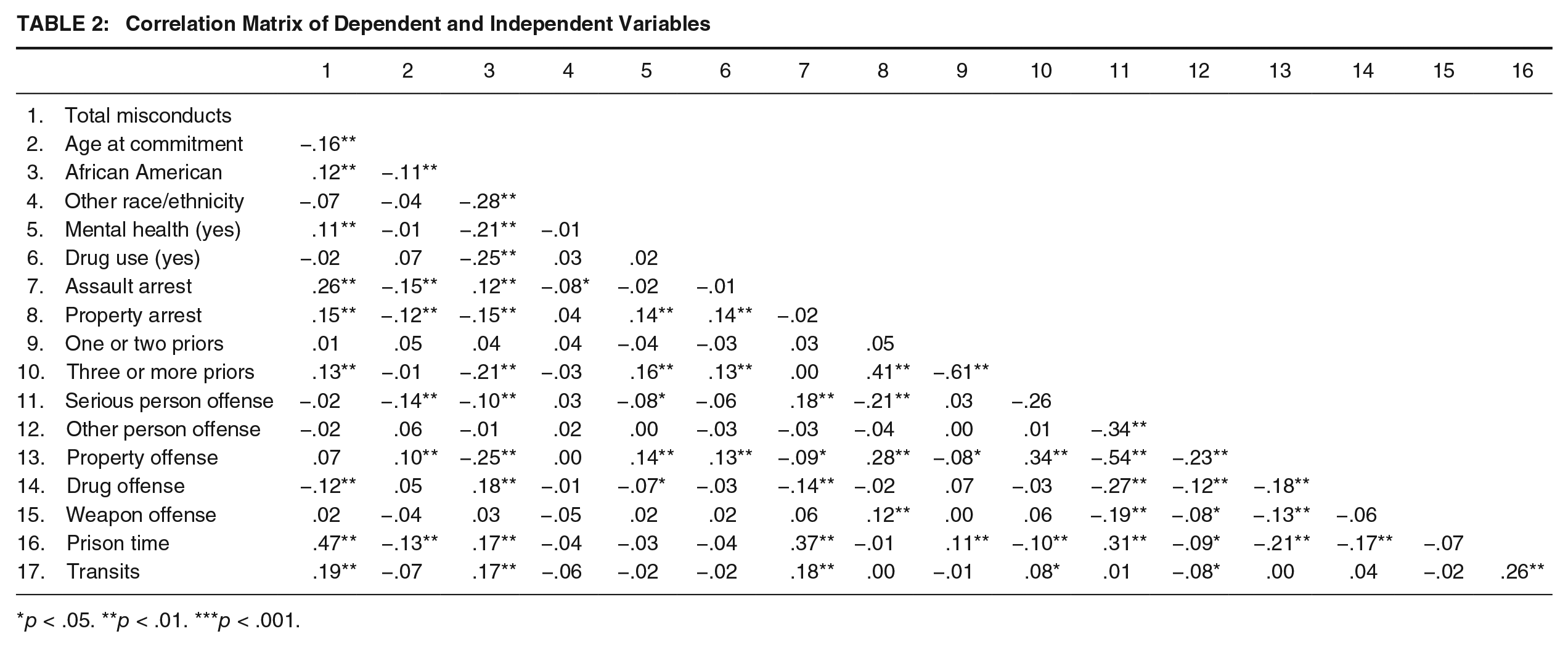
p < .05. **p < .01. ***p < .001.
Most of the prior research on juvenile misconducts in adult prisons acknowledged differences in offense type, focusing on only violent offenders (McShane & Williams, 1989) or comparisons of violent and non-violent offenders (Kuanliang et al., 2008). Time spent in prison (p < .01) and transits (p < .01) were both positively correlated with total number of misconducts. Thus, it is clear that total number of misconducts is correlated with our primary independent variable as well as many of our control variables.
Multivariate Analysis
Table 3 presents the results of the Poisson regression model. Age at first commitment to prison was negatively related to number of misconducts (p < .01). This means that accounting for other factors, each additional year of age was associated with 14.5% fewer total misconducts. Younger juveniles at commitment, then, accumulated more misconducts controlling for a range of other factors related to misconducts. In many respects, this finding supports the argument that younger juveniles do not serve time well and suggests that the fact that they do not serve time as well may be associated with an interaction between their developmental stage and the realities of the prison environment.
Regression With Total Misconducts as Dependent Variable
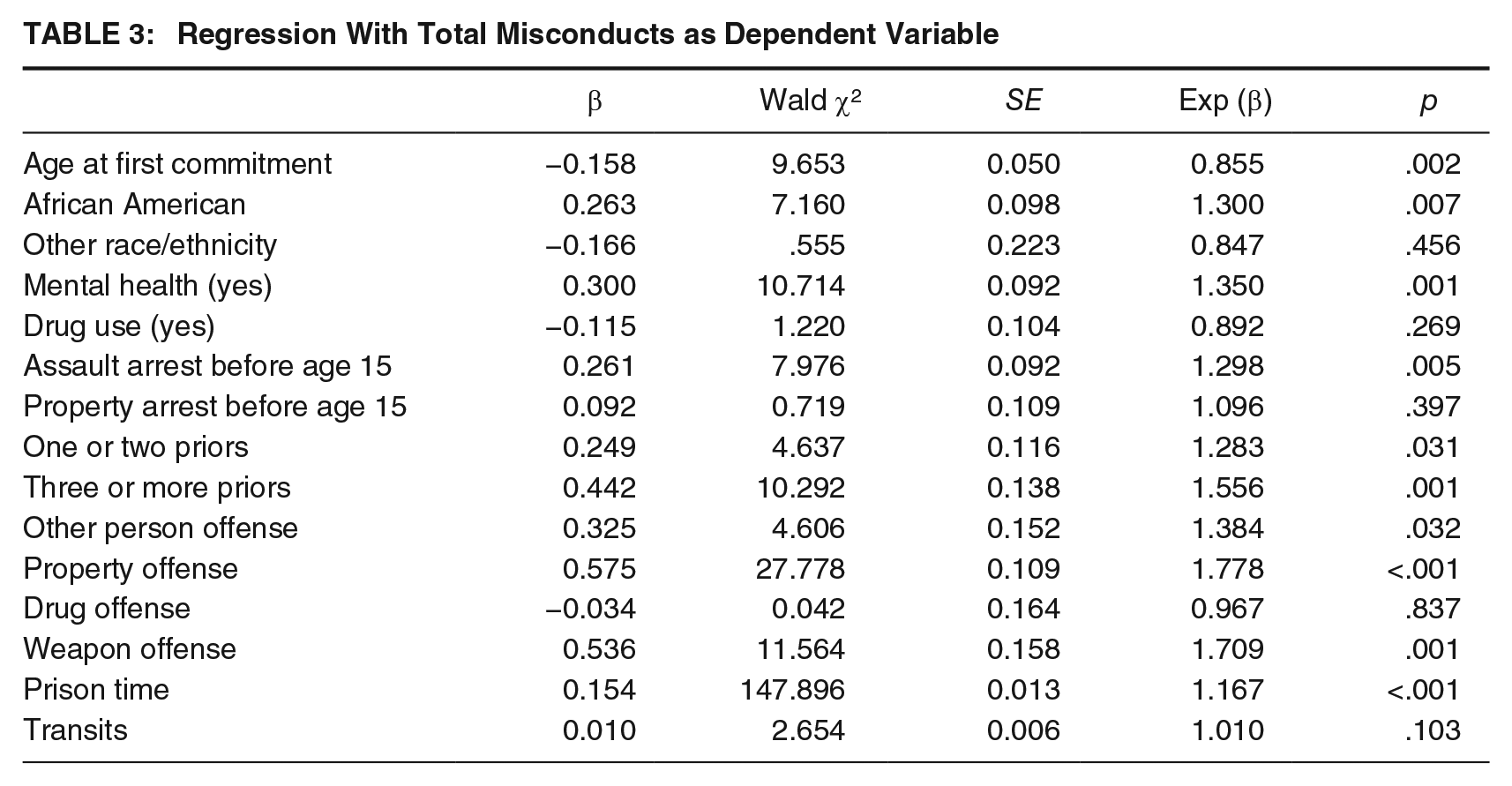
Among our control variables, African American youth received 30% more misconducts than Caucasian youth (p < .05). Caucasian youth and youth of other racial and ethnic groups, however, did not differ significantly with regard to number of misconducts. Youth with a known mental health issue accumulated 35% more total misconducts than those without known mental health issues (p < .01). Youth with a known drug use history, however, did not differ significantly from those without. Aspects of a youth’s prior juvenile and offending history are also related to misconducts. Youth with an assaultive arrest by age 15 accumulate nearly 30% more misconducts than those without (p < .01), although whether a juvenile had a property arrest at age 15 was not significantly related to total number of misconducts. In addition, juveniles who had one to two prior commitments or probation experiences had 28% more total misconducts than those with none (p < .05), and youth with three or more had 56% more total misconducts than those with none (p < .01) indicating that youth with a more persistent offending history accumulate more misconducts.
A number of significant differences were found with regard to the commitment offense and number of misconducts. For offense type, serious person offenses were used as the reference category because these were considered to be the most serious offenders according to the legislature. Juveniles committed for other person offenses had 38% more total misconducts than serious person offenders (p < .05). Property offenders had 78% more total misconducts than serious person offenders (p < .01), and weapon offenders had 71% more misconducts (p < .01). There were no significant differences with regard to drug and serious person offenders. As expected, prison time was significantly related to number of misconducts as each additional year in prison was associated with 17% more total misconducts. Transits, or prison moves, were not significantly related to misconducts.
Discussion
The goal of this study was to examine the relationship between age and institutional misconducts among a sample of juveniles committed to adult prisons and to expand theoretical explanations regarding the prison behavior of juveniles. Because there is relatively little theoretical development specific to the behavior of juveniles in adult prisons, we used the importation model that has been used to explain prison behavior among adults. This model asserts that a person’s pre-prison characteristics manifest themselves in the prison environment. We also posited that developmental processes that unfold throughout adolescence and into adulthood, at least in part, explain differences in prison behavior. As noted previously, young people differ from adults with regard to decision-making, impulsivity, and susceptibility to peer influence, among other characteristics (Gardner & Steinberg, 2005; Steinberg et al., 2009; Steinberg & Scott, 2003). These differences are likely to manifest themselves in several ways. First, it is likely that interaction of the developmental status of juveniles and the stressful and intimidating environment within prisons is likely to compromise the decision-making of young people and lead to more misconduct behavior. Second, because development unfolds over time, we are likely to see differences among transferred juveniles based on the age at which they enter prison.
Consistent with prior research that juveniles do not serve time as well as adults (Kuanliang et al., 2008; McShane & Williams, 1989), we found that within our sample, juveniles who were younger when they were committed to prison accumulated more misconducts. Specifically, each year of age was associated with 14.5% fewer total misconducts. This relationship is the inverse of the age–crime curve where delinquency increases from early adolescence and peaks in late adolescence/early adulthood before decreasing into adulthood. Thus, these findings lend some support to our contention that developmental differences might be associated with prison behavior among incarcerated juveniles. Given other studies that have found that the prison environment does not meet the developmental needs of young people (Bishop, 2000; Bishop & Frazier, 2000; Fagan, 2008; Ng et al., 2012), developmental theory is potentially a useful explanatory framework for understanding the behavior of young people in the prison environment, and this finding raises more questions about the efficacy of committing young people to adult prisons. This finding also suggests that young people might be at further disadvantage in adult prisons because prison behavior is associated with longer stays in prison (Flanagan, 1980; Huebner & Bynum, 2006; see also Caplan, 2007, for a review).
Although various measures of developmental status exist, a limitation of this study is that it only used age as a marker of development. In addition, because we do not have data on the specific interactions that explain prison behavior, we cannot rule out other explanations. For example, in light of research that has found that young people are more susceptible to abuse in prison, it might be likely that juveniles, especially younger juveniles, commit misconducts to avoid specific prison situations or to protect themselves in other ways. Another theoretical framework used to explain prison behavior, the deprivation model, asserts that prison conditions, not necessarily individual characteristics, drive prison behavior (Gover et al., 2000; Poole & Regoli, 1983). Thus, the interaction of the susceptibility of juveniles and prison conditions could lead to more misconducts as young people use misconducts to negotiate their prison experiences. As Leigey and Hodge (2013) pointed out, there is clearly a need to better understand how young people navigate and negotiate the prison environment. Yet, we believe that our finding regarding the relationship between age and prison behavior is important and that developmental theory is a useful framework for understanding behavior. At a minimum, this finding adds to literature on the relationship between age and prison behavior and provides more evidence that placing young people in adult prisons is problematic and places them at a substantial disadvantage. It is worth noting that those who served time in prison as youth are likely part of the group Moffitt (1993) labeled life-course persistent offenders, and may already be vulnerable to recidivism post prison, whereas others may be at greater risk because incarceration itself, per the deprivation model, may increase risk of recidivism.
In addition to our findings regarding age at commitment and prison behavior, we also found that a number of other control variables were related to prison behavior. The relationship between race and misconducts, African American youth accumulated more misconducts even when controlling for a number of theoretically informed measures, is particularly important given the relationship between misconducts and time served in prison. Early research has shown that African American and Caucasian inmates were equal in engaging in misconduct behavior but that African Americans were more likely to have official reports made (Poole & Regoli, 1980). Previous work also suggests that there is a tense relationship between predominantly Caucasian prison staff and African American inmates (Poole & Regoli, 1983). Results may not reflect actual rule-violating behavior but rather misconducts that tend to result in official reports. Although our study was not designed to evaluate specific interactions and perceptions of interactions between staff and juvenile inmates, this finding raises questions regarding racial dynamics within the prison context.
A similar picture emerges for understanding the role of one’s mental health status in relation to juvenile misconducts, and this study expands existing knowledge on understanding juveniles’ prison behavior. The finding that juveniles with a known mental health history were more likely than those without such a history to have misconducts is not surprising considering the reality that these issues might have on influencing the way an individual reacts to the stress of prison life. Given the high rate of mental health issues among transferred juveniles, and the relative lack of sufficient mental health services within prisons, this finding raises additional questions about the appropriateness of incarceration for juveniles in adult prisons, particularly those with mental health issues.
Our study also expands existing knowledge of juveniles’ prison behavior through the finding that young people with more extensive prior histories in the juvenile system accumulate more misconducts. This suggests the importance of persistent offending in understanding prison behavior. Current research includes a limited use of measures that account for the prior offending or system history of a juvenile in other studies. With regard to the type of offense with which a juvenile was transferred, the analyses showed that property offenders accumulate more misconducts than serious person offenders. This points, at least in part, to the fact that juveniles who get committed to prison for property offenses are more likely to be persistent offenders, whereas those committed for violent person offenses are less likely to be chronic offenders. In the Pittsburgh Youth Study, Loeber and Hay (1997) found similar support for this, as most young people desist in aggression and violent behavior as they grow older.
Conclusion
Policy and practice changes have eased the process for juveniles to be transferred into adult prison facilities to serve their time, and transferred juveniles represent a small, but important, group within the prison population. Until this article, only few existing studies have been identified to specifically address juveniles’ behavior in prisons, and all in different jurisdictions. Due to the variety of legislative changes as well as state variations in the transfer process, research needs to examine and compare findings from across these different contexts. Furthermore, although research is increasingly addressing the front-end mechanisms of transfer, as well as the back-end outcomes once they serve their time, a lack of research addresses how they are serving their time while locked up in prisons. The main findings of the study confirmed our hypothesis that the younger the age of the juvenile, the higher number of prison misconducts he is likely to have. In addition to findings that are largely consistent with previous studies on the behavior of juveniles in adult prisons, we also addressed existing gaps in knowledge to provide a more focused and detailed understanding of juveniles’ behavior while incarcerated. Research on misconducts has the benefit of shaping prison policies, particularly with regard to staff and inmate safety, and research on the role of young people’s misconducts is beneficial. If mechanisms easing the process of moving young people into prison remain, though, surrounding discourse needs to include evaluations of these effects on juveniles. Thus, our research finding that younger inmates do not serve time well is particularly important, and considerations need to be made regarding age and developmental status of this population. Future dialogue and research need to be based on the reality and effects for justifying continued use of transfer mechanisms and not simply the “get tough” rhetoric of the past.
Footnotes
Acknowledgements
The authors thank the Michigan Department of Corrections (MDOC), Rosemary C. Sarri, and Irene Y. H. Ng, for their support of this work. The authors also thank the anonymous reviewers and the editor for suggestions that have improved this article. Dr. Kolivoski was affiliated with the School of Social Work, University of Pittsburgh, Cathedral of Learning, Pittsburgh, Pennsylvania 15260, during the time when this research was conducted.