



Abstract
The development of risk–needs assessments has substantially expanded assessment content, which is reflected in the now regular use of both static and dynamic items. However, while the risk–need–responsivity model differentiates between risks and needs theoretically, the scoring of risks and needs does not make for a clear demarcation. We argue that an assessment of an offender’s needs should be scored separately and solely on items that are changeable and predict recidivism. This article describes the conceptualization and development of Washington State’s offender needs assessment. Designed to complement an offender’s assessment of risk, we make use of key design elements to avoid many theoretical and methodological caveats. Using preexisting item selection, weighting, and validation methods, we present domain-based needs models that maximize item content and provide substantial performance in the prediction of recidivism.
Introduction
Over the last two decades, the use of offender assessments has expanded beyond the prediction of recidivism with little clarification of the different means by which assessment instruments are intended to be used. While the risk–needs–responsivity (RNR) principles have been revered in contemporary corrections’ circles, the next hurdle in the field is the consistent application of the concepts within offender assessments (Taxman & Pattavina, 2013). Primarily, instruments have been used to assist agencies to manage a correctional population and to dictate frequency of contact and/or level of supervision in the community (Barnoski & Aos, 2003; Chadwick, DeWolf, & Serin, 2015; Viglione, Rudes, & Taxman, 2015). Key aspects of correctional management include the provision of treatments and services, assistance in case management, and prioritization of offenders for interventions (i.e., address needs and responsivity). While criminal history and other static items are useful for identifying an offender’s overall recidivism risk, tracking dynamic change prior to and following the provision of interventions is essential for the prioritization of limited agency resources as well as to identify positive impact on recidivism reduction.
While the creators of the RNR model clearly differentiated between risk and needs conceptually (Andrews, Bonta, & Hoge, 1990), many instrument scales are not designed to differentiate between item types. However, with a few notable exceptions, 1 many contemporary risk assessments combine needs with static risks, and the two item types are treated as virtually the same entity as long as they possess a liberal empirical relationship with recidivism (Douglas & Skeem, 2005; Kraemer, Kazdin, Offord, Kessler, Jensen, & Kupfer, 1997; Kroner, Mills, & Reddon, 2005; Polaschek, 2012; Serin, Chadwick, & Lloyd, 2016; Ward, 2016). Agencies that refer clients to interventions and assess their progress while under supervision often do not possess the level of assessment detail needed to track offenders’ dynamic need and change when scoring mechanics merge static and dynamic items into a single construct of risk and/or risk level.
Static and Dynamic Items Used in Risk and Needs Assessments
To clearly define the concepts within an assessment framework, static items are those that cannot be changed (i.e., number of prior convictions, prison infractions, age), whereas dynamic items are those that are amendable to treatment (e.g., currently employed, recent substance use, homelessness).
As described by the RNR’s creators, risks are “characteristics of people and their circumstances that are associated with an increased chance of future criminal activity” (Andrews & Bonta, 2010, p. 20), which includes both static and dynamic variables. The intent of a risk assessment instrument is to measure an individual’s risk to reoffend, which can include static factors such as prior incarceration, age, and even a history of substance abuse and/or mental health issues. However, contemporary instruments also include dynamic predictors, such as current employment, housing stability, financial issues, and recent mental health and/or substance abuse issues. Under the RNR model, risk assessments should include all static and dynamic measures that prove to be predictive of recidivism.
The concept of needs was theorized to be the identification of problematic circumstances (Andrews et al., 1990). With this said, the intended outcome of a needs assessment is optimum intervention selection, prioritization, and matching. Therefore, we argue that a needs assessment is intended to only measure dynamic characteristics that are currently influencing the individual’s probability of recidivism. As defined by Andrews and Bonta (2010), needs are specifically “dynamic risk factors that can change” (p. 21). They further differentiate between dynamic items that predict recidivism (termed criminogenic needs) and those that do not (noncriminogenic needs). Andrews and Bonta further reveal this point when they describe the criminogenic need principle:
Criminogenic needs are a subset of an offender’s risk level. They are dynamic risk factors that, when changed, are associated with changes in the probability of recidivism . . . [o]ur argument is that if treatment services are offered with the intention of reducing recidivism, changes must occur on criminogenic needs factors. (p. 49)
Therefore, criminogenic needs can only be dynamic predictors that have the ability to assess (or predict) criminal behavior. Andrews and colleagues’ theoretical argument was that treatment services are to be offered with the intention of reducing the probability of recidivism, and thus should focus on criminogenic needs. Noncriminogenic needs are less of a priority but can be addressed to increase an individual’s motivation, improve public health or overall quality of life (Andrews & Bonta, 2010).
It should be distinguished conceptually that the summary risk score in a risk assessment is the estimation of the offender’s overall likelihood of recidivism, and this quotient is used to assign supervision (dose and intensity), while the needs scores in a needs assessment are quotients used to assign interventions intended to prevent or reduce an individual’s risk of recidivism.
Conceptual Utility of Needs Assessments
For case managers, the provision of interventions is based on the currently relevant needs of the offender; as such, a needs assessment should include only dynamic, changeable, and conceptually temporary factors that allow for a scale to potentially reduce to a 0, or identify an offender as having “no current need.” Latessa and colleagues claim that “. . . the most effective programs target dynamic risk factors” (Latessa, Lemke, Makarios, Smith, & Lowencamp, 2010, p. 16). This argument seems simple, but incorporating these concepts within the complexity of assessment design has been elusive. Much of prior RNR research indicates that higher risk offenders should receive greater intervention resources (Prendergast, Pearson, Podus, Hamilton, & Greenwell, 2013), and while it may be true that a static drug conviction committed 15 years ago may increase an offender’s risk, it does little to inform case managers of an offender’s “high need” for programming.
The current study examines the theoretical distinctions between risk and needs assessments and the development of a dynamic-only needs assessment model. First, the conceptual differences between combined risk–needs instruments and needs-only assessments are reviewed. Next, key issues of commonly used tools are outlined. Finally, development details and validation findings of the Static Risk Offender Needs Guide–Revised (STRONG-R) dynamic-only needs assessment, created for the Washington State Department of Corrections, are presented.
Contemporary Uses of Risk and Needs
Popular assessment instruments are often developed using similar methodologies; however, slight variations are observed with regard to construction and design variations (Hamilton, Tollefsbol, Campagna, & van Wormer, 2017). This section attempts to highlight key issues in instrument development as they pertain to offender needs assessment (ONA). Contemporary instruments such as the Level of Service/Case Management Inventory (LS/CMI), the Ohio Risk Assessment System (ORAS), and the Women’s Risk Need Assessment (WRNA) were constructed using several subscales that indicate risk in a given domain, and, when combined, give practitioners an overall offender risk score (Andrews, Bonta, & Wormith, 2004; Latessa, Smith, Lemke, Makarios, & Lowencamp, 2009; Wright, Van Voorhis, Bauman, & Salisbury, 2008). While these instruments weight static and dynamic items and domain subscales equally, the Correctional Offender Management Profiling for Alternative Sanctions (COMPAS) weights items and scales by their variable impact (Brennan, Dieterich, & Ehret, 2007).
Furthermore, all instruments attempt to break the risk score distribution into levels or bands (i.e., low, moderate, and high), which allows agencies to utilize risk level to effectively manage offender supervision in the community. However, because risk level is only partially relevant when choosing a treatment modality, breaking the continuous distribution of risk into a set of ordinal categories does not allow agencies to “efficiently allocate resources in a manner that reduces recidivism” (Latessa et al., 2009, p. 2). For example, two offenders may hypothetically possess the same global risk score; however, “Offender A” may have scored the maximum on a Substance Abuse domain subscale, whereas “Offender B” may have scored the maximum on the Employment domain subscale. Both offenders may possess the same overall risk to recidivate, but one may be prioritized for chemical dependency treatment, while the other for vocational training. This presents a pragmatic problem for practitioners and reduces the face validity of the instrument used.
Current assessment instruments commonly create an individual’s global risk score by blending dynamic criminogenic needs with static risks, essentially treating needs items as risk factors. Much of the field agrees that when combining risk and needs into a single instrument, one is provided with a more accurate prediction of recidivism risk (e.g., Andrews & Bonta, 2010; Hamilton et al., 2016); however, critics attuned to the everyday workings of correctional assessment have found many needs variables included on current instruments to be irrelevant when predicting recidivism (Baird, 2009; Barnoski & Aos, 2003; Caudy, Durso, & Taxman, 2013; Hamilton & van Wormer, 2015). Essentially, some instruments collect needs items that are not associated with any measure of recidivism (Austin, Coleman, Peyton, & Johnson, 2003). For example, the LS/CMI, COMPAS, and WRNA all provide domains or subscales that do not claim to be criminogenic. Baird (2009) suggests that “labeling a need as criminogenic when it has little or nothing to do with criminal behavior is counterproductive, leading to ineffective interventions and unnecessary expense” (p. 9). He further argues that risk management and case planning are two separate processes. To be consistent with the RNR model, risk management should use all variables available to improve the organization’s ability to predict recidivism. Therefore, static and dynamic variables should only be included in the assessment if they significantly improve the instrument’s ability to predict recidivism within a specified population. However, needs management should only use predictors that have the ability to change over time.
Targeting Needs
Recent work by Taxman and colleagues (Taxman & Caudy, 2015; Taxman, Pattavina, & Caudy, 2014) has suggested that some needs domains have proven to be of higher priority than others when attempting to prevent recidivism via correctional intervention. Taxman and Caudy (2015) state that “informing treatment placements requires . . . targeting dynamic risk factors (needs) that are both malleable and directly related to recidivism outcomes during correctional programming” (p. 73). Specifically, this work suggests that two domains—criminal thinking 2 and substance abuse—provide the greatest impact on recidivism, while destabilizing factors (e.g., mental health, family, financial, employment, housing, and educational deficits) are less important and may even be noncriminogenic (Taxman & Caudy, 2015). This suggests that there exists a core set of criminogenic needs and a set of needs domains that are indirectly related to offender recidivism. Taxman and Caudy have provided advancement in the way in which one might conceptualize needs and their importance. They suggest that unanswered questions still remain in regard to the content and scoring of needs assessment instruments (Taxman & Caudy, 2015). Scoring schematics should also consider the severity/specificity of the recidivism target or focus the needs assessment on the most probable recidivism event, rather than any event generally. For instance, the COMPAS allows risk and needs assessment to be used in sentencing decisions, institutional treatment, and case management (Brennan, Dieterich, & Ehret, 2009). The COMPAS utilizes an analytically weighted scoring system to determine the predicted risk of recidivism, and can also be used to assess an offender’s likelihood to violently reoffend. The instrument represents one of the first “systems” of risk assessment, adjusting item scores and weights based on the purpose of assessment—probation, prison, and prerelease.
Furthermore, when only dynamic items are included in a needs assessment, treatment can be directed at offender characteristics that are changeable. The Sex Offender Needs Assessment (SONAR) was developed by Hanson and Harris (2000) to predict sex offending, and designed to complement their static tool (i.e., Static-99). The SONAR represented an advancement of the RNR model, specifying a stand-alone instrument that may be used to assess dynamic items amenable to intervention. Hanson and Harris suggest that the use of a dynamic-only tool is critical to successful supervision and case management of sex offenders, aiding officers in anticipation of recurring problems based on offenders’ criminogenic needs. In addition, the Inventory of Offender Risk, Needs, and Strengths (IORNS) provides separate scales of static and dynamic predictors (Miller, 2006). Somewhat different in design, the IORNS provides two scales—the Dynamic Need Index and Protective Strengths Index—that when combined with a Static Risk Index assesses an individual’s overall risk to recidivate. The IORNS provides an additional conceptual link between general offending and specified needs scales comprised of items to be utilized for treatment and service planning.
Furthering Hanson and Harris (2000) and Miller’s (2006) argument, dynamic variables may empirically increase one’s ability to classify offenders properly, but once a given temporary/changeable need is met, it is no longer a current issue to be used to inform treatment and case management. However, if static items are used to compute an offender’s need domain score, this represents a theoretical design flaw, as an individual’s domain score can never reduce to 0 or to a level of no need.
Scale Construction
Until relatively recently, gender was not an integral component of assessment instruments. Most assessment tools were designed as “gender neutral”; meaning that they should assess male and female offenders with comparable accuracy. However, as criminal justice populations are predominantly male, most instruments, such as the Revised Level of Service Inventory (LSI-R), were constructed with male-oriented constructs and male-dominant samples (Salisbury, Van Voorhis, & Spiropoulos, 2009). As a result, these instruments have been argued as inappropriate for female populations, despite conflicting empirical findings. Some instruments, such as the Structured Risk Assessment (SRA), use gender as a predictor, but research from the past several decades indicates that gender is a much more fundamental and intricate element to offenders’ criminal trajectories than simply being a risk factor for men (Brennan, Breitenbach, Dieterich, Salisbury, & Van Voorhis, 2012; Reisig, Holtfreter, & Morash, 2006; Rettinger & Andrews, 2010).
Building off recent research exposing the different pathways men and women generally take to criminal involvement, some contemporary instruments utilize gender-specific scoring for more accurate assessment of offenders. For example, the WRNA measures factors that are, empirically, more persistent in the lives of female offenders, such as mental health issues and trauma (Salisbury et al., 2009; Van Voorhis & Presser, 2001). The WRNA was originally created as a gender-responsive supplement to existing instruments, such as the LSI-R and the COMPAS, but it was expanded to become a separate risk/needs assessment tool. Similarly, the STRONG-R was designed to identify factors that influence males and females differently and to weight and score them to reflect these differences. While the WRNA is gender responsive for female populations only, the STRONG-R was designed to be utilized for both male and female populations.
Another theoretical issue related to the methods and development of stated instruments is the criteria used to determine a needs item inclusion. As originally conceptualized, a need is considered criminogenic if it is associated with (i.e., predicts) recidivism. However, some instruments (e.g., LS/CMI, ORAS, WRNA) identify criminogenic needs liberally, where merely a bivariate association with recidivism is required for an item to be included and scored in a subscale. This conceptualization ignores potential issues related to shared variance and multicollinearity. As common regression assumptions dictate, models should include only those measures that are empirically related to the outcome and exclude unrelated measures (Berry, 1993). Although using bivariate tests to filter out irrelevant items is a common first step of model building techniques, building scales or creating a domain scoring scheme requires one to examine the relative importance of each measure (i.e., weighting) using a multivariate selection procedure (Hosmer, Lemeshow, & May, 2008). For a domain scale to retain a high level of predictive accuracy, needs items should be selected and scored in a multivariate space. Therefore, a higher bar should be set with respect to the selection and inclusion of criminogenic needs (Baird, 2009). If domain scoring is intended to inform intervention provision, these subscale portions of the tool must consist of a uniquely validated model in their own right.
A common method by which to create subscales in the social sciences is a factor analytic approach, which uses predictor items as dependent variables and subsequently predicts them with a latent factor that conceptually represents part, or all, of the domain subscale (e.g., Andrews & Robinson, 1984; Brennan et al., 2007; Hollin, Palmer, & Clark, 2003; Hsu, Caputi, & Bryne, 2011; Schlager & Simourd, 2007). Once the latent factor’s measurement qualities are calculated, the factor can represent a measurement of a theoretical concept that is not directly measurable. For some social sciences (e.g., psychology), these methods provide an important technique, measuring concepts that may be related to recidivistic outcomes (e.g., psychopathy). However, when attempting to predict manifest system outcomes, results can rarely be subject to external validity checks to ensure generalizability of the scale’s accuracy outside its creation population. This leads to two key observations: the first being that generally weighted assessments are considered less accurate because a true base rate for the larger criminal justice population cannot be established (Gottfredson & Moriarty, 2006); and the second observation refers to how laws and policies differ across jurisdictions, each serving different populations. For example, in his creation of the Minnesota screening tool assessing recidivism risk (MnSTARR), Duwe (2014) claims, “Minnesota relies much more heavily on community sanctions (e.g., probation and jail) than most other states” (p. 605), insinuating that manifest system outcomes such as infractions and even probation violations would not be able to be explained with the same risk/needs factors as those determined in other jurisdictions. A prime contemporary example is possession of marijuana being legalized in multiple states and smaller jurisdictions (Walker, Posey, & Hemmens, 2016).
Essentially, factor analytic approaches are nomothetic, seeking to determine general factors involved in a causal chain, where studies of one jurisdiction are ideographic, describing specific properties of that jurisdiction and its population. Furthermore, single items that cannot be combined within a given scale may be important predictors but omitted due to the lack of other (two or more) correlated measures available to combine with and thus constitute a factor. Thus, the use of latent variable methods in the development of criminogenic needs scales appears to be at odds with the RNR model, as Andrews and Bonta (2010) argue that criminogenic needs must provide a direct empirical relationship with recidivism.
Instruments that use latent variable approaches to validate subscales are currently limited to special populations (e.g., Psychopathy Checklist–Revised; Hare, 1991; Hare, 2003), whose intragroup variance is easier to predict than that of the general population. While offender trajectories in behavior have been well established (Chung, Hawkins, Gilchrist, Hill, & Nagin, 2002; Piquero, Farrington, Nagin, & Moffitt, 2010; Piquero, Piquero, & Farrington, 2010; Wiesner & Capaldi, 2003), the variety of offender populations is simply too heterogeneous, and system-wide variation in outcomes is too great for contemporary researchers to use psychometrics to simultaneously explain behaviors of the individual and of the system. When using the RNR model, multivariate techniques (i.e., multiple regression) using localized data can currently meet system prediction demands to better classify offenders with regard to current, changeable behavior that is amenable to intervention and likely to result in reduced recidivism probability.
Key Issues for Needs Assessments
Based on this review of just a few contemporary risk and needs assessments, an outline of key issues for consideration when constructing an instrument to assess individuals’ criminogenic needs and assist in case management decisions is provided:
“
Due to these described conceptual issues, there is a growing research need to examine and develop dynamic needs assessments to assist in case management and intervention matching decisions. The current study describes the development of the STRONG-R dynamic needs assessment instrument. Similar to Harris and Hanson (2010), this tool was developed to provide a prediction of criminogenic needs or dynamic risk of recidivism. As discussed further, the STRONG-R needs assessment takes advantage of a large pool of items collected as part of the ONA interview, restricting classification of needs within each of its nine domains to items that are both dynamic and identified to predict recidivism. 4 This instrument development method allows for assessment of an offender’s reduction in needs during the course of supervision.
This needs assessment development extends prior efforts, constructing models separately for males and females, using multivariate item selection, analytic weighting, and specified prediction models for violent, property, drug, and (any) felony recidivism. The analytic methods and assessment design elements used here have previously been identified to improve prediction strength and provide a compilation of methodologically sophisticated and theoretically consistent techniques (see Hamilton et al., 2016). We contend that using only dynamic items as a method to assess an individual’s intervention needs draws upon Andrews and Bonta’s (1994) theoretical framework regarding rehabilitation/restoration and has the potential to improve correctional assessment and rehabilitative practices.
Method
In addressing these key issues, a needs assessment instrument for the Washington State Department of Corrections (WADOC) was created. As discussed, the STRONG-R needs assessment instrument provides a separate assessment than the STRONG-R risk assessment to better align with the “N” of the RNR model. While the items selected and their weighted scores slightly differ from the STRONG-R risk assessment, the items selected are drawn from the same pool collected in the ONA interview. Once STRONG-R assessment data are collected, developed software applications compute separate algorithms; one computes scores and classification for risk, and a separate one calculates needs—the difference being those that are calculated for needs provide scores within each outlined domain and utilize only dynamic items. The following sections outline that development process, with the focus being on the development of the needs assessment. 5
While the key issues identified in the literature appear to be essential in developing a contemporary needs assessment to aid treatment efforts, practitioner concerns encompass more than a simple validated scale of needs (Maloney & Miller, 2014). Prior to the creation of the aforementioned needs assessment, several development discussions were facilitated with key WADOC assessment officials, staff, and stakeholders in the summer of 2014. The collaboration defined the needs assessment’s intended use and the available items that could be selected and scored.
The needs assessment is designed to complement the STRONG-R risk assessment. The item pool contains both static and dynamic items collected from the criminal history file review and offender interview. 6 As mentioned, an additional interview is not required to score the needs assessment. The assessment process uses automated calculations of prior criminal history measures drawn from state agency records. Additional items are gathered from an offender needs interview. Software utilizes responses differently based on a given statistical algorithm, where items and weights are allowed to differ to improve prediction for the tool’s specific objective (e.g., a given risk or needs model).
Design of the STRONG-R
The utility of the needs assessment operates within a continuum of the STRONG-R assessment system. The application first uses static and dynamic items to determine an individual’s risk score and classification level (i.e., the risk assessment). The STRONG-R has one general recidivism and three outcome-specific prediction models. Using model-specific algorithms, the individual’s response data are weighted and processed into risk-level categories. Specifically, once an offender’s responses have been collected on all items in the STRONG assessment item pool (AIP), these responses are weighted and scored. Computations provided by STRONG-R algorithms (see Hamilton et al., 2016) place offenders in one of five risk levels—(5) High Violent, (4) High Property, (3) High Drug, (2) Moderate (general) Felony, and (1) Low (general) Felony. 7 This hierarchical ranking of risk was established based on the WADOC priority of recidivism prevention. This process is illustrated in Figure 1.
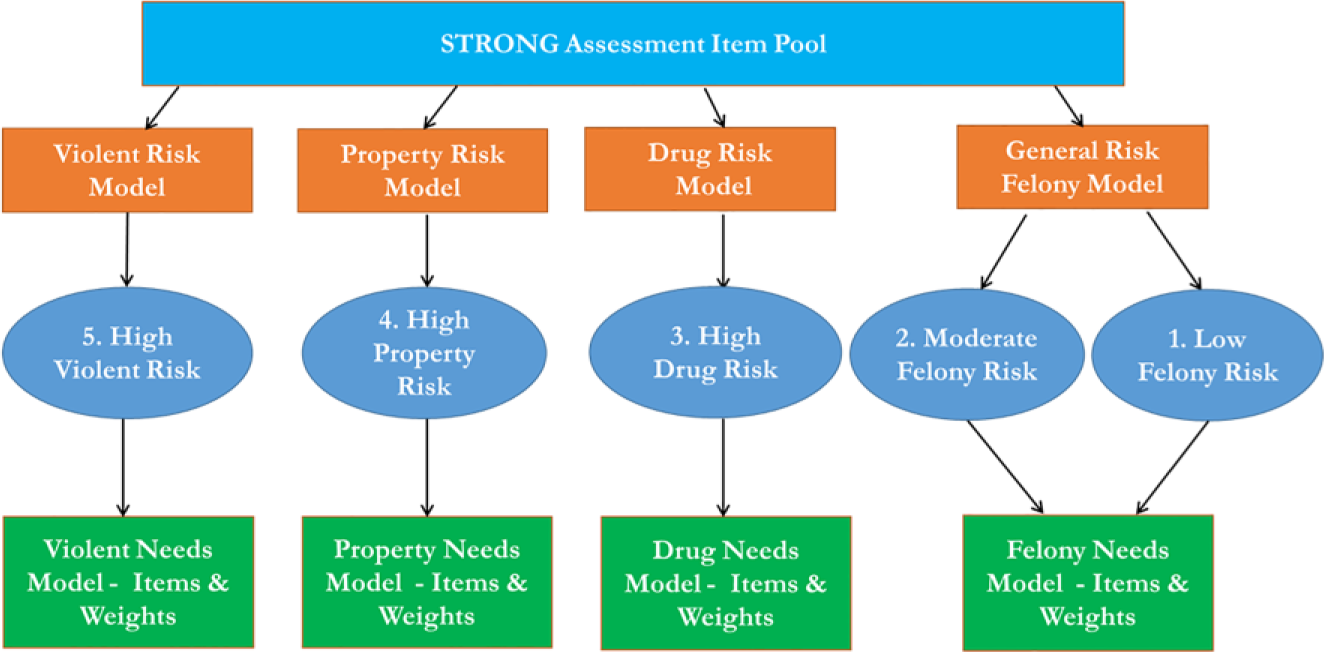
STRONG-R Risk and Needs Classification Process
To illustrate further with an example, an offender enters the WADOC system and is assessed on the items in the larger STRONG AIP, which contains all static and dynamic items/responses available. The STRONG-R algorithms for each of the four models are then scored for an individual. For example, if an offender scores as “high risk” for both the Violent and Drug risk assessment models, the highest ranking would be selected, identifying the offender as Category 5—High Violent. The Violent Needs model algorithm would then be applied, and the software would return the offender’s scores/classification needs (i.e., High, Moderate, and Low) within each domain that predicts violent offending. This filtering process from the general pool, to risk category, to needs scores provides additional specificity for case managers. The added complexity is necessary to allow case plans to focus intervention efforts on reducing an individual’s assigned criminogenic needs category, which is designed to have the greatest strength in predicting an offender’s specific recidivism risk type.
However, despite the described complexity, this process all takes place in the background, where the work of scoring risk, classifying offenders, and applying weighted needs scores is based on a system of algorithms computed through a unified software platform. As the offender criminal history file review is designed to auto-populate many of the items within the AIP, the assessor is tasked to complete the offender interview, entering the appropriate responses into the system. Once the AIP is complete, the software application computes both the level of risk and the offender’s associated needs rankings, resulting in a “dashboard” similar to the sample displayed in Figure 2. These needs then become the focus of case management, where WADOC staff members are guided in the provision of intervention and supervision. The STRONG system is designed to reassess the individual every 6 to 12 months, whether incarcerated or in the community, where reductions/escalations of dynamic items are anticipated based on their performance under supervision.

Example Needs Report
Development of the STRONG-R Needs Assessment
The creation of the needs assessments utilized several stages. First, the large pool of items (k = 135) routinely collected by the WADOC as part of the STRONG assessment was utilized (i.e., AIP). Empirically static items were removed, resulting in a total of 63 dynamic need items for potential inclusion. A list of STRONG items and responses was previously provided by Hamilton and colleagues (2016). Similar to the instruments discussed, offender needs items are separated based primarily on RNR’s conception of primary content categories (see Girard & Wormith, 2004): (a) Education, (b) Employment, (c) Friends/Peers, (d) Residential, (e) Family, (f) Substance Abuse, (g) Mental Health, (h) Aggression, and (i) Attitudes/Behaviors. Each of the STRONG-R domains is conceptually similar to those initially described by Andrews and Bonta’s (2010) Central Eight, and while the RNR model does not overtly identify mental health as a criminogenic need, the STRONG model includes it in the needs assessment. Despite low area under the curve (AUC) values, research indicates that it may be indirectly linked to recidivism as a lifestyle destabilizer that can be targeted for change (Taxman & Caudy, 2015).
Each of the domains can be logically tied to common interventions: Attitudes/Behaviors with cognitive-behavioral-based programs, Aggression with aggression replacement therapy, Mental Health with psychiatric care, Substance Abuse with drug rehabilitation programming, Family with family-centered programming, and so on. Within each domain, separate models were computed. A previously developed customized bootstrap stepwise binary logistic regression algorithm was utilized for item (or feature) selection (see Hamilton et al., 2016).
Through the use of regression modeling within domains, each criminogenic need is identified in a multivariate space, reducing issues related to shared variance and nonscoring items/domains. The procedure is also designed to prevent illogical weighting, whereas models computed without this procedure force weighting directionality via traditional selection methods or those that utilize the Burgess-style scoring formulations. These modeling procedures are broken down further by gender. This procedure selects a unique set of items/responses, and their corresponding coefficient weights produce gender, outcome, and domain-specific algorithms. Combining the assessments created for each domain (9), recidivism type (4) and gender (2) provide for a total of 72 independent models, which form the needs assessment instrument.
Although some critics may perceive this design as overly complex, the procedure is simply an extension and combination of previously utilized assessment development techniques. Essentially, the tool makes use of four key design elements: (a) the use of dynamic-only items, (b) specific and general models of criminogenic need predictors, (c) separate gender-specific scoring, and (d) the use of domain-specific, rather than Burgess, weighted response scoring. This needs assessment design delivers a greater level of specificity not provided by instruments previously discussed or currently available.
Sample
The sample used to create the STRONG-R needs assessment includes subjects who (a) were convicted of a felony or select gross misdemeanors 8 by a Washington State Court, (b) were supervised by the WADOC, (c) were assessed and provided responses on the AIP, and (d) reentered the community between August 2008 through December 2010. Model outcomes were operationalized as the specific or general felony reconvictions following an offense resulting in the current WADOC supervision. The total sample size for the study was 47,970 (male n = 39,155; female n = 8,815). To provide consistency with the assessment, a fixed 2-year follow-up period was utilized to observe recidivism outcomes, which has been identified in prior work as an appropriate length of observation for community-based outcome evaluations (Hamilton & Campbell, 2013; Taxman & Thanner, 2006).
Item Weighting and Predictive Validity
Item weights were assigned, and the assessment of predictive validity of each model was completed using a process similar to those identified in prior studies (see Brennan & Oliver, 2000; Duwe, 2014; Fawcett, 2004; Kohavi, 1995; Steyerberg et al., 2001). Assessment of the predictive performance of each model was conducted using a validation technique called k-fold cross validation. Generally, there are two steps toward validating a risk/needs assessment instrument: training of the risk model based on a set of data, and then testing the created models on a new set of data to assess how well they make correct predictions. Simpler methods that employ this technique often use a split sample, separating the data into two equal halves: one for training, the other for testing. The limitation for this method is that it does not use all of the data available for each of the two steps, only one half.
A method that resolves this limitation is 10-fold cross validation, which partitions the dataset into 10 equal parts at random. Nine of the parts are used for training the risk model, with the remaining one part used for testing. This process is repeated 10 times, with a different tenth of the data used for testing each time. The performance metrics of the predictions for each of the 10 subsets are then averaged to yield a single score. The performance metric used was the receiver operating characteristic (ROC) AUC. The AUC statistic is an effect size estimate that balances prediction specificity and sensitivity, and the computed value provides the probability that a needs score for a given model will rank a randomly chosen recidivism instance higher than a randomly chosen nonrecidivism instance (Fawcett, 2006). An AUC of 0.5 would indicate prediction no better than chance, whereas an AUC of 1.0 would be perfect predictive accuracy. Industry standards identify four ranges/sizes of AUC effects—negligible (<0.56), small (0.56-0.63), moderate (0.64-0.70), large (>0.71; see Rice & Harris, 2005).
Essentially, item weights and predictive validity statistics for each model are computed simultaneously. Item weights are retained from the training portions of each model and averaged. The model AUC is retained from the validation portion of the model. In addition, 95% confidence intervals are computed for each validation AUC to indicate the variability in each effect size. This weighting and validation procedure was completed for all 72 models. Furthermore, this described procedure is not unique to this study design and has been outlined to provide increased stability of the performance estimate while achieving a lower rate of bias (see Steyerberg et al., 2001). For regression models computed, standardized coefficients and validation AUC statistics are presented. For each AUC presented, an evaluation of effect sizes (see Rice & Harris, 2005) is provided to distinguish domains with greater performance from those with smaller and even negligible prediction strength.
Results
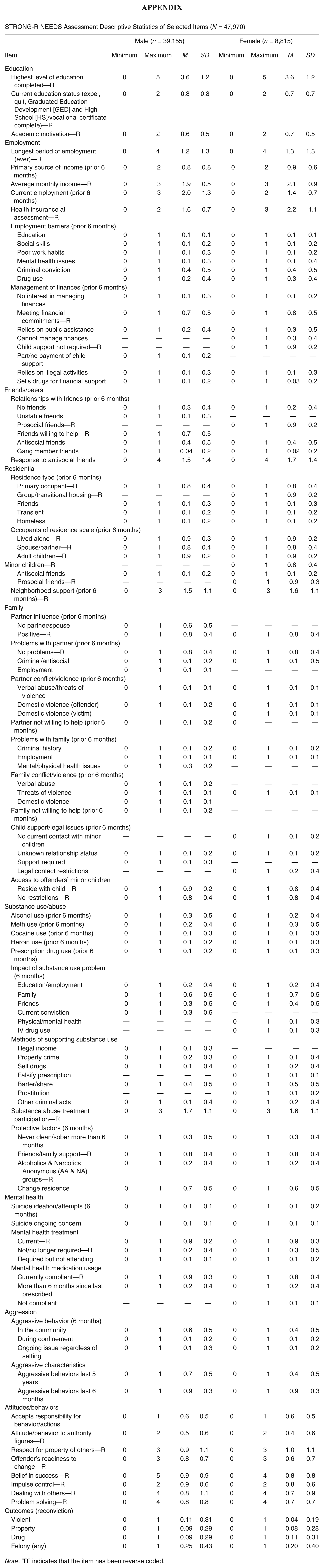
Descriptive statistics were computed for all outcomes and selected predictors of the 72 created needs models and, to conserve publication space, are displayed in the appendix. All items selected were gathered as a result of the ONA interview. It is important to note the differences in base rates for the eight outcomes examined, where males and females identified to possess differences with regard to the proportion reconvicted for Violent (11% vs. 4%), Property (9% vs. 8%), Drug (9% vs. 11%), and any Felony (25% vs. 20%).
Model Items and Weights
The resulting coefficients of the 72 domain-based regression models are displayed in Table 1. Standardized estimates are provided for each model to aid in the comparison of item importance within domain. Several important findings are identified with regard to the items selected and the variations between outcomes and gendered models. Within each of the nine domains, there is commonly one item or few items that are selected as predictors regardless of outcome type or gender, such as current education status, longest period of employment, response to antisocial friends, neighborhood support, positive influence of partner/spouse, substance abuse treatment participation, required mental health treatment, aggression during confinement, and accepts responsibility for behavior/actions.
Standardized Regression Coefficients by Domain and Outcome
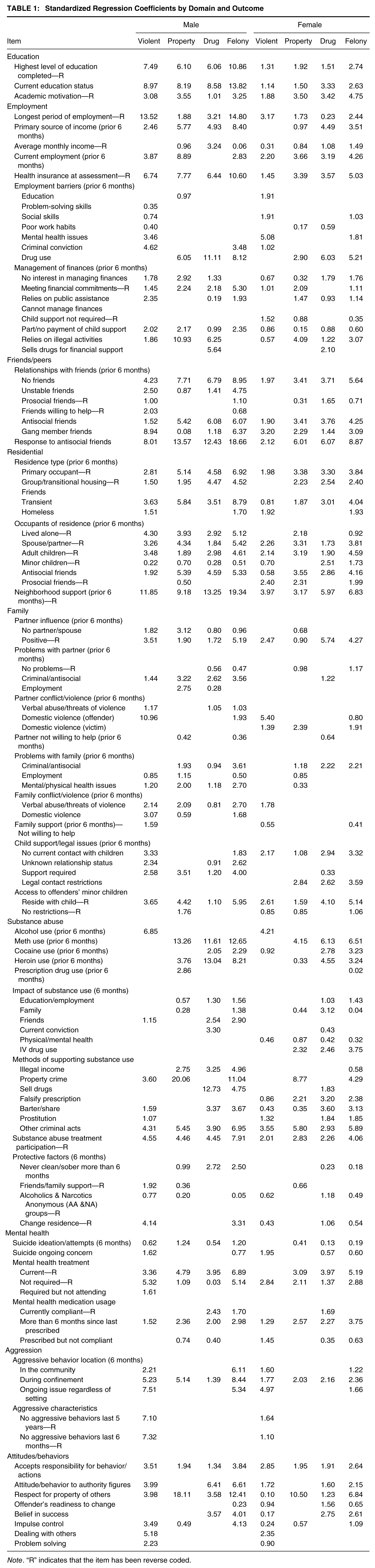
Note. “R” indicates that the item has been reverse coded.
Far more variability than consistency was found. Within outcomes, substantial variations are identified. Specifically, violent offending tends to be affected by employment barriers, supportive friends and family, homelessness, alcohol abuse, problem solving and skills dealing with others, and all of the selected Aggression-related items. A substantial amount of selected needs items was similar when predicting property and drug recidivism, where domain models of both outcomes indicated a lack of Aggression-related items and a variety of similar items in the substance abuse domain. This would suggest that these two types of nonviolent offenses were relatively similar, both indicating a substantial portion of substance abuse items but differ in terms of the method of support for their illegal activities. The Felony models tend to be an amalgam of the other three specified outcomes, providing few items unique to the Felony only outcome. Items selected were more consistent with the specified outcome that has the largest base rate (i.e., Violent for men and Drug for women).
With regard to gender variations, more similarities than differences were found between males and females. With that said, several key items were found to vary. Specifically, female items related to social support (i.e., child support not required, prosocial friends, and minor children legal contact restrictions) and victim/offender characteristics that are more prevalent in female populations (i.e., domestic violence victim, prostitution, and prescription falsification to support substance use) tended to be selected more often as domain predictors. Other gender variations were found among the weightings, where aggression and attitude/behavior item weightings tended to be lower, on average, for female offenders. Furthermore, females tended to have fewer items selected across domains as compared with males, suggesting either lower power (due to a comparatively small sample size) or a lack of gender-responsive items/domains included in the item assessment pool.
Domain Performance
Table 2 provides the validation of AUC values of each model. Bolded figures are used to highlight the top two prediction domains for each of the eight recidivism pathway types. Using effect size estimates (see Rice & Harris, 2005), domains with AUC values greater than 0.63 are indicated as moderate effects (underlined), and those less than 0.56 (italicized) indicate negligible effects, or less than small. Several general trends are identified.
Predictive Validity Model Findings—Validated AUCs (95% CIs)
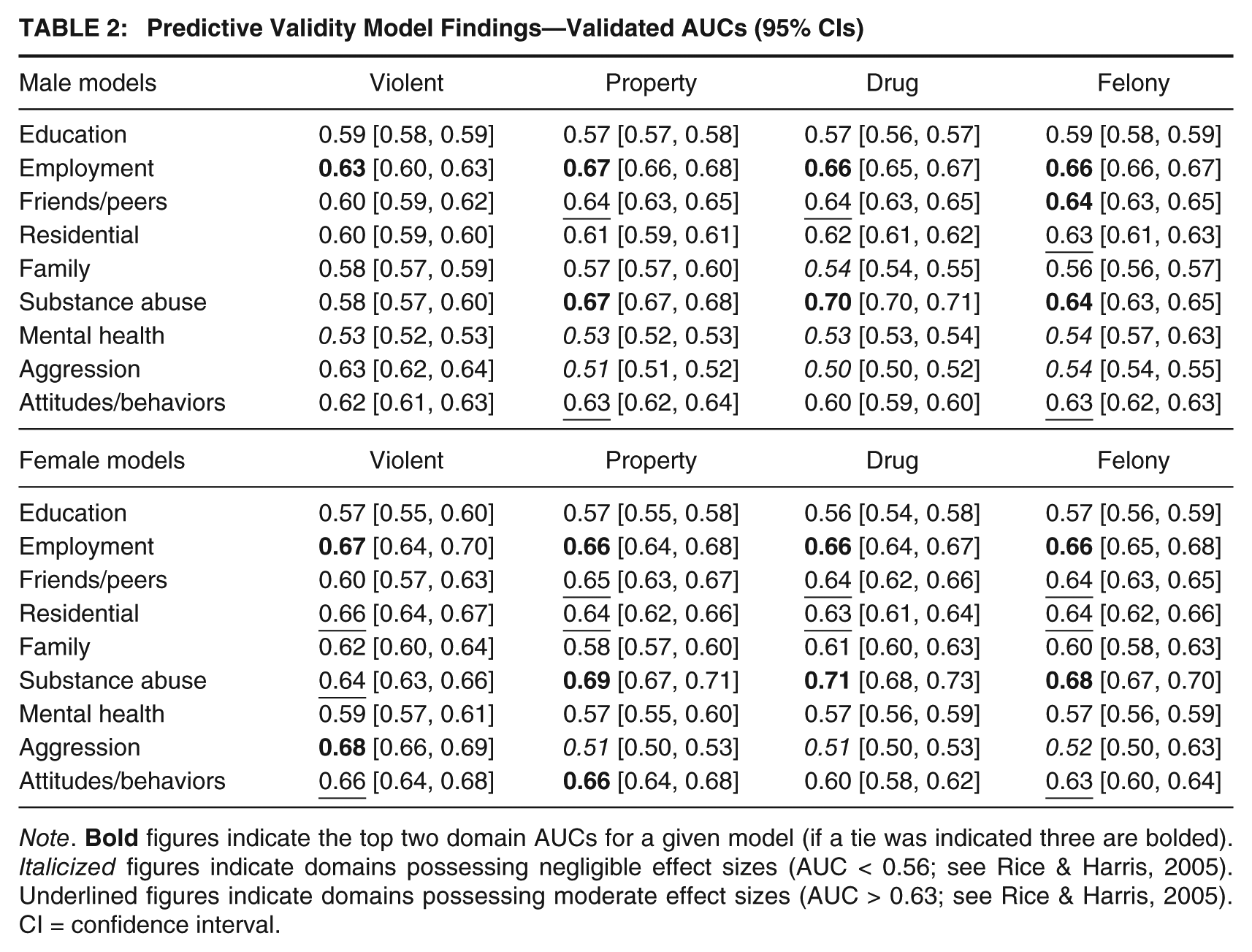
Note.
First, while no domains were strong predictors (AUC > 0.71) of reoffending, several were identified to be of moderate prediction strength (AUC > 0.63). Overall, 32 of the 72 prediction models were identified to have moderate effect size strength. It is also interesting to note that some domain models were found to have similar prediction strength as compared with reported findings of the full risk–need prediction models discussed previously (e.g., ORAS, LSI, WRNA; Folsom & Atkinson, 2007; Makarios & Latessa, 2013; Manchak, Skeem, & Douglas, 2008; Van Voorhis, Bauman, & Brushett, 2013). This AUC achievement was likely a result of the methodological techniques for selection, weighting, and recidivism outcome-specific modeling.
Second, several domains were found to be consistent predictors of reoffending. Employment was found to possess a moderate prediction effect size regardless of outcome or gender. With regard to substance abuse, this domain provided a moderate effect size prediction for seven of eight outcome models, whereas Friends/Peers and Attitudes/Behaviors were found to have moderate effect size predictions for at least half of the outcome models examined. Education and Family domains were found to possess a consistently small prediction effect for all but one of their 16 prediction models.
Third, variations were identified between violent and the other three outcome models. Specifically, Aggression was found to be a domain with moderate prediction strength and one of the top two domains for both male and female Violent reoffending models, while negligible prediction strength was identified for Aggression for the Property, Drug, and any Felony models. Conversely, the Substance Abuse domain was identified to be a top two domain for Property, Drug, and any Felony models but not for the Violent models. The Friends/Peers domain was also found to be of moderate prediction strength for Property, Drug, and any Felony models but not for the Violent models.
Examining gender variations, mental health was of negligible prediction strength for males but a small effect for females. As previously stated and parallel to our gender-specific stance, considering the large body of literature supporting the importance of mental health indicators in predicting recidivism, items in this pool may not reflect the best measurements needed to accurately assess mental health, gender-invariant or not. Similarly, the Residential domain provides consistent model prediction strength for females but generally small ratings for males. These gender variations are found to be consistent with prior findings (Van Voorhis et al., 2010; Van Voorhis & Presser, 2001), but we anticipate better gender-responsive measures to be developed in the future to assess all domains in the model.
Discussion
The STRONG-R needs assessment makes a substantial departure from current offender assessments and instrument procedures. While building on components and concepts invoked by prior literature and assessment designs, the STRONG-R needs assessment instrument makes several key departures that are novel and provide both theoretical and methodological advantages.
A More Consistent Application of Criminogenic Needs
As described, a large pool of assessment items is used but with limited selection to only those items identified to be dynamic or amenable to intervention. This provides a more consistent application of the RNR model, focusing the assessment on the individuals’ criminogenic needs that may be ameliorated through correctional treatments and services. Second, although establishing items as “criminogenic needs” starts with a bivariate examination of recidivism prediction, creating criminogenic needs scales must incorporate each item’s relative prediction strength into a multivariate space. By modeling each domain separately, domains are ensured to include only relevant prediction items, and model issues of shared variance and multicollinearity are attenuated. This is a recently discussed issue within the field (see Baird, 2009); this solution removes the likelihood that “prediction noise” is included in the assessment of needs.
Furthermore, although a few studies have attempted to compare the predictive power of static-only to static–dynamic prediction models (Barnoski & Aos, 2003; Cottle, Lee, & Heidlburn, 2001; Jung & Rawana, 1999), there are scant empirical findings of the incremental utility of dynamic-only prediction. It is interesting—and somewhat refreshing—to note that some of the domains returned AUC values that are similar to static-only models (see Drake, 2014) and those demarcated as third- and fourth-generation risk–needs assessments (Folsom & Atkinson, 2007; Makarios & Latessa, 2013; Manchak et al., 2008; Van Voorhis et al., 2013). This finding supports the inclusion of dynamic needs items empirically linked to recidivism in needs assessment.
An Improved and More Specific Instrument Design
The regression-based methodology attempts to correct limitations of previous designs. Prior methods have focused on latent variable approaches: These approaches diminish prediction of manifest outcomes (e.g., Andrews & Robinson, 1984; Brennan et al., 2007; Hollin et al., 2003; Hsu et al., 2011; Schlager & Simourd, 2007). While these are important methods for psychological approaches, where manifest outcomes are not readily available, the RNR model suggests that prediction of recidivism should be the primary focus.
Although weighting techniques and subgroup norming procedures have been utilized and discussed for many years in other fields (Aamodt & Kimbrough, 1985; Wang & Stanley, 1970) and have recently been found to increase accuracy for offender models (Barnoski & Aos, 2003; Duwe, 2014; Hamilton et al., 2016), these techniques have been largely overlooked when assessing offender needs. Thus, the development methods created for the STRONG-R risk assessment were used (see Hamilton et al., 2016) to further provide methodological advancements for items selection and weighting that have been found to increase predictive performance over models known to use bivariate selection and Burgess (unweighted) methodologies.
Extending the approach of prior needs assessments (i.e., SONAR and IORNS), this method produced models based on four distinct outcomes and for each gender separately to allow for the maximization of prediction items included in the conceptualized domains and removed issues of shared variance and multicollinearity within the domain. While this expands the number of domain-based models estimated to 72, these distinctions have been shown to provide additional content and predictive performance over those assessed for general recidivism prediction (see Hamilton et al., 2016). In addition, recent decades have brought increased computing power to allow these models to be run almost instantaneously. Practitioner buy-in is always important, and our method was developed in a collaborative environment, with both administrators and practitioners providing a plethora of feedback and support. While not claiming to have the only method for consideration, we believe that our findings provide a solution to Taxman and Caudy’s (2015) unanswered questions with regard to content and scoring of needs assessment instruments.
As the results indicate, the method of creating prediction distinctions provides for an interesting pattern of items selected and weighting schematics for each domain-based model. Variations in models’ AUC values suggest that substantial variation in domain prediction is demonstrated between violent and nonviolent outcomes, where aggression items are more important for the prediction of violence and friends/peers and substance abuse items are more important for the prediction of Property, Drug, and any Felony reoffending. As illustrated in Figure 1, modeling distinctions such as these allow the practitioners to focus intervention efforts on the primary domains that are found to reduce an offender’s specified risk type. For example, for a male offender identified to be at high risk of violent recidivism, needs assessment outputs would direct case management to focus intervention efforts around employment and aggression needs and to a lesser extent attitudes/behaviors. In contrast, for a female offender identified to be at high risk of drug reoffending, a case plan would be developed to focus on substance abuse, employment, attitudes/behaviors and to a lesser extent friends/peers and residential issues. These pathway distinctions provide better guidance to case managers to more aptly address (and potentially ameliorate) key criminogenic need areas; better tailoring the instrument to the offender and their most likely form of recidivism. Furthermore, by specifying needs pathways for males and females separately, this model better incorporates the concepts of gender responsivity first pioneered by Van Voorhis and colleagues (2010).
Consistent with Taxman and colleagues’ discussions of dynamic needs versus destabilizing factors (Taxman & Caudy, 2015; Taxman et al., 2014), the results demonstrate a prioritization of domain importance. Similarly, substance abuse was found to be a strong prediction domain. Furthermore, while not comprised of a single domain, several item domains of criminal thinking were identified to be of importance related to Taxman and colleagues’ conceptualization—Friends/Peers, Aggression, and Attitudes/Behaviors. However, these outcome-specific distinctions indicate greater specificity surrounding criminal thinking scales, where some of these items/domains are better predictors of violence while others are predictors of nonviolent reoffending. When considering intervention matching solutions, this distinction could direct a case manager to refer an individual to anger replacement/management rather than to general criminal thinking interventions (e.g., Thinking for a Change).
Also consistent with their concept of destabilizing factors, several domains were found to produce only small or negligible relationships with recidivism. Items that tap an offender’s mental health, education, residential, or family needs were less criminogenic but may interact, moderately, or impede the effectiveness of criminal thinking and substance abuse interventions. These concepts are also in line with Andrews and Bonta’s description of “Big Four” and “Central Eight” where destabilizing factors provide less direct recidivism reductions and may be more useful in identifying potential responsivity barriers and in improving community health but do not provide the biggest bang for a jurisdiction’s buck when the primary focus is recidivism reduction (Andrews & Bonta, 2010). 9 Hence, there is an argument to give lower priority to interventions in which needs within a given set of domains are not likely to influence an individual’s probability of future reoffending, while retaining information gathered in low priority domains to identify potential destabilization and responsivity barriers.
A primary reason for the STRONG-R needs assessment is to inform responsivity and treatment matching. As stated previously, there is a need to distinguish risk from needs assessments, as one is designed for supervision and another to assist with case management and treatment/intervention prioritization. While still untested, Taxman and colleagues (Crites & Taxman, 2013; Taxman, Caudy, & Pattavina, 2013; Taxman et al., 2014) have suggested a five-category hierarchy for the provision of treatments and services for correctional jurisdictions:
Offenders who are substance dependent for opioid, cocaine, crack, and methamphetamine, regardless of risk level, should be targeted for intensive drug treatment programming.
Offenders who present with three or more criminogenic needs (other than substance dependence) or high levels of criminal thinking, regardless of risk level, should be targeted for interventions that address criminal cognitions.
Offenders who have two or fewer criminogenic needs, but abuse drugs or alcohol or have a co-occurring disorder, should be targeted for self-management and/or skill building interventions.
Offenders who are at moderate risk and have one criminogenic need should be targeted for interpersonal skills development.
Offenders with one criminogenic need and at low-to-moderate risk should be targeted for life skills that include financial management, housing stability, stress management, or other efforts to manage daily pressures.
The creation and testing of treatment matching design such as these will undoubtedly be the focus of future research and implementation efforts. Our findings support much of the hierarchy model outlined by Taxman and colleagues’ efforts and provide further confirmation of our approach.
The lone exception is with regard to the Employment domain. Here, we found consistent prediction of recidivism, and Employment possessed one of the top two domains for all eight outcome models examined. This domain was not considered part of the Big Four and has been identified as a destabilizing factor (Andrews & Bonta, 2010; Taxman & Caudy, 2015). This is an interesting finding and may be a result of the removal of static items for the needs assessment calculation. While it is not surprising that the Employment domain is a strong predictor of reoffending (see Laub & Sampson, 2003; Wilson, 1996), it is anticipated that case planning would make efforts to treat substance dependence and criminal thinking before providing offenders with employment programming, thus stabilizing their dependency before engaging in additional programming. However, a lack of empirical guidance suggests that an unanswered question of intervention sequencing is still to be determined. That is, the efficacy of intervention ordering has yet to be confirmed empirically by research, and the current findings do not provide this level of detail.
The complexity of the STRONG-R needs assessment is noteworthy. The scoring mechanics for the any Felony models alone are intricate enough to necessitate several hours of assessment staff training to grasp how a particular score is derived in a given offender pathway and domain. Not only are the specifics of the weighting and scoring procedures designed to be used in conjunction with a software application, it is likely a necessity. As demonstrated here, instruments that make use of overly simplistic Burgess-style scoring mechanisms are potentially reducing models’ predictive strength in the neighborhood of 5%, which is confirmed by previous findings (see Hamilton et al., 2016). Although this prediction loss may seem slight, in a modest-to-large sized state or agency this could result in the misclassification of tens of thousands of offenders each year. Fortunately, software developed specifically for the STRONG-R limits training efforts to examinations of output or report screens, as scoring algorithms are computed behind the scenes once need interview items are entered.
Limitations
Based on the findings presented previously (see Table 2), several domains were found to have negligible effect sizes, indicating a lack of prediction strength for a particular gender and/or recidivism type. Some readers might interpret said finding as these specific domains are not areas of concern or are noncriminogenic. Removing negligible domains is noncontroversial and logical for certain prediction pathways. For example, it is logical that the Aggression domain was negligible for nonviolent recidivism pathways, and one would likely not want to waste aggression reduction interventions on offenders predicted to recidivate nonviolently. Furthermore, as indicated in Table 1, this domain consists of a single item for property and drug offenders, and does not make for a stable prediction model. Therefore, in certain cases, forcing domains into the assessment of some needs models would provide for an inappropriate evaluation of needs and is tantamount to forcing “item noise” into the prediction equation. Thus, assessing a high-risk drug or property offender on Aggression domains would prove counterproductive to case management efforts.
However, for other needs, removing negligible domains may be concerning. For instance, similar to Andrews and Bonta’s (2010) findings, the Mental Health domain was not found to be predictive of any male recidivism type. This is not to say that mental health issues are unrelated to recidivism. As mentioned above, mental health can be viewed as a lifestyle destabilizer, and in conjunction with other challenges, may make an offender more likely to recidivate. Despite low AUC values, it could be that specific types of serious mental illnesses may predict future convictions and require treatment and/or medications but are not prevalent enough within the general offender population to be indicative of future criminality. This leaves open the door for measurement/model improvement, and would suggest that either the pool of mental health items be expanded or that a screening tool be constructed to identify a level of issue severity needed to transfer an individual to a mental health professional for more testing and specified case management (see Hamilton et al., 2017). All of the STRONG-R instruments have been designed to have the potential to be modified as better information is acquired. In prior studies (see Hamilton et al., 2016), the process by which new measures are added, tested, and integrated into an existing tool is termed item beta testing; this practice allows for the necessary evolution and improvement of risk and needs assessments. Furthermore, it is anticipated that item responses of negligible domains will still be made available to case managers, as knowing an offender has a mental illness can still be useful for determining intervention uses and responsivity. These items will exist for information purposes only, however, and will not score as part of the needs assessment.
Another issue not addressed in the current study is the concept of stable versus acute needs. The SONAR assessment has incorporated these ideas to address the relative temporary-ness of a need or domain to be assessed. While not the focus of the current study, future efforts will examine and attempt to identify stable and acute needs within the general offender assessment design.
Conclusion
As RNR principles have been revered in contemporary corrections’ circles, the next hurdle for the field is the consistent application of the concepts within offender assessments (Taxman & Pattavina, 2013). As discussed previously, risk assessments should include all static and dynamic measures that prove to be predictive of recidivism, while controlling for issues of shared variance in a global risk model’s multivariate space. However, variables used as part of a needs assessment should consist of domains or subsets, in which scored scales can be used to prioritize offenders for interventions (Andrews & Bonta, 2010). For case managers, the provision of interventions is based on the currently relevant needs of the offender; as such, a needs assessment should include only dynamic, changeable, and conceptually temporary factors that allow for a scale to potentially reduce to a 0, or identify an offender as having “no current need.” This argument seems simple, but incorporating these concepts within the complexity of assessment design has been elusive. Much of prior RNR research indicates that higher risk offenders should receive greater intervention resources (Prendergast et al., 2013), and while it may be true that a static drug conviction committed 15 years ago may increase an offender’s risk, it does little to inform case managers if an offender is “high need” for programming. The STRONG-R needs assessment achieves the intended goal of the “N” in the RNR model by removing static items and creating an instrument with the sole purpose of assessing offenders’ current, acute criminogenic needs.
While risk bands (e.g., high, moderate, and low) may be used to prioritize interventions within agencies with limited resources, using static risk factors to determine program eligibility is counterproductive and provides a process that is obtuse to the understanding of needs and specific responsivity. Latessa and colleagues (2010) claim that “. . . the most effective programs target dynamic risk factors” (p. 16). Yet, many instruments assess offender needs by combining institutionally defined static items that are not amenable to treatment with dynamic items to create a “risk” score. Similarly, the STRONG-R system of assessments is designed to first score an offender’s static and dynamic factors to assess their overall risk of recidivism using selected items (of all types) to identify the particular type of recidivism in which the individual has the greatest propensity to commit. Then, using only the changeable, dynamic responses from the STRONG-R AIP, the needs assessment focuses case management on only those predictive domains locally weighted to address the offender’s likely recidivism pathway, allowing for a more directed intervention–offender match.
The debate in the field thus far has focused on the use of need items and their incremental utility in offender risk assessment (Barnoski & Aos, 2003) and the inclusion of nonpredictive dynamic “noise items” (Baird, 2009). Although we do not claim to have created the perfect instrument, this design takes substantial strides toward solving the issue of excluding noncriminogenic noise items and the more consistent use of RNR concepts. While existing tools that mix risk and needs items paved the way for more contemporary designs, we believe that this type of scoring is (a) distracting and inefficient for case managers, (b) may utilize items that do not possess a strong empirical relationship to recidivism, and by RNR definition, (c) does not comprise an offender “needs assessment.” While we do not expect universal acceptance of our approach, we contend that if a tool developer was only concerned with offender needs and not attempting to assess risk and need simultaneously, the tool created would provide a design similar to that of the STRONG-R needs assessment.
In the coming years, there are certainly improvements to be made to the instrument and additional data points to be gathered, such as extending the type and quality of items collected via the needs assessment interview, longitudinally tracking the reduction/escalation of offender needs over time, and the impact of needs scores following the provision of interventions. As the STRONG-R needs assessment is implemented, these areas of improvement will be the focus of development and future research.
Footnotes
Appendix
STRONG-R Needs Assessment Descriptive Statistics of Selected Items (N = 47,970)
| Item | Male (n = 39,155) |
Female (n = 8,815) |
||||||
|---|---|---|---|---|---|---|---|---|
| Minimum | Maximum | M | SD | Minimum | Maximum | M | SD | |
| Education | ||||||||
| Highest level of education completed—R | 0 | 5 | 3.6 | 1.2 | 0 | 5 | 3.6 | 1.2 |
| Current education status (expel, quit, Graduated Education Development [GED] and High School [HS]/vocational certificate complete)—R | 0 | 2 | 0.8 | 0.8 | 0 | 2 | 0.7 | 0.7 |
| Academic motivation—R | 0 | 2 | 0.6 | 0.5 | 0 | 2 | 0.7 | 0.5 |
| Employment | ||||||||
| Longest period of employment (ever)—R | 0 | 4 | 1.2 | 1.3 | 0 | 4 | 1.3 | 1.3 |
| Primary source of income (prior 6 months) | 0 | 2 | 0.8 | 0.8 | 0 | 2 | 0.9 | 0.6 |
| Average monthly income—R | 0 | 3 | 1.9 | 0.5 | 0 | 3 | 2.1 | 0.9 |
| Current employment (prior 6 months) | 0 | 3 | 2.0 | 1.3 | 0 | 2 | 1.4 | 0.7 |
| Health insurance at assessment—R | 0 | 2 | 1.6 | 0.7 | 0 | 3 | 2.2 | 1.1 |
| Employment barriers (prior 6 months) | ||||||||
| Education | 0 | 1 | 0.1 | 0.1 | 0 | 1 | 0.1 | 0.1 |
| Social skills | 0 | 1 | 0.1 | 0.2 | 0 | 1 | 0.1 | 0.2 |
| Poor work habits | 0 | 1 | 0.1 | 0.3 | 0 | 1 | 0.1 | 0.2 |
| Mental health issues | 0 | 1 | 0.1 | 0.3 | 0 | 1 | 0.1 | 0.4 |
| Criminal conviction | 0 | 1 | 0.4 | 0.5 | 0 | 1 | 0.4 | 0.5 |
| Drug use | 0 | 1 | 0.2 | 0.4 | 0 | 1 | 0.3 | 0.4 |
| Management of finances (prior 6 months) | ||||||||
| No interest in managing finances | 0 | 1 | 0.1 | 0.3 | 0 | 1 | 0.1 | 0.2 |
| Meeting financial commitments—R | 0 | 1 | 0.7 | 0.5 | 0 | 1 | 0.8 | 0.5 |
| Relies on public assistance | 0 | 1 | 0.2 | 0.4 | 0 | 1 | 0.3 | 0.5 |
| Cannot manage finances | — | — | — | — | 0 | 1 | 0.3 | 0.4 |
| Child support not required—R | — | — | — | — | 0 | 1 | 0.9 | 0.2 |
| Part/no payment of child support | 0 | 1 | 0.1 | 0.2 | — | — | — | — |
| Relies on illegal activities | 0 | 1 | 0.1 | 0.3 | 0 | 1 | 0.1 | 0.3 |
| Sells drugs for financial support | 0 | 1 | 0.1 | 0.2 | 0 | 1 | 0.03 | 0.2 |
| Friends/peers | ||||||||
| Relationships with friends (prior 6 months) | ||||||||
| No friends | 0 | 1 | 0.3 | 0.4 | 0 | 1 | 0.2 | 0.4 |
| Unstable friends | 0 | 1 | 0.1 | 0.3 | — | — | — | — |
| Prosocial friends—R | — | — | — | — | 0 | 1 | 0.9 | 0.2 |
| Friends willing to help—R | 0 | 1 | 0.7 | 0.5 | — | — | — | — |
| Antisocial friends | 0 | 1 | 0.4 | 0.5 | 0 | 1 | 0.4 | 0.5 |
| Gang member friends | 0 | 1 | 0.04 | 0.2 | 0 | 1 | 0.02 | 0.2 |
| Response to antisocial friends | 0 | 4 | 1.5 | 1.4 | 0 | 4 | 1.7 | 1.4 |
| Residential | ||||||||
| Residence type (prior 6 months) | ||||||||
| Primary occupant—R | 0 | 1 | 0.8 | 0.4 | 0 | 1 | 0.8 | 0.4 |
| Group/transitional housing—R | — | — | — | — | 0 | 1 | 0.9 | 0.2 |
| Friends | 0 | 1 | 0.1 | 0.3 | 0 | 1 | 0.1 | 0.3 |
| Transient | 0 | 1 | 0.1 | 0.2 | 0 | 1 | 0.1 | 0.2 |
| Homeless | 0 | 1 | 0.1 | 0.2 | 0 | 1 | 0.1 | 0.2 |
| Occupants of residence scale (prior 6 months) | ||||||||
| Lived alone—R | 0 | 1 | 0.9 | 0.3 | 0 | 1 | 0.9 | 0.2 |
| Spouse/partner—R | 0 | 1 | 0.8 | 0.4 | 0 | 1 | 0.8 | 0.4 |
| Adult children—R | 0 | 1 | 0.9 | 0.2 | 0 | 1 | 0.9 | 0.2 |
| Minor children—R | — | — | — | — | 0 | 1 | 0.8 | 0.4 |
| Antisocial friends | 0 | 1 | 0.1 | 0.2 | 0 | 1 | 0.1 | 0.2 |
| Prosocial friends—R | — | — | — | — | 0 | 1 | 0.9 | 0.3 |
| Neighborhood support (prior 6 months)—R | 0 | 3 | 1.5 | 1.1 | 0 | 3 | 1.6 | 1.1 |
| Family | ||||||||
| Partner influence (prior 6 months) | ||||||||
| No partner/spouse | 0 | 1 | 0.6 | 0.5 | — | — | — | — |
| Positive—R | 0 | 1 | 0.8 | 0.4 | 0 | 1 | 0.8 | 0.4 |
| Problems with partner (prior 6 months) | ||||||||
| No problems—R | 0 | 1 | 0.8 | 0.4 | 0 | 1 | 0.8 | 0.4 |
| Criminal/antisocial | 0 | 1 | 0.1 | 0.2 | 0 | 1 | 0.1 | 0.5 |
| Employment | 0 | 1 | 0.1 | 0.1 | — | — | — | — |
| Partner conflict/violence (prior 6 months) | ||||||||
| Verbal abuse/threats of violence | 0 | 1 | 0.1 | 0.1 | 0 | 1 | 0.1 | 0.1 |
| Domestic violence (offender) | 0 | 1 | 0.1 | 0.2 | 0 | 1 | 0.1 | 0.1 |
| Domestic violence (victim) | — | — | — | — | 0 | 1 | 0.1 | 0.1 |
| Partner not willing to help (prior 6 months) | 0 | 1 | 0.1 | 0.2 | 0 | — | — | — |
| Problems with family (prior 6 months) | ||||||||
| Criminal history | 0 | 1 | 0.1 | 0.2 | 0 | 1 | 0.1 | 0.2 |
| Employment | 0 | 1 | 0.1 | 0.1 | 0 | 1 | 0.1 | 0.1 |
| Mental/physical health issues | 0 | 1 | 0.3 | 0.2 | — | — | — | — |
| Family conflict/violence (prior 6 months) | ||||||||
| Verbal abuse | 0 | 1 | 0.1 | 0.2 | — | — | — | — |
| Threats of violence | 0 | 1 | 0.1 | 0.1 | 0 | 1 | 0.1 | 0.1 |
| Domestic violence | 0 | 1 | 0.1 | 0.1 | — | — | — | — |
| Family not willing to help (prior 6 months) | 0 | 1 | 0.1 | 0.2 | — | — | — | — |
| Child support/legal issues (prior 6 months) | ||||||||
| No current contact with minor children | — | — | — | — | 0 | 1 | 0.1 | 0.2 |
| Unknown relationship status | 0 | 1 | 0.1 | 0.2 | 0 | 1 | 0.1 | 0.2 |
| Support required | 0 | 1 | 0.1 | 0.3 | — | — | — | — |
| Legal contact restrictions | — | — | — | — | 0 | 1 | 0.2 | 0.4 |
| Access to offenders’ minor children | ||||||||
| Reside with child—R | 0 | 1 | 0.9 | 0.2 | 0 | 1 | 0.8 | 0.4 |
| No restrictions—R | 0 | 1 | 0.8 | 0.4 | 0 | 1 | 0.8 | 0.4 |
| Substance use/abuse | ||||||||
| Alcohol use (prior 6 months) | 0 | 1 | 0.3 | 0.5 | 0 | 1 | 0.2 | 0.4 |
| Meth use (prior 6 months) | 0 | 1 | 0.2 | 0.4 | 0 | 1 | 0.3 | 0.5 |
| Cocaine use (prior 6 months) | 0 | 1 | 0.1 | 0.3 | 0 | 1 | 0.1 | 0.3 |
| Heroin use (prior 6 months) | 0 | 1 | 0.1 | 0.2 | 0 | 1 | 0.1 | 0.3 |
| Prescription drug use (prior 6 months) | 0 | 1 | 0.1 | 0.2 | 0 | 1 | 0.1 | 0.3 |
| Impact of substance use problem (6 months) | ||||||||
| Education/employment | 0 | 1 | 0.2 | 0.4 | 0 | 1 | 0.2 | 0.4 |
| Family | 0 | 1 | 0.6 | 0.5 | 0 | 1 | 0.7 | 0.5 |
| Friends | 0 | 1 | 0.3 | 0.5 | 0 | 1 | 0.4 | 0.5 |
| Current conviction | 0 | 1 | 0.3 | 0.5 | — | — | — | — |
| Physical/mental health | — | — | — | — | 0 | 1 | 0.1 | 0.3 |
| IV drug use | — | — | — | — | 0 | 1 | 0.1 | 0.3 |
| Methods of supporting substance use | ||||||||
| Illegal income | 0 | 1 | 0.1 | 0.3 | — | — | — | — |
| Property crime | 0 | 1 | 0.2 | 0.3 | 0 | 1 | 0.1 | 0.4 |
| Sell drugs | 0 | 1 | 0.1 | 0.4 | 0 | 1 | 0.2 | 0.4 |
| Falsify prescription | — | — | — | — | 0 | 1 | 0.1 | 0.1 |
| Barter/share | 0 | 1 | 0.4 | 0.5 | 0 | 1 | 0.5 | 0.5 |
| Prostitution | — | — | — | — | 0 | 1 | 0.1 | 0.2 |
| Other criminal acts | 0 | 1 | 0.1 | 0.4 | 0 | 1 | 0.2 | 0.4 |
| Substance abuse treatment participation—R | 0 | 3 | 1.7 | 1.1 | 0 | 3 | 1.6 | 1.1 |
| Protective factors (6 months) | ||||||||
| Never clean/sober more than 6 months | 0 | 1 | 0.3 | 0.5 | 0 | 1 | 0.3 | 0.4 |
| Friends/family support—R | 0 | 1 | 0.8 | 0.4 | 0 | 1 | 0.8 | 0.4 |
| Alcoholics & Narcotics Anonymous (AA & NA) groups—R | 0 | 1 | 0.2 | 0.4 | 0 | 1 | 0.2 | 0.4 |
| Change residence | 0 | 1 | 0.7 | 0.5 | 0 | 1 | 0.6 | 0.5 |
| Mental health | ||||||||
| Suicide ideation/attempts (6 months) | 0 | 1 | 0.1 | 0.1 | 0 | 1 | 0.1 | 0.2 |
| Suicide ongoing concern | 0 | 1 | 0.1 | 0.1 | 0 | 1 | 0.1 | 0.1 |
| Mental health treatment | ||||||||
| Current—R | 0 | 1 | 0.9 | 0.2 | 0 | 1 | 0.9 | 0.3 |
| Not/no longer required—R | 0 | 1 | 0.2 | 0.4 | 0 | 1 | 0.3 | 0.5 |
| Required but not attending | 0 | 1 | 0.1 | 0.1 | 0 | 1 | 0.1 | 0.2 |
| Mental health medication usage | ||||||||
| Currently compliant—R | 0 | 1 | 0.9 | 0.3 | 0 | 1 | 0.8 | 0.4 |
| More than 6 months since last prescribed | 0 | 1 | 0.2 | 0.4 | 0 | 1 | 0.2 | 0.4 |
| Not compliant | — | — | — | — | 0 | 1 | 0.1 | 0.1 |
| Aggression | ||||||||
| Aggressive behavior (6 months) | ||||||||
| In the community | 0 | 1 | 0.6 | 0.5 | 0 | 1 | 0.4 | 0.5 |
| During confinement | 0 | 1 | 0.1 | 0.2 | 0 | 1 | 0.1 | 0.2 |
| Ongoing issue regardless of setting | 0 | 1 | 0.1 | 0.3 | 0 | 1 | 0.1 | 0.2 |
| Aggressive characteristics | ||||||||
| Aggressive behaviors last 5 years | 0 | 1 | 0.7 | 0.5 | 0 | 1 | 0.4 | 0.5 |
| Aggressive behaviors last 6 months | 0 | 1 | 0.9 | 0.3 | 0 | 1 | 0.9 | 0.3 |
| Attitudes/behaviors | ||||||||
| Accepts responsibility for behavior/actions | 0 | 1 | 0.6 | 0.5 | 0 | 1 | 0.6 | 0.5 |
| Attitude/behavior to authority figures—R | 0 | 2 | 0.5 | 0.6 | 0 | 2 | 0.4 | 0.6 |
| Respect for property of others—R | 0 | 3 | 0.9 | 1.1 | 0 | 3 | 1.0 | 1.1 |
| Offender’s readiness to change—R | 0 | 3 | 0.8 | 0.7 | 0 | 3 | 0.6 | 0.7 |
| Belief in success—R | 0 | 5 | 0.9 | 0.9 | 0 | 4 | 0.8 | 0.8 |
| Impulse control—R | 0 | 2 | 0.9 | 0.6 | 0 | 2 | 0.8 | 0.6 |
| Dealing with others—R | 0 | 4 | 0.8 | 1.1 | 0 | 4 | 0.7 | 0.9 |
| Problem solving—R | 0 | 4 | 0.8 | 0.8 | 0 | 4 | 0.7 | 0.7 |
| Outcomes (reconviction) | ||||||||
| Violent | 0 | 1 | 0.11 | 0.31 | 0 | 1 | 0.04 | 0.19 |
| Property | 0 | 1 | 0.09 | 0.29 | 0 | 1 | 0.08 | 0.28 |
| Drug | 0 | 1 | 0.09 | 0.29 | 0 | 1 | 0.11 | 0.31 |
| Felony (any) | 0 | 1 | 0.25 | 0.43 | 0 | 1 | 0.20 | 0.40 |
Note. “R” indicates that the item has been reverse coded.
Notes
 .
.