



Abstract
The role of “triggers” for violence is seldom considered when assessing risk of violence in prisoners and forensic patients. A sample of 494 cases from a two-phase study of violent prisoners in England and Wales were rated for presence of acute risk factors and “triggers” occurring before the index offense. Logistic regression was performed to test prediction of acute factors and triggers by preoffense static and stable dynamic factors. Regression models were then built to investigate associations between triggers and violent reoffending post release. Although stable dynamic risk factors were accurately predicted by static actuarial risk, neither were associated with specific violence triggers. An argument with a stranger resulting in violence was associated with future violent reoffending. Violence triggers are highly context-specific but cannot be predicted using existing risk factors. They have a complex relationship with preexisting dynamic factors resulting in future violence.
Introduction
Risk factors for violence are understood to be aspects of the individual and his or her environment that are associated with the future commission of violence. The distinction between “static” (unchangeable) and “dynamic” (fluctuating) risk factors for violence is well established within the criminological literature (Sampson & Lauritsen, 1994). However, further distinctions between different types of dynamic factor have subsequently been made (Douglas & Skeem, 2005) based on their proximity to a violent event and their amenability to treatment.
A first group of stable dynamic factors are often referred to as “skills deficits, predilections and learned behaviors that correlate with . . . recidivism but can be changed through a process of ‘effortful intervention’” (Hanson, Harris, Scott, & Helmus, 2007, p. i). These factors can change over time but are generally expected to remain unchanged for months or even years (Hanson & Harris, 2000). For example, substance misuse or addiction disorders (Grann & Fazel, 2004), neurocognitive problems such as impulsivity (Webster & Jackson, 1997), and attitudinal or dispositional concerns, such as negative attitudes toward authority, treatment, or professionals (Andrews & Bonta, 1994) have been referred to as stable dynamic factors. As with static factors, the impact of stable dynamic factors on violence risk is considered to be cumulative; that is to say, an increased number of stable dynamic factors will increase risk of violence proportionally. This enables the construction of actuarial risk prediction scales where a high score is associated with greater susceptibility to future violence (Singh, Grann, & Fazel, 2011).
In contrast, acute dynamic risk factors are considered to be “highly transient conditions that would only last hours or days” (Hanson et al., 2007, p. i). Their relatively short period of effect is thought to differentiate them from stable factors. For example, an offender’s chronic, hazardous alcohol misuse would be considered a stable dynamic risk factor and amenable to intervention. However, a state of intoxication would represent a risk factor with transient effect. Acute risk factors, such as mood state and substance intoxication, change rapidly, and may also signal that an individual is highly likely (“predisposed”) to commit an offense in the near future (Beech & Ward, 2004). However, a key question remains as to whether there exist “super-acute” factors that have an immediate, moment-to-moment impact in precipitating a violent incident. These factors are referred to in the literature as “triggers” (Zamble & Quinsey, 1997), a term best defined in analogy to the “trigger of a gun”: A bullet cannot be discharged without the operation of the trigger, which then becomes a necessary component in the gun’s functioning. Epidemiologists draw attention to the temporal precedence of such necessary components in the onset of an event in determining causal reasoning (Rothman & Greenland, 1998).
In the context of existing theories of aggressive behavior, triggers are sometimes known as “situational variables.” In the General Aggression Model (Anderson, Bell, Powell, Williamson, & Blount, 2004; DeWall & Anderson, 2011), for example, they are conceptualized as external environmental events that promote an “acute cognitive and emotional appraisal of [a] situation” resulting in a “worsening cycle of negative emotions, maladaptive cognitions and eventually the resumption of criminal conduct” (S. L. Brown, St Amand, & Zamble, 2009, p. 27). Triggers are suggestive of what is known in neurocognitive understandings of aggression as “reactive” aggression in response to a frustration or threat (Blair, 2001) and not necessarily present in “instrumental” aggression, where there is more likely to be an element of planning or forethought before the aggressive act (Cornell et al., 1996).
Triggers have been described as occurring in criminal interpersonal violence (S. L. Brown et al., 2009), domestic abuse (Babcock, Costa, Green, & Eckhardt, 2004; Herrenkohl, Kosterman, Mason, & Hawkins, 2007), sexual assault (Balemba & Beauregard, 2012), and ethnic conflict (Pul, 2003; Varshney, Panggebean, & Tadjoeddin, 2004). However, triggers are rarely clearly defined or specified in previous investigations, and are often confused or conflated with acute dynamic risk factors. It is therefore essential to compare the characteristics of trigger factors and their effects with acute dynamic factors to determine whether they constitute a subgroup of acute dynamic factors, or a conceptually different exposure on a pathway leading to violence. A second key issue is whether external triggers can be “predicted” using existing knowledge of a potential offender’s static or dynamic risk, or whether they simply constitute random, unpredictable events.
Stable, Acute, or Triggering?
Stable dynamic factors are included in most risk assessment instruments, such as the Health, Clinical Risk 20 (HCR20; Douglas, Hart, Webster, & Belfrage, 2013; Webster, Douglas, Eaves, & Hart, 1997), Violence Risk Appraisal Guide (VRAG; Quinsey, Harris, Rice, & Cormier, 2006), or Violence Risk Scale (VRS; Wong & Gordon, 1999-2003). However, there have been greater difficulties in operationalizing acute dynamic factors than stable dynamic ones, and three problems persist in the operationalization of acute dynamic risk factors. First, research into the presence of acute risk has been focused primarily on prediction of sexual rather than violent or general recidivism. Second, definitions of acute dynamic factors for violent reoffending are neither well identified nor robustly tested. Third, and importantly, most studies fail to make a distinction between acute dynamic factors that are predictive of, or correlated with, the commission of a violent offense due to their motivating, disinhibiting, or stressing effect, otherwise classified as “risk markers” (Douglas & Skeem, 2005), and those factors that are not only proximal, but have a triggering effect on the offense. For example, many individuals with mental illness experience delusions, which have been shown to correlate with violence (Taylor et al., 1994). However, recent research has shown that the link between delusions and violence is mediated by the presence of anger due to the delusions (Coid et al., 2013). Thus, although a predictive association exists between delusions and violence, the link between delusions and violence is explained by a third variable.
The distinction between acute factors and triggers is rarely made but has been justified on the basis of theory (S. L. Brown et al., 2009). Attention to triggers for violence, as opposed to acute risk factors that may simply be correlates, could be a critical distinction in determining which interventions—in particular those limiting exposure to potential triggers—will be most effective, and with which offenders. However, if triggers could not be predicted, and if they were apparently random events, developing effective interventions targeting these factors may not be feasible or productive.
However, the distinction between a “trigger” as a necessary component in a violent act and the “acute dynamic factor” as a mitigating concern also has precedents outside criminology. For example, the legal concepts of “loss of control” or “provocation” in certain jurisdictions (such as the United Kingdom or France) implies a diminishing of responsibility on the basis of expert evidence that a provoking factor was so strong as to reduce the individual’s culpability; or that, in certain cultural settings, a level of provocation is such that it would trigger an act of violence in any average man or woman. For example, in U.K. law, the Coroners and Justice Act 2009 explicitly mentions that a defendant is not to be convicted of murder if “[the defendant’s] acts and omissions in . . . killing resulted from [defendant’s] lack of self-control [and] the loss of self-control had a qualifying trigger” (S54), where a qualifying trigger is defined by fear of violence from the victim, or whether things were said to the defendant which “constituted circumstances of an extremely grave character, and . . . caused [defendant] to have a justifiable sense of being seriously wronged.” In a legal context, therefore, there is a stark contrast between a trigger factor, something so extreme or unusual as to reduce responsibility in law, from other apparent acute dynamic factors such as intoxication which, in most jurisdictions, is no defense whatsoever.
In some approaches (Haggard-Grann, Hallqvist, Langstrom, & Moller, 2006), “trigger” and “acute risk factor” are used as interchangeable terms for factors such as “intoxication.” However, we would argue that there is a meaningful distinction to be drawn between an “acute risk factor” and a “trigger,” both in relation to the distinct legal implications and also to the conceptualization of a trigger as an event highly proximal to the violent act, potentially less than an hour (Zamble & Quinsey, 1997, p. 63). Within this conceptualization, triggers are the final, precipitating factor leading to an offender’s decision to perpetrate a violent act. Within a risk-focused formulation of violence, triggers would be considered after predisposing (static), perpetuating (stable dynamic), precipitating (acute dynamic), and protective factors (Barker, 1995). Because triggers are themselves, or are contingent upon, environmental and social factors, which may or may not be present and can change, the model indicates they are the most difficult factors to predict accurately. Most importantly, triggers represent events which directly precipitate an offense: personal or environmental stimuli experienced by the offender that “invoke both an acute cognitive and emotional appraisal of the situation” (S. L. Brown et al., 2009, p. 27) or an “initial external or internal event that stimulates a person to respond aggressively” (McMurran, Hoyte, & Jinks, 2012). By implication, the violence would not have occurred without the triggering event (unless the violence had been planned in advance) and would therefore constitute a necessary component event in the pathway.
It is also possible, as other authors have pointed out, that individual offenders may respond or not respond to a trigger depending on their particular resources, dispositions, and other dynamic risk factors present at the time the trigger is experienced. For example, Hanson (Hanson et al., 2007) refers to the “triggering” (p. 5) of schemas in his description of the sexual offense pathway, implying that individuals with distinct schema profiles will respond differently to stimuli. However, this concept has not yet been tested in relation to triggers for violent offenses.
Assessing Triggers
A review of the literature on “acute” or “proximal” risk factors demonstrated that existing measures of acute risk for violence (whether triggers or acute dynamic risk) are currently restricted to two questionnaires. The first is the Problem Survey Checklist (S. L. Brown & Zamble, 1998), which requires attention to potential acute risk factors in the days and hours leading up to the offense, including difficulties in relationships, employment, accommodation, financial stress, interpersonal conflict, and physical/emotional health. The second is Coid’s (1998) checklist of “motivating” factors for violence, which comprises a combination of dispositional items (e.g., hyperirritability, pyromania), motivational (e.g., power/domination/control, revenge, jealousy), acute risk factors (e.g., intoxication, compulsive urge to harm/kill); and triggers (e.g., victim precipitation, blow to self-esteem). However, from a community risk management perspective, both checklists are of limited value. Brown and Zamble’s checklist is based on a consideration of psychiatric inpatients that assumes minute-to-minute observation is possible; Coid’s checklist considers motivating for offending, including some items that might be considered external triggers, but also contains items that are dispositional in nature.
Given the absence of a systematic measure for the existence of external triggers, the present study sought to determine whether it was possible to derive a list of external triggers for violence from a large sample of offenders. We then sought to examine whether the presence of specific triggers was “predictable” based on an offender’s existing static and/or dynamic risk profile; and to determine whether the presence of triggers could be of use in risk management of high-risk offenders due to their association with reoffending following release.
Aims
This study aimed to establish evidence for the existence of violence triggers—social or other events external to the violent individual—that may have precipitated a crime. It was exploratory in nature, and its objectives were to establish:
The existence of common triggers which precipitated violent offenses among a sample of high-risk U.K. prisoners.
Whether violence triggers were predicted by static and dynamic risk factors present at the time of the offense.
Whether the timing of the trigger—proximal or distal to the violent offense—varied depending on the specific trigger, or influenced the presence of planning.
Associations between individual triggers, and planning in the index offense and future reoffending following release.
Method
Sample
The sample under study was a group of 494 violent offenders taken from a prospective, two-phase cohort study of 1,396 male and female prisoners in England and Wales serving a prison sentence of 2 years or more for a sexual or violent offense (excluding life sentenced prisoners) conducted between November 2002 and February 2007. The study was designed to evaluate the accuracy of existing risk assessment instruments and to investigate the presence of previously unknown risk factors and motivations for violent and sexual reoffending following release from prison (Coid et al., 2007; Coid et al., 2009; Ullrich & Coid, 2011). Participants were identified using the U.K. Prison Service “Inmate Information System” (IIS), on the basis of meeting the criteria of (a) serving a prison sentence of 2 years or more for a sexual or violent principal offense (excluding life sentence prisoners), (b) being aged 18 years and above, and (c) having 1 year of their sentence left to serve. A total of 3,264 eligible prisoners serving sentences in all prisons in England and Wales were considered for participation in the study. In all, 633 prisoners (21%) did not consent to take part, and 1,081 (34.4%) could not be interviewed, either because they were found to be unsuitable for inclusion, died, or were deported before they left prison. Interviews for the first phase of the study, considered in this article, were completed with 1,396 prisoners.
Statistical analysis was restricted to offenders with a conviction for physical violence, according to U.K. criminal law: This meant a conviction for affray (A U.K. legal term describing a public fight “disturbing the peace”), assault, Actual Bodily Harm (ABH), Grievous Body Harm (GBH), wounding, or manslaughter. Offense accounts and depositions were reviewed to exclude those with a sexual motive, on the basis that different triggers would apply. If the conviction was for manslaughter, they were excluded if the charge was for causing death by dangerous driving. This resulted in a subsample of 494 male and female offenders (n = 406, 82.2% male; and 88, 17.9% female) with a mean age of 28.2 years (SD = 8.4; range = 18-63 years). The mean length of sentence completed at interview was 4.1 years (SD = 2.4; range = 0.1-15). The majority of the sample were White (n = 410, 83.2%), 54 (11.0%) were Black, 10 (2.0%) of South Asian origin, and 19 (3.9%) of Chinese or other ethnic origin. A total of 306 (62.1%) respondents reported having no educational qualifications.
Ethics
Ethical approval for this study was granted by the South East Multi-Centre Research Ethics Committee (the United Kingdom). Written, informed consent was obtained from all participants. Vignettes reproduced in Appendix B are based on real cases; however, information that would identify a particular crime or offender was omitted to ensure confidentiality.
Measures
Static risk of offending was originally measured using the items of the Historical (H) scale of the HCR20, Version 2 (Webster et al., 1997). A 1-day assessment of interrater reliability (IRR) was conducted in March 2003, and intraclass correlation (ICC) values were obtained: HCR20 total score—ICC = 0.98; history (H)—ICC = 0.98; clinical (C)—ICC = 0.80; and risk management (R)—ICC = 0.87. Although originally scored at the time of interview, for the purpose of this study the scale was rescored on the item criteria for the updated version 3 of the HCR20 (Douglas et al., 2013) and backdated to the time period before the index offense. We removed the index offense, concurrent, and subsequent offenses, from the offender’s profile, calculating age of the offender at the time of the offense.
Psychopathy was scored using the Psychopathy Checklist–Revised (PCL-R; Hare, 2003), administered by researchers at interview together with collateral information. The clinical threshold for psychopathy was a PCL-R score of 30 or more. Raters were trained during a 2-day workshop; IRR for PCL-R total score was ICC = 0.85.
Personality disorder was diagnosed using the Structured Clinical Interview for Diagnostic and Statistical Manual of Mental Disorders (4th ed.; DSM-IV; American Psychiatric Association, 1994) Axis II Personality Disorders (SCID-II; First, Gibbon, Spitzer, Williams, & Benjamin, 1997) and a lifetime diagnosis of schizophrenia, delusional disorder, or drug-induced psychosis was established at baseline using a module from the Schedule for Affective Disorders and Schizophrenia: Lifetime version. Alcohol misuse was measured using the Alcohol Use Disorders Identification Test (AUDIT; Babor, Higgins-Biddle, Saunders, & Monteiro, 2001), with three thresholds: a score of 8 to 15 as representing hazardous drinking; 16 to 19 being “dangerous drinking” requiring intervention; and 20 or above representing alcohol dependence. The presence of drug dependence was assessed by the researcher based on whether the participant’s self-reported pattern of drug use during the current sentence met the criteria for an Axis I diagnosis of substance dependence.
Stable dynamic risk factors were rated from self-report information provided by participants at the time of the offense, including whether (a) unemployed, (b) living with a partner who might constitute a potential victim, (c) living off money obtained through crime, (d) alcohol dependent before the offense based on the AUDIT measure (see above), and (e) dependent on drugs.
Development of a new measure for external triggers
Based on existing definitions for violence triggers, we created a typology to distinguish a trigger from an acute risk factor, as defined by Hanson et al (2007). For a stimulus to qualify as a violence trigger, the following criteria had to be met:
A single event or environmental stimulus;
Occurred within the 24 hr preceding an offense;
Have a plausible triggering relationship to the offense;
Involve one or more of:
An immediate change in behavior of the individual observed after the occurrence of the trigger;
The offender described an immediate effect on his or her intention to commit the offense; or
An immediate effect on his or her intention to engage in behavior that resulted in the offense.
For the purposes of this study, we developed a new checklist of common external triggers, to be rated by qualified professionals on the basis of collateral information relating to listing both acute dynamic risk factors and violence triggers.
We adopted an iterative approach to the development of this checklist. In a first version, we combined the Brown & Zamble and Coid questionnaires described above, and then removed any items that related to sexual offending specifically or other specific types of offending; which were dispositional in nature rather than preceded by risk factors or triggers; or which represented an internal state that would require observation of, or contact with, an offender (e.g., “dynamic antisociality,” “negative affect”) and could not be scored reliably based on review of offense accounts or accompanying depositions.
Having removed these items, we developed a second version of the checklist and piloted its application to a subsample of 100 offenders on the basis of a review of the offender’s account of the offense; collateral information reviewed by the researcher, and a structured account of the offender’s modus operandi compiled by the researcher from collateral review. We rated each trigger item for its proximity to the offense, by the typology offered by Zamble and Quinsey (1997, pp. 61-63): the trigger occurred (a) directly, within seconds of the offense; (b) less than 1 hr before the offense; (c) between 1 and 24 hr before the offense; or (d) more than a day before the offense. Triggers that occurred within an hour before the offense (categories 1and 2 above) were considered to be “proximal”; those occurring more than an hour before were considered “distal”. In rating the cases, we also considered whether planning played a role in the offense. Planning was considered to have occurred when either the offender’s account or collateral clearly described planning in the commission of the offense; or where the trigger occurred more than 24 hr before the index offense.
After rating 100 sample cases, we iterated the questionnaire a third time. At this stage, we removed or combined items that showed very low prevalence (n < 5); and split the questionnaire into items that met our criteria for “triggers” above; and those items that appeared to be relevant and acute to the offense but did not meet all the criteria, and were therefore classified as acute dynamic risk factors. We then rerated the first 100 sample cases with the revised version of the questionnaire (see Appendix A). Examples of how the checklist coding was applied are given in Appendix B.
Reconviction data (as described above) were available for all but 10 offenders (n = 484, 98.0% of the sample); cases where this information was not available were retained in the first three stages of the analysis, but excluded from an analysis of reconviction.
Rating method
For each of the cases in the sample, the rater reviewed the prisoner’s account of the most serious violent offense (e.g., where an offender has two convictions, one for ABH [aggravated bodily harm] and one for wounding, the wounding offense would be coded) together with any additional information relevant to the offense taken from police or court files and recorded by the interviewer (e.g., where the police files contradicted the offender’s account). Following the guidelines adopted for the PCL-R (Hare, 2003), collateral information was preferred to offender accounts where the two differed. Where sufficient collateral was not available to corroborate the offender’s account or provide a coherent alternative explanation, cases were omitted.
To ensure IRR in the questionnaire, the first 120 “training” cases were joint-coded by 2 raters. The remaining cases were coded by a single additional rater, who had previously been involved in consideration of all the “training” cases. To test IRR, a sample of 25 cases (approximately 5% of the sample) was allocated to a further rater—who had not previously seen or rated the case—for double coding. ICC coefficients were then calculated for the measure based on the dual-rated cases, and IRR of the checklist was found to be strong. For a sample of 25 dual-rated cases, the two-way random effects intraclass coefficient or ICC (overall agreement) was 0.89.
Procedure
Initial interviews of offenders were conducted in prison by research assistants trained in all relevant risk assessments, who would usually spend a day in prison per offender, reading and extracting data from prison files, including depositions relating to the index offense. The research assistants would then carry out an interview with the prisoner lasting 3 to 4 hr with the intent to establish the offender’s criminal history and the nature of the index offense, including any relevant motivations, as well as scoring measures of psychopathology and mental disorder. On the basis of this information, researchers would then score risk assessment measures as detailed below.
Following release from prison, participants were then followed up for a mean length of 5.3 years using the U.K. Police National Computer (PNC), a police database containing criminal histories of all offenders in Great Britain, to establish the presence of any reconvictions. Offenses included in the category of violent reoffending were taken from the U.K. Home Office’s Standard List of Violence Against the Person (committed) offense for England, Wales, and Scotland, excluding threats and weapon violence not resulting in injury. In the United Kingdom, robbery is not classified as a violent crime and constitutes a separate offense (robbery of business property and robbery of personal property) so was also excluded.
Data Analysis
This was an exploratory study designed to investigate the validity of the concept of the external trigger for physical violence. Sample demography and prevalence of identified triggers was reported using descriptive statistics. Logistic regression analysis was then performed to investigate the association of triggers with demographic factors to identify any potential confounders. Trigger factors occurring more than 24 hr before the offense were excluded at this stage. Analysis of associations between triggers and (a) evidence of planning; and (b) whether the trigger occurred distally or proximally to the offense was conducted using unadjusted logistic regression.
Binary logistic regression was carried out to test whether psychopathology, preexisting static, stable dynamic and acute dynamic risk factors could predict the occurrence of individual triggers. Finally, logistic regression models adjusted for demography alone, then demography and static risk, were used to test the associations between individual dynamic risk factors, triggers, and future violent offending. All data were analyzed using STATA SE version 13.1 for Windows.
Results
Table 1 shows the acute dynamic and trigger factors identified at the time of the violent offense. These were not mutually exclusive. More than half were intoxicated with alcohol at the time of the violent offense, one in five with drugs, and one in five were influenced by peers who encouraged them in their violent behavior, or who they felt bound to support in the context of a violent altercation. A small number of prisoners (n = 16; 3.2%) showed evidence of acute psychotic symptoms at the time of the offense.
Prevalence of Stable, Acute Dynamic Risk and Trigger Factors (N = 494)

Table 1 also shows that the most common trigger factor had been an argument with a victim not in an intimate relationship, followed by victim precipitation, where the victim had either struck the offender first or had verbally insulted the offender, triggering violent retaliation. In approximately one in five cases, the offender had deliberately harassed or bullied the victim (or a close friend or intimate partner of the victim) leading to physical retaliation, which had in turn resulted in an extreme violent assault by the offender. This was followed in prevalence by a blow to the self-esteem, with feelings of humiliation, on the part of the offender as a result of the victim’s words or behavior, followed by arguments within an intimate relationship. Less prevalent triggers included violence in the context of theft/robbery, threatened or actual loss, an unexpected encounter with the victim in the context of a preexisting grudge, violence as a response to being apprehended for criminal or other antisocial behavior, provocation by the victim (which was not deliberate), perception of threat leading to a preemptive attack on the victim, and in a small number of cases the offender had observed an ongoing fight or altercation and had joined in for the purposes of excitement. In the overwhelming majority of cases (92.8%), a trigger was found to be present. Evidence of planning was found in only 13% of cases in the study sample.
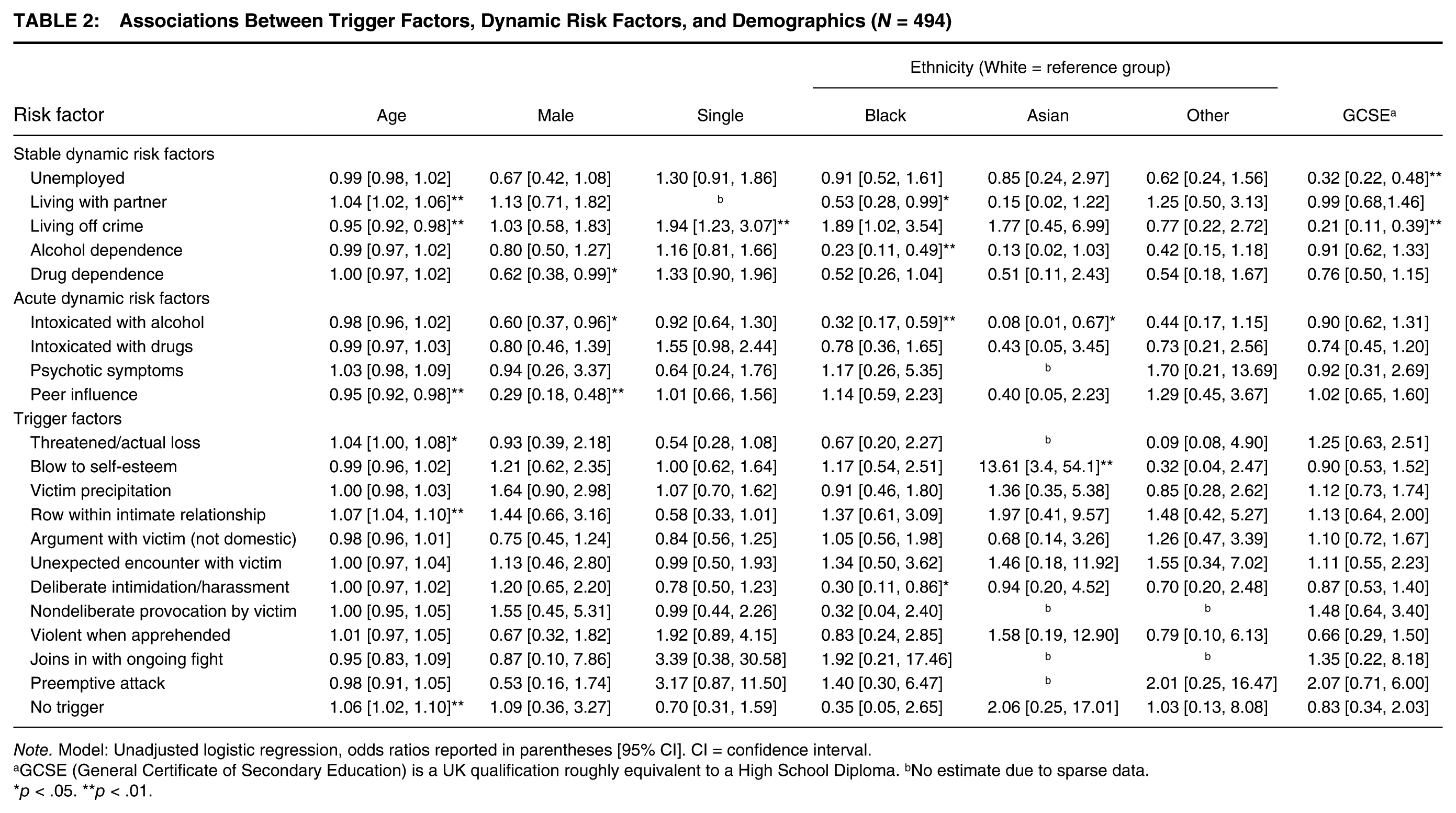
The logistic regression analyses presented in Table 2 demonstrate that, although all stable dynamic risk factors showed associations with demographic factors, there were few associations between acute risk or violence triggers and demographic factors.
Associations Between Trigger Factors, Dynamic Risk Factors, and Demographics (N = 494)
Note. Model: Unadjusted logistic regression, odds ratios reported in parentheses [95% CI]. CI = confidence interval.
GCSE (General Certificate of Secondary Education) is a UK qualification roughly equivalent to a High School Diploma. bNo estimate due to sparse data.
p < .05. **p < .01.
However, absence of a trigger factor in the offense was associated with older age (odds ratio [OR] = 1.06, 95% confidence interval [CI] = [1.02, 1.10], p = .004). Individual triggers of threatened or actual loss (OR = 1.04, 95% CI = [1.00, 1.08], p = .034) and a row within an intimate relationship (OR = 1.07, 95% CI = [1.04, 1.10], p < .001) both showed a specific relationship with older age in this sample. However, Black ethnicity was negatively associated with deliberate harassment/bullying by the perpetrator leading to violence (OR = 0.30, 95% CI = [0.11, 0.86], p = .025), relative to the White ethnic reference group; and the Asian group showed a higher propensity to experiencing a blow to self-esteem or insult prior to the violent offense, relative to the White reference group (OR = 13.61, 95% CI = [3.42, 54.10], p < .001).
Psychiatric Morbidity
Table 3 shows the association between dynamic and trigger factors and psychiatric morbidity. A similar pattern of significant findings was observed in the relationships between the different categories of risk factor and psychopathology as was with demography: There were few associations between trigger factors and psychiatric morbidity, slightly more for acute dynamic factors and many more for stable dynamic factors.
Associations Between Dynamic Factors, Triggers, and Psychopathology (N = 494)

Note. Model: Logistic regression adjusted for demography and psychiatric comorbidity odds ratios reported in parentheses [95% CI]. PCL-R = Psychopathy Checklist–Revised; PD = personality disorder; CI = confidence interval.
Cut off point for clinical psychopathy was taken as a score of 30 in line with manual recommendations (Hare, 2003). bNo estimate due to sparse data.
p < .05. **p < .01.
Logistic regression analysis controlling for demographic factors and psychiatric comorbidity identified that alcohol intoxication at the offense was positively associated with alcoholism (OR = 6.04, 95% CI = [3.84, 9.50], p < .001) and negatively associated with drug dependence (OR = 0.50, 95% CI = [0.31, 0.80], p = .003); drug intoxication was associated with drug dependence (OR = 3.06, 95% CI = [1.81, 5.17], p < .001), and personality disorder (OR = 1.94, 95% CI = [1.02, 3.69], p = .044), but showed no relationship with alcoholism. Psychotic symptoms at the offense were associated with prevalence of a psychotic illness (OR = 6.82, 95% CI = [2.08, 22.31], p = .001), and with alcoholism (OR = 3.94, 95% CI = [1.11, 13.94], p = .033).
A row within an intimate relationship was associated with depressive illness (OR = 2.61, 95% CI = [1.39, 4.88], p = .003), and depressive illness was negatively associated with incidents in which there had been nondeliberate provocation by a victim (OR = 0.19, 95% CI = [0.05, 0.67], p = .012). Psychopathy showed an association with deliberate harassment of the victim leading to violence (OR = 3.20, 95% CI = [1.49, 6.86], p = .004).
Planning and Temporal Associations of Triggers With Violence
We first examined the relationship between the presence of any trigger factor and whether the offense was planned or unplanned. Logistic regression analysis showed that, of unplanned offenses, 422 (90.8%) had no trigger for the violent offense; compared with only 43 (9.2%) of planned offenses with no trigger (OR = 23.83, 95% CI = [9.36, 60.68], p < .001).
Next, we considered the relationship between the type of trigger and the proximity of that trigger to the violent incident. In this analysis, we divided offenses into those where there was evidence of planning (n = 60, 12.3%) and those where no planning was apparent; and also into offenses where there was a distal trigger (n = 87, 17.6%); or a proximal trigger (n = 387, 78.3%). For each division, we conducted a logistic regression analysis with the trigger as the outcome variable and the dividing variable as the predictor, to examine whether the trigger was more likely to occur, respectively, closer or further to the offense; and/or with elements of planning.
Two triggers were more likely to occur in conjunction with an offense where there was evidence of planning, than in a nonplanned offense: blow to self-esteem or humiliation (OR = 2.15, 95% CI = [1.14, 4.05], p = .017); and deliberate intimidation or harassment by perpetrator (OR = 2.19, 95% CI = [1.20, 3.98], p = .010); an argument with a nonpartner victim was less likely to be planned (OR = 0.12, 95% CI = [0.04, 0.39], p < .001). In addition, three of the 12 triggers were more likely to occur as distal (i.e., occurring more than 1 hr before the offense) rather than proximal triggers: threatened or actual loss (OR = 2.44, 95% CI = [1.18, 5.08], p = .017); blow to self-esteem (OR = 3.65, 95% CI = [2.14, 6.25], p < .001); and unexpected encounter with known victim (OR = 2.44, 95% CI = [1.18, 5.08], p = .017). An argument with nonpartner victim was more likely to be a proximally occurring trigger than a distal one (OR = 0.51, 95% CI = [0.28, 0.93], p = .027).
Do Static Risk Factors Predict Dynamic and Trigger Factors?
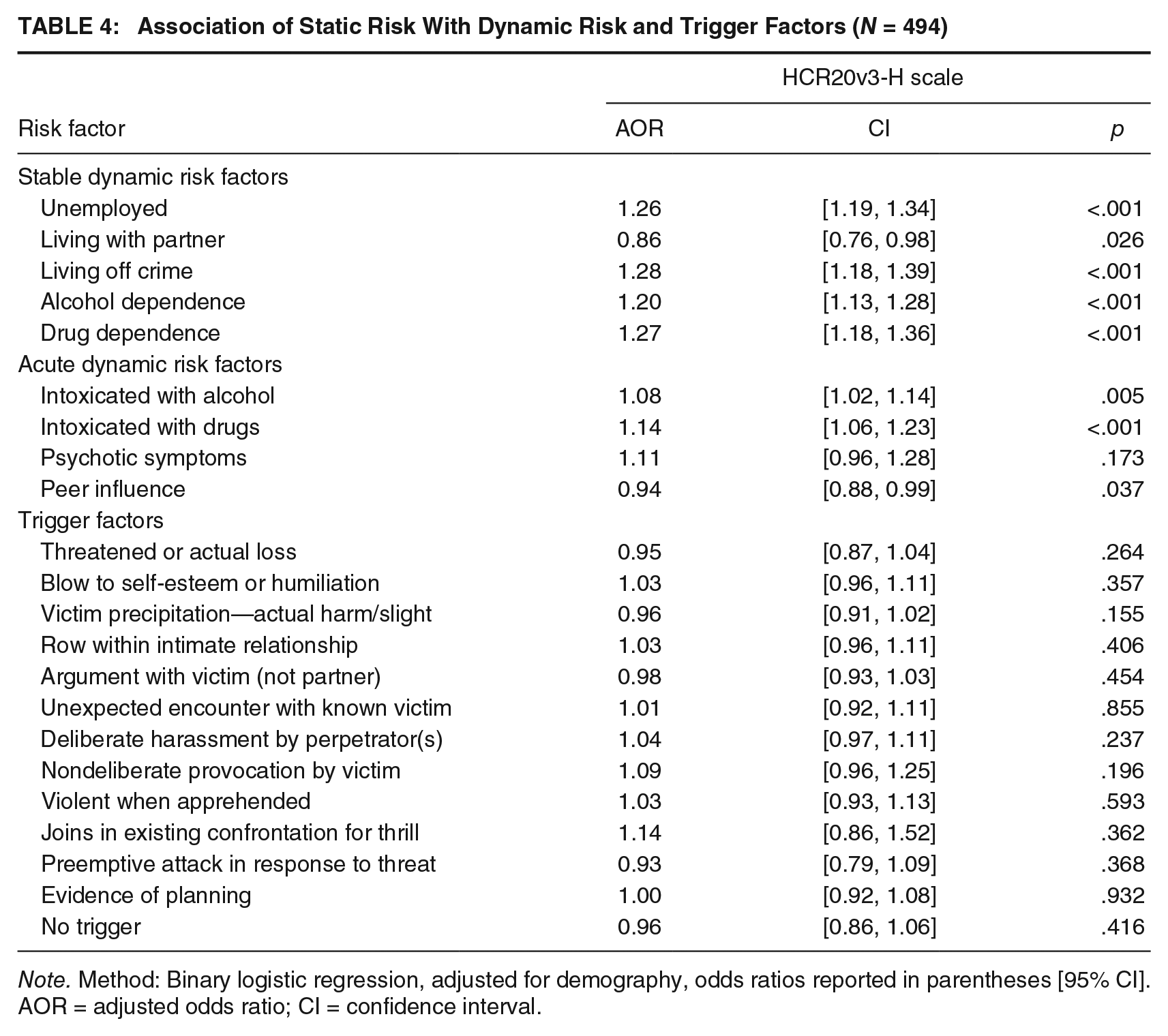
Table 4 shows the results of a logistic regression analysis of associations between historical (H) scale of the HCR20 with stable and acute dynamic risk factors and external trigger factors associated with violent offenses. In the table, the adjusted ORs demonstrate the strength of association between the historical score, measuring static risk prior to the violent offense, and dynamic and trigger factors.
Association of Static Risk With Dynamic Risk and Trigger Factors (N = 494)
Note. Method: Binary logistic regression, adjusted for demography, odds ratios reported in parentheses [95% CI]. AOR = adjusted odds ratio; CI = confidence interval.
Logistic regression analysis demonstrated strong positive associations between stable dynamic factors and HCR20 except for living with an intimate partner, which showed a significant negative association with higher static risk score (OR = 0.86, 95% CI = [0.76, 0.98], p = .026),. Static risk was strongly associated with being unemployed (OR = 1.26, 95% CI = [1.19, 1.34], p < .001), living off crime (OR = 1.28, 95% CI = [1.18, 1.39], p < .001), alcohol misuse disorder (OR = 1.26, 95% CI = [1.19, 1.34], p < .001), and drug dependence (OR = 1.27, 95% CI = [1.18, 1.36], p < .001). A higher level of static risk was also linked with acute dynamic risk factors of intoxication with alcohol (OR = 1.08, 95% CI = [1.02, 1.14], p = .005) or drugs (OR = 1.14, 95% CI = [1.06, 1.23], p < .001), but not symptoms of psychosis. High levels of static risk were negatively associated with the acute dynamic risk factor of peer influence (OR = 0.96, 95% CI = [0.88, 0.99], p = .037).
In contrast to the findings relating to dynamic risk items, static risk score showed no significant associations with any individual trigger factor. Furthermore, there was no association between static risk and either evidence of planning in the violent offense, or when there had been no trigger observed leading to the offense.
Can Trigger Factors Predict Future Violence?
To assess the predictive validity of our static risk measure, we first tested the ability of the HCR20v3 Historical (“H”) scale to predict future violent reoffending. Receiver operating characteristic (ROC) curve analysis using the STATA rocfit command demonstrated that, consistent with previous research findings, this scale was a highly significant predictor of violent reoffending after release (area under the curve [AUC] = 0.64, 95% CI = [0.59, 0.69], p < .001).
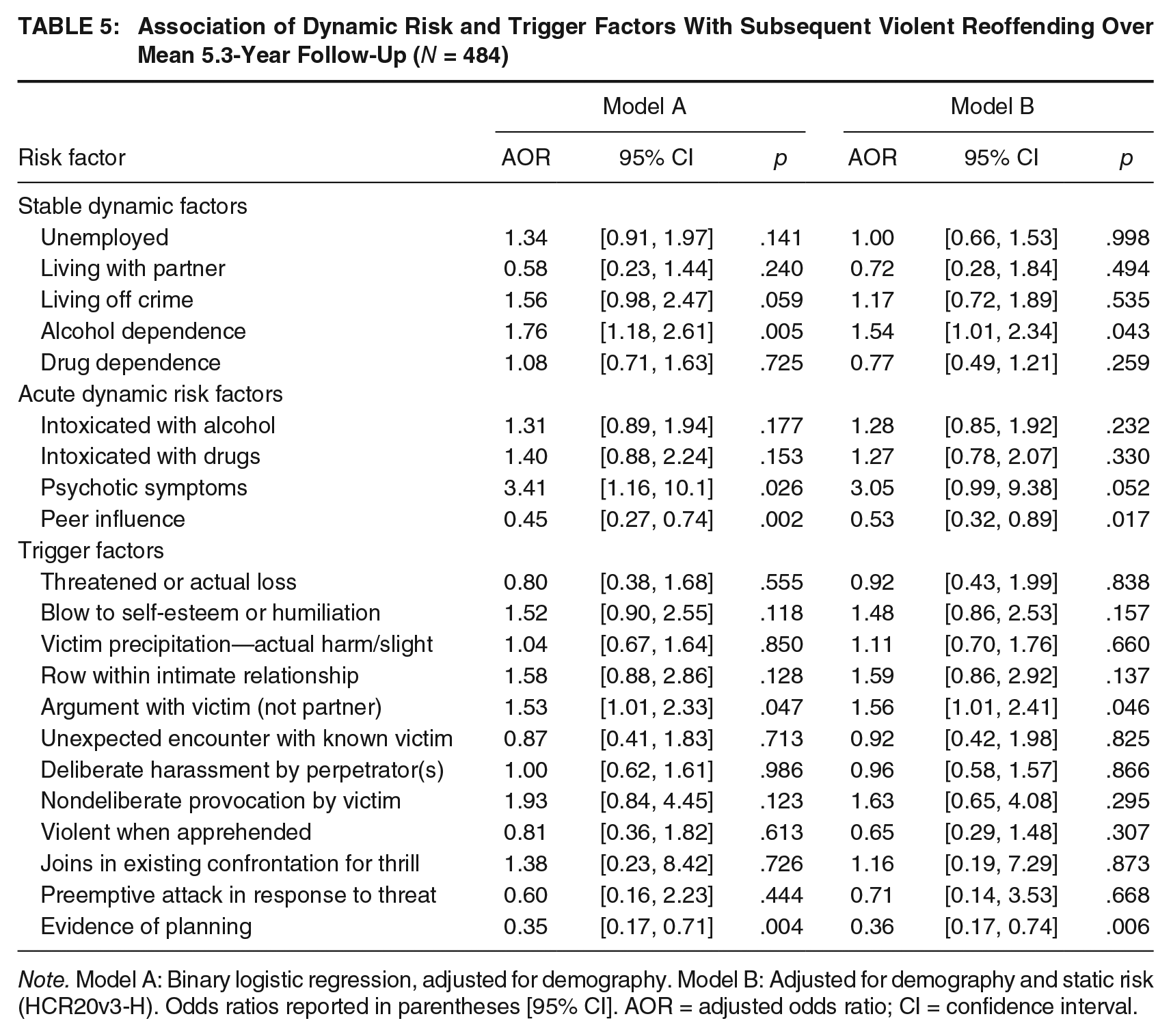
Table 5 shows the associations between dynamic risk factors and trigger factors, and subsequent violent reoffending following release from prison. Although the dynamic risk factors alcohol dependence, psychotic symptoms and peer influence were associated with future reconviction for violence, after adjustment for static risk measured using the H-scale of HCR20, only the association with alcohol dependence remained significant (OR = 1.54, 95% CI = [1.01, 2.34], p = .043).
Association of Dynamic Risk and Trigger Factors With Subsequent Violent Reoffending Over Mean 5.3-Year Follow-Up (N = 484)
Note. Model A: Binary logistic regression, adjusted for demography. Model B: Adjusted for demography and static risk (HCR20v3-H). Odds ratios reported in parentheses [95% CI]. AOR = adjusted odds ratio; CI = confidence interval.
Only the argument with a victim who was not in an intimate relationship with the offender showed a significant association with future offending (OR = 1.53, 95% CI = [1.01, 2.33], p = .047). Evidence of planning in the offense showed a negative association with subsequent violent reoffending following release (OR = 0.35, 95% CI = [0.17, 0.71], p = .004). These findings remained significant after adjustments for static risk.
Discussion
In this study, we explored whether external triggers for violence would be present in the index offenses of a sample of U.K. prisoners convicted of serious violent offenses. We identified 12 distinct triggers. At least one trigger was present in the majority of index offenses committed by this high-risk group, and some triggers showed an association with demographic factors, including age and ethnicity. Furthermore, although stable dynamic and acute dynamic risk factors present at the time of the offense could be statistically “predicted” by the presence of static risk factors, neither static nor dynamic risk levels could predict triggers unless that trigger occurred when an offender was apprehended in the commission of a separate, nonviolent offense. When trigger factors were included in regression models to predict future violent reconviction, only one trigger—arguments with a nonpartner friend or stranger—demonstrated a significant association with subsequent reconviction for violence. Conversely, where there was evidence of planning before the index offense, this was strongly protective of future violent reconviction.
The great majority of unplanned offenses were found to have a trigger. However, even in the case of planned offenses, nearly 10% of those with planned offenses were found to have some event in the pathway that was considered to be a triggering factor for their violence. This meant that, although the offense had been preplanned, for a subgroup of these violent offenses, a trigger had occurred which had a direct influence on the timing of the violence.
Construct Validity of Triggers and Relationship to Acute Risk
The triggers identified in this study showed considerable overlap with those identified in the existing literature, in particular with those found in a qualitative study of young male offenders by McMurran et al. (2012). Although their sample was all male, younger, and had committed exclusively alcohol-related violence, they reported six themes: taking offense, seizing an opportunity for material gain, helping others, perception of threat, distress, and seeking a fight. These mapped broadly onto the triggers identified in the present study. Many of these triggers have precedents in the experimental or qualitative psychological literature linking them with violent response. For example, taking offense to disrespect or perceived insult (Butler & Maruna, 2009), which corresponds to blow to self-esteem in the present study; perception of a threat when intoxicated (Giancola, Josephs, Parrott, & Duke, 2010); seizing an opportunity for material gain (McMurran & Cusens, 2005); or violence for fun or “for a thrill” (Graham & Wells, 2003). In addition, many triggers identified in these studies were predominantly external or environmental, and had no direct psychological explanation, such as unexpectedly encountering a known former or potential victim, but may have been indirectly influenced by a predisposition of the offender to grudges or revenge (Baumeister, Exline, & Sommer, 2008).
We found no association between mental disorder and particular triggers in most cases. Although, consistent with the literature, there were multiple associations identified between dynamic risk factors and mental disorder, we found only two significant associations between mental disorder and triggers. First, that if a row occurs in an intimate relationship, violence is 2.5 times more likely among serious violent offenders if the perpetrator is depressed. This suggests a susceptibility to a specific violence trigger within intimate partner rows to depressed individuals in a relationship. The second association was that of deliberate intimidation of the victim to provoke a violent altercation with presence of psychopathic disorder in the perpetrator, which was three times more likely to be present in individuals who precipitated an event with violence as a reaction. This trigger was suggestive of violence that is motivated by a desire for gratification by the offender, rather than in reaction to another stimulus (Cornell et al., 1996; Woodworth & Porter, 2002). Finally, lifetime presence of psychotic disorder was associated with the absence of any trigger. This suggested that the drivers for violence amongst offenders with a history of psychosis differ from those in nonpsychotic offenders, a finding that is increasingly acknowledged in recent research (Coid et al., 2013; Ullrich, Keers, & Coid, 2014). These findings are of particular interest in the context of an overall negative finding for the predictive role of triggers because they lend credence to the hypothesis that particular individuals with particular psychological profiles do have a tendency toward specific triggers.
However, we did not find similar violence triggers to those in other studies of acute risk (S. L. Brown et al., 2009; S. L. Brown & Zamble, 1998; Zamble & Quinsey, 1997) such as emotional or physical health problems or accommodation difficulties. Although we originally included these in our checklist, they were removed due to low prevalence in the sample. A possible reason for this discrepancy between the present study and previous literature may be the distinction, proposed in this study and absent from most prior studies, between triggers—such as a threat or insult from the victim—and acute risk factors, that show a statistical association with violence, such as intoxication or psychotic symptoms. For example, not everyone who is young, drunk, and/or psychotic will be violent; however, someone who is already disinhibited and under stress, and then subjected to a personal insult, or apprehended whilst stealing money to fund a drug habit, has an increased risk of responding violently to that environmental—or, more correctly, “interpersonal”—stimulus. Previous studies based on a predictive model of risk (Jones, Brown, & Zamble, 2010) have not made this distinction and have referred to, for example, “acute dynamic environmental triggers.” Although such factors are correlated with violence, and temporally precede a violent act, they may be confounded by third factors associated with them. The question “how does homelessness lead to violence” is not straightforward to answer without reference to mental disorder, drug use, and temperament, whereas “how does the threat of arrest lead to violence” has a clear logical connection: Violence is used to evade the threat of future sanction. Such triggered violence has previously been found to be responsible for over 25% of assaults on police officers in the United Kingdom (B. Brown, 1994).
This conclusion is strengthened by the evidence presented here that what we identified as acute dynamic risk factors for violence functioned mostly as expected. Acute dynamic risk factors were associated with some mental disorders and, unlike violence triggers, were significantly predicted by existing static and stable dynamic risk assessment instruments scored before the index offense. The very high prevalence of acute alcohol intoxication at the index offense—over 50% of violent crimes were committed whilst the perpetrator was drunk—has been noted elsewhere (Boles & Miotto, 2003). The identification of a link between intoxication and future reconviction does highlight a need for more direct risk management of those at risk of alcohol-related violence. Nevertheless, these same individuals are likely to have been repeatedly violent on occasions when they demonstrated no violence, indicating the necessary component in the pathway toward violence of other factors and in most cases a trigger factor for violence to occur.
Although some acute risk factors—specifically alcohol intoxication and psychosis—showed some predictive power over future offending, violence triggers did not predict future violence except weakly in the case of the index offense arising out of an argument. Moreover, the presence of planning in the index offense showed a strong negative association with future violence. This at first seems counterintuitive, as one might expect planned violence to be more calculated. However, based on our analysis of the proximity of triggers to the offense, it may equally be the case that “planned” offenses were more likely to be revenge attacks. There is some limited evidence that arsonists do not reoffend when the motive for the original crime was revenge, rather than pyromania (Rice & Harris, 1996).
These findings provide a complex and nuanced picture of the role of triggers in violent offending. We originally proposed that violence triggers may be entirely idiosyncratic, external, or environmental in nature, and hence unpredictable. Although this was confirmed in our study, there were indications that trigger factors are not entirely random occurrences; they show complex links with mental disorder and static risk. It appears that triggers do not fit clearly into established paradigms of static, dynamic and acute risk; why this is the case merits further consideration. It seems as though violence triggers do not function in the same way as traditional (i.e., static or stable dynamic) risk factors, but are highly situational and complex, with links to personality, but limited association with dynamic risk factors or future risk of general violence.
If this hypothesis is to be tested or interpreted further, it is likely that, first, prospective studies will need to be designed to collect detailed information on violent individuals’ state of mind and acute risk at the time of—or immediately prior to—the violence (e.g., Coid et al., 2013). Second, statistical modeling should focus not on establishing associations or prediction, but on the creation of causal models based on longitudinal data, which can account for multiple confounding risk variables. Only in this way could the possibility of a unique impact of violence triggers for individuals fitting a specific profile be confirmed or discounted.
Limitations
This was an exploratory study featuring retrospective observer-based ratings from collateral information that necessarily contained some subjectivity and interpretation. While every effort was made to ensure clarity and consistency of the ratings, it is possible that some offenders gave inconsistent and/or contradictory accounts of their offense, or that material was so ambiguous that ratings may have been subject to some disagreement. In mitigation, several findings of the study suggested construct validity—for example, the association between psychopathy and deliberate intimidation—and IRR of the acute factor checklist was acceptable.
One limitation of the study was that, while it was originally designed to identify new potential risk factors, motivations, and pathways for violent offending and their associations with psychopathology (Coid et al., 2007), it was not specifically designed to identify trigger factors. During the course of analysis of the data for other purposes, it was discovered that there were external trigger factors that did not correspond to either a motivation or a preidentified dynamic risk factor. Although not specifically designed to identify trigger factors, it does therefore have the advantage of providing a potential validation for the “trigger” concept itself, which has previously only been validated in studies designed to identify triggers. Similarly, this retrospective design meant that we had no way to ensure that we were compiling an exhaustive or complete list of triggers as these would be limited by the specific nature of the sample (high-risk offenders in U.K. prisons). In particular, the focus on external triggers in this article was an artifact of the data collection, in that no systematic measure was made of offenders’ cognitive or emotional responses at the time of the offense; only the “facts of the case” in terms of the sequence of events described in the offenders’ account and/or court depositions.
In some cases, data gathering was limited by suggestions that the offender’s account of the offense was not accurate, but there was no contradicting evidence obtained by the interviewer. Due to specific taboos on violence against women or children, offenders may have been reluctant to disclose details about this type of offense. One offender gave an account of an offense against a male neighbor—for which he was not convicted—unrelated to his convicted offense of sadistic violence against a young child. In this case, however, collateral information was available in order to construct a more realistic account of the violent offense for rating purposes. Other cases, however, had to be omitted where an account was unrelated to the index conviction, but no collateral was unavailable.
Furthermore, a lack of statistical power for some calculations where numbers were small have to be taken into consideration. Despite the large study numbers and long follow-up, the range and idiosyncrasy of potential triggers for violence may require a higher number of cases to be detected accurately. For this reason, we recommend that future research be prospective, and focused on the presence of acute risk factors in environments where their presence or absence can be more readily detected and recorded (e.g., in forensic mental health settings). Moreover, such studies should include a wider range of outcomes beyond conviction for violence to include incidents of nonconvicted aggression.
Conclusion
External triggers for physical violence have been shown to be random events that cannot be predicted from static or dynamic risk factors, and their presence cannot predict whether an individual will violently reoffend. Rather, they appear to be linked to an individual offender’s specific psychological characteristics, in particular certain forms of mental disorder. In this, triggers are distinct from “acute dynamic risk factors,” which are proximal to a violent offense but are not a necessary or sufficient condition for the occurrence of the violent offense in themselves. Presence of these acute factors can, unlike triggers, be predicted by some risk assessments, and they are associated with future violence.
We believe that our study has provided some evidence to suggest that trigger factors differ from stable and acute dynamic factors. Unlike dynamic risk factors, triggers are not predictable from demographic factors or mental disorder, and, most importantly, are differentiated by a lack of association with static risk. This may suggest that trigger factors are linked to underlying personality factors such as impulsivity or anger control, which we did not specifically measure in this study, which may influence the outcome of a trigger in a given context.
In contrast to static measures of risk, we did not find trigger factors were predictive of future reoffending. If triggers are random and unexpected events, then this would be a logical inference. However, we also found in this study that the stable and acute dynamic factors we measured showed poor predictive ability relative to static risk, and this was unexpected. This would indicate that in this study, whilst showing many key differences between the two, we were unable ultimately to finally confirm a complete distinction between acute dynamic factors and triggers.
Footnotes
Appendix A
Appendix B
Acknowledgements
The authors would like to thank the three anonymous peer reviewers for their constructively critical comments on earlier versions of this manuscript and Dr. Jaime S. Henderson for her perseverance with us through the many necessary amendments.
The authors were funded from a program grant from the U.K. National Institute of Health Research (RP-PG-0407-10500).