



Abstract
African American women are positioned at the intersection of multiple disadvantaged statuses and disproportionately affected by criminal justice policies, as evinced by their increased likelihood of incarceration. Yet they continue to be overlooked in mainstream criminological research. Using data from 418 African American women in the B-WISE (Black Women in a Study of Epidemics) project, the present study investigates the relationship between several prominent stressors occurring in five social contexts and criminal thinking as a coping strategy. Findings indicate that criminal thinking may be one maladaptive coping mechanism to manage stressors, such as gendered racism, financial stress, and network loss, that occur across these multiple social contexts for African American women in prison and on probation. Spirituality, on the other hand, seems to operate as a buffer. Implications for practice include promoting programs that strengthen a sense of collective identity in the community, as well as hiring more African American women who could provide additional culturally competent behavioral health services in criminal justice professions.
Keywords
Introduction
The War on Drugs and America’s ensuing “race to incarcerate” (Alexander, 2012; Mauer, 2006) has undoubtedly gravely affected minority populations. Specifically, according to Carson and Sabol (2012), the number of women in prison, one third of which were sentenced for drug offenses, increased by 587%, from 15,118 in 1980 to 111,387 in 2011. Female imprisonment increased at almost 1.5 times the rate of males during that same time period (637% vs. 419%), and more recently has continued to increase at nearly double the rate. Currently, about 1 million women are under criminal justice supervision. Like men, a woman’s likelihood of incarceration varies greatly by race—one in 18 African American women face incarceration in their lifetime, making them 2.5 times more likely to be incarcerated than White women and almost as likely as White males (one in 17; Guerino, Harrison, & Sabol, 2011). Despite the documented fact that African American women are disproportionately disadvantaged and affected by criminal justice policies, they continue to be overlooked in mainstream, criminological research. This oversight is important as African American women involved in the criminal justice system are at the intersection of multiple disadvantaged statuses and experience high levels of stress (Jang & Johnson, 2005).
Using data from 418 African American women in prison and on probation in the B-WISE (Black Women in a Study of Epidemics, R01DA022967, PI: Oser) project (see Oser, Bunting, Pullen, & Stevens-Watkins, 2016; Perry, Pullen, & Oser, 2012 for additional methodological details), the present study investigates the relationship between several prominent stressors occurring in five social contexts (i.e., employment and finances, personal illness or injury, social network loss, child victimization, and gendered racism) and criminal thinking as a coping strategy. The overall objective of the current research is to develop a better understanding of the various stressors and traumas criminally involved African American women experience and how they affect levels of criminal thinking to develop and implement solutions to address these issues.
Salient Stressors in the Lives of African American Women
Stressful or traumatic life events can vary in intensity and occur in different life domains. They can be emotional or physical, and often require adaptation and adjustment on the part of the affected individual (Nevid & Rathus, 2003). Miller and Smith (2012) differentiate between acute, or short-term, stress, and chronic, or long-term, stress. Chronic stress can be a result of traumatic events or structural inequality, and is associated with a host of negative outcomes. The negative consequences of acute and chronic stress are well documented in the literature (e.g., Burt, Simons, & Gibbons, 2012; Perry, Harp, & Oser, 2013; Stevens-Watkins, Perry, Pullen, Jewell, & Oser, 2014). While few are immune to stressful experiences, researchers have highlighted that some individuals are at greater odds of not only experiencing negative and stressful life events but also experiencing them more frequently than others. Evidence from these studies suggests that African American women are disproportionately experiencing stress, partially due to their multiple disadvantaged status (Greer, 2011; Hatch & Dohrenwend, 2007; Pearlin, 1999; Warnecke et al., 2008). African American women occupy a unique space in society, in that their existence operates at the intersection of race and gender. The women in the current sample find themselves not only at the intersection of race and gender but rather experience the stressors discussed below as criminally involved, poor, un(der)employed, traumatized, drug-involved women of color. The stress experienced by the women in the present study, and its impact on criminal thinking (i.e., a form of maladaptive coping), has to thus be couched in the interplay of the aforementioned factors, rather than treating demographics and identities as simple independent and unconnected predictors of behavior and attitudes. Intersectionality scholars assert that individuals experience and process life events from the intersections of various social identities and oppression, and these perspectives affect, among other outcomes, behavior (Carr, Rosenfeld, Magyar, & Rotter, 2009; Shields, 2008).
Intersectionality has been studied with regard to negative (mental) health outcomes (Cole, 2008; Collins, 1990) and certain types of adaptive coping (Carr et al., 2009). However, to date, no study has examined the impact of the various types of stress on a maladaptive coping mechanism (criminal thinking) among criminally involved African American women. Four individual stressors in different social contexts (i.e., economic and finances, personal injury and accidents, social network loss, and adult victimization) as well as the culturally specific stressor of gendered racial discrimination are very salient in the lives of African American women. These often co-occur and exacerbate the issues sparked by each other’s presence.
Financial
Among the most salient stressors is economic disadvantage, to which African American women are exposed disproportionately. This relationship is compounded by their more common involvement in the criminal justice system due to the repressive crime policies of the past decades (Alexander, 2012). Economic disadvantage is a stressor that can be linked to various underlying social structural inequalities affecting African American women in general, and criminally involved African American women more specifically. Research shows that compared with males, a greater number of female offenders are not fully employed when arrested, and many live below the poverty level and depend on public assistance.
Occupying space in a low socioeconomic strata is intimately intertwined with a host of well-documented collateral damages. One of the most far reaching realities of many African American women are the consequences of decades of disenfranchisement and mass incarceration that disproportionately affected poor African American neighborhoods and the individuals residing there. Specifically, African American women face a loss of potential same-race male partners due to incarceration and must serve as the head of the household, which affects the financial standing of families in the African American community (Alexander, 2012; Braman, 2004). Moreover, a study by Pager (2003) found that individuals with criminal records have problems finding employment and maintaining a steady source of sufficient income, thus exacerbating the cycle of poverty and economic deprivation. While the sample population in Pager’s research did not include African American women, there is no obvious reason why this relationship would be different for them.
Health
With respect to health and personal injury, racial and gender disparities exist in the United States with African American women experiencing worse overall health as compared with their White counterparts (Williams & Sternthal, 2010). Mental health issues, such as depression, are also strikingly more prevalent among African American women, compared with both Whites and African American men (Cutrona et al., 2005). Augmenting the potential negative effects of poor (mental) health is the fact that African American women are less likely to be insured and to seek preventive care or other forms of health services (Institute of Medicine, 2001; Oser et al., 2016; Pullen, Perry, & Oser, 2014). While access to health care is a contributing factor to racial health disparities, research also suggests that African Americans are often not trusting of health care providers, especially in light of scientific and institutional racism (such as the infamous Tuskegee experiments; Institute of Medicine, 2001; Sewell, 2015). According to the Institute of Medicine (2001) and other scholars (Kerrison, 2015; Pullen et al., 2014; Stevens-Watkins et al., 2014), this leads to more health stressors and the lack of adequately addressing incidents of personal illness and/or injury. In addition, health disparities are heightened when the individual is involved in the criminal justice system, evinced by the significant portion of criminal-justice-involved women who suffer from drug addiction, PTSD, and/or mental illness. Poor health diminishes adaptive coping capabilities and increasing the likelihood that the stress experienced to health issues and other (related or unrelated) stressors is handled through maladaptive coping mechanisms, such as criminal thinking.
Social network loss
Health-related issues such as personal injury and accidents also have implications for social network loss. For example, higher mortality rates within one’s social group due to health issues or accidents results in smaller social networks. It is a well-established fact that for decades African Americans have had the highest mortality rates among racial and ethnic groups in the United States (Jemal et al., 2008; Satcher et al., 2005). More specifically, African Americans have higher mortality for most of the leading natural causes of death in the United States, which include heart disease, stroke, and cancers, as well as HIV/AIDS (Center for Disease Control and Prevention, 2013). Related to this is the finding that African Americans are at a higher risk of death due to homicide, which is partially attributed to the increased likelihood of residing in socially unstable low-income neighborhoods with increased exposure to violence (Arias, Rostron, & Tejada-Vera, 2010). Many of the racial differences in mortality rates can be linked to longstanding inequalities in economic status, education, and occupation (Warner & Hayward, 2006).
Social network loss in the present study also relates to separation from a significant other and/or marital dissolution. Compared with Whites and Hispanics, African Americans are less likely to marry, report lower levels of relationship satisfaction, and are more likely to divorce (Amato, 2012; Aughinbaugh, Robles, & Sun, 2013; Marsh & von Lockette, 2011). In the past, some found that the racial gap in marital dissolution could be traced back to differences in income and education (see Cherlin, 1998). A more recent study using the National Longitudinal Survey of Youth (NLSY79) found that two factors increased the likelihood of divorce among African Americans. Specifically, current household income and childhood family structure were predictive of divorce among adult African Americans. The risk of divorce was significantly reduced among African Americans with higher levels of income who grew up in a household with both parents (Amato, 2012). The reasons for social network loss among criminally involved African American women are varied and can create life circumstances for which adaptive coping is increasingly difficult.
Victimization
Empirical evidence shows that African American women are more likely to be victimized as adults compared with other racial/ethnic groups (Logan, Walker, Jordan, & Leukefeld, 2006; Truman & Langton, 2015). According to Black and colleagues (2011), about 4 out of every 10 African American women experience physical or sexual victimization by a partner in their lifetime, and for low-income women of color, this victimization is more likely to be lethal (Benson & Fox, 2004; West, 2005). Richie (2000) adds that low-income women of color are “most likely to be in both dangerous intimate relationships and dangerous social positions” (p. 1136). Studies on the prevalence of intimate partner violence have found that racial and ethnic differences disappear when socioeconomic factors are taken into account (Cho, 2011; Logan et al., 2006; Rennison & Planty, 2003), further underscoring the need to contextualize the experience of the women in this study at the intersection of multiple marginalized statuses (Sokoloff & Dupont, 2005).
Gendered racism
Race scholars contend that racism is a source of chronic strain and psychological distress for African Americans (Brown & Keith, 2003; Kwate, Valdimarsdottir, Guevarra, & Bovbjerg, 2003; Landrine & Klonoff, 1996; Stevens-Watkins et al., 2014). According to Plummer and Slane (1996), coping mechanisms and management skills may be particularly challenging for those experiencing chronic racist events. Unfortunately, racial discrimination is not the only form of discrimination African American women encounter. Their particular social space at the intersection of race and gender also carries a very specific form of discrimination, namely, gendered racism (Essed, 1991), that has been shown to not only affect employment opportunities (Skaggs, 2012) and health measures (Perry et al., 2013) but also levels of psychological distress (Bowleg, 2013; Collins, 1998; King, 2003; Moradi & Subich, 2003; Stevens-Watkins et al., 2014). The overall effects of gendered racism are in line with the general principles of stress proliferation and models of cumulative disadvantage and may potentially intensify the maladaptive stress response to subsequent negative incidents (Geronimus, Hicken, Keene, & Bound, 2006; Perry et al., 2013).
Underscoring the importance of the debilitating effects of gendered racism, Perry and colleagues’ (2013) analysis of African American women from low SES backgrounds found that women facing substantial discrimination due to their race and gender were vulnerable to numerous other types of stressors. In particular, adult victimization and employment and financial stressors were strongly related to gendered racism (Perry et al., 2013). Accounting for the research findings reported above, it should then come as no surprise that African American women under criminal justice supervision represent a subgroup among African American women who, due to their extremely marginalized status, are even more likely to report instances of gendered racism in their lives, both in the community and during their incarceration (Henriques & Manatu-Rupert, 2001).
Other Culturally Relevant Factors
In addition to the stated stressors, a number of cultural factors salient in the lives of the women in the sample may be associated with criminal thinking. For the present study, three factors that have been specifically linked to African American culture are explored: ethnic identity, spirituality, and cultural mistrust. To answer the question of whether these would serve as protective factors or increase the risk of criminal thinking, we turn to the larger cultural socialization literature.
Ethnic identity
Rotheram and Phinney (1987) defined ethnic identity as “one’s sense of belonging to an ethnic group and the part of one’s thinking, perceptions, feelings, and behavior that is due to group membership” (p. 13). Decades of research have produced important findings on the relationship between ethnic identity and a host of psychological as well as behavioral outcomes (see Arroyo & Zigler, 1995). For instance, a positive ethnic identity has been associated with lower levels of depression, high self-esteem, and overall psychological well-being (Goodstein & Ponterotto, 1997; Phinney, Cantu, & Kurtz, 1997; Smith & Brookins, 1997). In addition, ethnic identity is negatively associated with antisocial behaviors (Jagers & Mock, 1993; Rotheram-Borus, 1990). Ethnic identity has also been established as a buffer for racial discrimination (Burt et al., 2012). Therefore, a positive ethnic identity is generally believed to function as a protective factor from the negative effects of racial discrimination, lowering the likelihood of criminal thinking or behavior as a coping mechanism. However, Bennett (2006) found that the buffering effect of ethnic identity did not hold with a sample of young African American females, thus identifying a need for more research. Most of the existing research utilized adolescent samples; thus, studying this concept with criminally involved African American women is a gap in the literature the present study is attempting to fill.
Spirituality
Spirituality and the related construct of religion are foundations of the African American community (Staton-Tindall, Duvall, Stevens-Watkins, & Oser, 2013). In particular, spirituality is salient for many African American women whose lives at the intersection of gender and racial marginalization are burdened with many forms of adversity (Mattis, 2000). Various studies have concluded that spirituality serves as a protective factor against many negative health behaviors for African American women (Paranjape & Kaslow, 2010; Staton-Tindall et al., 2013; Watlington & Murphy, 2006). The idea that spirituality and criminal thinking are inversely related makes intuitive sense, and is in line with criminological theories. Spirituality is also a key component of many rehabilitation programs offered to ex-offenders, further underscoring the idea that spirituality may reduce recidivism. However, some contend that strong spirituality for African American women might indeed impede their access to institutionalized health care services (Hankerson et al., 2013; Neighbors, Musick, & Williams, 1998), which could potentially have negative health outcomes, which in turn are associated with maladaptive coping mechanisms, such as criminal thinking. Empirical evidence on the spirituality–criminal thinking link thus warrants further study, especially among the multiply marginalized African American women involved in the criminal justice system (for a review on the literature, see Giordano, Longmore, Schroeder, & Seffrin, 2008).
Cultural mistrust
The notion that African Americans have developed a sense of cultural mistrust due to historical and contemporary oppression and racism dates back decades and is well-established (e.g., Grier & Cobbs, 1968; Whaley, 2001). Research has found support for a positive correlation between levels of mistrust and criminal behavior among samples of African Americans (for an extensive review, see Terrell, Taylor, Menzise, & Barrett, 2008). Four areas where cultural mistrust of Whites most often surfaces have been identified (Terrell & Terrell, 1981): educational, political/legal, work, and interpersonal/social settings. African American women often deal with various intersecting sources of oppression, as pointed out by intersectionality scholars. Terrell and colleagues (2008) reviewed 125 studies on the correlation between cultural mistrust and behavior and found wide support for theoretically predicted outcomes, namely, that cultural mistrust influences African American’s behavior in a variety of settings. More specifically, Biafora and colleagues (1993) associated high cultural mistrust in African American youth with greater likelihood of antisocial behavior. Cultural mistrust is linked to experienced or perceived discrimination (Terrell & Terrell, 1981), and observed among African American males as well as females (Fyffe, 2000). Cultural mistrust among criminally involved African American women as a correlate of criminal thinking has yet to be empirically examined.
Criminal Thinking
Walters (2006) defined criminal thinking as the “thought content and process conducive to the initiation and maintenance of habitual lawbreaking behavior” (pp. 87-88). The predictive power of criminal thinking patterns on criminal behavior is solidly acknowledged in the literature (e.g., Andrews & Bonta, 1994; Gendreau, Little, & Goggin, 1996; Simourd & Olver, 2002; Walters, 2006), supporting the notion that the likelihood of committing a criminal offense is significantly higher if the individual engages in criminal thinking. Many traditional theories of crime, such as Hirschi’s (1969) social control theory, Sutherland’s (1947) differential association theory, and Cloward’s (1959) strain theory include criminal beliefs as central constructs. Simourd and Olver (2002) contend that “the general personality and social psychology perspective (Andrews & Bonta, 1994) views criminal attitudes as one of the “big four” risk factors that play a strong role during the ‘psychological moment’ of crime” (p. 428). Several meta-analyses by Gendreau and colleagues (1996) further evinced that criminal attitudes are very strong predictors for criminal behavior and recidivism.
Past research on gender differences in criminal thinking has led to mixed findings, and seem to depend on the specific instrument used in the respective studies. While Walters (2002) argued that women exhibit higher levels of criminal thinking, others found the opposite to be true (e.g., Holsinger, Lowenkamp, & Latessa, 2003; Manchak, Skeem, Douglas, & Siranosian, 2009). Similar inconsistencies exist with regard to race and criminal thinking. Here, the operationalization of race seems to play a role, as well as the type of instrument used in the study. For example, in a study that dichotomized race, White offenders reported lower levels of criminal thinking than non-Whites (Walters & McKoy, 2007). However, an earlier study by Walters (2002) that included three racial categories (White, Black, and Hispanic) found that Black offenders demonstrated the highest levels of criminal thinking, while no significant differences were detected between Whites and Hispanics. Dembo, Turner, and Jainchill (2007), using a different instrument, found no significant racial differences in their sample with respect to criminal thinking.
Comprehensive research in the area of cognitive development indicates that negative personal experiences lead to the development of cognitive structures through which individuals interpret subsequent experiences, meaning that criminal thinking is likely influenced by a person’s personal life experiences (see Flavell, Miller, & Miller, 2002). Experiencing persistent individual and social stressors leads to changes in how the affected individual explains and rationalizes behaviors and experiences (Cuadra, Jaffe, Thomas, & DiLillo, 2014). Research and theory have linked criminal behavior with a host of individual, structural, and environmental factors, none of which have been proven to solely pose an exclusive causal influence. As discussed in more detail below, a sizable body of research points to associations between stressors and crime (e.g., Felson, Osgood, Horney, & Wiernik, 2012; Hoffmann & Su, 1997), such as racial and gender discrimination, death or illness, unemployment, relationship or financial problems. However, despite consistent support in research, relatively little attention has been paid to the link between stressors and criminal thinking (Knight, Garner, Simpson, Morey, & Flynn, 2006; Simourd & Olver, 2002), and African American women have been largely overlooked in this respect.
Evidence of a relationship between stressors and criminal thinking among Black women would be important because the rationale for studying criminal thinking in the past has largely focused on the understanding of how it predicts criminal behavior and whether changes in criminal thinking translate to changes in actual behavior. In other words, criminal thinking has mostly been examined for its role in predicting crime or recidivism. In the present study, however, we are interested in examining individual and culturally relevant factors that lead to criminal thinking in a largely understudied population, criminally involved African American women. By doing so, we hope to increase the understanding of whether and how particular salient stressors influence the individual’s criminogenic attitudes, and whether that relationship is mitigated by culturally relevant protective factors.
One notable exception is the recently developed theory of African American offending by Unnever and Gabbidon (2011) that focuses specifically on the issues of racial discrimination experienced by African Americans and the degree to which these encounters influence criminal behavior. Rather than superseding more traditional theories of offending, Unnever and Gabbidon’s (2011) theory is meant to be a supplement. Among others, the authors incorporate elements and evidence from Agnew’s general strain theory (e.g., strain–anger–offending) and contextualize the processes within the social historical experience that is shared by most African Americans in the United States. They argue that African Americans, unlike any other racial group (e.g., Whites) or other ethnic minorities (e.g., Hispanics), have a unique racial lens that informs their beliefs and behaviors, especially as they relate to the salience or race and how racism impacts their lives in the U.S.” (Unnever & Gabbidon, 2011, p. 27)
In short, they assert that African Americans know that their race matters, and that their experiences with discrimination related to their race influence the likelihood of African Americans’ engagement in criminal behavior.
The Present Study
The present study makes three unique contributions to the literature. First, there is a limited body of research on African American women, despite their over-representation in the criminal justice system and disproportionate burden of individual and social stressors. Second, no studies have examined how stressors correlate with criminal thinking, despite the strong link between criminogenic thinking and involvement in crime. Moreover, this study explores multiple individual stressors as well as the culturally specific stressor of gendered racism and their relationship with criminal thinking. Third, this study also examines whether culturally relevant risk and protective factors are associated with criminal thinking among African American women, which are often excluded from the literature.
The following research questions are examined in the present study:
It is hypothesized that prisoners will experience significantly more stressors, report more cultural mistrust, and lower levels of ethnic identity and spirituality than their counterparts on probation. In addition, it is hypothesized all stressors will be positively associated with criminal thinking and that the culturally specific social stressor of gendered racism will be the most robust correlate. Moreover, it is expected that African American women with a strong ethnic identification, high levels of spirituality, and less cultural mistrust will report lower levels of criminal thinking.
Method
Sample
Data for the present study were derived from a larger federally funded project titled Black Women in a Study of Epidemics (B-WISE) collected between 2008 and 2011. The purpose of B-WISE was to examine health problems and health services utilization among African American drug-using and nondrug-using women across various segments of the criminal justice system (i.e., women in prison, on probation, and not currently involved in the criminal justice system). Additional methodological details are available elsewhere (Luke & Oser, 2015; Oser et al., 2016; Perry et al., 2013; Perry et al., 2012; Staton-Tindall et al., 2013; Stevens-Watkins et al., 2014). Only data from the prison and probation samples were used for the current analyses (n = 437).
Study eligibility criteria included (a) self-identifying as an African American, (b) being at least 18 years or older, (c) willing to participate in the study, and (d) speaking English. For the prison sample, a liaison at the three women’s prisons in Kentucky provided a list of African American women who were eligible for community re-entry within 60 days (i.e., either serving out their sentence or seeing the parole board) each month. The potential participants were mailed an individual recruitment letter to attend an information session at the prison. The letter stated that both attending the information session and participating in the study were voluntary, and no information would be shared with correctional staff. At the information session, voluntary participants who met all eligibility criteria were scheduled for a data collection appointment with a trained African American female interviewer in the visitation or multipurpose room. No correctional officers or other inmates were nearby during the data collection. For the probation sample, trained African American female interviewers approached all African American women in the waiting room of the seven probation districts in Kentucky for eligibility screening. These probation districts were chosen because they were the districts with the highest percentages of African Americans under community supervision in the state. Interested and eligible participants were given an appointment time to complete an interviewer-administered survey in a private location other than the probation office (e.g., a private office at a university, in a community-based organization, at a public library).
Prior to data collection, informed consent was collected from participants. All survey data were collected by trained African American female interviewers using laptops outfitted with computer assisted personal interviewing (CAPI) software. Participants were compensated US$20 for participating in the 1.5-to 2-hr-long interview. Study procedures were approved by a University’s Institutional Review Board, and participants were protected by a federal Certificate of Confidentiality.
Measures
The dependent variable of interest, criminal thinking, was measured using a modified version of the Criminal Thinking Scale (CTS; Knight et al., 2006). The overall CTS included 32 items, which were measured on a Likert scale ranging from 1 (strongly disagree) to 5 (strongly agree). Responses for the items in the scale were summed, divided by the number of items included (yielding an average), and multiplied by 10 to rescale final scores so they ranged from 10 to 50. Higher scores indicated more criminal thinking, and the overall internal validity was strong (α = .90).
Six sociodemographic variables were included in the multivariate models. Age was measured in number of years, and number of kids was a count variable. Education was examined as a dichotomous variable (1 = high school diploma, 0 = no high school diploma), as was marital status (0 = not married, 1 = married). Annual household income was coded in thousands of dollars. Illicit drug use in the past year on the streets was a dichotomous variable (1 = drug use, 0 = no drug use).
Four of the five stressors were measured using items from The Traumatic Life Events Questionnaire (TLEQ; Kubany et al., 2000). The TLEQ was intended to capture a person’s “trauma history,” and measures exposure to variety of stressful events. For each item, participants were asked how often they had experienced the specific event in the past year. Response categories ranged from “never,” “once,” “twice,” “three times,” “four times,” “five times,” to “more than five times.” The TLEQ was modified in the B-WISE project to capture more common stressors and to make the instrument more applicable to the experiences of African American women with criminal histories. Specifically, questions about relationships, employment, and financial problems were added to the questionnaire, and questions pertaining to natural disasters and combat experiences were omitted. Similar to the approach used by Perry and colleagues (2012), the stressful events were separated into four categories of individualized stressors: employment and financial, personal health and injury, social network loss, and victimization. The employment and financial stressor was comprised of three items including being laid off/fired, unsuccessfully seeking work, and having a major financial crisis. Three items comprise the personal health and injury stressor including an accident that resulted in injury or death to another, serious motor vehicle accident, or life-threatening personal illness. Social network loss, based off of four items, includes such traumatic events such as separation or divorce or death of a loved one. Seven items comprise the victimization stressor including a broad range of traumatic events ranging from being the victim of a robbery that involved a weapon to stalking or physical abuse by a significant other. The number of stressful events in the past year was calculated by summing the scores for all the items in the subscale, with higher scores indicating experiencing more stressful events in that subscale.
The culturally specific social stressor of gendered racism was also examined. The gendered racism scale was created using the Schedule of Sexist Events (SSE; Bowleg, Neilands, & Choi, 2008) and the Schedule of Racist Events (SRE; Landrine & Klonoff, 1996). These two instruments asked participants about their experience of unfair treatment “because you are a woman” and “because you are Black,” respectively. The 10 items in the SSE and the 12 items in the SRE were combined into one scale for the theoretical and methodological reasons articulated by Perry and colleagues (2012) including difficulties attributing the cause of unfair treatment to one’s race versus gender, multicollinearity between the sexist and racist event scales, combining the scales did not comprise internal reliability (SSE α = .94, SRE α = .88, and gendered racism α = .90), and an iterated principle factor exploratory factor analyses suggested a one-factor solution was appropriate.
The SSE was measured on a 4-point Likert scale, which includes response categories of 1 = never, 2 = rarely, 3 = sometimes, and 4 = often. The SRE was measured on a six-point Likert scale (1 = never, 2 = once in a while, 3 = sometimes, 4 = a lot, 5 = most of the time, and 6 = almost all of the time). The SRE was truncated at a value of 4 as the first three response categories of both the SSE and the SRE were conceptually similar. This operationalization prevented racial discrimination from being over-weighted. Moreover, six items were identical on both the SSE and the SRE, so these items were averaged to prevent a single event from being over-weighted due to a participant attributing the unfair treatment to both their race and gender. The summed items created the gendered racism scale, with higher scores indicating more experiences of gendered racism. See previous research for additional details on the rationale and creation of the gendered racism scale (Perry et al., 2012).
The multivariate models also included the culturally relevant measures of ethnic identity, spirituality, and cultural mistrust. Ethnic identity was measured by the affirmation and belonging subscale of the Multigroup Measure of Ethnic Identity (Phinney, 1992). This subscale measured feelings of ethnic pride and belonging and attachment to one’s own group. Five items were measured on a 4-point Likert scale (1 = strongly disagree to 4 = strongly agree). Items were averaged, and higher scores indicated higher ethnic identify achievement. Internal reliability was acceptable with an alpha of .75. Spirituality was measured by the existential well-being subscale of the modified Spiritual Well-Being Scale (Staton, Webster, Hiller, Rostosky, & Leukefeld, 2003). Existential well-being refers to a sense of well-being based on life purpose and satisfaction. An example item in the 12-item scale is “I believe there is some real purpose in my life.” Items were measured on a 6-point Likert scale that ranged from 1 = strongly disagree to 6 = strongly agree. Negatively items were reverse-scored, and items were summed. Higher scores indicated higher levels of spirituality. The overall internal reliability was moderately strong (α = .80). The Cultural Mistrust Inventory (Terrell & Terrell, 1981) measured the extent to which African Americans mistrust Whites in interpersonal and social contexts. The 14 items in the Cultural Mistrust Inventory were measured on a 7-point Likert scale of the extent to which participants agreed with a statement. Negatively worded items were reverse-scored, and the items were summed. Higher scores denote higher levels of cultural mistrust (α = .74).
Analytic Plan
The original study included 437 participants who were incarcerated or on probation, but 19 cases were excluded due to missing data on key independent variables of interest. This resulted in a final sample size of 418 African American women for the analyses. First, descriptive statistics and associations on all variables were examined. To examine bivariate differences between African American women recruited while in prison (n = 228) versus while on probation (n = 190), chi-square statistics and t-tests were used for categorical and continuous variables, respectively. Second, a series of ordinary least squares (OLS) models were examined separately for prisoners (n = 228) and for probationers (n = 190). Models 1 and 3 examined the relationship between sociodemographic characteristics and stressors on African American women’s criminal thinking while in prison and on probation, respectively. Models 2 and 4 included all of the variables in the previous model but also included the three culturally relevant variables for the prison and probation samples. The table displayed the unstandardized coefficients as well as the F-statistic to measure model fit and the adjusted R2. Multicollinearity was examined using variance inflation factor (VIFs); however, all VIFs were below the 2.0 cutoff.
Results
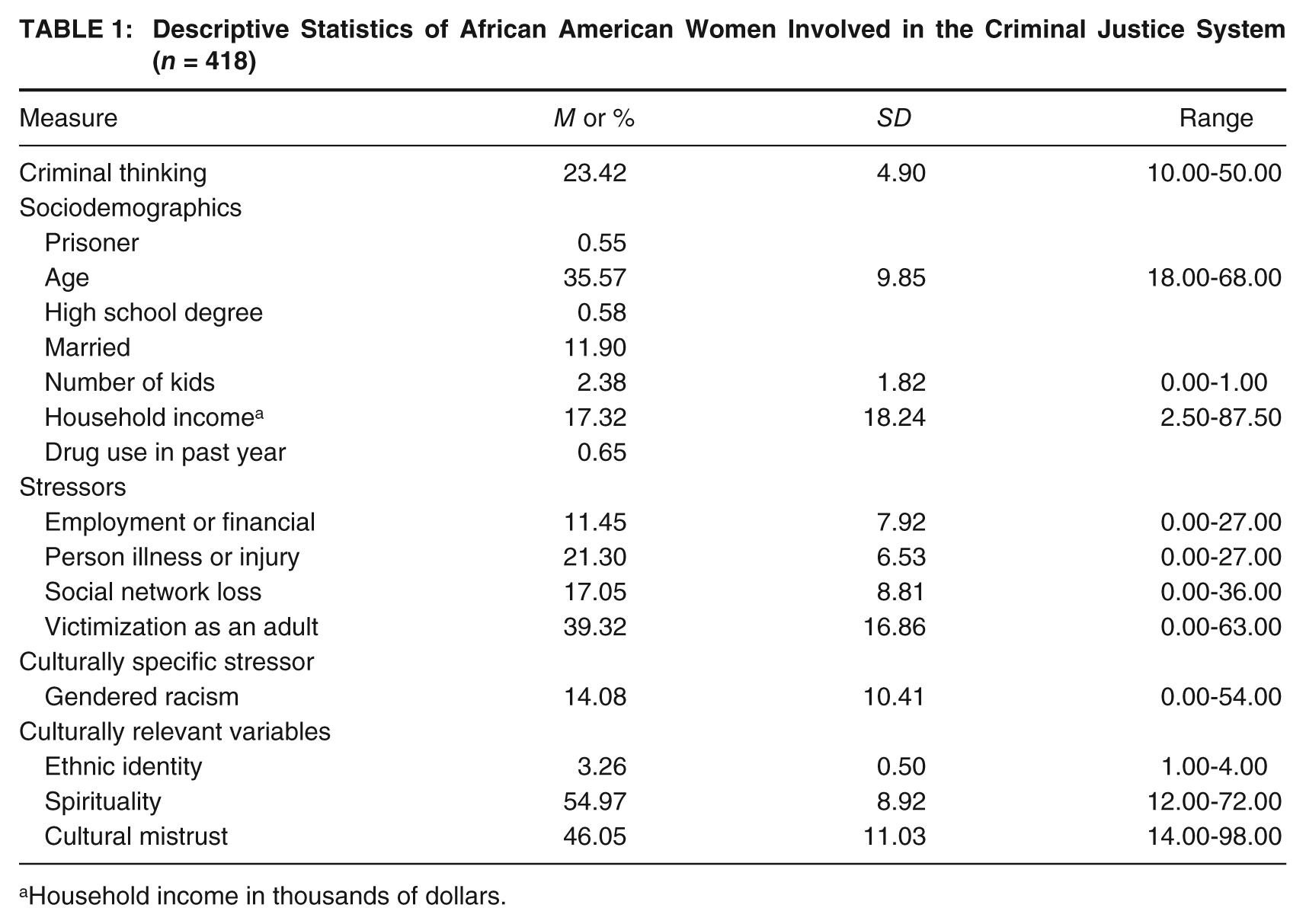
The descriptive statistics of the African American women involved in the study are displayed in Table 1. Participants scored lower than the midpoint on the criminal thinking scale (M = 23.42, SD = 4.90). By study design, about half of the women were interviewed while in prison (54.55%) and 65.00% had engaged in illicit drug use in the past year on the streets. The average participant was a 35-year-old unmarried woman with two children, a high school degree (58.13%), and a household income of US$17,320.
Descriptive Statistics of African American Women Involved in the Criminal Justice System (n = 418)
Household income in thousands of dollars.
The women in the present study had experienced notable amounts of individual stressors in a variety of social contexts. Specifically, they scored above the midpoint on experiencing a personal illness or injury (M = 21.30, SD = 6.53) and victimizations (M = 39.32, SD = 16.86) in the past year. Participants reported levels of stress below the midpoint in the employment or financial context (M = 11.45, SD = 7.92). Moreover, moderate levels of experiencing losses in their social network (M = 17.05, SD = 8.81) and gendered racism (M = 14.08, SD = 10.41), the culturally specific social stressor, were reported. Overall, African American women involved in the criminal justice system reported high levels of ethnic identity (M = 3.26, SD = .50) and spiritual well-being (M = 54.97, SD = 8.92). Cultural mistrust among women in the sample was below the midpoint of the range of the scale (M = 46.05, SD = 11.03).
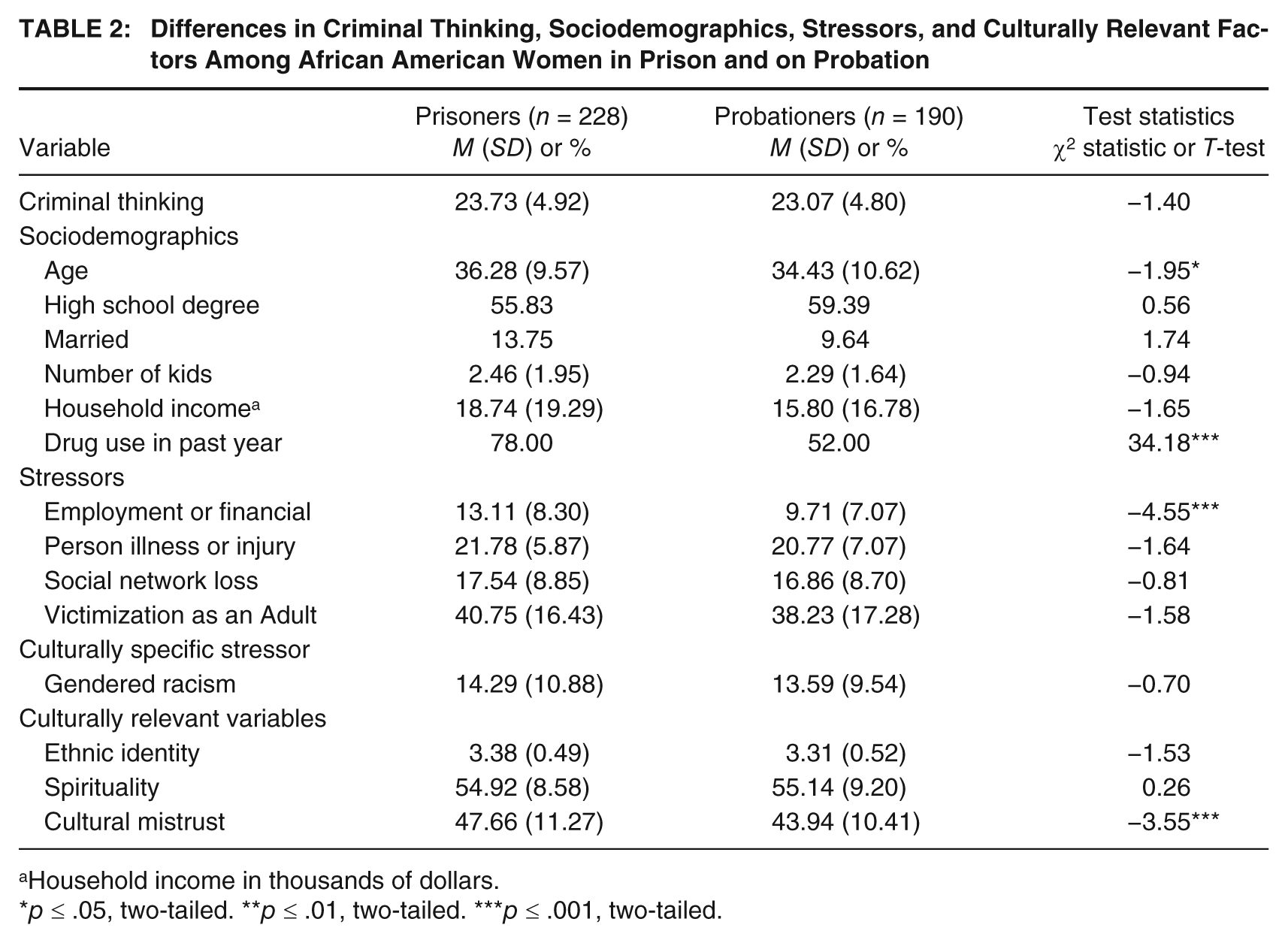
The results of the chi-square statistics and t-tests for bivariate analyses are displayed in Table 2. African American women’s level of criminal thinking did not significantly differ based on their level of involvement in the criminal justice system. However, African American women prisoners were significantly older than probationers by almost 2 years and more likely to report drug use in the past year on the street. In addition, prisoners (M = 13.11, SD = 8.30) reported significantly higher levels of employment or financial stressors as compared with their counterparts on probation (M = 9.71, SD = 7.07; t = −4.55, p < .001). African American women in the prison sample also reported significantly higher levels of cultural mistrust (M = 47.66, SD = 11.27) as compared with the African American women on probation (M = 43.94, SD = 10.41; t = −3.55, p < .001).
Differences in Criminal Thinking, Sociodemographics, Stressors, and Culturally Relevant Factors Among African American Women in Prison and on Probation
Household income in thousands of dollars.
p ≤ .05, two-tailed. **p ≤ .01, two-tailed. ***p ≤ .001, two-tailed.
Table 3 presents the unstandardized coefficients of four OLS models, with Models 1 and 2 examining criminal thinking among prisoners and Models 3 and 4 exploring the correlates of probationers’ criminal thinking. Specifically, Model 1 examined sociodemographic characteristics and stressors as correlates of criminal thinking among African American women in prison. As displayed in Model 1, African American women in prison with higher household incomes (b = −.05, p = .004) had significantly lower levels of criminal thinking. Conversely, use of drugs in the past year (b = 2.81, p < .001) was a positive correlate of criminal thinking. No stressors were associated with criminal thinking among African American women in prison, with the exception of gendered racism, which was the most robust positive correlate of criminal thinking for prisoners (b = .12, p < .001).
Ordinary Least Squares (OLS) Regression Models of the Relationship Between Stressors, Culturally Relevant Factors, and Criminal Thinking for Prisoners and for Probationers

Note. b = unstandardized coefficient.
p ≤ .05, two-tailed. **p ≤ .01, two-tailed. ***p ≤ .001, two-tailed.
Model 2 examined the same variables as Model 1 but also included the three culturally specific variables. When culturally specific variables were included in the multivariate model (see Model 2 in Table 3), household income, drug use, and gendered racism remained statistically significant. Moreover, two of the three culturally specific variables were associated with African American women prisoners’ criminal thinking. Specifically, spirituality was negatively associated with criminal thinking (b = −.15, p < .001), while criminal mistrust had a positive relationship with criminal thinking (b = −.09, p < .001). Both Models 1 and 2 were significant as a whole; however, Model 1 only explained 17% of the variance in criminal thinking as compared with 30% of the variance in criminal thinking explained by the inclusion of culturally relevant variables in Model 2.
Model 3, which contained the same variables as Model 1, examined sociodemographic characteristics and stressors as correlates of criminal thinking among African American women on probation. Being married (b = −2.17, p = .048) and reporting a higher household income (b = −.05, p = .018) were correlated with significantly less criminal thinking among probationers. Similar to Model 1, use of drugs in the past year was significantly associated with criminal thinking (b = 2.20, p = .001). Unlike Model 1 with prisoners, several stressors were statistically significant correlates of probationers’ criminal thinking. Experiencing more financial stress (b = .14, p = .003) and more social network loss (b = .13, p = .009) was associated with more engagement in criminal thinking. In addition, gendered racism stressors were positively associated with criminal thinking among African American women on probation (b = .07, p = .046).
When culturally specific variables were included in the multivariate model using the sample or probationers, one variable (i.e., gendered racism) that reached statistical significance in Model 3 was no longer significant in Model 4. As displayed in Model 4, being married was negatively associated with criminal thinking, while drug use continued to be a positive correlate of criminal thinking. In addition, probationers with a high school degree (b = −1.39, p = .027) reported significantly less criminal thinking. The stressors in the social contexts of employment and finances (b = .12, p = .008) and social network loss (b = .12, p = .009) were significantly associated with higher levels of criminal thinking for African American women on probation. Similar to Model 2, spirituality (b = −.10, p = .008) was negatively associated with criminal thinking, and African American women on probation reporting higher levels of cultural mistrust also reported higher levels of criminal thinking (b = .14, p < .001). Both Models 3 and 4 were significant as a whole; however, Model 3 explained 19% of the variance in criminal thinking as compared with 32% of the variance in criminal thinking explained by the inclusion of culturally relevant variables in Model 4.
Discussion
The present study seeks to advance our understanding of the relationship between stressful life events and criminal thinking among a group of African American women under criminal justice supervision. This study set out to make several distinct contributions to the literature, as well as build on existing research. First, there is a limited body of research on African American women, despite their over-representation in the criminal justice system and disproportionate burden of individual and social stressors at the intersection of multiple marginalized social identities. Second, no studies have examined stressors as specific correlates of criminal thinking, despite the strong link between criminogenic thinking and involvement in crime (e.g., Andrews & Bonta, 1994; Gendreau et al., 1996; Simourd & Olver, 2002; Walters, 2006). Moreover, in addition to exploring individual stressors, the current study investigates the relationship between criminal thinking and gendered racism, a factor unique to the demographic studied here and one that has been linked to various negative outcomes among African American women (e.g., Bowleg, 2013; King, 2003; Moradi & Subich, 2003; Perry et al., 2013; Skaggs, 2012; Stevens-Watkins et al., 2014). Third, this study also examines culturally specific risk and protective factors associated with criminal thinking among African American women, which are often excluded from the literature.
Before delving into a discussion of the findings from the multivariate models, it is important to note that the observed mean on the criminal thinking scale for the African American women in this study was very similar to the racially diverse sample of women under correctional supervision in Taxman, Rhodes, and Dumenci’s (2011) study, underscoring the notion that African American women do not think “more criminally’ as compared with other women. The descriptive results of the present analysis highlight that African American women involved with the criminal justice system experience significant stressors in a variety of social contexts, which are substantially higher than their community counterparts across all social contexts (Perry et al., 2013; Stevens-Watkins et al., 2014). In particular, experiences involving personal illness/injury and victimization were well above the scale midpoint, and social network loss occurred frequently for the women in the present study. Moreover, the African American women in the sample were subject to culturally specific stressors, such as gendered racism. The solid presence of gendered racism underscores the fact that the stressors the women are dealing with occur at the intersections of their multiple social identities, consistent with prior research finding (see Brown & Keith, 2003; Collins, 1998; Kwate et al., 2003; Landrine & Klonoff, 1996; Shields, 2008; Stevens-Watkins et al., 2014). Despite these stressors, some salient culturally specific protective factors such as a strong ethnic identity and embracement of spirituality were prominent in the lives of African American women involved in the criminal justice system.
In the multivariate models, the first hypothesis that individual stressors would be associated with criminal thinking was partially supported among probationers. Two of the social contexts, personal illness and victimization, were not significant correlates of criminal thinking in the full probationers’ model. Employment and finances were positively associated with an increase in criminal thinking. A possible explanation for this relationship is the fact that having a felony record makes it more challenging to get a job, especially one that is lucrative enough to gain somewhat of a financial stability, which may be associated with some criminal thinking tenets such as rationalizing future crime. Social network loss was also associated with an increase in criminal thinking. Women in the sample may have externalized blame on the health care system for a loved one dying and feel justified for thinking about acting out criminally. Other studies using community-based samples of African American women found that employment and financial issues as well as social network losses were positively associated with worrying about one’s health (Perry et al., 2013) as well as overall psychological distress (Stevens-Watkins et al., 2014).
The second hypothesis, positing that gendered racism would be the most robust correlate of criminal thinking, was not supported by the OLS analysis. While significant in three of the four models, past year involvement in drug use was a more robust predictor of criminal thinking for both groups of women in the study, confirming a relationship that is very well established in the literature. Findings indicate that gendered racism is the only stressor associated with criminal thinking for prisoners. This highlights that experiences of discrimination due to one’s race and/or gender play a salient role for those with multiple disadvantaged statuses and that criminal thinking may be a way to rationalize some of the discriminatory experiences African American women in prison have faced.
Adding to the relatively new literature on gendered racism, the findings of the present study suggest a positive relationship with criminal thinking. As discussed earlier in this article, the negative impact of gendered racism on African American women’s psychological health and its link to increased levels of drug use has been found in previous studies (see, for example, Stevens-Watkins, Perry, Harp, & Oser, 2012). The effect of gendered racism also supports the arguments of intersectionality scholars with respect to the multiple disadvantaged identities of poor, criminally involved African American women highlighted in the present study.
Gendered racism operates on multiple levels, meaning it can be individual and institutional, and does not affect the recipient in a vacuum (Stevens-Watkins et al., 2012). On the individual level, the perception of gendered racism can at times be very subtle (e.g., micro-aggressions) and even ambiguous. If happening repeatedly, the woman might feel the need to create a rationalizing narrative for the anger or frustration she is feeling, or the behavioral reaction she exhibits, thus engaging in criminogenic thinking to “right the wrong.” An example of gendered racism at the institutional level would be the perception of unfair treatment by the police or courts due to one’s status as an African American woman. As was mentioned in the introduction of this article, African American women are overrepresented in the criminal justice system compared with women of other races and ethnicities, and their representation in the system is more comparable with White men than other women (Guerino et al., 2011). The perception of being treated differently (i.e., worse) due to one’s gender and race—two factors out of the person’s control—may result in rationalizations for engaging in criminal behavior.
The third hypothesis that African American women in the sample who possess a strong ethnic identity, high levels of spirituality, and lower levels of cultural mistrust would report lower levels of criminal thinking was only partially supported. Specifically, higher levels of spirituality were associated with lower levels of criminal thinking, lending creed to previous evidence that hailed spiritual well-being as a buffer to criminality. Thus, this research reaffirms the protective nature of the belief in a higher power (Chu, 2007; Giordano et al., 2008; Maruna, 2001; Schroeder & Frana, 2009; Terry, 2003). A potential explanation for this is that women who identify as spiritual feel connected to a higher power, which enables them to draw strength from their faith and cope in a more productive and adaptive way. Cultural mistrust, on the other hand, was positively associated with criminal thinking, meaning that higher levels of cultural mistrust are associated with more criminogenic attitudes. Future research should examine this relationship longitudinally and qualitatively to get at the foundations of cultural mistrust (e.g., institutional racism, micro-aggressions, etc.). All in all, the current results indicate that gendered racism, spirituality, and cultural mistrust are factors to consider when attempting to clarify the correlates of criminal thinking. While the present study only included a restricted sample of African American women who are under criminal justice supervision, future research should investigate these relationships in a more generalizable sample and among other demographic groups.
These findings have practical implications. For example, our research found that some of the stressors examined here were more relevant for probationers. This is intuitive since the particular stressors are likely more pressing for the women trying to comply with the various conditions of their probation. Following this logic, unless the underlying sources of stress that may result in criminal thinking are adequately addressed, the probationers face an increased risk of violating their probationary terms. It would thus be pertinent to ensure that practitioners, such as probation officers supervising these women or clinicians treating them are educated about the unique stresses African American women are dealing with, and are adequately trained to provide resources and support before probation violations occur. Probation officers and community service providers could assist African American women to access their own spiritual and religious resources to cope with gendered racism as these have been found to be successful strategies for other concerns (see, for example, Utsey, Adams, & Bolden, 2000).
Black women experience tangible and intangible barriers to seeking and receiving much needed support. Failure to identify and remedy these stressors thus has wider justice implications for those whose experiences already are overlooked, even as their exposure to risk is disproportionately large, and may have a ripple effect on other factors, such as cultural mistrust. Our findings highlight the need for more racially diverse personnel in law enforcement, corrections, and social service agencies, with a specific focus on African American females. If more African Americans were employed in these legal and correctional systems, it could reduce instances of gendered racism. Likewise, employing more African American women would provide additional culturally competent behavioral health services to address stressors and gendered-racism.
In addition, it would be beneficial to provide educational and preventive interventions, both inside the correctional facility and in the community, in the form of peer mentoring or targeted workshops to allow African American women of all ages to discuss their experiences with gendered racism and other unique stresses and promote a range of effective coping strategies.
Limitations
No study is without limitations, and the limitations of the present data call for further research on this topic. First, this study was based on cross-sectional quantitative data, limiting the ability to predict causal relationships between the variables of interest and understand an individual’s lived experience. Due to the cross-sectional nature of the study, we are unable to ascertain the causal direction of these relationships. It is plausible that cultural mistrust would increase criminal thinking, especially when this mistrust stems from negative experiences with individuals in power in predominantly White institutions, such as law enforcement or the judicial system from a different cultural background in power-differentiated roles, such as police or judges. If, as an African American woman, one feels treated poorly by these others, and that narrative is reinforced in one’s own cultural group, it might lead to coping with such treatment in a deviant or delinquent way. However, criminal thinking could also plausibly lead to cultural mistrust, once again potentially due to the treatment of others outside one’s cultural environment.
Additional qualitative data from African American women could yield greater insights into the mechanisms underlying this complex relationship and the salience of each life stressor. However, results from other studies suggest that the relationships between social stressors and coping/behavior (in our case, criminal thinking) typically work in the time order predicted in the present study (e.g., Agnew, Brezina, Wright, & Cullen, 2002; Felson et al., 2012; Mazerolle & Piquero, 1998). Despite the support of previous research for our interpretations, more research is also needed using longitudinal data to investigate the causal order of the relationships under study.
Second, the data are not based on a nationally representative sample of African American women. Specifically, African American women were recruited from state prisons and probation offices in one southern State, which also limits generalizability to African American women under correctional supervision in Department of Corrections in other States or federal prisons. It should be noted that individuals involved with the criminal justice system have lower household income and levels of education as compared with the general populations (Harlow, 2003). Current results should not be extended to other African American women without further research. Third, our study was limited in that it did not assess the magnitude of perceived distress resulting from negative life events, and future studies should consider improving on measurement limitations.
Conclusion
Women in the sample occupy multiple disadvantaged positions in society, and also face substantial stressors including financial or employment struggles, more personal illnesses or injuries, and higher levels of victimizations. Criminal thinking may be one maladaptive coping mechanism to manage stressors that occur across these multiple social contexts for African American women in prison and on probation. Criminal justice agencies should consider promoting programs that strengthen a sense of collective identity, such as peer-mentoring programs, as well as expand on their offerings of religious and spiritual opportunities. Engagement in these culturally relevant activities would be a limited financial investment for Department of Corrections that may promote better ways of coping with stress and trauma, thereby decreasing the likelihood of recidivism and increasing the overall well-being of multiply marginalized criminally involved African American women.
Footnotes
Acknowledgements
We thank the participants for sharing and the anonymous reviewers for the insightful and detailed comments and suggestions.
This research is funded by the National Institute on Drug Abuse (NIDA, R01-DA22967, PI: Oser; K02-DA35116,PI: Oser). Opinions expressed are those of the authors and do not represent the position of the Kentucky Department of Corrections or NIDA.