




Abstract
This study integrates egocentric social network analysis techniques and qualitative methods to examine (a) the characteristics of female offenders’ semiregular interaction partners and their provision of resources, (b) the relationship and key resources provided by the “most helpful” and “least helpful” network member, and (c) the characteristics of network members that offenders identify as having negative influence on them. In-person interviews were conducted with 41 female felons who provided information on 436 network members. Findings from the network data suggest that, on average, women possess 10 semiregular interaction partners, networks have a heavy concentration of substance users, and less than half of the network members provide any form of helpful supervision-related resources to the participants. Findings from the qualitative component of the research highlight the helpfulness of networks members who provided transportation, financial assistance, and emotional support. Helpful network members tended to be older, employed, more educated, and closer geographically.
Keywords
Introduction
Strong personal support networks are pivotal to women’s successful navigation of community-based correctional requirements. Although variable, correctional requirements may include maintenance of employment; timely attendance at supervision visits; payment of court-related fees; avoidance of assaultive, threatening, or intimidating behaviors; and desistance from crime, substance use, and interactions with criminal peers. These requirements inherently impose the need for strong financial stability and/or social support to provide women with child care, transportation, and emotional support throughout the correctional process. Unfortunately, the literature suggests that a large number of women in the criminal justice system lack access to needed resources due to poverty, unemployment, residential instability, and residency in high-crime, low-resourced neighborhoods (e.g., Cobbina, Morash, Kashy, & Smith, 2014a; Morash, 2010).
There is a body of literature that examines the effects of social support on women’s experiences in the criminal justice system, desistance from crime, and substance abuse treatment outcomes (Collica, 2010; Leverentz, 2006b; Lewandowski & Hill, 2009; Strauss & Falkin, 2001; Valera, Chang, Hernández, & Cooper, 2015). However, this body of research focuses exclusively on imprisoned, recently incarcerated, or treatment-based populations and fails to provide insight into the composition of community-based female probationers’ support networks. Furthermore, the ways in which personal support networks assist women in meeting correctional requirements have received limited assessment. This gap in knowledge is notable because a large proportion of women in the criminal justice system are not sentenced to prison terms but instead remain in communities under correctional supervision (Kaeble, Glaze, Tsoutis, & Minton, 2015; Kaeble, Maruschak, & Bonczar, 2015). Due to their uninterrupted residency in their local communities and connections to positive and negative network members, it is likely that community-based correctional populations possess unique network characteristics (e.g., proportion of substance-abusing network members).
Considering the access granting nature of strong social networks to employment opportunities, educational advancement, and mental health and social support (Granovetter, 1973; Halpern, 2008; Wellman & Frank, 2001), it is important to understand female offenders’ current network construction and the characteristics that aid in resource access. The current study examines (a) the size and composition of 41 community-based female offenders’ personal support and negative networks, (b) the provision of supervision-related resource support (i.e., transportation to the supervision agency) from network members, and (c) the narratives surrounding the “most helpful” and “least helpful” network members’ provision of support, as well as their characteristic similarities and differences.
Personal Support Networks and Resource Accessibility
Personal support networks have received considerable examination over the past 30 years. The General Social Survey set the stage for studying core discussion networks (Burt, 1984; Marsden, 1987; Moore, 1990), critiquing methods for eliciting network members (Straits, 2000), and creating discourse for critically assessing social network data (Fischer, 2009; McPherson, Smith-Lovin, & Brashears, 2006, 2008, 2009; Paik & Sanchagrin, 2013). The method of study has since been applied in various fields to answer complex questions. In the field of criminology, egocentric or individual-focused social network research has yielded key findings regarding co-offending behaviors among adolescents (McGloin & Piquero, 2010) and patterns of juvenile delinquency in academic settings (Haynie & Osgood, 2005), but has received limited utility among community-based correctional populations.
Instead, the potential for personal support networks to provide women in the criminal justice system with access to various types of resources has been pursued through qualitative research. These studies highlight the importance of kinship members in providing support (Valera et al., 2015) and the dynamic nature (both destructive and conventionalizing) of romantic partnerships during women’s reentry process (Leverentz, 2006a). Parents and siblings have been found to play important roles in women’s stability post-release. Many provide emotional and instrumental support, such as housing and child care, which are associated with lower rates of recidivism and drug-use relapses (Bui & Morash, 2010; Clone & DeHart, 2014; O’Brien, 2001; Petersilia, 2003). Furthermore, supportive friends have reportedly eased the reentry process for some women (Parsons & Warner-Robbins, 2002), and research with a predominantly male sample suggests that engaging in activities with friends can improve offenders’ success in parole compliance (Bahr, Harris, Fisher, & Harker Armstrong, 2010).
The author’s review of the literature yielded two studies which quantitatively examined the characteristics of female offenders’ personal support networks and the ways in which these characteristics affect resource access. Reisig, Holtfreter, and Morash (2002) examined the social support networks of 402 female felons who were under community supervision. Findings from the research suggested that women with higher income and those who had achieved higher levels of education had larger networks and received more social support. Furthermore, economically disadvantaged female offenders tended to have especially few social network members to “talk to” and “hang out with,” and who provided them with financial assistance. Overall, women reported a relatively small number of social network members, with an average of five members (Reisig et al., 2002).
Strauss and Falkin (2001) conducted a study regarding the social support systems of 100 drug-involved women offenders attending court-mandated drug treatment programs. Findings from the study suggested that significant others and parents were strong providers of practical help and advice, and more than two thirds of women identified their mothers as supporters. The data presented from the study did not allow for an examination of network size or the proportion of network members who provided a specific type of support (i.e., affirmational, emotional, practical, or informational), but did indicate that more than half of parents and significant others identified provided at least one form of support. The studies reviewed above allow for some insight into female offenders’ core personal network compositions and deficient areas of support.
Building Resource-Rich Personal Networks
The intensive nature of egocentric network data collection has contributed to the limited research on individuals’ semiregular interaction partners. Although not yet derived from network research methods, there is reason to believe that offending female populations have an especially difficult time building strong support networks. Specifically, research illustrates the ways in which community characteristics and correctional requirements have the potential to stifle healthy social network construction and reduce access to needed resources. Women in the criminal justice system, especially African American women, frequently reside in economically disadvantaged, segregated neighborhoods which are crime-ridden and encourage reclusive behaviors to avoid reoffending (Cobbina, Morash, Kashy, & Smith, 2014b). In response to their environment, women employ isolating tactics such as protecting their homes with physical security, staying at home, and avoiding certain places (at certain times) to avoid victimization (Cobbina et al., 2014a). In addition, the stigmatizing effects of a conviction (Carter & Feld, 2004) may further restrict women’s small networks (Cobbina et al., 2014a; Reisig et al., 2002; Richie, 2001).
In the general population, resource accessibility is dependent upon the types of members in the network (e.g., friends, family, coworkers) and the strength (e.g., frequency of contact or length of the relationship) of those ties (Granovetter, 1973). Reclusive behaviors demonstrated by community-based offenders in the noted studies may further restrict women’s networks to familial and intimate ties. Furthermore, prior research on the homophilous nature of networks places the under-resourced population of women at greater risk of possessing network members who are facing similar resource deficiencies (McPherson, Smith-Lovin, & Cook, 2001).
Negative Network Ties
A final aspect of network composition that is important to discuss is negative network ties. Many female offenders are a part of kinship networks in which family members break the law (O’Brien, 2001). Criminally engaged family members and friends can contribute to women’s illegal behaviors (Griffin & Armstrong, 2003; Leverentz, 2006a), and unhealthy intimate relationships may place women at risk of physical abuse or coercive tactics to engage them in illegal activities (Bloom, Owen, & Covington, 2003; Caspi, Lynam, Moffitt, & Silva, 1993; Giordano, 1978; Haynie & Osgood, 2005; Haynie, Steffensmeier, & Bell, 2007; Jones, 2008). These sources of negative social capital, or ties with nonconventional or antisocial people, may promote negative norms and reinforce antisocial behaviors (Lin, 1999).
Prior research has been effective in identifying negative social capital characteristics among members within women’s support circles. Qualifiers of negative capital have included substance use, engagement in crime, and physical and emotional abuse. However, to the knowledge of the author, participants from criminal justice settings have yet to be presented with the opportunity to explicitly identify negative network members with whom they have chosen to discontinue communication. A research design that allows for this distinction could further clarify why offenders eliminate some negative network members, but not others.
The Current Study
The current study integrates select social network research techniques and qualitative methods to examine (a) the characteristics of female offenders’ semiregular interaction partners and the provision of resources from those network members, (b) the characteristics of negative network members, and (c) the key resources provided by the “most helpful” and “least helpful” network members and the ways the two groups of individuals are similar or different. Specifically, the following research questions are addressed:
Method
Sample
Study participants were drawn from a larger study of women on probation and parole. The original inclusion criteria for the 402 participants in the larger study were the following: (a) one or more felony convictions, (b) a history of substance abuse, and (c) a supervision period of 2 to 3 months with their current agent. Women were supervised by 73 agents located in 18 counties that had a mix of urban, suburban, and rural areas. The sample was racially diverse (48% White only, 32.2% Black only, and 17.9% multiracial women of color, including Hispanic, 1.3% unclear, and 0.5% Native American) and women ranged from 18 to 60 years of age (M = 33.9, SD = 10.6). Of the 402 women participating in the initial wave of the research (completed 2011-2013), 302 women were retained through the fourth wave of interviews completed between 2015 and 2016.
Women in the present study were drawn from the pool of participants who completed the fourth interview (n = 302, 75%) and were under probation supervision at the start of the original study. Twenty probationers who had reoffended between June 2015 and June 2016, and 21 probationers who had not reoffended during the specified time period were randomly selected for inclusion in the research. Participants were matched based on age, race, and the number of prior convictions. As shown Table 3, the sample is racially diverse (65.9% White only, 24.4% Black only, and 9.8% multiracial women of color, including Hispanic), women ranged from 24 to 57 years of age (M = 37.68; SD = 10.19), and more than half of the participants reported making less than US$10,000 per year (n = 25, 61.0%). Approximately half of the participant had not obtained employment (n = 21, 51.2%), one quarter had secured part-time employment (n = 10, 24.4%), with a similar proportion reporting full-time employment (n = 10, 24.4%).
Data
The data were generated from a series of semistructured and open-ended interview questions collected during face-to-face interviews with 41 female felons. Network Canvas (Hogan et al., 2016), an interactive, computerized method, was used to (a) elicit a list of individuals in women offenders’ social networks (including negative network members), (b) gather information on network members’ characteristics, and (c) identify the members in women’s networks who were the most helpful or least helpful in navigating probation requirements.
Name generators were used to establish network size. Name generators prompt study participants to identify semiregular and core network members (Marin & Hampton, 2007; McCallister & Fischer, 1978). The current research advances prior research by including 11 name generators, instead of a single name generator, which research shows in a more reliable method (Marin, 2004; Marin & Hampton, 2007; McCallister & Fischer, 1978). The primary name generator “Who are the people that you socialize with and who you spend time with, who are adults aged 17 and older?” has previously been used to study mentally ill populations (Estroff, Zimmer, Lachicotte, & Benoit, 1994). The domain-specific name generators focus on general settings, as well as criminal justice settings. Specifically, participants were asked, “Other than people you have already named, are there any other individuals from [domain description] that you have interacted with in the last 6 months that are significant to your life?” The domains of interest for the sample include (a) family members, (b) friends or people you “have fun” with, (c) religious setting, (d) academic setting, (e) employment setting, (f) correctional setting, (g) treatment/self-help setting, (h) neighborhood setting, (i) negative network members, and (j) “any other people” participants wanted to add. The probe for negative network members was slightly different than the other name generators. Participants were asked, “Are there any close friends, family members, or associates that you have stopped speaking to since the start of probation supervision due to conflict or other differences?” After network members were identified, a series of semistructured questions, or name interpreters, were asked pertaining to the characteristics of each network member (i.e., age, race, employment status, type of substance use) and pertaining to interactions between the network member and the participant (i.e., type of substance use together, frequency of contact, probation-related resource provisions). Data were imported into SPSS for descriptive analyses.
Once women’s networks were established, participants were asked to select from their network of members the “most” and “least” helpful network members in navigating the requirements of correctional supervision. With the approval of the participant, audio recordings were collected for the narratives surrounding the most memorable experience of support and lack of support. The open-ended responses were the only section of the interview that was audio-recorded. The audio recordings were transcribed and read into NVivo software for coding and qualitative analysis. Intercoder reliability was established by the author and a graduate student. The contents of 20 transcripts were coded to establish intercoder agreement. Strong reliability was established for the resource or action provided by the most helpful (92% agreement) and least helpful network members (90% agreement). Each type of support or action was coded as a single unit.
Procedure
All of the interviews were completed between December 2016 and March 2017. Each interview took approximately 1.5 hr to complete. Women were compensated with US$40 in the form of cash at the completion of the interview. Each interview was completed in the privacy of the participant’s residence or in an isolated area of a public establishment within their communities (e.g., coffee shops, libraries). The interviewer received 6 hr of training on the instrument prior to beginning data collection and abided by the institutional review board (IRB) guidelines required by the affiliated institution.
Measures
For clarity, the description of the quantitative measures for the study are divided into the measurement of the (a) network member attributes and tie/relationship characteristics and (b) aggregate scores for participants’ entire network. Network member attributes are unique to the individuals participants identified as part of their personal networks (e.g., age, race, education level). Tie characteristics require engagement from both the participant and the network member (e.g., frequency of contact, substance use together). The “whole network” variables comprise the aggregate scores of each woman’s network characteristics. In other words, each variable represents the average response across network members within each participant’s network. From these scores, the proportion of network members who share a characteristic (e.g., average percentage of females across networks) or the average score across the networks (e.g., average level of education across networks) can be assessed.
Quantitative measures of the network member and relationship (tie) characteristics
Women provided information about the age, race, and gender of each network member. In addition, they were asked to provide the employment status (employed or unemployed) and education level of each network member. Education was measured on a 7-point scale including attended middle school, attended high school, graduated high school, attended college, graduated from a 2-year college, graduated from a 4-year college, or obtained professional degree. Most of the quantitative measures focused on tie characteristics. The six tie characteristic measures include frequency of contact, relationship closeness, geographical closeness, relationship length, types of substances used between the offender and the network members, and the provision of supervision-related resource support. Frequency of contact with network members was measured on a 5-point scale with response options including less than monthly, about monthly, 2 to 3 times per month, weekly or about weekly, and daily or about daily. Offenders’ relationship closeness to each network member was measured by asking, “How close do you feel your relationship is with [name]?” The 5-point scale included the following response options: very distant, distant, somewhat close, close, and very close. Geographical closeness was a proxy for the distance the network member lives from the participant. It was measured on a 6-point scale which included the following response options: lives in a different state, in the same state, within an hour of your home, in the same city, in the same neighborhood, or in the same house. The length of each relationship was measured on a 5-point scale with response options including weeks, months, less than a year, several years, and 7 or more years. To measure substance-abusing behaviors shared between the two individuals, women were asked, “Have you ever used any substances with this person?” Response options included none, alcohol, marijuana, meth or crack cocaine, and heroin or prescription drugs. Finally, supervision-related resource support was measured by asking women, “While you were under court supervision, did this network member help with any of the following needs at least once [check all that apply]?” Response options included the following: (a) provided child care during agent visits, (b) payment of court-related fees, (c) talked through supervision-related problems, (d) provided transportation to supervision visits, (e) provided stable housing, and/or (d) no resource provided. Table 1 summarizes the tie-level measures and variable values.
Tie Characteristic Measures and Variable Values
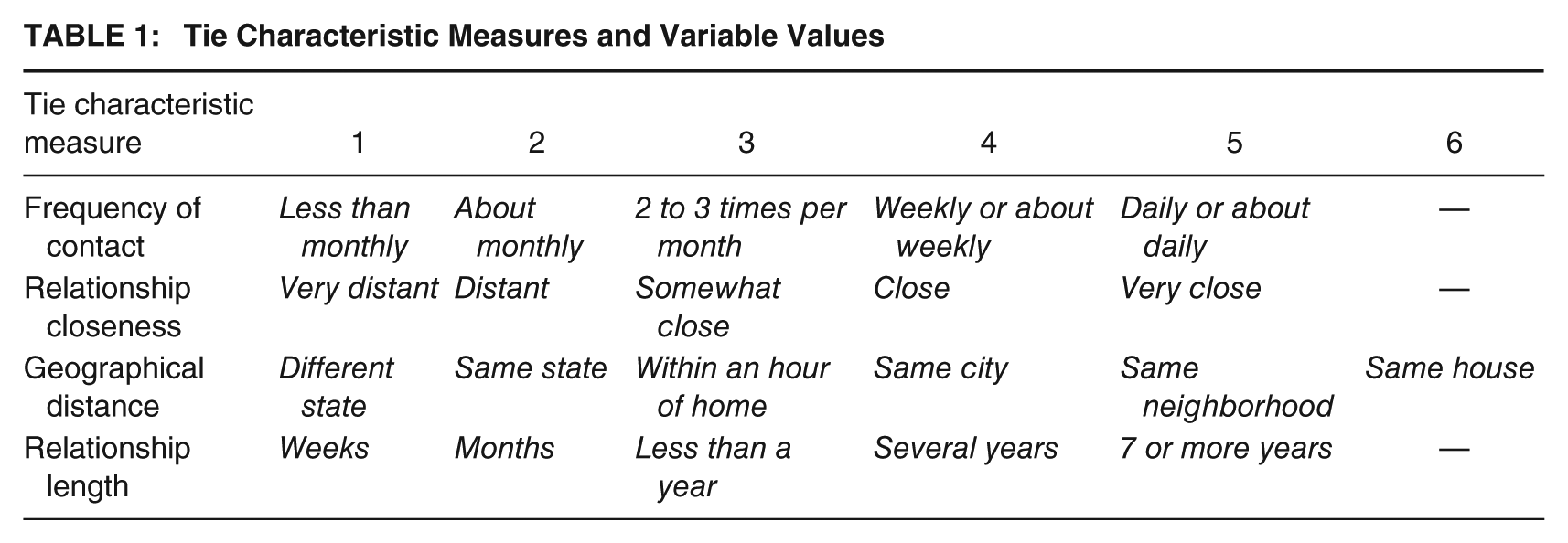
Negative network member measurement
Using the same variables outlined above, a separate descriptive analysis was conducted for network members elicited by only the “negative network member” name generator. These individuals are not a part of women’s support networks. Instead, negative network members represent conflictual and discontinued relationships.
Quantitative measures of the participant and whole network
Participants’ demographic information, employment status, and income were assessed. With regard to the network characteristics, aggregate scores were calculated for the same variables described above to represent the proportion of each women’s network that possess a specific characteristic or the average score across each network. Network size represented the number of members who were named in response to the name generators, excluding the negative network members. In addition, a measure of racial homophily was calculated to assess the proportion of network members who share the same race as the participant.
Qualitative measures of network member helpfulness
Now turning to the qualitative measures, participants were asked to identify “the network member who was the most helpful in helping you in navigating probation.” The interviewer would then ask the participant to “describe the most memorable experience of support from this network member who helped you meet the requirements of your probation supervision.” To ensure uniform probing across participants, the following statements and questions were used: (a) “Tell me about the day or moments surrounding the experience,” (b) “What resource, assistance, or advice did they provide?” (c) “Why was their help meaningful to you?” and (d) “How did they discover you needed help?” The same questions were administered to identify the least helpful network member and to understand women’s most memorable experience of lacking supervision-related support.
Results
Name Generators and Relational Composition
As shown in Table 2, the primary name generator elicited approximately half of the network members (n = 234, 53.7%). The remaining network members were elicited from the following name generators: family ties (n = 54, 12.4%), employment settings (n = 33, 7.6%), negative network members (n = 29, 6.7%), friends or individuals participants had fun with (n = 20, 4.6%), religious settings (n = 16, 3.7%), neighborhood settings (n = 15, 3.4%), treatment settings (n = 11 or 2.5%), academic settings (n = 9, 2.1%), correctional settings (n = 5, 1.2%), and “other” individuals not elicited by the prior name generators (n = 10, 2.3%). In examining the relational composition of women’s networks, approximately half of the network members elicited held kinship ties to the participants (n = 209, 47.9%). Other prominent relational ties included friends (n = 82, 18.8%), coworkers (n = 41, 9.4%), ex-friends (n = 28, 6.4%), and significant others (n = 27, 6.2%). The remaining relational ties each accounted for less than 4% of the network members identified and include support group members, religious leaders, neighbors, therapists, community agents, academic instructors, roommates, and “other” individuals.
Name Generator and Relational Network Composition

Note. NG = name generators.
Name generators are listed in the same order as the questionnaire. bIncludes aunts, uncles, grandparents, cousins, and “other family.”
Network Member Characteristics
As shown in Table 3, the size of women’s networks ranged from four to 27 network members (M = 9.93, SD = 4.63). Network members were predominantly women (n = 236, 58%) and ranged from 17 to 100 years of age (M = 42.93, SD = 16.52). Most of the network members were employed (n = 261, 64%) and on average had completed high school (M = 3.58, SD = 1.40). Racial composition of the network members included mostly White (n = 265, 65%), followed by Black (n = 117, 29%), multiracial including Hispanic (n = 12, 3%), and American Indian or Alaskan Native (n = 6, 2%) network members. Substance use was prominent among the sample of network members. Nearly half (n = 182, 45%) of network members had drunk alcohol with the offender. Approximately one quarter (n = 92, 23%) of the network members used marijuana with the participant. Heroin or prescription pills (n = 33, 8%) and crack cocaine (n = 29, 7%) use between the network member and the offender were less common. Approximately, one third had been under correctional supervision (n = 134, 33%).
Participant and Network Characteristics
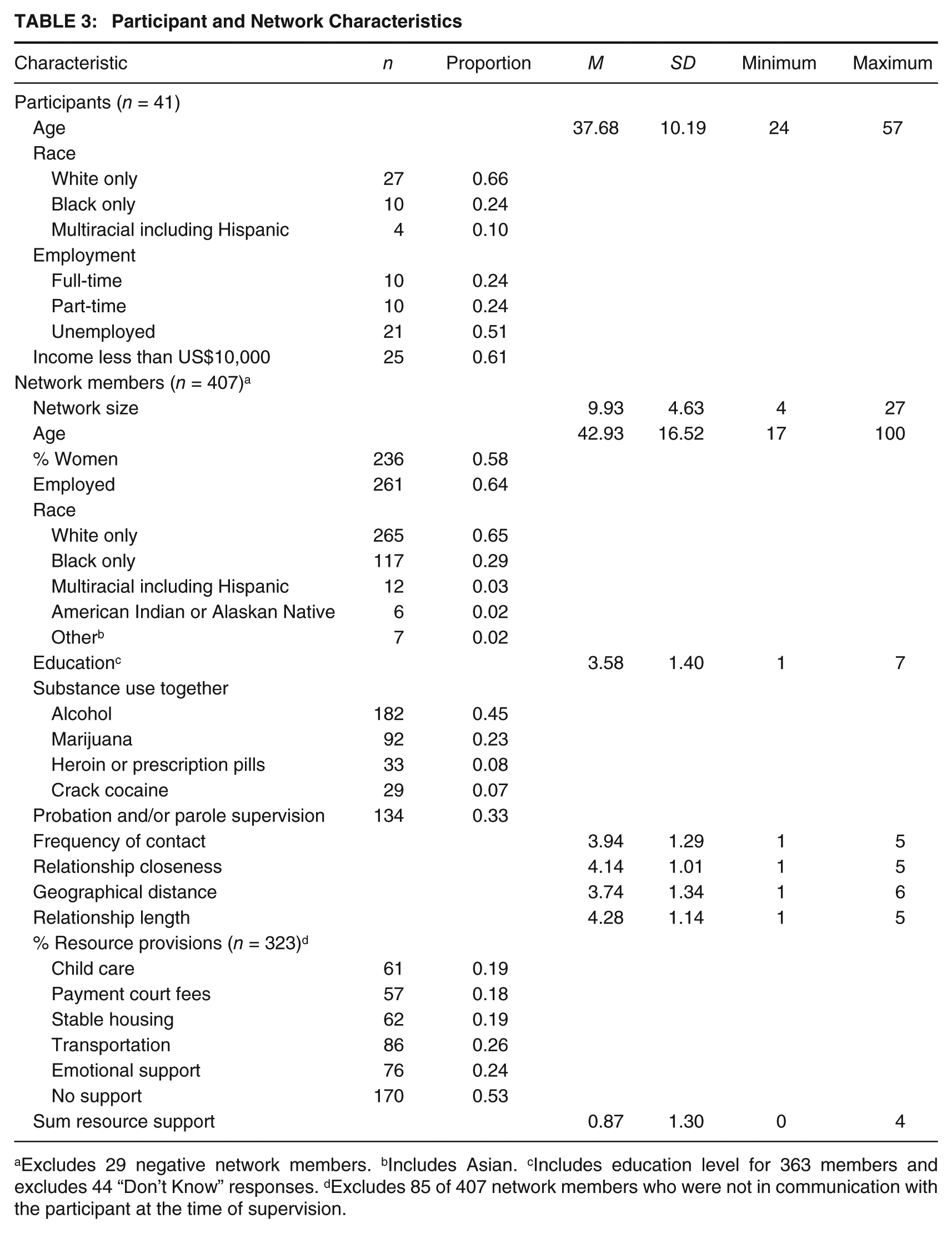
Excludes 29 negative network members. bIncludes Asian. cIncludes education level for 363 members and excludes 44 “Don’t Know” responses. dExcludes 85 of 407 network members who were not in communication with the participant at the time of supervision.
Women, on average, experienced frequent contact (M = 3.94, SD = 1.29), strong relational closeness (M = 4.14, SD = 1.01), moderate geographical closeness (M = 3.74, SD = 1.34), and long relationships (M = 4.28, SD = 1.14) with their network members. About half of the network members whom women knew while under court supervision did not provide the participant with any resources related to their correctional supervision (n = 170, 53%). Approximately one quarter provided emotional support throughout the court experience (n = 76, 24%) or transportation to supervision-related meeting requirements (n = 86, 26%). Less often, network members assisted with child care during supervision visits (n = 61, 19%), the payment of court-related fees (n = 57 or 18%), or provided stable housing (n = 62, 19%). On average, network members provided less than one type of court-related resource support (M = 0.87, SD = 1.30).
Whole Network Characteristics
Table 4 displays the average aggregate scores for women’s networks. The minimum and maximum scores represent the variation in network member characteristics for women’s networks across the sample. A range of uniformed absence to complete saturation of network characteristics is present for the proportion of women’s network members who were employed, were of the same race as the participant, shared experiences of alcohol use, and provided emotional support, transportation support, and no supervision-related resource support. Few women reported high saturations of individuals with whom they use heroin/prescription pills (M = 0.08, SD = 0.13, minimum = 0.00, maximum = 0.50) or meth, crack, or cocaine (M = 0.08, SD = 0.13, minimum = 0.00, maximum = 0.50). Networks had moderate variation in representation across networks and low proportion of individuals who provided child care during supervision visits (M = 0.15, SD = 0.23, minimum = 0.00, maximum = 0.86), assisted with court-related fees (M = 0.19, SD = 0.16, minimum = 0.00, maximum = 0.50), or provided stable housing (M = 0.20, SD = 0.17, minimum = 0.00, maximum = 0.60). Each of the participant’s networks comprised at least 30% women. Tie characteristics of the whole network variables suggest frequent communication of women with their network members and long relationship lengths. Minimum network averages were close to 3, or communication “2 to 3 times per month,” for contact frequency and 3, or “less than a year”—but more than a few months—for relationship length. Women’s networks with the lowest average aggregate scores for closeness approached “somewhat close” relationships. The lowest average aggregate scores for geographic distance suggest that network members, in the most distant circumstances, on average, “lived in the same state but more than an hour away.” Finally, the average sum of supervision-related resource support across networks ranged from complete absence to an average of 2.71 resources provided.
Egos’ Whole Network Characteristics
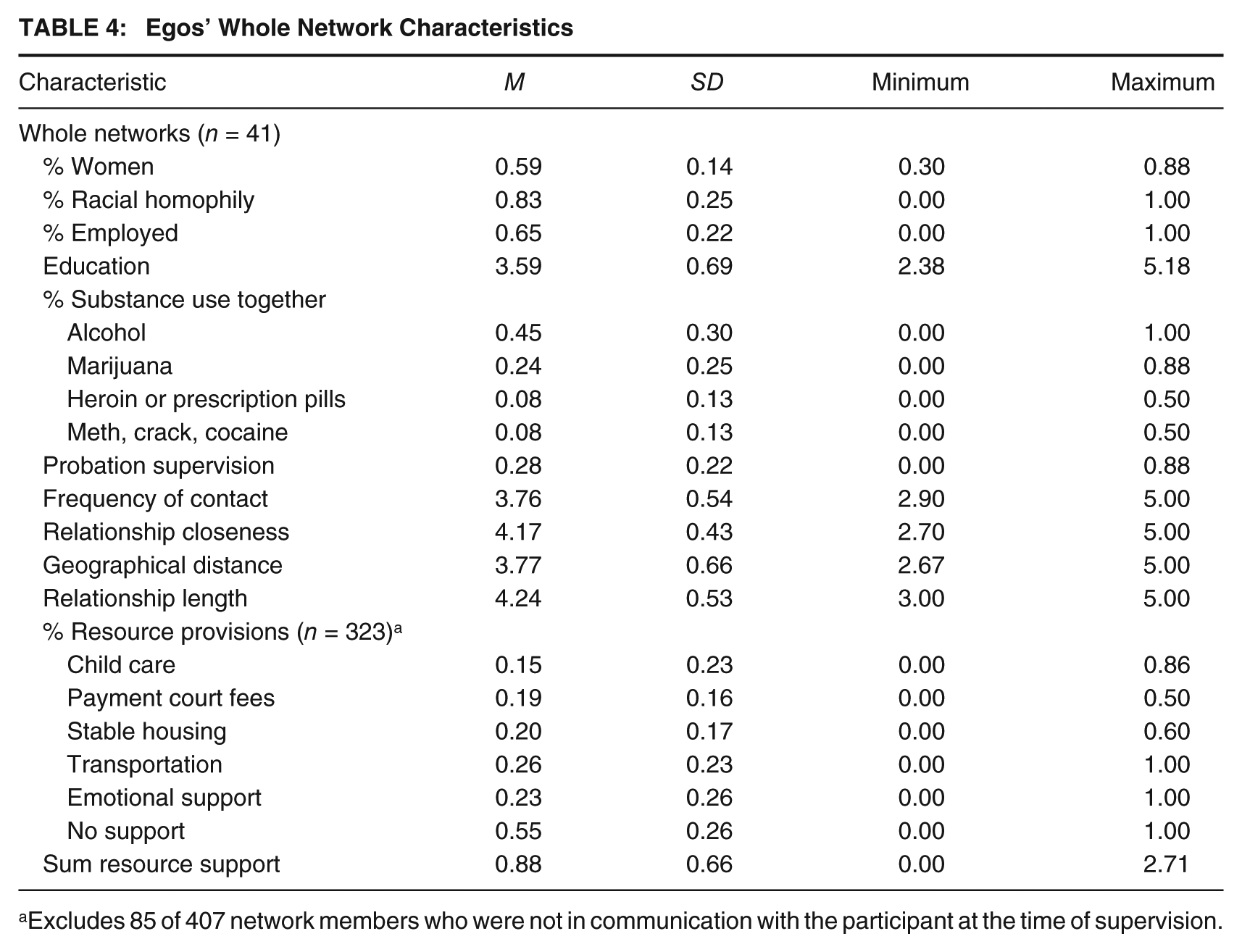
Excludes 85 of 407 network members who were not in communication with the participant at the time of supervision.
Negative Network Members
Less than half of the sample participants (n = 19, 46.3%) identified the 29 named negative network members (6.7% of 436). Most of the negative network members were female (n = 23, 79.3%), varied in age (M = 42.9, SD = 10.5, range = 25-63), shared relationships with participants that were 7 or more years in length (n = 26, 89.0%), had previously been under correctional supervision (n = 23, 79.3%), interacted infrequently with the participant (96.6% spoke less than monthly), and were disproportionately comprised friends (79.3%). The remaining members hold kinship ties (e.g., uncles and cousins). Negative network members yielded a slightly higher average score of summed resource support (M = 1.00, SD = 1.5, range = 0-5). The proportion of shared substance-using behaviors between the participant and the network member was higher among negative network members than for women’s personal support networks. When asked about shared substance-using experiences, women reported the following usage with negative network members: alcohol with 65.5%, marijuana with 51.7%, heroin or prescription drugs with 27.6%, and meth or crack/cocaine with 17.2%.
The Most Helpful Network Members in Navigating Probation Requirements
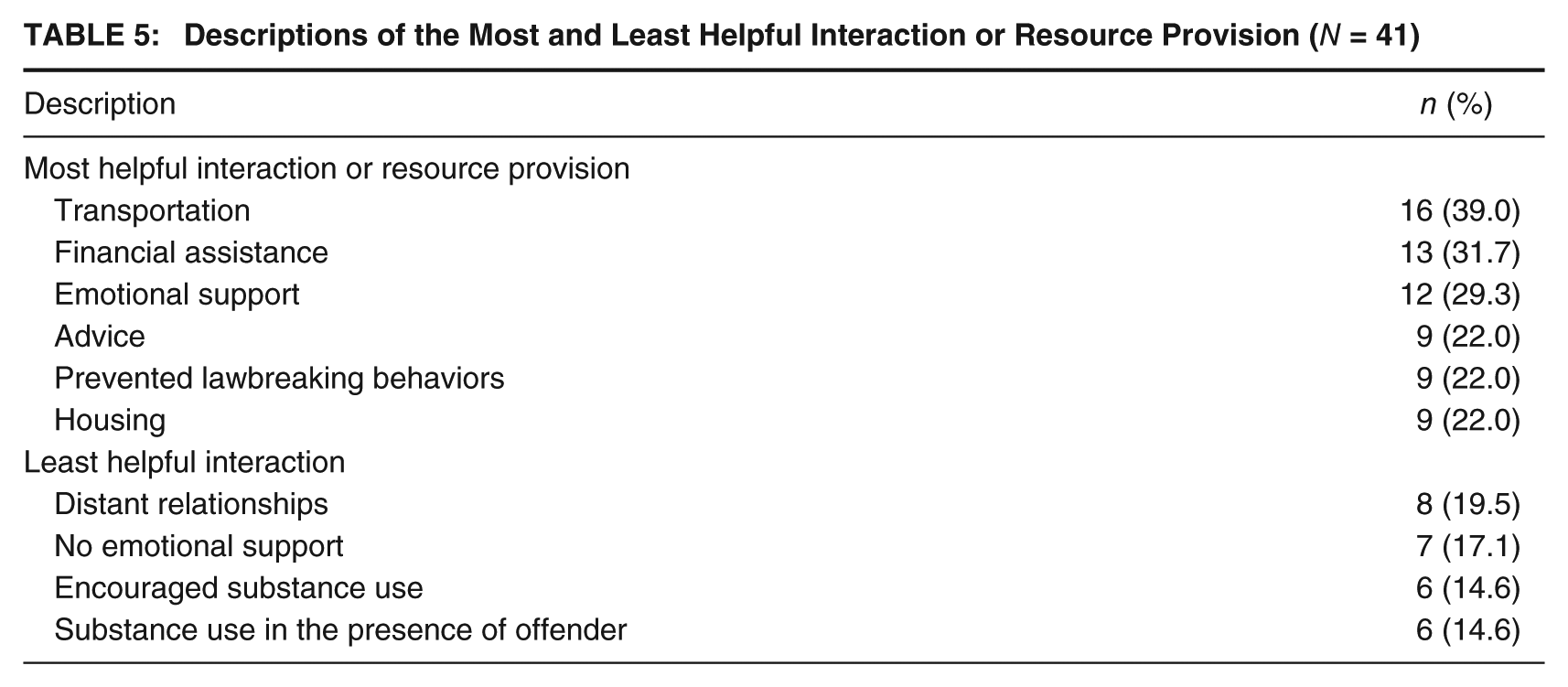
The discussion of the results now turns to the qualitative findings of the research. Women were asked to identify their most helpful network member in navigating supervision requirements and to describe their most memorable experience of supervision-related support from that individual. Women most commonly selected their mothers (n = 18, 43.9%) as the most supportive network member, followed by a significant other (n = 9, 22.0%), a sibling (n = 5, 12.2%), friend (n = 4, 9.8%), or other family member (i.e., aunt, uncle, or grandparent; n = 3, 7.3%). Ex-boyfriends (n = 1, 2.4%) and substance abuse support group members (n = 1, 2.4%) were also identified as helpful. Experiences of support were most commonly related to transportation (n = 16, 39.0%), financial assistance (n = 13, 31.7%), emotional support (n = 12, 29.3%), advice (n = 9, 22.0%), housing (n = 9, 22.0%), and preventing lawbreaking behaviors (n = 9, 22.0%; see Table 5). Less common forms of helpfulness noted by participants included child care, attending court cases, providing support while the offender was in treatment facility, and facilitating admission into a substance abuse treatment program.
Descriptions of the Most and Least Helpful Interaction or Resource Provision (N = 41)
Transportation
Transportation support from network members played a key role in women’s navigation of probation supervision (n = 16, 39.0%). License suspensions, walking to supervision offices, and frequent drug testing served as barriers to abiding by rules for required visitation to supervision agents. For example, Kayla, a 27-year-old unemployed mother of three, shared an experience of her mother providing her with transportation to meet with her probation agent after her preplanned form of transportation did not follow through. She stated, “Yeah, she [her mother] drove me [to her agent’s office] last week. It was freezing cold out, below zero. I wasn’t gonna go. I was gonna abscond. But then she took me.” She continued, “I was already irritated because the people who were supposed to take me didn’t show up.” Mothers were key sources of transportation support. This was true even when mothers possessed limited resources. For example, Ashley, a 47-year-old White mother, identified an experience when she was over a friend’s house, but needed transportation to a probation-related requirement. Her friend’s car had broken down and her home was not on a bus route. Ashley explains,
Well, I had not been working and I really needed to get somewhere and my mom actually paid for a taxi cab to get me there. I barely made it or I would have been in violation, because she [her agent] already gave me the next day. She [her mother] literally paid for a taxi cab for me to get where I was going. It was almost the last of her money because at the time she didn’t have much money. But that would be the most memorable because she literally saved me. I didn’t go back to jail and it was the last of her money.
Women’s lack of transportation was often driven by their lack of a stable source of income.
Financial assistance
Financial assistance was the next most common theme that reflected helpful support from network members (n = 13, 31.7%). Women voiced concerns about various financial obligations affiliated with probation supervision, including drug screening costs, restitution, and court fees. Network members who were willing to assist financially directly contributed to women’s release from supervision as well as reduced supervision-related stress. For example, Jasmine, a 51-year-old White mother previously convicted of operating a motor vehicle while intoxicated and assaulting a police officer, shared a conversation she had with her boyfriend regarding his commitment to alleviating some of her financial strain. She stated, “He [her boyfriend] said that he would pay half if I would pay the other half. And that would be my probation and I would be done with this and have no worries.” Similarly, Carla, a 29-year-old White mother of three working part-time, expressed the relief she felt when her mother paid off her supervision-related fees. She stated, . . . it was a relief you know to not feel that burden or the fear that was going to continue to hang over my head, or not be able meet the obligations of my probation, not be able to complete it. Because otherwise I had met all of the requirements successfully.
Kimberly, a 24-year-old mother to one child with a history of retail fraud and substance possession, revealed the amount of money required to complete probation supervision. She stated, “she [her mother] always paid my fines. We paid off $2,000 [laughs]. If I wouldn’t have got the fines paid, I would have been violating my probation and probably would’ve gone to jail so it was very helpful.” These narratives unveil the role financial support played in women’s perceived freedom and emotional state. Financial support from family members and significant others had the potential to shorten the length of the probation supervision period and to resolve various court-related problems.
Emotional support
Another common theme in descriptions of meaningful support from network members was emotional support (n = 12, 29.3%). From the challenges of attending residential substance abuse treatment programs to struggling with changes in correctional officers, women relied on network members to listen to their problems. Angie, a 34-year-old White female with a history of retail fraud, shared experiences of emotional support from her boyfriend while she was attending a substance abuse treatment program. When asked about memorable support, she stated, He was very supportive. He was there the whole time. He wrote letters back and forth. I had to do a lot of apologizing to him, you know. Like I said, we had been on and off all of these years and he had no idea that I had slipped into heroin and stuff like that. [I] just remember him hugging me and telling me that I could do it.
When asked why this support was so meaningful, she continued, He was definitely there to listen, he was open to my apologies. I had a lot of apologizing to do. He doesn’t throw it in my face. I am a different person, and he loved both of them, he loved both of them people.
Although some network members seemed to provide positive support that was unrelated to crime, such as Angie’s boyfriend, some network members used their experiences in the criminal justice system to provide the participant with emotional support. For example, Brittney, a 19-year old unemployed mother of three, shared a stressful probation-related experience during which her network member provided her with advice regarding her new probation officer. She stated, I was just, like, freaking out over having to have a new probation officer because I don’t like change. He just, like, told me how nice she [her new probation agent] was and how helpful she was. He made me feel a lot better about it and she actually was super nice and helpful so that made me feel better too.
Occasionally, emotional support transitioned into advice. For example, when asked why she did not want to comply with the change, Brittney stated, “Oh, I was just upset because I didn’t want probation at all. I wanted more jail time and no probation. He was in the court room telling me I better take this deal because I didn’t want to.”
Brittney’s account of support was particularly interesting because under traditional correctional guidelines, female offenders are forbidden from interacting with individuals with criminal records. When further probed regarding the importance of the support from the crime-involved network member, she continued, “Because I knew that he actually knew ’cause he’d been through it. I hate it when somebody tells me that it’s gonna be okay when they never went through it. When my mom tells me I’m like, ‘Shut up!’” This narrative shows the complex interplay between helpful support and the criminal background of network members offering that support.
Advice
Advice from network members often prevented women from making poor choices and served as a voice of reason when they did not want to comply with the rules of probation. For example, Keisha, a 31-year-old African American mother of four with a history of assault and larceny, shared her most memorable experience of support from her boyfriend, who advised her not to spend time with a substance-abusing friend. Keisha had recently been released from a 3-month residential substance abuse treatment program and had a 2-week time period before she was required to meet with her probation officer. When a friend asked her to go to the store with her, her boyfriend intervened. She explains, . . . I almost slipped up because a friend of mine—well it used to be a friend of mine—came by and I was like oh I think I’m going to go to the store and he [her boyfriend] said ‘you’re not going anywhere with her [laughs]’. I guess he had that feeling and sure enough, right as she came back later, letting me know that her intentions were to drive me to a drug house and she wanted to see where my head was at. I was like well why would you want to do that?
Preventing violations and lawbreaking behaviors
Network members were also helpful in assisting women in preventing probation violations (n = 9, 22.0%). For example, Mya, a multiracial 24-year-old mother of three with an extensive criminal history including home invasion and possession of forged prescription drugs, shared an experience of refraining from substance use and visiting her probation agent even when she knew she would test positive for illegal substances. She stated, I didn’t want to go to my PO [probation officer] because I knew it was going to be bad. But then basically she [her sister] would say one day I will have to deal with it and that I would have to get it over with regardless.
Similarly, Lauren, a 23-year-old White mother of one, stated that her boyfriend encouraged her to continue going to work, to meet the requirements of her supervision. She explains, He pushed me. He pushed if I didn’t want to go to work because with a felony you had to work. If you did not you going to be put in the jail. So, the times that I didn’t want to work when I got morning sickness [due to her pregnancy] he would push me, he would make me go.
Not only did her network member encourage behavior that aligned with the requirements of supervision, but when problems occurred he took action. When asked why this experience of support was so meaningful, she continued by saying, It was the only time on probation that I failed. I switched a job; I was working at McDonalds and I got a job at K-Mart. So, I quit McDonalds and started working at K-Mart. I got put in jail for switching a job and not telling her [the probation agent]. He [her boyfriend] went in to K-Mart, talked to my manager, which I should have been fired right away and then he went into my probation office and he went off on the probation officer and I got out [of jail] three days later with no charges or anything.
Furthermore, she explained, “If it wasn’t for him, I would have been stuck in jail for however long and it would have been on my record for future jobs.” This account highlights the importance of network members providing women with support throughout the correctional process. Several women also noted the importance of network members who provided housing, child care, and assistance applying for jobs so that they could conform to supervision requirements.
The Least Helpful Network Members in Navigating Probation Requirements
Next, participants were asked to identify their least helpful network member and the most memorable experience of their lack of support. Least helpful network members were most commonly friends (n = 14, 36.8%), followed by siblings (n = 8, 21.2%), parents (n = 6, 15.8%), aunts and uncles (n = 6, 15.8%), counselors (n = 2, 5.3%), coworkers (n = 1 or 2.6%), and significant others (n = 1, 2.6%). As shown in Table 5, there was less agreement among women in the sample regarding themes of the least supportive behaviors. Most commonly, women selected network members as “least helpful” due to geographically or emotionally distant relationships (n = 8, 19.5%; i.e., a coworker) which limited their abilities to provide support. The most frequently identified actively unsupportive behavior women noted among network members was failure to provide emotional support (n = 7, 17.1%). Other themes of negative interactions included encouraging substance use (n = 6, 14.6%) and using substances in the presence of the participant (n = 6, 14.6%). Lack of emotional support (n = 7, 17.1%) was present throughout the themes reviewed below; thus, a section is not provided for the specific theme.
Network members encouraged substance use
All of the women in the sample had some history of substance use. Consequently, networks members who encouraged women to continue using substances (n = 6, 14.6%) further complicated what Marcia, a 46-year-old White mother with one child, described as a “raging war” inside of her to desist from substance use. She describes an experience with her ex-friend who encouraged her to continue using substances by describing the types of drugs to which she had access. She recounts the experience stating, she would keep telling me how much stuff [drugs] she had; like, if she had pain pills or whatever on her. She would keep telling me oh I got this and that. Flaunting it! It was okay for her because she wasn’t on probation at the time so she could take them and I couldn’t. I was like man I wish I was off probation, I wish I was off probation. But then by that time I’d come to my senses, I didn’t want them anymore.
When asked why the lack of support was memorable, she continued, “Because it was like a raging war inside of me because I wanted to take them.”
Andrea, a 29-year-old White woman previously convicted for possession of marijuana and operating a motor vehicle while impaired, shared a story about her brother that mirrored Marcia’s struggles with avoiding substance use. She stated, He [her brother] is a drinker, but I don’t drink. But he’s a smoker too–he smokes marijuana. And that was my hardest, the worst thing for me to stop when I got on probation; the hardest thing I should say, not the worst.
She then describes his encouragement of her substance use: “He would—‘Here Sis’ [participant gestures the passing of marijuana]. I’m not a drinker and I don’t think he would try to get me to drink. That I would say no to, but the marijuana part I would accept.” Although the participant would occasionally turn down the offers to smoke marijuana, she admits that she violated her probation multiple times due to her inability to stop smoking the substance. In an effort to avoid future violations, she explained that she instead started consuming chemicals and employing techniques that prevented her agent from detecting the substance during drug screenings.
Substance use in participants’ presence
Even when network members did not encourage the participant to use drugs, substance use in their presence presented challenges (n = 6, 14.6%). Specifically, network members’ actions while under the influence of substances placed women in difficult situations. For example, Ciara, an African American 18-year-old woman convicted of home invasion, describes an experience with her father when he continued drinking after he agreed to provide her with transportation to a court-ordered class. She stated, He knew I was on probation and he would be excited to drink and hang out. I had to go to one of my classes and he didn’t really care and he continued to drink. I didn’t make it to my class . . . he’s my dad and I thought he was going to be more supportive.
As a result of the experience, Ciara stated that she isolated herself from others and does not interact with friends or family members frequently.
Jennifer, a 28-year-old White mother of three convicted of various drug offenses including maintaining a drug house and possession/delivery of marijuana, shared a similar experience with her father. She explains, I was on tether and I had a certain time that I had to be back to the house. He drove me to the facility so I could do my drug screening and on the way back we had to drop by his friend’s house. He locked himself in the bathroom for like an hour. I don’t know what drug he was doing. I was late getting back and I got in trouble with my probation officer. He called her [the probation agent] and made up this big story that he had a flat tire and stuff but . . . it was because he was using.
The participant said she felt “frustrated, disappointed, and sickened” by the experience. She continued, “I was trying to get clean and he was still using around me. Every time he did it, it made me want to do it. And I did, I slipped a couple of times.” Her father eventually ended up going to jail and serving time under probation supervision as well.
Characteristics of the Most Helpful and Least Helpful Network Members
The most helpful and least helpful network members in offenders’ networks played distinctly different roles in assisting female offenders in navigating the probation process. The next section of the analysis examines the characteristics of the two groups. As displayed in Table 6, there were some similarities between the two groups. The least and most helpful network members collectively shared long relationship histories, Most Helpful (MH)—M = 4.83, SD = 0.44; Least Helpful (LH)—M = 4.71, SD = 0.93; t(77) = −0.74, p = .464, similar proportions of female network members, MH—M = 0.61; LH—M = 0.63; χ2(1) = 0.04, p = .842, and comparable proportions of criminally engaged individuals, MH—M = 0.29; LH—M = 0.47; χ2(1) = 2.74, p = .098. However, there were also several differences between the two groups. Network members who were the most helpful tended to be older, MH—M = 50.78, SD = 14.90; LH—M = 39.11, SD = 14.35; t(76) = −3.52, p = .001, employed, MH—M = 0.61; LH—M = 0.34; χ2(1) = 5.66, p = .017, more educated, MH—M = 3.74, SD = 1.46; LH—M = 2.97, SD = 1.27; t(71) = −2.39, p = .019, geographically closer to the participant, MH—M = 4.13, SD = 1.64; LH—M = 3.43, SD = 1.34; t(73) = −2.00, p = .049, and in contact more frequently, MH—M = 4.73, SD = 0.78; LH—M = 2.76, SD = 1.73; t(77) = −6.60, p < .001. In addition, the least helpful network members did not share close relationships with the participant, MH—M = 4.56, SD = 0.90; LH—M = 3.21, SD = 1.58; t(77) = −4.72, p < .001, and provided less support across multiple needs, MH—M = 2.63, SD = 1.83; LH—M = 0.45, SD = 1.03; t(77) = −6.48, p < .001.
Independent Samples t-Test of the Most and Least Helpful Network Members’ Characteristics
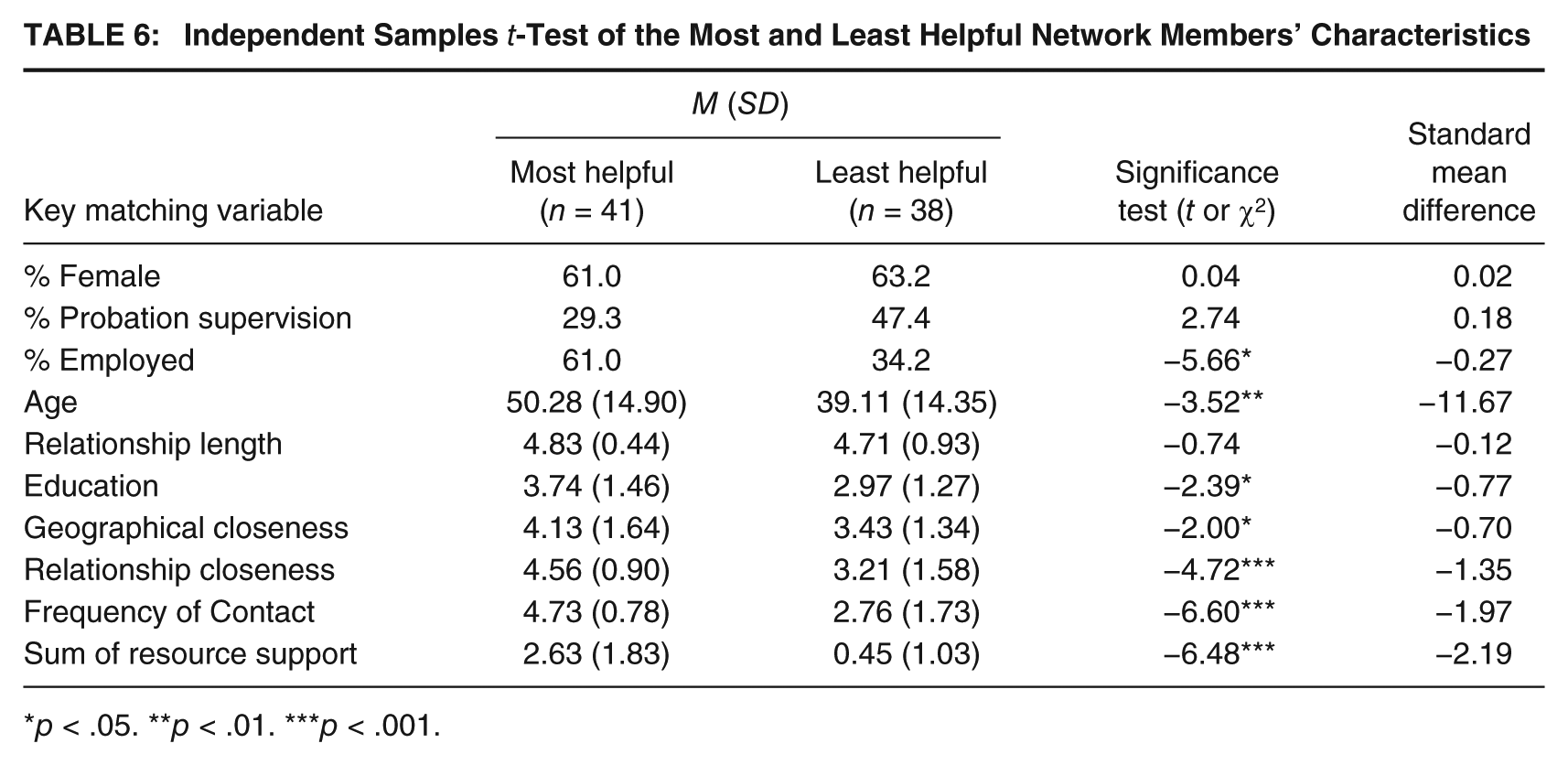
p < .05. **p < .01. ***p < .001.
Discussion
Network Size and Composition
The current study aimed to most effectively capture semiregular interaction partners by utilizing 11 name generators (Straits, 2000). Few studies had attempted to examine the size and composition of female offenders’ personal support networks. Reisig et al. (2002), as an exception, reported women’s network sizes ranged from 0 to 20 members, with an average size of five network members. Participants in the present study reported a similar range of network members but a considerably higher average network size. The finding of a larger average network size is likely the result of the strategic use of multiple name generators and interactive network software. Slightly more than half of the network members were elicited by the primary name generator, but name generators specific to family, friends, and individuals from employment settings proved to be important. The employed strategies appear to be effective in capturing members who are not a part of participants’ core networks and may hold promise for capturing a more complete representation of semiregular interaction partners.
With regard to the relational composition of women’s networks, kinship ties accounted for nearly half of all relationships. Friends, coworkers, and ex-friends (or negative network members) were also represented among the elicited network members. Few women (less than 2%) identified network members who were therapists, probation officers, or served in other relevant service roles. This finding was unexpected. Prior literature has highlighted the inclusion of correctional officers as network members and the supportive or resource-granting roles some can play in women’s rehabilitative process (Bui & Morash, 2010; Cobbina, 2010; Morash, 2010; Skeem, Eno Louden, Manchak, Vidal, & Haddad, 2009). Specifically, human service professionals can connect women with state capital (i.e., state-issued resources), which has been associated with reductions in recidivism (Holtfreter, Reisig, & Morash, 2004). It is unclear why these individuals were not represented in the participants’ networks. One explanation could be the limited number of women currently under correctional supervision at the time of the interview.
Perhaps, the most notable compositional characteristic discussed in the research findings is the high proportion of various types of substance use shared between the participants and network members. The conceptualization of substance use as a tie characteristic (i.e., shared substance use) instead of strictly a participant or network member characteristic allowed for the discussion of the proportion of network members that directly engage in substance-using behaviors with the participants. Considering the substance-abusing histories of the women in the sample and the well-documented relationship between substance use or abuse and criminal activities (Bennett & Holloway, 2009; Bennett, Holloway, & Farrington, 2008; Lurigio & Swartz, 1999), these relationships may threaten women’s desistance from crime and abstinence. In some cases, half of women’s network members used crack cocaine, heroin, or prescription drugs with them. The proportion of network members who used marijuana and alcohol with the participant was even higher with 88% and complete saturation reported, respectively. Future research should explore the effects of high proportional representation of network members who use substances with the participant on offenders’ continued substance use and reoffending rates.
The Most Helpful and Least Helpful Network Members
The qualitative findings of the study, regarding the helpfulness of network members, support prior works which emphasize the importance of kinship networks (Bui & Morash, 2010; Clone & DeHart, 2014; Valera et al., 2015). Mothers and siblings were the “most helpful” network members. Transportation support, financial support, and emotional support were pivotal to women avoiding violations, completing supervision faster, and coping with probation requirements. However, kinship networks were also sometimes included among the “least helpful” network members in navigating probation supervision. “Least helpful” friends presented opportunities to commit crime, but family members were especially difficult for women to detach from, presented opportunities to use drugs regularly, and directly interfered with women’s abilities to attend court-related meetings (e.g., by failing to provide transportation). Consistent with Falkin and Strauss’s (2003) work on the support networks of drug users, network members did not fit neatly into dichotomous categories of supporters and enablers. Instead, some network members not only provided constructive social support but also enabled drug use. Furthermore, when examining the characteristics of the “most helpful” and “least helpful” network members, the two groups shared similarities. Both groups of network members had long relationship lengths with participants and comparable proportions were criminally engaged.
Negative Network Members
A separate descriptive analysis was conducted to assess the characteristics of network members with whom women had discontinued communication or shared conflictual relationships. Negative network members, in comparison with women’s primary support network, used more substances with the participants and were disproportionately friends, with few holding kinship ties. Some scholars have taken particular interest in researching network members who burden, upset, or stress participants or who are “sometimes demanding or difficult” (Bertera, 2005; Durden, Hill, & Angel, 2007; Lee & Szinovacz, 2016; Offer & Fischer, 2018; Straits, 2000). These studies strive to identify and assess negative network member relationships. Unfortunately, contextual differences (i.e., mental health), the use of vastly different negative name generators, and differing study samples (i.e., college students) limit the applicability of the findings to the current research (Campbell & Lee, 1991). However, recent increases in negative network member research highlight the need for a balanced understanding of supportive and burdensome network members across disciplines. For female offenders, negative network members appear to be individuals who threatened their sobriety or desistence from use of other substances and were involved with the law.
Neutral Network Ties
The current research is intentional about identifying the “most helpful,” “least helpful,” and “negative” network ties. However, it is also important to discuss the neutral nature of relationships with network members. In many cases, network members neither helped nor hindered participants in fulfilling their supervision-related needs. Scholars across disciplines, including the health, business, and education fields, note the selective nature of help-seeking behaviors (Borgatti & Cross, 2003; Heaney & Israel, 2008; Pescosolido, 1992; Tellez, 1992). Specifically, the body of research identifies factors which influence an individual’s decision to seek help from certain people, such as perceived receptiveness to the request or access to the needed resources. In the context of the current research, more than half of the network members women identified did not provide any form of supervision-related resource support. It is possible that network members are unable to provide needed forms of support or were not “selected” to provide support for some other reason (Bearman & Parigi, 2004). For example, a network member’s knowledge of the participant’s supervision status or criminal history likely influences whether or not the participant seeks supervision-related support. This may begin to explain why so few of women’s network provided any form of resource support. Future research could clarify this problem by asking whether each network member is aware of the participant’s correctional status.
Finally, the first two categories of the “most helpful” and “least helpful” network members—geographical distance and lack of emotional support—capture a lack of support that is passive. Unlike the network members who were actively encouraging women to use substances or were using substances in their presence, the former network members were not actively engaging in behaviors that interfered with the stipulations of women’s correctional supervision. Future scholars could be more precise in identifying network members who are unable to help in contrast to those who cause harm to the participant.
Limitations
Despite the strengths of the research, there are some limitations. The small sample size limits generalizability of the findings, although the methods used did produce a large sample of network members. In addition, the research employs select egocentric social network methods but fails to provide insight into the structural characteristics of women’s personal support networks. Examination of structural characteristics such as network density and clustering could aid correctional officers in advising women in beneficial network alterations. Finally, future research should use multilevel modeling to identify which offender, network member, and network characteristics predict specific types of resource accessibility. The present study provides a descriptive assessment of women’s networks and the network members who are the most and least helpful in navigating the correctional process; however, it cannot speak broadly to the characteristics that place network members at greater odds for providing support.
Conclusion
In closing, the current study has the potential to inform policy and theory. Currently, probation officers attempt to positively influence alterations to offenders’ personal support networks by stipulating desistance from peers with a prior history of crime or substance use; however, network members do not fit neatly into dichotomous categories of individuals who provide support and those who encourage antisocial behaviors. For community-based offenders, these relationships, especially those holding kinship ties, can be particularly difficult to navigate. Establishing strategies for women to discontinue communication with crime- and substance-involved family members, or effectively communicating the need for law-abiding behaviors in their presence, could assist women in successfully completing supervision requirements and avoiding future substance use.
Furthermore, a self-evaluative strategy could be implemented by correctional agents to allow women to gain a greater understanding of their network composition. By cataloging network member characteristics, specifically their substance-abusing behaviors and provision of resource support, women may become more astute to the potential costs and benefits of engaging in frequent communication with specific network members. Doing so could also limit women’s emotional evaluation of relationship length and kinship ties and promote a critical assessment of risk of continued substance abuse and/or criminal engagement imposed by some social ties.
With regard to theory, gendered theories of crime are still in the developmental stages. Various constructs, risks, needs, and pathways have been identified as influential to women’s offending patterns (Daly, 1992; Moffitt, 1993; Richie, 2001; Salisbury, Van Voorhis, & Spiropoulos, 2009; Van Voorhis, Salisbury, Wright, & Bauman, 2008; Wright, Salisbury, & Van Voorhis, 2007). The current research corroborates prior findings regarding support and women’s experiences in the criminal justice system. It also contributes to the research by allowing for some conclusions to be drawn regarding proportional representation of specific types of network members. Future use of social network techniques has the potential to clarify connections between support and recidivism and the ways in which certain types of networks can fulfill unmet needs and/or reduce recidivism rates.
Footnotes
Author’s Note:
This work was supported by the Michigan State University College of Social Sciences. The author is grateful to Merry Morash for her comments on an earlier version of this article and Kayla Hoskins for collecting the research interviews.