



Abstract
Research on justice-involved women has provided evidence for the importance of using gender-specific information in the assessment, treatment, and understanding of criminal pathways and risk of recidivism in women who have committed offenses. Although research on women who have sexually offended suggests there are differences between men and women who sexually offend, no studies have compared gender-specific and gender-neutral factors to predict recidivism with this group. The current study provided an examination of gender-specific and gender-neutral recidivism risk factors in a sample of 225 women who had sexually offended and were subsequently released from custody with an average follow-up time of about 5 years. Results of the study indicate gender-specific factors, such as mental illness symptoms and victimization history, are demonstrative of risk of reoffense in women who sexually offend. These findings provide implications for future research regarding risk assessment and more effective application of treatment for this understudied population.
The numbers of women under correctional supervision, among both incarcerated and probated offenders, are rapidly increasing (Kaeble & Bonzcar, 2016). With the expansion of the female correctional population has come an increased interest in female criminality. This line of inquiry has consistently identified a divergence in criminal pathways between justice-involved women and men (see Vogel & Nicholls, 2016). Relatedly, researchers have identified gender-specific factors that are demonstrative of risk for recidivism in justice-involved women (Salisbury & Van Voorhis, 2009; Scott, Grella, Dennis, & Funk, 2016; Van Voorhis, Wright, Salisbury, & Bauman, 2010). A recent study conducted by Wijkman and Bijleveld (2013) extended support for the importance of gender-specific risk factors for females who have sexually offended, although these findings have yet to be examined further. Much like general justice-involved women, statistics indicate that the arrest rate for females who sexually offend is on the rise (Federal Bureau of Investigation, 2016), and similarly, researchers have identified unique pathways into sexual offending that differ from their male counterparts (Gannon, Rose, & Ward, 2008, 2010) In addition, some studies reveal criminal pathways that mirror those of general justice-involved women (Elliot, Eldridge, Ashfield, & Beech, 2010; Strickland, 2008; Turner, Miller, & Henderson, 2008). Studies supporting the importance of “gendered” pathways into sexually offending warrant the examination of gender-specific risk in this population.
Gender-Informed Pathways to Offending and Reoffending
Researchers who hold that women demonstrate unique paths to offending behavior argue that there are “gendered” pathways through which the life experiences unique to women are linked to criminal offending (Belknap, 2007). These factors that contribute to female criminality may be factors that only occur with females or, although present in both men and women, occur more often among women or have unique effects for them (Gavazzi, Yarcheck, & Chesney-Lind, 2006; Reisig, Holtfreter, & Morash, 2006; Salisbury & Van Voorhis, 2009). Daly (1992) began this line of inquiry by presenting multiple pathways followed by justice-involved women. Along with pathways that mirrored justice-involved men, Daly (1992) identified multiple pathways to offending in justice-involved women, which included victimization and substance abuse. Researchers continue to find support for these “gendered” pathways through studies highlighting the prevalence of victimization and substance abuse in samples of justice-involved women (Brennan, Breitenbach, Dieterich, Salisbury, & Van Voorhis, 2012; Messina, Grella, Burdon, & Prendergast, 2007; Salisbury & Van Voorhis, 2009; Scott et al., 2016). Furthermore, studies have identified the significance of mental health in the criminal pathways of justice-involved women (DeHart, Lynch, Belknap, Dass-Brailsford, & Green, 2014; Salisbury & Van Voorhis, 2009), although this role may be complex. Work by Dehart and colleagues (2014) specifies that mental health plays a direct role in criminal behavior for women, whereas Chesney-Lind (2000) identified the unique connection between victimization and depression or other mood disorders among justice-involved women. More recent work supports this notion, highlighting the role that victimization plays in future substance abuse and mental health issues, which then leads to criminal behavior (Tripodi & Pettus-Davis, 2013). Whether it is mental health alone or the interaction of victimization and mental health, researchers provide consistent evidence that mental health plays a unique role in female criminality.
This line of inquiry has called into question the application of some evidence-based approaches for the treatment of justice-involved women. The risk–needs–responsivity (RNR) framework (Andrews, Bonta, & Hoge, 1990) is one such approach. According to Andrews and colleagues, the core of the RNR framework is that “risk of recidivism, criminogenic need, and the responsivity of offenders to different service options are the characteristics of offenders that may determine level, targets, and type of rehabilitative effort” (p. 19-20). For example, if evidence indicates that mental health is a criminogenic need (i.e., predictive of recidivism), then treatment should address mental health issues. Alternatively, if mental health issues are not significantly related to recidivism, then it is possible that they act as responsivity needs. The RNR framework has received considerable support (Andrews & Bonta, 2010; Andrews & Dowden, 2007; Lipsey, 2009; Raynor, 2007), but the majority of this support has come from studies of justice-involved men. While there is evidence that the RNR principles apply to women (Blanchette & Brown, 2006), Resig and colleagues (2006) purport that factors unique to women who follow “gendered” pathways into criminality must be included to successfully apply the RNR framework effectively to them.
Central to the success of the RNR framework is the assessment of factors related to risk of recidivism. These factors, which include antisocial beliefs, personality, and criminal behavior, are presumed to assess the risk of future criminal behavior. Studies that have assessed the predictive ability of these “gender-neutral” factors have revealed some support for their utility with justice-involved women. Rettinger and Andrews (2010) conducted an analysis of recidivism outcomes in a sample of women using the Level of Service/Case Management Inventory (LS/CMI), a measure developed to assess gender-neutral factors, and found that scores on the LS/CMI accounted for the majority of the variability in recidivism. The authors noted that, among the gender-specific factors included in the analyses, victimization was significantly related to future recidivism, but this relationship was no longer significant when other risk factors were included. The authors noted that these factors are more likely responsivity rather than criminogenic factors.
A study conducted by Van Voorhis and colleagues (2010) revealed that gender-specific factors, such as victimization, mental health issues, and self-esteem, did increase predictive utility of overall criminogenic risk for recidivism in justice-involved women. In line with Rettinger and Andrews (2010), they demonstrated considerable support for gender-neutral factors, but noted that the inclusion of gender-specific factors resulted in a considerable increase in the ability to predict recidivism. These results have also been demonstrated in more recent studies examining recidivism of justice-involved women. For instance, Scott and colleagues (2016) discovered that victimization in a time period before incarceration significantly predicted recidivism. In DeHart and colleagues’ (2014) study, mental health issues significantly predicted rearrest for drug offenses and abuse as an adult significantly predicted rearrest for property and drug offenses. Although the literature does provide support for the predictive ability of gender-neutral factors, it also provides ample evidence indicating that victimization, substance abuse, and mental health issues all play pivotal roles in female criminality.
Females who Sexually Offend
Studies have shown that, like general justice-involved women, women who commit sexual offenses exhibit similar characteristics, such as victimization, mental health issues, substance abuse, self-esteem, and self-efficacy (Gannon et al., 2008, 2010; Johansson-Love & Fremouw, 2009; Steadman, Osher, Robbins, Case, & Samuels, 2009; Turner et al., 2008). Elliott and colleagues (2010) showed that the majority of their sample of women who sexually offended experienced some sort of victimization and had undergone, or were currently participating in, treatment for depression and self-esteem problems. Fazel, Sjostedt, Grann, and Langstrom (2010) revealed that over a third of their sample of women who have sexually offended had been hospitalized for a psychiatric problem, and one recent study indicated that the rate of child abuse among women who sexually offended is more than three times that of general population females (Levenson, Willis, & Prescott, 2015). Researchers have also shown that women who have sexually offended demonstrate higher levels of victimization than general justice-involved women (Christopher, Lutz-Zois, & Reinhardt, 2007; Strickland, 2008), indicating that victimization may play an even larger role in sexual offending for women.
Although these studies exemplify the similarities in factors influencing criminality between general justice-involved women and women who have sexually offended, there also exist unique factors for the latter group. Gannon et al. (2010) identified one pathway into sexual offending in their sample that involved coercion and subsequent offending with a male co-offender, either out of fear or a need to establish intimacy. Examining specifically co-offending females, Comartin, Burgess-Proctor, Kubiak, and Kernsmith (2018) revealed that both childhood and adult trauma were related to co-offending women who sexually offended. The prevalence of male co-offenders among samples of females who have sexually offended has been consistently demonstrated in the literature (Gannon et al., 2014; Miller & Marshall, 2018; Muskens, Bogaerts, van Casteren, & Labrijn, 2011; Vandiver, 2006, 2010). One recent study analyzing a large sample of both male- and female-perpetrated sexual offenses demonstrated that over 30% of the female-perpetrated incidents involved a male co-offender, compared with 2% among male-perpetrated incidents (Williams & Bierie, 2015).
Risk of Recidivism Factors for Females who Sexually Offend
Despite the small amount of research on reoffense risk for women who sexually offend, a few studies have provided evidence for factors that may predict sexual and nonsexual recidivism. In a large-scale empirical analysis of 1,466 incarcerated women who were convicted of a sexual crime in the state of New York, it was shown that “more prior child victim convictions, more prior misdemeanor convictions, and increased offender age” (Sandler & Freeman, 2009, p. 467) significantly increased the likelihood of sexual recidivism in their sample (the age relationship was nonsignificant when the individuals convicted of promoting prostitution were removed). Similarly, Bader, Welsh, and Scalora (2010) indicated that the sexual recidivists in their sample had higher amounts of prior property crime than the nonrecidivists. In addition to providing evidence for factors that may indicate risk of sexual recidivism in women who sexually offend, researchers also report that women who sexually offend do not specialize in sexual offenses, but rather exhibit general offending patterns (Cortoni, Hanson, & Coache, 2010; Freeman & Sandler, 2008; Sandler & Freeman, 2009).
For nonsexual recidivism, Sandler and Freeman (2009) revealed that younger offenders with more prior misdemeanor and drug offenses had significantly higher odds of recidivating with any kind of felony offense. Along these lines, decreased age, increased previous drug and violent arrests, and increased previous incarceration terms have been shown to significantly predict nonsexual recidivism (Freeman & Sandler, 2008). Studies have also shown that women who commit their offense alone, rather than in the presence of a co-offender, tend to demonstrate more nonsexual recidivism (Miller & Marshall, 2018; Muskens et al., 2011). According to Muskens and colleagues (2011), “this suggests that some characteristics of solo offenders, as yet unspecified, make solo offenders more likely to re-offend than co-offenders” (p. 57). While the Muskens and colleagues (2011) study had a small sample size (N = 60), the findings in this study were supported by a larger sample study (Miller & Marshall, 2018; N = 225). These convergent findings yield further empirical support to the idea that women who sexually offend alone may pose a higher risk for nonsexual recidivism than co-offending women.
Recidivism risk studies have also compared samples of women who sexually offend with men who have sexually offended and have consistently shown that men reoffend more often than women (Freeman & Sandler, 2008; Williams & Nicholaichuk, 2001). Cortoni and colleagues (2010) conducted a meta-analysis involving 10 studies and revealed that the rates of recidivism in women who sexually offend for sexual and nonsexual recidivism were significantly less than their male counterparts. Most noteworthy, according to Cortoni and colleagues (2010), are the low levels of sexual recidivism among samples of women who sexually offend, which varied from 1% to 3% in the 10 studies included. The findings were also mirrored by Freeman and Sandler (2008). In their matched sample of 390 women and 390 men who sexually offended, the men had significantly higher levels of both nonsexual and sexual recidivism. For Freeman and Sandler’s (2008) study, it should also be noted that other than the differences in rates of recidivism, no significant differences in risk factors existed between men and women. One reason for the lack of risk factor differences between these groups could be because Freeman and Sandler’s (2008) study lacked gender-specific risk factors demonstrated to be indicative of risk in general justice-involved women.
Current Study
Although previous research on recidivism risk factors for women who sexually offend has provided insight into the areas of risk that show promise, several issues exist. Many of these studies have relatively small sample sizes or did not include any sexual recidivists (Bader et al., 2010; Muskens et al., 2011). In the Sandler and Freeman (2009) study, they were able to obtain a large sample (N = 1,466), but their data were less rich than the other studies, precluding their ability to account for gender-specific factors. The current study, however, using a moderately sized sample of women who sexually offended (N = 225), includes both gender-neutral factors and gender-specific factors that are associated with risk in general justice-involved women and those who sexually offend (Andrews et al., 2012; DeHart et al., 2014; Geraghty & Woodhams, 2015; Miller & Marshall, 2018; Salisbury & Van Voorhis, 2009; Simpson, Yahner, & Dugan, 2008; Van Voorhis et al., 2010). In particular, this study sought to examine both gender-neutral and gender-specific risk factors in relation to sexual and nonsexual recidivism in a sample of women who sexually offend.
Method
Sample
The sample for this study consisted of 225 women who have sexually offended who were arrested for a sexual offense, convicted of the offense, served a prison sentence, and participated in treatment with the Texas Department of Criminal Justice (TDCJ) at some point between 2000 and 2014. Table 1 contains all of the demographic information on the sample. The average age of the women who sexually offend in the sample was about 31 years (SD = 8.32), the average level of education was “less than high school,” and the average IQ estimate (Beta III; Kellogg & Morton, 1999) was 90.52 (SD = 15.28). For marital status, the majority of the sample was single (36%), followed by married (34.7%), divorced (20%), separated (4.9%), and those labeled as “other” (4.4%). For race, the sample was primarily Caucasian (64%), followed by Hispanic (19.1%) and Black (16.9%). Because of the small number of Black and Hispanic individuals, the race categories were collapsed into White (64%) and non-White (36%) categories.
Descriptive Statistics for Sample (N = 225)
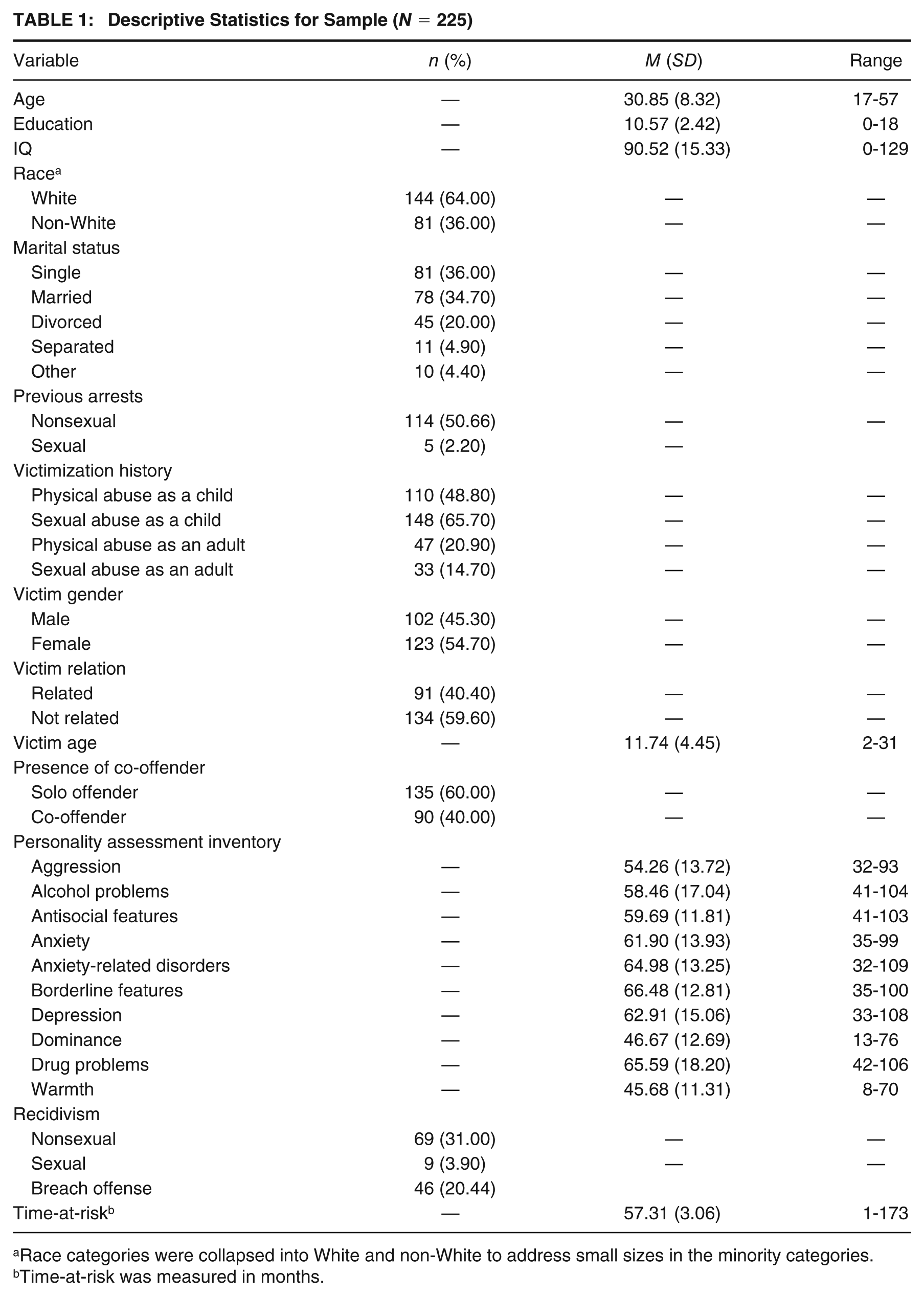
Race categories were collapsed into White and non-White to address small sizes in the minority categories.
Time-at-risk was measured in months.
Aggravated sexual assault of a child or sexual assault of a child accounted for over half of the index offenses for the women in the sample. The remainder of the women in the sample were charged with index offenses of sexual assault, indecency with a child, aggravated sexual assault with a deadly weapon, and injury to a child. Approximately 60% of the women in the sample committed their offense alone, and the majority had victims who were female (54.7%) and who were unrelated (59.6%). Because of some missing data in the sample, 14 individuals were excluded from the analyses, resulting in a final sample size of 211.
Measures
Dependent Measures
Recidivism in this study was operationalized as the first offense that the offender was arrested for after being released from prison for their index sexual offense. This means that the offender did not have to be convicted of the offense to be labeled as a recidivist. In addition, rearrests for violations of sex offender registration requirements were not included as recidivism in the current study, because these behaviors differ profoundly from new criminal behaviors. Pseudo-recidivism was accounted for by ensuring that the date of offense occurred after the offender was released. It is possible that an offense may have actually happened prior to the index offense, but the arrest did not occur until after the offender was released for the index offense. Because of this, it is important to account for this potentially confounding issue. Table 1 provides information on the percentage of women in the sample who were rearrested for a breach offense, a nonsexual offense, or a sexual offense. Information on the frequencies of specific types of recidivism offenses can be found in Table 2.
Recidivism Rates by Offense Type (N = 225)
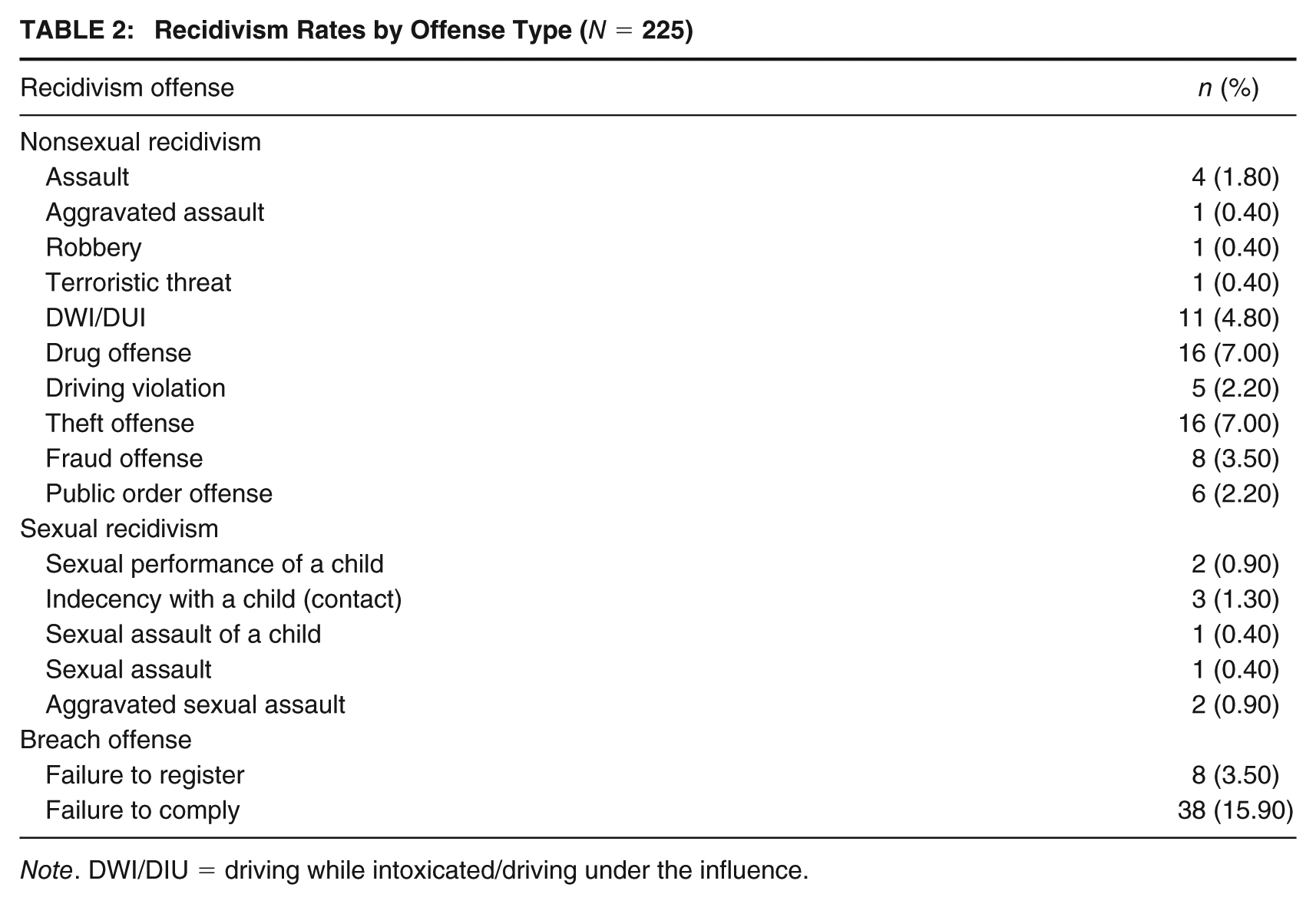
Note. DWI/DIU = driving while intoxicated/driving under the influence.
Time-at-risk for the sample was calculated by using the date of completion for the offender’s Static-99R (Helmus, Thornton, Hanson, & Babchishin, 2012) as the release date and either the date of rearrest for recidivists or the date of end of data collection for the nonrecidivists as the end of the individual’s time-at-risk. The protocol in the State of Texas involves completing the Static-99R within 6 months prior to the release from prison. This provides a relatively accurate indicator of the release date, as the actual date of release was not included in these data used for this study. Descriptive statistics for time-at-risk for the sample can be found in Table 1.
Independent Measures
The independent measures for the current study included gender-neutral and gender-specific risk factors. For gender-neutral risk factors, information on offender demographics, criminal history, and victim characteristics were used. Gender-specific factors included mental health history, substance abuse, history of victimization, and the presence of a co-offender. Descriptive statistics for each of the variables can be found in Table 1.
Gender-neutral factors
For offender demographics, offender age was used as a gender-neutral predictor of recidivism. Age was coded as a continuous variable that accounted for the age of the offender at their index offense. Criminal history variables included previous nonsexual arrests and previous sexual arrests. These variables were originally coded continuously, but were transformed into dichotomous variables to address strong positive skews (0 = no previous arrests; 1 = at least one previous arrest). Victim characteristics included the gender of the victim, whether or not the victim was related to the offender, and the age of the victim. Victim gender and victim relation were coded dichotomously. Male victims were coded as 1 and female victims were coded as 0. If the victim was related to the offender, they were coded as 1, and 0 if they were not related to the offender. Finally, victim age was a continuous variable accounting for the age of the victim at the time of the offense.
Gender-specific factors
To measure levels of symptoms of mental illness and substance abuse in the sample, scores on the Personality Assessment Inventory (PAI; Morey, 1991) were used. These were completed prior to the beginning of the treatment program and, thus, were collected from the clinical files at the treatment unit at which the individuals were housed. The PAI contains 344 items and is a self-administered tool used to examine personality and psychological functioning. Answer responses for each item are (1) totally false, (2) slightly true, (3) mainly true, and (4) very true. These Likert-type responses provide the PAI the ability to assess how intense the feature of each item is (Morey, 1996). Contained in the PAI are 22 nonoverlapping scales that include 11 clinical, five treatment, two interpersonal, and four validity scales (Morey, 1996). The PAI has been validated using large (i.e., greater than 1,000) samples of college students, general population individuals, as well as clinical patients (Morey, 1991). While the PAI has been shown to be an accurate assessment of antisocial disorders and symptoms of mental illness for general justice-involved individuals and those who have committed a sexual offense (Morey & Quigley, 2002), research by Boccaccini, Rufino, Jackson, and Murrie (2013) indicated that this instrument was useful in predicting the level of prison misconduct among females participating in a sexual offender treatment program (SOTP).
For the current study, scales assessing Aggression (AGG), Antisocial Features (ANT), Anxiety (ANX), Anxiety-Related Disorders (ARD), Borderline Features (BOR), Depression (DEP), Dominance (DOM), and Warmth (WRM) were used to assess levels of symptoms of mental illness. The Drug-Related Problems (DRG) and Alcohol-Related Problems (ALC) scales were used to assess substance abuse.
History of victimization included four variables accounting for whether or not the offender reported experiencing physical or sexual abuse either as an adult or as a child. These four variables were coded dichotomously, with 1 indicating that the specific abuse had taken place and 0 indicating that it had not. Finally, whether or not the offender committed the offense alone or with a co-offender was included as a gender-specific independent measure. This variable was also coded dichotomously, with solo offenders coded as 1 and co-offenders coded as 0.
Procedure
This study was approved by the Institutional Review Board (IRB) at Sam Houston State University, as well as the TDCJ institutional review board. Data for this study were gathered from two different sources. Information on offender age, mental health, substance abuse, victimization, victim characteristics, and the presence of a co-offender was gathered from treatment files located within the facility where incarcerated females who sexually offend participate in the SOTP. Data for recidivism and criminal history were collected by accessing the website for the Department of Public Safety (DPS) and locating the subsequent criminal history files. The process for gathering data from both treatment files and the DPS criminal history files involved recording data onto code sheets to ensure the standardization of collected variables.
Analytic Approach
To examine the ability of gender-specific and gender-neutral factors to predict recidivism, a Harrell’s C statistic approach was used. The interpretation of this statistic is identical to a receiver operating characteristic (ROC) analysis (e.g., .56, .64, and .71 indicate small, moderate, and large effects), but as opposed to ROC analysis, Harrell’s C is recommended in situations where there is not a fixed time-at-risk (Helmus & Babchishin, 2017). Furthermore, like ROC analysis, Harrell’s C is not affected by the base rate of recidivism. This is an optimum statistical approach whenever there are a small number of recidivists in the sample. All of the analyses of the current study were run in Stata version 14.
Results
Gender-Neutral Factors
Nonsexual Recidivism
Results for the analysis of the predictive ability of gender-neutral factors can be found in Table 3. According to the results, the only significant gender-neutral factor was previous nonsexual arrests (p = .001). Individuals in the sample who had at least one previous arrests were significantly more likely to be rearrested for a nonsexual offense post-release. Age, previous sexual arrests, victim characteristics, and whether or not the index offense was a contact offense did not significantly predict nonsexual recidivism.
Harrell’s C Statistics for Nonsexual and Sexual Recidivism (N = 211)

Note. CI = confidence intervals; PAI = Personality Assessment Inventory; ANX = anxiety; ARD = anxiety-related disorder; DEP = depression; BOR = Borderline Features; ANT = Antisocial Features; AGG = Aggression; DOM = Dominance; WRM = Warmth; ALC = Alcohol-Related Problems; DRG = Drug-Related Problems.
p < .05.
Sexual Recidivism
This set of analyses included gender-neutral factors as predictors of sexual recidivism (see Table 3). Harrell’s C statistics indicated that none of the gender-neutral factors significantly predicted rearrest for a sexual offense post-release. Previous nonsexual and sexual arrests, age, victim characteristics, and whether or not the index offense was a contact offense did not significantly predict sexual recidivism.
Gender-Specific Factors
Nonsexual Recidivism
The next set of results involves the examination of the predictive ability of gender-specific factors for nonsexual recidivism (see Table 3). Results indicated that solo offender status (p = .005) significantly predicted rearrest for a nonsexual offense post-release. The remainder of the gender-specific predictors, which included scores on the mental health issues, substance abuse, and victimization, did not significantly predict rearrest for a nonsexual offense.
Sexual Recidivism
The final set of analyses involved gender-specific variables and sexual recidivism. For symptoms of mental illness variables, scores on the ANX (p = .001), ARD (p = .012), DEP (p = .001), BOR (p = .016), and DOM (p = .006) subscales significantly predicted rearrest for a sexual offense post-release. History of victimization was also significantly related to rearrest for a sexual offense. In particular, individuals who experienced physical abuse as an adult (p = .017) and individuals who experienced sexual abuse as a child (p = .028) were significantly more likely to be rearrested for a sexual offense than those who did not. Solo offender status, substance abuse, and other victimization variables did not significantly predict sexual recidivism.
Discussion
Although research on women who have sexually offended has increased over the past decade, little knowledge exists on potential risk factors for this population. Furthermore, despite a wealth of evidence indicating the importance of gender-specific risk factors among justice-involved women, researchers have yet to compare the ability of gender-neutral and gender-specific factors to predict recidivism in a sample of women who sexually offend. This gap in knowledge makes it impossible to assign valid risk scores for the offender registry, as well as to assess the appropriate treatment intensity and focus. The current study sought to extend risk of recidivism knowledge and understanding with women who sexually offend by examining risk for sexual and nonsexual recidivism with both gender-neutral and gender-specific risk factors. The results of the study provide support for gender-neutral factors, such as criminal history, as well as gender-specific factors, such as mental health symptoms, prior victimization, and the presence of a co-offender.
Recidivism Rates
Rates of recidivism in the current sample were similar to previous studies, which indicate low rates of sexual recidivism and moderate rates of general recidivism for women who sexually offend (Cortoni et al., 2010; Freeman & Sandler, 2008; Sandler & Freeman, 2009). The prevalence of this finding provides important risk information, in and of itself. Continuous low rates of sexual recidivism for this offender group raise doubt that the registry or sexual offender–specific treatment will reduce the likelihood of sexual recidivism. In fact, sexual recidivism rates for women who sexually offend are reported to be between 1% and 3%, which is approximately the same rate of female sexual offending in the general population (Cortoni, Babchishin, & Rat, 2017). This reliable finding also indicates that determining appropriate risk factors for sexual recidivism in women who sexually offend will continue to be difficult. In addition, this finding calls into question the use of risk assessments in judicial decision making that have not been validated for use with women who sexually offend. The consequences of using male-normed risk assessment methods will not only lead to an overestimation of risk but could also mean that certain women who sexually offend may be arbitrarily assigned to higher risk categories in the registry with increased restrictions post-release.
Previous research on the recidivism of women who sexually offend has shown that while this population sexually recidivate at low rates, the women recidivate with general offenses much more often (Cortoni et al., 2010; Freeman & Sandler, 2008; Muskens et al., 2011; Sandler & Freeman, 2009). Further support for this finding was provided in the current study, with just under 30% of the sample reporting a nonsexual rearrest.
Gender-Neutral Factors
Nonsexual Recidivism
Only one gender-neutral risk factor significantly predicted nonsexual recidivism: previous nonsexual arrests. This finding coincides with a large body of research indicating that criminal history is a strong predictor of rearrest across justice-involved men and women (Andrews & Bonta, 2010; Andrews & Dowden, 2007; Andrews et al., 2012; Lipsey, 2009; Raynor, 2007), as well as previous research on predictors of nonsexual recidivism among women who have sexually offended (Freeman & Sandler, 2008; Sandler & Freeman, 2009). This finding also supports research by Wijkman, Bijleveld, and Hendriks (2011) examining different classes of women who sexually offend. In particular, Wijkman and colleagues (2011) identified the “generalist” class, who were characterized as women with a lengthy criminal history and that fit the “general prototype of an anti-social offender” (p. 42). While this supports the importance of criminal history in the prediction of recidivism for women who have sexually offended, it is worth noting that none of the other gender-neutral factors for recidivism were significant. Offender age, victim characteristics, and whether or not the offense was a contact offense did not significantly predict nonsexual recidivism. That being said, results of this study support the use of gender-neutral factors in the prediction of general recidivism for women who have sexually offended, and more specifically, criminal history factors.
Sexual Recidivism
According to the results of the analyses, none of the gender-neutral factors significantly predicted sexual recidivism. This is especially problematic in light of the lack of gender-specific sexual recidivism risk assessments. The variables contained in the analyses were all similar to variables contained with the Static-99R (Helmus et al., 2012), which is currently being used in some jurisdictions to assess risk of sexual recidivism for women who have sexually offended (Miller & Marshall, 2018). A recent meta-analysis conducted by Cortoni and colleagues (2010) revealed that women who sexually offended sexually recidivated at a significantly lower level than their male counterparts. In light of these findings, the authors held that risk assessment tools designed for use with male offenders will overestimate the risk of sexual recidivism in women. Furthermore, these risk assessments may also misspecify risk, as they fail to account for gender-specific factors.
Gender-Specific Factors
Nonsexual Recidivism
The results of the analyses indicated that solo offender status significantly predicted nonsexual recidivism. While research on differences in risk between co-offending and solo offending women is relatively limited, this finding does support previous research (Miller & Marshall, 2018; Muskens et al., 2011). Two implications can be derived from this finding. First, this finding supports the notion that gender-specific factors do contribute to the prediction of nonsexual recidivism for women who have sexually offended. In light of this result, it is suggested that future research on risk of recidivism for women who have sexually offended takes into account the presence or lack of a co-offender to properly assess risk of nonsexual recidivism. It is also suggested that future studies examine whether factors related to recidivism are present in solo, but not co-offending women, to determine whether solo offender status is actually a risk factor. Second, further support is given to the “generalist” class of women who have sexually offended (Wijkman et al., 2011). This class not only has a long criminal history and exhibits prototypical antisocial traits, these “generalists” also tend to commit their sexual offense alone. Beyond informing risk assessment, these findings provide some insight into treatment for these women. Women who have sexually offended without a male co-offender and have a lengthy criminal history may profit more from treatment targeting overall antisocial behavior, rather than sexual offending behaviors.
Sexual Recidivism
A number of gender-specific risk factors significantly predicted sexual recidivism. Higher scores on measures of anxiety, depression, and borderline personality disorder significantly predicted sexual recidivism. This finding coincides with research highlighting the importance of mental health issues in risk assessment for general justice-involved women (DeHart et al., 2014; Salisbury & Van Voorhis, 2009; Van Voorhis et al., 2010). Although research on females who sexually offend indicates that mental health issues seem to be elevated among this population, researchers had yet to examine whether these factors are related to rearrest for another sexual offense. Muskens and colleagues (2011) examined mental health issues, but their sample did not contain any sexual recidivists, preventing an examination of this relationship. This further highlights the importance of the current study, which was the first to examine mental health issues as a predictor of sexual recidivism in a sample of women who sexually offend. Results also indicated that increased scores on the dominance scale were significantly related to sexual recidivism. This finding adds additional support to research identifying self-efficacy and self-esteem as demonstrative of risk for general justice-involved women (Salisbury & Van Voorhis, 2009; Van Voorhis et al., 2010) and provides evidence that these factors represent risk in women who sexually offend.
Finally, the results indicated that experiencing physical abuse as an adult and sexual abuse as a child significantly predicted sexual recidivism. Researchers examining gender-specific factors have noted the importance of victimization in female offending, beginning with Daly’s work on gendered pathways. Furthermore, researchers have noted that victimization is demonstrative of risk of recidivism in general justice-involved women (Salisbury & Van Voorhis, 2009; Van Voorhis et al., 2010). These findings provide additional support for this notion, as well as exemplify the importance of victimization in the risk of sexual recidivism for women who have sexually offended. Implications for treatment can also be derived from these findings. According to the results of this study, treatment for women who sexually offend may be more effective if it focuses on many of the same factors that treatment for general justice-involved women address, such as mental health issues, self-efficacy, and victimization, rather than a treatment protocol designed specifically for individuals who have committed a sexual offense. In addition, these results support the existence of multiple classes of women who sexually offend that may demand differing treatment protocols (Gannon et al., 2014; Wijkman et al., 2011).
Limitations
Limitations for the current study involve the nature of the sample, the low number of sexual recidivists, and the time-at-risk variable. The sample for the current study consisted of women who sexually offended, were serving prison sentences, and were participating in a cognitive/behavioral SOTP, representing approximately 36% of all incarcerated women who sexually offend (G. Engman, TDCJ, personal communication, May 22, 2017). As the sample did not include those who did not participate in treatment or those who were sentenced to community sanctions, this limits the generalizability of the findings. The low base rates of sexual recidivism also present a limitation to the current study by reducing statistical power in risk variable examination. Although statistical analyses that account for low base rates were employed, larger samples containing a greater number of sexual recidivists are desirable for statistical power. Finally, the time-at-risk variable had two limitations. First, date of release was operationalized as the date of completion of the Static-99R (Helmus et al., 2012). While this is generally a valid proxy of date of release, on occasion the assessment may be filled out no more than 6 months prior to release from prison. This limits the precision of the time-at-risk variable. In addition, only month-level data for time-at-risk were available. It is generally more desirable to obtain day or week level time-at-risk data, but the Department of Public Safety files did not provide this precise level of data collection. Regardless, month-level data are still adequate to conduct analyses where time-at-risk is controlled.
Conclusion
Despite recent empirical steps forward in the examination of women who sexually offend, notable gaps in the literature still remain. Because of these gaps, many steps in the decision-making process for women who sexually offend, specifically in regard to risk assessment and treatment, are made without the consideration that this population may present a unique set of needs when compared with their male counterparts. The current study sought to fill some of these gaps by drawing from the literature on risk of recidivism in general justice-involved women, to test whether the gender-specific risk factors identified in this literature represented risk in women who sexually offend. The results of this study do provide support for the ability of gender-specific factors to predict recidivism, specifically in regard to offender symptoms of mental illness, self-efficacy, and victimization for sexual recidivism, and solo offender status for nonsexual recidivism. Future research should continue this line of inquiry to examine the importance of a gender-specific approach for women who sexually offend.
