



Abstract
In pursuit of “what works” in violent offending behavior programs, there remain insufficient evaluations of program outcomes. Three hundred forty-five offenders from the Canadian Violence Prevention Program (VPP) were compared after an average 3-year follow-up with 338 non-VPP participants. Outcomes measured were new convictions for violent, sexual, or general offenses. Intent-to-treat design was used. Subsequently, participants who completed or did not complete the program were compared with the non-VPP group. Further analyses considered Indigenous and non-Indigenous subgroups. Overall, lower recidivism rates were associated with VPP completion, both in the complete sample and ethnic subgroups. However, the main finding of significantly lower likelihood of violent recidivism was found only for the Indigenous offenders, while significantly lower likelihood of general (nonviolent) recidivism was specific to non-Indigenous offenders. Results are interpreted cautiously in relation to program effectiveness given the quasi-experimental design and the important implications of outcome studies for correctional services.
Introduction
In 2004, Polaschek and Collie concluded their survey of the impact of rehabilitation for violent offending with a call for well-designed program evaluations, stating that there was “a striking paucity of studies meeting even minimal design standards” (pp. 331). Specifically, too few studies had been conducted with an untreated comparison group (with random allocation to group or matched samples), outcome measures were sometimes limited to indices such as institutional misconduct rather than reoffending (or did not report on violent recidivism in violent offenders), and studies suffered important omissions such as adequate description of program content and delivery, or sample characteristics (Polaschek & Collie, 2004). As will be demonstrated in the following review of more recent research, the response in the succeeding literature suggests that there remain concerning shortcomings in the empirical basis underpinning forensic intervention with high-risk violent offenders. This is not an overstatement: To contextualize using Canadian estimates as an example, violent crime (even when excluding homicide or attempted homicide) may represent 10 times the prevalence of sexual aggression (Ouimet, 2010). Yet, the theoretical advances and research developments in the evaluation of “what works” in the assessment and treatment of sexual offenders far outweigh those in the domain of nonsexual violence. This becomes apparent considering efforts to improve sex offending treatment evaluations (Collaborative Outcome Data Committee, 2007; Schmucker & Lösel, 2015), compared with the existing research focusing on nonsexual violence as reviewed below.
A systematic review conducted in 2012 identified only 10 studies reporting on outcomes in terms of psychometric measures and violent incidents following psychotherapeutic interventions for violence in prison or forensic psychiatric samples (Ross, Quayle, Newman, & Tansey, 2013). Some support for the effectiveness of psychotherapeutic interventions in reducing recurrence of violent behavior was found. However, there are serious limitations to the conclusions that may be drawn from the studies included in the review. Foremost, very little recidivism data were reported; typically outcome measures were limited to self-reported change or institutional behavior (e.g., staff observations of physical and verbal aggression). A subsequent meta-analysis focusing on cognitive behavioral therapy (CBT) interventions targeting anger in violent offenders concluded that completion of anger management programs may be effective in reducing risk; completing CBT-based programs was associated with a general recidivism risk ratio of 0.77 in relation to control groups, and a violent recidivism risk ratio of 0.72 (Henwood, Chou, & Browne, 2015). Henwood et al. (2015) calculated that this would imply 23% risk reduction for general recidivism and 28% risk reduction for violent recidivism following CBT-based anger management intervention. However, such conclusions are dependent on the reported risk ratios being reliable indicators of treatment effects, whereas quality assessment of included studies identified various types of bias (Henwood et al., 2015). Most commonly, studies were noted to suffer selection bias (systematic sampling error such as significant differences between groups in demographic variables or offending history), attrition bias (insufficient procedures for managing program noncompletion or loss of participants during follow-up), and reporting bias (omission of important methodological information or null-effects). These study weaknesses create inaccuracy in the estimation of treatment effects. A further caveat is that Henwood and colleagues (2015) were interested specifically in the effect of anger management programs. Although their inclusion criteria permitted any CBT-based violence intervention, their results are based largely on Anger and Other Emotions Program outcome studies whereas anger management is likely to represent only one component of successful multifactorial programs (Polaschek, 2006).
Jolliffe and Farrington (2007) conducted a meta-analysis of eight studies comparing the violent recidivism rates of violent offenders who participated in violence treatment programs with those who did not. Six of the eight individual studies in the meta-analysis found lower rates of violent recidivism in the treated group than in the comparison group, but only two were statistically significantly lower. Overall, treatment for violent offenders was associated with significantly lower rates of violent recidivism (mean d = 0.16), but methodological features moderated this result. That is, there were smaller differences between the treated and untreated groups in studies with more rigorous methodology according to Jolliffe and Farrington’s (2007) evaluation (i.e., studies that they classified as having been designed to minimize systematic bias). Specifically, in studies of high methodological quality and those that did intent-to-treat analyses (which aim to minimize attrition bias by retaining data for all participants for analysis within the treatment group, as initially allocated), treatment was not significantly associated with lower rates of violent recidivism (average d = 0.08 and 0.07, respectively). However, in studies of lower methodological quality and when only treatment completers were compared with comparison groups, treatment was significantly associated with lower rates of violent recidivism (average d = 0.37 and 0.22, respectively).
One more review of interventions and violence outcome research determined that there was simply too much heterogeneity among studies for meaningful synthesis of the data presented (Hockenhull et al., 2015). As noted by the review authors, there is a lack of the kind of robust evidence that policy makers rely upon to allocate resources efficiently and effectively. Based on the available evidence, it remains unclear whether the lower rates of violent recidivism generally associated with treatment actually demonstrate that treatment is effective or are more parsimoniously attributed to methodological shortcomings (Dowden & Andrews, 2000; Jolliffe & Farrington, 2007; Quinsey, Harris, Rice, & Cormier, 2006). As such, there is a need for a focus on high-quality evaluations with minimal systematic bias.
The Violence Prevention Program (VPP) is an intensive cognitive-behavioral reintegration program, running in Canadian federal penitentiaries, with international accreditation. The VPP was intended to reduce the likelihood of violent recidivism among high-risk, male offenders. The program was designed to motivate participants to challenge their use of violence, alter their antisocial and pro-violence attitudes and beliefs, and develop a pro-social lifestyle. Additional objectives of the VPP include the development of improved anger control, problem solving, and self-management skills. The intervention consists of 10 modules presented over the course of 94 two-hour group sessions, at the rate of six sessions per week. In line with the thinking at the time of its development (1999), the VPP includes a relapse prevention component. An initial evaluation of outcomes following VPP participation found lower rates of recidivism among participants compared with a control group (Cortoni, Nunes, & Latendresse, 2006). In addition, and in line with efforts to understand “what works,” for whom, under what conditions (Palmer, 1975), separate analyses were carried out for the subgroup of Indigenous (Canadian First Nations, Métis, and Inuit) participants. This work is important given the increasing overrepresentation of Indigenous people under jurisdiction of the Correctional Service Canada (Public Safety Canada, 2016), associated responsivity needs (ensuring that appropriate services are available), and legal implications of a lack of ethnically sensitive and relevant research to inform evidence-based practice with Indigenous offenders (Olver et al., 2018). While the initial evaluation of the VPP yielded promising results, at the time of reporting follow-up data were available for a relatively short period (approximately 1 year). Therefore, further evaluation of the VPP is needed.
Method
Sample
Participants were male federal offenders who had participated in the VPP (n = 500) between 1999 (year of inception of the VPP) and October 31, 2004, and a comparison group (n = 466) who had not participated in the VPP. Referral criteria for the VPP were having been convicted for at least two violent offenses and scoring within the highest risk category of the Static Factors Assessment (SFA) conducted by the Correctional Service of Canada (CSC). The comparison group consisted of similarly violent offenders who, like the VPP participants, were incarcerated between 1999 and October 31, 2004, but in those CSC penitentiaries that did not offer the VPP thereby ensuring the comparison group consisted of only offenders who had no opportunity to participate in the program. This group was selected using the SAS® LOGISTIC procedure to create a propensity score or probability of receiving treatment (Parsons, 2000), had it been available in their institution. The variables entered into the equation were as follows: risk and need as assessed on the SFA, race (Indigenous or Other), two or more convictions for violent offenses, and age. Further information concerning sampling and matching processes can be retrieved from the original research report (Cortoni et al., 2006). In all, 283 cases were subsequently excluded due to incomplete postrelease recidivism information. Therefore, the present sample included 345 offenders in the VPP group and 338 offenders in the comparison group. The mean sentence lengths were 6.15 years (SD = 6.07) for the VPP group and 4.72 years (SD = 4.15) for the comparison group. Average ages at time of release were 33.39 years (SD = 8.93) for the VPP group and 32.71 years (SD = 7.85) for the comparison group.
Measures
Risk data were taken from CSC’s Offender Intake Assessment (OIA; Motiuk, 1997), which includes an SFA estimating an overall level of static risk (low, medium, or high). In addition to risk level, age, ethnicity, and prior program participation were obtained from the Offender Management System, an automated database used by CSC to manage the information held on federal offenders. Recidivism data were collected from Canadian Police Information Center (CPIC) records, which contain the complete criminal history of all offenders in Canada. For the purpose of the present study, recidivism was defined as a new criminal conviction following release. Separate counts were made for total number of new convictions for violent offending (with sexual offending as a subcategory) and general (i.e., nonviolent) offending. Time at risk was defined as the length of time an offender remained in the community following release during a follow-up period ending July 31, 2011. The longest time at risk observed was almost 13 years. The average time at risk for any type of recidivism was 3.06 years (M = 1,118 days; range = 3-3,736) for the VPP group, and 3.18 years for the comparison group (M = 1,161 days; range = 4-4,662).
Analytical Strategy
Risk level was included in the analyses to control for the relationship between risk and recidivism. Age at time of release was also included due to an established pattern of decreasing likelihood of reoffending as age increases (Hanson et al., 2002). Finally, prior program participation was taken into account as it may confound program efficacy research results (Lösel, 2001; Merrill, Alterman, Cacciola, & Rutherford, 1999). There were two categories of prior program participation. The first category was the sum of all prior violence-related correctional programs, excluding the VPP. These programs included anger management, family violence, and other violence-related programs, but excluded any participation in maintenance for any of these programs. The second category was the sum of all prior nonviolence related correctional programs. These programs included cognitive skills, living skills, sexual offender, and substance abuse programs. Sexual offender programming was included as nonviolent because it was considered theoretically different from nonsexual violence intervention.
A series of Cox regression survival analyses were conducted to examine the relationship between VPP participation and subsequent recidivism while controlling for risk, age at time of release, completion of other violence program, and completion of nonviolence programs. Cox regression analyses yield hazard ratios, also known as risk ratios. The hazard ratio indicates the increase in the rate of recidivism in one group compared with the other. A hazard ratio of 1.00 indicates no association between the predictor variable and the rate of recidivism. Values greater than 1.00 indicate a higher rate of recidivism, whereas values less than 1.00 indicate a lower rate. The hazard ratio is considered significant when the 95% confidence interval does not contain 1.
The analyses were first conducted using all VPP participants whether they completed the program or not (intent-to-treat design), and then repeated with the VPP completers and noncompleters separately. In both cases, the analyses were completed on the entire sample regardless of ethnic origins, and then separately for the Indigenous and non-Indigenous subsets of the sample. Each analysis was conducted in two blocks: risk, age at time of release, completion of other violence programs, and completion of other nonviolence programs were entered into the analysis in Block 1; group (i.e., treatment participation status) was entered in Block 2. When a model statistic was significant, covariates were considered significant at the standard level of p < .05. Outcomes were examined separately for violent and for general (i.e., nonviolent) recidivism.
Results
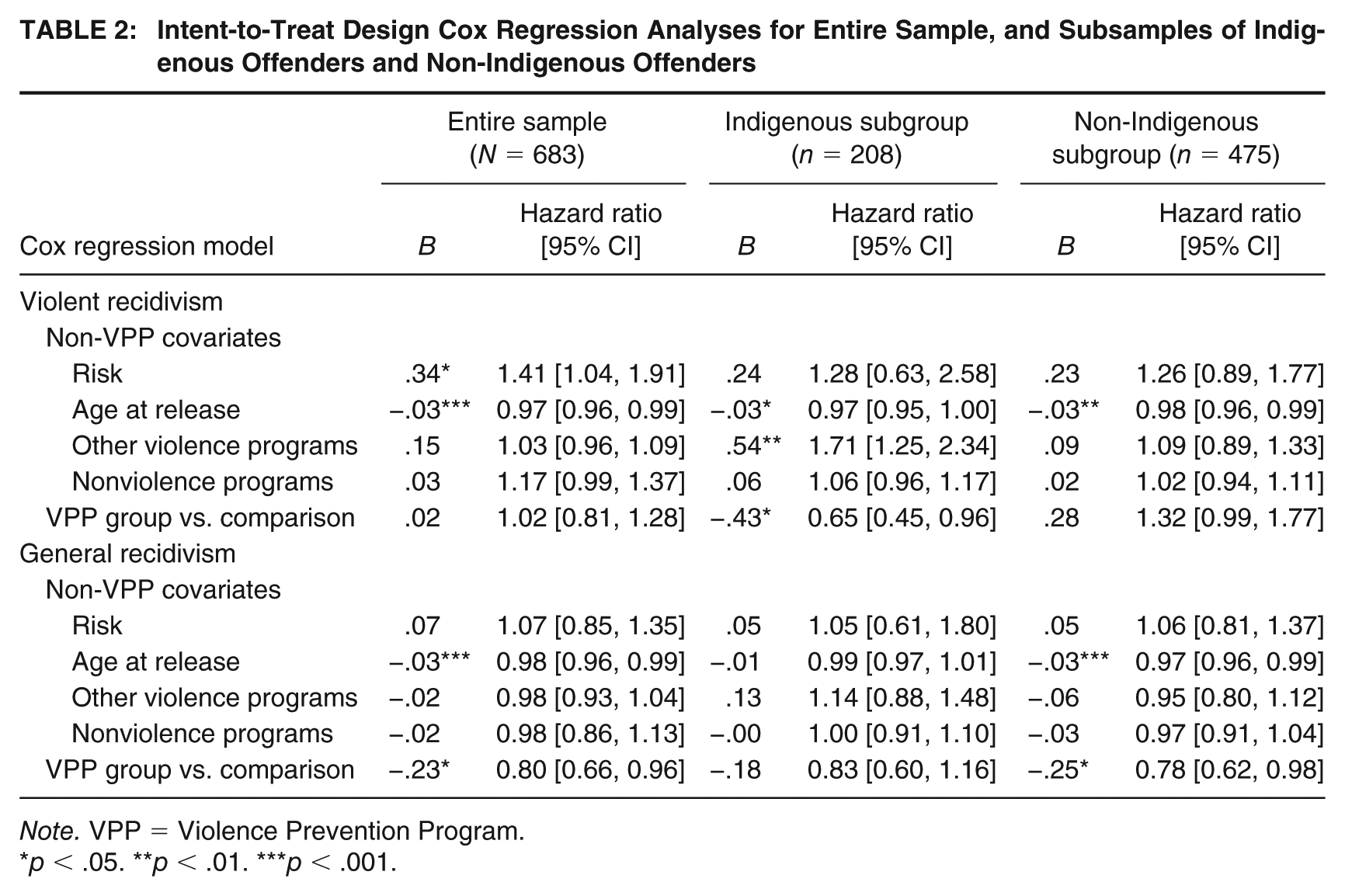
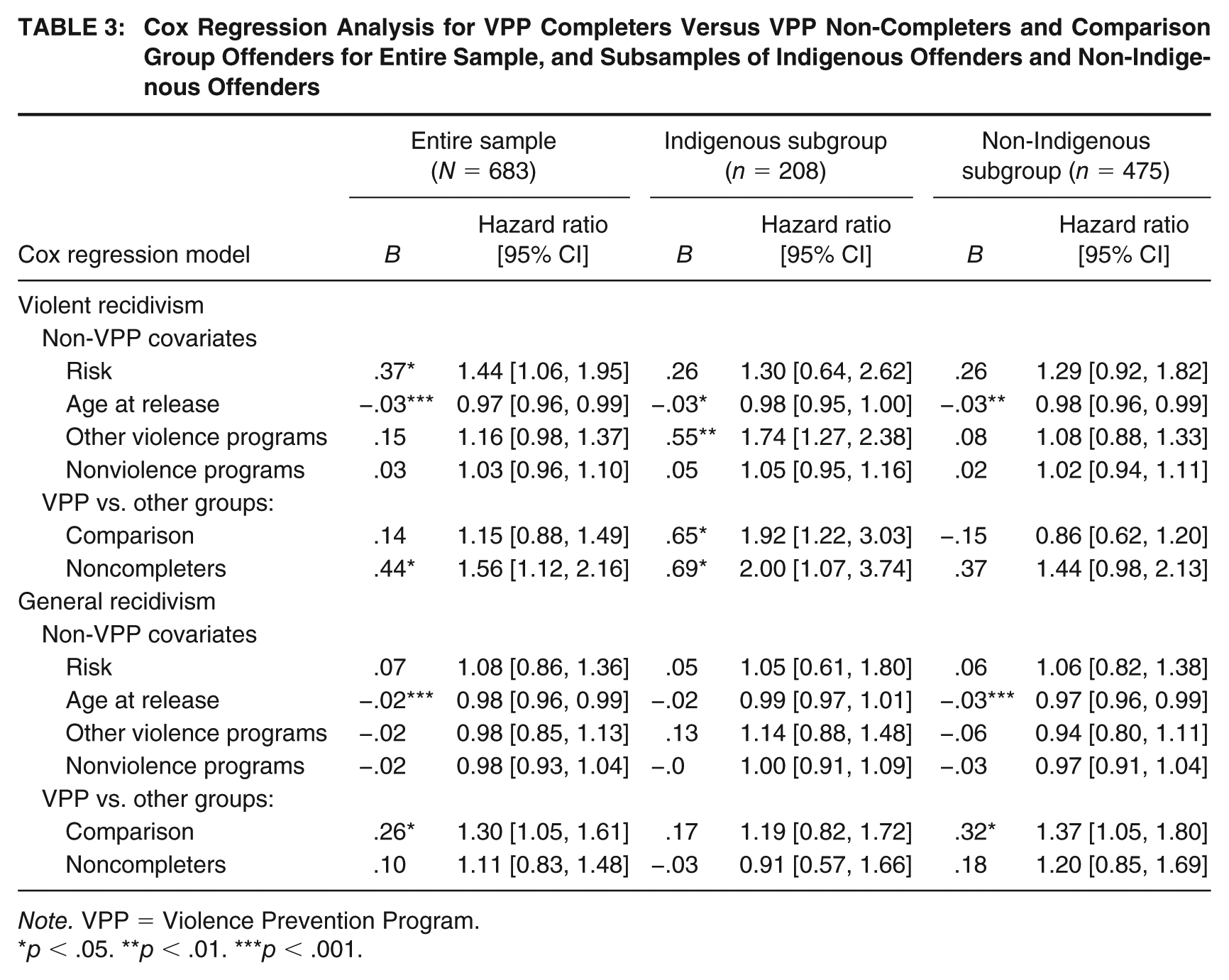
Risk level, age at time of release, and prior participation in violence and nonviolence programs are presented in Table 1 for the entire sample and the subgroups of Indigenous and non-Indigenous offenders. Recidivism rates are also provided in Table 1, showing that there were very few new convictions for sexual offenses among the entire sample. Taking this information together with the current focus on nonsexual violence (given that the VPP is considered theoretically different from sexual offending treatment programs and does not target risk factors associated with sexual offending), subsequent analyses considered only violent recidivism excluding sexual offending and general (nonviolent, nonsexual) recidivism. The results (Block 2 of each Cox regression model) from all intent-to-treat analyses are presented in Table 2. The results for VPP completers versus noncompleters, as well as the comparison group, are presented in Table 3. Results are also shown graphically to illustrate outcomes by treatment group (VPP completers; VPP noncompleters; comparison group) for violent recidivism (Figure 1) and general recidivism (Figure 2) among the entire sample, Indigenous offenders only, and non-Indigenous offenders only.
Rates of Recidivism, Offender Intake Assessment Risk Level, Non-VPP Program Participation, Age at Time of Release, and Time at Risk for Entire Sample of Canadian Male Federal Violent Offenders, Indigenous Offenders Only, and Non-Indigenous Offenders Only

Note. VPP = Violence Prevention Program.
Intent-to-Treat Design Cox Regression Analyses for Entire Sample, and Subsamples of Indigenous Offenders and Non-Indigenous Offenders
Note. VPP = Violence Prevention Program.
p < .05. **p < .01. ***p < .001.
Cox Regression Analysis for VPP Completers Versus VPP Non-Completers and Comparison Group Offenders for Entire Sample, and Subsamples of Indigenous Offenders and Non-Indigenous Offenders
Note. VPP = Violence Prevention Program.
p < .05. **p < .01. ***p < .001.
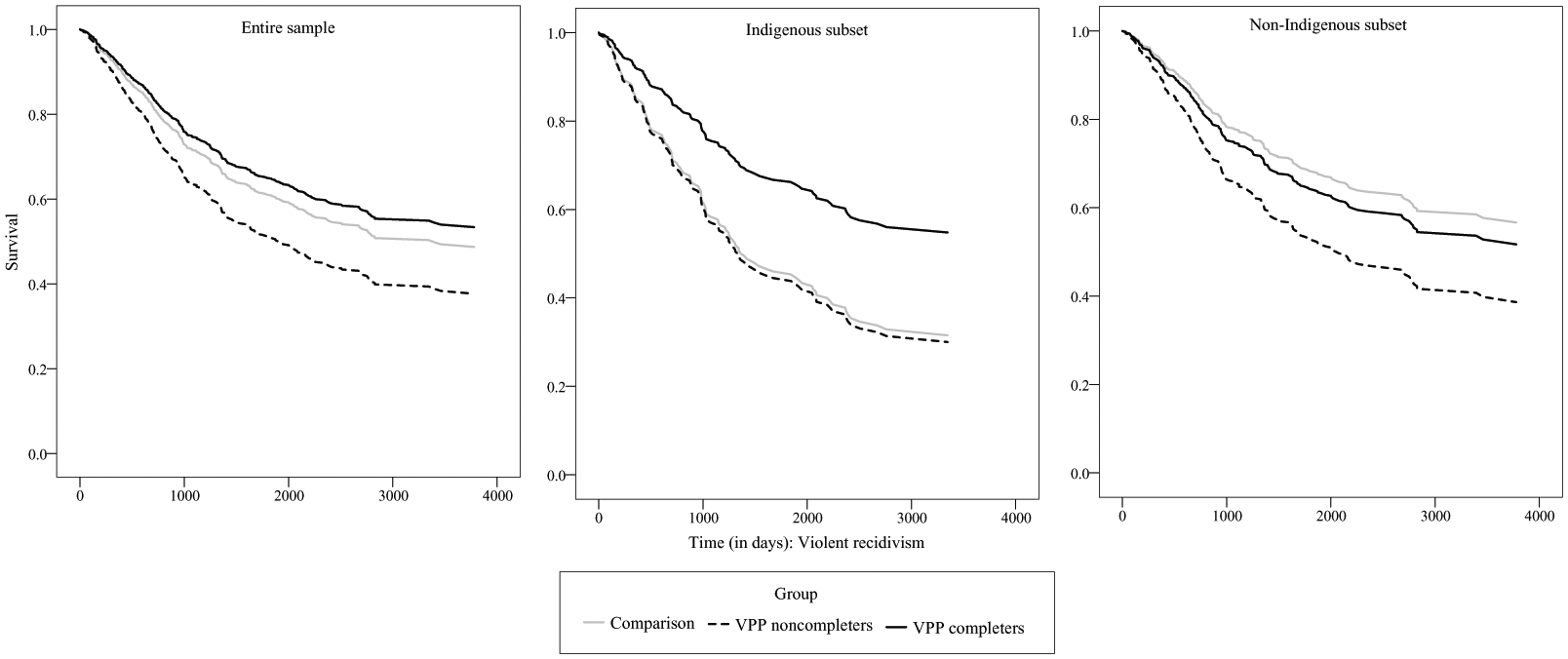
Cox Regression Analyses of Violent Recidivism for Entire Sample, and Subsamples of Indigenous Offenders and Non-Indigenous Offenders
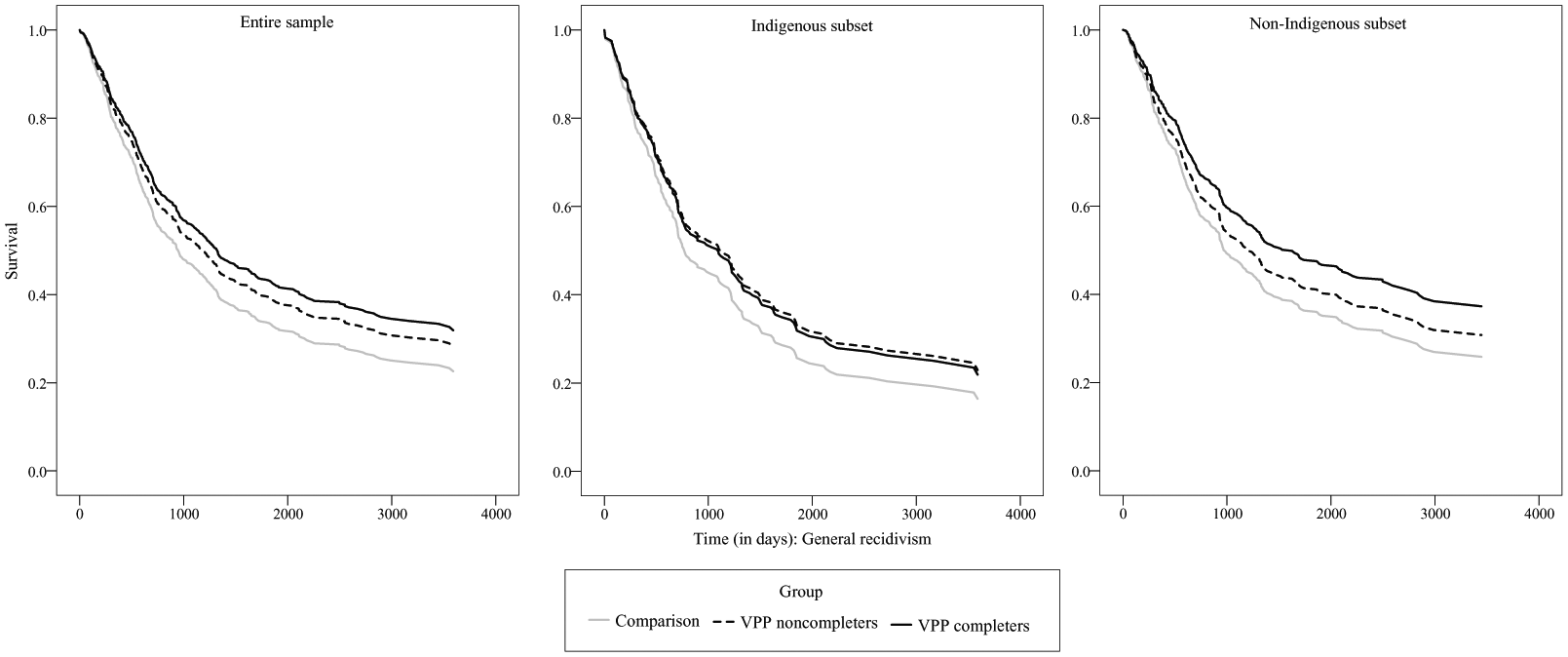
Cox Regression Analyses of General Recidivism for Entire Sample, and Subsamples of Indigenous Offenders and Non-Indigenous Offenders
VPP Participation and Violent Recidivism
In the series of Cox regressions that examined the association between VPP participation and violent recidivism, a total of 372 cases (Indigenous = 92; Non-Indigenous = 280) were censored because they had not recidivated with a new violent offense, or they had died during the follow-up period.
Intent-to-Treat Analyses
Entire sample
In Block 1, risk level (B = .34, p = .03) and age at time of release (B = −.03, p < .001) significantly predicted survival time, χ2(4) = 23.89, p < .001. In Block 2, adding VPP participation did not make a significant contribution to the model after adjusting for the covariates, χ2(1) = .02, p = .88. In the entire sample, there was a nonsignificant difference in the likelihood of violent recidivism between the VPP group and the comparison group.
Indigenous only
In Block 1, age at time of release (B = −.03, p = .01) and participation in other violence programs (B = .51, p = .002) significantly predicted survival time, χ2(4) = 20.34, p < .001. In Block 2, adding VPP participation made a significant contribution to the model after adjusting for the covariates, χ2(1) = 4.89, p = .03. Among Indigenous offenders, the VPP group had a significantly lower likelihood of violent recidivism than offenders in the comparison group.
Non-Indigenous only
In Block 1, age at time of release (B = −.03, p = .007) predicted survival time, χ2(4) = 9.29, p = .05. In Block 2, adding VPP participation did not make a significant contribution to the model after adjusting for the covariates, χ2(1) = 3.57, p = .06. Among non-Indigenous offenders, there was a nonsignificant difference in the likelihood of violent recidivism between the VPP group and the comparison group.
VPP Completers Analyses
Entire sample
In Block 1, risk level (B = .37, p = .03) and age at time of release (B = −.03, p < .001) predicted survival time, χ2(4) = 23.89, p < .001. In Block 2, adding VPP participation made a significant contribution to the model after adjusting for the covariates, χ2(2) = 6.64, p = .04. In the entire sample, VPP completers had a significantly lower likelihood of violent recidivism than the VPP noncompleters, but nonsignificantly lower than the comparison group.
Indigenous only
In Block 1, age at time of release (B = −.03, p = .01) and participation in other violence programs (B = .51, p = .002) predicted survival time, χ2(4) = 20.34, p < .001. In Block 2, adding VPP participation made a significant contribution to the model after adjusting for the covariates, χ2(2) = 9.35, p = .01. Among Indigenous offenders, VPP completers had a significantly lower likelihood of violent recidivism than both VPP noncompleters and the comparison group.
Non-Indigenous only
In Block 1, age at time of release (B = −.03, p = .007) predicted survival time, χ2(4) = 9.29, p = .05. In Block 2, adding VPP participation made a significant contribution to the model after adjusting for the covariates, χ2(2) = 6.84, p = .03. Among non-Indigenous offenders, the comparison group had a significantly lower likelihood of violent recidivism than VPP noncompleters, but differences between the VPP completers and the other two groups were nonsignificant.
VPP Participation and General Recidivism
In the series of Cox regressions that examined the association between VPP participation and general recidivism, a total of 238 cases (Indigenous = 55; non-Indigenous = 183) were censored because they had not recidivated with a new nonviolent offense, or they had died during the follow-up period.
Intent-to-Treat Analyses
Entire sample
In Block 1, age at time of release (B = −.03, p < .001) predicted survival time, χ2(4) = 18.54, p = .001. In Block 2, adding VPP participation made a significant contribution to the model after adjusting for the covariates, χ2(1) = .5.67, p = .02. In the entire sample, offenders in the VPP group had a significantly lower likelihood of general recidivism than the comparison group.
Indigenous only
There were no associations between the covariates and general recidivism, or between VPP program participation and general recidivism for the Indigenous subgroup: Block 1, χ2(4) = 3.64, p = .46; Block 2, χ2(1) = 1.18, p = .28.
Non-Indigenous only
In Block 1, age at time of release (B = −.03, p < .001) predicted survival time, χ2(4) = 16.18, p < .001. In Block 2, adding VPP participation made a significant contribution to the model after adjusting for the covariates, χ2(1) = 4.44, p = .04. Among non-Indigenous offenders, the VPP group had a significantly lower likelihood of general recidivism risk than the comparison group.
VPP Completers Analyses
Entire sample
In Block 1, age at time of release (B = −.03, p < .001) predicted survival time, χ2(4) = 18.54, p = .001. In Block 2, adding VPP participation made a significant contribution to the model after adjusting for the covariates, χ2(2) = 6.15, p = .046. In the entire sample, VPP completers had a significantly lower likelihood of general recidivism than the comparison group.
Indigenous only
There were no associations between the covariates and general recidivism, or between VPP program participation and general recidivism for the Indigenous subgroup: Block 1, χ2(4) = 3.64, p = .46; Block 2, χ2(2) = 1.20, p = .55.
Non-Indigenous only
In Block 1, age at time of release (B = −.03, p < .001) predicted survival time, χ2(4) = 16.18, p = .003. In Block 2, adding VPP participation did not make an overall significant contribution to the model after adjusting for the covariates, χ2(2) = 5.44, p = .07, although VPP completers had a significantly lower likelihood of general recidivism than the comparison group.
Discussion
Both the initial evaluation (Cortoni et al., 2006) and the present study indicated more positive outcomes for VPP completers compared with offenders who were selected for the program but did not complete it, and a comparison group. Here, there was a general pattern across different recidivism outcomes (new convictions for violent and nonviolent offenses) of lower rates of recidivism among those who had completed treatment. Overall, when taking into account time at risk in the community, the VPP completers fared better than the other two groups, albeit with various differences between groups failing to reach statistical significance at all levels. Specifically, in relation to violent reoffending, a statistically significant difference was found between the VPP completers and VPP noncompleters, but not between the VPP completers and the comparison group. Moreover, the Indigenous VPP completers had a statistically significantly lower likelihood of violent recidivism, whereas a lower likelihood of general (nonviolent) recidivism for VPP completers was specific to the non-Indigenous offenders.
Outcome studies are pivotal in criminal justice and correctional service policy and practice decisions. Methodological inadequacy has been a notable problem in this field of research, although this has been recognized and researchers have begun to respond to the issue (Lösel, 2001). Randomized controlled trials to evaluate correctional programs are rarely, if ever, feasible. However, quasi-experimental research provides meaningful information, depending on levels of sampling bias, classification bias, and measurement bias (Higgins, Altman, & Sterne, 2011). In the present study, samples were selected to minimize the preexisting differences between program participants and the comparison group by drawing from a sample of offenders eligible for intervention, and a sample of offenders who would have been eligible for intervention had it been available to them. As such, the problem of the effect of “refusers” (offenders who reject treatment) was curtailed, as it is clear that the comparison group was not simply made up of treatment refusers. In addition, propensity score matching ensured that VPP completers and the comparison group were alike on static factors (race, previous violent offending, and age) and pretreatment risk and need level (Cortoni et al., 2006). While some cases were necessarily excluded from the present study due to incomplete data, this occurred across groups and is therefore unlikely to have introduced systematic attrition bias.
An intent-to-treat design was used in this study as this approach is recommended as the least biased (Collaborative Outcome Data Committee, 2007). However, this approach masks the effect of noncompleters (participants who dropped out or were removed from treatment due to group management issues or for administrative reasons). Improved sample equivalency achieved through an intent-to-treat approach requires the compromise of an unrepresentative treatment group: Can a treatment group really be considered as such if it contains a subgroup who did not receive all of the treatment (or any of it depending on the point of dropout/removal)? By way of analogy, would participants in a clinical trial who stopped taking an experimental drug at the beginning or part way through treatment (whether they decided against continuing or were removed from the trial for any other reason) be expected to show a reduction in symptoms any more so than a wait-list control group?
This issue was addressed in the present study by reanalyzing the data with separate groups of VPP completers and noncompleters. As expected, a tendency toward the poorest outcomes was evident for noncompleters, except among the Indigenous offenders, where the rate of violent recidivism for the noncompleters and the comparison group was very similar. In contrast, for non-Indigenous offenders, outcomes were poorest for noncompleters, but the violent recidivism rate was highly similar for the VPP completers and the comparison group. For general recidivism, rates were similar for Indigenous offenders irrespective of treatment status. In contrast, the non-Indigenous VPP completers had better general recidivism outcomes than the noncompleters, but the comparison group fared the worst. While it could be hypothesized that low motivation among the noncompleters explains these results, it is unlikely as motivation was tested by Cortoni et al. (2006), with no significant differences seen between VPP completers, noncompleters, and the comparison group.
Perhaps the most intriguing question arising from the present results is, given that the VPP specifically targets cognitive-behavioral propensity for violence, why are there less compelling results for violent recidivism than for general recidivism? First, it must be clarified that this statement refers to results for the entire sample, whereas the question of apparently differential responses to the program among Indigenous offenders and non-Indigenous offenders will be discussed later. Second, it is necessary to consider whether results may be explained as a statistical artifact related to an issue of low base rates. This would have seriously impacted any multivariate analyses of sexual recidivism, as a statistically significant difference between groups in survival analysis would be based on a recidivism rate of less than 1% for both VPP completers and VPP noncompleters, compared with 5% in the comparison group. However, for reasons that have been stated, sexual recidivism was excluded from the central analyses meaning that the low base rate of sexual recidivism is not relevant to the interpretation of our results. Reoffending otherwise occurred much more in line with expected frequencies based on previous research (Henwood et al., 2015), suggesting the presence of meaningful between-groups differences. Therefore, we proceed by generating some explanatory hypotheses and identify avenues of further research that will be necessary.
Possibly, the thinking styles and behavioral patterns associated with persistent violence are simply resistant to real-world change even among those who respond well to intervention and appear genuinely committed to pro-social community reintegration. A related hypothesis might involve a long-term maintenance problem. The follow-up period in the present study was longer than is often seen in research of this kind; it may therefore be that any positive effects of treatment were not well sustained in the absence of some form of “top-up” treatment. There could be a need for more intensive maintenance programs in the community, or access to a strong support group such as the Circles of Support and Accountability system available for high-risk sexual offenders (Wilson, Cortoni, & McWhinnie, 2009). Answering these questions is the task of further research, which must consider not only the overall direction of change but also the mechanisms of change. For example, Polaschek, Yesberg, Bell, Casey, and Dickson (2016) found that the reduced number of violent reconvictions in their sample of treated violent offenders was mediated by a lower dynamic risk score on the Violence Risk Scale (Wong & Gordon, 2000), but not by greater release readiness. This type of emerging research will develop our understanding of how program participation may favor desistance from crime.
A further possibility is that despite appropriately directing persistently violent offenders to the most intensive treatment that targets relevant criminogenic factors (Andrews & Bonta, 2010), there remain shortcomings in the identification of these individuals’ specific criminogenic treatment needs. Given the core components of the VPP that include, among others, altering antisocial as well as pro-violence attitudes, and developing improved anger control, problem solving, and self-management skills, it may be that the program targeted more extensively factors related to expressive violence than instrumental violence. Therefore, if the participants in the present study were more characteristically instrumental in their use of violence, participation in the VPP should not necessarily be expected to be strongly associated with reduced rates of (instrumental) violence. In contrast, as issues such as improved self-management skills are relevant for nonviolent criminal behavior, it could be expected that participation in the VPP would help reduce general criminality. Indeed, consistent with this proposition, VPP participation was associated with lower likelihood of general recidivism in the present sample. Clearly, however, as not all of the variables necessary to fully test these hypotheses were available in the current study, further research is required.
Implications for Indigenous Offenders
When we repeated our analyses examining Indigenous offenders and non-Indigenous offenders separately, outcomes differed. Interestingly, a reverse pattern of findings was established when only Indigenous offenders were examined. Survival analysis showed that a greater proportion of Indigenous VPP completers successfully remained free from violent offending, but not general offending, during the study follow-up period than the Indigenous offenders in the comparison or noncompleters groups. Importantly, this pattern of results held for the more conservative intent-to-treat analysis as well as the VPP-completers analysis. This suggests that that a different violent offending mechanism may be at play for Indigenous persons, a mechanism that may be more effectively targeted by the VPP. Should the hypothesis offered above regarding the differential criminogenic treatment needs of instrumental versus expressive violence be confirmed, this would indicate that expressive violence, rather than instrumental violence, may better characterize Indigenous persons who engage in persistent violence.
This finding potentially bears important implications in relation to the evidence base that may be drawn upon in consideration of the appropriateness of mainstream correctional programs for Indigenous persons. The CSC has a number of culturally relevant services specifically designed to facilitate the reintegration of Indigenous individuals, such as the In Search of Your Warrior (ISOYW) program. The effectiveness of the ISOYW at reducing recidivism has yet to be adequately tested; preliminary evaluations suggest user satisfaction and low rates of readmission and violent recidivism (Trevethan, Moore, & Allegri, 2005), but a more rigorous test of impact on recidivism is still needed. Within this context, there should be concurrent efforts to better understand the criminogenic needs of persistently violent Indigenous persons. As such, future research should test which components of the ISOYW are associated with reduced recidivism, and explore the differences and similarities with the components of the VPP to shed some light on why the VPP seems particularly suited for the successful reduction of violence among Indigenous offenders.
Limitations
We have eliminated the hypothesis that VPP noncompleters may have been less motivated to engage in treatment, or may have been those offenders with greater risk and criminogenic needs, based on between-group analyses suggesting that these factors are not likely to explain our results. However, there may be other variables, or even aspects of the factors we considered, that account for the current findings other than a genuine treatment effect. For example, evidence of psychopathic traits would have contributed to the assessment of risk and need that determined treatment placement, but psychopathy was not specifically measured. Future research should perhaps consider not only overall risk and needs, but additionally various subtypes of risk factors to determine their association with programs results.
Furthermore, although the present sample was drawn from propensity score matched groups, due to incomplete data at the secondary follow-up phase, there was a loss of participants available to include in the present analyses. Nevertheless, the comparability between samples should be sufficient so as to avoid significant bias, which would threaten the integrity of the study. Regardless, it is necessary to remain cautious in attributing effects to the intervention in the absence of a true experimental design.
Conclusion
Inference of treatment effectiveness based on outcome information requires caution. Hence, we emphasize the need to search for sources of bias and alternative interpretations of results. In the present study, within the parameters discussed, we found that VPP completers recidivated somewhat less, and at a slower rate, than offenders who were selected for but did not complete the program, and offenders who were similar in terms of demographic characteristics, risk, and criminogenic need but had had no opportunity to participate in the program. Outcomes for Indigenous offenders were particularly positive in that violent reoffending, although not general recidivism, was found with lower frequency among VPP participants using an intent-to-treat analytical model. These results suggest that the VPP may address the needs of Indigenous persons at least as well, if not better, than those of non-Indigenous individuals, suggesting that the latter group may require a different approach to reduce their risk of violent reoffending. Given the societal costs of violence, the findings of the present study suggest that ongoing efforts to improve interventions for persistently violent offenders are worthwhile, but that better identification of their criminogenic treatment targets is still required.
Footnotes
Authors’ Note:
The authors would like to thank Collette Cousineau and Brian Grant, Correctional Services Canada, Research Branch, and Chantal Hermann, Carleton University, for facilitating and assisting with data collection for this research. This work was supported by the Centre international de criminologie comparée (CICC Postdoctoral Fellowship 2017).
