




Abstract
The present study uses Sampson and Laub’s theory of inequality and social control to examine whether underclass poverty and racial/ethnic inequality hold current relevancy over the court processing of juvenile offenders. Hierarchical generalized linear modeling was used to investigate the impact of community aspects, offender characteristics, and offense-related factors on juvenile court outcomes occurring at intake, adjudication, and judicial disposition. Findings indicate limited evidence for the anticipated relationships between underclass poverty and racial/ethnic inequality on court processing stages. The individual and combined impact of being Black or Hispanic, and/or charged with a drug offense, exerted stronger effects on juvenile justice decision-making compared with Sampson and Laub’s structural factors. Implications for addressing the federal Disproportionate Minority Contact (DMC) Mandate based on the findings are discussed, as well as the future empirical inquiry surrounding whether community factors interact with offender and offense characteristics to influence outcomes of youth referred to juvenile court.
The link between living in high poverty communities and economic and social distress has been well documented. These impoverished communities are identified by a considerable number of out-of-wedlock births, high infant mortality, persistent joblessness, and long-term welfare assistance (Sampson, 2012; Wilson, 1987). Disadvantaged communities are also evidenced by high rates of crime and mass incarceration (Clear, 2009; Crutchfield, 2015). The impact of such an effect is especially acute for impoverished minority residents (i.e., Blacks) relative to poor White individuals (Perkins & Sampson, 2015). Furthermore, juveniles (age 18 years and younger) comprise 23% of the general population, yet represent 32% of those living in poverty. Higher poverty rates are observed among minority youth compared with their White counterparts (Koball & Jiang, 2018), as well as being exposed to the negative consequences of living in poor communities (Turanovic, Rodriguez, & Pratt, 2012). Residing in a low-income background is considered a main risk factor in assessing the prevention and overall causes of juvenile delinquency (Farrington, Ttofi, & Piquero, 2016).
Research has also identified that decision-making by police and court systems may be fueled by a reliance on class and racial/ethnic stereotypes of youth and their residing neighborhoods. The result of these negative perceptions is an increase in social control of minorities and the poor (e.g., Bridges, Conley, Engen, & Price-Spratlen, 1995; Gaarder, Rodriguez, & Zatz, 2004). In this sense, the unequal processing of youthful offenders in the juvenile justice system is one form of social control that disadvantages minority youth. However, the body of literature that connects impoverished communities, racial/ethnic stereotyping, and social control through juvenile court processing is quite small, yet paves the way for additional research into the interrelationships between the race/ethnicity of youth, economic characteristics of communities, and greater involvement in the juvenile justice system (Maroun, 2017; Rodriguez, 2013).
We believe that a perspective that focuses on juvenile justice decision-making can be used to understand the above-mentioned complexities of social control. To do so, the present research uses and extends the macro-level theory of inequality and social control developed by Sampson and Laub (1993). Of the few studies conducted to test the validity of the perspective, the findings have been mixed. The data used were also primarily from the 1980s and early 1990s, and focused on court outcomes involving three to four homogeneous jurisdictions (e.g., Leiber, 2003). The applicability of the theory to explain the treatment of Hispanic juvenile offenders relative to Whites and Blacks from either a macro or individual level has not been explored. Prior analyses conducted, while appropriate over 20 years ago, also did not allow for direct tests of the interrelationships among poverty and racial inequality with race, drug offending, and court decision-making (e.g., Leiber & Jamieson, 1995; Sampson & Laub, 1993).
We address these limitations and advance the literature by examining whether counties that exhibit greater underclass poverty and racial/ethnic inequality result in disadvantaged case outcomes for youth in general, and specifically for minority youth (i.e., Black and Hispanic youth) involved in drug offending. These interrelationships are examined by using data from 2000 through 2010 across three juvenile court stages in 67 counties in a Northeast state. Hierarchical linear modeling (HLM) is used to allow for the simultaneous examination of the individual- and cross-level interactions between individual-level offender and offense characteristics with the structural measures of underclass poverty and racial/ethnic inequality to predict juvenile court outcomes (Raudenbush & Bryk, 2002; Rodriguez, 2007, 2013). The results have policy implications for addressing the Disproportionate Minority Contact (DMC) initiative as well as inform interventions for achieving more equitable treatment of all youth in the juvenile justice system (Leiber & Rodriguez, 2011; Peck, 2018). 1
Sampson and Laub’s Theoretical Framework of Inequality and Social Control
Sampson and Laub (1993) developed a modified conflict perspective that integrated structural conditions of communities, racial stereotyping, and the war on drugs to explain the social control of juvenile offenders. Underlying the relationship between community factors and juvenile justice decision-making is an emphasis on racial stereotyping based on Tittle and Curran’s (1988) symbolic threat hypothesis, and the more general “threat” of underclass populations. The theory assumes that poor, underclass, and minority populations will be perceived by juvenile court decision-makers as threatening and in need of social control (e.g., harsher punishment) in communities characterized by underclass poverty and racial inequality. Rather than decision-makers observing juvenile offenders as directly undermining positions of authority, Sampson and Laub (1993) agree with Tittle and Curran’s (1988) symbolic threat hypothesis and emphasize that juveniles and minorities are symbolized in the perceptions of decision-makers as being aggressive, sexual, and lacking responsibility for their actions. The interplay between the characteristics of youth, especially minority youth, and the social psychological emotions of juvenile court officers are central components of symbolic threat. These psychological emotions of fear are manifested in beliefs that juveniles, the poor, and minority youth pose symbolic threats to White middle-class standards and public safety (Sampson & Laub, 1993).
Sampson and Laub (1993) further refine the concept of symbolic threat in their perspective by emphasizing decision-makers’ use of stereotyping within a larger context symbolized by the war on drugs of the 1980s. The theory discusses the evolving stereotype of the poor Black male as a drug offender. This stereotype became more pronounced because of two trends from the 1980s: (a) an increase in Black males under correctional supervision and (b) an increase in punitive responses toward drug offenders, especially Blacks and cocaine users. Their perspective includes a community-level examination of juvenile court processing of drug cases and justified the inclusion of drug offending into their theoretical perspective based on race differences in juvenile arrests and court referrals for drug abuse violations during the 1980s.
Overall, the relationship between class, race, and drugs is seen as intertwined and difficult to disentangle (Sampson & Laub, 1993). All things considered, poverty and racial/ethnic inequality are believed to influence the social control of the poor, Blacks, and Hispanics, and the effects will be most evident for those charged as drug offenders. 2
Literature Review
In Sampson and Laub’s (1993) initial test of the perspective, they used a nationally representative sample of aggregated individual-level juvenile court records from 1985. The overall findings indicated some support for the perspective, in that both underclass poverty and racial inequality predicted the treatment of youth in the decisions of formal petition, secure detention, and out-of-home placement. When findings were disaggregated by race, counties characterized by underclass poverty did not predict detention outcomes for White youth, but did influence the decision to detain nonpetitioned Black youth. Counties with high levels of racial inequality were more likely to detain Black nonpetitioned drug and property offenders compared with Whites, where underclass poverty was positively related to rates of out-of-home placement for Black personal and drug offenders at judicial disposition.
Subsequent tests of Sampson and Laub’s perspective also used data from the 1980s in four urban counties with the largest non-White population in Iowa. Leiber and Jamieson (1995) found that race effects between Black youth and White youth were discovered across some decision-making stages. Blacks were not always subjected to harsher court outcomes, yet indicators of poverty and racial inequality exerted positive, negative, or null effects depending on the stage examined. Leiber and Jamieson (1995) yielded some support for the contention that the structural characteristics of communities involving underclass populations, inequality, and stereotyping by decision-makers impact the social control of minority youth. Further tests of the perspective by Leiber and Stairs (1999) and Leiber (2003) yielded similar mixed results.
Most recently, Sutton (2013) adapted Sampson and Laub’s (1993) perspective to explain pretrial detention outcomes, guilty pleas, and sentence severity of adult felony offenders. Using court cases from the year 2000 within 40 counties, poverty concentration and racial income inequality did not influence court outcomes for minority defendants. Income inequality influenced some of the dependent variables, but the findings were not always in the anticipated direction. Race and sentence severity were not conditioned by structural factors, and community characteristics exerted modest effects on criminal justice proceedings.
In summary, the ability of Sampson and Laub’s (1993) macro-level theory to explain the interrelationships of race/ethnicity and social context in the form of poverty, racial/ethnic inequality, and drug offending with increased social control has been mixed. The differences in the results from prior studies, however, may be attributed to the sample (place and time), population (juvenile vs. adult), and analyses used (aggregation of data vs. case-level data). The applicability of the perspective to explain the treatment of Hispanic youth relative to Whites and Blacks from either a macro and/or individual level has also been ignored. 3
Study Expectations
Based on Sampson and Laub’s (1993) theoretical perspective and prior research of juvenile court outcomes, three expectations frame the present study. The first expectation is that counties characterized by underclass poverty and racial/ethnic inequality will evidence greater social control compared with counties evidencing less underclass poverty and racial/ethnic inequality. Justification for this first prediction rests on the tenets of Sampson and Laub’s (1993) perspective, findings from their original research, and past studies that have examined economic characteristics of communities and juvenile court processing (e.g., Freiburger & Jordan, 2011; Leiber, Peck, & Rodriguez, 2016; Rodriguez, 2010, 2013).
Next, the central theoretical question for the current study focuses on the extent to which the social control of minority youth involved in drug offending is heightened when these juveniles reside in counties characterized by underclass poverty and racial/ethnic inequality. Sampson and Laub (1993) found that disadvantaged court outcomes resulted for Black drug offenders who lived in impoverished communities. Likewise, prior research shows that minority youth have been subjected to greater social control than Whites (e.g., Bishop, Leiber, & Johnson, 2010; Maggard, 2015), and that drug offenders are often the recipients of severe treatment throughout court processing (e.g., DeJong & Jackson, 1998; Leiber & Stairs, 1999) being especially true for Black and Hispanic drug offenders (Hayes-Smith & Hayes-Smith, 2009). Thus, the second expectation is that youth who are a combination of being a racial/ethnic minority (Black or Hispanic) and charged with a drug offense who reside in counties with underclass poverty and racial/ethnic inequality will receive more severe juvenile court outcomes than youth who reside in similar counties.
The third and final expectation is based on the belief that while minority youth charged with drug offending will be perceived by decision-makers as more threatening than White drug offenders, the threat will be more pronounced for Blacks than Hispanics in communities evidencing underclass poverty and racial/ethnic inequality. This position is in opposition to those that contend the risk may be greater by Hispanics compared with Blacks (e.g., Caravelis, Chiricos, & Bales, 2011; Feldmeyer & Ulmer, 2011), but parallels some prior research that says differently (Feyerherm, 2017). Our third and final expectation is based on this latter body of prior research, and also provides an opportunity to expand Sampson and Laub’s (1993) structural assumptions to Hispanic populations and Hispanic juvenile drug offenders.
Method
Overview of Sample
The data for the present study are part of a larger project funded by the National Institute of Justice (2012-IJ-CX-0051), where juvenile court records were provided by the National Center for Juvenile Justice (NCJJ), which houses the National Juvenile Court Data Archive (NJCDA). In this study, the data include all delinquent referrals from all counties (n = 67) in a Northeast state from January 2000 through December 2010. 4 The final sample size is 302,531 referrals. The sample does not include youth waived/transferred to adult court, but instead follows referrals as they move through the juvenile court process (i.e., intake, adjudication, disposition). Demographic, legal, and extra-legal information from each youth was provided to the Archive and released to the authors.
Variables
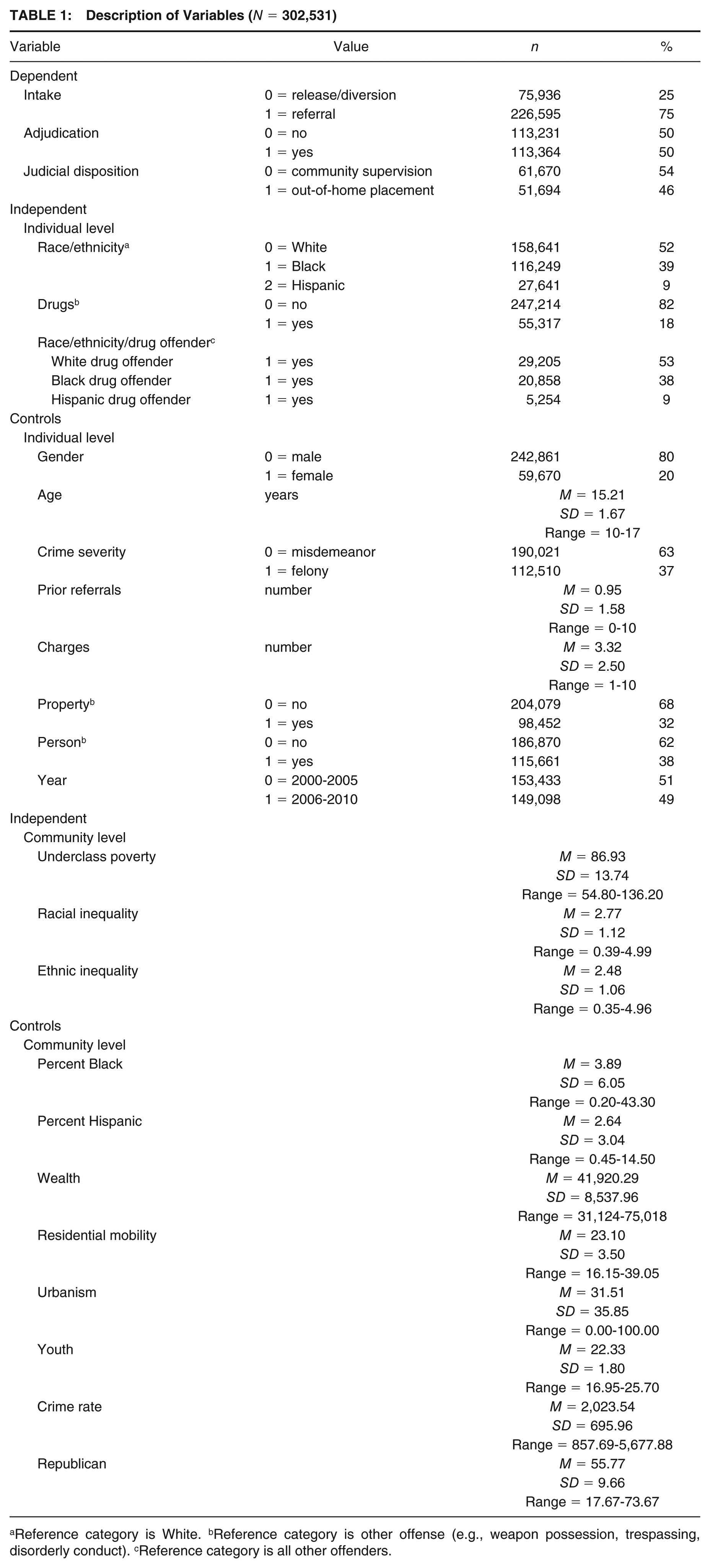
The coding and distribution of all dependent, independent, and control variables are presented in Table 1. The selections of specific measures are based on Sampson and Laub’s (1993) theoretical perspective and prior research on juvenile court outcomes (DeJong & Jackson, 1998; Freiburger & Jordan, 2011; Sutton, 2013; Thomas, Moak, & Walker, 2013).
Description of Variables (N = 302,531)
Reference category is White. bReference category is other offense (e.g., weapon possession, trespassing, disorderly conduct). cReference category is all other offenders.
Decision-making was predicted at three processing junctures: intake, adjudication, and judicial disposition. Each of the three court stages constitutes a separate dependent variable. The intake stage was coded to differentiate between youth who were released or diverted from the juvenile justice system (coded as 0) and those who received an intake referral and were referred on for further court proceedings (coded as 1). Seventy-five percent of the sample was referred on for further court proceedings. Adjudication was differentiated by youth who received an intake referral who were not adjudicated delinquent (coded as 0) compared with those who were adjudicated (coded as 1). Fifty percent of youth who made it to the adjudication stage were subsequently adjudicated delinquent. The final stage, judicial disposition, differentiated between adjudicated youth who received community sanctions (coded as 0) and those who were sentenced to out-of-home placement (coded as 1). Fifty-four percent of youth at judicial disposition (i.e., the judicial disposition hearing) received community sanctions, compared with 46% of youth who were placed outside of the home.
Concerning the independent individual-level variables of interest, race and ethnicity were coded to differentiate between White, Black, and Hispanic youth, with Whites constituting as the reference group. Fifty-two percent of the sample was White, 39% were Black, and 9% were Hispanic. Drug offenses (0 = no, 1 = yes) were captured by a dummy variable that represented different types of drug-related charges. Drug offenses represented 18% of all offenses. Fifty-three percent of all drug offenders were White, 38% were Black, and 9% were Hispanic.
Numerous individual-level control variables were also taken into consideration. Demographic variables included gender and age. Gender was coded to differentiate between males (80%) and females (20%), while age was coded in years. The average referral was 15 years old. Various legal factors were also included as controls based on the referral’s most serious charge: crime severity (0 = misdemeanor, 1 = felony), number of prior referrals, and number of current charges. Property (0 = no, 1 = yes) and person (0 = no, 1 = yes) offenses represented the other two offense type dummy variables, with other offenses constituting the reference group (i.e., trespassing, disorderly conduct). On average, a delinquent referral was a misdemeanor offense, had 0.95 prior referrals, 3.32 current charges, and committed a person offense. In addition, a variable was also constructed to control for referral year (0 = 2000-2005, 1 = 2006-2010). Fifty-one percent of all referrals occurred between 2000 and 2005.
The structural variables of interest included constructed indices and individual measures from averaging data collected from the 2000 and 2010 U.S. census. The county-level variables mirror those included by Sampson and Laub (1993) and later studies of the perspective. An index of underclass poverty was constructed based on six interrelated measures: percentage of households receiving public assistance, percentage of female-headed households with children below 18 years old, percentage of individuals living in poverty, percentage of household incomes less than US$10,000, percentage of nonfamily households, and percentage of female-headed households living in poverty. Higher values are indicative of greater underclass poverty (α = .81). Two separate measures of racial and ethnic inequality were also constructed. Racial inequality was measured by the ratio of Black to White individuals living in poverty, which was constructed from dividing the percentage of Black individuals living in poverty in each county by their White impoverished counterparts. Ethnic inequality was measured by the ratio of Hispanic to White individuals living in poverty. Higher values in the inequality measures indicate greater inequality (to the disadvantage of Blacks and Hispanics) between each minority group compared with Whites. 5
The remaining community-level variables were treated as controls. Many control variables parallel those used in Sampson and Laub’s (1993) original examination of the theory. The proportion of Black residents and proportion of Hispanic residents in each county were included where larger values represent a higher percentage of minorities in the population. A wealth measure was created based on the county’s median household income. A measure of residential mobility was constructed based on the percentage of residents who have moved households in the past 5 years. Urbanism was captured by the percentage of the population who reside in an urbanized area. Density of youth was created based on the percentage of individuals below the age of 18 years. A crime rate measure was constructed by averaging the UCR Part 1 index crime rate per 100,000 individuals for the years 2000-2010. Last, a republican variable was created as an indicator of the average percentage of individuals in each county who voted for the republican candidate in the 2000, 2004, and 2008 presidential elections. 6
Analytic Strategy
Due to the nested nature of juveniles residing within counties, a two-level hierarchical linear structure was used to analyze the data. As each of the dependent variables has binary outcomes, hierarchical generalized linear modeling (HGLM) were used to assess the effect of individual-level (Level 1) and community-level (Level 2) data on each court outcome (Raudenbush & Bryk, 2002). HGLM models mirror the log odds coefficients produced in binary logistic regression equations (Armstrong & Rodriguez, 2005). Both log odds and odds ratios are reported in the tables. Following prior research, grand mean centering was used on all Level 1 (Freiburger & Jordan, 2011; Leiber et al., 2016; Rodriguez, 2013) and Level 2 predictors (Hayes-Smith & Hayes-Smith, 2009). This specific centering technique assesses the effect of community characteristics (Level 2) while controlling for offender/offense factors (Level 1).
The analytic procedure included several steps. All steps were conducted for each dependent variable (intake, adjudication, and judicial disposition). First, an intercept-only, unconditional model was estimated to determine whether the mean rate of each dependent variable varied across counties. The results of each model (not shown) were significant and confirmed the use of multilevel models. 7 Second, all community-level measures (Level 2) were included in a model to estimate the effect of any county-level measures on each depending variable, controlling for Level 1 characteristics. This model also included any potential individual-level race/ethnicity and drug offending interactions with the inclusion of county-level measures. The purpose of the interaction terms between the race/ethnicity of the offender and drug offenses was estimated to see whether being a Black or a Hispanic drug offender impacted court outcomes compared with other types of offenders.
The final step in the analyses involved the estimation of cross-level interactions between a youth’s race/ethnicity, drug offenses, and community-level variables of interest to understand how youth of specific racial and ethnic backgrounds (with and without drug offenses) are treated within counties characterized by underclass poverty, racial inequality, and ethnic inequality (e.g., Black × Underclass Poverty, Hispanic × Drugs × Ethnic Inequality). Estimating cross-level interactions allows for a detailed examination of the hypothesized effects involving community factors, race/ethnicity, and drug offending with court outcomes as argued by Sampson and Laub (1993).
Heckman’s (1976) two-stage analytic procedure was also used at the stage of judicial disposition to create a hazard rate as an additional predictor at the sentencing stage. 8 The addition of the hazard rate when predicting judicial disposition corrects for potential sample selection bias from the stage of adjudication to judicial disposition (Peck & Jennings, 2016). Diagnostic examinations in the form of variance inflation factor (VIF) and tolerance statistics showed no problems with multicollinearity among the Level 1 and Level 2 variables (including the hazard rate).
Results
The Effects of Community- and Individual-Level Indicators on Decision-Making
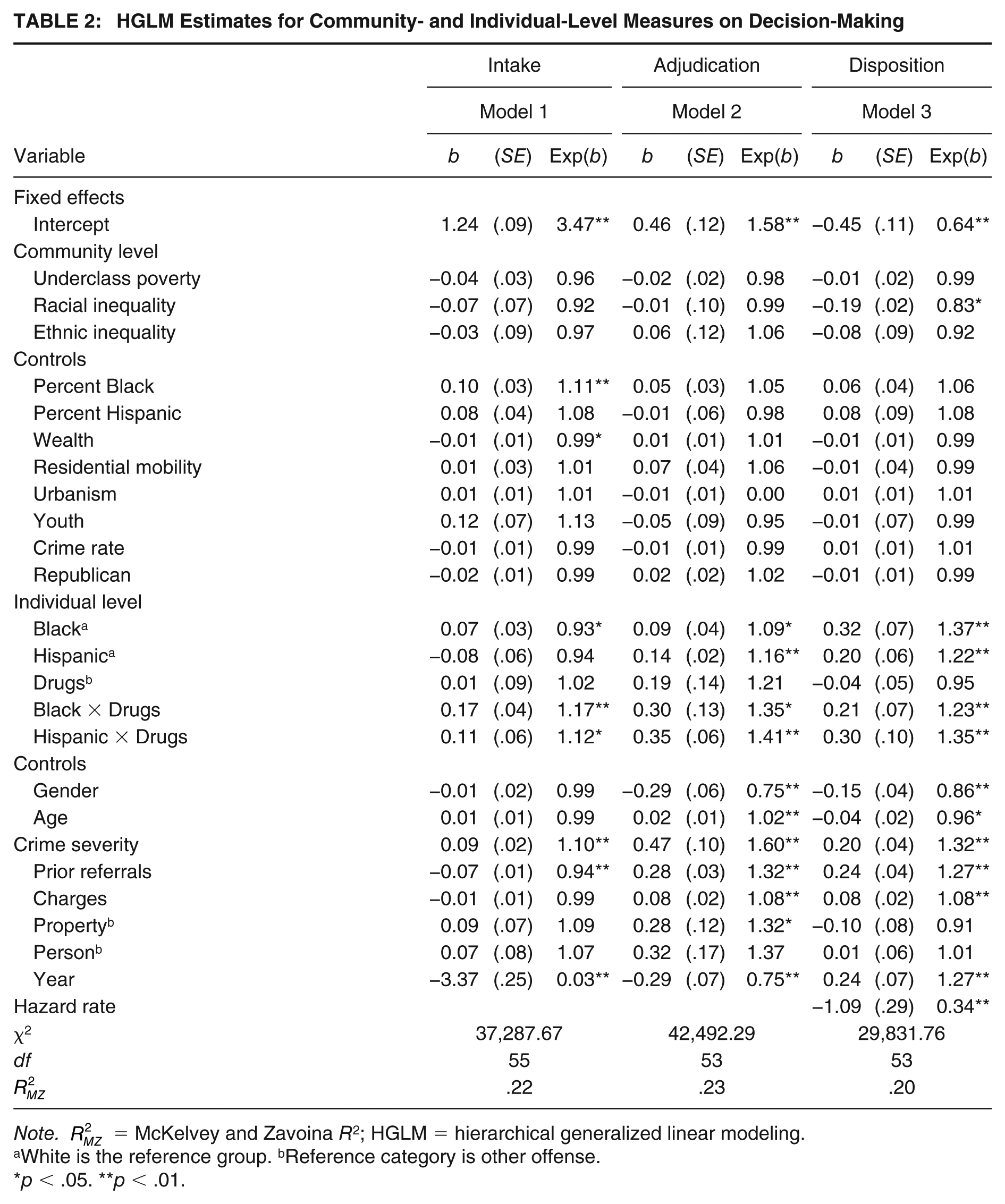
HGLM results involving the community-level (Level 2) and individual-level (Level 1) data on decision-making at intake (Model 1), adjudication (Model 2), and judicial disposition (Model 3) are presented in Table 2. As shown in Model 1, none of the community-level independent variables of interest significantly influence the mean rate of intake. Black youth have a decreased odds of receiving an intake referral, while being Hispanic or a drug offender does not have a significant effect on decision-making at intake. Tests for the presence of a joint relationship involving Black youth and drug offending and Hispanic youth and drug offending with intake decision-making, however, indicate both interaction terms to be statistically significant (Model 1). Blacks and Hispanics charged with a drug offense have greater odds of advancing further into court proceedings by 17% and 12%, respectively, compared with similarly situated Whites.
HGLM Estimates for Community- and Individual-Level Measures on Decision-Making
Note.
White is the reference group. bReference category is other offense.
p < .05. **p < .01.
The results involving community- and individual-level variables at adjudication are presented in Model 2 of Table 2. Paralleling the findings at intake, the county-level measures of underclass poverty, racial inequality, and ethnic inequality are not significant determinants of outcomes at the adjudication stage. At the individual level, being Black and Hispanic increases the odds of being adjudicated delinquent. Black and Hispanic youth have a 9% and 16%, respectively, greater likelihood of being adjudicated delinquent compared with Whites. While being a drug offender was not found to be a significant determinant of adjudication, the joint relationship linking Black and Hispanic youth and drug offending with adjudication outcomes reveals a significant effect. The odds of being adjudicated for Black drug offenders increases at this stage by 35%, and for Hispanic drug offenders by 41%.
Model 3 presents the HGLM estimates of decision-making at the stage of judicial disposition. One of the central community characteristics appears as a significant predictor of decision-making at this stage, where inequality has an inverse effect on sentencing at judicial disposition. Counties where racial inequality is more prevalent, the odds of youth being subjected to residential placement are lower compared with youth who reside in counties evidencing less racial inequality. When focusing on the individual-level findings, most of the effects reported at adjudication carry over to the dispositional stage. Being Black and Hispanic continues to increase the odds of receiving out-of-home placement as a sanction by 37% and 22%, respectively, where being a drug offender does not predict dispositional outcomes. The combination of being Black and a drug offender increases the odds of receiving a sentence of out-of-home placement by 23%. A similar trend emerges for Hispanics charged with a drug offense at disposition, having a 35% greater likelihood of receiving residential placement.
Up to this point in the analysis, the null effects of underclass poverty, ethnic inequality, and with one exception, racial inequality on juvenile justice decision-making is contrary to expectations and fails to provide support for our first prediction. Other findings involving individual and joint effects of the independent variables of interest (i.e., race/ethnicity, drug offending) with decision-making varied by the stage in the proceedings.
Cross-Level Interaction Effects on Decision-Making
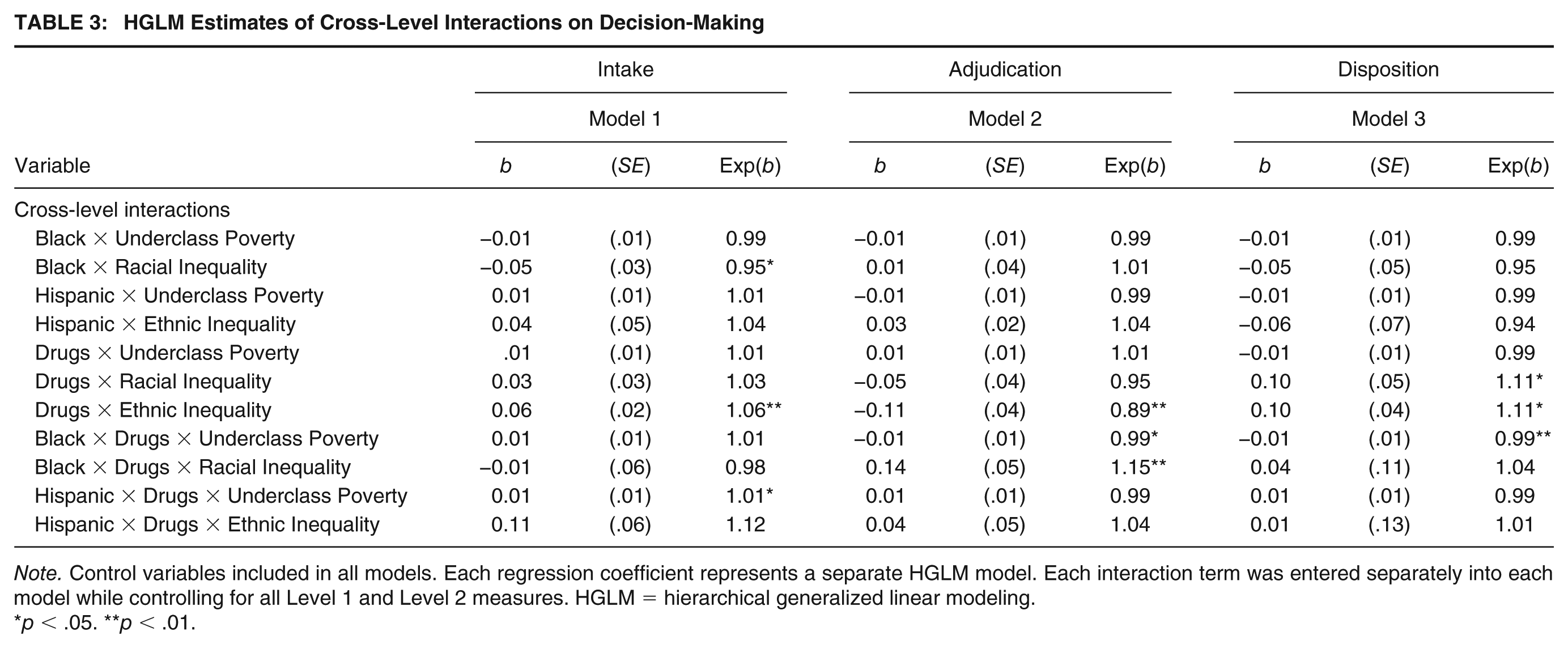
To disentangle the impact of community characteristics on the social control of youth of various racial and ethnic backgrounds, HGLM estimates for cross-level interaction effects on decision-making at intake (column 1), adjudication (column 2), and judicial disposition (column 3) are presented in Table 3. Each regression coefficient represents a separate HGLM model. Each interaction term was entered separately into each model while controlling for all Level 1 and Level 2 predictors. As described earlier, the estimation of cross-level interaction terms is a methodological tool to assess Sampson and Laub’s (1993) premise and our second expectation that communities with underclass poverty and racial inequality will subject youth, but more so Black and Hispanic youth charged with drug offenses, to greater social control.
HGLM Estimates of Cross-Level Interactions on Decision-Making
Note. Control variables included in all models. Each regression coefficient represents a separate HGLM model. Each interaction term was entered separately into each model while controlling for all Level 1 and Level 2 measures. HGLM = hierarchical generalized linear modeling.
p < .05. **p < .01.
As shown in column 1, three of the 11 potential cross-level interactions produced significant effects at the stage of intake. Most of these significant effects were in the predicted direction. Specifically, youth charged with drug offenses who lived in counties with high levels of ethnic inequality had a higher log odds of receiving an intake referral than similarly situated offenders charged with other offense types. Hispanic juveniles charged with a drug offense, who resided in counties characterized by underclass poverty, were positively related to severe intake outcomes compared with similarly situated White youth. Black youth who resided in counties with high levels of racial inequality were negatively related to intake outcomes compared with Whites who resided in similar counties of inequality.
Column 2 presents the results of cross-level interactions at the adjudication stage. Only three significant cross-level interactions were discovered, and two of the three effects were small and in the unexpected direction. Youth charged with a drug offense who lived in counties with ethnic inequality and Black youth charged with a drug offense who resided in counties with underclass poverty were associated with a lower log odds of being adjudicated delinquent. However, Black youth who were charged with a drug offense and resided in counties characterized by racial inequality had a higher log odds of being adjudicated delinquent than similarly situated White youth in these counties. At judicial disposition (column 3), three significant cross-level interactions emerged. Two of these effects were in the expected directions. Youth charged with a drug offense who lived in counties with higher racial and ethnic inequality had a higher log odds of receiving the more severe outcome of residential placement at disposition. Like the finding at adjudication, Black youth charged with a drug offense who lived in counties with underclass poverty also received leniency (lower log odds of receiving out-of-home placement) compared with similar Whites who lived in these counties.
Overall, from examining the cross-level effects of community characteristics, race/ethnicity, and drug offending across all offenders, minimal support is found for the predicted relationship that Blacks and Hispanics drug offenders who reside in disadvantaged communities would receive severe court outcomes (Expectation 2). For each of the three decision-making stages, only three significant cross-level interactions emerged, and the degree of support was once again sporadic depending on the specific stage examined. In addition, out of the five significant racial/ethnic-specific cross-level effects (e.g., Black × Racial Inequality, Hispanic × Drugs by Underclass Poverty), three resulted in leniency for Black youth and Black drug offenders and two resulted in greater social control for Black and Hispanic drug offenders. Therefore, no support is provided for the third expectation that the threat would be more pronounced for Blacks than Hispanics in communities with higher levels of disadvantage.
Discussion
In short, minimal support was found for Sampson and Laub’s (1993) perspective, highlighting that individual factors, such as race and ethnicity, tend to have more explanatory power than structural-level indicators of poverty and inequality. More specifically, drug offenders who were Black or Hispanic were treated severely at intake compared with other offenders. Minority youth, Black drug offenders, and Hispanic drug offenders received harsh outcomes at adjudication. At judicial disposition, being Black or Hispanic had a greater likelihood of receiving out-home-placement than community sanctions. These effects were enhanced if a minority youth was charged with a drug offense. While the direct and combined impact of being Black, Hispanic, and a drug offender is consistent with prior research (Freiburger & Jordan, 2011; Leiber, 2003), these results also confirm that race/ethnicity still matter in present-day juvenile justice proceedings. These individual-level effects based on the racial/ethnic background of juveniles are troublesome, especially since numerous reform efforts have been implemented in the last decade that expand beyond the Office of Juvenile Justice and Delinquency Prevention’s initiative to reduce DMC (Donnelly, 2017; Maggard, 2015). The results from the current study underscore the need for a continued and stronger commitment on the part of practitioners, researchers, and policy makers to the implementation and evaluation of intervention and prevention initiatives, and the monitoring of such efforts (Peck, 2018).
Results from our analyses also discovered that drug offenders, and in particular Black or Hispanic drug offenders, were responded to differently than other types of offenders (Feld, 1999; Mitchell & Caudy, 2015). Although speculative, this finding suggests that perceptions of the “dangerous drug offender” still thrive even 40 years after the war on drugs was declared (see also Leiber, Peck, Lugo, & Bishop, 2017; Steen, Engen, & Gainey, 2005). Supportive of this opinion, Mitchell and Caudy (2017) found that youth and young adult who were Black or Hispanic drug offenders had a greater likelihood of being arrested compared with Whites. However, racial disparities could not be explained by differences in community factors. The stereotype of being a “Black drug offender” exerted a stronger influence on arrest decisions regardless of structural indicators. Our results parallel Mitchell and Caudy’s (2017) arguments that unconscious stereotypes from the war on drugs that link Blacks to drug offending are still present today.
Regarding our expectation that the macro-level variables of interest would be a determinant of increased social control, effects existed only at one of the three court outcomes, and these community-level findings were not in the expected direction. While contrary to the results reported by Sampson and Laub (1993) and some prior research (e.g., Bridges et al., 1995; Rodriguez, 2010, 2013), the failure to find community characteristics to be predictive of social control is not atypical (e.g., Hayes-Smith & Hayes-Smith, 2009; Sutton, 2013; Thomas et al., 2013). Limited evidence was also found for the anticipated relationships between community characteristics and disadvantaged treatment of minority drug offenders. When community characteristics did impact the treatment of minorities and/or drug offenders, the effects at times resulted in less rather than more social control.
We believe that there are two potential explanations for the inconsistent impact of community factors directly or in interaction with race/ethnicity and drug offending on juvenile court outcomes. First, what might account for these conflicting outcomes is that decision-makers are compensating or correcting for racial/ethnic inequities that they believe occurred at earlier processing stages (i.e., arrest, detention). Underlying this thinking is the “loosely coupled” nature of the juvenile justice system (Bishop et al., 2010). Different decision-makers at detention, intake, adjudication, and judicial disposition either enhance the effects of structural factors on court outcomes, or attenuate racial/ethnic effects from potential biases evident at earlier stages (see Bishop et al., 2010; Steffensmeier, Ulmer, & Kramer, 1998). Based on the findings relative to our expectation, it may be fruitful to include structural factors into Bishop and colleagues’ (2010) integration of the focal concerns and “loose coupling” perspectives to explain certain irregularities in the outcomes of youth across numerous stages who have different community, offense, and offender characteristics. Second, a lack of statistically significant findings surrounding community factors and race/ethnicity in juvenile case processing does not automatically mean that disparities do not occur. In fact, biases in decision-making are becoming more implicit and subtler in nature than overtly discriminatory. Although nonsignificant quantitative results are a step in the right direction in terms of demonstrating a decrease in community or racial/ethnic-based discrimination in the juvenile court, there may be qualitative differences in decision-makers’ perceptions of minority youth and disadvantaged communities that are still occurring but did not result in statistically significant effects.
Finally, no support was found for the prediction that the interaction of race/ethnicity and drug offending on juvenile court outcomes would be larger and more severe for Blacks compared with Hispanics in communities evidencing underclass poverty and racial/ethnic inequality. In fact, out of the 12 potential cross-level interactions involving Black or Hispanic drug offenders with community characteristics, only four significant interactions emerged. We did not find a larger and more detrimental effect of being a Black drug offender in disadvantaged communities with greater social control than Hispanic drug offenders with similar community characteristics.
As one example, Black drug offenders were awarded leniency at adjudication and disposition in counties characterized by underclass poverty. This result could be attributed to the perceptions of decision-makers of Black youth (but not Hispanics), and specifically where these juveniles live when charged with drug crimes. Court actors may view Black youth charged with drug offenses as victims, rather than offenders, depending on whether they live in disadvantaged communities. It may be that court actors invoke stereotypical perceptions of offenders when determining cases outcomes based on certain offender (i.e., race) and offense (i.e., drug crimes) characteristics. In some cases, however, outcomes are decided based on the context surrounding the offender’s social status and degree of disadvantage. If decision-makers believe that offenders have few alternatives to crime based on residing in socially disadvantaged locations, they could be perceived as being less blameworthy and subsequently receive lenient court outcomes (Farrell & Holmes, 1991; Peterson & Hagan, 1984). Or, it may be that judges are not associating Black or Hispanic juvenile drug offenders with negative community stereotypes (e.g., faulty parental discipline, inadequate education, lack of supervised activities, etc.) and are cognizant to not penalize juveniles based on the qualities of their neighborhoods (Sampson, 2012). This explanation could relate to the overall lack of significant cross-level interactions regarding Black or Hispanic drug offenders with community characteristics.
The lack of overall support for Sampson and Laub’s perspective and our three predictions could be based on certain methodological limitation. First, the utilization of county-level measures may have masked potential differences within counties that were not captured by county-level census data, therefore providing less support for Sampson and Laub’s (1993) theory than that actually exists. Smaller units of analysis have the potential to uncover community and racial/ethnic effects that were not found in the present study of counties, and meaningful differences in these measures may be more evident across zip codes or census tracts. Rodriguez (2013) examined structural indicators of disadvantage across zip codes rather than counties, as policy initiatives for at-risk youth in the study’s geographical location were targeted based on zip codes. Support for Sampson and Laub’s (1993) theoretical model or other macro-level perspectives may be found in subsequent studies with more finite measures of disadvantage. Future research may want to consider the use of zip codes, census tracts, and other smaller units of analysis to identify possible pockets of disadvantage more so than county-level indicators.
Second, potentially important control measures at the community level were unable to be included in the data and should be considered in future research. Trends in drug markets, gang membership/activity, measures to indicate the war on drugs, and additional indicators of concentrated disadvantage (e.g., the index of dissimilarity [D]) may provide potential insight into support or nonsupport for community-level perspectives of juvenile court outcomes. These measures could establish whether there is a connection between community characteristics and racial/ethnic disparities in the social control of youth. Last, future tests of the perspective should also include individual-level variables such as legal representation, the type of representation, or indicators reflecting assessments about a youth’s family or school involvement. All of these factors have been previously linked to race/ethnicity and juvenile court outcomes (e.g., Bishop & Frazier, 1988; Donnelly, 2017; Feld, 1999; Gaarder et al., 2004). While our focus was on juvenile court decision-making, the possible relationships posited by Sampson and Laub’s (1993) perspective may be helpful in the assessment of the police and the overrepresentation of minority youth referred to the court (Feld, 1999).
Overall, the present study discovered that more often than not, levels of economic disadvantage in a community did not directly influence juvenile court processing, and only a few times interacted with a juvenile’s race/ethnicity and drug offending to produce disparities in case outcomes. In fact, the direct effect of being a minority seems to influence juvenile court outcomes to the disadvantage of Blacks or Hispanics more so than the structural economic and social conditions of where these youths reside. As a result, the task for future theoretical, empirical, and practical endeavors is to focus on the evaluation and monitoring stages of the DMC Mandate to understand why even after accounting for community factors, Black and/or Hispanic youth are treated in a different (and maybe even biased) manner than similarly situated Whites.
Footnotes
Authors’ Note:
This project was supported by Award 2012-IJ-CX-0051, awarded by the National Institute of Justice, Office of Justice Programs, U.S. Department of Justice. The opinions, findings, and conclusions or recommendations expressed in this publication/program/exhibition are those of the author(s) and do not necessarily reflect those of the Department of Justice.
