




Abstract
Despite efforts to reduce the number of people in the United States living in prison, people with mental illnesses continue to be overrepresented in prisons. This study explores how race impacts the prison experiences of individuals with mental illnesses. Thirty-seven participants were recruited from three states via flyers at community treatment providers and through word of mouth. Participants completed in-depth, semi-structured interviews and surveys to understand prison experiences and collect demographic information. Data analyses included descriptive statistics, framework method analysis, and an intersectional lens. Findings show that participant experiences were influenced by race through interpersonal interactions between those incarcerated and through interactions between people incarcerated and correctional staff. Intersectional identities underlying these interactions were explored including race, socioeconomic status, rural versus urban residents, and subordinate/dominant roles tied to power (e.g., staff vs. person incarcerated). These findings provide insight into how race, mental illness, and criminal-legal contact intersect.
In 2022, the United States continued to have the world’s highest incarceration rate with 573 per 100,000 people living in custody (Sawyer & Wagner, 2022). This incarceration rate disproportionately impacts people of color, people living in poverty, and people impacted by mental illness (MI) and substance use disorders. When these factors intersect, incarceration rates increase (Baloch & Jennings, 2019; Ocen, 2013; Wang, 2022). Little research examines the cumulative effect of multiple, intersecting identities on experiences in prison (Batastini et al., 2022). The research that does exist suggests intersectional identities involving race, gender, and health can lead to increased discrimination and racism in prison (Kilty, 2021). Understanding these experiences is important because incarcerated people are highly subject to systematic injustice (Gilson, 2016). Failing to engage in an intersectional approach may obscure needs and mask the differential impacts of prison exposure (Cho et al., 2013). This project used intersectionality as an analytical framework to explore how previously incarcerated individuals perceive their racial/ethnic identity, urban/rural demographic identity, and overall positionality within the carceral setting influences their interactions between fellow incarcerated individuals and correctional staff.
Mental Disorders and the U.S. Prison System
People with MI continue to be overrepresented in the criminal-legal system despite diversion programs. Prevalence rates of current and lifetime psychiatric disorders are greater in state prisons compared with community samples (Prins, 2014). People with MI have longer sentences than individuals without MI and tend to serve their entire sentence (Comartin et al., 2020; Fellner, 2006). The prison environment has negative impacts on mental and physical health during and following incarceration (Edgemon & Clay-Warner, 2018; Schnittker & John, 2007). Promoting positive mental health via programming and services within prisons can help people with MI by increasing access to evidence-based practices, specialized housing wings, and medications (Edgemon & Clay-Warner, 2018; Semenza & Grosholz, 2019). Only half of individuals taking medication for MI in the community continue to receive treatment after entering prison (Gonzalez & Connell, 2014). Individuals who were previously incarcerated also perceive barriers to accessing mental health services, poor quality of mental and physical health services, inadequate staffing, and arduous medical procedures as barriers to receiving mental health care (Canada et al., 2022).
Race and the U.S. Prison System
Racial discrimination is deeply embedded in U.S. history. The social construct of race has long been used as a tool for segregation and control and to perpetuate false arguments based on innate biological differences (Bryant et al., 2022; Witzig, 1996). Segregation and control are demonstrated post-slavery through the lynching of Black bodies as a weapon of terror, Jim Crow laws in the American South to separate White from Black Americans, redlining to prevent Black people from acquiring property and accruing wealth, immigration laws that specifically targeted and prevented Asian immigrants coming into the U.S., and mass incarceration (Mirken, 2020; Travieso, 2020). Jails and prisons are the “New Jim Crow,” and a revision of slavery (Alexander, 2012; Gottlieb & Flynn, 2021; Schoenfeld, 2018). It is well established that people of color are imprisoned at disproportionate rates compared with people who identify as White (Baloch & Jennings, 2019; Nellis, 2021; Schnittker et al., 2011). Segregation continues in prison by gender, racial identity, and sexual orientation (Dolovich, 2010; Furst, 2017; Hemmens & Stohr, 2014).
After the Supreme Court deemed racial segregation in prisons unconstitutional in 1968’s Lee v. Washington, correctional staff found a way around this under the guise of prison security (Hemmens & Stohr, 2014). Prison populations being segregated by racial/ethnic identity means that within-group identity is heightened while between-group identity may promote conflict unless a need for a universal identity emerges (Kreager & Kruttschnitt, 2018). Irwin (2005) found that racial groups in California prisons segregated themselves according to identity, however, racial boundaries between groups were porous overall, and there was relatively low tension between racial groups.
Research exists on the organizational structure of correctional facilities, but there is limited research on how race, ethnicity, and other factors influence experiences in U.S. prisons. Hemmens and Marquart (1999) describe how perceptions of race are impacted by socio-demographic factors apart from education status. In their study, Hispanic individuals identified their experiences as being more like the experiences of White individuals than the experiences of Black individuals within prison settings (Hemmens and Marquart, 1999). Other literature takes a more in-depth approach to exploring race and identifies prison as a political setting that contributes to racial/ethnic identity formation and role negotiation. Richmond and Johnson (2017) discovered that incarcerated men made decisions about leisure time based on ideas of survival, race, and access to social power. Another study by Kreager et al. (2017) discusses how a hierarchy was formed in men’s prison in Pennsylvania, and how this social order informed social status. Those who were incarcerated for longer or perceived as older were seen as possessing more power, influence, and status over other individuals incarcerated. This article shows how age and longer prison sentences inform social order within carceral settings. These studies make a more distinct connection between race, ethnicity, social roles, and functioning within the correctional setting.
Intersecting Identities
The research on the role of race and ethnicity in experiences within correctional settings is growing, particularly as it relates to disparate experiences of people with intersectional identities. More studies are considering race and ethnicity alongside gender, mental and physical disabilities, economic status, and age. Existing research suggests that intersectional identities can contribute to concealing identities related to gender and health status due to stigma, lead to unnecessary uses of solitary confinement, affect re-entry into the criminal-legal system, increase risks for labor coercion and abuse, and prevent people from accessing needed medications and medical services (Bostock, 2020; Kilty, 2021; Rucker, 2022). In Kilty’s (2021) study, Black women who were HIV-positive experienced multiple stigmas influenced by their compounded identities.
A study by Porter et al. (2021) evaluated the effect of time served in prison on mental health symptoms and found that White individuals experienced a negative relationship between reported mental health symptoms and time served, while Black individuals experienced the opposite. When gender was applied, White women who engaged in a violent crime had a higher rate of reported mental health symptoms over time, but there was no increase among Black women, Black men, or White men. By evaluating each group at the intersection of multiple identities, researchers were able to gain a more nuanced understanding of how different populations are differentially impacted (Porter et al., 2021). In the same vein, Willingham (2011) discussed how oppression contributes to carceral experiences for women of color with societal discrimination based on gender, race, and sexuality extending into prison within the United States. Finally, Abrams et al. (2008) argued that hegemonic forms of masculinities involving competition, hierarchy, stoicism, sexism, and homophobia were reinforced through institutional and interpersonal mechanisms while other forms of gender expression were largely suppressed.
Using an intersectional lens has the potential to shed light on disparate institutional practices and help orient efforts toward structural change (Bell, 2017; Bunn, 2018; Gueta, 2020). Gilson (2016) showed how an intersectional analysis of the prison system works to produce and negotiate identities by introducing concepts such as surveillance, vulnerability, and positionality to those within the carceral setting. An intersectional lens was used to examine how race/ethnic identity intersects with other identities, including urban/rural demographic identity, and overall positionality within a carceral setting for individuals previously incarcerated who have a MI, chronic health condition, or substance use disorder. The current project sought to fill the gap in the literature by investigating experiences of race and power dynamics within prison among individuals with MI, chronic health conditions, or substance use disorder who were previously incarcerated in prison in the United States using an intersectional lens throughout the analytic process.
Method
This project was part of a larger study that explored the experiences of individuals who were previously incarcerated surrounding their use of physical and mental health care services and interactions with prison staff. 43 participants with a history of incarceration and current MI were recruited to participate in in-depth interviews and complete health history surveys. After obtaining approval from University Institutional Review Boards, adults meeting the criteria were recruited at three different recruitment sites spanning the Midwest and East Coast. Participants provided consent before participating in audio-recorded interviews, later to be transcribed and de-identified before inductive coding began. During the in-depth interview, participants were asked how they perceived race as impacting their prison experiences. This project utilized data from the responses to this question. An intersectional lens was used to analyze how participants perceived race impacting their overall prison experience, relationships with others, and social positioning within the prison. The specific research question guiding this analysis is as follows:
Sampling and Recruitment
A combination of sampling strategies was used to recruit participants. Purposive sampling was used to select participants who met inclusion criteria and were able to engage in discussions on their experiences in prison. Snowball sampling was subsequently used to identify additional eligible participants. Researchers distributed flyers in community mental health centers in the respective sampling sites in addition to handing out flyers to interviewed participants to give out to their social networks. If participants were interested, they were encouraged to contact researchers directly via contact information located on the flier or were encouraged to enlist help from community health care providers to contact researchers. Once contact was made with researchers, participants were screened over the phone to determine if they met eligibility criteria and were able to provide informed consent.
Participants were eligible for the original study if they met the following: (1) were over the age of 18, (2) spoke English, (3) had at least one previously diagnosed serious MI which included major depressive disorder, schizophrenia spectrum disorders, and Bipolar I or II, and (4) spent time in a state, medium- or maximum-security prison within the past three years.
Procedures and Measurement
Once consented, researchers met with participants in person for approximately 2 hr to review the consent and complete an audio-recorded, 90-min in-depth interview about their experiences while incarcerated and a brief questionnaire. In-depth interviews were semi-structured, meaning researchers prepared a question guide beforehand but remained flexible with probing questions and follow-up, as needed. Interviewers engaged conversationally with participants, allowing participants to direct what they wanted to discuss about their experiences. The interview guide was developed by the research team and included questions pertaining to general experiences while incarcerated, living in prison with an MI, accessing treatment for chronic health conditions, quality of mental and physical health treatment, interactions with staff and people living in prison, re-entry experiences, and cycles of incarceration. If participants did not bring up race first, the interviewer asked them specifically about it (i.e., “How did you perceive race influencing your experiences while incarcerated, if at all?”). Interviews were transcribed by a third party. The questionnaire was designed to supplement interviews. It included questions about demographics, mental and physical health histories, incarceration histories, medical insurance, current living situations, and current workplace.
Data Analysis
Framework Method
The framework method was used to analyze interview data systematically and iteratively analyze data (Gale et al., 2013). The researchers first reviewed audio files and transcripts for accuracy and to become familiar with all interviews. The research team then created memos to begin the process of creating codes inductively through multiple transcript reviews. Two members of the research team reviewed memos and created a codebook of parent and child codes and accompanying definitions of codes. Once the codebook was created, all five members of the research team completed line-by-line coding of three additional transcripts. The research team met an additional time to review the existing codebook and coded transcripts before commencing the coding of the remaining transcripts. The research team met regularly to review coding themes wherein coding discrepancies were discussed using a consensus approach. Dedoose, version 8.3.43 and 9.0.17, was used to organize and code transcripts. Participants were given pseudonyms to protect their identities post-analysis.
Data analysis for this manuscript was conducted using an intersectional lens. An intersectional lens can be understood by examining the inseparable identities that compound one another within society to form an individual’s unique world experience. Intersectionality theory was later extended by outlining how it can be applied to social research by identifying three different approaches to how categories can be used in intersectional analysis: anticategorical, intercategorical, and intracategorical (McCall, 2005).
Intersectionality has since been expanded to be understood as an always-changing analytic tool that can be applied to many different systems of power and oppression (Carbado et al., 2013; Hancock, 2007; Rice et al., 2019). According to Rice et al. (2019), “. . . to do intersectionality justice, researchers must unequivocally orient to issues of power, positionality, and differences throughout their research process” (p. 8). Hancock (2007) additionally outlines six key assumptions in using intersectionality as an analytical framework: (1) there is always more than one category of difference (i.e., gender, race, class) at play within the context of analysis; (2) the many categories of difference being analyzed are oftentimes not attributing to the processes equally; (3) these categories of difference are always acting in contestation with institutional/structural forces and attention should be paid to both individual and institutional forces; (4) there is within-group diversity among categories of difference that cannot be ignored; (5) analysis of categories of difference should be conducted integratively at all levels; and (6) intersectional analysis requires both empirical and theoretical interrogation of the research question.
The following analysis adheres to using intersectionality as an analytic tool by adhering to McCall’s (2005) application of intersectionality as an analytic tool—an intercategorical approach will be used to compare and describe unique experiences different racial/ethnic groups have within the correctional setting while an intracategorical approach will be used to explore the experiences of particular groups and participants. In addition, Hancock (2007) and Rice et al.’s (2019) assumptions in using intersectionality as an analytical tool were followed in the analysis to consider systems of power, oppression, and contesting identities that may or may not be contributing to processes equally.
The first author of this article joined the research team during data analysis and coding. As a White, cisgender gay male researcher, the first author borrowed from Black feminist and queer epistemologies to analyze and interpret data through an intersectional framework lens. As a queer and feminist researcher, the first author is currently working on his doctoral dissertation exploring policing of transgender women of color in the Midwest. He’s worked on previous research projects in correctional and mental health spheres including training on transgender awareness/knowledge of correctional staff in the state of Missouri, and explorations of structural/individual violence and access to health services within correctional settings for individuals who have health comorbidities. The first author also works as a clinical social worker in the state of Missouri working with clients from varying identities and backgrounds.
Descriptive Statistics
Descriptive statistics, including frequencies and measures of central tendency, were used to analyze completed participant questionnaires. A total of 43 participants took part in the original project; however, six participants from one of the geographic locations in the original project did not complete questionnaires; these six participants are not reflected in the demographic information listed in the results section. Calculated percentages in the results are based on the 37 participants who completed the questionnaire. Minimal data were missing from the other participants. If data were missing, the case was removed from the analysis of the missing variable but was not dropped from the dataset completely.
According to Dworkin (2012), the study sample size is sufficient for qualitative studies using in-depth interviews. Based on the original project’s aim of using grounded theory to explore the experiences of individuals previously incarcerated within carceral settings, the research team believes theoretical saturation was reached to determine the sample size which is supported in the literature as a determinant of qualitative sample size (Boddy, 2016).
Results
Demographics
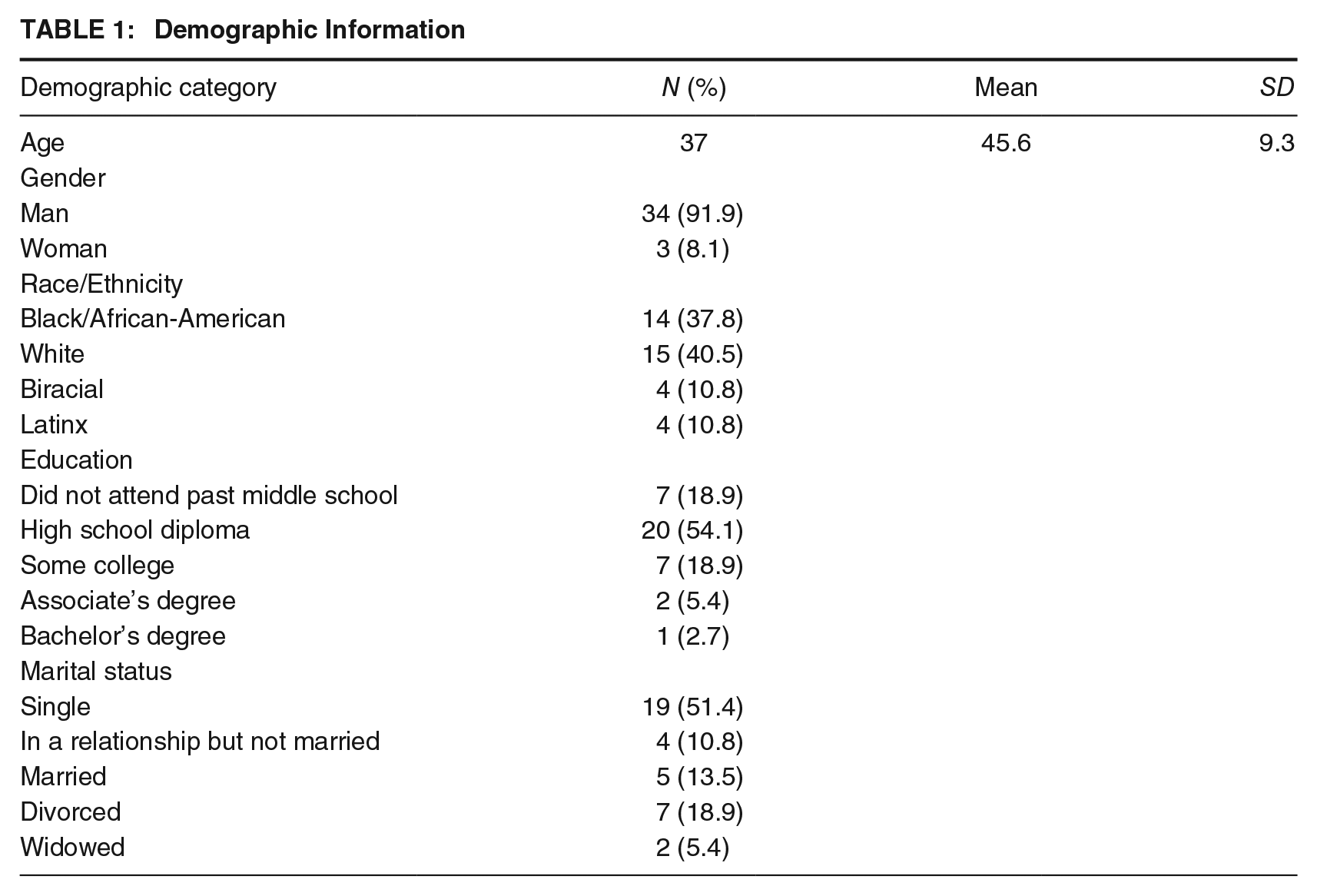
The table below illustrates demographic information for the sample. Participants were 45.6 (SD = 9.3) with a range from 27 to 62 years old. Almost all participants who completed questionnaires came from urban backgrounds; two reported rural backgrounds. Some participants received Social Security disability income for their psychiatric illnesses (27.8%) while others had pending cases (33.3%). Almost all participants reported having several medical and mental health diagnoses. 58.3% of participants endorsed being diagnosed with a chronic illness or major physical illness while 38.9% did not; the rest of the participants did not answer. 94.4% of participants endorsed being diagnosed with an MI or substance use disorder while 5.6% did not answer. The most reported diagnosis was Bipolar I (n = 13, 35.1%). Just about three-quarters of participants had at least one major medical comorbidity (n = 27, 73.0%). Three-quarters of participants also had a co-occurring substance use disorder (n = 28, 75.7%). Finally, participants were arrested prior to the age of 18, on average, 3.6 times (SD = 9.3) with a range of zero juvenile arrests to a high of 25. The number of adult arrests ranged considerably from one to 150 (M = 24.4, SD = 33.5).
Demographic Information
Overview: Prison Context and Intersectional Identities
When exploring interactions in the prison context, racial identity, and geographic background shaped participants’ experiences. Participants across the entire age range perceived experiences of racism within interactions in prison. Regarding gender, very few women participated in the original study; thus, there was not adequate representation of women in correctional settings to include gender as a category of difference in this analysis. It is important to note that all individuals included in the study had an MI, a chronic health condition, and/or a substance use disorder, and thus this category could not be used as a category of difference for examination. Rather, this could be used as an intracategorical area of exploration (McCall, 2005).
Participant Identities Impacting Interactions
Race/Ethnicity as an Isolated Identity
It’s important to look at how race was discussed as its own identity category. Some participants perceived race/ethnicity to impact their prison experiences in varying experiences. Some did not see it impacting it at all. Colt, a Black man in his 40s with multiple prior arrests, perceived carceral organization by racial/ethnic identity as a thing of the past, saying that “it’s so overcrowded that they will just throw you in there.” Many participants across racial and/or ethnic identities saw race as a means of organization between people living in prison who share the same racial identity or ethnicity, which in turn, provided social support and protection. Elijah, a middle-aged Black man, reported: Jail is segregated into different type of gang members. You know, you have got your Latin Kings, your Nietas, you got your Bloods, your Crips, you got your Africans, you got your Jamaicans. Shower posses. You have so many different cliques. And when everyone goes to chow, you are pretty much segregated into your own little eating area in case anything goes down. Everyone protects themselves.
Noah, a middle-aged White man with both physical and mental health conditions, had a similar perspective: Prison in general, you stick with your own race. Um, they had in the yard . . . they had called courts. That’s where the tables are and that’s where people hang out. You know, you have the Black court, the Mexican court, the White court, and all that, and usually, you know, the races stick together.
This sense of community led to social support that was felt by various individuals previously incarcerated. Social support came in many forms including protection from other people living and working in prison. Henry, whose demographic data was not collected via questionnaire, recalled how he was warned by other people incarcerated to stay away from certain correctional staff to prevent potential harm: “You got inmates who will tell you that’s one of them guards you don’t wanna mess with. He don’t like Blacks. You don’t wanna mess with him. He don’t like Blacks. Inmates will tell you.”
Other participants saw race/ethnicity as a means of division. While participants reported these racial groups to have strong barriers between them, this organization sometimes caused “racial tension” that manifested as physical or verbal harassment and violence between groups. Jackson, who identifies as a White man in his 50s, described: I’m not prejudiced, but I noticed that a lot of Black folks hate[d] White people while I was in there. And I couldn’t understand like what’s going on here. Like, everything had to do with “Whitey this” or, or, or. ‘We’re in here because the White man put us in here.’
Racial in-groups in prison can be porous. Between-group barriers can be deconstructed with matters pertaining to finances or contraband (i.e., selling/purchasing items). Logan, who identifies as a middle-aged man of color with depression, noted: If you needed something, you know, they would . . . they would sell, right. If it was like a money exchange, they like—if you needed drugs . . . if you needed drugs, the White guy sold it to the Black guy, the Black guy sold it to the White guy, Hispanics . . . it’s a funny thing because they racist, it’s a racist group, but all of them, when it came to money . . . they would agree to come together and talk.
In prisons, racial/geographic identities may be (temporarily) transcended by shared universal identities centered around incarceration, particularly around transactional activities.
It is important to remember that although some participants talked about race as an isolated identity, taking an intersectional approach assumes that identities are almost always interacting with one another. Most participants’ perceptions of race followed this tenet, as race was often tied to other identities, varying within and across sites. Participants’ perceptions of race permeated almost all relationships in prison: between and among incarcerated individuals and between incarcerated individuals and correctional staff.
Race × Urban/Rural Background Between and Among Individuals Previously Incarcerated
In the prison context, race and geography (i.e., participant home before prison and location of the prison) were important intersecting identities that varied across sites. Individuals incarcerated in states on the East Coast discussed this difference in a dichotomy of “Upstate” and “Downstate” whereas participants from the Midwest used more general descriptors of “urban” and “rural” or specified cities or areas by name. Prisons located in more rural areas created less diversity in staff who may live in the surrounding areas and, to some extent, the composition of the incarcerated population. Will, a Biracial man in his 30s with co-occurring MI and substance use, perceived that there were more White people incarcerated in rural prisons compared with those that were located closer to more urban areas. One caveat to the intersection of race and/or rural/urban identity is an inherent connection with ableism, which cut across all participants. Participants who did not have a physical illness or disability predominantly discussed Whiteness as a racial identity in prison interactions, while those who did have a physical illness or disability tended to discuss identities of color as a factor while negotiating aspects of carceral living (e.g., movement or safety).
Racial attitudes amplified by geographic backgrounds (i.e., rural or urban) would manifest in interactions between individuals who were incarcerated and further create conflict. Will reported he was incarcerated in a prison with a population that was predominately White. He discussed how he would be more alert and nervous when other individuals who were incarcerated used racial slurs around him. He said, “Good ‘ole country boys, they don’t like no Black people from anywhere.” For him, race/ethnicity and rural/urban identity were inseparable.
Race × Seniority Between and Among Individuals Previously Incarcerated
When adding another possible identity to the analysis, seniority in prison may also influence social interactions. Julian, a Hispanic man in his 30s with multiple mental disorders, discussed how interactions between individuals who were incarcerated may look differently depending on seniority. He noted how those with more seniority may have more privileges, power, or social standing compared with individuals incarcerated who were newer to their facilities. Tristan, a man of color who did not provide his age, notes how the leader of individuals incarcerated identified as Black, White, and Puerto Rican, subsequently creating less between-group tension. Tying this back to an intersectional lens, how long an individual who was previously incarcerated was in the correctional system may be indicative of another identity that can be assumed. Because this was only mentioned by one participant, it is difficult to say if this is applicable across different age ranges, races/ethnicities, or other different groupings of identity. Racial and ethnic identity may be less important if social leaders within the incarcerated population identify with multiple racial and ethnic backgrounds.
Power Differentials Between Individuals Previously Incarcerated and Staff Due to Identity
Power Differentials Between Individuals Previously Incarcerated and Staff × Race
When taking an intersectional approach it is also imperative to look at contestations of power within systems, not just individual intersections of identity. Participants across multiple racial and ethnic identities experienced exercises of power between the staff and incarcerated populations. While power is not inherently connected to racial or ethnic identity, it is historically within the United States. White populations historically enslaved, colonized, and disenfranchised communities of color, which binds race and power tightly together. Given the argument that incarceration is a modernized version of slavery, power differentials between White populations and people of color are pertinent in carceral settings and it is impossible to look at these identities as inseparable. Participants of color recognized this connection especially, as Xavier, a Black man in his 60s, described: When the odds are stacked against you and it’s frustrating because of things we don’t get that other segments of society are privileged to have . . . When you’re upstate and it’s a whole bunch of Black inmates, and the overseers, correction officers, 99.9% are White, there’s going to be resentment by the Blacks, a lot because sometimes we are innocent of what we are charged with. We may have had a faulty lawyer . . . the jury may have been tainted against you. You know, all White jury and you’re a Black male—how can this be a jury of my peers? They don’t understand what I live through, you know . . .
Participants were able to identify how being a correctional staff member afforded its own identity. Isaac, a Black man in his 40s, reported it was “staff versus ‘whoever.’” Will discussed how they believed this power comes directly from staff’s position: “You put somebody in a position of power, their judgment is going to come into play one way or another eventually.” Lucas, a middle-aged White man, also directly discussed the power differentials in that they believe staff were on a mission to keep individuals who were incarcerated down as they see those individuals as “the enemy,” saying “some COs have the attitude that they have to keep their boots on our necks cause we’re criminals.” Hudson, a middle-aged Black man, adds: . . . Some [staff] get off on enforcing the rules a little bit further. Power’s a hell of a drug. And some of them uh really are lost in that power high. For eight hours . . . Some officers, you gotta walk a tighter rope than others. They approach everything with control, with force and that’s a big clash thing. You know, you’re walking around, you’re on your medication, um you have these issues, you have this diagnoses that you’re dealing with. And they don’t know about that. You’re just an inmate with a number, wearing green and you’re a threat to them in whatever kind of way. And that’s how they see you.
Participants cite examples of how officers provoke people with racial slurs, initiating physical conflict, or giving ticket infractions. Participants perceived that staff’s belief that they are untouchable allows them to engage in these activities without consequence. Caleb, whose demographic data was not collected via questionnaire, provided a specific example when he recalled an officer saying “This is my house. Nothing you say means anything. So if we want to, we can beat you up. Cause we know the DA. We know the judge.” Participants perceived this need to demonstrate power was particularly important for maintaining status. Elijah states, “if the commanding officer is coming down the tier, you better stand against the wall, whatever it is, because if not, that officer has to show some type of, uh, strength, to keep his job.” These participant perceptions outline how they saw how being a correctional staff member was an identity in and of itself, sometimes operating on its own or serving in conjunction with correctional staff or incarcerated individuals’ racial/ethnic identities.
Social influence
Study participants also recognized the social influence that staff have on one another, displaying power differentials when there’s more staff presence. Participants noted more overt violence and verbal harassment when there were groups of officers as well as changes in how they talked to and engaged with the incarcerated population. Caleb provided an example of how they were called racial slurs during a physical altercation with an officer which was followed by a sergeant physically beating him. Elijah also discussed the change in demeanor among officers when there are more than one around: Even though, their personality might be that they are nice guys. And a lot of them are, but when other correction officers come around, they have got to show that militant side. They will go bipolar. We used to call it “They will go bipolar on you.” When they are by themselves, “Yeah, how you doing? Yeah.” As soon as another correction officer, “Get against the wall! You are moving around too much!”
Rarely did participants discuss having power themselves in interactions with correctional staff. Henry was the only participant who hinted that power may be bidirectional. In their interview, they describe: it’s hard on the guards to really maintain composure inside the jails. It’s really hard. It’s really hard ‘cause you got maybe 600 inmates to one guard and you really can’t watch everything. A lot of guys, they try to take advantage of them. Sneak drugs in and stuff like that. It’s hard for these guards too.
In this way, individuals who are incarcerated may possess power in their ability to outnumber correctional staff. This bidirectionality of power also indicates that because of their ability to outnumber staff, individuals who are incarcerated have more covert and resourceful ways of resistance against the correctional system.
Some participants did not view the race of staff to influence interactions, at least not as much as the inherent power differentials in prison. Felix, a Black man in his 40s, discussed his viewpoint on how all correctional officers are all the same, no matter their race—“It is like correctional officer wants to become a correctional officer, they are like brainwashed. You know what I mean? It doesn’t matter what color they are, they all act the same.”
Staff sharing identity with individuals incarcerated
Participants across racial, ethnic, and gender identities described instances where shared racial identities of staff and people incarcerated led to special privileges. Logan shared: They had a Spanish CO (correctional officer) where I was at and . . . he would talk to the Blacks . . . if you was Puerto Rican like I am, he would give you more of a break . . . like if you got into a fight or if you got into some kind of altercation, he would . . . lean more to the Hispanic than the Black or the White. Now, he . . . he didn’t like the Whites for whatever reason . . . they had a Black guy, a Black CO, he leaned more to the Black guys. Then, they had a White CO, he leaned more to the White guys. You know, it was an experience . . . you can’t believe it ‘cause you could actually see it . . . see this going on.
While participants discussed this happening with prison staff of various racial and ethnic backgrounds, participants cited this happening most often between correctional staff and individuals incarcerated who were White. Grace, a Black woman in her early 30s, noted: “COs were racist in that giving extra privileges, especially extra food privileges when getting food or when getting recreation time.”
Conversely, shared racial identity did not always lead to privileges. White participants noted that depending on where you were incarcerated, sharing a White identity with correctional staff increased the harassment from officers due to staff beliefs that White people do not belong in prison. Jonah, a divorced White man in his 50s, provided important insight into this finding: The higher you go up in state, the mountains and stuff, they don’t—this is what I’ve come to see, they don’t like Blacks. They don’t like Spanish. But if you’re White and you’re upstate, they don’t like you more. They feel like you’re White and you shouldn’t be in jail. They sometimes will beat you down depending on how you carry yourself.
Although some participants entered prison perceiving that racism would drive conflict between people incarcerated and staff, some participants noted that once in prison, this perception changed. Jackson reported they initially thought White individuals who were incarcerated would get more preferential treatment based on the color of their skin. However, they found White individuals who were incarcerated were oftentimes treated worse than people of color, describing how these individuals were told “they were White trash, trash of the world” (Jackson).
In resource-deprived environments like prisons, special privileges may be especially detrimental to staff interactions and perceptions of fairness. Just as staff gave privileges to people with shared identities, participants also noted differences in how racial identities fueled barriers to people having their needs met, their requests taken seriously, or as a tool for enacting violence and further exploiting power differentials. Participants endorsed experiences of staff using racial violence and harassment including being “openly racist verbally, using slur language.” Acts of racial violence were especially prominent toward people who did not speak English. Staff exploited power through harsher or more extreme punishments like more serious ticket infractions or extended time in segregation or keep lock (i.e., isolating people to their cells). Participants recalled staff-perpetrated violence that led to serious injury or even death. For example, Caleb reported while they were incarcerated two people died from being beaten by correctional staff. Caleb continued by saying that individuals who are incarcerated even have a term for when correctional staff perpetrate physical violence—“they put hands and feet on you.”
Race may function in a different way in interactions between both staff and individuals who are incarcerated from racial or ethnic groups other than White. Julian, a Hispanic man in his 30s with multiple mental disorders, provided an example of something he heard officers say: “I’m American. I was born in America. I’m American.’ He spoke Spanish, but he won’t say he’s uh . . . even Black man will say, ‘I’m American. I’m uh . . . I’m not Black. I’m American.” Officers may be attempting to de-identify with the individuals who were incarcerated to create strict barriers between them, minimize feelings of guilt or shame, justify verbal or physical violence, or to act in alignment with their institution and sense of duty.
Power Differentials Between Individuals Previously Incarcerated and Staff x Race × Urban/Rural Background
Like the findings discussed above, participants perceived that racial identity and geography also have an impact on interactions with staff when accounting for this additional identity. Participants noted the “small, rural town” morals and values of staff fuel racial violence. Ava, a single Black woman in her 50s, noted, “. . . Redneck county. Full of rednecks, really racist to Black people and Latinos . . . They are the type of individual that turn their back and spit on you, spit talk racist to you and stuff with everything.” Participants asserted that some officers from rural areas had no previous interaction with people of color prior to working in the prison. Hudson explained: 95, 98% of the correctional officers from rural country areas. Um I . . . encountered correctional officers that told me, “First time I seen a Black person is when I came to work.” I’m like, ‘Are you serious? It’s 2000!’ And they’re like, ‘It’s 1800 people in my town and half of those are related. Like I never lived you know outside of my town and my first experience with . . . you know, with people is when I got the job.’ I’m like, “Wow.” You know. So he only comes to work you know, only knowing what possibly he’s read or heard about individuals, and that’s how he’s going to treat you until after he’s on the job five, ten years and then he learns people are people. And that’s how it goes.
Henry also mentioned similar experiences, “. . . More rural White guards specifically who did not like colored folks. Hillbilly kind of guards that don’t like Blacks and they will take it out on you if you don’t just do what they gotta tell you.” Participants of color perceived that racially charged behavior and race-based violence occur in prison because most people working in prisons are White. Miles, a Black man in his 20s, suggested that the racial violence is “. . . because they’re in supremacist gangs . . . They call it ‘the land of the KKK.’” While study participants largely perceived people incarcerated to organize via racial and ethnic identity, Logan was the only participant who perceived explicit separation and organization by race and ethnicity among staff.
Similar to individuals previously incarcerated, staff sometimes knew individuals who were incarcerated prior to incarceration due to shared rural/urban background. As an example, Lucas stated “. . . treatment from COs or staff differed based on whether or not you knew them. Black guards were breaking my balls all the time ‘cause I was a White dude” yet he found the White correctional staff treated him better because they knew him and members of his family. These instances are likely more common when people incarcerated are from communities in or near where prisons are located. A sense of community may be felt among individuals who were incarcerated who came from the same neighborhood or community as staff, or simply knew of one another outside the correctional setting.
Power Differentials × Race × Urban/Rural Background × Respect Between Individuals Previously Incarcerated and Staff
One participant found that even if you share a similar racial, ethnic, or rural/urban identity with staff, respect was a factor within the relationship. Brandon, a Black man in his 50s, notes: Like I said, I mean, color—I mean, your own color will treat you worse than a different color, so to me, that’s like, you know, it’s just a matter of respect, you know what I’m saying. You show people respect, you give respect, going to give you respect.
This hints at respect potentially being independent of the relationship between racial, ethnic, or rural/urban identity between individuals who were incarcerated and correctional staff instead of being a function of these identities.
Discussion
Participants’ experiences interacting with prison staff and residents are best understood through an intersectionality lens. Participants in this study provided in-depth accounts of their own experiences interacting with one another and staff. Participants provided “content specialization” of intersectionality which recognized the significant role of both race and power in prison interactions (Hancock, 2007). The ways race functioned in correctional settings were compounded by both urban and rural identities and pre-incarceration identities, which supports Crenshaw’s (1989) theory that identity categories are often inseparable. These inseparable racial, ethnic, rural, and urban identities led to socialized groups that were formed based on these identities. These groups served to provide social support to individuals while they were incarcerated and provided a sense of community. Overlapping identities, however, could also function to fuel conflict between different racial and ethnic groups.
While data supported the intersection of racial and ethnic identity and how it is interwoven with urban, rural, and pre-incarceration identities from outside correctional settings, other identities including gender, education level, class, and mental and physical ability may also influence interactions between individuals during incarceration. As Hancock (2007) states, these identities may be present in interactions but contribute less than other identities. Although power was a prominent theme across participant interviews, themes around exercising resistance in response to power emerged only minimally in the study, perhaps related to the correctional setting where individuals resisting power face immediate, harsh discipline. Participants did discuss moments when a more universal identity based on resistance to correctional systems may supersede racial identity (Cho et al., 2013; Hancock, 2007; Howard & Renfrow, 2015).
In this study, participants discussed aspects of their incarceration that reinforce the systemic racism built into correctional systems (Alexander, 2012; Gottlieb & Flynn, 2021; Schoenfeld, 2018). Participants provided great depth to their responses when discussing the mechanics of race relations and more specifically power between individuals who are incarcerated. Participants described the explicit and implicit exercises of power influencing their interactions that were most prominent on an individual level. Participants discussed how correctional staff’s power positioned them above or in a hierarchy within the correctional setting. This allowed for systems of domination to take place through verbal and physical assault or through indirect avenues of power (e.g., ticket infractions).
Few participants discussed how people incarcerated exercised or had power in contestation with staff, hinting at a potential bidirectional, albeit uneven, distribution of power in the correctional setting. Participants cited racial and ethnic and urban and rural identity influencing interactions between correctional staff and individuals who were previously incarcerated, as well as class differences among the two that fueled this power differential. This was most evident in the staff’s reference to perceived Whiteness by using phrases like “White trash,” calling attention to the compounding racial and class identities.
Participants’ experiences highlighted the inseparable aspects of racial/ethnic and urban/rural identities and how they impacted staff interactions as they relate to privileges and needs not being met, respectively. Participant experiences also show how violence or exercises of power were more prevalent when correctional staff were in the presence of other correctional staff, hinting at how power is magnified in a correctional identity.
Participants discussed how staff of color would de-identify from their racial and ethnic identity in favor of a more dominant “American” identity. Queer theorist José Muñoz (1999) describes a process of “deidentification” wherein marginalized populations practice survival strategies “to negotiate a phobic majoritarian public sphere that continuously elides or punishes the existence of subjects who do not conform to the phantasm of normative citizenship” (p. 4). In this way, correctional staff of color may purposefully de-identify with individuals who are incarcerated to separate themselves from and uphold the structures of power inherent in the correctional setting so they do not become victim. This is also reminiscent of Smith’s (2006) work outlining the three pillars of White supremacy and how marginalized individuals may participate in one or more of these pillars against other marginalized individuals under the guise of immunity from the other forms of White Supremacy.
While only one participant hinted at social hierarchies based on older age, “seniority,” or longer sentencing, the participant did support findings established by Kreager et al. (2017) on social hierarchies within carceral settings based on age or longer presence within the carceral settings.
Implications
This study aimed to look at the ways in which intersectional identities like race, ethnicity, rural versus urban background, and positionality drove social interactions and functions of power within correctional settings. This article adds to the intersectional literature by discussing these intersections of identity and structures of power within correctional settings and can be used to understand the dynamics of identity between both individuals who are incarcerated and correctional staff. These dynamics of identity, power, and oppression are crucial in understanding how carceral experiences for individuals incarcerated worsen or exacerbate MH, chronic physical health conditions, or substance use recovery. These dynamics are also shown to be linked to perceived social support between other individuals incarcerated as well as potential support from correctional staff, which can impact experiences of health symptoms and coping (Harandi et al., 2017; Polcin & Korcha, 2017). Previously incarcerated individuals’ perceptions of powerlessness have been shown to lead to adverse outcomes of MH, chronic health conditions, and substance use recovery (Guerra et al., 2017; Infurna et al., 2017; Kearns et al., 2018).
This information can be used to help shape better trauma-informed and social justice practices and policies. Participants in the study cited how racial and ethnic identity was protective and bolstered social resilience within correctional settings between individuals who are incarcerated, however it may also lead to conflict between different racial and ethnic groups. It is important for correctional staff to acknowledge the support racial and ethnic in-group identity provides for individuals who are incarcerated while also attempting to reduce conflict between outgroups via structured social activities and social skills groups for individuals who are incarcerated and conflict de-escalation training for correctional staff.
Multiple questions are raised when considering the organization of people by racial identity including both correctional staff and people incarcerated: How do correctional staff benefit from having this conflict between racial groups? Is correctional leadership interested in improving relationships between racial groups due to these perceived benefits? Past research indicates that correctional staff purposefully separate racial groups from one another and that this separation only adds to conflict. How do individuals previously incarcerated perceive these conflicts and how do they carry these conflicts with them during their incarceration? Because women were largely left out of the sample, is race a less salient identity for women in a correctional setting?
Group therapy opportunities largely focus on psychoeducation, mental health skills groups, and adjusting to life outside of prison; however, a smaller percentage focuses on living within the correctional setting (Morgan et al., 2006). Approaching support groups to promote dialogue via dialogic-critical facilitation outlined by Maxwell et al. (2011) could be helpful in allowing individuals who are incarcerated to appreciate diversity, form relationships between one another, engage in dialogue that brings awareness to inequality and positionality, and have empathy for one another while also promoting individual agency as sites of positive change.
Participants in the study also discussed perceived power differentials between themselves and correctional staff, oftentimes resulting in abuses of power, and verbal, physical, or medical abuse or neglect. Little research currently exists on correctional staff training on social justice and human rights within the United States. Scholars recommend these types of trainings to promote positive changes in prison culture including Bloom and Bradshaw (2022), who advocate for more trauma-informed training for correctional staff. Training specifically aimed at social justice issues and human rights could also be helpful in building awareness of social justice issues, reducing overall stigma correctional staff and supervisors have of individuals who are incarcerated, and reducing both race-related violence and violence that is not race-related. A group program mentioned above provided by Maxwell et al. (2011) could help to start that dialogue between correctional staff about their own positionality and inequality that exists within prisons and within their positions between staff and incarcerated individuals.
Ensuring prison staff receive these training means reduced verbal, physical, or medical abuse and neglect, which means improved experiences and improved service delivery for medical and mental health care. Individuals who have medical or mental health concerns and identify as a member of a racial or ethnic group are disproportionately represented within the United States prison system. Understanding how these dynamics of intersecting identities between racial and ethnic groups who are incarcerated and between individuals who are incarcerated and correctional staff are essential in creating better prison environments, including reduced rates of conflict, physical, verbal, and medical abuse and neglect, and reduced stigma.
Limitations
A limitation of this data analysis is that the original project did not take an explicit intersectional approach to the project aims, data collection, and its interviewing procedures. The original project asked participants about their experiences in prison regarding engagement with health services and interactions with peers and staff. An intersectional approach was adopted to interpret the role of intersecting identities in participant experiences. Participants were not asked explicitly how they saw their intersectional identities impacting their experiences or how their identities connected to form unique experiences. Participant responses could have been swayed given they were specifically asked about experiences related to race. Because participants were asked about race impacting their carceral experiences specifically in the original study, results were not analyzed whether or not participants brought up race on their own versus when asked about it by the research team.
Because a mix of purposive sampling and snowball sampling were used to first recruit participants who could provide in-depth responses to the research question and then reach saturation at each site, participant views on identity and how it functioned within correctional settings may not be fully representative of all experiences within correctional settings. This may be true of individuals from various racial/ethnic, rural/urban backgrounds, individuals with MI, chronic health conditions, and/or individuals with a substance use disorder. Researchers relied on participants’ memories to recount experiences within the prison as they relate to race and ethnic identity. It is possible that participants did not remember experiences accurately when reporting compared with when they happened. When interviewing, the interviewers tried to minimize this effect by asking participants in different ways about their experiences and reflecting back to participants what they reported to enhance accuracy.
Conclusion
This research explored how race impacts the prison experiences of individuals with mental illnesses. Findings show that race played a role in participant experiences in interpersonal interactions between people incarcerated and through interactions with correctional staff. Intersectional identities underlying these interactions including race, urbanicity, and power (e.g., staff vs. person incarcerated) contributed differentially to both perceived conflicts and supports among interactions with peers and staff. These findings provide insight into how race, mental illness, and criminal-legal contact intersect and provide a foundation for understanding the importance of intersectional identities in the carcel system.
Footnotes
Authors’ note:
This work was partially funded through the University of Missouri Research Board.
