



Abstract
The requirement to submit to drug testing is either a standard or special condition of adult community correctional supervision in most jurisdictions. Positive drug test results are one of the most common violations of probation that result in official action by a supervising officer. This study examines the relationship between individual characteristics, drug test results, and federal supervision outcomes. Results indicate that individual risk score and offense category are associated with positive drug tests. Furthermore, testing positive for hard drugs is associated with revocation for new crimes and non-drug technical violations, but testing positive for cannabis only is not associated with supervision revocation for either reason.
Scholars and policy-makers frequently note a relationship between substance abuse and delinquency, criminal behavior, and community supervision outcomes (Bennett et al., 2008; Hawken et al., 2014; White & Gorman, 2000). Despite the extensive research on the relationship between substance use and crime, the causal mechanisms of this relationships are not exactly clear (see White & Gorman, 2000), and there are important variations in this relationship depending on individual and community characteristics, the specific substance, and the type of criminal behavior (Bennett et al., 2008; e.g., Britt et al., 1992; Cartier et al., 2006; Mieczowski et al., 2000; Pedersen & Skardhamar, 2009). Nevertheless, a substantial body of research finds a relationship between substance abuse, especially opiates, cocaine, and other “hard” drugs, and criminal activity and negative outcomes in community supervision in the United States and other Western countries (Bennett et al., 2008; Butken et al., 2011; Hearnden, 2000; Horyniak et al., 2016; Pierce et al., 2015).
Individuals under correctional supervision have much higher rates of illegal drug use, substance abuse, and substance dependency than what is found in the general population (Substance Abuse and Mental Health Services Administration, 2014; Wooditch et al., 2013). Approximately 80% of the state and federal prison population admitted to using illegal drugs at least once in their lifetime and nearly 30% reported being on drugs at the time of their offense (Mumola & Karberg, 2006; see also Spohn et al., 2014). Individuals within state prison reported “regular” use of cocaine (30%), methamphetamine (15%), and heroin (13%), all of which are much higher than found among the general population (Mumola & Karberg, 2006).
In response to public concerns over drug use and crime in the 1980s, many states and the federal government began to include drug testing as a condition of pretrial release, probation, or parole. Since that time, drug testing has become a standard or special condition of state and federal felony community supervision in every jurisdiction in the United States (Travis & Stacey, 2010). Drug testing is most frequently used in drug treatment court environments and for identified substance abusers (Hawken et al., 2014). As a standard condition of supervision in many jurisdictions, however, drug testing may be required for any and all individuals under supervision in a manner designated by department policy or officer discretion.
Purpose and Research Questions
Prior research provides useful information about the factors associated with revocation of community supervision, including illegal substance use and alcohol abuse (e.g., Gray et al., 2001). A significant body of research finds that illegal drug use, positive drug tests, and/or substance abuse increase risk for recidivism, supervision failure, or program termination (see, generally, Center for Substance Abuse Treatment, 2013; White & Gorman, 2000). However, the purpose of these studies and available data limit knowledge about the frequency of positive drug tests, the drugs for which individuals test positive, and the relationship between test results for different drugs and types of supervision outcomes. For example, Shannon et al. (2016) reported that more positive drug tests and testing positive for either cannabis or cocaine decreased the likelihood of successfully completing a drug court program. However, the official reason for termination from the program was not reported and the authors did not examine new criminal behavior as an outcome of interest. Gray et al. (2001) found that nearly one quarter (22%) of all reported violations among their sample were due to positive drug tests. However, the authors did not have information on the specific drug for which their population tested positive. Furthermore, the study did not differentiate between violations of supervision and revocation of that supervision. In a study of the impact of Arizona’s passage of a mandatory drug treatment law, Rodriquez and Webb (2007) reported that a positive drug test was the most serious violation for approximately one third of those on probation supervision. However, the study was limited to persons with low-level offenses and did not distinguish type of drug or examine the relationship between positive drug tests and more serious violations (e.g., new crime). Furthermore, the focus on individuals whose supervision was revoked limits the generalizability of these findings. Thus, it appears that gaps exist in the existing research which impedes our understanding of the relationship between drug testing outcomes, individual characteristics, and supervision outcomes.
Scholars and community supervision practitioners continue to advocate for community supervision to be guided by evidence-based policy and practices (see Andrews, 2006; Bonta & Andrews, 2016; Center for Substance Abuse Treatment, 2013; Crime and Justice Institute, 2009). A better understanding of the relationship between drug testing results and supervision outcomes could be useful in improving assessment of individuals under supervision, targeting interventions for those individuals, and more effective responses to illegal substance use (e.g., Bahr et al., 2012; Hawken et al., 2014; Taxman et al., 2003). Utilizing data on individuals under federal community supervision, this study examines three primary research questions: (a) what is the distribution of specific drug test results among individuals under federal community supervision, (b) what relationships exist between drug testing outcomes for specific drugs and individual and case characteristics, and (c) what, if any, relationships exist between positive drug tests for specific drugs and different supervision outcomes?
Method
Sample
Our sample consists of all individuals under federal postrelease supervision or probation supervision from a single federal district during an 11-year time period (2007–2017). The district has approximately 1,600 active community supervision cases at any given time and, as with most federal districts, the majority of offenses are gun or drug related. While the federal criminal justice system includes different types of community supervision, the vast majority of individuals (83%) are under supervised release, which is a judicially imposed term of community supervision to follow a determinate prison sentence (Motivans, 2019). This is consistent with our sample, of which roughly 87% of terms of supervision were for supervised release.
Data
Data were obtained from the federal district’s information management system and included characteristics about individuals under supervision and their drug tests. Data on individual characteristics include race, 1 sex, age, and initial offense category (drug, violence, weapons, sex offense, traffic, public order, and financial). Individual risk was controlled by using Risk Prediction Index (RPI) scores. 2 Our sample includes individuals on postrelease supervision, as well as probation supervision. Given the unique challenges and potentially higher risk and needs faced by those returning to the community after incarceration, analyses differentiate between terms of probation and supervised release. Finally, during the course of the study, the federal district implemented a new training program to improve officer supervision skills. Staff Training Aimed at Reducing Rearrest (STARR) is based on core correctional practices including cognitive-behavioral interventions, motivational interviewing, and improving officer interaction skills (Alarid & Jones, 2018; Lowenkamp et al., 2014). To control for the potential impact of the new program on drug test outcomes, we measure whether a particular test was taken on a date that an individual’s supervising officer had been determined to be STARR “proficient.” 3
Drug testing controls include the number of tests per individual and time under supervision at the time of test. Federal law requires that individuals on federal probation and supervised release refrain from the use of controlled substances and submit to one drug test within 15 days of sentencing or release and at least two additional tests at the court or officer’s discretion (U.S. Criminal Code, 18 U.S.C. § 3563[a][5]). 4 Federal district courts also have the discretion to add additional standard or special conditions related to substance use testing (Vance, 2017). Officers have discretion on the frequency of drug testing under these conditions, though, during the study time period, more than monthly was rare. During the period under study, more than 93% of terms of supervision had at least one drug test; more than 87% experienced at least two drug tests.
The study examines two different outcomes and each required a unique data set with different units of analysis. Drug test outcomes are defined as either positive or negative based upon in-office drug screening and as entered into the data management system. Data include information on the type of drug for which the test was positive or negative: any drug, “hard” drugs (cocaine, narcotic, amphetamine, or benzodiazepine), or cannabis. Drug testing is performed by an in-office urinalysis via an immunoassay screening instrument. Drug test data are based upon drug test days as the unit of analysis. 5 The data include 32,717 individual drug test days. These 32,717 drug test days include urine analyses submitted by 4,058 different individuals under supervision. Sample statistics for the drug test outcome data set are presented in Table 1.
Summary Statistics for UA Data Set
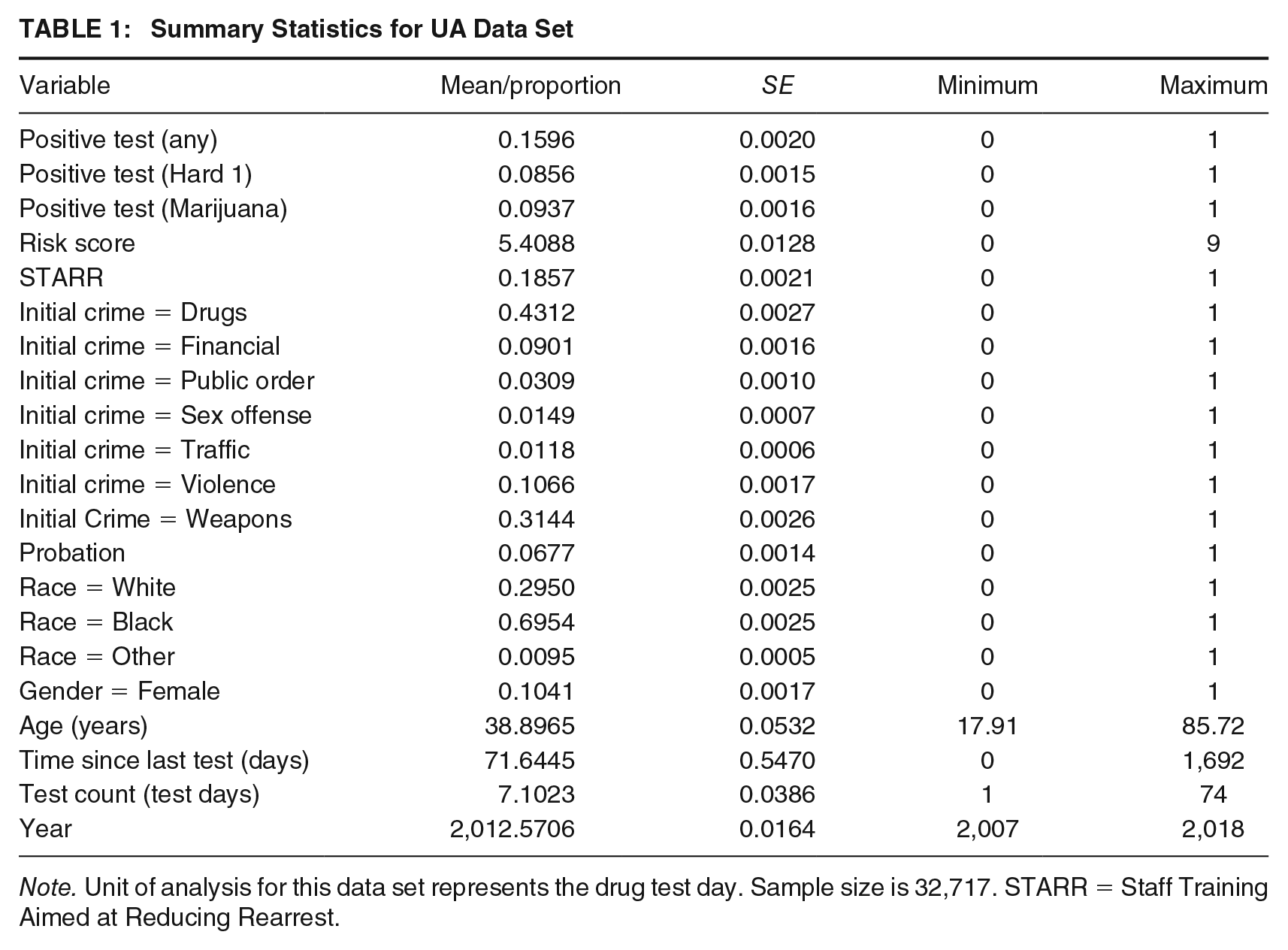
Note. Unit of analysis for this data set represents the drug test day. Sample size is 32,717. STARR = Staff Training Aimed at Reducing Rearrest.
Second, we are interested in three distinct supervision outcomes: revocation for a new crime, revocation for a technical violation (non-drug related), and revocation for a technical violation involving positive drug tests. The reference category for each of these outcomes represents terms of supervision that ended successfully or ones that are still ongoing. For the supervision outcome analysis, individual terms of supervision are the unit of analysis. The data set includes 3,905 terms from 3,599 different individuals. While the majority of individuals only experienced one term of supervision, some had as many as five. In this case, we fit a two-level logit model to these data that includes a single variance component for each individual. The variance component helps account for the fact that nearly 10% of the individuals in our sample had more than one term of supervision. Sample statistics for supervision outcome data are reported in Table 2. Very few terms of supervision were revoked for technical violations. While the data include more than 467 terms of supervised release that were revoked due to a new crime, there were only 143 instances of terms being revoked for general technical violations and 162 instances of terms revoked for technical drug use violations. Our findings regarding the sources of new crime-related revocations, therefore, are relatively more robust.
Summary Statistics for Revocation Data Set
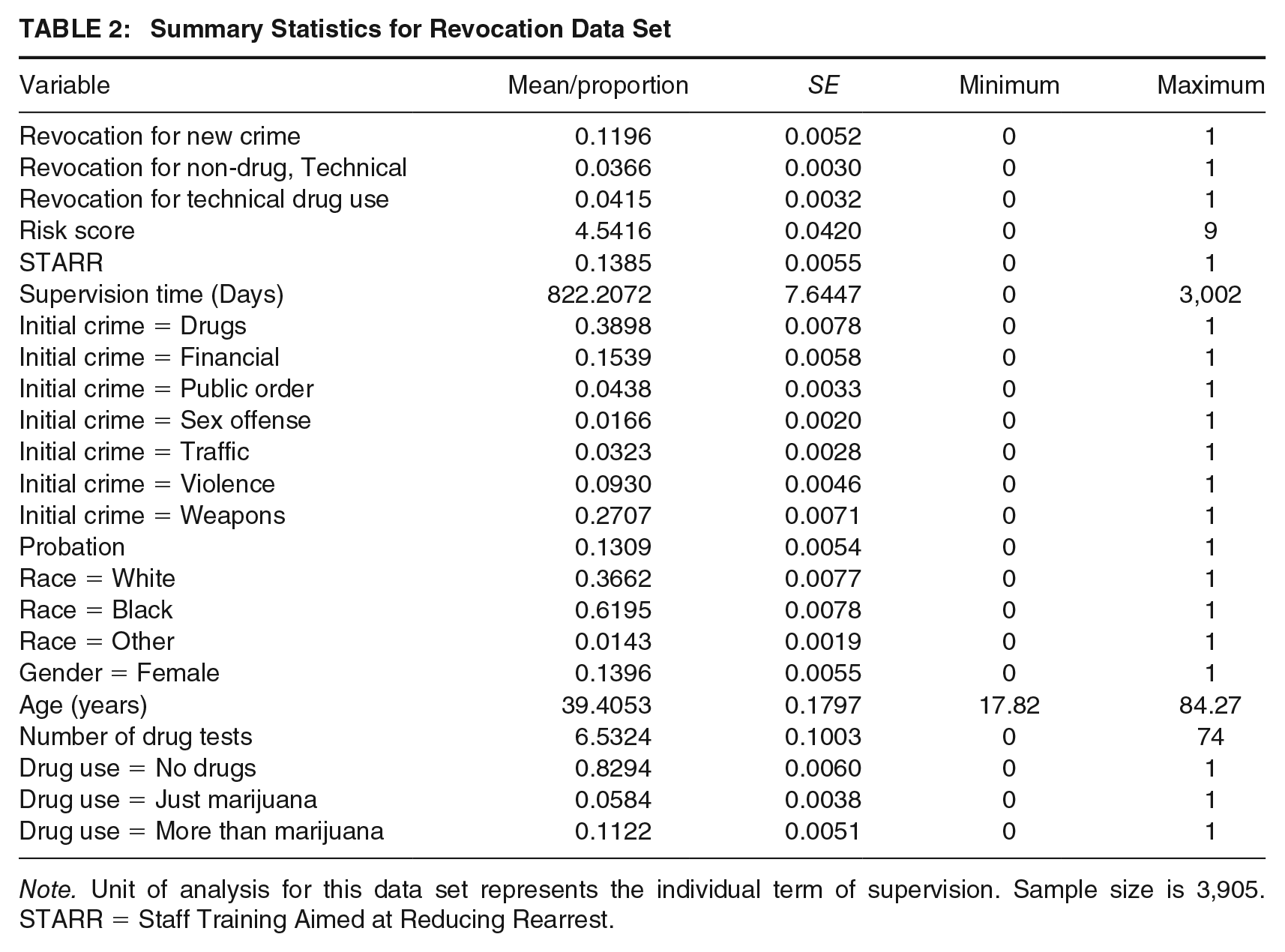
Note. Unit of analysis for this data set represents the individual term of supervision. Sample size is 3,905. STARR = Staff Training Aimed at Reducing Rearrest.
Results
Research Question 1 inquires about the distribution of drug test outcomes. Figures 1 and 2 reveal at least three important characteristics about positive drug tests among those in our sample. First, positive drug tests have become more frequent, meaning that drug testing behavior and outcomes are correlated with time. Second, positive drug tests are more common for some drugs relative to others, although it seems that most drugs follow a somewhat similar trend with respect to time (see Figure 1). Finally, the rate of positive drug tests varies according to risk assessment score (see Figure 2). Our analysis, then, incorporates these issues among others.
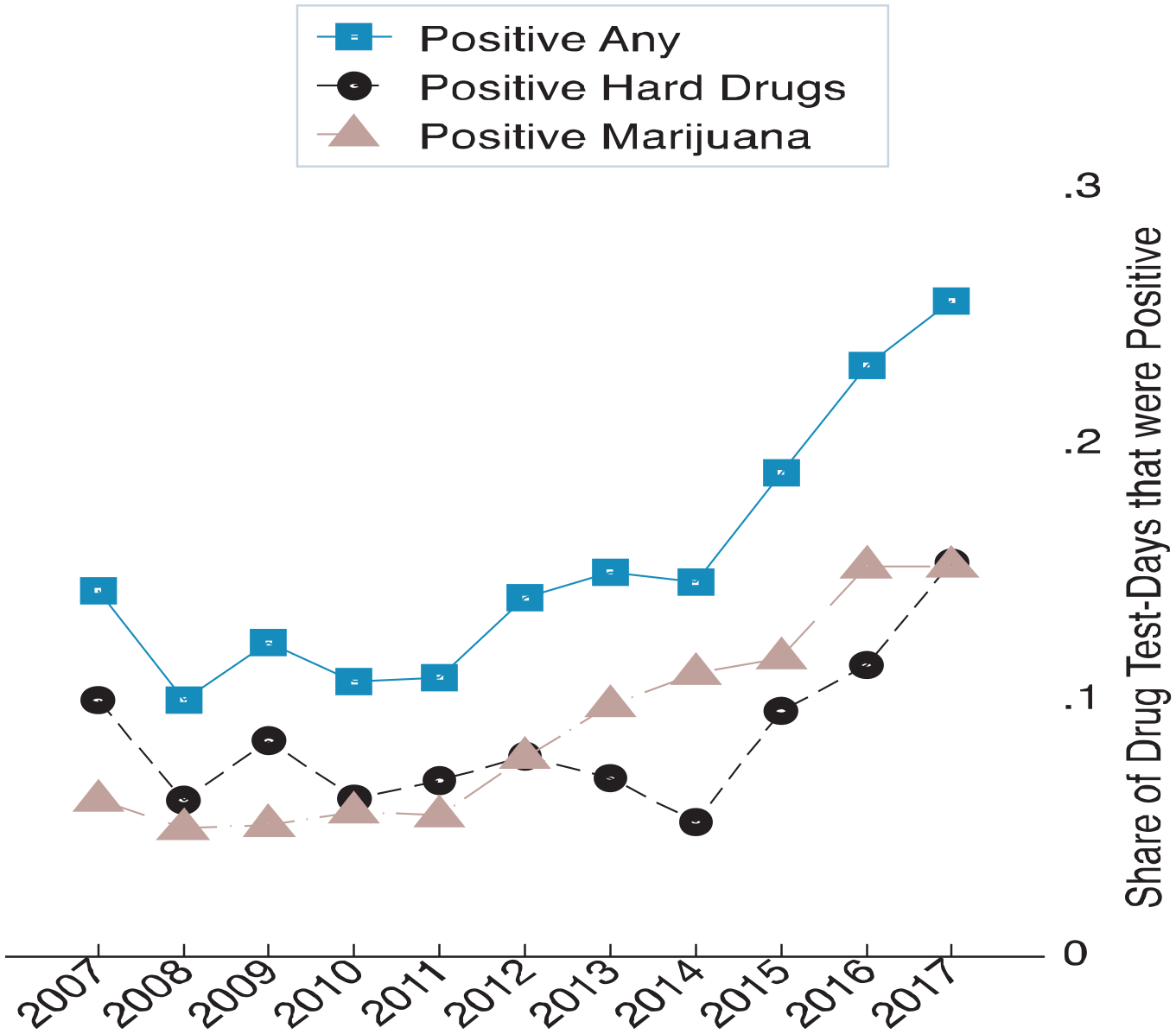
Positive Drug Tests Over Time by Type
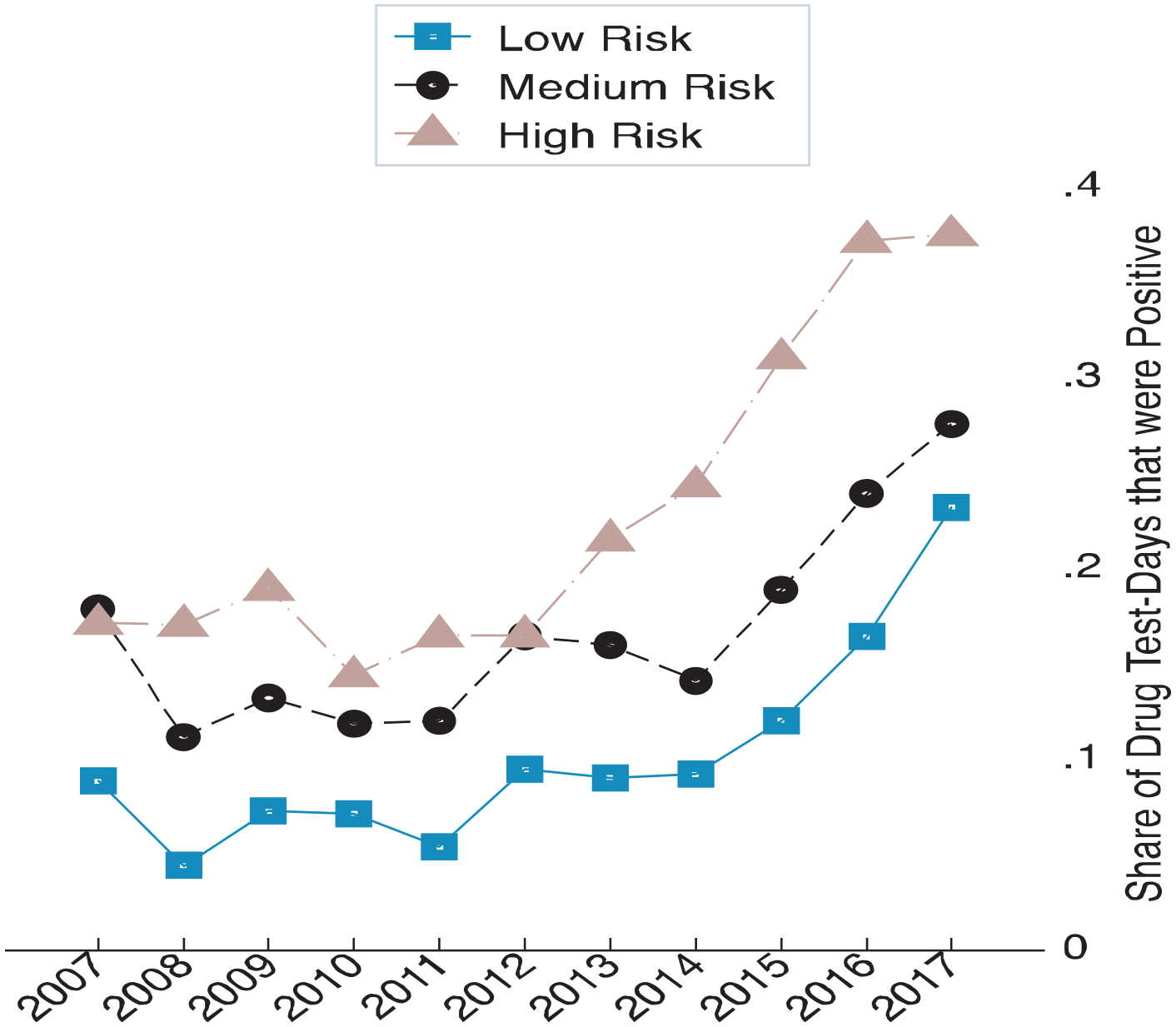
Positive Drug Tests by Individual Risk Level
Drug Test Outcomes
Both drug test and supervision outcomes are measured with binary variables—positive versus negative drug tests in the first model and revoked versus successful terms of supervision in the second model. A simple logit or probit model is ordinarily appropriate for an outcome whose values are binary. But logit and probit models, like ordinary least squares, make the key assumption that each observation is independent and identically distributed (I.I.D.) from the rest. Our data with respect to both outcomes violate this assumption because they are nested within larger units. Therefore, we fit multilevel logit models to better account for such clustering (Rabe-Hesketh & Skrondal, 2012).
In the drug test outcome data set, each drug test is nested in terms of supervision, which are further nested in individuals. At the extremes, one individual experienced 74 drug-test days, while others experienced only a single drug test day. In addition, while the vast majority of individuals in our sample were only supervised for a single term of supervision, 373 individuals submitted drug tests in more than one supervisory term. In fact, some individuals submitted drug tests in as many as five different terms of supervision. To address these complications, we fit a three-level model to these data, which includes a variance component fit to individuals and to terms of supervision. In classic multilevel parlance, we model our data according to three distinct levels: test days, which are nested in terms, which are further nested in individuals. Multilevel models are ideal in circumstances like these because of their ability to incorporate covariates at different levels of aggregation, while segmenting residual variation at different levels of aggregation (Gelman & Hill, 2007; Raudenbush & Bryk, 2002). Multilevel models are also very useful when levels of analysis are correlated with time (Singer & Willett, 2003).
Table 3 presents a multilevel logit model fit to drug test outcomes to address Research Question 2, namely, the relationship between individual and case characteristics and specific drug test outcomes. This model contains two variance components (or random intercepts)—one fit to individuals and the other to individuals’ terms. By including these variance components, our model adjusts for the fact that most individuals in our sample experienced more than one drug-test day, and some experienced more than one term. This reveals variability in drug tests between individuals (irrespective of term) and between their terms. We also add a control variable that measures the time (in days) since the last drug test and another that measures the number of tests in that term of supervision. These variables help systematically account for autocorrelation in individual drug use behavior over time. Finally, there is a significant upward trend in positive drug tests over the sample period (Figure 1), so the year in which a drug test took place was included to capture this global trend.
Sources of Positive Urine Analysis
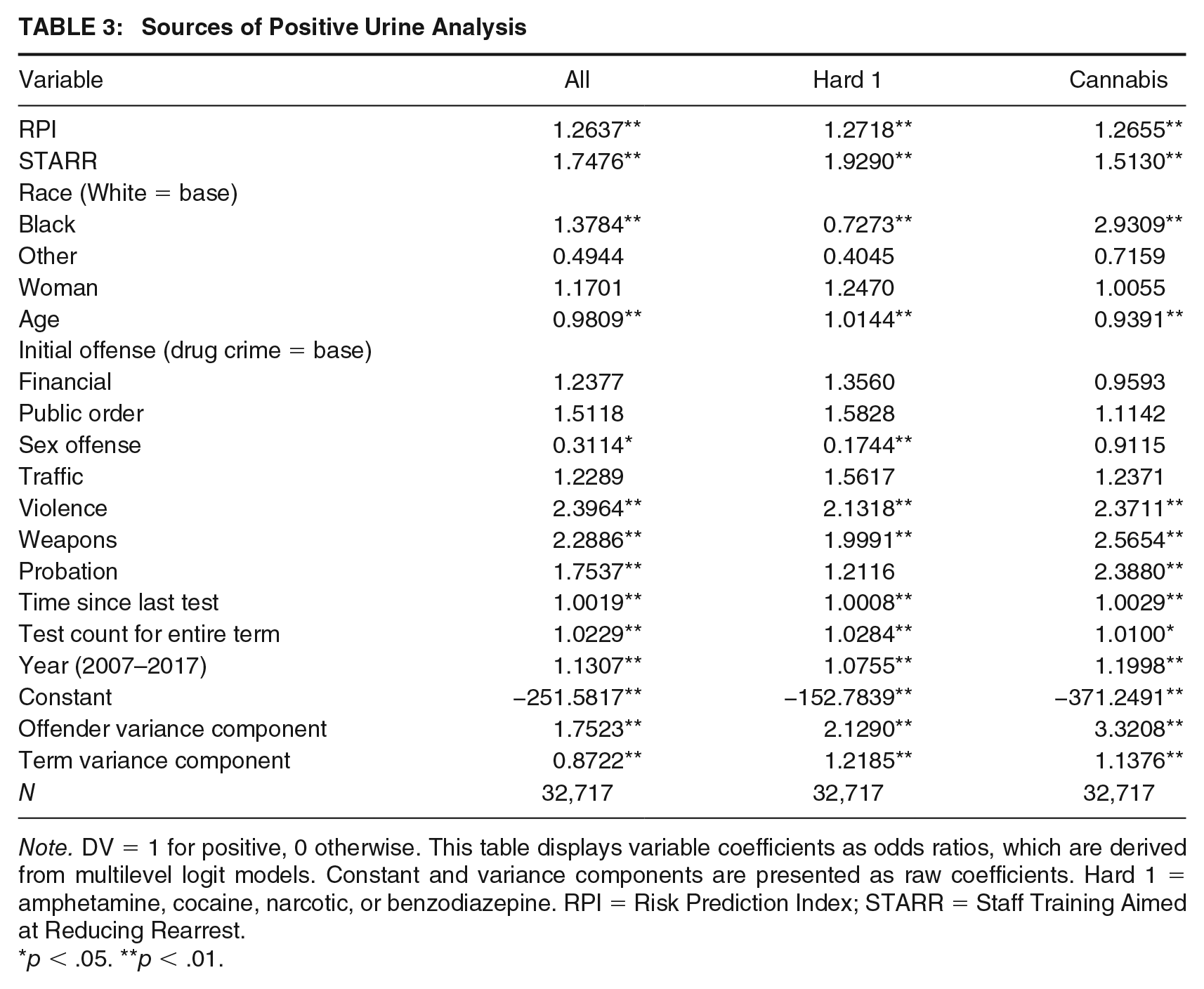
Note. DV = 1 for positive, 0 otherwise. This table displays variable coefficients as odds ratios, which are derived from multilevel logit models. Constant and variance components are presented as raw coefficients. Hard 1 = amphetamine, cocaine, narcotic, or benzodiazepine. RPI = Risk Prediction Index; STARR = Staff Training Aimed at Reducing Rearrest.
p < .05. **p < .01.
The coefficients presented in Table 3 reveal some consistency across outcomes. Individuals under supervision with higher risk scores, other things being equal, are more likely to experience positive drug tests of any kind, positive hard drug tests, and positive cannabis drug tests. For example, relative to an individual with the lowest risk score, high-risk individuals are over 10 times more likely to experience a positive “hard” drug test. Thus, the likelihood a drug test is positive is significantly higher for those with higher risk scores relative to those with lower risk scores, even after controlling for other critical characteristics about the individual and the circumstances of their drug tests. The likelihood of a positive drug test also varies according to an individual’s initial offense. Relative to those who committed a drug crime, those convicted of violent and weapons-related crimes are consistently the most likely to experience positive drug tests (any drug, cannabis only, or hard drugs). Drug tests taken by individuals convicted of a sex offense are the least likely to be positive. Supervision by a STARR proficient officer appears to impact drug testing results. A drug test taken by an individual supervised by a STARR proficient officer is 1.7 times more likely to be positive than a drug test taken by an someone supervised by a non-STARR proficient officer. In addition, we find that there are important differences between individuals on probation and those on supervised release. Individuals on probation supervision are more likely to have a positive drug test for any drug and more than twice as likely to have a positive cannabis drug test than those on post-release supervision, but there is no statistical difference between type of supervision and postive tests for hard drugs. Therefore, it is likely that positive cannabis tests explain the finding of higher positive “any drug” tests.
Results do reveal some critical differences between positive drug types. Individual racial characteristics appear to matter. While Black individuals in our sample are more likely to experience a positive drug test of any kind relative to White individuals, Table 3 reveals that this association is largely driven by cannabis use. The second and third column of coefficients demonstrate that Black individuals are more likely to experience a positive cannabis drug test, but they are less likely to experience a positive “hard” drug test than White individuals. Black individuals on supervision are nearly 3 times more likely to test positive for cannabis use, whereas White individuals are 1.4 times more likely to test positive for hard drug use, other things being equal.
Supervision Outcomes
To address Research Question 3, the analysis examines how drug test results shape the likelihood that a term of supervision ends in revocation. We look at three distinct outcomes with respect to this data set: whether or not an individual’s term of supervision is revoked for a new criminal offense, for a technical violation related to drug use, or for a technical violation unrelated to drug use. As noted previously, a two-level logit model is utilized because some individuals in our sample had more than one term of supervision.
Table 4 presents the multilevel model fit to supervision outcomes. Overall, 19.74% of terms of supervision in the sample resulted in revocation. Specifically, 11.94% of supervision terms were revoked due to new offense violations, 3.66% for technical, non-drug violations, and 4.14% for technical drug use violations. These findings indicate a higher success rate of supervision compared with studies of individuals under state-level community supervision (e.g., Clear et al., 1992; Gray et al., 2001; Morgan, 1994; Rodriquez & Webb, 2007). Our sample also appears to have a lower revocation rate than reported for individuals under federal community supervision in other jurisdictions (Administrative Office of the U.S. Courts, 2018; Minor et al., 2003).
Sources of Supervision Revocation
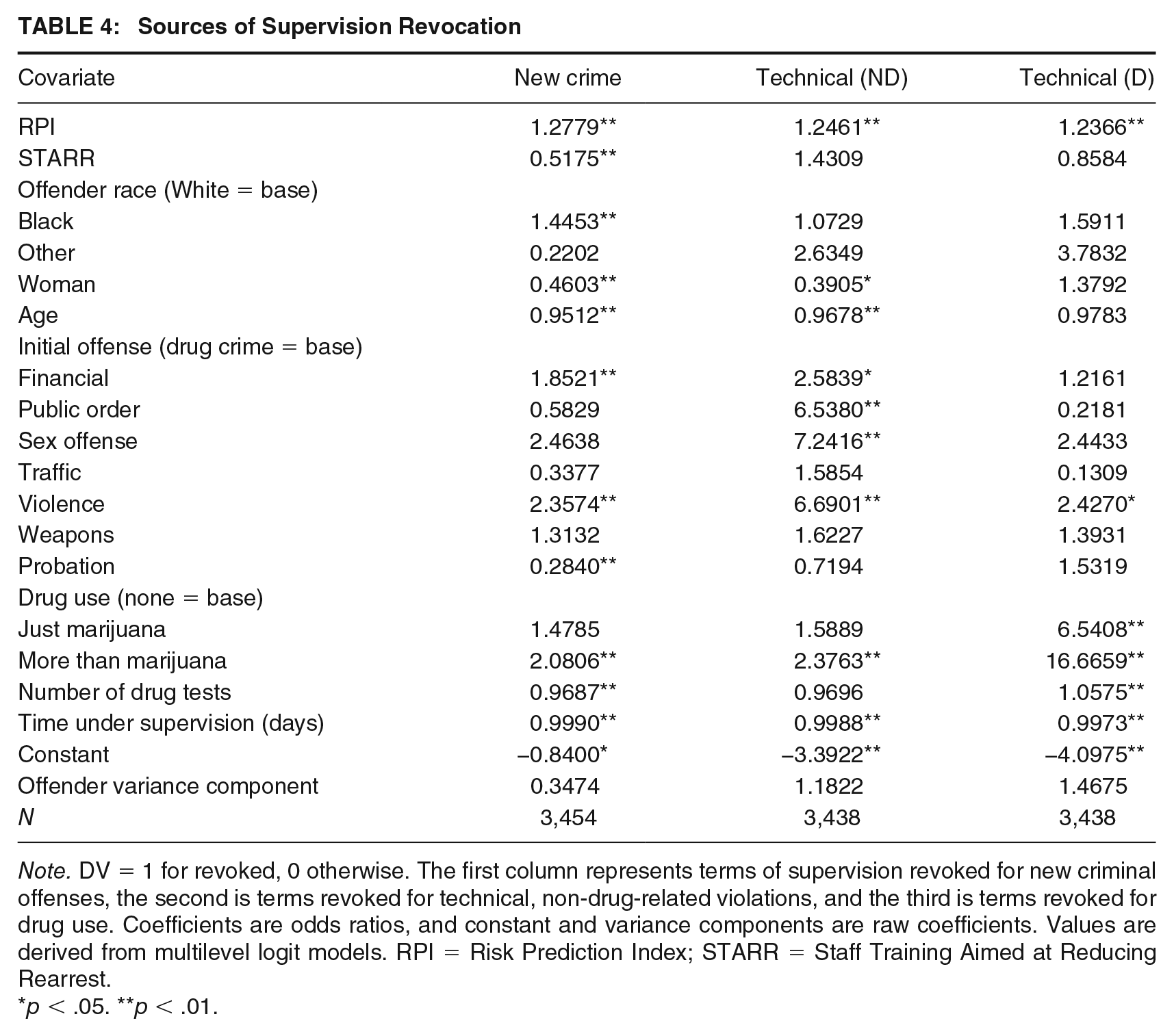
Note. DV = 1 for revoked, 0 otherwise. The first column represents terms of supervision revoked for new criminal offenses, the second is terms revoked for technical, non-drug-related violations, and the third is terms revoked for drug use. Coefficients are odds ratios, and constant and variance components are raw coefficients. Values are derived from multilevel logit models. RPI = Risk Prediction Index; STARR = Staff Training Aimed at Reducing Rearrest.
p < .05. **p < .01.
Not surprisingly, individual risk is positively associated with revocation for new crimes and technical violations. This adds support for the continued use of validated risk instruments in informing and improving supervision strategies (Bonta & Andrews, 2016; Center for Substance Abuse Treatment, 2013; Evans et al., 2011; Oleson et al., 2011). Those with the highest risk scores are more than 10 times as likely to have their terms revoked for a new crime relative to individuals with the lowest risk scores.
In addition, we find evidence that STARR matters in terms of supervision outcomes. Although individuals supervised by STARR proficient officers are more likely to have positive drug tests, they are less likely than those supervised by non-STARR proficient officers to have their terms revoked for a new crime. In fact, individuals supervised by non-STARR proficient officers are nearly twice as likely to have their terms revoked for a new crime relative to individuals supervised by STARR proficient officers. STARR fails to have a statistically discernible impact on revocation for a drug violation or non-drug technical violation.
Individuals who test positive for hard drugs are at the greatest risk of having their supervision term revoked for a new crime. In fact, the only statistically discernible difference in terms of new crimes is between individuals who experienced at least one positive drug test for hard drugs and those who did not experience any positive drug tests. This supports extensive prior research that use of hard drugs, such as cocaine and narcotics, puts individuals at greater risk of recidivism and failure under community supervision (see Morgan, 1993; White & Gorman, 2000). However, those who experienced positive drug tests for cannabis alone are not statistically discernible from individuals who experienced no positive drug tests regarding revocation for new crimes. This is a potentially important finding that is explored more in “Discussion” section. Findings further indicate that positive cannabis-only drug tests are unrelated to revocations for non-drug technical reasons.
Terms of supervision for Black individuals are more likely to result in revocation for new crimes, but not technical violations, relative to White individuals. Higher rates of supervision failure among ethnic minorities have been found in prior research, but this has varied across outcome measure and study (e.g., Gray et al., 2001; Minor et al., 2003; Shannon et al., 2016). Other research has found that variables related to social disadvantage are a better predictor of supervision outcomes than race alone (e.g., Albonetti & Hepburn, 1997; W. D. Johnson & Jones, 1998; see also Morgan, 1993).
Given the strong relationship between race and type of drug test outcome reported in Table 3, it was surprising that race was not associated with technical drug revocation. It is reasonable to assume that positive drug tests for hard drugs will be treated more severely, by officers and the court, than positive drug tests for cannabis. All things being equal, testing positive for hard drugs, compared with cannabis only, should result in an increased risk of technical drug revocation. As Whites were more likely to test positive for hard drugs, one might expect that Whites would have higher rates of technical drug revocation. We did not find this. Even though the relationship between race and technical drug use violation does not reach the threshold of statistical significance, Table 4 indicates that Black individuals on supervision appear be more likely to have their supervision revoked for technical use of drugs relative to White individuals. Again, this is not statistically significant, but it is in the opposite direction than one would expect given findings on the relationship between drug test results and race. These results raise questions about the relationship between race, drug use type, and supervision outcomes that others are encouraged to examine with more robust data.
Finally, supervision outcomes vary according to gender. While we found no evidence that drug test results vary according to gender, women in our sample were less likely than men to have their terms revoked for a new crime or for a technical non-drug-related violation. It should be noted, however, that the sample contains relatively few women, as more than 86% of terms of supervision were for men.
Discussion
While some findings from the present study are consistent with prior research, others raise new and interesting questions. Research on community supervision outcomes typically combines positive drug tests with other “technical” violations. As a result, it is difficult to assess the factors associated with positive drug tests or their independent impact on supervision outcomes. Furthermore, research rarely specifies the type of drug for a positive drug test. As result, we know less about the specific distribution of substances among drug test results and the relationship, if any, between positive drug tests and specific supervision outcomes. To our knowledge, no previous study has been able to distinguish the impact of positive tests for different drug types and their relationship to different types of supervision revocation.
Results indicate that testing positive for hard drugs significantly increases the likelihood a term of supervision will result in revocation for any reason. New generation risk assessments have included substance use as a dynamic risk factor for some time but, until recently, little attention has been paid to examining exactly why substance use is important. Researchers have suggested multiple pathways that might explain this relationship, including criminal behavior to support substance dependence, lowering of inhibitions secondary to substance use, and/or exposure to more antisocial peers/environments as a result of substance use (White & Gorman, 2000). While these relationships are likely interconnected, intervention efforts may be different depending on the underlying reasons for use. One direction is to examine more fully the relationship of substance use to offending specific to the individual under supervision (Alexander et al., 2014). The idea of specific “drivers” for substance use may assist in determining appropriate intervention efforts. Alexander et al. (2014) suggest at least five possible drivers for substance use: antisocial attitudes, poor coping skills, social networks, mental health (self-medicating), or physical addiction. For example, if the driver for substance use is underlying antisocial attitudes, rather than physical addiction, cognitive-behavioral therapy or interventions may be a more effective approach (Bahr et al., 2012; Bonta & Andrews, 2016; Center for Substance Abuse Treatment, 2013; Trotter, 2013). Skeem and colleagues have raised a similar concern in the correctional supervision of individuals with mental illness (Skeem et al., 2014). While prevailing wisdom had suggested that criminal behavior among those with mental illness was a byproduct of untreated diagnoses, their research suggests that more general criminogenic risk factors as found in the Level of Service/Case Management Inventory (e.g., antisocial attitudes and traits, drug and alcohol use) are important contributors to the recidivism of individuals with mental illness. Therefore, focusing exclusively on psychiatric treatment, without corresponding intervention to criminogenic risk factors, may have only marginal impact on the recidivism of those with mental illness (Skeem et al., 2014). This suggests that knowledge about specific drug use behavior, rather than merely testing positive for “any drug,” could be helpful in more effective supervision and targeting of individual risk, need, and responsiveness to treatment interventions.
In addition, recent efforts on risk assessment have explored more sophisticated analyses of dynamic risk factors to include acute factors (Lowenkamp et al., 2016; Serin et al., 2016). The premise for acute factors is that they may change significantly in small increments of time (i.e., between monthly contacts with a probation officer) and may place the individual at greater risk of imminent failure. The Dynamic Risk Assessment of Offender Reentry (DRAOR) includes substance use as one of three acute factors to be considered, along with anger/hostility and opportunity/access to victims (Serin et al., 2016). Our results linking positive hard drug tests with subsequent revocations for new crimes suggest these efforts could be very worthwhile. Beginning supervision with a behavioral analysis of prior conduct, followed by risk assessment and acute risk factor analyses, may allow officers to better understand the relationship of substance use and criminal behavior for the particular individual they are supervising, which could lead to more successfully targeted interventions (Lowenkamp et al., 2016). Remaining aware of the acute risk posed by substance use could lead to more effective monitoring or targeted interventions at critical moments in supervision.
Another interesting finding involved the impact of STARR proficient officers. Individuals supervised by STARR proficient officers were less likely to have a revocation for a new crime, but not statistically distinct for technical violations. 6 Research demonstrates that traditional surveillance and efforts at increased control alone are insufficient to reduce recidivism or revocation rates. There is a significant body of research indicating that more intensive supervision results in higher levels of violations and revocation when such supervision focuses solely on surveillance and control (e.g., Lowenkamp, Latessa, & Holsinger, 2006; Lowenkamp, Latessa, & Smith, 2006). Studies generally find that it is the combination of effective treatment and interventions with appropriate surveillance and monitoring that produces the best outcomes for those under community supervision (Lowenkamp et al., 2010; Paparozzi & Gendreau, 2005). The STARR officer training curriculum provides officers with skills to address violations within the supervision framework, most importantly, skills related to effective disapproval and cognitive awareness/intervention (Alarid & Jones, 2018; Robinson et al., 2012). In the presence of positive drug tests, it is likely that proficient officers utilized these skills to improve individuals’ ability to understand the short- and long-term consequences of their actions and their ability to disrupt their thinking (Alarid & Jones, 2018). Such skill-building interventions could be used with individuals in high-risk situations and may influence future criminal behavior. Prior research on STARR and similar cognitive intervention programs, such as EPICS and STICS, which incorporate elements of the Risk-Needs-Responsivity model of correctional interventions have reported positive impacts on reducing recidivism and technical violations (Bonta & Andrews, 2016).
The present results also raise questions about the value of drug testing individuals on community supervision for cannabis. First, study results indicate no relationship between cannabis use alone and new crime or technical non-drug revocations. While there may be concerns about individuals under supervision using cannabis, those who tested positive for only cannabis were no likely to have their supervision revoked than those who never test positive for any drug. There have been increasing questions about the value of drug testing for cannabis among those under community supervision (The Crime Report, 2018). Recently, several former commissioners of New York City probation issued a formal statement calling for the elimination of cannabis testing for those on probation supervision (The Crime Report, 2018). Such concerns are part of a larger critique of community supervision, especially the use of excessive conditions and conditions unrelated to successful supervision (Corbett, 2015; Horwitz, 2010; Klingele, 2013). Among our sample, Black individuals were more likely to have positive cannabis-only tests, but less likely to test positive for hard drugs, compared with White individuals. If cannabis use is associated with minority status, but unrelated to new crime or non-drug technical violations, sanctioning individuals for cannabis-only use may contribute to additional racial disparities with little benefit to public safety or individual rehabilitation.
Limitations and Future Research
The present study has several limitations. Although we were able to utilize a valid risk instrument to control individual risk, it is not the more recently developed Post-Conviction Risk Assessment (PCRA) instrument, which has been found to have higher predictive validity. The study was also limited by available data on relevant population characteristics. For example, while the RPI risk score incorporates a measure for prior substance abuse, it was impossible to independently control for prior substance abuse. The study was also based on a single jurisdiction which may not be representative of all federal districts. In particular, the limited ethnic diversity within the sample precluded meaningful examination of the relationship between ethnicity, drug testing results, and supervision outcomes. Furthermore, the district under study has been one of the first to fully implement STARR for all officers, which suggests a district-level commitment to utilizing core correctional principles to improve supervision outcomes (see Paparozzi & Gendreau, 2005). It is unclear how much variation in supervision practice and outcomes is found across federal districts, but it is plausible that results may vary in different jurisdictions.
Most importantly, the sample is comprised exclusively of individuals under federal supervision who may be unique from individuals under state supervision in important ways. A result of federal sentencing laws and prosecutorial case selection is that federal correctional populations include a much higher percentage of individuals convicted of drug crimes compared with state correctional populations. In 2016, approximately 15% of the state prison populations’ most serious charge was for a drug-related offense, whereas 47% of individuals in federal prison were convicted of a drug-related offenses (Carson, 2018, see Tables 12 and 14). Similar differences are found among community supervision populations. Nearly one half of all individuals under federal community supervision were sentenced for a drug-related offense (Motivans, 2019). More importantly, 35% of individuals under federal community supervision were convicted of a drug trafficking offense and only 11% are for possession (Motivans, 2019). While differences in trafficking versus possession offenses for state-level community supervision are difficult to ascertain (e.g., Caulkins & Sevigny, 2005), state community supervision populations appear to include a higher percentage of possession, rather than trafficking, drug offenses compared with federal populations. As a result, the drug offense category used in the present study likely includes a larger percentage of trafficking/distribution cases than would be found in a comparable sample of state cases. Therefore, it will be important to test these results with state-level data.
Even with these caveats, the results add to existing literature about the factors related to positive drug testing during supervision and its relationship to supervision outcome. The relationship between “hard” drug use and revocation highlights the need for targeted intervention with evidence-based strategies. The present findings indicate that cannabis use alone, however, does not necessarily increase individual risk for supervision revocation. Research about the relationship between cannabis use and negative physical or behavioral outcomes such as crime and supervision outcomes is mixed (see Bretteville-Jensen & Rossow, 2011; The Crime Report, 2018; The Marshall Project, 2019; Pedersen & Skardhamar, 2009). Cannabis use, like alcohol use, may increase individual risk for negative social influences or diminish cognitive functioning and decision-making skills. However, our findings raise the possibility that drug testing for cannabis may also contribute to racial disparities in supervision outcomes with limited benefit for individuals under supervision or to community safety.
The challenges facing individuals under community supervision, especially those released from prison, is well documented (Petersilia, 2003; Travis, 2005; Visher & Travis, 2011). Research highlights the importance of conditions of supervision, supervision strategies, and targeted interventions that empower and promote individual success rather than relying exclusively on control or compliance-focused strategies (e.g., Viglione et al., 2017). Future research should examine multijurisdictional federal, as well as state-level data, to assess the merits of traditional drug testing practices, how officers respond to positive results, and the impact of that response on supervision outcomes.
Footnotes
Authors’ Note:
The authors wish to thank Randy Hamilton for his generous assistance in obtaining data for this study. The opinions, findings, conclusions, and recommendations expressed in this article are solely those of the authors and do not represent those of the Administrative Office of the U.S. Courts, the Charlotte-Mecklenburg Police Department, or the U.S. Probation and Pretrial Service.
