



Abstract
The Risk-Need-Responsivity (RNR) model deems criminal attitudes a high-priority criminogenic target for both genders while self-esteem is considered noncriminogenic, hence low priority. In contrast, self-esteem is afforded greater priority among gender-responsive researchers, while the construct of criminal attitudes is afforded lesser priority. We examined whether self-esteem and gender moderated the relationship between criminal attitudes and recidivism among 300 justice-involved youth (200 males, 100 females). Contrary to the hypothesis, high self-esteem (≥72.15th percentile) magnified the relationship between criminal attitudes (Pride in Delinquency Scale) and recidivism in females only; self-esteem levels evidenced no impact on the relationship between criminal attitudes and recidivism among males. Results suggest that prioritizing self-esteem as a treatment target among justice-involved female youth without simultaneously considering whether or not pride in criminal conduct is also present may inadvertently increase reoffending. Implications for exploring whether high self-esteem may in reality represent falsely inflated self-esteem are discussed.
Historically, research pertaining to criminal conduct has predominantly focused on males. Given that female-perpetrated crime is less prevalent and less serious in comparison to male-perpetrated crime, researchers have generally overlooked females (Brown et al., 2019). However, feminist-driven scholarship, coupled with the influx of females into the justice system over the last three decades, has propelled justice-involved females to the forefront of correctional research and policy. For example, the proportion of arrests in the United States attributed to female youth continues to grow, rising from 20% in 1985, to 30% in 2015, despite the fact that overall youth-perpetrated crime continues to decline in the United States (Puzzanchera & Ehrmann, 2018). Notably, the decline in youth arrest rates since 2006 has been greater for males (decreased by 71%) than females (decreased by 61%; Puzzanchera, 2019).
Two key treatment targets have garnered attention in the correctional literature: criminal attitudes (Bonta & Andrews, 2017) and self-esteem (Van Voorhis, 2012). Self-esteem in the general psychology literature is defined as a person’s assessment of one’s self-worth, importance, or value (Robinson et al., 2013). The construct of criminal attitudes encapsulates attitudes, beliefs, thinking patterns, and rationalizations that are supportive of crime (Bonta & Andrews, 2017). The relative importance of these constructs in the context of correctional assessment and rehabilitation is debated between scholars who primarily study justice-involved females, collectively labeled gender-responsive researchers, and mainstream correctional researchers, collectively labeled gender-neutral researchers. Gender-neutral researchers have historically focused largely on justice-involved males. Throughout the manuscript the term female encapsulates adolescent and adult females, and the term male includes both adolescent and adult males. We also indicate when we are referring specifically to adults or youth.
In brief, gender-responsive theorists posit that while females may share some risk factors with their male counterparts, they also possess unique risk factors such as victimization, parental stress and low self-esteem, which in turn requires female specific interventions that are trauma-informed and relationally based (Salisbury et al., 2016). Notably, gender-responsive researchers rarely, if ever, identify the construct of criminal attitudes as a core treatment target. Furthermore, gender-responsive scholars have also suggested that self-esteem may function as a protective factor that buffers the risk of recidivism (Blanchette & Brown, 2006; Bloom et al., 2003; Van Voorhis, 2012). In contrast, gender-neutral theorists posit that males and females have similar risk factors and will benefit equally from similar intervention strategies (Bonta & Andrews, 2017). Gender-neutral scholars have always identified the construct of criminal attitudes as a fundamental risk factor in both genders and have disregarded the importance of general distress variables such as low self-esteem because they are viewed as noncriminogenic factors (Andrews et al., 2012; Rettinger & Andrews, 2010). However, Bonta and Andrews (2017) recently acknowledged that the relationship between self-esteem and criminal conduct is complex and requires further investigation. Consequently, the goal of this study is to understand whether or not self-esteem may moderate the relationship between criminal attitudes and recidivism as a function of gender in a youth justice sample.
Self-Esteem/Antisocial Behavior Link in the General Psychology Literature
The link between self-esteem and criminal conduct has sparked debate over the years (Baumeister et al., 2003). One long-established view in the general psychology literature is that low self-esteem leads to aggression (Adler, 1956; Bushman et al., 2009). In this vein, Donnellan et al. (2005) explored the link between low self-esteem and externalizing behaviors such as delinquency, aggression, and antisocial behavior in a sample of adolescents and college students from the United States and New Zealand. The first study utilized a cross-sectional design with 292 youth from two schools in northern California. The researchers observed a negative correlation between self-esteem and delinquency (r = −.35). However, the researchers did not examine gender differences. Similarly, as part of the Dunedin Multidisciplinary Health and Development Study, Moffitt et al. (2001) utilized a longitudinal research design with 812 youth assessed at age 11 (78% males, 48% females) and again at age 13 to explore the relationship between self-esteem and externalizing behaviors. Results indicated that as self-esteem decreased, externalizing problems as reported by parents at age 11 (r = −.18) and at age 13 (r = −.27) increased. Similar results were observed with teacher reports (age 11: r = −.16 at age 11; age 13: r = −.18 at age 13). However, the researchers did not disaggregate the results by gender. In contrast, some researchers (e.g., Baumeister et al., 2000) have posited that it is actually high self-esteem (unstable high self-esteem), narcissism, or threatened egotism (when favorable views of oneself becomes threatened) that correlates with aggression. Furthermore, Baumeister et al. (2000) proposed that people with high self-esteem can be on either side of the continuum of aggression (i.e., they can be too aggressive or nonaggressive). Hence, the relationship between self-esteem and aggression remains unclear.
Self-Esteem/Crime Link in the Correctional Literature
The Risk-Need-Responsivity (RNR) model is derived from the general personality and cognitive social learning theory of criminal conduct (GPCSL; Bonta & Andrews, 2017). The RNR model posits that the factors that predict criminal behavior are essentially the same for males and females (Andrews & Bonta, 2006; Rettinger & Andrews, 2010). In brief, the risk principle states that treatment should be proportional to level of risk. The need principle directs that treatment should target crime causing risk factors that are dynamic (i.e., criminogenic needs). Finally, the responsivity principle states that treatment should be grounded in social learning approaches such as cognitive behavioral therapy (CBT) and be delivered in an environment characterized by warmth, empathy, firmness, and fairness. In addition, the program should attend to specific characteristics of the population being treated (e.g., gender, ethnicity, learning difficulties, anxiety, personality factors).
Notably, the RNR model conceptualizes self-esteem as a noncriminogenic need. It is categorized as a personal distress variable that is not predictive of criminal recidivism. Hence, self-esteem is not part of the Central Eight risk factors: Criminal History, Anti-Social Behavior, Anti-Social Attitudes, Anti-Social Peers, Education/Employment, Family/Marital Status, Leisure/Recreation, and Substance Abuse (Bonta & Andrews, 2017). In contrast, some gender-responsive researchers conceptualize low self-esteem as a dynamic risk factor and high self-esteem as a protective factor (Salisbury et al., 2009). Although the link between low self-esteem and delinquent/criminal outcomes among females is understudied, there is research to suggest that low self-esteem is a correlate and potentially even a risk factor for delinquency and criminal conduct among females.
Kort-Butler (2006) analyzed 14,738 (55% males and 49% females) high school students using the National Longitudinal Study of Adolescent Health to examine the relationship between self-esteem and delinquency. Cross-sectional analyses revealed that low self-esteem was correlated with delinquency in females only. However, there was no relationship between self-esteem and delinquency for males. Likewise, a meta-analysis by Larivière (1999) showed that low self-esteem was correlated with criminal behavior for justice-involved women. Larivière (1999) included five correlational and one predictive study that sampled only justice-involved women and found a negative correlation between self-esteem and criminal behavior (r = −.38). Van Voorhis (2012) tested the predictive validity of self-esteem in relation to recidivism in women-only samples. She illustrated that self-esteem was significantly associated with recidivism in three separate samples of justice-involved women in the United States (rs ranged from −.10 to. −.22), and lower levels of self-esteem were predictive of greater likelihood of recidivism. Hence, low self-esteem may be a salient risk factor for justice-involved females.
In contrast, two RNR meta-analyses found no evidence for a relationship between self-esteem and criminal conduct. Gendreau et al.’s (1996) meta-analysis found that personal distress variables (e.g., low self-esteem, anxiety) were weak predictors of recidivism. However, the study’s findings were not disaggregated by gender and were based largely on males. Simourd and Andrews (1994) conducted another meta-analysis examining the risk factors of delinquency for female and male youth separately. The authors reported that personal distress variables (e.g., low self-esteem, anxiety) were not predictive of delinquency for either gender. Like most meta-analyses, the authors only examined the univariate relationship between personal distress and recidivism/delinquency. The extent to which self-esteem may have interacted with other criminogenic variables was not examined.
Criminal Attitudes and Crime
Criminal attitudes are one of the most robust predictors of crime among males as evidenced by meta-analytic findings (Gendreau et al., 1996; Olver et al., 2014). Similarly, meta-analyses that have explored potential gender differences in the predictive power of criminal attitudes have also illustrated that criminal attitudes predict criminal recidivism equally well for males and females (Hubbard & Pratt, 2002; Olver et al., 2014; Simourd & Andrews, 1994). However, collectively the meta-analyses were either based on a very small number of primary studies or relied heavily on the criminal attitude subdomain from the family of Level of Service (LS) instruments. More recently, evidence using self-report measures suggests that criminal attitudes do predict criminal recidivism among justice-involved youthful females. For example, the Pride in Delinquency Scale (PIDS; Shields & Whitehall, 1991) and the Measures of Criminal Attitudes and Associates (MCAA) measure (Mills et al., 2002) have shown to predict recidivism among justice-involved female youth (O’Hagan et al., 2019; Skilling & Sorge, 2014). However, in contrast, Morash et al. (2018) observed that criminal attitudes as measured by the Women’s Risk/Needs Assessment (WRNA; Van Voorhis et al., 2008) did not predict women’s violence over a 2-year period using a sample of 396 women on probation and parole.
The Wormith (1984) Study
To our knowledge, only one study (Wormith, 1984) examined the combined impact of self-esteem and criminal identification (criminal attitudes and associates) on recidivism. Wormith (1984) examined the effects of a behavioral self-control program with 50 low risk, incarcerated, adult males to reduce recidivism. Importantly, the results revealed a significant interaction between self-esteem and criminal identification. Specifically, incarcerated men who evidenced an increase in both self-esteem and criminal identification following treatment evidenced the highest recidivism rates during a 3-year follow-up period.
Wormith (1984) speculated that increases in self-esteem among participants who seemingly adapt to the prison environment as evidenced by increases in criminal identification, are particularly high risk to re-offend. Conversely, he posited that increases in self-esteem among those men who rejected institutional lifestyle are not problematic and may in effect reduce future criminal behavior. This study has been extensively cited as an example of why it is deleterious to make justice-involved individuals feel better about themselves without simultaneously targeting crime causing criminogenic needs such as criminal attitudes and associates. Not only has this study not been replicated, but it also stands in contrast to the gender-responsive position that self-esteem should be a treatment target in and of itself.
Consequently, the current study examined whether or not self-esteem strengthens or weakens the relationship between criminal attitudes and recidivism as a function of gender. Given the opposing views of the gender-responsive and gender-neutral positions, two competing hypotheses were examined: Hypothesis 1: In accordance with the gender-responsive position, it is hypothesized that higher self-esteem levels will function as a protective factor by minimizing the association between criminal attitudes and criminal recidivism for all justice-involved youth, but the magnitude of the effect will be stronger for females. No hypotheses will be specified regarding how high self-esteem scores must actually be before a protective effect is observed. Hypothesis 2: In accordance with the gender-neutral perspective and the Wormith (1984) study, higher self-esteem levels will amplify the association between criminal attitudes and criminal recidivism, irrespective of gender. Again, no hypotheses will be specified regarding how high self-esteem must be before an aggravating effect is observed.
Method
Participants
Three-hundred justice-involved youth (200 males, 100 females) participated in the study ranging in age from 12 to 21 (M = 16.80, SD = 1.25). There were no significant gender differences, t(298) = 1.28, p = .202, d = 0.15. In terms of race, youth identified as follows: 48.3% White, 30.9% Black, 4.9% Indigenous, 16% other (e.g., Asian, Latinx, and East Asian). Four percent chose not to self-identify. A chi-square analysis revealed significant gender differences with respect to race, χ²(1, N = 288) = 16.32, p < .001, Cramer’s V = .24. The sample consisted of more White females (64.6%) than White males (39.7%), and more Black males (36.5%) than Black females (20.2%). More males (17%) also identified as being part of another racial group than females (10.1%).
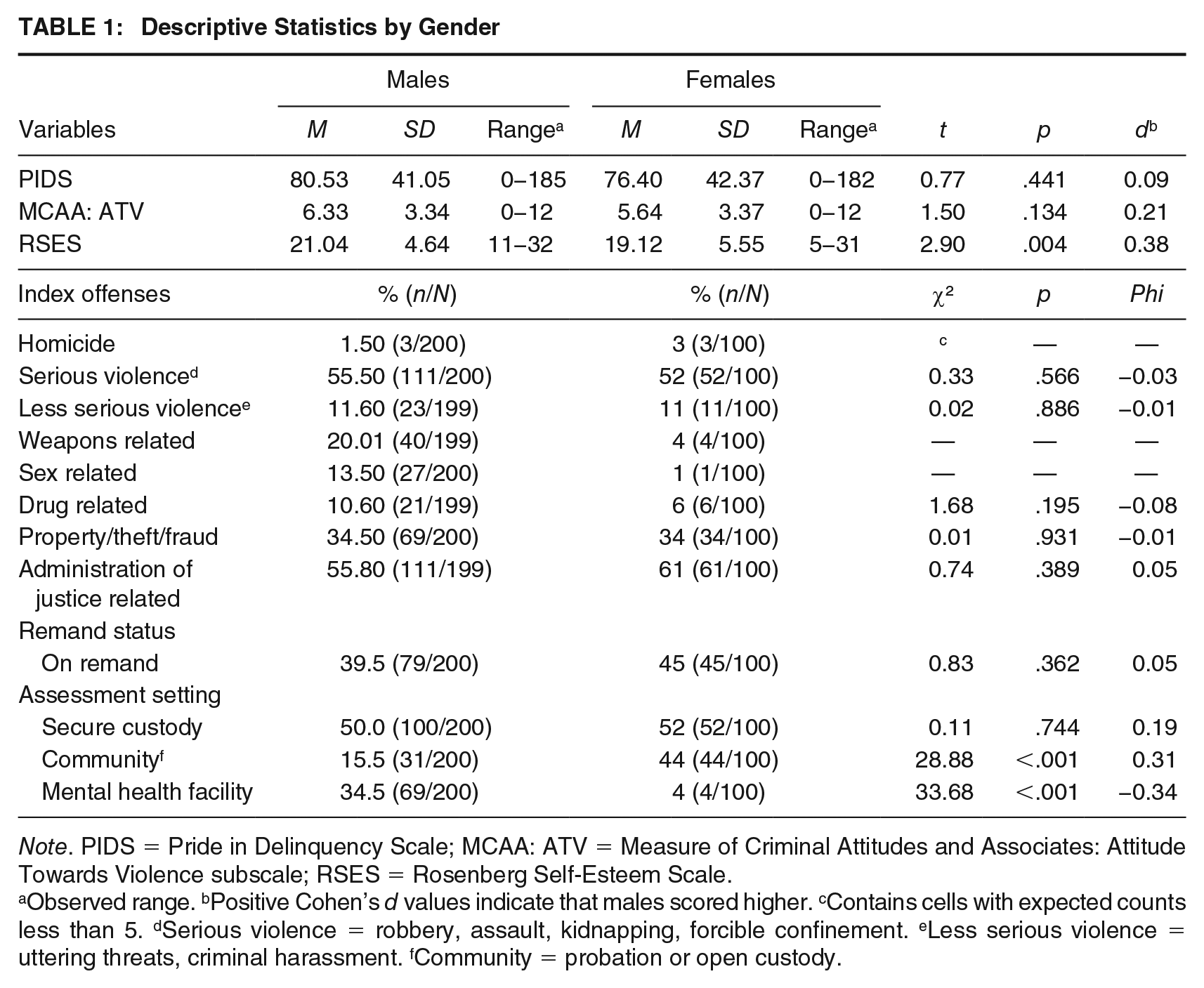
Participants were originally recruited from an out-patient mental health program involved in forensic mental health assessments and a provincial government agency that provides services to justice-involved youth. At the time of assessment, 41.3% (n =124) of the participants were on remand pending trial outcome or sentencing decision, and 58.7% (n = 176) had been adjudicated (probation or custodial sentences). Assessments were conducted in the following locations: probation (20.3%, n = 61), secure custody (50.7%, n = 152), open custody (4.67%, n = 14), and a mental health agency (24.3%, n = 73). Participants were either charged or convicted for the following crimes: homicide related (2%), serious violent (e.g., robbery, assault, forcible confinement; 54.3%), sex related (9.3%), weapons related (14.7%), less serious person related (e.g., uttering threats, criminal harassment; 11.4%), drug related (9%), property, theft, and/or fraud related (34.3%), and administration of justice offenses (e.g., probation breach, failure to appear in court) (57.5%). The percentages do not add to 100% given that each participant could have been charged or convicted for one or more crime(s). See Table 1 for gender comparisons.
Descriptive Statistics by Gender
Note. PIDS = Pride in Delinquency Scale; MCAA: ATV = Measure of Criminal Attitudes and Associates: Attitude Towards Violence subscale; RSES = Rosenberg Self-Esteem Scale.
Observed range. bPositive Cohen’s d values indicate that males scored higher. cContains cells with expected counts less than 5. dSerious violence = robbery, assault, kidnapping, forcible confinement. eLess serious violence = uttering threats, criminal harassment. fCommunity = probation or open custody.
Measures
Pride in Delinquency Scale (PIDS)
The PIDS is a 10-item scale developed for youth to assess an individual’s comfort with engaging in criminal behavior (Shields & Whitehall, 1991). Sample items include (a) “Getting away from the police after a high-speed chase”; and (b) “Beating up a child molester.” Items are measured on a scale from −10 (indicates extreme shame) to +10 (indicates extreme pride). A constant of 100 is added to the summated total score (plausible range −100 to +100) resulting in a final score ranging from 0 to 200 with higher scores indicative of greater pride in committing crime. Recent convergent and predictive validity evidence supports the PIDS for male and female justice-involved youth (O’Hagan et al., 2019). In the current study, internal consistency was strong (males: α = .88, ω = .89; females: α = .87, ω = .88; total scale: α = .88, ω = .89).
Measure of Criminal Attitudes and Associates (MCAA)
The 12 item Attitudes Towards Violence subscale (ATV) from the MCAA was used to assessed attitudes toward violence (sample items include “There is nothing wrong with beating up a child molester”; and “It’s understandable to hit someone who insults you”) (Mills et al., 2002). Each item is scored 1 (agree) or 0 (disagree) resulting in a plausible range of 0 to 12, with higher scores reflecting attitudes supportive of violence. Past research supports the ATV’s convergent and predictive validity with both justice-involved female youth and male youth (O’Hagan et al., 2019). Internal consistency was strong (α =.83, ω = .84 for both genders; total scale: α =.83, ω = .84).
The Rosenberg Self-esteem Scale (RSES)
The Rosenberg Self-esteem Scale (RSES) is a 10-item self-esteem scale (sample items include “On the whole, I am satisfied with myself”; and “I take a positive attitude toward myself”) (Rosenberg, 1965). Each item is rated on a 4-point Likert-type scale ranging from 0 (strongly agree) to 3 (strongly disagree). Total scores range from 0 to 30 with higher scores reflective of higher levels of positive self-esteem. Internal consistency was strong (males: α = .83, ω = .84; females: α = .87, ω = .87; total scale: α = .85, ω = .86).
Criminal Recidivism
Criminal recidivism was coded by combining two different sources of recidivism information provided from provincial (the Ministry of Community Safety and Correctional Services; MCSCS), and federal sources (the Canadian Police Information Centre; CPIC). Recidivism included any new criminal conviction (violent or nonviolent) but technical violations (e.g., parole or probation breaches) were excluded. A 3-year fixed follow-up period was used. Recidivism was coded dichotomously (0 = no recidivism, 1 = any recidivism). Interrater reliability was high (> 90% agreement for 21 cases).
Procedure
Prior to commencing the research, all requisite approvals were obtained (i.e., court orders, ethics board clearances, guardian consents for youth 15 and under, consent from youth 16+). Eight trained psychology student researchers, and the second and third authors of this manuscript collected the data between 2009 and 2012. Notably, the data analyzed in this study are part of a larger project examining youth, gender, and pathways to the justice study (see Brown et al., 2020). Each researcher first conducted a detailed file review of their assigned youth, followed by a one-on-one interview with the youth. Each youth then completed the self-report questionnaires in a separate session(s). Custody youth were interviewed in their respective custodial settings while community youth were either interviewed in a probation office or in a mental health hospital setting. Finally, compensation was as follows: custody youth received $30.00 in canteen cards, and community youth received $30.00 in gift cards. Recidivism information was obtained electronically in May 2016.
Statistical Analysis
Three receiver operator characteristic analyses were conducted to explore the relationship between recidivism and the PIDS, the MCAA: ATV, and the RSES. Potential covariates were also considered. Next, the hypotheses were tested vis-à-vis two separate moderated moderation analyses (i.e., three-way interactions: RSES × PIDS × Gender, and RSES × MCAA: ATV × Gender) using the conditional process analysis macro developed by Hayes (2018). The macro was developed for use with SPSS v.26. The macro used maximum likelihood logistic regression.
Results
Descriptive Statistics
The PIDS, MCAA, and RSES were normally distributed, and no transformations were required. Assumption for normality, linearity, homogeneity of variance, and homoscedasticity were met for the total sample as well as for males and females separately. Males scored higher than females on self-esteem and the attitudinal measures (PIDS and MCAA; .09 > ds < .38), albeit the effect sizes were nil to small (see Table 1). The correlation between the attitudinal measures was moderate (r = .44), and the correlations between the RSES and the PIDS (r = −.02) and the RSES and MCAA (r = −.09) were low.
Gender comparisons were also conducted for index offense type, remand status, and justice setting (see Table 1). In terms of offense type, there were no gender differences. However, females rarely committed sex- or weapons-related offenses, thus precluding statistical comparisons for these index offenses. There were also no gender differences in terms of remand status. Similarly, the proportion of males and females in secure custody at the time of the study was equivalent. However, a greater proportion of females comprised the community subsample (i.e., open custody or probation). See Table 1 for a complete breakdown.
In terms of recidivism, males were significantly more likely than females to recidivate during the 3-year fixed follow-up (63.5% vs. 47%), χ²(1, N = 300) = 7.45, p = .01,Phi = .16. Race, age at time of assessment, and index offense type were all considered as potential covariates for inclusion in the moderated regressions. Only age (r = −.17,p = .003) and administration of justice offenses significantly predicted recidivism. Sixty-eight percent of youth with at least one administration of justice index offense were more likely to recidivate versus those with no administrative offenses (32%), χ² (1, N = 299) = 16.08, p < .001, Phi = .23. Thus, these variables were retained as covariates in the moderated regressions.
Criminal Attitudes, Self-Esteem, and Recidivism Results by Gender
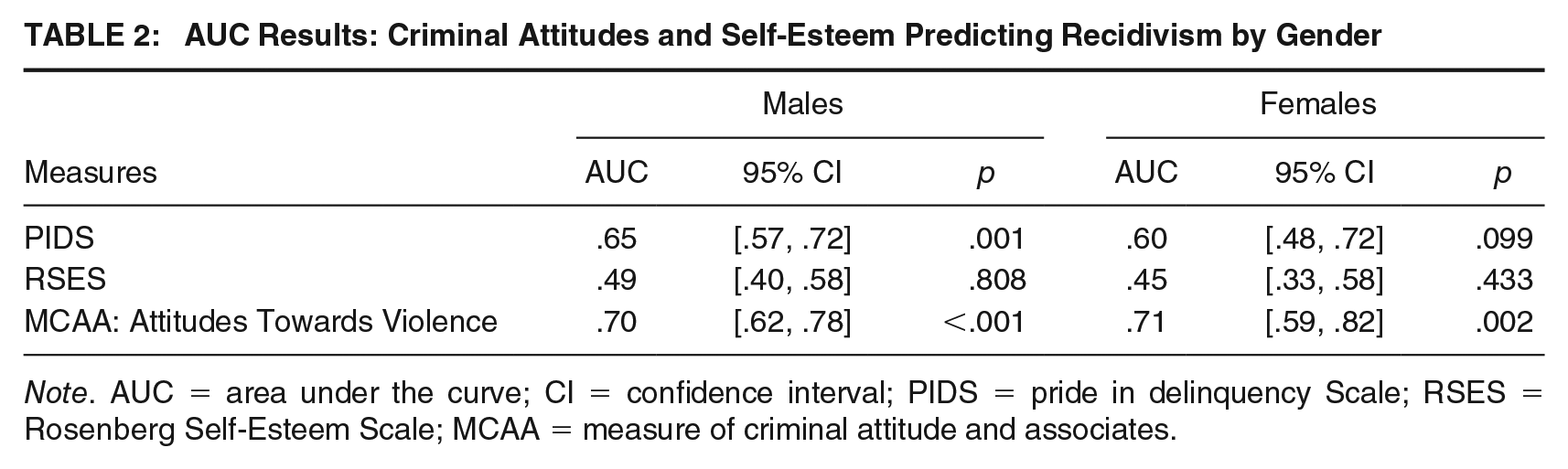
As Table 2 illustrates, the attitudinal measures (MCAA: ATV and PIDS) predicted recidivism in the moderate range (Rice & Harris, 2005) for males and females (AUCs ranged between .60 and .71). However, the self-esteem (RSES) measure did not predict recidivism in either gender. The male AUC was 0.49; the female AUC was 0.45.
AUC Results: Criminal Attitudes and Self-Esteem Predicting Recidivism by Gender
Note. AUC = area under the curve; CI = confidence interval; PIDS = pride in delinquency Scale; RSES = Rosenberg Self-Esteem Scale; MCAA = measure of criminal attitude and associates.
Moderated Moderation Regression Results: Effect of Self-Esteem and Gender on the Relationship Between PIDS and General Recidivism
Note. PIDS = Pride in Delinquency Scale; CI = confidence interval; RSES = Rosenberg Self-Esteem Scale.
Unstandardized coefficient. b95% confidence intervals around B. cScored 1 = male. dHad at least one administration of justice index offense.
Moderated Moderation Results: PIDS X RSES X Gender
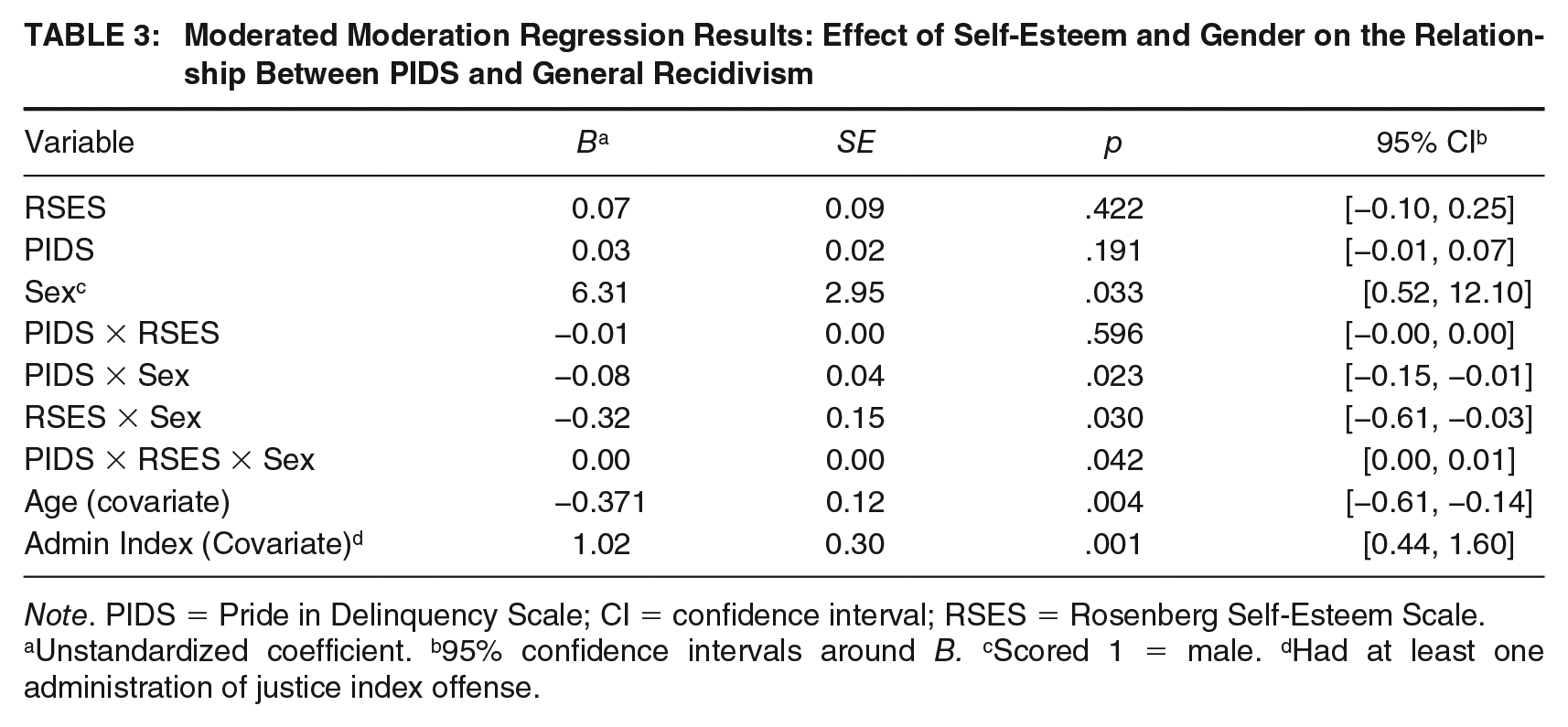
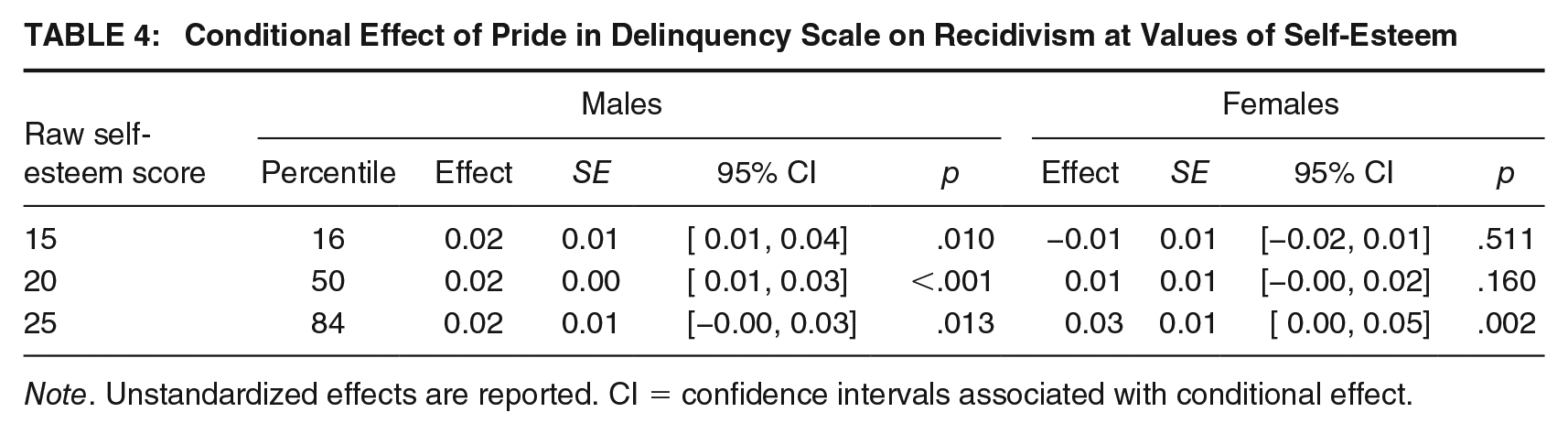
The first analysis examined whether gender and self-esteem moderated the relationship between criminal attitudes (measured by the PIDS) and recidivism (see Table 3); age and administration of justice offenses were included as covariates. According to Table 3, the three-way interaction between the PIDS, gender, and self-esteem was significant. Thus, only the three-way interaction was probed further vis-à-vis conditional effects and graphics. The interaction was probed along three percentiles of self-esteem (16th, 50th, and 84th) to ensure that all probed data points were within the range of the observed data (Hayes, 2018). Table 4 presents the conditional effects of the PIDS on recidivism as a function of self-esteem scores; effects are presented separately for males and females. As Table 4 illustrates, for males, the relationship between the PIDS and recidivism remained significant at all levels of self-esteem. In contrast for females, level of self-esteem did moderate the observed relationship between the PIDS and recidivism. Lower levels of self-esteem nullified the preexisting relationship between the PIDS and recidivism, whereas higher levels of self-esteem magnified the preexisting relationship between the PIDS and recidivism.
Conditional Effect of Pride in Delinquency Scale on Recidivism at Values of Self-Esteem
Note. Unstandardized effects are reported. CI = confidence intervals associated with conditional effect.
Additional follow-up analyses (simple moderated regressions) were conducted for males and females separately with age and administration of justice offenses as covariates. These analyses sought to identify the exact self-esteem score (or range of self-esteem scores) when the conditional effect of the PIDS on recidivism transitions between statistically significant and not significant. The Johnson–Neyman (JN) technique was used for this purpose. The initial analyses adopted the pick-a point approach in estimating the conditional effects (where three percentiles of the levels of self-esteem are used to represent “low: 10th,” “moderate: 50th,” and “high: 90th” levels), whereas the JN technique is used to reduce the arbitrariness of the selection of values of self-esteem to estimate the conditional effect of PIDS on recidivism. The JN technique specifies where along the self-esteem scores (the moderator variable) that the conditional effect of the PIDS on the dependent variable (recidivism) will be statistically significant and nonsignificant (Hayes, 2018). Hence, those points are also known as the region of significance.
As expected, the results for males indicated no region of significance. However, the results for females revealed one significant region at a value of 22.79 on the RSES (72.15th percentile). Hence, consistent with the prior omnibus moderated moderation regression, levels of self-esteem that exceeded the 72.15th percentile moderated the relationship between the PIDS and recidivism in females. Figures 1 and 2 display the three-way interaction graphically. Figure 1 illustrates the relationship between PIDS scores and the predicted probability of recidivism for males as a function of three levels of self-esteem (low = 16th percentile, moderate = 50th percentile, high = 84th percentile). Comparable results for females are presented in Figure 2. In sum, Figure 1 illustrates that the relationship between the PIDS and recidivism is unaffected by levels of self-esteem in males. Conversely, for females, Figure 2 illustrates that while higher levels of self-esteem magnify the relationship between the PIDS and recidivism, lower levels of self-esteem nullify the relationship between PIDS and recidivism. The JN technique identified the exact point at which self-esteem in females becomes “too high”—the 72.15th percentile—magnifying the impact of PIDS on recidivism.
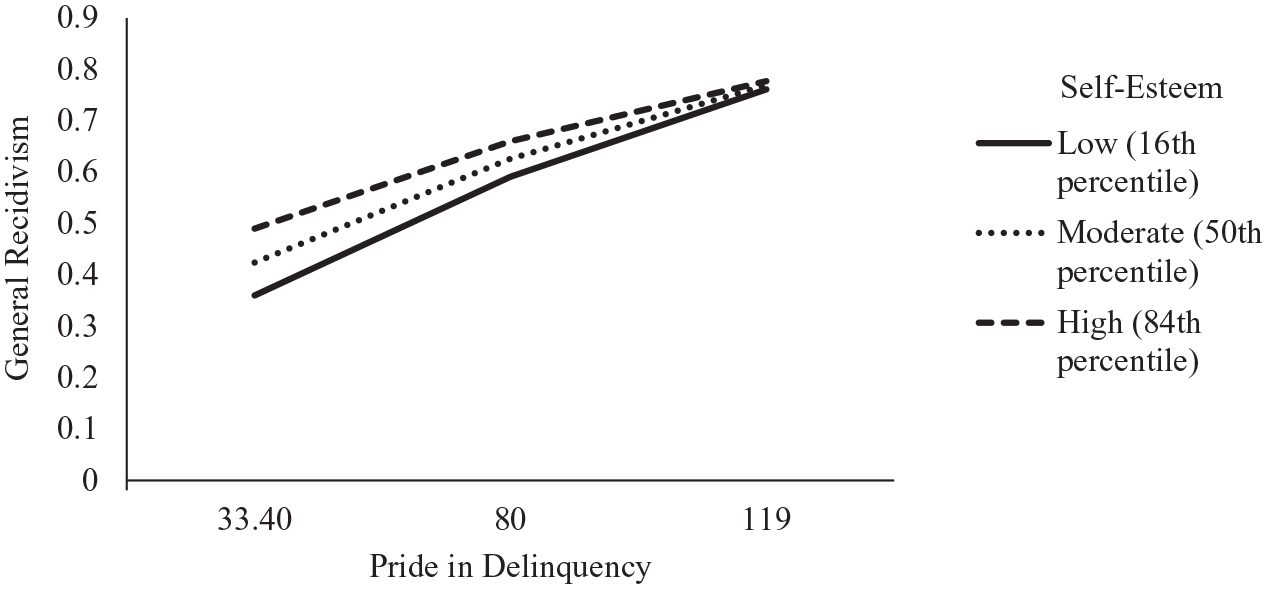
Relationship Between Pride in Delinquency and Recidivism in Males as a Function of Self-Esteem (No Significant Interaction Effect)
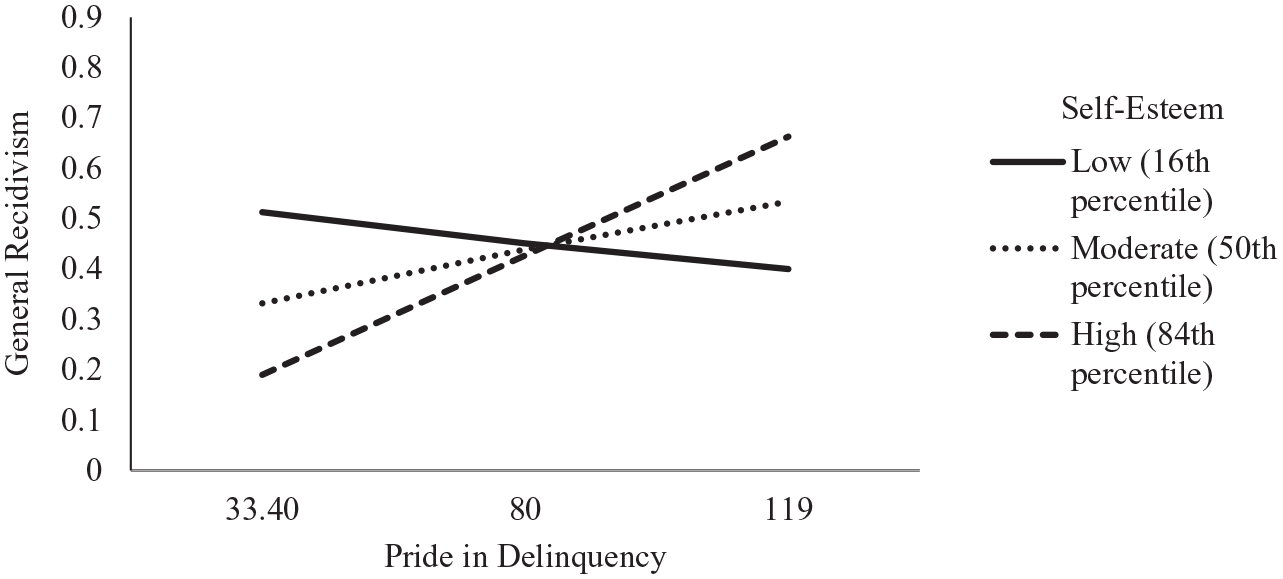
Relationship Between Pride in Delinquency and General Recidivism in Females as a Function of Self-Esteem (Significant Interaction)
Moderated Moderation Results: MCAA: ATV × RSES × Gender
The second analysis examined the moderating effect of self-esteem and gender on the relationship between the MCAA: ATV and recidivism. As Table 5 illustrates no significant effects were observed. Thus, the observed moderation effect of gender and self-esteem on the relationship between the PIDS and recidivism did not replicate with the MCAA: ATV.
Moderated Moderation Regression Results: Effect of Self-Esteem and Gender on the Relationship Between the MCAA: Attitude Towards Violence Subscale and General Recidivism

Note. MCAA: ATV = Measure of Criminal Attitudes and Associates: Attitude Towards Violence subscale; CI = confidence interval; RSES = Rosenberg Self-Esteem Scale.
Unstandardized coefficient. b95% confidence intervals around B. cScored 1 = male. dHad at least one administration of justice index offense.
Consequently, the more parsimonious binary logistic regression was performed (i.e., interaction terms were removed) to assess the effects of the MCAA: ATV, gender, age, administration of justice offenses, and self-esteem on recidivism. The logistic regression model was significant, χ2(5) = 47.78, p < .001. According to the results in Table 6, self-esteem did not predict recidivism. However, being male, younger, having at least one administrative of justice offense, and higher MCAA: ATV scores increased the odds of recidivism.
Logistic Regression Results: MCAA: Attitude Towards Violence Subscale, Gender, Age, and Self-Esteem Predicting Recidivism
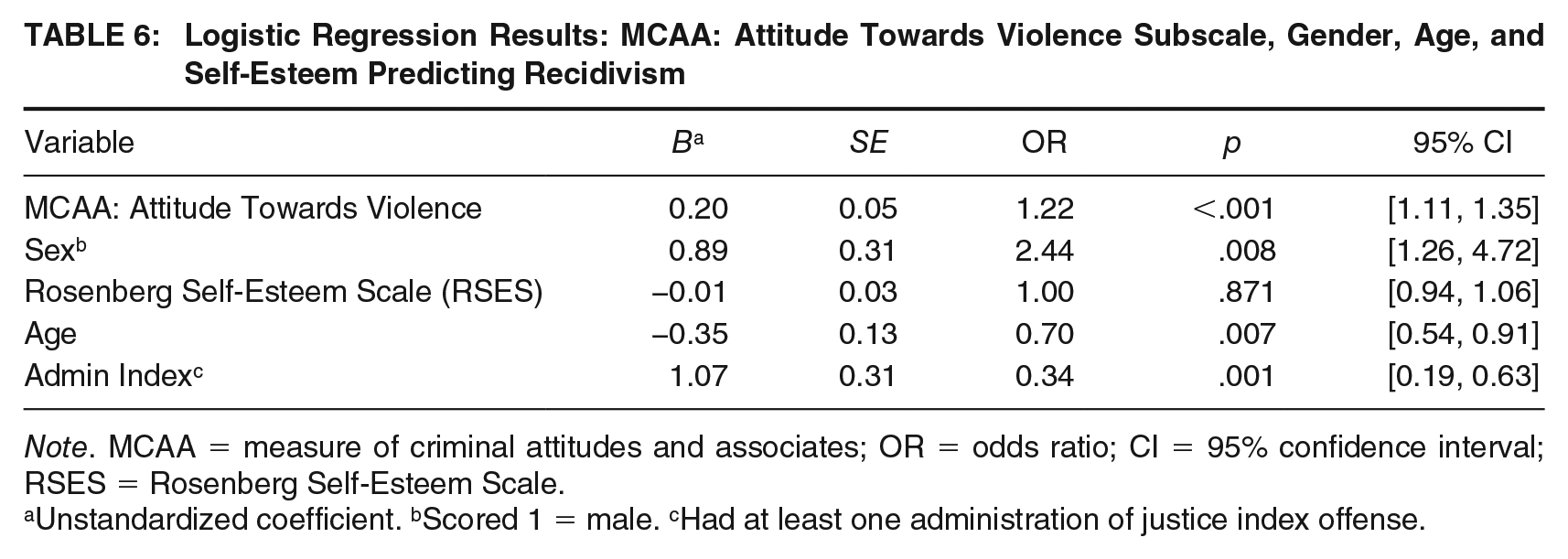
Note. MCAA = measure of criminal attitudes and associates; OR = odds ratio; CI = 95% confidence interval; RSES = Rosenberg Self-Esteem Scale.
Unstandardized coefficient. bScored 1 = male. cHad at least one administration of justice index offense.
Discussion
Self-esteem is one of the most studied constructs in social sciences (Bachman et al., 2011). In addition, self-esteem has been a topic of debate in the correctional field between RNR (e.g., Andrews & Bonta, 2003) and gender-responsive scholars (Hubbard, 2006). Hence, the purpose of this study was to explore the relationship between self-esteem, criminal attitudes, gender, and criminal recidivism in a youth justice sample. Specifically, we were interested in understanding if the relationship between recidivism and two different measures of criminal attitudes (the MCAA: ATV subscale and the PIDS) was moderated by gender and self-esteem. Consistent with prior research (Hyde, 2005), the study found that females did evidence lower levels of self-esteem than males, although the magnitude of this difference was classified as small as per Cohen’s (1988) guidelines. Moreover, self-esteem in and of itself did not predict recidivism in either gender, while both the PIDS and the MCAA: ATV predicted recidivism in both genders. However, the results illustrated that gender and self-esteem have a moderating effect on the relationship between criminal attitudes and recidivism, but only for females and only when the PIDS was used to operationalize criminal attitudes.
Self-Esteem, Criminal Attitudes, and Recidivism
Together, the results showed that for males, the PIDS predicted recidivism regardless of self-esteem level. In contrast for females, self-esteem impacted whether or not the PIDS predicted recidivism. Higher levels of self-esteem—the 72nd percentile—was the point at which self-esteem magnified the predictive strength of the PIDS. This finding aligns with the gender-neutral hypothesis or the “Wormith effect” that higher self-esteem leads to higher recidivism rates when coupled with high levels of PIDS, but only for females. However, this does not support the gender-responsive hypothesis that higher self-esteem buffers the risk of recidivism.
The MCAA: ATV subscale predicted recidivism in both genders. However, contrary to the hypothesis, there were no interactions between the ATV subscale, self-esteem, and gender. It is difficult to speculate why the observed interaction effect with the PIDS did not replicate with the MCAA: ATV. Although past research has illustrated that the ATV domain of the MCAA is valid with both females and males (O’Hagan et al. 2019), it is plausible that the PIDS is a more developmentally appropriate tool and thus more likely to capture nuanced interaction effects.
Understanding the Self-Esteem Effect
According to Bushman and Baumeister (1998), it is not high self-esteem that leads to aggression, but rather unstable high self-esteem, narcissism, and/or threatened egotism (when favorable views of oneself becomes threatened). Given that we did not include a direct measure of unstable self-esteem or threatened egotism in our study, it is difficult to contemplate to what extent our measure of high esteem—scores greater than the 72nd percentile on the Rosenberg Self-esteem scale—may have actually been mimicking threatened egotism or unstable high self-esteem rather than merely healthy levels of stable high self-esteem. However, past research has shown that females exhibit lower levels of self-esteem relative to their male counterparts in both general (Hyde, 2005) and justice populations (Van Voorhis, 2012). Consequently, it is possible that the females in our study who happened to rate themselves at the high end of the self-esteem continuum on the day they were assessed may have actually been better categorized as evidencing threatened egotism and/or unstable self-esteem. It is also possible that females scoring above the 72nd percentile were actually manifesting a sense of falsely inflated self-esteem as a defensive mechanism against feelings of genuine low levels of self-esteem. Interestingly, Bushman and Baumeister (1998) and Walker and Bright (2009) have put forth a compelling argument that falsely inflated self-esteem coupled with anger and socially threating situations may lead to aggression and violence. These highly speculative hypotheses require further investigation.
Gender-responsive research exploring the lives of justice-involved females has repeatedly underscored how factors such as poverty, dysfunctional relationships, and victimization lead to low self-esteem and marginalization that subsequently increase the likelihood of criminal conduct. Thus, gender-responsive researchers advocate for approaches that empower females (i.e., increase self-esteem to a healthy level) to make healthy choices and to mobilize resources (Correctional Service of Canada, 1990; Van Voorhis, 2012). In contrast, RNR researchers do not prioritize self-esteem for males or females. In fact, low self-esteem is not considered a risk factor for males (Bonta & Andrews, 2017). Also, to our knowledge, high self-esteem has not been proposed as a protective factor for males. The assumption among gender-responsive scholars is that most justice-involved females experience unhealthy levels of low self-esteem rather than inflated self-esteem levels. As such, Baumeister’s constructs of unstable inflated self-esteem and threatened egotism are absent from the gender-responsive lexicon.
Practical Implications
The results indicate that while criminal attitudes in and of themselves should be targets of rehabilitation for both genders, targeting self-esteem in and of itself is more tenuous. For example, assessment practices should be sufficiently detailed to determine whether or not females simply have low self-esteem which may impede one’s ability to mobilize resources and make healthy choices, in comparison to when unstable levels of high self-esteem (or falsely inflated self-esteem) are displayed that may make individuals more vulnerable to social interactions that threaten self-esteem, which in turn may lead to aggression. Although the study requires replication, it does suggest that clinicians should be wary of patterns of unstable levels of inflated self-esteem in the presence of strong criminal thinking patterns.
Theoretical Implications
The study was grounded in both the RNR model and gender-responsive tenets regarding the role of self-esteem and criminal attitudes in predicting recidivism. Although the study found that self-esteem was not predictive of recidivism in and of itself, the combined effect of seemingly high self-esteem and high criminal attitudes (in females) challenges the view that self-esteem is inconsequential. Thus, the results suggest that the highly versatile RNR model may require subtle refinement in terms of the potential importance of self-esteem to the rehabilitative process. However, given that the study did not assess changes over time in any variable, self-esteem can only be hypothesized to be a potentially relevant dynamic need.
On the surface, the results appear to run counter to the gender-responsive model that self-esteem can potentially buffer the risk of recidivism. However, in our study, if falsely inflated self-esteem was manifesting as high self-esteem, our results do not in fact contradict the gender-responsive model. The gender-responsive model simply requires subtle refinement underscoring the complexity of self-esteem as it relates to aggression and antisocial behavior. In addition, although gender-responsive models do not afford much weight to criminal attitudes as treatment targets, the results underscore that youthful females do indeed exhibit criminal attitudes. Furthermore, the results indicate that criminal attitudes are moderately predictive of recidivism in both genders. For this reason, the highly integrative gender-responsive model could also benefit from refinement whereby criminal attitudes are given more attention, particularly among higher risk cases.
Future Directions and Limitations
A sampling bias may have occurred since a high proportion of our sample included high risk youth (79% had engaged in at least one violent crime). In addition, there were little differences between the males and females in terms of violence. Hence, our sample was not representative of the general youth justice population in Canada. The typical justice-involved youth in Canada has committed a nonviolent crime such as theft and has either been diverted entirely from the justice system or is serving a probation sentence (Allen & Superle, 2016). Thus, the results of the study limit the findings to a small subset of justice-involved youth, albeit an important one, given the seriousness of their crimes and their levels of re-offense. Furthermore, the sample size was relatively small, and the ratio of males to females was 2:1. Therefore, replication is necessary with a larger and more representative sample of youth with equal gender representation.
Another variable to consider is race. Black, Indigenous, and youth of color were overrepresented in our male sample (64.6%). Comparatively, there were substantially fewer Black, Indigenous, and youth of color in our female sample (39.7%). There is some evidence that justice-involved Black males have higher levels of self-esteem compared to their White counterparts (Gillespie, 2005). However, Holsinger and Holsinger (2005) reported no differences in self-esteem levels between Black and White justice-involved female youth (Holsinger & Holsinger, 2005). Due to power issues, it was not plausible to consider a four-way interaction (i.e., Race × Gender × Self-Esteem × Attitudes) in the current study. As a result, it remains unclear how the observed gender differences in race may have impacted our results. Quantitative studies that examine how multiple intersecting identities (e.g., age, race, sexual orientation, disability, etc.) impact results are indeed challenging. In the absence of excessively large samples, complex intersectionality questions may be best answered by qualitative research methods.
Our study was limited in that we did not capture threatened egotism and/or unstable inflated self-esteem. We also could not determine if observed high self-esteem was in fact, falsely inflated self-esteem. Thus, further research should aim to disentangle the differences (if any) between “normal” levels of healthy self-esteem, high self-esteem, falsely inflated self-esteem, and threatened egotism and/or unstable self-esteem. Research of this nature is critical.
In sum, the study identified a self-esteem “tipping point” for females but not males. Self-esteem scores ≥ the 72nd percentile of the RSES when coupled with high PIDS scores magnify the probability of recidivism for females only. For males, self-esteem appears to have no impact on the relationship between criminal attitudes and recidivism. An equally important observation was that while self-esteem scores in and of themselves do not predict recidivism in either gender, criminal attitudes measured vis-à-vis the PIDS or the MCAA: ATV do. Thus, the construct of criminal attitudes remains an important target for both genders.
Footnotes
Acknowledgements
We thank the youth and justice organizations who made this research possible. We dedicate this article to the late Dr. Wormith who served as the inspiration for this study—a treasured friend and colleague.
This research was supported by a grant from the Social Sciences and Humanities Research Council (SSHRC, 410-2009-1020).
