




Abstract
In the United States, populations of Color are overrepresented across virtually all arenas of the criminal justice system. These realities have led scholars to bring race and ethnicity to the forefront of our examinations of crime and justice. Understanding how culturally specific factors distinctly impact a group is imperative when it comes to understanding why some engage in offending while others do not. Analyzing the pathways specified by the theory of African American Offending (TAAO) among a Latinx population can help shed light on whether this theory may be broadly applicable to populations of Color. This insight can aid in the development of culturally appropriate interventions and policies to combat the institutional racism that increases marginalized populations’ likelihood of contact with the criminal justice system. Thus, we explore how well TAAO pathways apply to a Latinx sample of youth. Findings lend support for culturally distinct examinations. Implications are discussed.
The American criminal justice system has long been criticized for its documented racial and ethnic disparities. Scholars argue that understanding and addressing the racial and ethnic criminal injustices in our society require culture-specific explanations that take into account individuals’ lived experiences and within-group variations (e.g., Brooks, 1994; Solorzano & Yosso, 2001). To this end, Unnever and Gabbidon (2011) developed the theory of African American offending (TAAO), suggesting that Black Americans share a unique worldview largely as a result of their historical oppression and marginalized social position. In brief, TAAO contends that Black people experience unique forms of racial discrimination and criminal justice injustices, which can lead to negative emotions that exacerbate the likelihood of criminogenic behavior. These experiences, however, are theorized to be conditioned by racial socialization and identity, which may serve to provide resilience and/or spark resistance (Unnever & Gabbidon, 2011).
Although Black and Latinx people are indeed culturally distinct, these groups share similar structural positions and social experiences within the American context. Similar to their Black counterparts, Latinx youth are criminalized, experience comparable institutional discrimination, and develop common subcultures and worldviews to cope with their marginalized positions (Rios, 2011). As such, the major tenets of TAAO—the consideration of diverse forms of discrimination, the influence of negative emotions, and the conditioning effects of ethnic and racial identity—may tentatively apply to Latinx individuals. Alternatively, it is also possible that cultural distinctions between these groups result in diverse pathways toward and away from crime. In other words, TAAO may work broadly as a theory of crime that explains the similar experiences of people of Color in the United States; on the contrary, the theory may be better applied as a framework that calls for understanding the culture-specific experiences of different marginalized groups.
Analyzing the pathways specified by TAAO among a Latinx population can help shed light on whether this theory may be broadly applicable to populations of Color within the United States. This insight can aid in the development of culturally appropriate interventions and policies to combat the institutional racism that increases marginalized populations’ likelihood of contact with the criminal justice system. To this end, we review the empirical connections between discrimination, negative emotions, ethnic socialization and identity, and criminal behavior for Latinx populations. We then explore how well TAAO pathways apply to a Latinx sample of youth.
Latinx Pathways to Offending
In brief, Unnever and Gabbidon (2011) purport that marginalized groups face specific forms of discrimination such as criminal justice injustices and everyday experiences of racial/ethnic discrimination. Based on variation in individual racial/ethnic socialization, these experiences may or may not lead to a degree of negative emotions, namely, anger and depression, which in turn influence the likelihood of offending. These premises have garnered a good degree of empirical support, although assessments have focused almost exclusively on Black populations (e.g., Gaston & Doherty, 2018; Isom, 2016; Jones & Greene, 2016; Isom Scott & Seal, 2019; Unnever, 2014; Unnever et al., 2016).
Some research, however, provides evidence of these associations among Latinx persons. Experiences of discrimination among Latinx youth are shown to be linked to increased depression, distress, and anger (Finch et al., 2000; Isom Scott et al., 2020), and disadvantaged Latino youth tend to respond to discrimination with feelings of shame and frustration, which often manifests in forms of criminalized resistance (Rios, 2011). Other work with Latinx youth has found anger to be directly associated with an increased likelihood of offending (Isom Scott et al., 2020), and the effects of discrimination on violent delinquency to be partially mediated by anger (Pérez et al., 2008). Finally, the influence of ethnic socialization and identity is uncertain among this population. Ethnic socialization describes the process wherein children and adolescents learn the unique aspects of their shared heritage and culture, which can ultimately result in the development of a shared ethnic identity (Umaña-Taylor et al., 2013). While some researchers have found ethnic identity to be protective against the negative effects of discrimination (Martinez & Dukes, 1997; Romero et al., 2014) as well as linked to improved overall health, well-being (Yancey et al., 2001), and self-esteem (Phinney et al., 1997; Romero et al., 2014), others found it unrelated to experiences of violence among Latinx persons (Arbona et al., 1999; Isom Scott et al., 2020; see also Isom Scott, 2020).
Linking Discrimination, Emotions, and Identity to Crime
Although the relevance of these factors and their basic connections have been established, little emphasis has been given to testing the specific pathways proposed by TAAO, particularly among non-Black populations of Color. Understanding how these factors function collectively can provide a clearer picture of why some group members engage in crime while others do not. TAAO asserts that experiences of discrimination increase negative emotions, which in turn spur criminogenic responses. Such an indirect association (i.e., the relationship between discrimination and offending through negative emotions) is known as a mediated relationship, wherein the link between an independent and dependent variable passes through a third variable, the mediator (Hayes, 2013). Unnever and Gabbidon (2011) additionally posit that positive racial socialization and identity can serve as buffers to protect against the mediating impact of negative emotions. When a mediator is affected by another factor, resulting in a conditional indirect association, such as described here, this is referred to as a moderated mediation (Hayes, 2013). The pathways suggested by TAAO can be tested via mediation and moderated mediation analyses and have received moderate support with a sample of Black youth (Isom Scott & Seal, 2019). To our knowledge, no study has assessed these pathways among the Latinx population.
Latinx Ethnic-Racial Experiences and Crime
TAAO’s pathways to offending are centered on the Black American experience—namely, their shared experiences of discrimination and racial socialization and identity. As explained above, many of these factors are potentially relevant to explaining other groups’ of Color involvement with crime. It is important to note, however, that Latinx people are a distinct pan-ethnic group with diverse histories—including varied experiences with law enforcement—which have led to notable contemporary group differences (see Isom & Cann, 2021). Although this discussion focuses on the macro-level experience of Latinx Americans, it is important to note that important differences certainly exist among Latinx individuals. It is our intention here not to undermine such differences or equate their experiences to Black Americans, but rather to highlight certain commonalities experienced by this particular group.
Like other communities of Color, Latinx communities experience both everyday discrimination and systemic racism, including criminal justice injustices. For example, in addition to being nearly 3 times more likely to be incarcerated than are White men (Carson, 2020), Latinx persons report experiences of overpolicing and often hold more negative perceptions of police (Becerra et al., 2017; Fine et al., 2019; Isom Scott, 2020). However, Latinx Americans face additional ethnic-racial stressors, including the implementation of immigration policies, that uniquely strain relations between Latinx communities and law enforcement (Becerra et al., 2017; Quiroga et al., 2014). As immigration policies have become increasingly publicized and enforced, Latinx populations have begun to report increased hate crime victimization and ethnic-racial discrimination (Becerra et al., 2017; Lockwood & Cuevas, 2020; Quiroga et al., 2014), including discrimination experiences based on skin tone, perceived immigration status, and language fluency (Lockwood & Cuevas, 2020; Stein et al., 2019).
Beyond their specific ethnic-racial discriminatory experiences, several Latinx culture-specific factors have been identified as influencing one’s likelihood of offending. Acculturative stress, the negative affect associated with the process of psychological change resulting from extended contact with other cultural groups (Berry, 2003), for instance, is a common phenomenon among Latinx populations and is associated with increased delinquency and involvement with the criminal justice system (Pérez et al., 2008; Isom Scott et al., 2020).
Furthermore, la familia, or the family, is a central socializing component of orthodox Latinx culture (Gallegos-Castillo, 2006). Embedded within familism are orthodox gender scripts, typically defined by the cultural standards of machismo and marianismo, which reinforce stereotypical expectations of femininity and masculinity and regulate gendered interactions (Marrs Fuchsel, 2013). This patriarchal gender hierarchy is further reinforced by religious norms, particularly from the Catholic church wherein girls are taught the importance of chastity until marriage (Rodriguez, 1994). Over half of the Latinx population identify as Catholic (Malavé & Giordani, 2015), and Catholicism serves as a significant social support for many Latinx persons (Harris & Feldmeyer, 2015). While religion is a known buffer of offending (Epstein-Ngo et al., 2013), these teachings reinforce patriarchy and traditional gender normative behavior. As unique aspects of the Latinx ethnic-racial experience, these elements should be included when examining potential pathways to crime for Latinx groups (see Isom et al., 2021).
The Current Study
Unnever and Gabbidon’s (2011) seminal TAAO is an important step in understanding culture-specific involvement in crime, but it is unknown how applicable this theory is to other people of Color. Building upon a race-centered and culture-specific theory of crime, we bring the Latinx lived experience to the forefront to investigate whether the pathways proposed by TAAO to explain African American offending can be utilized to understand offending among Latinx youth, particularly when other culturally relevant factors are controlled. Specifically, we assess the mediation associations of anger and depression as well as the moderated mediation effect of ethnic identity by testing the following hypotheses:
Using a sample of Latinx youth from the Project on Human Development and Chicago Neighborhoods (PHDCN) data (Earls et al., 2006, 2007a), we investigate mediation and moderated mediation models to assess the theorized roles of discrimination, police injustices, negative emotions, and ethnic identity for Latinx youth above and beyond other culturally relevant factors and other correlates of crime.
Method
Data and Sample
We utilize data from the PHDCN’s Community Survey and the third wave of the Longitudinal Cohort Study (Earls et al., 2006, 2007a). Data collection began in 1994 with the Community Survey and Wave I of the Cohort Study and ended in 2002 when Wave III of the Cohort Study data collection was completed. For the Community Survey, 343 neighborhood clusters were created from the 847 census tracts of Chicago, Illinois, based upon the area’s socioeconomic status and racial and ethnic composition. The Longitudinal Cohort Study followed a stratified probability sample of 80 neighborhood clusters drawn from the original clusters. Researchers sampled between 800 and 900 youth from each of the seven original age cohorts (i.e., birth, 3, 6, 9, 12, 15, and 18) within each of the 80 sampled neighborhood clusters.
Our sample includes age cohorts 9, 12, 15, and 18 at Wave III, thus ranging in age from nearly 12 to 25 years old. The Wave III Personal Identity File (Earls et al., 2007b) served as our base to which we merged all other relevant data files. This subset of items, collected only during Wave III, captures experiences with discrimination, negative encounters with the police, and ethnic identity. The Personal Identity File also allowed respondents to self-report and rank their ethnic and racial identities. To identify the Latinx sample, respondents were classified as Latinx 1 if they selected such as their sole or first identity in the categorical questions and/or listed it as their primary identity in the open-ended question. If their self-classifications did not match, the open-ended responses took precedence, resulting in a final sample of 858 Latinx youth. Missingness ranged from 0% to 14.4%. 2 We analyzed the sample for systematic or randomly missing data patterns and replaced missing values using multiple imputation. 3 Our final sample is 51.3% female with a mean age of 17.4 years old.
Measures 4
Dependent Variable
Respondents were asked, “In the last year, have you . . .” engaged in a variety of behaviors ranging from burglary to assault, with respondents providing a yes or no response to each of the 23 felony offenses. The final measure of serious and violent offending was a count outcome of how many types of offenses a person had engaged in over the last year. 5
Independent Variables
We measured discrimination using the mean score of the following five items: In the past year, were you discriminated against in your neighborhood, outside of your neighborhood, when you wanted service, when you first met someone new, or other times (1 = yes; α = .539). We measured police injustices using a single question asking whether or not the respondent had been discriminated by the police in the last year (1 = yes).
Mediating Variables
We measured anger using the mean score of the items, “I argue a lot,” “I scream a lot,” and “I have a hot temper,” with responses ranging from 0 (not true) to 2 (very or often true; α = .701). Similarly, we measured depression with the items, “I feel lonely,” “I cry a lot,” and “I am unhappy, sad, or depressed” with the same response options (α = .695).
Moderator Variable
We adapted the measure of positive ethnic identity from the Puerto Rican Adolescent Survey (Earls et al., 2007b). Respondents were asked to name the one ethnic or religious group that they felt is most important to them. Their answer served as the reference category for five items: I tried to learn about [GROUP] history, traditions, and customs; I think a lot about how being [GROUP] has affected my life; I feel like a member of the [GROUP] community; I have often talked to other people to try to learn more about my [GROUP] culture; and I feel good about being [GROUP]. These items closely align with those from the Multigroup Ethnic Identity Measure–Revised (MEIM-R; Phinney & Ong, 2007). Responses ranged from 1 (strongly disagree) to 4 (strongly agree). If the respondent did not provide an ethnic or racial group as their most important group, the above questions were recoded to zero so the remaining responses would be ethnicity-based. We use the mean of the recoded responses as a measure of positive ethnic identity (α = .697).
Control Variables
We included various control variables that are known correlates of crime, are culturally distinct controls, or are represented in leading criminological theories. Gender was measured dichotomously (1 = women). Age was calculated by subtracting the date of survey administration from the respondent’s reported date of birth. Income was measured categorically, ranging from 1 (less than US$5,000 in annual earnings) to 11 (over US$90,000 in annual earnings). We also created an index to measure propensity for criminal coping (see Agnew, 2013; Thaxton & Agnew, 2018). This index included school enrollment, involvement with delinquent peers, family attachment, impulsivity, and engagement in risk-seeking behaviors. 6 We recoded scales for each factor based on quartiles into dichotomous variables and summed with higher scores indicating a greater propensity for criminal coping. 7 Structured similarly to the dependent variable, respondents were asked to self-report all previous serious offending behaviors in which they had engaged prior to the completion to the survey.
We also controlled for acculturation by developing an index comprised of five items, wherein respondents with higher scores were deemed more acculturated to American customs. Measures for this index included proficiency in speaking English, daily use of English, born in the United States, U.S. citizenship, and the integration of American customs at home (α = .711). 8 Catholicism as a primary identity was measured dichotomously (1 = Catholic). As sexual behavior is closely aligned with religious and traditional gender norms (Faulkner, 2003; Isom Scott, 2018), we controlled for participants’ engagement in sexual behaviors. We measured this using three questions wherein participants were asked, “Have you ever had sexual intercourse?”; “Have you had more than one sexual partner?”; and “Have you ever been pregnant/have you ever gotten someone pregnant?” (1 = yes). Higher scores indicated greater engagement in sexual behaviors.
Research finds community characteristics account for much of the disparity in crime rates (Bursik & Grasmick, 1993). We measured concentrated disadvantage, residential stability, and ethnic heterogeneity using indicators created by the original PHDCN investigators and taken from the Community Survey (Earls et al., 2007a; Sampson et al., 1997). 9 Furthermore, given the focus on Latinx communities, percent Latinx residents was also controlled for in each neighborhood cluster. Diagnostics and sensitivity analyses suggest multicollinearity was not a concern for the present data. 10 The Supplemental Material presents the correlation matrix and descriptive statistics for all variables of interest.
Analytical Strategy
Hayes (2013; Preacher & Hayes, 2004, 2008) developed a regression-based path-analytic framework 11 with bootstrapping for mediation (and moderated mediation or conditional process) analysis overcoming several of the shortcomings of Baron and Kenny’s (1986) original mediation analytical method. These modified procedures are not held to the assumptions of direct associations, assess regression models simultaneously and contingently, and account for the nonnormality of the indirect association sampling distribution via the bootstrapping procedure. Bootstrapping is a resampling technique that treats the provided sample as representative of the population from which it was drawn. Through multiple resampling of the data and repeated regression estimations within each sample, bootstrapping calculates the factors of interest and their distributions. With this technique, there is no assumption of normality; thus, the resultant confidence intervals follow the distribution of the sample. The continuously plotted confidence intervals provide a region of significance where the indirect effect is considered significant if the region does not contain zero (Hayes, 2013; Preacher et al., 2007).
Based on the work of Unnever and Gabbidon (2011), we argue that Latinx offending is grounded in this group’s lived experiences as a marginalized group in the context of a racially and ethnically stratified society. The current data ask participants about their experiences and behaviors over a given year, allowing for an assessment of the cumulative effects of the process, making it adequate for this initial investigation of the proposed pathways for Latinx youth. We employ Hayes’s (2013; Preacher & Hayes, 2004, 2008) bootstrapped regression-based path-analytic framework to assess the indirect associations of anger and depression, as well as the conditional indirect associations of positive ethnic identity, on the relationships between discrimination and police injustices, and the likelihood of serious offending. Tests of mediation and moderated mediation were conducted following the procedures outlined by Hayes (2013) using Stata15, thus employing a repeated series of maximum likelihood regressions, with results based on 5,000 bootstrapped samples. 12 A visual representation of the assessed mediation and moderated mediation models (i.e., the hypotheses) may be found in the Supplemental Material.
Results
An underlying assumption of our study is that the proposed pathways will be relevant for Latinx populations while taking into consideration culturally specific factors. In other words, the TAAO pathways are not fully distinct to Black Americans, but malleable to other people of Color’s lived experience within a U.S. context. To assess this assumption, preliminary sensitivity analyses were conducted. In particular, models were assessed without controls, with only the correlates of crime, 13 and then including Latinx-specific factors 14 for model fit. The fullest model, incorporating all factors, fit the data best, lending credence to our assumption. Thus, the present results are not exploring Latinx-specific pathways, but do control for potential Latinx-specific confounders that improved model fit for this particular population. These pertinent results are presented below, and all additional analyses are available upon requests.
Mediation Model
The first bootstrapped regression-based path-analytic model examined the mediating effects of anger and depression on the associations between discrimination and police injustices with serious offending for Latinx youth. Goodness-of-fit statistics provide somewhat mixed results on the adequacy of the model (χ2 = 113.1, df = 50, χ2/df = 2.26, root mean square error of approximation [RMSEA] = 0.362, comparative fit index [CFI] = 0.815, standardized root mean square residual [SRMR] = 0.025). 15 The SRMR suggests good fit and is the most pertinent fit indicator for secondary data and multi-item indicators (see Cook et al., 2009; Pavlov et al., 2021). The other indicators suggesting less than ideal model fit are plausibly due to the variable to sample size ratio (i.e., misspecification) and/or the skewness of the dependent variable (skewness = 3.25). Both of these factors can sway goodness of fit and bias the results of maximum likelihood regression, the standard analytical technique for structural equation modeling in Stata (Kline, 2011). 16 To further investigate this issue, the mediation model was reanalyzed using quasi-maximum likelihood regression and generalized structural equation modeling to account for the nonnormality of the sample distribution. No significant differences between the coefficients, standard errors, and goodness-of-fit statistics were revealed. 17 Maximum likelihood regression, however, is robust to violations of the normality assumption (Diamantopoulos & Siguaw, 2000; Reinartz et al., 2009). Furthermore, model specification should be guided by hypotheses and theory, not statistical results (Kline, 2011). And most relevant to the present analyses, the use of bootstrapping to assess the indirect associations need not assume normality as it adjusts the distribution of the standard errors and confidence intervals to match the distribution of the sample, and thus limits the likelihood of Type I error (Hayes, 2013; Preacher et al., 2007). Based on these statistical premises and given the original fullest model best fits the data compared with the diagnostic models, the results presented are the maximum likelihood estimates with bootstrapped standard errors and confidence intervals.
The first hypothesis predicts anger and depression mediate the associations between discrimination and police injustices with offending for Latinx youth controlling for other factors. Table 1 presents the direct associations of discrimination and police injustices with anger, depression, and serious offending. Somewhat surprisingly, only police injustices are significantly associated with anger (b = .10), whereas discrimination is not significantly associated with either negative emotion. However, discrimination (b = .60) and anger (b = .51) are significantly associated with offending. Furthermore, counter to predictions, depression is not significantly associated with offending. Previous research finds police injustices and discrimination are directly associated with serious offending for Latinx youth while controlling for negative emotions (Isom Scott, 2020). Thus, based on these direct associations, it appears the association between discrimination and offending is likely not mediated, but the association between police injustices and offending may be mediated by anger but unlikely depression.
Mediation Model: Direct Associations With Anger, Depression, and Serious Offending
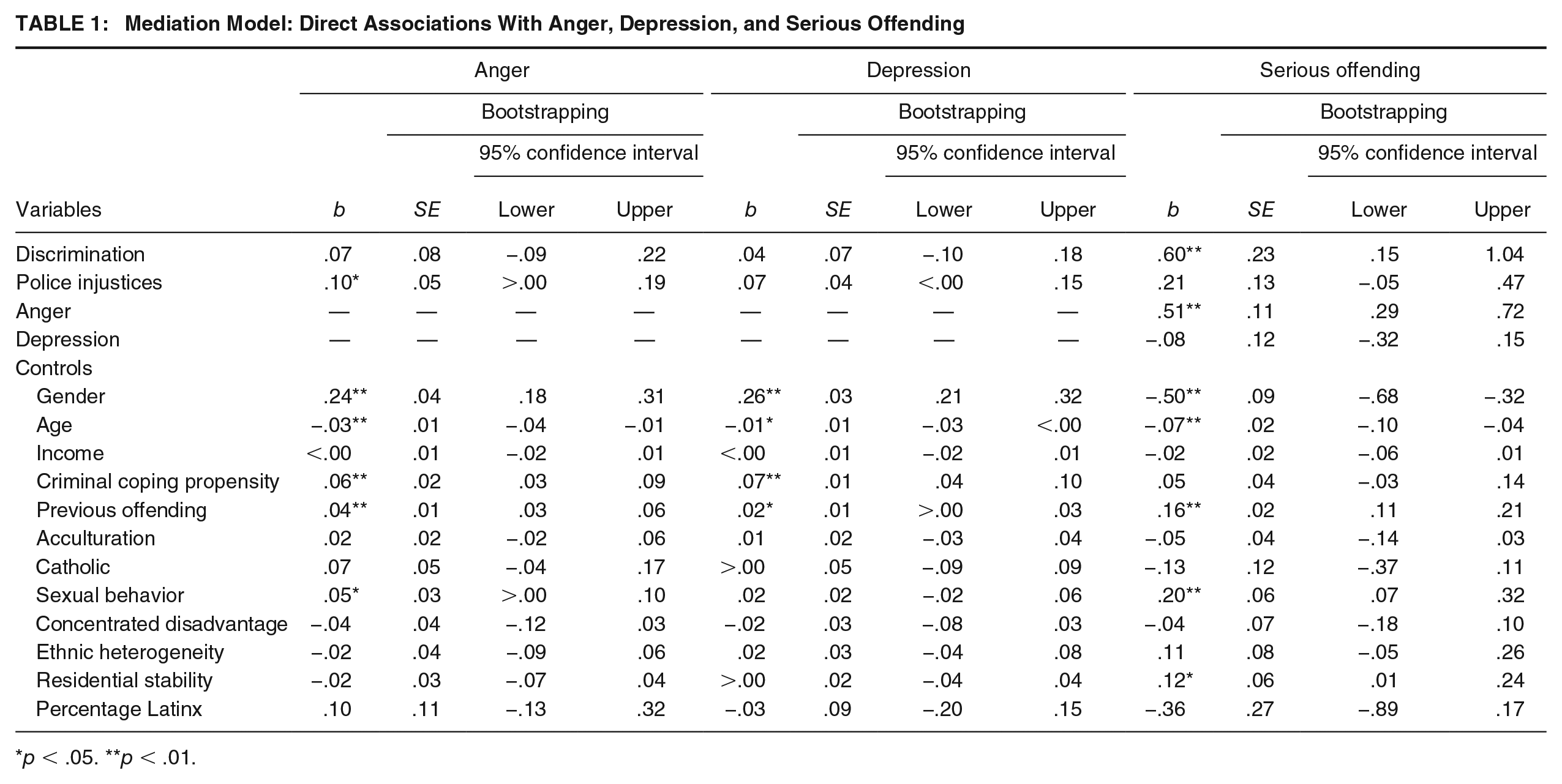
p < .05. **p < .01.
Table 2 presents the indirect and total associations of the mediation model. The lack of significant indirect associations for discrimination signifies a lack of mediation effects on behalf of negative emotions. However, the indirect and total associations for police injustices approaching significance lend credence to the mediating effect of anger between police injustices and offending. This is further supported by the modest change in associations between the direct effects and total effects models. Figure 1 depicts the full mediation model. Discrimination and anger are significantly associated with offending, but neither anger nor depression mediates the association between discrimination and offending. Furthermore, anger is significantly associated with police injustices. Police injustices, in turn, are not significantly directly associated with offending. Thus, negative emotions, particularly anger, likely mediates the association between police injustices and offending. Thus, counter to the hypothesis, anger and depression are not the only, and are certainly not the driving, factors linking police injustices and discrimination with offending for Latinx youth.
Mediation Model: Indirect and Total Associations With Serious Offending
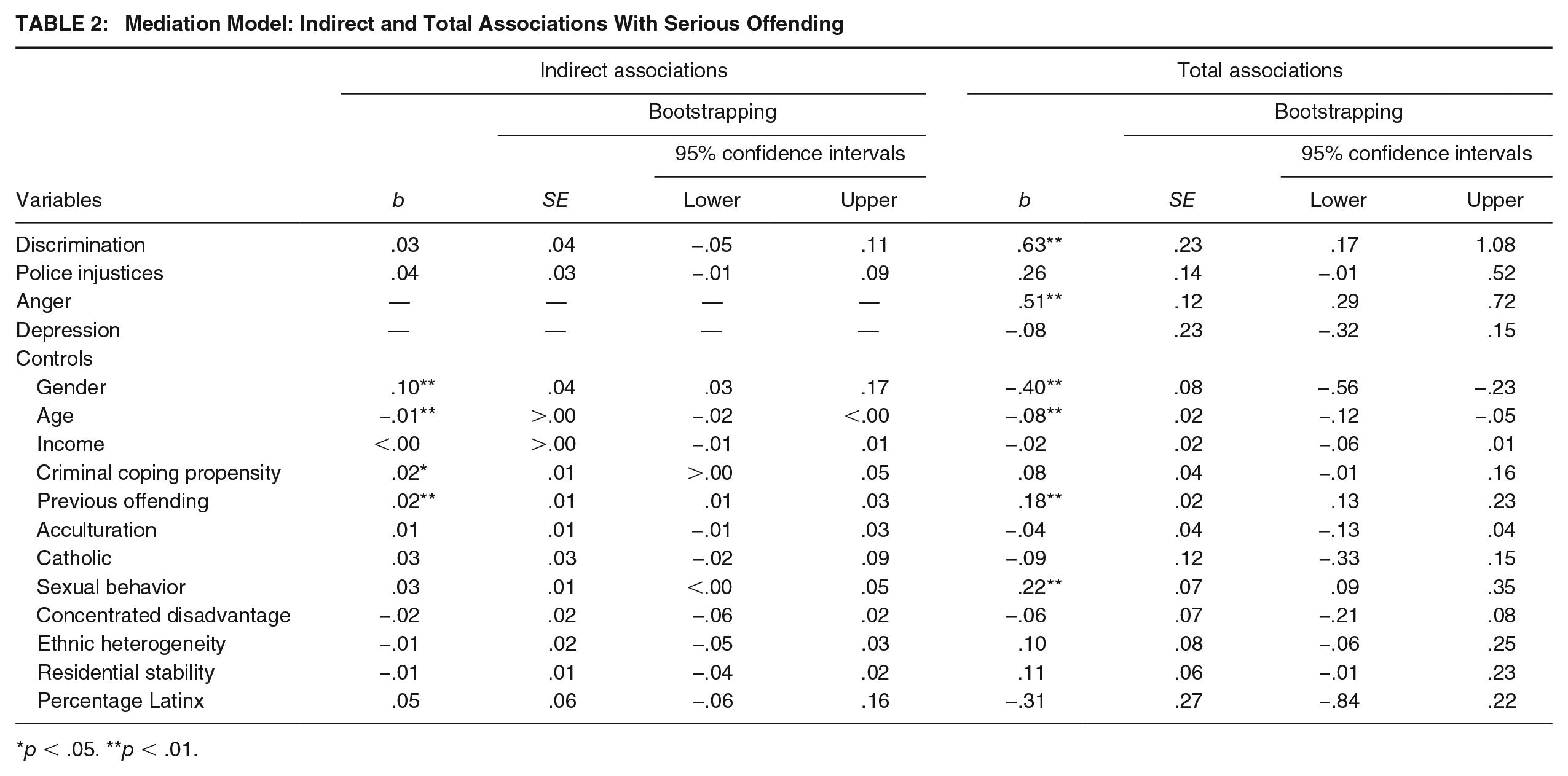
p < .05. **p < .01.
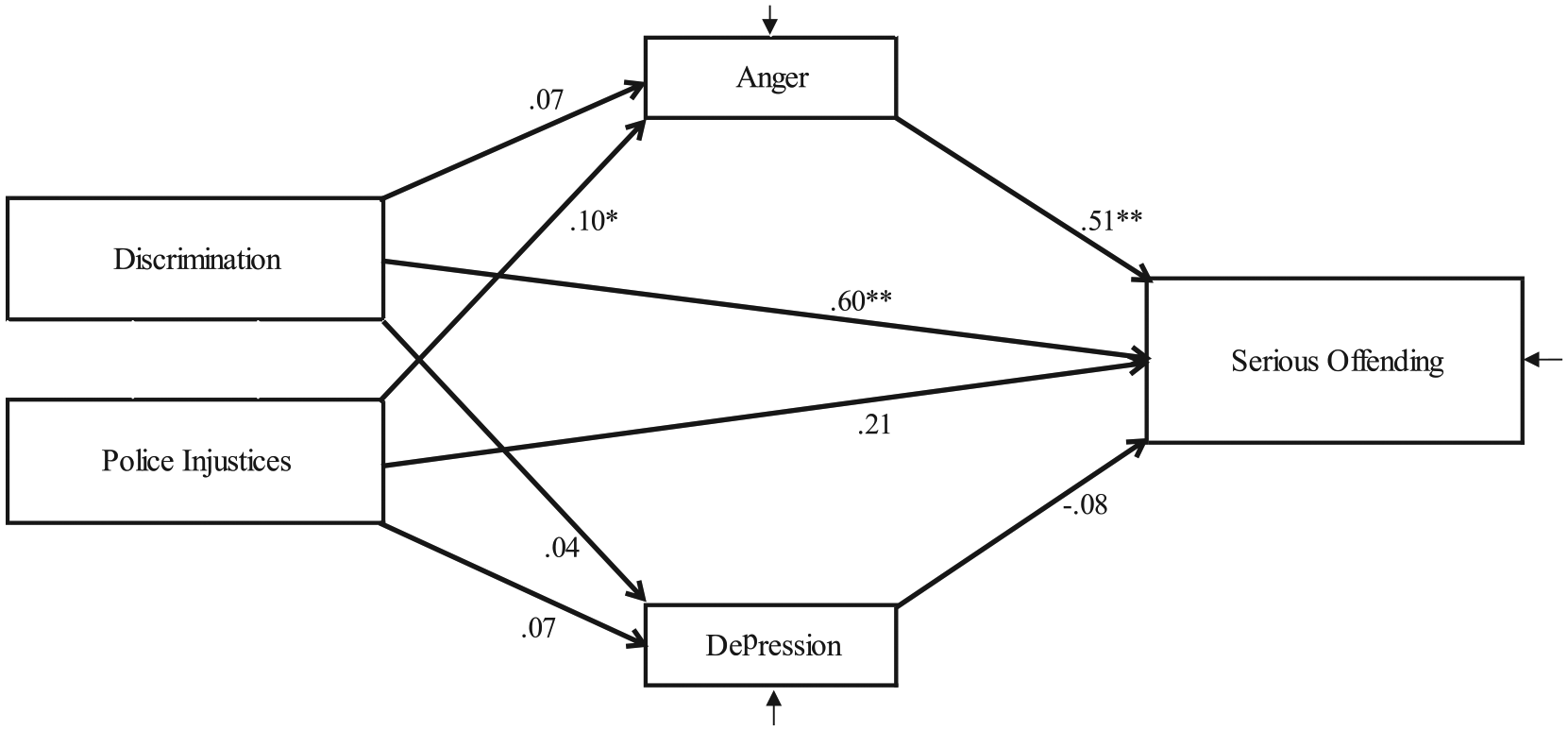
Mediation Model Examining Serious and Violent Offending
Moderated Mediation Model
For the moderated mediation model, conditional indirect associations were calculated by multiplying the coefficients from the independent variables via the mediators with the mean of the moderator, as well as one standard deviation above and one standard deviation below the moderator, and then bootstrapped to yield distribution-adjusted standard errors and confidence intervals (Hayes, 2013; Preacher et al., 2006).
Goodness-of-fit statistics again revealed somewhat mixed results for the moderated mediation model (χ² = 113.99, df = 59, χ2/df = 1.93, RMSEA = 0.363, CFI = 0.812, SRMR = 0.022), yet the model was determined to be adequate for the present analysis (see discussion above). Table 3 presents the conditional indirect associations for discrimination and police injustices via negative emotions conditioned by positive ethnic identity. The direct, indirect, and full associations for the moderated mediation model are presented in the Supplemental Material. Table 3 suggests positive ethnic identity does not condition the pathways between discrimination and police injustices directly or indirectly through negative emotions to offending for Latinx youth. Again, counter to the hypothesis, a positive ethnic identity does not seem to provide resilience against discrimination, police injustices, or the negative emotions and criminal coping that may ensue.
Moderating Effects of Ethnic Identity on Serious Offending

p < .05. **p < .01.
Discussion
Overall, our results reveal possible mediation effects between police injustices, anger, and serious offending for Latinx youth, but no substantial mediation effects between other types of discrimination, negative emotions, and offending. Anger and discrimination were both significantly, positively associated with serious offending, whereas neither police injustices nor depression was associated with violent offending. Anger, but not depression, seems to somewhat mediate the relationship between police injustices and serious offending, although neither of the negative emotions we included appear to mediate the relationship between discrimination and serious offending. Our findings are consistent with prior literature that emphasizes anger, but not depression, as an impetus of serious offending behaviors (Jennings et al., 2009; Isom Scott, 2020; Isom Scott et al., 2020; see also Agnew, 2002; Brezina, 2010; Piquero & Sealock, 2010).
Contrary to our predictions, our findings suggest that a positive ethnic identity is not protective against serious offending, as no moderated mediation effects of ethnic identity were observed between various forms of discrimination, negative emotions, and serious offending. These findings contribute to an already mixed body of literature (see Arbona et al., 1999; Chesin & Jeglic, 2012; French et al., 2006; Martinez & Dukes, 1997; Romero et al., 2014; Sabina et al., 2015; Isom Scott, 2020). It may be that our study uses serious offending as the primary outcome variable and fails to include other, perhaps broader, outcomes that may better capture the protective effects of positive ethnic identity.
Overall, these findings differ from the pathways revealed for Black Americans (Isom Scott & Seal, 2019) and ultimately suggest that the pathways theorized by TAAO may not be as relevant for Latinx populations. We failed to find a significant relationship between racial discrimination and depression in our Latinx sample. Yet, we observed a strong, positive association between discrimination and serious offending among Latinx youth. Furthermore, ethnic identity was not a significant buffer against serious offending in our sample. Notably, culturally specific factors, including acculturation and Catholicism, were not significantly associated with anger, depression, or serious offending.
Because Latinx populations have unique ethnic-racial experiences, it is increasingly important to understand how these experiences shape their resilience against or propensity toward criminal offending. While Latinx populations have become increasingly targeted and ensnared through crimmigration policies (Provine, 2013), they also experience everyday prejudices based on perceived immigration status and English language skills (Lockwood & Cuevas, 2020; Stein et al., 2019). These additional layers of discrimination, perpetuated by both individuals and by the criminal justice system, create an ethnically unique experience that may account for the results found here. Ultimately, our findings highlight the importance of developing culturally distinct understandings of crime and developing theoretical pathways that are specific to Latinx populations.
Of noteworthy import are our findings surrounding gender, which reveal that Latina young women are significantly more likely than Latino young men to experience anger and depression related to discrimination but are significantly less likely to engage in serious offending behaviors (see Table 1). In addition, our results indicate gender is indirectly positively associated with offending and the total effects of gender are smaller than the direct effects (see Tables 1 & 2). These findings suggest gender likely mediates (or moderates) the associations between forms of discrimination, negative emotions, and offending for Latinx youth. Gender also remains significant in the moderated mediation model. In other words, these pathways likely operate differently for Latina and Latino youth. These findings, consistent with other work (Isom et al., 2021; Jennings et al., 2009), indicate that the proposed pathways toward crime are likely influenced by gendered ethnic and cultural experiences, especially gender-specific difficulties related to acculturation, machismo, and marianismo (Castillo et al., 2010; Marrs Fuchsel, 2013). Recognizing Latinx persons’ lived experiences through exploring the intersection of their gendered, ethnic, and cultural identities is imperative to relevant theory and policy development (Burgess-Proctor, 2006; Potter, 2013; Isom Scott, 2018).
Our findings reinforce a need not only for group-specific theories of offending but for intersectional analyses to determine within- and between-group differences. Criminological research has historically centered on White men (Daly & Chesney-Lind, 1988), and only recently have theorists begun to consider the implications of the intersections of race, ethnicity, and gender on individuals’ lived experiences (Potter, 2013). Our research provides further support for applying a critical lens to criminological studies as our findings suggest that, while Latinx populations may suffer overrepresentation in the criminal justice system comparably with other marginalized groups, they experience and cope with strains differently than do other racial or ethnic groups (c.f., Isom Scott & Seal, 2019). Future research should continue to develop and empirically test culturally specific theories in an attempt to better understand the ways that individuals from marginalized groups respond to their unique ethnic-racial experiences. In addition, the unique gender, ethnic, and cultural positionality of Latina young women should be further explored, as our work contributes to prior literature that suggests that their pathways to offending differ from their Latino counterparts (Isom et al., 2021; Jennings et al., 2009).
As with any research, our study has limitations. Specifically, the PHDCN data are aging (Wave III was completed in 2002) and only reflect neighborhoods within Chicago, Illinois (Earls et al., 2006, 2007a), thus hindering the generalizability of our results. It is likely that as policies have changed over the last two decades, the discrimination and experiences of systemic racism aimed at Latinx populations have also changed. For example, while presidential administrations can be more or less pro- or anti-immigration, Trump’s anti-immigration rhetoric was deemed extremely dehumanizing and signified to this population that they did not belong in America, bringing fear and panic among Latinx communities to a degree much greater than when the data were collected (E. Scott, 2019; Wray-Lake et al., 2018), although this is also likely to wane under the Biden administration. Another concern with secondary data includes the necessary adoption of available measures. The discrimination and police injustice measures do not exhaustively cover all forms of discrimination or police injustices, and therefore may not completely reflect participants’ experience. We suspect that the discrimination and police injustices measured here reflect a conservative estimation of participants’ discriminatory experiences and fail to capture many of the distinct derogatory encounters faced by Latinx Americans.
Our measures of anger and depression are also imperfect. The survey items utilized only capture participants’ baseline disposition for anger and depression but cannot account for the anger and depression that they experience during any given situation. This is problematic as TAAO contends that while a negative temperament may predispose an individual to negative coping responses, it is the immediate state of emotions that motivate offending (Agnew, 1997; Unnever & Gabbidon, 2011). That these measures capture trait-based negative emotions as opposed to state-based responses to strain may explain why our findings reveal a strong, positive association between discrimination and negative emotions but not necessarily between negative emotions and serious offending. Future research should include both state- and trait-based negative emotions regarding Latinx persons’ pathways of offending.
The ethnicity measures included in the data may also be problematic as they do not allow for the further differentiation between Mexican, Central and South American, and Spanish-speaking Caribbean respondents. 18 As noted above, cultural differences exist between these groups (Cuevas et al., 2014; Fine et al., 2019), and we are unable to account for these differences in our analyses. Future research should recognize the cultural differences within the Latinx population, as these ethnic differences may impact research findings. In addition, future studies might include different or additional outcome variables beyond serious offending, as findings may differ if other forms of deviancy and criminality are explored, especially if ethnic and cultural variation are considered.
Finally, although our data come from a larger longitudinal study, our study depends on a cross-sectional approach by analyzing only one wave of data. TAAO depends on the long-term strain from the cumulative interaction of persistent discrimination and negative emotions, and a cross-sectional approach is appropriate as these factors exist and change together (Hayes, 2013; Kline, 2011). Although we feel confident in our approach for this study and its scope, additional longitudinal research would contribute to the field a more comprehensive understanding of the temporal order of the associations that we observed.
In conclusion, the undeniable link between race and ethnicity and crime and justice demands the development of explanations of crime that focus on culturally specific factors based on individuals’ lived experiences and within-group differences (see Brooks, 1994; Du Bois, 1899; Peterson, 2012, 2017; Solorzano & Yosso, 2001; Trevino et al., 2008). Work like Unnever and Gabbidon’s (2011) serves as an important foundation that highlights the unique experiences of marginalized groups and distinct cultural pathways toward and away from crime. Here, we apply such a framework to the Latinx population, the fastest growing, but greatly understudied, ethnic group in America (Stepler & Brown, 2016; Wu, 2014).
Although we did not find full support for the mediation and moderated mediation pathways proposed by TAAO, we found direct links between varied forms of discrimination, anger, and offending and shed light on the importance of gender within these relationships. Ultimately, our study emphasizes the need for intersectional culture-specific quests for knowledge to appreciate within- and between-group differences. Understanding how culture specifies our relationship with criminal behavior and the justice system can help combat the various social factors that lead marginalized populations to have greater contact with the criminal justice system by informing the development of culturally appropriate interventions and policies. We hope other scholars lean on this work to further these aims.
Supplemental Material
sj-docx-1-cjb-10.1177_00938548211040546 – Supplemental material for Discrimination, Emotions, and Identity: Unpacking Latinx Pathways to Crime
Supplemental material, sj-docx-1-cjb-10.1177_00938548211040546 for Discrimination, Emotions, and Identity: Unpacking Latinx Pathways to Crime by Deena A. Isom, Deanna Cann and Amber Wilson in Criminal Justice and Behavior
Footnotes
We have no known conflict of interest to disclose.

Notes
References
Supplementary Material
Please find the following supplemental material available below.
For Open Access articles published under a Creative Commons License, all supplemental material carries the same license as the article it is associated with.
For non-Open Access articles published, all supplemental material carries a non-exclusive license, and permission requests for re-use of supplemental material or any part of supplemental material shall be sent directly to the copyright owner as specified in the copyright notice associated with the article.
