




Abstract
Social bond theory argues that weak bonds (e.g., relationships, values, activities) with society facilitate engagement in crime and deviance. As these bonds are strengthened, young people grow out of deviance and into prosocial adulthood roles. Social bond theory has four classic components: Attachment, Commitment, Involvement, and Belief. While these components are significant for adolescents and youth, research has yet to examine how social bonds function for young and emerging adults (ages 18–29). This article examines how emerging adults identify and define which social bonds are essential in their transition into prosocial adulthood. Life story interviews were conducted with emerging adults (n = 30), approximately half of whom have histories of justice system involvement. Themes from interviews inform a reconceptualization of social bond theory for emerging adults focusing on two key elements: (a) Attachment and (b) Commitment Through Involvement.
Social control theories argue that behavior is linked to relationships, values, and engagement in conventional institutions in society. Within this perspective, engagement in (and desistance from) crime is a result of social, structural, and environmental factors, including communities and social networks as well as cultural norms (Lopez & Scott, 2000; Murdock, 1949). The social bonds one has with society can influence engagement in crime or other delinquent behaviors (Hirschi, 1969). While strong bonds provide a reason to avoid crime, weak or broken bonds provide the freedom to act in deviant ways. When bonds can be strengthened, they can thus serve as “hooks for change” (i.e., turning points; see Giordano et al., 2002) to facilitate the process of desistance and the adherence to prosocial behaviors.
The integration of social control and life-course perspectives has been common among criminologists (Laub et al., 2018). As young people age and develop, their place in society shifts allowing for potential transitions in and out of risky behaviors or deviance. Under this perspective, desistance from crime and other deviant-type behaviors is considered to function as a process across the life course (Bersani & Doherty, 2018; Bushway et al., 2003; Kazemian, 2007; Laub & Sampson, 2001). Through this transition across life stages, new turning points and contexts for social bonds emerge, as explained in Sampson and Laub’s (1993; Laub & Sampson, 2001) age-graded theory of social control. Engagement with social controls and turning points functions distinctly in an age-graded pattern in that as people age, they can engage in the process of desistance by embracing the turning points that come with the transition to adulthood.
Shifts in social-structural factors and norms across society have changed how social controls function within the life course. For example, structural changes in society (e.g., changes in the economy, emphasis on higher education, shifts in cultural norms) and demographic shifts among young people (e.g., increased age of marriage) have facilitated the development of emerging adulthood (Arnett, 2000). Emerging adulthood theory proposes that a developmental phase within the life course exists among modern-day young people between the ages of 18 and 29, 1 operating distinctly from adolescence (13–17) or adulthood (30+). Specifically, this phase is defined by identity exploration, changes in relationships, new markers of adulthood, and distinct values from earlier generations (Arnett, 2015), altering the mechanisms of social bonds.
Thus, the classical social bonds merit a reexamination using emerging adulthood theory (Costello & Laub, 2020; Salvatore, 2017). To do this, we conducted life story interviews (LSIs) with 30 young people from a midsized city in New England, approximately half of whom had a history of justice-system involvement. We examine the qualitative data from these interviews and propose a reconceptualization of social bonds for emerging adults.
Social Controls and the Life Course
In his seminal work Causes of Delinquency, Hirschi (1969) argued that the understanding of delinquency and crime begins with acknowledging the predisposition toward antisocial behaviors. Hirschi argues that innately, we all have some susceptibility toward deviance, hedonism, and delinquency. This argument focused on the behavior of youth, in that young people were vulnerable to behave in a selfish, impulsive, or aggressive manor. Hirschi’s proposal thus is that we must understand what pulls young people away from this and into prosocial behaviors. Research must examine these motivators for social conformity and the prevention of delinquent behavior, as they manifest in one’s adherence to society, its members, and its rules.
Hirschi (1969) identified four key elements of social control through which youth establish prosocial bonds to society: attachment, commitment, involvement, and belief (see Figure 1). Traditionally, attachment focuses on connections with others like family, friends, teachers, and romantic partners. These attachments and their strength influence behavior (Hirschi, 1969; Schroeder, 2014). When attachments are robust, young people care more about how these connections view them, which, in turn, motivates them to avoid delinquent involvement. Of the four components, attachment is considered the most important for influencing behavior and deviance (Hirschi, 1969; Kubrin et al., 2009).
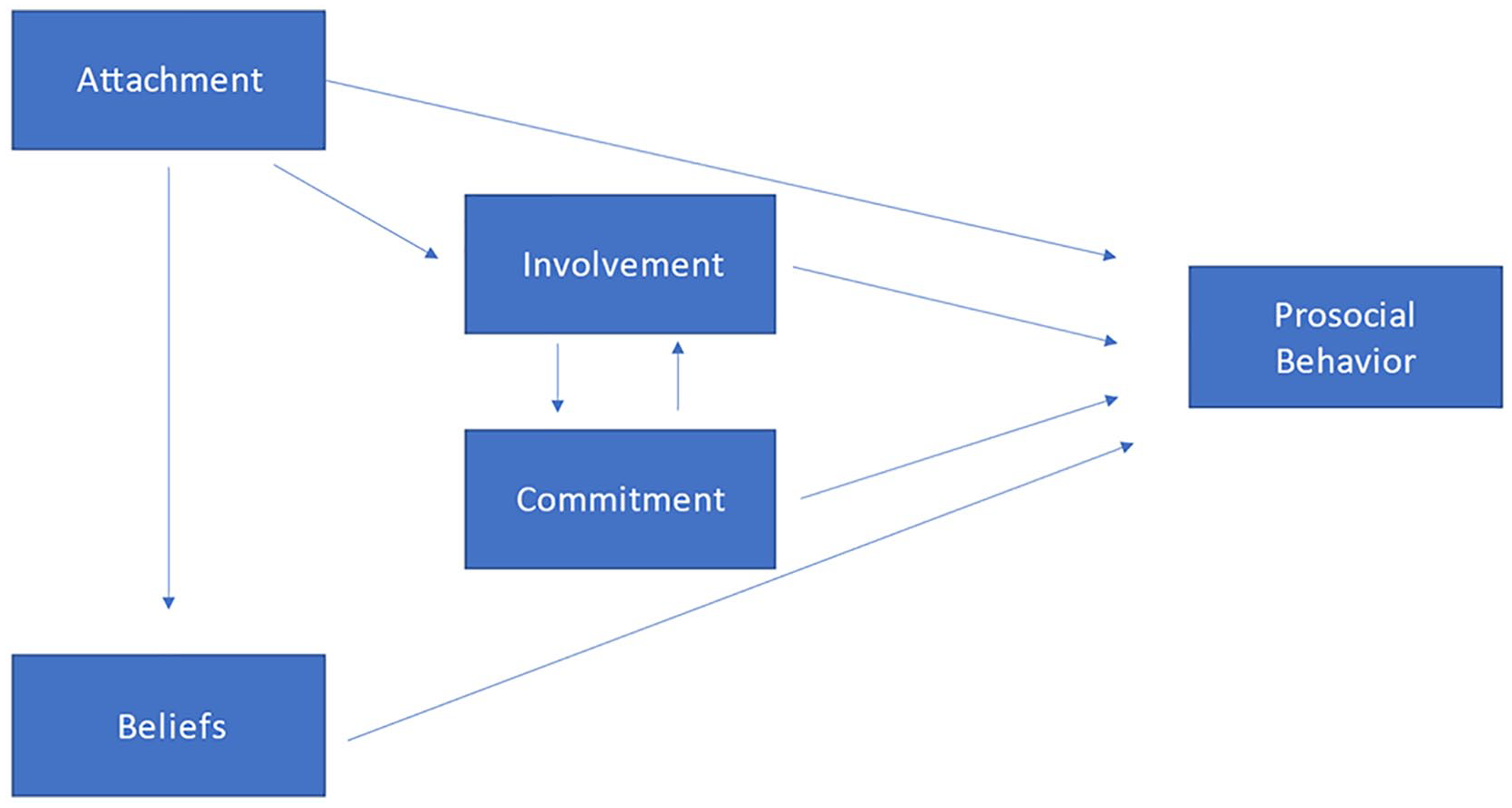
Hirschi’s Social Bond Theory
Second, commitment manifests through the setting and achieving of life goals. Often characterized as one’s investment in society, it traditionally includes concepts like commitment to educational success, building a family, building a career, or establishing a good reputation. Commitment to these goals deters involvement in delinquency because of the risk it poses to future achievement (Hirschi, 1969; Schroeder, 2014). The third element is involvement in conventional activities within society, focusing on how and with whom people spend their time. Hirschi theorizes that engaging in prosocial activities reduces delinquency among youths. This is due to the loss of free time when doing prosocial activities (e.g., schoolwork, afterschool jobs, sports). Furthermore, engaging in activities with prosocial peers reduces the time available for delinquent associations (Hirschi, 1969).
Last is the component of belief in society’s common values and institutions (e.g., schools, workplace, police). When a person believes that the rules and institutions of society are fair and just, they are more likely to adhere to them and not engage in delinquency (Hirschi, 1969; Schroeder, 2014). Adherence includes feeling a moral obligation to contribute to society and respecting the importance of laws and authority figures. Belief in society’s common values makes it more likely that youths will restrict delinquent behaviors.
Sociostructural changes to society (e.g., the economy, the job market, social norms) affect how young people access or are expected to access social bonds. To account for these shifts in generations since Hirschi’s (1969) social bond theory, Sampson and Laub (1993; Laub & Sampson, 2003; Laub et al., 2018) developed an age-graded approach that integrates social control and life-course perspectives. These works note that as young people age and mature, their place in society shifts allowing for transitions in and out of risky behaviors. Through this transition across life stages, new turning points and contexts for social bonds can facilitate the processes of desistance. While age-graded theory recognizes that sociostructural changes have delayed many turning points, it does not account for the difference in how emerging adults view and interact with social institutions. Furthermore, it does not acknowledge the extended lifestyle exploration young people engage in during this transitional stage of emerging adulthood.
Emerging Adulthood Theory
Shifts in societal norms related to developmental trajectories across the life-course and markers of adulthood led to the development of a theory of emerging adulthood. Arnett (2000, 2016) conceptualized emerging adulthood as a period of development that starts in the late teens and lasts through the mid- to late-20s and is distinct from both adolescence and young adulthood. A distinguishing factor of emerging adulthood is the instability experienced by youths, which facilitates exploration during this life phase. This exploration exists across several contexts, including ties to formal and informal social controls. In addition, it may increase engagement in risky and deviant behaviors (Arnett, 2005; Salvatore, 2017).
This phase in the life-course exists due to shifts in societal norms, which afford emerging adults a prolonged period of identity and social role exploration. These shifts include delayed onset of marriage and parenting, seeking a meaningful career, pursuing higher education, and embracing identity exploration (e.g., Arnett, 2000, 2016; Shanahan, 2000). In addition, environmental barriers (e.g., job market, economic stability) impede attaining traditional adulthood roles, such as stable employment and home-ownership (Côté & Bynner, 2008).
Within emerging adulthood, young people have left adolescence’s dependency and social structure while not yet establishing a fully realized adult self in society (Arnett, 2000). For example, emerging adults are no longer subject to the purview of others (e.g., teachers, parents) and have different expectations of social relationships with peers, romantic partners, and parents (Salvatore, 2017). As a result of these shifts, scholars acknowledge that traditional adulthood turning points (e.g., marriage, parenting, employment) are not reached until the later 20s and early 30s (Furstenberg et al., 2005). By delaying these transitions to adulthood into the late-20s, emerging adults are free to explore the potential trajectories of their lives (Arnett, 2000). Emerging adults, thus, tend to view formal and informal social institutions as avenues to explore and experiment, including in the contexts of relationships, careers, and worldviews.
Experimenting With Social Bonds in Emerging Adulthood
Identity and social role exploration is one of the defining characteristics of the phase of emerging adulthood. Young people in this phase experiment with their social bonds to society in an effort to identify who they are within the context of society. This has theoretical implications for what social bonding looks like for emerging adults and the mechanisms through which this bonding can occur. Exploration for emerging adults is conceptualized within three categories: social relationships, careers, and worldviews.
First, emerging adults experience changes in the form and function of their relationships (i.e., attachments). In this life phase, emerging adults often seek financial autonomy from their parents, with an emphasis on independent housing (e.g., Arnett, 2000, 2016). Unlike in adolescence, this autonomy may be central for emerging adults to maintain a positive attachment to parents (Dubas & Petersen, 1996; Fingerman & Yahirun, 2016; O’Connor et al., 1996). Outside of this, emerging adults are also engaging in exploration within their peer and romantic relationships. They begin to focus on the quality and depth of these relationships to facilitate the development of small support systems, which are imperative in supporting the processes of self-exploration (Barry et al., 2016; Shulman & Connolly, 2013, 2016).
The second type of exploration occurs in careers and employment (i.e., involvements). Emerging adults emphasize the career as an avenue for self-expression and enjoyment, differing from earlier generations’ views that work is an unpleasant but necessary function of adulthood (Arnett, 2004, 2015). This shift in perspective encourages exploration within the context of a career, allowing emerging adults to try potential career tracks without feeling obligated to fully engage in these career tracks until they identify one which has significant meaning for their adult self. Furthermore, the emphasis on higher education and internships allows college students to utilize their educational process to explore careers (Magolda & Taylor, 2016; Marshall & Butler, 2016).
Finally, emerging adulthood is distinct from other life-course phases due to the exploration of worldviews (i.e., beliefs) and personal values (i.e., commitments). This process in emerging adulthood is characteristic of and imperative to the process of cognitive development (King & Kitchener, 2016; Perry, 1999). Emerging adults prioritize establishing their own values systems and worldviews as an indicator of their maturation and development (Arnett, 1998, 2000). This process is primarily grounded in taking ownership and responsibility for their behavior and independent decision-making (Arnett, 1997, 1998, 2000; Greene et al., 1992; Scheer et al., 1996). This process facilitates how emerging adults construct their belief systems about the world, including their communities and place within them influencing how they build their commitments and beliefs within society.
Social Bonds and Deviance in Emerging Adulthood
Research on emerging adults with histories of delinquency suggests that this phase may facilitate or exacerbate deviant behaviors. Identity exploration may enable engagement in risky behaviors or criminal offending (Chassin et al., 2002). Aspects of emerging adulthood may threaten desistance for emerging adults with histories of delinquency, which can facilitate substance use, financial problems, and recidivism (e.g., Moffitt et al., 2002; Piquero et al., 2002). Emerging adults with delinquent pasts are less likely to experience traditional informal controls, like marriage or full-time employment, than their peers without histories of delinquency (Kang, 2019). When they eventually encounter these turning points, it is typically later in life (Kang, 2019).
Researchers in criminology have begun to examine the applicability of social bond theory to emerging adulthood. Examinations of social bonds within emerging adulthood have thus far largely focused on applying the four traditionally conceptualized social bonds to this phase in the life course. This research has shown mixed results in demonstrating the influence of traditionally conceptualized social bonds for emerging adults. Considering the new context of formal and informal social controls for emerging adults, this is not surprising.
Salvatore and Taniguchi (2012) examined whether social controls influenced criminality or deviance among emerging adults utilizing the National Longitudinal Study of Adolescent Health data. Their research found that their operationalized social controls generally played a statistically significant role in influencing criminal or deviant activity as expected (see Salvatore & Taniguchi, 2012). These included many traditional components, such as parental attachment, being married, having children, attending religious services, and owning property. However, they also found that some traditional social controls, such as military service, education level, and hours worked at a job, had no significant influence on criminal or deviant activity. Instead, they found that job satisfaction and economic stability had significant effects on reducing criminal or deviant activity (Salvatore & Taniguchi, 2012). This suggests that some components of social control may function in line with emerging adult theory.
Researchers have also examined how these traditional bonds function in the transition to adulthood. For example, while closeness and attachment to one’s parents may be a critical turning point, the definition and context of it may have changed. Emerging adults often seek autonomy from their parents financially, emphasized by obtaining independent housing (e.g., Arnett, 2000, 2016). This autonomy may strengthen attachment to parents in emerging adulthood and, in turn, facilitate desistance (Abeling-Judge, 2021). However, the influence of parental attachment may not be equitable across crime type. For example, Lloyd and Turanovic (2020) reported that the cessation of drug and alcohol use by young people may not be affected by the attachment they have with their parents.
Differences in the formation of bonds and influences of social controls are evident across the literature studying the transition to adulthood. The importance of friendships and peers has changed during this life phase as emerging adults seek different types of support from friends than in adolescence (Barry et al., 2016). Friends, for example, may support or inhibit identity exploration, as they serve as the primary support system for emerging adults (Allan, 2008). Friendships and changes in peer groups during the exploration and instability of emerging adulthood remain essential indicators of the developmental process but also reflect the potential changes in social roles while transitioning to adulthood (Barry et al., 2016; Carstensen et al., 1999). During this life phase, emerging adults emphasize a smaller group of friends that they can trust to support their desistance (Nader, 2019). This may influence how emerging adults cut ties with delinquent peers, supporting a transition into prosocial adulthood (Copp et al., 2020).
This research at the intersection of emerging adulthood theory and social bonds provides evidence that both formal and informal social controls have changed for emerging adults. Thus, it is likely that social bonds and controls may not function in emerging adulthood as they have in adolescence. However, questions remain on precisely what social bonds are essential for emerging adults and how the level of these bonds differentially influences behaviors. As emerging adults do not engage with the same formal and informal institutions as adolescents, the research must address if and how social bonds apply theoretically within the life-course of emerging adults. A reexamination of social bonds and their function within emerging adulthood is necessary to understand how social controls theoretically function within this life phase.
Researchers have called for the consideration of emerging adulthood in the context of classical criminological theories, including social control theories (e.g., Costello & Laub, 2020; Salvatore, 2017). Thus, this study examines how social bond theory may be (re)conceptualized for emerging adults. This research uses a qualitative methodology to understand how emerging adults define their communities, experiences, beliefs, and relationships (i.e., social bonds) and how this influences their transitions into (prosocial) adulthood.
Method
Sample
The qualitative sample consists of 30 young adults between 18 and 32 (see Table 1 for demographic data) recruited for interviews in 2018 and 2019. The average age of participants is 22.6 years old (SD = 3.09), and the majority of participants were men (n = 17; 56.67%). In addition, most participants (n = 18; 60%) self-identified as people of color, with nine identifying as Latino/a, three as Black/African American, one as Asian, four as multiracial/multiethnic, and one as another race/ethnicity.
Sample Demographics
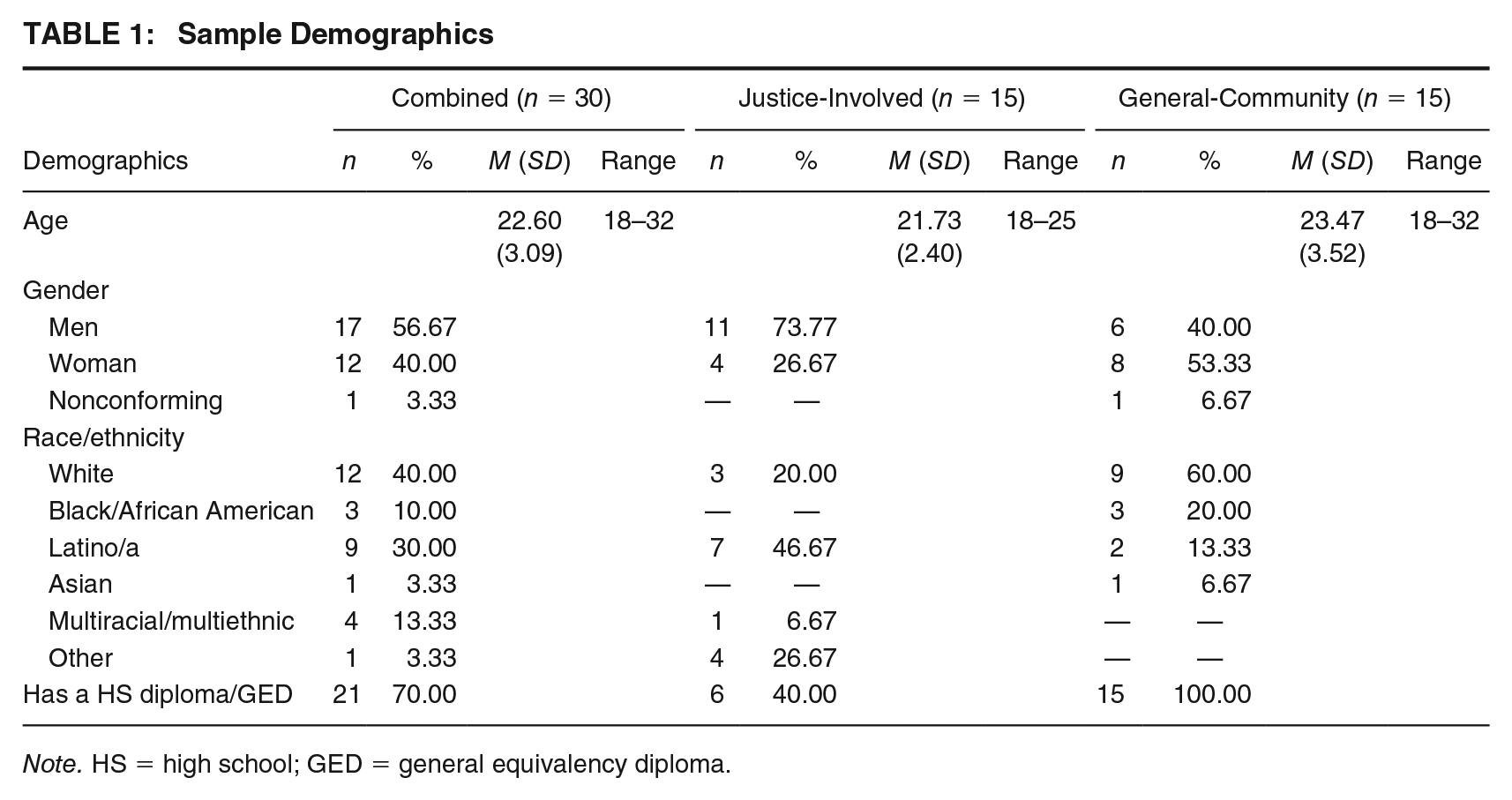
Note. HS = high school; GED = general equivalency diploma.
Participants were purposefully recruited for semistructured LSIs in two groups during 2018–2019. The first group (Justice-Involved group) consisted of emerging adults engaged in a voluntary community-based organization for young people with histories of justice-involvement. This population was selected because they were actively working on the desistance process. This community-based organization supplied young people with day programs, including employment and work training, education, and recreational programming.
Before beginning data collection, the researcher participated in the organization’s programming to facilitate recruitment and a contextual understanding of the organization and the young people’s experiences within it. This included participating in the programming alongside young people and program staff, such as employment training, and spending unstructured time with young people, such as breaks and lunch. Through this process, the young people were introduced to the researcher and were able to informally ask questions about the project. Potential participants were told that the project was conducted independently of the community-based organization. Therefore, program staff would not be informed about their responses or provided any personal information from interviews. In total, immersion in the community group, active recruitment, and participant interviews ran for approximately 11 months.
The 15 participants in the Justice-Involved group, on average, spent approximately 1 year enrolled in a community-based intervention program. The average age of participants in the Justice-Involved group is 21.7 years old (SD = 2.40), and the majority of this sample were men (n = 11; 73%). In addition, most of this sample (n = 12, 95%) self-identified as people of color. Fourteen participants (93.33%) had been charged with a crime, five participants (33.33%) had been incarcerated, and four participants (26.67%) were labeled as gang affiliated. 2 The participant without a criminal charge was gang affiliated.
After data collection and analysis of the Justice-Involved group was completed, we recruited a second group (Local Community group) of emerging adults from the wider community to further examine the concepts seen in the Justice-Involved group. The second group was recruited from the same area as the community-based program. Recruitment flyers were uploaded to local community forums (e.g., Craigslist, Facebook), posted at local businesses (e.g., coffee shops), and posted at nearby colleges and universities.
The goal for this second sample was to recruit emerging adults from the local population who were not enrolled in prosocial programming. The focus was to understand and compare their mechanisms and processes of building social bonds directly to the Justice-Involved sample to see how they overlapped or differed. This allowed for the consideration of the desistance process of Justice-Involved emerging adults with a comparison of emerging adults in the general population to further develop the theory reconceptualization in this study.
The average participant’s age in the Local Community group is 23.47 years (SD = 3.52), and most participants identified as women (n = 8, 53%). The majority of participants in this group (n = 9, 60%) self-identified as White. The local community participants were asked if they had a history of justice system involvement. Two participants (13.3%) from this group disclosed that they had histories of justice system involvement, one of whom had formal criminal charges.
All participants were 18 or older. Recruitment flyers asked for participants between ages 18 and 25; those above age 25 were not excluded as Arnett (2016) noted that emerging adulthood can last beyond age 25. Consent was obtained from participants for voice recordings of the interviews, facilitating reliability and validity in the coding process (Creswell & Clark, 2011).
Interview Protocol
A narrative methodological approach was used to collect interview data on life histories, including significant experiences and events (Creswell, 2007). A semistructured LSI protocol was employed to support participants in constructing a narrative through significant life moments and developing a life story (McAdams, 1993, 2008). Through LSIs, participants author an integrative story that links past reflections with present realities to construct a vision for the future (Erikson, 1968; McAdams, 1988; McAdams et al., 1996). The LSI template was modified to capture specific life experiences for this sample. Personal ideology and reflection sections were removed, and questions addressing social and environmental factors specific to this population were added. This allowed participants to include experiences in their communities and social relationships in their life story narratives. Interview questions were informed by the existing literature reviewed above, work that has adapted the LSI for similar populations (e.g., McAdams et al., 1996; McCabe & Dinh, 2018), and recommendations for modifications proposed by narrative experts (Adler et al., 2017).
Analytic Plan
This research draws on a grounded theory methodology with some modifications to reconceptualize Social Bond Theory for emerging adults. This study utilized sampling toward theoretical saturation in each group’s data collection. Interviews were analyzed after collection, and the findings informed subsequent data collection. Second, the researcher was immersed in the field before and during the recruitment process for Justice-Involved participants. Immersion was not applicable to Local Community participants.
Unlike grounded theory, this study did not apply a true inductive analytic coding process, as its focus was on reconceptualizing existing theory. The coding process instead applied a “theoretical” thematic analysis (Braun & Clarke, 2006), drawing from previous research and theoretical themes. It utilized abductive coding in place of an inductive coding to facilitate empirically based theory reconstruction (Deterding & Waters, 2021; Timmermans & Tavory, 2012). Abductive coding acknowledges that qualitative research may not be truly inductive because of exposure to previous research and theory, while allowing for analysis to be open to unexpected or divergent findings (Timmermans & Tavory, 2012).
Interviews were professionally transcribed and coded using NVivo 12. The coding process followed the constant comparative method to facilitate the validity of the coding scheme (Glaser & Strauss, 1967). This combined systematic data collection, coding, and analysis with theoretical sampling 3 to support theory generation (Conrad et al., 1993; Glaser & Strauss, 1967; Kolb, 2012). After interview data were collected from participants, it was analyzed and coded. The findings informed theory development through theoretical sampling, enabling the researcher to seek additional participants and data to refine this coding scheme while gaining new insights (Strauss & Corbin, 1998; Taylor et al., 2015). To support data validation and theory development, the coding examined negative cases, or those that are distinct from the majority of data collected and included concepts inconsistent with existing or emerging findings (Taylor et al., 2015).
An initial coding scheme was developed after the first five interviews, which was informed by existing literature while allowing for new themes to emerge in the coding process. This included coding for the data for themes of the four components of social bonds (attachment, commitment, involvement, and belief). Open coding techniques were used throughout the coding process, including comparing across participants, conceptualizing codes, and then categorizing data (Strauss & Corbin, 1998). After the initial coding scheme was developed, axial codes were created, allowing central themes to be refined into more specific categories and concepts, such as types of turning points and quality of relationships. As recruitment continued, new findings were integrated until reaching a point of saturation.
Results
Through their narrative interviews, participants were asked to discuss key life events related to their transition to adulthood. This analysis examines the components of this transition into adulthood through the social control perspective for participants enrolled in desistance programming. In addition, it examines participants’ narratives from the same community to identify the thematic commonalities and differences between these two groups. Ultimately, this context sets the stage for identifying how social bonds are built within the environment of deviance, desistance, and maturation for participants. First, the results will review themes within the classic conceptualization of social bonds and its four components. Then, a reconceptualization of social bond theory is offered for young and emerging adults.
This analysis examines the desistance process for the Justice-Involved group through the social control perspective. Overall, these participants recognized that reducing or stopping their engagement in crime plays a vital role in their transition into adulthood. In addition, participants acknowledged the role of desistance behaviors in their maturation. They also expressed hope and belief that others will recognize this desistance as a sign of their maturation. Thus, the process of desistance played a crucial role in their identity narratives. Similar revelations about maturation were reported by the Local Community group, although they did not discuss it as desistance from crime. Instead, it was presented as taking on new challenges in their lives (e.g., school, relationships, careers) that they identified as vital to their maturation process and identity development.
Attachment
When describing attachments, participants focused on the quality and context of significant relationships rather than the quantity. Participants wanted to establish reliable social networks that supported their transition into adulthood. Although this was true for both groups, those with histories of justice involvement heavily emphasized this trust and loyalty in supporting their desistance process. Attachments within several categories of people were noted consistently, including parents, peers, romantic partners, and children.
First, participants described seeking to establish independence from their parents as a crucial part of their maturation and transition into adulthood. Definitions of parental support varied across participants, but generally, participants noted that relationships with their parents should primarily be emotional or personal—and should move away from financial support while transitioning to adulthood. A signifier of participants’ independence was the ability to establish housing independent of their parents. Although traditionally, independence is conceptualized and operationalized as home-ownership, our participants often defined it as renting. This aligns with the emerging adulthood literature on delays in home-ownership during the life course (e.g., Côté & Bynner, 2008; Warner & Remster, 2021).
Participants also emphasized the importance of their parents viewing them as independent adults to their identities. Interviewees farther along in establishing independence from parents (e.g., obtained independent housing and financial autonomy) noted that their relationship with their parents had improved since adolescence. Josephine, a 25-year-old Black woman from the Local Community group, discussed how establishing independent housing helped her parents respect her as an adult instead of viewing her solely as their child.
I also appreciate that they, you know, respect me as an adult . . . I’m like they’re adult kid. They don’t, they don’t treat me like a child. You know, I’ve seen some people with their parents like no matter how old they are, you, you’re just going to be treated like a child and not respected. But I value that my parents respect me as an adult, you know, so I’m having my own household and, you know, not necessarily living with them.
Jason, a 19-year-old White man from the Local Community group discussed how living apart from his family gave him independence, stating that his “living style is not really conducive to living with [his] parents.” He described how living separate from his parents improved their relationship as he was able to be more himself. Jason’s remarks illustrate how he could now behave in a way aligned with his own self-perception, and distinctly from when he had lived with his family.
For participants from the Justice-Involved group, parents played an important role in desistance. Participants often looked for parents to support them in becoming adults instead of continuing to treat them as youth. Often, they perceive this treatment from their parents as a demonstration of their belief in them, their desistance from crime, and validation that they are successfully transitioning to adulthood.
The second area of attachment that played a significant role in how participants defined their transitions into adulthood is relationships with peers. Primarily, this was grounded in the process of knifing off “bad” friends (e.g., Elder, 1998; Farrall, 2002; Laub & Sampson, 2003)—or those who they viewed as being disloyal or not trustworthy. Justice-Involved participants spurned peers who continued engaging in deviant activities they were trying to avoid. Participants acknowledged that this process was not easy—expressing that they felt strongly tied to their peers, so it was not simple to distance themselves.
Overall, participants emphasized the importance of friendship quality over the number of friends they could claim, including characteristics like loyalty, trust, and support as the defining factors of friends. They wanted friends who would be there and support them through bad moments. Sebastian, a 24-year-old multiracial man from our Justice-Involved group, expressed this by talking about “fake ass friends” who used to “push [him] to do some dumb shit over and over.” He acknowledged that these friends do not have his best interests in mind and are not trustworthy, and thus cannot support his desistance process. Sebastian discusses how he would rather be alone than spend time with people he cannot trust: I’d rather be by myself chilling in my crib, on my porch, whatever, listening to some music. By myself. Knowing that I’m good. If I shit my pants right now, chilling on my porch, I shit my pants, I’m with nobody. This n****r can’t tell nobody. But if I’m with somebody, I’m like, “This n****r probably going to tell a bitch that I shit my pants.” Knowing that I’m safe, whatever I do right now, it[will all] come falling down with doing a crime. Are you with somebody that’s fake? When they get caught, they going to tell on you? It all comes down, even with little things in life that I experience with fake people.
Sebastian’s example of a potentially embarrassing moment that he would not want shared with others is a metaphor for trust. If something embarrassing or compromising were to happen with him, he would rather experience it alone than do so with people who he cannot trust. This reflects the importance of trust and loyalty in friendship for emerging adults, who now rely on friends as their primary support group, unlike adolescents (Allan, 2008).
Sebastian continues to elaborate that not everyone is going to be “fake” or untrustworthy: Not everybody’s going to be like that. Not everybody. 75, 90%, yeah. But it’s like a little 10%, 15% of real people are like you . . . that will love you the same way you love them. Cherish the friendship like you do. If I call you my brother, if you’re my friend, I don’t call you a friend no more. You’re my brother, my family. You’re family.
Similarly, Colby, a 20-year-old White gender-nonconforming young adult from the Local Community group, notes that loyalty and trust do not equate to condoning poor behavior: I haven’t had many people sit there and say, “You know what, [Colby] ’s made some bad decisions in her life, but I still stand by her as a friend.” ’Cause she doesn’t excuse my toxic behavior; she doesn’t stick up for me when I’m being a bad person. But she will stand by my side and wait for me to get better, and help me when I ask for the help.
Here, Sebastian and Colby explain that the most important social connections are recognized as such, further separating those deemed trustworthy. Although most participants noted only a few ties to peers they consider important, they consistently identify these as trustworthy, reliable friends.
The third facet of attachment is romantic relationships. While romantic relationships and marriage have been viewed as key social bonds in the past, Justice-Involved participants did not emphasize romance as a critical turning point in their adulthood. Many explicitly stated that their partners did not play an essential role in transitioning into adulthood or desistance. In contrast, many Local Community participants recognized the importance of romantic relationships in their transitions to adulthood. For example, Josephine, a Local Community participant, discussed that despite college, she did not feel prepared to be in a “real” relationship when she met her now-husband: And then so meeting him at that time was like this awakening of like, “Okay. I need to mature. I don’t know the first thing about relationships. I don’t know the first thing about kind of like communicating and dealing with conflict with another person like that.” So, I felt like that was a huge turning point for me to, okay, I need to grow up. Like, yes, um, I have college education, I’m smart, but I need relationship education. Like I need how, I need to know how to do this. So, that was a turning point for me, meeting him and then us becoming so serious after like a few months and . . . Yeah. That was huge.
This difference between the groups may be attributed to the delays that Justice-Involved participants face compared with peers in the wider community (e.g., Schiraldi et al., 2015). Thus, it is likely that romantic attachments function differentially in these groups.
The final category of attachment is parenting, which differs across our samples. About half of the Justice-Involved participants were parents, while there were no parents in the Local Community group. Parent participants emphasized the importance of being a good parent in their own transitions into adulthood and desistance process. Steve, a 25-year-old White man from the Justice-Involved group, discusses how having to consider his child in addition to himself was the impetus for his desistance. Here, he describes the high point of becoming a father: It’s my first kid too, so it’s big. It’s just life-changing. Now I have to not worry about only me, but him. I have to support him and just before I didn’t have to do a lot. I didn’t have to go work to have money to buy food for him, diapers. Just being a father. Just being there for him even if it isn’t diapers and stuff like that. Just being with him instead of in jail or on the streets.
For Steve, fatherhood is tied to desistance. He understands that by continuing to engage in crime and becoming incarcerated, he would not be able to be the father he wants to be for his child. Thus, taking on this role of fatherhood facilitates a critical social bond with society and is vital for his identity transformation and transition into prosocial adulthood.
Parenthood is also important for mothers’ desistance. Emma, a 22-year-old multiracial woman from the Justice-Involved group, noted that becoming a mother limited her ability to move about freely, even for everyday tasks: It’s hard even taking out the trash. I can’t take out the trash with the baby. You have to wait until someone comes.
Emma says that she has to wait for another person, usually her mother, to come home and help with the baby so that she can complete basic tasks like taking out the garbage or laundry. Her struggle to complete daily tasks illustrates many mothers’ reduced mobility and is likely a factor in their desistance.
Commitment
Participants in both groups expressed the desire to adhere to the prosocial norms of society. Both groups consistently identified key themes of commitment through their future hopes and goals, such as wanting an education or training for their career, establishing a meaningful career, wanting a family, owning a home, and establishing financial stability. For example, Sofia, a 25-year-old Latina woman from the Local Community group, talks about future plans for meaningful work based on her current work in behavioral services: I wanna open uh, . . ., behavioral services [company] . . . Maybe with, like, a friend or something that I meet through my company now . . . just because I think there’s a pretty big need for behavioral services, and, like, more autism wards, and people who work with, like, autistic kids. . . . I think there is a big need for that, and . . . Yeah, I wanna see that become a bigger—have more support in the school systems.
She identifies this work as meaningful as it fulfills a societal need and expands her career, allowing her to own or co-own a business. Justice-Involved participants expressed a similar commitment to a prosocial future, but they specifically identified the importance of these commitments in motivating their desistance. By visualizing the future and steps toward these commitments, they can work through their transition to adulthood and embrace desistance.
For example, Carlos, a 21-year-old Latino man from the Justice-Involved group, discusses his desire for a meaningful and enjoyable career: I really want to be an EMT. I know they don’t make money like that, but that’s something exciting and I want to do something that I love. . . . I don’t want to have a job where I’m just like, damn, I don’t even want to go in, and then be miserable the whole day. It’s terrible. Because I’ve dealt with it. I just feel whatever makes me happy in the end and if there’s money in my pockets, and my son’s all right, then what could be worse?
Carlos expresses the meaningfulness that most participants desire from their work and the aversion to jobs that make them “miserable.” However, it is crucial to acknowledge that these commitments were directly tied to participants’ involvement, as discussed in their narratives. Thus, the mechanisms of this component may differ in accordance with involvement.
Involvement
Participants viewed their involvements as being driven by the commitments they intend to adhere to. This is distinct from adolescence, where things like extracurriculars and afterschool jobs are the focus of involvements. As emerging adults transition to adulthood, they recognize the importance of how they spend their time and how this connects to maturation. Involvements, thus, no longer function as stopgaps so they do not have time to engage in crime. Instead, involvement is centered in commitment and works toward goals of commitment.
For participants, involvement is often defined through their commitment to employment. The Justice-Involved group’s engagement in the program and access to education (e.g., general equivalency diploma [GED], community-college-level courses) and job training drive their commitment goals. For example, Sebastian from the Justice-Involved group describes how the program prepares him: Being at [this community-based organization] is a life project because what I’m coming to do every day, coming in, is to try to perfect culinary . . . my cooking craft. What is that doing for me is making me experience more, experience, and they pay for the certificates. Your manager at ServSave, they pay a lot of money for you to just come up. When you go into a real establishment, you come to the boss like, “Yo. Here’s all my paperwork. Here’s my resume.”
For the Local Community participants, involvement is defined as employment or higher education. Sofia from our Local Community group describes her commitment to her life goals of grad school and a family and the need to complete school before having children: . . . I wanna go to grad school, and it’s for two years, and I would like to do that before I have kids, and I’ve tried to plan it out so, like, that I would be, like, pregnant while in grad school, and then to have my kids, like, after—after I take my exams— . . . I don’t know how much you can really plan that out, but I—I’ve just seen a bunch of other parents go through, like—either any type of school or just be too busy for their kids, and it have a really bad effect on their kids, and I don’t want to put my future children through that. So I would rather push myself to go to grad school and get my schooling done, and get my career kind of on a good path before I introduce the kids to this world . . .
Both Sebastian and Sofia describe how their commitments to future goals drive their choices in involvements within their transitions to adulthood. Participants in both groups also acknowledge how barriers (e.g., financial trouble, difficulty finding an enjoyable job, family struggles) may inhibit or impede their trajectory from the ideals of commitment to their tangible involvements. Yet, they still internalize the expectation of maturation and progress into adulthood (Coyle, 2019; Matza, 1964) both generally and within their individual relationships (e.g., Umamaheswar, 2018, 2020).
Belief
Most participants expressed belief in society’s common values and acknowledged that they should adhere to them, including participants engaging in the desistance process (i.e., collective efficacy; Sampson et al., 1997). However, participants also explicitly stated that these values were not drivers of their behavior. Participants view behavior indicative of the belief component as markers of adulthood, or something that real adults do. Yet, participants acknowledge that these values do not directly influence the decisions they make at this life stage, and instead propose that these values may influence their future, fully realized adult selves.
Eric, a 23-year-old White man in the Local Community group, highlights this when discussing his place within the community, and responsibility for behaving in line with his community’s values and being involved with people living in his community: I don’t know if I’d say I have a responsibility to. I just think if, if I wanted to, I think I definitely could, um, ’cause I have the ability to . . . probably not right now . . . I think when I’m more financially secure and able to worry less about myself, um, I think I could be able to help people . . . I kinda owe that responsibility to myself to kinda worry about myself before I’m able to help other people.
Here, Eric is acknowledging that he recognizes the value of supporting others in his community, in line with collective efficacy. However, he also recognizes that he has not reached maturity in society (financially, emotionally, personally) to allow for the values he holds to influence his behaviors in his community. Thus, some participants acknowledge it as something they want to engage in once they reach adulthood. Lena, a 23-year-old Asian woman from the Local Community comes to a similar conclusion. After discussing her community and being asked about her role in that community, she explains “I don’t know if I’ve thought that far ahead.”
Belief not motivating emerging adults in this study has overarching implications for how it functions in the context of theory. It may be that the level of belief has a lesser influence on how emerging adults interact with society, which then alters how belief is perceived to influence deviant behavior. Furthermore, as others have noted, changes in sociostructural shifts and belief in society’s common values may not be as crucial for emerging adults as they are theorized for adolescents or previous generations (Arnett, 2000; Elder, 1998; Sampson & Laub, 1993).
Reconceptualizing Social Bonds for Emerging Adults
Based on the findings of this work, coupled with the extant literature on emerging adults, a reconceptualizing of social bond theory is proposed for this population. This has two components: Attachment and Commitment Through Involvement (see Figure 2). Two distinctions exist in the framework of this reconceptualization as compared with classic social bond theory. First, the components of commitment and involvement are merged into one domain because of how involvements are driven by commitment within this life phase. Second, and potentially more controversially, is removing belief from this reconceptualization. Removing belief is proposed because it is not identified as a behavioral driver for emerging adults. Instead, the expectations of belief are viewed as a behavior to engage in once adulthood has been reached. Rather than attributing the concepts of belief (e.g., communality, collective efficacy) to social bonds, it may be more imperative for researchers to explore these components directly through their topics or other theories and understand how they function adjacently to social bonds.
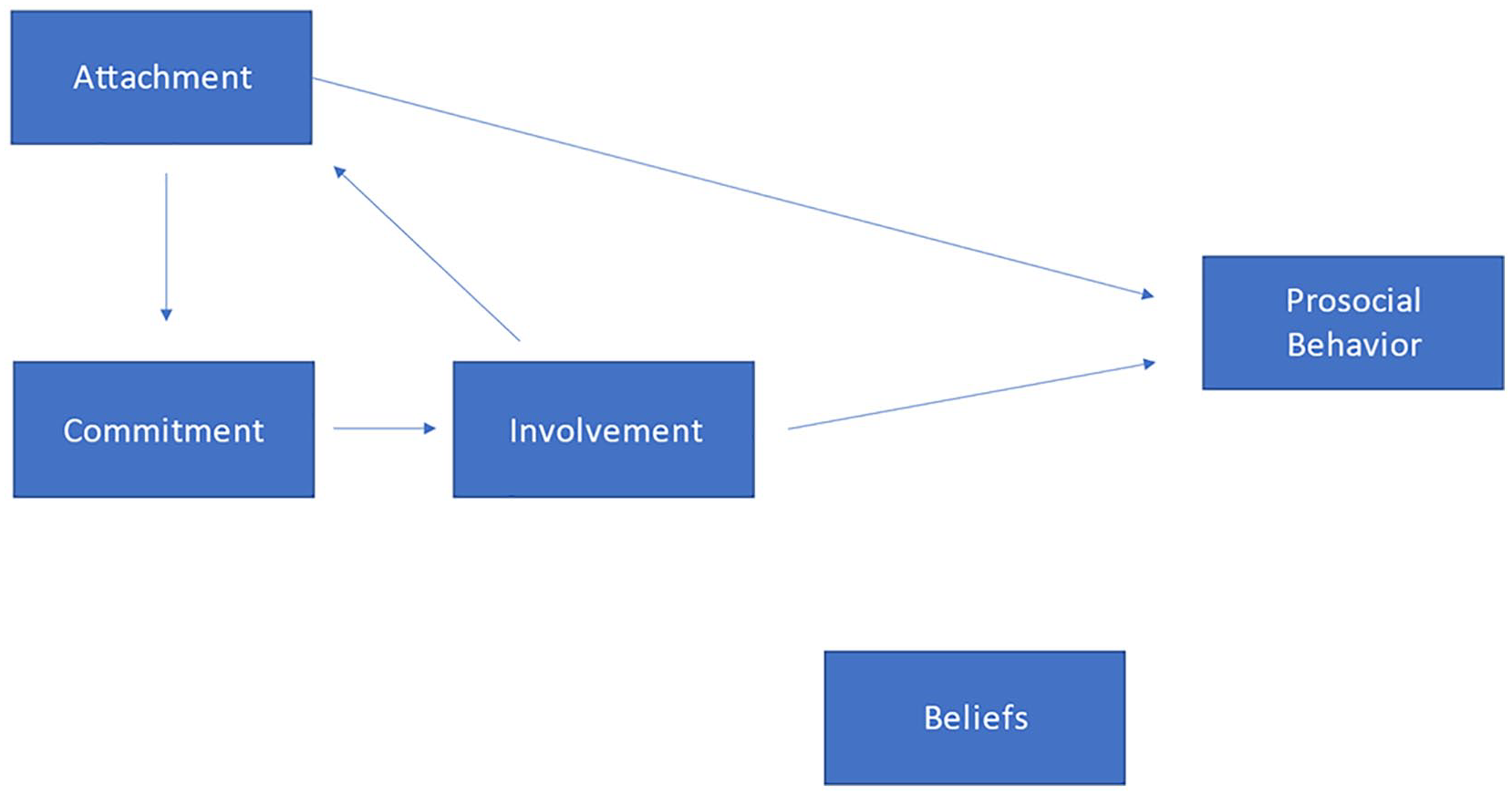
Social Bonds for Emerging Adults
Attachment largely functions the same in this reconceptualization as in the classic social bond theory. However, here Attachment is defined by different domains than the classic to meet the reality of young and emerging adults. While this analytic process identified to four crucial groups (i.e., parents, peers, romantic partners, and children), attachment is not necessarily limited to these types. Here, it is proposed that the quality of attachments is imperative to understanding how Attachment functions as a social bond in emerging adulthood. For example, Josephine from the Local Community group discusses the closeness and trust she feels from her intimate peers: . . . I honestly think that what makes them different is just . . . the frequency in the communication, um, but also you just, you, you just have your people that you know if I was in a bind, if I needed something, I could go to these people no questions asked and they’d be there for me. And I could just always, just explain later.
The quality of the attachment here is different than that of other peers. Josephine notes that the frequency of interaction and reliable support from her friends defines these relationships. Thus, measuring this quality of attachments (and not just their presence) can help researchers to understand how these relationships can differentially influence behavior and desistance within the transition to adulthood. Specifically, changes in attachments in social networks may be imperative to know how young people engage in desistance and transition into adulthood.
The second component is Commitment Through Involvement. In this reconceptualization, it is evident that these domains are intertwined for young and emerging adults. This connection is not necessarily unprecedented, as Hirschi (1969) discussed the interrelated nature of the four components of social bond theory (see Figure 1). However, this component is distinct because for emerging adults, the concepts of commitment and involvement function as one element driving behaviors. Colby from the Local Community group illustrates this as their commitment to future goals through involvement in traditional institutions: Well, the next chapter for me is going to be something, but I don’t quite have planned out being completely honest with you. But what I do know is in the next five years, I plan on at least going to college. And I know that I plan on at least thinking of things that are, kind of, grand in schemes. Not because I want to just come up with these stupid, uh, big ideas. But, I want to plan for grand things in the future.
While Colby does not have set goals, they focus on creating a plan for the future with the understanding that college is the path to explore and achieve those goals. The components of commitment and involvement are interwoven to the point that they become a singular component for emerging adults. Therefore, there remains a need to measure what types of involvement young people engage in. In addition, it may be valuable to consider the context of commitment in conjunction with involvement.
Discussion
This research examined the narratives of 30 emerging adults in their transitions into adulthood. Two groups were recruited, one actively enrolled in community-based desistance programming and one drawn from the local community. Participant narratives were examined for themes of classical social bonds (Hirschi, 1969), and the findings support our reconceptualization of social bonds theory for emerging adults. In this reconceptualization, two components are proposed: (a) Attachment and (b) Commitment Through Involvement.
The component Attachment functions theoretically similar to the traditional component. When prosocial attachments are strong, emerging adults feel motivated to engage in desistance or avoid deviance. However, the form of Attachment is distinct among emerging adults because of changes to social relationships, which aligns with emerging adulthood theory research. For emerging adults, four groups of social relationships are crucial: parents, peers, romantic partners, and children. The quality of attachment is emphasized by emerging adults seeking support from these relationships during maturation. In addition, these relationships are distinct in their needs and expectations compared with relationships during adolescence and adulthood.
Specifically, emerging adults emphasize wanting to build emotional support and connection with parents while wanting their parents to acknowledge their maturation. However, unlike adolescence, attachment with parents can be strengthened by reducing financial support (e.g., housing, paying their bills). Emerging adults also emphasize choosing to reduce their friend groups, actively “knifing off” friendships that do not support their transition to adulthood (e.g., Elder, 1998; Farrall, 2002; Laub & Sampson, 2003). Participants with children emphasized the importance of these relationships in their transition to adulthood. The financial, temporal, and emotional responsibilities of parenting drive participants toward prosocial behaviors. For participants in the Justice-Involved group, parenthood was a crucial motivator for desistance.
When comparing emerging adults from the two groups, some distinctions existed in romantic relationships’ needs and expectations. Specifically, Justice-Involved group members placed less emphasis on the importance of romantic/marital partnerships in their transition to adulthood than those in the Local Community group. This has important theoretical implications, as marriage has been emphasized as a significant turning point (e.g., Kang, 2019; Laub & Sampson, 2003; Sampson & Laub, 1993). Without access to this turning point, the landscape for desistance within the life course may function differently for justice-involved emerging adults.
The second reconceptualized component is Commitment Through Involvement. Here, participants emphasized the connectedness of their commitments and involvement. This is distinct from adolescence, where commitments and involvement are not integrated and do not rely on each other to facilitate desistance or as a protective factor from deviance. Instead, emerging adults likely choose their involvements and structure how they spend their time based on their commitments. Thus, having commitments to society’s shared values facilitates choices for involvement. This aligns with research examining emerging adult theory which posits that emerging adults make choices to establish meaning and fulfillment in adulthood in areas like employment and education that did not exist in previous generations (Arnett, 2004, 2015). In addition, understanding how social bonds differ for emerging adults enables desistance programming to be tailored to create successful outcomes among this population.
Limitations
As with any qualitative research, limitations exist in data collection and the generalizability of findings. One important note here is the likely bias in the collection of the Justice-Involved sample. Participants in this sample were targeted for recruitment due to their involvement in desistance programming. Their participation in active desistance aligns with the components of social bond theory, including behaviors that help promote prosocial attachments, commitments, involvements, and beliefs.
The Local Community group’s main limitation is the unequal time spent immersed between the two groups. Researchers purposefully recruited from the local population near the desistance program. However, there was no comparable program for the general population, so the researchers had no mechanism to establish long-term familiarity before interviewing.
Directions for Future Research
The findings of this study suggest many directions for future research that intersect the fields of criminology and emerging adulthood. First, future research should examine the experiences of justice-involved emerging adults not engaged in desistance programming as they likely have different connections with society’s prosocial components. Second, future research should also look at diverse emerging adult populations. This will support the importance of these results and provide insight into additional dimensions, specifically surrounding Commitment Through Involvement and how this may influence desistance from crime. Finally, research with intersectional populations of emerging adults, justice-involved and not, would bolster a nuanced understanding of how emerging adults embrace social bonds with society.
Footnotes
Authors’ Note:
The authors would like to thank all of the young people who volunteered to share their stories for this research. The authors would also like to thank Drs. Kelly Socia and Kyleigh Clark-Moorman for their invaluable feedback on earlier versions of this manuscript. In addition, the authors truly appreciate the time and care the anonymous reviewers and journal editors put into this manuscript—it really helped to shape the final iteration, and we are grateful for their insight. This study was funded by the Association for Doctoral Programs in Criminology and Criminal Justice Student Research Funding Opportunity (Fall 2018, awarded to Elias Nader) as well as the University of Massachusetts Lowell Graduate Student Association.
