




Abstract
Using survey data from a sample of 1,435 Ukrainian and Russian adults, this study examines the interplay between collective processes, individual-level self-control, and offending. Multilevel regression models estimate the direct effects of neighborhood-level self-control, perceptions of sanction risks, and strain on criminal behavior, showing how these contextual factors condition the association between individual-level self-control and offending. Findings suggest that collective self-control and perceived sanction risks are important moderators of the self-control–crime relationship at the individual level, highlighting the protective effect of high self-control on offending in neighborhoods with strong collective self-control and sanctioning climates. Overall, the study stresses the importance of exploring the role of neighborhood processes beyond social disorganization in the self-control–crime nexus.
Introduction
Self-control theory (Gottfredson & Hirschi, 1990) argues that individuals possessing characteristics such as impulsivity, risk-taking, and self-centeredness share the trait of low self-control and that the inability of weakly controlled individuals to appreciate the long-term effects of their actions makes them particularly likely to engage in crime. Although the instigating effect of low self-control on crime has been confirmed in multiple studies (see Burt, 2020; Vazsonyi et al., 2017), research suggests possible weaknesses in self-control as a hegemonic predictor of crime (Gottfredson & Hirschi, 1990). For instance, studies have documented a number of individual-level factors that condition the relationship between self-control and crime, including perceived costs of offending (Tittle & Botchkovar, 2005), strain (Botchkovar et al., 2009; Turanovic & Pratt, 2013), and criminogenic exposure (Botchkovar et al., 2009; Desmond et al., 2012; Grasmick et al., 1993; Hirtenlehner et al., 2015). There is also evidence that the effect of self-control on crime is influenced by various neighborhood characteristics (e.g., A. M. Jones, 2017; Zimmerman, 2010; Zimmerman et al., 2015).
To date, most research investigating the interactive relationship between self-control and neighborhood characteristics has done so through the lens of social disadvantage (e.g., Gibson, 2012; Vazsonyi et al., 2006). Fewer studies have evaluated the role of neighborhood-level social processes in the relationship between self-control and crime. Drawing on theorizing by Agnew (1999, 2006), Tittle (2007, 2011), and Wikström et al. (2012), this study introduces several underscrutinized neighborhood social processes—collective self-control, perceptions of risk, and strain—to investigate how they affect the relationship between self-control and crime. Three aspects of this study highlight its contribution to the literature: (a) simultaneous focus on the processes of collective self-control, collective perceptions of sanction risks, and collective strain; (b) assessment of possible multilevel relationships between these processes, personal levels of self-control, and crime; and (c) data from a random sample of adults elicited in the contexts of Ukraine and Russia.
The Conditional Nature of Self-Control
Despite Gottfredson and Hirschi’s (1990, p. 117) claim that self-control should explain “all crimes at all times,” the relationship between self-control and crime has been found to be conditioned by a number of different individual characteristics (Desmond et al., 2012; Grasmick et al., 1993; for example, Tittle & Botchkovar, 2005) and structural conditions at the neighborhood level (e.g., Meier et al., 2008; Pratt et al., 2004; Vazsonyi et al., 2006, 2017; Vogel & Van Ham, 2018; Zimmerman, 2010). Regarding structural moderators, some research indicates that the effect of low self-control is magnified in disadvantaged neighborhoods (Gibson, 2012; S. Jones & Lynam, 2009; Lynam et al., 2000), whereas other studies report that the effect of self-control on crime is heightened in neighborhoods of higher socioeconomic status (Zimmerman, 2010). Still other studies suggest the effect of self-control on criminal behavior is invariant across neighborhoods (Vazsonyi et al., 2006).
Only two studies explicitly have integrated community processes into the logic of self-control theory. Zimmerman and colleagues (2015), using data from Russia and Ukraine, found that the crime-preventive effect of self-control was particularly strong in neighborhoods with lower levels of morality (Zimmerman et al., 2015). In a different study, A. M. Jones (2017) drew on a social learning perspective in arguing that higher levels of aggregate self-control effectively diminish opportunities for “modeling” impulsive behavior. Using two parts of the PHDCN survey, he found that the positive effect of low individual self-control on self-reported delinquency was amplified in neighborhoods with low levels of aggregate self-control. The focus of the study on younger respondents precluded further theorizing about the generalizability of findings to adult community residents.
Overall, the literature concerning the association between contextual factors, individual self-control, and criminal activity is scant. Using a sample of adults of all ages, we expand the scope to neighborhood processes that have the potential to change the relationship between self-control and criminal behavior at the individual level: collective self-control, perceived threat of sanctions in the community, and collective strain. The timeliness of this research is highlighted by Burt (2020), who notes in her review of research on self-control and crime that “increased attention to the influence of social factors and their effects on and interplay with individual differences in shaping self-control processes related to crime could be especially valuable” (p. 63).
Self-Control and Neighborhood-Level Social Processes
Collective Self-Control
Despite the paucity of empirical research linking neighborhood processes to self-control, multiple theoretical perspectives expect the effect of self-control on crime to be influenced by community elements. Perhaps one of the most intriguing ideas has been proposed by Tittle (2011), who speculated that community residents share expectations for how individuals should exercise their self-control. According to Tittle (2011), individuals can “collectively develop processes and institutions for generating stronger self-control in the population” (p. 105), thus building collective self-control consciousness.
Importantly, collective self-control should be differentiated from collective efficacy (Bandura, 1986; Sampson et al., 1997) as a crime-reduction mechanism. While collective efficacy taps into the ability of a community to realize its shared goals by exercising informal social control, collective self-control consciousness (Tittle, 2007, 2011) supports the growth of culture emphasizing the benefits of exercising self-control as well as social institutions that cultivate the development of self-control among individuals. While demonstration of strong self-control capabilities may be rewarded, poorly controlled behavior demonstrated by youth or adults is punished, formally or informally, by community residents. In turn, social institutions, including schools and recreational facilities, aligned with community values, may adopt programs actively fostering the development of self-control. Tittle (2011) uses the examples of Las Vegas and Salt Lake City to show how different community expectations may promote rather weakly controlled behavior in one case and rigid self-restraint in the other.
Consistent with these arguments, studies have found that collective self-control may directly affect crime rates at the county level (Diamond et al., 2018), suicide and homicide at the state level (Findley & Brown, 2018), and homicide rates at the country level (Eisner, 2014). In addition, as mentioned earlier, research suggests that collective self-control may moderate the effects of individual self-control on self-reported offending (A. M. Jones, 2017). Overall, based on Tittle’s theorizing and recent empirical evidence, we expect that community levels of self-control not only directly and situationally affect individual behavior but also condition the association between individual self-control and offending. It would be reasonable to assume that communities providing significant monitoring over individual lives and promoting the culture of self-control will bolster the inhibitive effects of individual self-control on offending. In contrast, communities with lower levels of collective self-control consciousness may provide more opportunities for transgressions and otherwise be a source of learning models conducive to misbehavior, serving as reservoirs of group values associated with criminal conduct (e.g., Felson et al., 1994). In short, the effect of individual self-control on criminal behavior may weaken in less controlled communities because they expose their residents to alternative behavioral models (see also A. M. Jones, 2017 for a similar argument).
Collective Perceived Threat of Sanctions
Individual perceptions of sanction threats have long been established as a moderately effective predictor of offending (e.g., Pratt et al., 2006; Tittle, 1980). Personal risk perceptions have also been reported to condition the relationship between offending and self-control (Pogarsky, 2007; Sellers, 1999; Tittle & Botchkovar, 2005). Although not much is known about the community-level perceptions of sanctions, the possibility of their existence has been raised by Wikström and colleagues (2012; see also Wikström & Treiber, 2007) whose situational theory views community-level deterrence processes as environmental cues potentially affecting individual decision-making and behaviors in situations conducive to crime. For example, strong deterrent qualities of the environment may exert direct effects on individual criminal behavior by eliminating crime as a possible behavioral option for an individual (cf. Antonaccio et al., 2017). Similar to collective self-control consciousness, community-level deterrence may be conceptualized as a cultural element, albeit with an emphasis on external, rather than internal, control. The experiences with sanctions may be vicarious rather than direct for most residents of such communities (Stafford & Warr, 1993). However, these communities successfully promote law-abiding behavior at the institutional level, enlisting community institutions in ensuring compliance with the law.
Community perceptions of sanction risks may also condition the association between self-control and offending behavior. One possibility is that collectively deterred neighborhoods weaken the will of individuals to make independent decisions, thus eroding the relationship between self-control and crime. In this scenario, individual self-control matters far less than the fear of sanctions prevailing in the community. Another possibility is recognized in the literature investigating the association between sanctioning climate and individual crime. Studies show that the crime-preventive effects of various individual cognitive skills are stronger in environments in which sanctions are objectively more certain (Maimon et al., 2012). Following this logic, individual self-control may be particularly salient as a predictor of criminal involvement in communities where perceptions of sanction risks are heightened.
Collective Strain
In his macro-level strain theory (MST), Agnew (1999) theorizes that disadvantaged neighborhoods have higher crime rates because of the stress experienced by their residents. According to the theory, anger and frustration exhibited by those interacting in such communities may heighten the likelihood of negative behavioral outcomes, including violent behavior. Although Botchkovar and colleagues (2018) found no evidence that community strains influenced individual offending directly or in conjunction with individual strains, several studies have documented the direct effects of aggregate strain in the school context (e.g., Brezina et al., 2001). Using a sample of Chinese adolescents, Chen and Cheung (2020) found school-level strains to exert statistically significant direct effects on self-reported delinquent behaviors. Similarly, using a sample of Chinese students from vocational schools, Zhang and colleagues (2020) documented direct effects of classroom-level strain on self-reported delinquency.
Although studies have also documented the existence of a moderating relationship between self-control and strain at the individual level (e.g., Bichler-Robertson et al., 2003; Boccio & Beaver, 2021; Cheung & Cheung, 2010; cf. Botchkovar et al., 2009), researchers have yet to investigate the possibility of an interactive relationship between collective strain and individual self-control. Because collective strain in the community exposes individuals to multiple sources of frustration and anger, it is likely to exacerbate the negative association between self-control and criminal behavior. Furthermore, a frustrated community may be a taxing environment in which to reside, as a result of the heightened probability of angry altercations. Individuals may find themselves exercising self-control too often and ultimately experience self-control fatigue regardless of their actual self-control abilities (Muraven et al., 1998). Thus, living in strained communities may weaken the inhibiting effect of self-control on criminal behavior.
Overall, there are reasons to expect a range of community processes to interact with the self-control–crime relationship at the individual level. These conditioning influences, in turn, are likely to depend on the specific social and cultural contexts in which communities and residents are embedded.
Study Context
Although Ukraine and Russia are politically and geographically distinct from one another, the two countries share many historical and cultural characteristics (Zimmerman et al., 2015). After the collapse of the Soviet Union, each society transitioned to a market economy in a volatile process marked by much political and societal instability (World Bank, 2004). Relative deprivation has been felt more acutely in Russia and Ukraine than in most Western countries. For instance, whereas GINI coefficients would suggest that Russia and the United States have similar levels of inequality and poverty, socioeconomic disparities in Russia and Ukraine are much sharper, and disadvantaged populations in both countries often live in extreme poverty unparalleled in the West (e.g., Round & Williams, 2010). In recent years, growing inequality in the post-Soviet world has contributed to divisions between economically prosperous and nonprosperous neighborhoods (Makhrova & Tatarintseva, 2006). Post-Soviet neighborhoods marked by economic disadvantage are socially isolated, stagnant, and deprived of resources.
The criminogenic situation in economically disadvantaged neighborhoods in Russia and Ukraine is complicated by historically tense relationships between their general populations and police. A recent survey of Ukrainians indicated that about half of the country does not trust police officers and more than 53% consider them to be ineffective (Levchenko, 2019). Russians share similar sentiments. Asked to produce several problems plaguing police in the country, Russians named, among others, corruption (47%), lack of professionalism (32%), unlawful arrests (30%), and use of torture methods by police officers (21%; Levada Center, 2013). While negative attitudes toward and reluctance to interact with police are common in both Ukraine and Russia, it is possible that these attitudes are even more prominent among those living in most economically disadvantaged areas wherein interactions with police are likely to be negatively affected.
Overall, residents of Ukrainian and Russian urban areas face a significant number of structural issues and are likely to encounter all or most of the community-level challenges described above. For instance, it could be argued that multiple unsuccessful encounters with police and other agents of the criminal justice system produce the climate of perceived low sanction risk following any wrongdoing, particularly in more disadvantaged neighborhoods. In turn, the absence of stable values ultimately results in low collective self-control in these neighborhoods. Finally, permanent worries over economic troubles expose many residents of disadvantaged communities to collective strain (e.g., Botchkovar et al., 2018). Although it is possible for each neighborhood process to affect individual behavior directly, it is also likely they interact with personal levels of self-control to heighten the probability of a criminal behavioral response.
Current Study
Using data from two large cities in Russia and Ukraine, this study explores the direct effects of several important and understudied community-level processes on individual offending. The study also evaluates the effects of three community-level moderators on the individual-level self-control–crime relationship. We test the following hypotheses:
Method
Data and Participants
Data for this study were collected in the summer of 2009 from two cities, Lviv, Ukraine and Nizhni Novgorod, Russia, by professional survey organizations with significant experience carrying out criminological survey research and face-to-face interviews. A multistage stratified random sampling of households was used. In a strategy consistent with Bursik and Grasmick (1993), each city was mapped into smaller and more homogeneous neighborhoods. For census purposes, each city consists of six to eight districts wherein 65,000 to 250,000 people reside. Because there are no equivalents of U.S. census tracts or blocks in Russia and Ukraine, these large districts were mapped into smaller (approximately 8,000 residents) neighborhoods defined as having at least two parallel or perpendicular streets with a shared grocery store, public transportation, or playground. Using this strategy, we identified 60 neighborhoods in Lviv and 80 neighborhoods in Nizhni Novgorod. These communities are consistent with the general definition of a neighborhood as a geographical and social subsection of a larger community in which residents share a common sense of identity that persists over time (Bursik & Grasmick, 1993, pp. 5–12).
Between these cities, 41 neighborhoods (20 in Lviv and 21 in Nizhni Novgorod) were randomly selected to ensure appropriate coverage. Within these neighborhoods, we randomly sampled eligible apartment buildings (and apartments within building) and houses such that 35 dwellings from each neighborhood were included in the survey. One adult respondent (18 years or older) whose birthday was closest to the date of the interview was selected from each household. Overall, 1,435 1 respondents participated in the study, 745 from Nizhni Novgorod and 700 from Lviv. All participants received a small financial incentive for taking part in the survey. The participant replacement rate was about 65% due to respondent unavailability, apartment building locks and intercoms, or commercial leasing of the sampled building/apartment. This replacement rate is consistent with other studies carried out in European countries (e.g., Kordos, 2005) and the United States (e.g., Grasmick et al., 1993). 2
Measures
Dependent Variable
Projected crime
A measure of projected crime was constructed using four items asking respondents to project the likelihood of committing two property and two violent crimes in the future. The items ask whether respondents would (a) “Take money or property from others worth less than $5”; (b) “Take money or property from others worth $5 or more”; (c) “Hit or threaten to hit another person in an emotional outburst”; and (d) “Physically harm or threaten to harm another person on purpose.” Measured on a 5-point scale from 0 = no chance to 4 = very high chance, these items were summed to create an additive scale (α = .84). We used self-projected criminal activities instead of past involvement in crime to more accurately capture the temporal order between our independent and dependent variables. Self-projected crime measures have been used successfully in previous criminological research (e.g., Antonaccio et al., 2017; Brauer et al., 2013) and found to be a valid estimate of actual offending in a number of studies (Murray & Erickson, 1987; Pogarsky, 2004). In our data, projected offending and past offending are highly correlated at r = .76. Finally, projected offending may be less likely to elicit survey response bias as it is less implicating than reporting previous criminality (Tittle et al., 2003). The average person in the sample indicated a modest chance of offending with a mean of 2.29 (SD = 0.685) on a scale from 0 to 16. Re-estimating all of our models using past offending as a dependent variable revealed no substantive differences in findings. Descriptive statistics for the variables used in the analyses are shown in Table 1.
Descriptive Statistics

Note. SES = socioeconomic status.
Individual-Level Variables
Self-control
Our self-control measure was constructed using a set of 23 items originally proposed by Grasmick and colleagues (1993) as tapping into all six theorized dimensions of self-control (see Appendix A). Each item had a 5-point response scale ranging from 1 = very often to 5 = never. The items were summed and the resulting scale was standardized (α = .83). Higher values on the scale represent higher levels of self-control.
Perceived risk of sanctions
Drawing on past research in similar contexts (e.g., Antonaccio et al., 2017; Tittle et al., 2011), perceived sanction risk was captured by eight items asking respondents to assess the likelihood of facing formal and informal punishment for the four offending behaviors in question. Each item (see Appendix A) had a 5-point response scale ranging from 1 = never to 5 = very likely. The summative scale based on these items was standardized (α = .87). Higher values on the scale are associated with higher perceptions of risk.
Vicarious strain
Following Agnew (2006), who argues that victimization experiences tend to be one of the most criminogenic types of strains, we measured strain using eight items asking respondents about their experiences with violence and property crime in their neighborhoods in the 6 months prior to the date of the interview. Responses to each item were given on a 5-point scale ranging from 1 = never to 5 = very often (see Appendix A for a complete list of items). The items were combined in a summative scale that was subsequently standardized (α = .85). Higher scale values are associated with higher levels of strain.
Neighborhood-Level Variables
Collective self-control/collective perceived sanction risk/collective strain
Following prior studies (e.g., A. M. Jones, 2017), we aggregated and averaged individual reports of self-control, perceived sanction risks, and strain to construct neighborhood measures of these variables. All three constructed measures were standardized. Higher values of the measure represent higher levels neighborhood self-control, perceived sanction risk, and strain.
Control Variables (Individual-Level)
At the individual level, we incorporated into the models the following four control variables: age, gender, education, and ethnicity (see also Antonaccio et al., 2017). While ethnicity is a dummy variable (1 = Russian and 0 = All other ethnicities), education is measured on a 6-point scale, where 1 = incomplete secondary, 2 = completed secondary, 3 = vocational/technical, 4 = some college, 5 = college degree, and 6 = PhD. Gender is a binary variable (1 = male and 0 = female), and age is a continuous measure ranging from 18 to 91.
Control Variables (Neighborhood-Level)
Neighborhood socioeconomic status
In line with prior literature, we control for neighborhood socioeconomic status (SES). In Russian and Ukrainian contexts, traditional income questions are not welcome because many people receive off-the-book wages that allow them and their employers to evade taxes. Respondents were thus asked to report which of six items they can afford on their income (see Appendix A for full list of items). These items were added for each respondent to create an individual SES score. This score was aggregated to the neighborhood level by averaging and standardizing. Higher values of the measure represent higher levels of neighborhood SES. 3
Neighborhood crime
We also aggregated individual reports of past criminal behavior (with items identical to projected crime measures) to produce a measure of neighborhood crime. Higher values of the measure represent higher levels of neighborhood crime.
Country
We control for country of residence by including a dummy variable that indicates whether a neighborhood was located in Russia or Ukraine (1 = Ukraine, 0 = Russia).
Analytical Strategy
Because our dependent variable is a skewed count measure, we estimated a series of two-level mixed-effects negative binomial models to assess the effects of individual- and neighborhood-level predictors on projected offending (Raudenbush & Bryk, 2002). All models were found to have mean variance inflation factor (VIF) values below 2, indicating that multicollinearity is not an issue in our study.
We chose grand-mean centering for the predictors included in the study. Because centering around the grand mean produces a coefficient representing an average of between- and within-group effects, we include cluster means to capture between-group effects independently of within-group effects and to partial out between-group variation from the centered individual-level predictor. This procedure makes the effect produced by a community-level predictor a true contextual effect (Enders, 2013; Raudenbush & Bryk, 2002).
We estimated Models 1 and 2 to evaluate our hypotheses regarding the direct effects of self-control and various neighborhood processes. The first model contains all Level 1 variables to investigate how projected offending (POij) varies by levels of self-control (self-controlijXij), strain (strainijXij), and perceived likelihood of punishment (punishmentijXij) of persons i across neighborhoods j:

Model 2 investigates the effects of individual-level variables on projected criminal involvement for the average sample of individuals B0j, living in neighborhood j. This model varies as a function of various neighborhood conditions such as collective self-control (γ01SCj), collective strain (γ02Strainj), and collective likelihood of punishment (γ03Punishmentj) while also controlling for associated individual- and neighborhood-level factors, a random neighborhood effect, u0j and a normally distributed person effect, rij:

Model 3 is a slope-as-outcome model testing hypotheses regarding cross-level interaction effects between individual self-control and three neighborhood social processes and estimating the effect of individual self-control on projected offending as a function of those neighborhood characteristics. Thus, Model 3 includes three cross-level two-way interactions: Self-Control × Collective Self-Control, Self-Control × Collective Strain, and Self-Control × Collective Sanction Risk.
Findings
To examine variation in projected offending across neighborhoods, an unconditional model was run using linear regression because there is no appropriate metric from which individual-level variance could be calculated in negative binominal models. The analyses (available from authors upon request) indicate that projected offending varies significantly across neighborhoods (p < .001), with approximately 13% of variation in projected offending being across neighborhoods. This finding supports our multilevel modeling strategy.
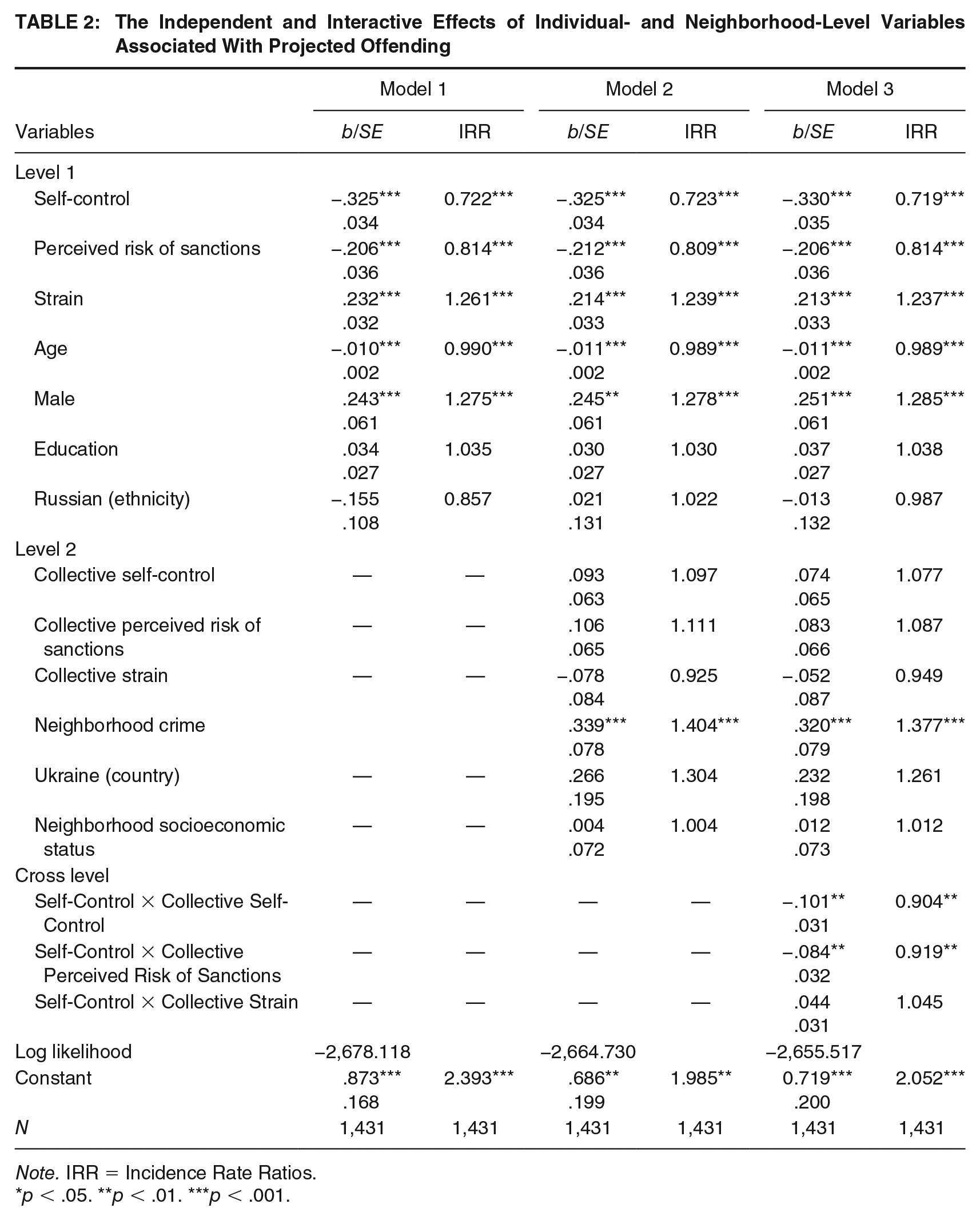
Estimates shown in Table 2 represent the direct and interactive effects of individual and neighborhood self-control, strain, and perceived likelihood on projected behavior. Model 1 assesses the relationship between projected offending and all individual-level variables. In support of Hypothesis 1a, individual self-control (IRR = 0.722) is significantly and inversely associated with projected offending, indicating that individuals with higher levels of self-control are less likely to engage in criminal activity. Notably, perceived sanction risk (IRR = 0.814) has a statistically significant negative effect on the likelihood of criminal involvement, with each standard deviation increase associated with about a 20% decline in the expected count of projected criminal activity. Finally, individual strain (IRR = 1.261) is also associated with a heightened probability of projected offending. Two of our control variables, age (IRR = 0.990) and gender (IRR = 1.275), are also statistically significant predictors of projected offending in the expected directions.
The Independent and Interactive Effects of Individual- and Neighborhood-Level Variables Associated With Projected Offending
Note. IRR = Incidence Rate Ratios.
p < .05. **p < .01. ***p < .001.
To assess Hypotheses 1b, 2, and 3, Model 2 assesses the direct effects of neighborhood processes and conditions on individual offending net of individual- and community-level control variables. Contrary to expectations, neither collective self-control, collective perceptions of sanctions, nor collective strain is significantly associated with projected offending.
Model 3 assesses the interactive relationship between individual self-control and neighborhood variables, including collective self-control, collective perceptions of sanctions, and collective strain, in their effect on individual behavior. Hypothesis 4 suggests that the crime-inhibiting effect of individual self-control on offending is contingent upon community self-control levels. The interaction term between self-control and collective self-control in Model 3 is statistically significant (IRR = 0.904) and inversely associated with projected crime involvement. As shown in Figure 1, the crime-preventive effect of individual self-control is stronger in communities with high levels of collective self-control (b = −.431 at 1 SD above the mean). The strength of this effect dwindles in communities with low collective self-control, and the predicted effect of individual self-control is thus reduced (b = −.229 at 1 SD below the mean). Overall, these results provide support for Hypothesis 4, which proposes that the relationship between individual self-control and offending will be strengthened in communities with higher collective self-control levels.
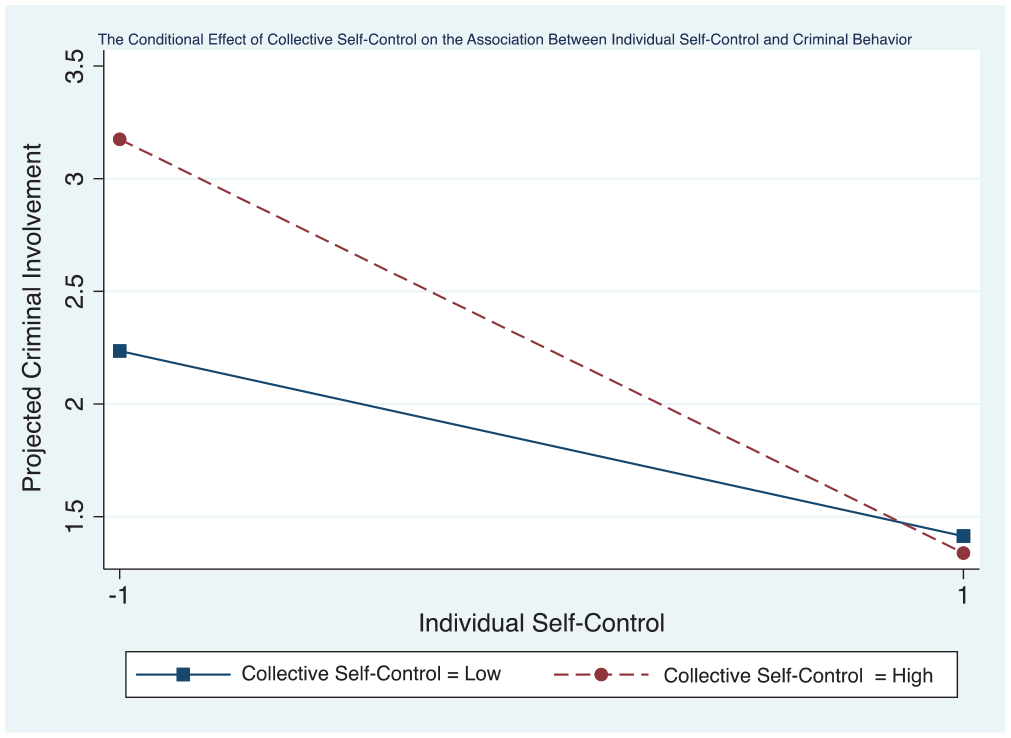
Interaction Term Between Collective Self-Control and Individual Self-Control
Hypothesis 5 suggests that the inhibitive effect of individual-level self-control on offending is boosted in neighborhoods with higher levels of perceptions of sanction risks. This hypothesis is supported in our study. As shown in Model 3, Table 2, the negative effect of the interactive term between collective sanction perceptions and individual self-control is statistically significant (IRR = 0.919). The predicted negative effect of individual self-control on offending is estimated to range from −.414 (at 1 SD above) in neighborhoods where perceived risks of sanctions are high to −.246 (at 1 SD below) in neighborhoods that are relatively undeterred by sanctions 4 (see Figure 2).

Interaction Term Between Collective Perceived Risk of Sanctions and Individual Self-Control
Finally, Hypothesis 6 suggests the inhibitive effect of self-control on offending is diminished for individuals who reside in neighborhoods with high levels of community strain. The relevant coefficient for the two-way interaction (Table 2, Model 3) is not statistically significant, thus producing no support for this hypothesis. 5
Discussion
This study sought to investigate the complex interplay between self-control, crime, and several theoretically important neighborhood processes. We argued that community self-control, collective perceptions of sanction risks, and collectively experienced strains may affect the relationship between self-control and offending. We also expected each of these community processes to influence individual behavior directly. Our findings offer mixed support for these hypotheses. On one hand, we found consistent support for the key premises of self-control theory, general strain theory, and deterrence perspective, with associations between offending and individual self-control, strain, and perceived risks of sanctions remaining strong across all models. On the other hand, at the neighborhood level, perceived sanction threat and collective strain appear to be unimportant for individual offending.
There may be several reasons for these findings. For instance, community strain may be of little importance to Russians and Ukrainians because these societies have built resilience as a result of a sustained exposure to chronic strain in their lives (Botchkovar et al., 2018, p. 459; see also Botchkovar & Broidy, 2013). Likewise, collective fear of sanctions may not be potent as a direct predictor of crime due to the shakier state of informal and, even more so, formal social control in both countries. It is easy to imagine that neighborhoods most fearful of sanctions in these contexts are those in frequent contact with corrupt authorities who, similar to the Italian Camorra, scare some but serve as learning models to others.
Our findings also indicate that some community characteristics, including perceived sanction risks and collective self-control, are important moderators of the relationship between individual self-control and crime. First, our results point to the importance of communities with high collective self-control for those with both high and low self-control. One way to look at our findings is to compare ways in which communities with varying self-control levels benefit or disadvantage individuals with high self-control. Consistent with our hypotheses, those with high self-control tend to thrive in communities with high self-control levels. The protective effect of personal self-control dwindles, however, in communities with low collective self-control.
Our additional findings 6 also highlight a different angle concerning individuals with high and low self-control levels. Whereas persons with higher self-control are even more protected in communities with high self-control, for those with low self-control living in communities with high self-control may be criminogenic (cf. A. M. Jones, 2017; Tittle, 2011). A potential explanation for this finding may be that communities with higher levels of collective self-control are a supportive environment for those with like self-control levels, but they may negatively label individuals with lower levels of self-control, thus increasing their risk for offending. In his work on shaming in communities, Braithwaite (1989) describes disintegrative, stigmatizing shaming as the kind that may be practiced even in interdependent, cohesive communities. It would be reasonable to assume that similar processes may be occurring in neighborhoods exhibiting high collective self-control characteristics.
The results concerning collective perceptions of sanctions mirror those related to community self-control. We found collective perceptions of sanctions to be conditioning the relationship between individual self-control and offending, with the inhibitive effect of individual self-control being strongest in communities that are more deterred by sanction threat. At the same time, similar to the case of highly controlled communities, neighborhoods with high collective perceptions of sanctions also appear to have crime-inducing rather than preventive effect on those with low self-control. 7
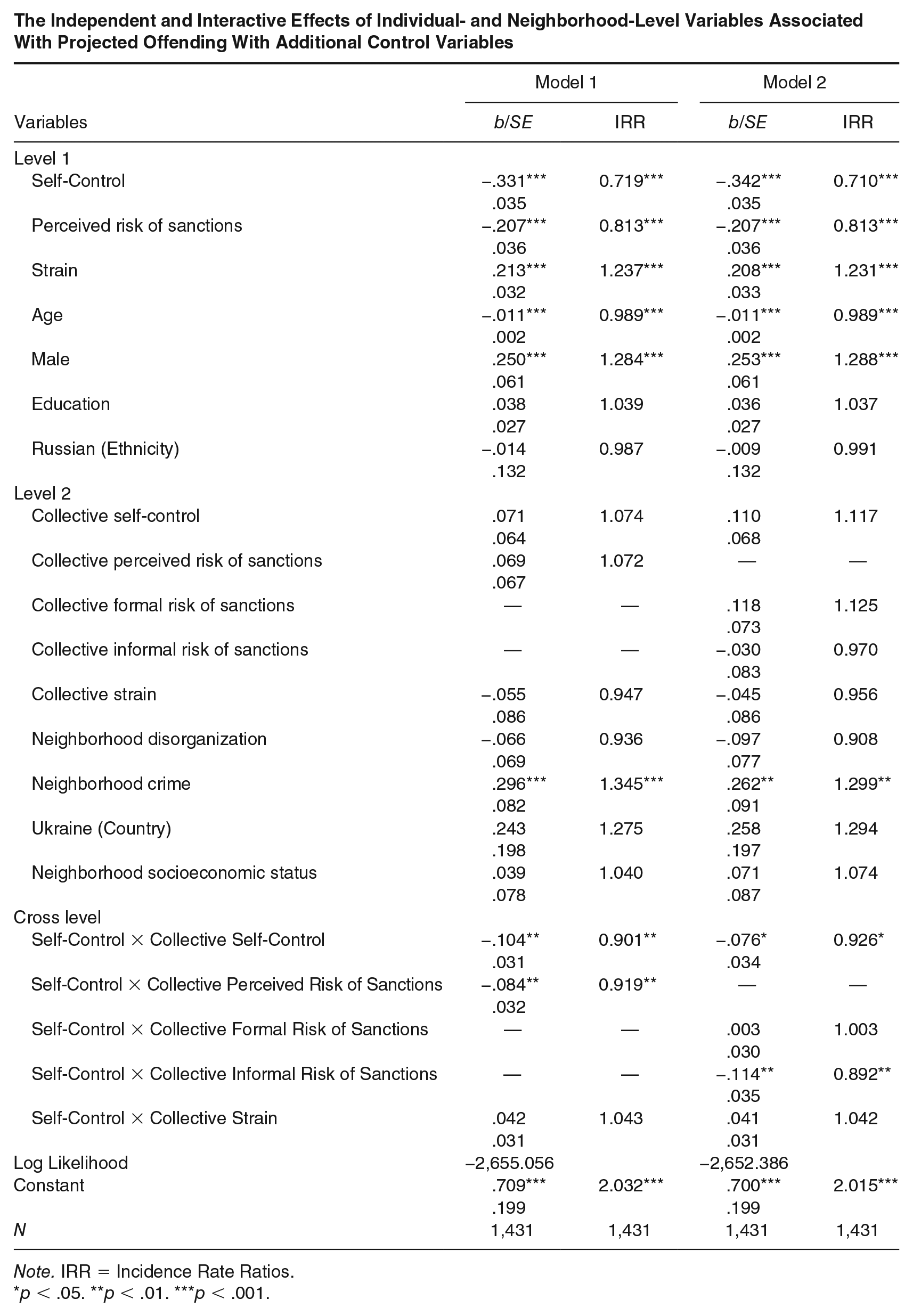
In our study, it is the concern with informal, rather than formal, sanctions that slightly magnifies the protective effect of self-control on crime. This highlights the possibility that, similar to other countries with low levels of trust in police, communities often have to “take matters into their own hands” in the absence of consistent formal sanctions coming from the criminal justice system. These findings align with previous research suggesting that a culture of retaliation is born out of necessity in communities in which agents of formal control are perceived to be “out of the loop” (Kubrin & Weitzer, 2003, p. 178). It would be reasonable to assume that communities deterred by informal sanctions almost uniformly consist of individuals who have little personal experience with crime and sanctions of any kind. This naiveté effect (Tittle, 1980) then might boost the effect of self-control on offending. Yet another possibility is that heavy sanctioning climates heighten residents’ reliance on rational reasoning (Maimon et al., 2012), which increases the chance that self-control will be utilized more frequently by those living in these neighborhoods.
These findings have important policy and practice implications. On one hand, because our study confirms individual self-control to be an important predictor of offending, it may be necessary to emphasize family-oriented programs that focus on childrearing and socialization experiences (Piquero et al., 2009, 2010, p. 830; Sherman et al., 1997). Schools, in turn, may benefit from programming that concentrates on teaching social skills and coaching high-risk youth on critical thinking skills (Sherman et al., 1997; see also Riggs et al., 2006). Future practice may focus on interventions emphasizing social skill development, cognitive coping strategies, and delaying of rewards (see Piquero et al., 2016, 2010). On the other hand, because ecological processes appear to serve as important moderating factors affecting the relationship between self-control and crime, future policies need to take into consideration the obvious impact of communities on individual behavior. Our findings appear to suggest that highly controlled and deterred communities are most welcoming toward those with high self-control. Given the relatively low cross-community mobility in Russia and Ukraine, it is likely that they effectively foster the development of self-control in their residents. This highlights the importance of community-based interventions, including both educational and recreational programming. Examples of such programs can be community-based supervision of youth or fostering parent connections using social media (Sampson, 2012). Although the practical measures we highlight may be particularly salient for younger people whose self-control levels appear more malleable relative to adults, in communities with lower population turnover, such as those frequently observed in Ukraine and Russia, their effects are likely to be seen in both younger and older populations. Furthermore, as Sampson (2012) suggests, key to forming social control in communities are stable intertwined local organizations collectively working to aid residents, allocate resources, and regulate relevant neighborhood processes. Together, these steps may help the development of a community culture that values self-control efforts and deters individuals from crime.
At the same time, our findings point to the potentially negative effects highly controlled communities may have on individuals with low self-control. It is reasonable to assume that such communities are prone to labeling those displaying behaviors indicative of low self-control. This may occur through informal repercussions, such as gossip or public stigmatizing shaming (Braithwaite, 1989). We argue, however, that a well-sewn and established fabric of social organizations and informal networks existing on the community level may prevent future stigmatization of individuals with low self-control.
Despite the contributions our study makes to the literature on ecological context and self-control, it is not without limitations. First, our findings may not generalize beyond the two Russian and Ukrainian cities selected for the study. More expansive datasets are necessary to investigate the effects of neighborhood processes on the relationship between individual self-control and crime elsewhere in the world. Furthermore, like any survey data, our data are vulnerable to possible telescoping, exaggeration, and/or misreporting of information. However, the consistency of our findings with results based on other data collected in Ukraine and Russia (Botchkovar & Broidy, 2013; Botchkovar et al., 2009) reassures us of the reliability of our findings. In addition, the cross-sectional nature of our data may affect our ability to determine the correct time order between dependent and independent variables. However, the set of precautions we have taken, including analyzing data with past crime reports as well as self-projected criminal involvement, boosts confidence in the causal order investigated in the study. Finally, our dependent variable is limited to petty theft and assault, which may impact the generalizability of our findings to other types of criminal behavior. More research is necessary to establish the generalizability of our findings to a variety of offenses.
Conclusion
Our study makes an important contribution to the literature assessing the conditioning effect neighborhood-level processes have on the relationship between individual self-control and crime. Although most research investigating how neighborhood context affect self-control and crime have done so through the lens of structural disadvantage and associated social disorganization (but see Zimmerman et al., 2015), our study demonstrates the importance of collective self-control and collective perceptions of sanction risks as key neighborhood processes influencing the relationship between individual self-control and criminal behavior. Highlighting the importance of community-level cultural elements that promote prosocial behavior by focusing on the development of self-control and deterrence by informal punishment, they point to a number of important community-level interventions. Adopted intervention strategies and programming should aim to foster individual self-control and bolster its inhibitive effects on criminal behavior. For instance, family-, school-, after-school-oriented programs and activities may positively affect the behavior of individuals residing in communities that emphasize internal and external control. Furthermore, programming focused on youth supervision, formal or informal, as well as the establishment of a fabric of supporting community organizations, should help promote inclusive environment conducive to the development of individual self-control.
Footnotes
Appendix
The Independent and Interactive Effects of Individual- and Neighborhood-Level Variables Associated With Projected Offending With Additional Control Variables
| Variables | Model 1 | Model 2 | ||
|---|---|---|---|---|
| b/SE | IRR | b/SE | IRR | |
| Level 1 | ||||
| Self-Control | −.331***
.035 |
0.719*** | −.342***
.035 |
0.710*** |
| Perceived risk of sanctions | −.207***
.036 |
0.813*** | −.207***
.036 |
0.813*** |
| Strain | .213***
.032 |
1.237*** | .208***
.033 |
1.231*** |
| Age | −.011***
.002 |
0.989*** | −.011***
.002 |
0.989*** |
| Male | .250***
.061 |
1.284*** | .253***
.061 |
1.288*** |
| Education | .038 .027 |
1.039 | .036 .027 |
1.037 |
| Russian (Ethnicity) | −.014 .132 |
0.987 | −.009 .132 |
0.991 |
| Level 2 | ||||
| Collective self-control | .071 .064 |
1.074 | .110 .068 |
1.117 |
| Collective perceived risk of sanctions | .069 .067 |
1.072 | — | — |
| Collective formal risk of sanctions | — | — | .118 .073 |
1.125 |
| Collective informal risk of sanctions | — | — | −.030 .083 |
0.970 |
| Collective strain | −.055 .086 |
0.947 | −.045 .086 |
0.956 |
| Neighborhood disorganization | −.066 .069 |
0.936 | −.097 .077 |
0.908 |
| Neighborhood crime | .296***
.082 |
1.345*** | .262**
.091 |
1.299** |
| Ukraine (Country) | .243 .198 |
1.275 | .258 .197 |
1.294 |
| Neighborhood socioeconomic status | .039 .078 |
1.040 | .071 .087 |
1.074 |
| Cross level | ||||
| Self-Control × Collective Self-Control | −.104**
.031 |
0.901** | −.076*
.034 |
0.926* |
| Self-Control × Collective Perceived Risk of Sanctions | −.084**
.032 |
0.919** | — | — |
| Self-Control × Collective Formal Risk of Sanctions | — | — | .003 .030 |
1.003 |
| Self-Control × Collective Informal Risk of Sanctions | — | — | −.114**
.035 |
0.892** |
| Self-Control × Collective Strain | .042 .031 |
1.043 | .041 .031 |
1.042 |
| Log Likelihood | −2,655.056 | −2,652.386 | ||
| Constant | .709***
|
2.032*** | .700***
|
2.015*** |
| N | 1,431 | 1,431 | 1,431 | 1,431 |
Note. IRR = Incidence Rate Ratios.
p < .05. **p < .01. ***p < .001.
