



Abstract
America’s juvenile justice system was founded on the notion that the juvenile court would serve as the “ultimate parent” for youth. Yet, the history of youth punishment challenges the promise of juvenile “justice.” To offer a more comprehensive account of the family systems in juvenile court, this study draws from the insights of historical research on youth punishment and family criminalization to examine juvenile court outcomes in Arizona. Combining a historical lens with insights from attribution theory, we use quantitative and qualitative methods to examine the relationship between diverse family systems, including single mothers, single fathers, extended families, and foster care families, and juvenile court outcomes (i.e., diversion, preadjudication detention, petition, and judicial dismissal). Our findings suggest the need for more complex understandings of both family and punishment, and more expansive theorizations of the sorts of solutions that match the scope and scale of the problem.
America’s juvenile justice system was founded on the notion that the juvenile court would serve as the “ultimate parent” for youth whose caregivers were deemed inadequate. The history of youth punishment challenges the promise of juvenile “justice,” given how families are viewed and acted upon by court officials. While the hypercriminalization of Black and brown youth by juvenile justice systems is an ongoing focus of research (Henning, 2021; Ketchum & Peck, 2022), less theoretical and empirical attention has been paid to the criminalization of families and, in particular, the treatment of youth from family systems that diverge from the White, heteronormative, nuclear “ideal.”
Juvenile justice research on court outcomes has documented the role of “family” in racial/ethnic punishment inequality (e.g., Bishop et al., 2010; DeJong & Jackson, 1998; Love & Morris, 2019). However, this body of work has primarily studied family and race through binary measures that fail to capture the complexity of “other” family systems. 1 Researchers using attribution theory (Albonetti, 1991) have examined an array of family-centric factors such as resources, parental incarceration, and “adequate” supervision to demonstrate how attributions of “legitimate” and “illegitimate” families racialize youth punishment (Gaarder et al., 2004; Goldman & Rodriguez, 2022; Rodriguez, 2013). However, both attribution scholarship and other juvenile justice research have not included a historical lens to the analysis of contemporary youth punishment.
Importantly, historical research has documented how the racialized criminalization of “other” family systems was pivotal in establishing an unevenly distributed system of punishment (Chávez-García, 2012; Ward, 2012). Historical research also exposes the enduring legacies of family criminalization and the ongoing policies of child removal that systematically penalize Black, Latino, and Native communities (Cox, 2015; Elliott & Reid, 2019; Roberts, 2001, 2012; Rolnick, 2016). 2 This work highlights the need to explore how diverse family “structures” (e.g., extended kin, nonbiological parents) may signal deeper historical ideologies about legitimate and illegitimate family systems that racialize legal decision-making. The incorporation of a historical lens is consistent with a recent report by the National Academies of Sciences, Engineering, and Medicine (NASEM, 2022), which concluded that analyses of disparities in the justice system must consider the historical legacies of colonialism and slavery.
In this study, we place attribution and other juvenile justice scholarship on family in conversation with historical research on youth punishment. We use attribution theory as a guiding frame to better understand the role of “other” family systems in juvenile court outcomes in Arizona. To do so, we utilize a mixed-methods approach (i.e., administrative data and case file information) to analyze the impact of youths’ “other” family systems, including single mothers, single fathers, extended families, and foster care families in diversion, preadjudication detention, petition, and judicial dismissal outcomes. We also examine how “other” family systems matter for racial/ethnic youth as they move through the system. Below, we summarize key insights from historical research on youth punishment and family criminalization and then review attribution and juvenile justice research on family and court outcomes.
A Brief History of Family in American Youth Punishment
The foundational doctrine of American juvenile “justice,” parens patriae—or the notion of a Parental State—emboldened the courts with the legal and ideological authority to determine adequate parenthood. “Illegitimate” families—in particular, those deemed incapable of socializing youth into ideal (White) “citizens”—were viewed by the parental state as in need of replacement by a more adept guardian (Platt, 1969/1977). Central to constructions of illegitimacy was the racialized criminalization of “other” family systems—such as single mothers, extended kin networks, foster and nonbiological parents, and those that otherwise differed in culture or structure from the White, two-parent home (Chávez-García, 2012; Ward, 2012). This criminalization developed through unique, yet interconnected relationships between the American juvenile justice system and Black, Latino, and Native communities.
The criminalization of Black motherhood is perhaps the most enduring legacy of the webs between social control and notions of illegitimate families. Gendered racial ideologies about Black mothers, as either inherently unfit or un-humanly resilient, have historically indicted Black mothering as the root of social disorder (Elliott & Reid, 2019; Muhammad, 2010; Powell & Phelps, 2021). Bolstered by these ideologies, state institutions—including the courts, child protective services (CPS), and schools—claim unfettered access to Black women’s homes and remove Black children from their families under the assumption that Black mothers are incapable guardians (Roberts, 2001, 2012). Historians have linked the degradation of Black motherhood and removal of their children to the legacies of transatlantic slavery (Hartman, 2008; Willoughby-Herard, 2022).
Alongside the criminality of Blackness through the development of U.S. carceral regimes (Haley, 2016; Muhammad, 2010), the juvenile justice system also developed through specific, yet interconnected, relationships to Mexican/Latino and Indigenous families. In the nascent stages of the courts, researchers used physical and psychological tests to link Mexican/Mexican American youths’ “feeblemindedness” and criminality to their families, communities, and “genetic or racial stock” (Chávez-García, 2012, p. 4). These assessments involved investigating multiple generations of the family unit in an effort to identify the root of youths’ “pathology” and were used to sort and punish youth (Chávez-García, 2007). This system of sorting, classifying, and punishing facilitated the construction of a hierarchy of racial differences between Black, Latino, Native American, and White persons that was necessary for effective colonization in the west and southwest (Gómez, 2005) and for enforcing exclusionary categories of citizenship.
For Native youth, the criminalization of family life was inseparable from colonial conquest, and its contingency on extinguishing not only Indigenous people, but their cosmologies, epistemologies, and modes of being. First Nations (and African Indigenous) theories of parenting view children as sacred and thus refused European colonizers’ use of individualized punishment and violence as appropriate modes of childrearing and social control (Willoughby-Herard, 2022). Indigenous communal forms of child development were at odds with Western ways and were therefore used to justify the invasion of missionaries, state actors, colonizers, and White vigilantes into Native people’s lives and homes. Myths that Natives were incompetent, backward, and amoral caregivers valorized the systematic removal of Indigenous youth, who were sold or given to White families as indentured servants, or otherwise enslaved in the mission system (Bergman, 1977; Chávez-García, 2012). Native boarding schools, school jails, and their punishment policies severed Native youths’ connections to their families, languages, knowledge traditions, and home/lands (Child, 1998). Scholars have noted the resulting attempted forced assimilation of Native populations and impact on reproductive rights of Indigenous mothers (Lumsden, 2016; Vaught et al., 2022). These historical policies laid the foundation for the ongoing punishment of Native youth and their communities (Seelau, 2012; Vasquez-Tokos & Yamin, 2021).
In sum, historical research offers important contributions to an understanding of family criminalization in contemporary youth punishment. Most fundamentally, it reveals how the very foundations of the courts are inseparable from the country’s foundations in colonialism and slavery. Second, it suggests how diverse family “structures” (e.g., extended kin, nonbiological parents) may signal deeper historical ideologies about legitimate and illegitimate family systems that racialize legal decision-making. As we outline below, these historical insights have meaningful, though undertheorized connections to the findings of juvenile justice literature and, in particular, attribution scholarship.
Families, Juvenile Court Outcomes, and Racial Inequality
Family Structure as a Decision-Making Factor in Juvenile Court
To examine the role of family in contemporary youth punishment, juvenile justice research on court outcomes has focused primarily on the influence of single parenthood, operationalizing family structure through a single parent/non-single parent binary (Bryson & Peck, 2020; Leiber et al., 2016; Morrow et al., 2015; Peck & Beaudry-Cyr, 2016). Scholars attempting to explain pervasive inequalities in court outcomes use single parenthood as a proxy for “broken homes” and examine family structure as an extralegal factor that may be racialized and therefore indirectly produce differential treatment (Engen et al., 2002; Pope & Feyerherm, 1995). These studies find that family structure affects court outcomes, particularly in front-end outcomes like diversion, such that youth from single-parent homes are punished more severely than youth from two-parent families (Bishop et al., 2010; DeJong & Jackson, 1998; Love & Morris, 2019). Although findings vary by region and processing stage, multiple studies show that family structure exacerbates the punitive treatment of Black youth (Leiber, 2003; Love & Morris, 2019). While important, the heterogeneous genealogies of families that characterize the United States are largely absent in this work. Attribution scholarship has overcome some of these limitations.
Attributions of Family and Unequal Juvenile “Justice”
Attribution theory posits that court officials use the information at their disposal to assign “guilt,” assess responsibility, and therefore determine punishment for individuals who come into contact with the courts (Albonetti, 1991; Heider, 1958). More specifically, officials attribute the reasons behind individuals’ behaviors to internal (e.g., personality) or external (e.g., environmental) factors. Consistent with scholarship arguing that “guilt” and “criminality” are fundamentally gendered and racialized (Haley, 2016; Muhammad, 2010), scholarship has shown how attributions are linked to racialized punishment and inequality. Bridges and Steen’s (1998) seminal study found that court officials attribute White youths’ behaviors to external factors, while they attribute Black youths’ behaviors to internal traits such as “amoral character” (p. 564); and that these negative internal attributions fuel the severe punishment of Black youth. Bridges and Steen (1998) propose that underlying the harsher punishment of Black youth is the belief that “the etiology of their crimes is linked to personal traits” and therefore unamenable to “treatment” (p. 567). Thus, despite the absence of an explicit historical lens, their study highlights the legacy of ideologies that link criminality to Blackness.
Moving beyond a Black/White binary, Beckman and Rodriguez (2021) recently homed in on the role of negative attributions (as opposed to attributions generally) in perpetuating racialized youth punishment. Similar to Bridges and Steen, they found that Black, Latino/a, and Native youth were more likely than White youth to be ascribed negative internal attributions and that these negative internal attributions were associated with a lower likelihood of being diverted from formal system involvement. While there are deep historical roots to court officials’ views of criminality as inherent to youth of color, attributions of family also have unique linkages to historical ideologies about criminality as a genetic and biological trait (Chávez-García, 2012).
Indeed, scholarship demonstrates how attributions about family, including but beyond “structure,” influence and racialize court outcomes. Attribution research has shown how factors such as parental incarceration and lack of resources are relied upon to predict which youth will “rehabilitate” and therefore who should receive diversion-based interventions (Fader et al., 2014; Rodriguez, 2013; Rodriguez et al., 2009), which youth should be detained pending adjudication (Armstrong & Rodriguez, 2005), and which youth should be removed from the home altogether (Rodriguez, 2013). The salience of these attributions exposes how racialized constructions of “legitimate” (i.e., resourced, two-parent, non-system-involved) and illegitimate families are connected to legal actors’ decisions about youth punishment. Factors such as socioeconomic status and parental incarceration systemically affect Black, Latino, and Native youth, and as shown by historians, are inextricable from the legacies of racial displacement that founded the courts. Absent a historical lens, however, these factors may result in framing families as pathologized (via “risk”) (Craig et al., 2021; LaBerge et al., 2022).
Racialized narratives about families that diverge from the “ideal” White nuclear home can be used to justify officials’ decisions to remove youth of color from their homes. For example, the removal of nonwhite youth can be fueled by the assumption that “dysfunctional” families are the roots of their “criminal” behavior (Cox, 2015). Rodriguez et al. (2009) show how certain dimensions of family structure (i.e., “extended” and foster care) inform officers’ attributions of dysfunction. Anderson et al. (2023) expose the gendered-racial dimensions of these attributions of family pathology. In addition to highlighting the structural factors that girls of color navigate and how they are presented by officials as internal failures (e.g., sexual promiscuity), Anderson et al. (2023) show that girls’ families were consistently referenced as facilitators of delinquency.
Beyond structure and ostensibly broken relationships, what underlies assumptions of dysfunctionality and therefore constructions of “legitimate” family systems, are judgments about “adequate” parental supervision. Attributions of parental supervision and responsibility are primary decision-making factors in juvenile court (Bortner, 1982; Gaarder et al., 2004; Goldman & Rodriguez, 2022) and shape the punishment process in important ways. For example, Goldman and Rodriguez (2022) found that both race/ethnicity and family factors associated with structural racial dispossession (e.g., financial strain and parental incarceration) predict probation officers’ perceptions of caregivers’ capacity to supervise their children and, as a result, youths’ likelihood of being diverted during their first system referral.
Collectively, these studies suggest that decision-making factors used by court officials are rooted in notions of what constitutes an adequate family and, therefore, which youth are in need of home removal and which families in need of disruption and surveillance in order to implement social control. Attribution scholarship highlights the complexity of family (including but beyond structure) and links the criminalization of racialized youth to the pathologization of family systems that diverge in structure, resources, and/or custom from the “ideal” White (two parent) home. Accordingly, we propose an investigation of family attributions that reflects the complexity and heterogeneity of diverse family systems to advance knowledge on contemporary youth punishment.
The Present Study
The current study builds from prior work on family and juvenile court outcomes, by moving beyond binary measures of both family and race and by situating our inquiry within a historical context of the racialized criminalization of diverse family structures. We suggest that contemporary studies of youth punishment can be understood within the historical fact that juvenile courts and “other” systems of childrearing have manifested in distinct though interconnected ways for Black, Latino, and Native youth.
Hypotheses
Given enduring disparities in youth punishment, historical family criminalization in youth justice, and attributions of family legitimacy, we test three hypotheses:
Method
Study Context
We rely on quantitative data from the Arizona Juvenile On-Line Tracking System (JOLTS) database and qualitative youth case file data from Pinal County, Arizona. Both sets of data were collected as part of a larger project examining Disproportionate Minority Contact (DMC) in Arizona’s juvenile justice system, dedicated to identifying factors associated with racial and ethnic disparities throughout the juvenile court process. While JOLTS data represent a cross-sectional sample of youth and their family systems, case files (e.g., youth and family histories, contact logs, psychological evaluations, social services and counseling documents, police reports, pre-disposition and disposition reports, and court reports) contain extensive information on the youth and their court history.
Participants
All youth referred (N = 9,950) in the county during 2005–2010 were drawn from the JOLTS database to quantitatively examine the juvenile court outcomes. We exclude cases where youth were transferred to adult court, delayed cases due to youth’s age approaching 18 years old, cases transferred to other jurisdictions, citations, and traffic violators. Qualitatively, we examine a representative sample of 66 youth case files from the Pinal County DMC assessment. These cases represent a random sample of case files from the county as part of the assessment. The youth in the case files were also first referred to the juvenile court between 2005 and 2010. Importantly, we do not link the case files with the JOLTS data. For both quantitative and qualitative analyses, in instances where a youth was referred to the court multiple times, the first referral in the year was included in the sample. Each youth was followed through four distinct court outcomes, allowing us to explore the role of family as youth move through the system.
Measures
Independent Variables
We capture family systems using six dummy coded measures, including single mother, single father, extended family, parent/extended family, foster care, and two parents as the reference category. Nearly half (47.6%) of youth were from single-mother families and an additional 11.5% were from single-father families. Thirteen percent of youth were from extended family systems and 2% were from families that included parent/extended family. Five percent of youth were in some sort of foster care arrangement. Twenty-four percent of youth were from two-parent families. Consistent with prior work on court processes (Mears et al., 2014; Steffensmeier et al., 1998), we include both extralegal and legal control variables, which have been shown to be significant in court outcomes. Demographic indicators consisted of gender (boys = 1; girls = 0), race/ethnicity (dummy coded variables for Latino, Black, and Native American with White persons as the omitted category), and age at the time of court referral. Among youth referred to the juvenile court, 67% were boys and 33% were girls (see Table 1). Forty-two percent of youth were White, 11% were Black, 39% were Latino, and 7% were Native American. The average age of youth in the sample was 14.7 years of age. A control for school status (enrolled in school = 1; not enrolled in school = 0) at the time of court referral was also used. Over two thirds (68.7%) of youth were enrolled in school at the time of referral. Legal variables included the most serious offense at referral (i.e., person felony, person misdemeanor, property felony, property misdemeanor, drugs, public order, status offense, and obstruction of justice, with property felony as the reference category) and whether youth had prior referrals (yes = 1; no = 0) to the court. Twenty percent of youth were referred to the court for person offenses (5% were person felony offenses; 15% were person misdemeanor offenses) and 24% of youth were referred for property offenses (11.3% were property felony offenses; 12.3% were property misdemeanor offenses). Twelve percent of youth were referred for drug offenses. A quarter of youth were referred for public order offenses, 12% for status offenses, and 7% for obstruction of justice offenses. Twenty-eight percent of youth had at least one prior referral before the instant referral. Given the empirical importance of detention on subsequent outcomes (see Rodriguez, 2010; Zane et al., 2021), the measure was included as a predictor of the petition and dismissal outcomes.
Frequencies of Independent and Dependent Variables
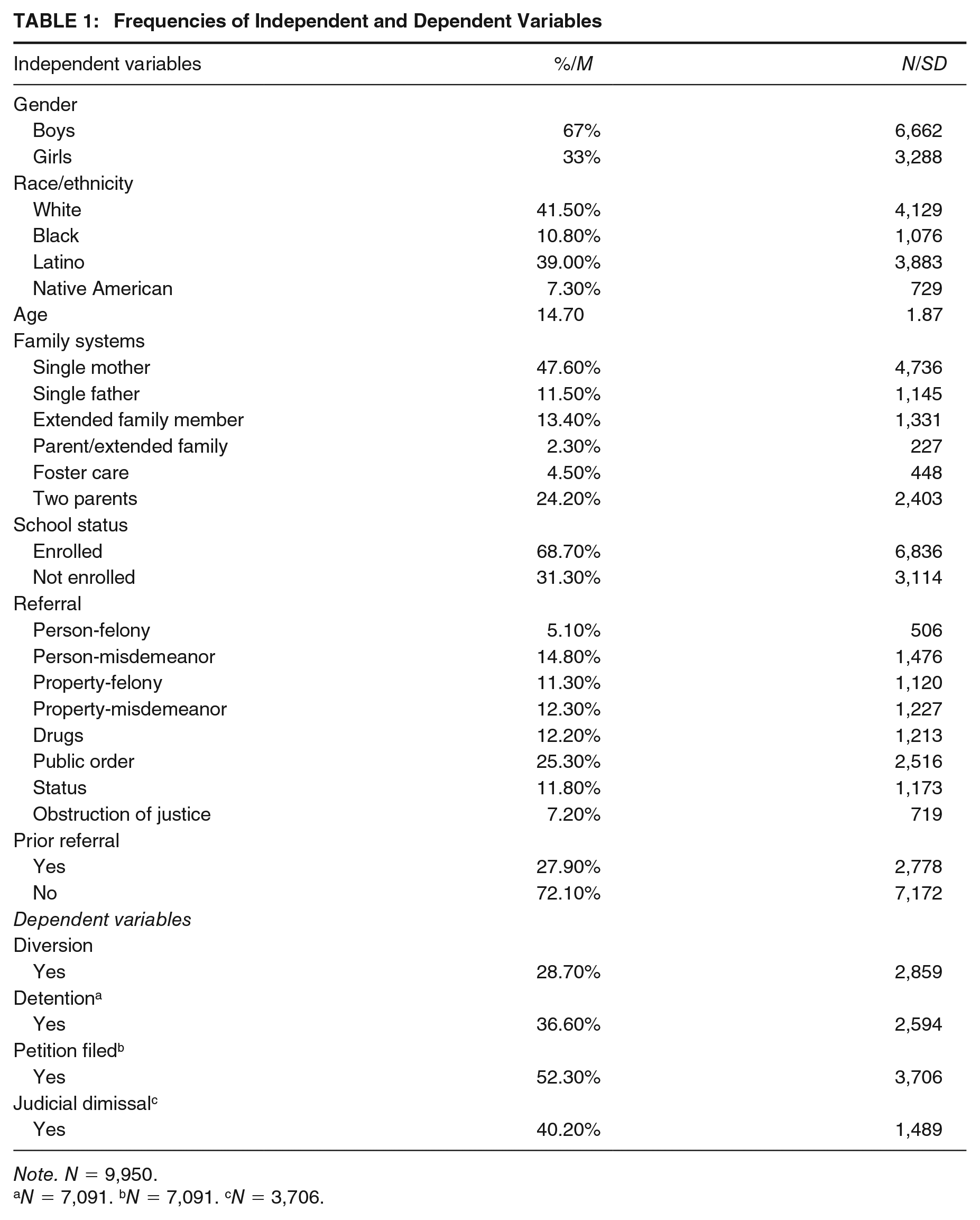
Note. N = 9,950.
N = 7,091. bN = 7,091. cN = 3,706.
Dependent Variables
Four dependent variables were examined in quantitative analyses to reflect multiple decision points in the juvenile justice system: diversion (i.e., informally processed), detention, petition filed, and judicial dismissal. Diversion (yes = 1; no= 0) occurs when the County Attorney makes the decision to not file a petition against the youth but rather place the youth in a diversion program. If the youth complies with the program requirements, the County Attorney will not file charges against the youth. If the youth does not comply with the requirements, a filing of a petition alleging delinquency or incorrigibility could result. Detention (yes = 1; no = 0) was measured by comparing those youth who were detained preadjudication with those who were not detained. The petition process occurs when the County Attorney files a petition against a youth alleging delinquency or incorrigibility (yes = 1; no = 0). For those youth who had a petition filed, during the adjudication process, the juvenile court judge determines whether to dismiss the petition(s) (yes = 1; no = 0) or not (i.e., adjudicate the youth as delinquent or find him or her to be a status offender). A review of the dependent variables shows that 28.7% of cases were informally processed or diverted. Of those that were formally processed, 36.6% were detained, 52.3% had a petition filed, and 40.2% were judicially dismissed.
Procedures
This study uses a concurrent triangulation mixed-methods design (Creswell et al., 2003; Creswell & Plano Clark, 2007), which we situate within a critical epistemological lens. Quantitative and qualitative data were collected and analyzed concurrently but separately, and results of both analyses were compared and contrasted at the integration phase (Creswell et al., 2003; see Analytic Plan), to glean a more comprehensive understanding of the role of family attributions and historical racial ideologies in youth punishment.
Concurrent triangulation designs are often used to address the limitations in using only one type of data (Creswell & Plano Clark, 2007). In this study, as informed by a critical epistemological lens, we understand these limitations as being structured by power relationships, and are critical of how quantitative analyses can reify race as a static identity marker, rather than a structure of power and historical process (Hall, 2017). Because case file data include comprehensive narratives comprised of multiple court actors’ perspectives, reasoning, recommendations, and formal legal decisions, they offer a window into the dynamic nature and treatment of family systems navigating juvenile court. That is, quantitative outcomes tell an important, but partial, story of families, race, and court outcomes. Indeed, as our findings and discussion sections will elaborate, triangulating qualitative and quantitative results in this study reveals how quantitative data can obscure the racialized nature of court processes and outcomes.
Analytical Strategies
Quantitative Analysis
Logistic regression analysis was used to estimate the influence of the independent variables, and control measures on the four categorical dependent variables. To test Hypothesis 1 (H1) and Hypothesis 2 (H2), we estimate an overall model with the corresponding variables. To test Hypothesis 3 (H3), we analyze race and ethnicity-specific models and include family system measures, as well the control measures as covariates of the court outcomes. We restrict our presentation to the independent variables of interest.
Qualitative Analysis
To analyze qualitative youth case file data, we conducted a combined deductive/inductive thematic analysis, which was guided by our research questions and existing theoretical concepts (Braun & Clarke, 2006). 3 Thematic analysis was primarily conducted by the second author, while the first author confirmed the developed themes. Our substantive theoretical interest in this portion of the study was how attributions of family inform decision-making, with an attention to the connections between attributions and historical racial ideologies around family. As with quantitative analyses, we analyzed these patterns within and across racial/ethnic communities with distinct historical relationships to the courts.
Case file data were converted to PDF files and uploaded into Adobe Acrobat. Four separate datasets were developed, corresponding to the four racial/ethnic groups of interest (White, Black, Latino, and Native American). While we relied on youths’ race/ethnicity as documented in quantitative administrative data to do so, the nature of the qualitative data allowed us to see race as it operates as a dynamic structure, rather than static identity marker. For example, youth and families’ race/ethnicity, as documented by court officials, shifted within a single case file (i.e., various court actors racialized youth and families differently), which speaks to the aforementioned limitations in quantitative, particularly legal administrative, data.
In the first round of coding, the second author thoroughly read and manually highlighted case file data in all four sets for measures of family systems, court outcomes, and family attributions. Codes for family systems and court outcomes were informed by measures utilized in quantitative analyses, but also included a broader set of “outcomes” not captured in quantitative data (e.g., mandated referrals to family therapy, or the appointment of ad litem guardians). Initial family attribution codes were both deductively informed by prior family attribution literature and historical research on family criminalization (e.g., attributions of family supervision; criminalization of Black motherhood); and inductively grounded in the data (Braun & Clarke, 2006; Charmaz, 2014). The author then reread the data numerous times to refine attribution and outcome codes, and sort relevant data accordingly (Ruona, 2005).
The second phase of analysis moved from “descriptive” to “interpretive” (Braun & Clarke, 2006) and was conducted within and across each of the four datasets. In this phase, the researcher used the “comment” feature in Adobe to insert theoretical code “memos” (Bingham & Witkowsky, 2022) which identified emerging threads between attributions, historical ideologies around family, and court officials’ disposition recommendations and decisions. A first round of memo’ing was conducted within racial/ethnic groups, wherein memos identified differences or convergences in the attributions and treatment of diverse family systems within a community (e.g., differences or convergences between officials’ attributions of Black single-parent and Black two-parent families). A second round of memo’ing was then conducted across racial/ethnic groups, wherein memos identified differences or convergences in the attributions and treatment of similar family systems, across diverse racial/ethnic communities (e.g., memos identified differences or convergences between officials’ attributions of White foster families and Native foster families). Both of these rounds (i.e., within and across racial/ethnic groups) were repeated numerous times to refine codes. Data were then sorted again into relevant codes, and final themes (or “findings”) were developed (Bingham & Witkowsky, 2022; Ruona, 2005).
Mixed-Methods Integration
In line with a concurrent triangulation design, data were integrated at the interpretation stage, with the aim of developing a more nuanced understanding of a social phenomenon (Creswell & Plano Clark, 2007; Creswell & Tashakkori, 2007). After quantitative and qualitative analyses were completed, both researchers independently compared the results of each, focusing on convergences and inconsistencies between our quantitative results and qualitative results, with respect to the proposed hypotheses. Informed by our critical epistemological lens, we analyzed these convergences and inconsistencies with a focused interest in power relationships and implications for social inequality, and with a critical eye toward dynamic processes of racialization and criminalization, and historical relationships that cannot be captured in quantitative data alone. Thus, in the following sections, we first lay out the results of quantitative analyses. We then discuss qualitative findings in a way that attends to these inconsistencies, to develop a nuanced and historical understanding of family criminalization and youth punishment.
Results
Quantitative Results
Family Criminalization and Youth Punishment: Overall Models
Table 2 presents the quantitative estimates for the overall models of the four juvenile court outcomes, while race-specific analyses are reported in Tables 3 to 6. The diversion model (see Table 1, Model 1) shows the effects of the variables of interest and control measures. Consistent with H1, we found that Black and Native American youth were less likely than White youth to receive diversion. As hypothesized (H2), other family systems were treated more punitively than two-parent systems at this critical stage of court processing. Youth of single mothers (0.618 times; exp [−0.481]), single fathers (0.649 times (exp [−0.432]), extended family (0.451 times (exp [−0.796]), and youth in foster care (0.654 times (exp [−0.424]) were all less likely than youth of two-parent families to receive diversion.
Logistic Regression Models Predicting the Influence of Race/Ethnicity and Family Status on Juvenile Court Outcomes
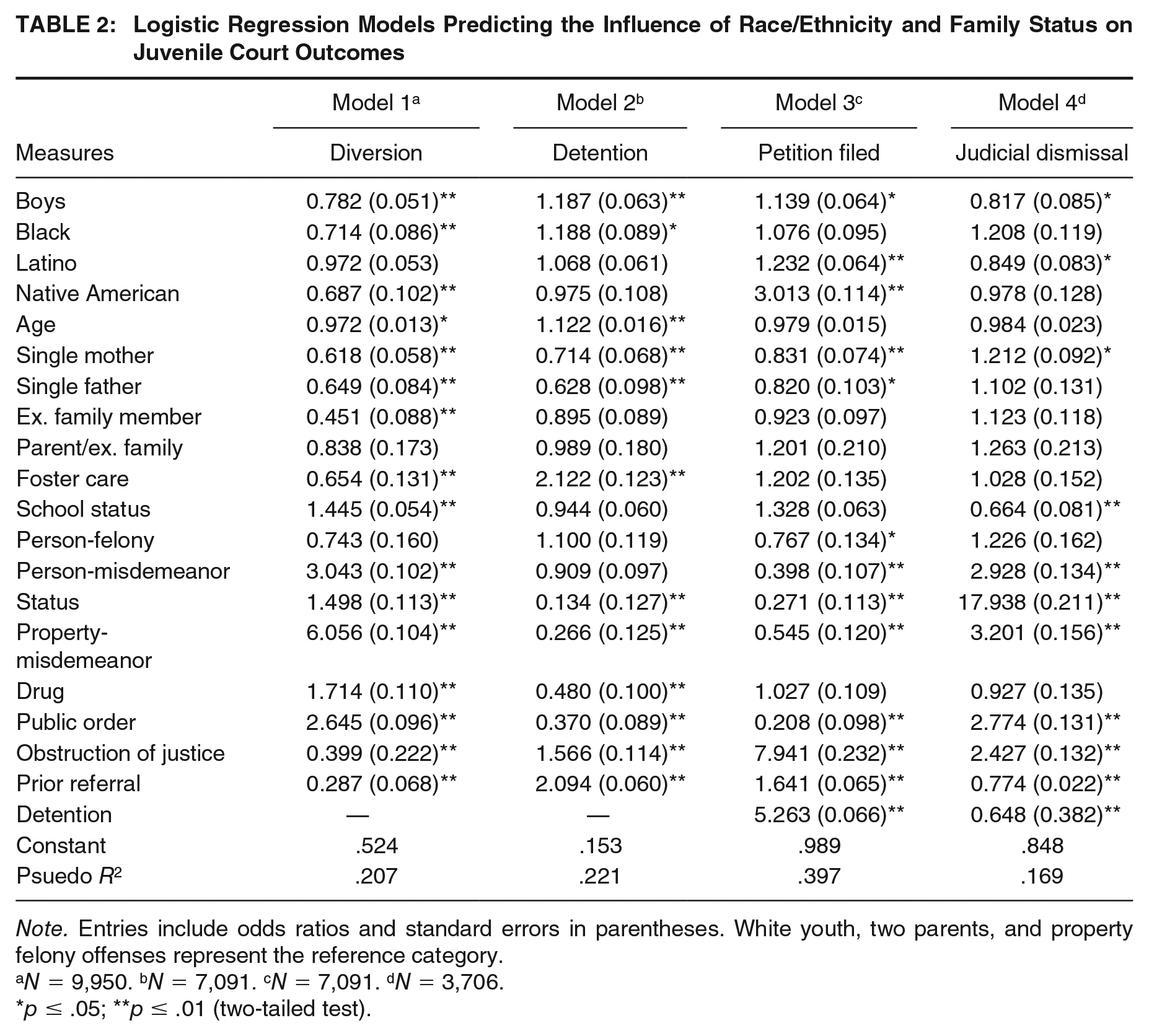
Note. Entries include odds ratios and standard errors in parentheses. White youth, two parents, and property felony offenses represent the reference category.
N = 9,950. bN = 7,091. cN = 7,091. dN = 3,706.
p ≤ .05; **p ≤ .01 (two-tailed test).
Logistic Regression Models Predicting Family Systems on Diversion: Race-Specific Models
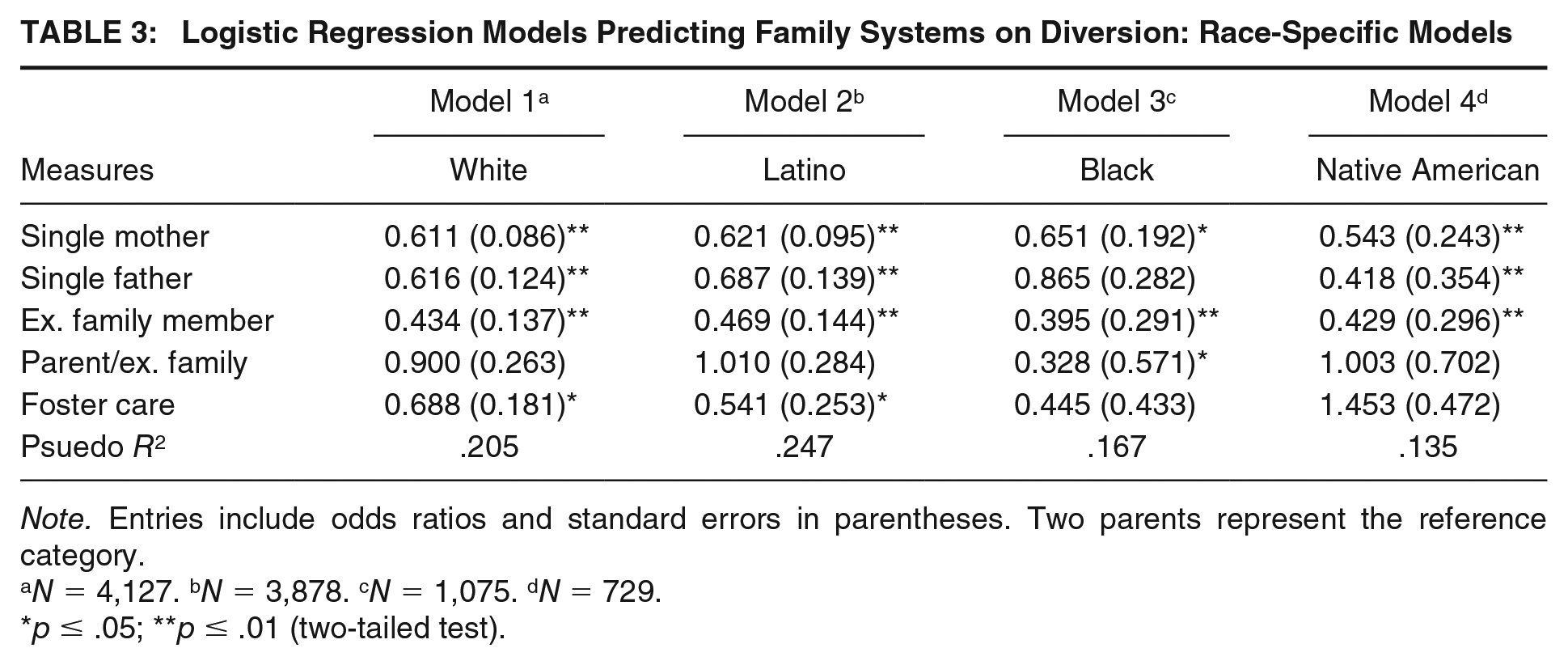
Note. Entries include odds ratios and standard errors in parentheses. Two parents represent the reference category.
N = 4,127. bN = 3,878. cN = 1,075. dN = 729.
p ≤ .05; **p ≤ .01 (two-tailed test).
Logistic Regression Models Predicting Family Systems on Detention: Race-Specific Models
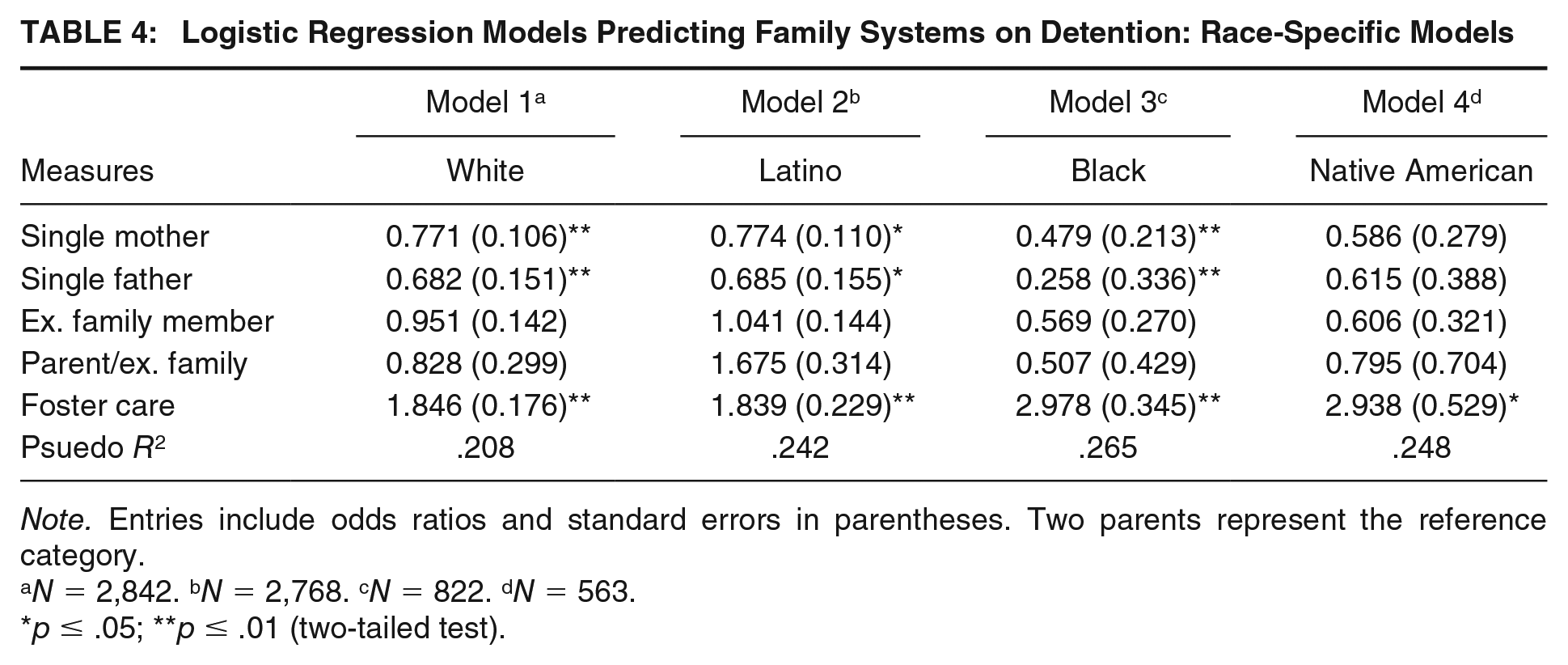
Note. Entries include odds ratios and standard errors in parentheses. Two parents represent the reference category.
N = 2,842. bN = 2,768. cN = 822. dN = 563.
p ≤ .05; **p ≤ .01 (two-tailed test).
Logistic Regression Models Predicting Family Systems on Petition Filed: Race-Specific Models
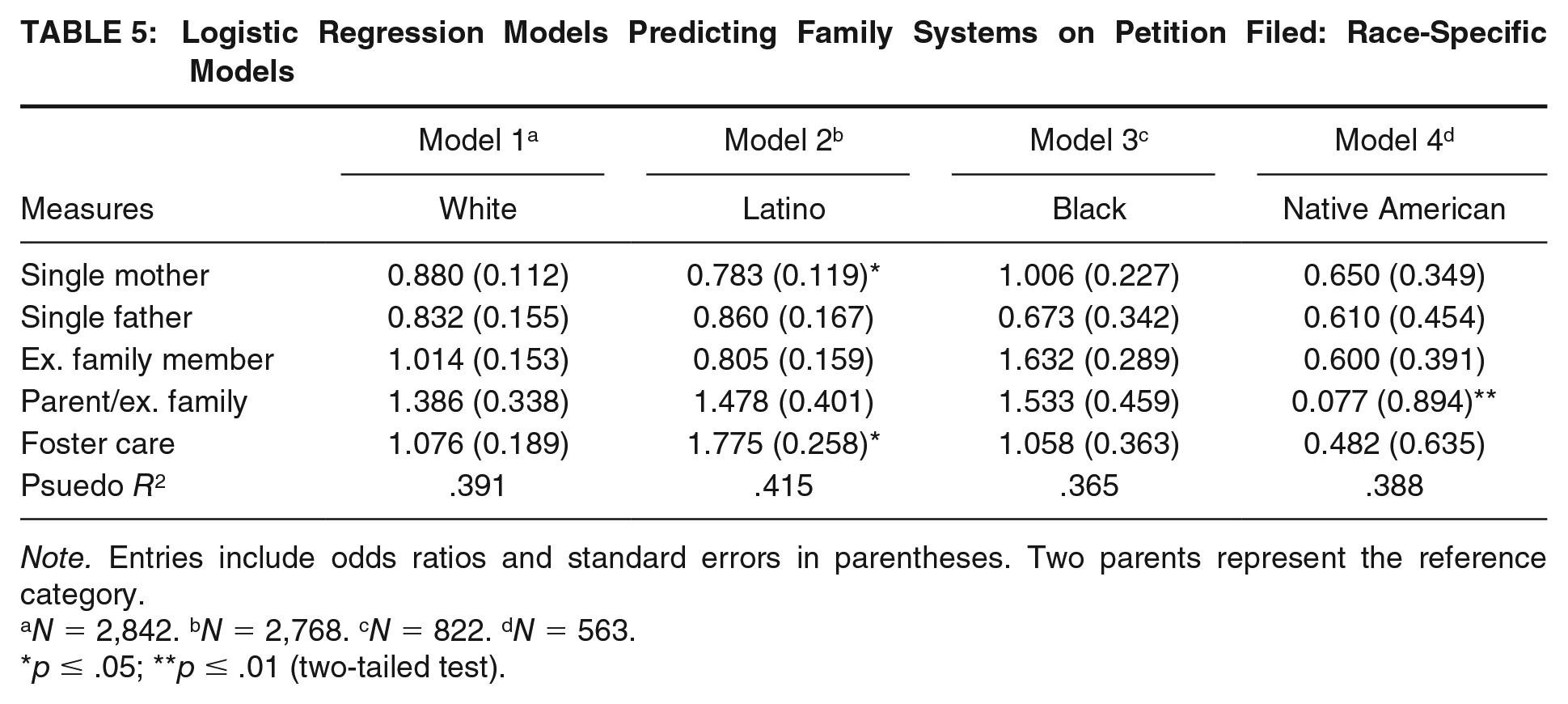
Note. Entries include odds ratios and standard errors in parentheses. Two parents represent the reference category.
N = 2,842. bN = 2,768. cN = 822. dN = 563.
p ≤ .05; **p ≤ .01 (two-tailed test).
Logistic Regression Models Predicting Family System on Judicial Dismissal: Race-Specific Models
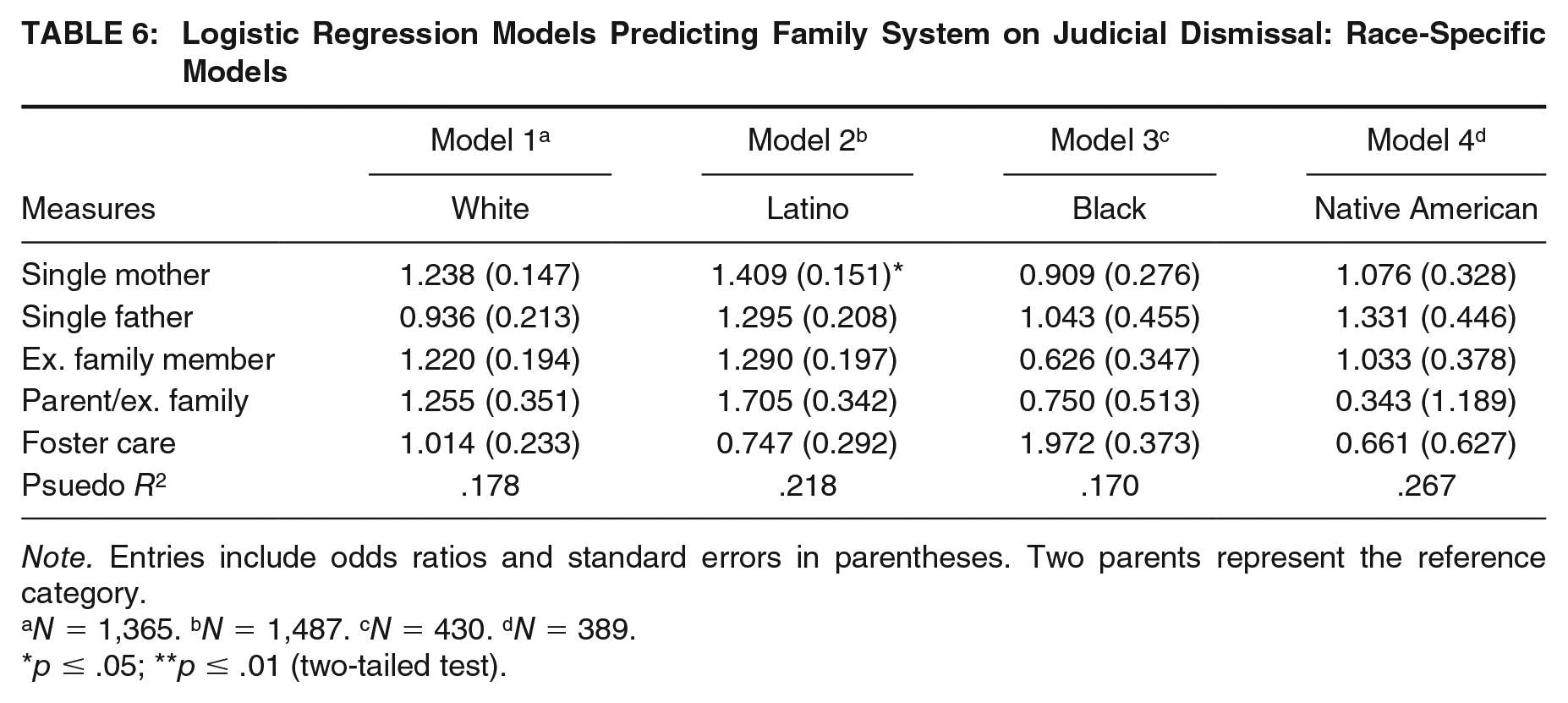
Note. Entries include odds ratios and standard errors in parentheses. Two parents represent the reference category.
N = 1,365. bN = 1,487. cN = 430. dN = 389.
p ≤ .05; **p ≤ .01 (two-tailed test).
Detention findings (see Table 2, Model 2) illustrate that Black youth were more likely than White youth to be detained. Consistent with H2, youth in foster care were 2.122 times (exp [0.753]) more likely than youth from two-parent families to be detained. However, contrary to H2, we found that youth from single-mother and single-father families were less likely than youth of two-parent families to be detained.
Petition findings reveal continued racial and ethnic disparities (see Table 2, Model 3). Latino youth were 1.232 times (exp [0.208]) more likely than White youth to have a petition filed, while Native American youth were 3.013 times (exp [1.103]) more likely than White youth to have a petition filed. Consistent with detention outcome analyses (and contrary to H2), youth from single-mother and single-father families were less likely than youth of two-parent families to have a petition filed.
A hypothesized (H1), judicial dismissal analyses (see Table 2, Model 4) show that Latino youth were less likely (0.849 times (exp [−0.164]) than White youth to have petition dismissed by the judge. Contrary to H2, youth from single-mother families were also more likely than youth from two-parent families to have their petition dismissed.
Family Criminalization and Youth Punishment: Race-Specific Models
Race-specific analyses for diversion (see Table 3, Models 1–4) show mixed support for our hypothesis that youth of color with “other” family systems will receive more severe outcomes than youth with two-parent families (H3). We find that “other” family systems matter for both White and racial and ethnic minority youth. In particular, White, Black, Latino, and Native American youth from single-parent families were less likely than two-parent families to be diverted. Also, White and Latino youth in foster care were less likely than White and Latino youth from two-parent families to be diverted. Black youth from parent/extended families were less likely than Black youth from two-parent families to be diverted.
Race-specific analyses (see Table 4, Models 1–4) of detention show that White, Latino, and Black youth from single-mother families and single-father families were less likely than youth of two-parent families to be detained. Foster care matters for all youth, whereby White, Latino, Black, and Native American youth in foster care were more likely than youth from two-parent families to be detained. It is notable that we find leniency at detention for youth with single parents, across all racial/ethnic groups.
Race-specific analyses (see Table 5, Models 1–4) of petitions filed show that family system measures are only significant for Latino and Native American youth. Latino youth in foster care were more likely than Latino youth from two-parent families to have a petition filed. However, Latino youth from single-mother families were less likely than Latino youth from two-parent families to have a petition filed. Native American youth from parent/extended families were less likely than Native American youth from two-parent families to have a petition filed.
Race-specific analyses of judicial dismissal show that only single-mother families for Latino youth were a significant predictor of judicial dismissals (see Table 6, Models 1–4). Specifically, Latino youth with single mothers were more likely than Latino youth from two-parent families to have their petitions dismissed.
To better understand the quantitative findings and the role of family attributions in legal actors’ decision-making, we now turn to excerpts from case file narratives. Building from the framework established in the front end of this article, we situate our exploration of these attributions within a broader historical context of racialized youth punishment and family criminalization.
Qualitative Findings: A More Complex Picture of Youth and Family Criminalization
Narratives illustrate that during initial contact with the system, attributions of (inadequate) supervision structured decision-making. In particular, fueling officials’ decisions to deny single-parent youth diversion were their assumptions of inadequate supervision: (Youth) has a loving home environment but, one that lacks in supervision. He simply has too much freedom for a boy his age. (#8713, Latino boy, 13 years) Having to take care of her child and (Youth) may be a little too much for [her]. This leaves (Youth) with little supervision. (#2615, Latino boy, 15 years)
These findings indicate how the foundational doctrine of parens patriae continue to structure legal actors’ decisions about youth. Since the role of single parenthood at diversion has been the focus of much prior scholarship, we turn our focus here to a more thorough discussion of the attributions that inform youth punishment as youth move through the system.
Quantitative analyses of detention, petition, and dismissal outcomes show that single motherhood affects all racial/ethnic groups, whereby youth with single mothers appear to receive more leniency as they move through the system. While these results may suggest a uniform, rather than a racialized process, case file narratives reveal differential attributions behind courts’ justification for this leniency between White and non-White youth. As youth moved past diversion, White youth with single mothers were portrayed by court officials as trying their best and, despite struggling with compliance, were given the benefit of the doubt: Her mother reported that she does have issues that they are trying to work through. The juvenile is participating in counseling services. Her grades are not great at this time, but mother said that the last couple of weeks she has been trying to do better. This officer will recommend that she remain released to her mother pending the next court hearing. (#2214, White girl, 14 years) She is trying her best to raise her teenage daughters on her own, but at this point her daughters are on the verge of being out of control. Counseling will give Mother a support system to help her deal with these issues and eventually work into family counseling with her daughters. (#3415, White girl, 15 years)
Rather than framing single White mothers as incompetent caregivers, officials ascribed positive attributions to mothers’ efforts to raise their children, which resulted in decisions to provide youth with services that might compliment, rather than disrupt or displace, their family unit. Likewise, despite their seemingly harsher treatment in comparison to White single mothers, two-parent homes of White youth were also framed in officials’ narratives through positive attributions of supportive and responsible parenting and functional family bonds. Importantly, we found various instances where two-parent families of White youth actively sought court intervention at the detention stage, looking for placement as a means of accountability or access to services for their child: Youth gets [along] well with family but they are unable to determine the cause of his issues. Mom and stepfather both want youth placed in a secure facility. Family willing to participate in any treatment. (#7216, White boy, 16 years) Minor held in detention with discretion to release. Psychological evaluation ordered. (Youth) has supportive parents who hold him accountable for his actions at home. Due to this offense, his parents have implemented a parent coach to come to the home once a week to help build better communication. (#1615, White boy, 15 years)
Despite harsher outcomes at later stages in court processing, as reflected in quantitative results, the courts’ attributions of White two-parent families as positive and functional, as well as parents’ trust of the system, speak to historical research on the collaborative relationship between White families and the courts (Agyepong, 2018). Positive attributions of White parents—single and otherwise—demonstrate the continued intersection of race and constructions of family legitimacy, which becomes more evident when juxtaposed with officials’ attributions of both single-parent and two-parent families of color.
Indeed, qualitative findings offered a more complex understanding of the apparent leniency at later stages in court processing for Latino single-parent youth, which in our quantitative analyses ran contrary to H2. In contrast to White youth, leniency for Latino youth with single parents, as these youth moved through the system, was not extended based on positive attributions of responsible parenting, but rather was contingent on compliance: Minor to be UA’ d once a week. Mother shall keep probation and the court advised of any address change, if she fails to do so it can result in contempt of court. (#5415, Latino boy, 15 years)
Although this youth was not detained, it is implied that if the mother fails to comply with the courts, his freedom will be compromised—a notable departure from White parents who are “trying their best” and deserving of extra support. Furthermore, in contrast to both Latino single parents and White two parents, narratives of Latino two-parent homes were saturated with attributions of dysfunction. In particular, two-parent Latino families were presented by officials as pathologically dysfunctional, criminal, and incapable of holding youth accountable: Stepfather was released from prison after seven and a half years in October. The family admits to not having reported probation violations to probation or their FFT therapist. Mother and stepfather claim they were giving (Youth) an opportunity and didn’t want to get him into trouble. (Youth) and his family were fully aware that this would be their last opportunity to assist the minor in leading a law-abiding life. Unfortunately, the family and (Youth) failed in less than two months. It is the opinion of this officer that the family and the minor may never be able to repair their relationship. (#6716, Latino boy, 16 years) (Youth) lives with his mother and step-father. (Youth) doesn’t really like his step-father and chooses to spend most of his time over at his grandfather’s home. The rules at his grandfather’s are nearly non-existent. The mother has lost control over her son with the grandfather supporting (Youth)’s bad behavior rather than supporting his daughter’s rules. The mother needs to reclaim control of her son. . . . All of the data essentially picks up on a very significant family systems pathology going on with (Youth) and his parents. (#8314, Latino boy, 14 years)
These narratives of dysfunction are inseparable from racialized ideologies of Mexican/Latino youth and families (Chavez-Garcia, 2007, 2012) that were integral to the formation of the courts. Historically, myths of “inherited” or “genetic” criminality fueled the confinement of Latino youth in state reformatories (Chávez-García, 2012; Schlossman, 2012). Rather than court officials simply using the information at their disposal to make a decision, as typical renderings of attribution theory suggest, the attributions of dysfunction, inadequacy, and pathology evident in case file narratives can be linked to the vestiges of historical family criminalization.
Also in stark contrast to positive attributions of White families, narratives behind leniency (as reflected in quantitative results) for single Black parents and severity for Black two-parent families at detention and petition were both racialized. Attributions of inadequate supervision operated in unique ways to structure the apparent “leniency” for Black single-parent youth at detention, offering a critical window into “unexpected” quantitative findings in relation to H2. In particular, this leniency occurred through CPS involvement, which was seen as introducing an additional and necessary layer of surveillance to ensure accountability: [CPS] said she was going over to the house later tonight to speak with (Youth) and father—She will be telling father that he needs to sign (Youth) up for services ASAP or they may have to keep the case open—told of next court date. (#3915, Black girl, 15 years)
These attributions of inadequate parenting, and their mobilization as justification for simultaneous court and CPS involvement, reflect and extend long-standing historical genealogies of the criminalization of Black parenthood, and the entrenched nexus between juvenile court and foster care for Black youth (Roberts, 2001, 2012).
Importantly, CPS was also introduced for Black two-parent homes at detention. In contrast to single-parent homes, however, attributions of dysfunction were especially salient in court officials’ narratives. Black two-parent families were portrayed as steeped in family conflict and unable to respond to youths’ needs. In the following case, CPS placement was “assigned” as part of the court’s response: Mother must engage in individual counseling to address the issues that brought her daughter in CPS care, and show that she is benefiting from these services. Mother must also participate in family counseling with (Youth) to address these same issues, and other issues that may be identified. Alleged father must recognize that he has abandoned his daughter. Once located father must also engage in appropriate services . . . (Youth)’s stepfather, must actively participate in parenting classes. He must also participate in counseling with mother to address the issues that brought (Youth) into care, and other issues that may be identified. (#4314, Black girl, 14 years)
Here, despite a two-parent structure (mother and stepfather), attributions of paternal absence overlap with attributions of family dysfunction. These attributions reproduce the gendered-racial ideologies disseminated and normalized by the Moynihan Report (1965) and E. Franklin Frazier’s (1932) The Negro Family in Chicago—both of which utilized statistics on family “illegitimacy” to identify the matriarchal Black family unit as the principal source of crime and delinquency (Muhammad, 2010; Patterson, 2010).
While quantitative results reveal that all youth with foster parents experienced severe punishment at detention, narratives illustrate the persistence of negative family attributions—and, constitutively, historical racial ideologies—in decisions to punish Black, Latino, and Native youth. Evaluations by court officials of foster families of youth of color were linked to youths’ biological family members and informed by attributions of parental incarceration and criminality: Given this home environment, (Youth) continues to live up [to] the expectations instilled by his relatives. (Youth) tries to display the mental toughness by making statements he is not a snitch and would rather spend time in the detention facility than to rat on his friends. The current boyfriend of the biological mother is also an ex-convict, having spent time at the Arizona State Prison. . . . It is evident that (Youth) has never had any structure as he was growing up. He fended for himself and became involved in criminal activities because of family relatives. (#5013, Latino boy, 13 years)
To be clear, the criminal behavior of family members may be associated with youths’ delinquent behavior. Our point is that court officials’ attributions of biological family members’ incarceration and “criminality” for youth of color—even in cases where youth are no longer living with their biological parents—reflect the historical ideology of youths’ “pathology” (Chávez-García, 2012, p. 4) and how the court “treats” such youth.
By offering insight into outcomes beyond official court dispositions, narratives also revealed patterns of multiple foster care placements for youth of color, the resulting trauma of family separation and child removal, and attributions of (biological) parental incarceration: (Youth) is currently in her fifth placement in a short time for disruption in the other placements. (#4314, Black girl, 14 years) Psychological precipitating factors would be his significant concern about his separation from his family of origin. This has been a big factor for him to consider suicide as he realized he was taken away from his family and has been on CPS custody for the past 1 year. It is unclear whether he has secure attachments with his family members. His father is in correctional facility. He has 2 older sisters, 1 older brother and 1 younger brother. His deceased brother, who died at age 5, was a source of grief and bereavement for the patient as he was only 7 years old when his 5-year-old brother died. This has left him empty inside. (#2615, Native & Latino boy, age 15)
Importantly, multisystem involvement uniquely affected the treatment of Native youth, whose families and communities have been tangled in webs of local, state, and federal control over Native land. This multisystem involvement explains, paradoxically, our quantitative findings that Native youth in extended families were treated more leniently at petition. The court’s ability to rely on extended family members for consequences, if they were compliant, justified this “leniency”: (Youth) was granted an early successful termination of her probation at today’s review hearing. She was accompanied by her grandmother and mother. The two women have been instrumental in (Youth)’s success on probation. (#4715, Native girl, 15 years)
However, this reliance on extended kinship was buffered by the surveillance and investigation of probation, social services, and Tribal services, which characterize Indigenous communities: (Youth) will complete CWS w/ Grandparents and doing work for an elderly aunt. Grandmother [and] Gila River Social Services present, and [Social Services] advised the judge investigation is being completed. (Youth)’s therapist often felt that the people residing in her aunt’s house contributed to [her] delinquent behavior. (Youth)’s home on the reservation is not in good shape. [Her] case manager through the Gila River Indian Community, will be looking at placing her in a group home upon her completion of the substance abuse program at The New Foundations. [Her caseworker] feels that (Youth) needs a better home environment and better support system around her and does not want her to return to the reservation due to the poor home life and lack of positive support system. (#6614, Native girl, 14 years)
Thus, while Native youth with extended families may be afforded the benefit of not being petitioned, this apparent “leniency” (as reflected in quantitative results) from the court was, in fact, coupled with child removal by other state institutions.
Discussion
By integrating quantitative legal administrative and qualitative youth case file data, this study sought a deeper, more nuanced understanding of how “other” family systems—including but beyond single parenthood—shape youth punishment, and how attributions of family racialize this process. Consistent with prior research, we find racial and ethnic disparities across court outcomes. Quantitative analyses also reveal varied impacts of other family systems in court outcomes. For example, youth from other family systems (single mothers, single fathers, extended family, and foster care) were all less likely than youth of two-parent families to receive diversion. At the detention stage, youth in foster care were more likely than youth from two-parent families to be detained, and youth from single-mother and single-father families were less likely than youth of two-parent families to be detained and have a petition filed. Among those cases where a petition was filed, youth from single-mother and single-father families were more likely to have their petition dismissed.
Quantitative race- and ethnicity-specific models show that other family systems matter for all racial and ethnic groups, whereby White, Latino, Black, and Native American youth from single-parent families were less likely than two-parent families to be diverted. As youth moved through the system, however, single parenthood became associated with leniency: specifically, for all racial/ethnic groups, single parents experienced some leniency, compared with two parents within race, at detention, petition, and dismissal outcomes. While these findings ran contrary to our hypotheses, and might suggest a nonracialized process, qualitative findings painted a more complex picture. Critical divergences emerged in the attributions used to justify decisions for White and racial and ethnic minority youth, and these differing attributions overlapped with service allocation by court officials. For all single-parent youth, services were a critical part of the court’s response. Informed by positive attributions of responsible and functional parenting, court services for White youth were recommended as temporary support for deserving family units who were “trying their best.” For Latino, Black, and Native single-parent youth, however, services were constructed (or threatened) as requirements that must be met in order for both youth and their parents to earn freedom and to evade child removal by multiple overlapping systems.
Indeed, we find that leniency at petition and detention for single parents of color was contingent on compliance, which may fuel systemic inequality. While the inability to comply with court requirements may be seen as the “failure” of families, capacity for and willingness to comply is related to both access to resources and trust in the courts. Furthermore, officials relied on negative attributions of family dysfunction to introduce multisystem surveillance through probation and/or child services, following or accompanying diversion, as a mechanism to oversee compliance. For Black families especially, narratives show how CPS works with the courts to establish a list of expectations for family members, perpetuating historical patterns of state supervision of Black children and families (Roberts, 2001, 2012).
Likewise, despite similar detention outcomes for White and non-White two-parent families in quantitative analyses, we found differences in the attributions informing the harsher treatment of Latino and Black two-parent youth, in particular, attributions of dysfunction, parental incarceration, family criminality, and paternal absence. Importantly, the “criminal” behavior and/or system involvement of family members in the lives of youth are significant life events. Our findings illustrate how attributions of such behavior, when placed within a broader historical context, expose the entrenched nature of racial ideologies around criminality. That is, rather than simply decision-making factors, these attributions demonstrate explicit continuities of a court system developed through cultural explanations of criminality, poverty, and racial inferiority (Muhammad, 2010). As with single parents, these attributions justified and initiated the introduction of overlapping systems, in particular CPS.
The salience of attributions of pathology, criminality, and dysfunction across family structures and varying court outcomes for families of color—juxtaposed with positive attributions across structure and outcome for White families—may signal something deeper than biased decision-making. At its root, the consistent positive attributions of White family systems are linked to a foundational ideological doctrine of American punishment: the rights of White families to autonomy and self-determination. Even in the case of harsher punishment for White two-parent youth at detention, for example, it was often the parents who decided the best course of action for their children. In contrast, the attributions of incompetence, pathology, and criminality for families of color are rooted in a deeper ontological narrative: that parents of color have no intrinsically sovereign right to (raise) their children.
Our results have methodological and theoretical implications. Examining the courts’ reasoning behind seemingly similar quantitative family system effects across race, and seemingly lenient outcomes within race, offers critical insight into the ways racial ideologies around “legitimate” and “illegitimate” families are reproduced, yet difficult to observe in administrative data. Theoretically, our findings suggest multiple directions for future research. First, conceptualizations of juvenile court outcomes should adopt an historical understanding of contemporary youth punishment. We show how connecting attributions to the historical ideologies and structures from which they emerge drastically shapes the conclusions drawn. Rather than individual court officials making biased decisions, a historical lens centers how justice system processes and outcomes are inextricable from, and function inherently to reproduce, a broader landscape of dispossession. These conclusions can help shift the scholarship’s focus on differential offending versus differential treatment toward a historical and structural understanding of the justice system.
Second, our study suggests the need for broader theorizations of family systems, beyond static and binary measures of “structure.” Our findings reveal that court outcomes are shaped by a diverse set of other family systems that diverge from the “ideal” White two-parent home in various, complex ways and with differential consequences for heterogeneous communities of color. Likewise, our qualitative findings suggest that, rather than reducible to “structure,” such family systems signal deeper ideological narratives around who has a right to family autonomy. Indeed, the history of American punishment reveals that the criminalization of racialized family systems by the courts vastly exceeds a set of assumptions about single-parent households. Finally, future studies should consider the nexus between courts and other institutions of punishment and surveillance, situating the courts within a broader carceral apparatus that includes courts, schools, social services, and other state institutions. That is, conceptualizing and investigating juvenile court outcomes as exclusive to judicial outcomes may not capture the ways that youth, and especially families, become entangled in multi-institutional webs, even if they receive “lenient” judicial dispositions.
Our work has practical implications for entities serving youth. Narratives highlighted the ongoing use of the courts to prescribe what it deems is in the “best interest” of the family, with no evident consideration of family or youth voices. This simultaneously fuels the underserving and hypercriminalization of Black, brown, and Native youth. Practitioners must unwaveringly center the needs of the family, which demands they have a thorough understanding of the complex and violent histories between the courts and diverse communities. Behavior that court officials label as noncompliance or system avoidance by families of color must be understood in context of the relationship between communities of color and state institutions. Attempts to deal with conflict within the family is a form of autonomy that should not be punished, but centered around what is really in the “best interest” of youth. The deep trauma of child removal that emerged in our findings attests to the gaps between what the courts, and what young people themselves, define as “safety.” A community’s right to support and care for their children, and a child’s right to fail, make mistakes and grow in the care of their communities, are pivotal dimensions of self-determination that have long been exclusively reserved for certain (White) families.
Relatedly, our study highlights how access to services justified the courts’ decisions to formally process youth. Practitioners and policy makers must understand the direct relationship between the amount of funding for institutions of confinement and the amount available for community-based institutions and infrastructures of care that support youth and families in noncarceral ways. Redistributing resources at a structural, systems-level must be a central priority for policy makers and align with efforts to reduce the footprint of the justice system for communities of color. Reducing our reliance on punishment, and pursuing more sustainable forms of community safety and accountability, demands a collective investment in noncarceral systems of youth and family development and care (NASEM, 2022).
Our study is not without limitations. Data from this study come from one jurisdiction in Arizona and thus caution should be exercised when generalizing the findings. Second, the study did not include controls, such as risk assessments and family resources, which may affect how juvenile court officials respond to youth. Future research should consider how family systems alongside these correlates affect decision-making processes and racialize court outcomes. Our findings also shed light on the unique attributions and punishment of Black girls in the court system. An explicit focus on gendered-racial dimensions family criminalization can provide a more comprehensive account of youth punishment. Finally, our data represent a snapshot in the lives of youth. We encourage researchers to use longitudinal and qualitative data to examine the dynamic nature of family systems and their impact on court outcomes, and on other auxiliary systems (e.g., CPS).
Conclusion
By exploring court outcomes and attributions through a historical lens, this study has provided a more comprehensive understanding of the enduring ideologies of racialized family criminalization that shape contemporary youth punishment. Life-affirming and nonpunitive support for young people demands prioritizing the self-determination of families of color. We present our work as part of larger efforts dedicated toward addressing inequality produced and exacerbated by juvenile courts. While our work centered on juvenile court outcomes, it is clear that youth and families engaged with the justice system are also navigating the presence and demands of other state institutions. Future research on this nexus of control will be essential in the pursuit of policies to improve youth and family well-being.
Footnotes
Authors’ note:
The authors wish to thank the editors and anonymous reviewers for their insightful and constructive feedback.
