



Abstract
Social integration is theorized to enhance psychological well-being and reduce stress among incarcerated women. However, little empirical research has examined the association between prison social integration and women’s stress during incarceration. This study expands on previous research by (a) examining the relationship between different types of prison network ties among incarcerated women and self-reported stress and (b) exploring whether women’s perceptions of social integration mediate the association between prison network ties and stress. Using ordinal logistic models that incorporate social network and survey data from two women’s prisons in Pennsylvania (N = 223) (WO-PINS), we find that pseudo-family–based, friendship-based, and trust-based network ties formed during incarceration are associated with reduced stress among incarcerated women. However, we find limited evidence that perceptions of social integration mediate the relationship between prison network ties and stress, suggesting that prison network ties are associated with stress reduction independent of an individual’s perception of integration.
Over the past four decades, the number of incarcerated women in the United States has significantly increased, yet limited attention has been directed toward this growing population (Heimer et al., 2023). This growth in the incarcerated female population raises concerns about their adjustment to prison with implications for their mental and physical health, stress levels, suicide risk, rehabilitative potential, and re-entry (Fedock, 2017). Notably, poor mental health is pervasive among incarcerated individuals, particularly women, with nearly three-quarters of incarcerated women reporting a mental health condition (James & Glaze, 2006). Despite this, limited research has explored how the conditions of confinement affect women’s mental well-being while in prison (Edgemon & Clay-Warner, 2019). Understanding how women cope and adapt to this environment is crucial given the gendered deprivations inherent in prison life (see the work by Crewe et al. (2017) and Leigey (2019) for a more detailed discussion of gendered deprivations).
Moreover, prior research also finds gender differences in women’s and men’s experiences of prison life. For example, the social interactions within women’s prisons are often more fluid and centered around creating familial-like ties (Kruttschnitt & Gartner, 2003; Pollock, 2002, although Greer, 2000, presents a differing view). In addition, women’s strategies used to adapt and cope in prison significantly rely on relationships with other incarcerated individuals (Dillavou et al., 2022). Therefore, examining incarcerated women’s social relationships within prison provides a valuable lens for understanding their adaptation to incarceration (Clemmer, 1940; Goffman, 1961; Sykes, 1958). Greater integration with fellow incarcerated individuals has been found to mitigate the challenges of imprisonment and protect the mental well-being of men and women (Edgemon & Clay-Warner, 2019; Haynie et al., 2018). These relationships are especially critical for incarcerated women who have limited access to support networks outside of prison (Huggins et al., 2006; Pollock, 2002; Severance, 2005). However, some previous studies on incarcerated women’s prison relationships have produced mixed results regarding the benefits of these connections (Collica, 2010; Greer, 2000; Severance, 2005; Wulf-Ludden, 2015).
The current study explores the associations between incarcerated women’s prison network ties and their self-reported stress. Employing ordinal logistic regression to analyze social network and survey data collected within women’s prison units, this research extends previous investigations by (a) examining the associations between different types of prison network ties with other incarcerated individuals and incarcerated women’s self-reported stress, (b) investigating whether the efficacy of these prison network ties in reducing stress is dependent on the specific type of social network considered (e.g., pseudo-family–based, friendship-based, trust-based prison networks), and (c) exploring whether women’s perception of social integration within the prison unit accounts for the association between women’s prison network ties and reported stress.
We draw upon recently collected data from the Woman’s Prison Inmate Networks Study (WO-PINS), designed to explore informal social networks within women’s prisons. This dataset comprises quantitative survey information from 223 incarcerated women residing in three prison units in two Pennsylvania prisons (Kreager et al., 2021). In the first prison, designated as a minimum-security prison, respondents resided in a “good behavior” unit (N = 104). To be eligible for housing in a “good behavior” unit, residents must be misconduct-free for up to 12 months before entry and remain misconduct-free during their residence (although the length of incarceration and severity of offenses do not determine eligibility). “Good behavior” units also allow residents more freedom to associate with each other than allowed residents in general population units. In the second prison, a maximum-security prison, we included women housed in a “good behavior” unit (N = 63) as well as a general population unit (N = 56). Incarcerated individuals in maximum-security prisons generally have significantly restricted autonomy, face increased surveillance, and have fewer rehabilitative and recreational opportunities than incarcerated individuals in minimum-security prisons.
In these three prison units, respondents provided network nomination data on their pseudo-family–based, friendship-based, and trust-based network ties with other incarcerated individuals in their unit. In this article, we posit that the challenging gender-specific deprivations and interactions experienced during incarceration underscore the importance of the additional social, emotional, and instrumental resources embedded within prison social networks for incarcerated women’s adjustment to prison (Berkman et al., 2000; Cohen, 2004; Crewe et al., 2017).
Our results reveal that incarcerated women’s prison network ties, encompassing three types of relationships among incarcerated women (pseudo-family–based, friendship-based, and trust-based social ties to other incarcerated women), are associated with significant reductions in women’s self-reported stress. In addition, our mediation analysis illustrates that although perceptions of social integration are associated with reduced stress, they cannot entirely account for the associations between prison network ties and self-reported stress. As a result, women’s social connections within the prison environment play a significant role in enhancing their mental well-being, extending beyond their perceptions of social integration within prison units.
Background
The American system of mass incarceration presents significant societal challenges, including the often-overlooked issue of poor mental health among those confined (James & Glaze, 2006). Deprivation theory, foundational in penology, suggests that prison conditions profoundly impact incarcerated individuals’ behavior (Goffman, 1961; Sykes, 1958). Prisons are often seen as total institutions marked by various hardships collectively referred to as “the pains of imprisonment” (Goffman, 1961). Extensive research has shown that these hardships, particularly the conditions of incarceration, are closely linked to adverse mental health outcomes (Lacey et al., 2015).
The stress process model, widely accepted in sociology and psychology, explains the relationship between environmental stressors encountered in prisons and an individual’s mental well-being (Aneshensel & Avison, 2015; Pearlin et al., 1981). Numerous studies support this model, revealing how these stressors, often embedded within the prison system, can create substantial mental health challenges for incarcerated individuals. For instance, chronic environmental stressors continually strain coping resources, leading to significant psychological burdens (Edgemon & Clay-Warner, 2023; Massoglia & Pridemore, 2015; Schnittker & John, 2007).
Incarcerated women face a distinct set of challenges that elevate their risk of mental health problems compared to their male counterparts (Edgemon & Clay-Warner, 2023; Richie, 2012; Schnittker & John, 2007). These challenges include high rates of trauma and abuse, caregiving responsibilities as mothers, unique healthcare needs, histories of substance abuse and mental health issues, limited access to rehabilitation and programming, and vulnerability to exploitation (Alves & Maia, 2017; Bloom et al., 2005; Dodge & Pogrebin, 2001; Fedock, 2017; Houck & Loper, 2002; Owen et al., 2017). Moreover, incarcerated women often struggle to access adequate mental health services, and the quality of care may not meet medical standards (Harner & Riley, 2013; Kosak, 2005). Despite the substantial number of incarcerated women grappling with severe mental health conditions, there is limited research focused on identifying attributes of the prison environment that might alleviate these challenges (except for Crewe et al., 2017; Edgemon & Clay-Warner, 2023). Given the high-stress prison environment and limited mental health resources, it is crucial to identify factors that can ease stress among incarcerated women.
Social integration, rooted in Durkheim’s (1951) concept of anomie, is recognized as a protective factor for psychological well-being. Durkheim (1951) argued that anomie is a context characterized by the absence of clear rules of behavior, where individuals experience uncertainty, conflicting expectations, and ambiguous norms and values, resulting in psychological distress—all characteristics associated with the experience of incarceration. Social integration is theorized to alleviate feelings of anomie by promoting a sense of belonging. Recent studies emphasize that social integration reduces stress by providing social support and resources that foster this sense of belonging (Cohen, 2004; Listwan et al., 2010; Seeman et al., 2002). Social integration has also been found to mitigate emotional strain following stressful events, while a lack of social integration can amplify the adverse effects of stress (Berkman et al., 2000; Pearlin et al., 1981).
Building on Durkheim’s concept of anomie, research has established a link between social ties, integration, and individual well-being (Listwan et al., 2010; Seeman et al., 2002). According to Cohen’s (2004) theory of social relationships and well-being, social ties can alleviate stress by raising perceptions of integration and providing greater access to social support and other valuable resources. Studies among the general population have highlighted the importance of social connectedness in reducing perceived stress levels and mitigating the negative consequences of acute and chronic stressors (Berkman et al., 2000; Thoits, 1995; Wang et al., 2014).
Within the prison context, social ties with other incarcerated individuals may be crucial for reducing stress associated with the prison environment. Incarceration disrupts interpersonal connections with the outside world, making social ties within the prison environment more salient (Sykes, 1958). The depersonalized, hostile, and harmful prison environment exacerbates feelings of anomie, or “anomic” alienation, as Goffman (1961) described. In this context, increased social integration can potentially counteract feelings of isolation resulting from separation from external social connections by providing additional outlets for processing daily life and offering support, advice, information, and other resources that enhance coping with incarceration (Berkman et al., 2000; Cohen, 2004; Severance, 2005). Therefore, incarcerated individuals who experience greater social integration with others will likely experience lower levels of anomie, stress, and improved well-being.
Social integration is particularly critical for incarcerated women given the trauma associated with separation from children and family (Jiang & Winfree, 2006). Furthermore, qualitative research finds that feeling some amount of social support from other incarcerated individuals positively influences the well-being of incarcerated women (Hart, 1995; Jones, 1993). Establishing supportive connections with fellow incarcerated individuals provides opportunities for incarcerated women to discuss worries and receive empathy and support. These connections are vital, especially for incarcerated women who are likely to have experienced past trauma or have underlying mental health concerns that are often triggered by the conditions of confinement (Fazel & Baillargeon, 2011; James & Glaze, 2006). Overall, this body of research suggests that social integration within the prison context likely plays a pivotal role in reducing stress and enhancing the well-being of incarcerated women, offering them essential support and a sense of belonging.
Social connections within the prison environment can take various forms and encompass various types of relationships. While existing research focused on the general population has predominantly underscored the significance of friendship and family ties for increasing social integration and improving well-being, ethnographic studies focused on women’s gendered adaptations to prison have brought to light other types of relationships observed in women’s prisons, including pseudo-family and trust-based ties among incarcerated women (Collica, 2010; Huggins et al., 2006; Pollock, 2002; Severance, 2005; Young & Haynie, 2022). This diversity in prison network ties prompts inquiries into their distinct effects on incarcerated women’s perceived stress.
For instance, pseudo-family–based relationship ties, where incarcerated individuals take on family-like roles with other incarcerated individuals, may provide essential emotional support, help reduce stress, shield against external threats, and aid women in coping with separating from their children and loved ones (Dodge & Pogrebin, 2001; Houck & Loper, 2002). In contrast, friendship ties may offer a broader range of resources, including advice, information, material support, a platform for discussing sensitive topics, and emotional support to alleviate the stress encountered during incarceration (Severance, 2005). Trust-based ties may facilitate sharing of sensitive information and enhance women’s sense of safety (Huggins et al., 2006; Young & Haynie, 2022).
Although previous research suggests that social ties within the prison can have a positive impact on the well-being of incarcerated women (Seeman et al., 2002; Wang et al., 2014), there remains a pressing need to delve deeper into the nature of these social relationships and their specific associations with incarcerated women’s reports of stress. By exploring various types of social ties and their potentially distinct influences on the well-being of incarcerated women, we can develop a more comprehensive understanding of the role of social integration within the prison context and its implications for incarcerated women’s perception of stress. In the following section, we present hypotheses concerning how distinct types of social ties may relate to incarcerated women’s experiences of stress.
Pseudo-Family Social Ties
The concept of the “pseudo-family” in women’s prisons has garnered long-standing interest. Coined by Giallombardo (1966), prison families refer to incarcerated individuals adopting traditional family roles with other incarcerated individuals to rebuild severed bonds due to incarceration (Dillavou et al., 2022; Kolb & Palys, 2018). These pseudo-family networks often provide caregiving and emotional support, which are vital in reducing isolation, fostering belonging, and reducing stress (Fleisher & Krienert, 2006). Recreating pseudo-family relationships may compensate for lost familial ties due to incarceration (Collica, 2010), instilling a sense of safety and reducing stress (Forsyth & Evans, 2003; Kolb & Palys, 2018). Previous studies highlight the importance of pseudo-families in providing social, emotional, and economic support to incarcerated women (Forsyth & Evans, 2003; Hart, 1995; Kolb & Palys, 2018). Based on these findings, we propose the following hypothesis:
Friendship Social Ties
Recent research questions pseudo-families’ relevance in contemporary prison culture (Greer, 2000), with some evidence that friendship-based relationships have gained prominence in women’s prisons, surpassing the role of pseudo-families (Severance, 2005). Friendship-based ties provide emotional and instrumental support, which is essential for reducing stress. For instance, Collica (2010) found that social support from fellow incarcerated individuals, including emotional support, enhanced coping strategies, reduced emotional distress, and equipped incarcerated individuals to manage stress better (see also Clear, 2007; Kruttschnitt et al., 2000). Therefore, we propose the following hypothesis:
Trust-Based Social Ties
In general, research has yet to look at the influence of trust-based social ties on incarcerated individuals’ well-being, except for recent work by Young and Haynie (2022). Building trust within the prison environment, exacerbated by gossip and perceived disloyalty, presents significant challenges (Einat & Chen, 2012; Greer, 2000). Nonetheless, trust plays an important role in incarcerated individuals’ relationships (Liebling & Arnold, 2012). Being able to trust other incarcerated individuals while challenging is also highly desired by incarcerated women, as these ties provide a sense of security, emotional support, and opportunities to share private information, fostering social connections and contributing to incarcerated women’s well-being (Hart, 1995; Liebling & Arnold, 2012; Young & Haynie, 2022). Thus, we propose the following hypothesis:
Measuring Social Integration
In both general population and prison research, social integration is typically assessed through one of two methods: a subjective evaluation of an individual’s sense of social belonging in a particular environment or a quantitative count of their social connections to others within that context (Brissette et al., 2000; Seeman et al., 2002; Thoits, 1995; Wang et al., 2014). These measures are sometimes used interchangeably despite potential differences in their implications (House et al., 1988). In the prison context, these dimensions of social integration hold unique significance. While existing literature often assumes that the benefits of social network ties primarily arise from the sense of belonging they provide (i.e., individuals’ perceptions of social integration), it is important to acknowledge that prison social ties to other incarcerated individuals may offer additional resources and benefits beyond fostering a sense of belonging. These resources could encompass access to advice, coping strategies, increased safety, companionship, or emotional support, all of which are crucial for stress reduction and well-being during incarceration (Crewe et al., 2017). If social ties primarily alleviate stress by promoting a sense of belonging, incarcerated individuals’ perceptions of social integration within their prison unit should mediate the association between prison network ties and stress. However, if social network ties among incarcerated individuals provide added benefits beyond providing a sense of belonging, they should remain significantly associated with reduced stress even after accounting for incarcerated individuals’ perceptions of social integration. Therefore, it is essential to measure both perceptions of social integration and the number and type of social ties with other incarcerated individuals to fully understand their associations with incarcerated women’s stress.
Given the potential advantages of having access to more extensive social networks, we anticipate that network-based measures of social ties will continue to be significantly associated with lower stress levels, even after accounting for incarcerated individuals’ perceptions of social integration within the prison. As a result, our research aims to explore the complex interplay between perceived social integration, the number and types of social ties connecting incarcerated individuals to one another, and incarcerated women’s reports of stress. Thus, we propose our fourth hypothesis:
The Current Study
Drawing upon social integration, stress, and the gendered adaption to incarceration literature, the current study examines the associations between incarcerated women’s social network ties, their perceptions of social integration, and self-reported stress. Using social network and survey data from three prison units in two women’s prisons in Pennsylvania (N = 223 women), we extend previous research by (a) examining the relationship between different types of prison network ties among incarcerated women and self-reported stress, (b) investigating whether the effectiveness of network ties in reducing stress depends on the type of prison relationship ties considered, and (c) exploring whether women’s perception of prison integration mediates the association between prison network ties and stress. To accomplish these objectives, we consider three distinct prison networks occurring within women’s prisons, each corresponding to a unique type of social relationship with other incarcerated individuals (pseudo-family–based, friendship-based, and trust-based social ties).
Based on theory and prior research, we expect that incarcerated women who are more integrated into prison social networks would experience more positive adjustment and report lower stress. Drawing on the rich and unique social network data available in WO-PINS (further described below), the current study considers whether having more social ties with other incarcerated individuals is associated with women’s reports of lower stress, a measure we use to indicate prison adjustment. We argue in the current study that the gendered experiences of incarceration make the additional social, emotional, and resource support embedded in social ties within prison networks integral for incarcerated women’s adjustment to prison.
Data and Methods
Using unique data from the WO-PINS (Kreager et al., 2017, 2021) designed to explore the informal social networks within women’s prisons, our sample consists of 223 incarcerated women housed in three prison units in two female Pennsylvania prisons. Data collection occurred in two stages: First, in 2017, data were collected from a “good behavior” unit in a minimum-security prison housing 131 women, with a 79% response rate (104 completed interviews). In the second stage, data were collected in 2018 from women housed in two units in a maximum-security prison in Pennsylvania. These units housed 119 women in total, with an 83% response rate (63 interviews) in the “good behavior” unit and a 74% response rate (56 interviews) in the general population unit.
Data collection primarily involved in-person survey interviews with incarcerated women, including closed and open-ended questions. Respondents were guided to identify fellow imprisoned women in their unit with whom they shared particular types of relationships, including prison pseudo-family ties, friendship ties, or trust-based ties. For each type of network, the number of identified social ties was calculated for women in the sample. Given the detailed and near-complete network data in WOPINS, including distinct types of relationship-based social ties, these data are uniquely suited to address the objectives of this study as they provide insights into detailed social interactions among incarcerated women in different prison units and security levels, allowing for the first quantitative assessment of prison networks’ role in stress reduction among incarcerated women.
Measures
Self-Reported Stress
Perceived stress scales have long been considered a key method for evaluating respondents’ appraisals of stress levels (Cohen et al., 1983). Before assessing respondents’ level of stress, interviewers defined stress as “a situation in which a person feels tense, restless, nervous, anxious, or unable to sleep at night due to troubled thoughts.” Following this definition, respondents were asked whether they currently experienced stress “never” or “rarely” (1), “sometimes” (2), or “most of the time” (3). These responses were formed into a scale (1–3) indicating whether a respondent experienced low, mid, or high levels of stress, with greater stress levels scoring higher on the scale. Because almost no women reported “never” experiencing stress, the “never” and “rarely” categories were collapsed into one “low stress” category to attain satisfactory cell counts. Refer to the Supplementary Table S1 to see respondent demographics and integration broken out by stress level.
Social Network Ties
All network measures were collected by asking respondents to review a roster of other women in their unit and nominate all peers with whom they shared a specific type of relationship. Respondents could nominate as many other incarcerated individuals as they considered being tied to. To capture structural integration, we use the number of women who nominate the respondent as a member of their network (in-degree nominations). We standardized each network measure to have a mean of zero and a standard deviation of one to compare the different types of relationship-based network ties.
Pseudo-family network
The family network was ascertained by asking respondents if they were in a prison family. If the respondent verified their presence in a prison family, they were prompted to identify other unit-incarcerated individuals who were “part of their prison family.” Thus, pseudo-family–based networks are measured as the number of other women who identified the respondent as being part of their family.
Friendship network
Data on friendships in prison were collected by asking respondents who they “get along with on their unit.” As incarcerated individuals sometimes adamantly report that connections in prisons are not friendships but “associates” they get along well with (Crewe, 2009), this item proxies friendships in prison. Prior social network studies in prison have assessed friendship ties using this definition of a prison friendship (see Haynie et al., 2018; Kreager et al., 2017; Schaefer et al., 2017). Friendship-based network ties are measured as the number of other incarcerated individuals who identified the respondent as someone they get along well with.
Trust network
Last, to assess trust in others, respondents were asked, “Who on this unit would you trust to support you in an argument with another inmate on this unit?” This measure of trust is predicated on Hardin’s (2002) formulation, in which trust can be ascertained by one’s ability to trust another to accomplish something. In this scenario, the respondent’s trust in another incarcerated individual to support them in an argument is used to approximate trust. Trust-based network ties are measured as the number of other imprisoned individuals who identified the respondent as someone they trust to support them in an argument with other incarcerated individuals.
Perceived Social Integration
Women’s perceptions of social integration with others in their unit were captured by creating an index based on seven survey questions. For each question, respondents were asked to rate their agreement as (1) strongly disagree, (2) disagree, (3) neutral, (4) agree, or (5) strongly agree. The statements used were: (a) Other incarcerated individuals make me feel like I belong on this unit. (b) I rarely interact with people who care about me in this unit. (c) I feel disconnected from other people in this unit. (d) I often feel like an outsider in this unit. (e) I feel that there are people in this unit I can turn to in times of need. (f) I am close with other people on the unit. (g) I have at least one interaction with another person daily on the unit. Responses to statements b, c, and d were reverse-coded so that higher scores represented stronger feelings of social integration. Then, all questions were summed and divided by the total number of questions (7) to ascertain the average level of perceived social integration, resulting in an index ranging from 1.71 to 5.0 (Cronbach’s alpha = 0.74). Because this variable was notably skewed, we used a cubed transformation to normalize the distribution. Last, we standardized the scale, similar to our treatment of the network-based prison ties, allowing us to compare the effects of perceived social integration with our measures of prison network ties.
Unit Control Measures
Given that the three prison units under study have distinct characteristics, we include dummy variables to control for differences across units. For example, respondents reside in a good behavior unit at the first site, a minimum-security prison (S1GB). As this is the largest unit (n = 104), this site is our reference category. Turning to the second site, a maximum-security prison, we survey women in a general population unit (S2GP) and a good behavior unit (S2GB). Refer to Supplementary Table S2 for descriptive statistics across unit types.
Individual Attribute Control Measures
Demographic and background characteristics were also included as controls since they likely influence the primary variables, prison social ties, social integration, and stress. For instance, older women face distinct challenges while incarcerated, including increased vulnerability to mental health issues over time due to the stress and isolation associated with incarceration (Cunha et al., 2023). Thus, we controlled for respondents’ age, which was measured by respondents’ age at the time of the survey.
Research also suggests that experiences of stress and mental health issues are more acute among non-White women (Lacey et al., 2015). Therefore, we control for women’s self-identified racial identity by creating a dichotomous variable indicating whether respondents identified as White (coded as zero) or non-White (coded as one). Of our sample of 223 women, 151 identified as White, and 72 identified as a non-White racial identity. Of those 72 respondents who identified as non-White, 59 identified as Black, 10 identified as Hispanic, and 3 identified as some other racial identity. Due to the very small numbers of women who identified as Hispanic or other race (non-White, Black, or Hispanic), we are unable to differentiate among more detailed racial identities.
Because research indicates that educational attainment is associated with better mental health outcomes (Halpern-Manners et al., 2016), we control for education. Education is measured as the number of years of education reported by respondents. In addition to these demographic characteristics, we also control for women’s in-prison victimization, as previous research identified this as one of the most stressful prison experiences (Edison & Haynie, 2023; Owen et al., 2017). In-prison victimization is a binary measure that indicates whether the respondent reported being violently or sexually victimized in prison (1 = yes, 0 = no). Last, we control for women serving life sentences (1 = life sentence, 0 = non-life sentence) as they are more likely to have established social ties with other incarcerated individuals (Kreager et al., 2021).
Analytic Approach
We begin our analysis by presenting descriptive statistics for our sample, including average stress levels, the average number of social ties among incarcerated individuals for each prison network type (family, friend, trust), and average levels of social integration. We then examine correlations among variables before proceeding to ordinal logistic regression analyses to evaluate our hypotheses.
Our multivariable analyses consist of two stages. First, we employ ordinal logistic models to evaluate the associations between each type of relationship-based network tie and women’s reports of stress, allowing us to assess H1–H3. In the second stage, we use ordinal logistic models to explore H4, investigating whether perceptions of social integration mediate the association between prison network ties and incarcerated women’s reports of stress. To do this, we introduce the measure of perceived social integration into the earlier ordinal logistic models containing our prison network measures. Mediation analysis helps us determine the extent to which perceived social integration accounts for any observed association between the prison network measures and stress (see Gunzler et al. (2013) for a discussion of mediation analyses). In this study, we assess whether the inclusion of perceived social integration reduces or eliminates the coefficients representing prison network ties (i.e., comparing coefficients for prison network ties before and after adding perceptions of integration to the model). If the coefficients representing the relationships between prison network ties and stress decrease in size and/or become insignificant when perceived integration is included, it suggests that prison social ties reduce stress by promoting a sense of belonging. However, if the coefficients for prison network ties remain similar in magnitude and significantly associated with stress when perceived integration is added to the model, it suggests that social ties are linked to lower stress for reasons beyond providing a sense of belonging.
Before undertaking analyses, the distributions of all continuous variables were assessed for skew and outliers. Because our prison network and education variables were somewhat skewed (network-based measures were positively skewed, and educational level was negatively skewed), we ran models with and without variable transformations. The results were not significantly different using transformed variables, so we used untransformed measures for ease of interpretation.
Results
Descriptive Analysis of Key Variables
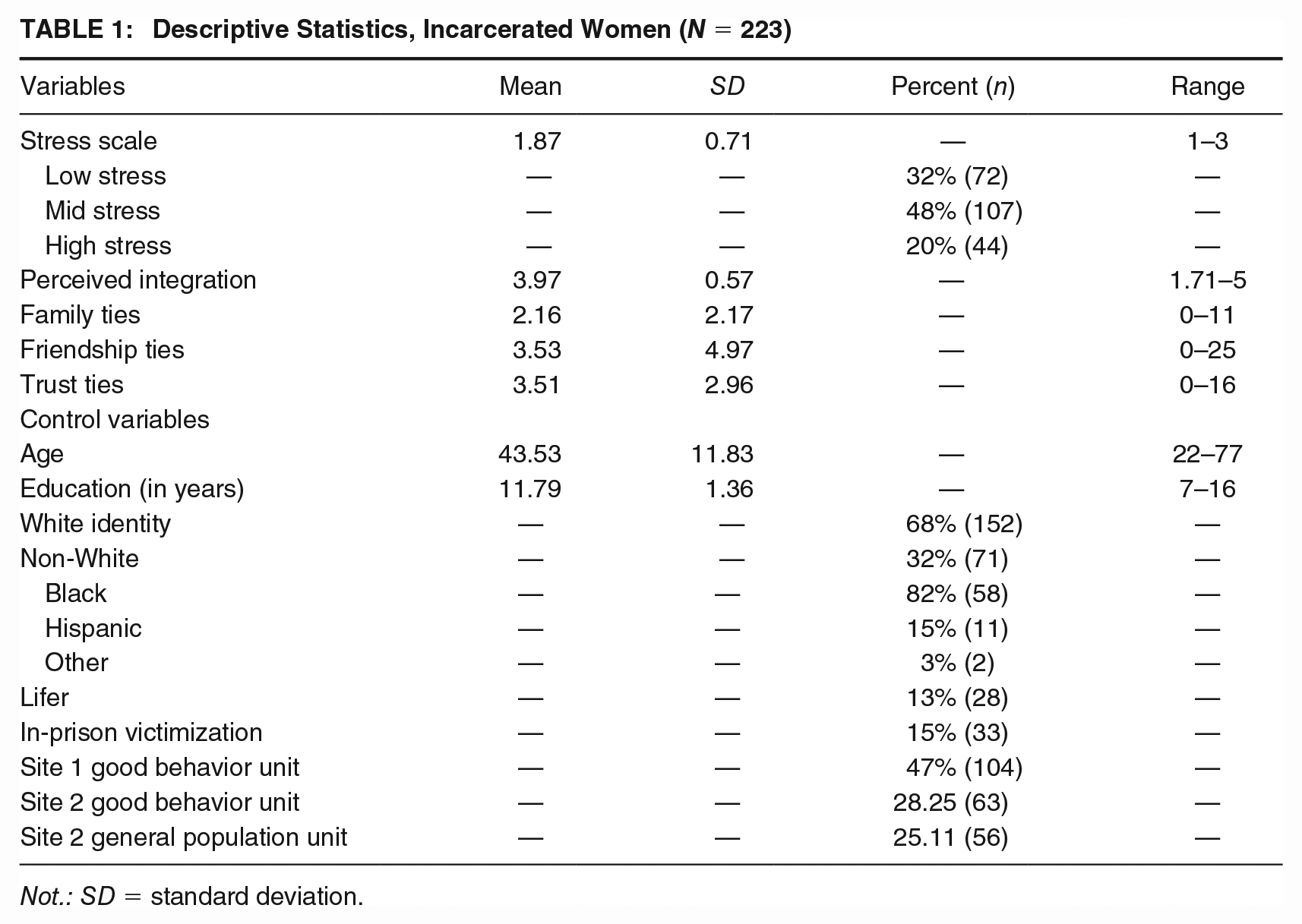
Beginning with the descriptive analyses, Table 1 reveals that the average stress level reported by the women in our sample was 1.87, with a standard deviation of 0.71, indicating that most women report experiencing some level of stress during incarceration. When examining the percent of respondents who fall into each stress category, 32% of the women reported feeling low levels of stress (“never” or “rarely” feeling stress), 48% of women reported medium levels of stress (feeling “sometimes” stressed), and 20% of the women reported high levels of stress (feeling stressed “most of the time”). With a range of 1.71 to 5.0, the average level of perceived social integration across units was 3.97, suggesting the average respondent felt somewhat integrated within their prison unit. Turning to our prison network measures, the least common relationship-based ties reported by women were pseudo-family ties, with respondents having an average of 2.16 family ties (range of 0–11 ties). The mean number of friendship ties and trust ties are similar, with women reporting an average of 3.5 ties, although friendship ties have a more extensive range (0–25) than trust ties (range of 0–16).
Descriptive Statistics, Incarcerated Women (N = 223)
Not.: SD = standard deviation.
Tuning to our control variables, Table 1 reports that the average age of respondents is 43.53, with incarcerated individuals falling between ages 22 and 77 years. Across the units under study, women typically did not complete high school, although a few women received a college degree (mean years of education = 11.83 years, range = 7–16). Within the sample, 68% of the respondents identified as White, and 32% identified as non-White. Of those 32% who identified as non-White, 82% of the women identified as Black, 15% as Hispanic, and 3% identified as some other race. Almost 13% of respondents were serving life sentences (i.e., lifers), and 14.8% had experienced violent victimization while incarcerated. The first site’s good behavior unit accounts for 46.6% of our sample, the second site’s good behavior unit accounts for 28.3%, and the second site’s general population unit accounts for 25.1%.
Fundamental differences exist when considering the characteristics of the respondents housed in the good behavior unit compared to those housed in the general population unit. Women were only eligible to be on the good behavior units if no prison rule infractions appeared on their records for at least 12 months before transitioning to the unit. Those residing in the general population unit had no baseline requirements and were often newly incarcerated, resulting in a population with different demographics. Relative to the general population unit, the good behavior unit residents were, on average, older, identified more social ties to other incarcerated individuals, and were more racially diverse. The nature of good behavior units lends to these differences. Refer to the Supplementary Table S2 for descriptive statistics across unit types.
Turning to Table 2 and the correlation matrix representing the bivariate associations among variables reveal somewhat surprising results. Contrary to our expectations, at the bivariate level, prison network ties are not associated with women’s reports of stress. In contrast, perceptions of social integration are negatively associated with stress (r = −.16). However, perceived integration is positively associated with the different types of prison network ties, ranging from correlations of .39 with family ties, .29 with trust-based ties, and .26 with friendship ties. Because these bivariate associations do not account for essential control variables associated with network ties and stress, we next turn to our multivariable ordinal logistic models to determine the associations between prison network ties, perceived integration, and stress, net of control variables.
Correlation Matrix of Your Predictor and Criterion Variables

Multivariable Analyses
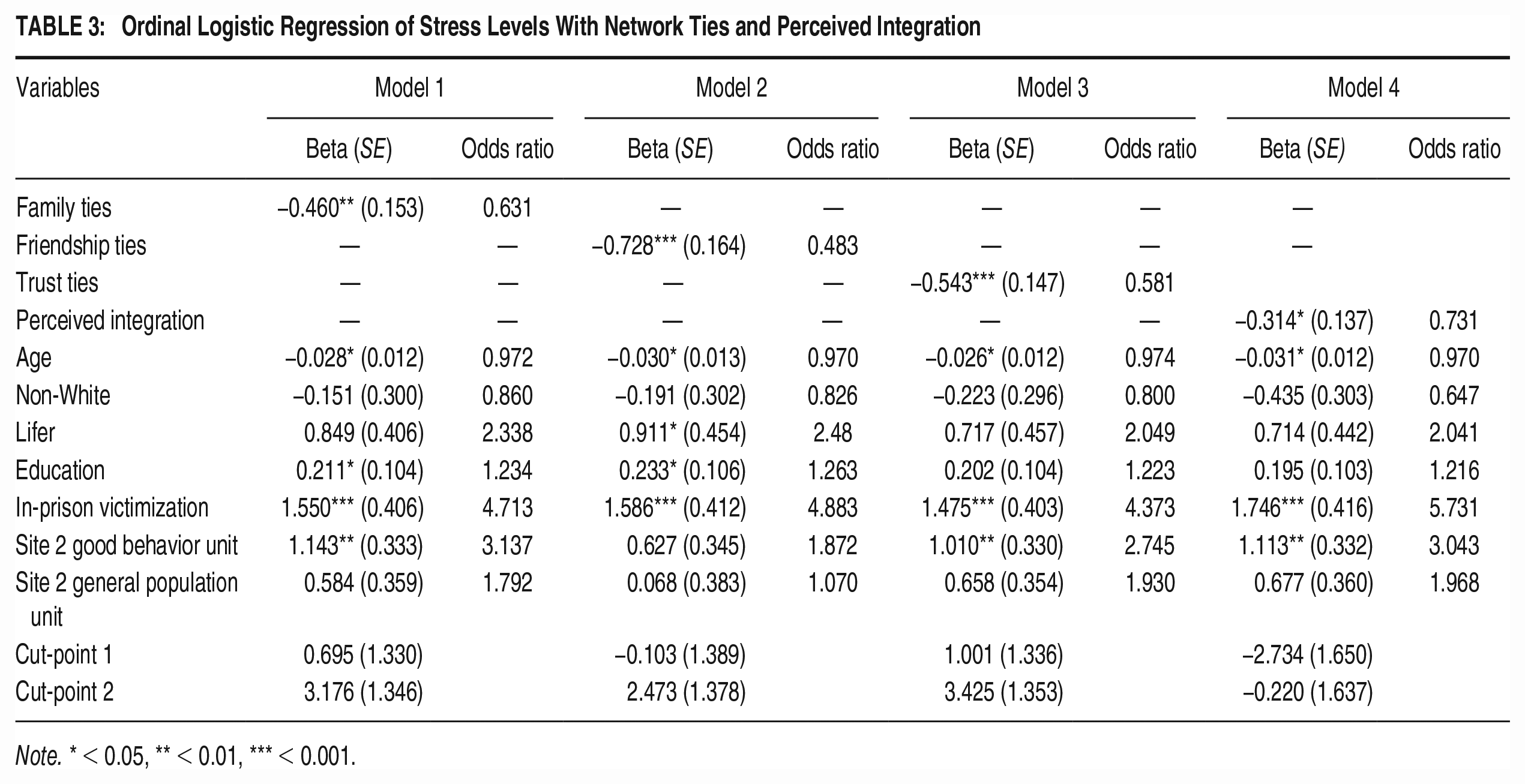
Table 3 presents our results evaluating the associations between prison network ties, perceptions of social integration, and reports of stress. We begin our multivariable analysis by running four ordinal logistic models predicting stress levels for each type of prison network tie (Models 1–3), followed by Model 4, which drops the prison network measures but adds perceptions of social integration to the model. Consistent with our H1, Model 1 shows that for each standard deviation increase in pseudo-family ties, the odds of falling into a higher stress category decrease by approximately 37% (1–0.63) (p = .003). Model 2 reveals a similar relationship, with each additional standard deviation in friendship ties associated with a 52% decrease (1–0.48) in the odds of reporting a higher stress level (p < .001), supporting H2. Turning to H3, which posits trust-based network ties will likewise reduce stress, Model 3 indicates that a standard deviation increase in trust ties is associated with 42% lower odds (1–0.58) of being in the highest stress category (p < .001). Last, Model 4 illustrates that each standard deviation increase in perceptions of social integration also reduces the odds of reporting a higher stress level by 27% (1–0.73; p = .022).
Ordinal Logistic Regression of Stress Levels With Network Ties and Perceived Integration
Note. * < 0.05, ** < 0.01, *** < 0.001.
When comparing the standardized results for perceived integration (Table 3, Model 4) and our three network measures (Table 3, Models 1–3) on incarcerated women’s reports of stress, it is evident that once control variables are accounted for, network ties signaling companionship (e.g., family, friendship, and trust ties) have a stronger negative association with stress than the measure assessing women’s perceptions of social integration, which is less effective in reducing stress. In particular, the number of friendship ties with other residents is associated with the most considerable stress reduction compared to the other network ties examined. When comparing the stress reduction associated with friendship ties (Model 2) and perceived integration (Model 4), the probability of being in a lower stress category is double for the former. Furthermore, each additional standard deviation in friendship ties increases the odds of falling into a lower stress category by approximately 10% more than is the case for trust ties and 15% more than is for prison family ties.
Focusing briefly on control variables, results indicate that experiencing victimization while incarcerated increases the likelihood of reporting a higher stress level by four times that of women not reporting being victimized (p < .001), consistent with prior prison research (Listwan et al., 2010; Porter, 2019). Our results highlight that although perceived social integration is modestly associated with reports of lower stress, having more extensive prison network ties produces more substantial stress reduction.
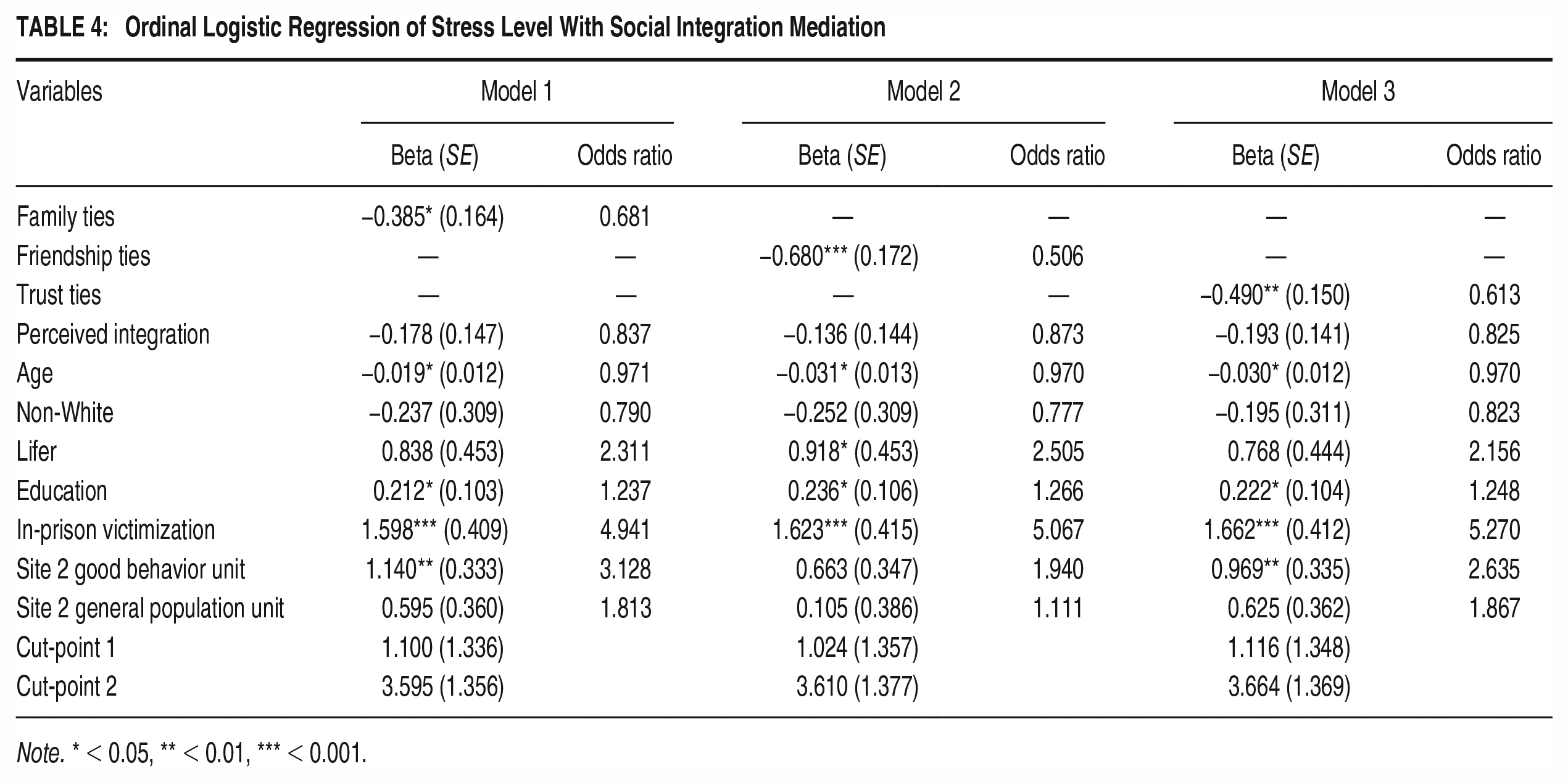
We next turn to our mediation analysis reported in Table 4, which evaluates H4, positing that the association between prison network ties and reported stress will persist in net of women’s perceptions of social integration. To examine this hypothesis, we reanalyze the three types of network measures, described in Table 3, by adding the indicator of perceived integration to each model and determining whether accounting for perceptions of integration reduces the association between prison network ties and reported stress (Table 4, Models 1–3). Table 4 reveals that controlling for perceived integration modestly reduces the size of the coefficients representing family (Model 1), friendship (Model 2), and trust (Model 3) network ties. However, despite the inclusion of perceptions of integration, prison-based relationship ties remain significantly associated with reports of lower stress. For instance, controlling for perceptions of integration reduces the size of the family coefficient (Model 1) by 16.3%, the friendship coefficient (Model 2) by 6.59%, and the trust coefficient (Model 3) by 9.77%. These changes were calculated by subtracting the coefficients in Table 4 from Table 3, dividing them by the Table 4 coefficient, then multiplying them by 100%.
Ordinal Logistic Regression of Stress Level With Social Integration Mediation
Note. * < 0.05, ** < 0.01, *** < 0.001.
Finally, these results also reveal that perceptions of integration are no longer significantly associated with reports of stress once models account for prison-based relationship ties like pseudo-family (Model 1), friendship (Model 2), and trust (Model 3) network ties. Therefore, although perceived social integration partially mediates a small portion of the relationship between prison network ties and stress, the stress-reduction benefit of family, friendship, and trust social ties persists in net of the inclusion of an indicator of perceived integration, supporting H4. Altogether, Table 4 results indicate that prison network ties are more effective at reducing stress than perceptions of integration among our sample of incarcerated women, suggesting that network ties provide additional resources beyond those offered by feelings of being integrated into prison life.
Discussion
Throughout social integration research, the concept of perceived social integration refers to individuals’ beliefs about their level of integration within a particular setting. It is often used interchangeably with a more structural measure of social integration based on the number of social ties individuals have with their peers (Brissette et al., 2000; Seeman et al., 2002; Thoits, 1995; Wang et al., 2014). However, research has yet to empirically explore the relationship between these measures in the context of prison. In this study, we bridge this gap by examining both perceived social integration and quantifiable indicators of the number of social ties with other incarcerated women across different relationship types reported by incarcerated women.
While past research on women’s prisons emphasized the significance of pseudo-family ties, recent studies suggest friendship ties have become more prevalent and beneficial in today’s prison climate (Giallombardo, 1966; Greer, 2000; Hart, 1995; Severance, 2005). On the other hand, trust-based ties have received less attention but may also reduce stress, similar to friendship or family ties (Liebling & Arnold, 2012; Young & Haynie, 2022). Our study addresses the types of social ties that are most beneficial for incarcerated women’s mental health. We analyzed data from three prison units in two Pennsylvania women’s prisons to address these questions. Our goal was to compare how the number of social network ties and perceived integration relate to incarcerated women’s reports of stress. We also examined the varying associations of prison network ties with stress outcomes, including pseudo-family, friendship, and trust ties. Last, we explored whether perceived social integration mediates the relationship between prison network ties and stress.
Our results show that having more extensive family, friendship, and trust ties is associated with lower stress among incarcerated women. Perceptions of integration are also linked to lower stress levels when examined independently of prison network measures. Friendship ties were associated with the greatest amount of stress reduction, followed by trust-based and pseudo-family–based prison ties. Perceived social integration, as a non–network-based measure, accounted for the least amount of stress reduction compared to our prison network ties. Our analysis also suggests that perceived integration plays a minor mediating role, indicating that the stress-reducing effect of prison network ties extends beyond feelings of integration. These prison network ties likely alleviate stress by providing tangible resources and support, in addition to fostering a sense of belonging and community.
Lin (2008) distinguished between binding and bridging ties, defining binding ties as those relationships characterized by strong, close, and enduring bonds often associated with emotional connections, trust, and reciprocity. Overall, our findings suggest that incarcerated women’s family, friendship, and trust-based relationships bind them together and offer them tangible resources beyond instilling a sense of belonging. With that said, friendship-based ties, while not necessarily based on strong emotional feelings, do appear to be the most binding, at least in terms of their role in reducing incarcerated women’s stress (Collica, 2010; Greer, 2000; Severance, 2005). While our study looked at each type of relationship-based network separately, future research could identify whether those identified as part of one type of network (e.g., friends) also appear in the other two types of networks (e.g., family or trusted). This measure of network overlap might better capture Lin’s (2008) concept of binding ties.
While we maintain that social integration, defined as the establishment of social network ties within prisons, plays a crucial role in alleviating the daily perceptions of stress among incarcerated women (Seeman et al., 2002; Wang et al., 2014), it is also important to acknowledge the differences between social relationships in prison and those in the community. In prison, individuals have limited control over their social environment, as network members are primarily determined by security measures and shared living spaces rather than personal choice. Outside of the prison context, friendships are typically grounded in shared interests, trust, and mutual respect. In contrast, prison interactions may be more transactional or proximity-based rather than resembling traditional friendships. Relationships serve diverse purposes outside the prison, including socialization and resource access, whereas in prison, they are often driven by safety, the need for emotional support, or access to unavailable resources (Severance, 2005). Despite these differences, prison relationships, while unique, play a significant role in incarcerated women’s overall social support system and greatly impact their adjustment to prison life and likely their preparation for reintegration into the community. Researchers and practitioners should navigate these distinctions between settings thoughtfully, all while acknowledging the pivotal role of social ties to other incarcerated individuals in enhancing the outcomes and overall quality of life for incarcerated individuals (House et al., 1988; Thoits, 1995).
Our findings have important policy implications. By distinguishing between perceived integration and the number of prison relationship-based ties to other incarcerated individuals, we highlight the importance of considering both aspects for understanding incarcerated women’s well-being. Being able to connect with other incarcerated individuals in various roles reduces women’s stress during incarceration. Promoting these relationships and facilitating community-building activities through correctional programs will likely alleviate some of the stress associated with imprisonment, improve overall well-being, and prepare individuals for successful reintegration into society (Cunha et al., 2023).
Of course, as with any study, there are some limitations of our study that future research should address. Our sample is limited to three prison units in two Pennsylvania women’s prisons, limiting generalizability to other U.S. prisons. In addition, the cross-sectional nature of our data prevents causal statements regarding our findings. Beyond perceptions of integration, we cannot clearly identify other potential mechanisms underlying the associations between prison network ties and stress. Last, stress among incarcerated women is a multifaceted concept influenced by a myriad of personal, institutional, and societal factors. While the current study highlights the role of prison social networks, future research should acknowledge the complexity of stress within the broader context of incarceration and explore a more comprehensive array of contributing factors, including personal stressors (e.g., motherhood, mental health) and institutional stressors (e.g., overcrowding). The complexity of the topic and the multifaceted nature of stress within correctional facilities call for more comprehensive investigations that consider a broader array of stressors, gendered experiences, and the use of mixed-methods approaches. Building upon the foundation laid by the current study, future research can provide a more holistic understanding of stress among incarcerated women and inform targeted interventions and policy improvements.
These limitations are necessary compromises given the unique nature of the data utilized in this study. Data within prisons are notoriously difficult to attain, making a dataset as large as the one examined here a rare commodity. Furthermore, no other in-prison data from the United States contain complete social network information, measures of perceived integration, and a wide range of demographic, behavioral, and attitudinal attributes. Given that our research questions focus on various types of prison network ties, having near-complete social network data describing the relationships among women housed in the three prison units was integral to study success. Furthermore, the completeness of these networks reveals an unprecedented picture of inmate society that was previously hidden from view.
In conclusion, understanding how different forms of social integration within prison units reduce stress among incarcerated women is crucial for improving their mental health during incarceration and preparing them for successful reintegration into society. Our results emphasize the importance developing social ties with other inmates as an important way to reduce stress while incarcerated. Incorporating social network dynamics into research on incarcerated women’s mental health offers valuable insights for future studies and intervention development.
Supplemental Material
sj-docx-1-cjb-10.1177_00938548241268008 – Supplemental material for The Ties That Bind: The Association Between Social Network Ties, Integration, and Stress Among Incarcerated Women
Supplemental material, sj-docx-1-cjb-10.1177_00938548241268008 for The Ties That Bind: The Association Between Social Network Ties, Integration, and Stress Among Incarcerated Women by Story Edison and Dana L. Haynie in Criminal Justice and Behavior
Footnotes
Authors’ note:
This research was supported by the National Institute of Justice [2016-MU-MU-0011] and the National Science Foundation [1457193]. However, the content is solely the authors’ responsibility and does not necessarily represent the official views of the respective agencies.

Supplemental Material
References
Supplementary Material
Please find the following supplemental material available below.
For Open Access articles published under a Creative Commons License, all supplemental material carries the same license as the article it is associated with.
For non-Open Access articles published, all supplemental material carries a non-exclusive license, and permission requests for re-use of supplemental material or any part of supplemental material shall be sent directly to the copyright owner as specified in the copyright notice associated with the article.
