




Abstract
The current study examined the role of sanctions and incentives in improving community supervision outcomes, utilizing data collected from 300 individuals under probation supervision by the Denver Adult Probation Department. The research expanded the current literature by addressing two important existing gaps. First, we included supervision failure due to absconding as a unique dependent variable. Second, we controlled for client behavior to enhance our confidence in study findings. Findings revealed no evidence in support of the use of sanctions to improve supervision outcomes. Incentives, however, were associated with both an increased likelihood of supervision completion and a lower incidence of criminal offending. Study findings suggest a need to prioritize efforts to integrate incentive use into everyday supervision practices, as well as a need to increase funding to support the research and development of incentive programs to guide agencies in creating and sustaining programs that will have the greatest impact.
Over the last two decades, the correctional field has shed many of the get-tough policies that dominated policy and practice at the end of the 20th century (Cullen et al., 2023). Motivated by a growing realization of the deleterious economic and societal consequences of mass incarceration, jurisdictions have implemented a variety of strategies in an attempt to limit prison admissions, including the increased use of community supervision options. While often viewed by judges and other decision makers as alternatives to incarceration, evidence reveals that probation and other community supervision programs often act as a conduit to incarceration through high failure rates. In many states, for example, community correction revocations account for over half of new prison admissions each year (Horowitz et al., 2018).
In an attempt to slow the probation-to-prison pipeline, agencies have adopted a number of evidence-based strategies aimed at promoting prosocial behavioral change and improving supervision outcomes, including the use of sanctions and incentives. Grounded in behavioral learning theories, sanctions and incentives are intended to provide supervision officers the tools to actively support behavioral change in the clients they supervise. Incentives (e.g., praise, gift cards, and reduced reporting requirements) are used to reinforce compliant/prosocial behaviors, while sanctions (e.g., verbal reprimands, increased reporting, and short jail stays) are administered in response to acts of noncompliance to discourage future recalcitrance.
Research on the efficacy of sanctions and incentives in community supervision settings (discussed in more detail below), while mixed, suggests these interventions can play an important role in promoting positive supervision outcomes. A recent study by Clark and associates (2023), for example, found that a specialized caseload designed for young adult probationers, which included the incorporation of sanctions and incentives, led to improved stability and supervision outcomes. Similarly, Breno and colleagues (2023), using data from more than 30,000 probationers and parolees in the state of North Carolina, found the use of sanctions and incentives was associated with improved outcomes during the first 6 months of supervision.
The current study adds to the growing body of research on the use of sanctions and incentives using data collected from the Denver Adult Probation Department (DAPD). Specifically, this research expands the current literature by addressing two important gaps in existing studies. First, we expand the scope of our inquiry to include supervision failure due to absconding supervision, which occurs when the client is no longer in contact with the supervising officer and their whereabouts are unknown. While research on absconding is limited, existing findings suggest that drivers of absconding may be unique from other types of technical violations (Grattet & Lin, 2016). In the current research, we examined whether officer use of sanctions and incentives influenced client decisions to abscond supervision.
Second, the current study aims to disentangle the potential spurious relationship between the use of sanctions and invectives and client behavior that is inherent in retrospective studies. Much of the research focusing on sanctions and incentives relies on existing agency data which is used to model the efficacy of sanctions and incentives on supervision success or other related dependent variables, while controlling for relevant factors related to the client and their supervision. Missing from these models, however, is a measure of client behavior that, at least in theory, is directly related to both the decision to administer a sanction or incentive and the decision to pursue a revocation. Probation clients, for example, who are more compliant in their supervision have greater opportunities to receive incentives simply due to their conforming behavior. This conforming behavior is also more likely to result in a successful completion of supervision. As such, it is not entirely clear whether the use of incentives is causal or superfluous. In the current research, we attempted to isolate the impact of incentive and sanction use on supervision outcomes by controlling for client behavior, which to our knowledge provides a unique contribution to the literature.
Prior Research on Sanctions and Incentives in Community Supervision
Research on the use of sanctions and incentives in community supervision populations has grown considerably over the last decade. As such, it is beyond the scope of this article to review each study on the topic individually; instead, we focus on themes that have emerged in the literature. Before proceeding, it is important to highlight two constraints of the existing research on sanctions and incentives that prompt a level of caution in generalizing the findings. First, it should be recognized that much of the research on this topic focuses on the application of sanctions and incentives in specialized supervision programs such as drug courts or Honest Opportunity Probation with Enforcement (HOPE)/swift, certain, fair (SCF) interventions as opposed to general probation and parole supervision. Often these programs focus on specific target populations and/or involve other interventions, thus making generalizations to broader community supervision populations somewhat tenuous. Second, the body of literature on sanction use is more plentiful and developed than the literature on incentives. As a result, the themes discussed below are more heavily influenced by what we know regarding the efficacy of sanctions as opposed to incentives.
Theme 1: The Literature on Sanction Use Is Mixed but Trending Toward Ineffective
There are two primary strands of research that provide insight into the efficacy of sanctions with community supervision populations. One strand, which has received substantial attention recently, focuses on sanctions implemented under the SCF framework. Modeled after Judge Alm’s well-known Hawaii HOPE program, SCF supervision programs generally seek to induce compliance through the consistent imposition of sanctions, most commonly short jail stays, for violating supervision conditions (Hawken & Kleiman, 2009). The proliferation of SCF programs over the last decade can be attributed in large part to a 2009 evaluation of the HOPE program which showed positive outcomes, including fewer positive and missed drug tests, lower revocation rates, and fewer arrests (Hawken & Kleiman, 2009). Since this initial evaluation, multiple studies have been conducted on replication programs, which have sprung up across the country. While some have found support for SCF sanctioning programs (Grommon et al., 2012; Hamilton et al., 2016), others have concluded that SCF practices are either ineffective or lead to unintended negative outcomes such as increased revocation and conviction rates (Lattimore et al., 2016; O’Connell et al., 2016). A recent meta-analysis completed by Pattavina and associates (2024) that comprised 18 studies ultimately concluded that “HOPE/SCF programs have minimal effects on recidivism.” In sum, the once optimistic view on the efficacy of SCF sanctioning programs has softened considerably in the wake of empirical research finding little support for the efficacy of the programs.
A second strand of research on the efficacy of sanctions comes from the more general research focusing on sanction use in community supervision outside the SCF model. Here again the research is mixed but trending toward ineffective, especially when used as a standalone intervention. A recent study by Romain Dagenhardt and colleagues (2023), for example, found that jail sanctions used as a response to technical violations in a domestic violence court setting had no effect on recidivism rates and actually resulted in a shorter time to recidivism when compared with those who only received verbal reprimands. Similarly, research conducted by Mowen et al. (2018) found that sanctions and verbal reprimands were associated with increased levels of substance use and criminal activity. Again, not all research on sanction effectiveness produce null findings. The aforementioned study by Breno and colleagues (2023) found that sanction use was associated with improved short-term outcomes among probation and parole clients in the state of North Carolina. In addition, a study by Wodahl et al. (2011) examined the use of sanctions and incentives among individuals supervised on an intensive supervision program in Wyoming. Results indicated that sanctions, when used in concert with incentives, led to higher rates of program success. However, when taken together, the evidence suggests that sanctions, whether utilized as part of an SCF program or used in conjunction with more traditional supervision settings, are lacking consistent empirical support.
Theme 2: The Literature on Incentive Use Is Mixed but Trending Toward Effective
As previously mentioned, the literature on the value of incentives in community supervision is less developed than the literature on sanction use. With this in mind, there is growing evidence to support the use of incentives as a tool to improve supervision outcomes (Breno et al., 2023; Mowen et al., 2018; Mueller, 2022; Wodahl et al., 2011). For example, Mowen and colleagues’ (2018) analyses of the Serious and Violent Offender Reentry Initiative data found that officer use of incentives, namely verbal praise, was associated with lower levels of criminal offending and substance use. Similarly, Carroll et al. (2006) found using monetary vouchers among a sample of marijuana-dependent probationers in a treatment setting was associated with a lower frequency of positive drug tests and increased treatment engagement.
Not all research on incentive use has shown positive outcomes. One strand of research, for example, has explored the value of adding monetary incentives as a supplement to traditional drug court reward structures (e.g., praise from the judge, level advancement, and decreased reporting requirements) as a means to enhance abstinence and treatment attendance (Hall et al., 2009; Marlowe et al., 2008; Prendergast et al., 2008). These studies found no evidence that the addition of monetary incentives significantly improved outcomes. However, it should be emphasized that this research specifically examined whether the addition of monetary payments enhanced already existing drug court reward systems as opposed to the overall efficacy of incentives. The effect of monetary incentives alone on outcomes remains untested.
Theme 3: Type of Outcome Measured Matters
Studies on sanctions and incentives have explored several different outcomes that are salient in community supervision, including drug use, treatment retention, technical violations, program completion, and criminal offending. While patterns are still emerging, there is evidence to suggest that the effectiveness of sanctions and incentives vary across the nature of the dependent variable being explored, as well as the length of the follow-up period. These patterns are most visible in the SCF sanction literature. Pattavina and associates’ (2024) meta-analysis, which incorporated finding from 18 unique studies, revealed that effect sizes for sanctions were more robust among studies that had shorter follow-up periods (<12 months) and those that focused on non-drug use outcomes (e.g., arrest, probation violation, incarceration). Similar patterns are observed in studies focusing on incentive use, especially as they apply to the nature of the outcome being examined. With some notable exceptions (Carroll et al., 2006; Mowen et al., 2018), the literature suggests that incentives may be more effective at improving outcomes, such as supervision completion and avoiding criminal reoffending, than substance-related behaviors such as drug use and treatment retention.
One outcome that has received minimal attention in the sanction and incentive literature is absconding. Absconding is a unique type of technical violation that occurs when a client breaks all contact with the supervising officer and the client’s location is unknown. While no national level statistics exist, reports from individual jurisdictions suggest that absconding is not trivial and accounts for a substantial number of clients who are revoked for technical violations. A 2011 study focusing on felony probationers in Collin County Texas, for example, revealed that absconders accounted for 30% of all revocations (Belshaw, 2011). Grattet and colleagues (2009) found that two-thirds of technical violations among parolees in California were for absconding. Similarly, research conducted with the DAPD, which is the site of the current study, revealed that 61% of probation clients revoked for technical violations from 2015 through 2018 had absconded supervision (Wodahl & Schweitzer, 2021).
Existing research on absconding behavior, while limited, has focused largely on understanding the predictors of absconding. This literature generally reveals that absconding behavior is correlated with a variety of individual-level characteristics. Studies have shown, for example, that risk of absconding is higher among clients who are younger and non-White, those with unstable employment and housing situations, those with more severe criminal histories, and those with elevated risk levels (Mayzer et al., 2004; Powers et al., 2018; Stevens-Martin & Lui, 2017). Evidence also shows the risk of absconding is influenced by supervision-level factors. More specifically, studies have revealed that individuals who are subject to more intense and punitive forms of supervision are at higher risk to abscond supervision (Grattet & Lin, 2016; Schwaner et al., 1998). A study by Grattet and Lin (2016), for example, using data drawn from parole records in California, found that supervision intensity was positively associated with the hazard of absconding supervision after controlling for individual-level factors.
Extrapolating on these findings, it is probable that the use of sanctions and incentives may influence decisions to abscond. The imposition of sanctions, for example, might reinforce perceptions of supervision as being punitive, thus increasing motivations to flee. On the other hand, use of incentives may dispel negative views toward supervision and supervision officers, leading to lower rates of absconding. Only one study to date has looked specifically at the influence of sanctions and incentives on absconding behavior (Breno et al., 2023). This study found that both sanction and incentive use were associated with lower levels of absconding behavior during the first 6 months of supervision. The degree to which these findings remain stable over the supervision period, however, is currently unknown.
Theme 4: The Importance of Study Design
A final theme in the research on the influence of sanction and incentive use on supervision outcomes relates to the variation in findings across study designs. Succinctly stated, studies using higher quality designs, especially those that employ randomized controlled trials (RCTs), are more likely to reveal null findings compared with studies that used quasi-experimental designs. This theme was highly evident in the aforementioned meta-analysis on HOPE/SCF sanctioning programs, which revealed that studies which utilized RCT designs revealed no evidence to support the efficacy of sanctions in community supervision settings (Pattavina et al., 2024). A similar pattern is also observed in the incentive literature with RCT studies more likely to reveal null findings (Hall et al., 2009; Marlowe et al., 2008; Prendergast et al., 2008).
One potential reason for the discrepancy of findings may be model misspecification in quasi-experimental studies caused by the failure to account for client behavior in the multivariate models. To date, no published studies have controlled for client behavior when modeling the influence of sanctions and incentives on supervision outcomes. Because the underlying behaviors that lead to the application of sanctions and incentives are often the same behaviors that lead to supervision outcomes of interest (e.g., sanctions for behaviors that can lead to revocation, incentives for behaviors that promote successful completion), this is potentially problematic. If these behaviors are not statistically controlled for, incorrect assumptions about the true nature of these relationships may be made. This is especially important when considering the connection between incentive use and supervision outcomes. Compliant and prosocial behaviors that are likely to trigger the administration of an incentive, such as attending treatment, abstaining from drugs and alcohol, and paying court ordered fees and costs, are the same behaviors that lead to positive supervision outcomes. As such, when studies fail to control for client behavior, the significant findings may reflect a spurious relationship as opposed to a causal relationship.
Current Study
The current study seeks to add to the literature on the effectiveness of sanctions and incentives in improving supervision outcomes using data on probation clients supervised by the DAPD. More specifically, the study was guided by the following research questions:
Does the use of sanctions and incentives during supervision influence supervision outcomes when controlling for client compliance with supervision conditions?
Does the influence of sanctions and incentives on supervision outcomes vary across the type of supervision outcome being considered, including probation outcome, absconding, and the commission of a new crime?
Study Site and Overview of Relevant Policies
Data for this project were collected as part of a larger research study aimed at identifying drivers of revocation in the DAPD. The DAPD provides supervision services for adults convicted of felony and misdemeanor level offenses sentenced out of the Second Judicial District Court in Colorado. Geographically, the DAPD’s jurisdiction includes the City and County of Denver that has a residential population of more than 700,000. The DAPD is one of the largest adult supervision offices in Colorado with approximately 4,500 active cases at the time of data collection. Approximately 66% of the DAPD’s clients are under supervision for a felony offense, while the remaining 34% are supervised for misdemeanor charges. The DAPD supervises a challenging caseload with a disproportionately high concentration of clients with severe substance abuse and mental health problems, as well as high levels of housing instability. The challenging nature of the DAPD’s supervision population is evidenced in the distribution of probationers based on risk level. Over half (52%) of their caseload was determined by the Level of Services Inventory–Revised (LSI-R) risk/needs assessment instrument to be high risk, while medium-risk (32%) and low-risk (16%) clients made up the remaining 48%. The DAPD has embraced a culture that values research and evidence-based practices, with the goal of promoting and supporting long-term prosocial behavioral change among its clientele.
At the time of data collection, the DAPD had a behavior modification policy that provided guidance to officers on sanction use. While not designed to remove all discretion from officers, the policy guides officers to use sanctions in lieu of revocation except in cases where the severity of the violation (e.g., committing a new violent offense) warrants immediate return to court. The policy also guides officers to use low- or high-magnitude sanctions depending on the severity of the transgression. High-magnitude responses included primarily custodial sanctions such as short jail terms or home confinement, while low-magnitude sanctions included responses such as increased drug testing, written assignments, and more frequent reporting. No such policies existed regarding the use of incentives. Thus, while the DAPD generally encouraged the use of incentives among its officers, there were no policies in place to specifically guide incentive use. Incentives used at the DAPD at the time data were collected include verbal praise, gift cards, and reduced supervision requirements (e.g., reduced drug testing frequency).
Method
Study Sample
Our study sample consisted of 200 unsuccessful and 100 successful high- and moderate-risk probation clients who were discharged from the DAPD from 2015 through 2018. We first drew a disproportionate random sample of 200 unsuccessful discharges from the population of clients who were unsuccessfully discharged during that time. We drew our disproportionate sample of 200 unsuccessful discharges using two criteria. First, we oversampled Black males; we did this for multiple reasons: (1) to ensure adequate racial representation for future analyses aimed at detecting potential racial differences, (2) preliminary analyses indicated this group may be at high risk of revocation and therefore we wanted to be sufficiently powered to be able to explore this, (3) the Chief of the DAPD was particularly interested in potential racial differences, and (4) race was a key focus of the granting agency due to the events of 2020 and the Black Lives Matter movement. Second, to ensure that adequate file information was available for the case file reviews we only included individuals who had both a completed presentence investigation (PSI) and a documented risk score—as measured by the LSI-R—in our sampling frame (approximately 25% had both). 1 To ensure this requirement did not create a sample that was unrepresentative of the probation population at the DAPD, we explored how those with both a PSI and LSI-R score may have differed from the overall population by comparing these two groups on: success rates on supervision, basis of revocation (technical vs. new crime), offense level (felony vs. misdemeanor), and demographics. Overall, probationers who had both a PSI and LSI-R were similar in many respects to those who did not have both a PSI and LSI-R. There were approximately equal rates of successful completion of probation (39% vs. 36%), revocations for a new crime (10% vs. 8%), and revocation for a technical violation (19% and 23%). The groups were similar demographically in terms of age (both means = 34), sex (male = 82% vs. 77%), and race (White = 54% vs. 66%; Black = 28% vs. 21%). One difference, however, was that clients who had both a PSI and LSI-R were somewhat more likely to have committed a felony (65%) than those who had neither a PSI nor LSI-R (53%). Of our final sample of 200 unsuccessful discharges, approximately 73% were categorized as maximum risk and 27% as medium risk at the start of their probation term.
After selecting our 200 unsuccessful discharges, we utilized propensity score matching to select a comparable group of clients who successfully completed probation to allow for a direct test of differences in supervision strategies/practices and client behavior on probation outcomes. Specifically, we matched our sub-samples on age, race, sex, risk level, and crime type, which allowed us to explore other potential differences/drivers of revocation.
After our full sample of 300 was identified, members of the research team extracted data from electronic client case files to include detailed information about each client’s background (e.g., education, abuse history, mental health history), violation history (e.g., missed drug tests, treatment violation, missed appointments), types of treatment referrals, and supervision events. General information was coded (e.g., age, race, education), along with a month-by-month log of the client’s employment status, housing status, treatment compliance, violations, sanctions, incentives, supervision events, and life events. Sample descriptives are provided in Table 1.
Sample Descriptive Statistics

Dependent Variables
Probation Outcome
The outcome of the probation client’s supervision term was coded as either a successful completion (1) or unsuccessful discharge (0). Successful completion encompasses any client who completed their probation term or were released early from probation. Failure to successfully complete probation encompasses any client who did not successfully complete their probation term and includes those who absconded from probation and those who had their probation revoked (most often for the commission of a new crime or a technical violation).
New Crime Violation
Another dependent variable was whether the client was arrested and charged with a new crime while on probation. Clients who were arrested and charged with a new crime, whether a felony, misdemeanor, both, or unknown, were coded as 1, and all other clients were coded as 0.
Absconding
We were also interested in drivers of absconding, as absconding is a key issue at the DAPD. Per agency policy, for a client to be considered as absconded, the supervising officer must make various efforts to establish contact with the client to include phone calls, home visits, and contacting family members and last known employer. In addition, the officer must contact local jails and run local and national records checks. If through these efforts the individual cannot be located, the client is considered on absconding status and a warrant is requested. Clients who were removed from supervision due, at least in part, to an absconding event were coded as 1, while clients whose probation term ended another way (e.g., successful completion, revocation for committing a new crime) were coded as not absconding (Not Absconding = 0).
Independent Variables
The two primary independent variables of interest are measures of sanctions and incentives received while on supervision. To account for the prevalence of sanctions and incentives received by clients during their supervision terms, we created two proportion scores that indicate the number of months clients received at least one sanction and the number of months clients received at least one incentive. 2 To do this, any month the client received one or more sanction or incentive was coded as a one. We then summed this value across the client’s time on probation and divided this value by the total number of months the client was on probation, allowing for scores to range from 0 to 1. For example, if a client had 3 months where they received at least one incentive and the client was on probation for 12 months, the client would have a value of 0.25 for the proportion of months they received at least one incentive. Furthermore, if the same client instead had 6 months where they received at least one sanction (out of the 12 months of their term), the client would have a value of 0.50 for the proportion of months they received at least one sanction. Descriptive statistics regarding the types of incentives and sanctions utilized are presented in Table 2.
Frequency of Incentive and Sanction Types Used
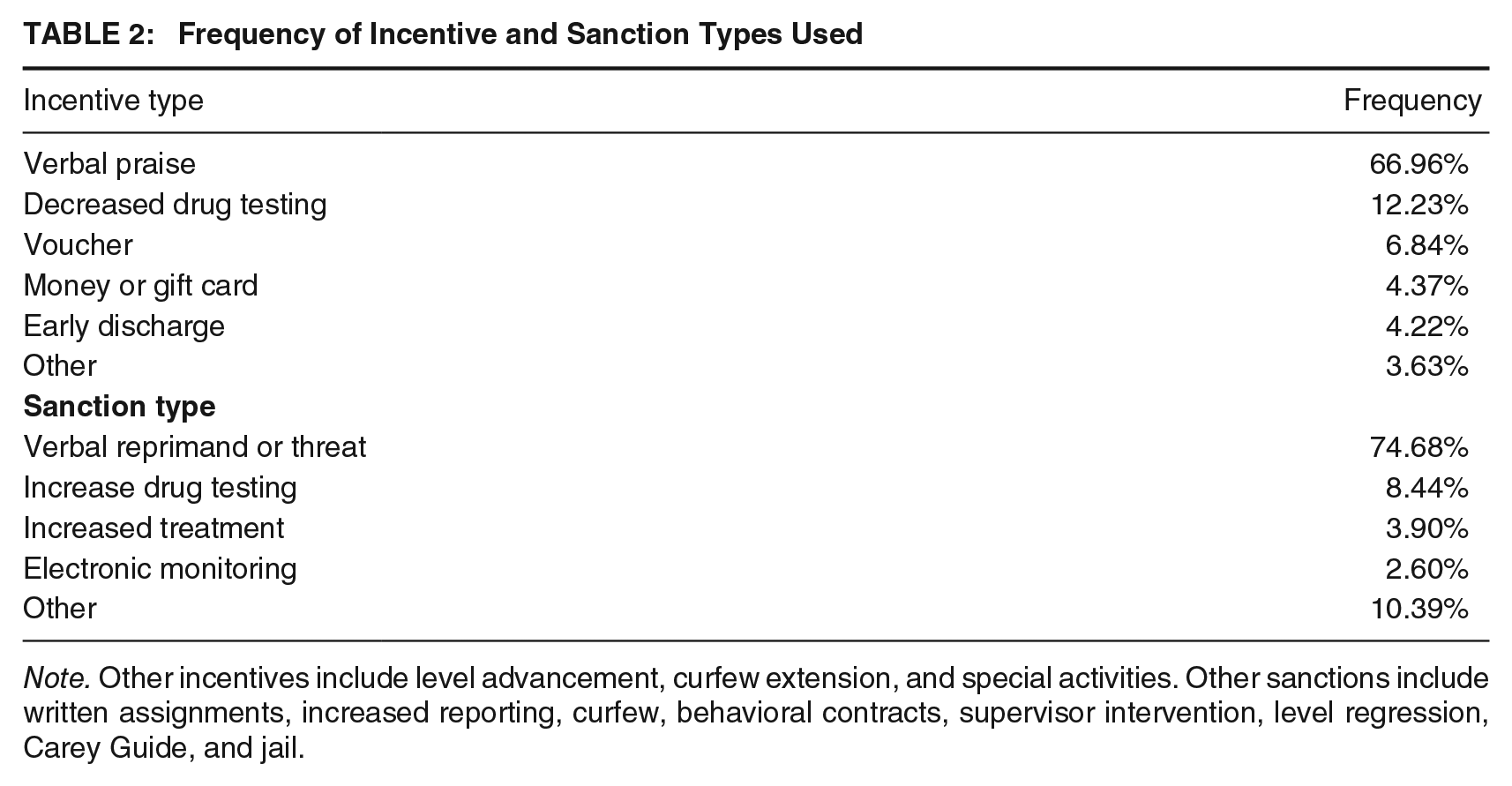
Note. Other incentives include level advancement, curfew extension, and special activities. Other sanctions include written assignments, increased reporting, curfew, behavioral contracts, supervisor intervention, level regression, Carey Guide, and jail.
Our decision to measure sanction and incentive use as a proportional variable as opposed to an alternative method, such as an aggregate count received during the duration of the supervision, was made to avoid the potentially confounding effects of supervision length in our models. In our sample, negative supervision events (e.g., absconding, revocation) generally occurred early in the supervision period. Nearly half of our sample who experienced a revocation, for example, were terminated within 6 months of starting supervision and three quarters were terminated by month 12. By contrast, 90% of successful clients were still under supervision at 18 months. As a result of the increased time spent on supervision, successful clients had greater opportunity to experience both sanctions and incentives. Given this, using aggregate counts makes it difficult to interpret whether any positive or negative relationship between the number of incentives and sanctions received and supervision outcomes is simply a product of greater or lesser time on supervision as opposed to the experience of the intervention itself. By contrast, scaling the variables by the total months under supervision allowed us to account for variability in time on supervision, which, if left unaccounted for, could lead to incorrect interpretations about the influence of sanctions and incentives on supervision outcomes.
Control Variables
Individual-Level Variables
To control for relevant demographics, we included sex (0 = female), age, race (0 = White), and whether the client had a high school education (0 = no) in our models. We also included whether the client had a documented history of mental health issues (0 = no history), whether the client had any children under 18 living with them (0 = no children in the home), and the client’s LSI-R score at the start of their probation term.
We also computed the stability of clients’ housing arrangements and employment. To create a measure of housing stability, we categorized each month of the client’s supervision as either being stable or unstable/homeless. 3 We then calculated the percentage of months in which the client’s housing was coded as stable and the percentage of months the client’s housing was coded as unstable/homeless. Clients with stable housing for at least 70% of the months they were on probation were coded as having generally stable housing while on supervision (Housing Stability = 0). All others were coded as having unstable housing while on supervision (Housing Stability = 1). Employment stability was calculated the same way, with stable employment coded as zero and unstable/unemployed coded as 1. It should be emphasized that our measures of both housing and employment stability are based on information documented by supervision officers reported in the client case files and thus are limited in their capacity to account for variation in what may be deemed stable or unstable from the perspective of the clients themselves.
Supervision-Level Variables
Along with the individual-level variables outlined above, two supervision-level variables were included in our models. First, recognizing the potential importance of addressing criminogenic needs through treatment referrals, a count variable was created to measure the number of referrals made by the officer during the supervision period. Here, we expect a positive relationship between referrals and successful supervision outcomes; however, it should also be recognized that an increase in referrals creates additional opportunities for noncompliance. A client who is referred to a treatment program would be considered in violation for neglecting to follow through with required assessments and other treatment appointments.
Finally, a measure was created to measure the client’s average noncompliance while under supervision. This variable is a measure of the degree to which clients were unable to adhere to conditions of supervision, ranging from missing an appointment with their supervision officer to engaging in new criminal activity. Recognizing there is substantial variation in the severity of violations, point values, hereinafter referred to as violation scores, ranging from 1 (less serious) to 3 (very serious) were assigned based on the nature of the transgression. Violation scores were guided largely by the results of a survey given to supervision officers, which asked officers to rate the perceived severity of various violations commonly experienced by probation clients in the DAPD. See Table 3 for the list of violations and corresponding scores.
Violation Behaviors and the Corresponding Noncompliance Value
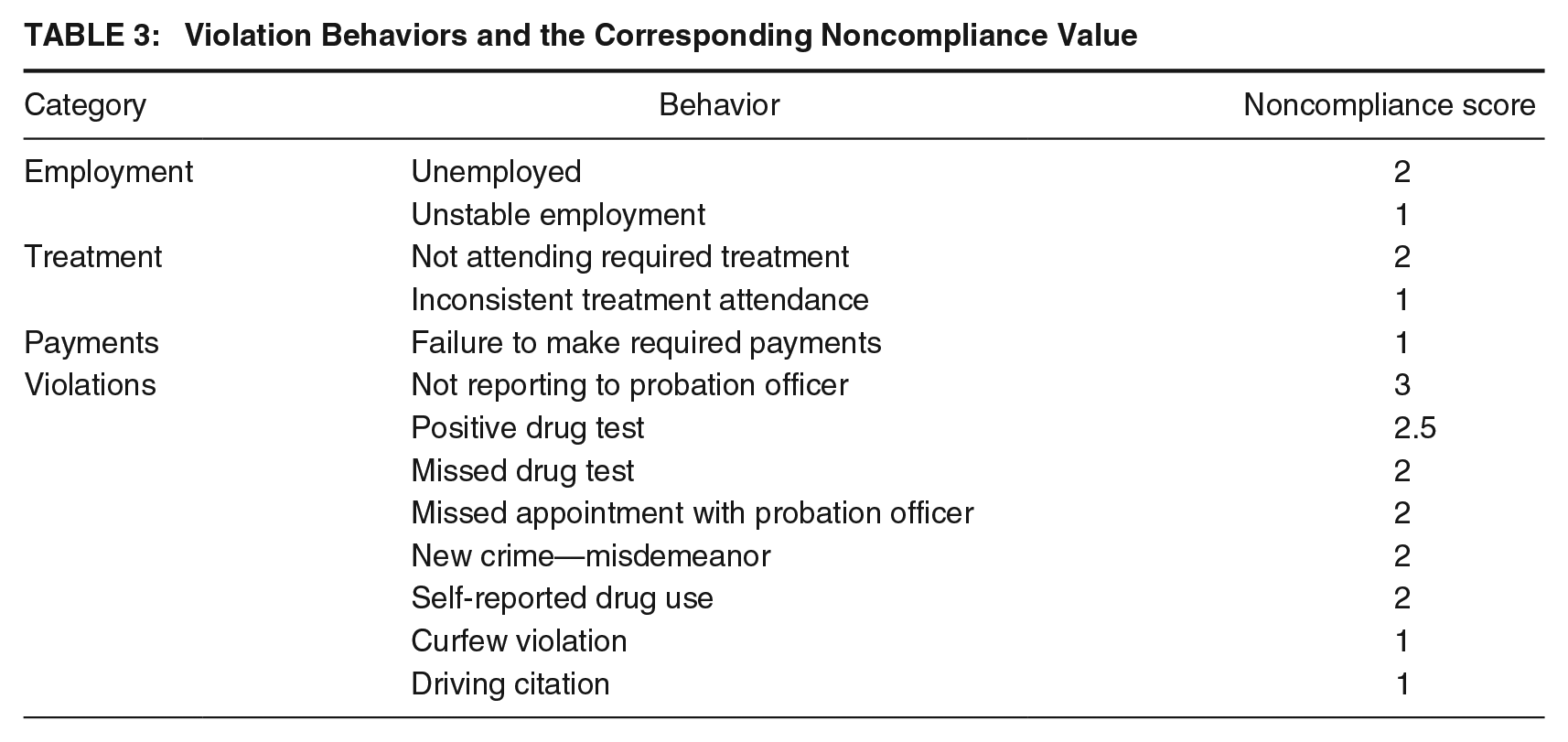
Next, monthly noncompliance scores were calculated by summing violation scores for each type of noncompliance experienced in that month. For example, if a client had two missed drug tests (each 2 points), a missed appointment (2 points), and a curfew violation (1 point), their violation-related noncompliance score for the month would be a seven. Finally, we divided clients’ total noncompliance scores by the number of months they were on probation to get an average noncompliance score for each client. Higher average scores indicate greater noncompliance with the terms of the client’s probation.
Analytical Plan
Because all three of our dependent variables were dichotomous (probation outcome—successful vs. unsuccessful, new crime violation—yes or no, and absconding—yes or no) and we had multiple categorical and continuous predictors, we ran a multivariate logistic regression model for each of our dependent variables. In each model, the following variables were entered as potential predictors: proportion of months with at least one sanction, proportion of months with at least one incentive, number of referrals for services the client received, client sex, client age, whether the client had a high school education, client race (White vs. Black, White vs. Hispanic), whether the client had any children under 18 at home, whether the client had a history of mental health issues, the client’s LSI-R score at the start of probation, whether the client had stable housing and stable employment during probation, and the client’s average noncompliance.
Results
To examine possible drivers of whether a client successfully completed their probation term, a multivariate logistic regression model was ran (R2 = .33). See Table 4 for all multivariate findings. As shown in Model 1, the proportion of months where clients received at least one incentive, the number of referrals received, and whether a client had a high school education and stable housing were all significant predictors of a client’s success on probation, when holding average noncompliance constant. The odds of a client successfully completing probation increased by a factor of 47.92 for every one-unit increase in the proportion of months where the client received at least one incentive. For every additional referral a client received, clients were 46% more likely to successfully complete probation and clients who had a high school education were 125% more likely to successfully complete probation. Furthermore, clients who experienced unstable housing were 0.79 times less likely to successfully complete probation.
Logistic Regression Models Predicting Client Probation Outcome, Commission of a New Crime, and Absconding

Note. Bolded p-values indicate significance at p < .05.
Model 2 examined possible drivers of whether a client committed a new crime during their probation term (R2 = .15). The proportion of months where clients received at least one incentive, whether a client had a high school education, a client’s LSI-R score at the start of their probation term, and average noncompliance all significantly predicted whether a client committed a new crime while on probation. The odds of a client committing a new crime while on probation decreased by 95% for every one-unit increase in the proportion of months where the client received at least one incentive and by 53% for clients who had a high school education. The odds of a client committing a new crime while on probation increased by 7% for every one-point increase in a client’s LSI-R score. Furthermore, for every one-unit increase in a client’s average noncompliance scores, there was a 20% increase in the likelihood that the client would commit a new crime while on probation.
Finally, Model 3 explores possible drivers of whether a client absconded probation during their probation term (R2 = .29). Whether a client had dependent children at home and whether a client had stable housing significantly predicted whether a client absconded probation when holding average noncompliance constant. More specifically, clients who had children under 18 at home were 58% less likely to abscond supervision than clients who did not have children at home. Furthermore, clients who had unstable housing were 3.53 times more likely to abscond supervision than clients with stable housing. It is also important to note that incentive use, while not reaching conventional levels (α = .05) of statistical significance, was trending in a manner consistent with the previous models.
Discussion
The current study was guided by three research questions aimed at enhancing our understanding of the value of sanctions and incentives in improving supervision outcomes. We return to these questions here, as we discuss the importance of the findings and their congruence with the prior literature in the field. In addition, we draw attention to the policy implications of these findings for community supervision agencies looking to create or adapt practices related to the use of sanctions and incentives.
Perhaps the most glaring and consistent finding from this research involves the lack of sanction use as a significant predictor of probation outcomes. Succinctly stated, there is no evidence that sanction use led to fewer revocations, reduced criminal offending, or a lower proclivity for absconding supervision when controlling for a client’s average noncompliance. These findings are not unsurprising given the growing body of literature that has failed to find empirical support for the use of sanctions in community supervision settings and call into question the appropriateness of continuing to allocate finite government resources to sanctioning programs. That said, there was no evidence to suggest the use of sanctions produced negative outcomes, such as those observed by some recent studies (Mowen et al., 2018; Romain Dagenhardt et al., 2023). As such, it might be argued that the ongoing use of sanctions may be worthwhile if sanctions achieve other organizational goals, such as enhancing individual accountability (an important function of community supervision programs by corrections professionals and external stakeholders). However, the value of sanctions must also be weighed against other potentially negative consequences. For example, Wodahl and associates (2021) found that officer use of sanctions was a barrier to building high-quality relationships between probation clients and their supervising officers. The financial costs associated with operating sanctioning programs, especially those that involve the use of custodial sanctions, are not trivial. This money may be better spent on supporting programs and practices that have been found to support long-term behavioral change.
In contrast to sanctions, study findings revealed strong support for incentives. More specifically, clients who received incentives on a more consistent basis were more likely to successfully complete probation and less likely to engage in new criminal activity. It should also be emphasized that the impact of incentive use was not extinguished by the inclusion of our measure for client behavior (average noncompliance), which increases our confidence that the observed relationship between incentive use and our dependent variables is not the artifact of a mis-specified model.
The policy implications from these findings are clear. Community corrections agencies should prioritize efforts to integrate incentive use into everyday supervision practices. Furthermore, our results suggest a need to increase federal funding to support the research and development of incentive programs to guide agencies in creating and sustaining programs that will have the greatest impact. As recent research has called into question the ongoing allocation of federal dollars being invested into SCF sanctioning systems (Pattavina et al., 2024), we advocate for a shifting of these dollars into research and development of incentive-based programs that appear to have a greater capacity to improve both long- and short-term outcomes.
A main contribution of this study was its inclusion of absconding as a unique outcome variable. As correctional agencies continue to enact policies that promote alternatives to revocation to keep clients in the community, an unintended consequence is an increase in absconding behavior that usually results in the issuing of a warrant and subsequent incarceration. As a result, a better understanding of the predictors of absconding and the role of supervision practices that might mitigate or aggravate absconding behavior, such as sanctions and incentives, is emerging as an increasingly important issue. While neither sanction nor incentive use emerged as significant predictors of absconding, incentive use was trending toward significance such that increased incentive use led to a lower likelihood of absconding. We recommended future research continue to explore the relationship between incentive use and absconding, preferably with larger sample sizes to lessen the probability of committing a type II error.
Finally, while not the focus of our current study, it is important to highlight the importance of stable housing as a predictor of supervision success. Individuals in our sample who lacked a stable residence were more likely to experience a revocation and more likely to abscond supervision. While the importance of stable housing has been the subject of extensive commentary and empirical inquiry for justice-involved individuals reentering the community following incarceration (see for example, Herbert et al., 2015; Lutze et al., 2014; Roman & Travis, 2006), substantially less attention has been given to the importance of housing for those under probation supervision (Jacobs & Gottlieb, 2020). Our findings parallel a recent study by Jacobs and Gottlieb (2020) that found homelessness and housing instability were important predictors of recidivism among a sample of individuals under probation supervision in San Francisco. While it might be easy to provide a broad statement about the need for probation agencies to partner with existing community agencies and to prioritize housing assistance in the supervision of at-risk populations, we recognize that challenges to homelessness and housing instability are complex and defy simple solutions. As such, perhaps the most appropriate recommendation we can make at this time is for policy makers and correctional administrators to recognize the importance of stable housing for probation success and to search for creative solutions that make sense in their local communities.
Limitations
There are important study limitations to the study that are worth noting. As previously discussed, the sample size was limited to 300 probation cases, leaving open the possibility of type II errors when interpreting the findings. It should also be recognized that the data were collected from official probation casefiles that consist exclusively of information inputted by supervision officers. As is to be expected, we observed substantial variability across officers in terms of thoroughness of the information provided. As such, while the goal was to capture all client behavior, we were limited to only those behaviors that came to the attention of the probation officer and made their way into the casefile and supervision notes.
A second limitation relates to the grouping of all incentive and sanction events into binary categories in our analyses without regard for variations in the type or intensity of the intervention levied. For instance, a client who receives a verbal reprimand for missing a supervision appointment is treated identically in our analyses to a client who receives a potentially more punitive response (e.g., increased drug testing). Prior research confirms that individuals under community supervision perceive the value of incentives and the punitiveness of sanctions very differently based on both the type and magnitude of the intervention (see, for example, Wodahl et al., 2013, 2017, 2020). Wodahl et al. (2017), for example, found that probation clients placed high value on certain incentives, such as earned compliance credits, reduced reporting requirements, and higher monetary value gift cards, while less value was assessed to incentives such as letters of recognition and public ceremonies of accomplishments. While the degree to which these differences in perceptions relate to future client behavior remains untested, future research should explore this relationship.
A final limitation to consider stems from the realization that supervision agencies are not stagnant. They are continually changing and adapting to their population and the needs of their constituencies. This is especially true in an agency such as the DAPD that embraces learning and continually evaluates their policies and practices with the goal of achieving better outcomes. For example, since the collection of this data, the DAPD has adopted new policies that guide officer use of incentives and have developed new incentive options such as the creation of an incentive room where probation clients can select from a variety of incentive options, such as gift cards, clothing, and items for their children (e.g., coloring books, school supplies, toys). As such, it is important to recognize that the data collected for this project capture a single point in time assessment of sanctions and incentives and may not necessarily reflect current practices.
Conclusion
The current study sought to enhance our understanding of the role of sanctions and incentives in promoting successful supervision outcomes. While results found no support for the use of sanctions in improving outcomes across any of our dependent variables, strong evidence emerged for the use of incentives in both decreasing criminal reoffending and avoiding revocation. In addition, the influence of incentives on absconding behavior, while not significant, was trending in the right direction. The veracity of these findings is strengthened by the inclusion of a measure of client behavior (average noncompliance), which enhances our confidence that the observed relationship between incentive use and supervision outcomes is meaningful and not the sole consequence of model misspecification. Considering these findings within the broader literature on sanctions and incentives in community supervision raises questions about the ongoing allocation of public funds to support sanction-focused programs, such as SCF sanctioning programs. Incentive-based programs, on the other hand, seem to have a much more stable empirical foothold and are deserving of additional attention and resources, which includes resources to support a more systematic research agenda to continue to evaluate the role incentives can have in supporting long-term behavioral change.
Footnotes
Authors’ note:
This work was supported by a grant from Arnold Ventures as part of the Reducing Revocations Challenge grant. The authors have no conflicts of interest to report.
