



Abstract
The economic and social crisis in Argentina at the end of 2001 ended a decade of explicit free-market or neoliberal policies that had their roots in the country’s last military dictatorship (1976–1983). The current challenges facing the city, along with legacies of this recent past, include increasing social inequality, crime, poverty, and the difficulty of managing public services that were comprehensively privatized during the 1990s. State responses to these challenges have been more effective with regard to employment than with regard to their impact on housing and security.
La crisis económica y social en Argentina a finales del 2001 acabó con una década de política de mercado libre o neoliberalismo que tenía sus raíces en la dictadura militar (1976–1983). Los desafíos contemporáneos que encara la ciudad, al lado de la herencia de su pasado reciente, incluye el agrandar del desequilibrio social, el crimen, la pobreza, y la dificultad del manejo de servicios públicos los cuales fueron privatizados comprensivamente durante los 1990. Las respuestas del estado a estos retos han sido más eficaces en torno al empleo que en su impacto en la vivienda y la seguridad.
The Buenos Aires metropolitan region is one of the world’s megacities and a major economic, political, and cultural hub in Latin America. 1 While the city has experienced rapid change in recent years, certain enduring social and economic themes continue to challenge city authorities. 2 In this article we situate the contemporary city in the context of political change in Argentina and Latin America more generally. More specifically, we engage with debates about the continent’s popularly labeled “shift to the left” in the wake of a pronounced period of market-based or neoliberal economic policies during the 1980s and 1990s (for commentaries on the significance of the Latin American neoliberal “experiment” see, e.g., Chase, 2002; Green, 2003; Petras and Veltmeyer, 2003; Svampa, 2005; Weisbrot, 2006).
Within Latin America, Argentina can claim to have had more experience than any other country with the neoliberal experiment, though after more than a decade of reforms the economy collapsed in December 2001 amid widespread social and political unrest. Therefore, the country’s recent history has brought into sharp focus the appropriateness and efficacy of the neoliberal economic policies that led to high levels of long-term unemployment and poverty in a country that once could claim to be the most socially egalitarian nation in Latin America (Azpiazu, 2002; Riggirozzi, 2009). In 2002, the country’s gross domestic product shrank by 11 percent while the official poverty level reached 57 percent of the total population. Consequently, many observers argued for the need to understand the relationship between these social and economic failures and the policies that preceded them (Haslam, 2003; Moreno-Brid and Paunovic, 2006; Munck, 2005). In line with other writers (see Perreault and Martin, 2005; Weisbrot, 2006), we avoid setting up a simplistic division between “old” neoliberal and “new” leftist regimes, in part because of the ambiguity of the emerging political landscape of Latin America and Argentina (Cortés, 2009). Perreault and Martin (2005: 192) reaffirm this complexity, pointing to the fact that the continent is increasingly governed by “left-leaning pragmatists willing to negotiate for softer versions of neoliberalism.” As a consequence, the political strength of these new Latin American governments often appears to be based on their pragmatic and contradictory characteristics.
We begin by presenting a summary of the city’s contemporary geography and demography, providing some necessary contextual information relating to the 2001 Argentine economic and sociopolitical crisis, and of the living conditions of the city’s most vulnerable populations, principally those living in the city’s villas or informal settlements. The following sections underscore certain prominent and interconnected challenges facing the contemporary city—housing and the environment, security, and employment—and conclude with a discussion arguing that, despite political discourses suggesting otherwise, the contemporary city does not represent a clean break from the past or the establishment of an alternative political regime. In looking at housing and at the environmental problems of the urban poor, we are focusing on processes that began before the 1990s and in some instances seem to have only marginally improved since the 2001 crisis, even in the context of rapid economic growth and significant national and provincial efforts to improve housing for low-income groups (Hancevich and Steibrun, 2009). As for security, although official data from the Ministry of Justice show a reduction in crime rates since 2002, the public perception as reflected in the media is one of increasing insecurity. While acute unemployment resulted from the free-market policies of the 1990s, this is one area in which substantial progress has been made since 2002.
Post-Neoliberal Buenos Aires: Profiling Contemporary Urban Change
The autonomous city of Buenos Aires is the central metropolitan district of the city and the nation’s capital, home to all the principal federal government buildings, cultural institutions, and business headquarters. It consists of 48 barrios (neighborhoods), a total area of 200 square kilometers, and a population of 2,776,234 as of the 2001 census (INDEC, 2004). Outside it lies the Conurbano Bonaerense (or Greater Buenos Aires), covering an area of 3,685 square kilometers and home to 8,684,437 people in 2001. Beyond Greater Buenos Aires there are a number of cities and towns that, though not physically connected, function as part of the Buenos Aires metropolitan region. These urban areas add another million people to the metropolis and include La Plata and its surroundings (to the south and capital of the province of Buenos Aires), Zárate, Campana, and Pilar (to the north), Luján (to the northwest), and Cañuelas (to the west), plus some other minor centers. 3 The total urban area of Buenos Aires is widely understood to have had over 13 million inhabitants, one-third of the Argentine population, in 2010. It concentrates more than 50 percent of the national industrial production and a still greater proportion of certain command functions, such as the headquarters of national and transnational companies. The region also hosts most of the nation’s specialized services (e.g., medical care), including the more recently developed software production and design industries, as well as scientific, technological, and artistic production.
A critical reference point in understanding the geography of contemporary Buenos Aires is the political and economic crisis that gripped Argentina at the end of 2001, which had far-reaching economic and significant social repercussions (Altamira, 2002; Blustein, 2005; Bosco, 2007; Chatterton and Gordon, 2004; Dinerstein, 2002; 2003). During three days of chaos on the streets of Buenos Aires in December 2001, 26 people were killed in rioting, the majority shot by military armed forces as the president and his cabinet resigned. Just before the eventual currency devaluation, the government defaulted on its sovereign debt, some US$140 billion, confirming its status as an international financial pariah. Within months, the social implications of the financial crisis became clear as the country’s unemployment and poverty levels reached all-time highs (Haselip, 2005; Tedesco, 2003) (Figure 1). Most noticeably, urban poverty levels increased from 22 percent in 1991 to 38 percent just before the crisis of late 2001 (peaking at 57.5 percent in October 2002), while income polarization has continued to expand and insecurity levels have greatly increased (Bosco, 2007; INDEC, 2004; Lopez-Levy, 2004; Petras and Veltmeyer, 2003).
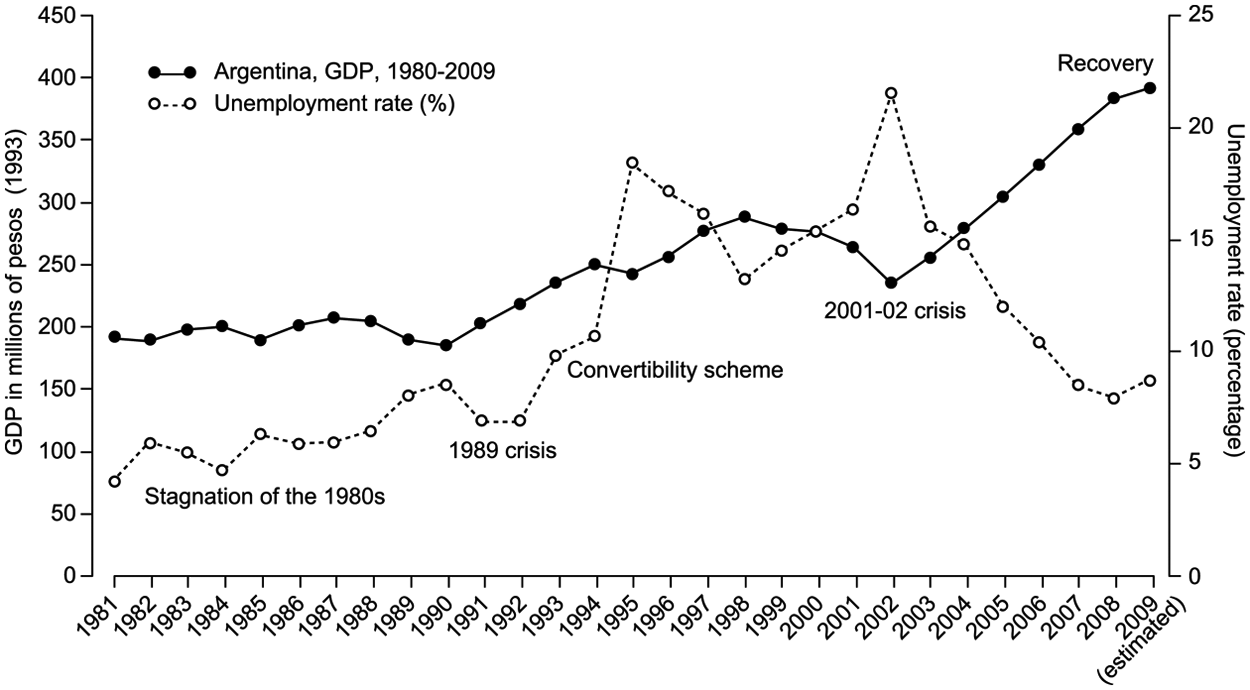
Gross domestic product and unemployment through the 2001–2002 crisis and recovery.
While the existence of poor neighborhoods in Buenos Aires cannot be associated with the 2001–2002 economic crisis alone (indeed, their history can be traced back to the early waves of twentieth-century immigration from Europe [Auyero, 2002]), these economic shocks have certainly produced long-lasting social legacies (see Miranda, 2008) and resulted in a greater proportion of people living in precarious conditions today. Despite this, some physical indicators of poverty, such as those associated with the Index of Unsatisfied Basic Needs, including sanitation and school attendance, did improve during the 1990s. Moreover, as early as 2003, with renewed economic growth, there was a decline in urban poverty indicators, although this was largely related to improving incomes and only partially to better structural conditions (Miranda, 2008).
Broadly, two main types of low-income residential area can be identified throughout the Buenos Aires metropolitan region. These are commonly referred to as villas de emergencia or villas miserias and barrios carenciados. The villa is a densely populated informal settlement characterized by substandard housing and is mostly unplanned, with little formal documentation or mapping by local authorities (Keeling, 1996). The most recent census statistics available show that there were 108,056 people living in villas in the Capital Federal in 2001, more than double the 1991 figure of 52,608 (Gobierno de la Ciudad Autónoma de Buenos Aires, 2002) (Figures 2 and 3), although this number is widely regarded to be conservative. 4 While more up-to-date census figures are not available, organizations working with marginalized groups in Buenos Aires report both the expansion of existing villas and the growth of new ones throughout the city (also see Cravino, 2008; Fernández Wagner, 2009). The Buenos Aires-based Instituto de la Vivienda de la Ciudad (Institute for Urban Housing) estimates that the population of villas grew by 40,000 between 2001 and 2005, bringing the total population of informal settlements in the Capital Federal alone to at least 150,000 (more recent studies estimate that the total villa population in the city is now 200,000 [Cravino, 2008]).
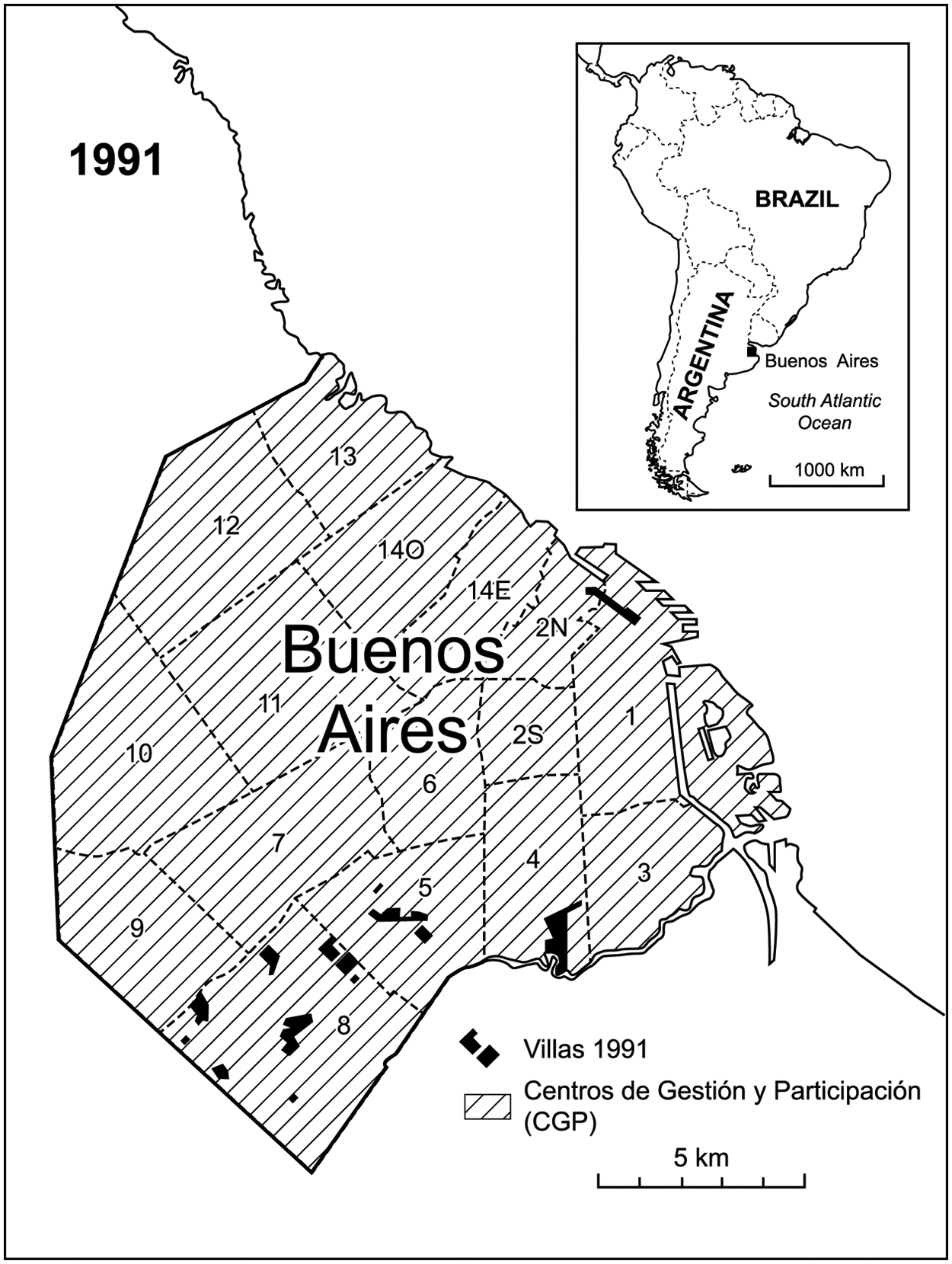
Neighborhood blocks containing villas miserias (informal settlements) in the Capital Federal, 1991 (Gobierno de la Ciudad Autónoma de Buenos Aires, 2002). CGPs are essentially neighborhood-level offices providing, for example, information to residents on city government services. Some of the CGP zones cover a number of neighborhoods while others are dedicated to a single one.
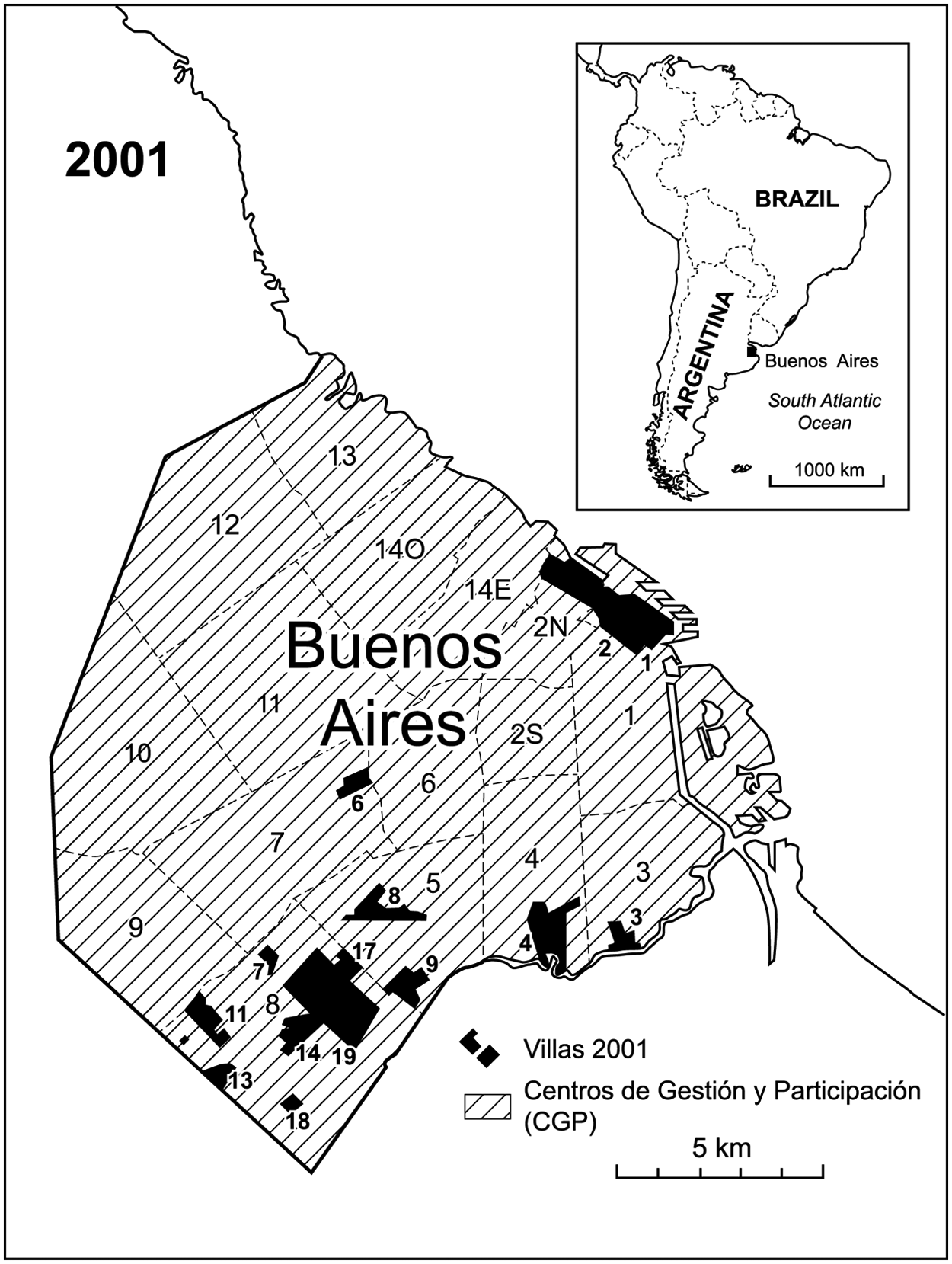
Neighborhood blocks containing villas in the Capital Federal, 2001 (Gobierno de la Ciudad Autónoma de Buenos Aires, 2002).
Barrios carenciados (literally “neighborhoods of people without”) are typically neighborhoods of formalized settlement, with defined blocks containing structures with proper foundations and addresses and mostly with paved roads and public service infrastructures. Unlike the villas, they are not isolated or visually obvious in appearance. However, despite their more formal status and better integration with local authorities, these neighborhoods often have household income levels as low as or even lower than those in the villas (Consejo Nacional de Vivienda, 2003). This is largely the result of a widespread demographic shift that took place during the neoliberal era, when incomes declined for the poorest sections of society and long-term unemployment increased. As a consequence of this economic and demographic shift, residents of these areas are commonly referred to as the “new poor” by both academics and the media (Annecke, Carpio, and Endelli, 2004; Haselip, Dyner, and Cherni, 2005). An added disadvantage that can be seen to affect the barrios carenciados comes from their formalization. The great majority of households in these areas are connected to and obliged to pay for the formal supply of public services such as water and electricity, whereas these services are usually accessed free of charge in the villas, albeit with a precariousness that involves different costs and disadvantages (Haselip and Potter, 2010).
During the 1990s and until the 2001 crisis, Argentina was frequently mentioned by the international financial institutions (the World Bank, the International Monetary Fund, the Inter-American Development Bank) and other neoliberal policy advocates as an example of how free-market economics can help bring economic growth and stability to Latin America. The extent of the 2001–2002 crisis therefore served to undermine pro-market discourses, not only revealing the wider social and economic failings of the neoliberal project (with rates of unemployment, poverty, crime, and insecurity at historically high levels) but calling into question its underlying logic, relying as it did in the case of Argentina upon an unsustainable and contradictory set of policies central to which was the linking of the country’s (nonmarket) currency to the U.S. dollar (Riggirozzi, 2009).
With regard to a shift in urban and housing policies in the Buenos Aires metropolitan region, by far the most important postcrisis policies have been those related to welfare payments and the provision of basic public services, including health care. Specifically, the Unemployed Heads of Household Plan and the Plan Remediar (providing medicine for poor communities) have had significant indirect impacts on urban housing and living conditions that to a large extent can be said to have replaced formal urban and housing reform policies.
The Unemployed Heads of Household Plan is the most prominent social security plan in Argentina. Means-tested monthly payments are given to families with dependents whose main breadwinners are unemployed or whose income is negligible. The plan was launched in January 2002, partly financed by the World Bank, and was intended to be a short-term measure to alleviate extreme poverty (Chiara, 2007; Cortés, 2009). However, by 2005, 2 million individuals were in receipt of the payments, which averaged 300 pesos per family per month (US$100), and while the economic crisis both enabled and legitimized this welfare policy it has since become locked-in by the postcrisis politics dominated by the Peronist party that has been in control of the federal government since 2002. Between 2000 and 2005, total social expenditure grew from 0.65 to 1.06 percent of Argentina’s gross domestic product (Riggirozzi, 2010), easily financed by a postcrisis economic boom driven principally by increased exports. Further, Chiara (2007) points out that the Unemployed Heads of Household Plan has been at the heart of a recentralization of decision making in urban governance and social spending since the Kirchner administration was elected in 2003.
A return to the subsidy schemes used by the federal government since 2003 is an unsustainable alternative to more radical economic restructuring to tackle the endemic social inequalities in Argentina, such as progressive income tax reform. Given its size and scope, the Unemployed Heads of Household Plan is a significant reason that the postcrisis period cannot be described as a clear break from the preceding years of neoliberal policy. The program has received criticism for its insufficient coverage and the fact that payments have depreciated considerably, remaining the same in spite of high levels of inflation (Cortés, 2009: 62). Furthermore, the distribution and management of subsidies and welfare payments has become explicitly politicized in the post-neoliberal era. For example, despite the strictly economic criteria for entitlement, the policy has been criticized for allowing or even depending upon political parties and nongovernmental organizations to distribute the funds throughout low-income communities. This invites the accusation that support may be withheld from individuals unless they agree to vote for a particular candidate or associate themselves with an organization whose interests are not clearly defined (see Auyero, 2000). For example, it is suggested that groups of piqueteros (members of the nationwide protest movement that often gains attention through the setting up of roadblocks) are in receipt of these funds and distribute them among their members, which has infuriated some (especially office workers stuck in traffic) who argue that this method of distributing social security removes any incentive to find work by funding “unproductive” protesters.
Housing and Environmental Challenges
The informal nature of villas means they have no planned or fixed access to public services. Despite plans from both the federal and local governments to reduce their presence, villas have been growing in number and size over the past few years. They vary in age, size, demographic and ethnic makeup, and structural quality (Cuenya, Pastrana, and Yujnovsky, 1984; Municipalidad de la Ciudad de Buenos Aires, 1991). The more established villas tend to have better access to services through the construction of semipermanent informal supplies of electricity and water (López, 1999; Pirez, 2001). They also tend to benefit from contacts and established relations with local authorities and public utility suppliers, often forging deals and “understandings” with regard to access to certain public services. Villa 31, with a population of approximately 30,000 residents, is perhaps the best-known, mainly because of its city-center location and its proximity to the Retiro and San Martín areas, with the highest-valued real estate in the country (Figures 4–6).
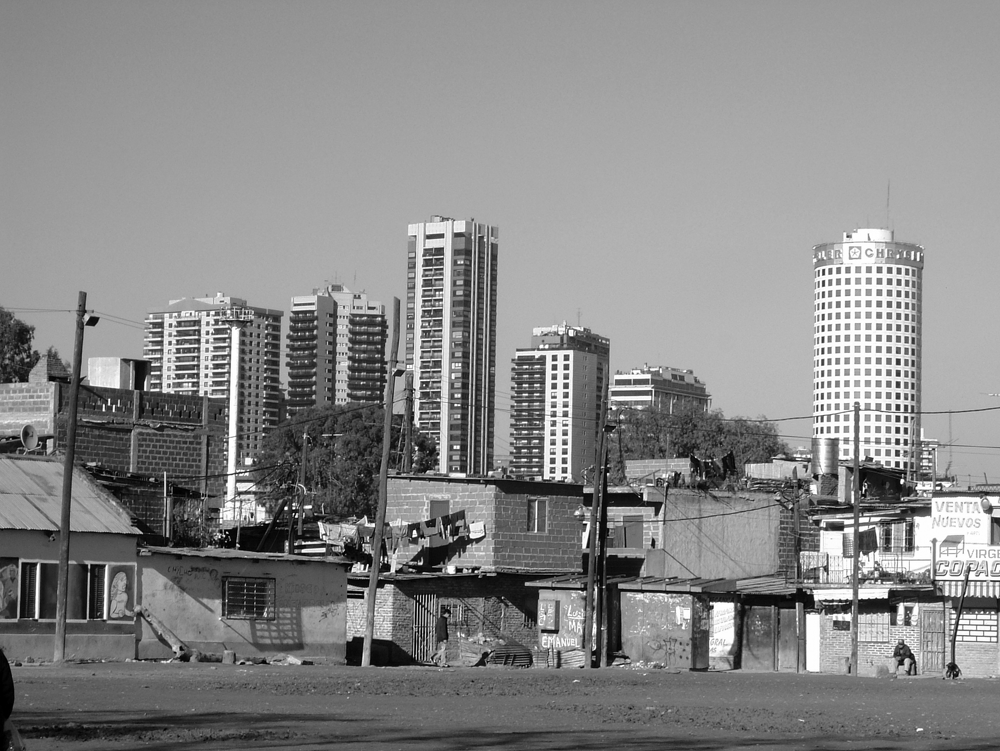
Houses in Villa 31, near the city center.

A street in Villa 31.

Electrical connections in Villa 31.
In order to halt the growth of Villa 31 and to improve the quality of its existing buildings, the city legislature approved, in December 2009, a policy for formalizing the villas (Castro, 2010). This effort was inspired by an architecture project developed by the Institute for Human Space at the University of Buenos Aires. In contrast to the wholesale clearance policies adopted by the military governments, this project will demolish approximately 30 percent of the existing structures in order to open up access roads in what is a very densely populated settlement and will connect all the remaining houses to running water and sewers, as well as establishing electricity and gas connections, which, where they exist, are currently not being paid for (Haselip, Dyner, and Cherni, 2005; Pirez, 2001). Politicians have also pledged to finance the construction of a secondary school in Villa 31, as well as a trading space for local businesses, public parks, and a radio station.
A significant proportion of villa inhabitants are non-Argentines, many from Bolivia and Paraguay, while approximately another 20 percent are Norteños, Argentines from the poor northern provinces close to the Bolivian and Paraguayan borders (Clarín, September 27, 2005). These new arrivals tend to inhabit informal settlements that are more precarious than existing villas, mostly without access to public services and occupying some of the most undesirable and peripheral locations in the city.
A key feature of the barrios carenciados is their low levels of access to the natural gas network. According to the Argentine Institute for Social Affairs, 67 percent of households in Greater Buenos Aires have access to the gas grid, although this figure rises to over 95 percent for “nonpoor households” and falls to just 33 percent for poor households. Within this lowest third, the majority use bottled gas (liquefied petroleum gas, usually propane but sometimes butane) and the rest kerosene, firewood, or charcoal (IDESA, 2007). The market for piped natural gas was privatized and subjected to market regulation in a similar way to that of the electricity market, and tariffs were frozen by emergency legislation in early 2002 so as to not inflict greater costs upon consumers following the currency devaluation (Haselip and Potter, 2010). However, consumers who do not have access to the gas grid are faced with the choice of buying the more expensive bottled gas and its associated appliances or using electricity. Such post-neoliberal policies through adjustments to public services and privatization have therefore compounded the regressive distribution of economic benefits experienced in the city during the 1990s.
The lack or poor quality of infrastructure disproportionately exposes the population of villas and barrios carenciados to contamination and environmental degradation (see, e.g., Alsina, Borello, and Miño, 2007a; 2007b; Alsina, Borello, and Zalts, 2006). One of the more serious problems in Buenos Aires is the poor quality of drinking water (Di Pace et al., 1992; Gallopin, 2004; Santa Cruz and Silva, 2002), particularly in the villas in the city proper and in the more peripheral suburbs, where water and sewerage networks serve a small proportion of the population. In these neighborhoods, households often have their own water wells drilled at shallow depths and are consequently subjected to contamination derived from industrial, commercial, and house effluents and from the leaching of household wastes and other materials deposited in clandestine dumps. Flooding is also a major concern in the Buenos Aires metropolitan region, with poorer communities in particular being exposed to its negative health consequences. The areas that are more vulnerable to major floods are in the vicinity of the rivers Reconquista and Matanza-Riachuelo and the coastal area (of the Río de la Plata) in the districts of Quilmes, Berazategui, Berisso, and Ensenada. Many poor barrios have insufficient infrastructure to deal with flooding, and their unpaved streets and location in low-lying areas of the city (the areas not subject to flooding were the first to be urbanized and command higher land prices) lead to severe waterlogging, especially in areas with softer clay soils.
Atmospheric pollution is another environmental concern in Buenos Aires, especially in areas adjacent to the city’s main roads, principal transport terminals, and industrial areas. High pollution levels result from the fact that many private and public transport vehicles are old (a fact that is, in turn, associated with low income) and the dense concentration of suburban train and bus terminals, which creates pollution “nodes.” In addition, industrial and commercial firms frequently do not comply with regulations on gases and emissions, producing significant levels of air and noise pollution for those living nearby. Soil degradation is also a significant environmental issue associated with the actions of industry, including the elimination of vegetation, the alteration of natural drainage, and the deposition of heavy metals derived from gas effluents and open dumps. Soil, clay, gravel, and tufa extraction for intensive farming, road construction, and handmade and industrial brick production have historically been performed in several districts. The extraction results in the creation of pits of varying size and in the destruction of more fertile soil horizons and also encourages the illegal dumping of wastes and construction materials. Artificial ponds are breeding grounds for disease vectors (e.g., dengue fever) and frequently the site of fatal accidents when residents swim in them.
The city’s environmental problems are therefore systemic and interrelated. For example, surface water that is contaminated by industrial effluents and sewage without prior treatment filters to the aquifer, adversely affecting the quality of the underground water supply. These problems do not appear in all parts of the Buenos Aires metropolitan region with the same severity, nor do they impact everyone in the same way. Soil degradation is a typical environmental problem on the outer fringes of the metropolis; atmospheric pollution principally occurs in the main commercial and industrial centers, which are often located next to areas with lower land prices. Consequently, and as is often the case in the world’s megacities, it is the urban poor who are most exposed to poor environmental conditions and pay the highest price in terms of exposure to respiratory and infectious diseases and stresses such as noise pollution. More generally, the post-2002 administrations have had limited success in curbing environmental problems, which themselves can be understood as a failure of free-market rule compounded by a lack of planning to distribute the cost of market “externalities” more equitably. While this indicates a failure of postcrisis policy making to shift away from its neoliberal roots, the situation is not so clear. For example, some progress has been made in ameliorating a number of structural conditions such as access to urban infrastructure (water and sewers) and measures to reduce crowding through the provision of sidewalks (Adaszko and Salvia, 2010). This has taken place at the same time as a significant increase in the number of people living in villas after 2001. This apparent contradiction may be explained by the federal government’s massive construction program, prioritizing the building of houses oriented to low- and very-low-income households after 2002 (Fernández Wagner, 2009).
Urban (In)Security
Although the total population of the villas constitutes a relatively small proportion (less than 5 percent) of the almost 2.7 million population of the Capital Federal, their visual presence and notoriety are significant in shaping perceptions of insecurity in the city. In particular, the villas are commonly thought, especially by higher-income residents, to be centers of crime and drug dealing, and the people therein are viewed as presenting a threat to security. The Argentine media play a critical role in perpetuating these simplistic and often negative representations, employing language and images that construct the villas (and poor areas in general) as marginal, threatening, and “other” (Auyero, 2002; Silva, 2008). Indeed, a fear of and prejudice against villa communities is widely understood to have been a key motivating force behind the last military government’s radical clearance programs, whereby most of the city’s then-200,000-strong villa population was violently evicted and reduced to just 5,000 by 1980 (Clarín, September 27, 2005). Silva’s (2008) analysis of contemporary articles in the Argentine press about villas and their inhabitants suggests that this negative framing, with its roots in the years of the dictatorship, continues to inform media representations and influence public opinion. While there is arguably a need for more sensitive depictions of these environments, the social inequalities—including the unequal distribution of violent crime and victimization across the city—that characterize modern Buenos Aires are hard to ignore.
Despite official reports on public security (e.g., Gobierno de la Ciudad de Buenos Aires, 2009) that consistently point to the difficulty of collating reliable statistics on crime, it is clear that the Capital Federal has the highest crime rates in Argentina (the majority of crime is property-related, although a large proportion of thefts are violent [see LICIP, 2010]). The residents of villas and poorer areas bear the brunt of this victimization, perpetuated by their socioeconomic exclusion and the associated lack of formal institutional support (Auyero, 2002). Of particular concern in recent years have been the negative social impacts of the consumption of the cheap and relatively accessible drug paco (a type of low-grade cocaine), as well as alcohol and, to a lesser extent, marijuana (Palomar, 2009). The effects are especially pronounced in poorer communities, where the lack of state programs perpetuates the cycle of interpersonal violence, distrust, and fear (Auyero, 2002). The continued marginalization of these communities, which some argue is a result of neoliberal policies and the rolling back of state responsibility, results in a society that is highly polarized (Keeling, 1996). This societal division is nowhere more explicitly expressed than through the privatization of city space and the rapid growth of barrios cerrados or countries (various forms of gated communities, often located directly alongside villas or poorer neighborhoods) in and around the Capital Federal. These class tensions, in this case manifest in the prejudice and distrust of the middle classes with regard to residents of the poorer neighborhoods of the city, are echoed more generally in the post-neoliberal political scene that is unfolding in Argentina. Riggirozzi (2009: 110) highlights the ways in which “Argentine politics is beginning to reflect a historic division between the nationalistic stance of the government, appealing to the people, and an opposition alliance based around farmers and the urban middle class.”
Perhaps more than any other urban planning trend, the rise of gated communities in Buenos Aires represents a stark continuity of explicit neoliberal policy making whereby government support for the construction of private urban communities has been maintained in the post-2002 era. In the early 1990s, different kinds of gated communities with varying levels of closure to the surrounding area were developed in the Buenos Aires metropolitan region, especially in the northern and northwestern sectors. Although no systematic or comprehensive assessments have been made of the social and environmental impact of these new communities, various investigations have highlighted a number of potential challenges (Paiva et al., 2000; Thuillier, 2005). First, the settlements have contributed to social fragmentation in terms of the physical separation of communities, reducing the opportunity for social cohesion (Thuillier, 2005). Furthermore, they have emphasized stark divisions in the provision of sanitary and urban services between communities living on the two sides of the gates (Keeling, 1996). In some cases, the introduction of barrios cerrados (closed neighborhoods) has led to the closure of public roads, hindering access and increasing travel times for neighboring populations that rely heavily on public transport. The environmental effects of these developments are often substantial, with their construction changing micro-topography and rainwater drainage directions, thus increasing the flood risk for nearby settlements. In addition, liquid effluents produced by the neighborhoods are usually dumped into watercourses, adversely affecting populations living outside (Paiva et al., 2000; Thuillier, 2005).
A spate of attacks on gated communities in the northern and northeastern sectors of the city has received substantial media attention in recent years, and this can be expected to do little to alleviate fears relating to security and violent crime in and around the city (see La Nación, March 11, 2010, which includes maps indicating the location of recent robberies). The tendency to fortify and privatize property, with local and national television networks often discussing the most effective means of protection, will likely increase, leading to the societal tensions witnessed in other cities around the world (see Hook and Vrdolijak, 2002; Lemanski, 2006). Indeed, this trend creates and perpetuates a vicious circle of fear that motivates ever-tighter security measures on behalf of those opting to live in closed communities, whereby a self-fulfilling paranoia drives them farther from the “outside” communities. In turn, this trend tends to exacerbate the resentment felt by the excluded surrounding communities. As with the inequitable distribution of the effects of pollution, such social trends can be understood as a failure of neoliberal ideology and policy to coordinate harmonious urban living. Since 2002, the federal government has done nothing to curb the construction of gated communities, thus marking a significant continuity of neoliberal rule in the context of the explicitly anti-neoliberal political discourse of the various Kirchner administrations.
The general sense of growing insecurity is not restricted to property crime, and the creation of the Policía Metropolitana de la Ciudad de Buenos Aires (the Metropolitan Police Force of Buenos Aires), which began patrolling in February 2010, is in part a response to the perceived and actual increase in crime on the streets of the city. The efficacy of this new force in terms of its access to and activities within “harder-to-reach” neighborhoods and villas across the city, as well as its relationship with the existing Policía Federal, is not yet clear. Far more predictable is the continuation of debates about (in)security in and around Buenos Aires, highlighting a need to understand how these discourses are shaping the planning of and lived experiences of distinct communities within city space.
(Un)Employment Challenges
For the country as a whole, high levels of unemployment are a relatively recent phenomenon. Argentina has historically had low levels of unemployment and, in many sectors, regions, and periods, even labor shortages. This essentially explains the early mechanization of the pampas and the tremendous capacity to absorb immigrants from Europe and other regions of the world between the 1880s and the mid-1940s. Certainly, at the regional level, there have been marked contrasts: for example, since the 1940s most of the provinces in the north of Argentina have had higher levels of unemployment than Buenos Aires, while Patagonia has traditionally experienced labor shortages. The exodus from the interior provinces to Buenos Aires had already slowed by the mid-1950s (Vapñarsky, 1995), although this was more visible after the mid-1970s, when the country initiated a restructuring of its manufacturing base that affected, in particular, labor demand in Buenos Aires and other industrial cities. Systematic unemployment data have been collected in Argentina since the early 1970s, although their reliability continues to be questioned. 5 National unemployment did not reach double digits until 1991 (Beccaria, 2008) (Figure 7). Even during the 1980s, with a stagnant economy, unemployment remained at manageable levels. Many years after 1994, when there were high rates of economic growth, unemployment levels continued to rise. In part this was the result of the sale of hundreds of state-owned enterprises, the majority of which were considered by their new private owners to be labor-“inefficient” (Duarte, 2002). It was only during the recovery period after the crisis of 2001–2002 that unemployment went down as economic growth rates went up. The Kirchner administrations’ post-neoliberal economic and social policies have been effective here, reflecting a form of contemporary nationalist governance that remains open to market rules (Cortés, 2009; Riggirozzi, 2009). Thus, employment growth after the crisis stemmed from the combination of a number of processes facilitated in part by the policies of the government and wider global market conditions: reindustrialization through import substitution, a major expansion of domestic construction, the growth of tourism and associated services, resulting in the expansion of both employment opportunities and disposable income, and a significant growth of exports, especially of agricultural commodities.
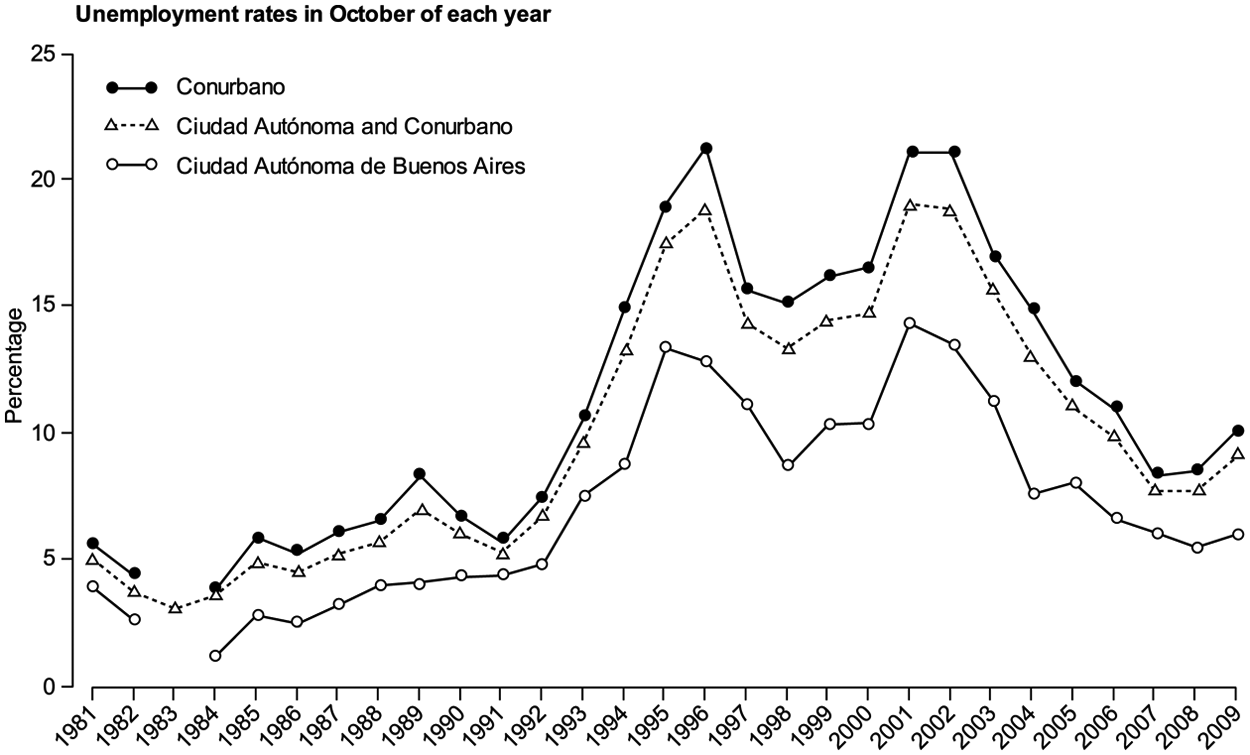
Unemployment rates in the Ciudad Autónoma de Buenos Aires and in the Conurbano, 1981–2009.
Although these trends are for the country as a whole, the evolution of unemployment in urban Buenos Aires followed a similar pattern. Historically, unemployment in the city proper has always been lower than the figures for Argentina and much lower than those for the Buenos Aires metropolitan region. At the same time, although there are no comparable and systematic unemployment data for all the municipal districts that compose the metropolitan region (see, e.g., data collected in a household survey in 1997 in four districts of Greater Buenos Aires [Kohan and Fournier, 1998]), unemployment in Greater Buenos Aires has been and is much higher than these figures show.
Furthermore, the recent (2002–2010) economic recovery gives the false impression that the city and the country have recovered the jobs that were lost during the 1990s. On the contrary, all the analyses undertaken have shown that job creation since the crisis of 2001–2002 has been concentrated in sectors, activities, and job positions that are limited in technological sophistication and often precarious (Beccaria, 2008; Fernández Bugna and Porta, 2008). It is remarkable how unemployment fell during this post-neoliberal period and, furthermore, how fast formal employment was created after the crisis, but, predictably, a number of problems persist. A few new activities requiring specialized skills, such as software production, have emerged (Borello, Robert, and Yoguel, 2006), while others, such as shipbuilding and film production, have been reborn (Borello, Quintar, and Seijo, 2010; Calá et al., 2008) and still others have received an unprecedented boost from the state (such as funding for research and development). 6 Nevertheless, the general picture is not encouraging. The key criterion here is not just the quantity of jobs created but their quality.
For example, even in informatics, in which Argentina (and especially Buenos Aires) not only has a long tradition but also has experienced a significant boom in the past decade, the quality of its human resources remains rather limited (Borello et al., 2005). The fragility and precariousness of a significant proportion of the existing jobs, even within the city of Buenos Aires proper, can be linked directly to characteristics of the economic structure of the city and the country. For example, production systems even within the dense Buenos Aires metropolitan region generate limited agglomeration economies, even in traditional sectors (Borello, Morhorlang, and Silva, 2011). In the Buenos Aires metropolitan region, the diffusion of information technology both in manufacturing activities and in state administration has, so far, been limited (Robert et al., 2008; Yoguel et al., 2004). In short, the production of goods and services is carried out, generally, in systems that have few agents, which in turn are poorly managed and characterized by weak connections with one another and with institutions, and knowledge creation in these systems is also limited (Yoguel, 2009; Yoguel, Borello, and Erbes, 2009; Yoguel et al., 2007).
Since 2002 the Argentine economy has been reconstructed with a lower level of complexity than it had attained in the mid-1970s. 7 It is a paradox that the economic policies of the 1990s, which were aimed at modernizing the country, should actually have put the country back on a path it had already traveled. Arguably, it is not enough simply to recover the jobs that were lost during the 1990s. Rather, what is needed is the construction of new activities that can retain the talent that the country is losing through an ongoing “brain drain.” As the largest urban agglomeration in the country and its undisputed economic, social, and political center, the city of Buenos Aires is not creating enough jobs at the two extremes of the labor market. Thus, the state continues to have a number of work and training programs oriented to very-low-skilled workers, supplementing the limited creation of jobs in this segment by the private sector. At the same time, the country continues to export (albeit at a lower rate than in the second half of the 1990s) professionals and technicians. The imports and services that enter the country through the port and international airport of Buenos Aires represent, in part, activities that could be carried out by many of the people the country is losing to European and U.S.-based employers.
Whereas neoliberal policies are often aimed at separating economic policy making from social policies, the two administrations that have led the country since 2003 have, when it comes to employment, sought to connect the two spheres, thus marking an explicit policy shift away from free-market thinking. While in the 1990s economic policies seemed to respond to technical rationales, since 2003 economic decisions have followed political objectives. In this line of argument, the central aim of the governments in the postdevaluation era has been the re-creation, amplification, and protection of the national market. In spite of a seemingly antibusiness attitude, both post-2002 governments have substantially enlarged Argentine markets by fostering the creation of thousands of new enterprises and new jobs.
Conclusions and Policy Directions: Housing, Security, and Employment
Most experts agree that there are approximately 2 million families living in inadequate housing in Argentina, as many as half of them in the Buenos Aires metropolitan region. Among the inhabitants of Buenos Aires, there is a perception that crime rates are higher than ever, although they are lower than those of other major Latin American cities. Unemployment levels continue to be high, and the quality of many of the new jobs created since 2003 has been low. The three prominent issues on which we have concentrated our review have consistently received attention from the state. However, the social drama of the 1990s and early 2000s exacerbated the city’s housing, security, and employment problems and placed greater demands on the state to attend to them. State responses have perhaps been more effective with regard to employment than with regard to the other two issues. Macroeconomic decisions made by the Argentine government sent the “right” signals to firms and entrepreneurs, directly creating 2 million new jobs relatively quickly after the 2002 crisis. 8 Although state funding for infrastructural improvements and the construction of new housing has grown dramatically since 2003, the state has been less effective in responding to society’s demands and expectations with regard to housing and the environment. The same can be said of security, where police corruption, an increase in drug-related activities, and an overall lack of clear policy direction have undermined most state efforts. Lack of major improvements on this count can, in part, be attributed to the absence of an institution that coordinates the state’s efforts at the level of the metropolis.
The ineffectiveness of the state’s actions in terms of housing and security and the broad-brush approach with which it has tackled employment issues can also be linked to the widespread dismantling of planning and research efforts during the 1990s (Oszlak, 2003). The two federal administrations that have governed since 2003 have brought about drastic changes in economic and social policy, although these shifts have not been allied with effective state reconstruction (e.g., employing mechanisms for the effective enforcement of legislation and delivery of public goods to the most needy) and have met resistance from a large proportion of the middle classes, especially in the city of Buenos Aires. Housing and security are issues that require sensitive state responses, and the same can be said for the creation of the high-quality jobs that would maintain Argentina’s skilled workforce. The latter also requires a major change in the economic profile of the country, one focused on the capacities created in universities and technical schools rather than on the export of primary commodities with little value added. In short, some policies require a sustained and intensive effort on a very small scale at the level of small groups of highly trained and highly motivated public officials and technicians. Many of these policies, in order to be effective, require continuous adjustment and change as they unfold. Yet, in the Argentine context, experts have recognized the difficulties in achieving sustained and widespread improvement in the quality of state management (Oszlak, 2003).
Given that Argentina was once cited as an example of the way free-market economics can produce economic growth and stability, it is somewhat ironic that its postcrisis political discourse is characterized by the striking hegemony, even among self-proclaimed critics of market liberalization policies, of neoliberal thinking regarding the problems afflicting urban areas and public services. In part, this reflects the extent to which market logic has become normalized across a broad political and ideological spectrum. In the policy sphere, key elements of the market model inherited from the 1990s have been preserved and combined with a limited return to state intervention via price controls, subsidies, and both supply- and demand-side management policies to produce a hybrid and contradictory set of relations. For example, most of the funds invested by the Ministry of Industry are fiscal incentives for firms developing manufacturing projects in the periphery of Argentina, such as Tierra del Fuego; limited funds are oriented to more heterodox initiatives such as the fostering of certain firms’ capabilities in quality control, design, labor organization, and the promotion of clusters of enterprises. The most striking contradiction, however, is that these changes have been implemented via a “double discourse” driven by an anti-neoliberal politics. In this sense, the changes discussed in this article do not closely correspond with the thesis of continued neoliberal roll-out proposed by Peck and Tickell (2002). Rather, in the context of postcrisis Argentina, the processes of urban governance and planning are much more conflictive and divisive and less coherent. However, if there is a lack of clarity regarding what works in addressing the variety of social and economic challenges facing Buenos Aires in the post-neoliberal era, it only serves to underscore the importance of the debate and experimentation that must necessarily inform a heterodox policy agenda. Therefore it would be naïve to expect a clean break from the neoliberal policies of the 1990s, given that there was no revolution in Argentina and many of today’s key political figures came to prominence during that decade. It would be equally naïve to expect solutions to problems that often date as far back as the 1940s and 1950s and that require a concerted effort involving many diverse actors.
Footnotes
Notes
Matthew Benwell is a lecturer in human geography in the School of Environmental Sciences at the University of Liverpool. James Haselip is a researcher at the UNEP Risø Centre, Department of Management Engineering, Technical University of Denmark. José Antonio Borello is an associate professor in the Instituto del Conurbano of the Universidad Nacional de General Sarmiento and a researcher at CONICET in Buenos Aires.