




Abstract
In 2010, some 13,000 people occupied the second-largest park in Buenos Aires, located in the most deprived area of the city. The city and state governments reacted with violent repression leading to three deaths. After government officials promised that a housing program would be provided, the problem was viewed as “solved.” However, four years later not a single home had been built. Interpretive frames and political practices in Buenos Aires were influenced by the conflict, and this ultimately strengthened the positions of the national and local governments. This, in turn, intensified structural discrimination against lower-income groups in Buenos Aires. Thus, far from bringing about sustainable housing solutions, the occupation reinforced policies of security and sanction.
En 2010, cerca de 13,000 personas ocuparon el segundo parque más grande de Buenos Aires, ubicado en la zona más pobre de la ciudad. Los gobiernos de la ciudad y del estado reaccionaron con una violenta represión que causó tres muertes. Después de que los funcionarios gubernamentales prometieron establecer un programa de vivienda, el problema se dio por “solucionado.” Sin embargo, cuatro años más tarde no se había construido ni una sola casa. Los marcos interpretativos y las prácticas políticas en Buenos Aires se vieron influenciados por el conflicto, y esto terminó por reforzar las posiciones de los gobiernos nacionales y locales. Esto, a su vez, intensificó la discriminación estructural contra los grupos de más bajos ingresos en Buenos Aires. Por consiguiente, lejos de traer soluciones de vivienda sostenibles, la ocupación reforzó las políticas de seguridad y sanción.
On December 2, 2010, the mayor of the city of Buenos Aires, Mauricio Macri, announced the granting of property deeds to the residents of most of the city’s informal settlements. A few days later, several families began to occupy the Parque Indoamericano in the southwestern part of the city. On December 7, around 500 families, mainly from the surrounding informal settlements (villas miserias), were counted in the park. The 320 acres of the park, the city’s second-largest, spread across Villa Soldati and Villa Lugano, the city’s most deprived neighborhoods. Local residents would describe the Parque Indoamericano as an untended wasteland, unsuitable even for playing soccer. A portion of the park contains a newer informal settlement, a social housing project, and an industrial park for pharmaceuticals.
Strongly opposed to the occupation, the Corporación Buenos Aires Sur, a nearby public-private institution responsible for coordinating social housing construction in the South, filed a charge of usurpation. The responsible judge, without inspecting the site, ordered the eviction of the occupiers. The same day 260 federal and metropolitan police officers forcibly evicted the occupiers, killing two individuals: Bernardo Gallo, 24 years old, from Paraguay and Rosemary Chura Puña, 28 years old, from Bolivia. Numerous individuals were injured, and 55 were arrested. The next day, however, the occupiers returned to the park, this time in greater numbers; some 13,000 persons moved into the park during the following days.
Initially, the police took no action, certainly in part because public authorities were unsure about the fallout that would come from the deadly eviction. While the national government was advocating a peaceful solution to the conflict, the mayor demanded that the national police be sent to the park again, blaming “out-of-control immigration policies” for an occupation that was being orchestrated by “mafia-style organizations and criminals.” Meanwhile, confrontations flared up between the occupiers and the surrounding residents (and were reported on sensationally by the media), and on December 9 a third person died: Emilio Canaviri, from Bolivia, supposedly killed by a member of a barra brava (an Argentine mafia with ties to soccer clubs) who had been hired by the city government. Additionally, dozens of people were injured (CELS, 2012). Violent unrest continued on subsequent days, and it was not until December 11 that the gendarmerie arrived to take control of the situation. During this time, negotiations between the state authorities and the communities were conducted in the Casa Rosada, and on December 13 the city and the national government finally reached an agreement on a jointly funded housing plan. The occupying organizations consented to the plan and vacated the park.
Informal occupations of land are by no means uncommon in the city and adjacent municipalities of the province of Buenos Aires. However, this was the first time in Argentine history that a public park had been occupied on such a massive scale. No other event, before or since, has been able to highlight the need for housing in such a dramatic way. Nor had previous occupations called forth such a vehement reaction by the police. Combined with sensational media coverage, the conflict provoked heated debates about the housing shortage and racism in Argentina.
Despite the new awareness of housing issues generated by the occupation, the promised housing plan remains unfulfilled, and neither the homicides nor the injuries caused by the police have been properly investigated. Indeed, the aftermath of the occupation has been marked by repeated defeats for protesters. In 2011 the attorney general of Buenos Aires charged six representatives of social organizations with responsibility for the illegal occupation. While the charges against four of them were dropped a few months later, charges against two spokespersons affiliated with the autonomous social movements Frente Popular Darío Santillán (Darío Santillán Popular Front—FPDS) and Corriente Clasista y Combativa (Classist and Combative Current—CCC) were ongoing until 2014. Quite different treatment was received by those responsible for violence against protesters: by the end of 2011, 45 police officers and the judge who ordered the eviction had been charged, but the charges were dropped only two months later. According to the investigations, it is believed that the city police officers replaced their rubber bullets with lead bullets (interview, lawyers for the Centro de Estudios Legales y Sociales [CELS], August 18, 2012; see also Hölzl, 2015).
This paper is based on the assumption that conflicts like the occupation described above play a central role in mediating power relations and determining the precise contours of local political culture (see, e.g., Tarrow, 2011). Against this backdrop, it seeks to answer two questions: Why has there been a continuing lack of recognition of people’s housing needs and broad tolerance for racial discrimination? And how has the occupation of the Parque Indoamericano affected political values and practices in Buenos Aires? In addressing these questions, the study aims to contribute to recent research on contentious politics in cities, which are said to be defined by “concerted, counter-hegemonic social and political action, in which differently positioned participants come together to challenge dominant systems of authority, in order to promote and enact alternative imaginaries” (Leitner, Sheppard, and Sziarto, 2008: 157). As we shall see, despite the specific circumstances and practices particular to Argentina, the occupation of the Parque Indoamericano has features in common with other new conflict modes (e.g., riots, looting) worldwide that arise out of social injustice but do not fit into “legitimate” forms of political mobilization.
In order to reconstruct the conflict and the new political practices it produced, the study first introduces the general political conditions and forces that framed the occupation and related processes. In this connection, the focus is on discourse dynamics, understood as a key determinant of political power relations. According to Laclau and Mouffe (2001), political practices are crucially informed by hegemonic discourses. The technique of frame analysis is used to examine how political realities are defined via discourse and how political meaning is constructed. Particular attention is paid to the way the groups involved construe and classify experiences and perceptions of reality and address other groups in order to achieve their goals (Brand, Eder, and Poferl, 1997). On the basis of Foucault’s (1970) discourse formations, frames are defined as preferential interpretive patterns by which sense is made of experience and perceived reality. In this vein, the study tries to reconstruct discourse dynamics and potentially emergent discourse coalitions that are said to support the formation of new hegemonic frames. The enforcement of so-called master frames is regarded as a precondition for implementing certain solutions or routines in public. This implies the existence of discourse coalitions—social groups that give prominence to similar arguments and frames by means of cumulative effects (Hajer, 1995).
The analysis adopted an ethnographic approach that was especially useful because the predictability of the outcome of collective action is limited (Tilly, 1999). Problem-centered interviews, conducted in an open format, made it possible to bring to light the subjective interpretations and perspectives held by actors, as well as their strategies and reflections on the conflict. Around 20 interviews with social movement actors, representatives of nongovernmental organizations (NGOs), grassroots organizations, public sector stakeholders, and academic experts were conducted between May 2011 and August 2012. In order to map the dynamics of interaction, the interviews were combined with participant observation in assemblies and demonstrations and two group discussions with Bolivian activists and members of a social movement in Villa 20. Furthermore, the print media from December 2010 until December 2013, including approximately 50 articles, mostly from the newspapers Página 12, Clarín, and La Nación, were analyzed. Finally, documents related to the struggle, such as reports, election campaign materials, planning documents, and the web sites of selected movements were examined as a communicative means of reconstructing the processes of interaction and the institutional framework.
Political and Social Framework Conditions of the Occupation
Neoliberal Urban Development and Housing Policies Since the 1990s
Today, approximately 600,000 of Buenos Aires’s 3 million inhabitants live in deficient housing. 1 Over the past two decades, access to housing and the city has continuously diminished, and not only for the lowest income groups. In the light of Argentina’s rapid recovery after the recession of 2001–2002, with economic growth rates of about 8 percent and progressive policies of the Kirchner governments that helped to increase the formal job market and decrease poverty, this marked decline in access to housing is surprising at first glance. Since the 1990s, the Buenos Aires metropolitan area has been undergoing large-scale socioeconomic and spatial restructuring (Ciccolella and Mignaqui, 2008; Pírez, 2002). Strong emphasis has been given to the retreat of the state from urban development, most prominently as a result of the deregulation and privatization policies enacted under former president Carlos Menem (1989–1999). Yet foreign investment has also had an increasing impact. Perhaps paradoxically, decentralization, another important aspect of the country’s restructuring in the 1990s, has profoundly increased citizen rights, including the right to housing. Since 1996 the Argentine capital has been autonomous, with a directly elected mayor and its own constitution. Among other things, Article 31 of the constitution asserts that dignified housing is a right of all residents, including non-Argentines. But this expansion in rights and “downscaling” of governance (Swyngedouw, 2004) has been accompanied by a decline of financial freedom of action. Following the then-prominent ideas of the neoliberal thinker Hernando de Soto (1987), emphasis was placed on spatial revitalization and increased regulation of land. Decentralization also led to a considerable increase in vertical political discordance. Since 2007, opposition parties have been in power at alternate levels of government: the Peronist Frente para la Victoria (Front for Victory) at the national level and the conservative Propuesta Republicana (Republican Proposal—PRO) at the city level.
After the crisis of 2001–2002, housing policies were recentralized, and the national government focused on massive standardized housing construction. This ambitious program (the Programa Federal de Construcción de Viviendas), which provided funds for 120,000 new homes nationwide, 11,000 of them in the city of Buenos Aires (to be accomplished by 2008), helped to stimulate the economy, especially the construction sector, generating many new jobs (Ostuni, 2010). However, as land prices rose in the Argentine capital and because of vertical coordination shortfalls, there was a failure to meet construction targets (Baer, 2011: 328). Between 2002 and 2009 an average of 470 homes was constructed per year, even less than in the 1990s. High land prices were a product of the real-estate boom that Buenos Aires has been experiencing since 2003. Since investment in high-end residential real estate has been seen as particularly profitable, a massive surplus of luxury housing has resulted, leading to an increase in vacancy rates of 25–30 percent in this segment, with 180,000 high-end apartments vacant in 2010 (Telam, 2011, cited in Baer, 2011: 327), even while the housing deficit among the lower income classes continues to rise. Growing demand for land, increasing tourism, and gentrification have resulted in the eviction of residents living on public land and in squatted buildings, often state-owned (Auyero, 2010; Baer, 2011: 328).
Concomitant with this development, there has been an increase in both open and subtle forms of repression to control social movements and the urban poor. This has included the introduction to poorer neighborhoods of “security” programs that, according to Zibechi (2012), serve to control residents on the pretext of providing for their safety. Furthermore, since the businessman Mauricio Macri became mayor in 2007, the Instituto de la Vivienda de la Ciudad (City Housing Institute—IVC), a public entity in charge of housing policy in Buenos Aires, has been increasingly stripped of power. Beyond a continuous reduction in budgets for social housing and a pronounced focus on land regulation, an inexpensive and at the same time visible policy, many of the historical competences of the IVC have been outsourced on the ground that this would increase its efficiency (Arqueros et al., 2011). Unsurprisingly, housing policy in Buenos Aires is still characterized by a lack of transparency and mismanagement. According to experts interviewed, corruption has even increased in recent years.
Informal Political Practices
Since the rise of neoliberalism, the clientelistic practices characteristic of Peronism have become even more pronounced (Levitsky, 2003). In a context of increasing poverty, state entities have increasingly provided financial assistance for neighborhood networks (e.g., food banks in informal settlements). These structures are operated by so-called punteros, local political leaders who function as extensions of the government. After the economic crisis of 2001, the powerful social movements of the piqueteros (road blockers) were partly institutionalized by selective incentives such as the offer of social programs and the incorporation of movement leaders into the government (e.g., the Federación de Tierra, Vivienda y Habitat de la República Argentina [Federation of Land, Housing, and Habitat of the Argentine Republic—FTV]). Meanwhile, social movements seeking to stay autonomous such as the FPDS and the CCC have suffered enormous losses of importance and public acceptance during the past decade. The policy of integration, co-optation, and discipline has weakened social movements by splitting alliances and weakening trust among activists (Svampa and Pereyra, 2009). Recent tendencies in Argentina thus show how the state has widely regained control over social movements.
Social and Racial Discrimination
Socio-spatial neglect is intimately wedded to historically codified spatial meanings in Buenos Aires. Already in the early 1900s the east-west Rivadavia Avenue was viewed as a physical and symbolic dividing line between the prosperous North and the traditionally poor South (see, e.g., Gorelik, 2004). Moreover, Buenos Aires was built in an overt effort to construct a “white,” “elitist,” and “civilized” city (Cosacov and Perelman, 2011: 298), demonstrating the deeply rooted legitimation of social and racial discrimination. For a long time, immigration policies in Argentina aimed to Europeanize the country (Sutton, 2008: 107). During the military regime (1976–1983), Intendente Osvaldo Cacciatore aimed to modernize Buenos Aires by, among other things, eliminating informal settlements, in line with the principle of the ciudad blanca (white city) (Oszlak, 1991). The comments of the director of the predecessor of today’s IVC, who ordered the abolition of the settlements, went down in history: “Living in Buenos Aires is not for everybody but for those who deserve it” 2 (quoted in Oszlak, 1991: 78).
Especially since the 1990s, immigrants have been increasingly held accountable for social problems, including inadequate housing (Grimson and Caggiano, 2012). Various actors benefit from stirring up xenophobic tendencies, including, for example, public officials (since the scapegoating of immigrants eliminates the need to introduce ameliorative social policies) and construction and textile firms (which benefit from a cheap labor force). In this context, Quijano (2010) emphasizes the “racialization” of the division of labor. The real-estate industry and media companies (which are themselves partly involved in real-estate development) actively circulate “discourses of insecurity” (Kessler, 2009), thereby driving demand for gated housing and influencing land prices (see also Cosacov and Perelman, 2011). New forms of housing have strengthened a citizenship grounded in property rights that is coupled with a common rejection of poorer social groups, thus fortifying the stereotype of a collective enemy or “other” (e.g., Centner, 2012).
The social position of the squatters is shaped by a “differentiated” understanding of citizenship in Latin American societies (Holston, 2008). This historically established understanding is informed by social categories based on ethnic and migratory background, as well as socioeconomic and spatial factors. Access to land is considered a restricted right. Regarded as “informal” tenants who live in highly stigmatized areas, the squatters are not perceived as full-fledged citizens with a voice of their own. From the point of view of porteños (inhabitants of Buenos Aires) they differ greatly from, for example, the tenants of hoteles-pensiones, who, according to a sociologist interviewed, are viewed as “ancestors . . . part of the collective memory,” which is linked to immigration from Europe (see also Adamovsky, 2009). 3 The squatters are seen as new immigrants—although many are Argentine—and sometimes as second- or even third-class citizens (Cravino, 2012).
Informal Housing and Rising Socio-Spatial Inequalities
As a consequence of the above trends, the informal housing market in Buenos Aires has grown dramatically in recent decades (Cravino, 2012). The number of villa miseria residents has doubled since 2001 and tripled since 1991 (CELS, 2012). Furthermore, the percentage of renters has also tripled, today constituting 40 percent of all residents of villas. This has been accompanied by a tremendous increase in villa rents (eightfold in the last four years of the 2000s) (Cravino, 2011). 4 Another rent-increasing factor is that access to the formal market is restricted by the requirement of a financial guarantee to rent an apartment. Thus, the informal market has been transformed into a lucrative business in which housing seekers (often with immigrant backgrounds) are frequently served by communities of their own ethnicity. All squatting in recent years, including that which took place in the Parque Indoamericano, can be attributed to informal tenants. Cravino (2011: 33) calls this a “silent rebellion.”
These restructuring processes and associated reductions in access to urban land have increased spatial fragmentation and segregation in Buenos Aires, a city that is characterized by pronounced socio-spatial inequalities between its northern and southern neighborhoods (Herzer, 2008) (Figure 1). Correspondingly, around one-third of Villa Lugano’s 190,000 inhabitants and half of Villa Soldati’s 40,000 inhabitants live in informal settlements and social housing. Housing infrastructure in the area includes lower-middle-income single-family homes and large social housing complexes. Twenty-four percent of the inhabitants of Comuna 8 5 are of Bolivian, Peruvian, and Paraguayan origin. Independent of immigration numbers, access to public transport in these neighborhoods is inadequate, as are social services such as schools and health care (Parea and Vitale, 2011).
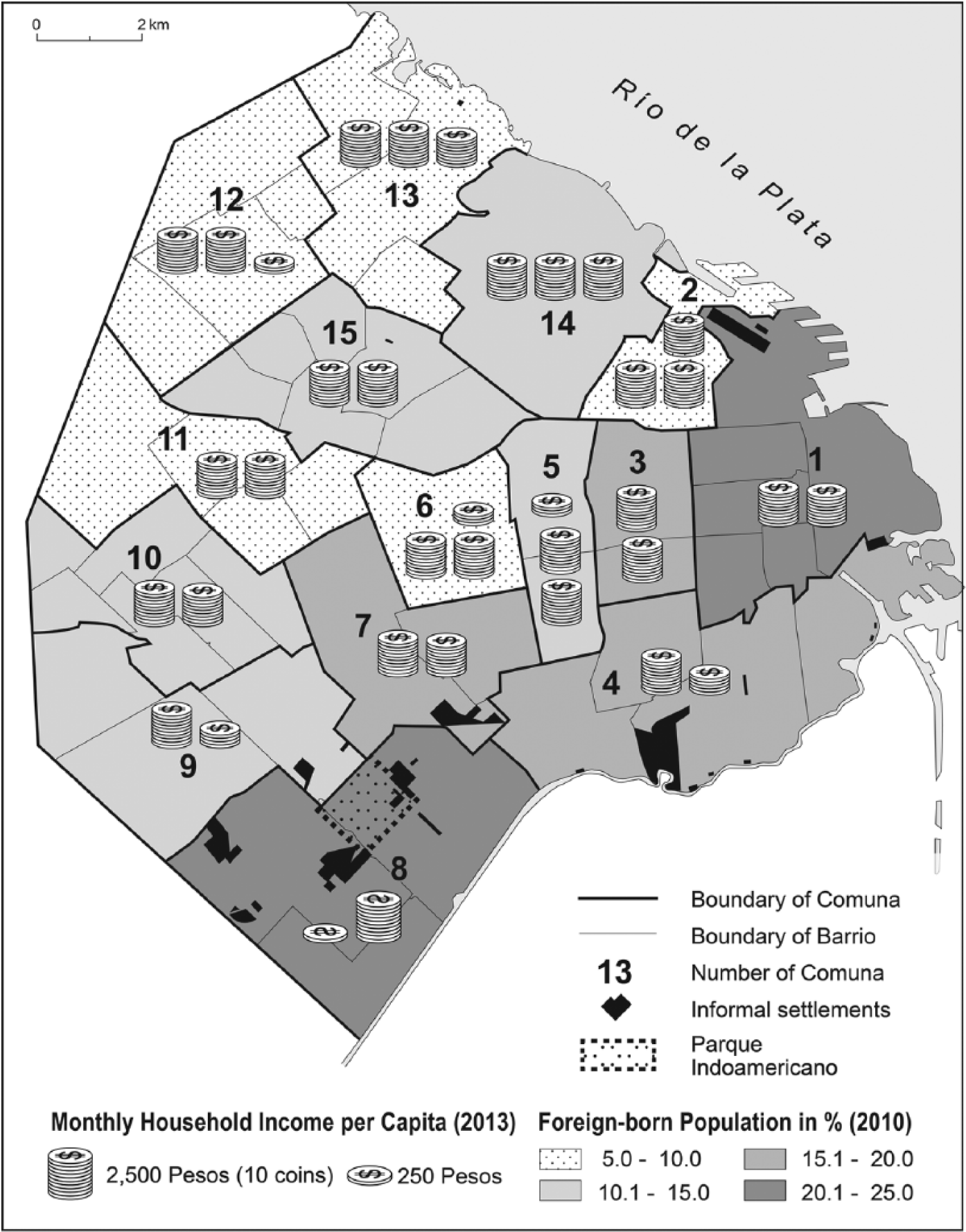
Socio-spatial disparities and distribution of foreign-born population in the city of Buenos Aires (DGEyC, 2011, 2013; INDEC, 2010; map prepared by Petra Sinuraya).
The Occupation: An Impetus For Action
What provoked the outbreak of the conflict? The most relevant precondition for resistance is a mounting subjective perception of social injustice (Giugni, 1999). From this perspective, the housing conditions in Buenos Aires described can be seen as a sufficient motivation for the occupation. Although the causes of historical events are complex and notoriously difficult to isolate, four major triggers can be identified.
The first and most important was the adverse social circumstances that people were confronted with: housing conditions were extremely poor, squatters suffered from extensive exploitation at the hands of landlords, and people could not count on the government to assist them. A woman squatter affiliated with the Frente de Organizaciones en Lucha (a piquetero movement) in Villa 20 reported (May 18, 2011): I lived in one room, we all slept together, with the kitchen in the room, and everything we had was in a room this small, and the bathroom was shared with the other tenants. . . . And in fact, I don’t know how it started and who started this occupation. I heard about it when it had already started, and I went to see if there was some place to go.
Second, prior to the occupation of the park, the city government announced the granting of property deeds to residents of social housing and informal settlements, signaling a willingness to improve living conditions in villas: “By handing the deeds over to them, you transform them into citizens, and the meaning of property will make them improve and reinforce their own homes” (Diario Perfil, December 2, 2010). This policy was motivated by the assumption that one can fight poverty by creating property stakeholders. The IVC president emphasized that it would enable the poor to “sell and buy real estate,” thereby integrating them “into society and the labor market.” However, the media did not cover the additional changes that this granting of property rights would bring: responsibility for urban development—previously a public matter—would be transferred to local residents through the amendment of Buenos Aires’s urban planning code, thereby increasing individual responsibility (Harvey, 2005). In this way, according to an IVC employee interviewed (August 16, 2012), far from being stimulated by a concern for the plight of the urban poor the property reform can be interpreted as an easily implementable and low-cost strategy for making land accessible to the formal market. Although this reform proposal was strongly criticized by the parliamentary opposition and neighborhood organizations and was subsequently withdrawn, the announcement triggered two fateful reactions among landlords and tenants: according to interviewees and NGO reports (CxI, 2011), many informal tenants were set adrift, as landlords feared that they might receive a property deed. This compounded the housing shortage. Furthermore, illegal squatting increased, as many viewed land occupation as a chance to receive a property deed.
In the framework of the institutional setting, a third trigger of the occupation related to clientelistic conflict at the local level. Apparently, punteros organized the first squatting because of differences of opinion with the mayor (CxI, 2011). Punteros may be allied with a huge variety of organizations, including parties and unions, and are often responsible for distributing social housing or subsidies. This is a common—and often successful—means of forcing the distribution of temporary housing subsidies in Argentina. In the media, however, the practice is strongly criticized as illegitimate, and the beneficiaries are regularly portrayed as freeloaders, thereby distracting attention from real housing problems. In a telling statement to the media, the owner of a PRO-funded food bank confirmed the “parasitic” nature of such subsidy recipients: “Eighty percent of the persons who occupied the Parque Indoamericano have a home and occupied this land [because they were] encouraged by political punteros who promised social subsidies” (food bank owner in Los Piletones, quoted in Clarín, December 13, 2010). This remark explains why Auyero, Lapegna, and Poma (2009: 2–3) warn against considering clientelistic politics and collective action competing political phenomena. The interrelations between actors are complicated and often difficult to untangle.
A fourth trigger of the occupation relates to the long tradition that collective action and squatting enjoy in Argentina (Villalón, 2007). In addition to the setting up of so-called piquetes (road blockades), squatting in public and private spaces has been a tool of collective action movements in Argentina since the 1980s. Despite the presence of families and children in the park, the first attempt to occupy the park was violently repressed by the police. In response to this oppression, many families returned to the park, this time without being organized by punteros (CxI, 2011: 13). Thus, the conflict gained momentum after the first wave of repression.
Reconstructing the Negotiations and Strategies of Various Actors
A wide range of actors were involved in the conflict surrounding the occupation of the Parque Indoamericano, including the occupiers themselves, community organizations, social movements, and local residents, in addition to the national and city governments, the national and city police, judicial institutions, criminal courts, and the embassies of neighboring states.
The occupiers consisted of an assortment of groups with varying and at times opposing interests: families with housing needs, including Argentines, Bolivians, Peruvians, and Paraguayans; economically oriented informal real-estate agents of nearby villas, such as Villa 20, who were parceling and “selling” land in the park; punteros of varying orientations, mostly affiliated with Peronism, who were organizing families to produce political pressure; social movements like the FPDS, which were protesting housing shortages and lack of government action by squatting in a public park, and many other organizations, including neighborhood initiatives and religious communities with housing and/or political interests. The diversity of groups involved in the occupation reflects the organizational fragmentation among the lower strata of Argentine society and the multiple forms of government present at the very local level (Vommaro and Cremonte, 2012: 82). While this plurality of actors is often characteristic of land squatting, in the case of the Parque Indoamericano occupation the dominance of individual families that were not collectively organized was crucial. By contrast, the informal settlements that have emerged over the past 25 years have most often been the result of organized squatting from the start. According to occupiers and experts interviewed, the families and communities that participated in the occupation by no means constituted a homogeneous and organized interest group.
Because of the diverse character of the occupation and the plurality of social organizations in Buenos Aires, the occupiers were unable to articulate common claims or select representatives for negotiations. This failure to establish broader networks and interrelationships of trust had fateful consequences, as such grassroots organization is considered a precondition for successful counterhegemonic movements and the transformation of power relations (Purcell, 2009). Instead, many—at times self-appointed—representatives pursued personal gain or the interests of selected community groups.
Many squatters emphasized that the Parque Indoamericano was not a park in the proper sense but largely an unmaintained, dangerous wasteland and thus tried to offer a competing frame to the government’s outrage over the occupation of a “public space.” The occupiers also highlighted that in the collective memory of the people living in the villas of Buenos Aires, the practice of land squatting is considered a legitimate mode of accessing housing. Many argued that taking land had always been the only option they had, not least because of barriers to formal access to housing (see also Auyero, 2010). However, in the media coverage of the occupation a largely negative image of the squatters received preferential circulation, and the squatters were unable to gather support for the argument that the housing crisis concerned Argentine society as a whole. According to a spokesperson for the CCC (interview, November 29, 2011), “The problem that has not yet been solved, as in 2001 when the less poor allied with the poorer people, is the housing issue. The other unsolved problem is the discrimination against the Paraguayan and Bolivian compañeros. We were unable to establish that those who were actually killed belonged to our people.” Ultimately, a lack of organization among the occupiers and repeated intimidation by punteros, among others, combined with hot weather and insufficient water supplies on the fenced-off territory, led to the dissolution of the occupation.
Following the occupation, various organizations demanded that the promised housing program be implemented and the homicides investigated. However, entrenched historical competition between community organizations, which had competing visions, and diverse co-optation practices confounded a united front that would allow a claim to be pursued in the courts. Legal redress would in fact be a distinct possibility, provided the communities were able to pool their efforts. A public defender (interview, December 21, 2011) explained: The occupation was not organized, not contrived, but spontaneous. After the occupation there were people who took over representing certain groups. These people don’t hold a general view. . . . There are lots of contradictions regarding the actions of some leaders. I don’t know what’s correct or incorrect. The picture is very complex. But that is also part of the reality of the organizations; they weren’t able to capitalize on the process.
Furthermore, the material shows the—in many respects—weak position of residents with an immigrant background. According to a Bolivian activist interviewed, many Bolivians who work informally in the textile industry are at the mercy of their employers, who are also often their landlords. Furthermore, many textile companies own radio stations, which are the most important source of information for residents, and these radio stations frequently cultivate discriminatory stereotypes against Bolivians, who are part of the occupation movement. Xenophobic rhetoric undermined cohesion between ethnic communities and sabotaged efforts to address housing problems and racism. Such rhetoric was very effective, as a Bolivian activist (interview, August 15, 2012; see also Taller Hacer Ciudad, 2011) reported: “For the Bolivian community it was important solely to not appear to be anywhere. Not being visible. This was the reaction.” Overall, the occupiers were not able to draw attention to their legitimate demands and real needs, as their ability to organize and mobilize themselves was weakened by economic constraints, co-optation, and structural discrimination that made them virtually “invisible” in public.
The way in which the city government acted—holding accountable the organizers who were supposedly behind the occupation—is quite striking. Its central motivation seems to have been to reverse the proliferation of informal settlements. Although two civilians were killed, the eviction of the squatters in the park in an extensive police operation was considered successful. This interpretation was based on the conviction that the occupation was a crime that had to be punished, the more so because the park was a public good that belonged to everybody. The squatters’ claims and needs were delegitimized through the circulation of storylines in which the poor of the South were described as “criminals,” “drug addicts,” or “freeloaders” who only wished to receive “social subsidies.” A then-representative of a social housing project in the park run by the NGO Madres de la Plaza de Mayo declared in a false statement that he withdrew after the eviction: “These were drug addicts of the most famous villas who shot at us. They wanted to occupy the apartments and threatened to kill us all if we didn’t leave” (Noticias Urbanas, December 9, 2010). In addition, the mayor, seeking to shift responsibility to the national government, blamed national immigration policy for the problem. This additionally served to establish a causal relation between criminalization, drug dealing, and immigrants. He framed his actions by referring to “uncontrolled immigration policies” and immigrants “engaged in drug trafficking and crime” 6 in an effort to drive a wedge between the occupiers and the surrounding lower-middle-class (often viewed as “European-Argentine”) residents. Because the residents of the surrounding areas are also socioeconomically deprived, the violence between occupiers and residents that resulted was perhaps unsurprising, especially in light of the racist reporting that accompanied confrontations. These events deepened existing perceptions of the South of Buenos Aires as an area marked by conflict of the “poor against poor,” or “occupiers against neighbors”—a storyline that received extensive coverage in the media. Yet this interpretation was a creation of the media: the “normal middle-class” residents were presented with a view of the “poor against poor” as part of the “spectacle of poverty” (Vommaro and Cremonte, 2012: 84). The poor themselves mostly lacked the capacity to influence these images. Moreover, the porteños were neither spatially nor emotionally affected by the confrontations in the South. For most residents of Buenos Aires, the occupation was an event experienced through the media.
The city government effectively delegitimized the squatters’ claims by appealing to notions of legal right and morality and by emphasizing the culpability of national policies. Strikingly, the interpretive frames circulated by the government shifted within a very short time span. While announcing the granting of property deeds, the city government pointed to precarious housing conditions and the need for integrating people into society and the job market, but once the occupation started the criminality and moral degeneracy of immigrants was emphasized. After the eviction of the occupiers, protest itself was framed as criminal, and an emphasis was placed on the need to punish illegal occupation and revitalize the park. In this connection, it is also notable that the institutions referred to by the city government changed with time: housing entities such as the City Housing Institute faded into the background, and finally only judicial institutions and the Ministry of Environment and Public Space were visible in the public sphere. The central frame can be summarized as “There is no housing problem” as the city clearly sought to whitewash the actual problem (see Table 1).
Discourse Dynamics and Practices of the City and National Governments during the Occupation of the Parque Indoamericano

Note: Storylines are in italics.
By contrast, the national government argued that it was the city government that was legally responsible for providing housing under Argentina’s federal and decentralized political system. At the same time, it distanced itself from the irresponsible, xenophobic, and violent rhetoric of the mayor. Actors at the national level followed a strategy of “divide and conquer” by efficiently employing the politics of scale and by seeking to transform the meanings ascribed to symbolically charged places (Leitner, Sheppard, and Sziarto, 2008). They feigned interest in a consensus-based resolution to the conflict by organizing negotiations at the Casa Rosada with social-movement representatives. Moreover, the national government demonstrated a peaceful and exemplary presence in the park: “The gendarmerie has already been in action for 18 hours without any complications, and the National Ministry of Social Development conducted the census properly. . . . Furthermore, the federal government neither agrees to squatting in public space of any kind, nor considers rewarding the occupation” (Clarín, December 12, 2010). However, this “peaceful” presence followed previous inaction by the gendarmerie during three days of racist confrontation. The census that was conducted of the squatters, which the responsible city ministry had declined to carry out, remains a “secret document,” as the lawyers for the CELS interviewed confirmed. Interviewees assumed that the president refused to send in the national police once again in order to cast a shadow over the city mayor—a common practice for undermining competing politicians or governance levels. Furthermore, when the chief of cabinet clarified that the national government was also opposed to squatting he introduced an interpretation to the city government’s frame that underlined the illegality of squatting. In this way, political elites collaborated to maintain or even increase their power, even though the relationship between the city and national governments can be described as absolutely conflictive. In an interview in Tiempo Argentino (Forster, 2010), the sociologist Javier Auyero stressed the risk of ignoring concordance between different governance levels and political parties: “Focusing so much attention on the differences between local, regional, and federal state interventions may lead one to lose sight of what they have in common beyond antagonistic rhetoric—namely, modes of regulating and disciplining the poor.” Regarding the negotiations at the Casa Rosada, however, it was the national government that selected and invited the representatives of the occupation. Unsurprisingly, the majority of representatives invited were from cooperating social organizations such as the FTV or Cámpora (a group close to Kirchnerism). Correspondingly, the national government was represented in the park via punteros, who persuaded the squatters—sometimes by peaceful means (e.g., by distributing water and food) and sometimes by threatening ones—to give up the occupation, as the following account of a spokesperson for the FPDS (interview, November 22, 2011) highlights: The government convinced the people to abandon the occupation. This puntero was there as a fighter. But he’s no fighter; he’s a functionary of the national government. He convinced with words and offered violence: He came with his gang and showed his gun [and said]: “You shut up; you know how it will end otherwise.” He took advantage of the claim that people would be stripped of their social security. Therefore people said, “We don’t have a home, but if they strip me of my social security, I’ll be even more damaged.” “They tell you lies,” our comrades said, and then they came and said that they would kill us.
This multiscalar government presence (see Nicholls, 2009) not only vested extensive power in the national government but allowed it to avoid blame for the occupation. In contrast to the city government, it demonstrated a readiness to engage in dialogue and negotiation while punteros and allied organizations weakened the mobilization. After the eviction, no actual desire to solve the housing problem was apparent. As efforts were made to clarify the conflict in its aftermath, the national government was no longer present, leaving it to the city “to solve the housing deficit” (cf. Table 1).
Discourse Dynamics and Practices Aimed at “Security and Sanction”
Although city and national governments employed opposing strategies to resolve the conflict, they pursued similar objectives: dissolving the occupation and reestablishing control over the situation and physical space. Neither the city nor the national government wanted to accept responsibility for the housing deficit. Instead, their frames aligned by focusing on the illegality of squatting and the moral turpitude of the squatters. This line of argument has dominated the conflict to this day. Consequently, we can identify a new and/or reinforced master frame of “security and sanction” that is increasingly applied to this discourse coalition. By means of passing on the responsibility and blaming immigrants and punteros and by drawing attention with moral arguments to the “honest” neighbors of the park, they managed to remove themselves from the affair. Interestingly, housing as a social problem in Buenos Aires was left undiscussed. Thus there was accordance between the city and national levels even though both were anxious to emphasize the contrasts between the PRO and Kirchnerism. During the conflict, both stressed the illegality of and need to prosecute squatting. The political practices and modes of discourse structuring pursued, based on a refusal to recognize rights and the judicialization of social problems, can be observed in similar conflicts (Fernández Wagner, 2012). Currently, there are more than 4,000 criminal trials against members of social movements in Argentina (lawyer for Liberpueblo, interview, August 17, 2012; see also Korol, 2009). 7
The emerging master frame of security and sanction is evident in the actions of both city and national governments. After the violent repression of the occupation, both chose more subtle strategies for conflict resolution, particularly localized interventions. While the negotiations at the Casa Rosada were covered by the media, the role played by punteros and community organizations in persuading squatters to leave the park was not visible to the broader public. Meanwhile, the city government supported open violence. Despite the tense and conflictive negotiations, the two levels of government ultimately reached agreement. For this reason, negotiation is seen as a crucial element of the discourse coalition. Moreover, as part of negotiating the housing program for the squatters of the Parque Indoamericano, the two levels of government reached consensus that citizens who had participated in squatting on public or private land would be excluded from welfare and housing programs in the future (CELS, 2012: 281). This threat aroused strong indignation among human rights organizations.
Within the frame of this discourse coalition, a number of practices evolved. In the following, the four most crucial discursive outcomes or political routines will be interpreted in the context of potential changes to power relations in local governance structures.
Increasing Security Policies
Most important, discourse surrounding the occupation led to the creation of a national ministry of security. As a consequence, the presence of the gendarmerie in Villa Soldati has increased, as provided for by the Seguridad Cinturón Sur (South Security Belt) program. The establishment of the ministry was a far-reaching institutional change. While this reform can be seen as official recognition of the problematic escalation in police violence that occurred, only one police official was forced to resign. Thus, the reform actually illustrates an effort to head off future conflict by increasing security instead of taking measures to resolve the housing deficit. In short, the government has mostly been interested in maintaining control: “The answer came on the part of the security forces. How do we control this and make sure that it does not get out of hand? The answer did not come by addressing the housing crisis” (public defender, interview, December 21, 2011). This was certainly not a completely new policy; however, the decision illustrates a further strengthening of security policies that aim to criminalize poverty across the globe (Wacquant, 2009). With such policies it is possible to further reduce powerful informal spaces that are not controlled by the state (Zibechi, 2012).
Control and Order Via Revitalizing Green Areas
The practices of the city government fit similarly into this master frame. It has not only refused to examine properly but even intensified its repressive treatment of squatting and its criminalization, for example, through housing policies. Furthermore, the mayor has continued to refuse to conduct a proper investigation of the homicides. Proactive measures have been limited to the revitalization of the park, again confirming a logic of order and control within the frame of security practices. In order to transform the symbolic meaning of the park and to prevent further squatting, the city government started a revitalization program in 2011. In this connection, a new place aesthetic has come to the fore that underlines once more the moral reprehensiveness of a possible future occupation. Inaugurating the first part of this program, the minister of the environment and public space, revealing the ongoing xenophobic and divisive framing of issues surrounding public space, commented on the measures as follows: “We decided to start our work in this part, because the neighbors of these neighborhoods put great effort into the Indoamericano. It was they who defended the park in the most critical moment, and they deserve credit” (Página 12, December 9, 2011). María Carman (2011) has highlighted the ways in which environmentalist rhetoric is used to justify socio-spatial displacement and the neglect of social needs, referring to this tendency as “the traps of nature.” For Carman, in the “war over space” the creation of green areas is used to positively frame policies that repress squatters (see also Hölzl, 2015). Thus we find appeals to preserving nature as a neutral means of justifying evictions, which are claimed to be for the benefit of squatters (Carman, 2006).
Notably, such rhetoric for repressing squatters dovetails menacingly with the avowed aim during the dictatorship of turning the Argentine capital into a “green city” (Cosacov and Perelman, 2011). Indeed, this goal motivated the establishment of several parks in the southern part of the metropolis. Accordingly, the program for revitalizing the park—in the absence of efforts to provide housing—is strongly reminiscent of this historical urban vision. In this way, it would appear that displacement of the urban poor is to be continued as a fixed aspect of the urban development goals for Buenos Aires. These goals include the creation of economic clusters, as provided for by the master plan (including the pharmaceutical cluster in the south); ongoing revitalization efforts in La Boca; the relocation of the Civic Center to Constitución; and the recently started development of a second bus terminal in Buenos Aires, located in Villa Soldati. Since all of these projects are located outside of already gentrified areas, it seems that the city government plans to develop the southern neighborhoods of Buenos Aires, which have a high potential for new infrastructure, housing, and economic activity (see also Gorelik, 2004: 235). Thus, the aim may be to achieve the gentrification of broad parts of southern neighborhoods, a goal that would entail an even more dramatic displacement of the poor.
“Non-Policies” in the Field of Housing
In spite of this enormous struggle, recognition of the constitutional right to housing has not increased. Hence, in the context of the Parque Indoamericano, we find an established practice by which there is simply no housing policy. In this way, the “South” functions as a frame frequently used by political decision makers to justify certain policies or “non-policies” (see, e.g., Grimson and Caggiano, 2012): “The state proved that neither this nor former administrations are willing to face the problem. It’s a problem that does not count for votes. If you solve it nobody is interested. It counts more to build a bicycle lane” (public defender, interview, December 21, 2011). This reaction fits into current housing policy in Argentina, which lacks the will at the city level to focus on housing construction, including self-construction initiatives (Rodríguez, 2009), and is incapable of implementing national programs in the city of Buenos Aires. Thus, while there is no public housing policy, we do find that the government has been forced by the outcome of legal battles to provide social housing. Thus housing politics in Buenos Aires can be described as reactive, with responsibility for providing housing increasingly left to judicial institutions—an inefficient arrangement that has led to further squatting while arousing resentment among “normal” residents. However, instead of questioning this judicial solution, the media typically discuss how squatting is legally “rewarded” with social housing, thereby reinforcing xenophobic attitudes. At the same time, according to an interview with an FTV spokesperson (May 16, 2011), the national government has been discussing a housing program with selected community organizations, thereby feigning openness to progressive reform. The advantage of this personalized strategy is that it helps to undermine motivation to engage in renewed protest, thus quelling unrest.
The Judicialization of Squatting
The common judicialization of squatting as a practice of punishment remains unquestioned. Two years after the occupation, a member of the magistrate council even judged the violent repression in the Parque Indoamericano as an ideal way of handling squatting (Candarle, 2012). Because of this judicialization, two putative organizers of the occupation remained accused for three years, until the end of 2013 (and the reconsideration of the case is still being discussed), while charges against those allied with the city and national governments were dropped a few months after the occupation. In this way, we find a common and subtle practice of criminalization that disempowers activists. As the Liberpueblo lawyer put it, It’s very usual, because, if there are direct repressive incidents, the response is eventually much more vigorous. As a consequence, the existence of lawsuits, with lawyers, papers, is a subtle form of repression, which is very useful if it’s not necessary to jail or to beat or to arrest or to kill. If it is necessary to arrest, to kill, or to jail, they do it, but if they can be more subtle, they try to be more subtle.
Thus we find judicialization as an additional routine or practice that serves to make the issues surrounding housing invisible in public discourse. Relegation to the judicial sphere depoliticizes the housing struggle in that it frames protest not as a political issue but as a judicial one, thereby further weakening the fight for the right to housing. This growth of judicialization can be interpreted as a deliberate effort to reduce the role of the political by narrowing the space and opportunity for conflict (Rancière, 2001). Of course, this trend is not visible only in connection with the occupation of the Parque Indoamericano, but it is particularly evident in this context. It must be considered against the backdrop of a conservative legal tradition in Argentina in which the judiciary does not play an active political role but rather adheres to strict interpretations of law (Fernández Wagner, 2012: 124). All in all, we find that the government employed effective politics of place to fulfill its objectives: the city government has a strong presence in the park and increasingly in the South, yet its strategies for exercising control remain invisible. Similarly, the national government has also augmented its presence in the area through increased deployment of the gendarmerie as well as by promising housing to selected social organizations located in these neighborhoods. Thus, the state has managed to consolidate or even strengthen its position of power without meeting the demands of activists.
Conclusion
The occupation of the Parque Indoamericano has become a frequent point of reference in public debates. However, despite the increased visibility of housing issues, the struggle has not yielded benefits for those who suffer from inadequate housing. This study has sought to reconstruct the local and national forces and the social movements and communities involved in the conflict and to shed light on the way it has impacted discourse dynamics and power relations. A frame analysis has shown how the city and national governments stabilized control over social movements and the urban poor and managed to suppress public recognition of the claim that squatters have a fundamental right to live in decent conditions. The defeat of the occupation occurred despite the enormous potential offered by the occupation for forging broader alliances and pursuing a common cause.
The failure of the occupation to achieve its goals is at least partially attributable to strong imbalances in economic and political power in Buenos Aires and in Argentina overall. The city and national governments possess powerful clientelistic structures that generally enable a strong local government reaction while weakening collective action. These informal political structures were effectively deployed. A wide range of instruments was used to exercise control, including repressive structures in the informal sector not directly controlled by the state. An additional important aspect of the discourse surrounding the occupation was racism. The groups subjected to instruments of control were perceived by the local public not as legitimate members of society but as what Rancière (2004) has called the “sans-part.” They lacked the economic and social resources and knowledge to make their social needs understood and covered appropriately by the media. Moreover, because of the underlying hegemonic socio-spatial order of the city and ethnic differences, related social inequalities, discrimination, and legalist differentiation remained unquestioned. Indeed, political actors benefited from the structurally embedded racial discrimination. In this way, entrenched political structures and the weak socio-spatial status of housing seekers preprogrammed the state’s actions, leading to a failure to engage in real reform or implement social programs. Ultimately, there were no routes allowing those in favor of reform to overcome existing sociopolitical structures and mechanisms of domination over urban space in order to translate their political demands into reality.
As a consequence, hegemonic frames and practices of security and sanction have been fortified while awareness of social injustice has been suppressed. By leveraging a politics of place informed by the rhetoric of environmentalism, it was possible not only to remove contested spaces from the conflict but also to create new moral barriers to future protest. Thus, far from being tempered, the power of the state appears to have increased since the occupation. Both national and city governments have an increased presence at the local level and an augmented ability to repress protesters through the police and the judiciary and—perhaps most crucial—remain in control of the narratives surrounding protest and occupation.
Footnotes
Notes
Corinna Hölzl is a postdoctoral researcher at University of Kiel. In her Ph.D. thesis she examined urban development conflicts and the impacts of social movements on urban politics in Santiago de Chile and Buenos Aires. She thanks Roland Verwiebe, Antonie Schmiz, Clara Irazábal, Tom Angotti, and the LAP reviewers for their helpful comments on earlier drafts of this article. This work was made possible by the Elsa-Neumann doctoral scholarship and the Caroline von Humboldt-Program (Excellence Initiative at Humboldt-Universität zu Berlin) (2010–2014). Travel grants from the German Academic Exchange Service (DAAD) supported the fieldwork in Buenos Aires (2011–2012) on which this article is based. She is grateful to those interviewed for their time and insights.