



Abstract
The presence of Evo Morales in the government of Bolivia raised expectations of change with regard to the politics of memory, justice, and the social and economic compensation for victims of the country’s dictatorships between 1964 and 1982. However, according to human rights organizations, these expectations have been only partly fulfilled. This can be explained by three fundamental factors: the government’s pursuit of an alliance with the military in order to accomplish its project, the collapse of the parties and traditional organizations of the left, and the articulation of a new narrative to consolidate the government’s project in terms of indigenous and anti-neoliberal nationalism. The latter two factors have resulted in the systematic political use of long memory (anticolonial resistance) and short memory (the popular protests of the 1990s and 2000s) and the partial displacement of an intermediate memory (the 1952 Revolution) and the memory of the dictatorships.
La presencia de Evo Morales en el gobierno de Bolivia generó expectativas de cambio con respecto a la política sobre la memoria, la justicia y la compensación social y económica para las víctimas de las dictaduras del país entre 1964 y 1982. Sin embargo, de acuerdo con las organizaciones de derechos humanos, estas expectativas sólo se han cumplido de forma parcial. Esto puede explicarse a través de tres factores fundamentales: la búsqueda de una alianza con los militares por parte del gobierno para poder llevar a cabo su proyecto, el colapso de los partidos y organizaciones tradicionales de izquierda, y la articulación de una nueva narrativa para consolidar el proyecto del gobierno en términos de un nacionalismo indígena y la oposición al neoliberalismo. Los últimos dos factores han resultado en un uso sistemático de la memoria larga (la resistencia anticolonial) y la corta (las protestas populares de los años noventa y el 2000), así como la dislocación parcial de una memoria intermedia (la Revolución de 1952) y la memoria de las dictaduras.
During the second half of the twentieth century in Bolivia, state repression, massacres, and arrests by the military accounted for more than 650 assassinations and left tens of thousands wounded, imprisoned, or exiled. In fact, about 150 disappeared continue to be recorded (ASOFAMD, 2008: 17; Guzmán, 2012: 95). In response to these crimes, Bolivia was one of the first countries in Latin America to establish a truth commission. Set up at the beginning of the 1980s, by the 1990s it had approved a series of initiatives for the compensation of the victims, and these were complemented by those of the governments of Evo Morales. However, despite these efforts and as a consequence of their limited success, organizations that could be described as authentic “entrepreneurs of memory” (Jelin, 2002) have expressed dissatisfaction, and this has resulted in public condemnation by Amnesty International, the Asociación de Derechos Humanos de Bolivia, and Human Rights Watch with regard to, among other issues, the impossibility of gaining access to military archives alluding to the dictatorships (Amnesty International, 2012; Human Rights Watch, 2014) and in the organization by the Plataforma de Luchadores Sociales (Social Fighters’ Platform–PLS) of a vigil in front of the Ministry of Justice since March 2012. The action demands a change in Morales’s policies concerning memories of the dictatorships. “No Forgetting, No Forgiving,” “Truth, Justice, Reparation, No More Impunity,” and “For a Conscious People of Historical Memory” are some of the slogans that can be seen at that vigil (see Figures 1 and 2).
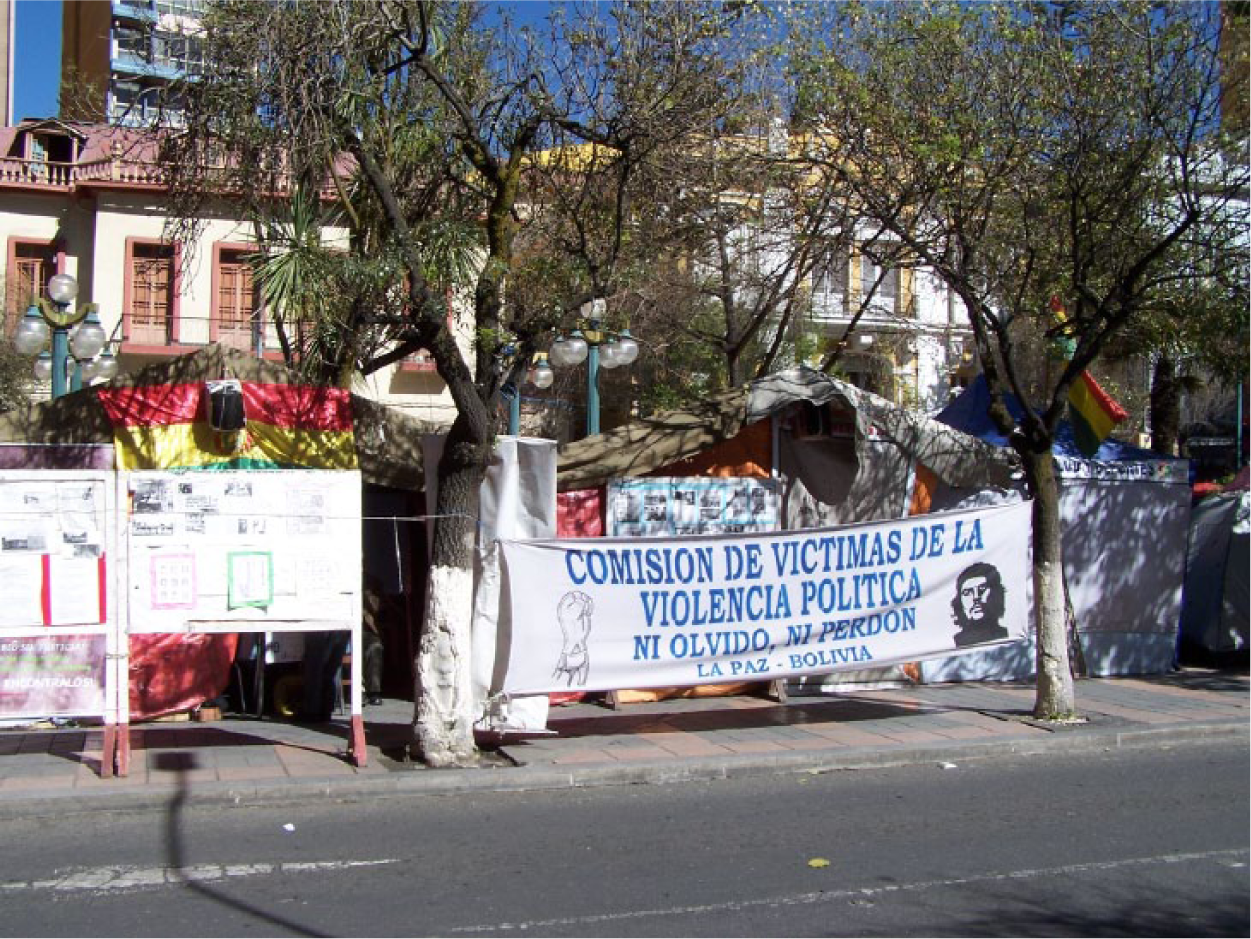
Vigil of the Plataforma de Luchadores Sociales in front of the Ministry of Justice (photo Adolfo García).

Mural with portrait of Marcelo Quiroga Santa Cruz (photo Juliane Müller).
These protests on the part of the victims’ and human rights organizations led us to ask why governments that identify themselves as socialist, sensitive to historical discrimination, and populist are not working to resolve definitively the demands of the dictatorships’ victims. Therefore, the objective of this article is to analyze the influence of the Morales governments on the politics of memory (García Alvarez, 2009), especially in connection with the dictatorships between 1964 and 1982 (Dunkerley, 1984; Malloy and Gamarra, 1988; Mayorga, 1978). 1 Far from intending to minimize the complex governmental task that the MAS government has had to face, we want to distinguish the contradictions of political practice from the contradictions that emerge from the structural framework (Kohl, 2010). With regard to the first, apart from those stemming from the proposal to construct a new highway across part of the Territorio Indígena y Parque Nacional Isidoro Sécure (Isidoro Sécure Indigenous Territory and National Park) without the permission of the indigenous communities, in violation of the new constitution (Almarez et al., 2012; Lorenzo, 2011), another contradiction of political practice is directly linked to the apparent disinclination of the MAS government to develop an effective policy for the restoration of memory, justice, and reparations for the victims of the dictatorships.
Analyzing the politics of historical memory in the Bolivian case and the factors that influence it allows us to understand that it is part of an area of struggle in which global trends involving international agendas and transitional jurisprudence converge with particular historical factors and conjunctures. While the Bolivian case underlines a key factor shared with other South American countries with regard to truth and justice, the role of the military, the reconfiguration of the Bolivian left and the indigenous and anti-neoliberal nationalist discourse are the consequence of historical variables and particular sociopolitical conjunctures that are significant for understanding the reframing of categories of international rights at the national level and their articulation with specific policies about memory.
Transitional Justice and the Politics of Memory
The society’s interest in recovering memory has to be framed in terms of a global trend toward memorializing traumatic events and granting prominence to victims of state terror and genocide. 2 The world wars of the twentieth century and the Nazi Holocaust promoted a transnational movement for the symbolic and material recovery of its victims (Bloxham, 2001). Studies of memory, of the one hand, and of transitional justice, on the other, emerged from the political and social consciousness of the importance of the compensation of victims and the condemnation of those responsible (Olick and Robbins, 1998). While the first have focused on memory in a broad sense, the latter have focused on democracy and stability in postdictatorship contexts, the political transformation of socialist countries, and the “post-conflict security framework” (Teitel, 2008: 3) of the countries of Central America, Eastern Europe, the Middle East, and Africa. The focus has been on truth and justice—research on the events, for example, by ad hoc commissions and the judicial prosecution of those responsible, the economic compensation of victims, and their symbolic repatriation (Lessa, 2013; Van Drunen, 2010).
In the Latin American context, studies of Guatemalan and Salvadoran reality after these countries began their democratization processes in the 1990s have called attention to the role of transitional justice in the pacification and democratization of societies divided by intense violence by the state and armed groups (Dosh, 2002). Parallel to these studies, research groups have emerged around the dictatorships of the Southern Cone, responding to the agenda of social organizations that had conducted the first studies and reports, especially in Argentina and Chile. One of these was the research and training program financed by New York’s Social Science Research Council in 1999, whose objective was to coordinate research by 60 young scholars on political repression in Southern Cone countries (Lida, Gutiérrez, and Yankelevich, 2007). In 2001 the Núcleo de Estudios sobre Memoria was formed, made up of experts and academics interested in the study of historical memory, mainly in Argentina, Chile, Brazil, Paraguay, and Uruguay (http://memoria.ides.org.ar/). Its principal themes were the use and custody of military archives, the emergence of social movements, and the analysis of commemorative rituals and places of special interest for those mnemonic processes.
In this article we aim to continue the studies of South American dictatorships that link memory with justice and truth (Bickford, 2000; Jelin, 1994; 2002; 2007; Stern, 2006; Van Drusen, 2010). Given the scarcity of research on the topic for Bolivia, 3 we will not examine the nature of memory or its processes of construction or the construction of historical memory by social organizations. Instead, we are interested in the politics and narratives of memory—not just those related to the dictatorships of the twentieth century but also those associated with other periods of injustice and systemic violence. In this way, the politics of memory and its management must be considered, following Pierre Bourdieu (1984), as symbolic capital that is put into play in the political sphere. Moreover, as the work of Graham, Ashworth, and Tumbridge (2000) urges us to understand, the past is a social field subject to conflicts and tensions and subject to differing interpretations that may even be contradictory or incompatible. It not only sanctions past narratives but also legitimates current social relations and structures and future narratives (Albro, 2006).
An indispensable context for understanding the field of memory in Bolivia is structural inequality and the counterposition of an official mestizo-creole historiography with one that is indigenous and has been subaltern. Whereas the former is based on the 1825 Independence and the National Revolution of 1952, the memory of the Aymara-Quechua insurgencies of 1781 disrupts this genealogy by challenging the idea of an integrated nation and recovering the memory of indigenous resistance and insurrection (Rivera Cusicanqui, 2003 [1984]; Stephenson, 2002; Thomson, 2003; Ticona, Albó, and Choque, 1996). These memory and subaltern studies, following Rivera Cusicanqui (2003 [1984]), have given us the terms “long memory” and “short memory,” the first referring to indigenous resistance to the Spanish presence, internal colonialism, and the subsequent creole hegemonies and the latter to the revolutionary power of unions and peasant militias of the 1952 Revolution. Apart from Rivera Cusicanqui, Javier Hurtado (1986) uses “long history” and “short history” to describe these two periods of oppression and resistance. More recently, Xavier Albó (2009) has referred to the “long ethnic memory” of indigenous political subjects.
In Rivera Cusicanqui’s work, the different insurrectional horizons are articulated. She attributes to these categories an epistemological dimension that reflects a particular conceptualization of time-space of Andean cultures and a special dialectical process in Bolivian history. That long memory is present in twentieth-century uprisings gives rise to cycles of popular and civilian protests grounded in a historical consciousness that pre-dates industrialization and working-class formation (Murillo, 2012). Empirically grounded in oral history analysis, this approach conceptualizes different moments in time as intertwined in the process of building “communicative” and “cultural memory” (Assmann, 2008).
These works are indispensable for understanding the cultural processes of memorialization that have been deployed in Bolivia. In our article, however, rather than the nature of memory on a theoretical-epistemological level or as a social phenomenon, we examine its use in the political sphere. We start from the premise that the articulation of different horizons tends to be omitted when they enter the political sphere and official discourse. We are especially interested in how allusions to different memories and insurrectional moments have been used to serve the political interests of the moment, accommodating themselves to and partially displacing each other according to the requirements of the intended societal project. Moreover, as the lineal time of the nation-state advances into the future (Alonso, 1994), new time layers of events are added that form an ever more recent short memory. As we will show, the politics of memory under the MAS oscillate between long memory and a new short memory of anti-neoliberal peasant and urban protests against U.S. and European political and corporate interests that has partially displaced not only the memory of the 1952 Revolution but also the historical memory of the dictatorships.
Truth and Justice Initiatives
According to a report released by Asociación de Familiares de Detenidos, Desaparecidos y Mártires por la Liberación Nacional (ASOFAMD, 2007), five different repressive contexts shook Bolivia during the twentieth century. The first, from 1964 to 1968, was headed by René Barrientos, under whose government the military assassinated dozens of miners who had supposedly supported Che Guevara’s guerrillas (Puente, 2011). In 1970, under the government of General Alfredo Ovando, the army defeated the Teoponte guerrillas, who were mostly students, killing 65 of them at the president’s order (“I only want dead bodies, not prisoners”) (Puente, 2011: 110). During the government of General Juan José Torres, Hugo Banzer organized a coup d’état that led to 14,750 arrests, 19,140 exiles, and 77 disappearances of Bolivians in Bolivia, Argentina, and Chile (Alanes, 2012: 66; Sivak, 2001); in the Valley massacres in Tolata, Epinaza, and Melga, some 200 peasants were killed protesting against some of that government’s decisions (Dunkerley, 1984). On November 1, 1979, just three months after the general elections, a coup d’état perpetrated by General Alberto Natusch provoked a popular uprising that was violently suppressed and caused, according to ASOFAMD (Alanes, 2012: 68), the deaths of more than 100 persons, another 200 wounded, and 20 missing people (known as the Todos Santos massacre). Finally, on July 17, 1980, a group of military under Luis García Meza and Colonel Luis Arce Gómez, linked to drug trafficking and advised by the German Nazi Klaus Barbie, overthrew the interim government of Lidia Gueiler, killing the socialist leader and congressman Marcelo Quiroga Santa Cruz and congressman Carlos Flores Pedregal. Another 26 persons disappeared during García Meza’s regime (Alanes, 2012: 70; ASOFAMD, 2008: 24).
Because of the state violence and human loss suffered under the dictatorships and their similarities with other Latin American dictatorships (Bickford, 2000; Jelin, 1994; Zalaquett, 1999), we believe that there should be a deeper analysis of them than they have so far received. According to Garretón, González, and Lauzán (2011), Bolivia’s Comisión Nacional de Investigaciones de Desaparecidos Forzados, established in 1982, was one of the first in Latin America, although it was paralyzed by the weakness of its mandate. Other important national initiatives were a law establishing compensation for victims of political violence and the creation of two commissions—in 1995 and 1997—with the aim of searching for the bodies of Ernesto Che Guevara and Marcelo Quiroga Santa Cruz. The Consejo Interinstitucional para el Esclarecimiento de Desapariciones Forzadas (Interinstitutional Council for the Clarification of Forced Disappearences—CIEDEF) was created in 2003 with the objective of integrating all the policies covering this field. In 2004 the government of Carlos Mesa approved Law 2640, whose principal objective was to establish procedures for compensation of the political victims of unconstitutional governments. Among the measures contemplated were awards of honors by the government, special social benefits, and economic compensation of the victims of such abuses. In tribute to the Jesuit, journalist, and filmmaker Luis Espinal, kidnapped and killed on March 21 and 22, 1980, March 21 was declared the Day of the Bolivian Cinema. In 2008 a national plan of action on human rights was approved, and the creation of a new truth commission was one of its main components. A biography of the murdered student Renato Ticona Estrada was published in that year, and in 2009, through a ministerial resolution, the Supreme Court authorized the declassification of part of its military archives.
Many of the local and national initiatives related to the public acknowledgment of victims took shape in public spaces, through the naming of streets and avenues and the building of memorials to honor primarily the distinguished victims of the dictatorships: between 1983 and 2005, the Heroes of January 15 memorial walk and Martyrs of Democracy Street (both named for the eight leaders of the Movimiento de la Izquierda Revolucionaria [Movement of the Revolutionary Left—MIR] executed on Harrington Street on January 15, 1981), the plaza and memorial way dedicated to Marcelo Quiroga Santa Cruz, who was murdered at the entrance of the Central Obrera Boliviana (Bolivian Workers’ Central—COB) headquarters in La Paz in 1980, and a plaza and school named for the student and leftist activist José Carlos Trujillo Oroza, who was detained and disappeared. Under the MAS governments we should highlight, among others, the plaza named after Renato Ticona Estrada, the authorization by the La Paz municipality of the placing of a plaque in honor of the murdered Jesuit Mauricio Lefebvre, the brief opening of the Museum of Memory in 2011 in the basement of the Ministry of Government, and the 2012 inauguration of the temporary exhibition entitled The Light of Memory.
As we have said, despite these efforts by Evo Morales’s governments at acknowledgment of the dictatorships’ victims, victims’ associations and human rights organizations have remained dissatisfied. Besides the already-mentioned vigil of the PLS in front of the Ministry of Justice, criticism has been directed at the CIEDEF and the human rights plan for their limited resources and interinstitutional coordination. Many of these organizations have pointed out that only 1,800 of the 6,200 dossiers presented for consideration under Law 2640 have been accepted (Amnesty International, 2012). This law was modified on April 30, 2012, to streamline the economic compensation, but in the opinion of the PLS (García Jerez, 2012) and Amnesty International (2012) its application is insufficient in that only 20 percent of the total compensation sought by each recognized victim has been granted. These organizations also denounce the extreme bureaucracy involved in acquiring victim status, which requires demonstrating that status, paradoxically, with an official document to which, even if one exists, full access is denied.
One of the main criticisms of these initiatives for social recognition voiced in our recent study was the focus on particular individuals to the detriment of others despite the fact that the law contemplated the granting of public honors to all proven victims (García Jerez, 2012; Garretón, González, and Lauzán, 2011). Social recognition has focused on political figures such as Quiroga, Trujillo, and the MIR members assassinated in 1981. There have been few devices for triggering public remembrance of a collective character—for example, calling attention to the so-called security houses, apartments in which politicians who sympathized with the opposition were tortured with impunity—and the only attempt to establish a memory museum barely outlasted its inauguration.
The Politics of Memory of the Dictatorships Under the Mas
Given the political dimension of memory and its management, we think it is appropriate to ask why the MAS governments have not responded to the demands of the social organizations in a definitive way. The question is especially timely in that evocations of the past have become the focus of constant attention in Bolivian public life. In response to this question, we highlight three explanatory factors: the military issue, the collapse of parties and traditional organizations of the left, and the articulation of a new narrative based on indigenous and anti-neoliberal nationalism whose objective is the consolidation of the MAS’s government project.
The Military Issue
The military issue (Acuña and Smulovitz, 1995) is the impossibility of carrying out one of the principal demands of the human rights and historical memory organizations, which is for justice (Jelin, 2007). Faced with the possibility that high-ranking military officials, sometimes still on active duty, could be found responsible for violations and that this would trigger a crisis of the state, governments such as that of Argentina have opted to avoid this situation in their first years (Jelin, 1994). In Bolivia, despite the fact that 30 years have passed since the last dictatorship, this factor is still present—a circumstance that derives from the process of transition to democracy, initiated in 1982, itself. The precariousness of the Unión Democrática Popular (Democratic People’s Union—UDP) government in the context of the fragmentation of the political left and an opposition that vetoed any decision led to the military’s becoming one of the main agents of internal security, charged with avoiding possible armed insurrection. This, as Quintana (1998: 24) has put it, “impeded the immediate prosecution of those responsible for the dictatorship.” In fact, as Barrios (1992) asserts, since from the beginning of democracy the functioning of the national defense committees established to reformulate civilian-military relations was not entirely satisfactory. These committees were unable to obtain access to information about the armed forces, and their supervisory role was understood as “meddling in the affairs of the military institution, which had a certain ‘historical immunity’” (Barrios, 1992: 3).
This was one of the explanations that members of victims’ associations gave us for the ineffectiveness of the current MAS government with regard to the demand for justice. This demand was manifested in 2012 in a declaration entitled “Bolivia: Thirty-three Years since the Todos Santos Massacre.” It called for the recovery of historical memory, “punishment for material and intellectual perpetrators,” and “integral reparations for victims.” According to the signatories of this declaration, 4 “victimization and impunity are still present today, when there are more than 100 victims who remain unqualified by the government through the Ministry of Justice’s qualification committee” (PLS, 2012). On one of our visits to the vigil organized by the PLS, some of its members, after hearing the news on the radio of Argentina’s judicial system’s decision to sentence General Jorge Rafael Videla in the summer of 2012, lamented the ineffectiveness of Bolivia’s judicial system in such matters (García Jerez, 2012). This was not the first time such a concern had been raised; in 2010 family members of human rights victims had demanded that the attorney general “investigate and prosecute 109 persons linked to the 1980 dictatorship, ex-military officers and 12 foreign mercenaries among them” (La Razón, July 24, 2010). 5 The president of the Fundación contra la Impunidad (Foundation against Impunity) stated in the same report that “the majority of the military members identified are in the country, enjoying their retirement, while two mercenaries are living in Santa Cruz” (La Razón, July 24, 2010). 6 Meanwhile in November of the same year the army was awarded the Orden Parlamentaria al Mérito Democrático Marcelo Quiroga Santa Cruz, an action that provoked indignation among victims and human rights organizations because the award was given to the same institution that had been responsible for Quiroga’s death. ASOFAMD claimed that in order to receive this decoration, the army should at least have had to declassify its archives (La Razón, November 19, 2010). The military’s impunity not only affected trials but also led to the impossibility of gaining access to a significant part of those archives (Amnesty International, 2010; 2012; ASOFAMD, 2007; Garretón, González, and Lauzán, 2011), one of the most important sources of documentation about what happened during the dictatorships and one of the most effective instruments for charging those possibly responsible (Figure 3).
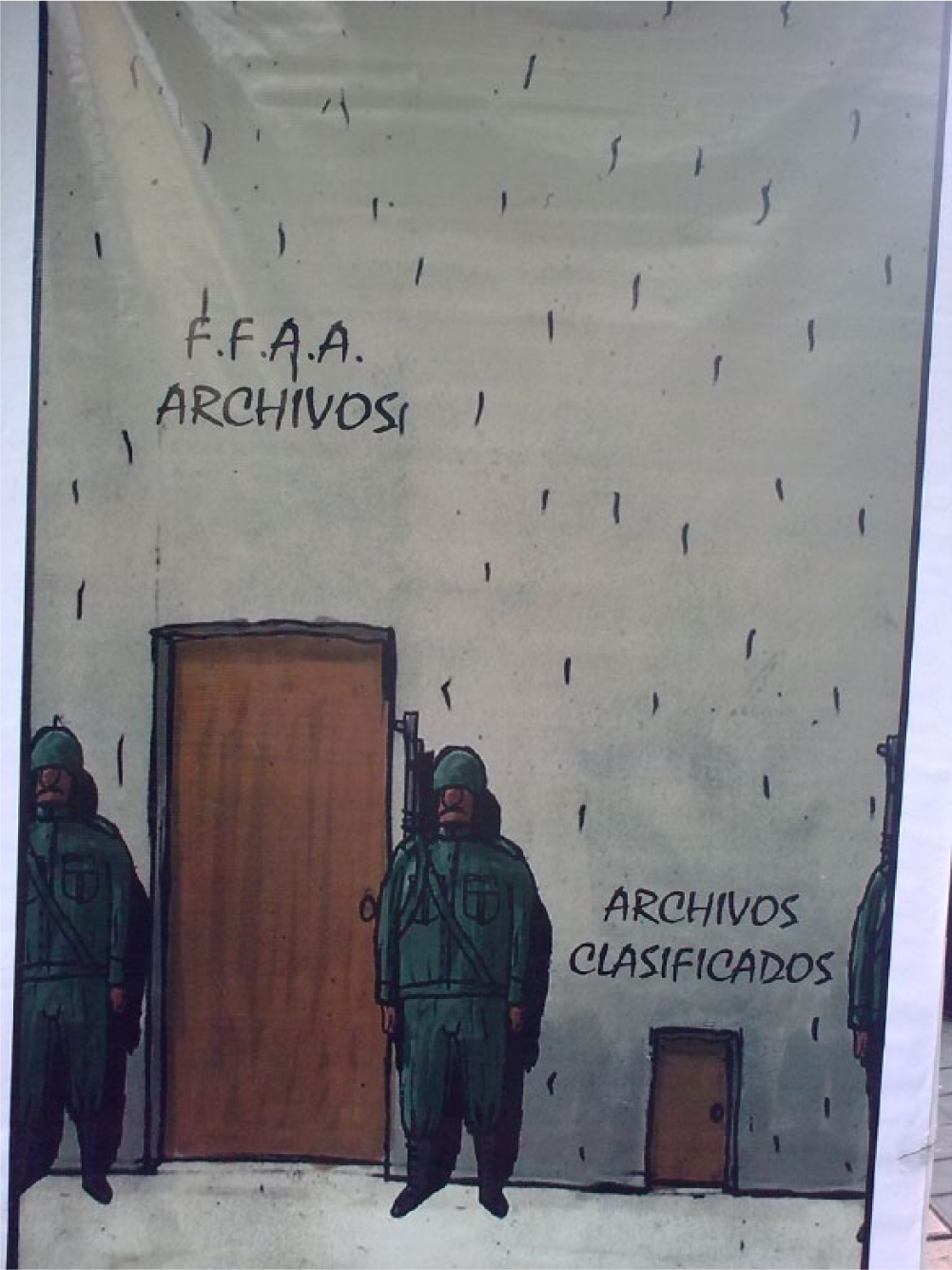
Poster denouncing the policy of declassifying the military archives (photo Juliane Müller).
The passivity of the MAS governments in dealing with victims’ claims for justice may be reflected in what Stefanoni (2006: 43) calls an attempt to reinstate the 1964 Pacto Militar Campesino (Military-Peasant Pact). This time it was not a matter of the co-optation of the peasantry by the armed forces but the reverse: a pact “articulated from an indigenous-grassroots government that incorporated the armed forces into the current nationalist process.” Morales’s ordering the military to occupy some oil wells in the nationalization process was evidence of this, as was his sending 28 generals of three different promotions to the reserve once he came to the presidency. In a more symbolic way, the Flag Day parade in 2006 included both the military and indigenous groups with the objective of displaying their desired unity (Mejías, 2007).
These initiatives, according to Morales, were intended to end the “times of dictatorship and conflict between the armed forces and the people” (Mejías, 2007: 449). It could be argued, following Stefanoni and Mejías, that the MAS governments were seeking to co-opt various state institutions for their political project. From this perspective, the possibility of sentences for those responsible for crimes and violations committed during the dictatorships could be interpreted as a serious obstacle to this co-optation. Not in vain, as Orellana (2006: 104) points out, has the “democratic revolution” of Morales’s government tended toward the pursuit of “peaceful coexistence with the old power” rather than “a radical transformation of the state structure.”
From the Decline of Marxism to a “New Multitude”
The decline of the traditional organizations of the Bolivian left is a consequence of internal and external historical factors. Many of these organizations date from the incorporation of a significant number of indigenous people, miners, and peasants after the Chaco War of 1932–1935, when the liberal model ultimately failed (Klein, 2011). Among the political parties whose ideological substratum was Marxist were the Partido Obrero Revolucionario (Revolutionary Workers’ Party—POR), the Partido de Izquierda Revolucionaria (Revolutionary Left Party—PIR), and the Partido Comunista de Bolivia (Communist Party of Bolivia—PCB) (Dunkerley, 1984; Puente, 2011). It was with the rise to power of the Movimiento Nacionalista Revolucionario (Nationalist Revolutionary Movement—MNR) that one of these organizations, the Federación Sindical de Trabajadores (Mine Workers’ Labor Federation—FSTMB), founded in 1944, achieved powerful mobilizing capacity. The FSTMB became part of the original platform of the proletarian masses and, once integrated into the COB, of the organizational framework of the 1952 Revolution (Degregori, 1999; Klein, 2011).
With the gradual shift to the right of the MNR, the organizations of the left lost influence. It is only under the dictatorships that they reemerged, this time under the leadership of the Federación de Mineros, the Bloque Independiente, and Jenaro Flores’s Movimiento Revolucionario Tupak Katari and more traditional organizations such as the COB and the PCB. The establishment of the Asamblea Popular in May 1971 was significant in that, as a representation of the Bolivian left, it brought together many union delegations and leftist parties (Klein, 2011; Puente, 2011). It was the “national-popular alliance” (Hylton and Thomson, 2007) between the COB, the recently founded Confederación Sindical Única de Trabajadores de Bolivia (Single Labor Confederation of Peasant Workers of Bolivia—CSUTCB), and the leftist parties and progressive sectors of the middle class that capitalized on the opposition to the various dictatorial regimes between 1977 and 1982 and acquired prominence in public life once democracy was restored. The establishment of the UDP and its electoral success in 1980 positioned these organizations at the head of government in 1982, once the last military rulers had been defeated. However, their inability to manage the economic crisis (Klein, 2011), the persistence of old structures of the 1952 state, and the discrediting of the COB with the peasant and indigenous organizations frustrated the expectations that had been placed in them (Puente, 2011). More specifically, the miners’ movement collapsed under the political repression and privatization of the mines undertaken by the government of Víctor Paz Estenssoro, which resulted in the elimination of more than 20,000 jobs and the migration of many families of miners to the cities and the coca cultivation areas. This, together with other neoliberal policies, contributed to the dispersion and depoliticization of the labor movement and, in general, of middle-class leftist sympathizers (Hylton and Thomson, 2007).
It was in this context that the objective conditions were created for the articulation of a new movement in the 1990s capable of bringing together the social sectors that lacked leftist organizational moorings. This new social-political force was made up primarily of the coca growers’ movement of the Chapare, which toward the end of the 1980s took control of the CSUTCB from the Kataristas, and later the MAS, with an increasingly broad social base. In contrast to that of the Kataristas, which fragmented into multiple subgroups and parties and lost its political influence, the coca growers’ movement and the MAS managed to bring together different social and indigenous sectors and rise via the political system (Van Cott, 2005). Moreover, the struggle between the indigenous-peasant unions and the proletariat for the leadership of the COB and the latter’s resistance to changing its orthodox notion of the industrial proletariat’s vanguard role led the peasants and especially the coca growers to focus on other organizations, such as the Federaciones del Trópico, the CSUTCB, and a coalition including neighborhood and other urban and periurban associations, marginalizing the COB from future mobilizations and actions (Hylton and Thomson, 2007). 7
The social movements of the 1990s and the beginning of the twenty-first century focused their protests against the U.S. Drug Enforcement Agency (DEA) and the large multinational corporations in the energy and basic services sector. The “water war” in Cochabamba in 2000 and the “gas war” in El Alto and La Paz in 2003, protests against privatization and external sale of natural resources that caused the departure of President Gonzalo Sánchez de Lozada, and the victory of the MAS in the 2005 elections can be understood as the result of the convergence of different subjects into a “new multitude” (Postero, 2010; also see Albro, 2005). In contrast to the classic labor organizations, this new political subject was able to capture the demands of the current Bolivian working class with more flexible and horizontal organization and indigenous forms of moral authority (Postero, 2010). As Ellner (2012) points out, the MAS itself rejected the old idea of the vanguard role of the traditional Marxist organizations in favor of a hybrid system that combined elements of both radical and representative democracy.
It may be this trajectory that explains why the MAS did not feel entirely indebted to either the parties or the traditional forces of the left. Moreover, ideologically, in the words of vice-president Álvaro García Linera (2006), the MAS governments were committed more to the development of an Andean-Amazon capitalism than to an intrinsically anticapitalist mode of production (also see Orellana, 2006; Webber, 2011: 189–190). Thus it did not fully reflect the ideology of those parties and their memories of the dictatorships, and this view led to the predominance of the indigenous element and a rejection of the neoliberal variant of capitalism to the detriment of the victims’ associations and former leftist militants.
A New Narrative: The Indigenous and Anti-Neoliberal Nationalist
The emergence and consolidation of an indigenous national discourse 8 was apparent in the unofficial inauguration of Evo Morales as president of Bolivia. At the ruins of Tiwanaku, Morales, being recognized as the greatest indigenous authority by Andean religious specialists, called on the ancestors and Pachamama for their blessing. The next day, in another ceremony, this time in the Plaza Murillo in La Paz, Morales spoke of his societal project: a “cultural democratic revolution” as a legacy of the idea of a new Inca Empire of Tupak Katari, the “great homeland” of Simón Bolívar, and the “new egalitarian world” of Che Guevara. At the same time, he called for a moment of silence in memory of the “martyrs of liberation,” among whom he included the indigenous insurgents of the colonial period, the intellectuals and priests disappeared by the military dictatorships, the coca growers murdered while opposing the policies of the DEA, and the urban activists of the neoliberal period (Postero, 2010). In these two speeches, one alluding more to the colonial period and the other more to contemporary Bolivian history, Morales, as Howard (2010) and Canessa (2006) point out, avoided presenting himself as exclusively indigenous in order not to endanger the plurality of the MAS project. It was crucial to bring together a significant number of social sectors on the basis of what Do Alto (2005) has called “a reciprocal exchange of legitimations.” However, the consolidation of the government project required a more solid narrative that has rested on tropes of indigenous and anti-neoliberal struggles that would be supported in a multiplicity of semiotic channels (Howard, 2010). This narrative has become especially salient since the already mentioned case of the Isiboro Sécure Indigenous Territory and National Park and the case of Mosetén, where the MAS government has attempted to extract petroleum against the will of the indigenous communities (Canessa, 2012). As the eco-indigenous discourse, very much present during the first MAS legislative period, entered into contradiction with the economic interests of the state, the government has attempted to recover its moral authority by guaranteeing the commitment of the new multitude through narratives and semiotic channels based on elements of long and short memory. As Fontana (2013: 35) argues, one of its rhetorical strategies has been the use of “merging categories,” narratives that combine new collectives and very recent protests such as those of the 1990s and 2000s with mythological notions.
Hence, along with the recurrent use of cosmological terms from the Aymara culture such as Pachamama and pachakuti (the future in the past), 9 the government began to recover and recall events and figures from the Republican period, such as the Zárate Willka insurrection in reaction to the Federal War of 1898–1901 (Webber, 2010). The most noted example of this rhetoric is the association of Tupak Katari with Evo Morales. For the MAS, both Tupak Katari and Evo Morales symbolize the grassroots and indigenous masses against colonizing and imperialist forces (Hylton and Thomson, 2007). 10 Therefore, for the MAS, Morales’s electoral victories represent one more milestone in the 500-year-long resistance to the nonindigenous conqueror, while the struggle against neoliberal policies and the DEA and their dead are one more part of the memory of indigenous liberation and its martyrs. The claim that the natural resources belong to the Bolivian, in the end native Bolivian, population is a statement that perfectly connects long indigenous with recent anti-neoliberal protests. Moreover, the coca leaf is a strong “merging” concept that relates indigenous cultural history with anti-imperialist policies.
The recovery of long memory and a certain displacement of the memory of 1952, did not, however, originate with Evo Morales’s coming to power but began in the 1960s with the emergence of a new indigenous consciousness. The nationalist revolution of 1952 had institutionalized the dispossessing of indigenous people of their languages, practices, and beliefs and converted them into peasants, with the intention of materializing a new mestizo national identity (Degregori, 1999). This failed attempt of the new regime, however, became in the 1960s an anticolonial reading of the Bolivian reality and indigenous confirmation by a group of Aymara university students, the Kataristas (Hurtado, 1986; Ticona, 1996). It was they who tried to break the Military-Peasant Pact after indigenous liberation and the recovery of their ethnic identity. Although Sinclair Thomson points to the existence, already in the 1940s, of thinkers and novelists who recovered the memory of Tupak Katari in their texts, it was in the 1960s and 1970s that the Partido Indio (Indian Party) of Fausto Reinaga and most of all the Kataristas, both under Flores and later under Felipe Quispe, who repositioned and situated Tupak Katari and other figures of the indigenous rebellions against the Spanish colonial authorities in the public sphere, aiming to make them part of their political discourse (Dunkerley, 1984: 213–214; Thomson, 2003). This rereading of the past would be used by the MAS for its refoundational project.
While this heritage adopted by the Morales governments explains the interest in long memory at the expense of other layers of cultural memory, it does not explain why they did not conceive the possibility of reusing memories of the dictatorships’ victims (those whom Morales had recognized as “martyrs of liberation”) for their cultural democratic revolution. Beyond the decline of the traditional organizations of the left at the beginning of the 1990s, in our opinion the MAS did not find many elements for a possible indigenous reinterpretation in the memory of the dictatorships or even in the ascent and repression of the first Kataristas (Dunkerley, 1984; Hurtado, 1986), although many of the victims of the bloodiest massacres in fact were indigenous, as were the Siglo XX and Catavi miners killed on June 24, 1967, and the Quechua peasants of the Valle del Alto in Cochabamba murdered in January 1974. It seems that the mnemonic material from the dictatorships—closely linked to Marxist organizations and relatively remote from the ethnic—did not quite fit its narrative of clearly indigenous and anti-neoliberal inspiration, in which an oscillation between long memory and the very short one offered Morales and the MAS notable symbolic resources for the building of a narrative future (Albro, 2006) based on “utopian visions of Andean culture” (Postero, 2007: 1) and state-centered industrial development. 11
Conclusions
It seemed that the scenario in MAS Bolivia would be highly suitable for the development of a politics of memory of the dictatorships based on social and economic compensation and justice. However, this expectation has not been totally met, and in our opinion this is the case because of the military issue, the decline of the traditional leftist organizations, and the necessity of constructing a new narrative for the consolidation of the MAS project. The MAS’s ascent to government marked a turn in the field of the politics of memory. This has meant that evocations of long and very short memory have become its hegemonic axis, partially displacing the memory of 1952 Revolution and the historical memory of the dictatorships, neither of which seems to provide sufficient symbolic material in the way of prominent figures or cosmological and ethical concepts to sanction its project for change. Public recognition of victims has concentrated on certain heroes of the resistance to repressive regimes, and while Morales mentioned them in his inauguration speech they have not been fully reworked as mnemonic material for constructing a new narrative capable of legitimizing his policies among the social bases.
Despite some institutional initiatives in favor of compensation for the dictatorships’ victims, we think that the displacement of memories of the dictatorships has had some ill effects. One of them has to do with the lack of economic and social recognition of the victims, which is generating a feeling of discouragement and distrust on the part of the human rights organizations that are working to recover historical memory under the MAS governments. At the same time, the MAS governments are losing the opportunity to articulate the memories of various phases or horizons of Bolivian history. After all, as Rivera Cusicanqui (2003 [1984]) and others have shown, different horizons and memories are juxtaposed into complex forms of collective and individual identity. Moreover, Nash (1993) (see also Albro, 2009) has described the way the collective action of socialist miners and workers combines class solidarity based on memories of past events such as the massacres of the dictatorships with Andean ritualized practices of resistance. To respect and reproduce this kind of juxtaposed memory in political discourse and practice would be a way of avoiding the risks inherent in the current strategy of MAS, among them Andes-centrism (Postero, 2007), the tendency to play certain social groups off against others, and the neglect of anonymous victims who have struggled for a more just Bolivia. It would mean taking on the totality of memories of the dictatorships—of their victims and of the political forces in which many of them worked toward a different, classless and more democratic Bolivia. All of this would make the new nationalist narrative more holistic and inclusive.
Thus our analysis of this case shows that, beyond global trends, international associative networks, and transitional justice in favor of historical memory, each national context generates a frame to deploy for resolving the issue. In these strategies, far-reaching political objectives such as the consolidation of a national project and immediate political interests such as the pursuit of internal social equilibrium converge. But they also embody historical factors that partially displace groups and their claims, such as the emergence of contradictions that, inherent in the complex task of governance, determine the magnitude and direction of these policies of redress.
Footnotes
Notes
Francisco Adolfo García Jerez is a professor in the Department of Social Sciences at the Universidad del Valle, Cali, Colombia. Juliane Müller is a lecturer in the Department of Cultural and Social Anthropology at the University of Munich, Germany. Margot Olavarria is a political scientist and translator in New York City.
References
Supplementary Material
Please find the following supplemental material available below.
For Open Access articles published under a Creative Commons License, all supplemental material carries the same license as the article it is associated with.
For non-Open Access articles published, all supplemental material carries a non-exclusive license, and permission requests for re-use of supplemental material or any part of supplemental material shall be sent directly to the copyright owner as specified in the copyright notice associated with the article.
