



Abstract
City master plans assumed a central role in urban planning in Brazil with the promulgation of a new constitution in 1988 and the passage of enacting legislation in 2001. Citizen participation became an important part of this new urban planning framework. In contrast to some of Brazil’s other democratic experiments, participation in urban planning has been received critically or with only cautious optimism. A comparison of two participatory forums in Santo André, São Paulo, shows that established patterns of administrative power can decisively influence the participation of the public in city planning. Differences in the executive structures of the two institutions enabled one of them but not the other to foster open-ended deliberation on policies with members of disadvantaged groups. The study suggests that participation might be enhanced by reserving executive positions for civil society participants, including the public at all stages of policy development, choosing participants largely from disadvantaged groups, and keeping the forum small.
Planos diretores para cidades desempenharam papel fundamental no planejamento urbano brasileiro com a promulgação da Constituição de 1988 e o sancionamento da legislação em 2001. Demais, a participação de cidadãos tornou-se importante elemento dessa nova moldura de planejamento urbanístico. Ainda assim, em contraste com outros experimentos democráticos no Brasil, a participação no planejamento urbano tem sido recebida de maneira crítica ou no máximo com otimismo cauteloso. Contudo, uma comparação entre dois forums participativos em Santo André, São Paulo, demonstra que padrões estabelecidos de poder administrativo tiveram influência decisiva na participação pública no planejamento urbano. Diferenças na estrutura executiva das duas instituições permitiram que uma delas, mas não a outra, promovesse deliberações transparentes sobre iniciativas enquanto permitia a participação de grupos menos privilegiados. O estudo sugere que a participação pode ser ampliada com a nomeação de participantes da sociedade civil a cargos executivos, incluindo-se o público em todos os estágios da política de desenvolvimento e escolhendo-se indivíduos majoritariamente entre segmentos mais desfavorecidos da população. O forum deve, ainda, manter-se pequeno.
City master plans assumed a vital role in urban planning with the passage of Brazil’s federal constitution in 1988. They became obligatory for cities of over 20,000 people and the sole means through which the urban planning powers devolved to municipalities in the constitution could be exercised following the passage of enacting legislation, the Statute of the City, 13 years later. At the municipal level, city master plans consist of a catalogue of legal stipulations that outline the capacity of the local government to intervene in matters of urban governance. They are, that is, instruments that establish and, as they are periodically modified, rework and redraw abstract models of the municipal territory and specify the legally sanctioned means through which the local government can intervene in planning, construction, and the use of land. The development of city master plans and the practical application of their provisions is, however, often held to be open to the input, suggestions, and demands of the public. Like many other governance and policy domains, the struggle for urban policy reform was, during Brazil’s democratization period, marked by calls for civil society to have a much more active role in government decision making. This paper examines some of the challenges in making these demands a reality in a governance environment heavily influenced by city master plans.
Despite the centrality of participation in master planning to municipal urban governance, there have been relatively few studies of its operation. When such studies are undertaken, the evaluations are often critical and note the significant practical challenges that are encountered when lay citizens participate in the planning process (Avritzer, 2009; Friendly, 2013; Villaça, 2005). Teresa Caldeira and James Holston (2014: 11), who see the potential for new forms of active citizenship in Brazil’s new democracy, have also observed the preponderance of members of the affluent classes at key moments in the development of São Paulo’s master plan. These critical and cautiously optimistic analyses stand in stark contrast to the enthusiastic evaluations of participatory budgeting, famously introduced in Porto Alegre (Abers, 2000; Baiocchi, 2005; Santos, 1998; but see also Wampler, 2007; 2008). In one prominent study that establishes a typology of participatory institutions in Brazil, Leonardo Avritzer (2009: 141) characterizes city master plans as having a design based on “public ratification,” given the prerogative of government to create the plans and use the attendant participatory forum as a space for vetting their policy proposals. While it is important to examine the effects of city master plans on the patterns of socio-spatial segregation in the city (Caldeira, 2000; Holston, 2008; Irazábal, 2005; Klink and Denaldi, 2011; Souza, 1999), this paper is concerned with the quality and nature of participation in urban governance and planning decision making. It examines the way city master plans are debated and discussed in practice, in a public forum on an ongoing basis, with the aim of exploring some of the barriers to citizen participation that were indicated in the more general studies. It does so by analyzing the city master plan of Santo André, a city in Greater São Paulo and the one in which the plan arguably first acquired the “participatory” label (Souza, 2007). Santo André is a propitious case study for examining participation in city master planning because there were two participatory institutions organized by the same administration that deliberated very similar urban and housing planning policies and issues. This enables some comparative purchase on the conditions under which the city master plan is discussed and debated in similar governance environments and some reflection on the types of conditions that would be needed for the promise of participatory master planning to be realized. These two participatory institutions are the Urban Development Council and the Housing Council, the former the governing participatory institution of the city master plan and the latter an older institution charged principally with deliberating housing and urban policy in the city.
The paper is based on 16 months of ethnographic fieldwork in Santo André between 2007 and 2008. I draw on field notes, the official minutes of the participatory institutions, and in-depth semistructured interviews with political appointees, public servants, and social activists. The text is divided into two parts. First, some historical context is provided both to the urban reform movement that mobilized support for participatory urban planning during the democratization period and to the specific history of the Urban Development Council and the Housing Council in Santo André. Second, some of the key characteristics of the Urban Development Council and the Housing Council are compared, drawing on field notes and excerpts from interviews. I account for the different kinds of citizen participation in the two institutions by revealing how the authority of government officials and the technical content of meetings figured in shaping the potential for participation in city master planning.
Participatory Projects and the Movement for Urban Reform
Brazil’s transition to democratic government, which began in 1985 with the installation of a civilian president, initiated a series of negotiations over the political and administrative features of the new republic. Many of the urban popular movements involved in the pro-democracy campaign, in addition to sections of the new left and members of the intelligentsia, called for increasing and institutionalizing “popular participation.” This “participatory project,” as Evelina Dagnino has termed it (2007: 551), was part of a longer legacy of social struggle that repudiated the elitism and political exclusivity of both liberal democracy and authoritarianism. It advocated, in contrast, a radical form of citizenship based, among other things, on egalitarian social relations and the right to participate fully in the affairs of government. However, the language of participation was adopted not only by urban social movements and the political left but by more conservative political actors.
The election of Fernando Collor de Mello to the presidency in 1989 initiated a period of neoliberal reform in Brazil as successive governments, particularly those of Fernando Henrique Cardoso (1995–2003), implemented policies supported by the Washington Consensus. These reforms rolled back the state, shifted responsibility for the fulfillment of social rights from the state to the marketplace, and distributed responsibility for services hitherto the domain of government among a burgeoning “third sector.” Many of the strategic goals of this “neoliberal project,” to maintain Dagnino’s terminology (2004: 96–97; 2007: 553), were plainly at odds with those of the participatory project. Perhaps most obvious, neoliberal reforms diminished the state’s capacity—through curtailing government funding and services—to meet citizen demands. And yet, despite divergent strategic interests, many neoliberal governments encouraged citizen participation, initiated participatory initiatives, and employed the rhetoric of participation. This represented, for Dagnino (2004: 98), a “perverse confluence” between participatory and neoliberal projects. Despite some shared discourse and, at times, agreement on the desirability of citizen participation, that participation and the role of civil society more broadly were conceived in quite different ways and often as part of otherwise antagonistic political strategies. However, the rhetorical support for citizen participation across the political spectrum helped foster the proliferation of participatory institutions in different governance domains.
The urban reform movement was a key element of the participatory democratic project. It gathered momentum in 1982 when a number of social actors came together under the banner of the Movimento Nacional para Reforma Urbana (National Movement for Urban Reform—MNRU) to intervene in the negotiations for the new constitution. The MNRU rejected the tenets of modernist urbanism, which advocated an ordering of the urban territory based on functional separation (for instance, between living, work, and leisure activities) and aligned the spatial organization of the city with the exigencies of capitalist accumulation, in favor of an alternative approach to planning that reasserted the primacy of the social (Friendly, 2013: 158–159; Souza, 1999: 278). Inspired by the concept of “right to the city” coined by the French Marxist Henri Lefebvre (1968), the MNRU sought increased investment in public infrastructure throughout the city so as to minimize class segregation and improve access to services for the most disadvantaged sectors of society and demanded that property and the city serve a “social function.” The democratization of urban planning and governance functions was another of the MNRU’s foremost demands, seeking to redistribute power away from the political class that had overseen the creation of cities marked by stark socio-spatial inequality. These demands were written into a popular amendment signed by over 100,000 citizens from around the country and presented to the constituent assembly that was convened in 1986 (Cardoso, 2003).
The MNRU was partially successful in realizing its goals. Two of its main demands, the social function of land and the right to the city, were represented in Brazil’s first constitutional urban charter in 1988. 1 These guiding postulates were, however, subordinated to a requirement inserted by a conservative group (Centrão) in the constituent assembly: cities with populations above 20,000 would require a city master plan (Avritzer, 2009: 143), which would be the sole means for implementing the legal powers specified in the constitution that gave local governments greater control over urban development (Carvalho, 2001: 131). Enabling legislation for the constitutional articles on urban policy (Nos. 182 and 183) was passed only 13 years after the passage of the constitution. Congressional lobbying by the MNRU, renamed the Fórum Nacional da Reforma Urbana (National Forum for Urban Reform), was successful in including several of its stipulations—including public participation, the social function of private property, and progressive land taxation powers—in Federal Law No. 10.257/0 (The Statute of the City). The passage of this statute was a landmark in urban policy and municipal law, creating together with the new constitution a new “juridico-urbanistic order” that was premised on the development and implementation of city master plans (Cymbalista and Santoro, 2002: 6).
City master plans therefore employ a language and style of organization that is tied into the legislative and operational conventions of the Federal Republic. The elaboration of technical and legal instruments and specifications in city master plans complements and indeed helps to constitute the working knowledge(s) of political appointees and public servants who are experts in urban planning law and use it in their daily work. Such an esoteric, technical discourse may, however, prejudice the involvement of lay citizens in participatory forums. Established expectations concerning how participatory meetings should be organized and run by government agencies can also decisively influence the degree and quality of citizen participation. The conveners of participatory meetings may have more or less implicit expectations, based on administrative structures and routines, about who should chair and coordinate proceedings and how urban planning matters should be presented. Such features of the participatory institutions are detailed and examined below, but first some local historical context is provided for the city of Santo André and the urban planning and development projects initiated by successive Workers’ Party administrations.
Santo André: City of Segregated Industrial Development
Santo André is a municipality in the southeast of Greater São Paulo and part of the ABC industrial region. 2 It is a thin crescent of land that is divided by the city master plan into urban and environmental macro-zones; only 38 percent of the territory is officially habitable and is inhabited by the vast majority of its 650,000 residents. The other 62 percent is part of a wetlands complex that encompasses part of the vast Billings Reservoir region, which provides potable water, hydroelectric power generation, recreation, and small commercial opportunities for local residents.
Santo André is, however, best known for its industry. Ever since the construction of the São Paulo railway in the late nineteenth century, the area around what is now the city’s central station was subject to first small and medium-sized and then heavier industrial development through the early stages of the twentieth century (Gaiarsa, 1991). The first large-scale strike occurred in 1906 in the textile factory Ipiranguinha, one of the city’s first manufacturing plants. Italian migrants had a large ideological and practical influence on the early labor movement, having brought with them anarchism and a direct action strategy that would have a lasting influence on the Brazilian left (Angell, 1998: 92; French, 1992). The history of the labor movement in the ABC in the decades to follow was discontinuous. Its ability to secure benefits for those on the shop floor depended, among other things, on the employment of different mobilizing strategies, economic conditions, external allies, global politics, and, perhaps most significant, the sometimes brutal reaction of conservatives and co-optative paternalism of populists (French, 1992). Nonetheless, it was activity from the factory floor and the management of the new, autonomous unions that gave some impetus to the end of the authoritarian era in the great strikes of the late 1970s (Sader, 1988). The unions were also instrumental in the formation of a new political party, the Workers’ Party, that would compete for power in the new democracy (Keck, 1992). The values and goals espoused by the Workers’ Party, when it was ratified in 1981, were common on the Brazilian left at the time. Importantly for this discussion, the party was supportive of and would become the foremost political advocate for the participation of the lay public in government decision and policy making.
It is little surprise, given the city’s political history, that Santo André was one of the municipalities to have a Workers’ Party mayor installed after the 1988 elections. A period of government ensued that was historically unique. It was the first time that the shantytown areas of the city, wherein about 18 percent of the population reside, were subject to concerted, cohesive, and technically sophisticated efforts on the part of public administrators to make the urban periphery part of the formal city. It was not the first time that legislation had been passed on illegal settlements, and it certainly was not the first time that political leaders had courted the city’s disenfranchised. But it was the first time that these efforts to transform the informal city were cohesive and, crucially, had the backing of a number of committed and trained professionals.
Housing and Urban Planning: The Problem of Regularization
The type of housing and urban development reform undertaken by the Workers’ Party administration on taking office in 1989 was influenced by an appreciation by senior government managers and professionals of the city’s changing socioeconomic conditions. First, economic restructuring—in particular the reduction of tariffs and other protectionist measures heralding the end of import-substitution-based industrialization—had an enormous impact on Santo André and the ABC region more generally. The once thriving industrial park known as the Tamanduateí axis, which ran along the central stretch of the city’s main railway, became a graveyard of empty factories and warehouses as large industrial interests moved interstate or abroad in search of lower operating costs or permanently closed their doors (Souza, 2007). Industrial employment dropped precipitously as a result. From 1984 to January 2002 industrial employment in the city fell by 50.68 percent (Denaldi and Passarelli, 2006: 31). An increase in service employment and a boom in the precarious informal market did not compensate for the secure and well-remunerated employment that industry had previously provided (Acioly et al., 2003: 10). Thus while the population growth that had boomed between 1960 and 1980 had largely leveled out in the following two decades, the city’s favelas grew in number and density as many of the lower-class workers found formal housing costs impossible to bear. Between 1991 and 1996 the favela population increased 3.78 percent per year, while the growth rate for the entire city was 0.31 percent. This growth was particularly intense in the wetlands macro-zone, concentrating informal development in the region farthest from basic services, with poor amenities, and, moreover, put the local ecology and the quality of the water supply at risk.
A number of interrelated administrative reforms enabled the government to respond to the housing and urban development issues the city faced. For instance, legislative measures were passed that established directives for the construction of low-income housing. In 1991 a zoning framework was introduced called “areas of special social interest.” Drawn from the landmark zones of special social interest developed in Recife, these areas were designed to facilitate land title regularization and urbanization and to provide incentives for developers to invest in housing projects for low-income families by, among other things, indirectly lowering land prices that had risen dramatically alongside population growth.
It was in a context of administrative reform, in which newly employed progressive public servants confronted an old bureaucratic culture (Denaldi and Dias, 2003: 319), that the Housing Council was created in 1999 and effectively began the following year with the principal aim of guaranteeing popular participation in the elaboration and administration of housing policy for the city (PMSA, 2006: 34). However, its specific duties suggest a fairly limited remit. Beyond organizing an annual housing conference and ensuring that the directives determined therein were adhered to, the Housing Council was responsible for managing the Fund for Housing, determining its criteria and the projects for which it would be used, and for holding public assemblies and meetings to debate housing issues in the city. Half of its 16 members were to be representatives of civil society elected in assemblies. Three of these members were allocated to representatives of associations of favela residents, 3 to housing associations or popular cooperatives, and 2 to disadvantaged groups or social segments working in the area of housing. The other members were public servants and political appointees. The civil society portion of the Housing Council’s membership was thus largely derived from organizations representing popular interests.
The Creation of the City Master Plan and the Urban Development Council
Attempts to establish a new city master plan in 2004 were a culmination of the legislative and policy reforms outlined above (PMSA, 2004). The plan merged urban development and housing policy and established a new Urban Development Council in a number of legislative amendments that were passed as a single law. Though Santo André’s master plan grew out of a local meeting stream that sought to develop a 20-year plan for the city entitled Future City, many of its provisions were made possible by the ratification of the federal Statute of the City and the new legal instruments that it introduced. Several of the plan’s specifications sought to reduce land prices, a long-standing goal of Workers’ Party administrations, through, for example, establishing zones of special social interest (adopting the terminology from Recife). The zoning components of the legislation were more complex and comprehensive than the areas of special social interest, and other formal instruments were included that strengthened the government’s hand in matters of urban development.
The city master plan provided a conceptual framework for the Urban Development Council, divided the municipal territory into purpose-specific zones, and delineated the administration’s powers in matters of urban planning and governance. Like the Housing Council, the Urban Development Council was responsible for holding public assemblies and meetings on urban development matters and for the management of a Municipal Fund for Urban Development, but it was also charged with oversight of the implementation of the plan’s provisions and policies. It was to debate proposed changes to the city master plan law, to propose changes to relevant legislation, and to initiate and manage technical and working groups. It was also responsible for the enactment of one of the plan’s urban planning instruments, the sale of building rights tax on structures whose height exceeded a floor area ratio of 1:1. The Urban Development Council was composed of 38 titular members, 19 from the government and 19 from civil society. Of these, 5 were representatives of business (an odd interpretation of “civil society”), 5 of social movements, 4 of nongovernmental organizations (NGOs), and 5 of other management councils. As did the Housing Council, it ordinarily convened once per month but would also hold extraordinary meetings. It was twice as large as the Housing Council and had a more extensive remit that included the review of legislative projects before their submission to the legislature.
I have argued that the language and organization of city master plans is tied into the legislative and operational conventions of the Federal Republic but also that the discussion of its provisions is shaped by administrative expectations concerning who should chair and manage the meetings and the way the technical content of the plan is presented. I will first examine the formal structures of authority in the two cases and account for the diverse ways that they are enacted. Then I will present summaries of the content of their meetings and excerpts of interviews with participants to reveal how the administration’s priorities shape the matters that are brought before the two forums and how they are presented.
Hierarchies, Formal and Real
Santo André’s participatory institutions are organized on the principle of equality. For every representative of civil society there is a government representative. If, for whatever reason, the full complement of civil society seats cannot be filled, then the number of government representatives will be reduced accordingly. This is important not so much because of the practicalities of council functioning as because it allows equality to be symbolically maintained. Formal hierarchies structured the institutions and assigned responsibilities and special titles to some of its members. Each had an executive committee made up of a small number of its state and civil society members that was formally charged with organizational responsibilities. Membership in the executive committee conferred authoritative titles on certain participants and provided (near) symbolic equality between government and civil society representatives in the institutional hierarchy.
The four members of the Urban Development Council’s executive committee were a president, a vice president, and two secretaries. The presidency was held by the director of the Urban Development Department, Fernando, 3 while Ruth, the director of the City Master Plan Department and former director of the Urban Development Department, took up the role of (government) secretary. Claudio, a representative of the Metalworkers’ Union of Santo André, assumed the vice presidency, and Roberta, an architect and founder of the NGO Instituto Ambiente, was the (civil society) secretary. The role played by each of these representatives in managing the meetings of the Urban Development Council is indicative of the established expectations concerning how government-organized gatherings should be convened and coordinated.
Since Fernando (government) occupied the highest-ranking position, it was little surprise that when present he ran the meetings—confirmed the minutes of the previous meeting, introduced the event program, mediated between speakers, and responded to questions. When he was absent, however, his role was passed not to the vice president (a post held by a civil society representative) but to Ruth, the government secretary. This, in fact, contravened the internal regulations of the council. Article 16 of Chapter 4 of those regulations specifies that “the vice president is responsible for replacing the president when she is absent or impeded.” 4 There was the clear expectation that the coordination and management of the Urban Development Council was the rightful domain of government officials even if that contravened a formal rule of the institution. 5 The executive structure of the Urban Development Council helped ensure that the forms of authority prevailing in the administration were reproduced in the institution’s assemblies and decision-making processes.
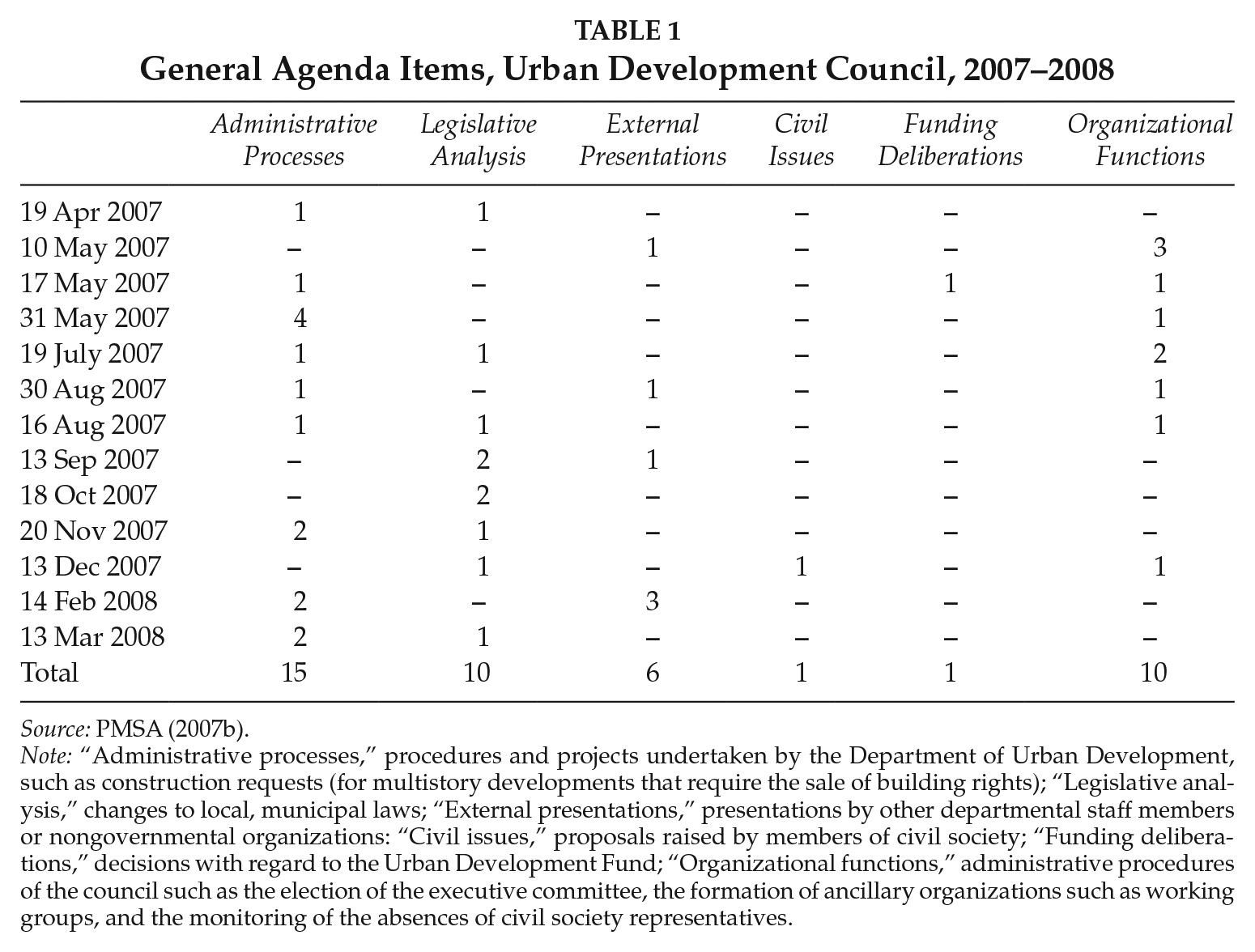
Thus far I have argued that the plan is disposed to technically esoteric discourse and that the executive structure of the Urban Development Council was folded into the formal hierarchy of the government—in effect helping to further normalize the power of senior government officials. While the authority of these officials could be seen in the manner in which they convened meetings and moderated discussion and debate, they also had significant influence over another aspect of the council: the content of its meetings. A summary of the minutes of the meetings that took place during my fieldwork (Table 1) reveals the technocratic character of the issues presented.
General Agenda Items, Urban Development Council, 2007–2008
Source: PMSA (2007b).
Note: “Administrative processes,” procedures and projects undertaken by the Department of Urban Development, such as construction requests (for multistory developments that require the sale of building rights); “Legislative analysis,” changes to local, municipal laws; “External presentations,” presentations by other departmental staff members or nongovernmental organizations: “Civil issues,” proposals raised by members of civil society; “Funding deliberations,” decisions with regard to the Urban Development Fund; “Organizational functions,” administrative procedures of the council such as the election of the executive committee, the formation of ancillary organizations such as working groups, and the monitoring of the absences of civil society representatives.
According to the formal minutes, the most popular agenda item was administrative processes and projects. The most popular of these processes was requests from developers to be exempt from the sale of building rights tax for proposed construction projects. The examination of existing or proposed legislation recorded the second-highest number of entries. 6 In fact, with two exceptions—a funding decision and an issue raised by a civil society representative—the Urban Development Council dealt almost exclusively with administrative projects and processes and legislative change. In other words, its meetings were largely a presentational space for the work of the administration and the policies that guided its activity. There were seldom open-ended discussions over how to implement the “social function” provisions of the plan or, indeed, how to respond to the needs of disadvantaged social groups.
The predominance of government officers and the technical complexity of deliberations in the Urban Development Council were both identified as barriers to participation by members of civil society, though to differing degrees. Rodrigo, for example, the administrative director of a residents’ and business owners’ association, identified the behavior of government employees as problematic:
Everything that comes, comes chewed. The only thing that the [civil society councilors] can move is a comma. It comes “ready.” The government maintains control, makes proposals, and changes them slightly only if they [the senior public servants] agree. They make concessions only when they think they should. There aren’t [any more than] six government councilors normally present in the meetings, but when they vote it’s packed. The government has a pre-made bloc of support, while civil society doesn’t always agree: it is separated into blocs. The government is never against the government or they [the offending public servants] would be out of their jobs.
Rodrigo was concerned not so much by the complexity of the council’s deliberations as by the means by which the government exercised control in its assemblies. The information that was presented to the council membership for discussion and review was, in a distinctive metaphoric expression, “already chewed.” He referred here to the extensive forethought, analysis, and collective work that had gone into the material before it was given to the council. His frustration stemmed from the fact that this forethought and analysis ought, in line with participatory ideals, to have been carried out, collectively, within the council rather than beforehand.
Bruno was a member of a small social movement, the Movimento da Defesa dos Direitos dos Favelados (Movement for the Defense of the Rights of Favela Residents—MDDF), that had participated in both the Urban Development Council and the Housing Council. He did not criticize the predominance of senior government officers, as did Rodrigo, but he maintained that participating in the deliberations of the Urban Development Council was difficult for civil society participants:
There were [disadvantages], because, man, it’s planning. It’s urban planning. That’s not just a little thing that you just show up and fix it in one go. There are some benefits and some drawbacks. . . . I have been a titular for one term [two years], and the first year there I just stayed [quiet], saying “Okay, okay,” and when voting for or against [particular motions] sometimes I abstained because I didn’t understand the thing, because it’s complicated, because it’s about urban planning. It’s about the planning of the city, it’s about a series of things, so it’s complicated for us from civil society. . . . So it’s a draw. There are some benefits and some drawbacks.
Bruno cited technical complexity as an impediment to his active participation in the debates and discussions. Faced with complex planning legislation in assemblies regulated by the government chairpersons, he acknowledged the challenges to effective participation. Yet he was not condemnatory and seemed to accept the complexity as a natural characteristic of urban planning. His criticism of the Urban Development Council, however qualified, was quite different from his evaluation of the Housing Council.
The Housing Council
The Housing Council was a quite different kind of participatory institution. As mentioned earlier, all its members came from popular organizations, it was smaller, and, according to the council president, it was the only participatory institution in Santo André with a civil society president. In the institution’s first term, the presidency had been held by the erstwhile director of the Department of Urban Development, Fernando, but for its second term the government and civil society representatives decided to reserve the post for a representative of civil society. This was a decision of observable consequence during the fieldwork period for this study, since Vanessa, the civil society president, had great influence on the council and was an irreverent and energetic spokesperson for disadvantaged social groups.
The position of vice president was occupied by Rafael, a government employee. Charged normally with minute-taking and other organizational tasks, Rafael also moderated the meetings in Vanessa’s absence. Even in these cases, the Housing Council did not lose its deliberative character; open-ended discussions still took place, as did often forthright interrogations of the uses and perceived abuses of government power. Rafael was not, it must be noted, the most senior government representative on the Housing Council; the directors of the Housing and Urban Development Departments were also among its members. The director of the Housing Department, Luana, attended most of the meetings at the beginning of my fieldwork period, but such was the egalitarian nature of the council (and perhaps her own disposition) that it was some weeks before I became aware of her position in the government. Following her exit from the administration, the new director did not attend the meetings of the Housing Council. The director of the Urban Development Department never attended a meeting during that period despite his formal membership.
Unlike the Urban Development Council, the Housing Council was not cloaked with the command structure of government. The fact that its top position was occupied by a civil society representative helped foster a more liberal, communicative atmosphere in its meetings. Not only were the meetings less formally regulated—concerning who could speak and when—but also the matters discussed therein attested to a different ideological orientation among its members. In this regard it is important to note the makeup of the council. As mentioned earlier, the civil society participants were representatives of associations of favela residents, housing associations, popular cooperatives, and disadvantaged groups. Drawn from such organizations, they were more likely to have similar material interests and similar working- if not lower-class backgrounds. This group of civil society representatives was paired with a unique set of individuals from the public service. Rafael and Vanessa were not the only progressive employees among the members of the Housing Council. Bianca, an urban planner, and Anderson, a housing analyst, displayed a similar predilection to help civil society council members understand government policy, to communicate the intentions and consequences of government practice, to further progressive policy within the administration, and to help civil society organizations, occasionally out of working hours and off government property. I had seen Bianca, in particular, on several occasions at the meetings of a small social movement organization and at the home of a social activist offering advice and support.
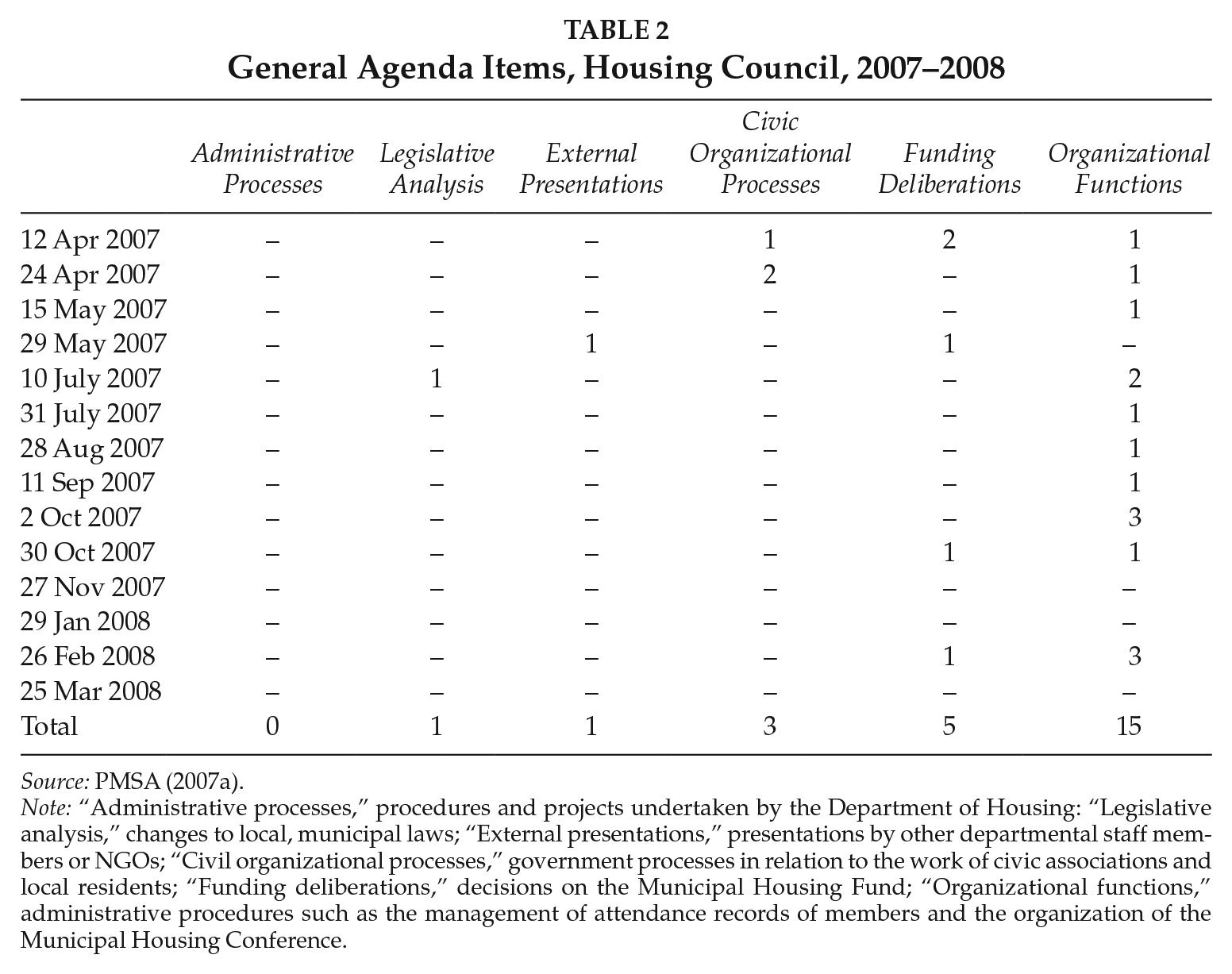
The main agenda items of the Housing Council’s meetings and the kinds of issues discussed in them (Table 2) reveal the progressive nature of its deliberations. It is clear that the analysis of administrative processes and projects, existing or proposed legislation, and presentations from other organizations or departments did not figure strongly in its meetings. While it had not analyzed any administrative processes and projects, in the same period the Urban Development Council had analyzed 15, and, while it had examined a piece of legislation only once, the Urban Development Council had analyzed legislation on 10 occasions. The Housing Council received fewer presenters from other organizations or organizational departments than the Urban Development Council—only one was recorded in the same time that the Urban Development Council had six. Whereas the Urban Development Council dealt with civil society issues only once, the Housing Council dealt with such issues not at all.
General Agenda Items, Housing Council, 2007–2008
Source: PMSA (2007a).
Note: “Administrative processes,” procedures and projects undertaken by the Department of Housing: “Legislative analysis,” changes to local, municipal laws; “External presentations,” presentations by other departmental staff members or NGOs; “Civil organizational processes,” government processes in relation to the work of civic associations and local residents; “Funding deliberations,” decisions on the Municipal Housing Fund; “Organizational functions,” administrative procedures such as the management of attendance records of members and the organization of the Municipal Housing Conference.
There were several agenda items of a different kind: civic organizational processes 7 did not appear in the minutes of the Urban Development Council meetings. While registering on meeting agendas only three times, this interest in expounding the relationship between the government and civic associations was indicative of a broader concern of the Housing Council to render government resources and services accessible to the city’s civil society organizations. For instance, of the five agenda items addressing deliberations over funding, four concerned investments sponsored by civic associations or unions. While occasionally these discussions were seemingly inflected by self-interest, 8 three of the funding deliberations related to a civic association that was not a member of the Housing Council but whose representatives were invited to attend relevant meetings. The other was for a request to augment an existing project in Sacadura Cabral, a project that did not, to my knowledge, benefit any of the Housing Council members. This demonstrates some concern about the welfare of civil society beyond the interests of its constituents.
In my interviews with civil society participants and public servants, the Housing Council was rarely criticized beyond a recognition of its limited resources. For instance, Bruno did not identify any hindrances to effective participation in the meetings of the Housing Council. When I asked him about the voice that civil society had in the Housing Council, he responded,
It has a voice and has achievements as well. . . . It is limited; it has little [by way of] resources. When it has to be divided among different sectors, it ends up that little can be done. But it helps a lot. It is better that you have the Housing Council in Santo André than not having anything.
He argued that civil society had a “voice” in the meetings of the council, something he had suggested was difficult in his evaluation of the Urban Development Council. Indeed, I too observed the ease with which civil society participants contributed to the deliberations of the council. This was similarly noted by a senior public official, Matheus:
I haven’t participated in the Housing Council for some time, but when I did it was quite different from the councils I participate in today. It was a small council. There were few people there, and the meetings were always in a small room. Everyone was around the same table, and it was more like a work meeting. We could better discuss and perhaps discuss things more deeply, in a more truthful way, in my opinion, because there were few people there. There was space to discuss, to exchange [ideas].
Here Matheus indicated the unguarded and “truthful” communication that took place in the council, but it was not due to the absence of technical discourse. While the deliberations of the Housing Council were not exclusively founded on the technical specifications of the city master plan, many of its details were discussed and debated at length—though this was not always reflected in the formal minutes. The last two meetings I observed were suggestive of how the provisions of the plan were discussed.
In the meeting of May 27, 2008, a progressive public servant, Julia, warned for the second meeting in a row that a diminution of the zones of special social interest was being tabled in the legislature at the behest of real estate interests. Two other public functionaries similarly expressed concern over the change. Julia explained to the attendees how this decision could restrict the development of low-cost housing. The Housing Council president, in response, suggested mounting a protest in the legislature and attracting media attention to what she and many other members of the council saw as the undemocratic influence of property developers on extant zoning specifications. This case serves as a good example of the activist mien of the Housing Council and the way in which under certain circumstances the otherwise esoteric provisions of the city master plan can be unpacked and acted on by members of the lay public. It also highlights some of the shortcomings of the Urban Development Council and provides clues to ways the promise of participatory master planning might be more fully realized.
Refiguring Administrative Norms
The creation of city master plans complements and elaborates the technical discourse used by urban planning professionals, but other conditions can help to influence how that discourse is employed in participatory forums. For instance, the executive structure in the Urban Development Council served to normalize the internal government hierarchy within its participatory meetings. Such was the effect of this normalization of government power that even when the government president was absent the role of chairing the meeting often went to another government representative rather than the vice president, a civil society participant. In the Urban Development Council government influence was keenly felt not only in the way meetings were convened and managed but also in the nature and content of its deliberations. Its minutes showed a preponderance of legislative projects and internal administrative processes among the matters it discussed. This may not, of itself, present an insurmountable barrier to public input, but the fact that the government would present these projects and processes as “ready” for approval allowed little opportunity for active participation in the council’s determinations.
In the Housing Council, however, the prospective effects of city master plans and other urban planning instruments were explained to civil society participants and, at times, discussed at length. This showed that city master planning need not be the sole preserve of technocrats. A more egalitarian atmosphere prevailed in the Housing Council, at least partly because its executive structure helped to disrupt the patterns of government power that were evident in the Urban Development Council. Vanessa, the civil society president, proved an outspoken ally of the social movements in the region, and her advocacy and personal demeanor helped to facilitate open-ended discussions. Representatives of civil society felt more at ease in sharing their perspectives, and absent high-status political appointees, progressive public servants were also able to offer, to borrow Matheus’s expression, “truthful” opinions. The progressive orientation of the Housing Council was also visible in the content of the meetings, which attested to the concern of the council with the problems and interests of civic and neighborhood associations. Other features, such as its small size and the personal dispositions of participants, also helped to create a space in which the otherwise esoteric content of the city master plan could be interpreted and discussed.
A number of insights may be drawn from this comparative analysis. First, reserving executive positions for civil society participants may help to disrupt the tendency for government hierarchies to be reproduced in participatory forums, as it did in the Housing Council, and to increase the probability that the institution will be receptive to civil society groups and their concerns. It may also help to ensure that administrative projects that are brought before the institution are presented in nonspecialist terminology. Second, when policies and projects are prepared in advance and brought before the forum for “ratification,” the potential for substantial citizen participation is sharply reduced. Genuine efforts to promote citizen participation in urban planning should include the public at all stages of policy development and implementation. Indeed, community actors are perhaps better able to provide meaningful input in the development of policy direction than after the project has been designed. Third, rather than including a broad range of social and business actors, which may provide an opportunity for already advantaged groups to advance their interests (Fung, 2003: 342), it may be best for members to be drawn largely from among the disadvantaged. Finally, a small institution can cultivate a more informal atmosphere in which otherwise withdrawn participants can voice their opinions. In addition, away from large audiences, sympathetic public servants may be more inclined to give forthright advice and support to community actors.
These insights may be instructive when designing new participatory planning institutions, but they also pose their own problems. For instance, reserving the foremost position in a participatory planning institution for a civil society participant may make it difficult to influence the work of government planners and employees (Daniel, 2000: 128). Involving the public at all stages of policy development and implementation may be burdensome, and developing smaller participatory institutions may make it difficult for the broader public to become involved. Such dilemmas cannot be solved in the abstract, however, and must be worked through on a case-by-case basis that takes into account the local sociopolitical conditions and the objectives of the institution.
Conclusion
City master plans are composed of scores of legal provisions that set out the rules for planning, building construction, and land use within a given territory. Indeed, the very composition of the Santo André plan—its officious vocabulary and scores of technical stipulations—makes the participation of the lay public in its evaluation and implementation a difficult proposition. Yet what makes participatory master planning even more difficult is that the plans are not simply complex but also woven into the legal and operational conventions of Brazilian government. Public functionaries and political appointees may, even unwittingly, create exclusive circuits of dialogue and exchange in participatory forums when they use the terminology of the plan that informs their day-to-day work. Participation in city master planning may therefore often in practice be an exercise in ratification rather than the deep democratic engagement that Evelina Dagnino (2007: 551) attributes to the proponents of the “participatory project.”
The comparison of the Urban Development Council and the Housing Council provided in this paper has revealed that established patterns of administrative power can decisively influence the participation of the lay public in city master planning. Key distinctions have been made between the executive structures of the two institutions and the types of issues that were addressed in their meetings that help to reveal why the Housing Council was able to foster open-ended deliberation on urban planning policies and issues with members of disadvantaged social groups and the Urban Development Council was not. Lessons have been drawn from the comparative analysis that may be instructive for progressive public servants and activists who hope to deepen citizen participation in urban planning processes.
If this analysis has provided insights into the two institutions’ distinct participatory cultures, it is perhaps germane to conclude by considering how they came to differ in this regard. The collegial culture and the progressive composition of the Housing Council may have been at least partly due to its limited remit and resources. For instance, the most senior government council member, the director of the Urban Development Department, was absent from its meetings although he regularly attended those of the Urban Development Council. Even Luana’s replacement as the director of housing, the second-most-senior government employee, attended infrequently, leaving it to an adviser from her department to help coordinate the sessions. Further, while the Urban Development Council had assigned institutional responsibilities such as the vetting of urban policy destined for the legislature, the Housing Council had little by way of official administrative authority apart from organizing the annual conference. Finally, the Municipal Housing Fund, its management perhaps the Housing Council’s only other responsibility of note, was limited and was used as a supplementary fund for existing projects rather than to finance original projects. 9 The decisions made by the Urban Development Council, by contrast, potentially affected the interests of a number of important actors in the city, including the local government. The regulatory techniques seen in its meetings—the presence of the government hierarchy, the formal coordination of the meetings, and the use of a technically esoteric idiom—can therefore be conceived as structuring effects of political power (Maricato, 2010: 6). Should progressive public servants and social actors wish to realize the promise of participatory master planning, they will also have to negotiate with the vested organizational and political interests that shape the conditions under which the plans are discussed and debated.
Footnotes
Notes
Victor Albert is an assistant professor of public policy at the Higher School of Economics, Moscow, and a postdoctoral research fellow of the Centro de Estudos da Métropole of the Universidade de São Paulo. He thanks Rowan Ireland, Anthony Moran, and Alison Huber and the LAP reviewers for their critical commentaries on earlier versions of this paper. A research grant from La Trobe University made this research possible.