




Abstract
After traditional academics mobilized university autonomy against government intervention and supported the coup d’état against Hugo Chávez, his government created a parallel system of public universities. María Egilda Castellano headed the effort to extend university access to poor Venezuelans. The events of her terms as vice minister of education (1999–2002) and rector of the Bolivarian University (2003–2004) and her subsequent career show the difficulty the Bolivarian government has had in creating sustainable institutions and challenge the applicability of the concept of permanent revolution to the Bolivarian process.
Después de que los académicos tradicionales usaron la autonomía universitaria en contra de la intervención del gobierno y apoyaron el golpe de estado contra Hugo Chávez, su gobierno creó un sistema paralelo de universidades públicas. María Egilda Castellano dirigió el esfuerzo por extender el acceso a las universidades a los venezolanos pobres. Los resultados de su trabajo como vice ministra de educación (1999–2002) y rectora de la Universidad Bolivariana (2003–2004) y su subsiguiente carrera profesional demuestran la dificultad que el gobierno bolivariano ha tenido para crear instituciones sostenibles y pone en duda la aplicabilidad del concepto de revolución permanente al proceso bolivariano.
The recent history of higher education in Venezuela is to a great extent reflected in the story of María Egilda Castellano Ágreda de Sjöstrand, the first rector of the Universidad Bolivariana de Venezuela (Bolivarian University of Venezuela—UBV). Castellano’s path from student and academic opponent of Venezuela’s Fourth Republic (1958–1998) to the corridors of state power mirrors the trajectory of many left-leaning intellectuals moving from critical opposition to appointment in the Bolivarian administration. Her shifting jobs and responsibilities in the first 10 years of the Bolivarian administration (1999–2009)—as vice minister of education and then of higher education and then rector of UBV and most recently as academic adviser for the new Alma Mater program—reflect the contingent position of intellectuals in the Bolivarian process. The frequent changes in state higher education policy and the shifts of Castellano’s career are telling of the (in)ability of the Bolivarian process to create sustainable institutions. UBV was established as the degree-granting university of the Sucre Mission, a program of mass access to higher education that enrolled half a million new students in higher education in 2003. but the initial resistance of traditional academics to accrediting its programs and the constant change of direction in planning had had unintended outcomes. While the creation of a parallel system of public institutions has addressed existing inequalities, it has also produced stratification within an increasingly two-tiered higher education system, with the traditional institutions retaining status and power in terms of knowledge production and the employability of their students.
This paper is based on 18 months of ethnographic fieldwork conducted between 2008 and 2011, during which I explored the role of radical intellectuals in the higher education reform of Bolivarian Venezuela. The main site of my fieldwork was UBV. Established in 2003 by socialist intellectuals and former student movement activists, UBV was the jewel in the crown of Bolivarian university reform. It embodied the Bolivarian process’s competing and often contradictory functions of training new teachers and educating both state technocrats and radical community organizers who challenged the centralizing state bureaucracy.
The starting point of the paper is the concept of permanent revolution, frequently and polemically used, including by the late President Chávez himself (quoted in Chávez, 2010), to describe the strategy of the Bolivarian process (see, e.g., Barreto, 2012; Bonilla Molina, 2012). This term was used by Karl Marx and Friedrich Engels to describe the perpetual struggle of the German working class after the 1848 revolutions against the still dominant “more or less propertied classes,” the goal of which was to provide the workers with better wages and improved security and eventually bring the revolution to an end. Marx and Engels argued that instead of allowing their former allies, the liberal-national bourgeoisie, to quell their discontent, the working class should unite internationally in a continuing effort to drive this class from power in the national and international arena—not modifying but abolishing private property and social classes and moving to a new classless society (Marx and Engels, 2006 [1850]).
The concept was further developed by Leon Trotsky, who argued that in an underdeveloped country such as early-twentieth-century Russia, where the bourgeoisie had not fully established a capitalist system, the proletarian vanguard party could come to power without going through the stage of liberal democracy. Trotsky (1969 [1931]) developed the three main features of permanent revolution, arguing, first, that a long, peaceful liberal-democratic transition made no sense: the dictatorship of the proletarian vanguard party “does not stop at the democratic stage, but goes to war against reaction from without” (130); secondly, that the permanency of the revolution was perpetual head-on conflict, “collision between various groups in society . . . revolutions in economy, technique, science, the family, morals, and everyday life develop in complex reciprocal action and do not allow society to achieve equilibrium” (132); and, thirdly, that the revolution would fail if isolated in one nation-state and could only be carried out if other countries joined the effort—that it “begins on national foundations but it cannot be completed within these foundations” (133).
A more detailed discussion of the notion of permanent revolution as a strategy of the Bolivarian government would require a detailed examination of the class origins of and power relations between its main protagonists, a task beyond the scope of this paper. Suffice it to say that while most social scientists have focused on developments in the popular sector, the intellectuals and the military—two of the key groups for Chavismo (Corrales, 2007; Ivancheva, 2013)—were left out of critical scrutiny. My broader work addresses this gap by focusing on the role of left-wing intellectuals within the Bolivarian movement. Yet, leaving aside the obvious facts that the Bolivarian government ascended to power not through a working-class revolution but through democratic elections and that even socialist intellectuals have a potentially problematic role as gatekeepers of symbolic power in institutions that reproduce state elites (Bourdieu, 1998), it is still worth exploring to what extent the Bolivarian movement has employed the tactic of permanent revolution.
Starting from Trotsky’s concept of permanent revolution, Steve Ellner (2011) has shown the relative applicability of this notion to the Bolivarian process. The reversal of neoliberal reforms, the nationalization of key sectors, and the retreat of the opponents of the process have helped radicalize the reforms carried out by the Bolivarian government. Nonetheless, there have also been “strategic alliances” with forces opposing Chavismo and the lack of a vanguard party in Venezuela (Ellner, 2011). I take this discussion forward, offering further insight into why the concept of permanent revolution, despite its discursive use, is not necessarily applicable to the Bolivarian process.
George Ciccariello-Maher (2007; 2013) sees the Bolivarian parallel structures as institutions of dual power that help to bring about the final victory over the bourgeois state. While this might seem to be the case for popular mobilization, in the field of knowledge production and certification a reverse and adversary logic is in play. As my empirical case study shows, the government’s decision not to reform or erase old structures but instead to create parallel ones perpetuated the shift of responsibility and compromised the durability of its new institutions. I detail how the decision not to interfere structurally with the existing traditional institutions responsible for reproducing elites and inequalities subjected Venezuela to an expanding global field of higher education in which all institutional forms are dependent on homogenizing norms of certification, audit, and ranking that emphasize research and teaching carried out by a few elite universities in developed countries (Marginson, 2008).
The paper speaks of the complexity of the colossal effort of the Bolivarian government to propose an alternative university model in a field dominated locally and globally by neoliberal pressures for competition, marketization, and privatization (Marginson, 2008). However, I also outline a number of features of the Bolivarian higher education system that make it impossible to achieve a sustainable reform modeled on permanent revolution. I claim that, despite its initial intentions, the Bolivarian government abandoned any pretense at reforming the traditional universities from within. Left unobstructed and functioning within the global system of neoliberal capitalism and its homogenizing field of higher education, the traditional institutions hindered efforts for deeper social change.
In what follows I trace a narrative of recent history concerning events taking place in a deeply polarized society where documents are treated as political and therefore public knowledge either resembles propaganda or is systematically destroyed. In a postcolonial setting such as Venezuela, historical archives are not simply scarce but also condemned as tools of colonial domination (Karabinos, 2008). To overcome the limitation presented by the lack of primary sources, I write the oral history of the higher education reform. I triangulate the information using a semistructured interview along with ethnographic narration and historical materials. This method of writing allows for a lively reconstruction of the institutional history of UBV as relational and immersed in a specific historical continuum and power dynamic.
The Old Rector of the New University
I first saw María Egilda Castellano at a UBV event in February 2009. Students had organized a debate about the relevance to the university’s future of the guiding document (UBV, 2003) produced by a team she had led in 2003. In the elevator taking me up to Simon Bolivar Hall, where the event was to take place, I bumped into a tiny woman in her early sixties with fair hair and blue eyes. I recognized Castellano’s face from the black-and-white photo published alongside an interview she had given to the Spanish journal Laberinto (2004). She was wearing an elegant suit, and her delicate stature and formal style were in contrast with the informal atmosphere of UBV. I knew from the interview that she had studied sociology, history, and comparative higher education at the Universidad Central de Venezuela (Central University of Venezuela—UCV), the oldest autonomous public university in Venezuela, based in Caracas. After finishing her Ph.D., she had held the position of lecturer at her alma mater from the mid-1980s until 1999, when President Hugo Chávez formed his first cabinet. She had been appointed vice minister for the university sector in the Ministry of Education headed by Héctor Navarro (1999–2002). In 2002 she had become vice minister for academic policy in the new Ministry of Higher Education, and in 2003 she had been selected by the president to design UBV. Under the pressure of the huge demand for university placements reflected in a nationwide census, Castellano and her team of sociologists and teaching experts had established the Sucre Mission, which granted university access to half a million Venezuelans. In the fall of 2004 Chávez had dismissed her from her position as rector of UBV and she had returned to the Ministry as an academic adviser for the Alma Mater program, a position she still held at the time.
I was able to watch Castellano make her entrance into the hall as quietly and unobtrusively as possible. The hall, a very large room lined with blue chairs facing a stage, swallowed up her tiny figure as she sat in the first row, surrounded by people but visibly on her own. She was approached and greeted by a group of mature students who affectionately called her “Profe.” Then everyone went quiet. The discussion was organized in a fashion rather untypical for UBV. Instead of a presentation followed by a lively debate, this meeting resembled an end-of-the-year show. A line-up of student bands played a mixture of folkloric songs, soft guitar rock, and covers of revolutionary hits. Their performances were interspersed with praise for UBV as “a gift of President Chávez to the people” but not one mention of the university’s guiding document.
I had heard two different stories about President Chávez’s decision to dismiss Castellano as rector. Some professors claimed that her vision of the university—expressed in the guiding document—was “too postmodern.” The proposed decentralized structure and the pursuit of local knowledge through applied fieldwork with communities clashed with the ideas of centralized planning and production promoted by members of the government and the UBV faculty. Another version pointed to her refusal to give priority in admission to UBV Caracas to members of the Francisco de Miranda Front, a militant youth organization linked to the Bolivarian movement. Neither version was confirmed by Castellano, but a combination of the two seemed to have seriously shaken her position. The next two rectors —Orietta Caponi and Andrés Eloy Blanco—were remembered mostly for the bureaucratic consolidation of the university. The new rector, Yadira Córdoba, was absent from Simon Bolivar Hall. “She is campaigning for our president!”, Vice Rector Luis Damiani announced in his welcoming message. He identified the guiding document as one of “utmost importance for the development of UBV” and warned the audience that UBV risked reproducing the model of traditional universities. He repeated his favorite slogan, “Let’s municipalize the university fully,” promoting the creation of a network of local classrooms without campuses. He urged the audience to applaud his colleague, Castellano, and they exchanged comradely hugs. Then he left the hall.
Damiani’s words signaled one of the reasons the guiding document was being discussed. Earlier that month one of the numerous presidential decrees published in the official newspaper (Gaceta Oficial, 2009) had announced a new set of regulations for the university that concentrated power in the hands of its administration. The regulations were seen by students and staff as violating the principles of decentralization and horizontal governance promoted by the guiding document. UBV administrators described them as a way of protecting the university’s autonomy and integrity vis-à-vis the new government reforms (including the opening of dozens of new universities as part of the Alma Mater program) that challenged the UBV model. Yet the students opposing the regulations were not present, and neither was Yadira Córdoba. Her absence, more than Castellano’s presence, was the elephant in the room.
After a two-and-a-half-hour-long repertoire of cheerful songs and interventions, Castellano was invited to the stage. She was told that the event had to be over in 45 minutes and half an hour’s worth of performances were scheduled after her speech. The special guest of the event, Castellano looked confused and exclaimed that she had prepared a lot. Faced with no reaction from the audience, she shrugged, smiled, and hurried on, apologizing for skimming through her PowerPoint slides. Castellano’s long, richly theoretical speech was at that point beyond my grasp. Judging from the increasing hum from the audience, who had by then been seated for a good three hours, I was not the only one who could not focus. Asked to speed up half-way through, Castellano shrugged, smiled disappointedly, and, during a short round of applause, sat down. After listening to the following performance, she disappeared quietly into the crowd.
I next met the first rector of UBV at the Ministry of Popular Power for Higher Education. Before I started the interview, she confessed that although UBV was her dearest intellectual project, she had not followed its development. She had “heard that it was going against the guiding document.” Castellano expressed her confidence that Córdoba was the right person to lead UBV but went on to say that “once a river runs out of its bed, it is not easy to bring it back on course.” Asked why she was replaced as a rector, she shrugged and said, “Chávez had another role for me.”
The Historical Trajectory of Higher Education Struggles
Castellano had entered politics following a path typical of intellectuals at the Ministry and in UBV’s administration. She was a member of the youth section of the Communist Party of Venezuela and participated in the Academic Renovation (1969–1971), the sustained occupation of autonomous universities that promoted the principles of the Córdoba Reform of 1918: democratic cogovernance, autonomy, public service, and free access. The Renovation was an attempt by the academic community to maintain university autonomy as it allowed campuses to become oases of the underground left. After the Punto Fijo Pact in 1958, which meant the end of the dictatorship of Marcos Pérez Jiménez, the new regime initially legalized the Communist Party, only to declare it once more illegal in 1961, ushering in a period of underground violent guerrilla struggle (Ellner, 2008: 60–61; Moreno, 2008: 357).
The Renovation was bloodily suppressed in 1970 but contributed to the legalization of the left. It had important, though problematic, consequences for the development of public universities. University autonomy in financial, administrative, and legal matters was limited by the 1970 University Law (Gaceta Oficial, 1970: Art. 9). Police could ensure “vigilance” over campuses, a privilege that the state used in the next decades, causing the death of many students. A central Office of University Planning was created to make centralized decisions and change governing bodies throughout the sector (Moreno, 2008: 360, 363–364). The law also created a binary system of public universities. While the old universities were still called “autonomous,” all the new ones were “experimental”—ruled directly by the government through regulations set out in the law. The experimental universities provided vocational training, and so did the newly established university institutes and technical colleges.
Castellano left organized politics after the Renovation with a sense of disillusionment with the state of the Venezuelan left, fragmented after decades of armed struggle. She remained active in academic movements for university reform. In the early 1980s she spent a year at the UK’s Open University, the experimental university for lifelong education that served as an inspiration for UBV. Back home, she observed from a distance the way Chávez appeared in the media in 1992 after an attempted military rebellion against neoliberal President Carlos Andrés Pérez. Along with other left-wing intellectuals, Castellano had had her reservations, but once Chávez came to power in 1999 she saw no reason to decline the offer to become his vice minister. She saw the Bolivarian project as “a unique opportunity for a deep transformation of Venezuela” and its leader as “a man of firm political will who understands the people’s needs.”
As vice minister in 1999 Castellano commissioned a study whose results signaled extreme stratification and weakening of the public sector of higher education in both its organization and its content (Castellano, 2002). The country lacked an integrated system of higher education; educational qualifications were not easily transferable between institutions. “Social exclusion and segregation were also a grave problem,” Castellano noted. The results of this survey, confirmed since by more recent research (Morales Gil, 2003), showed an elitization of the higher education provided by the autonomous public universities. In the 1990s the sector of secondary education had been partly privatized, and it was mostly graduates of private secondary schools who entered higher education. There were drastic cuts in public funding for universities. The concentration of 90 percent of all universities in the coastal area meant that access was hindered for students from the rest of the country. With regard to their content, Castellano told me, “Universities became ‘mills of professionals’ without ethics and social sensitivity.”
Between 2000 and 2002, she attempted to reform the existing universities. In her interview with Laberinto she mentioned three of these attempted reforms: the academic networks, quality with equality, and national and international integration (Laberinto, 2004: 52). During our interview in 2009 she explained these policies in more detail. Her team wished to create new regional centers that would bring together facilities, computers, laboratories, and services to be used by all the universities in remote areas. All faculty members were encouraged to complete a Ph.D. A Law of Communal Service required students to do applied work with communities. The Ministry tried to introduce new standards of student performance that placed responsibility not only on the student but also on the school environment. Low-income students received grants. Entry exams in Spanish and mathematics were made less demanding, reducing the use of complex vocabulary or material not covered in many schools.
Except for the published survey analysis (Castellano, 2002), no information about these programs is available today to the public. Castellano explained: “The older projects were not continued. I don’t know why. All efforts were simply concentrated on UBV.” Yet, while the creation of UBV in 2003 was described by Castellano as a continuation of all the Ministry’s previous reforms, it happened only after all efforts had been met by resistance from the traditional universities. In 2004 she said, “The universities were very slow and resistant. They did not act with the rapidity that the revolutionary process required” (Laberinto, 2004: 52). Since Chávez’s ascent to power, the Ministry had been operating within an extremely polarized society. A bill of higher education was angrily opposed in 2001 (MTU, 2001a). Education experts called the reforms “ideological” (García-Guadilla, 2006). Actors formerly opposed to autonomy used it as a mechanism to resist the government’s intervention (Moreno, 2008).
Castellano’s conviction that opening parallel Bolivarian institutions of higher education was the only way forward was shared by other Ministry experts, but this view avoided the discussion of alternatives. A number of small-scale projects and mobilizations in the traditional universities, using peaceful or confrontational means to champion wider access to education, could arguably have provided other avenues for reform, but the government did not take them into consideration. On the peaceful side, a pilot project for mass access called the Samuel Robinson Program was launched at UCV in 1997, a year before the election of Chávez. This program allowed high-school graduates from poor communities in the Caracas area to attend preparatory classes at UCV and, after graduating from them, be enrolled in UCV without an entry exam. The program also encouraged underpaid teachers in poor areas to attend UCV’s further-education classes (Programa Samuel Robinson, 2001). It was presented to the Chávez government as a model of gradual university reform, but it was never taken on board. It is now confined to UCV and the voluntary work of a few academics.
The Chávez administration also failed to support the Movement for University Transformation. Staged by left-wing academics who were promoting the reforms it proposed in autonomous public universities, the movement employed a confrontational tactic within the heart of the autonomous public university system. After growing protests (Alcaldía, 2011), tensions escalated on March 28, 2001. Students and faculty took over the session hall at UCV and, in line with the government’s program, demanded free access to the university, its further democratization, and a socially pertinent education (MTU, 2001b). While the movement was rejected by traditional academics, Chávez kept silent on the matter until the very last days of the occupation, when he appealed to the occupiers via the national media “not to succumb to desperate actions” (Alcaldía, 2011: 14–15). On April 30 anti-Chavista professors armed with bats and pipes retaliated against the occupation in an ugly, violent scene (Alcaldía, 2011: 10).
The government’s decision not to support the protests of left-leaning academics and students turned a good opportunity into a missed opportunity. Then–Vice Minister Castellano was quoted at that time as saying, “Given the resistance of the autonomous universities, all universities in Venezuela will have to become experimental” (Bandera Roja, 2001). Thus, ironically, when UBV opened its doors it was created as an experimental university—the model that post-1970 governments used to limit autonomy in the sector. The 2001 episode revealed a central contradiction inherent to any struggle for university reform: that between academic autonomy and the public function of the university. It showed that under a more progressive government academic autonomy could challenge academics’ privileged position and make it impossible to reform the university as an instrument of redistribution.
While both the Samuel Robinson Program and the Movement for University Transformation were bound to fail, they did indicate the intention of left-wing academics to fight at the heart of the old system. The government’s refusal to pursue the struggle against traditional universities showed both weakness and strength. Although it could be seen as a reasonable decision not to prolong an endless battle, it created instead a situation of dual power that would eventually weaken the state and its institutions (Ciccariello-Maher, 2013). However, the creation of UBV and the Sucre Mission forced the government to surrender the central arena of class conflict and permanent revolution. The academic field retained its equilibrium and remained stratified. The traditional universities continued to reproduce stratification and to act as gatekeepers of the accreditation process for the new institutions, thus enabling the globalizing field of higher education to keep imposing its liberal hierarchies. The new parallel institutions addressed urgent needs of redistribution but remained weak, underfunded, and subject to arbitrary power shifts.
Symbolic Victories and Symbolic Defeats: The Establishment of UBV
The disappointment of left-leaning students and academics with Chávez was short-lived. The 2002 attempted coup d’état against his government, staged by members of the Chambers of Commerce and the Confederation of Trade Unions and by foreign intervention, led the members of the radical left to develop ever stronger sympathies with the president. It was clear that many academics from traditional universities would support a bloody intervention against the government like the one in Chile in 1973. Later the same year, over 19,000 highly skilled workers from the state-owned petroleum company Petróleos de Venezuela (PDVSA) ceased production and were eventually fired (Vessuri, Canino, and Sanchez-Rose, 2005). Venezuela’s economy was still dependent on foreign-oriented academic elites who used university autonomy to safeguard a neocolonial model of knowledge production. Talking of this period, Castellano told me that “reforming the traditional universities was, for the time being, impossible.” What is more, the newly founded UBV was given one of PDVSA’s former administrative buildings, now abandoned—a symbolic act that had the feeling of a fresh start amid the ruins of a capitalist corporation.
The establishment of UBV and the Sucre Mission addressed two needs at once: the education of new government cadres and the incorporation of huge numbers of people into higher education. Between 1990 and 1998 the number of students enrolled in public higher education was rather stagnant, but from 1998 to 2007 it rapidly increased. In 1998 44 percent of higher education students were enrolled in private institutions. Nine years later, three-quarters of the students were enrolled in the public sector, and the Sucre Mission and UBV accounted for one-third of enrollments in that sector (Tables 1 and 2; MPPEU, 2007). The Sucre Mission was a program of decentralization of higher education. Controlled from Caracas, it had local classrooms in villages, schools, community centers, and teachers’ homes all around the country. Its students received funding from the Sucre Mission Foundation. Based in the Ministry of Higher Education, the foundation was used as a tool for redistributing public funding to all Bolivarian higher education institutions. UBV was the main degree-granting university for students who received education through the mission. It also had campuses in a number of cities; in 2009 there were five, but since then the number has doubled. Its students also received foundation funding. The curriculum and the study process of the mission and the university were designed to provide a new type of education based on the principles of critical pedagogy established by Paulo Freire. Challenging vertical power dynamics between teachers and students in the classroom and making extensive community service mandatory, this education aimed to empower communities by providing them ownership of knowledge production and to initiate an exchange critical of globalization and of the neocolonial model of science and development in Latin American countries.
Enrollment in Higher Education Institutions in Venezuela
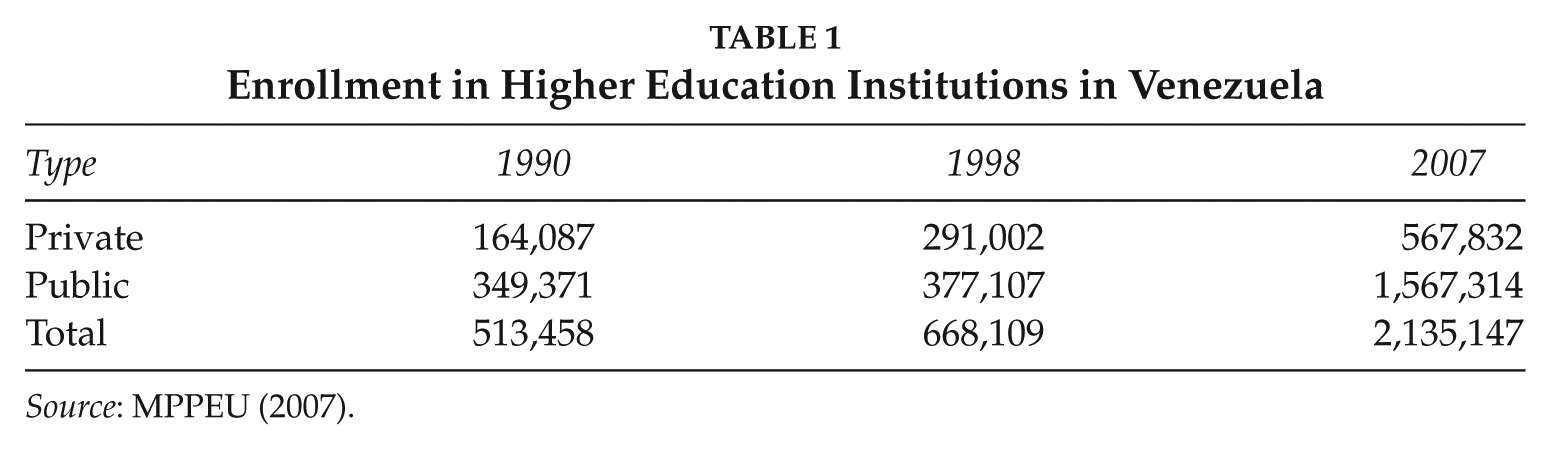
Source: MPPEU (2007).
Distribution of Students (%) Enrolled in Higher Education Institutions in Venezuela
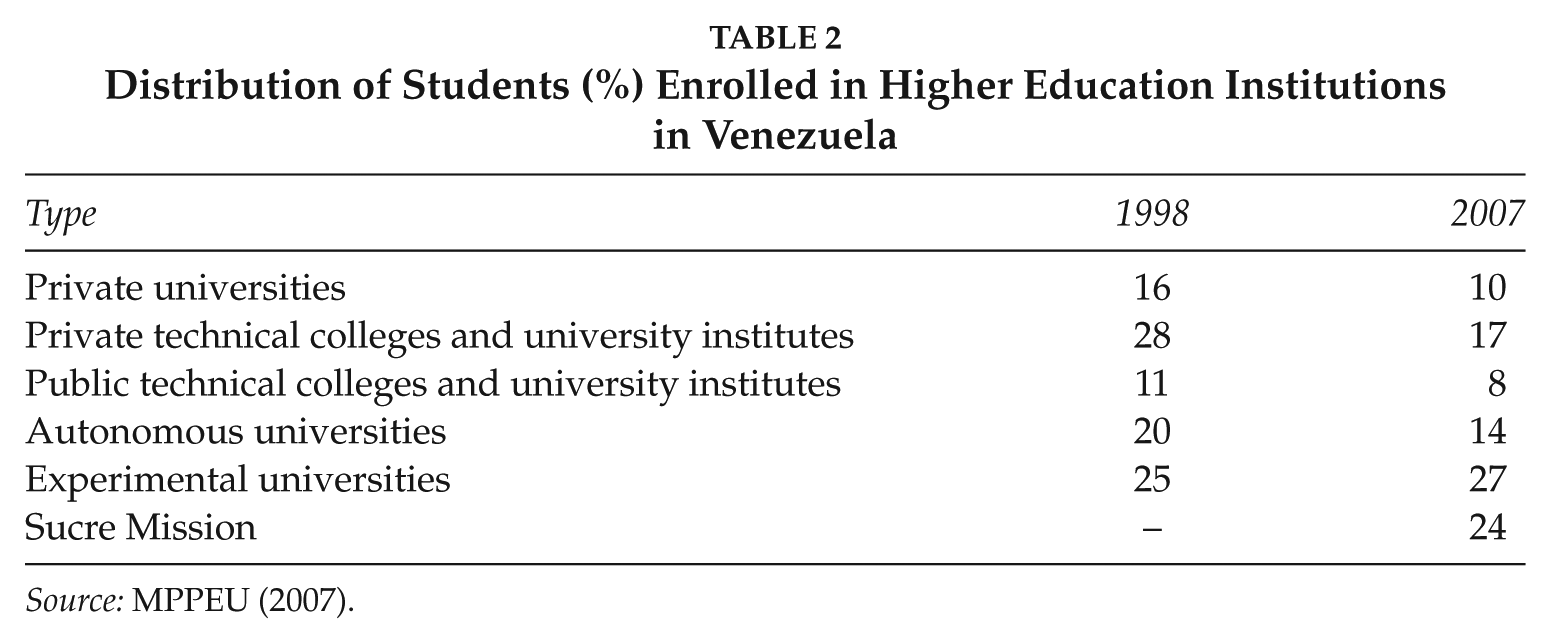
Source: MPPEU (2007).
Yet, while UBV’s establishment was celebrated as a victory, it also signaled a defeat. The hope that a parallel institution would both train cadres and incorporate the poor embodied the contradictions it aimed to address. Created in a country with few academics, many of them hostile to the government, the new university had to produce at once new teachers and new students, new state bureaucracy and radical antielitist education. The academic accreditation of UBV and the Sucre Mission depended on the approval of the Office for University Planning and the National University Council. The planning office was staffed mostly with opposition sympathizers, and the majority of the members of the council were rectors of Venezuelan public universities, also militantly opposed to the Bolivarian government. While the national system of accreditation was carried out according to the quality standards imposed by traditional academics on the council and followed by the planning office, by 2009 UBV and the Sucre Mission were failing to secure accreditation for the majority of their programs. Students from the university and the mission were required to redo their undergraduate work at traditional public universities in order to be accepted for postgraduate studies at those institutions, which retained the majority of the M.A. and Ph.D. programs.
Access for UBV students, many of them women and adult learners from poor communities, to the job market was also compromised. Already in 2004, national companies, national radio and television, and the Ministry of Agriculture and Lands were being asked to provide apprenticeships and jobs for the students (Laberinto, 2004: 53–54). In 2009 Castellano noted that the cooperation agreements were being neglected. Most large employers, such as PDVSA, turned their backs on UBV and Sucre Mission students and employed predominantly graduates from traditional universities. The state administration was the main employer of UBV students, who mostly got low-ranking positions with little chance of promotion. While thousands were graduating from UBV each term, only a handful of positions were listed in the jobs database of the Ministry.
Thus, by 2009, the new Bolivarian institutions of higher learning were part of a two-tiered system of public higher education. Their students could not secure postgraduate placements without going through accredited programs of higher education, and consequently their chances of securing a job and thus a stable income or recognition were limited. Increasing demands regarding accreditation, citation, and evaluation imposed by global ranking systems of academic prestige also started influencing the Bolivarian institutions. In order to accredit UBV’s programs, the government had to upgrade the academic profiles of its academics. Having just completed B.A. degrees at traditional universities and teaching full-time, most UBV faculty members had to complete postgraduate studies and accumulate fundraising, research, and publication portfolios (Ivancheva, 2013).
As long as elites remained in charge of institutions of knowledge production and certification, it was highly unlikely that parallel structures such as UBV and the Sucre Mission, still dependent on traditional forms of knowledge certification, could overcome their domination. Operating in a higher education sector dominated by traditional universities and the new standards of a global field of higher education (Marginson, 2008), UBV and the local classrooms of the Sucre Mission remained second-class. In an attempt to bridge this gap without directly addressing the structural constraints, the Bolivarian government accelerated the development of a two-tiered higher education system, a phenomenon typical of many capitalist countries in which the symbolic domination of certain institutions over others results in lower status for the latter and the increasing symbolic marginalization of their students.
The Bolivarian government did not use the tactic of permanent revolution in dealing with this new challenge. It neither dismantled the accreditation bodies nor created alternative systems of evaluation that would support the alternative model represented by UBV (Ivancheva, 2013). Instead, when an institution displayed deficiencies, it created parallel structures that inevitably reproduced some of those deficiencies.
Continuities and Departures in Higher Education Reform
Faced with the challenges posed by the accreditation of UBV and the Sucre Mission, which required the consolidation of their governance and their certification as academic institutions, the Bolivarian government shifted its focus to the Alma Mater program. Initially a teachers’ training program, by 2009 Alma Mater had become its new key policy (MPPEU, 2009). The program envisaged a rapid transformation of 29 accredited public technical colleges and university institutes into polytechnic universities and the establishment of 52 new institutions. A number of the new universities were to specialize in health, hydrocarbons, security, languages, telemetric science, agrarian science, economy, physical sciences, basic sciences, and tourism. The program also featured a university of the arts, a workers’ university, a university for the people of the Global South, and 17 territorial universities focusing on the industrial needs of poor regions.
According to Castellano, Alma Mater was to provide a “new framework for all Venezuelan universities.” Picking up where the Sucre Mission had left off, it followed the model of “municipalized higher education for all” and retained the local classrooms of the Sucre Mission as “part of endogenous nuclei.” The difference was that Alma Mater did not involve the municipalization of a big university such as UBV. Its main focus was creating new universities under the direct control of the central government. Castellano saw the Sucre Mission as a preparatory stage, “the first response to exclusion.” The two missions were very similar.
A closer look at the two programs, however, revealed rather the opposite. Alma Mater’s experimental universities contradicted the main principles of UBV as reflected in the guiding document, abandoning some of the most important features. While UBV aimed to follow the Cuban example in municipalizing medical education (see Campillo, 2008) and creating a small number of big universities centrally controlled by their administrations, with local classrooms around the country, Alma Mater created a large number of small universities with hierarchically structured administrations controlled directly by the Ministry. UBV’s emphasis on social sciences and community service was also compromised in Alma Mater’s short-term technical training programs, instrumental to a future planned economy. The ideal of local knowledge gave way to an emphasis on Venezuela’s participation in the global neoliberal competition for creating a “knowledge economy.”
With Alma Mater, the government seemed to have abandoned UBV and the Sucre Mission’s model of a decentralized network of loosely connected local classrooms that provided lifelong community-oriented learning. Encroaching on the UBV model, Alma Mater could hardly be seen as challenge to the traditional autonomous public universities. By producing a further split within the Bolivarian subsystem of public higher education, it failed to become a hallmark of deep structural change. It upset the fragile equilibrium of Bolivarian higher education, reinforcing the feeling that the underfunded and understaffed facilities were pitted against the hegemonic global academic order.
In the middle of my interview with Castellano, there was suddenly loud music playing in the foyer where we sat. Her colleagues appeared in a visibly elevated mood. A young woman exclaimed, “He’s staying, he’s staying!” Castellano got up and jumped into her extended embrace. The two women were soon being hugged by a man in a suit, all three bouncing about happily. Bedazzled, I sat there watching the three professionals doing their little victory dance in the middle of their workday at the office, celebrating what appeared to be the victory of a sports team or of a candidate in an electoral campaign. Castellano turned to me, her face radiant: “Chávez had to take austerity measures against the crisis. Today he decided which ministers to fire. We were afraid our minister would go, but he stayed–—we go on!” Higher education governance had undergone numerous metamorphoses since Chávez came to power. In 1999–2001 it was the Ministry of Education, in 2002 it became the Ministry of Higher Education, in 2007 it was renamed the Ministry of Popular Power for Higher Education, and in 2011 “University Education” replaced “Higher Education.” By 2010 a host of ministers had occupied the seat—Héctor Navarro, Samuel Moncada, Luis Acuña, Edgardo Ramirez, and Yadira Córdoba—many of them for less than a year. The fourth rector of UBV in less than five years, Córdoba was subsequently replaced by Luis Damiani and then Prudencio Chacón. All the high-ranking officials whom I interviewed in the period 2008–2011 had been assigned different positions at least once.
Against this background, María Egilda Castellano’s resignation to her career shifts within the Bolivarian government under the leadership of President Chávez seems in line with the strategy of cadre rotation. It shows the contingency of agency within the Bolivarian institutions, where responsibility is diffused and institutional sustainability is reduced to the proliferation of parallel structures. Given the need to incorporate poor Venezuelans and to create new kinds of knowledge, research, and teaching, the constant change of direction and focus of the reforms jeopardizes not only radical social change but even milder forms of redistribution. Time will tell if these challenges presented on the administrative level will prove decisive for the reform.
For the time being, however, they might have a rather negative impact on the outcomes of the reform. Instead of becoming instances of dual power subverting traditional institutions, the Bolivarian institutions have retained second-class status within a two-tiered system subjected to local and global hierarchies of prestige and accreditation. It is not inevitable that they will retain low status; they could be supported in their research and teaching sufficiently to enable them to outcompete the older universities. Operating as parallel institutions dependent on the recognition of traditional universities, however, they will have to beat the latter at their own game, performing up to global capitalist standards rather than according to alternative pedagogic and public service ones.
Conclusion
The stories of María Egilda Castellano and of her most cherished project, UBV, reveal a number of advances and challenges in Bolivarian higher education reform. The rapid political rotation of experts in the government and the constant shifts of decision-making power are telling of the precariousness of the Bolivarian structures. The decision to start from scratch every time resistance appears and to dismiss people in power positions is not confined to intellectuals or to higher education but speaks of an approach to both individual and collective agency and knowledge as contingent and replaceable. Castellano’s trajectory is that of an individual trying to reconcile these contradictions in her own biography. Despite the constant change of institutional framework, she has consistently fought for an integrated, decentralized mass higher education and science, accessible to all, that will benefit not only individual students but also society as a whole. She has tried to implement these principles working in different if not incompatible frameworks—the reform of traditional universities, the creation of a parallel decentralized system of higher education, and the opening of new, centrally controlled specialized institutions for the training of technical cadres. Yet her constant relocation has prevented her from taking her reforms farther and required adaptation to new state projects.
On the structural level, the Bolivarian higher education reform presents a challenge to the claim that a strategy of permanent revolution is operating in Venezuela. Traditional institutions are not challenged from below to the point of their dismantlement or transformation into qualitatively new, progressive institutional forms. Instead, parallel second-class institutions are constantly being produced and reproduced as soft forms of welfare redistribution. This conjuncture shows the powerlessness of the government and of the movement against external and internal enemies. Of course, the decision not to initiate a confrontation in the key arenas of struggle and instead to create parallel structures can be explained within the broader political context of the Venezuelan and Latin American recent past. It was conditioned by the history of political violence and brutal military intervention backed by foreign powers against left-wing regimes in the Global South. In the case of twenty-first-century Venezuelan democratic socialism, speaking of the dictatorship of the proletariat as Trotsky did has been made historically impossible in the aftermath of twentieth-century state socialism, which turned forceful intervention into waves of arbitrary violence.
At the same time, the failure to use the resistance of academics from traditional universities to confront the opposition and the violent 2002 coup has made the new parallel institutions transient and liminal. Victor Turner (1995: 94–95, 177) spoke of three distinct stages of ritual creating a new structure. The first period is marked by the creation of antistructure built in opposition to the dominant structure in society. In the second, “liminal” stage, structural norms are relaxed and new forms of solidarity and spontaneous community are created among the participants. In the final stage, “reincorporation,” the social system is reestablished and previously dominant figures and norms take up their central position again. Bolivarian higher education reform started as a contestation of traditional universities. As do all forms of access to education, it created dignity, solidarity, and possibilities for economic and social participation for the poor, the importance of which is enormous (Lynch, 2014). Yet the major challenge is not confusing this liminal moment of empowerment with an ultimate victory—recognizing that the global field of higher education has incorporated the new institutions into its hierarchy.
The reform’s retreat from the central arenas of political confrontation and the gradual subjection to traditional measures of success and failure have challenged Venezuela’s ability to create a replicable alternative university model. UBV, the Sucre Mission, and Alma Mater are constrained by the structural conditions they were designed to address. The government’s readily changing its priorities and canceling projects on which enormous resources were spent speak of a lack of a sustainable model capable of ensuring a real redistribution of economic and political power. The decision to leave the autonomous universities unobstructed has compromised the government’s and popular movements’ war against reaction from without. The swift cadre rotation and the tendency of the government to start reform anew has arguably challenged only the equilibrium of the Bolivarian higher education subsystem while allowing the broader system of public higher education to go back to its old equilibrium and reproduce the inequalities that the Bolivarian institutions were created to challenge. Thus, since they do not provide a sustainable model on a national level, the new experimental institutions are not resilient enough to provide an alternative to a homogenizing global field of higher education. Those coming to power after the death of President Hugo Chávez should not resign themselves to the second-class status of the Bolivarian institutions. Chávez’s colossal effort at social integration through higher education is not easy to inherit. It has revealed new contradictions that socialist governments in Venezuela and elsewhere need to address.
Footnotes
Mariya P. Ivancheva is a postdoctoral fellow at University College Dublin. Her PhD (from Central European University, 2013) was sponsored by the Marie Curie and Wenner-Gren Foundations, and the Center For Advanced Studies IVIC, Caracas. She thanks María Egilda Castellano, the main protagonist of this paper and the mastermind of the Bolivarian University, for the inspiration she has given to many scholars and policy makers in the field of higher education who now dare to envisage alternatives to academic capitalism.