




Abstract
In Latin America, cities with security challenges are increasingly invoking urban planning policy to rebuild governance in neighborhoods perceived as unruly. While the state’s “arrival” in marginalized areas is long overdue, it is also embedded in complex histories of violence and socio-spatial marginalization. Medellín’s Comuna 13 has historically been materially and discursively constructed as a space of relegation. Interview and focus group data show how policy cycles for Comuna 13 evolved from discretionary programs (1978–2002) to securitization and (para)militarization (2000–2003) and then social urbanism, a program of participatory urban upgrading (2004–2011). The latter, a reformist approach, aims to provide better services, foster participation, and reduce socio-spatial segregation. Underlying these positive aims, however, two contradictions remain concealed: deep-seated inequality resulting from decades of normalized exclusion and the perpetuation of a regime of hypersecuritization and (para)policing that recreates itself under new governance and spatial arrangements.
Cada vez más, las ciudades con problemas de seguridad en América Latina están apelando a las políticas de planificación urbana para restablecer la gobernanza en aquellos vecindarios considerados como ingobernables y revoltosos. Aunque ya era hora de que se sintiera la presencia del estado en las áreas marginadas, esta presencia está también insertada en unas historias complejas de violencia y marginación socio-espacial. Históricamente, la Comuna 13 de Medellín ha sido construida material y discursivamente como un espacio de relegación. Los datos obtenidos por medio de entrevistas y grupos de discusión demuestran cómo los ciclos en la Comuna 13 han evolucionado desde los programas discrecionales (1978–2002) a la seguridización y (para)militarización (2000–2003) y luego hasta el urbanismo social, un programa participativo de mejora urbana (2004–2011). Este último es un programa con un enfoque reformista que aspira a proveer mejores servicios, fomentar la participación y reducir la segregación socio-espacial. Pero en la base de estos objetivos, sin embargo, hay dos contradicciones que permanecen ocultas: una desigualdad profundamente arraigada que es el resultado de décadas de una exclusión normalizada y la perpetuación de un régimen de hiperseguridización y vigilancia que se recrea bajo la nueva gobernanza y los arreglos espaciales.
In the past two decades there has been a growing interest in examining the fractured character of Latin American cities. Experts have noted that, despite advances in the provision of services and the democratization of state institutions, cities continue to be profoundly unequal (Rodgers, 2012). The proliferation of violence in the region aggravates the urban divide. In the absence of the state, vigilante bands, urban militias, and/or youth gangs have emerged in marginalized neighborhoods to exert territorial control (Koonings and Kruijt, 2007). In many instances, these violent groups have imposed a social order, acting as substitutes for the state’s judiciary and performing police functions (Denyer-Willis, 2009). In turn, violent policing practices have historically forged tense relationships between ordinary people and the authorities, undermining the state’s legitimacy (Costa, 2011; Tierney, 2012). Conventional “firm hand” policy responses contribute to the escalation of violence (Davis, 2010) and deepen stigmatization based on place of residence, class, race, and age-group. Overall, the “ideal” of citizens acting within the rule of law with substantive rights, responsibilities, and political voice is negligible in these precarious urban enclaves (Davis, 2010).
In the context of consolidated decentralized governments, however, municipal authorities are increasingly invoking urban policies and planning tactics in their attempts to rebuild governance and state legitimacy in the contested neighborhoods. Central to the new generation of Latin America’s urban policy is the use of a place-based repertoire of policy tools, particularly geographic targeting and urban planning technologies to delimit micro-territories of state action. Thus, cities with serious security challenges, such as Medellín, Caracas, Mexico City, and Rio de Janeiro, have become sites of policy experimentation in which pacification, downtown renewal, slum upgrading, and participatory programs are currently deployed with the hope of transforming neighborhoods perceived as unruly (Valenzuela, 2013). Although the political orientations, scope, and intensity of these urban policies may differ widely, what they have in common is an urge to exert institutional control over derelict spaces and their disenfranchised users.
While the arrival of the state in marginalized areas may mean better service provision, the actual practices of “making spaces governable” (Ballvé, 2012) are inscribed with complex histories of violence, exclusion, and criminalization that tend to recreate themselves under new governance and spatial arrangements. This paper examines these tensions in Medellín’s Comuna 13. In the recent history of the city, Comuna 13 has been materially and discursively constructed as a “space of relegation,” a concept that refers to “stigmatized neighborhoods situated at the very bottom of the hierarchical system of places that compose a metropolis” (Wacquant, 2008: 1). After mounting violence and state neglect, urban security and spatial transformation strategies were invoked there in the 2000s to transform a space of institutional abandonment into a domain of urgent state action. Policy cycles for Comuna 13 evolved from a thin state presence and discretionary interventions (1978–2002) through securitization and (para)militarization (2000–2003) to social urbanism, a program of participatory urban upgrading (2004–2011). Although this periodization suggests distinctive policy temporalities, it is not clear-cut but built on continuities. Each moment carries the legacies of structural forces and earlier political choices while imbricating successive policy rounds.
The most recent approach, social urbanism, embodies urban reform efforts aimed at delivering better services, fostering participation, and connecting marginalized communities to the urban fabric. In this framing of the positive role of the local state, however, two salient contradictions remain concealed: deep-seated inequality and stigmatization resulting from decades of normalized socioeconomic exclusion and a regime of securitization and (para)militarization. Although such urban reform was grounded in claims to social justice, democracy, and human security, the dynamics of securitization have prevailed at the expense of its alleged goals. Against Medellín’s recent international praise for “innovative” and “successful” urban policy making, I question why seemingly “progressive” governance and spatial reconfigurations are reinforced through policing and intimidation in Comuna 13 and why, despite intense militarization, screening, and patrolling, criminal actors with paramilitary backgrounds continue to exert their influence.
I draw from qualitative data collected during fieldwork in Medellín between November 2010 and September 2012, including semistructured interviews (131 in total, including policy makers, community leaders, nongovernmental organization [NGO] actors, and other experts) and focus groups with residents (22 sessions for a total of 124 participants). The paper is organized as follows: first, I examine the structural dynamics that shaped Medellín’s urbanization and its planning institutions; second, I describe the formation of Comuna 13 and the parallel emergence of violence in the city; next, I frame the contours of the three policy cycles proposed, addressing how each of these stages has added layers of complexity to local governance.
Urbanization and Peripheralization
Discussing regional integration in Europe, Smith (2003: 235–236) revisits Marx’s observation that “the social relations of capitalism are more clearly and sharply observable at the periphery of the system than at the centre.” This remark can be equally applied to an analyisis of the Latin American metropolis, where peripheral spaces may reveal the inner workings of the social system that produces them. A similar analytical framework can be found in the work of Lefebvre (2003 [1970]). For Lefebvre, the process of urbanization is underpinned by the separation of central from peripheral spaces, a process that reflects—but also reproduces—the prevailing socioeconomic order. The state mediates this process through the use of force, the creation and maintenance of governance dispositions, and urban planning technologies: “In all cases, the formation of centralities is predicated on processes of peripheralization—displacement, enclosure, segregation, exclusion. This takes place through both ‘coercion’ and ‘persuasion,’ incorporation and domination” (Kipfer et al., 2008: 292).
In Colombia as in other Latin American countries, urban growth has been driven by two intertwined logics: violent processes of dispossession beginning in colonial times and endless struggles for rural and urban land pursued by heterogeneous segments of the population (Angotti, 2013). These processes have been mediated by the Colombian state and its institutions. Until the 1990s, Colombia followed the legal prescriptions of the 1886 Constitution, which is described as “oriented toward small, non-interventionist government, individual rights, and an overarching commitment to property rights” (Angel-Cabo and Lovera, 2014: 1). Under a liberal legal tradition, the 1886 Constitution and the Civil Code—which deals with private matters—have historically interpreted individual autonomy as superior to equality and solidarity. In this realm, private property was understood as an acquired right—almost an absolute right—not to be infringed upon by the state (Bonilla, 2011). 1
In Medellín, Colombia’s second-largest (approximately 2.5 million inhabi-tants) and wealthiest city, the development model adopted in the process of modernization—from small town to flourishing industrial city—was characterized by the dominance of private over public interests. The history of urban planning helps elucidate this phenomenon. Since the early twentieth century, business lobbyists have gained great influence over planning decision making and public works initiatives, including the development of landmark projects, the conversion of rural to urban lands, the razing of downtown slums in order to make space for office buildings, and even the regulation of conduct in public space (Botero-Herrera, 1996; Hylton, 2007). Less attention has been paid to the growing need for affordable housing.
As Lefebvre (2003 [1970]) notes, socio-spatial inequalities expose and reproduce structural exclusions by which dominant regimes seek to perpetuate themselves; in the city, these exclusions are often mediated by urban planning tactics. Indeed, urban planning in Medellín acted as a “centrifugal force” that displaced poor dwellers from central areas to the peripheral hills of the valley and disconnected the poor from the developments, public spaces, and routes frequented by those living in the “city of asphalt” (García, 1990). The shortage of affordable housing and constant evictions from downtown slums led newcomers to adopt squatting, pirate developments, and land invasions on slopes and in ravines and on geologically unstable lands. Conversely, middle- and upper-class neighborhoods grew in the central-western and southern areas of the city with full access to the benefits of a modern, functional city.
The Construction of Comuna 13 as a Space of Socio-Spatial Relegation
Comuna 13, also known as San Javier, is located in the Center-Western Zone of Medellín along with two other districts, Comuna 11 (Laureles Estadio) and Comuna 12 (La América). Within the zone, these districts developed under different legal statuses and planning prescriptions. Comuna 11, for instance, is representative of Medellín’s early planning efforts (dating to the 1930s) and the mid-century spirit of the city’s 1951 master plan. The renowned modernist architects Paul Wiener and Josep Lluís Sert designed Comuna 11 in a “garden city” style—a low-rise residential area with a circular layout, segregated zoning, linear parks, ample avenues, and quick access to the city’s downtown core (Schnitter, 2007). Comuna 12 was, in turn, devised as a working-class community equipped with infrastructure, including a streetcar route, by 1930. With time, both comunas retained a middle-class residential character.
In contrast, urban development in Comuna 13 started in the late 1970s as Latin America’s largest land invasion, with 5,000 households built within a five-year period (Aricapa, 2005). Currently, Comuna 13 has an area of 7 square kilometers and an estimated population of 139,000 (Alcaldía de Medellín, 2011a). The topographic characteristics of Comuna 13 are distinct from those of the rest of the Center-Western Zone. Both Comuna 11 and Comuna 12 are located on a plain in the more central area of the city’s narrow valley. Comuna 13, in contrast, is built into a more rugged topography. Some of its uneven hills reach 1,650 meters above sea level, with slope inclinations of over 50 percent (Alcaldía de Medellín, 2011a). Unstable soils make vast areas prone to landslides and generally unsuitable for human settlement. Given these features, neighborhoods such as Juan XXIII, La Quiebra, Las Independencias (Figure 1), El Salado, Antonio Nariño, Nuevos Conquistadores, Corazón, and Blanquizal cover large extensions declared as “non-recoverable high-risk zones” (Alcaldía de Medellín, 2011a). According to the city’s master plan, these areas prohibit “the provision of roads, infrastructure, and public services that promote the consolidation of new housing settlements or facilitate the opening of new areas for this purpose” (Concejo de Medellín, 2006).
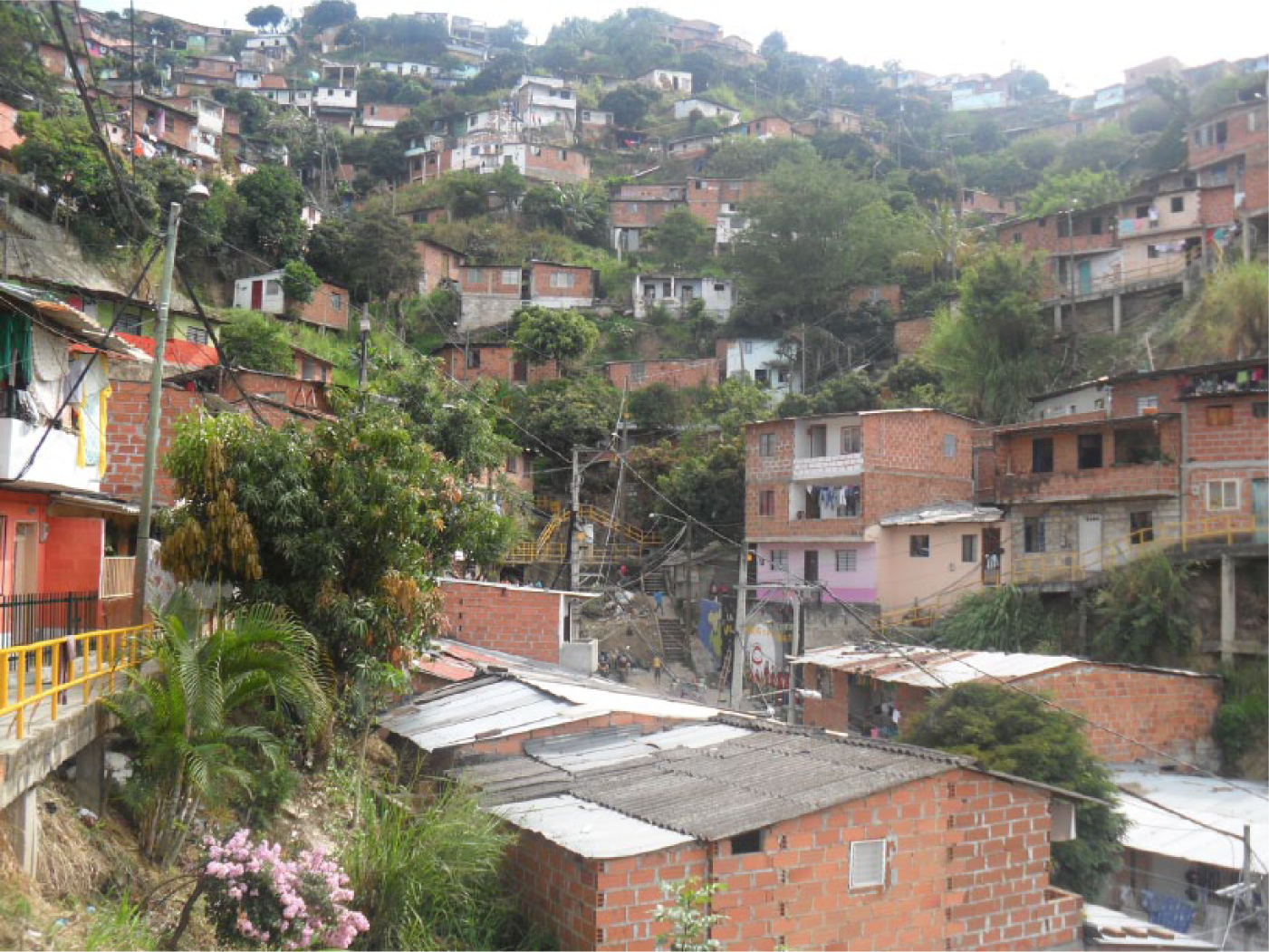
Las Independencias, Comuna 13. (Photo by author)
A striking paradox is that, though planning ordinances historically forbade the urbanization of Comuna 13’s at-risk terrains, local politicians have since 1978 directly intervened as brokers in the mushrooming invasions of the upper hillsides. Not surprisingly, once these politicians are elected they abandon their promises, and residents with illegal tenure are unable to reclaim the provision of municipal services through the political process or via administrative procedures (Aricapa, 2005). As a result, extensive territories in Comuna 13 have grown outside of the legal codes, administrative powers, and aspirational formalities of the master plan and the city’s planning regulations. In sum, the urbanization of the Center-Western Zone is predicated on a process of peripheralization. While locational advantages are concentrated in Comunas 11 and 12, in Comuna 13 heightened exposure to environmental risk and a lack of access to services and opportunities create deep socio-spatial injustices.
The construction of Comuna 13 as a space of socio-spatial relegation was not, however, only the result of uneven and exclusionary growth. As mentioned earlier, the process of peripheralization in Medellín is not unique to Comuna 13. Roughly half the city’s population lives in self-help neighborhoods with different degrees of consolidation (Echeverri and Orsini, 2010). In contrast to Bogotá, where socio-spatial fragmentation followed a strict north/south pattern, and Rio de Janeiro and Caracas, where pockets of poverty can be found adjacent to luxury zones, in Medellín a thick ring of poverty wraps around the hills of the Aburrá Valley, where the city sits. Barrios populares (lower-class neighborhoods) are ubiquitous in the mountains, except for the southern hills of El Poblado, the high-rise upper-middle-class ward that also serves as a corridor to the elite suburbs. Among the low-income wards, Comuna 13 is not the poorest. Comunas 1 and 2, in the Northeastern Zone, in fact, are poorer, ranking lowest on the city’s Human Development Index (Alcaldía de Medellín, 2007). Still, Comuna 13 carries the deepest territorial stigma, occupying a notorious space in Colombians’ mental cartographies of violence. Why was Comuna 13 stigmatized and relegated to the bottom of the socio-spatial hierarchies of the city, given that it was not the worst-off and shared many troubling circumstances with other comunas? How did it gain a local and national stigma as a homeland of violence? Among the structural and contextual determinants of urban violence and inequality, it is crucial to examine the role of urban policy and the language of the state with reference to designated problem areas (Dikeç, 2007). Through official accounts or portrayals of problems and individuals in relation to a territory, a “state’s statements define the ‘proper place’ of things and people” (Dikeç, 2007: 16). In doing so, urban policy attaches particular meanings to the social groupings inhabiting territories of policy intervention (Wacquant, 2008). This is the case of urban interventions in Medellín, which have contributed, sometimes inadvertently, to the symbolic and material construction of Comuna 13 as a dangerous place.
The history of Comuna 13, as told by old-timers and newcomers, is a history of adversity. One community leader told us her story as follows (interview, September 21, 2011):
I am from Independencias III. I arrived in Comuna 13 34 years ago; my family was one of the first to invade here. We came from Castilla, but the upper areas of the hillside here in Independencias were occupied by people coming from many places, some displaced by violence in the countryside, some evicted from downtown Medellín . . . people of all colors and sorts. It was quite a mix. It was very difficult at first because there was nothing but dirt, and the police would come every now and then to beat us up, destroy our shacks, try to kick us out. But as I was saying, the population was very diverse, and there were bad people who came to impose their rule, and one had to adapt to that system. It was very hard at first, robberies, rapes, murders.
In the early days of Comuna 13, inhabitants learned to cope with at least five types of risks: failure to meet the basic conditions of daily subsistence, aggravated by the city’s deindustrialization and related unemployment; landslides and flooding in the rainy season; threats of eviction, imprisonment, or police brutality; potentially escalating conflicts with neighbors; and lurking criminality (focus group, March 4, 2012). Relations between squatters and the public authorities were uneasy, often involving bullying and violent attempts at eviction. The failures of the state to guarantee basic rights and security in Comuna 13 are explained partly by the state’s intrinsically limited capacity but also by its differential treatment of Comuna 13’s residents. This differentiated citizenship (Holston, 2007) is supported by legal arguments. In the eyes of governments and local elites, squatters are infringing on planning regulations and property rights. Thus spatial practices and ways of inhabiting define, to a great extent, the precarious citizenship status of and the factual reclamation of rights by Comuna 13’s residents. For instance, many of the new settlements are not even recognized as falling within the city’s administrative jurisdiction, and because large extensions are labeled “at-risk” governments are forbidden to provide residents with basic services.
Given their standing as “invaders,” the new settlers are also rejected by inhabitants of adjacent neighborhoods. In turn, newcomers are also apprehensive. Machete fights among neighbors are frequent (resident, interview, September 17, 2011). Many migrants to the city have witnessed violence in one of the many episodes stemming from the Colombian political conflict (Tovar-Restrepo and Irazábal, 2014), but violence in the city acquires new logics. The growing needs of the community remain under the state’s radar, but the comuna is subjected to the increasing stigma of criminality. As nonstate violent actors compete to occupy the institutional void left by the state and acquire territorial control, violence escalates with unprecedented intensity (Riaño-Alcalá, 2006).
Violent Actors in Comuna 13
In the early 1980s, youth gangs arose in various peripheral neighborhoods. In turn, vigilante fronts appeared to counter banditry and petty crime, carrying out “social cleansing” in day shifts. Between 1986 and 1998, local leftist urban militias under the name of Comandos Armados del Pueblo (United Commandos of the People—CAP) claimed territorial control over the upper neighborhoods of Comuna 13. These militias were fundamentally antigang organizations and gained local recognition as legitimate authorities, performing judicial, policing, and development functions (Ceballos and Cronshaw, 2001).
Drug dealing proliferated alongside the formation of gangs and militias. Diverse forms of criminality, initially unrelated, quickly intertwined. In 1991, with a daily average of 19 violent homicides and a murder rate of 433 per 100,000 inhabitants, Medellín notoriously became the most violent city in the world. As violence rose, the Medellín cartel centralized several criminal organizations in a single network. This network, dubbed the Envigado Office, recruited its cadres of young hit men in low-income neighborhoods such as those of Comuna 13.
Between 1998 and 2002, left- and right-wing insurgent organizations, historically rooted in rural areas, coincided in their interest in conquering Comuna 13. The Fuerzas Armadas Revolucionarias de Colombia (Revolutionary Armed Forces of Colombia—FARC) and the Ejército Nacional de Liberación (National Liberation Army— ELN) were the first of these groups to arrive. Their rightist adversary, a paramilitary umbrella organization with a drug-related background, the Autodefensas Unidas de Colombia (United Self-Defenders of Colombia—AUC), arrived in 1998. Leftist and rightist rivals battled for territorial control (IPC, 2005).
Urban Policy Responses
Selective State Presence and Discretionary Interventions (1978–2000)
Between 1978 and 1992, state institutions were extremely weak in Comuna 13. Conflicts were self-regulated, and the upper hillsides were, mostly, off-limits to police. In the early 1990s there were two types of state responses to rising violence in the city. First, peace pacts with the Milicias del Pueblo (Militias of the People—MP) were promoted in Comunas 1 and 2. Militias operating in Comuna 13, however, were not included in the demobilization process, even where a conflict management approach had the same level of urgency as in Comunas 1 and 2. Only a few small-scale peace pacts were promoted to support temporary truces. These truces de-escalated difficult situations but left underlying issues of power and state illegitimacy unresolved (Gutiérrez and Jaramillo, 2004).
Second, in response to increasing violence, the national presidency appointed the Consejería Presidencial para Medellín y el Area Metropolitana (Presidential Council for Medellín and the Metropolitan Area—CPMAM) to build partnerships with NGOs and international assistance agencies and implement social and participatory programs. This council proposed and coordinated a slum-upgrading initiative, the Programa Integral de Mejoramiento de Barrios Subnormales (Integrated Neighborhood Upgrading Program—PRIMED) (Betancur, 2007). PRIMED operated in various peripheral neighborhoods in the city, three of them in Comuna 13 (Conquistadores, El Salado, and Independencias). Despite some success, it lost political support and was discontinued in 2000, one of many examples of “discontinuous public policy” in this context (Echeverri and Orsini, 2010: 137).
The urban policies implemented between 1978 and 2000 in response to the urban crisis in Comuna 13 reveal a mosaic of discontinuous approaches. Governmental agencies acted selectively across the city during this period with intermittent programs. In the case of PRIMED, state intervention was positive for local communities but not sufficient either to address inequities or legitimize state action. The peace pacts between the authorities and Medellín’s militias were political decisions that reaffirmed the diluted power of the state. As the state was unable to control the outcomes of these agreements, many ex-combatants were killed or lived under constant threat and others joined new violent ventures, leaving stigmas over criminality and the underlying drivers of violence unchanged (Gutiérrez and Jaramillo, 2004).
Securitization and (Para)militarization (2000–2003)
In the early 2000s, Medellín adopted a competitive city agenda based on a campaign to transform Medellín into “Latin America’s best corner” for foreign investment and trade. The presence of armed insurgencies in the city became incompatible with this project; specifically, Comuna 13’s recurrent disturbances had become a nuisance to the new international image that the city sought to project. There was no political patience for bringing back peace talks or other soft conflict management approaches. Mayor Luis Pérez (2001–2003) wanted the army involved.
Pérez argued that the political conflict of the countryside had been transposed to Comuna 13 and therefore the army rather than the police should be in charge of repelling insurgency. Pérez told a journalist, “My position is radical. There cannot be forces here other than the police and the army, and they have to sweep” (El Tiempo, October 20, 2002). Several attempts at “sweeping” took place in the final months of Andrés Pastrana’s presidency (1998–2002) but were unsuccessful in securing territorial control. Military operations involved Operación Otoño (February 2002), Operación Contrafuego (February 2002), Operación Mariscal (May 2002), Operación Potestad (June 2002), and Operación Antorcha (August 2002) (Angarita, Gallo, and Jiménez, 2008; IPC, 2005). Finally, Pérez asked for 2,000 troops and permanent militarization. Pastrana ruled this idea out but was in the last days of his presidency and was unable to support this decision (Aricapa, 2005).
In contrast to the “left turn” that characterized national politics in Latin America in the late 1990s, in Colombia a right-wing securitization ideology was on the rise (Avilés, 2012). Some of the precedents of this ideological radicalization were rooted in the failures of the Pastrana-FARC peace talks. Between 1998 and 2002, FARC intensified kidnappings, massacres, and other expressions of violence to level the playing field for negotiations with the government. Mainstream media demanded a firm approach in dealing with the FARC (Rochlin, 2012). In addition, the resources injected by the U.S. War on Drugs and Plan Colombia revived previously unviable forceful response options in policy circles. In 2002 Colombians elected Alvaro Uribe Velez with the slogan “firm hand, big heart.” Uribe’s ideology was aligned with the rhetoric of the U.S. War on Terror.
Less than a month into Uribe’s presidency, a decree adopted on September 11, 2002, created “zones of rehabilitation and consolidation.” Under this exceptional statute, the national government sought to expel insurgent groups. The implementation of the zones came with civil rights restrictions and increased powers for the public armed forces. For instance, foreigners were prohibited from living or circulating in the zones, the public authorities could use private property without a warrant, and citizens were required to attend to any demands around the provision of professional or technical services as required by the public armed forces. Although Comuna 13 was not officially declared a rehabilitation and consolidation zone, the measures implemented would follow those prescriptions (IPC, 2005).
With Uribe as president, Pérez had free rein. October 16, 2002, marked a watershed moment for Comuna 13: over four days, 1,500 troopers from combined state forces entered it on foot, in tanks, and from helicopters. This spectacular display of power was dubbed Operación Orión—Pérez’s longed-for forceful takeover of Comuna 13. In Colombia’s long history of war, Orión is unique not only in the level of violence deployed but also because it affected a dense population of 139,000. According to official numbers, there were 11 civilians killed, 200 wounded, and 243 arrested in the first four days of military engagement. Residents and human rights organizations assert, however, that 50 people were killed and, aside from the detainees, over 150 disappeared (Bedoya, 2012).
Orión was followed by an intense surveillance and militarization that lasted several months. Selective killings and daily curfews were imposed, regulating residents’ routines. Public armed forces occupied abandoned dwellings in the area, some dressed as civilians in order to conduct intelligence assignments (community leader, interview, September 17, 2011). Residents, including children, were treated as suspected criminals (Sánchez, Villa, and Riaño-Alcalá, 2011), which deepened the stigmatization attached to the community and to young men in particular (Angarita, Gallo, and Jiménez, 2008).
Celebrated by many as a military success, Orión was revealed soon thereafter to have involved as alleged informants many members of the Cacique Nutibara, an armed bloc of the AUC. Many innocent people faced unjust detention stemming from false confessions. Research findings by the Comisión Nacional de Memoria Histórica (National Commission for Historic Memory—CMH) suggest that, in the shadow of Orión, a deal was crafted to impose a new social order under paramilitary rule. 2 What followed was the reconfiguration of social order and territorial control in Comuna 13.
In the Colombian conjuncture of overlapping violence and expanding neoliberalism, the case of Orión shows that rhetorics of security and democracy are portrayed as an exclusionary duality in which the promise of security gains, even via the paramilitary war machine, outweighs the value of preserving democratic rights (Ramírez, 2010; Rojas, 2009). To be sure, the case that Uribe built for his securitization policies was also based on an economic development argument—that enhancing security in the territory would lead to an improved business climate (Presidencia, 2003). Similarly, under a competitive city agenda and the external pressures of globalization, Medellín has tried to reinsert itself into the regional and global circuits of intercity competition. But in order to attract foreign investment, strong messages of urban renaissance must be conveyed internationally to dissipate investor fears. Therefore, the arrival of the state in the “slum” requires highly visible pacification rituals; derelict, dangerous, and chaotic spaces such as Comuna 13 are to be controlled and normalized. Permanent securitization measures fulfill the need to protect urban capitalism against potential disturbances (O’Neill and Kedron, 2011).
While the Uribe-Pérez nexus’s political efforts to retake Comuna 13 were driven by a neoliberal securitization ideology, Orión also pointed to the notorious absence there of the state, which until 2003 had failed to deliver even basic services to the population. Local actors advocated for intensified social development programs, but, as a former director of an NGO noted, “the call for state action was one built on human rights, bottom-up planning, . . . meaningful participation” (interview, December 15, 2011). Such activism contributed to mobilizing a new era of urban policy—comprehensive urban upgrading.
Social Urbanism as Comprehensive Urban Upgrading (2004–2011)
The subsequent urban policy round is grounded in a civic network turned political movement: the Movimiento Compromiso Ciudadano (Citizen Commitment Movement—MCC). Against the city’s traditional bipartisan politics, the MCC elected two mayors: Sergio Fajardo (2004–2007), an academic, and Alonso Salazar (2008–2011), a journalist and social researcher. During Fajardo’s and Salazar’s administrations, the local state experienced a “NGOization” of government as progressive NGO actors and community organizers and academics who had previously advocated for urban reform came to occupy key government posts. This mix added a new “political rationality” and new “technologies of government” (Rose and Miller, 2010) to the local administration. The new logics and capacities acquired by the local state are best exemplified by social urbanism.
Social urbanism was conceived as an urban development policy that sought to reduce locational disadvantages through comprehensive neighborhood upgrading. In the words of one of the key actors, “Although all urbanisms are intrinsically social, social urbanism is the idea that these [urban development] projects should convey new opportunities for social transformation, should be socially meaningful” (Alejandro Echeverri, former director of the Urban Development Corporation, interview, December 3, 2010). Alongside these initiatives, two citywide initiatives were meant to expand local participation: a bottom-up participatory planning program with a long-term approach and a municipal program of participatory budgeting. Modeled after Porto Alegre’s experience, Medellín’s program allows local communities to preside over the allocation of 5 percent of the municipal budget.
Moreover, Fajardo justified targeted investments in the form of social urbanism as a form of “payback” of the “historical social debt” owed to those living on the city’s margins (interview, June 6, 2012). Under this new political rationality, planners employed an urban planning tool dubbed the “integrated urban project.” According to the municipal government, “integrated urban projects concentrate all the development tools available to the state in a planned and simultaneous manner to enhance progress in terms of equity and quality of life in a given territory” (Alcaldía de Medellín, 2011b: 125). In other words, policy makers see these projects as an equalizing and redistributive instrument (Alejandro Echeverri, interview, March 12, 2010). Nevertheless, it is important to emphasize that the politics of making spaces governable in contemporary Latin America, particularly through spatial reconfigurations, are also inevitably embedded in the aspirations of local elites to unlock stagnant land markets, attract foreign investment, and improve local competitiveness in the global arena.
Integrated urban projects included mobility infrastructure such as the Metrocable (Figure 2), the first application of aerial cable-car technology to provide mobility to low-income areas with difficult topographic access (Brand and Dávila, 2011: 648). Other initiatives included new schools (Figure 3), library parks, daycare centers, risk-mitigation public works, public space generation, urban security strategies, and local economic development initiatives (Alcaldía de Medellín, 2007). Between 2004 and 2007, just in Comuna 13, the municipality invested an unprecedented US$158.5 million in services and programs, a sum that increased to US$217.5 million for the 2008–2011 period (MCV, 2012: 76–78).
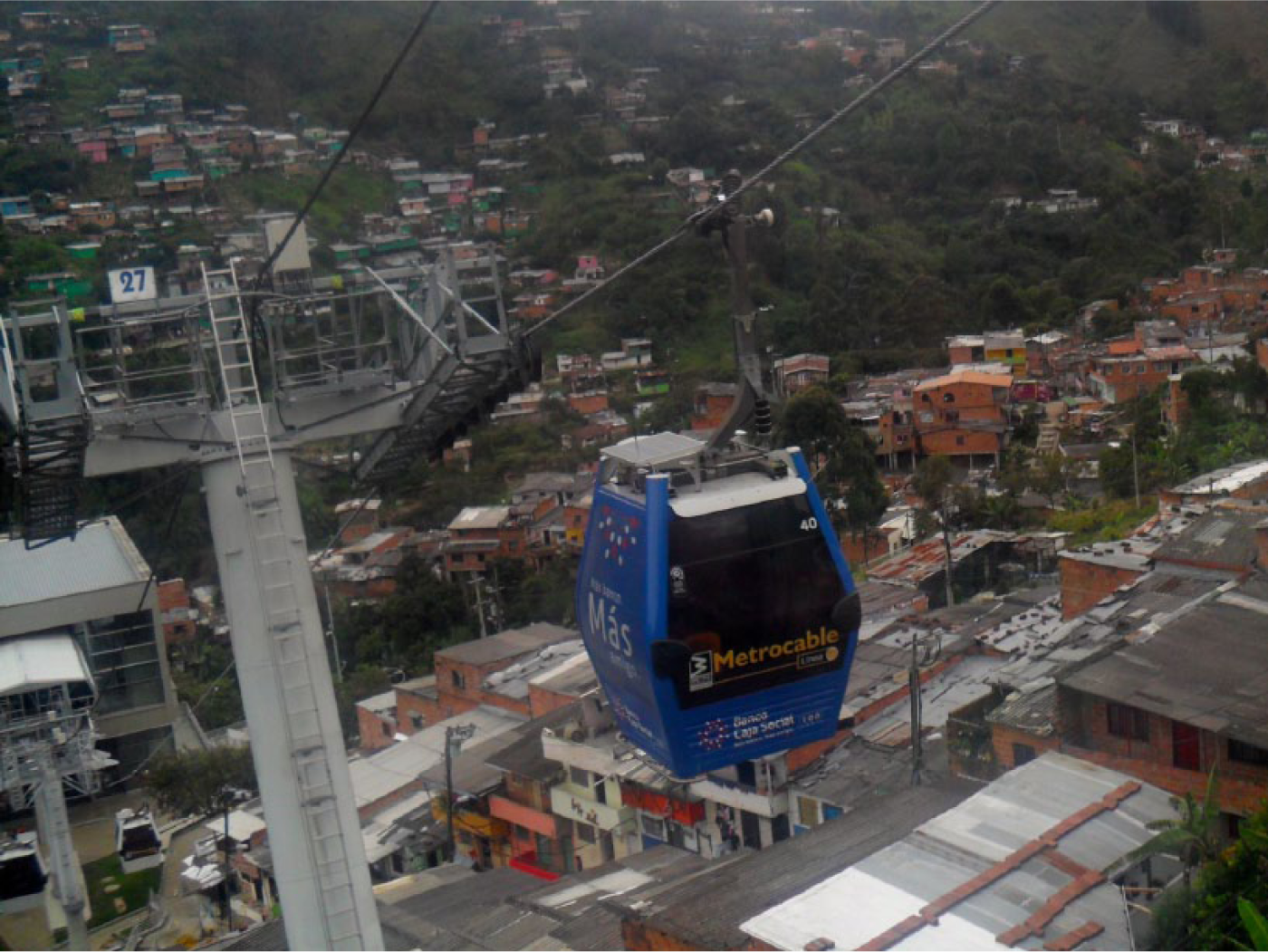
Metrocable Line J, Comuna 13. (Photo by author)

New school in Las Independencias, Comuna 13. (Photo by author)
The integrated urban project for Comuna 13 was introduced in 2006. It involved the San Javier Library Park, Line J of the Metrocable aerial transit system, new schools, sports fields, daycare centers, an avenue rehabilitation project, pocket parks, playgrounds, neighborhood amenities, and the continuation of Ciudadela Nuevo Occidente, a social housing complex that was already under way before Fajardo took office. The experience of the first integrated urban project in the Northeastern Area, where the construction of public works had begun in 2004, was received with great fanfare and high expectations. A journalist at a community radio station in Comuna 1 reported (interview, September 22, 2011),
You know that when something is new, it creates impact, especially when you see a project like the Metrocable. It hits twice because, on the one hand, there was no mass transit here, and, on the other, people saw it as a leisure ride, as tourism. In those early months, there were endless lines. . . . People started to feel a change, because new programs and buildings appeared quite quickly one after the next, and there was no time to adjust to the pace. . . . People would say, “Well, this neighborhood is going up!”
Along with positive expectations for neighborhood change, perceptions of the quality of life have been generally favorable. Residents report that both the intensity and the frequency of violent events have decreased—in their view, gangs were either displaced to other areas or have remained dormant (focus group, March 13, 2012). Moreover, residents feel proud of the library park, the sports fields, and the other neighborhood improvements. Similarly, at least in the areas influenced by the Metrocable, small businesses have sprouted and the rental market is seeing increased dynamism. While unemployment is still high and income levels in the Northeastern area remain dramatically low, residents interviewed generally looked on the bright side of the operations.
The outcomes of the project for Comuna 13 have been more nuanced. When the project was proposed, residents were distrustful of the administration, as Adela Ortega (interview, November 17, 2011), a local cultural leader, pointed out:
For the neighborhoods at the top of the hill, the issue of Orión was very difficult. . . . It’s the before and after, because Orión even determined the territorial organization here. . . . The people who resided in the conflict area, who were there and were beaten and wounded, were very scared. So they [the municipal planners] were looking to repair that. How does one repair the psychological damage when it is so difficult to break away with so many tragic events? When you live in fear? And along comes the integrated urban project.
These projects represented an opportunity for urban reform. Backed by a strong political commitment, a participatory methodology, the support of local organizations, and creative policy making, they have so far been “as good as it gets” for local residents. With Operación Orión as a precedent, however, the projects for Comuna 13 have unfolded in an environment of ongoing intimidation and incompatible attempts at compensation. It symbolizes the active conquest of one of Medellín’s most tumultuous urban frontiers and its increasing integration into the new model of the city. Unsurprisingly, then, the project does not generate in residents of Comuna 13 the same level of expectation that it produced in the Northeastern Area. Relationships between residents and the authorities are uneasy, and the model developed in the Northeastern Area is hardly replicable in Comuna 13.
While some of integrated urban projects coincided with grassroots development plans and were built with substantial participation, other projects have been less well-received because of their inherent limitations and high opportunity costs. For example, the city recently replaced 350 run-down stairways in a narrow alley of Las Independencias with giant exterior electric escalators aiming to connect 12,000 residents who had little mobility given the steepness of the hill (Figure 4). As a youth leader from Comuna 13 noted, “The escalators are nice, but we have more urgent problems” (interview, September 18, 2011). Indeed, many residents outside the catchment area of the escalators believe that they should not have been a priority. Some residents have asked the state to focus on less grandiose proposals such as sewerage, sanitation, food security, and jobs. With the election of Anibal Gaviria as the new mayor (2012–2015), integrated urban projects face new discontinuities. The policy of social urbanism has been replaced by a rhetoric of “civic-pedagogical urbanism,” a variation of social urbanism that retains participatory governance processes but cuts investments in public works, creating uncertainty over their completion.

Exterior electric escalators in El Salado, Comuna 13. (Photo by Esteban Agudelo)
Urban Governance in the Post-Orión Era
Beyond program discontinuities, technical limitations, and local disagreements, security remains the most crucial barrier to the transformations that the integrated urban project aims to accomplish in Comuna 13. After Orión, criminal gangs with paramilitary backgrounds maintained an active presence in the area, and therefore residents cannot move freely to enjoy the new public spaces available. Local economic development gains have also been rather limited. Despite growing commerce around the 99th Avenue project, as of August 2012 residents and shop owners interviewed in San Javier, Las Independencias, and 20 de Julio reported being victims of extortion and vacunas, a monthly or weekly “security tax” levied by criminal actors. Despite planners’ efforts to promote neighborhood permeability, walkability, and free circulation throughout Comuna 13, these goals continue to be truncated by what are dubbed “invisible frontiers”—boundaries imposed by the ruling gangs of the moment to (re)assert territorial dominance vis-à-vis their competitors. These boundaries are constantly being reconfigured, prompting residents to be wary and limit their daily routes and activities accordingly.
Paradoxically, Comuna 13 is the district with the highest concentration of public armed forces in Colombia. According to a report from the Ombudsman’s Office (Defensoría, 2013), it has 7 police stations, 3 police centers for immediate attention, and 12 military bases. This means that there are almost 800 permanent troopers patrolling 23 neighborhoods within a 7-square-kilometer radius. Residents resent the fact that, more than a decade after Orión, nightly curfews are still imposed on them. Bars and nightclubs are required to close earlier in Comuna 13 than in other areas of the city. Furthermore, young males report being victims of police profiling and criminalization: “You have to see what happens when a group like us—or any local young people, really—hangs out with friends in the surroundings [of the new public spaces]. Immediately, the tombos [police] show up to screen us . . . so we prefer to meet here in the ACJ [Asociación Cristiana Juvenil or YMCA]” (focus group, September 21, 2011).
Indeed, an additional intimidation factor for young males in Comuna 13 is the risk of forcible recruitment. While criminal actors, starting at an early age, harass boys to join gangs, the Colombian armed forces also instill a fear of forcible recruitment through what the youth call batidas—raids or checkpoints requiring youngsters to provide proof of good standing with the Colombian military or face immediate detention (focus group, September 21, 2011). In 2011 the Colombian Constitutional Court declared batidas illegal acts of arbitrary arrest (C-879/11) that violate a detainee’s due process and right to free movement. Medellín’s Fourth Brigade, which recruits approximately 600 youths every year through batidas, has challenged the court’s decision (Civico, 2014). As I observed in Medellín, batidas are frequently carried out in crowded public spaces such as subway station entrances. Journalists such as Ortiz (2013) note that they happen almost exclusively in low-income areas such as Comuna 13.
Yet, despite excessive screening, patrolling, and detention, the public armed forces face difficulties enforcing the rule of law (focus groups, March 4, 2012; September 24, 2011). With the FARC and the ELN gone and the demobilization in 2003 and 2005 of 20,000 AUC ex-combatants, these violent organizations have been replaced by confederated youth gangs working as paramilitary franchises for the Envigado Office. In the post-Orión social order, the public armed forces coexist with these violent groups, and their policing/surveillance practices are not perceived by the community as antagonistic. As a schoolteacher told me, “some gangs and the police are seldom rivals. They usually don’t mess with each other” (interview, March 13, 2011). The pervasive complementarity of policing between drug-fueled paramilitary actors and public armed forces is typical. As Civico (2012: 89) puts it, “the paramilitaries in Colombia have been at once against the state and within the state, both a parallel system and a strategic ally.” As such, the paramilitaries have been key agents of policing goals through a strategy of intertwining to reterritorialize.
Most surprising is the versatility with which paramilitary actors have adjusted to the expansion of participatory governance in Medellín: first by creating their own NGOs, which allow them to gain contracts with the state and legalize their social and political influence (López, 2010), and second by penetrating participatory budgeting and other civic forums with the goal of “more effectively delivering resources to their constituency” (Arias, 2010: 243). Having adapted to the city’s new progressive governance arrangements, criminal actors have retained their grip on illegal and legal fields, either supplanting, rivaling, or collaborating with the state or even aligning themselves with participatory governance and developmental objectives in order to increase their local influence. Indeed, Medellín’s praised innovative policy making has to be understood in relation to the fact that local criminal actors have found developmental policies advantageous to the sustainability of their own social, political, and territorial control.
Conclusions
Writers such as Sánchez, Villa, and Riaño-Alcalá (2011) argue that a geographical paradox has played out in Comuna 13. On the one hand, the intricacy of its hilly topography and the lack of accessible infrastructure marginalize the comuna from municipal government operations. On the other hand, its location is favorable to criminal actors: it allows a quick way in and out of the city without being noticed and provides access to an underground corridor for the trafficking of drugs and arms between the south of the country and the sea. This assertion reflects a seemingly popular belief that the troubles of Comuna 13 are inherently geographical. Although environmental determinants have deeply shaped the history of Comuna 13, I have purposely distanced myself from geographical determinism for two reasons: on the one hand, violence may be incorrectly associated with a particular topography, and, on the other, the “policy fix” may potentially be conceptualized as simply a matter of “renovating” the built environment. Instead, I have argued that Comuna 13 has been constructed, from afar and from above, as a space of relegation—an outcome of the interacting violence, inequalities, and exclusionary dispositions that are characteristic of Colombia’s urban system and, in Medellín, converge at the precarious urban margins. Untangling the dynamics that constructed Comuna 13 as a space of socio-spatial relegation takes us back to the fact that Colombian institutions have historically been built on a recalcitrant defense of property rights. Private interests, indeed, have shaped cities like Medellín at the expense of an increasing number of dispossessed households. A peripheralization process á la Lefebvre (2003 [1970]) secludes the urban poor, exposing them to multiple risks and limiting their access to the jobs and opportunities available to members of better-off social classes. At the same time, Comuna 13 has been articulated repeatedly through changing urban policy regimes and a dispute for socio-spatial control involving various types of violent actors and (para)policing entanglements. In this intricate context, well-meaning urban policy regimes—or the lack thereof—are inexorably at odds with the entrenched exclusion-violence nexus in these marginalized enclaves.
To explain the polyvalence of contemporary violence in the region, Arias and Goldstein (2010: 5) argue that in Latin America’s neoliberal democracies, violence and democratic institutions coexist under perverse logics in which the functioning of the first depends on the dysfunctional characteristics of the second and vice versa: “Violence is a mechanism for keeping in place the very institutions and policies that neoliberal democracies have fashioned over the past several decades, as well as an instrument for coping with the myriad of problems that neoliberal democracies have generated.” This understanding of violence and its relation to democratic policies in neoliberal climates explains why seemingly benevolent attempts at urban reform—as much as urban policy choices aimed at eradicating disorder by force—are limited when it comes to building meaningful democratic spheres. While Medellín’s social urbanism implies unprecedented and commendable targeted investments in underserved areas, the conditions of possibility for reform were set by the violent retaking of Comuna 13 and the maintenance of Orión’s hypersecuritization regime. It is against this pervasive (para)policing backdrop that attempts at urban reform are tried, take hold, and invite transfer in the absence of substantive justice and democracy.
The policy implications that stem from the analysis presented here would consider at least three questions: first, how to change the way in which illegal and extralegal powers are exercised in the city; second, how to reshuffle the different forms in which socioeconomic privileges are constructed in local society; and third, how to devolve greater autonomy, sociocultural recognition, opportunities for social mobility, and effective agency to citizens in Comuna 13, particularly youth.
Footnotes
Notes
Luisa Sotomayor is an assistant lecturer in the Faculty of Environmental Studies at York University, Toronto, Canada.