




Abstract
Comparison of the narratives of civil society and the federal government on YouTube and Twitter in the case of the disappearance of 43 students in Ayotzinapa, Mexico, allows the identification of the codes of representation being disputed in this emblematic case of violation of fundamental rights. Digital storytelling that goes viral and across media offers the possibility of organizing protest in the offline world. Its reflective attributes favor the visibility of injustice and permanence on the local and global agenda and in some cases exert pressure on social actors and authorities to establish mechanisms to resolve the conflict.
La comparación de las narrativas sobre la sociedad civil y el gobierno federal en YouTube y en Twitter en el caso de la desaparición de los 43 estudiantes en Ayotzinapa, Mexico, nos permite identificar los códigos de representación en disputa en este caso emblemático de violación de los derechos humanos. Los relatos digitales que se vuelven virales y pasan a otros medios ofrecen la posibilidad de organizar la protesta en el mundo fuera de la Red. Su capacidad de reflejar ayuda a visibilizar la injusticia, manteniéndola como tema importante en las agendas locales y globales, y en algunos casos también ayuda a ejercer presión sobre los agentes sociales y las autoridades para establecer mecanismos que puedan resolver los conflictos.
When the September 27, 2014, murder of six people and the disappearance of 43 students in the state of Guerrero became known, the speeches and images that began to circulate were not limited to the traditional media. The disappeared students were from the Escuela Normal de Ayotzinapa, a teacher-training school in the most violent state of Mexico and also one of the country’s poorest: 65.2 percent of the population lives in poverty and 24.5 percent in extreme poverty (CONEVAL, 2014). The magnitude of the tragedy makes it necessary to understand this context of exclusion and the history of the school’s social struggle and the spread of organized crime in the region.
Rural normal schools in Mexico were created in the 1920s to combat extreme poverty through the training of teachers from marginalized communities. They acquired a social focus during the administration of President Lázaro Cárdenas (1934–1940), which promoted an agrarian-social educational policy (Coll, 2015). With the establishment of the neoliberal economic model in Mexico in the 1990s, they stopped receiving support and began to disappear. The Ayotzinapa normal school has been strongly associated with resistance through its training of social activists and their repression by the state. “Today, in the middle of the twenty-first century, the cruelty of the Mexican state against the rural normal schools persists with the same force; there is no state government that has not worked to achieve their disappearance through all kinds of measures” (Coll, 2015: 84).
The confrontation with the authorities that is part of the Ayotzinapa normal school’s history has become more complex with the recent spread of organized crime in the area. According to the United Nations Office on Drugs and Crime (Oficina de las Naciones Unidas contra las Drogas y el Delito, 2016), Guerrero is one of the main opium producers in Mexico, and illegal businesses there are a source of economic sustainability and of a complex network of complicity with the local authorities (Maldonado, 2015). This situation helps to explain the impunity with which murders and disappearances occur.
One of the hypotheses of the Group of Independent Experts of the Inter-American Commission of Human Rights about the disappearance of the 43 students points to drug trafficking—Iguala to Chicago, known as “the heroin route”—as a possible cause of the tragedy. If the students, who usually took a bus to commute to their different activities, had unknowingly taken a vehicle loaded with narcotics, this could explain the indiscriminate attack, possibly perpetrated by the Federal Police, that they met with (GIEI, 2015). The government, in its account of the facts, also pointed to organized crime but attempted to refute any intervention by the federal forces. According to its version, local police turned the students over to drug traffickers, who then murdered and burned them in a local dump, presumably because of confusion linked to a territorial dispute between the criminal gangs known as the Guerreros Unidos and the Rojos (Gobierno de la Republica, 2014e). While the facts are still in dispute, 1 what is certain is that the city of Iguala, in which Ayotzinapa is located, is a drug-trafficking center (GIEI, 2015: 321). It is therefore characterized by a circle of violence and government complicity confirming Galtung’s (2004) suggestion that visible cruelty is only the tip of the iceberg of structural and cultural violence.
Local Tragedy, Global Indignation
The Ayotzinapa case provoked national and international indignation. Mainly through the digital ecosystem, society was informed and protests were organized. In just three months there were 55 protests throughout the country, a figure that at the time represented more than 40 percent of the citizen mobilizations during the Peña Nieto administration (Parametria, 2014). For a better understanding of the dispute over the Ayotzinapa narratives of the federal government and civil society, respectively, we have analyzed the two actors’ transmedia storytelling (Couldry, 2012) on YouTube and Twitter. The Ayotzinapa case generated a vast corpus of books, poems, performances, and songs. In solidarity, artists of various ideological persuasions united in outrage; writers such as Juan Villoro, Elena Poniatowska, Carlos Velazquez, and Enrique Krauze, visual artists such as Francisco Toledo, actors such as Gael García Bernal, and filmmakers such as Alejandro G. Iñárritu and Alfonso Cuarón helped to construct meaning in this collective action. Journalism such as that of John Gibler (2016) and Tryno Maldonado (2015) is part of the memory of the 43. As Poniatowska (2014) pointed out, “Mexico is now the country that is not at war but is very dangerous for young people: mutilated young people, young people without bodies, murdered young people.”
For the government of Enrique Peña Nieto, the Ayotzinapa case has represented a profound political and credibility crisis transcending Mexico’s borders, mostly because of the indignation expressed by global civil society in social media. It was not the first case of human rights violations in Mexico, but it received global attention for its combination of atrocity, poverty, and the youth of the victims with an indifferent government. The president’s first speech about the case took place days after the Mexican and international media reported the tragedy.
The global visibility of the event, thanks to the speed and virality offered by the digital platforms, exposed inherent contradictions between the social imaginary and the official discourse. The traditional press, radio, and television have mostly been condescending about Peña Nieto’s administration through what experts on freedom of expression call indirect censure (WAN-IFRA/Fundar, 2014). Mexico is the country most dissatisfied with democracy in Latin America: barely 19 percent of the public supports this political regime (Latinobarómetro, 2015). 2 Thus it is relevant to ask about the role of digital platforms, since there are high social expectations for its eventual capacity to drive changes favoring a more democratic society in a context of scarce institutional trust, limited media plurality (Noam, 2011; Trejo, 2011), and a participatory culture in its infancy (INE, 2014; WEF, 2014).
Limited freedom of expression is part of this scenario of disillusion. For example, in 2016 Freedom House considered Mexico “not free” while in the three previous years it had considered it “partially free.” While this figure, like those of other organizations, is produced in consolidated democracies and their indicators may be inexact for other realities, it may account for a phenomenon that is confirmed by local studies.
Mexico is one of the world’s most insecure countries for journalists. The National Commission of Human Rights recorded 88 deaths of journalists between 2000 and 2014, and the ineffectiveness of government programs to stop the violence has left the defense of freedom of expression to international civil and professional bodies such as Article 19, Reporters without Borders, and the Committee for the Protection of Journalists (Meneses, 2015b). In addition to violence and impunity there is a lack of support for democracy (CIDH, 2015):
The great challenge for the Mexican State therefore lies in breaking the reigning cycle of impunity with the mechanisms it has created in the past few years with the aim of achieving effective prevention, investigation, and processing and sanction of those responsible for violations of human rights and having the normative advances lead to real changes in the daily lives of people in Mexico.
This article illustrates and analyzes the codes confronted by civil society and the government to detect coincidences and confrontations without losing sight of the context in which indignation transcended social media to become collective action, with protests in the streets, that led the Peña Nieto administration to become involved in the case and even to sign an agreement with the Inter-American Commission on Human Rights for a group of experts to carry out an independent investigation.
Collectives, independent producers, activists, students, and a variety of social actors used social media to diffuse information, protest, and organize mobilizations that transcended the virtual and managed to influence not only decision making but also the president’s crisis of popularity. Although it is difficult to prove, the Ayotzinapa case may have caused citizen disapproval of Peña Nieto between August and December of 2014. According to a poll by the newspaper Reforma, disapproval rose from 46 percent to 58 percent, an unprecedented percentage for a Mexican governing politician since 1998 (Animal Político, 2014). Accusations against him and his wife for conflict of interest in the purchase of a US$7 million house also incited citizen indignation (Redacción AN, 2014).
Transmedia Storytelling and Cultural Form
The social appropriation of technology does not have a determinist logic, and, as Raymond Williams (2011) has suggested, those who analyze sociocultural phenomena should focus on their signifiers, interactions, and tensions—their cultural form. This can be examined in the language, narratives, and interpretive frameworks (Goffman, 1974) linked to the context in which social agents and their reflective projects develop, understood as self-confrontation and the ability of certain social actors to transform society (Beck, 2007).
Digital platforms allow personalized and flexible forms of involvement and agency (Bennett and Segerberg, 2012) and help to connect strangers who collaborate in a framework that favors affective involvement (Papacharissi, 2015) and acquires a logic that crosses platforms and narratives. The researcher Henry Jenkins (2003) considers this phenomenon part of the cultural convergence that favors the creation of transmedia storytelling, which today is used by activists to articulate actions in virtual space that are transferred to the physical world in the form of protests, occupations, and a great variety of political and aesthetic expressions.
Transmedia mobilization is an opportunity for contemporary social movements to communicate, besides being a powerful strategic tool for constructing a shared identity that increases their visibility and permanence on the agenda (Costanza-Chock, 2013). With this in mind, we observed civil society groups’ narratives on YouTube and Twitter from September 30 to December 2014 and compared them with those of the federal government during the same time period. We selected YouTube because its socio-technical attributes favor expression and performativity in a multimedia format and users do not require an account to download and share cultural productions. We observed Twitter through the hashtags linked with the Ayotzinapa case during the same period for the possibilities that it offered to unify, make viral, and lead the mobilization on the Web internationally and organize it in the streets.
We were able to ascertain that narratives traveled from one platform to another, creating a multimodal narrative. Twitter brings together expressions both online—that is, between platforms—and offline, since it connects with and reacts to events in the physical world (Jungherr, 2015). YouTube has more than a billion users, and almost a third of the persons connected to the Internet watch hundreds of millions of hours and generate billions of visits daily. Mexico is in third place globally in YouTube video consumption, and the profile of that consumer is a person between 18 and 34 years of age (ComScore, 2013). 3 For its part, in 2014 Twitter had 7.7 million active users per month in Mexico (eMarketer, 2014).
In a country with few channels for participation and limited media plurality, Twitter has become the main channel for questioning politicians. The Ayotzinapa case stayed in the Top Twenty Trending Topics of Mexico during the months following the students’ disappearance (Meneses, 2014). Analyzing the case on both digital platforms in their sociocultural context, we noted that citizen clamor was constructed as transmedia discourse that crossed multiple platforms and spaces inside and outside the Web.
The hybrid and complex media system—as Chadwick (2013) calls the ecosystem composed of a multiplicity of sources of information with different logics and norms—and transmedia storytelling helped to broaden and diffuse the case in the face of the federal government’s lack of response to an event that, while it took place in a small town, merited government attention for its seriousness. Social media were the place to call for marches and become informed about them. Between October 8 and November 7 of 2014, three massive marches took place in Mexico City and achieved important tweet storms that were reflected on YouTube through consciousness-raising videos that were calls to action.
The narrative of indignation of the protest of the disappearance of the 43 students was a transmedia phenomenon that increased the symbolic value of the account and one in which publics played an active role (Scolari, 2013). A transmedia story suggests a possible structuration of forms and signifiers. In this case we are talking about the clamor for justice and recognition (Papacharissi and Oliveira, 2012). In the Ayotzinapa case, transmedia storytelling helped to call attention to something that occurred in a poor place far from urban Mexico. Some theorists have even suggested that the digital framework could favor an eventual transformation of power relations (Castells, 2012), a hypothesis that is difficult to prove and is beyond the limits of this article.
The Social Practice of Digital Storytelling
In the 1930s, well before the overwhelming digital revolution, Walter Benjamin referred to storytelling as an art in which the narrator becomes the adviser of his reader, a narrative in which the protagonist seeks responses by putting into play an axiological charge (Benjamin, 1936, in Hale, 2016). Following this idea, storytelling is something more than telling stories (Lambert, 2006); it is a social practice that provokes thought and imagination so that the reader can draw his or her own conclusions (Branigan, 1992).
Storytelling in digital times makes its affective and emotional charge viral, and this contributes to contemporary citizen construction using issues, values, and universal codes (Burgess, 2006; Burgess and Green, 2009; Papacharissi and Oliveira, 2012; Poletti, 2011). As a powerful social tool, it also facilitates the empowerment of groups excluded from the polis (Jackson, 2002). Keys to human action can be discovered in the cultural forms produced and narrated, in which individuals, organizations, networks, and places converge (Tilly, 2002). Symbolic aspects of collective action can be unraveled through affective stories that mix news and drama; the Italian sociologist Alberto Melucci (1996) describes forms of confrontation with the state set off by discontent and marginalization, complex actions with powerful cultural meanings, a definition that is well suited to the case analyzed here.
In Mexico, civic culture is incipient, and there is a digital gap, with 70 million people unconnected (INEGI, 2013). Still, among those with access to the Internet, networks of indignation unfold (Castells, 2012), as occurred in recent Mexican history with the student movement #YoSoy132 (Meneses, 2015a), which may be considered the direct antecedent of the mobilizations for Ayotzinapa in that the core of the youth movement became active again in 2014 after being calm for years.
The resources that come into play in collective action are diverse and depend on the efficacy of certain actors within and outside the Web. One of the more important instrumental resources in the Ayotzinapa case was social media as a channel for dissemination of cultural productions and the driver of a new dynamic of mobilization that transcended Mexico’s borders. It is in this digital ecosystem, made up of multiple platforms, that the identity of resistance against traditional power lies (Castells, 2004; Hall and Jefferson, 2014), along with confrontational politics (Tilly, 2002). Storytelling as an emerging practice (Couldry, 2008) and one imbued with affectivity (Papacharissi, 2015) is politically and culturally different from telling mainstream history. While we recognize that the codes stemming from traditional media culture, together with digital codes such as software, devices, instantaneity, virality, and user participation, flow, fragment, intermix, and resignify the event, which because of these digital circuits charges a global dimension that in some cases comes to exert pressure on decision making at the local level. The Ayotzinapa case is an example of this dynamic of global action for justice.
Transmedia Storytelling about the Ayotzinapa Case
In the three months of research, we found 420 videos about the Ayotzinapa case on YouTube, produced by various civil society actors: students, YouTubers, independent internauts, digital communication agencies, musicians, alternative information collectives, nongovernmental organizations, and independent journalists, among others. In the same period we found 19 hashtags related to the case that became trending topics, went viral, and were reinforced by influencers. No tweet from the president became a trending topic; in contrast to members of civil society, the president barely used his account to refer to Ayotzinapa, instead referring to the case in speeches. Because it is challenging to choose a corpus for analyzing social networks, we based our research on the criteria of virality and popularity.
For the YouTube analysis, we used software especially designed to recover data, 4 and a manual search of the site complemented the results. The 420 videos initially found were reviewed in detail to identify productions that did not correspond to the selected period and those that were produced not by civil society but by political organizations and the traditional media. In the same way, we discarded videos with fewer than 20,000 views, following the proposed criterion of virality. To the resulting group of 203 videos we applied the formula for virality developed by Castillo and Meneses (2015), which takes statistical figures from YouTube and is based on Jenkins’s (2013) work on dispersion and virality (virality=[(# of times shared)/views reported]*100). 5 In this way we managed to obtain a group that corresponded to the objective of observing only viral narratives produced by members of civil society. After applying the formula we selected the top 40 viral videos and proceeded to analyze their storytelling in terms of identity, representation, and reflexivity. By “identity” we meant codes that answered the questions “Who am I?,” “For whom do I speak?,” and “What is my call to action?” (Tilly, 2002); by “representation,” referring to the work of Stuart Hall (2007), we meant the group of meanings given to the case and shared through words, phrases, images, sounds, and the various resources of audiovisual language; and by “reflexivity,” drawing on the work of Beck (2007), we meant the group of values in dispute and the proposed solution advanced.
In the case of Twitter, we analyzed the most popular hashtags in the period, during which 19 hashtags were designated as trending topics (Figure 1). According to the web site Topsy, the most influential tweets were from performers such as the bands Calle 13 and Café Tacuba, the actor Gael García Bernal, and the television producer and activist Epigmenio Ibarra, figures who gave updates on the Twitter network and were named in different viral videos on YouTube. The cultural form of Twitter is defined by hashtags that combine the conversational and the subjective as individual and collective support for an event or cause (Papacharissi, 2015). Many hashtags have links to other social media in the digital ecosystem.
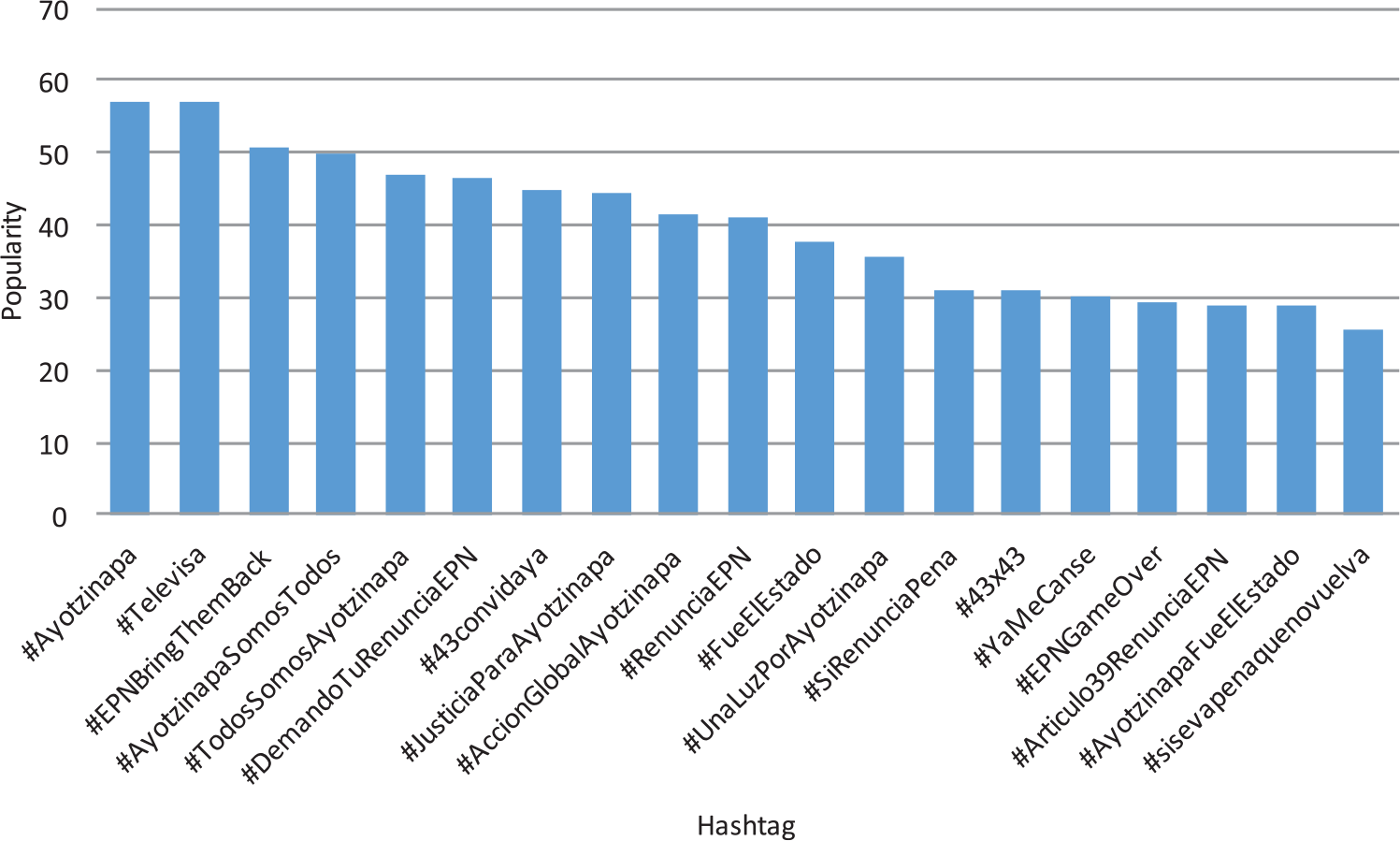
#Ayotzinapa on Twitter, hashtags by popularity (using Hashtagify.me, December 1, 2014)
The group eventually chosen for study consisted of 40 videos and 19 hashtags. We transcribed the storytelling and observed a unifying narrative in terms of our categories that crossed social media. In the audiovisual productions, the narrative trajectory began with an introduction in which an identity was constructed, followed by the representation of the condemnation and the values in dispute, the antagonist (placed at the climax of the story), and the proposed solution. 6 The most popular hashtags strengthened, mobilized, and diffused the facts of this representation.
To contrast the competing codes in the struggle for discursive power, we chose the most relevant of Peña Nieto’s speeches during the period on the Government of the Republic’s channel on YouTube on October 6 and 29 and November 18 and 27, 2014. These speeches resonated in the traditional media and in other social media and were analyzed in terms of the same categories, bearing in mind the political context and what was happening in the streets of Mexico, to explain the power–counterpower dynamic.
The Narrative Trajectories of Civil Society
The civil society producers represented the tragic facts on YouTube and Twitter empathetically as part of society and on behalf of the disappeared students and their families, articulating the core idea of social identification, “We Are All Ayotzinapa.” They anchored the meaning of the historical fact in a shared place of youth and defenselessness against a common enemy, a state penetrated by organized crime. Different representations of the case constituted the trajectory of the story through which people demanded justice and condemned impunity and corruption. This was a unifying story of citizens of diverse origins with shared codes and values that gave a common meaning to this violation of human rights.
In the case of YouTube, the unified representation of the case split at the end into two different views, proposing either social change through revolution or reflective and institutional projects (Figure 2). This representation was constant throughout the three months under analysis and was shared with Twitter, as in other protests within and outside cyberspace.

Transmedia storytelling, YouTube and Twitter
In the case of Twitter, a network that streams messages of 140 characters or fewer (Hermida, 2010), we analyzed the 19 hashtags in terms of our categories as a single discourse that coincided with the narratives of the YouTube videos. Hashtags such as #TodosSomosAyotzinapa (#WeAreAllAyotzinapa), #UnaLuzporAyotzinapa (#OneLightfor Ayotzinapa), #FueElEstado (#ItwastheState), #JusticiaporAyotzinapa (#JusticeforAyotzinapa), and #RenunciaPena (#PenaResign) are examples of symbolic convergence in the digital story in which an identity and a representation were formed about the Ayotzinapa case on the basis of being fed up with the absence of a credible version of the whereabouts of the 43 students. Precisely reflecting this societal frustration with the authorities was the hashtag #Yamecanse (#I’mtirednow), a response to Prosecutor Jesús Murillo Karam’s saying, “I’m tired now” to evade questions from the press and take his leave after a November 7, 2014, press conference in which he gave the official version of the youths’ having been burned in a dump. This is the hashtag that has remained the longest in the history of Twitter Mexico to date. Reflexivity could be noted in the calls to action demanding the president’s resignation, which we also observed in the YouTube stories that suggested the inevitability of regime change. Each web site and its cultural form established an account of shared values to remain in people’s memory. Civil society’s transmedia storytelling spoke on behalf of the victims, blamed the state, and alluded to raising awareness about the youths’ disappearance.
The narrative trajectory presents a form of affective and performative citizen agency deployed through cyberspace based on telling the story in the first person plural and using performance, poetry, and music as aesthetic elements and cultural forms. Social media facilitate modes of protest and resistance that are charged with emotion—not subject to a structure that allows the deliberation and balance sought in professional journalism—and that counter the official story. We observed short subjective and simple messages in which the existence of good and evil was palpable. They illustrate the media-tization of the culture of virtual protest in its audiovisual form and management of time by employing short and efficient sentences such as those used in television sound bytes, marketing, and short poems.
Society’s identification with the victims was sought by referring to common areas that citizens shared with the disappeared students: mother, youth, and studying in an effort to better one’s life in a country with high levels of social inequality. The images of the videos reinforced this similarity within the narrative trajectory—photographs of women suffering, adolescents going to school, and citizens marching in solidarity. In the narrative, first-person-plural references—“we,” “are,” “united”—or first-person-singular ones such as “I am one of the 43” are recurring narrative forms in all the productions.
There was construction of a common enemy—the state (the executive, the military, political parties, and the narco-state)—as the antagonist was linked to words like “death,” “fear,” “crime,” “repression,” and a demand for justice. The intention to make the condemnation heard by global society was apparent in the narration of some productions in other languages, mainly English. The common enemy was constructed visually with symbols that alluded to resistance to repression, photos of politicians and police, and banners and posters with slogans that denounced corruption, impunity, and the political class’s links to organized crime.
As for the proposals for solutions, the reflexive projects included both those that created awareness of the role of citizens’ recognition of the other as a subject of rights, proposing ambiguous solutions, and those that contemplated acts of resistance aimed at opening a space for political negotiation. In contrast, the revolutionary projects considered the institutional channels for political negotiation useless. The implicit reflexive projects were not univocal. The confrontation with the enemy was based on values such as justice, solidarity, and compassion, represented as if they were exclusive to civil society, and a reflexive project that demanded justice for the students and their families was constructed. Empowerment and technological appropriation on the part of civil society could be observed in the transmedia narrative.
While citizens used YouTube to inform citizens and raise their awareness, Twitter was used at the global level to amplify, broaden, and mobilize the protest in different social media such a Facebook and in street marches. The call for action in the YouTube viral videos can thus be found in Twitter hashtags such as #EPNBringThemBack and #RegresalosEPN, which show the linkages of the story in different social media. One of the most viral videos explicitly asked citizens to create a tweet storm (Loquesigue TV, 2014):
Every second counts, we need your urgent help. . . . because they took them alive, and we want them returned alive on October 21: Storm Twitter and Facebook with #EPNBringThemBack and #RegresalosEPN October 22: Marches and Protests Around the World for Ayotzinapa. Video fragment: #EPNBringThemBack #RegresalosEPN We want the 43.
Citizens put that request into action; the most viral hashtags of this period reflected those words.
A multiplicity of actors and resources enters into the dynamic of mobilization and negotiation of contemporary collective action (Eltantawy and Wiest, 2011). The many protests and local and international media coverage also played an important role in the articulation of global collective action. The Ayotzinapa case generated 88,000 mentions in 28 Mexican newspapers between November 28 and December 31 of 2014. 7 Thus. despite the government’s attempt to bury the case, it obtained a prominent place on Peña Nieto’s agenda. Although late in responding, the government reacted to the social clamor with measures that reinforced security in the state of Guerrero; it constructed a controversial historical truth and allowed a group of international experts to investigate the facts independently and later question its impartiality.
The Narrative Trajectories of the State
Peña Nieto represented the Ayotzinapa case in a different way in each of the speeches analyzed. The trajectory of his narratives gradually adapted to the level of national discontent and international pressure. His Twitter account, @epn, was used only to repeat some ideas from his speeches; his administration is reported to have used bots to discourage an adverse citizenry (Finley, 2015). The most off-the-mark speeches regarding the citizen clamor were the first and the third—October 6 and November 18—while the second and fourth—October 29 and November 27—showed more effort to harmonize with and achieve control of the narrative advanced by citizens from the beginning. The president read prepared speeches in the traditional press format. His image was diffused in the media in a three-quarter shot in which the national seal and flag could be seen. However, in the third speech, delivered at the inauguration of a clinic in the State of Mexico, the president broke protocol and openly showed his discontent with the social protest over the Ayotzinapa case.
The reactive stance of Peña Nieto’s narratives with respect to civil society calls for the presentation of four different narrative trajectories from the four speeches. The official story emerged from the identity of the hegemonic power’s being confronted at every moment by the students’ active parents. The representation of the other was not clearly expressed, but in each of the speeches analyzed the president constructed an ambiguous identity for the enemy. The adversaries of the state changed in each speech. In the first (Figure 3), the antagonist was the local authorities of Ayotzinapa (the mayor and his wife having been the first to be arrested), and therefore the president’s commitment was limited to contributing to the declarations: “The Government of the Republic will maintain institutional cooperation and collaboration with Guerrero officials to obtain clarification.” In the second speech (Figure 4), the president avoided naming those responsible, an ambiguity that led to his criminalizing protest in the third (Figure 5): “We have warned the violent movements that, under the protection and shield of this tragedy, are attempting to enforce protests without clear objectives.” It was not until the fourth speech that the president recognized the country’s institutional shortcomings and the existence of organized crime, at which point he discursively converged with the societal clamor: “The thousands of objections revealed in social media and the opinions of writers and columnists all agree on one point, that Mexico cannot continue this way. And they are right. After Iguala, Mexico must change” (Figure 6).
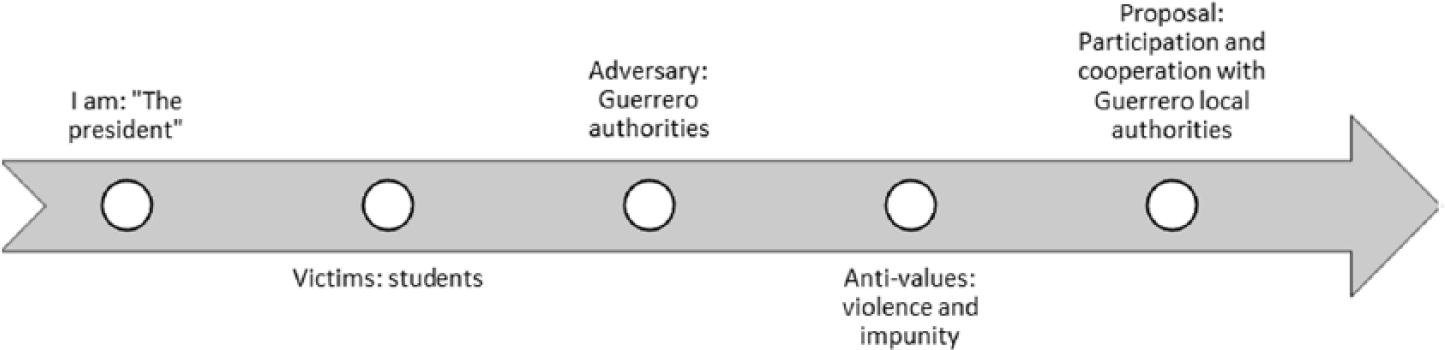
First presidential speech, October 6, 2014 (Gobierno de la República, 2014a)
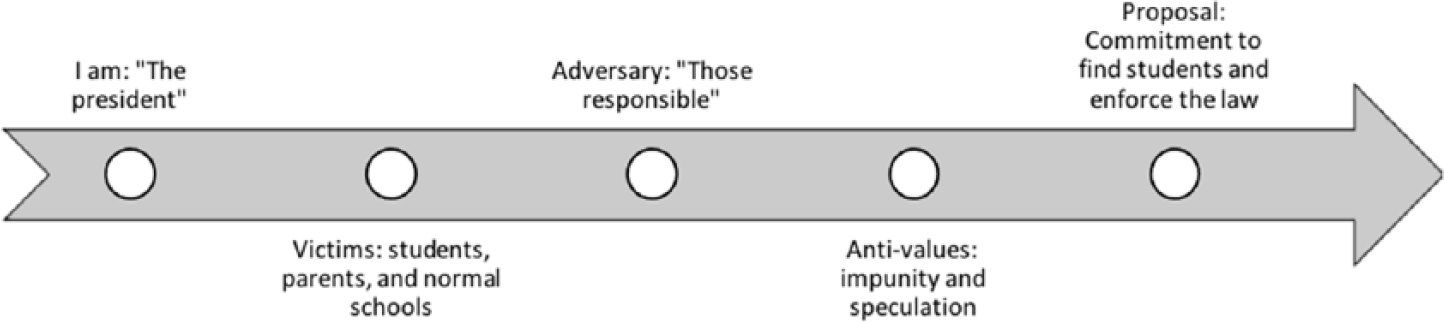
Second presidential speech, October 29, 2014 (Gobierno de la República, 2014b)
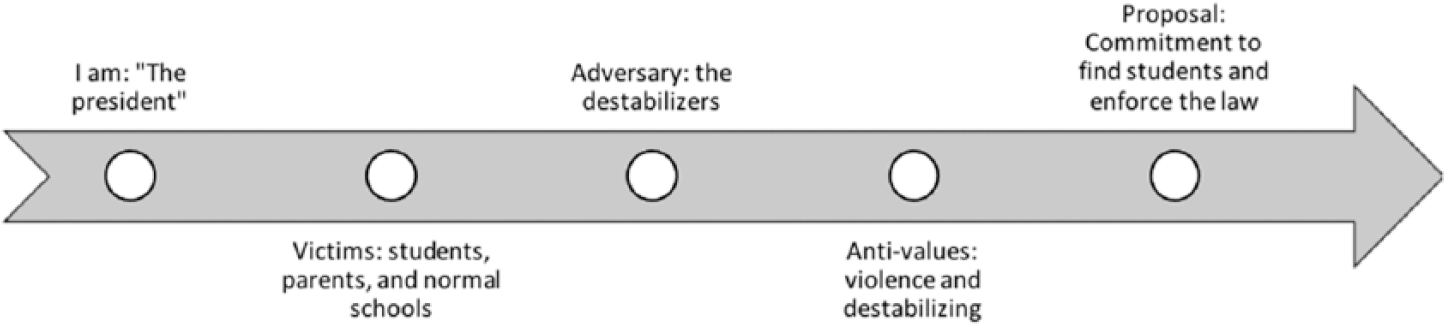
Third presidential speech, November 18, 2014 (Gobierno de la República, 2014c)

Fourth presidential speech, November 27, 2014 (Gobierno de la República, 2014d)
In the first two speeches he committed to observing the law and called for institutional trust. In fact, confronted by the social media, street marches, the traditional media, and international organizations such as the United Nations and the Inter-American Commission on Human Rights, he flew to China to attend a multilateral forum, which exacerbated the indignation (CNN Mexico, 2014). The third speech was delivered in this context of indignation over his having left the country in tense times and the charges of conflict of interest in the luxury house purchase. Thus, on November 18 the president’s annoyance with those protesting in the streets turned to those who supposedly wanted to destabilize his government, and he energetically condemned the protests. On November 27, given the accumulated anger, transcending borders, in the social and international media, the president showed solidarity by decreeing 10 measures to strengthen security in the country’s municipalities. A belated empathy could be noted two months later when he appropriated the social representation #WeAreAllAyotzinapa.
From this analysis it is apparent that there were two competing representations: a societal narrative of resistance that was emotional and clear in its messaging and demands and an isolated and disarticulated presidential discourse that condemned the protests and expressed anger over the charges against him.
Discussion and Conclusions
It is useful to analyze the narrative trajectories of a crisis to understand the construction of meaning and its tension with political decisions without losing sight of the sociocultural context in which it unfolds. Pointing out that the narrative trajectories of civil society groups and individuals expressed in social media via YouTube and Twitter about the Ayotzinapa case had an effect on decision making is beyond the scope of this article. Our analysis is focused on the cultural signifiers, disagreements, and struggle for discursive power in constructing the history of a case of violation of fundamental rights that has marked recent Mexican history.
We found an unstable narrative on the part of the federal government and a demand for justice from civil society groups, for whom there was one guilty party: the Mexican state. However, we observed changes in the government’s focus, which went from isolating the case to a poor community besieged by drug trafficking and criminalizing protest in the country to an apparent reconciliation with the clamor in the streets and what was being said on social media. We agree with the hypothesis that transmedia narratives offer a strategic capacity for reflexive social change that, in some cases, may pressure decision makers to take some type of action. We agree with Bennett and Segerberg (2012) and Papacharissi (2015) that focusing on the concrete results of a mobilization reduces the social complexity to a deterministic causal relation when the motivations of the actors may be different from their recognition, interlocution, or awareness.
Since transmedia communication is typical of collective actions today, its study represents a methodological challenge for sociopolitical research. The Web has sites such as Facebook, an important vector given its centrality in contemporary culture, that we did not include in our study and may be necessary for subsequent studies. Still, we were able to establish how anchors of meaning travel from one site to another, favoring visibility and permanence on the agenda. YouTube, with its audiovisual cultural form and absence of time limits, allows the expansion of a story. In contrast, Twitter is similar to a news stream, emphasizing tactics and immediate calls to action, functioning as a gatekeeper that unites and directs cultural production of other sites such as YouTube. The socio-technical specificities of Twitter—140 characters, the possibility of offers to link content, and the viralizing capacity of its retweeting function—favor this role.
The counterhegemonic discourse nested in social media such as those studied here, amplified by the global media system that confronted the Mexican government, configured a global public sphere with a sense of rejection, indignation, and confrontation with the power structure surrounding this episode in the face of a government that attempted to isolate the case and place responsibility on the local authorities. Citizens’ affective productions constituted a key element of offline mobilization and shaped social aspirations, as is affirmed by their popularity compared with that of Peña Nieto in the three months following the reporting of the case and the speed of diffusion of the marches and protests. Of course, the Mexican government, despite trying, could not avoid the political responsibility of dealing with a case of disappearances that might have been forcible unless proved otherwise.
More than two years after the facts became known, the Ayotzinapa case became internationally recognized thanks to, among other things, a supranational social media network that helped to raise awareness about the human rights situation in Mexico beyond its borders. The independent investigation by the Inter-American Commission on Human Rights did not manage to identify the guilty or suggest a credible line of investigation, but it did reject the Mexican government’s “historical truth,” that the students were incinerated by organized crime figures in the Cocula municipal dump. The commission even accused the government of impeding the investigation. The lack of evidence from a government investigation questioned by the group of independent experts has led Peña Nieto’s government into a crisis of credibility that may mark his term, which ends in 2018.
The question remains whether these representations or acts of indignation and protest, besides informing and raising citizen awareness, managed to influence decision making significantly. Drawing on our research, we suggest that the narratives that travel through global social networks cannot alone change social outcomes, although they organize civil society and pressure governments to listen and give occasional signs of understanding. Despite the disagreement between the Mexican government and the human rights commission, the Ayotzinapa case, as of 2016, continues to be open in Mexican, Latin American, and global society.
Footnotes
Notes
María Elena Meneses is a professor and researcher in the humanities and education faculty of Tecnológico de Monterrey, Mexico City Campus. María Concepción Castillo-González is a Ph.D. student in humanities at that institution. Margot Olavarria is a translator living in New York City.
References
Supplementary Material
Please find the following supplemental material available below.
For Open Access articles published under a Creative Commons License, all supplemental material carries the same license as the article it is associated with.
For non-Open Access articles published, all supplemental material carries a non-exclusive license, and permission requests for re-use of supplemental material or any part of supplemental material shall be sent directly to the copyright owner as specified in the copyright notice associated with the article.
